
Revision Notes
IGCSE Business: Motivating employees (Cambridge 0264) – Revision Notes
Condensed revision notes on motivating employees for Cambridge IGCSE Business 0264: theories, pay methods, non-financial methods and a quick self-test.
- Subject
- Business
- Level
- IGCSE
- Topic
- People in business
- Author
- Marlbridge Academic Team
- Updated
- Reviewed by
- Salman Ahmad (what this means)
Aligned to Cambridge IGCSE Business (0264), For examination in 2027, 2028 and 2029. Official specification .
Syllabus page (what it covers and how it is assessed): Cambridge IGCSE Business.
Syllabus points this page covers
0264
- 2.4 Motivating employees
Found an error? Report a correction.
Need help with this topic? Request a free trial class for IGCSE Business (0450 / 0264).
These notes condense section 2.4 (Motivating employees) of the Cambridge IGCSE Business 0264 syllabus for examination in 2027, 2028 and 2029. For full explanations and worked cases, read the study guide first, then test yourself with the practice questions. The course hub, the printable checklist and the free diagnostics help you find weak spots. Both papers draw on all the subject content, so be ready to use these ideas in a short answer and in a case study.
2.4.1 Key definitions
| Term | Meaning |
|---|---|
| Motivation | The desire and willingness to put effort into a job |
| Well-motivated workforce | Employees who work willingly, stay and accept new ways of working |
| Labour productivity | Output per worker (or per hour worked) |
| Absenteeism | Employees missing work without good reason |
| Labour turnover | The rate at which employees leave and are replaced |
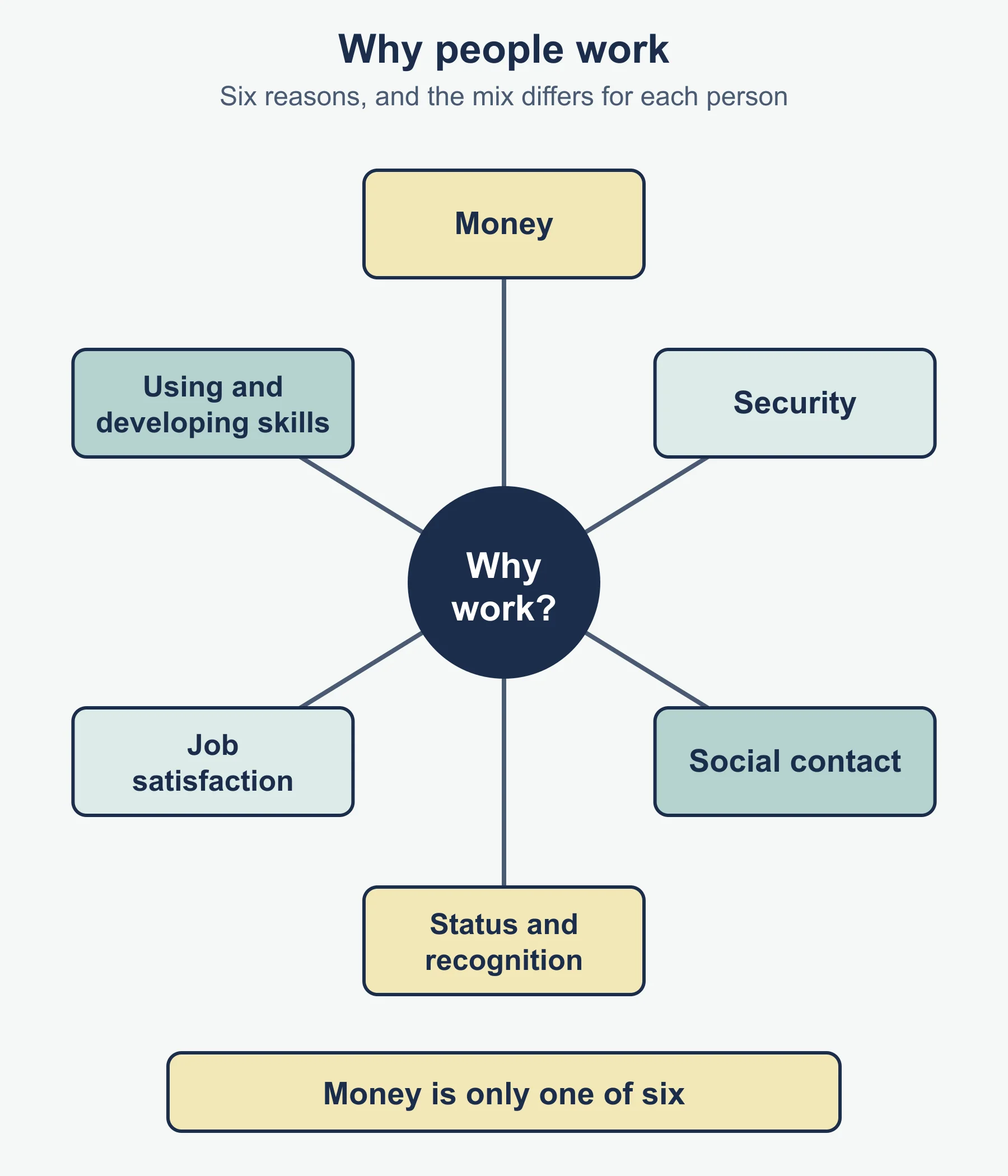
Why people work
- Money to pay for needs and wants.
- Job security and a regular income.
- Social contact and belonging.
- Status, respect and recognition.
- Job satisfaction and a sense of achievement.
- A chance to learn, use skills and progress.
Use at least two different reasons in an answer. “Money” alone gains little.
The four benefits of a well-motivated workforce
| Benefit | Link to cost or profit |
|---|---|
| Improved labour productivity | More output for the same labour cost, so cost per unit falls |
| Reduced absenteeism | Fewer gaps in production or service, less cover needed |
| Lower labour turnover | Lower recruitment, selection and training costs |
| Greater willingness to accept change / new methods of working | Faster and smoother introduction of new technology or methods |
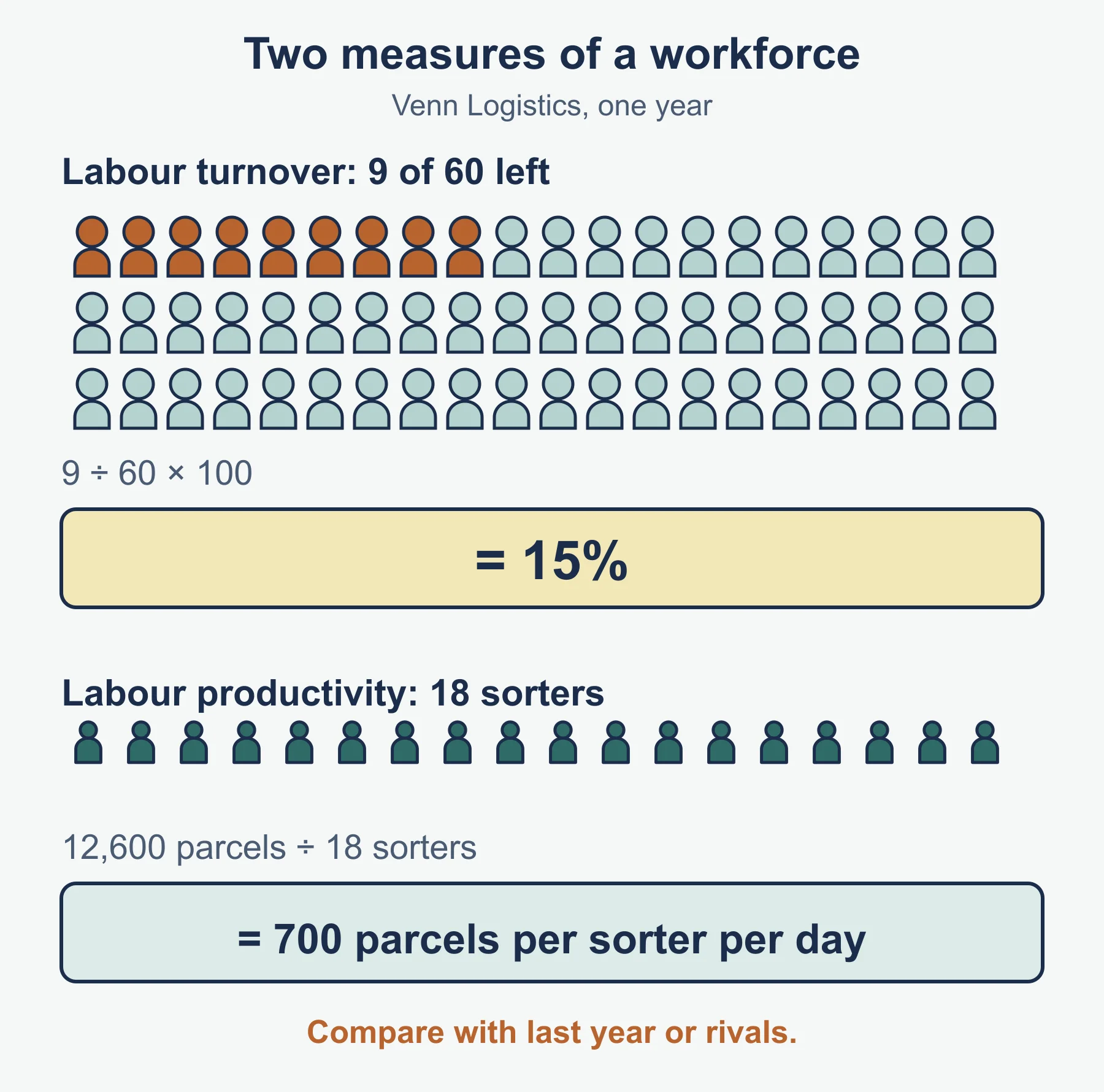
Standard formulas
| Measure | Standard form |
|---|---|
| Labour productivity | Output ÷ number of workers |
| Labour turnover (%) | Leavers in the period ÷ average staff × 100 |
| Absenteeism rate (%) | Days lost ÷ days that could have been worked × 100 |
The syllabus formulas list gives labour productivity as output per period divided by number of employees. The turnover and absenteeism forms are the usual standard forms, not printed in section 2.4.
Quick reminder. Rilkin Textiles produced 9,000 metres of cloth with 25 weavers and had 6 leavers from an average of 48 staff. Productivity = 9,000 ÷ 25 = 360 metres per weaver. Turnover = 6 ÷ 48 × 100 = 12.5%.
The three theories at a glance
Maslow
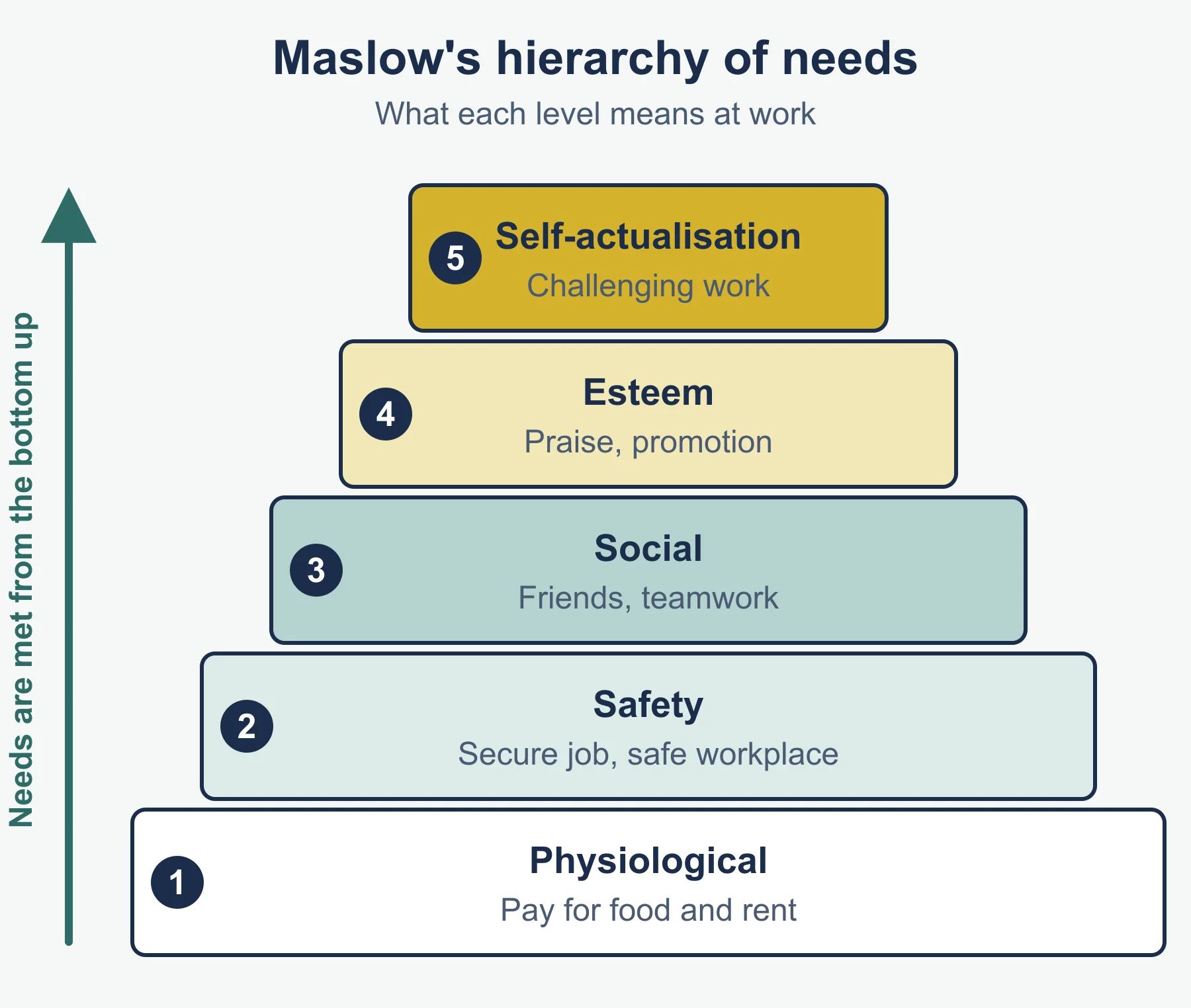
Five levels, lowest first. Each level drives behaviour once the one beneath is mostly met.
| Level | At work |
|---|---|
| Physiological | Wage enough to live on |
| Safety | Secure contract, safe conditions |
| Social | Teamwork, friendly workplace |
| Esteem | Praise, status, titles, promotion |
| Self-actualisation | Challenge, creativity, reaching potential |
Method in steps:
- Decide which level the worker is at from clues in the stem.
- Choose something that meets that level.
- Say why a lower-level reward would add little.
Taylor
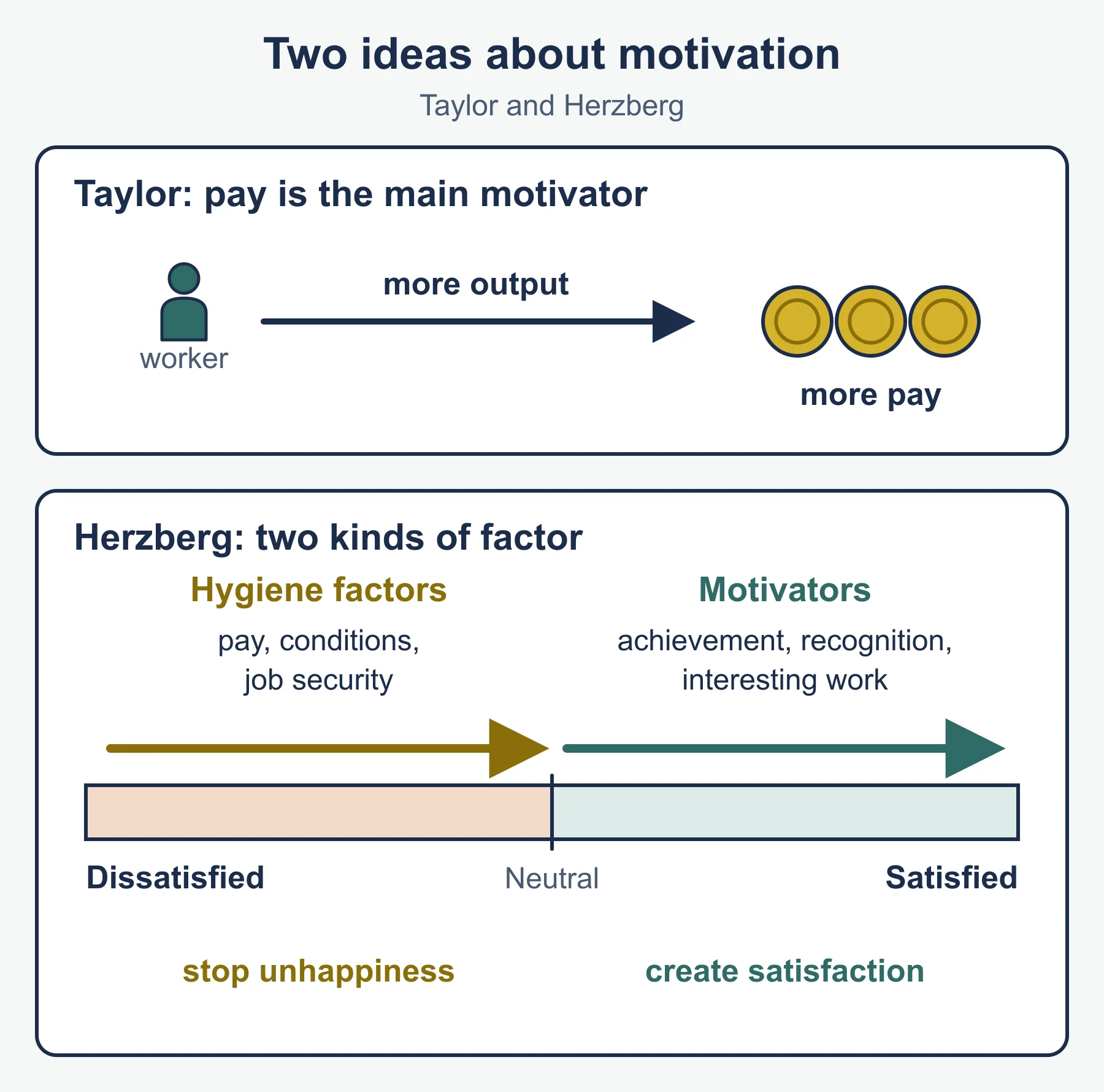
- Workers are motivated mainly by money.
- Break the job into tasks, find the best method, train, pay by output.
- Typical link: piece-rate and bonuses.
- Weakness: ignores boredom, teamwork and the quality of the work.
Herzberg
| Hygiene factors | Motivators |
|---|---|
| Pay, conditions, job security, policy, supervision | Achievement, recognition, responsibility, the work itself, advancement |
| Stop dissatisfaction if good | Create satisfaction and effort |
| Do not motivate alone | Need hygiene factors to be fair first |
Must-know distinctions between theories
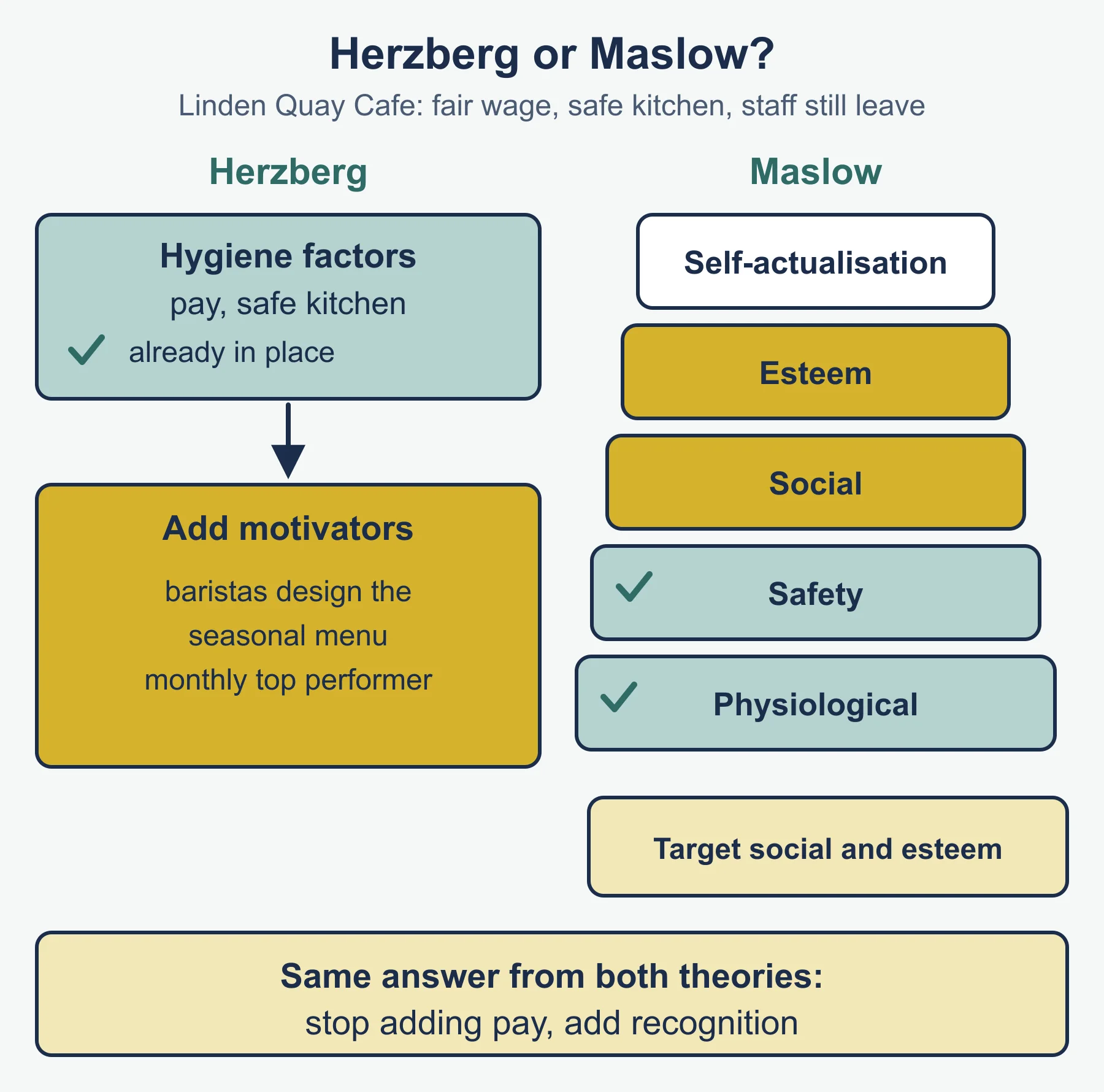
- Taylor says pay motivates. Herzberg says pay is a hygiene factor.
- Maslow gives a ladder of needs. Herzberg gives two groups of factors.
- Maslow’s esteem and self-actualisation levels sit close to Herzberg’s motivators.
2.4.2 Financial methods
| Method | Basis of payment | Main plus | Main minus |
|---|---|---|---|
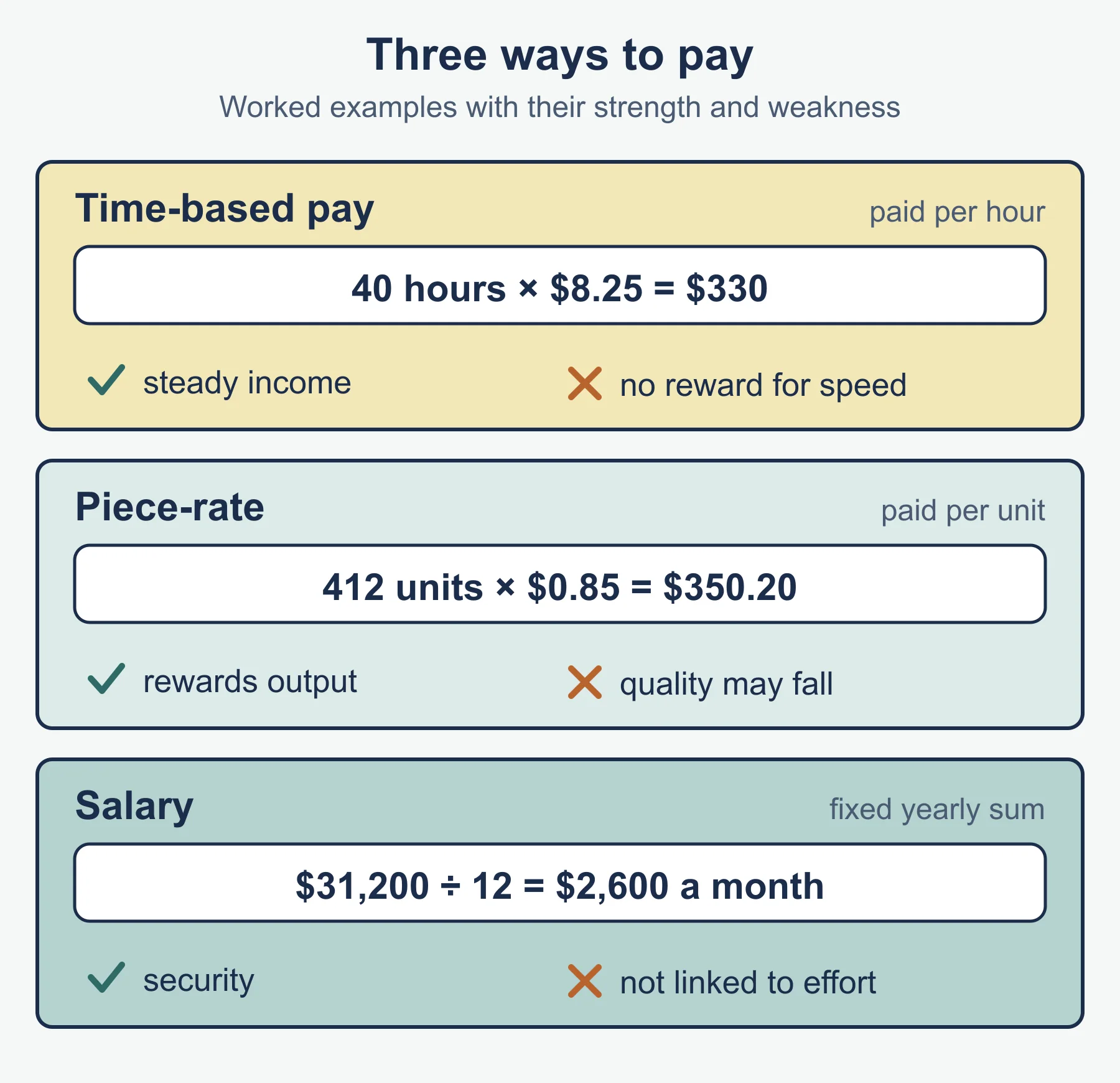
| Time-based | Hours worked | Simple, steady | No reward for speed |
| Piece-rate | Units produced | Rewards output | Quality may fall, pay uncertain |
| Salary | Fixed annual sum | Security | Not linked to effort |
| Bonus | Target met | Rewards results | Seen as automatic over time |
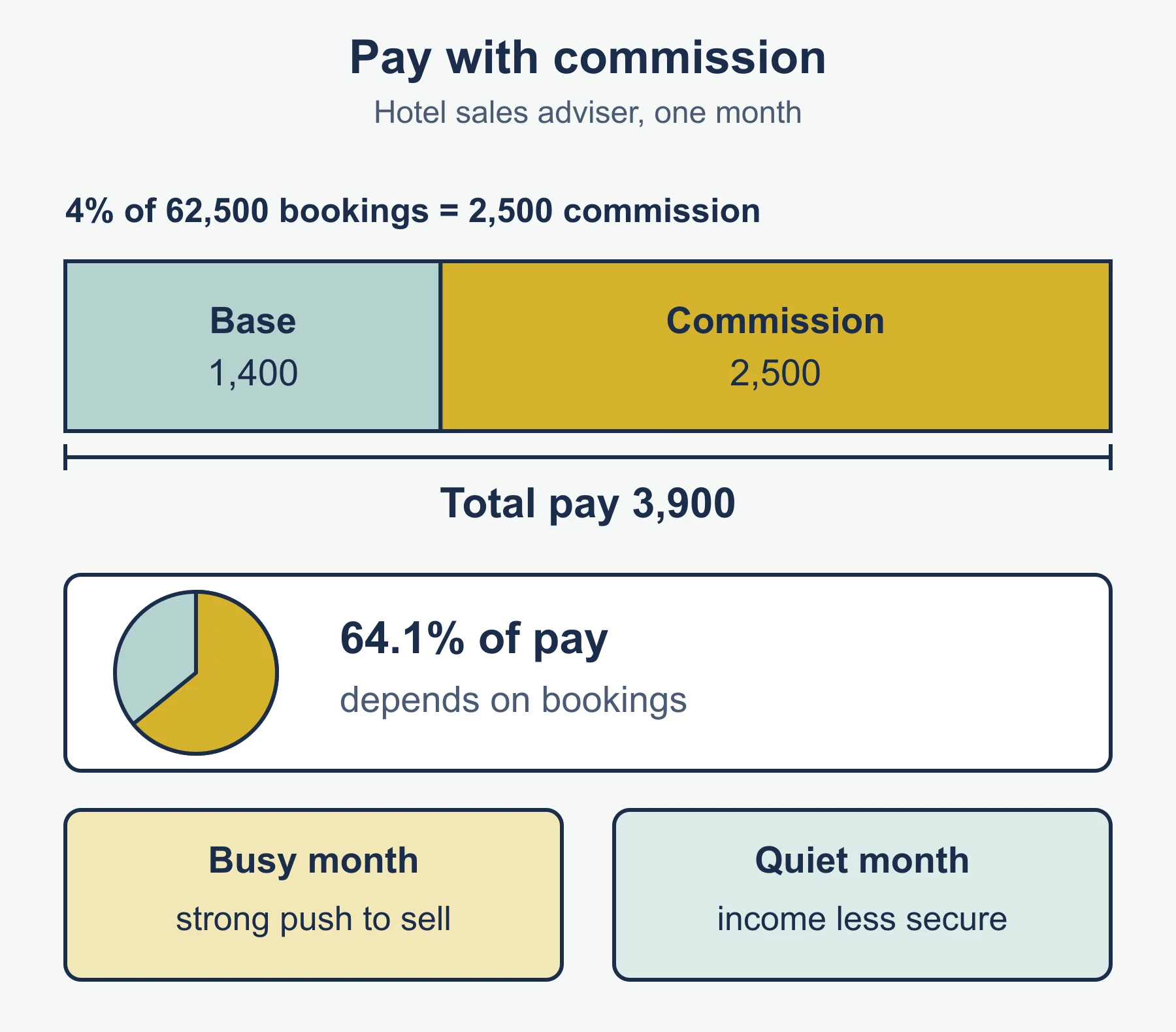
| Commission | Percentage of sales | Strong sales drive | Pushy selling, unstable income |
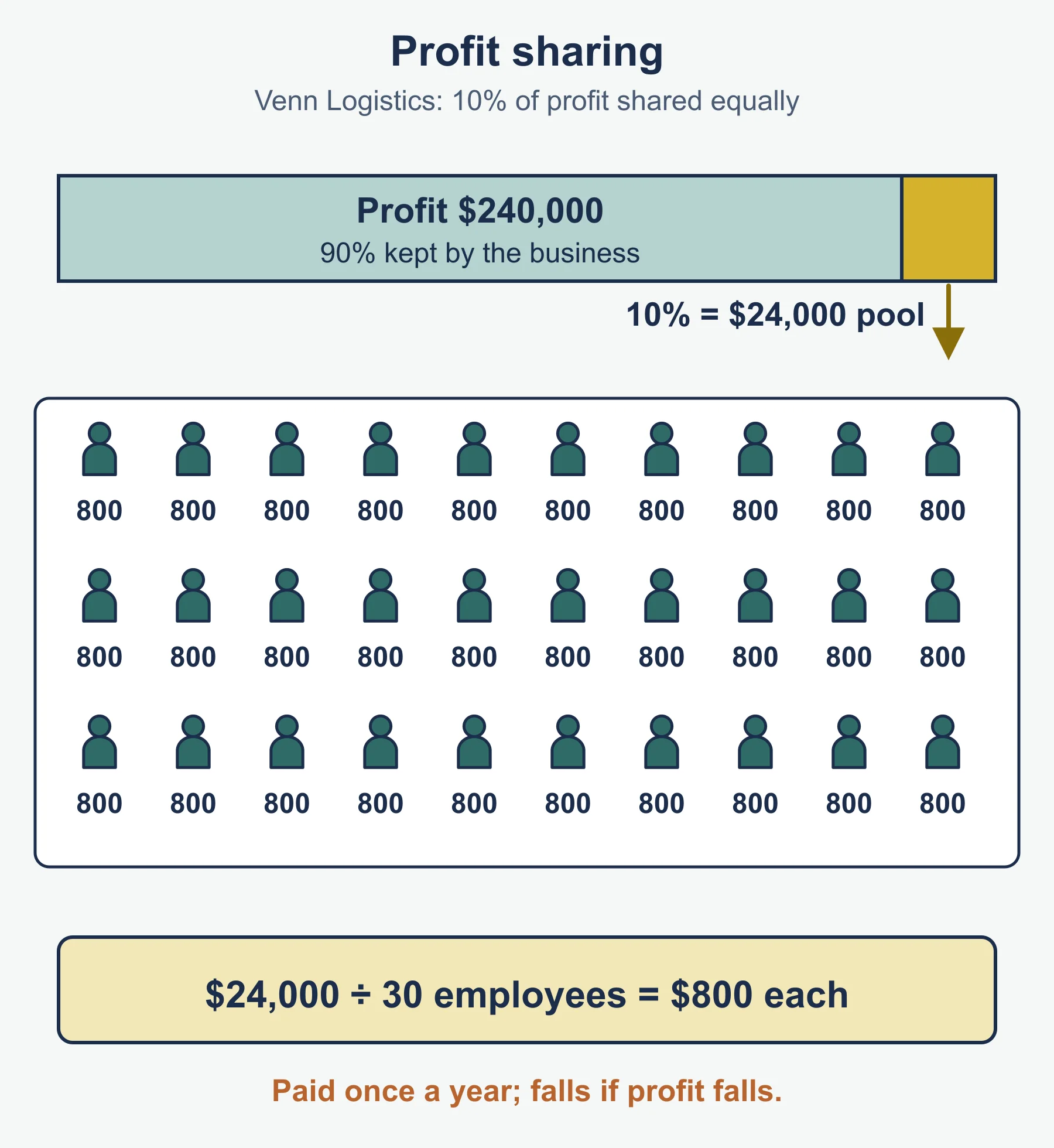
| Profit sharing | Share of profit | Loyalty, team spirit | Weak link to one person’s effort, delay |
| Fringe benefits | Non-cash extras | Valued perks | Cost, not wanted equally by all |
Pay calculations (method in steps)
- Write the rate and the quantity (hours, units, sales or profit).
- Multiply, or take the percentage.
- Add any basic pay.
- State the answer with units, and say what it means if the question asks.
Examples with Gantry Lane Printers:
- Time-based: 35 hours × 11 = 385.
- Piece-rate: 250 bundles of leaflets at 1.20 each = 250 × 1.20 = 300.
- Commission: 6% of 18,000 sales = 1,080.
- Profit sharing: 8% of a 150,000 profit = 12,000, shared by 20 staff = 600 each.
- Salary: 2,400 a month × 12 = 28,800 a year.
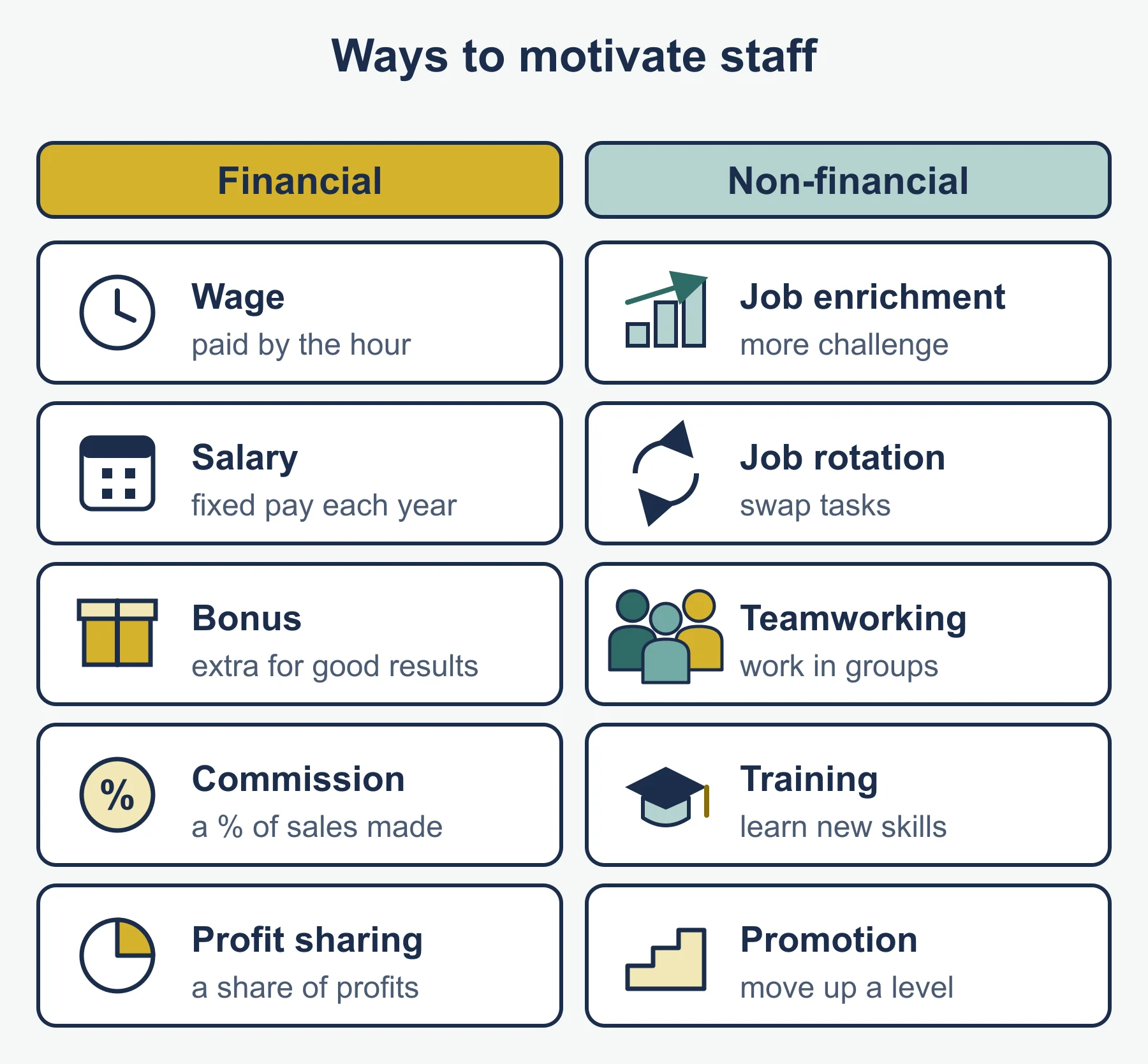
Non-financial methods
| Method | What it is | Link to theory | Limit |
|---|---|---|---|
| Job enrichment | More responsibility and challenge | Herzberg motivators, Maslow self-actualisation | Needs training, may need higher pay |
| Job rotation | Moving between tasks at the same level | Reduces boredom | Adds no responsibility, training time |
| Training | Developing skills | Esteem, growth | Cost, staff may leave |
| Opportunities for promotion | A career path | Esteem, achievement | Few posts, disappointment |
| Praise | Verbal recognition | Esteem | Must be sincere |
| Employee of the month | Public award | Esteem, recognition | Rivalry, same few winners |
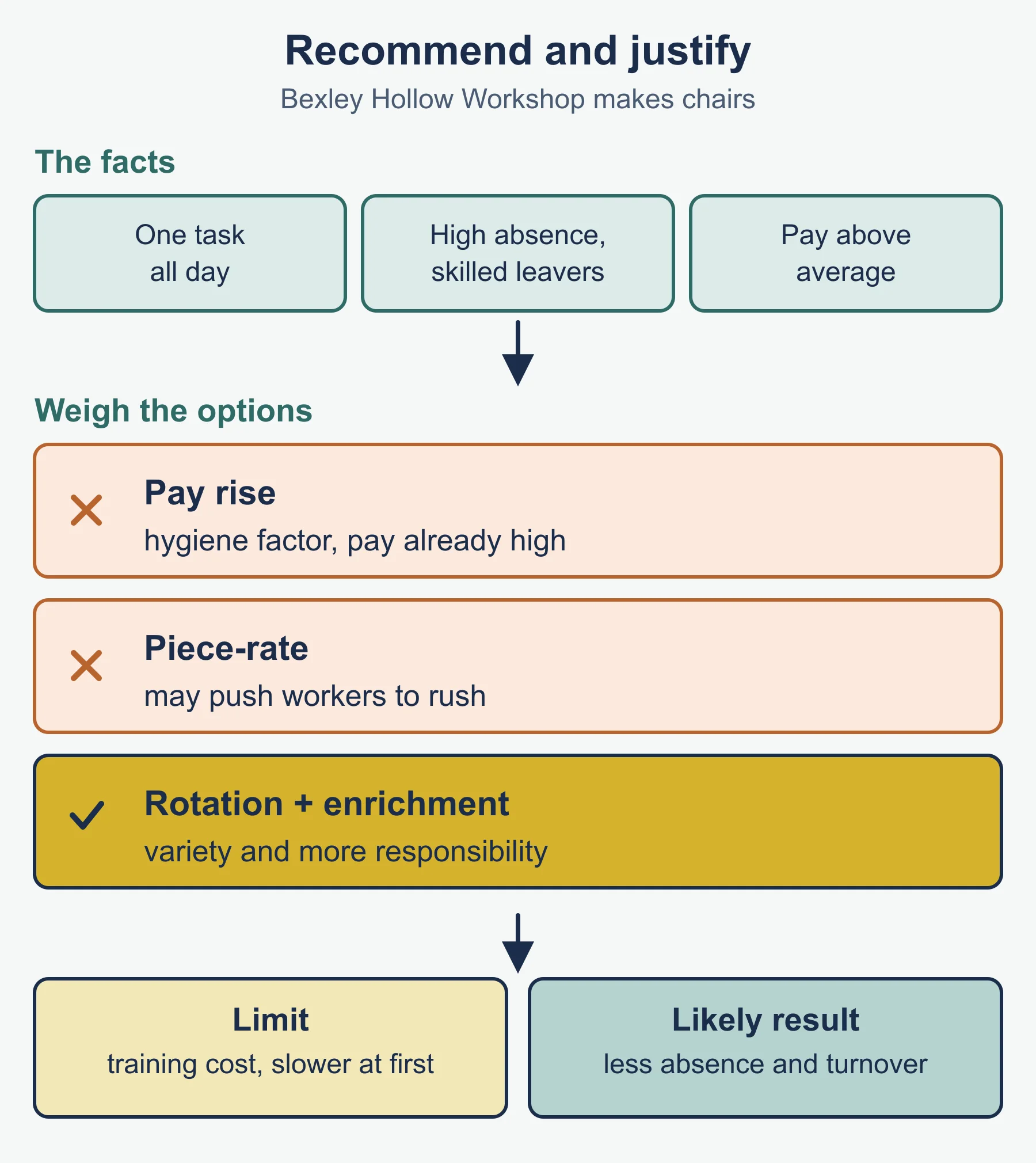
Recommend and justify
Method in steps:
- Identify the problem in the stem (low output, high turnover, resistance to change, boredom).
- Pick one method that fits.
- Explain how it works with a detail from the case.
- Give a limit or a comparison with another method.
- Make a clear final decision.
Good judgements rest on the workers’ circumstances: age, type of job, current pay, and the business’s size and cash position. A small business with little cash may prefer praise and flexible duties to a costly bonus scheme.
Worked reminder: applying a theory
Rilkin Textiles pays its weavers well and the factory is clean and safe. Weavers say the job is dull and nobody notices good work. Several have left for jobs paying less.
- Herzberg: pay and conditions are hygiene factors and are already fair. The missing piece is motivators, so add responsibility and recognition.
- Maslow: lower needs are met. The weavers lack esteem and self-actualisation, so use praise, promotion routes and more challenging tasks.
- Taylor: more pay or piece-rate would be the response, but the evidence in the case suggests money is not the problem.
A short, strong answer names the theory, picks out the clue from the case, and links it to one method. It then states a limit, for example that enrichment needs training time.
Matching problems to methods
| Problem in the stem | Likely suitable method | Reason |
|---|---|---|
| Repetitive work, boredom | Job rotation or job enrichment | Adds variety or responsibility |
| Staff need to be pushed to sell | Commission | Pay moves with sales |
| Output counts easily by unit | Piece-rate | Rewards each unit made |
| Skilled staff leaving for rivals | Training, promotion, fringe benefits | Gives a reason to stay |
| Staff resist new machines | Profit sharing, training, involvement | Shows staff gain from change |
| Very little cash to spend | Praise, employee of the month | Low cost |
| Team effort matters more than individual effort | Profit sharing or a team bonus | Rewards cooperation |
Things to say in evaluation
- The best method depends on the workers: a student on holiday work may want cash, while a long-serving supervisor may want responsibility.
- Cost matters. A bonus or profit-sharing scheme is paid from money the business may need elsewhere.
- Effects take time. Training and promotion pay off over months, a bonus works faster.
- Methods can be combined. Fair pay (the hygiene factor) plus recognition often works better than either alone.
- Measure success afterwards using productivity, absenteeism and turnover.
Quick self-test
- State two reasons why people work other than money.
- Name the four benefits of a well-motivated workforce listed in the syllabus.
- Gantry Lane Printers pays 11 an hour. Calculate pay for 35 hours.
- Calculate labour turnover when 6 of an average 48 staff leave in a year.
- Which of Herzberg’s two groups contains pay?
- Name the top level of Maslow’s hierarchy.
- Which theorist is associated with piece-rate pay as the main motivator?
- Distinguish between job rotation and job enrichment.
- Calculate absenteeism for 30 staff who lost 36 days out of 20 working days each.
- Name two non-financial methods that could meet esteem needs.
Answers
- Any two from security, social contact, status, job satisfaction, using skills.
- Improved labour productivity, reduced absenteeism, lower labour turnover, greater willingness to accept change or new methods of working.
- 35 × 11 = 385.
- 6 ÷ 48 × 100 = 12.5%.
- Hygiene factors.
- Self-actualisation.
- Taylor.
- Rotation moves workers between tasks at the same level. Enrichment gives more responsibility and challenge.
- 36 ÷ (30 × 20) × 100 = 6%.
- Any two from praise, employee of the month, promotion opportunities.
Where marks are usually lost
- Giving only one reason for why people work, or only “money”.
- Describing a method without applying it to the business in the stem.
- Confusing a bonus with commission or with profit sharing.
- Writing that hygiene factors motivate.
- Leaving out units or the working in a pay calculation.
- Describing job rotation as a promotion.
- Listing advantages only, with no disadvantage or limit.
- Recommending a method with no reason why it beats the alternative.
Frequently asked questions
What is the difference between a bonus, commission and profit sharing? A bonus is an extra payment for meeting a target. Commission is a percentage of the sales a person makes, and profit sharing gives employees a share of the business’s profit. Confusing these three methods is a common way to lose marks.
How do you calculate the absenteeism rate? Absenteeism rate (%) = days lost ÷ days that could have been worked × 100. This is the usual standard form; the Cambridge IGCSE Business 0264 formulas list gives only labour productivity, as output per period divided by number of employees.
Which motivation methods suit a business with very little cash? Low-cost non-financial methods such as praise and employee of the month are the most realistic choices. A small business short of cash may prefer praise and flexible duties to a costly bonus or profit-sharing scheme.
How can a business tell whether a motivation method has worked? It can measure labour productivity, absenteeism and labour turnover after the change and compare them with the figures before. Effects can take time, since training and promotion pay off over months while a bonus works faster.
Can motivation methods be combined? Yes. Fair pay, which Herzberg treats as a hygiene factor, combined with recognition often works better than either on its own.
Official syllabus
These notes follow section 2.4 of the Cambridge IGCSE Business 0264 syllabus for examination in 2027, 2028 and 2029, published by Cambridge University Press & Assessment (Cambridge International Education).
Get free revision emails (optional)
Occasional emails with practice questions, worked explanations and links to free resources for the qualification and subjects you choose. No spam, and you can unsubscribe from any email. The free tools on this site never need an email.
Related resources
-
Study guides
IGCSE Business: Organisation and management (Cambridge 0264)
Study guide to organisation and management for Cambridge IGCSE Business 0264: structures, delegation, leadership styles, redundancy and trade unions.
Business · Cambridge · IGCSE
Read guide -
Practice questions
IGCSE Business: Organisation and management (Cambridge 0264) – Practice Questions
Original practice questions with worked answers on organisation and management for Cambridge IGCSE Business 0264, with short-answer and case items.
Business · Cambridge · IGCSE
Try questions -
Revision notes
IGCSE Business: Organisation and management (Cambridge 0264) – Revision Notes
Revision notes on organisation and management for Cambridge IGCSE Business 0264: key terms, comparison tables, a self-test with answers and mistakes.
Business · Cambridge · IGCSE
Revise topic
Related articles
-
teaching
A Level tuition in Dubai: Cambridge or Pearson Edexcel International A Level?
Schools in Dubai and Abu Dhabi teach either Cambridge International AS & A Level or Pearson Edexcel International A Level. How the two are structured, why it matters for tuition, and how online classes from Lahore work.
9 October 2026
-
curriculum guides
Choosing subjects at IGCSE and A Level
How subject choices at 14 and 16 affect university options later, and how to keep pathways open without overloading a timetable.
28 July 2026
Studying this with a teacher
Working through Business IGCSE?
This page is free and stays free. If you would rather be taught it, Marlbridge runs Business classes one-to-one and in small groups of up to 15, online in your own time zone. The first trial class is free. WhatsApp replies within an hour (8am–11pm Pakistan time, every day); email the same day.
Cambridge Business teachers at Marlbridge

