
Revision Notes
IGCSE Business: Methods of communication (Cambridge 0264) – Revision Notes
Condensed revision notes on communication methods and barriers for Cambridge IGCSE Business 0264, with tables, a self-test and common mistakes.
- Subject
- Business
- Level
- IGCSE
- Topic
- People in business
- Author
- Marlbridge Academic Team
- Updated
- Reviewed by
- Salman Ahmad (what this means)
Aligned to Cambridge IGCSE Business (0264), For examination in 2027, 2028 and 2029. Official specification .
Syllabus page (what it covers and how it is assessed): Cambridge IGCSE Business.
Syllabus points this page covers
0264
- 2.3 Methods of communication
Found an error? Report a correction.
Need help with this topic? Request a free trial class for IGCSE Business (0450 / 0264).
These notes condense section 2.3 (Methods of communication) of the Cambridge IGCSE Business 0264 syllabus for examination in 2027, 2028 and 2029. For full explanations and worked examples, read the study guide. Test yourself with the practice questions, tick off topics on the printable checklist, and see the course hub for the rest of the syllabus. If you are unsure where you stand, take a free diagnostic first.
Every candidate sits Paper 1 (Short Answer and Data Response) and Paper 2 (Case Study). Both are based on all the subject content, so this topic can appear in either. Money figures are in dollars ($) and all businesses are invented.
2.3.1 Why communication is important
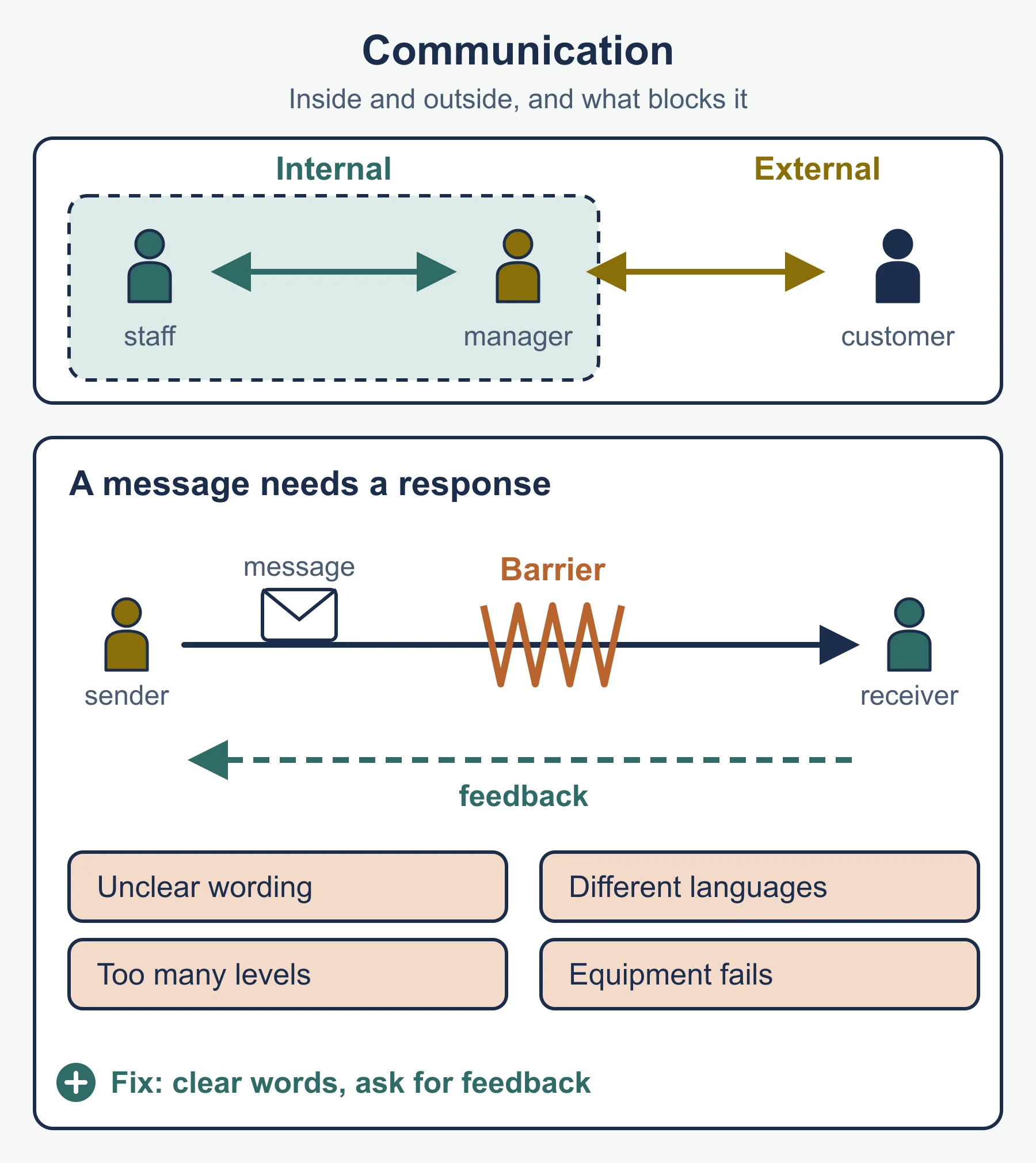
- Communication is a message passing from sender to receiver, with feedback to confirm understanding.
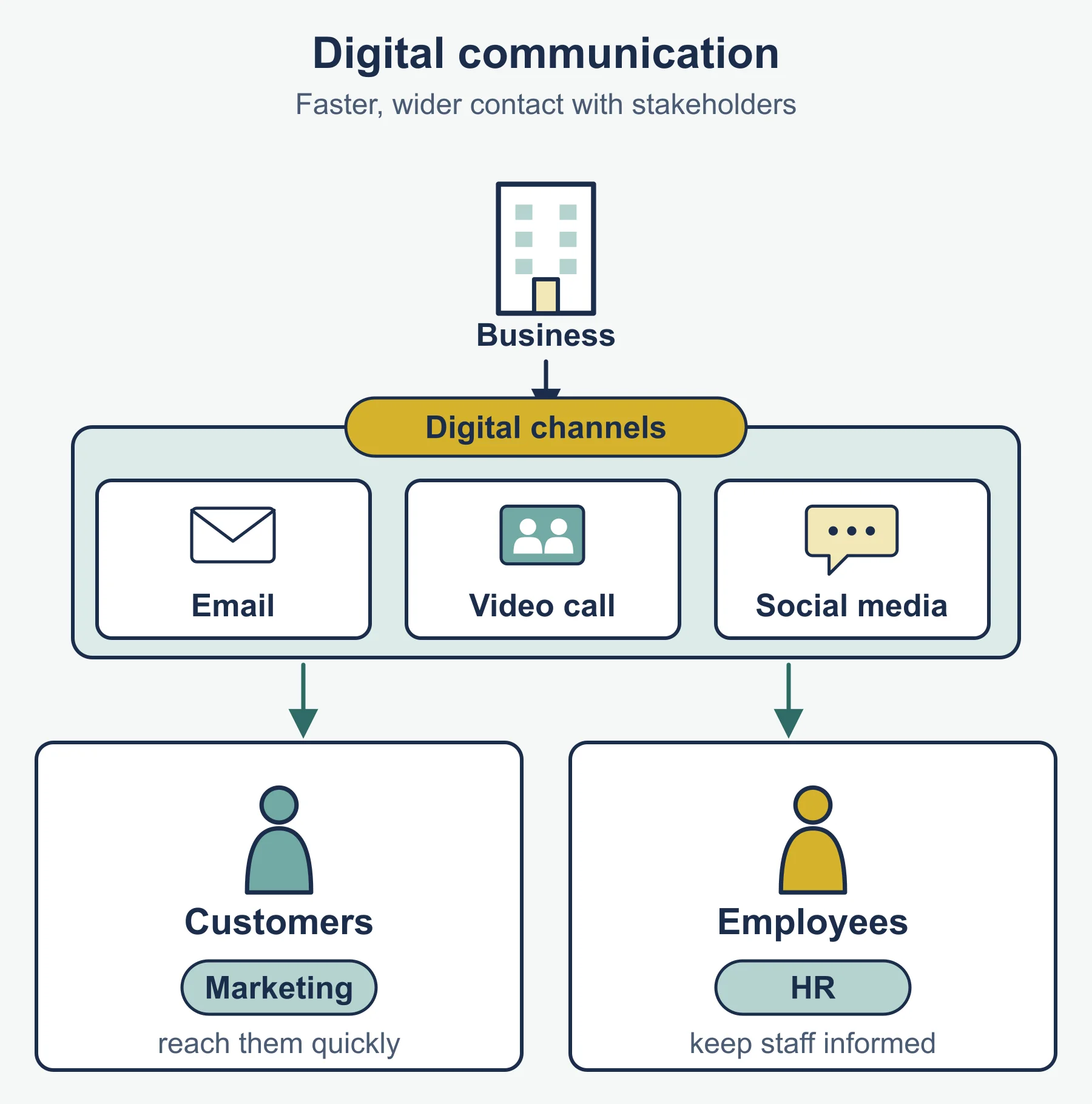
- It gives clear instructions, supports better decisions, keeps customers informed, involves employees and deals with problems before they grow.
- Poor communication leads to mistakes, delays, lost customers and unhappy staff.
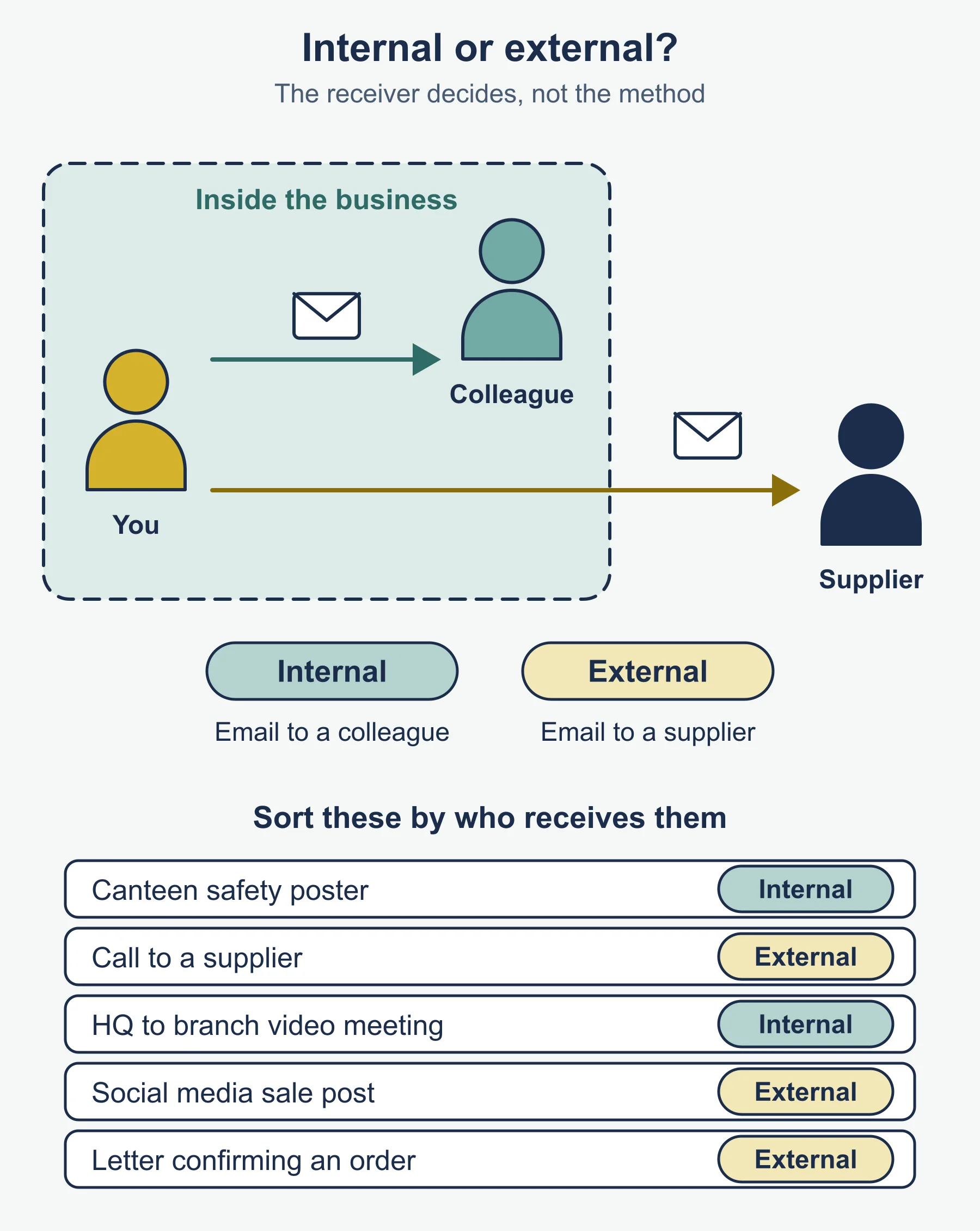
Internal and external communication
| Type | Receiver | Examples |
|---|---|---|
| Internal | People inside the business | Manager to team; one department to another; staff noticeboard |
| External | People outside the business | Customers, suppliers, lenders, government, local community |
Test: ask who receives the message. The method does not decide the type. An email can be either.
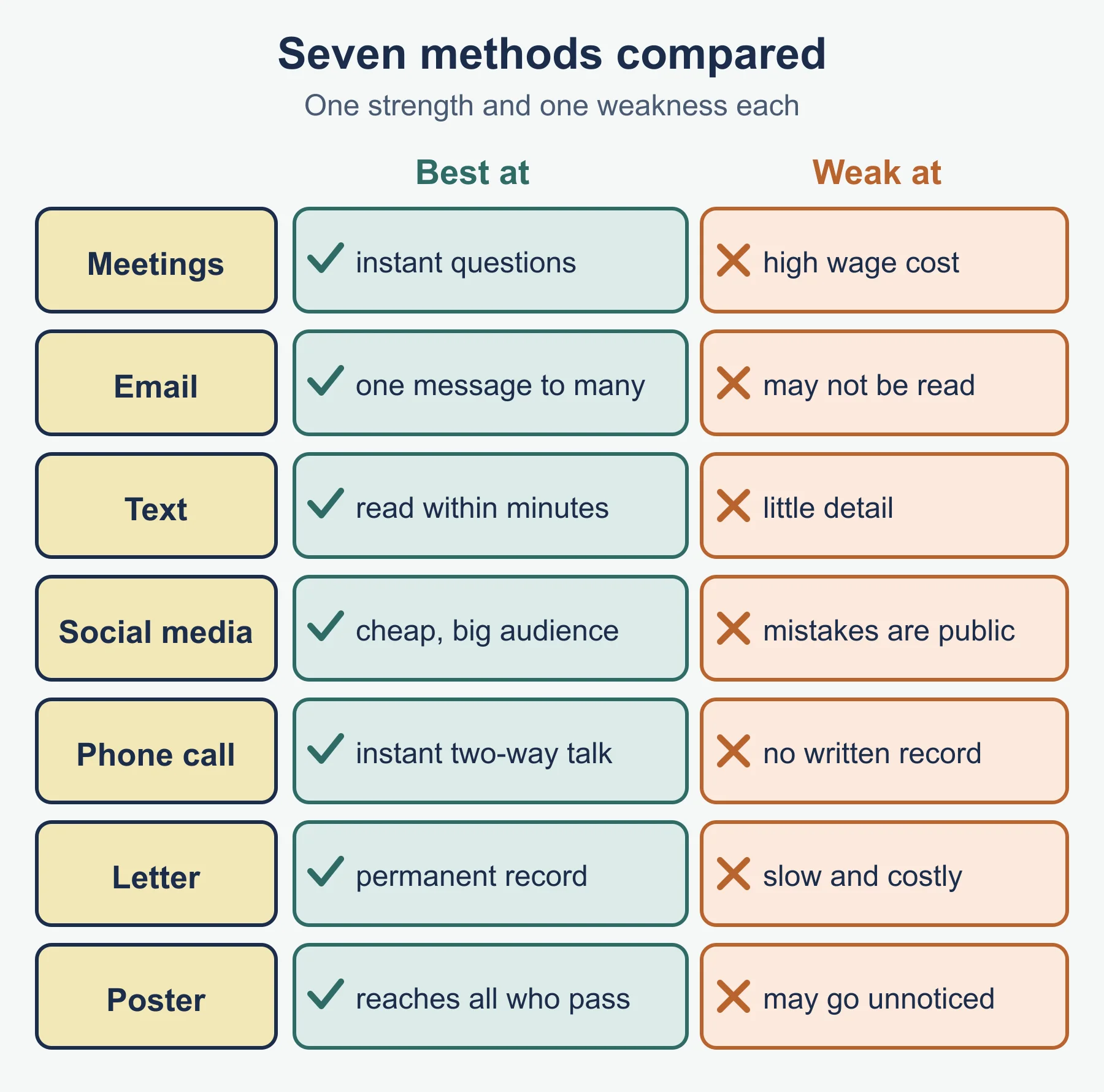
Methods: quick comparison
| Method | Best for | Main strength | Main weakness |
|---|---|---|---|
| Meeting, face-to-face | Discussion, complex or sensitive matters | Instant feedback, body language | Costly in time; hard to gather everyone |
| Meeting, virtual | Groups in different places | Saves travel; live questions | Needs a connection; less personal |
| Detailed messages to one or many | Quick, cheap, written record | May be unread; tone misread | |
| Text message | Short alerts and reminders | Fast; usually read quickly | Little detail; needs a mobile phone |
| Social media | Reaching customers and the public | Wide audience; two-way contact | Public; mistakes spread; needs monitoring |
| Phone call (including mobile) | Urgent matters needing a reply | Immediate two-way; tone of voice | No automatic record; may not be answered |
| Letter | Formal or official matters | Permanent record; formal | Slow; postage and printing costs |
| Poster or noticeboard | General information for those on site | Low cost; stays on show | Might not be read; no feedback; not confidential |
Method in steps: recommend and justify
- Identify the receiver (one person, a group, the public) and whether they are internal or external.
- Identify what matters most: speed, detail, record, privacy, feedback or cost.
- Choose the method that best fits the main need.
- Support your choice with two or three reasons drawn from the case details.
- Say why one other method is weaker.
- Add a judgement: what could change your choice?
Small worked reminder
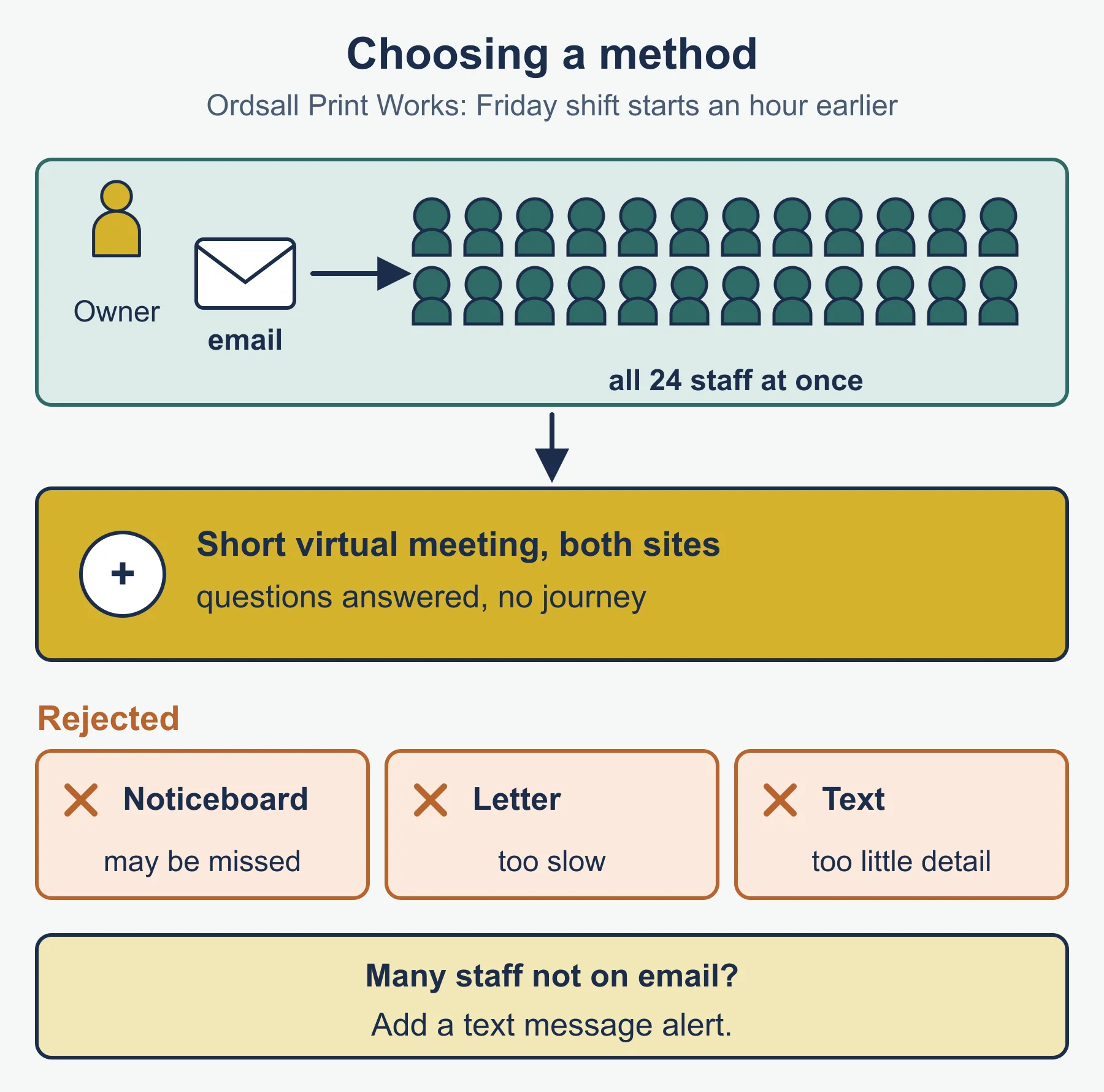
Situation: a clinic must tell 40 patients by tomorrow that their appointments are moved.
- Recommended: text message, because it is quick, patients usually read texts soon, and the message is short.
- Reason against a letter: too slow for tomorrow.
- Reason against a poster: patients are not in the building.
- Judgement: if a patient has no mobile phone, a phone call is better.
Must-know distinctions
| Pair | Difference |
|---|---|
| Internal and external | Receiver inside versus outside the business |
| Face-to-face and virtual meeting | Same room versus a video or audio link |
| Phone call and text message | Spoken, two-way and immediate versus short written message that may wait |
| Email and letter | Electronic and fast versus printed and slow, with postage costs |
| Poster and email | General display for people who pass by versus a message sent to named receivers |
| Barrier and problem | The barrier stops the message. The problem is its effect on the business |
| Reason and solution | Why the barrier arises versus what is done to reduce it |
2.3.2 Communication barriers
A communication barrier is anything that stops a message being sent, received or understood as intended.
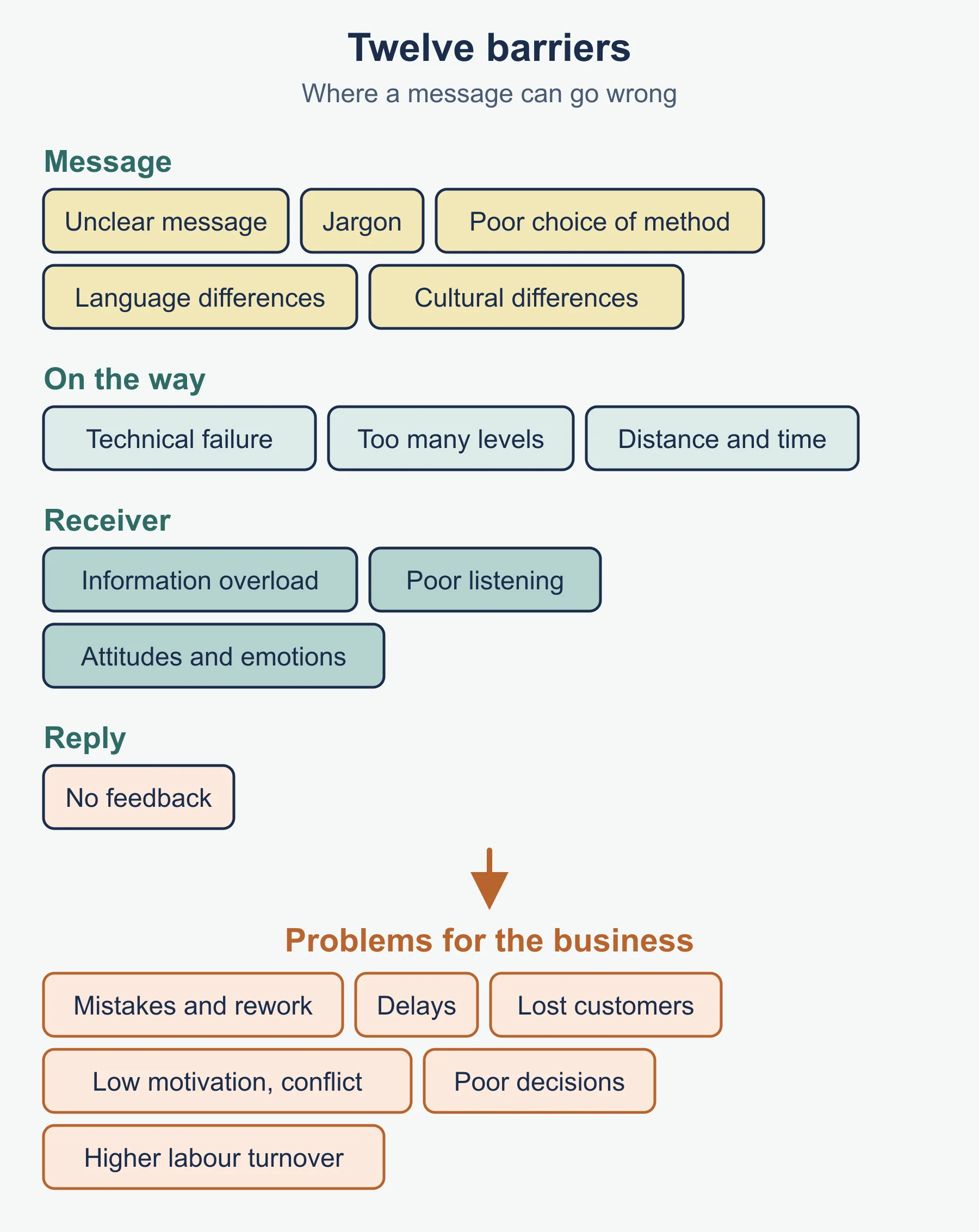
| Barrier | Reason it arises | Problem it causes | Way to reduce it |
|---|---|---|---|
| Language differences | Different first languages; poor translation | Wrong actions; misunderstandings | Plain, simple wording; translation help |
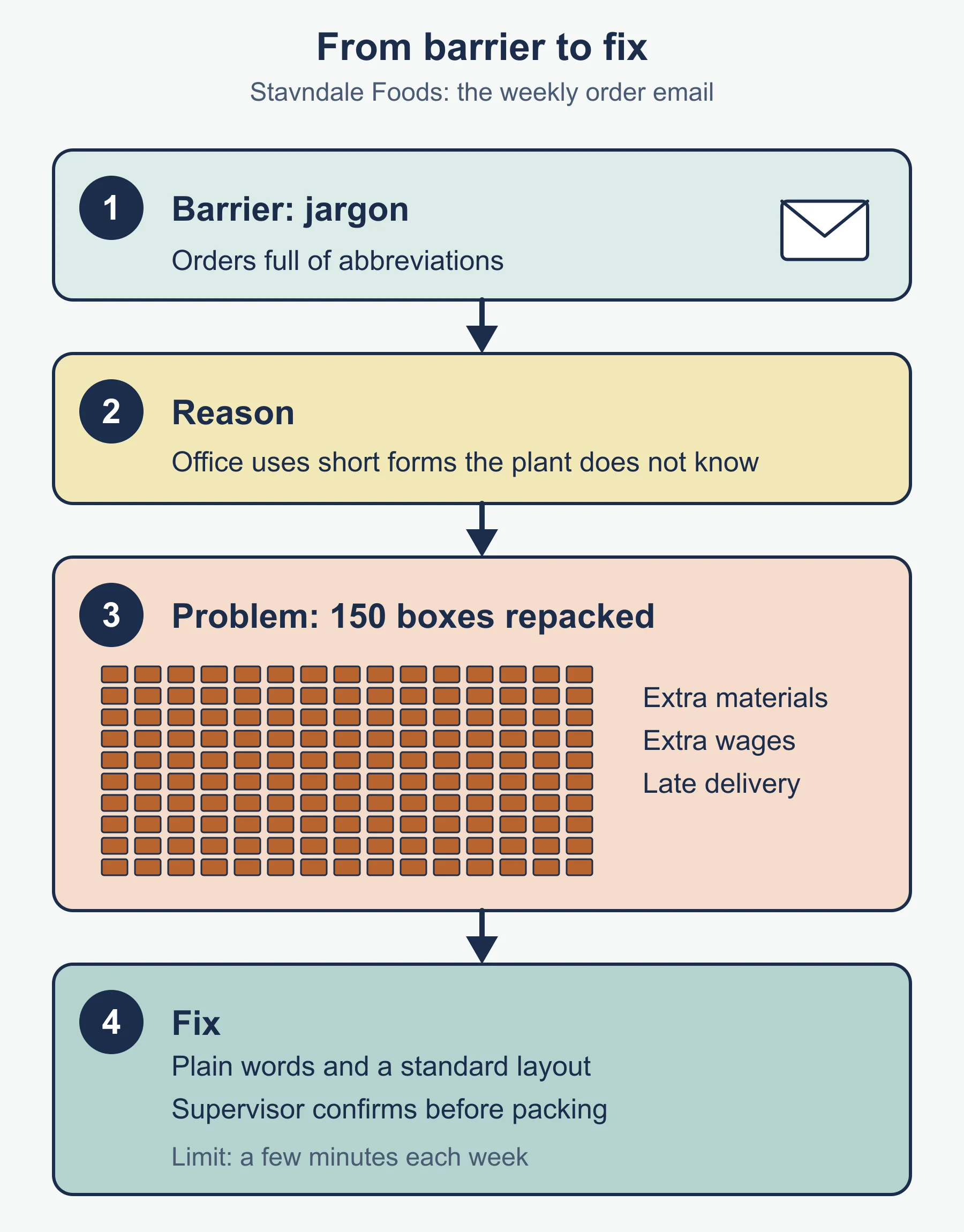
| Jargon | Specialist words used with outsiders | Message not understood | Everyday language |
| Wrong method | Method does not suit message | Delay; message missed | Match method to need |
| Technical failure | Faulty equipment; poor signal | Message lost or late | Maintenance; back-up method |
| Long chain of communication | Many levels between sender and receiver | Delay; message altered | Fewer levels; direct contact |
| Information overload | Too many messages | Key message missed | Fewer messages; mark urgent ones |
| Unclear message | Vague wording; missing detail | Mistakes; rework | Check before sending |
| Poor listening | Distraction; noise; no attention | Instructions not followed | Quiet setting; listening training |
| Time and distance | Different time zones or sites | Delays; no live discussion | Agreed overlap hours |
| Attitudes and emotions | Anger, worry or distrust | Message rejected or misread | Calm tone; build trust |
| No feedback | Sender never checks | Errors go unseen | Ask for confirmation |
Problems caused in general
- Mistakes and rework, which raise costs.
- Delays to decisions and deliveries.
- Customers lost to rivals.
- Poorer motivation and conflict between staff.
- Weaker decisions made on incomplete information.
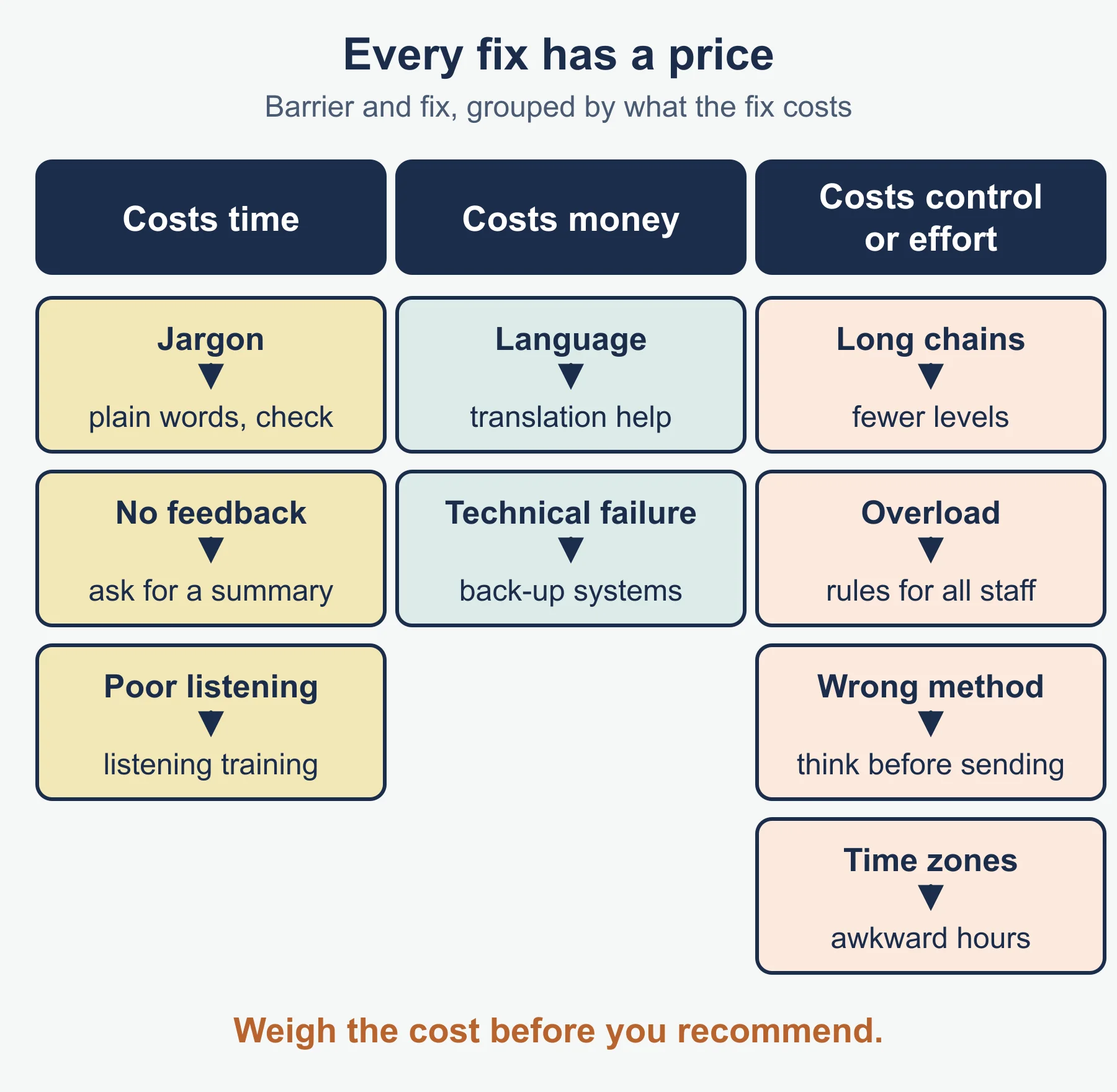
Reducing or removing barriers: a quick rule
Match each fix to the barrier. Then say what it costs or what it risks. For example, back-up systems reduce technical failure but cost money, and fewer levels of management speed messages but may lessen managers’ control.
Command words for this topic
The syllabus lists calculate, consider, define, explain, identify, justify, outline and state as command words. Analyse, evaluate and recommend are included below because the syllabus assesses analysis and evaluation (AO3 and AO4) and asks you to recommend and justify.
| Command word | What to do | Shape of a good answer |
|---|---|---|
| State, identify | Give a short fact | A word or phrase |
| Define | Give the meaning | One clear sentence |
| Explain | Give a point and the reason or effect | Point, because, so |
| Analyse | Break down causes and effects in a chain | Point, development, link to the business |
| Recommend | Choose an option | Choice plus reasons |
| Justify | Support a choice with evidence | Reasons from the case, with a rejected alternative |
| Evaluate | Weigh both sides and reach a judgement | For, against, final decision with a reason |
Small worked reminder: a barrier
Situation: a bakery owner changes a recipe by leaving a note in the kitchen. Two night staff are on leave and use the old recipe, so a batch must be thrown away.
- Barrier: a method that did not reach everyone (a note) together with no feedback.
- Problem: wasted ingredients, wasted wages and late orders.
- Fix: email or text the change to every baker and ask each to reply to confirm.
- Judgement: the extra minute for replies costs far less than a spoiled batch.
Grouping barriers to remember them
| Group | Examples |
|---|---|
| People | Poor listening, attitudes and emotions, language, cultural differences |
| The message | Jargon, unclear wording, too much detail |
| The method | Wrong choice, technical failure, no feedback |
| The structure | Long chains, time and distance, information overload |
Use a group to find a second example quickly. If you have named jargon, a second barrier from a different group may show more range.
Quick self-test
- Define external communication.
- Is a phone call from a manager to a supplier internal or external?
- State two advantages of a virtual meeting over a face-to-face meeting.
- Give one disadvantage of using a poster to announce a change.
- State one reason why a text message may be a poor choice for explaining a new safety procedure.
- Explain why a letter might still be chosen in some situations.
- Name two barriers that are caused by the method chosen.
- A message passes through five managers and arrives changed. Name the barrier and give one solution.
- A business sends 200 letters at a printing and postage cost of $0.50 each. Calculate the total cost.
- State one problem caused when a supplier misreads an order.
Answers
- Communication between the business and people or organisations outside it, such as customers or suppliers.
- External, because the receiver is outside the business.
- Any two: saves travel time and cost; people in different places can join; questions can be asked live; decisions can be made quickly.
- It may not be noticed or read, and there is no way to check that people understood it.
- A text has little space for detail, and there is no easy way to check understanding.
- Any one: a permanent written record; formality for official matters; the receiver has no email or mobile phone.
- Any two from: wrong method for the message, technical failure, information overload (too many emails), lack of feedback.
- A long chain of communication; reduce the number of levels or allow direct contact.
- 200 x 0.50 = $100.
- Any one: wrong goods supplied; delay; extra cost of correcting the order; unhappy customers.
Where marks are usually lost
- Describing a method without tying it to the situation in the question.
- Writing “it is cheaper” with no comparison.
- Deciding internal or external by method instead of by who receives the message.
- Naming a barrier but giving no reason or problem when the question asks you to explain.
- Writing “poor communication” as an example of a barrier.
- Offering a solution that does not match the barrier.
- Recommending a method without saying why you rejected others.
- Repeating one point twice when asked for two different ones.
- Forgetting to add a judgement or conclusion on “recommend” or “justify” questions.
Frequently asked questions
How do you tell internal from external communication? Ask who receives the message: internal communication is between people inside the business, and external communication is with people outside it. The method does not decide the type, since an email can be either.
Why is communication important to a business? Communication gives clear instructions, supports better decisions, keeps customers informed and helps employees feel involved. Poor communication leads to mistakes, delays, lost customers and unhappy staff.
What problems do communication barriers cause? Barriers can cause mistakes and rework that raise costs, delays to decisions and deliveries, customers lost to rivals, poorer motivation and conflict, and weaker decisions based on incomplete information.
How should you suggest a way to reduce a communication barrier? Match the fix to the barrier, then say what it costs or risks. For example, asking staff to reply to confirm a message tackles a lack of feedback.
Official syllabus
Aligned to section 2.3 of the Cambridge IGCSE Business 0264 syllabus for examination in 2027, 2028 and 2029, published by Cambridge University Press & Assessment (Cambridge International Education).
Get free revision emails (optional)
Occasional emails with practice questions, worked explanations and links to free resources for the qualification and subjects you choose. No spam, and you can unsubscribe from any email. The free tools on this site never need an email.
Related resources
-
Study guides
IGCSE Business: Motivating employees (Cambridge 0264)
Study guide to motivating employees for Cambridge IGCSE Business 0264: why people work, Maslow, Taylor, Herzberg, and financial and non-financial methods.
Business · Cambridge · IGCSE
Read guide -
Practice questions
IGCSE Business: Motivating employees (Cambridge 0264) – Practice Questions
Original practice questions with worked answers on motivating employees for Cambridge IGCSE Business 0264, with calculations and case studies.
Business · Cambridge · IGCSE
Try questions -
Revision notes
IGCSE Business: Motivating employees (Cambridge 0264) – Revision Notes
Condensed revision notes on motivating employees for Cambridge IGCSE Business 0264: theories, pay methods, non-financial methods and a quick self-test.
Business · Cambridge · IGCSE
Revise topic
Related articles
-
teaching
A Level tuition in Dubai: Cambridge or Pearson Edexcel International A Level?
Schools in Dubai and Abu Dhabi teach either Cambridge International AS & A Level or Pearson Edexcel International A Level. How the two are structured, why it matters for tuition, and how online classes from Lahore work.
9 October 2026
-
curriculum guides
Choosing subjects at IGCSE and A Level
How subject choices at 14 and 16 affect university options later, and how to keep pathways open without overloading a timetable.
28 July 2026
Studying this with a teacher
Working through Business IGCSE?
This page is free and stays free. If you would rather be taught it, Marlbridge runs Business classes one-to-one and in small groups of up to 15, online in your own time zone. The first trial class is free. WhatsApp replies within an hour (8am–11pm Pakistan time, every day); email the same day.
Cambridge Business teachers at Marlbridge

