
Revision Notes
Cambridge IGCSE Geography (0460): Migration – Revision Notes
Condensed IGCSE Geography 0460 notes on 1.2: types of migration, push and pull factors, impacts on source and receiving countries and a self-test.
- Subject
- Geography
- Level
- IGCSE
- Topic
- Theme 1 – Population and Settlement
- Author
- Marlbridge Academic Team
- Updated
- Reviewed by
- Azam Siddique (what this means)
Aligned to Cambridge IGCSE Geography (0460), 2025-2026. Official specification .
Syllabus page (what it covers and how it is assessed): Cambridge IGCSE Geography.
Syllabus points this page covers
0460
- 1.2 Migration
Condensed recall for 1.2 Migration (Cambridge IGCSE Geography 0460, Theme 1). For the full explanation, read the Population and Settlement study guide.
Key terms
| Term | Meaning |
|---|---|
| Migration | Movement of people to live in a new place |
| Internal (national) | Within one country |
| International | Between countries |
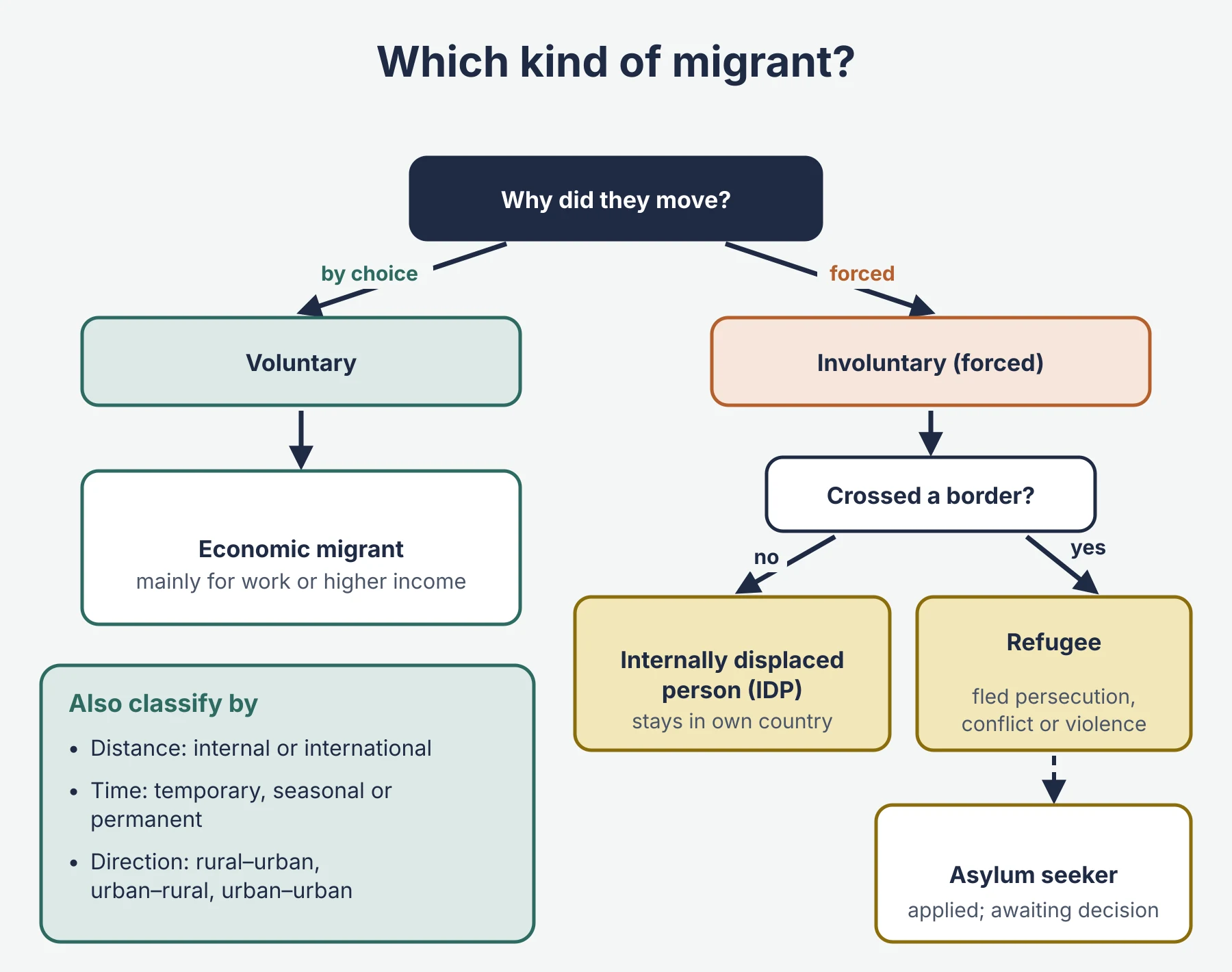
| Voluntary | The migrant chooses to move, usually for work or a better life |
| Forced | The migrant must leave because of conflict, persecution or disaster; refugees are forced migrants |
| Push factor | Something negative that drives people out |
| Pull factor | Something attractive that draws people in |
| Remittances | Money sent home by migrants |
| Brain drain | Loss of skilled, educated workers from the source country |
| Emigrant / immigrant | Someone leaving a country / someone arriving in a country |
| Net migration | Immigrants minus emigrants over a period |
| Refugee | Someone forced to leave their own country who cannot safely return |
| Internally displaced person | Someone forced from home who stays within their own country |
| Economic migrant | Someone who moves voluntarily to find work or higher pay |
| Temporary / permanent | A move for a season or a few years, compared with a move for life |
Push and pull factors
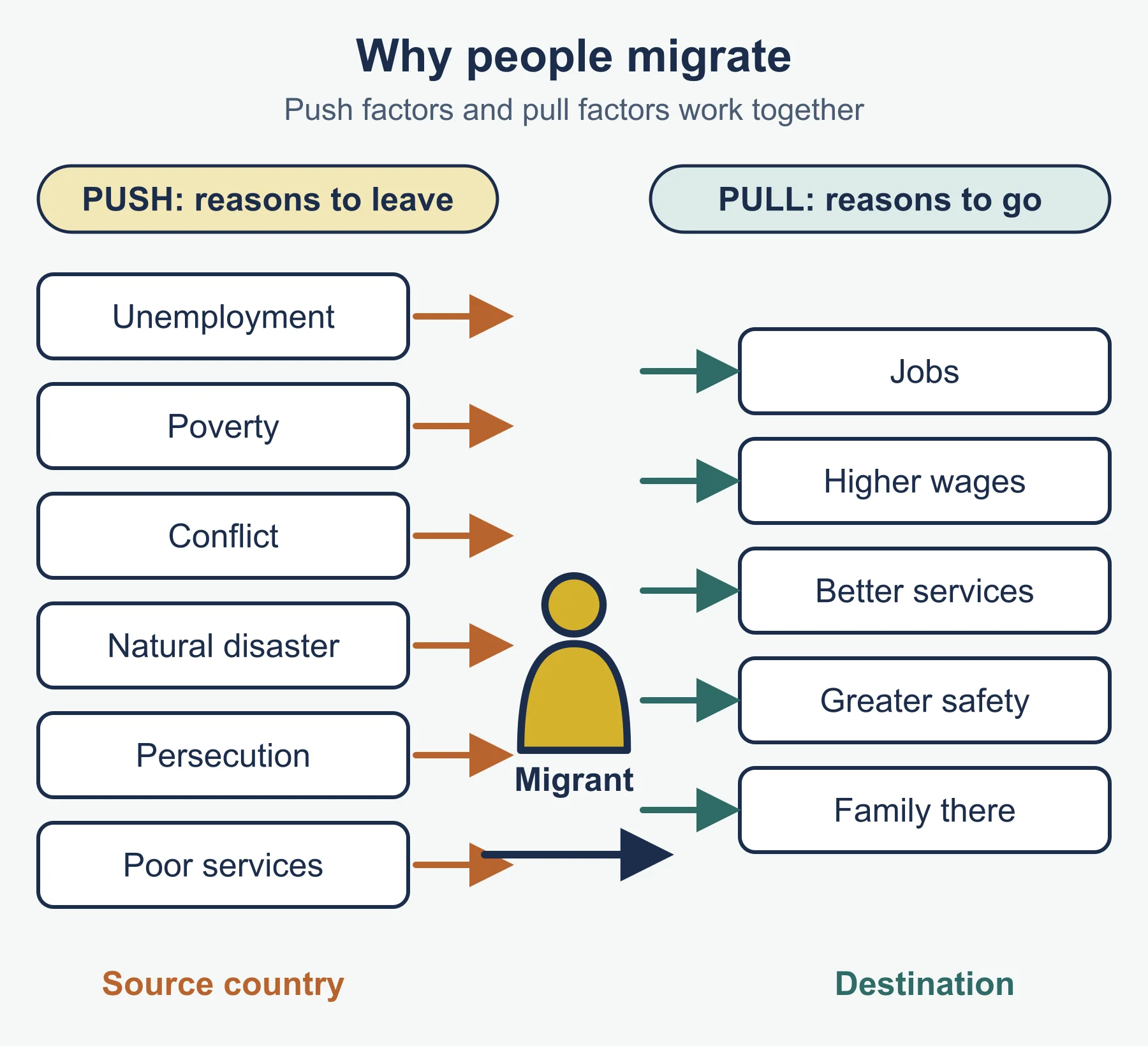
- Push: unemployment, poverty, conflict, natural disaster, persecution, poor services.
- Pull: jobs, higher wages, better services, safety, family already living there.
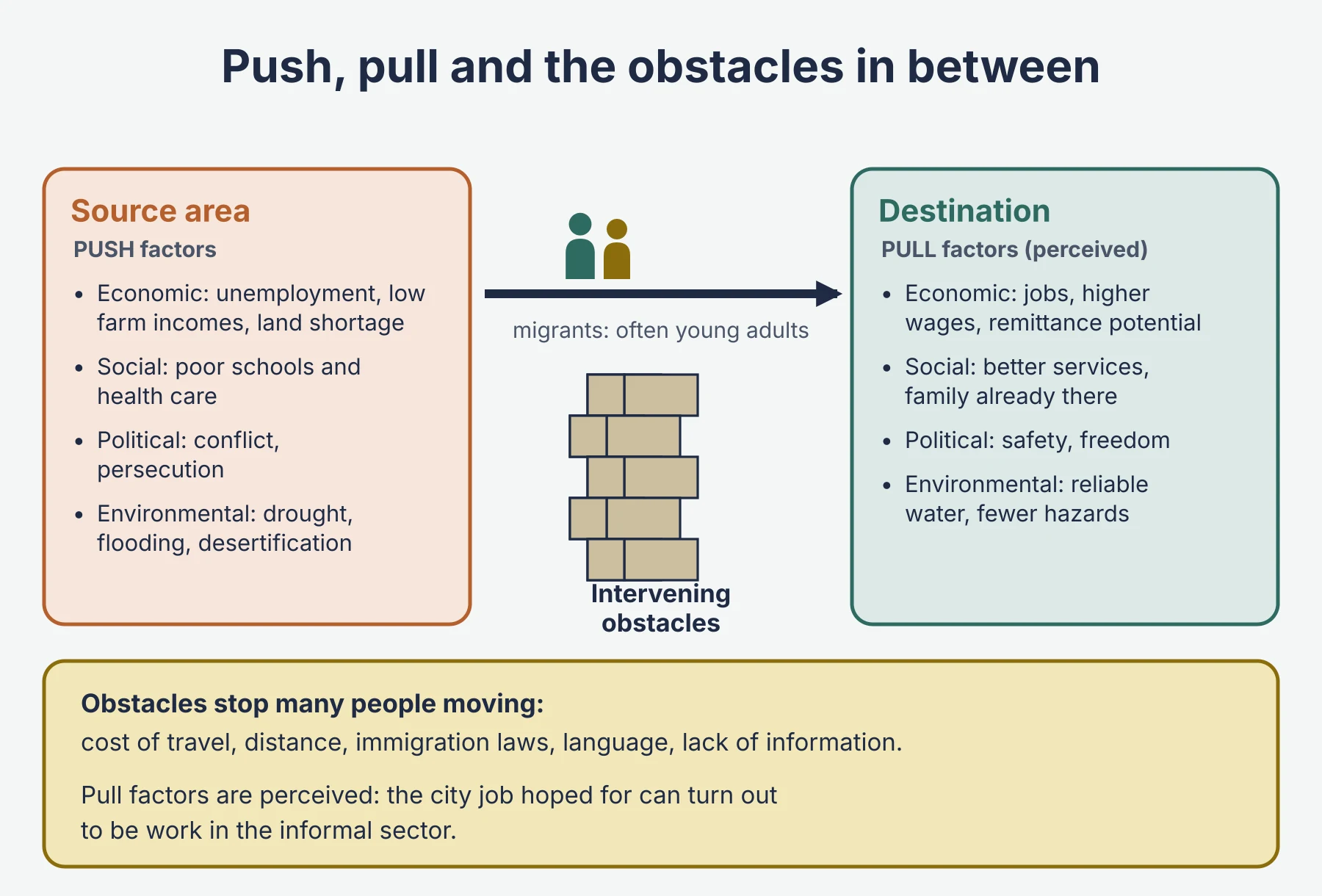
Push and pull work together: always pair a push factor in the source area with a pull factor at a specific destination. Barriers such as cost, distance, language and immigration controls can stop people who want to move.
Types of factor
| Push examples | Pull examples | |
|---|---|---|
| Economic | Low wages, few jobs, failed harvests | Labour shortages, higher pay |
| Social | Poor schools and hospitals | Better education and healthcare, relatives already there |
| Political | War, persecution, unstable government | Safety, political freedom |
| Environmental | Drought, flooding, earthquakes, rising sea level | Safer, more reliable environment |
Questions often ask you to classify factors, so use these headings in longer answers.
Why some people stay
Intervening obstacles (cost of travel, visas and border controls, language, distance, family ties) stop many people from moving even when push and pull factors are strong. Whether someone migrates depends on the balance between the factors and the obstacles.
Impacts: argue both sides
| Benefits | Costs | |
|---|---|---|
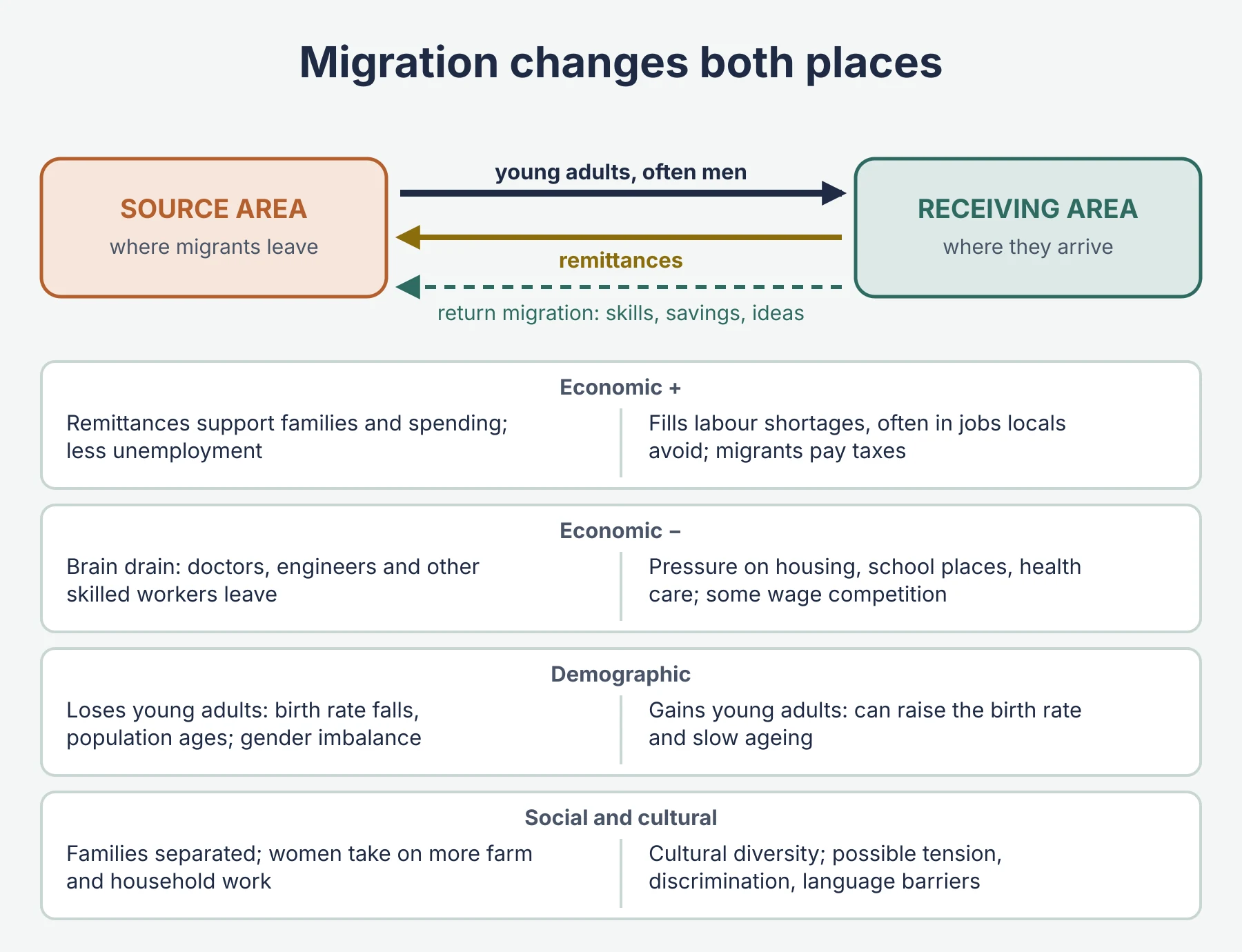
| Source country | Remittances; less unemployment; returning migrants bring skills | Brain drain; loss of working-age people; families split |
| Receiving country | Fills labour shortages; young taxpayers; cultural diversity | Pressure on housing and services; possible social tension |
Mark schemes reward answers that look at both countries, and at both benefits and costs.
Effects on population structure
Most voluntary migrants are young adults, often more men than women at first. So:
- the receiving area’s pyramid widens in the 20 to 40 age groups, and later at the base as migrants have children;
- the source area loses young adults, leaving a pyramid with a “pinched” middle and a larger share of children and elderly, so its dependency ratio rises.
Building a case study
Prepare one named migration flow (internal or international) and learn it as a card:
- From where to where, and whether voluntary or forced.
- Causes: two push and two pull factors, specific to those places.
- Impacts: at least one on the source area and one on the destination.
- Detail: names, dates or figures you are sure of.
Vague answers about “migrants” in general score less than answers about a named flow.
Worked case study: Poland to the United Kingdom (voluntary, international)
- When and why it started: Poland joined the European Union in 2004. The UK was one of only a few existing members to open its labour market to the new members straight away, so a large flow of mostly young Polish workers followed.
- Push (Poland): higher unemployment, especially among young people, and wages well below those in the UK.
- Pull (UK): labour shortages in construction, farming, food processing, hospitality and care; higher wages; the right to work without a visa; cheap flights between the two countries.
- Impacts on the UK: filled labour shortages; young workers paid taxes; Polish shops, churches and newspapers appeared in many towns, and Polish became one of the most widely spoken languages after English. Some areas saw pressure on school places and housing, and tension over jobs.
- Impacts on Poland: remittances supported families; unemployment fell; but some sectors later reported shortages of skilled workers such as builders and doctors – a brain drain.
- Later change: some migrants returned home as Poland’s economy grew and after the UK’s 2008 recession; the UK’s departure from the EU ended free movement for new arrivals.
Contrasting example: Syrian refugees (forced, international)
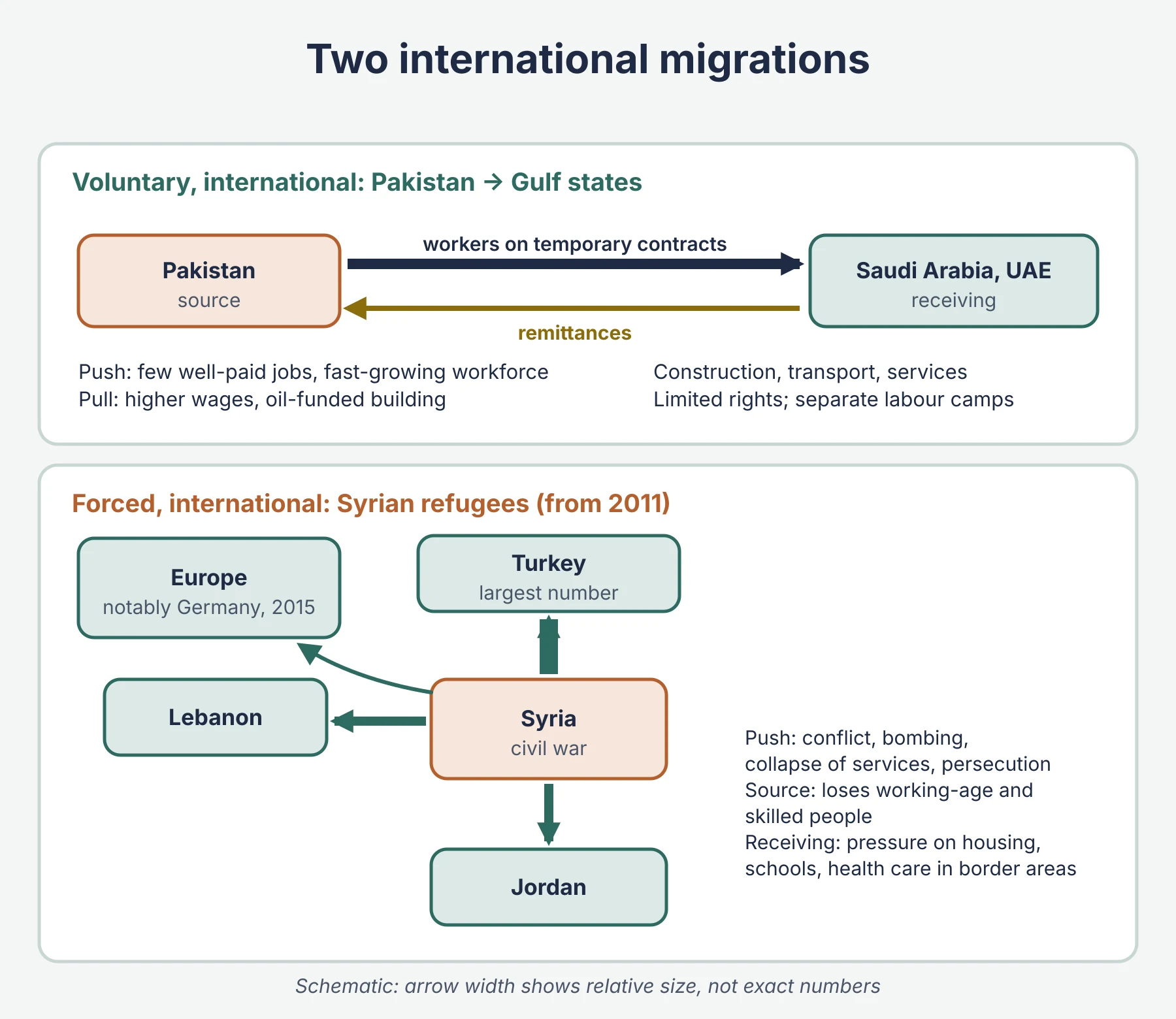
The civil war that began in 2011 forced millions of Syrians to flee. Most went to neighbouring Turkey, Lebanon and Jordan, with Turkey hosting the largest number; many others reached Europe, especially Germany. Impacts on host countries included pressure on housing, schools and water supplies, and large refugee camps such as Zaatari in Jordan. Use this to show you can tell forced from voluntary migration.
Exam traps
- Listing push factors with no pull factors, or the reverse.
- Judging migration from only the receiving country’s viewpoint.
- Confusing internal with international migration.
- Calling every migrant a refugee – a refugee is a forced migrant, but most migrants are voluntary.
- Writing about migration in general when the question names a place.
- Confusing emigration (leaving) with immigration (arriving).
- Forgetting that a refugee has crossed a border; someone displaced within their own country is an internally displaced person.
Command words
- Describe a flow on a map: direction, origin, destination, size of arrows, any pattern.
- Explain a cause: name the factor, say where it applies and why it makes people move.
- To what extent or evaluate: weigh benefits against costs for both countries and reach a judgement.
Self-test
- Distinguish voluntary from forced migration.
- Give three push factors.
- What are remittances?
- State one benefit and one cost of immigration for a receiving country.
- Why might a skilled worker find it hard to migrate even when pull factors are strong?
- Define net migration.
- What is a brain drain, and why does it matter to the source country?
- Classify each as economic, social, political or environmental: drought; persecution; low wages; poor schools.
- How does migration of young adults change the population pyramid of the receiving area?
- Why did many Polish workers move to the UK after 2004?
- What is the difference between a refugee and an internally displaced person?
Answers: 1. Voluntary migrants choose to move; forced migrants must leave because of conflict, persecution or disaster. 2. For example unemployment, conflict and natural disaster. 3. Money migrants send back to their families in the source country. 4. Benefit: fills labour shortages; cost: pressure on housing and services. 5. Barriers such as cost, immigration controls, language or distance. 6. The number of immigrants minus the number of emigrants. 7. The loss of skilled, educated workers; the country loses the people it trained and may face shortages of doctors, teachers or engineers. 8. Environmental; political; economic; social. 9. It widens the young-adult age groups and later the base, as migrants have children. 10. Poland had just joined the EU, the UK opened its labour market, wages were much higher and there were labour shortages. 11. A refugee has fled across an international border; an internally displaced person has been forced from home but remains in their own country.
More resources on this topic
Related resources
-
Revision notes
Cambridge IGCSE Geography (0460): Population Density and Distribution – Revision Notes
Condensed IGCSE Geography 0460 notes on 1.4: density and distribution, physical and human factors for dense and sparse populations, and a self-test.
Geography · Cambridge · IGCSE
Revise topic -
Revision notes
Cambridge IGCSE Geography (0460): Population Dynamics – Revision Notes
Condensed IGCSE Geography 0460 notes on 1.1: birth and death rates, the Demographic Transition Model, over- and under-population, population policies and a self-test.
Geography · Cambridge · IGCSE
Revise topic -
Revision notes
Cambridge IGCSE Geography (0460): Population Structure – Revision Notes
Condensed IGCSE Geography 0460 notes on 1.3: reading population pyramids, the dependency ratio, youthful and ageing populations and a self-test.
Geography · Cambridge · IGCSE
Revise topic
Studying Geography?
This page is free and stays free. Marlbridge is not offering Geography classes at the moment, so there is no tuition to book for it. The free study resources stay open to everyone.
Get free revision emails (optional)
Occasional emails with practice questions, worked explanations and links to free resources for the qualification and subjects you choose. No spam, and you can unsubscribe from any email. The free tools on this site never need an email.