
Revision Notes
Cambridge IGCSE Geography (0460): Urbanisation – Revision Notes
Condensed IGCSE Geography 0460 notes on 1.7: causes of urbanisation, rural push and urban pull factors, consequences, management strategies and a self-test.
- Subject
- Geography
- Level
- IGCSE
- Topic
- Theme 1 – Population and Settlement
- Author
- Marlbridge Academic Team
- Updated
- Reviewed by
- Azam Siddique (what this means)
Aligned to Cambridge IGCSE Geography (0460), 2025-2026. Official specification .
Syllabus page (what it covers and how it is assessed): Cambridge IGCSE Geography.
Syllabus points this page covers
0460
- 1.7 Urbanisation
Condensed recall for 1.7 Urbanisation (Cambridge IGCSE Geography 0460, Theme 1). For the full explanation, read the Population and Settlement study guide.
Key terms
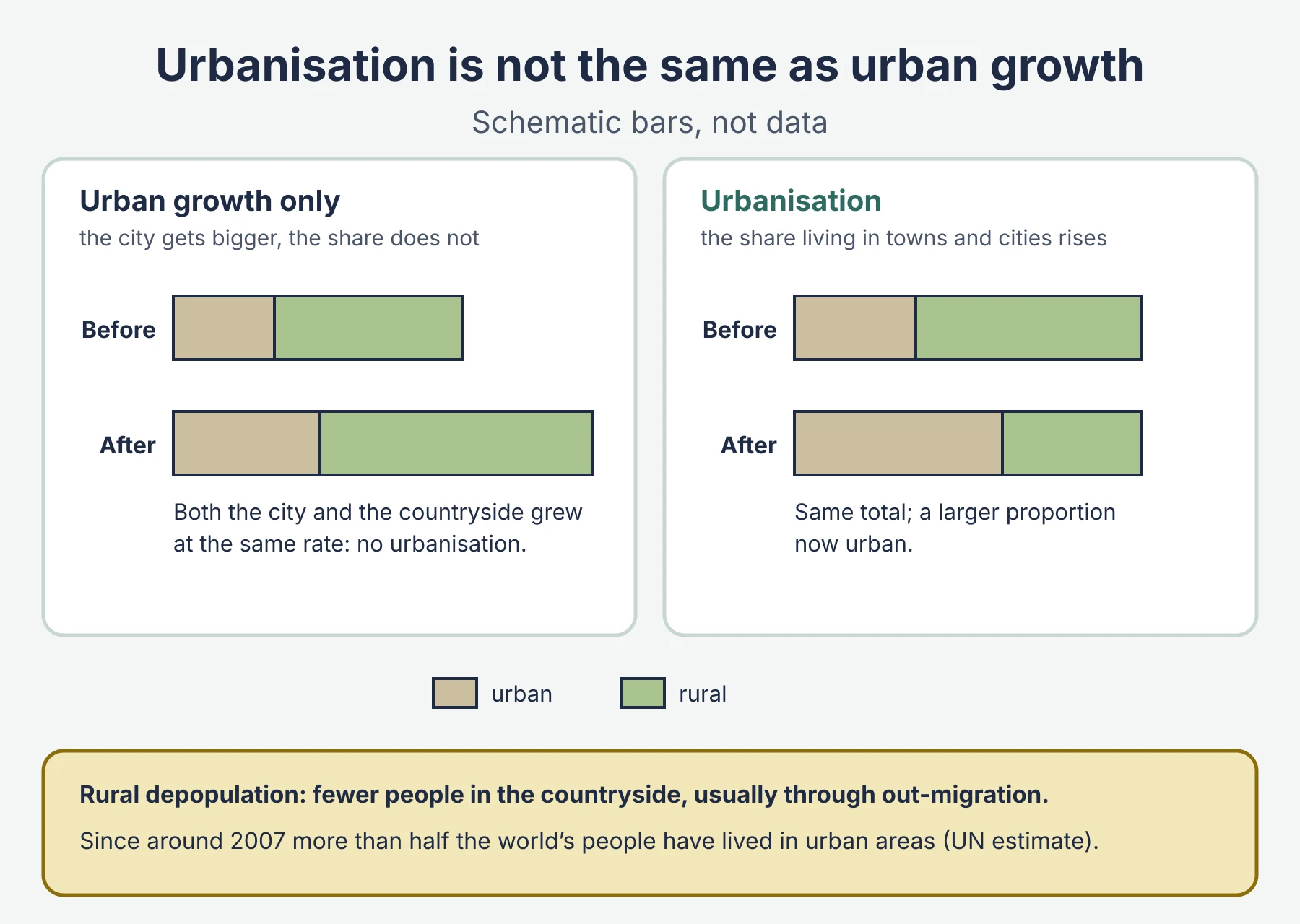
- Urbanisation – the increase in the proportion of a country’s population living in towns and cities.
- Rural-urban migration – movement from the countryside to towns and cities.
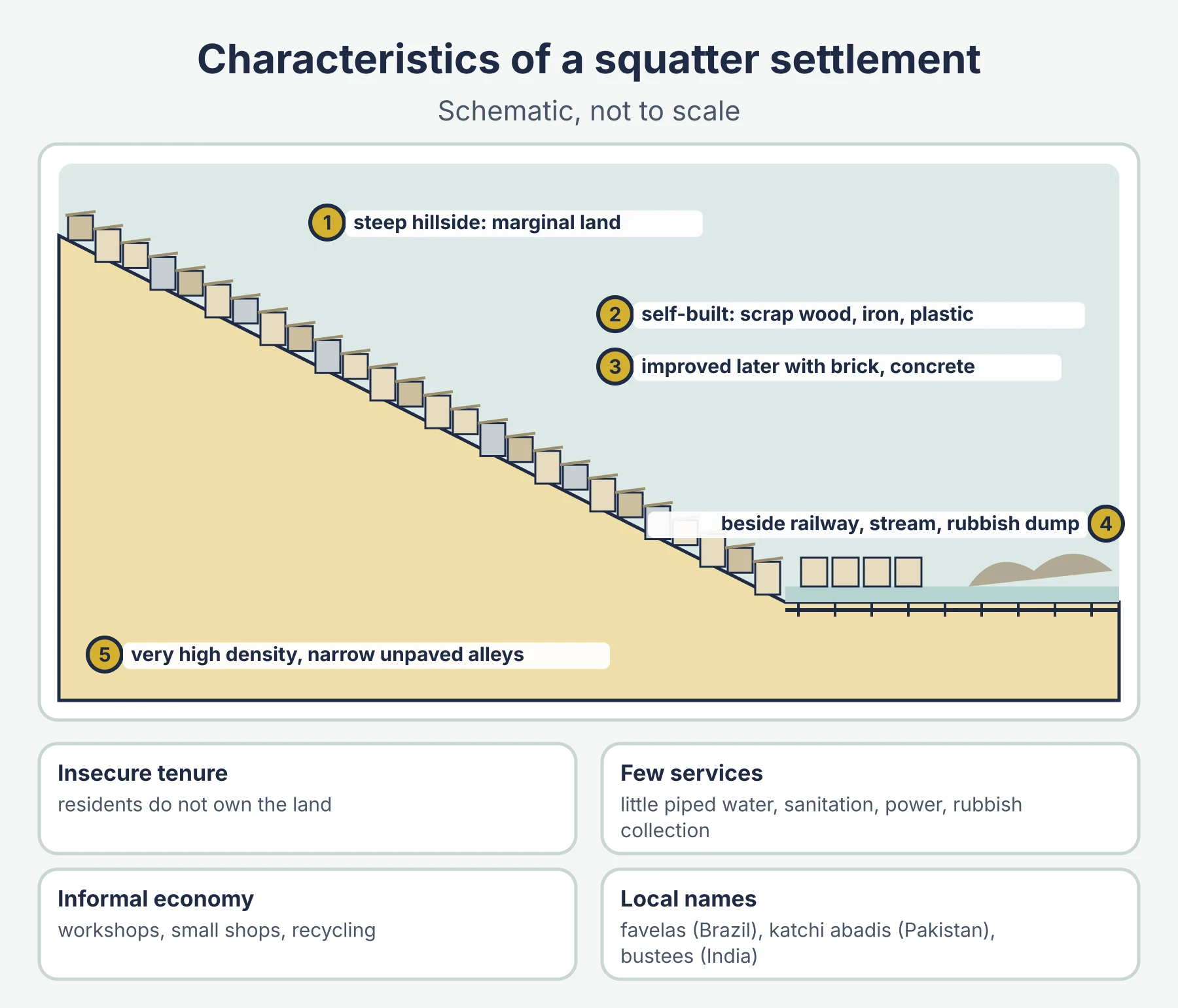
- Squatter settlement – housing built illegally on land the residents do not own.
- Urban growth – the increase in the number of people living in a town or city, or in its built-up area.
- Informal sector – unregistered, untaxed work such as street selling, recycling waste or casual building labour, with no contract or job security.
- Megacity – a city with more than 10 million people.
- Counter-urbanisation – people moving out of cities to smaller towns and the countryside, most common in high-income countries.
Take care: a city can grow in numbers without the proportion living in cities rising.
Where urbanisation is happening
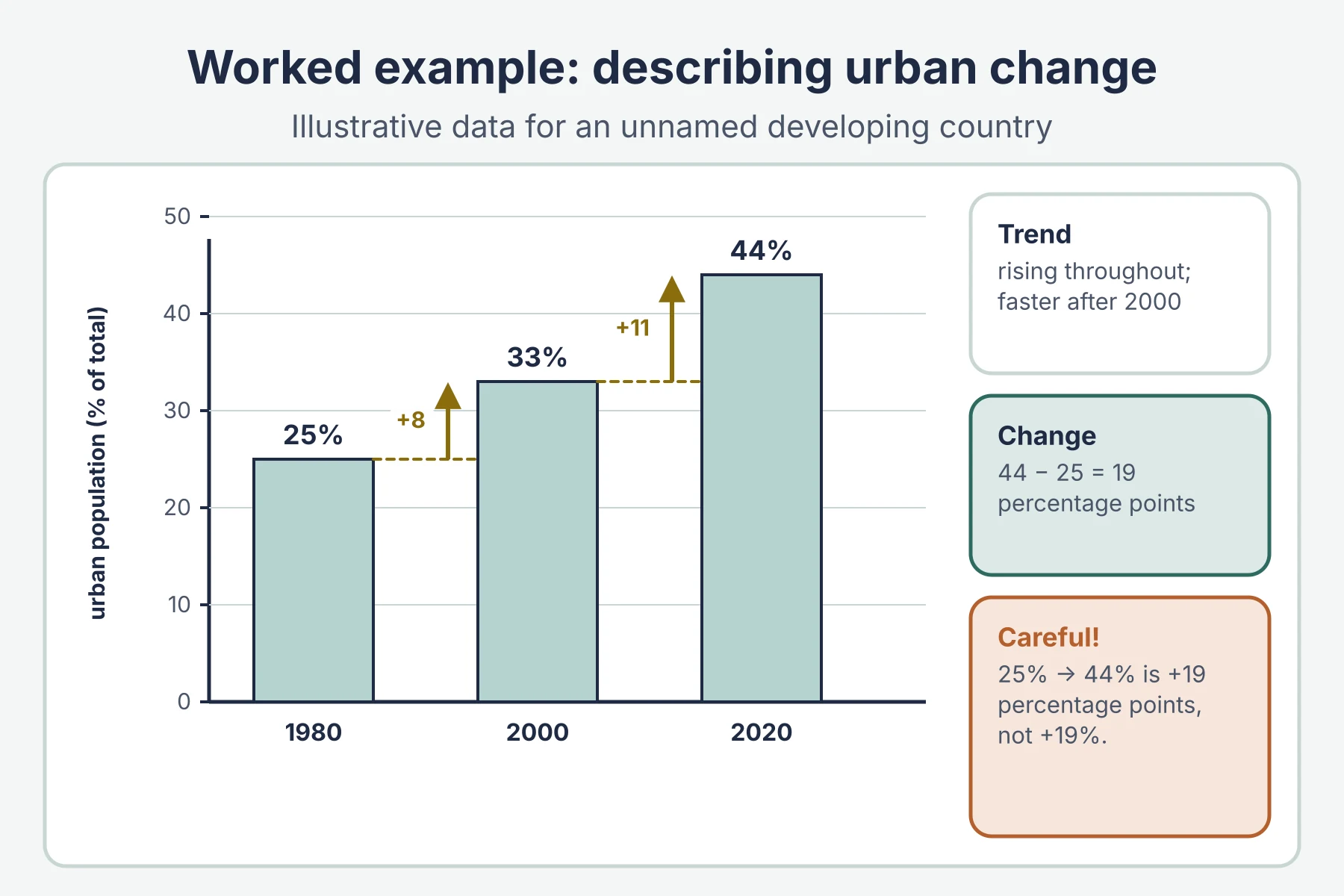
In most high-income countries the large majority of people already live in towns, so the urban proportion is rising only slowly and some people are moving out. The fastest urbanisation today is in low- and middle-income countries in Africa and Asia, where many people still live in rural areas and migration to cities is strong. As a result, most of the world’s newest and fastest-growing megacities are in these regions, while older megacities such as New York and Tokyo are growing slowly.
Causes (especially in low-income countries)
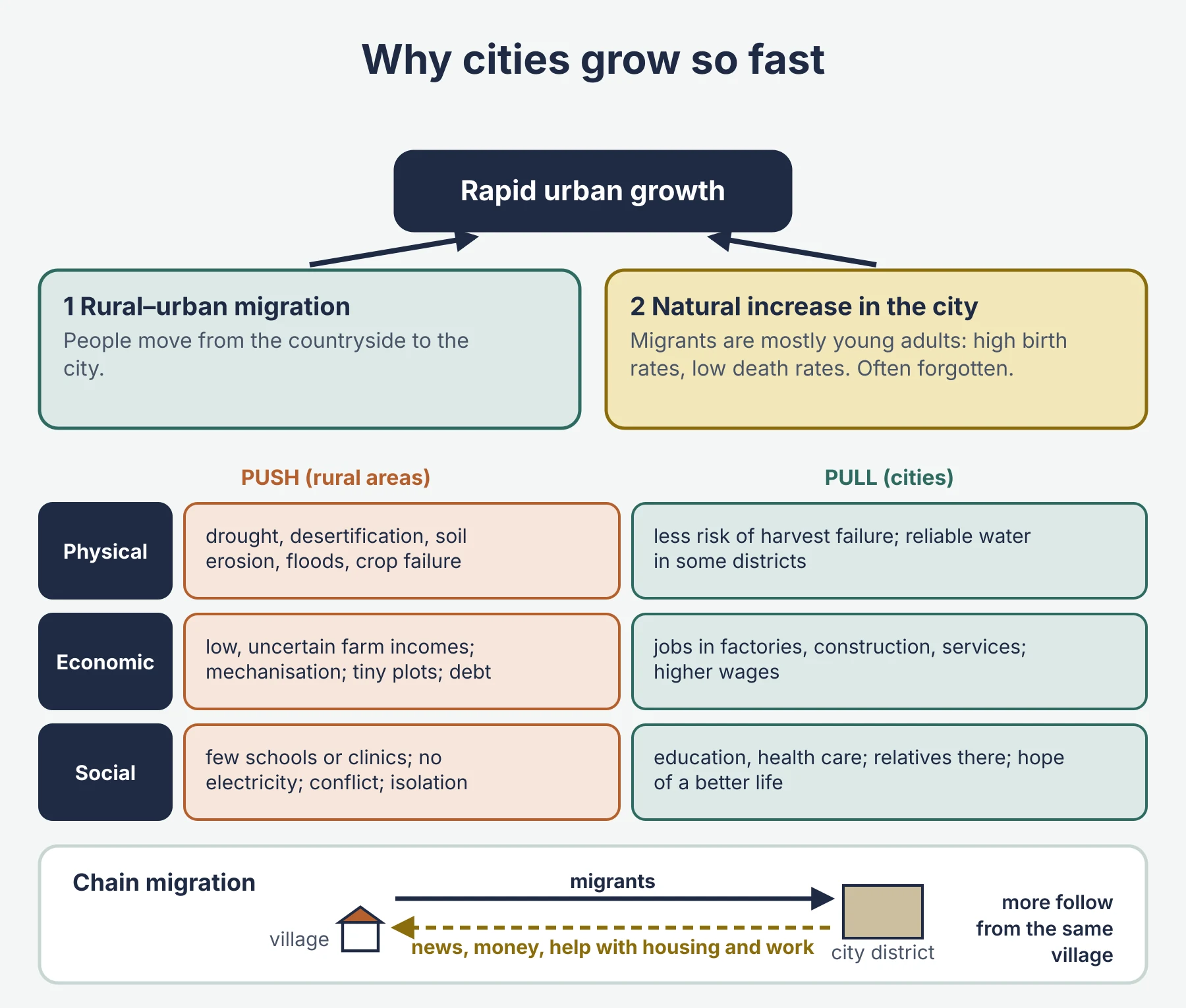
Two linked causes:
- Rural-urban migration, driven by:
- rural push factors: few jobs, low farm incomes, poor services, drought or land shortage, hardship;
- urban pull factors: more jobs, higher wages, better schools and hospitals, a perceived better standard of living.
- Natural increase in cities. Migrants are often young, so they have children in the city.
Explaining the push factors
- Mechanisation of farming means fewer labourers are needed.
- Land shortage: as rural families grow, land is divided between children until plots are too small to support a family.
- Natural hazards such as drought or floods ruin harvests and debts build up.
- Poor services: rural areas may lack secondary schools, hospitals, electricity or clean water.
Explaining the pull factors
- Cities hold factories, offices, ports and markets, so there are more jobs, including informal work that newcomers can start straight away.
- Services are concentrated in cities because they reach their threshold populations there.
- Friends and relatives who have already moved send back news and money, and offer a first place to stay. This chain migration keeps the flow going.
Consequences
| Problems | Benefits | |
|---|---|---|
| Social | Housing shortage and squatter settlements; pressure on schools and hospitals; crime | Better access to services for many; cultural mixing |
| Economic | Unemployment and informal work | Jobs, a larger market, remittances to rural families |
| Environmental | Traffic congestion, air and water pollution, strain on water and sanitation | Services and housing can be planned for many people at once |
Effects on the rural areas left behind: the young and the most able leave, so the rural population becomes older and more female; farms may be short of labour; but remittances can pay for school fees, better seed or new homes.
Management strategies
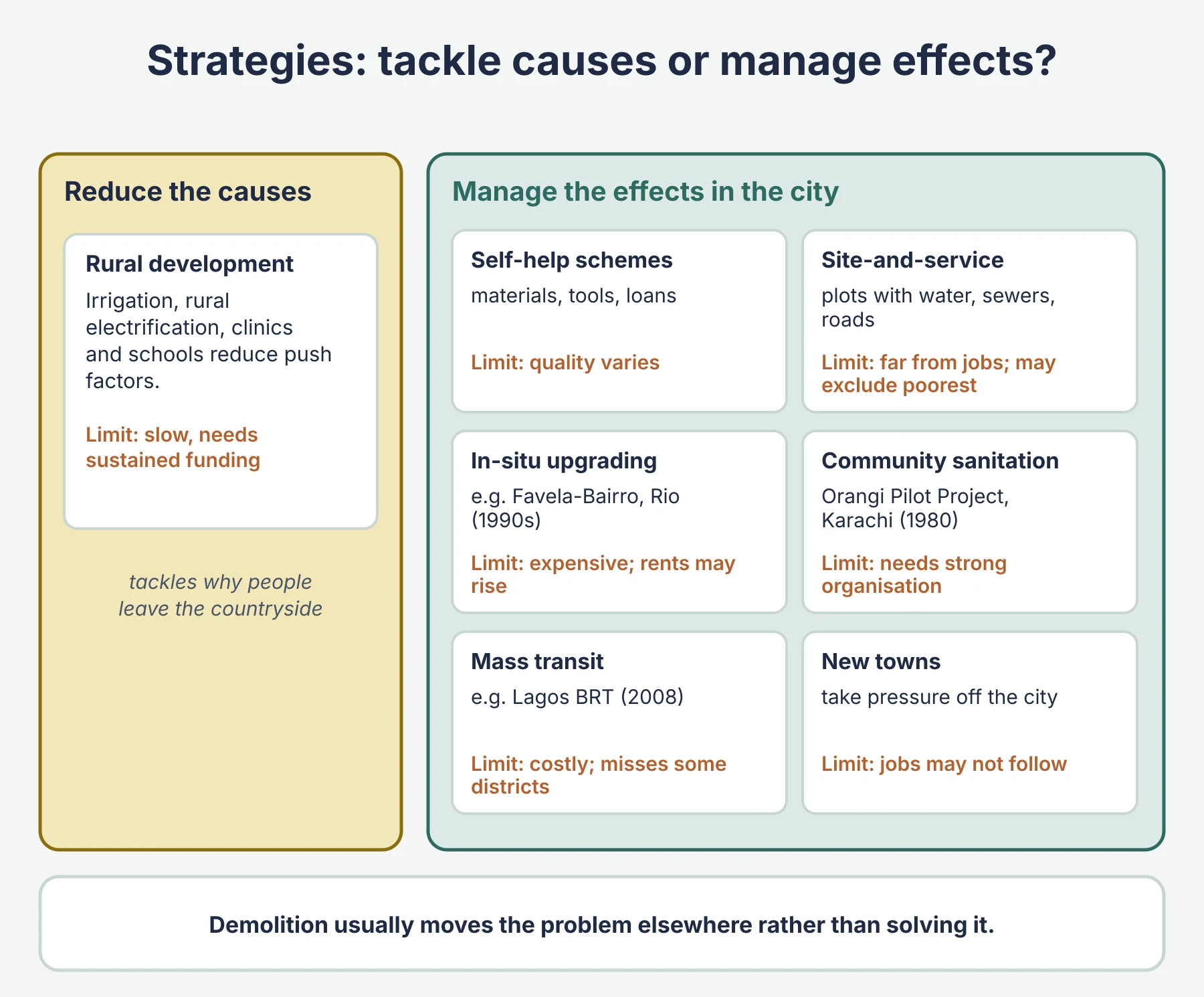
- Site-and-service schemes – plots with basic services, residents build.
- Self-help schemes – residents improve their own housing with support.
- Better public transport and services to cut congestion and pollution.
- Rural development (jobs, services, farm support) to reduce the push factors that send people to cities in the first place.
- Upgrading informal settlements in place – piped water, toilets, drains, paved paths and electricity – which is cheaper than clearance and keeps people near their work.
- Building new towns or satellite settlements to steer growth away from an overcrowded centre.
- Waste collection and recycling, much of it carried out by informal-sector workers.
Evaluate each: cost, how many people it reaches, and whether it tackles causes or only symptoms. Rural development tackles the cause but works slowly.
Case study card: Mumbai, India
Mumbai is a well-documented example of a rapidly growing city in a developing country.
- Where: on India’s west coast in the state of Maharashtra, built on a peninsula formed from former islands. It is India’s main financial and commercial centre, with a major port and the film industry (Bollywood).
- Why people moved: push factors in rural Maharashtra and in poorer states such as Uttar Pradesh and Bihar include low farm incomes, small plots, drought and lack of services; pull factors include jobs in services, manufacturing and the port, higher wages and better access to education and healthcare. Natural increase among the young population adds to growth.
- Problems: a large share of the population lives in slums; Dharavi is one of the largest in Asia, very densely packed, with shared toilets and water points, but also a busy centre of small industries such as leather work, pottery and recycling. The suburban railway is badly overcrowded at peak times; roads are congested; air and water pollution are severe; much sewage reaches the sea untreated; housing is extremely expensive because the peninsula limits space.
- What has been done: slum upgrading and rehousing schemes, including long-running plans to redevelop Dharavi into apartment blocks; new transport such as metro lines and a sea link road; satellite growth across the harbour at Navi Mumbai to relieve pressure on the peninsula.
- Evaluation: redevelopment can provide safer housing, but residents worry that high-rise flats do not suit their home-based businesses and that not everyone will qualify for a new flat.
Prepare a named city or country: where, why people moved (two push, two pull), problems (housing, services, environment) and what has been done, with specific figures only if you are sure of them.
Model paragraph (explain one cause)
“One cause of Mumbai’s rapid growth is rural-urban migration. In rural Maharashtra, droughts and small farm plots keep incomes low, which pushes young people to leave. Mumbai pulls them because it has many jobs in services and small industries, including informal work that a newcomer can start without qualifications. Because the migrants are mostly young adults, they also have children in the city, so natural increase adds further growth.”
This scores well because it names a place, separates push from pull, links each factor to a decision to move and adds the second cause.
Exam traps
- Defining urbanisation as “cities growing bigger” rather than a rising proportion of urban population.
- Listing push and pull factors without saying which is rural and which urban.
- Describing problems without any management response, or the reverse.
- Forgetting natural increase as a second cause.
- Giving a response with no evaluation.
- Treating all informal work as negative: it provides income and services such as recycling.
Self-test
- Define urbanisation.
- Give two rural push factors and two urban pull factors.
- Why does natural increase add to city growth?
- Name two problems of rapid urban growth.
- How would rural development help manage urbanisation?
- What is the difference between urbanisation and urban growth?
- What is the informal sector? Give one example.
- Explain how chain migration keeps rural-urban migration going.
- Give one positive and one negative effect of out-migration on the rural area left behind.
- Why is upgrading a squatter settlement in place often preferred to clearing it?
- Where in the world is urbanisation fastest today, and why?
Answers: 1. The increase in the proportion of a country’s population living in towns and cities. 2. For example few jobs and poor services (push); more jobs and better hospitals (pull). 3. Many migrants are young and have children in the city. 4. For example housing shortage and traffic congestion. 5. It reduces the push factors, so fewer people leave for the city. 6. Urbanisation is a rise in the proportion living in urban areas; urban growth is a rise in the number of people or the built-up area. 7. Unregistered, untaxed work with no contract, for example street selling or waste recycling. 8. Earlier migrants send back news, money and offer a place to stay, which encourages relatives and neighbours to follow. 9. Positive: remittances; negative: loss of young workers, so the population left behind is older. 10. It is cheaper, keeps communities and jobs together and avoids moving people far from work. 11. In low- and middle-income countries in Africa and Asia, because a large share of people still live in rural areas and migration and natural increase are both high.
More resources on this topic
Related resources
-
Study guides
IGCSE Geography: Population and Settlement (Cambridge 0460)
Cambridge IGCSE Geography 0460 (2025-2026 series), Theme 1: population dynamics, migration, population structure, density and distribution, rural and urban settlement, and urbanisation.
Geography · Cambridge · IGCSE
Read guide -
Revision notes
IGCSE Geography: Population and Settlement — Revision Notes
Condensed recall notes on the demographic transition model, population pyramids, migration and settlement hierarchy for Cambridge IGCSE Geography 0460.
Geography · Cambridge · IGCSE
Revise topic -
Practice questions
Population and Settlement: Practice Questions
Original exam-style practice questions with full worked answers on population structure, pyramids, migration, settlement hierarchy and land use.
Geography · Cambridge · IGCSE
Try questions
Studying Geography?
This page is free and stays free. Marlbridge is not offering Geography classes at the moment, so there is no tuition to book for it. The free study resources stay open to everyone.
Get free revision emails (optional)
Occasional emails with practice questions, worked explanations and links to free resources for the qualification and subjects you choose. No spam, and you can unsubscribe from any email. The free tools on this site never need an email.