
Revision Notes
O Level Business: Environmental and ethical issues and Business and the international economy (Cambridge 7115) – Revision Notes
Condensed revision notes on externalities, sustainability, ethics, globalisation, tariffs, MNCs and exchange rates for Cambridge O Level Business 7115.
- Subject
- Business
- Level
- O LEVELS
- Topic
- External influences on business activity
- Author
- Marlbridge Academic Team
- Updated
- Reviewed by
- Salman Ahmad (what this means)
Aligned to Cambridge O Level Business (7115), For examination in 2026. Official specification .
Syllabus page (what it covers and how it is assessed): Cambridge O Level Business.
Syllabus points this page covers
7115
- 6.2 Environmental and ethical issues
- 6.3 Business and the international economy
Found an error? Report a correction.
Need help with this topic? Request a free trial class for O Level Business (7115).
These notes condense sections 6.2 (Environmental and ethical issues) and 6.3 (Business and the international economy) of the Cambridge O Level Business Studies 7115 syllabus for examination in 2026. For full explanations and worked examples, read the study guide. Then test yourself with the practice questions.
Other links: Cambridge O Level Business hub, printable checklist, mixed external influences practice and the free diagnostics.
Key definitions
| Term | Meaning |
|---|---|
| Externality | A cost or benefit of a business decision that falls on people outside the business and its customers |
| External cost | A cost to third parties, for example pollution that harms local health |
| External benefit | A gain to third parties, for example jobs and better roads in the area |
| Private cost | A cost the business itself pays, such as wages and materials |
| Sustainable development | Meeting the needs of today without reducing the ability of future generations to meet theirs |
| Pressure group | A group that tries to influence business or government decisions on a cause |
| Legal controls | Rules set by government that limit what businesses may do, for example pollution controls |
| Ethical issue | A question of right and wrong in business behaviour |
| Globalisation | Growing links between countries in trade, finance and ideas |
| Import tariff | A tax on imported goods |
| Import quota | A limit on the quantity of a good that may be imported |
| Multinational company (MNC) | A business that operates in more than one country |
| Repatriation of profits | Sending profits back to the home country of the MNC |
| Appreciation | A currency buys more foreign currency |
| Depreciation | A currency buys less foreign currency |
6.2.1 Environment and ethics at a glance
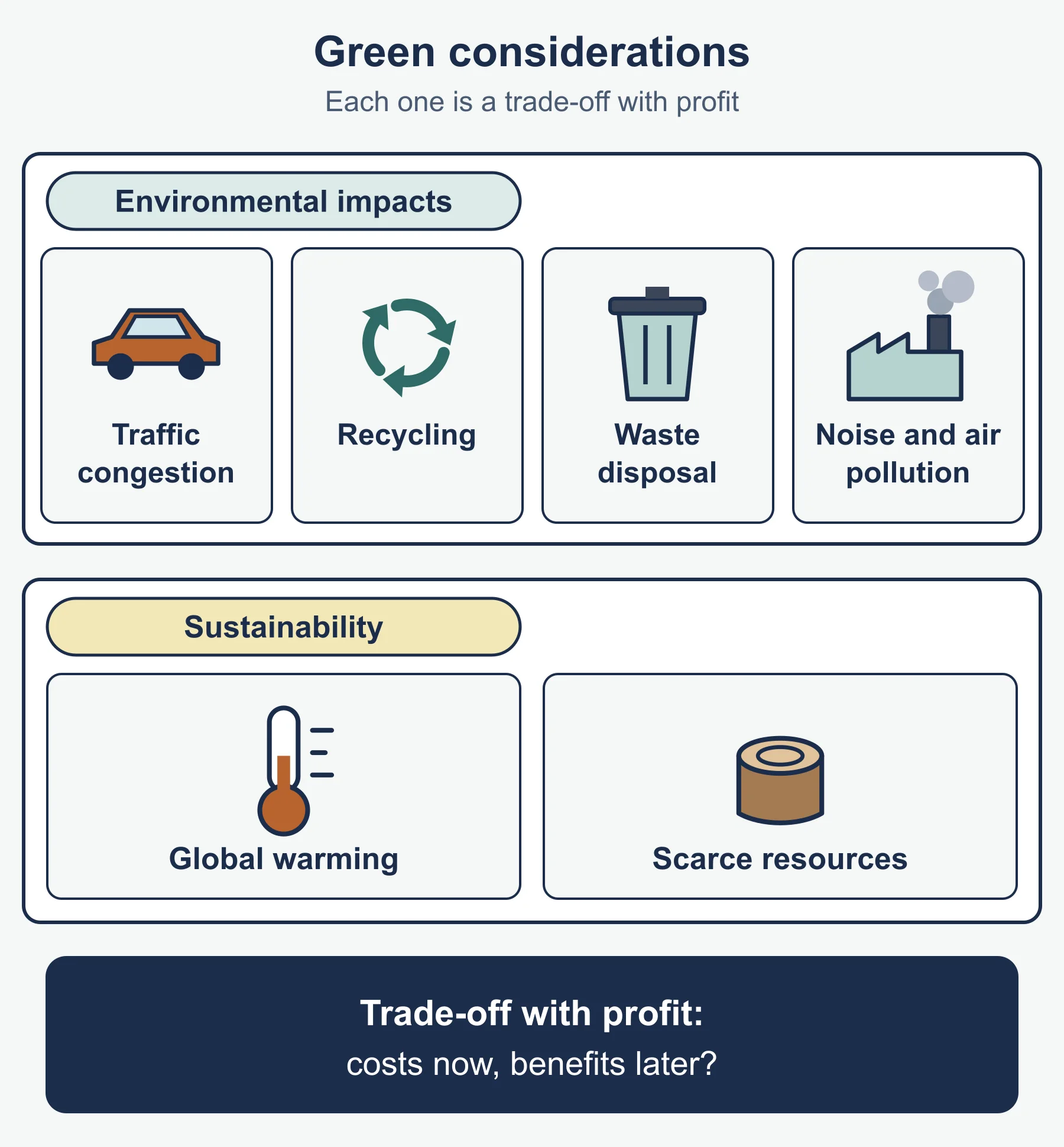
How business harms and helps the environment
- Harm: global warming from burning fossil fuels, air and water pollution, noise, waste, loss of habitats, use of non-renewable resources.
- Help: renewable energy, recycling, less packaging, longer-lasting products, local sourcing.
Externalities: spot the difference
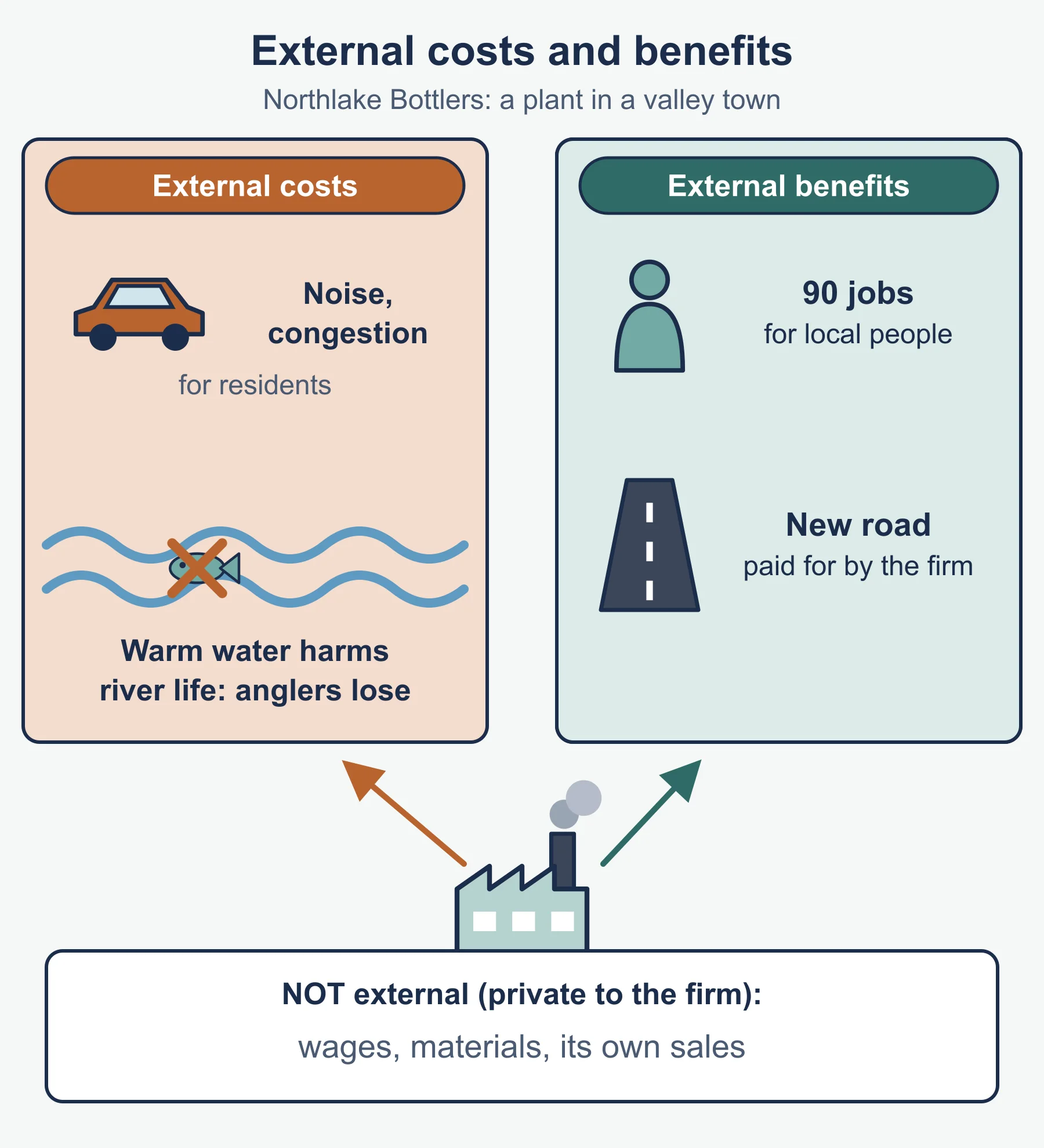
- The test: who pays or gains? If it is someone outside the business and its customers, it is external.
- A factory’s higher wage bill is private. A river polluted by the factory is an external cost.
- Do not credit the business with its own sales or profit as an external benefit.
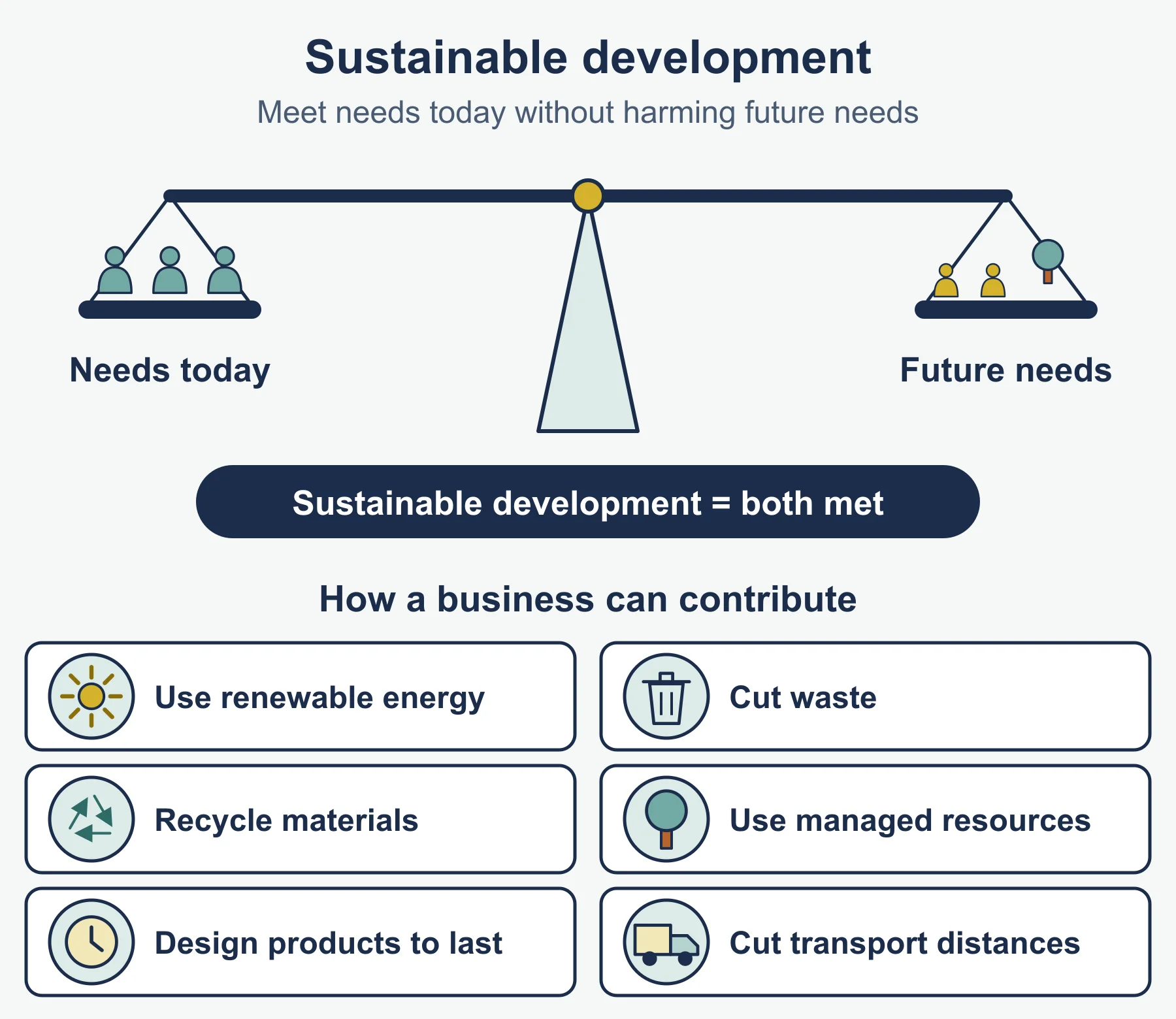
Sustainable development: ways a business can contribute
- Switch to renewable energy.
- Cut waste and recycle materials.
- Use resources from managed sources.
- Design products to be repaired, not thrown away.
- Reduce transport distances.
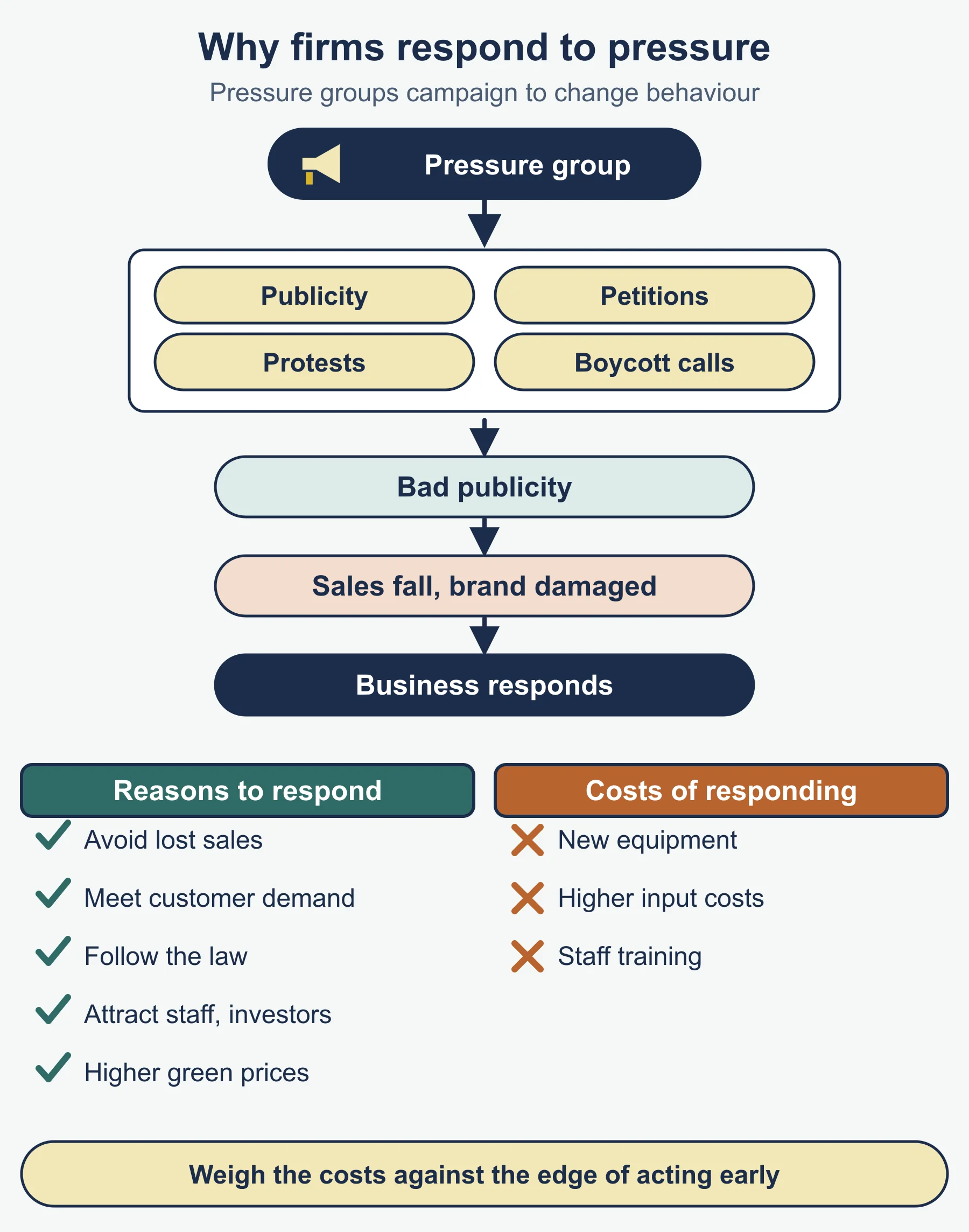
Responding to pressure and opportunity
| Reason to respond | Cost or limit of responding |
|---|---|
| Avoid lost sales from boycotts or bad publicity | New equipment and training |
| Meet customer demand for green products | Higher input costs |
| Follow the law and avoid fines | May raise prices against rivals |
| Attract staff and investors | Benefits may take time to appear |
Pressure group methods: publicity, petitions, protests, calls for boycotts, lobbying government.
Legal controls
- Purpose: stop harm and set the same minimum standard for all.
- Business effect: higher costs, but fewer fines and a better reputation.
- Keep descriptions general. Say “a pollution control” and explain what it does; do not make up the name of a law.
Profit versus ethics
| Issue | Profit-first choice | Ethical response |
|---|---|---|
| Child labour | Cheapest supplier, no checks | Audit suppliers, stop buying where it is found |
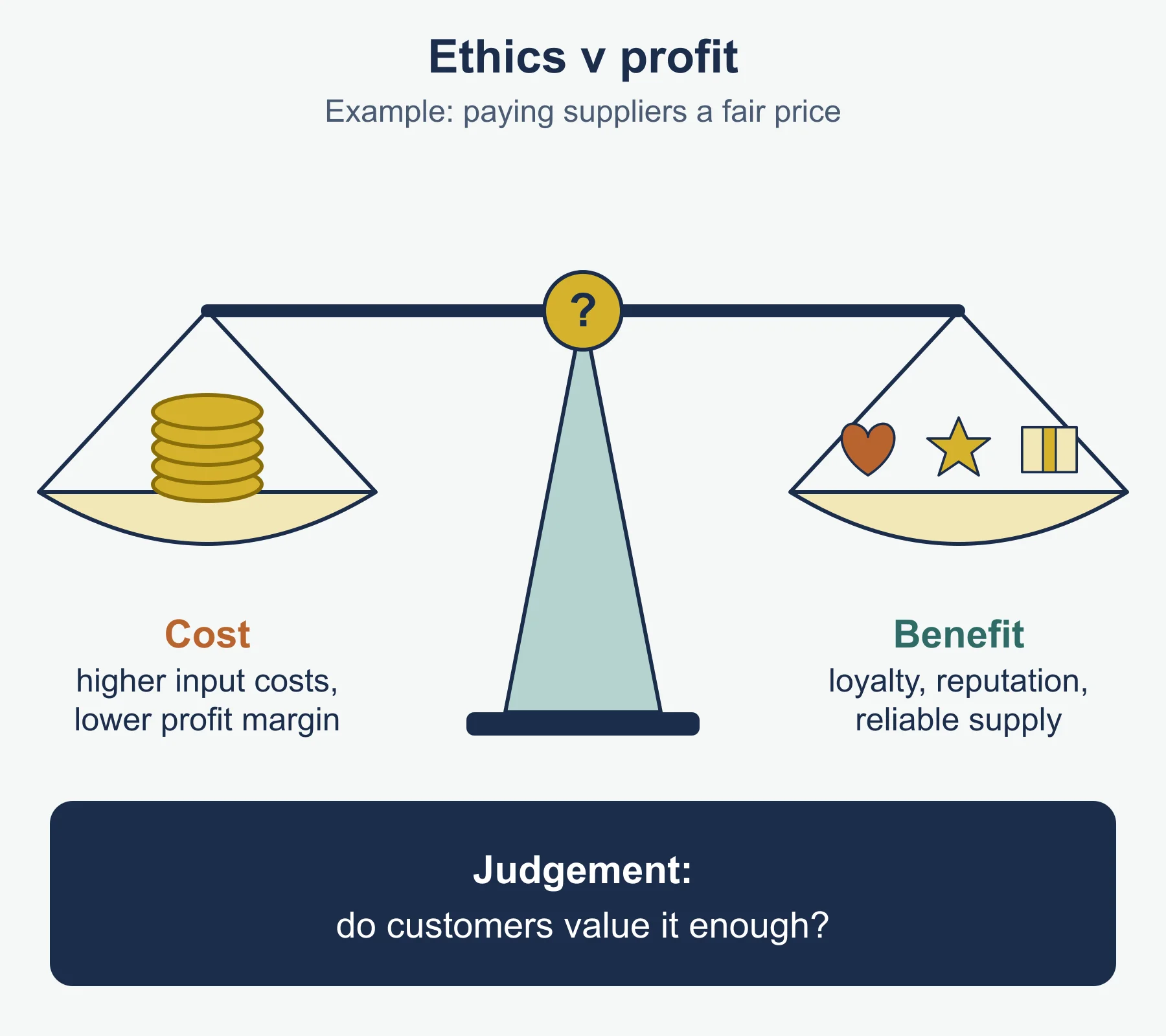
| Supplier prices | Squeeze the price down | Pay a fair price for a stable supply |
| Honest information | Overstate product claims | Tell the truth, accept lower short-term sales |
Judgement tip: an ethical choice often costs money now but can protect the brand, supply and customer trust.
6.3.1 Globalisation
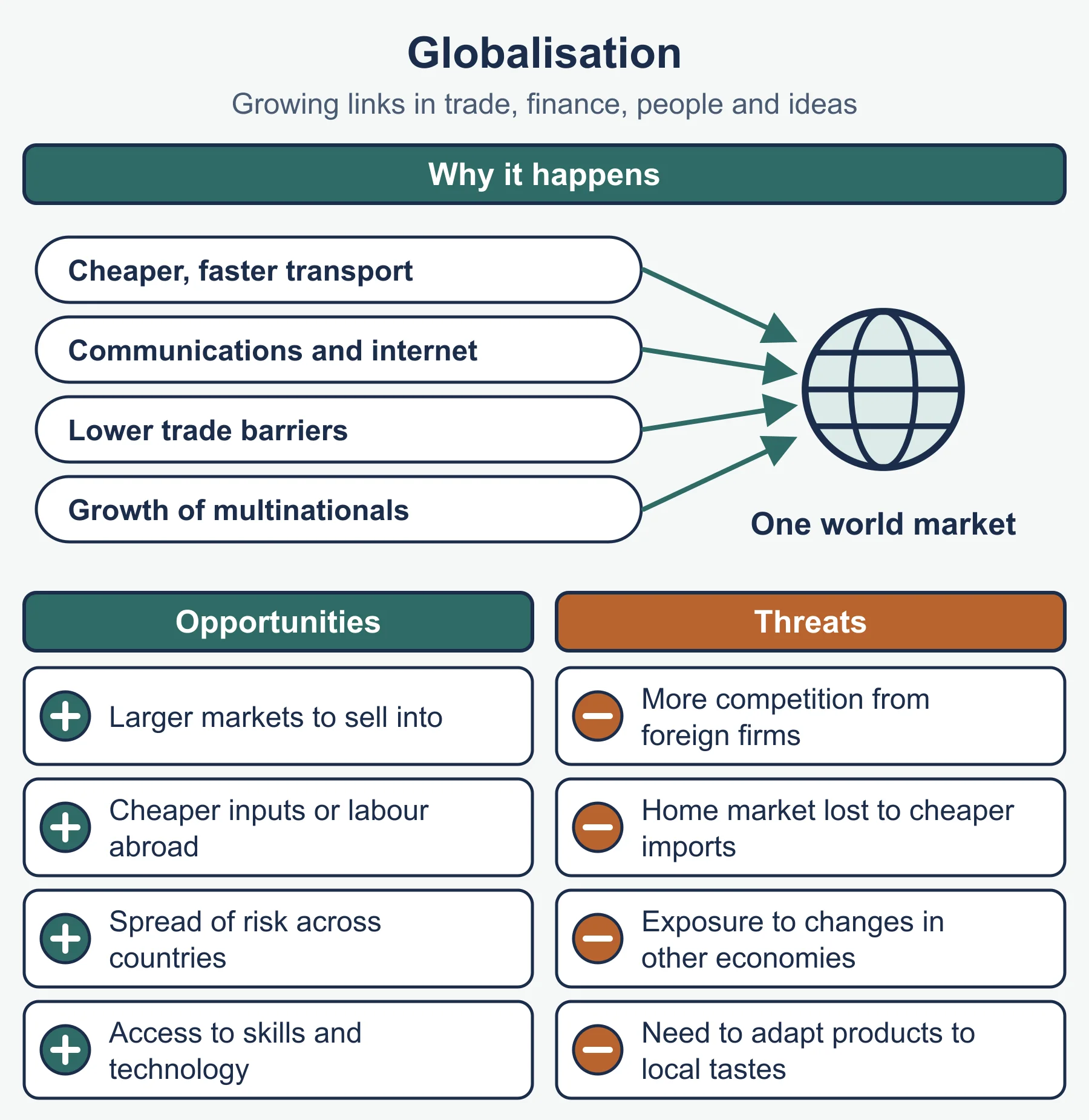
- Causes: cheaper transport, faster communication, lower trade barriers, growth of MNCs.
- Opportunities: bigger markets, cheaper inputs, spread of risk.
- Threats: more competition, lost home sales to cheap imports, need to adapt to local tastes.
Tariff versus quota
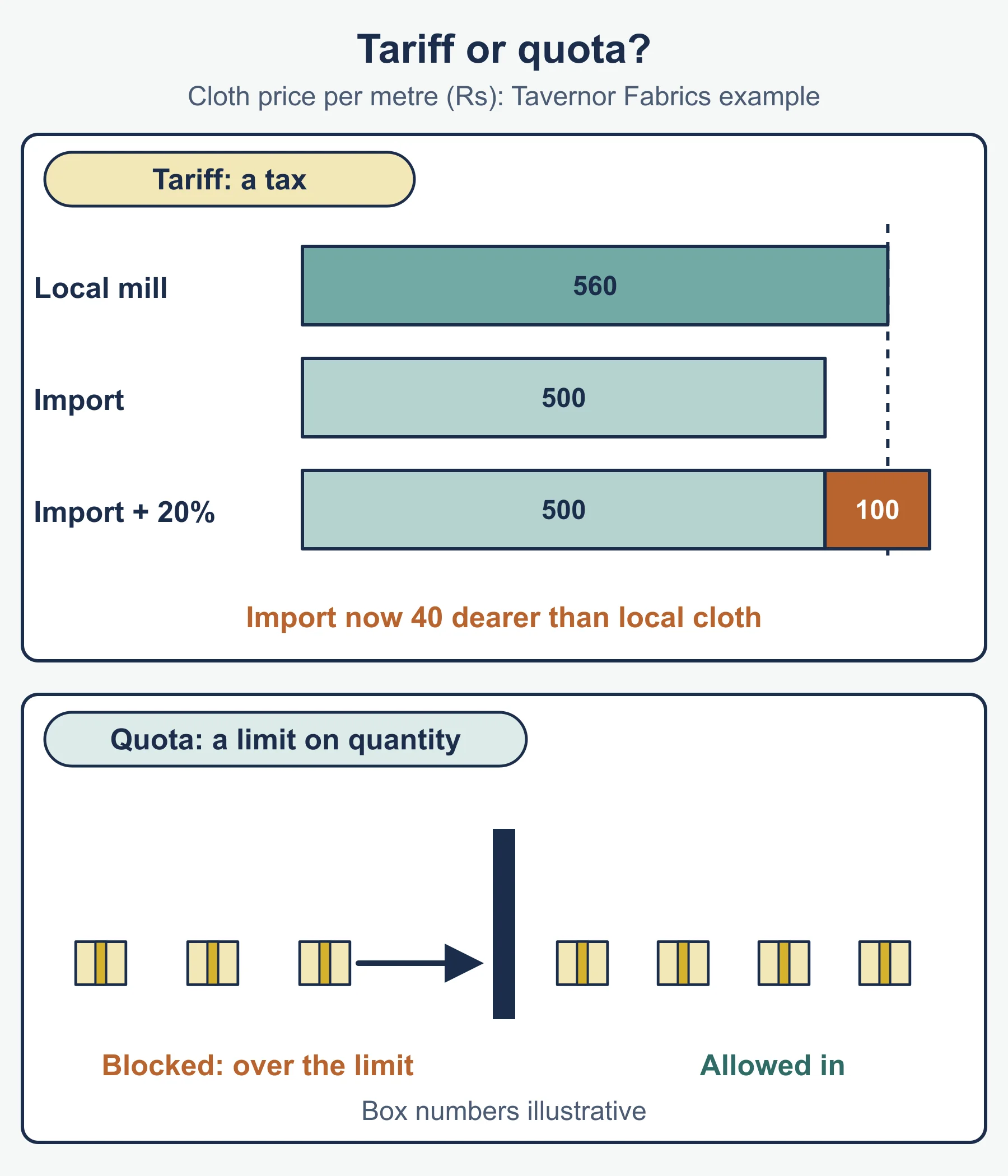
| Tariff | Quota | |
|---|---|---|
| What it is | Tax on imports | Limit on quantity imported |
| Effect on price | Imports cost more | Imports become scarce, so prices may rise |
| Government gain | Raises tax revenue | None directly |
| Why used | Protect local firms and jobs, protect new industries, raise money | Protect local firms and jobs |
Price with a percentage tariff = import price × (1 + tariff rate). Example: a 25% tariff on a Rs 800 item gives 800 × 1.25 = Rs 1,000.
6.3.2 Multinationals
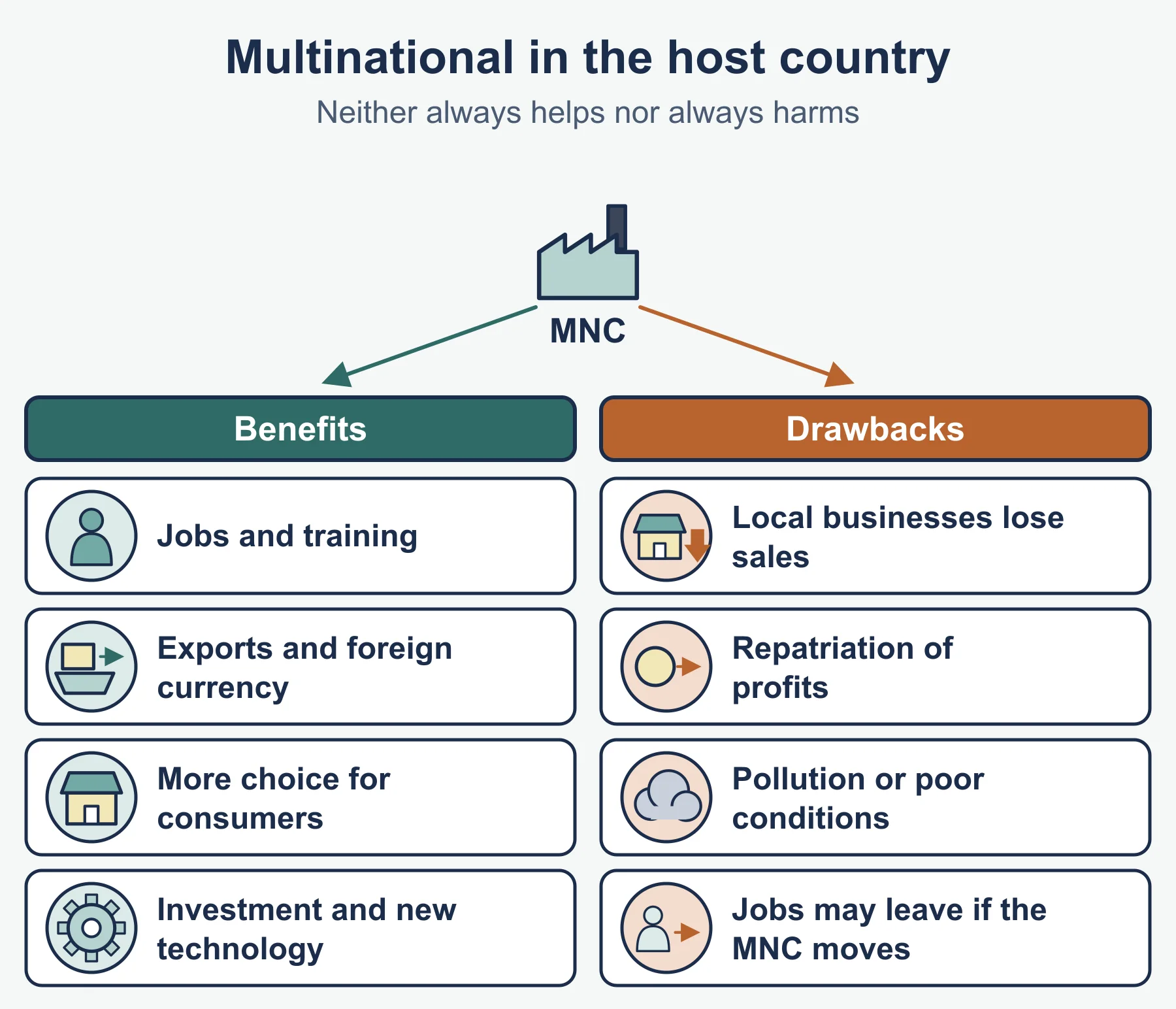
- Why they grow: new markets, lower costs, avoid tariffs by producing locally, spread risk, economies of scale.
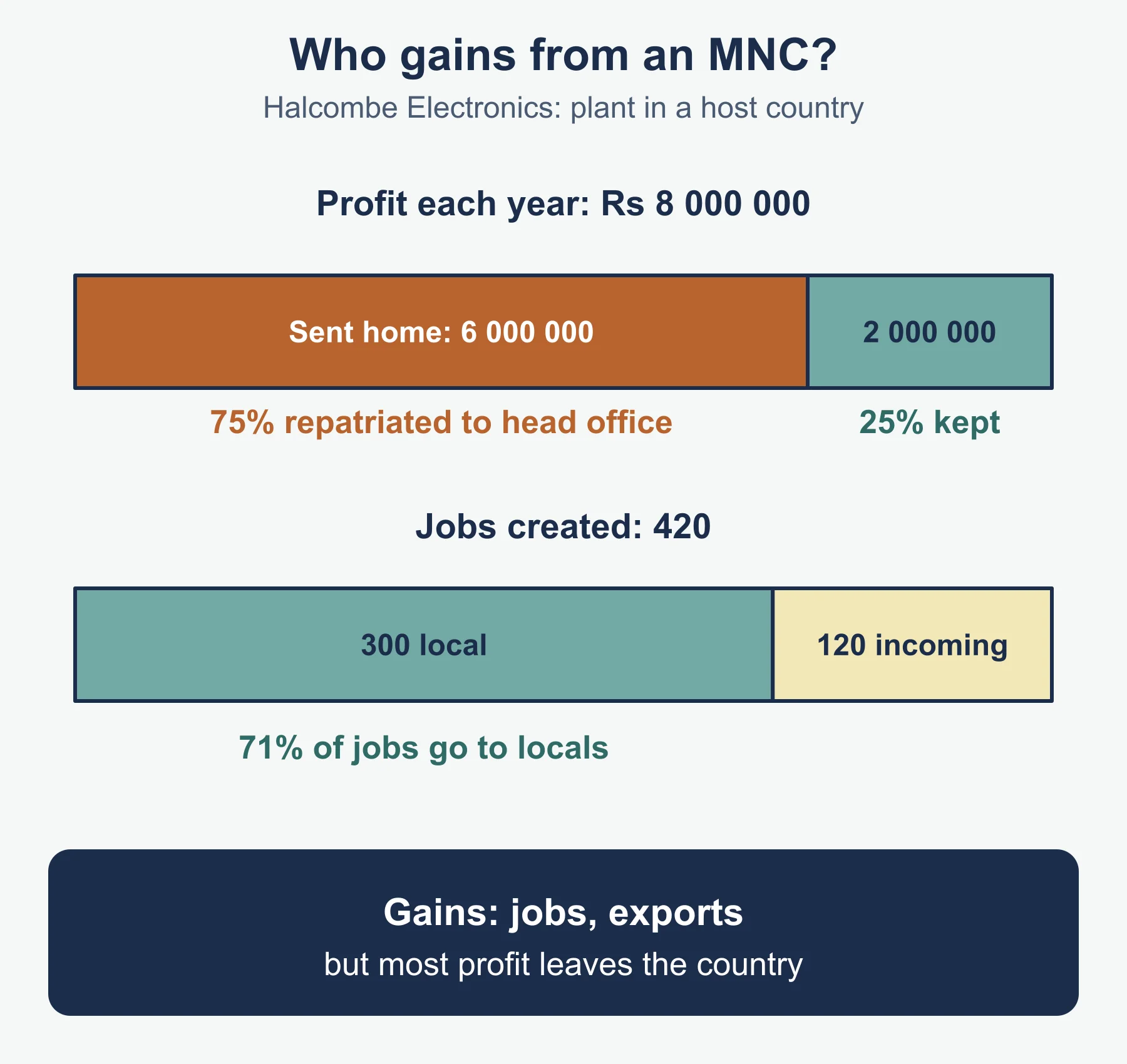
- Stakeholders: shareholders may gain; home workers may lose jobs; host-country workers gain jobs; local suppliers gain contracts.
| Host country gains | Host country loses |
|---|---|
| Jobs | Local businesses lose sales |
| Exports | Repatriated profits |
| More choice | Pollution or poor conditions possible |
| Investment | Jobs can leave quickly |
Method in steps for a host-country question:
- State the effect (job, export, choice, investment, lost sales, repatriation).
- Link it to the case study.
- Say who is affected.
- For evaluate, say which effect is larger and why.
6.3.3 Exchange rates
| Home currency | Exporter | Importer |
|---|---|---|
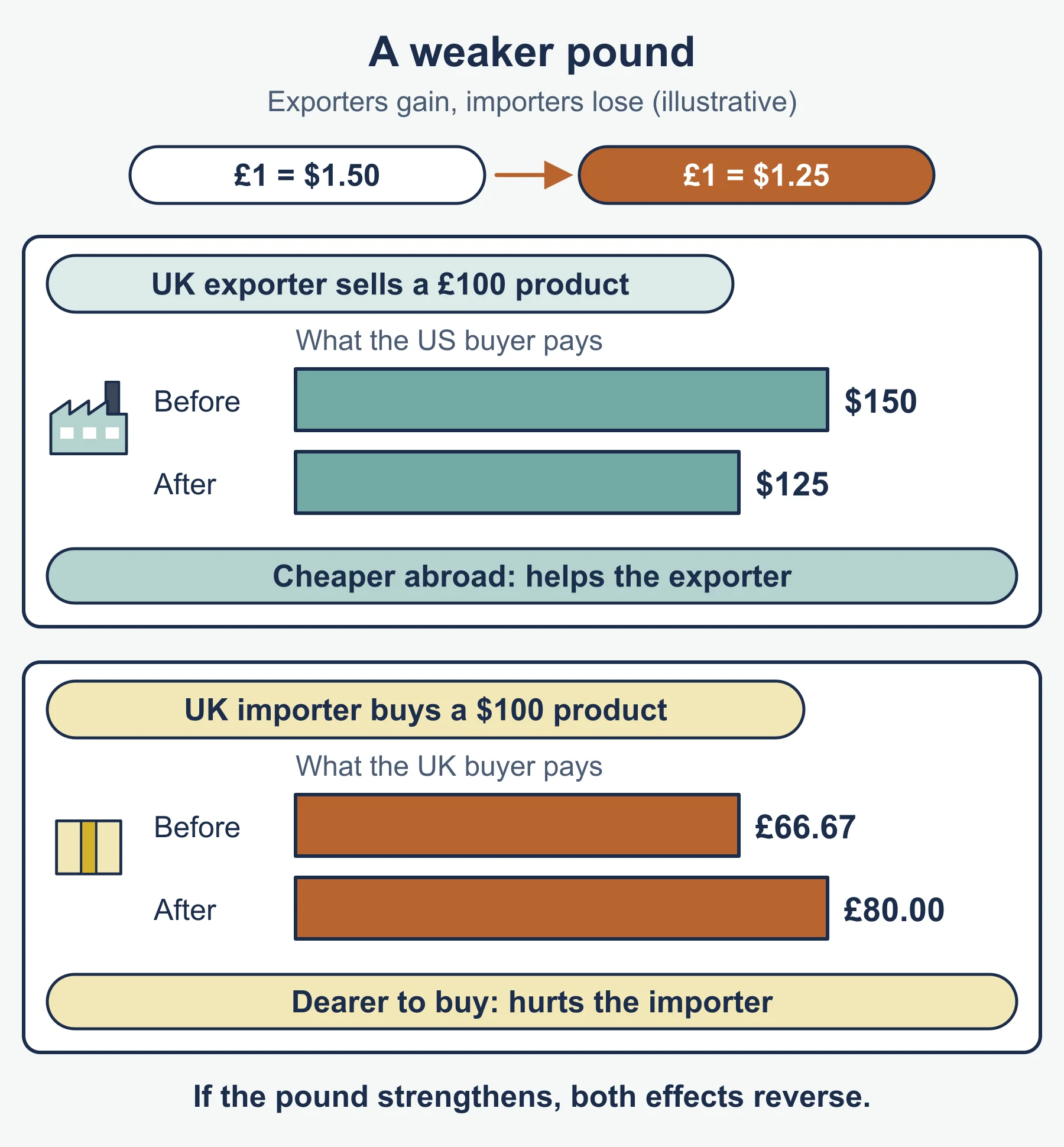
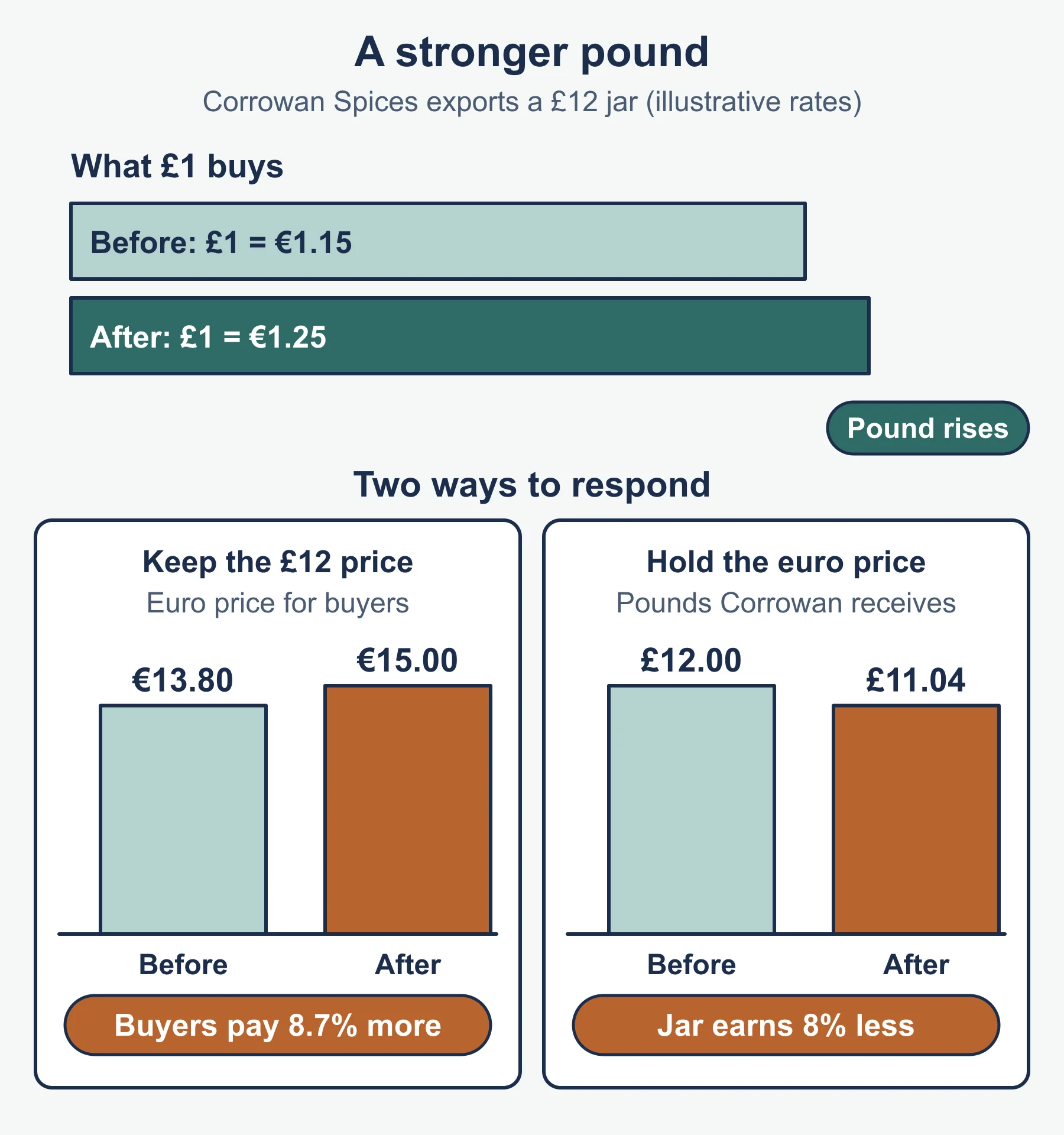
| Appreciates | Foreign price rises, less competitive | Inputs cheaper, costs fall |
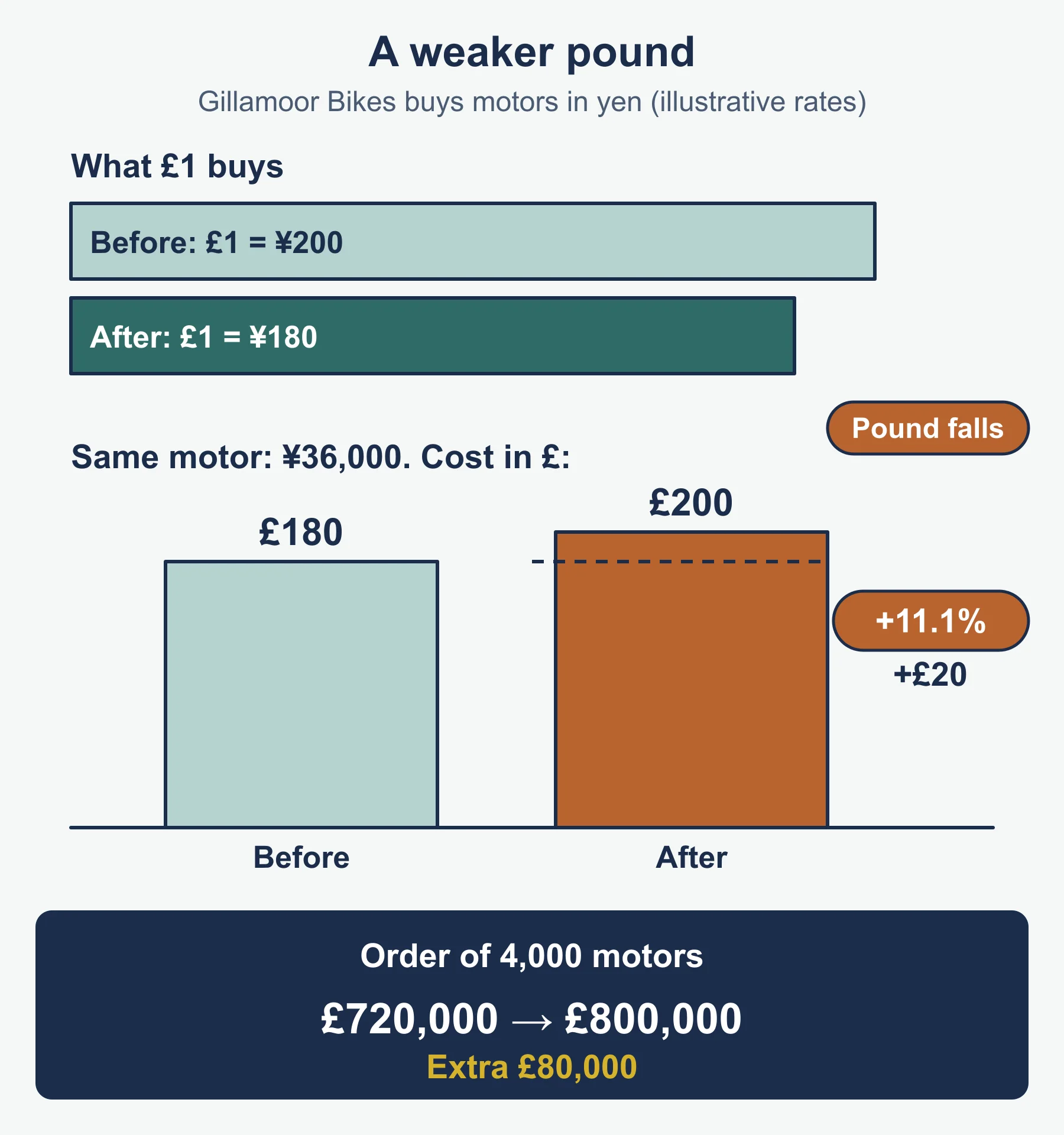
| Depreciates | Foreign price falls, more competitive | Inputs dearer, costs rise |
Exchange rate calculations are not assessed, so learn the direction of each effect and the reason.
Worked reminders
Ethics and profit with numbers
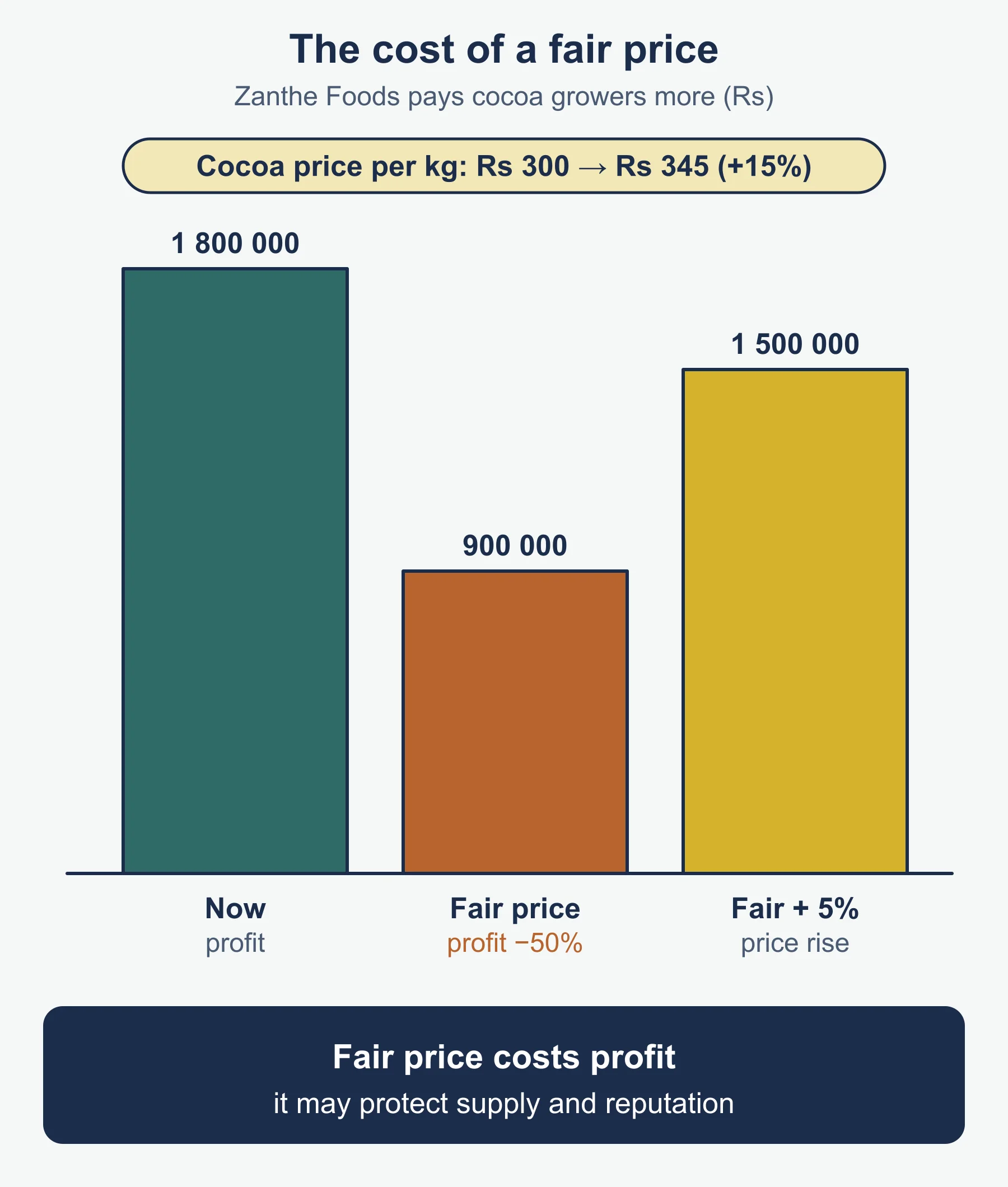
A garment maker buys 40,000 shirts a year from a supplier at Rs 450 each and earns Rs 3,600,000 profit. The supplier asks for Rs 495 so that it can pay fair wages.
- Rise: 45/450 = 10%.
- Extra cost: 40,000 × 45 = Rs 1,800,000.
- Profit falls to Rs 1,800,000, which is a fall of 50%.
Use figures like these to support a judgement: the firm could cover the extra cost with a price rise of Rs 45 per shirt, which is 6% of an average selling price of Rs 750.
Payback on a green investment
A new boiler costs Rs 420,000 and cuts a Rs 2,500,000 energy bill by 12%. The yearly saving is Rs 300,000, so the cost is recovered in 420,000/300,000 = 1.4 years. That supports the case for acting, though an answer should also mention the cash needed at the start.
Case-study skills for this topic
- Application: use the name of the business, product and place from the stimulus in each sentence.
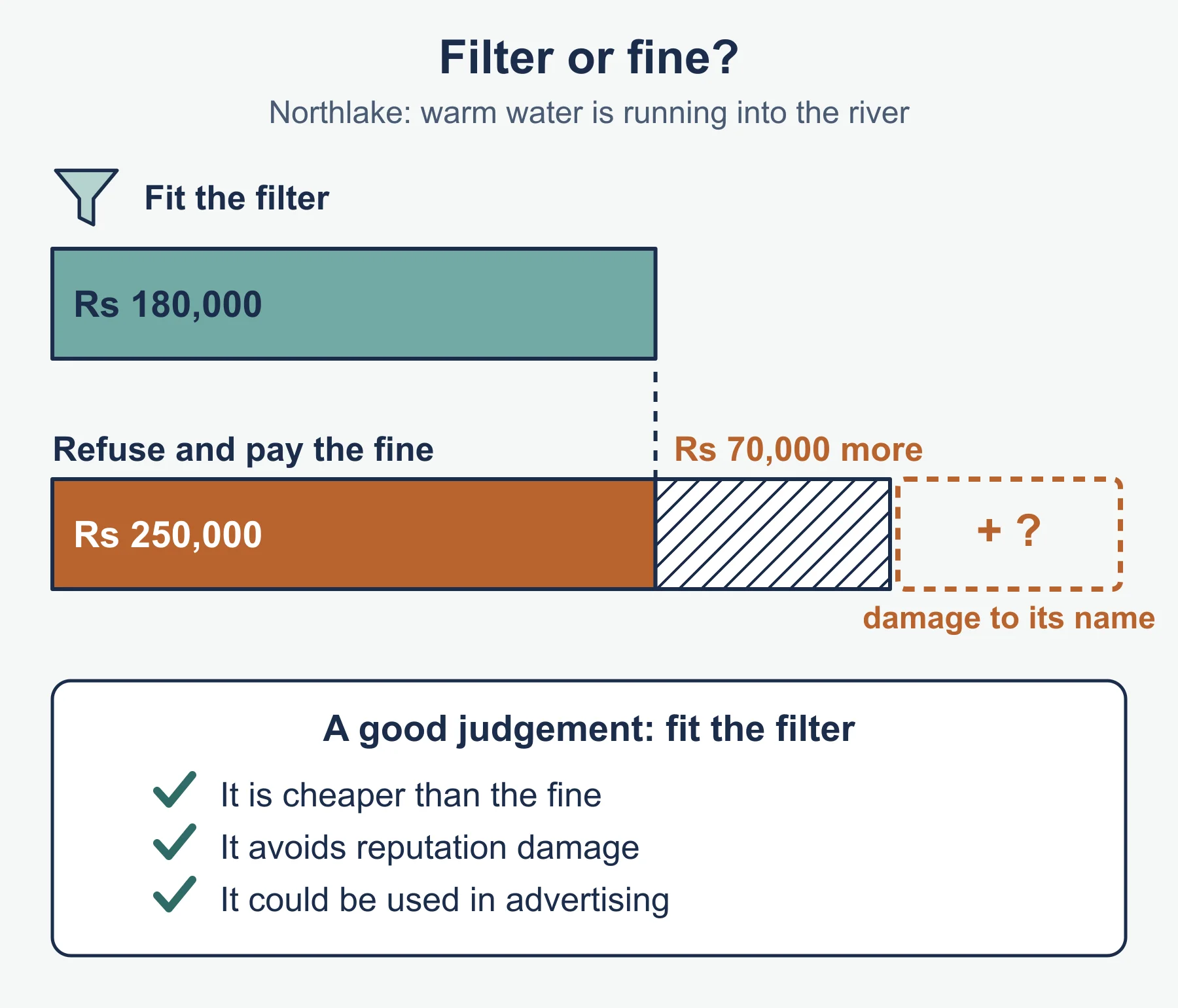
- Analysis: build a chain of reasoning, for example new filter, higher cost, lower profit, but fewer fines and better image.
- Evaluation: weigh both sides, say which matters more in this case and why. Short-term cost against long-term reputation is a common line of judgement.
- Command words: state and identify need a short answer; explain and analyse need a developed chain; evaluate, justify and recommend need a reasoned decision.
Quick exchange-rate cues
- Ask which direction the currency moved.
- Decide whether the business sells abroad (exporter), buys abroad (importer) or both.
- Say what happens to prices, competitiveness and profitability.
- Mention one thing the business can do, such as changing supplier or adjusting prices.
Must-know distinctions
- External cost or benefit versus private cost or benefit.
- Tariff (tax) versus quota (limit).
- Appreciation versus depreciation.
- Benefit to the MNC versus benefit to the host country.
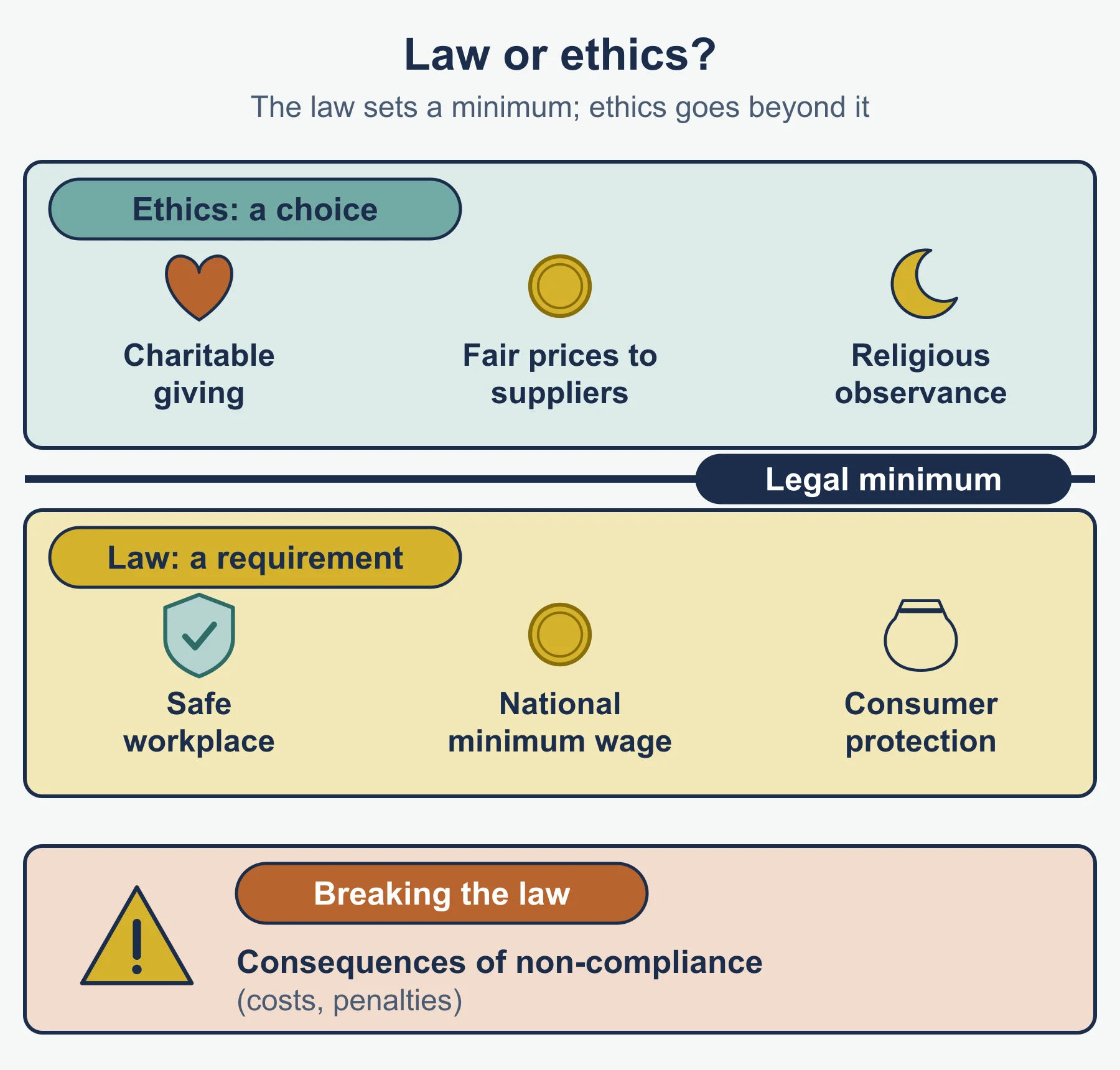
- Legal duty (must do) versus ethical choice (ought to do).
Quick self-test
- State what an externality is.
- A town gains 60 jobs from a new brewery. Is this an external or private benefit?
- Give one way a business can contribute to sustainable development.
- Name two methods a pressure group could use.
- A 25% tariff is placed on an imported item priced at Rs 800. What is the new price?
- Why might a government choose a quota rather than a tariff?
- Explain repatriation of profits.
- A country’s currency depreciates. State the likely effect on its exporters.
- A buyer pays 15% more to growers, raising the price from Rs 120 to what per kg?
- Give one reason a business might refuse to use a cheaper supplier that employs children.
Answers
- A cost or benefit to people who are not part of the business or its customers.
- External benefit, because it gains people outside the business.
- Any one: renewable energy, recycling, reducing waste, sustainably sourced materials.
- Any two: publicity campaigns, petitions, protests, calling for a boycott, lobbying the government.
- Rs 1,000 (800 × 1.25).
- It sets a firm limit on quantity, which protects local firms by capping imports, though it raises no tax revenue.
- Profits earned in a host country are sent back to the MNC’s home country, not reinvested locally.
- Its goods become cheaper abroad, so export sales may rise.
- Rs 138 (120 × 1.15).
- To protect its reputation, avoid boycotts and act ethically.
Where marks are usually lost
- Giving a cost to the business itself when asked for an external cost.
- Confusing a tariff with a quota, or calling a quota a tax.
- Describing what a pressure group wants, not the method it uses.
- Reversing appreciation and depreciation in an exchange-rate answer.
- Listing MNC effects without linking them to the host country in the case.
- Writing a one-sided answer to an “evaluate” or “justify” question.
- Inventing named laws instead of describing the legal control in general terms.
- Naming an ethical issue but not giving a business response.
Frequently asked questions
What is the difference between an import tariff and an import quota? An import tariff is a tax on imported goods, which raises their price. An import quota is a limit on the quantity of a good that may be imported.
What is the difference between an external cost and an external benefit? An external cost is borne by third parties, such as smoke harming the health of people nearby. An external benefit is a gain to third parties, such as local jobs created when a new factory attracts shops and cafes.
What is the difference between appreciation and depreciation of a currency? Appreciation means a currency buys more foreign currency, while depreciation means it buys less. Reversing the two is the usual way to lose all the marks on an exchange-rate question.
What is repatriation of profits? Repatriation of profits means a multinational sends profits back to its home country instead of reinvesting them where they were earned.
Official syllabus
Cambridge O Level Business Studies 7115, syllabus for examination in 2026, Cambridge University Press and Assessment (Cambridge International Education).
Get free revision emails (optional)
Occasional emails with practice questions, worked explanations and links to free resources for the qualification and subjects you choose. No spam, and you can unsubscribe from any email. The free tools on this site never need an email.
Related resources
-
Practice questions
O Level Business: External influences on business activity — Practice Questions (Cambridge 7115)
Original practice questions with worked answers on import quotas, tax, external costs, pressure groups, exchange and interest rates for O Level Business 7115.
Business · Cambridge · O Level
Try questions -
Study guides
O Level Business: Economic issues (Cambridge 7115)
Study guide to Cambridge O Level Business 7115 section 6.1: the business cycle, government economic objectives, taxes, spending and interest rates.
Business · Cambridge · O Level
Read guide -
Practice questions
O Level Business: Economic issues (Cambridge 7115) – Practice Questions
Original practice questions with worked answers on the business cycle, taxes, government spending and interest rates for Cambridge O Level Business 7115.
Business · Cambridge · O Level
Try questions
Related articles
-
teaching
A Level tuition in Dubai: Cambridge or Pearson Edexcel International A Level?
Schools in Dubai and Abu Dhabi teach either Cambridge International AS & A Level or Pearson Edexcel International A Level. How the two are structured, why it matters for tuition, and how online classes from Lahore work.
9 October 2026
-
curriculum guides
Choosing subjects at IGCSE and A Level
How subject choices at 14 and 16 affect university options later, and how to keep pathways open without overloading a timetable.
28 July 2026
Studying this with a teacher
Working through Business O LEVELS?
This page is free and stays free. If you would rather be taught it, Marlbridge runs Business classes one-to-one and in small groups of up to 15, online in your own time zone. The first trial class is free. WhatsApp replies within an hour (8am–11pm Pakistan time, every day); email the same day.
Cambridge Business teachers at Marlbridge

