
Study Guides
O Level Business: Production of goods and services (Cambridge 7115)
Study guide to production, productivity, inventories, lean production, job, batch and flow methods and technology, for Cambridge O Level Business 7115.
- Subject
- Business
- Level
- O LEVELS
- Topic
- Operations management
- Author
- Marlbridge Academic Team
- Updated
- Reviewed by
- Salman Ahmad (what this means)
Aligned to Cambridge O Level Business (7115), For examination in 2026. Official specification .
Syllabus page (what it covers and how it is assessed): Cambridge O Level Business.
Syllabus points this page covers
7115
- 4.1 Production of goods and services
Found an error? Report a correction.
Need help with this topic? Request a free trial class for O Level Business (7115).
This guide is aligned to the Cambridge O Level Business Studies 7115 syllabus for examination in 2026. It covers section 4.1, Production of goods and services, which is part of Topic 4, Operations management. Every content point in 4.1.1, 4.1.2 and 4.1.3 is taught below. The syllabus examines the subject through a short answer and data response paper and a case study paper, so you need the ideas and the skill of applying them to a business you are given.
Use it with the revision notes and the practice set. There is also an earlier operations management practice page that covers location, costs and break-even. Check the course hub and the checklist, and try the free 10-minute diagnostics to see where you stand.
What this section covers
| Syllabus point | What you must be able to do |
|---|---|
| 4.1.1 Meaning of production | Explain how resources are managed to produce goods and services |
| 4.1.1 | Distinguish production from productivity |
| 4.1.1 | Explain the benefits of increased efficiency and how to increase it |
| 4.1.1 | Explain why businesses hold inventories |
| 4.1.1 | Explain lean production, how to achieve it (just-in-time and Kaizen) and its benefits |
| 4.1.2 Methods | Give features, benefits and limitations of job, batch and flow production |
| 4.1.2 | Recommend and justify a method for a given situation |
| 4.1.3 Technology | Explain how technology has changed and is changing production methods, for example computers in design and manufacturing |
The meaning of production
Production is the process of turning inputs into outputs. A business needs resources: land and buildings, workers, machines and materials, plus money to pay for them. Managing those resources effectively means using them in the right amounts, at the right time, so that goods (a ceramic mug) or services (a haircut, a delivery) reach customers at a cost the business can afford and a quality customers accept. Waste of any resource raises cost per unit or lowers quality.
Production and productivity
These two words look similar and are often mixed up.
- Production is the total amount a business makes in a period. It is output: 3,000 mugs in a month.
- Productivity compares output with the resources used to make it. The usual measure is labour productivity, found by the standard form: output in a period divided by the number of workers.
Production can rise while productivity falls. If a firm doubles its workforce to double output, production rises but output per worker is unchanged.
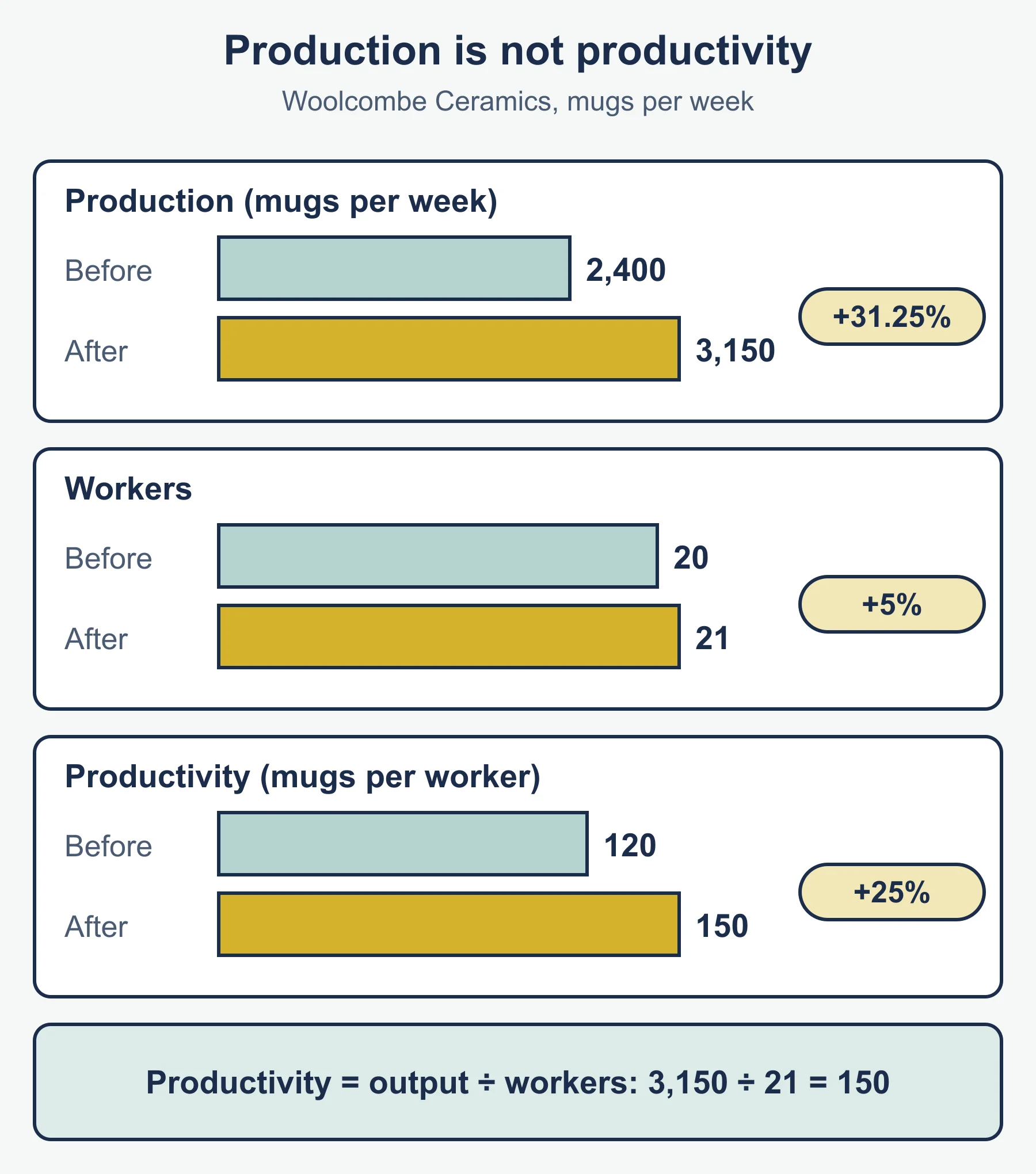
Worked example. Woolcombe Ceramics made 2,400 mugs in a week with 20 workers. After training and a new glazing machine it made 3,150 mugs in a week with 21 workers.
- Productivity before: 2,400 / 20 = 120 mugs per worker per week.
- Productivity after: 3,150 / 21 = 150 mugs per worker per week.
- Change in productivity: (150 - 120) / 120 x 100 = 25% increase.
- Change in production: (3,150 - 2,400) / 2,400 x 100 = 31.25% increase.
Production rose by more than productivity because one extra worker was also hired. Always state units: mugs per worker per week.
Benefits of increasing efficiency
Being efficient means getting more output from the same inputs, or the same output from fewer inputs. Benefits include:
- lower average cost per unit, which allows lower prices or higher profit
- a stronger position against competitors
- less waste of materials, time and energy
- the ability to meet orders faster
- more money available for wages or investment
How to increase efficiency
The syllabus names two examples, and others follow the same logic.
- Automation and technology. Machines and computer control produce at steady speed, make fewer errors and need less labour per unit. The cost is the purchase price, maintenance and possible job losses.
- Improved labour skills. Training lets workers do tasks faster with fewer mistakes, so output per worker rises. Training costs money and time away from work, and trained workers may leave.
Better motivation, better layout and better materials also raise productivity, but these two are the ones the syllabus lists. A good answer links the method to the type of business, then states the effect on productivity and on cost.
Why businesses hold inventories
Inventories are stocks of materials, work in progress and finished goods. A business holds them to:
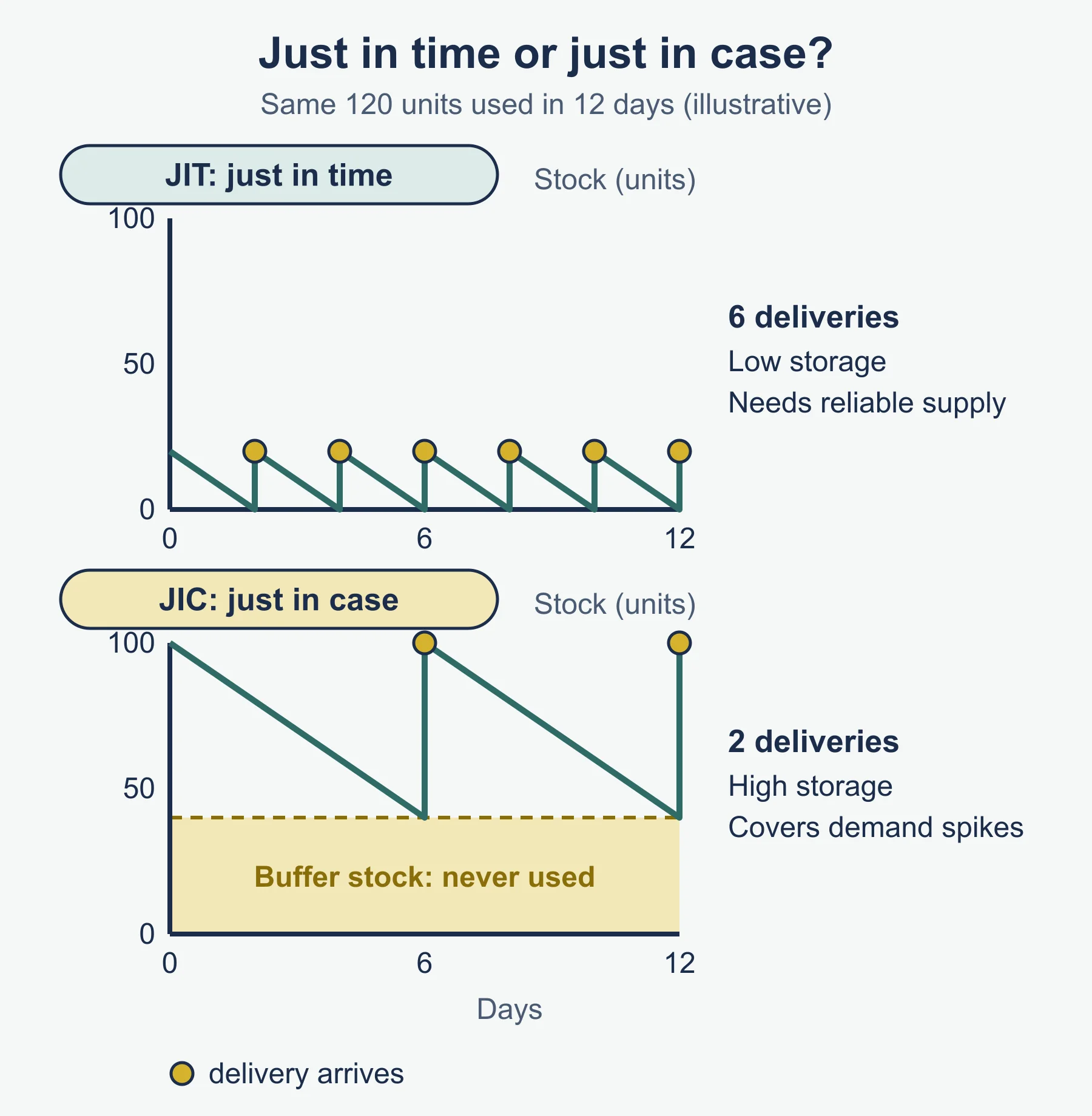
- keep production running if a supplier is late (a buffer)
- meet sudden rises in demand without disappointing customers
- supply customers straight away from finished goods
- buy materials in bulk at a lower price per unit
- allow for seasonal demand, such as a toy maker building stock before a festive season
Holding too much has costs: storage space, insurance, risk of damage or going out of date, and money tied up that could be used elsewhere. Holding too little risks stopping production and losing sales.
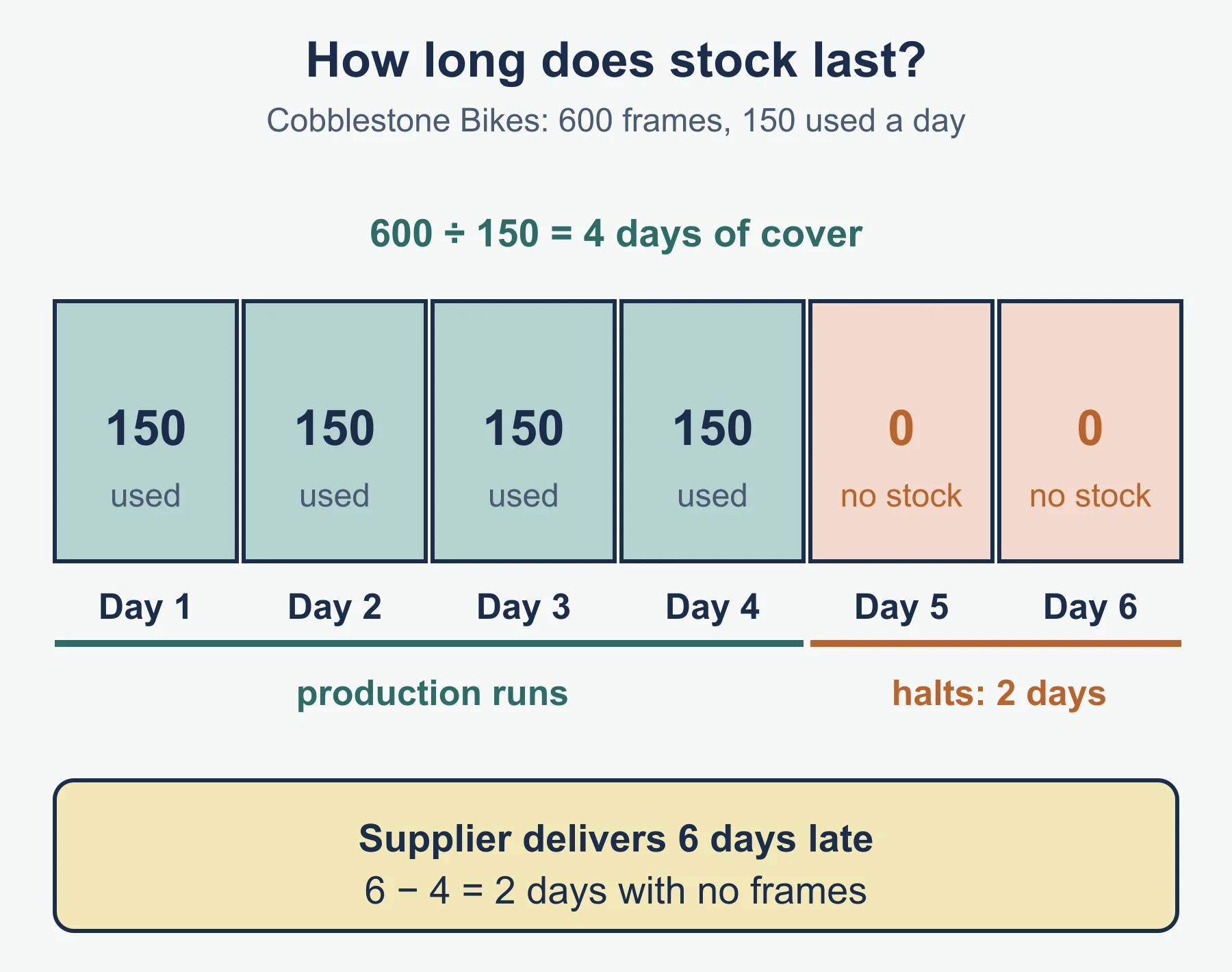
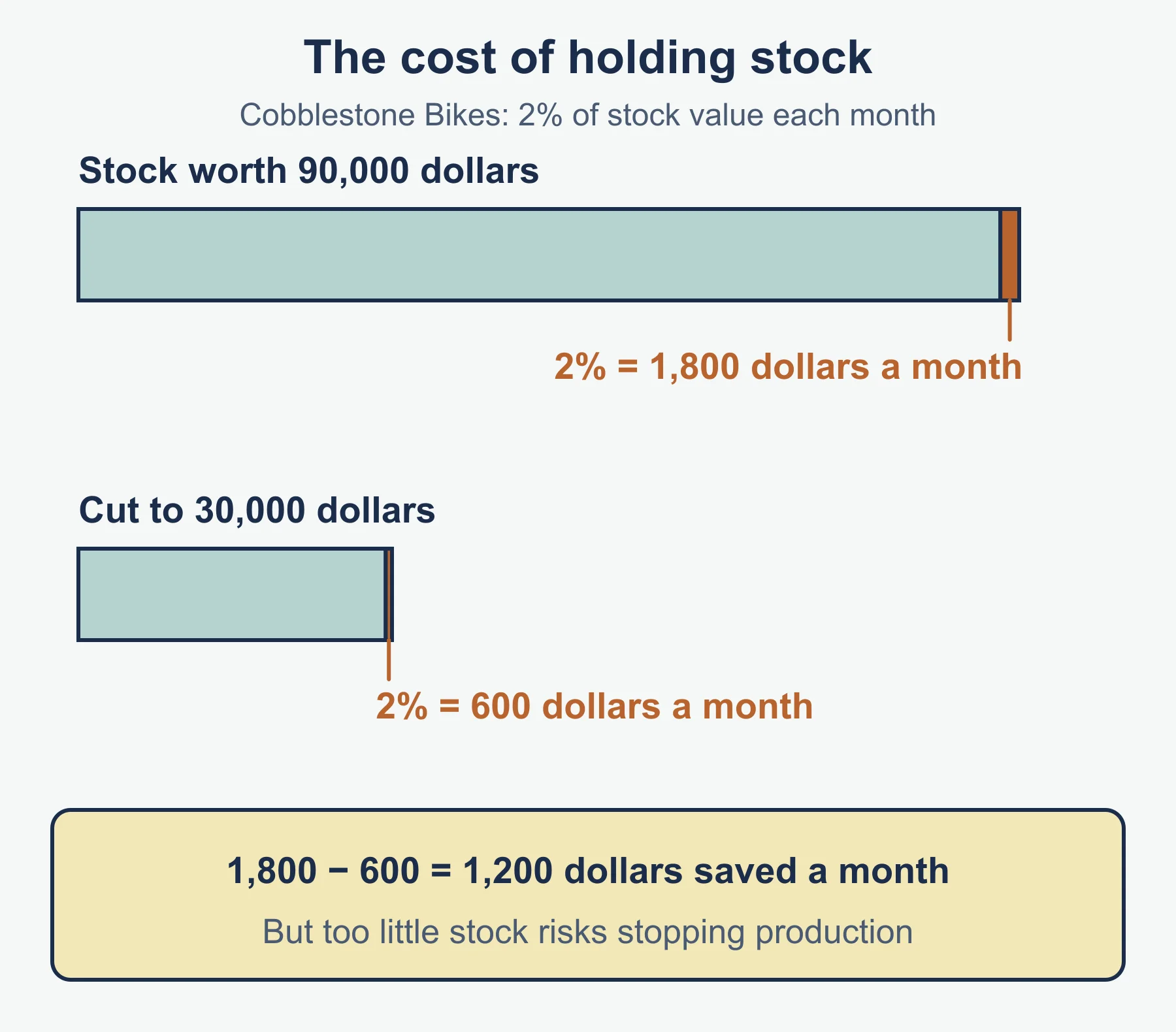
Worked example. Cobblestone Bikes keeps 600 frames in store and uses 150 frames each working day. Cover is 600 / 150 = 4 days. If a delivery is delayed by six days, production halts for two days. Management estimates the cost of holding stock at 2% of its value each month. Stock worth 90,000 dollars costs 1,800 dollars a month to hold. Cutting stock to 30,000 dollars costs 600 dollars, a saving of 1,200 dollars a month.
Lean production
Lean production means producing with as little waste as possible. Waste includes unused inventories, idle time, defects, unnecessary movement and overproduction. The aim is to give customers what they want while using the minimum resources. The syllabus names two ways of achieving it.
Just-in-time (JIT) inventory control. Materials arrive from suppliers just as they are needed, and finished goods leave soon after being made. Inventories are kept very low. This needs:
- reliable suppliers who deliver on time, often in small, frequent loads
- accurate forecasts of demand
- a well-organised production process with few breakdowns
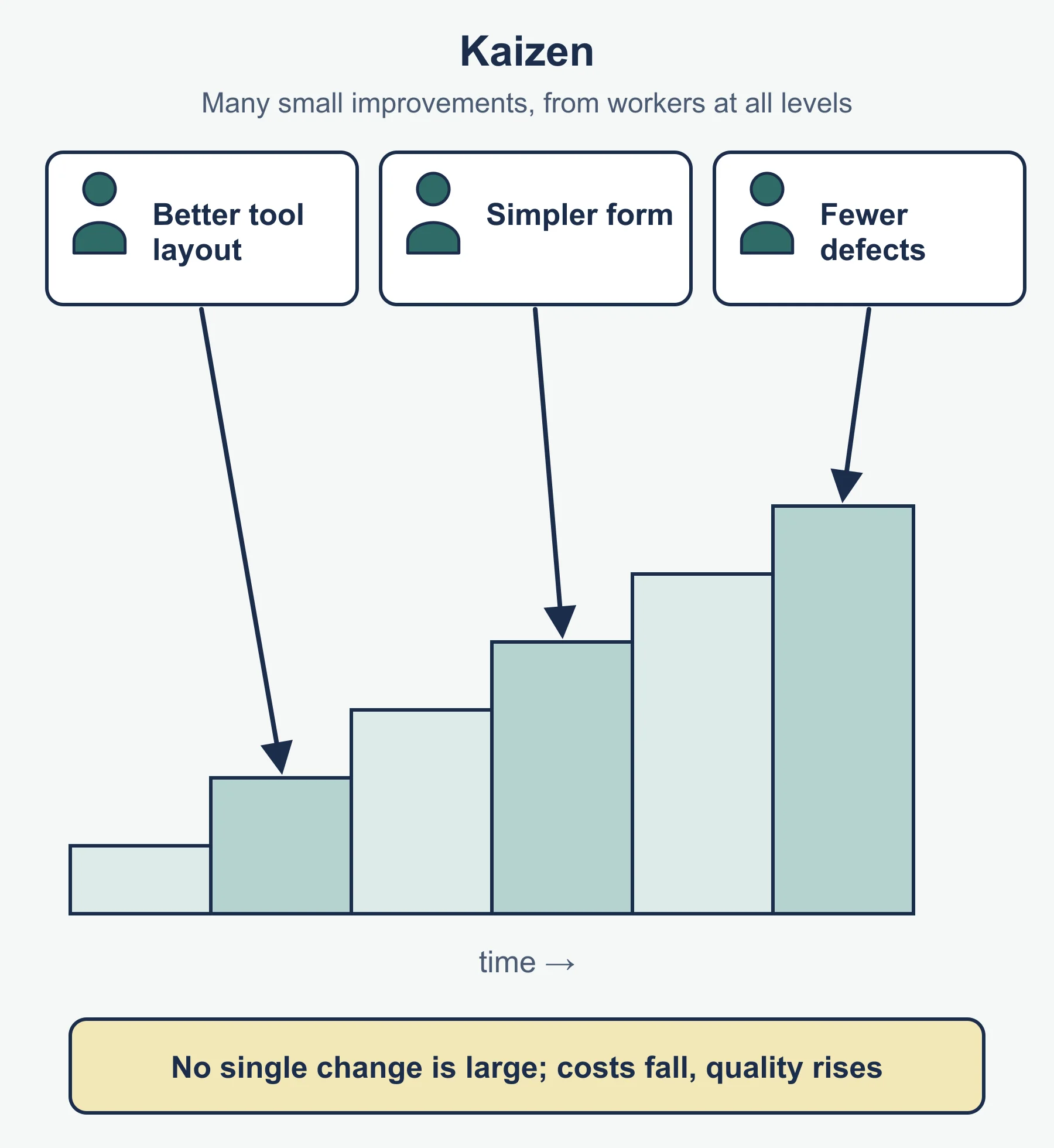
Kaizen. This is a Japanese word for continuous improvement. Workers at all levels suggest many small improvements, often in teams, and the business adopts them steadily. Examples are a better tool layout, a simpler form to fill in, or a change that reduces defects. No single change is large, but over time costs fall and quality rises.
Benefits of lean production.
- lower storage and inventory-holding costs
- less waste and fewer defects, so lower average cost
- quicker response to changes in customer demand
- more involved and motivated workers (especially with Kaizen)
- less cash tied up in stock
A balanced answer also notes that JIT leaves a business exposed: one late delivery can halt output, and the firm may lose bulk-buying discounts. This point goes beyond the syllabus list of benefits, but it helps you write a judgement.
The main methods of production
Job production
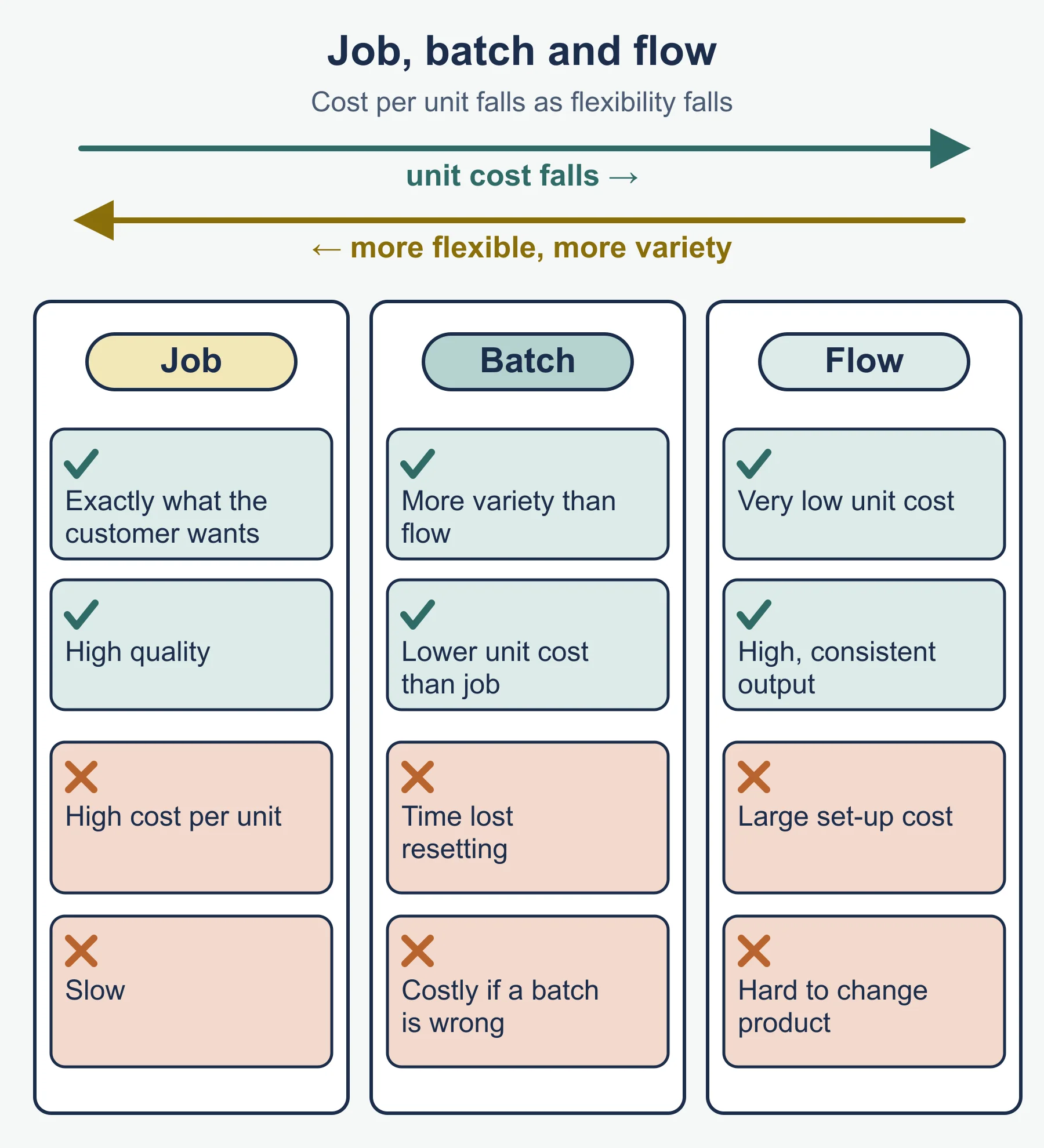
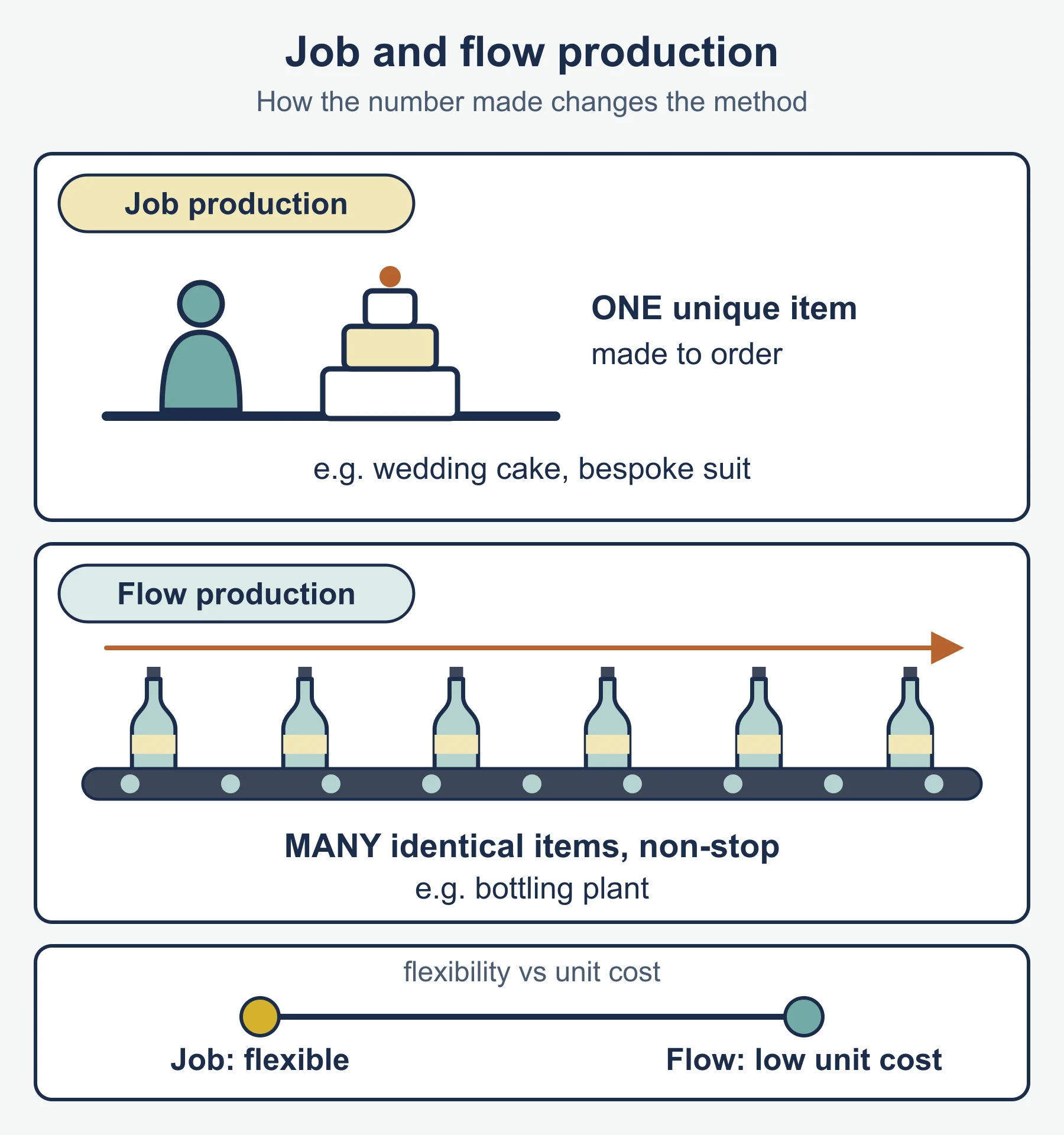
One item is made at a time to a customer’s order. Each job is different.
- Features: skilled workers, flexible tools, one-off orders, often a high price.
- Benefits: the product matches the customer’s wishes exactly; high quality; workers often feel pride in their work.
- Limitations: high cost per unit; slow; hard to use machines throughout; demand may be uneven.
- Example: Westerleigh Joinery builds a curved oak staircase for one house. No other staircase is the same.
Batch production
A group of identical items moves together through each stage, and then the whole process is reset for a different batch.
- Features: machines and workers can switch between products; products are made in set quantities.
- Benefits: more variety than flow production; lower unit cost than job production; flexible if demand changes.
- Limitations: time is lost resetting equipment between batches; storing work in progress between stages; costs rise if a batch is wrong.
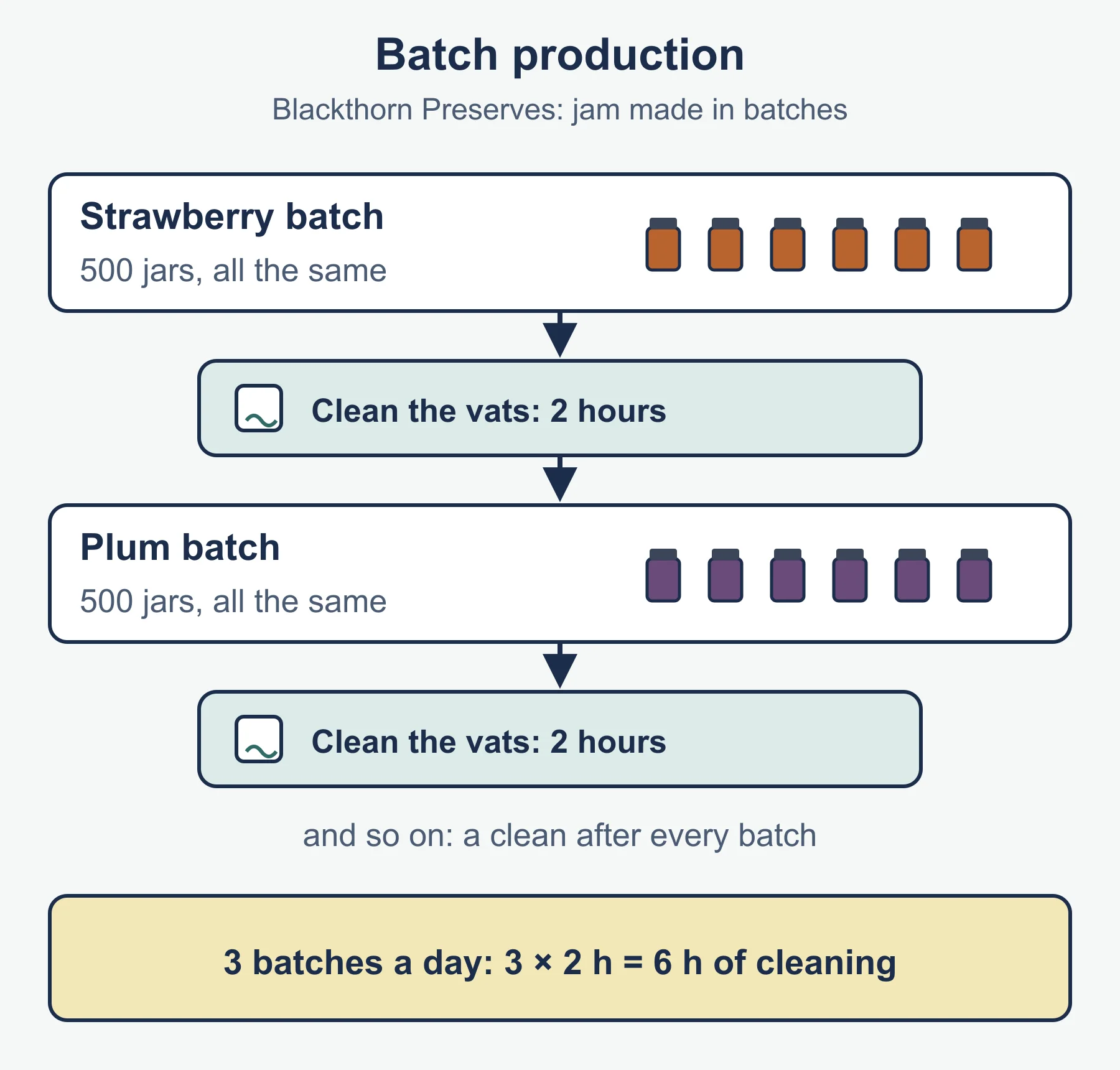
- Example: Blackthorn Preserves makes 500 jars of strawberry jam, cleans the vats for two hours, then makes 500 jars of plum. Making three batches a day uses 6 hours on cleaning.
Flow production
Products move continuously along a line of machines, often 24 hours a day, with each stage doing one task. It suits very high demand for a standard product.
- Features: large machines, high automation, standardised products, continuous output.
- Benefits: very low unit cost, high output, consistent quality, economies of scale.
- Limitations: large setup cost; inflexible, so changing the product is hard and expensive; repetitive work can demotivate workers; if one machine fails the line may stop.
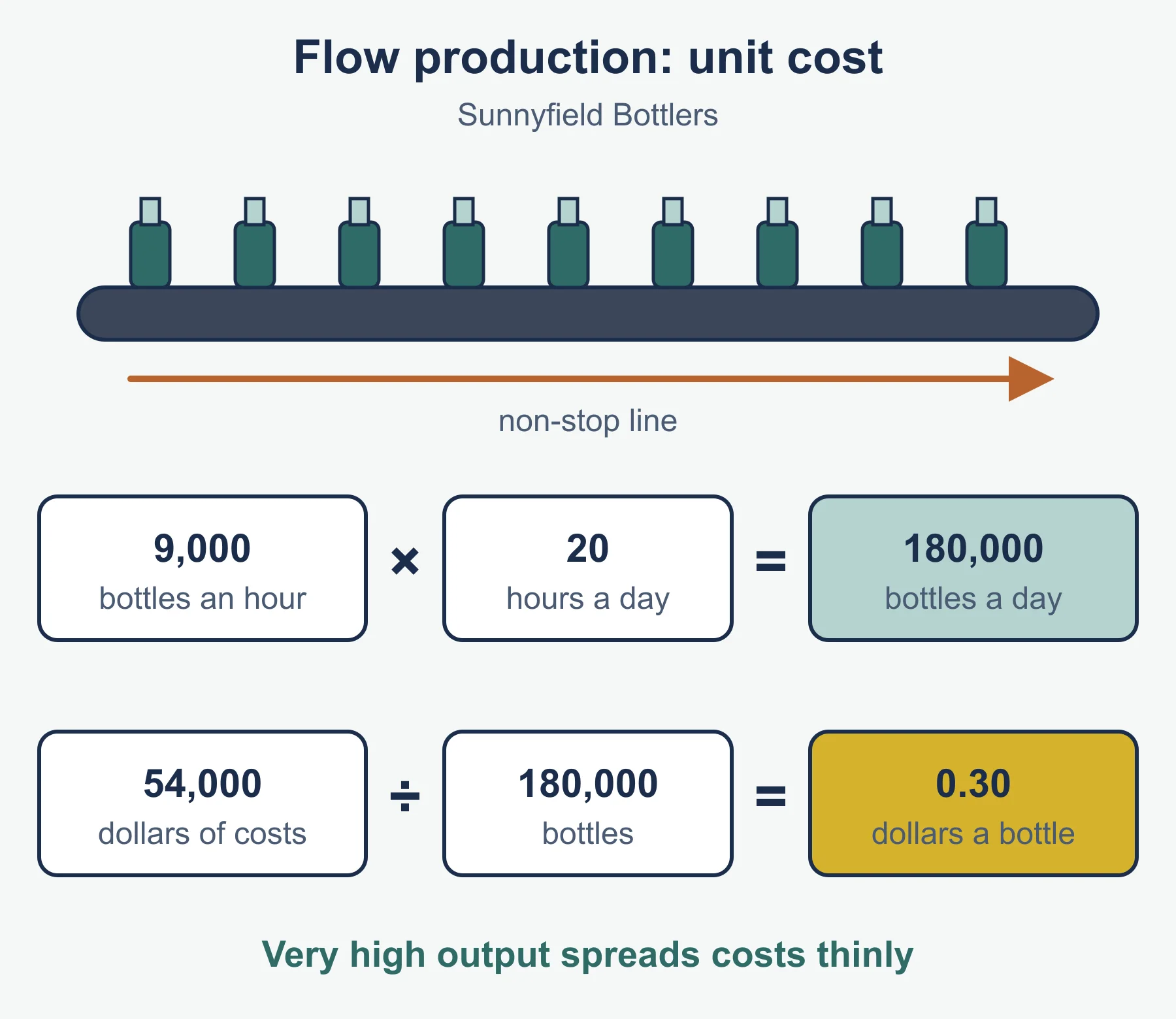
- Example: Sunnyfield Bottlers fills 9,000 bottles an hour for 20 hours a day, which is 180,000 bottles. Total daily costs of 54,000 dollars give an average cost of 54,000 / 180,000 = 0.30 dollars per bottle.
Choosing a method: recommend and justify
When asked to recommend a method, follow four steps.
- Pull out the facts: size of orders, variety, demand pattern, price, quality needed, funds available.
- Match them to the features of each method.
- Recommend one method.
- Justify it by explaining why it fits better than the main alternative, and mention one drawback and how serious it is.
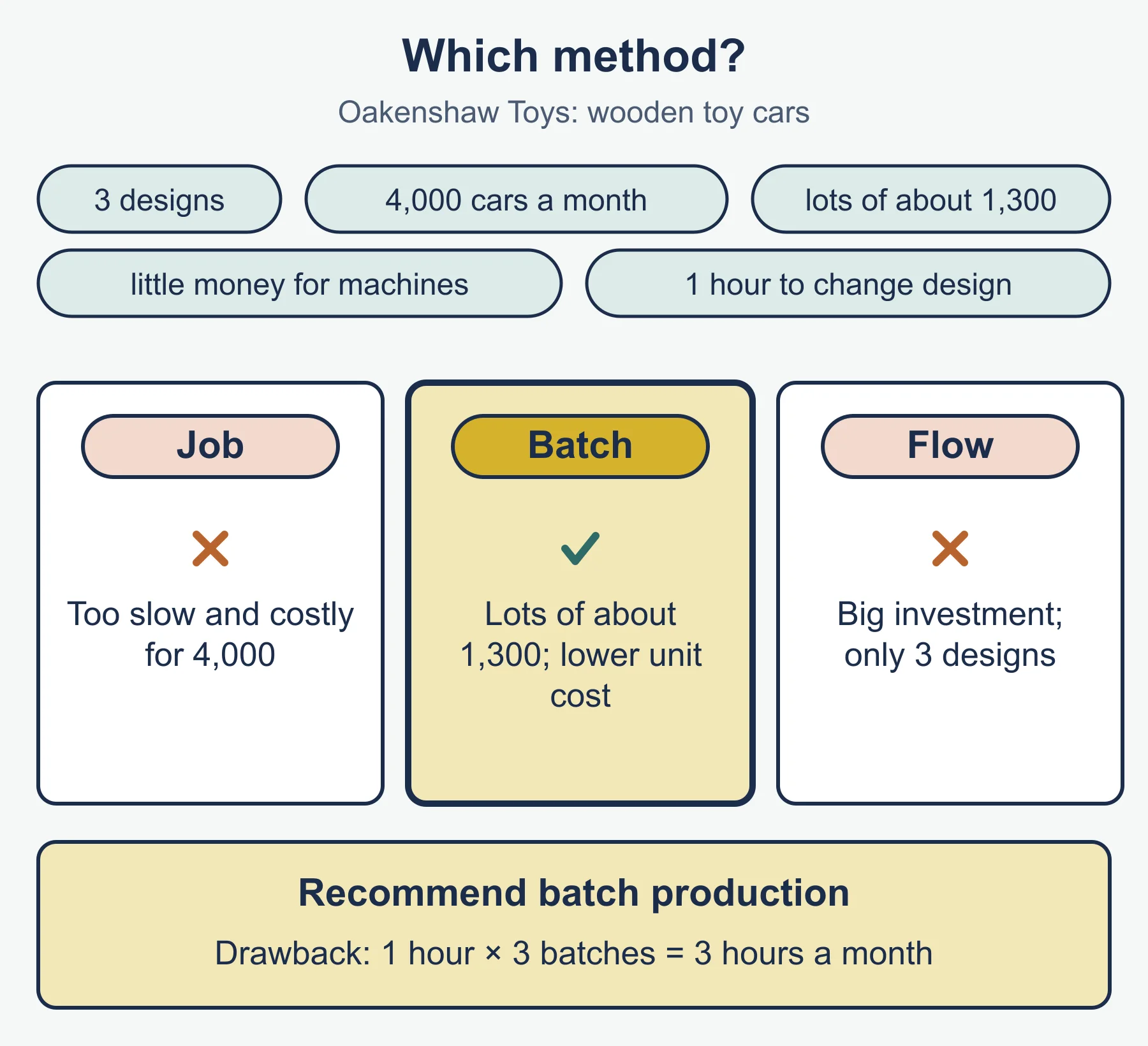
Worked example. Oakenshaw Toys makes wooden toy cars in three designs. Demand is steady at about 4,000 cars a month, and each design is wanted in lots of around 1,300. The firm has little money for large machines. Changing designs takes one hour.
Job production would be too slow and costly for 4,000 cars. Flow production needs large investment and the firm sells only three designs in modest volumes. Batch production suits: it produces each design in lots, keeps unit cost lower than job production and gives variety. The drawback is the hour lost at each design change, but with only three batches a month this is small. Recommendation: batch production.
Technology and production methods
Technology has changed how goods are designed and made, and it continues to do so.
- Computer-aided design (CAD) uses software to draw and test products on screen. Designs can be changed quickly, shared and stored, which reduces the cost of making physical prototypes.
- Computer-aided manufacturing (CAM) uses computers to control machines and robots that cut, weld or assemble. Output is accurate and repeatable, and machines can run through the night.
- Combining the two lets a design flow directly to the machine. It also helps even small firms offer customised products at a cost nearer to batch production than job production.
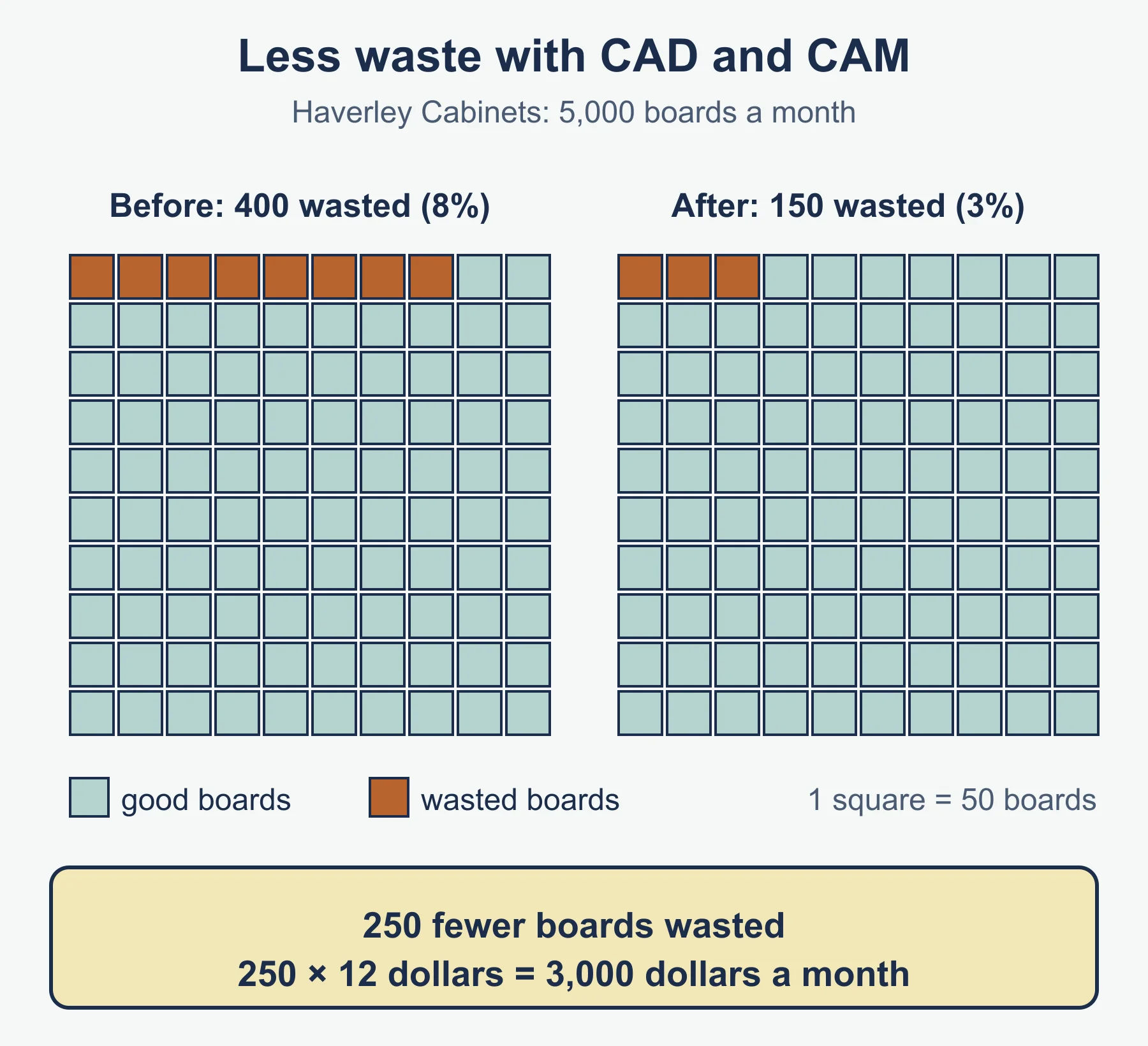
Worked example. Haverley Cabinets uses 5,000 boards a month. Before CAD and CAM, 8% were wasted. Afterwards, 3% are. Wasted boards fall from 400 to 150, a saving of 250 boards. At 12 dollars a board this saves 3,000 dollars a month.
Benefits are faster production, fewer errors, less waste, lower unit costs and more consistent quality. Limitations are the purchase and maintenance cost, the need for staff with new skills, the risk of computer faults, and possible redundancies. Technology also changes which method is feasible: automated equipment can make flow production viable at smaller volumes and make batch changes quicker.
Common errors
- Writing “productivity” when you mean total output.
- Leaving out units when calculating productivity.
- Describing JIT as “no inventories at all” instead of very low inventories.
- Saying Kaizen means one big change, instead of continuous small ones.
- Recommending a method without comparing it with an alternative.
- Listing features of a method with no link to the firm described.
Frequently asked questions
How do you calculate labour productivity in O Level Business 7115? Labour productivity = output in a period ÷ number of workers, which is the standard form. Always state the units, such as mugs per worker per week.
What is Kaizen? Kaizen is a Japanese word for continuous improvement. Workers at all levels suggest many small improvements, often in teams, rather than one big change.
What is the difference between batch and flow production? Batch production moves a group of identical items through each stage and then resets for a different batch, giving more variety. Flow production moves standard products continuously along a line, giving very low unit cost but little flexibility.
How can a business increase efficiency? The syllabus names automation and technology, and improving labour skills through training. Both can raise output per worker, but each has costs, such as the purchase of machines or time away from work.
When is job production the right choice? Job production suits one-off items made to a customer’s order, such as a staircase built for one house. It gives an exact match and high quality but a high cost per unit.
Official syllabus
Cambridge O Level Business Studies 7115, syllabus for examination in 2026, published by Cambridge International. Section 4.1: Production of goods and services.
Get free revision emails (optional)
Occasional emails with practice questions, worked explanations and links to free resources for the qualification and subjects you choose. No spam, and you can unsubscribe from any email. The free tools on this site never need an email.
Related resources
-
Practice questions
O Level Business: Production of goods and services (Cambridge 7115) – Practice Questions
Original short-answer, calculation and case-study questions with worked answers on production, lean methods and technology for Cambridge O Level Business.
Business · Cambridge · O Level
Try questions -
Revision notes
O Level Business: Production of goods and services (Cambridge 7115) – Revision Notes
Revision notes on production, productivity, inventories, lean production, job, batch and flow methods and technology for Cambridge O Level Business.
Business · Cambridge · O Level
Revise topic -
Study guides
O Level Business: Achieving quality production and Location decisions (Cambridge 7115)
Study guide to quality control, quality assurance and location decisions for Cambridge O Level Business Studies 7115, with worked examples.
Business · Cambridge · O Level
Read guide
Related articles
-
teaching
A Level tuition in Dubai: Cambridge or Pearson Edexcel International A Level?
Schools in Dubai and Abu Dhabi teach either Cambridge International AS & A Level or Pearson Edexcel International A Level. How the two are structured, why it matters for tuition, and how online classes from Lahore work.
9 October 2026
-
curriculum guides
Choosing subjects at IGCSE and A Level
How subject choices at 14 and 16 affect university options later, and how to keep pathways open without overloading a timetable.
28 July 2026
Studying this with a teacher
Working through Business O LEVELS?
This page is free and stays free. If you would rather be taught it, Marlbridge runs Business classes one-to-one and in small groups of up to 15, online in your own time zone. The first trial class is free. WhatsApp replies within an hour (8am–11pm Pakistan time, every day); email the same day.
Cambridge Business teachers at Marlbridge

