
Study Guides
O Level Business: Achieving quality production and Location decisions (Cambridge 7115)
Study guide to quality control, quality assurance and location decisions for Cambridge O Level Business Studies 7115, with worked examples.
- Subject
- Business
- Level
- O LEVELS
- Topic
- Operations management
- Author
- Marlbridge Academic Team
- Updated
- Reviewed by
- Salman Ahmad (what this means)
Aligned to Cambridge O Level Business (7115), For examination in 2026. Official specification .
Syllabus page (what it covers and how it is assessed): Cambridge O Level Business.
Syllabus points this page covers
7115
- 4.3 Achieving quality production
- 4.4 Location decisions
Found an error? Report a correction.
Need help with this topic? Request a free trial class for O Level Business (7115).
This guide covers sections 4.3 (Achieving quality production) and 4.4 (Location decisions) of the Cambridge O Level Business Studies 7115 syllabus for examination in 2026. Both sit inside section 4, Operations management. Paper 1 (short answer and data response) and Paper 2 (case study) each assess content from the entire syllabus, so these ideas can appear in either paper, usually applied to a business you are given. Pair this guide with the revision notes and the practice questions. For earlier operations topics there is also the operations management practice set. Course pages: Cambridge O Level Business hub, printable checklist and the free diagnostics.
What the syllabus asks you to know
| Syllabus point | What you must be able to do |
|---|---|
| 4.3.1 | Explain what quality means and why it matters for all businesses |
| 4.3.1 | Explain the concept of quality control and how businesses implement it |
| 4.3.1 | Explain the concept of quality assurance and how it can be implemented |
| 4.4.1 | Identify factors relevant to the location decision of manufacturing and of service businesses |
| 4.4.1 | Identify factors a business could consider when choosing which country to locate operations in |
| 4.4.1 | Explain the role of legal controls on location decisions |
| 4.4.1 | Recommend and justify an appropriate location for a business in given circumstances |
The heading of 4.4.1 covers location and relocation decisions, so the Relocation section below deals with moving as well as first choices.
4.3 Achieving quality production
What quality means
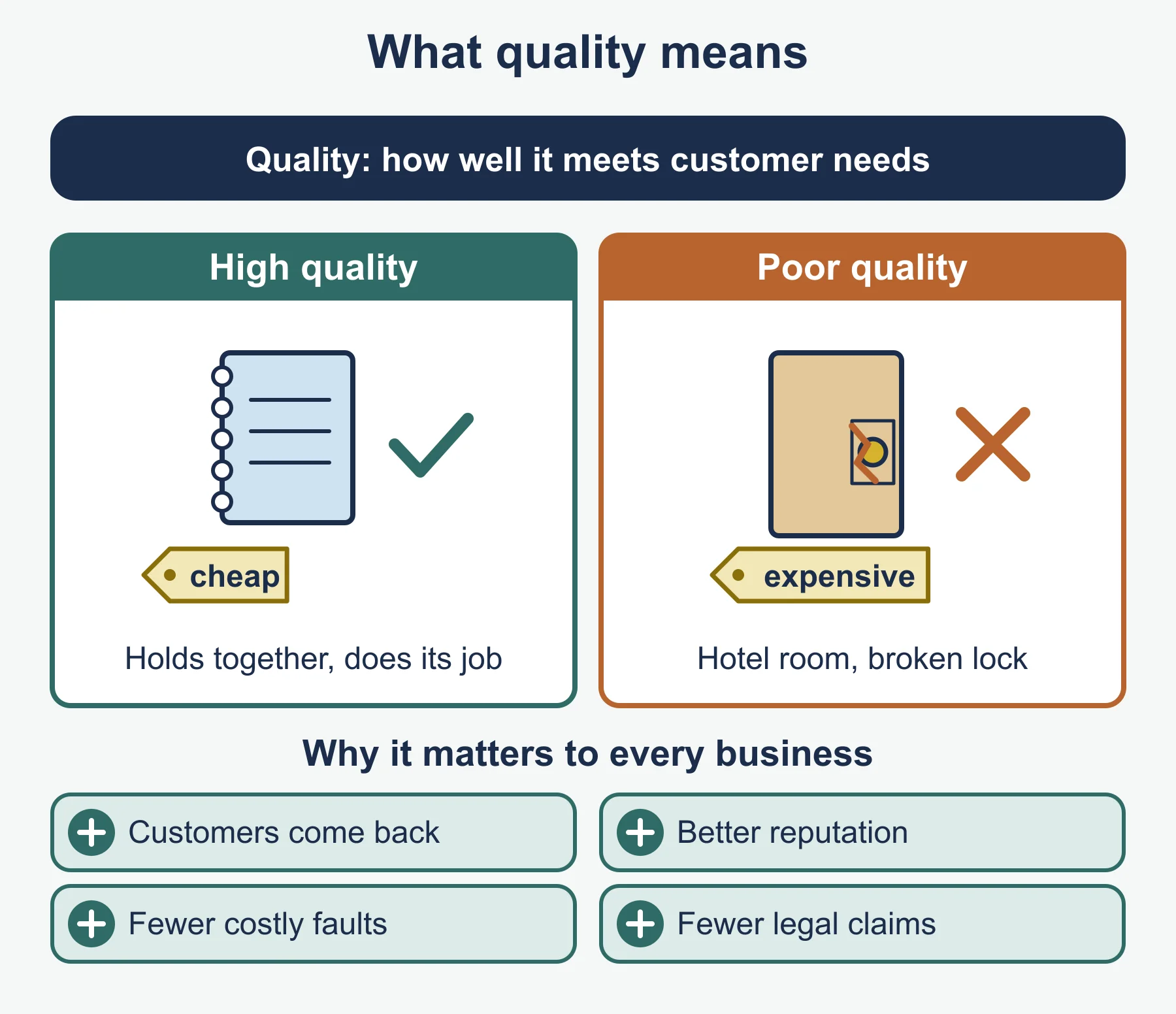
Quality means how well a product or service meets the needs and expectations of the customer. It is not the same as luxury. A cheap notebook is high quality if it holds together and does its job for the price. A hotel room with a broken lock is poor quality whatever the price.
Why quality matters for all businesses
The syllabus says “all businesses”, so be ready to apply it to a manufacturer, a shop, a clinic, a bus company or a charity.
- Customers repeat purchases and recommend the business, which protects sales revenue.
- A good reputation can support a higher price or make it easier to win new customers.
- Faults cost money: scrapped materials, reworking, replacements, refunds and staff time dealing with complaints.
- Poor quality can lead to legal claims if a product is unsafe or a service causes harm.
- Business customers who buy components will drop a supplier whose parts are late or faulty.
Take care with the direction of cause. Quality does not automatically raise profit. Getting quality right costs money too, so the question is whether the benefits outweigh the costs for that business.
Quality control
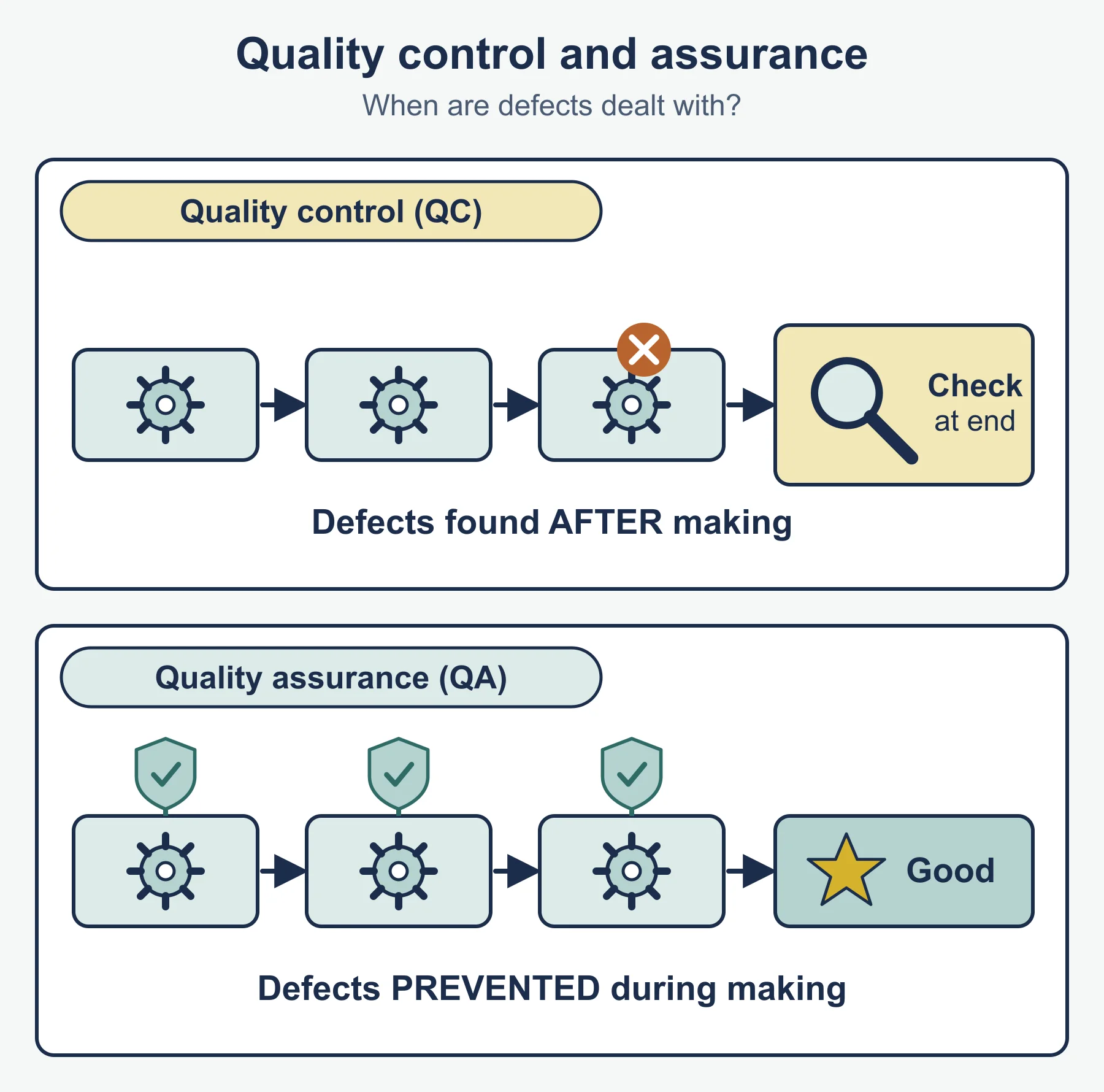
Quality control means checking products or services, usually after a stage of production or at the end, to find faults and stop faulty items reaching the customer. It is about finding mistakes.
Typical ways businesses implement it:
- an inspector examines every item, or a random sample, at one or more stages
- testing, such as stress-testing a chair or running a sample of devices for several hours
- checking against a standard, such as a template, a weight or a size tolerance
- removing faulty items for scrapping or reworking
Sampling is common when checking every item would be too slow, too costly or would destroy the product (a business cannot taste-test every tin of food and still sell it).
Strengths: it is easy to understand, catches faults before delivery and protects the brand’s name. Weaknesses: it finds faults rather than preventing them, materials and labour are already wasted when a fault is found, inspectors cost money, and sampling can miss a faulty item.
Worked example 1: sample inspection
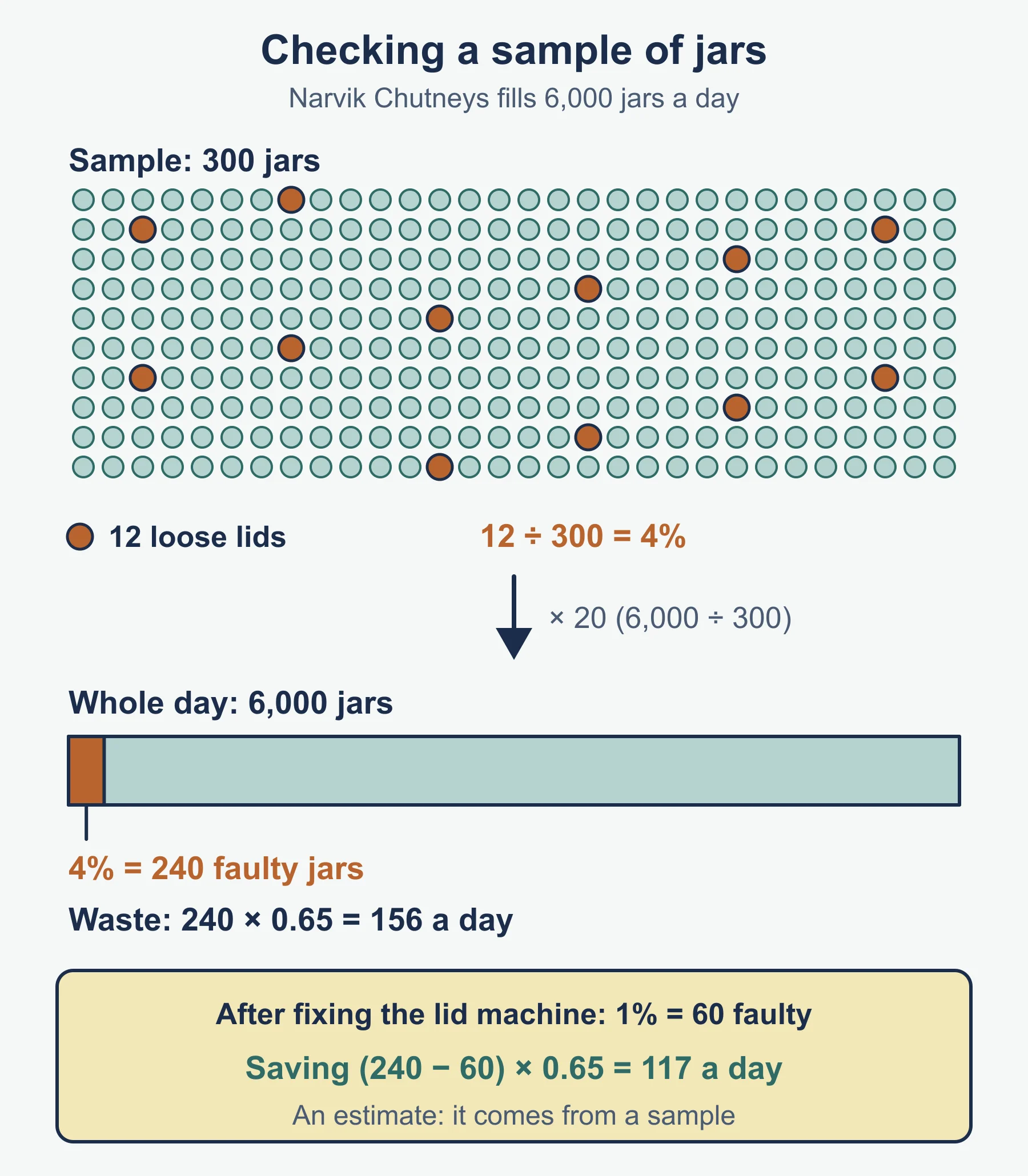
Narvik Chutneys fills 6 000 jars a day. An inspector takes a sample of 300 jars from each day’s output and finds 12 with loose lids.
Step 1, the proportion faulty in the sample: 12 ÷ 300 = 0.04, which is 4%.
Step 2, assume the sample represents the whole day: 4% of 6 000 = 240 faulty jars.
Step 3, cost of waste: each faulty jar wastes 0.65 of materials and labour, so 240 × 0.65 = 156 per day, or 780 over a five-day week.
Step 4, after adjusting the lid-fitting machine the defect rate falls to 1%. That is 60 faulty jars a day, so the saving is (240 − 60) × 0.65 = 117 per day, or 585 per week.
The figures are estimates because they come from a sample, and they count only wasted production costs, not lost goodwill if faulty jars reach shops.
Quality assurance
Quality assurance means organising the whole business so that faults are prevented at every stage, rather than found at the end. It is about preventing mistakes. Responsibility spreads to every worker, not only to inspectors.
Typical ways a business can implement it:
- agreed quality standards for every stage, written down and known by all workers
- checking and approving suppliers so that materials arrive to a set standard
- training workers in the skills and standards their job needs
- giving workers responsibility to check their own work and to stop a process if something is wrong
- maintaining machines on a plan so that they do not drift out of tolerance
- collecting customer feedback and using it to improve the process
- recording faults, finding the cause and changing the process
Strengths: fewer faults, less waste and rework, and often better worker involvement. Weaknesses: training, supplier checks and new systems cost money and time, it can take months to show results, and it needs commitment from managers as well as workers.
Worked example 2: comparing outcomes
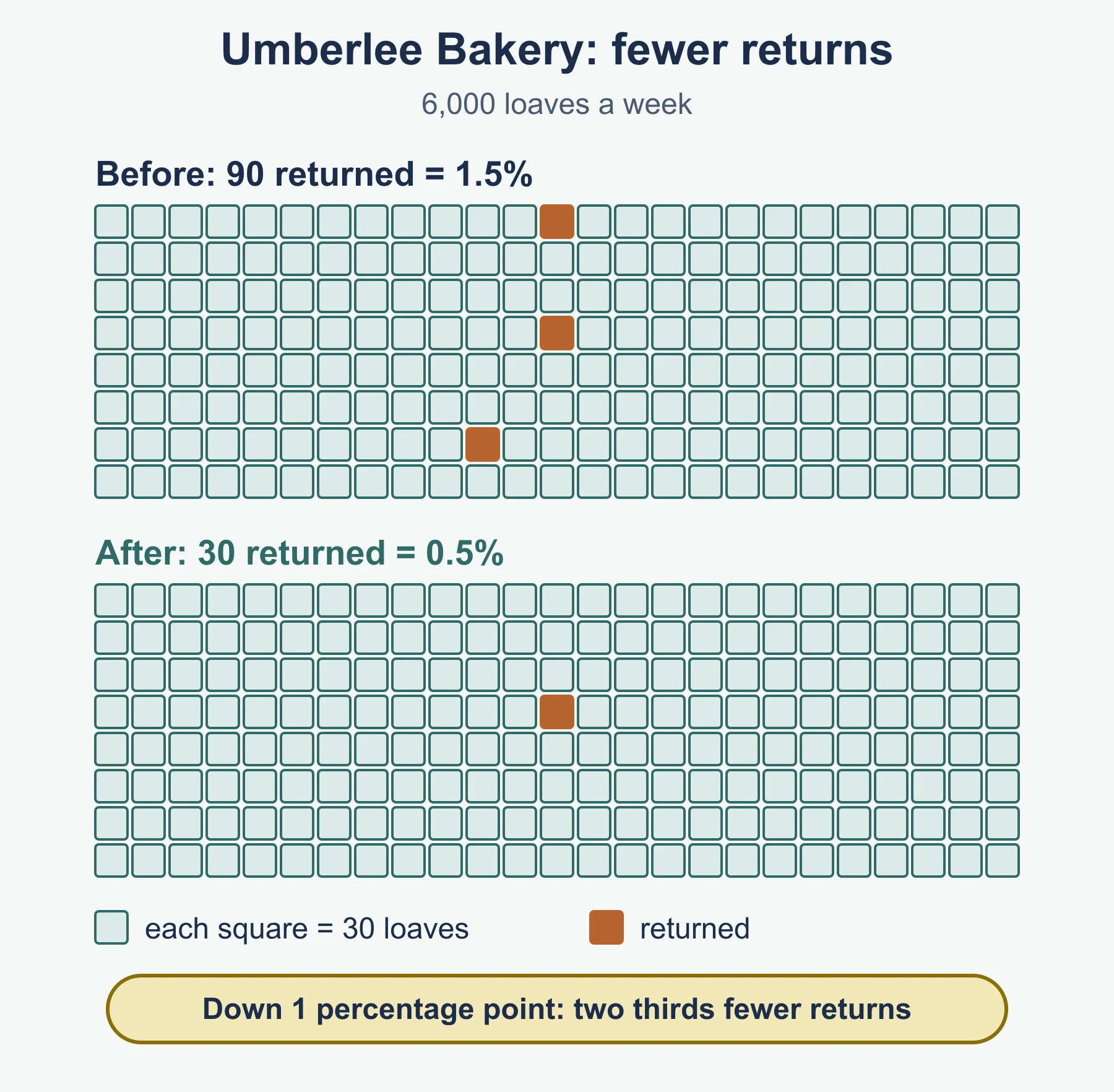
Umberlee Bakery sold 6 000 loaves a week and had 90 returned as stale or misshapen. It then introduced a written standard for each stage, supplier checks on flour and training for the night shift.
Returns before: 90 ÷ 6 000 = 0.015, which is 1.5%. Returns after, with 30 returns: 30 ÷ 6 000 = 0.005, which is 0.5%. Returns fell by one percentage point, and by two thirds in relative terms.
This shows faults fell for this bakery in this period. A sensible answer would also mention the cost of the training and checks.
Control versus assurance
| Quality control | Quality assurance | |
|---|---|---|
| Main idea | Find faults | Prevent faults |
| When | After production or at checkpoints | Throughout, including before production starts |
| Who | Inspectors mainly | Everyone in the business |
| Waste | Faulty items already made | Less waste in the first place |
| Cost pattern | Cost of inspection and of faulty items | Cost of training, systems and supplier checks |
Many businesses use both. If asked to recommend one, fit it to the business: a workshop making one-off items may rely on its owner checking each piece, while a large producer of identical items gains more from preventing faults.
4.4 Location decisions
Factors for manufacturing businesses
Location is the place a business chooses for its operations. Common factors for manufacturers:
- Cost of land and buildings: rent, purchase price and local taxes.
- Labour: number of workers, their skills, and wage rates.
- Raw materials and suppliers: the cost of moving bulky or perishable inputs.
- Customers: how far finished goods must travel, especially if heavy or fragile.
- Transport links: roads, rail, ports and airports.
- Utilities and room to expand: reliable power and water, and space on the site.
- Government help: grants, tax breaks or support in some areas.
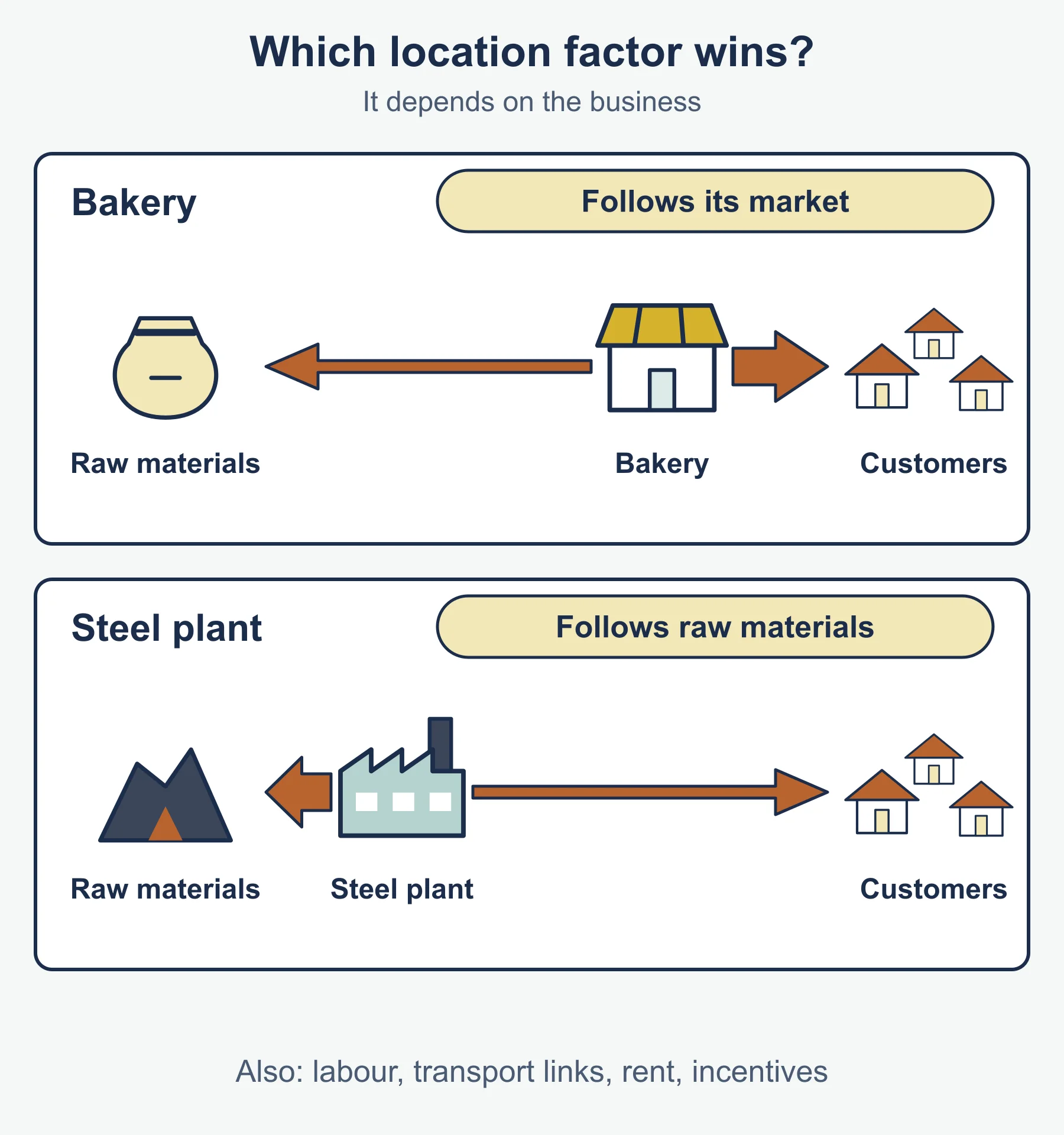
The importance of each factor depends on the product. A producer of bulky, low-value goods may need to be near its materials, while a maker of compact, high-value products can locate where skilled labour is available.
Factors for service businesses
Service businesses often depend on customers coming to them, or on workers being able to reach customers:
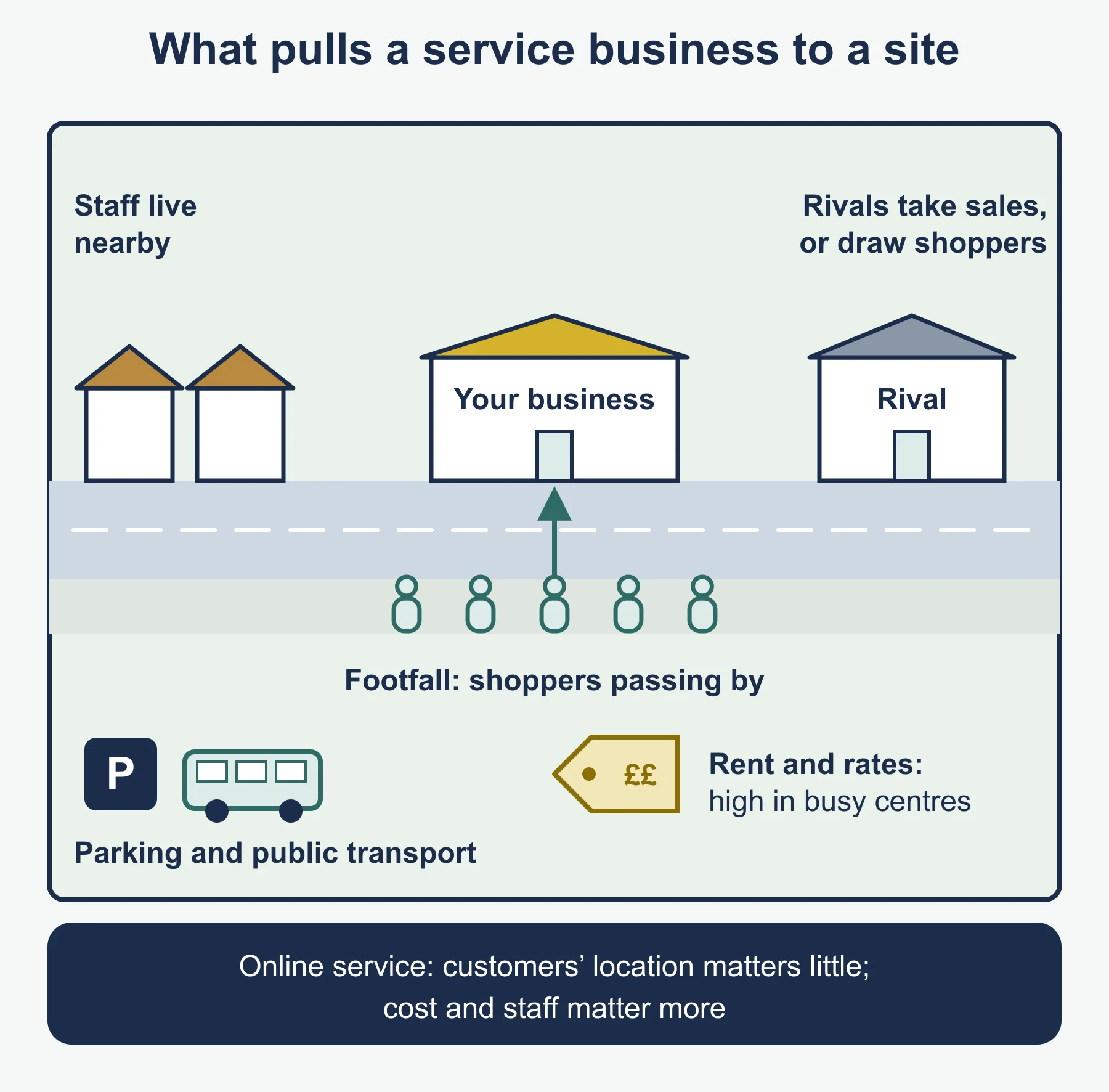
- Closeness to customers: footfall, local population, passing trade.
- Competitors: rivals nearby can reduce sales, though a cluster (like a food street) can also attract more shoppers.
- Visibility and access: parking, public transport, safety, easy entry.
- Rent and rates: often high in busy central locations.
- Staff: whether suitably skilled employees live nearby.
- Digital delivery: for an online service, customers’ location matters little, so cost and staff matter more.
Worked example 3: comparing locations
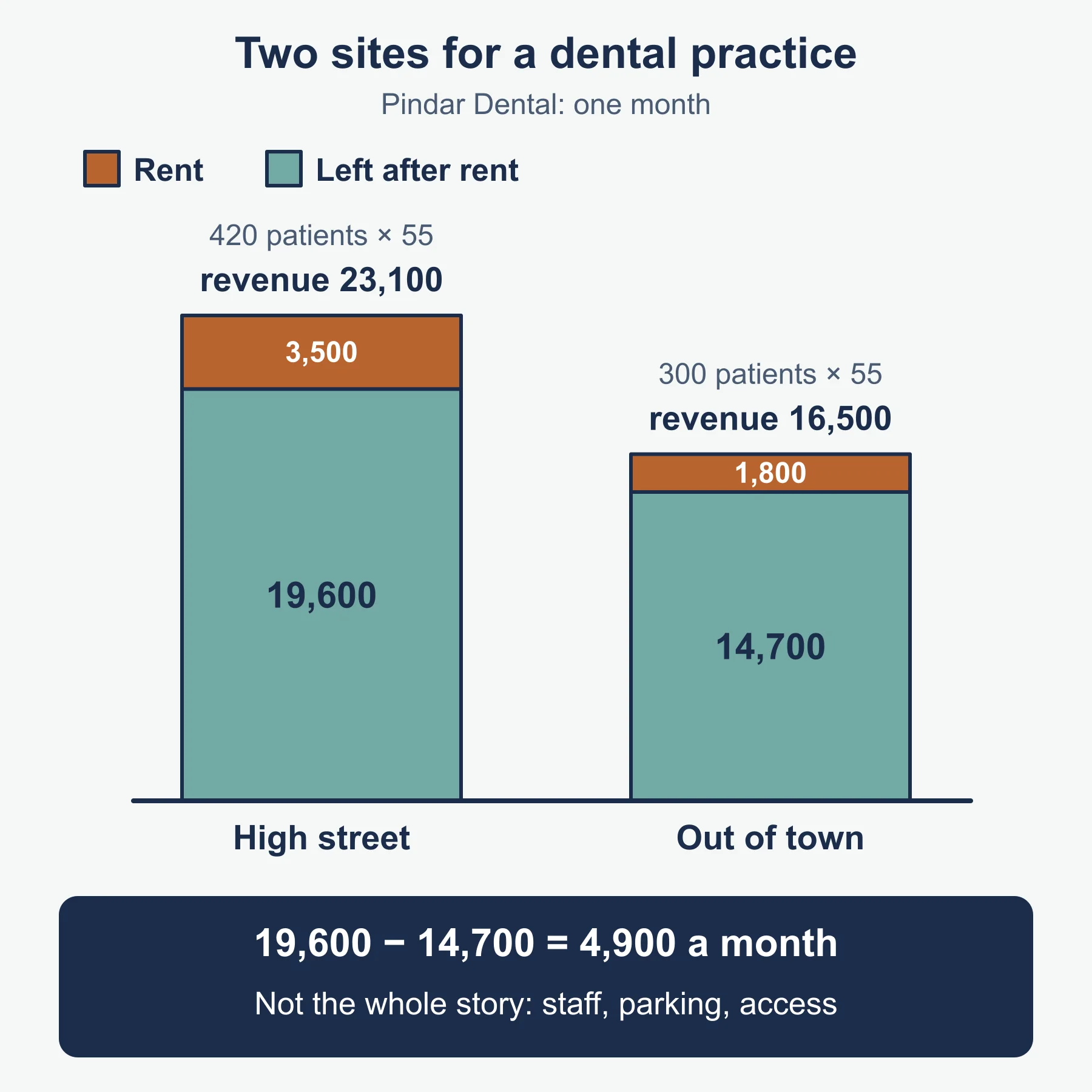
Pindar Dental can lease either a high-street unit at 3 500 a month or an out-of-town unit at 1 800 a month. It expects 420 patients a month on the high street and 300 out of town, paying an average of 55 each.
Revenue on the high street: 420 × 55 = 23 100. Out of town: 300 × 55 = 16 500. Revenue after rent: 23 100 − 3 500 = 19 600 against 16 500 − 1 800 = 14 700. The high street is 4 900 a month better on this comparison.
This ignores other costs, such as extra staff. A full answer treats the figures as one input, then considers parking, access for older patients and lease length.
Choosing which country
When a business considers a site abroad, the factors include:
- labour costs, skills and availability
- the size and growth of the market it hopes to serve
- transport and shipping costs and the quality of infrastructure
- taxes on imports (tariffs), trade barriers and trade agreements
- exchange rates, which affect costs and revenue when currencies change
- political stability and the risk of disruption
- language, culture and local customs
- government incentives for foreign firms
- legal controls, covered below
Worked example 4: unit costs in two countries
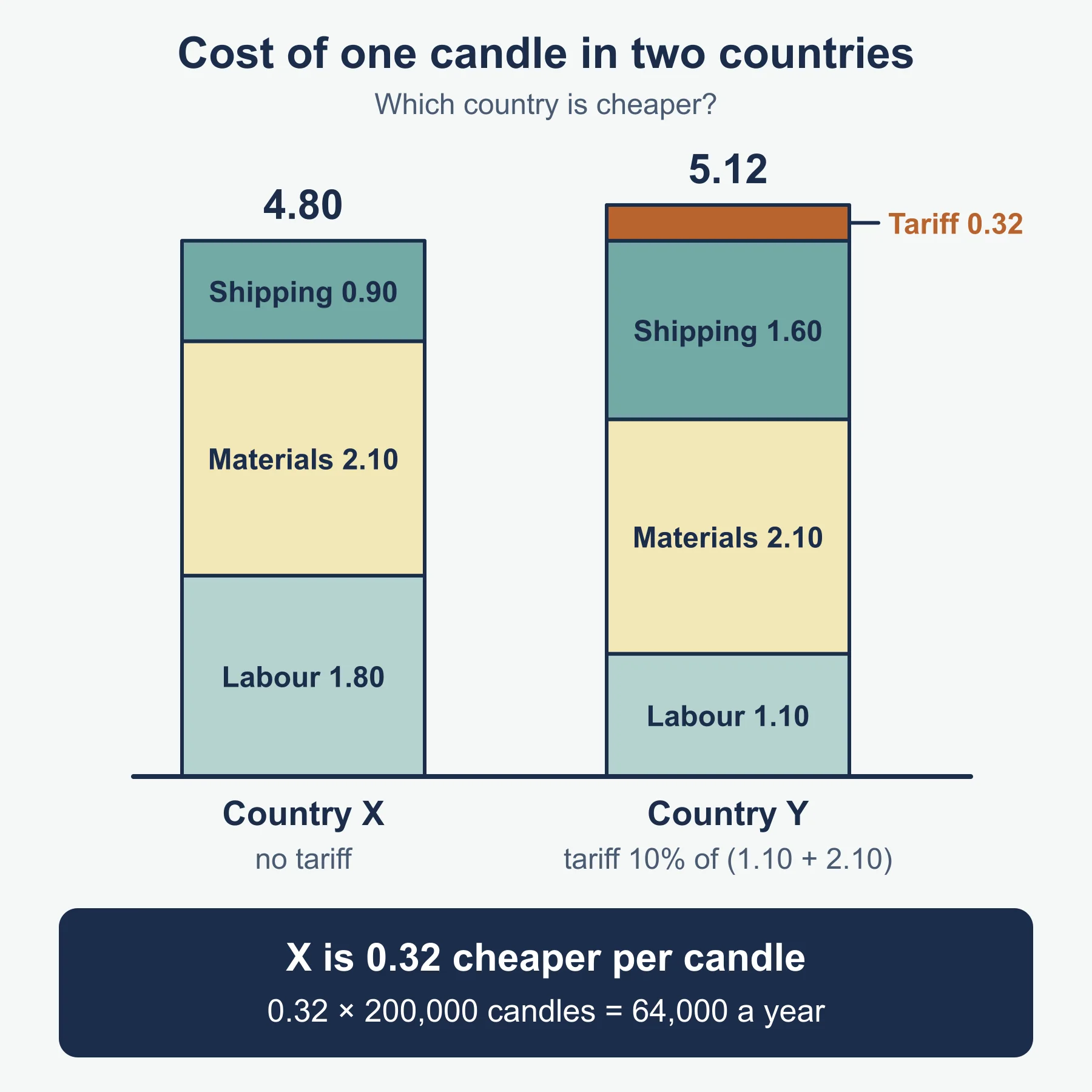
Ovelle Candles can make a candle in Country X or Country Y and sell it in a third market. Labour, materials and shipping per candle:
| Cost per candle | Country X | Country Y |
|---|---|---|
| Labour | 1.80 | 1.10 |
| Materials | 2.10 | 2.10 |
| Shipping | 0.90 | 1.60 |
| Import tariff | none | 10% of labour plus materials |
Country X: 1.80 + 2.10 + 0.90 = 4.80. Country Y: tariff = 10% × (1.10 + 2.10) = 0.32, so the total is 1.10 + 2.10 + 1.60 + 0.32 = 5.12. Country X is 0.32 cheaper per candle, which is 64 000 on 200 000 candles a year. Cheaper labour in Y is outweighed by shipping and the tariff.
A recommendation would still weigh other points, such as political stability and skills.
The role of legal controls
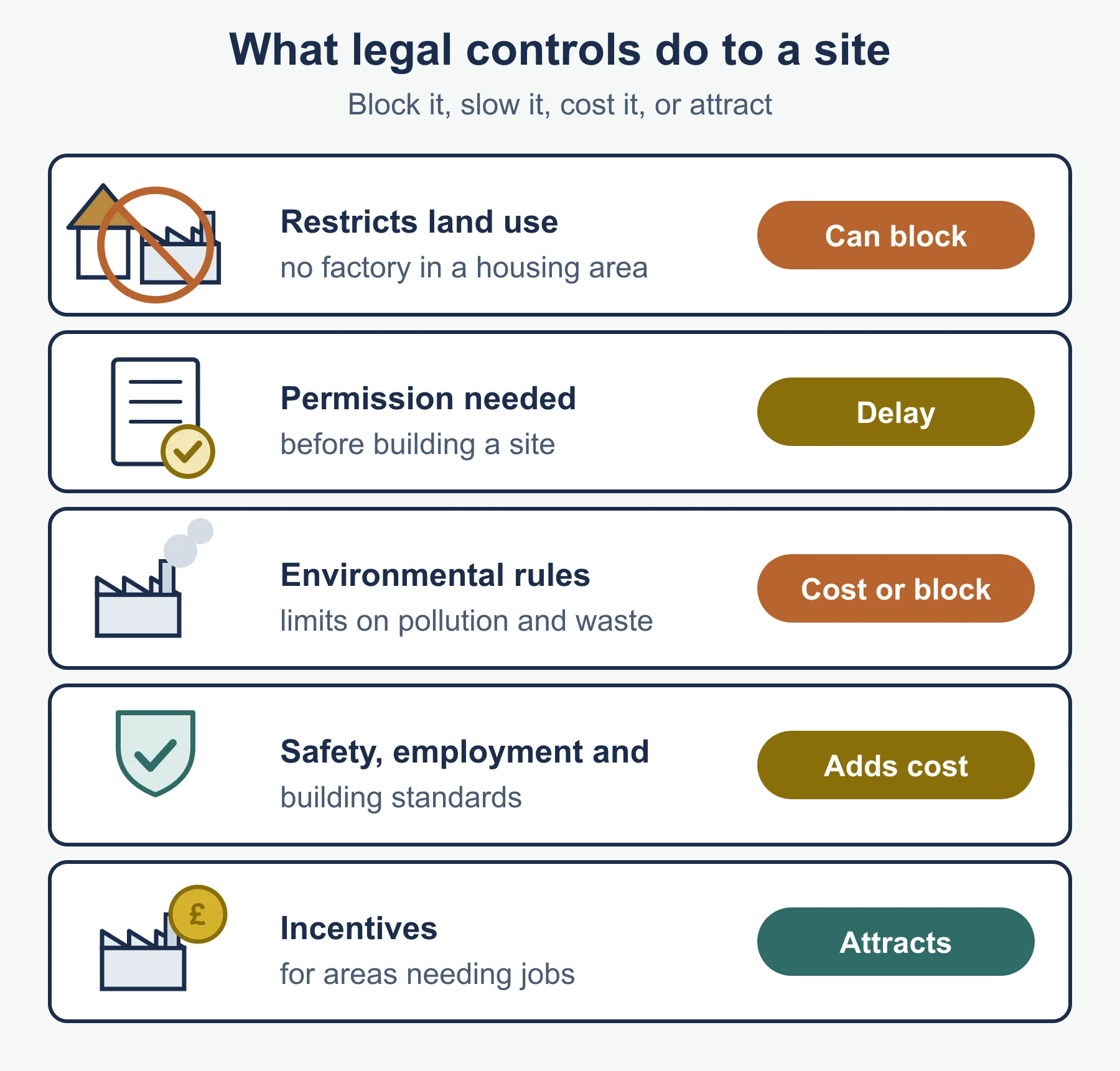
Governments use laws to influence where businesses locate. In general terms, legal controls can:
- restrict the use of land, so that a factory may not be built in a residential or protected area
- require permission before building or changing the use of a site
- set environmental rules, such as limits on pollution or waste, which can rule out some sites or raise costs
- set health and safety, employment and building standards
- offer incentives, for example to locate in areas needing jobs
Describe controls generally and show the effect: a law may block a location, add cost or delay, or make an area more attractive.
Relocation
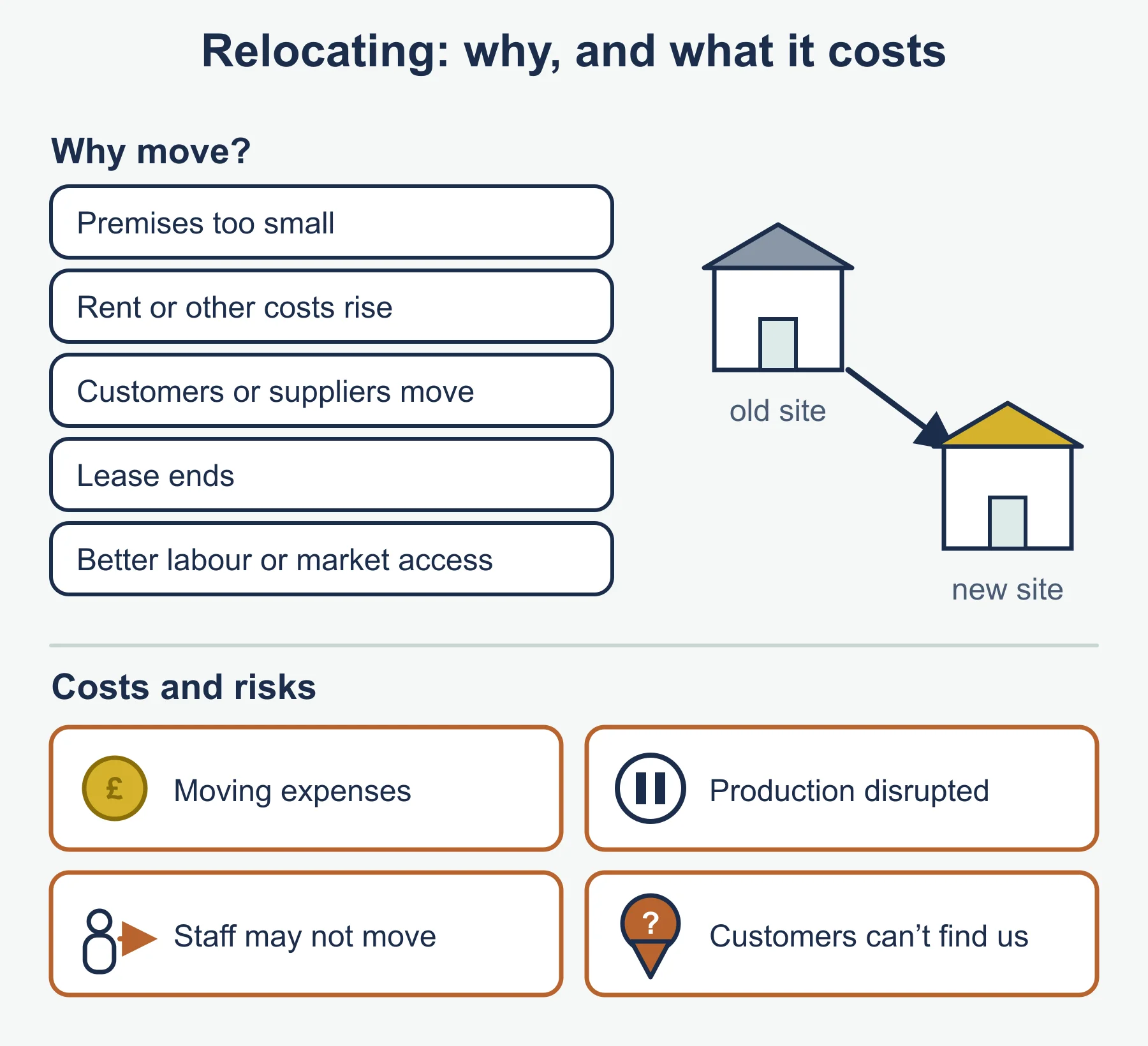
A business may relocate when its premises become too small, when rent or other costs rise, when its customers or suppliers move, when a lease ends or when a new location offers better access to labour or markets. Costs and risks include moving expenses, disruption to production, losing staff who will not move, and the risk that customers cannot find the new site.
Recommending and justifying a location
For “recommend and justify” questions, use this pattern:
- Choose one location clearly.
- Give two or three reasons that use facts from the case (costs, distance, labour, laws).
- Explain the effect on the business (cost, sales, quality, delivery).
- Show you considered the other option and why it is weaker, or what risk remains.
Common errors
- Describing quality as expensive or luxurious instead of meeting customer needs.
- Mixing up quality control with quality assurance, as though the two meant one idea.
- Listing location factors without linking them to the type of business in the question.
- Treating the cheapest site as automatically the best, ignoring labour skills, customers or laws.
- Naming specific laws or tariffs you cannot be sure of, rather than describing the control.
Next, practise on the practice questions and test yourself with the diagnostics.
Frequently asked questions
What is the difference between quality control and quality assurance? Quality control checks products or services after production or at checkpoints to find faults, mainly through inspectors. Quality assurance organises the whole business so that faults are prevented at every stage, with every worker responsible.
Does improving quality always raise profit? Not automatically. Getting quality right costs money too, so the question is whether the benefits, such as repeat customers and fewer refunds, outweigh the costs for that business.
Can a business use both quality control and quality assurance? Yes, many businesses use both. If asked to recommend one, fit it to the business: a workshop making one-off items may rely on its owner checking each piece, while a large producer of identical items gains more from preventing faults.
What factors affect the choice of country for a business in Cambridge O Level Business 7115? Factors include labour costs and skills, market size and growth, transport costs, tariffs and trade agreements, exchange rates, political stability, language and culture, government incentives and legal controls.
Is the cheapest location always the best? No. Treating the cheapest site as automatically the best ignores labour skills, customers and legal controls, so use cost figures as one input and weigh the other factors too.
Official syllabus
Cambridge International, Cambridge O Level Business Studies 7115 syllabus, for examination in 2026 (version 2, published December 2025), sections 4.3 and 4.4.
Get free revision emails (optional)
Occasional emails with practice questions, worked explanations and links to free resources for the qualification and subjects you choose. No spam, and you can unsubscribe from any email. The free tools on this site never need an email.
Related resources
-
Practice questions
O Level Business: Achieving quality production and Location decisions (Cambridge 7115) – Practice Questions
Original practice questions with worked answers on quality control, quality assurance and location decisions for Cambridge O Level Business 7115.
Business · Cambridge · O Level
Try questions -
Revision notes
O Level Business: Achieving quality production and Location decisions (Cambridge 7115) – Revision Notes
Condensed revision notes on quality control, quality assurance, location factors and legal controls for Cambridge O Level Business 7115.
Business · Cambridge · O Level
Revise topic -
Study guides
O Level Business: Costs, scale of production and break-even analysis (Cambridge 7115)
Study guide to costs, economies and diseconomies of scale and break-even analysis for Cambridge O Level Business 7115, with worked examples.
Business · Cambridge · O Level
Read guide
Related articles
-
teaching
A Level tuition in Dubai: Cambridge or Pearson Edexcel International A Level?
Schools in Dubai and Abu Dhabi teach either Cambridge International AS & A Level or Pearson Edexcel International A Level. How the two are structured, why it matters for tuition, and how online classes from Lahore work.
9 October 2026
-
curriculum guides
Choosing subjects at IGCSE and A Level
How subject choices at 14 and 16 affect university options later, and how to keep pathways open without overloading a timetable.
28 July 2026
Studying this with a teacher
Working through Business O LEVELS?
This page is free and stays free. If you would rather be taught it, Marlbridge runs Business classes one-to-one and in small groups of up to 15, online in your own time zone. The first trial class is free. WhatsApp replies within an hour (8am–11pm Pakistan time, every day); email the same day.
Cambridge Business teachers at Marlbridge

