
Revision Notes
O Level Business: Achieving quality production and Location decisions (Cambridge 7115) – Revision Notes
Condensed revision notes on quality control, quality assurance, location factors and legal controls for Cambridge O Level Business 7115.
- Subject
- Business
- Level
- O LEVELS
- Topic
- Operations management
- Author
- Marlbridge Academic Team
- Updated
- Reviewed by
- Salman Ahmad (what this means)
Aligned to Cambridge O Level Business (7115), For examination in 2026. Official specification .
Syllabus page (what it covers and how it is assessed): Cambridge O Level Business.
Syllabus points this page covers
7115
- 4.3 Achieving quality production
- 4.4 Location decisions
Found an error? Report a correction.
Need help with this topic? Request a free trial class for O Level Business (7115).
These are condensed notes for sections 4.3 (Achieving quality production) and 4.4 (Location decisions) of the Cambridge O Level Business Studies 7115 syllabus for examination in 2026. For full explanations and longer worked examples, read the study guide. When you are ready to test yourself, use the practice questions, the free diagnostics, the Cambridge O Level Business hub and the printable checklist. Earlier operations content is in the operations management practice set.
Key definitions
| Term | Meaning |
|---|---|
| Quality | How well a product or service meets customer needs and expectations |
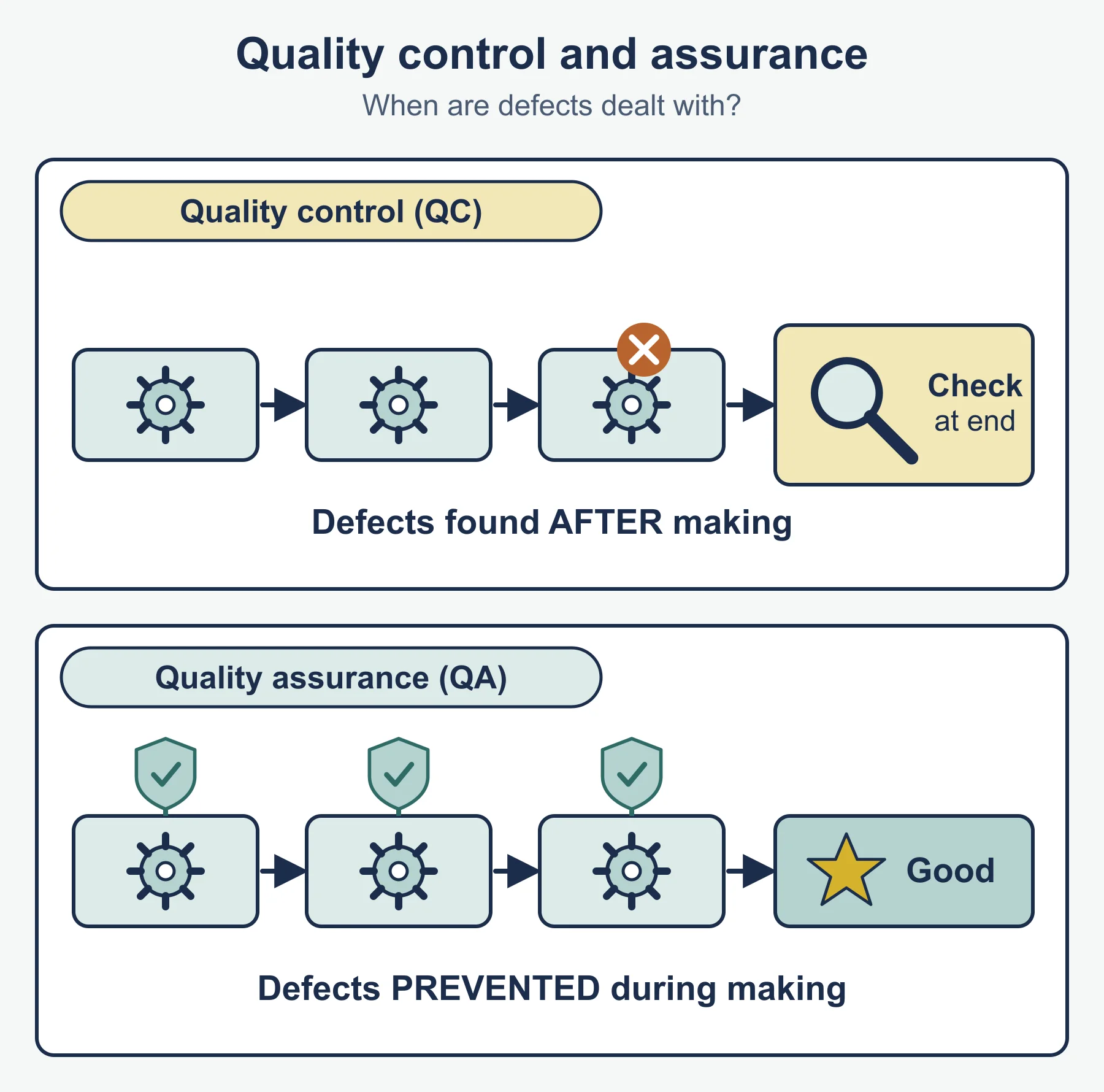
| Quality control | Checking products or services to find faults and stop faulty items reaching customers |
| Quality assurance | Organising the whole business so that faults are prevented at every stage |
| Location | The place where a business chooses to carry out its operations |
| Relocation | Moving operations from one site to another |
| Tariff | A tax on imported goods |
| Legal controls | Laws that restrict, permit or encourage where and how a business can operate |
The tariff row is standard business vocabulary rather than a term the syllabus defines. Use it when a case study mentions import taxes.
4.3 Quality: the essentials
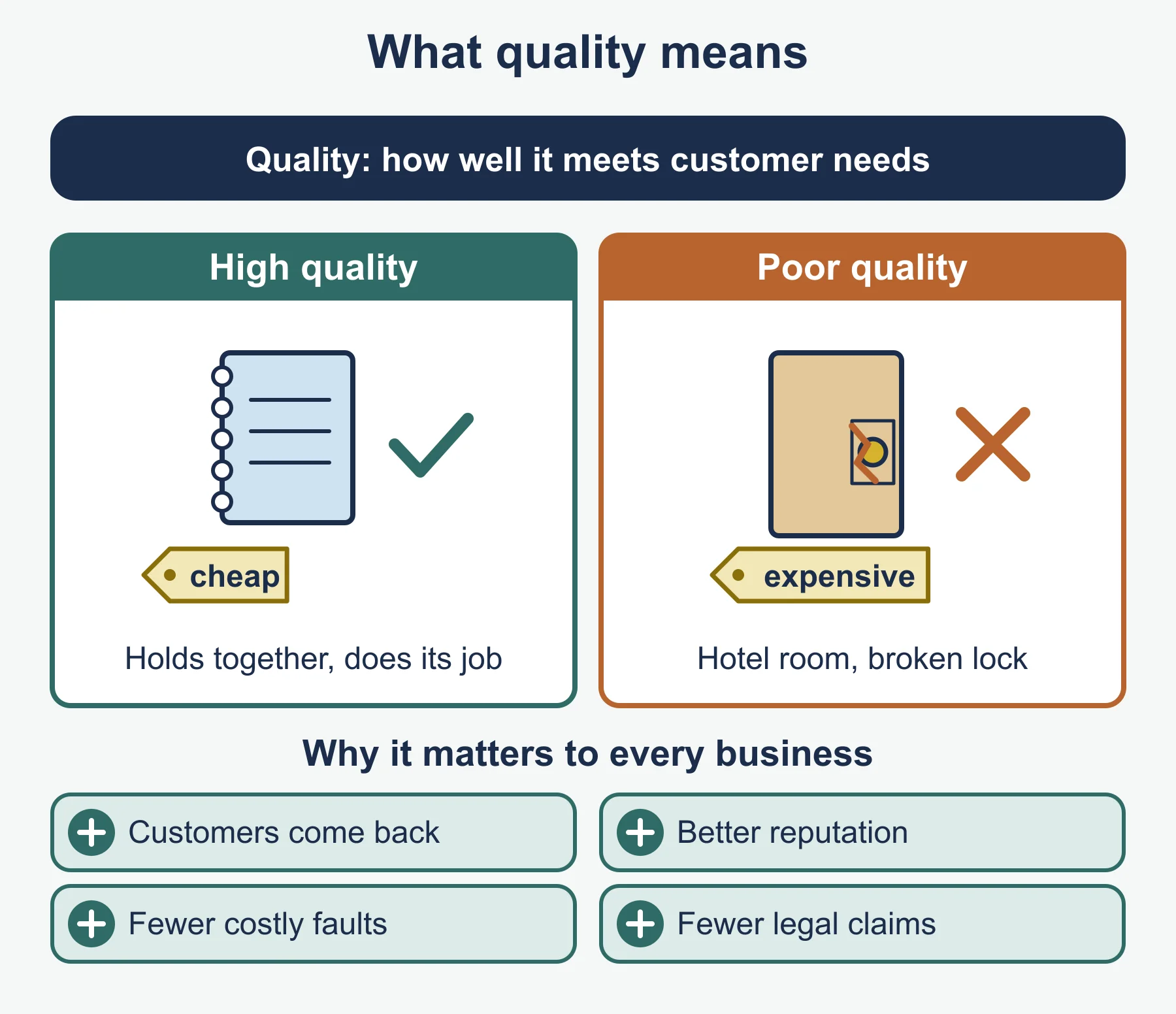
Why quality matters (all businesses)
- repeat custom, recommendation and a stronger reputation
- fewer refunds, replacements, reworks and scrapped items
- less risk of legal action if a faulty product or service causes harm
- keeps business customers who need reliable supplies
- may support a higher price
Remember to link the point to the business in the question: a hospital, a bakery and a bus company all gain from quality, but in different ways.
Quality control versus quality assurance
| Quality control | Quality assurance | |
|---|---|---|
| Aim | Find faults | Prevent faults |
| Timing | At checkpoints or at the end | At every stage |
| Who | Inspectors, mainly | Everybody |
| Typical methods | Inspecting every item or a sample, testing, comparing with a standard, rejecting faulty items | Written standards, supplier checks, training, workers checking their own work, planned machine maintenance, using feedback |
| Strength | Simple; stops faults reaching customers | Less waste; fewer faults made |
| Weakness | Waste already made; inspectors cost money; samples can miss faults | Training and systems cost money; slow to show results; needs commitment |
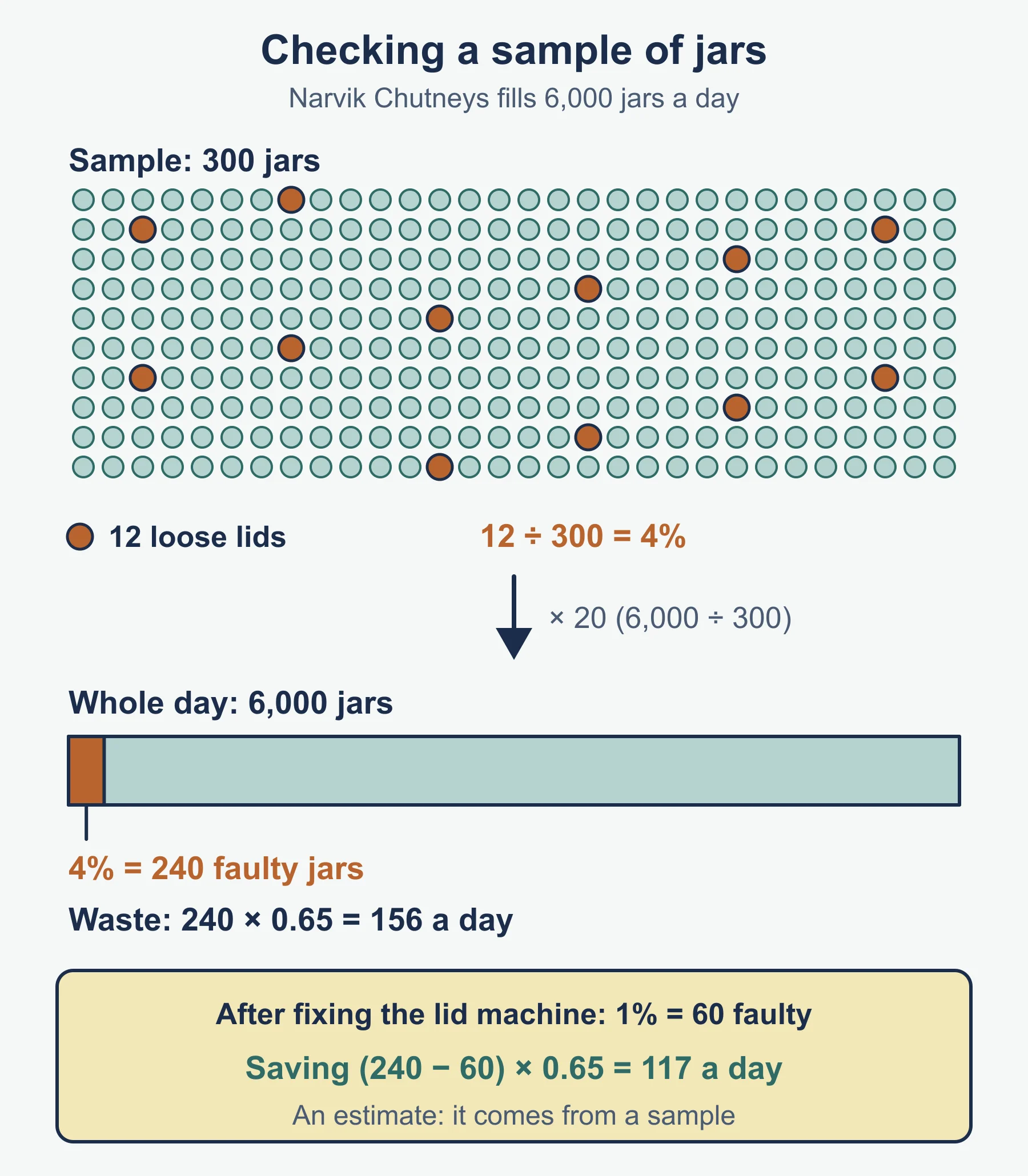
Method: estimate faulty output from a sample
- Divide faulty items in the sample by the sample size.
- Multiply that proportion by total output.
- Multiply the faulty items by the cost per faulty item.
- State the assumption that the sample represents all output.
Worked reminder: Ostwick Tiles samples 400 tiles and finds 14 cracked. The rate is 14 ÷ 400 = 0.035, which is 3.5%. In an output of 8 000 tiles that suggests 8 000 × 0.035 = 280 cracked tiles.
Must-know distinctions
- Quality is not the same as luxury or high price.
- Control finds faults; assurance prevents them.
- A sample gives an estimate, not a certainty.
- Fewer faults reduce costs, but the prevention itself has a cost.
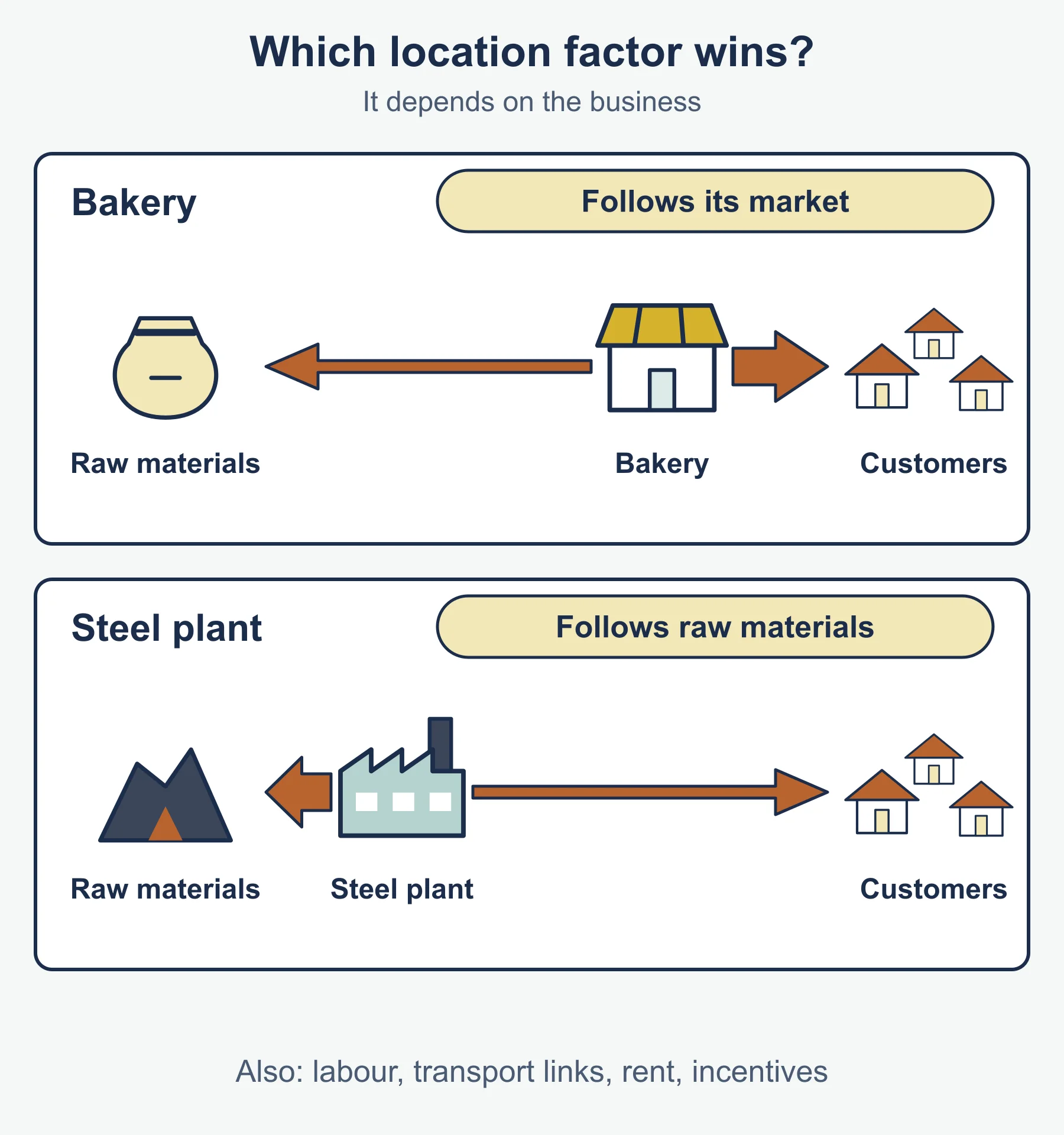
4.4 Location: the essentials
Manufacturing factors
| Factor | Example of how it matters |
|---|---|
| Land and building costs | Rent or purchase price affects costs per unit |
| Labour | Skills and wage rates; enough workers available |
| Materials and suppliers | Bulky or perishable inputs are costly to move far |
| Customers and markets | Fragile or heavy finished goods cost more to move |
| Transport links | Roads, rail, ports, airports for inputs and deliveries |
| Utilities and room to expand | Reliable power and water; space to grow |
| Government help | Grants or tax breaks in some areas |
Service business factors
| Factor | Example of how it matters |
|---|---|
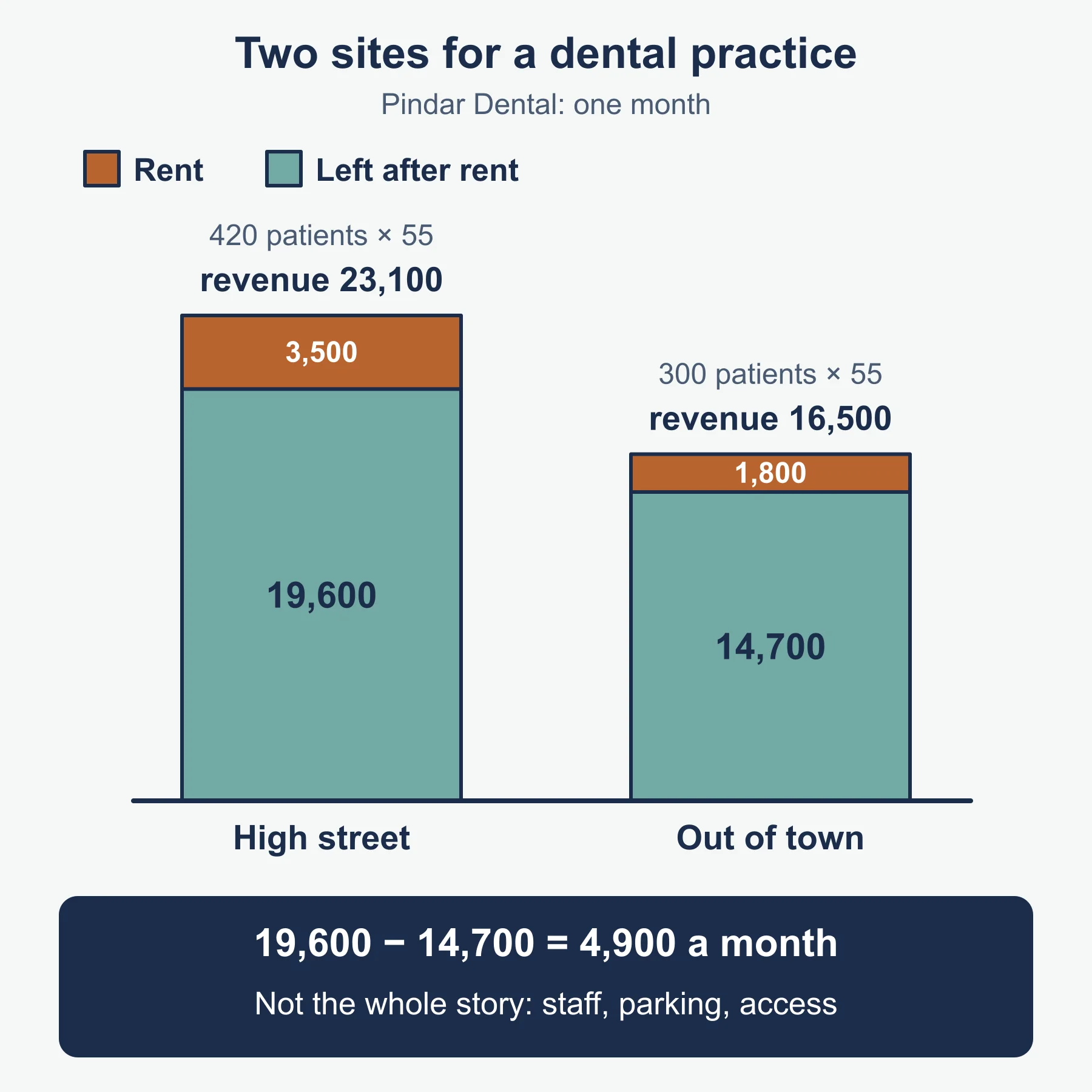
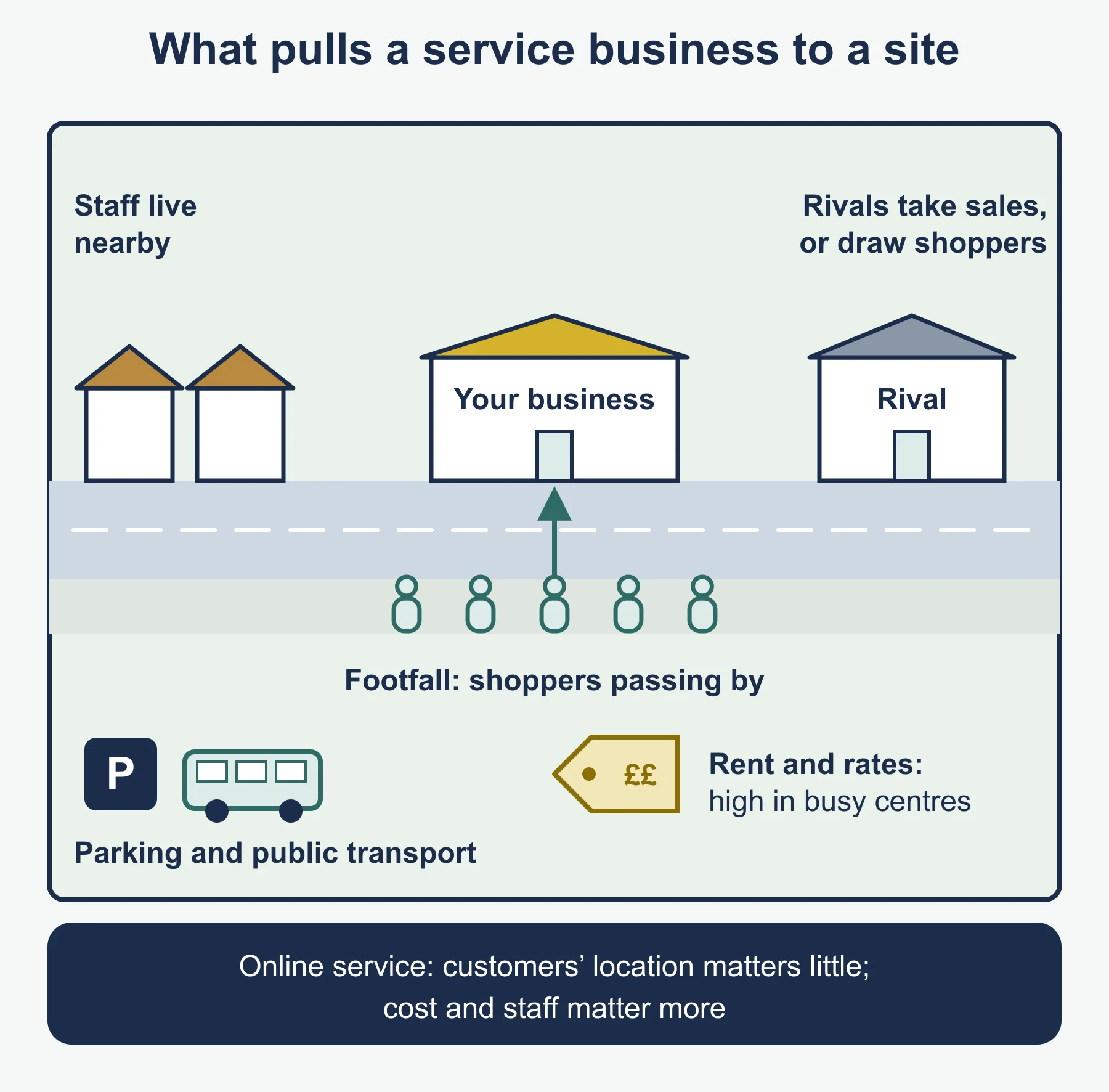
| Closeness to customers | Footfall, local population, passing trade |
| Competitors | Rivals reduce sales, but clusters may attract customers |
| Visibility and access | Parking, public transport, safety, easy entry |
| Rent | Busy central sites cost more |
| Staff | Skilled employees need to be able to reach the site |
| Online delivery | Customer location matters little, so costs and staff matter more |
Country choice factors
| Factor | Example of how it matters |
|---|---|
| Labour cost and skills | Lower wages may be offset by weaker skills |
| Market size and growth | A growing market can raise sales |
| Transport and infrastructure | Shipping costs and reliability |
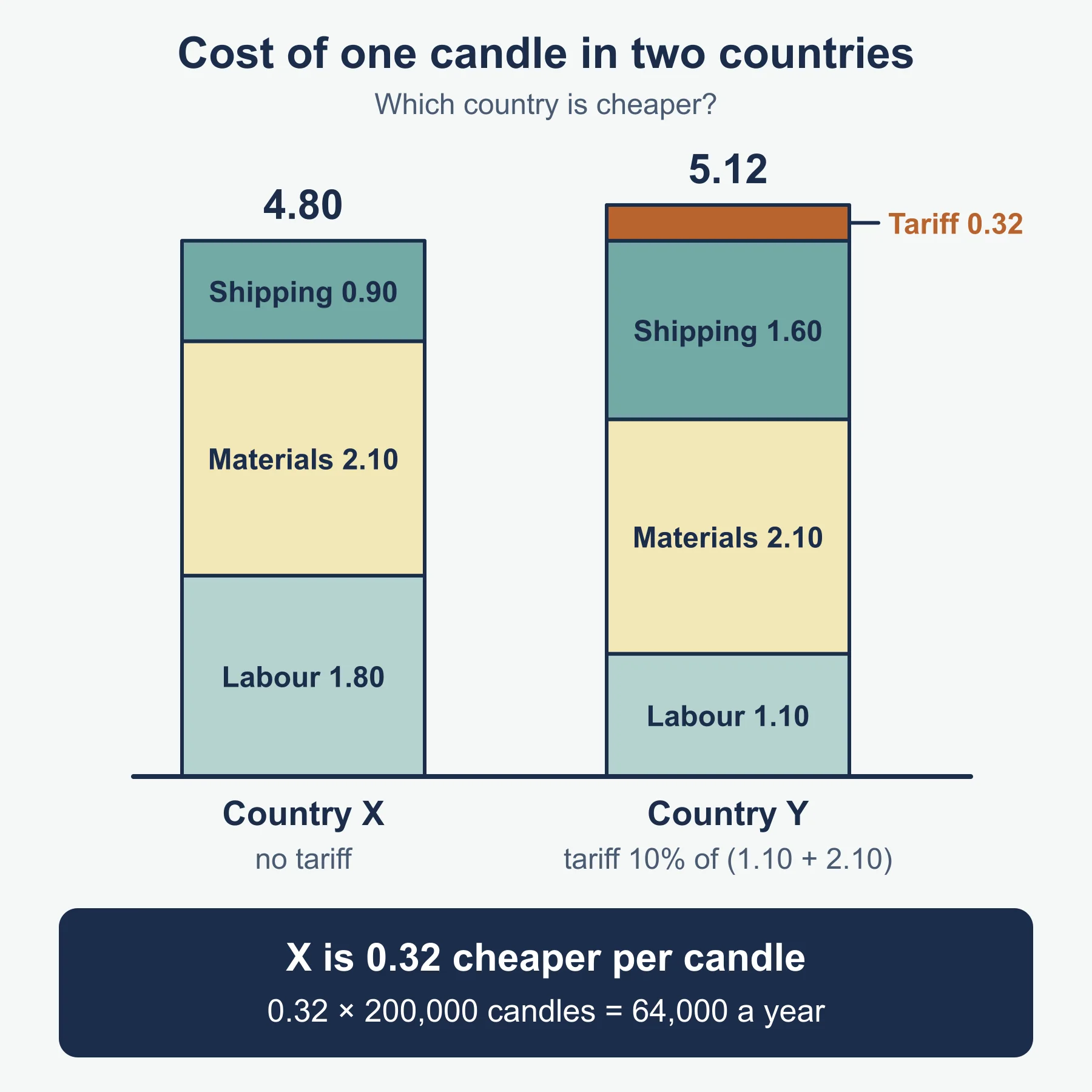
| Tariffs and trade barriers | Add costs to goods crossing borders |
| Exchange rates | Changes alter costs and revenue in home currency |
| Political stability | Instability risks disruption |
| Language and culture | Affect staff, customers and marketing |
| Government incentives | Lower start-up costs |
| Legal controls | May restrict, delay or add cost |
Legal controls on location
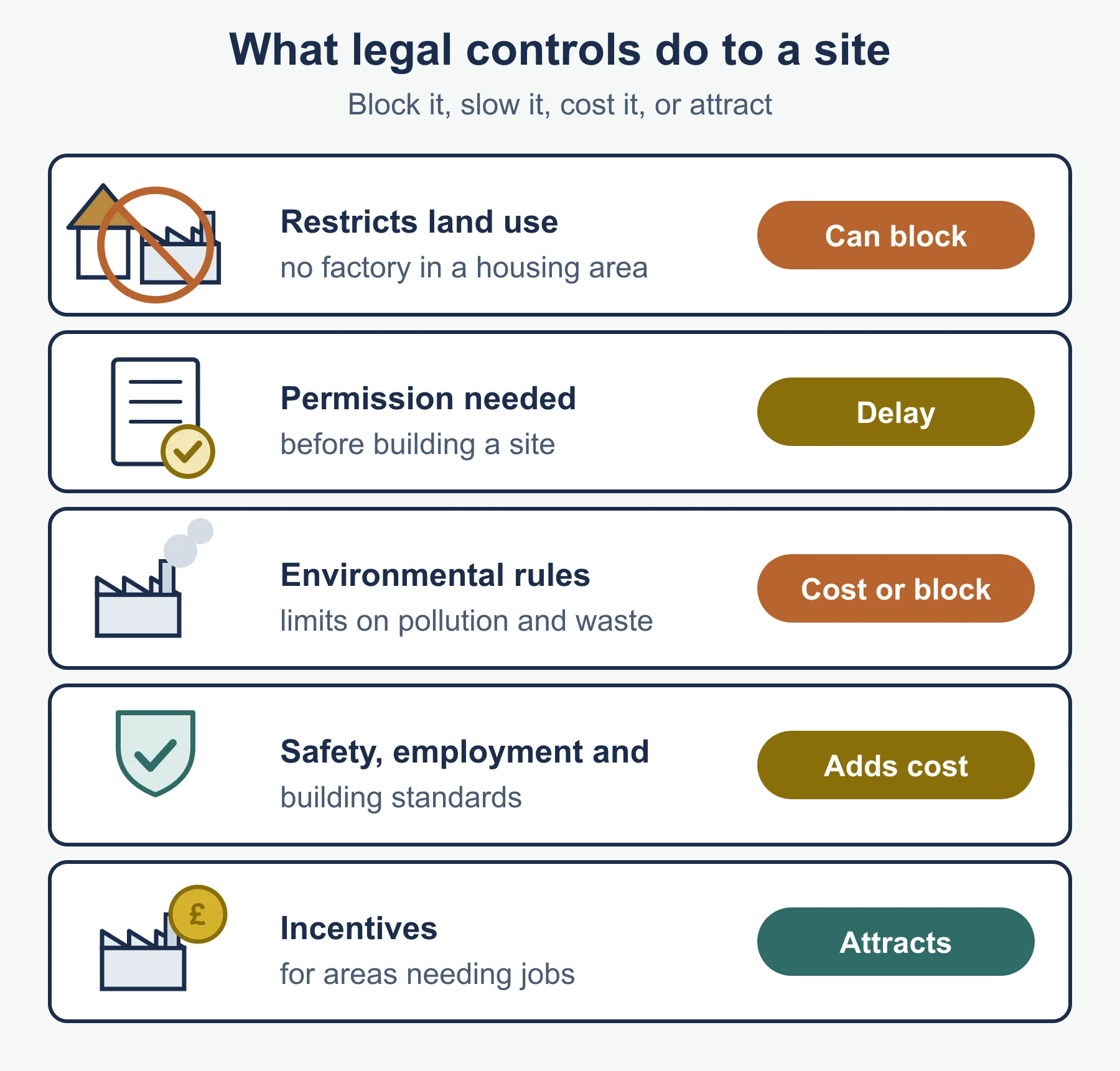
- limits on how land can be used, such as keeping factories out of residential or protected areas
- permission needed before building or changing the use of a site
- environmental rules on pollution and waste
- health and safety, employment and building standards
- incentives to locate in areas that need jobs
Describe controls generally. If you cannot name a law with certainty, do not guess; describe what it does instead.
Relocation
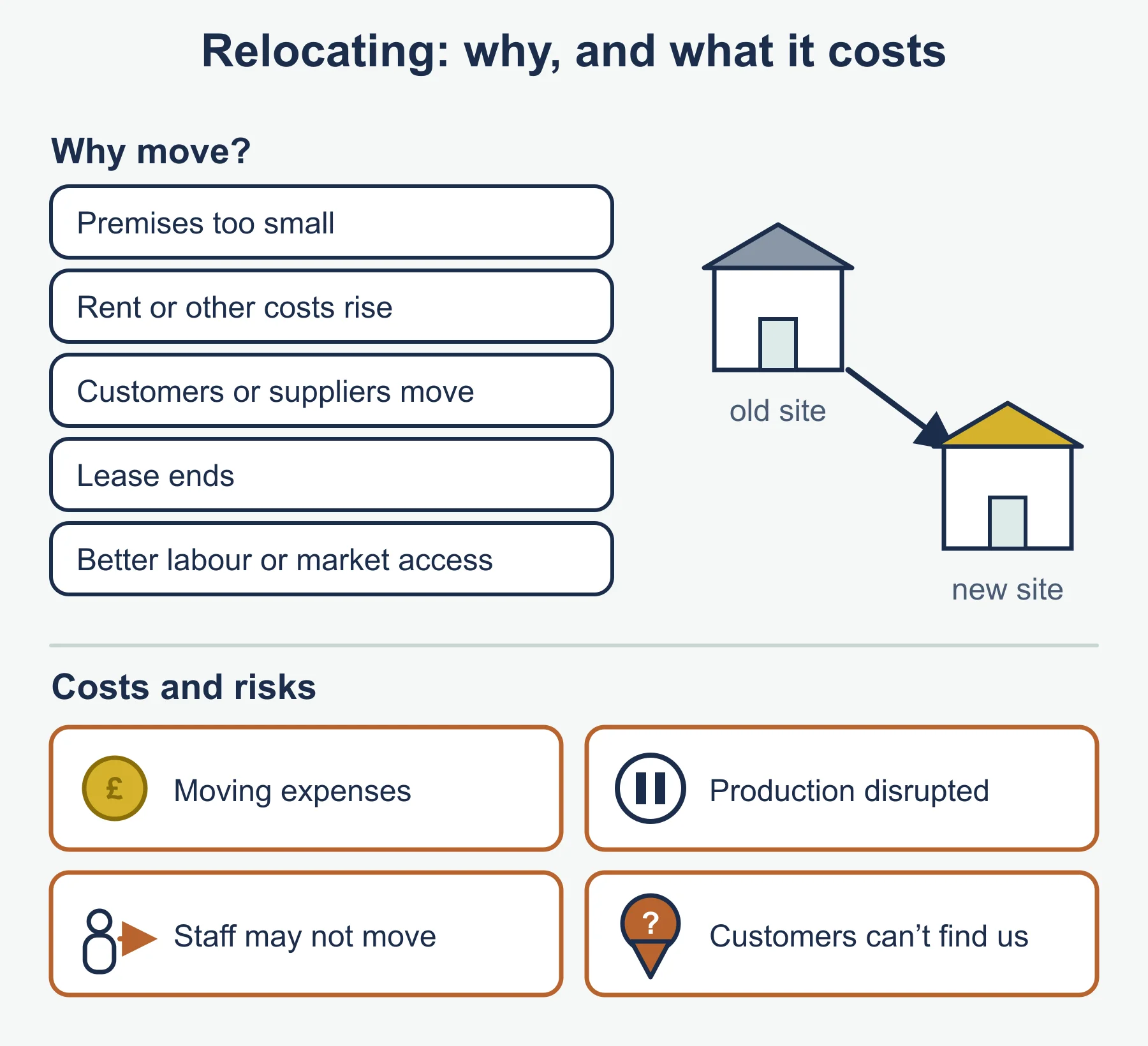
- Reasons: premises too small, rising rent or costs, lease ending, customers or suppliers moving, better access to labour or markets.
- Costs and risks: moving costs, disrupted production, staff leaving, customers unable to find the new site.
Method: recommend and justify a location
- State your chosen location in the first sentence.
- Give two or three reasons using data from the case.
- Explain the effect (cost, sales, quality, delivery).
- Weigh the best alternative and say why you still prefer your choice, or what risk remains.
Worked reminder: Dalwhin Cafe pays 5 200 a month rent at its current site and 3 900 a month at a new site. The saving is 5 200 − 3 900 = 1 300 a month, which is 15 600 a year. If the move costs 18 500, the saving takes 18 500 ÷ 15 600 = about 1.19 years, or roughly 14 months, to recover. Then weigh this against the risk that regular customers do not follow.
Command words to practise
The syllabus lists these command words and meanings: calculate (work out from given facts, figures or information), define (give precise meaning), explain (set out purposes or reasons, make relationships clear, say why and/or how and support with relevant evidence), identify (name, select, recognise), justify (support a case with evidence or argument), outline (set out the main points), state (express in clear terms) and consider (review and respond to given information).
For this topic, “define” suits quality, control and assurance. “Identify” suits location factors. “Explain” needs a reason plus a link to the business. “Justify” needs evidence from the case behind your chosen location or quality method.
Quick self-test
- Define quality.
- State the main difference between quality control and quality assurance.
- Give two ways a business can carry out quality control.
- Give two ways a business can implement quality assurance.
- A sample of 250 bottles contains 10 faulty. What percentage is faulty?
- If output is 5 000 bottles, how many faulty bottles does the sample suggest?
- Give two location factors for a manufacturer and two for a service business.
- Give two factors to consider when choosing which country to locate in.
- Describe one way legal controls can affect a location decision.
- Give two costs or risks of relocating.
- A business pays 2 000 a month at one site and 1 600 at another. What is the saving over a year?
- What four steps make up a recommend and justify answer?
Answers
- How well a product or service meets customer needs and expectations.
- Control finds faults; assurance prevents them.
- Any two from: inspecting items or samples, testing, checking against a standard, rejecting faulty items.
- Any two from: written standards, supplier checks, training, workers checking their own work, planned machine maintenance, using customer feedback.
- 10 ÷ 250 = 0.04, which is 4%.
- 4% × 5 000 = 200 bottles.
- Manufacturer: any two from land costs, labour, materials, customers, transport, utilities, government help. Service: any two from closeness to customers, competitors, visibility and access, rent, staff.
- Any two from: labour cost and skills, market size, transport, tariffs, exchange rates, political stability, culture, incentives, legal controls.
- For example: restrictions on land use may stop a factory being built in a residential area, so a business has to choose another site.
- Any two from: moving costs, disrupted production, losing staff, customers not finding the new site.
- (2 000 − 1 600) × 12 = 4 800.
- Choose; support with case evidence; explain the effect; weigh the alternative.
Where marks are usually lost
- Writing that quality means “good” or “expensive” without linking it to customer needs.
- Writing about quality control and assurance as if they were one idea, so neither is explained.
- Describing a method but not saying what it achieves for the business in the question.
- Listing location factors with no link to the type of business.
- Saying the cheapest location is best without weighing skills, customers, transport or laws.
- Not giving a reason drawn from the case when asked to recommend.
- Making a one-sided case in a question that asks you to justify a choice, with no alternative considered.
- Calculating a percentage or total and leaving out units or the assumption behind it.
Frequently asked questions
Does high quality mean a product is expensive or luxurious? No. Quality means how well a product or service meets the needs and expectations of the customer, so a cheap product can be high quality if it does its job for the price.
Why is sampling used in quality control? Sampling is used when checking every item would be too slow or too costly, or would destroy the product, as with taste-testing tinned food. Because it relies on a sample, some faulty items can be missed.
Why might a business relocate? A business may relocate when its premises become too small, costs such as rent rise, its customers or suppliers move, a lease ends or a new site offers better access to labour or markets. Moving brings its own costs and disruption.
Do location factors differ for manufacturing and service businesses? Yes. Manufacturers weigh land costs, labour, raw materials and transport, while service businesses depend more on closeness to customers, footfall, visibility and access. Link the factors to the type of business in the question.
Official syllabus
Cambridge International, Cambridge O Level Business Studies 7115 syllabus, for examination in 2026 (version 2, published December 2025), sections 4.3 and 4.4.
Get free revision emails (optional)
Occasional emails with practice questions, worked explanations and links to free resources for the qualification and subjects you choose. No spam, and you can unsubscribe from any email. The free tools on this site never need an email.
Related resources
-
Study guides
O Level Business: Costs, scale of production and break-even analysis (Cambridge 7115)
Study guide to costs, economies and diseconomies of scale and break-even analysis for Cambridge O Level Business 7115, with worked examples.
Business · Cambridge · O Level
Read guide -
Practice questions
O Level Business: Costs, scale of production and break-even analysis (Cambridge 7115) – Practice Questions
Original practice questions with worked answers on cost classification, scale of production and break-even charts for Cambridge O Level Business 7115.
Business · Cambridge · O Level
Try questions -
Revision notes
O Level Business: Costs, scale of production and break-even analysis (Cambridge 7115) – Revision Notes
Condensed revision notes on cost types, economies and diseconomies of scale, break-even charts and margin of safety for Cambridge O Level Business 7115.
Business · Cambridge · O Level
Revise topic
Related articles
-
teaching
A Level tuition in Dubai: Cambridge or Pearson Edexcel International A Level?
Schools in Dubai and Abu Dhabi teach either Cambridge International AS & A Level or Pearson Edexcel International A Level. How the two are structured, why it matters for tuition, and how online classes from Lahore work.
9 October 2026
-
curriculum guides
Choosing subjects at IGCSE and A Level
How subject choices at 14 and 16 affect university options later, and how to keep pathways open without overloading a timetable.
28 July 2026
Studying this with a teacher
Working through Business O LEVELS?
This page is free and stays free. If you would rather be taught it, Marlbridge runs Business classes one-to-one and in small groups of up to 15, online in your own time zone. The first trial class is free. WhatsApp replies within an hour (8am–11pm Pakistan time, every day); email the same day.
Cambridge Business teachers at Marlbridge

