
Revision Notes
O Level Business: Types of business organisation and Business objectives and stakeholder objectives (Cambridge 7115) – Revision Notes
Condensed revision notes with tables, methods and a self-test on organisation types, objectives and stakeholders for Cambridge O Level Business 7115.
- Subject
- Business
- Level
- O LEVELS
- Topic
- Understanding business activity
- Author
- Marlbridge Academic Team
- Updated
- Reviewed by
- Salman Ahmad (what this means)
Aligned to Cambridge O Level Business (7115), For examination in 2026. Official specification .
Syllabus page (what it covers and how it is assessed): Cambridge O Level Business.
Syllabus points this page covers
7115
- 1.4 Types of business organisation
- 1.5 Business objectives and stakeholder objectives
Found an error? Report a correction.
Need help with this topic? Request a free trial class for O Level Business (7115).
These revision notes are for the Cambridge O Level Business Studies 7115 syllabus for examination in 2026, sections 1.4 (Types of business organisation) and 1.5 (Business objectives and stakeholder objectives). The syllabus is not tiered. For full explanations go to the study guide, then test yourself with the practice questions.
Other links: Cambridge O Level Business hub, the printable checklist, and the free 10-minute diagnostics. Money is in dollars and every business named is invented.
1.4 Key terms
| Term | Short definition |
|---|---|
| Ownership | Who owns the business, takes the decisions and receives the profit |
| Risk | The chance that money is lost |
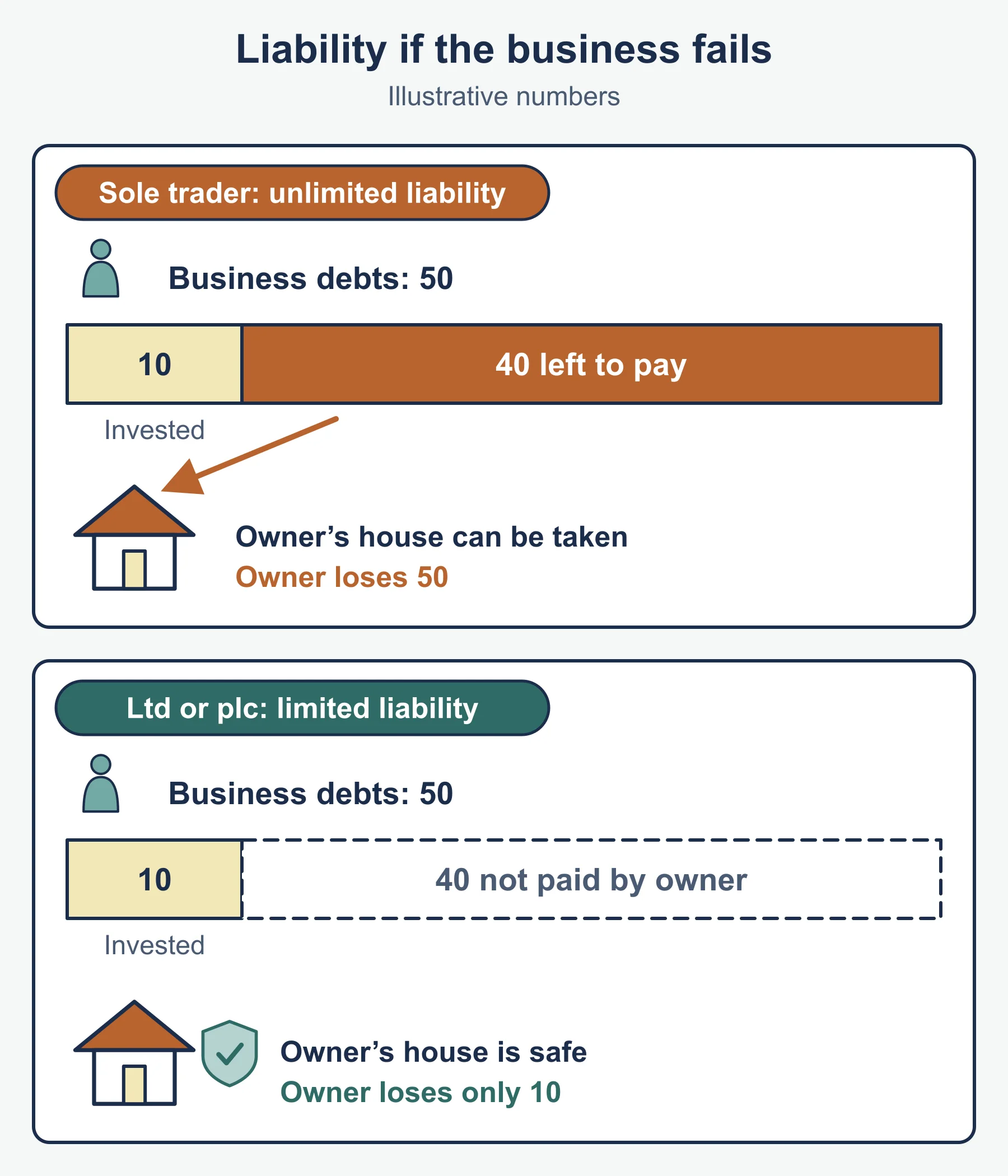
| Limited liability | An owner can lose only the amount invested in the business |
| Unlimited liability | An owner is personally responsible for all business debts |
| Unincorporated | Business and owner are treated as one: sole traders and partnerships |
| Limited company | A separate legal entity owned by shareholders |
| Public corporation | A public sector organisation owned by the government and run by appointed managers |
Forms of organisation at a glance
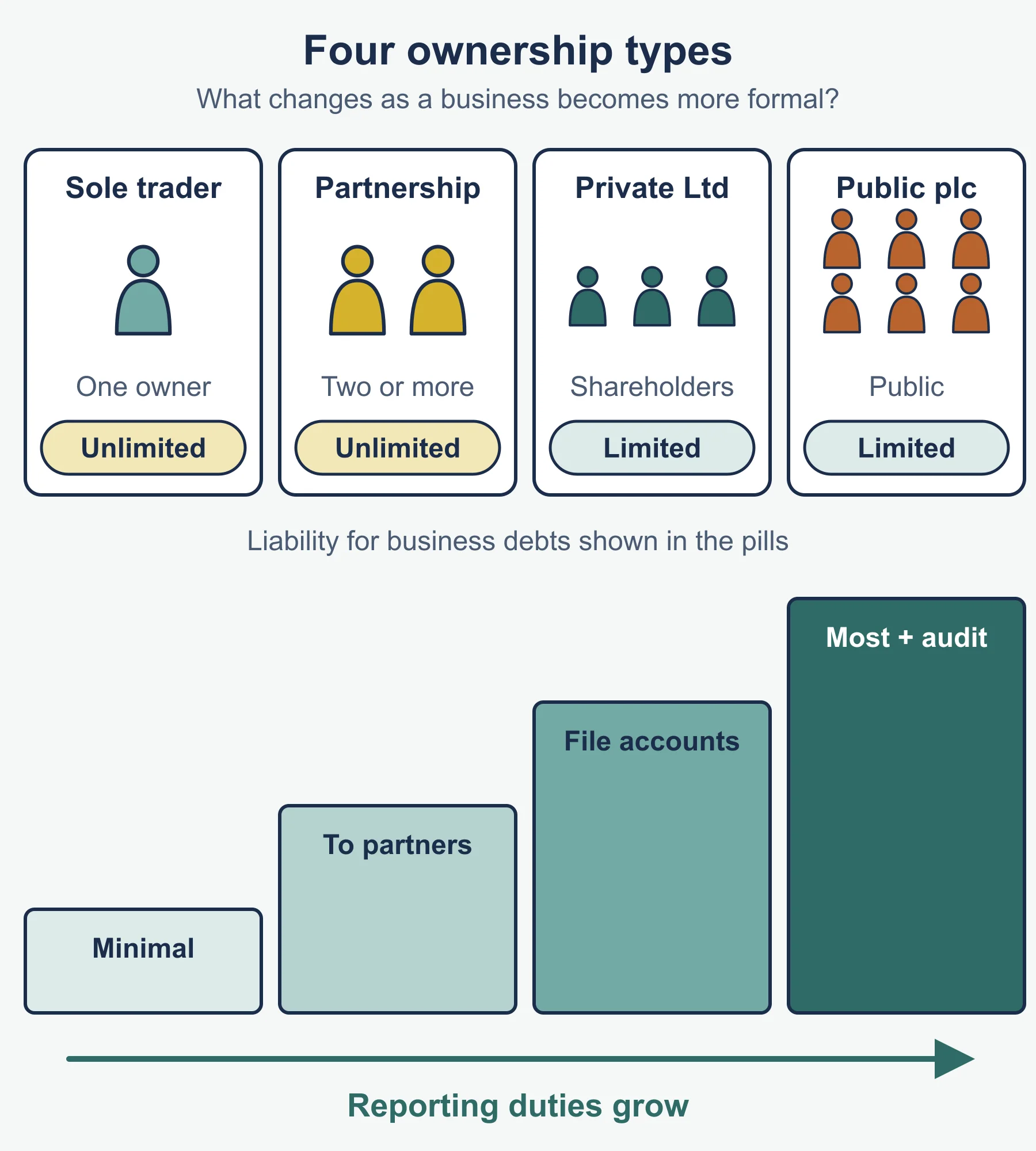
| Form | Owners | Liability | Capital from | Key point |
|---|---|---|---|---|
| Sole trader | One | Unlimited | Owner, loans | Full control, all profit |
| Partnership | Two or more | Unlimited (usual form) | Partners, loans | Shared skills and capital; may disagree |
| Private limited company | Shareholders | Limited | Shareholders, loans | Shares not for sale to the public |
| Public limited company | Shareholders | Limited | Stock exchange sales of shares | Large sums; takeover risk |
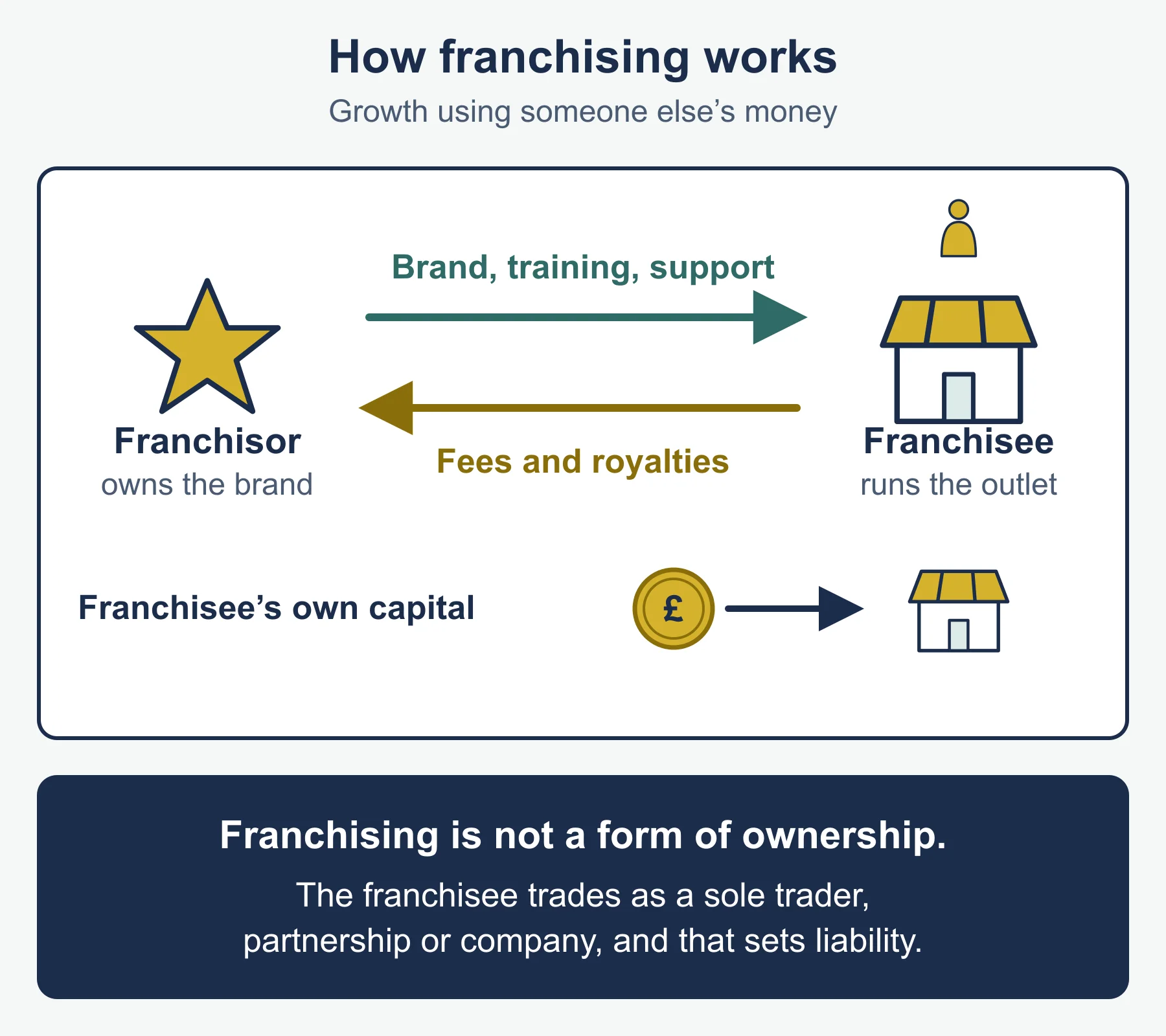
| Franchise | Franchisee owns outlet | Franchisee carries it | Franchisee plus fees paid to franchisor | Borrowed brand, fixed rules |
| Joint venture | Two or more businesses | As agreed | Partners | Project-based, shared cost and profit |
| Public corporation | Government | Owned by the state | Government, user charges | Service to the public |
Unincorporated versus limited
| Point | Unincorporated | Limited company |
|---|---|---|
| Legal identity | Same as owner | Separate from owners |
| Liability | Unlimited | Limited |
| Capital | Usually small | Usually larger |
| Control | Owners | Directors answerable to shareholders |
| Setting up | Quick, cheap | More steps and more costs |
| Information | Little must be published | More must be reported to shareholders |
Strengths and weaknesses
| Form | Main strengths | Main weaknesses |
|---|---|---|
| Sole trader | Control, keeps all profit, simple | Unlimited liability, little capital, heavy workload |
| Partnership | More capital and skills, shared workload | Unlimited liability, disputes, profit shared |
| Private limited company | Limited liability, more capital, owners keep control | More paperwork, shares hard to sell |
| Public limited company | Very large capital, easy to trade shares | Costly to run, takeover risk, spread control |
| Franchise | Known brand, support and training | Fees, rules, less freedom |
| Joint venture | Shared cost, risk and expertise | Shared profit, possible clashes |
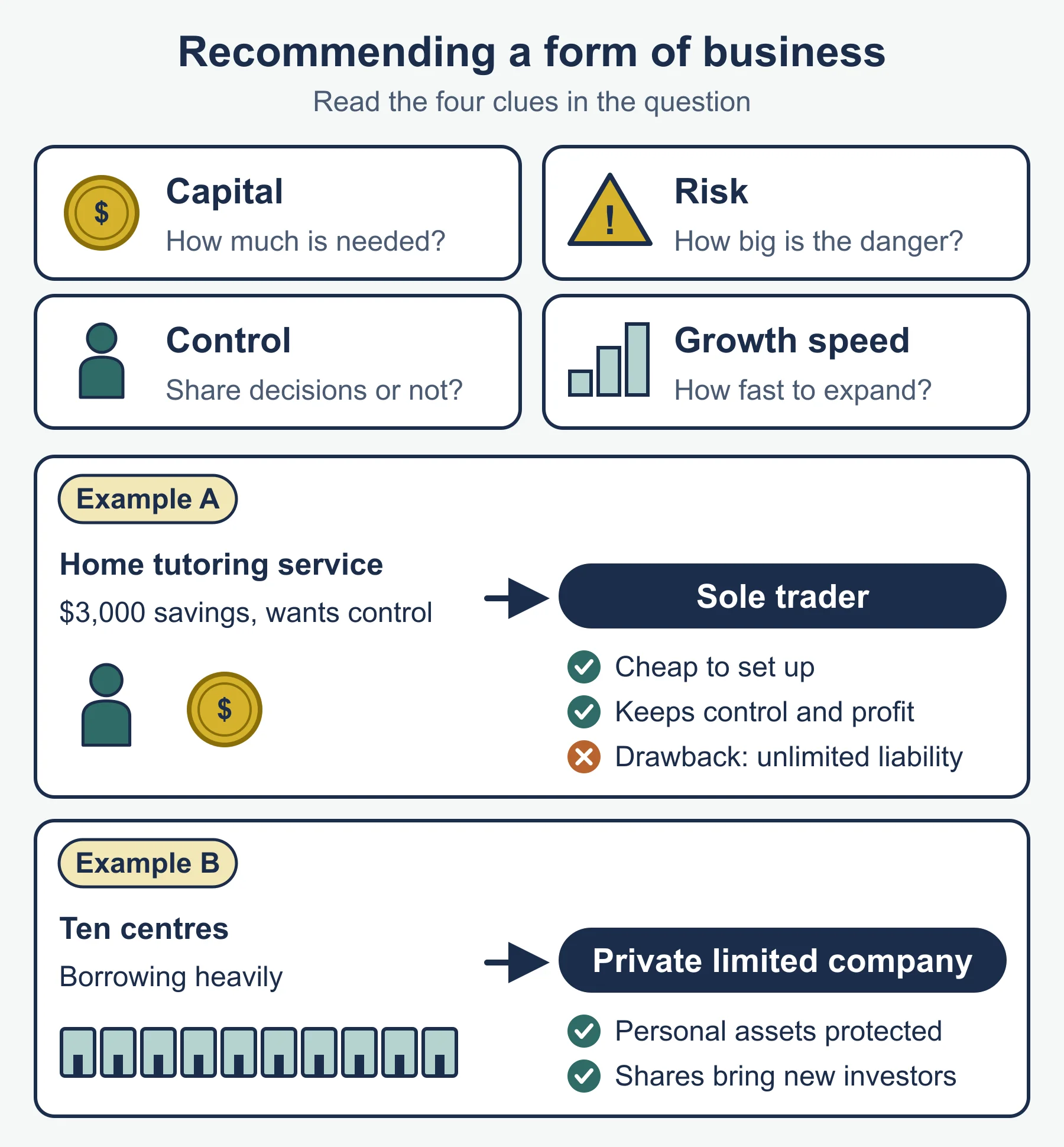
Method: recommend and justify a form
- Read the facts and underline clues: capital needed, risk, control wanted, growth plans.
- Name one form clearly.
- Link it to a clue and give a reason.
- Give a drawback or an alternative you rejected.
- Finish with a short judgement tied to the situation.
Reminder example. Mossop Tiles is a sole trader with sales revenue of 480,000 and costs of 372,000. Profit is 480,000 − 372,000 = 108,000, all of it the owner’s. If two equal partners ran it, each would get 54,000, and the owner would have shared control as well. Profit as a percentage of sales revenue is 108,000 ÷ 480,000 × 100 = 22.5%.
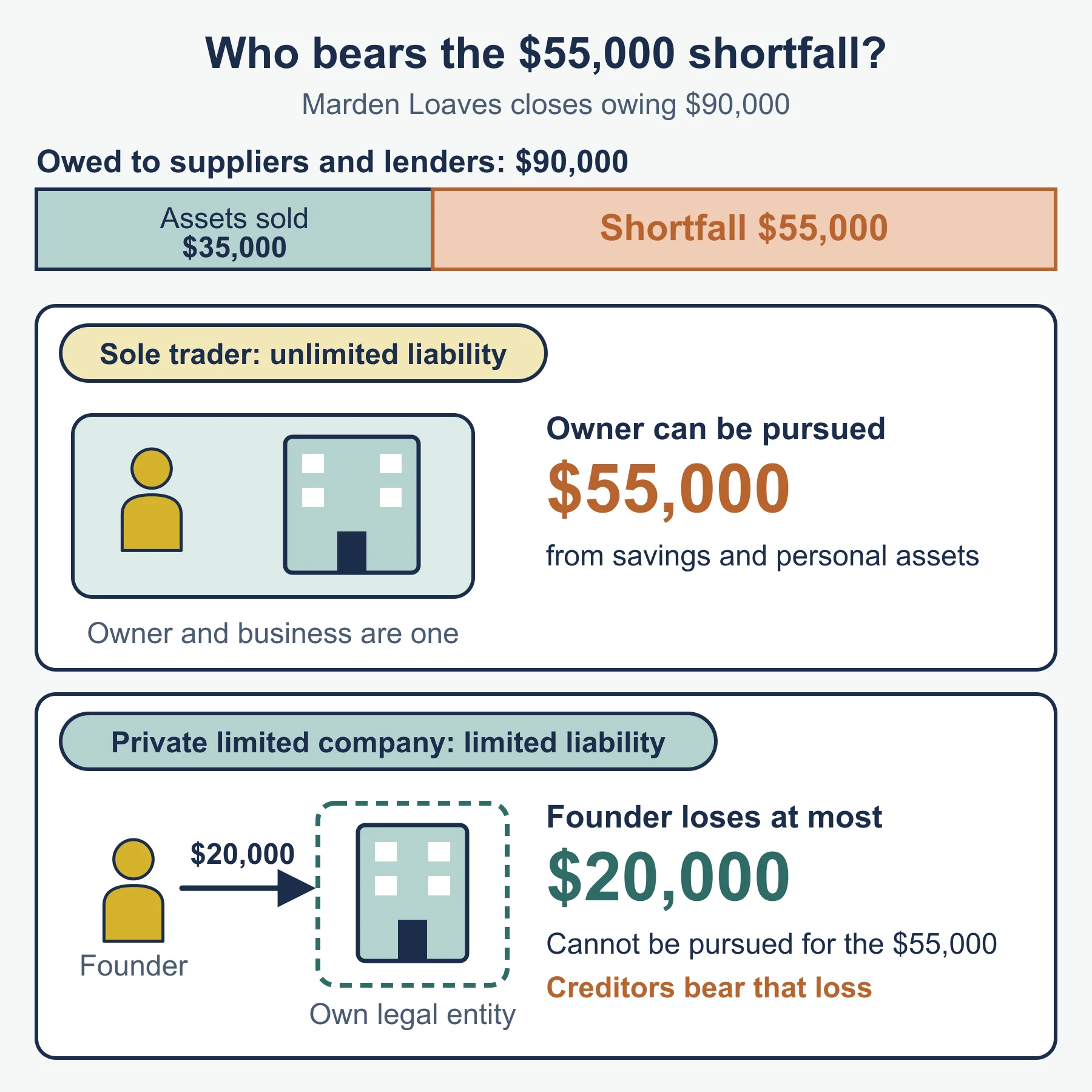
Reminder example on liability. A trader owes 160,000 and the sale of assets raises 95,000. The shortfall is 65,000. As a sole trader the owner could be asked to pay it from personal assets. As a limited company owner who invested 30,000, the loss is limited to 30,000.
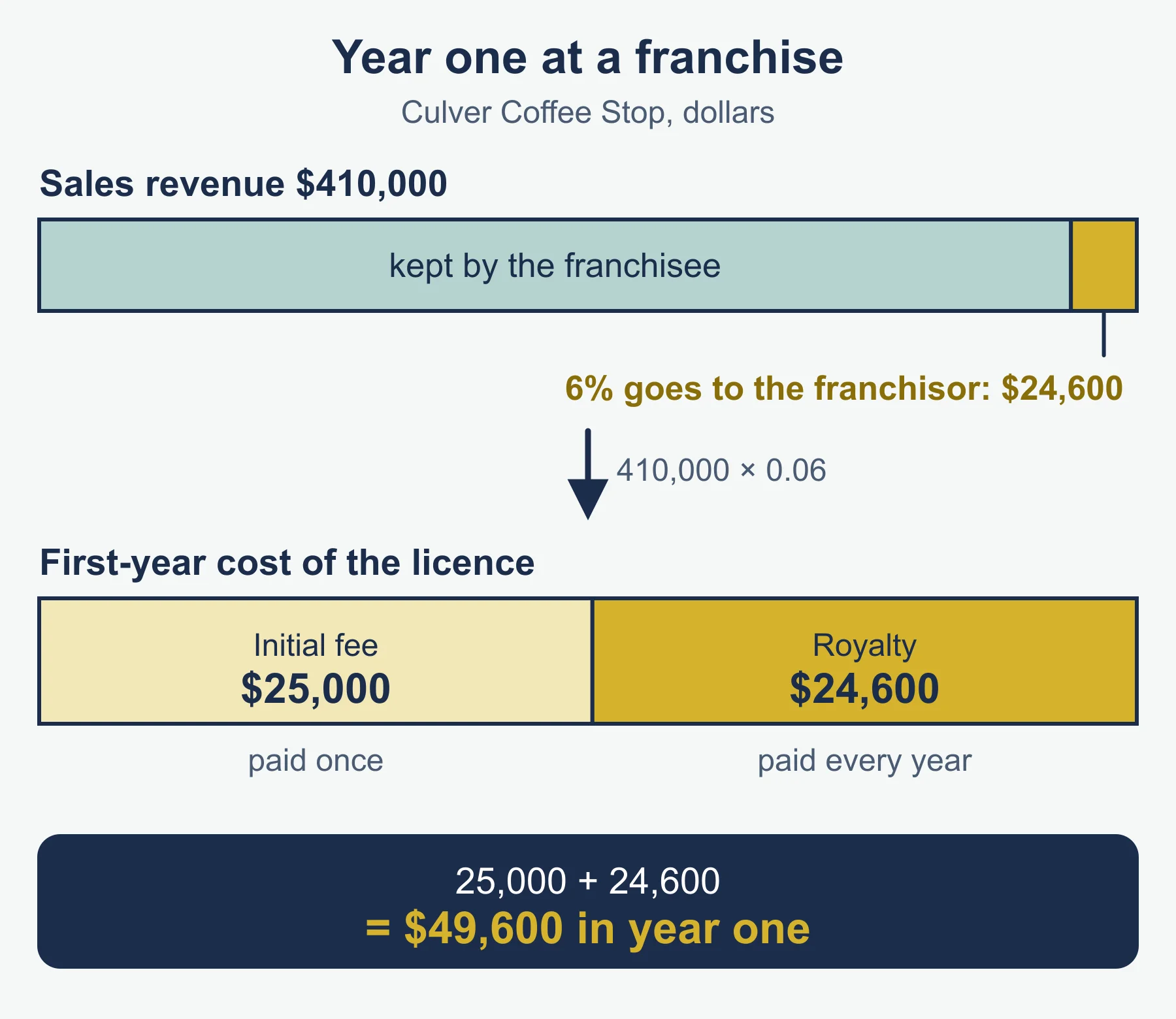
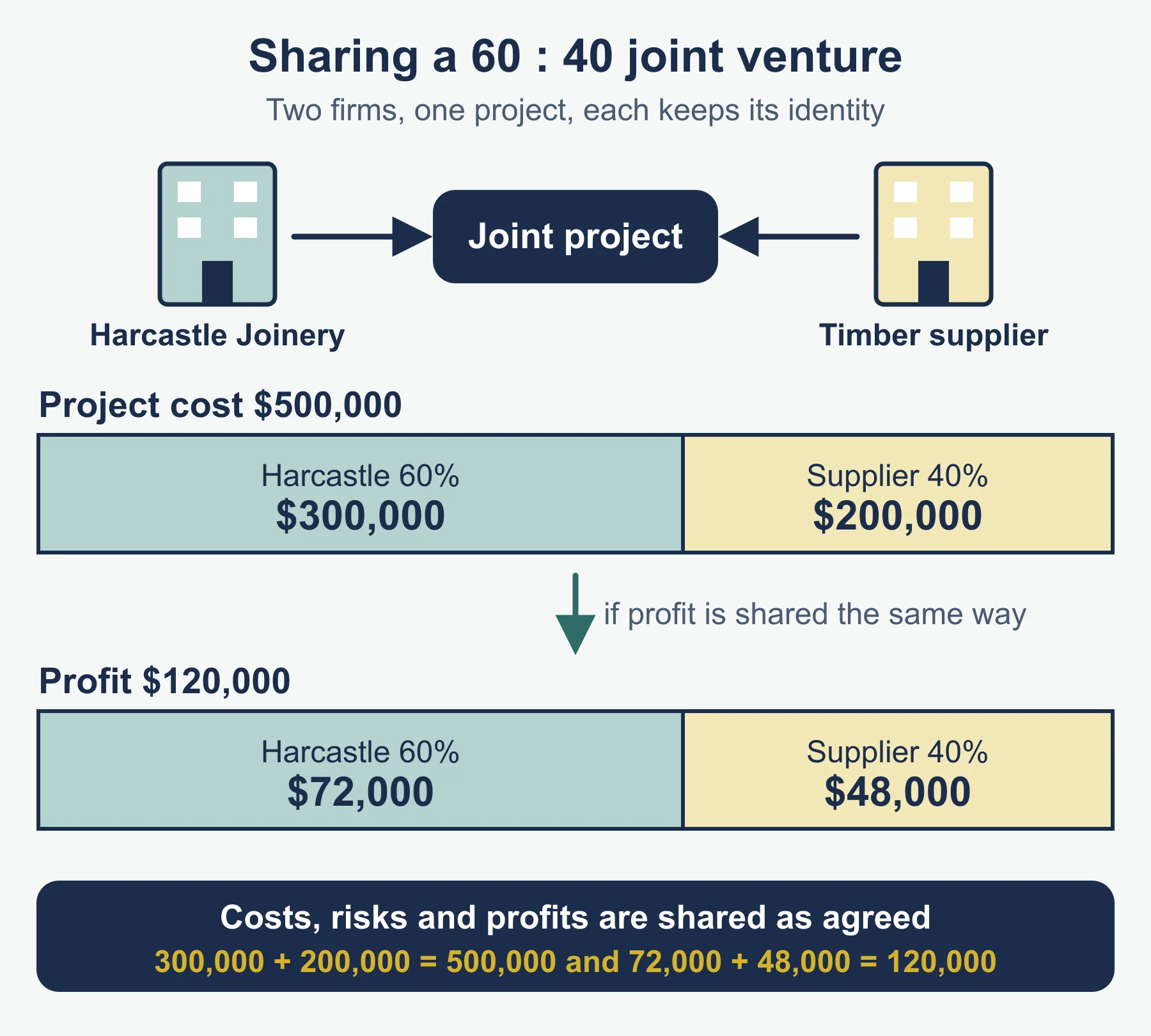
Reminder on franchise and joint venture money. A franchisee paying an 8% royalty on sales revenue of 250,000 pays 250,000 × 0.08 = 20,000. A joint venture project costing 90,000 shared 70 : 30 costs the partners 63,000 and 27,000.
1.5 Key terms
| Term | Short definition |
|---|---|
| Objective | A target the business wants to reach |
| Survival | Staying in business |
| Growth | Becoming bigger, for example higher sales revenue |
| Profit | Revenue minus costs |
| Market share | Share of total market sales: (business sales ÷ total market sales) × 100 |
| Social enterprise | A business whose main aim is social or environmental, with profit mostly reinvested |
| Stakeholder | A person or group with an interest in the business |
Why objectives matter and why they change
- They give direction and allow results to be compared with targets.
- They help managers choose between options and motivate staff.
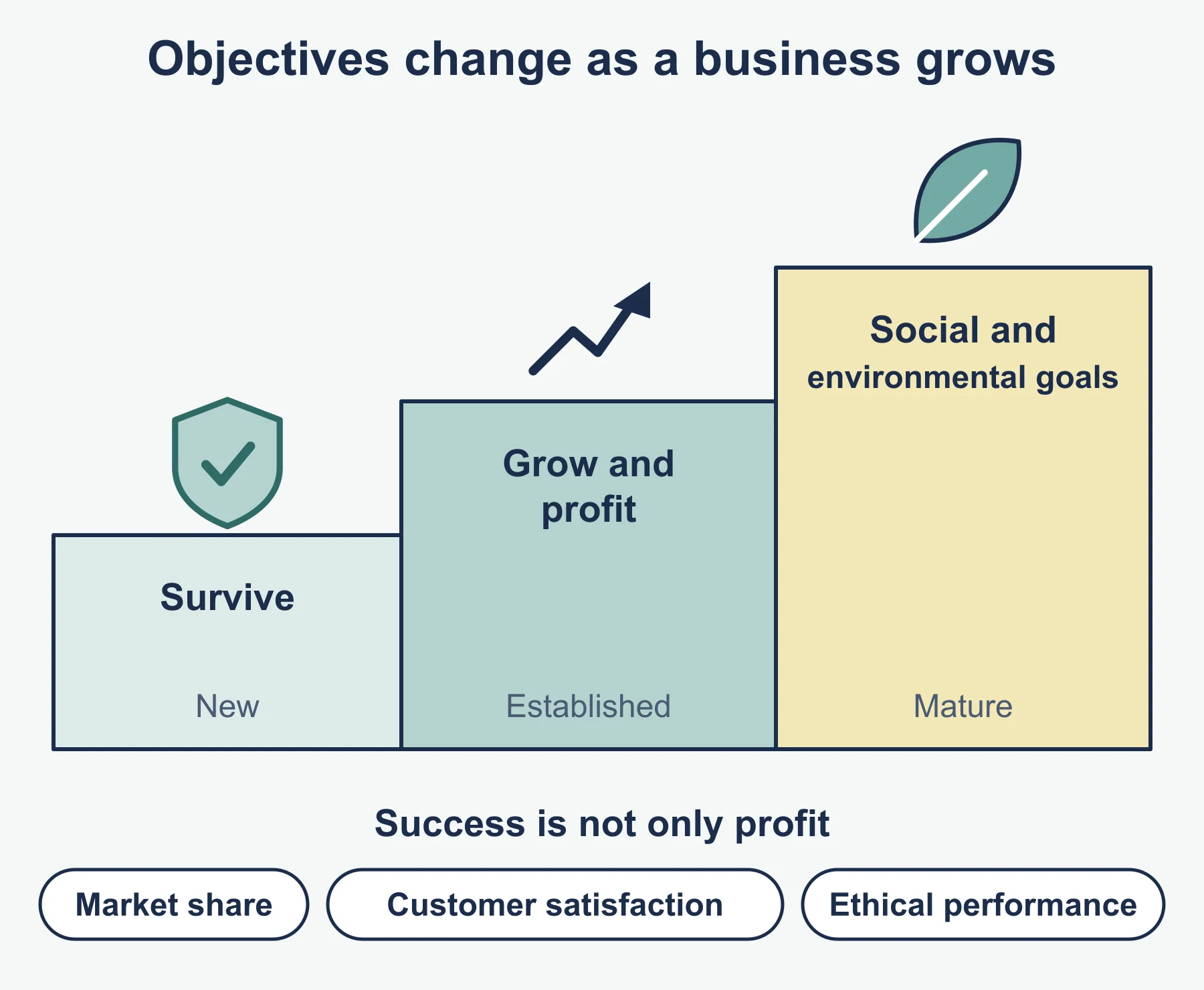
- Social enterprises add a social or environmental aim and reinvest most profit in it.
- They change when: the business is new or established, the economy weakens or improves, a competitor enters, or owners change what they want.
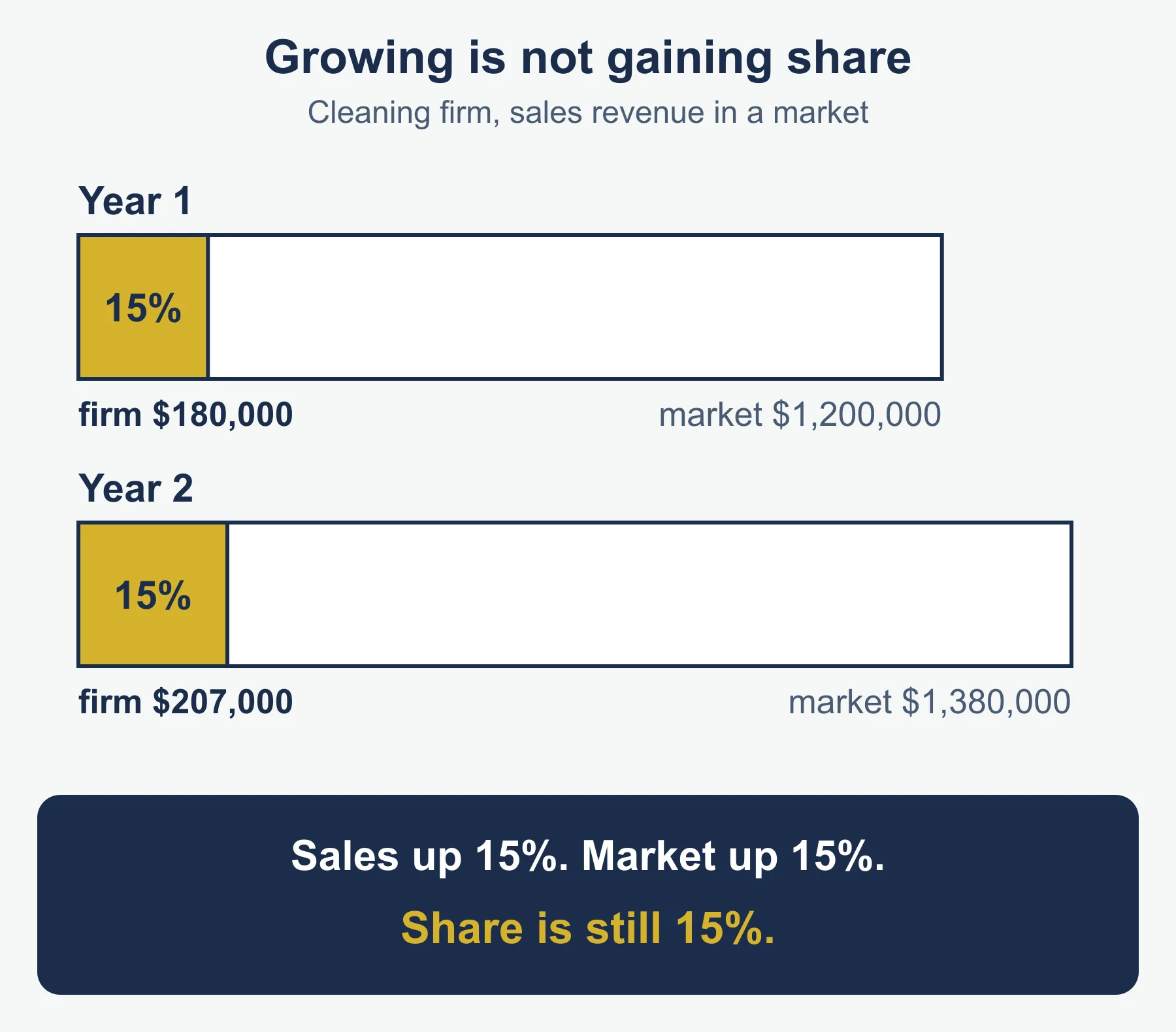
Reminder: market share and growth can differ. A business whose sales revenue rises from 54,000 to 63,000 has grown by (63,000 − 54,000) ÷ 54,000 × 100 = 16.7% (1 d.p.). If the market rose from 360,000 to 420,000 its share stayed at 15% (54,000 ÷ 360,000 and 63,000 ÷ 420,000).
Stakeholders
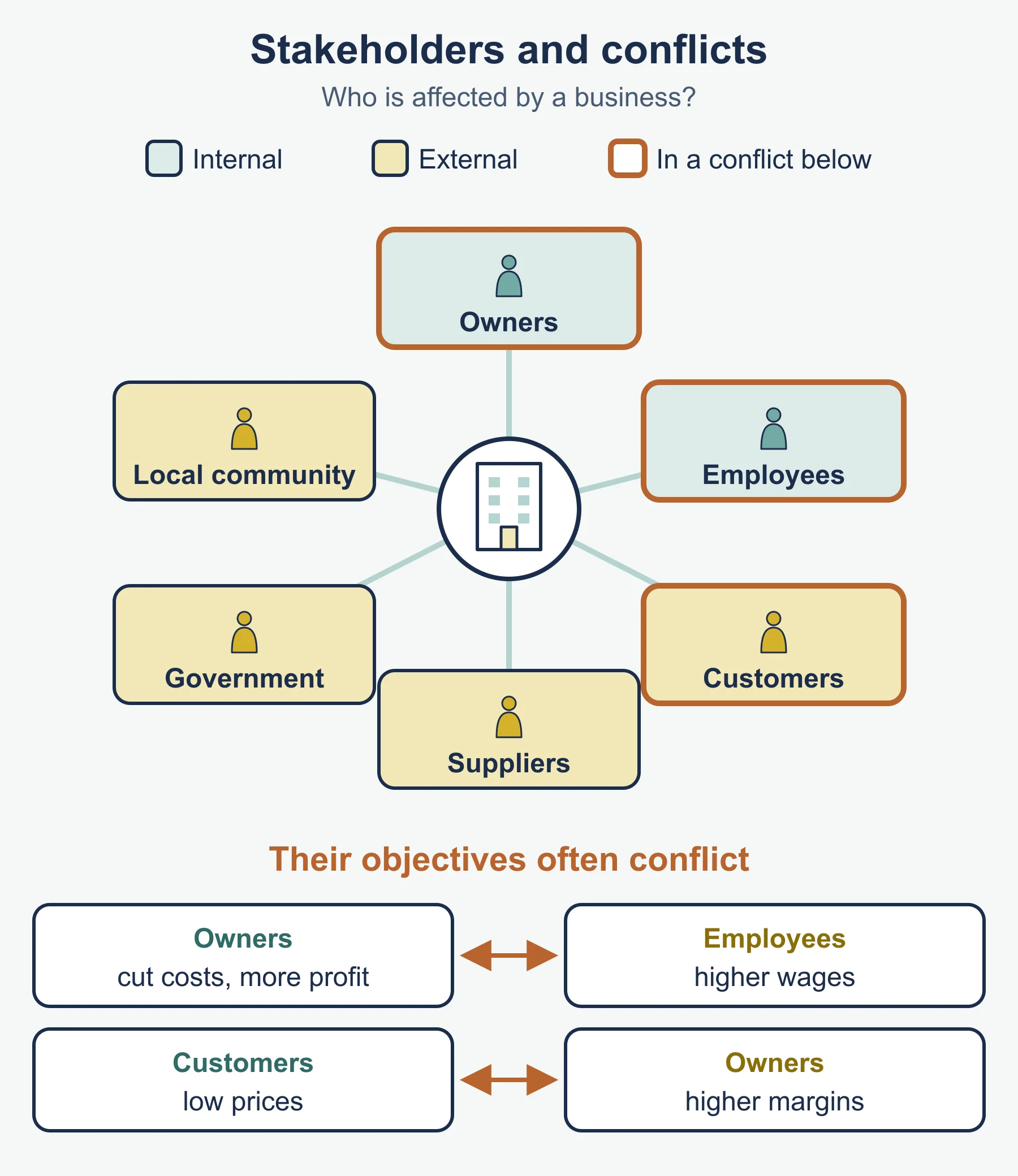
| Group | Internal or external | Typical objective |
|---|---|---|
| Owners and shareholders | Internal | Profit and dividends |
| Managers | Internal | Pay, status, business success |
| Employees | Internal | Pay, security, conditions |
| Customers | External | Quality and value |
| Suppliers | External | Prompt payment and regular orders |
| Lenders | External | Loan repaid with interest |
| Government | External | Tax, jobs, compliance |
| Local community | External | Jobs, clean surroundings |
Conflict pairs to remember
- Shareholders (higher profit) versus employees (higher pay).
- Customers (low prices) versus suppliers (higher prices).
- Community (quiet, clean) versus managers (bigger factory).
Method for a conflict question: name the two groups, state each objective, explain why both cannot be fully met, and where asked say which should come first and why.
Private and public sector objectives
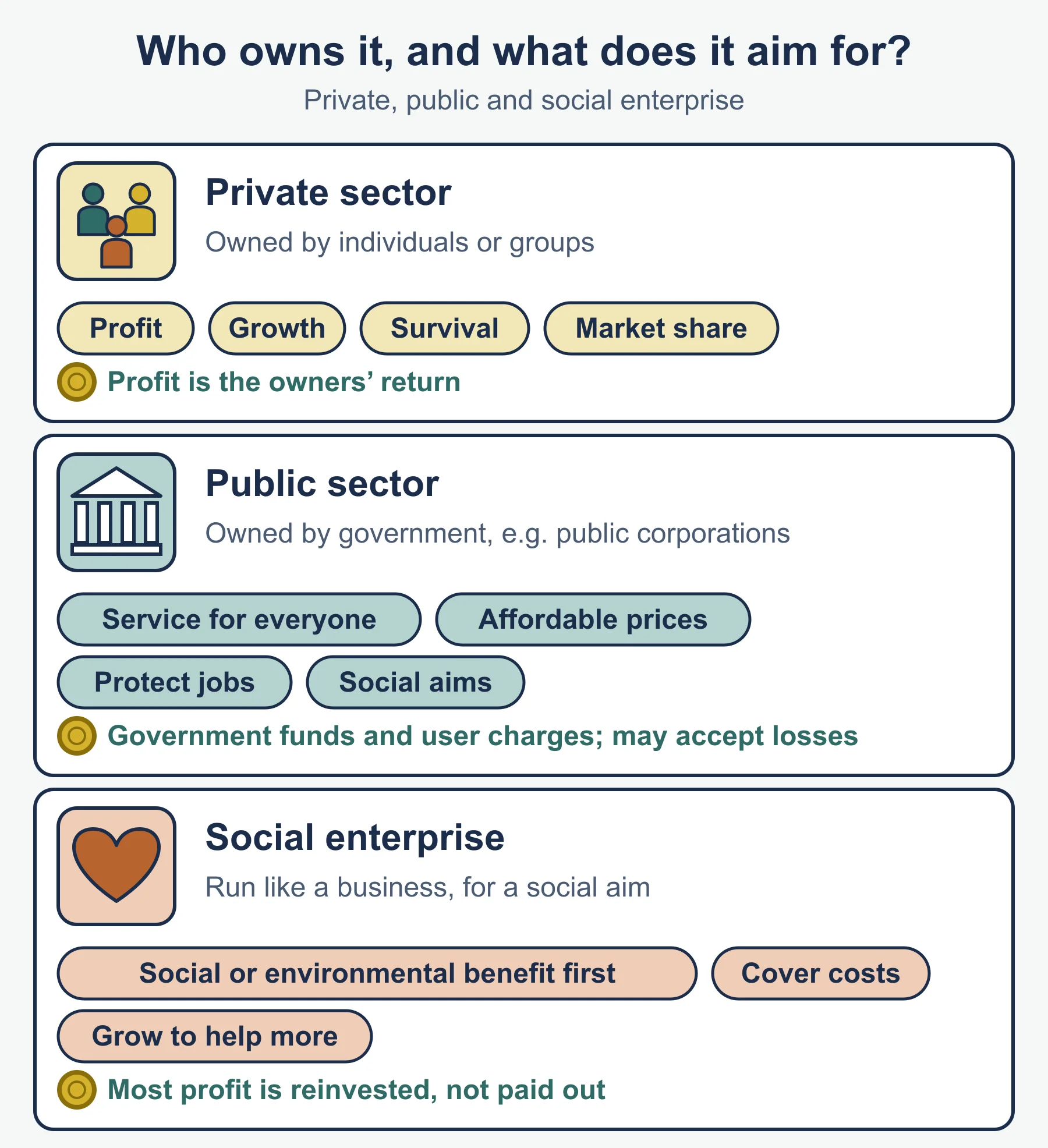
| Private sector | Public sector | |
|---|---|---|
| Owned by | Individuals or shareholders | Government |
| Usual main aims | Profit, growth, survival, market share | Service for all, affordable prices, jobs, social aims |
| Losses | Owners bear them | May be covered by government |
Must-know distinctions
- Private limited versus public limited: whether shares can be sold to the general public through a stock exchange.
- Franchise versus joint venture: a franchisee buys the right to use one brand; joint venture partners combine for a project.
- Internal versus external stakeholders: inside or outside the business.
- Social enterprise versus charity-like giving: a social enterprise still sells to cover costs.
Quick self-test
- Define limited liability.
- State two differences between a sole trader and a private limited company.
- Identify the main benefit of a franchise to a franchisee.
- A firm with sales of 90,000 sits in a market worth 750,000. Calculate its market share.
- Explain one reason why a new business may prioritise survival.
- Identify two external stakeholders.
- Give one example of a conflict between customers and owners.
- Outline one way a social enterprise differs from a private sector business aimed at profit.
- State one objective of a public corporation.
- Justify a partnership for two dentists who want to share equipment costs.
Answers
- The owner can lose no more than the amount invested, so personal assets are protected.
- Any two: a sole trader has unlimited liability but a company has limited liability; a sole trader is one owner while a company has shareholders; a sole trader is not a separate legal entity; a company can usually raise more capital.
- A known brand and proven methods, which lowers the risk of failure.
- 90,000 ÷ 750,000 × 100 = 12%.
- In the first years many new businesses lose money and have little cash, so staying open is a priority before growth.
- Any two from customers, suppliers, lenders, government, local community.
- Customers want lower prices, while owners want higher prices to make more profit.
- It puts social or environmental aims first and reinvests most profit, instead of paying it out to owners.
- Any one: provide a service to everyone, keep prices affordable, protect jobs.
- The dentists share equipment costs, skills and workload and can raise more capital than one person, which suits a joint practice. The drawback is unlimited liability and possible disagreement, but a written agreement can reduce this.
Where marks are usually lost
- Giving a feature without saying why it matters in the situation.
- Saying “limited liability” protects the business rather than the owner.
- Calling every business with shareholders a public limited company.
- Listing stakeholders with no objective, or objectives with no conflict when the question asks for conflict.
- Recommending a form of organisation without using the facts given.
- Answering “justify” with one side only.
- Using market share and growth as if they mean the same thing.
- Forgetting that public sector bodies can still care about costs.
Frequently asked questions
What is the difference between unincorporated businesses and limited companies? Sole traders and partnerships are unincorporated, so the business and its owners are treated as the same and the owners have unlimited liability. A limited company is a separate legal entity, and its shareholders have limited liability.
Is a public limited company in the public sector? No. A public limited company is a private sector business whose shares can be sold to the general public. The public sector is owned and controlled by the government, for example through public corporations.
Why do business objectives change over time? A new business may aim at survival in its first year, then growth once it is secure, and later profit or market share, as its situation and the market change.
How do private and public sector objectives differ? Private sector enterprises usually aim for profit, growth and market share. Public sector enterprises usually aim to provide a service to everyone, keep prices affordable and protect jobs.
Official syllabus
Cambridge O Level Business Studies 7115 syllabus for examination in 2026, published by Cambridge International Education, sections 1.4.1 and 1.5.1 to 1.5.3.
Get free revision emails (optional)
Occasional emails with practice questions, worked explanations and links to free resources for the qualification and subjects you choose. No spam, and you can unsubscribe from any email. The free tools on this site never need an email.
Related resources
-
Study guides
Business Activity and Classification
Needs, wants, scarcity, opportunity cost, added value and classifying businesses by sector and by ownership, for Cambridge O Level Business Studies 7115.
Business · Cambridge · O Level
Read guide -
Practice questions
Business Activity and Classification: Practice Questions
Original exam-style practice questions with full worked answers on business activity, sectors, added value, stakeholders and enterprise.
Business · Cambridge · O Level
Try questions -
Revision notes
Business Activity and Classification: Revision Notes
Condensed recall notes on needs and wants, added value, economic sectors and business classification for Cambridge O Level Business Studies 7115.
Business · Cambridge · O Level
Revise topic
Related articles
-
teaching
A Level tuition in Dubai: Cambridge or Pearson Edexcel International A Level?
Schools in Dubai and Abu Dhabi teach either Cambridge International AS & A Level or Pearson Edexcel International A Level. How the two are structured, why it matters for tuition, and how online classes from Lahore work.
9 October 2026
-
curriculum guides
Choosing subjects at IGCSE and A Level
How subject choices at 14 and 16 affect university options later, and how to keep pathways open without overloading a timetable.
28 July 2026
Studying this with a teacher
Working through Business O LEVELS?
This page is free and stays free. If you would rather be taught it, Marlbridge runs Business classes one-to-one and in small groups of up to 15, online in your own time zone. The first trial class is free. WhatsApp replies within an hour (8am–11pm Pakistan time, every day); email the same day.
Cambridge Business teachers at Marlbridge

