
Study Guides
O Level Business: Types of business organisation and Business objectives and stakeholder objectives (Cambridge 7115)
Study guide to forms of business organisation, business objectives, stakeholders and public versus private sector aims for Cambridge O Level Business 7115.
- Subject
- Business
- Level
- O LEVELS
- Topic
- Understanding business activity
- Author
- Marlbridge Academic Team
- Updated
- Reviewed by
- Salman Ahmad (what this means)
Aligned to Cambridge O Level Business (7115), For examination in 2026. Official specification .
Syllabus page (what it covers and how it is assessed): Cambridge O Level Business.
Syllabus points this page covers
7115
- 1.4 Types of business organisation
- 1.5 Business objectives and stakeholder objectives
Found an error? Report a correction.
Need help with this topic? Request a free trial class for O Level Business (7115).
This study guide follows the Cambridge O Level Business Studies 7115 syllabus for examination in 2026. It covers syllabus sections 1.4 (Types of business organisation) and 1.5 (Business objectives and stakeholder objectives), which sit in Topic 1, Understanding business activity. The syllabus is not tiered.
Use it with the revision notes and the practice questions. The course hub is at Cambridge O Level Business and the printable checklist lets you tick off each point. To find weak spots first, try the free 10-minute diagnostics. Earlier content is in Enterprise, business growth and size.
All money in this guide is in dollars, and every business named is invented.
What this unit covers
| Section | You must be able to |
|---|---|
| 1.4.1 | Forms of organisation, unincorporated versus limited, risk, ownership, limited liability, recommending a form, public corporations |
| 1.5.1 | Need for objectives, changing importance, survival, growth, profit, market share, social enterprises |
| 1.5.2 | Internal and external stakeholders, their objectives and conflicts |
| 1.5.3 | Private versus public sector objectives |
1.4 Types of business organisation
Three ideas to hold on to
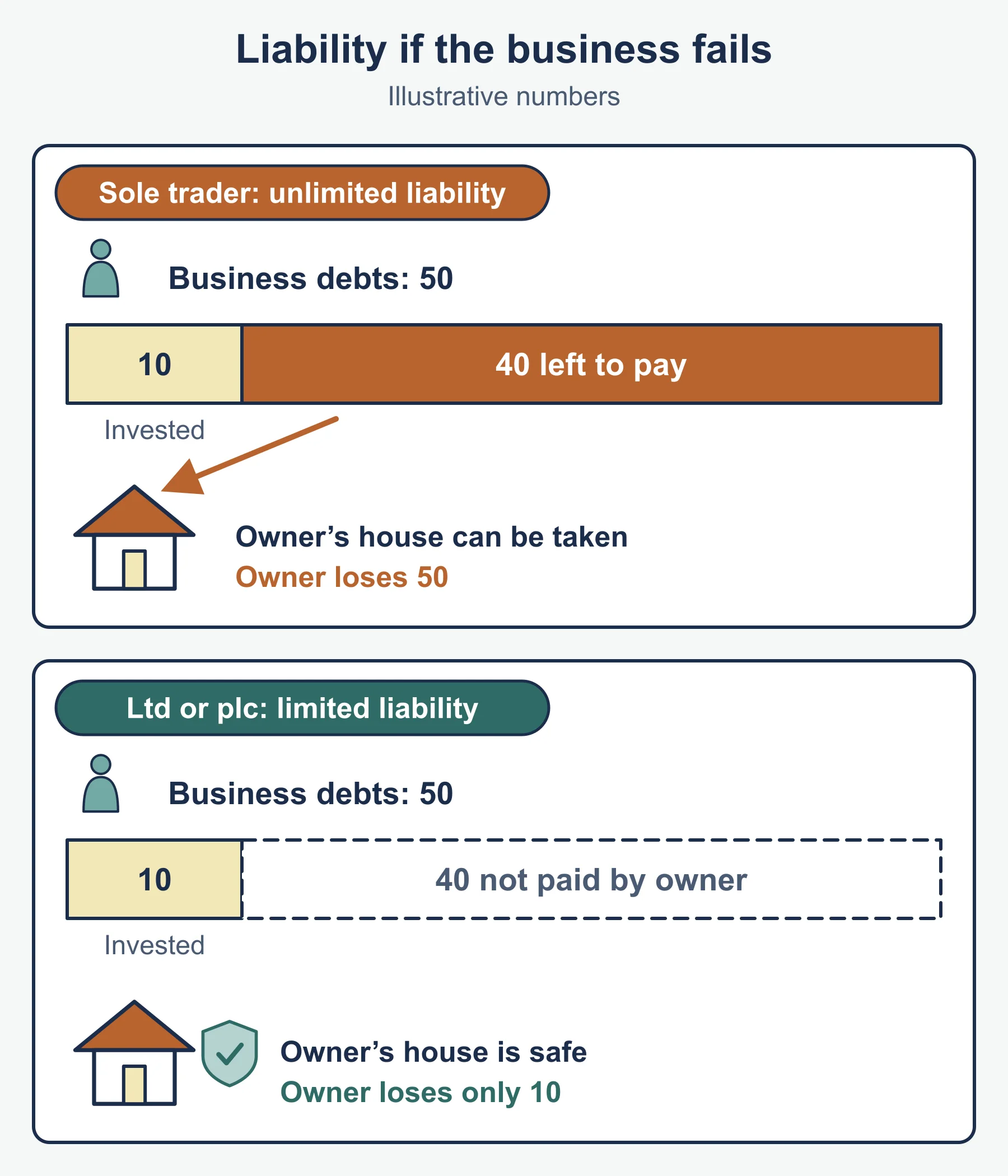
Ownership is about who owns the business and so who receives the profit and takes the decisions. Risk is the chance of losing money. Limited liability means an owner can lose no more than the amount they put into the business, so their personal possessions are protected.
Unlimited liability is the opposite: the owner is personally responsible for all the business debts.
Unincorporated businesses and limited companies
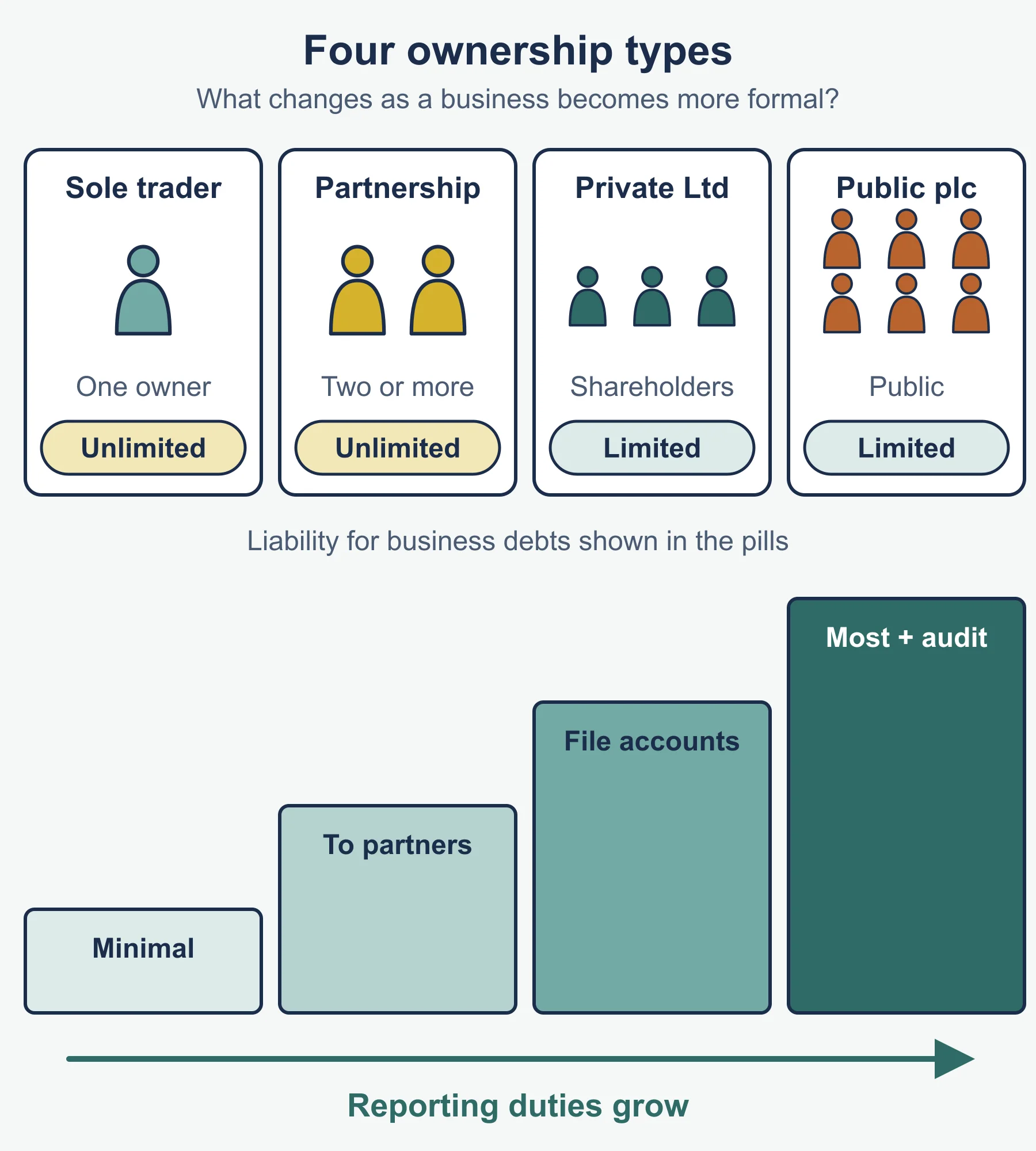
Sole traders and partnerships are unincorporated. In general terms, the business and its owners are treated as the same person. The owners have unlimited liability.
A limited company is a separate legal entity from its owners, who are called shareholders. Shareholders have limited liability. The company can own property and sign contracts in its own name.
The forms of organisation
| Form | Main features |
|---|---|
| Sole trader | One owner, who may employ others. Owner keeps all profit and takes decisions alone. Unlimited liability. Easy and cheap to start. |
| Partnership | Two or more owners who share the work, capital, decisions and profit. Unlimited liability in the usual form. A partnership agreement sets out roles and how profit is shared. |
| Private limited company | Owned by shareholders, usually family, friends or founders. Limited liability. Shares are not offered to the general public and cannot be bought on the stock exchange. Can raise more capital than a sole trader. |
| Public limited company | Limited liability. Shares can be sold to the general public through a stock exchange, so very large sums can be raised. Control is spread and takeover is possible. |
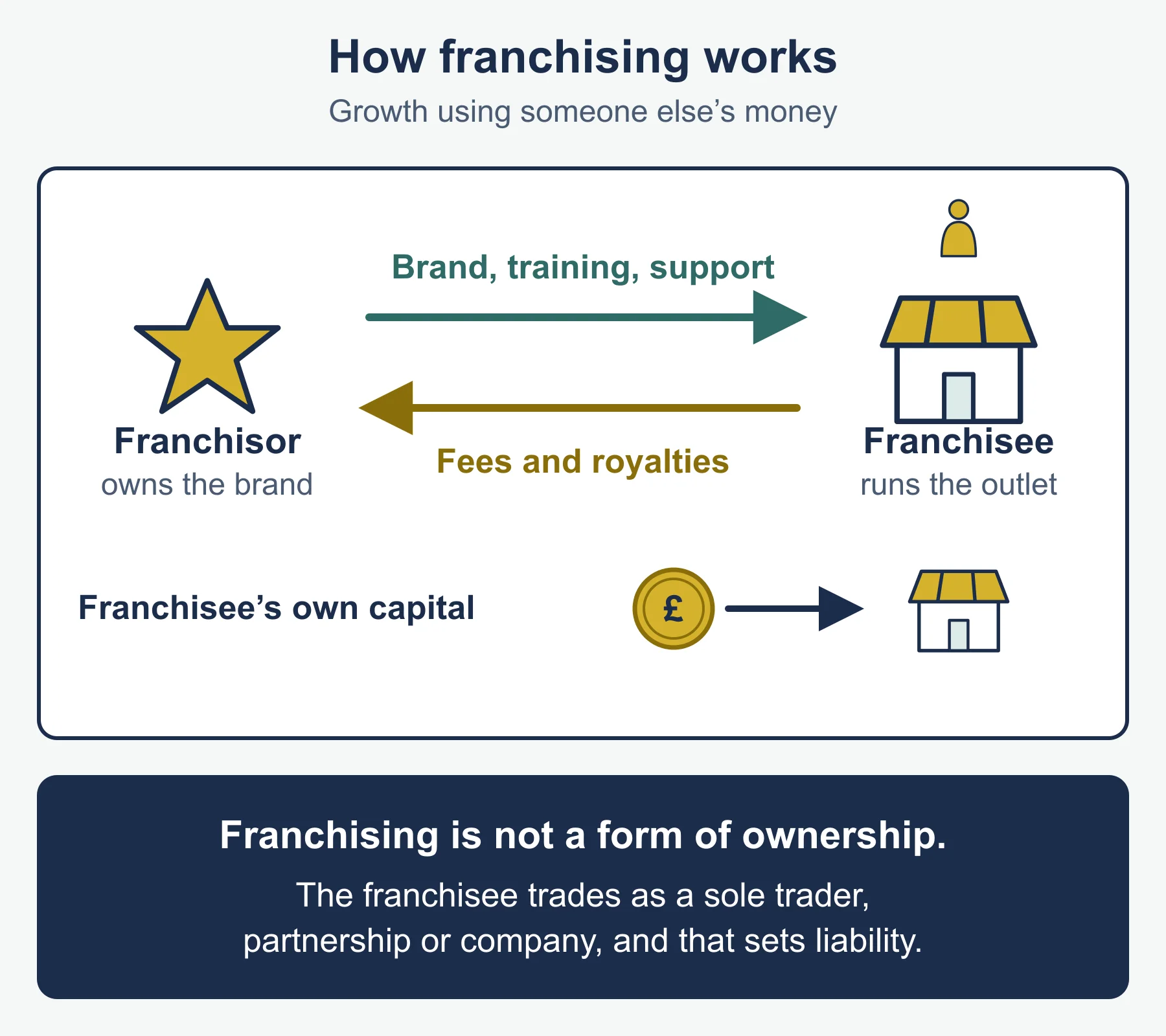
| Franchise | A franchisor sells the right to use its brand, products and methods to a franchisee, who pays a fee and usually a share of sales revenue. The franchisee follows the franchisor’s rules. |
| Joint venture | Two or more businesses agree to work together on a particular project or in a new market. Costs, risks and profits are shared as agreed. Each business keeps its own identity. |
Worked example 1: limited liability
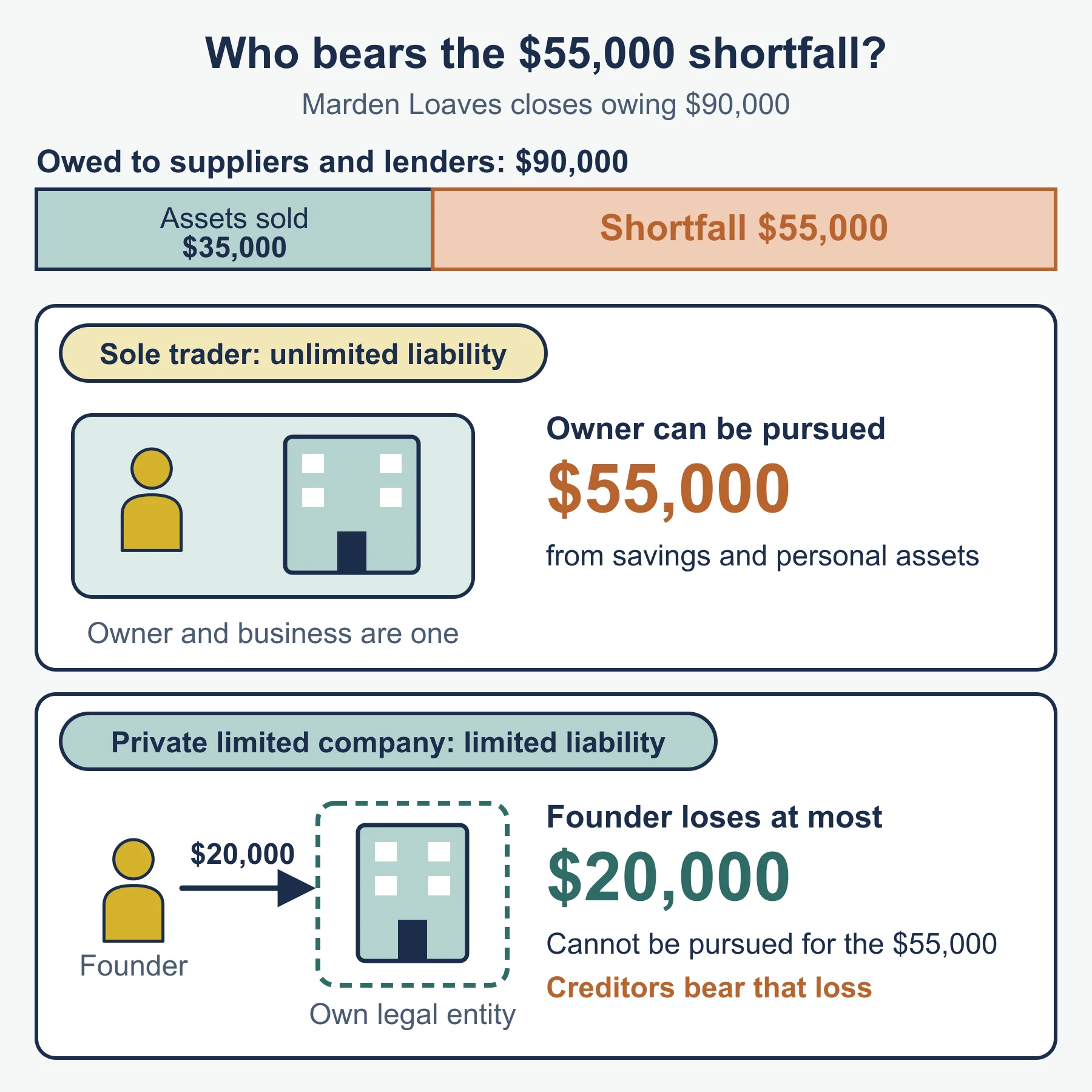
Marden Loaves is a sole trader’s bakery that closes owing 90,000 to suppliers and lenders. Selling the equipment and stock raises 35,000.
Shortfall: 90,000 − 35,000 = 55,000. The owner, with unlimited liability, can be pursued for the 55,000 from personal assets such as savings.
Now suppose the same business had been a private limited company in which the founder invested 20,000 in shares. The founder’s loss is limited to the 20,000 invested, and the founder cannot be pursued for the 55,000 shortfall. That unpaid debt is a loss for the creditors.
Worked example 2: sharing profit in a partnership
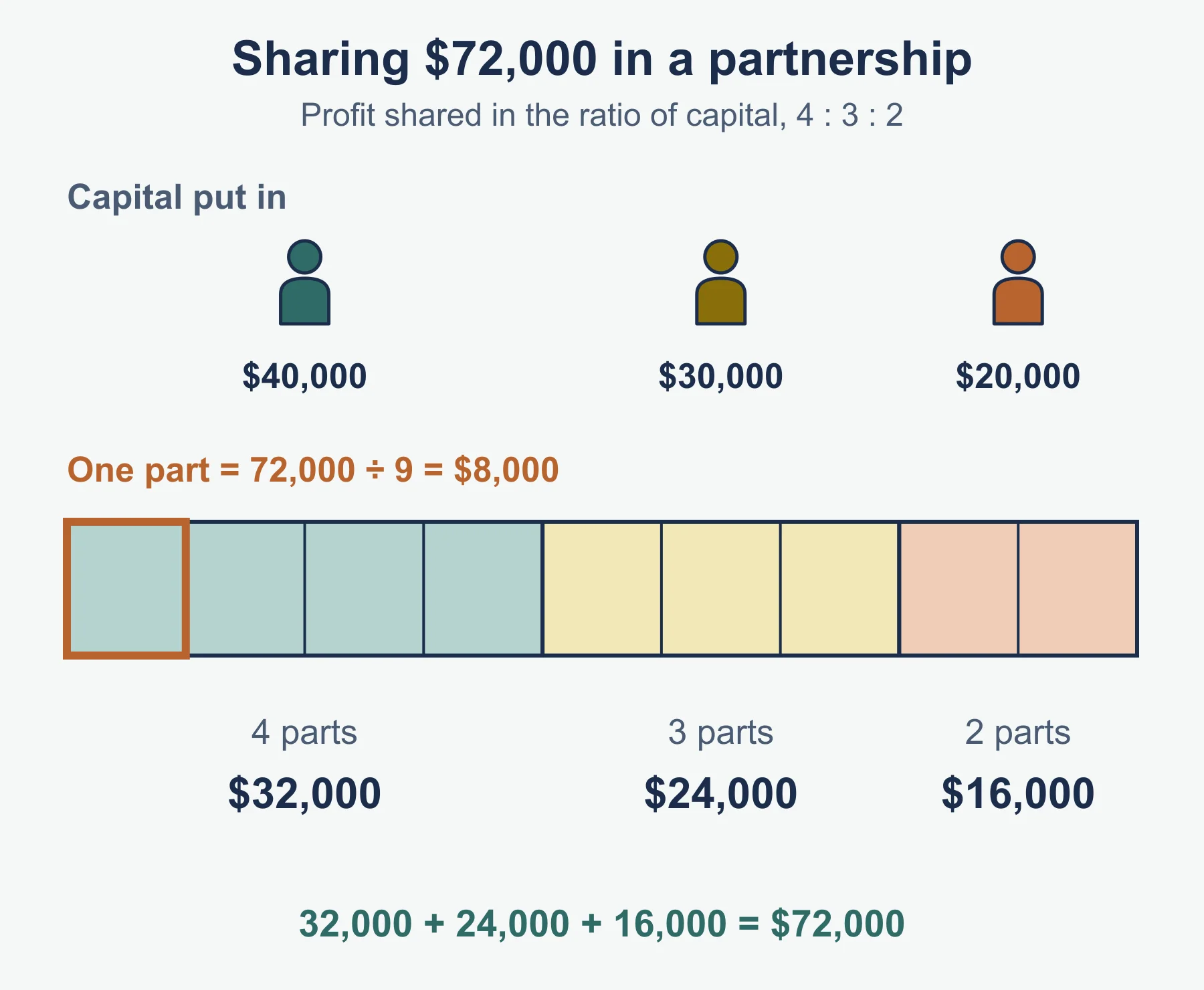
Sedgely Print Studio is a partnership of three people who put in capital of 40,000, 30,000 and 20,000. Their agreement shares profit in the same ratio, 4 : 3 : 2. This year’s profit is 72,000.
Total parts: 4 + 3 + 2 = 9. One part is 72,000 ÷ 9 = 8,000. The shares are 32,000, 24,000 and 16,000, which add up to 72,000.
Worked example 3: company profit and shareholders
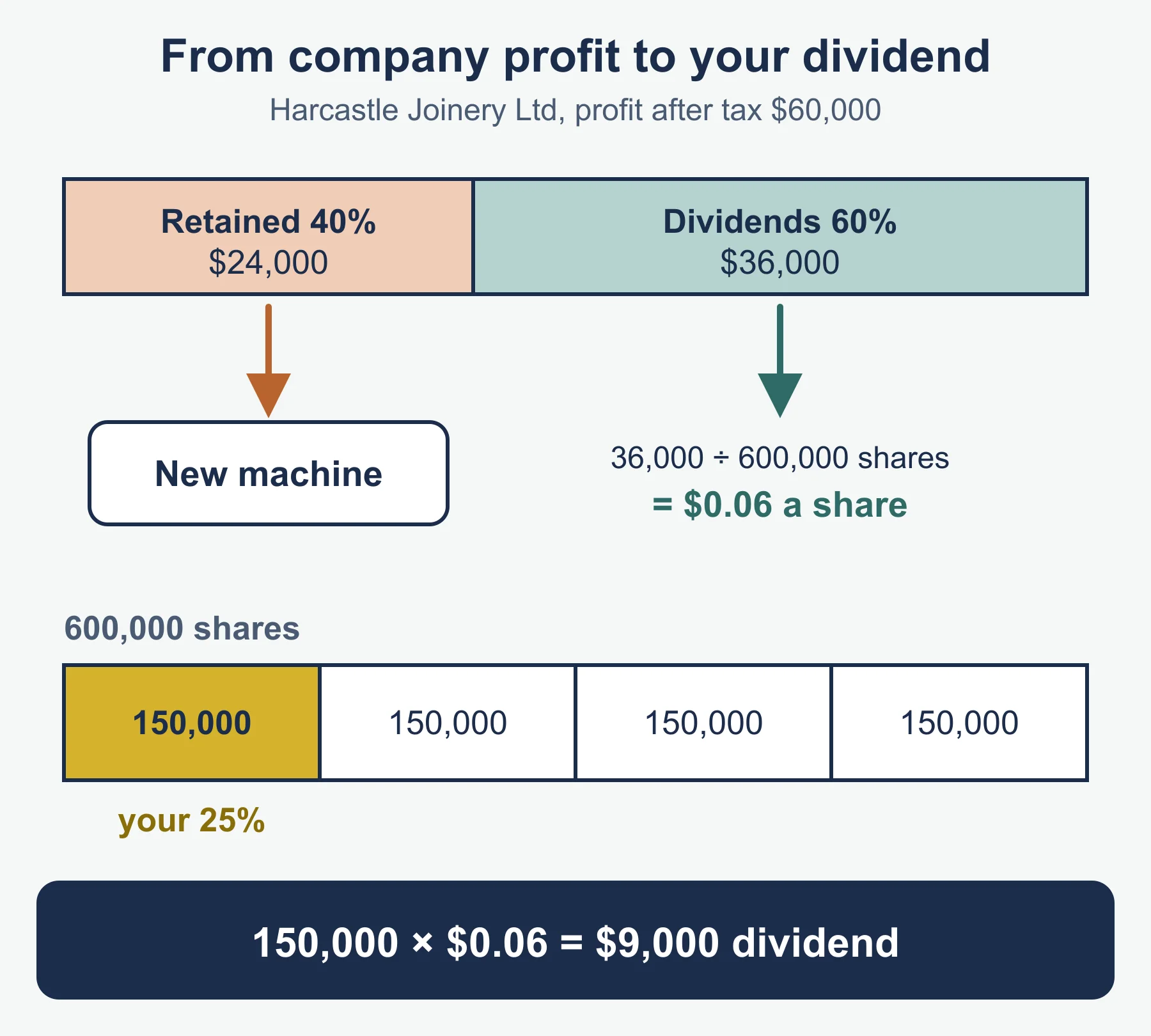
Harcastle Joinery Ltd makes a profit after tax of 60,000. The directors retain 40% to buy a new machine and pay the rest as dividends.
Retained: 60,000 × 0.40 = 24,000. Dividends: 60,000 − 24,000 = 36,000.
The company has 600,000 shares, so the dividend is 36,000 ÷ 600,000 = 0.06 per share. A shareholder with 150,000 shares owns 25% of the company and receives 150,000 × 0.06 = 9,000.
Worked example 4: franchise and joint venture
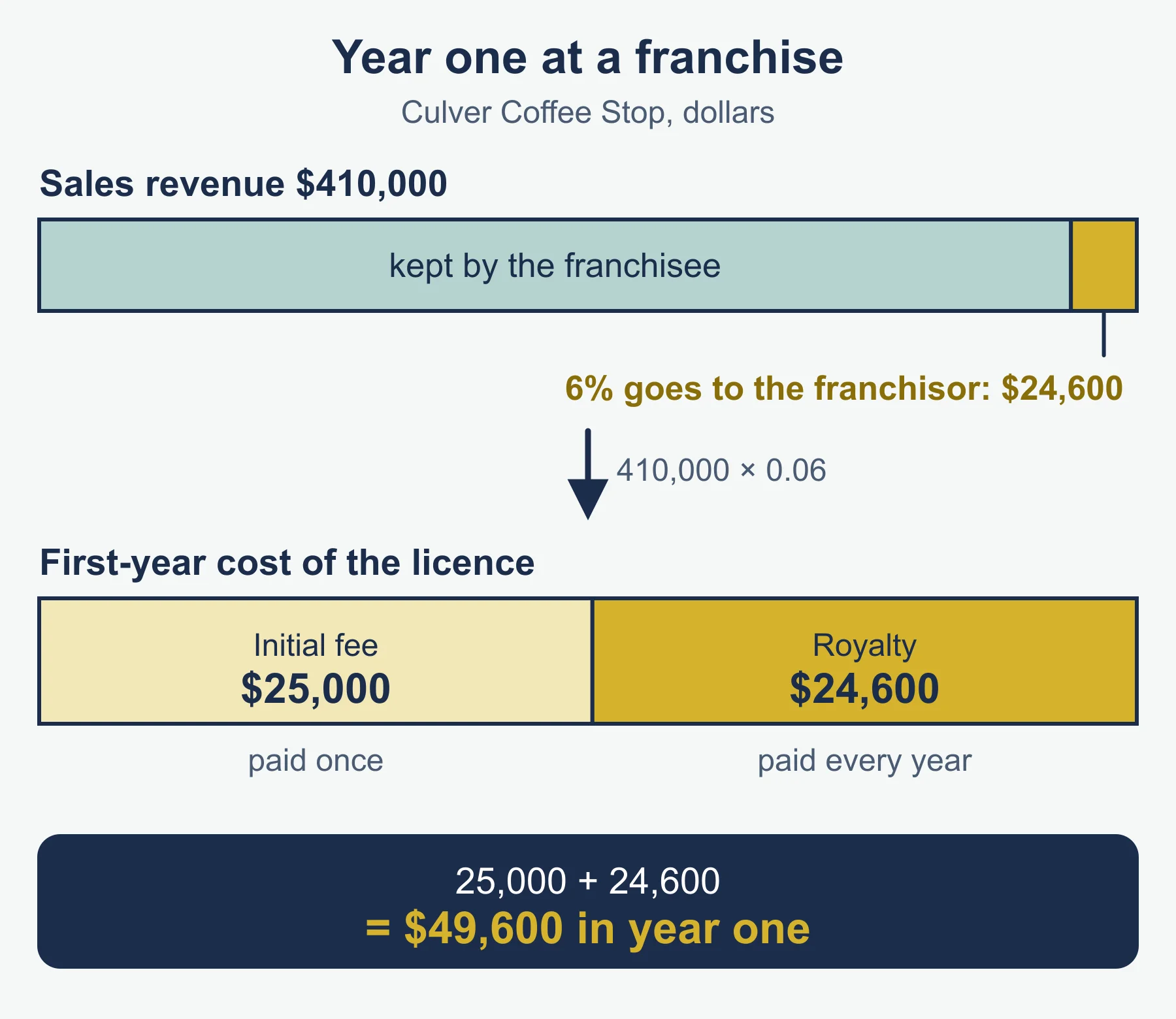
Culver Coffee Stop is a franchise outlet. The franchisee paid an initial fee of 25,000 and pays the franchisor 6% of sales revenue each year. With sales revenue of 410,000 the royalty is 410,000 × 0.06 = 24,600. The cost of the licence in the first year is 25,000 + 24,600 = 49,600.
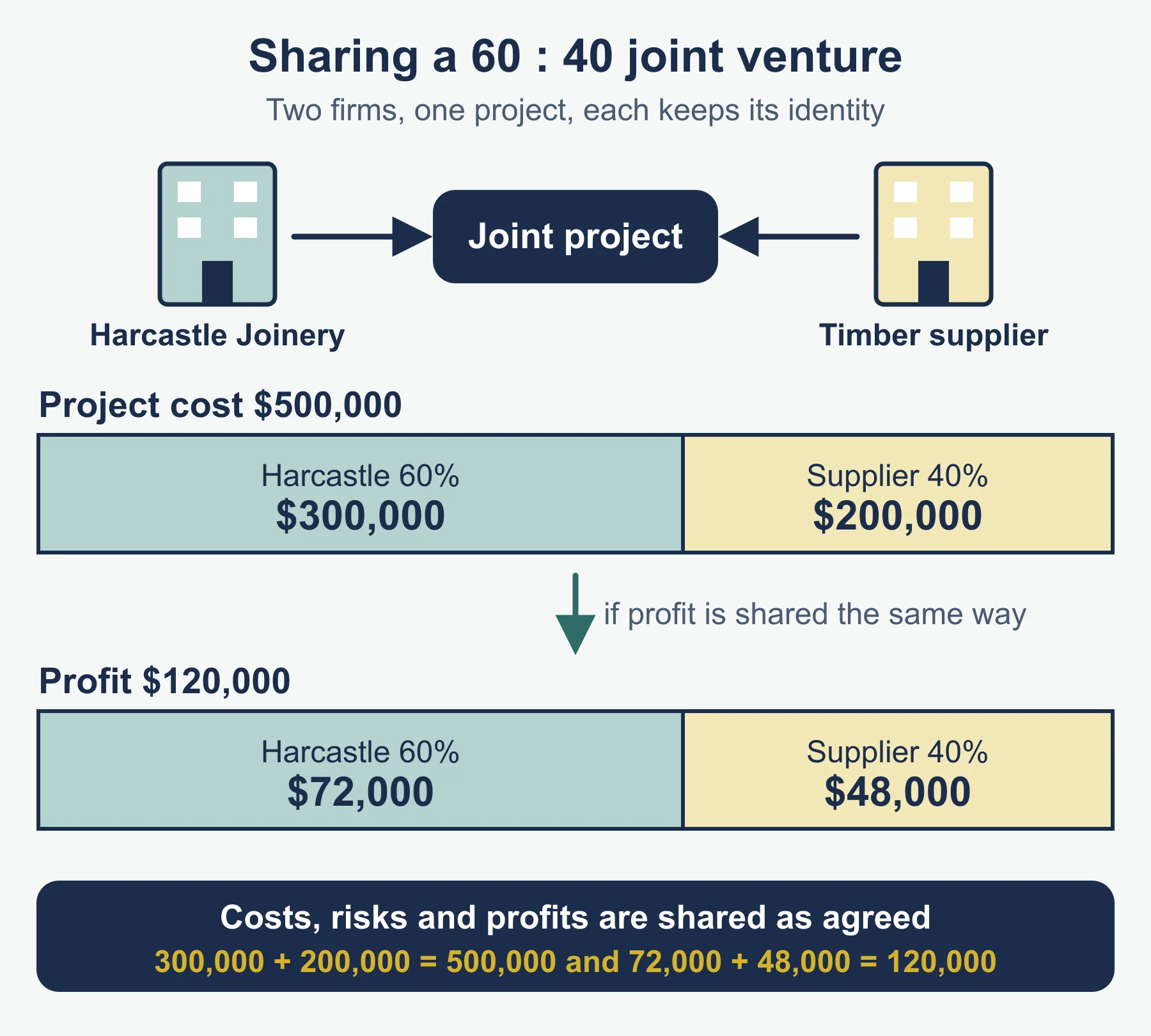
In a joint venture, Harcastle Joinery Ltd and a timber supplier share a 500,000 project 60 : 40, so Harcastle pays 300,000 and the supplier 200,000. A profit of 120,000 would give 72,000 and 48,000.
Advantages and disadvantages in brief
Sole traders keep control and profit but carry unlimited liability and have limited capital. Partnerships add capital and skills, with unlimited liability and a risk of disagreement. Private limited companies give limited liability and more capital, but must reveal some financial information. Public limited companies raise very large sums, but ownership is spread out and takeover is possible. Franchisees get a proven brand but pay fees and have less freedom. Joint ventures spread cost and risk, but profit is shared.
Recommending and justifying a form of organisation
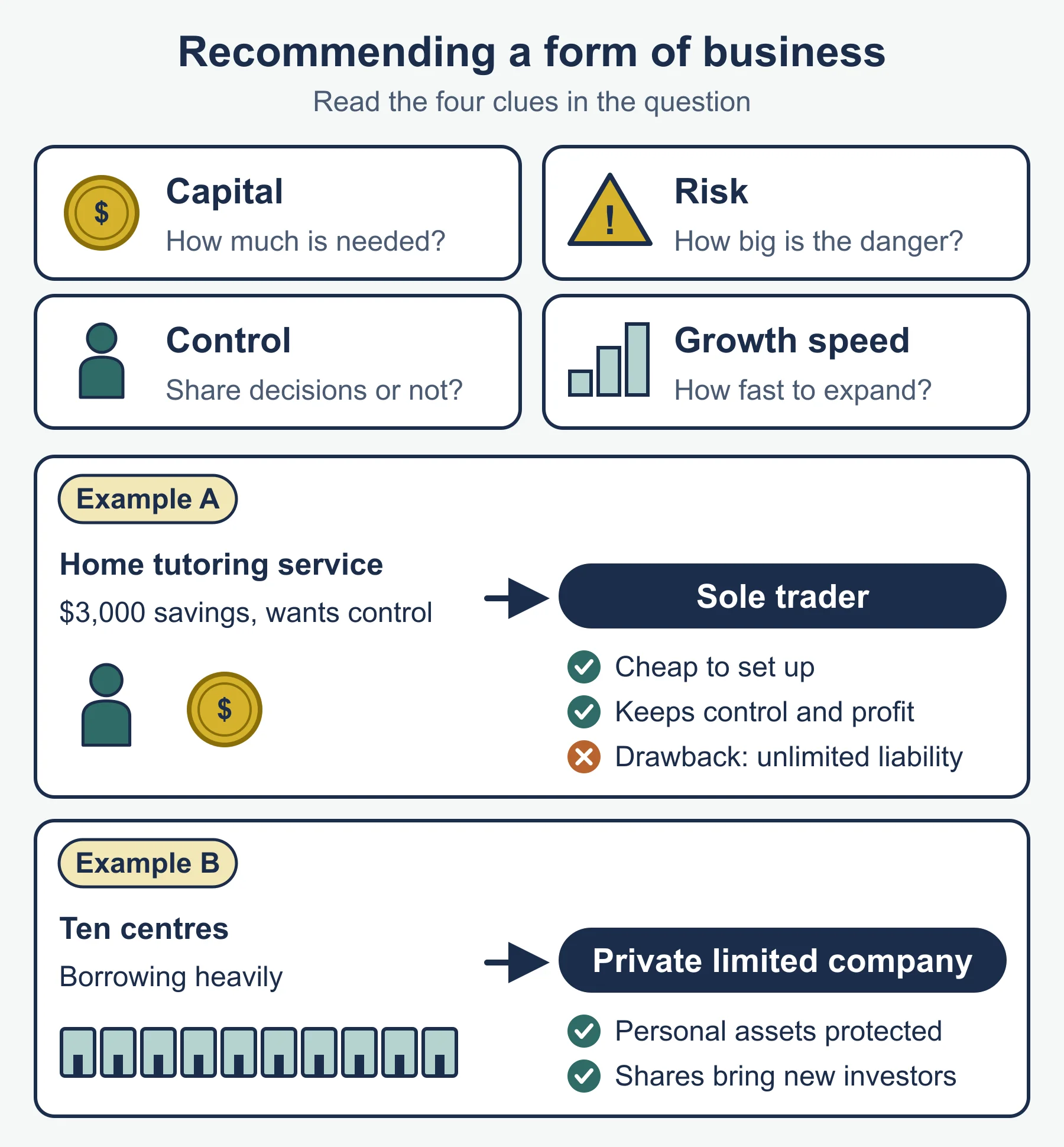
The syllabus asks you to recommend and justify a suitable form of business organisation for a given situation. Use the facts in the question. Look for four clues: how much capital is needed, how much risk there is, how much control the owner wants, and how fast the business wants to grow.
Link the form to a clue, give a reason, and weigh a drawback.
Example. A founder wants to open a small tutoring service from home with 3,000 of savings and does not want to share decisions. A sole trader is suitable because setting up is cheap and the founder keeps control and all profit. The drawback is unlimited liability, but the risk is low because few costs are fixed. If instead the founder wants to open ten centres and borrow heavily, a private limited company is better because limited liability protects personal assets and shares can bring in new investors.
Public sector organisations
The public sector is owned and controlled by the government. Public corporations are a main example. They are set up by the government, owned by it on behalf of the public, and run by managers the government appoints. Services such as rail, post or electricity supply are often run this way, though this varies by country. Finance comes from government funds and charges to users. They are accountable to the government and to the public.
1.5 Business objectives and stakeholder objectives
1.5.1 Why businesses need objectives
An objective is a target that a business wants to achieve. Objectives give everyone a common direction, help managers decide, let owners measure success against a target, and motivate employees.
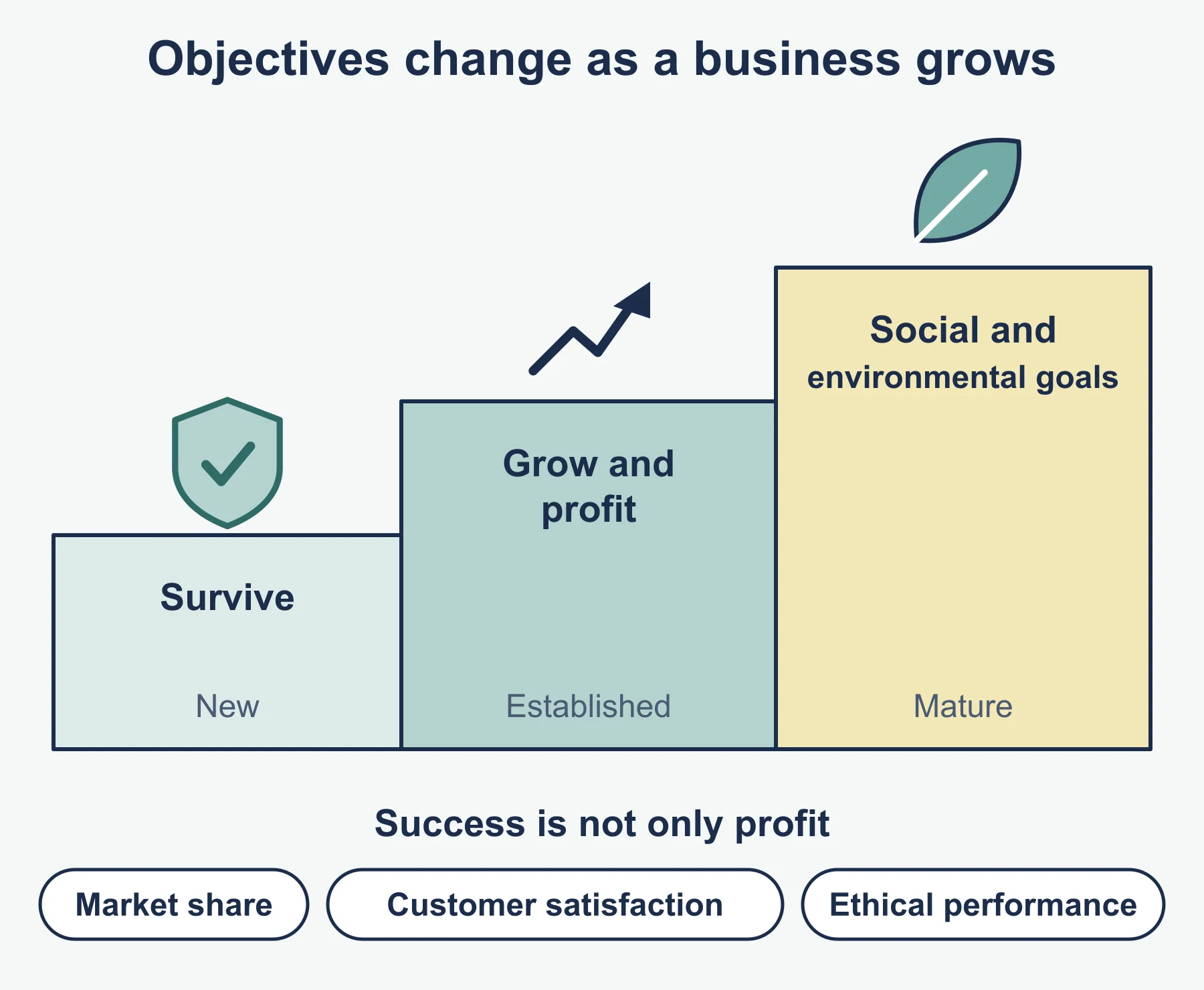
Businesses can have several objectives at once, and their importance changes. A new business may aim at survival in its first year, then growth once it is secure. In a recession, a business may drop growth and aim to survive. When a new competitor arrives, market share may become the priority.
Common objectives
| Objective | Meaning | Who gains and a drawback |
|---|---|---|
| Survival | Staying in business, especially in the first years | Owners and employees keep income. May mean low profit and no expansion. |
| Growth | Increasing the size of the business, for example in sales revenue, output or number of outlets | Higher income and security through size. Growth can bring cash flow and management problems. |
| Profit | Earning more revenue than costs, often to give a return to owners | Rewards owners and provides money for investment. A short-term focus may harm quality or staff. |
| Market share | The proportion of total market sales that a business holds | Greater strength against rivals and more power with suppliers. May need price cuts that reduce profit. |
Market share (%) = (the business’s sales ÷ total market sales) × 100. This is the standard form.
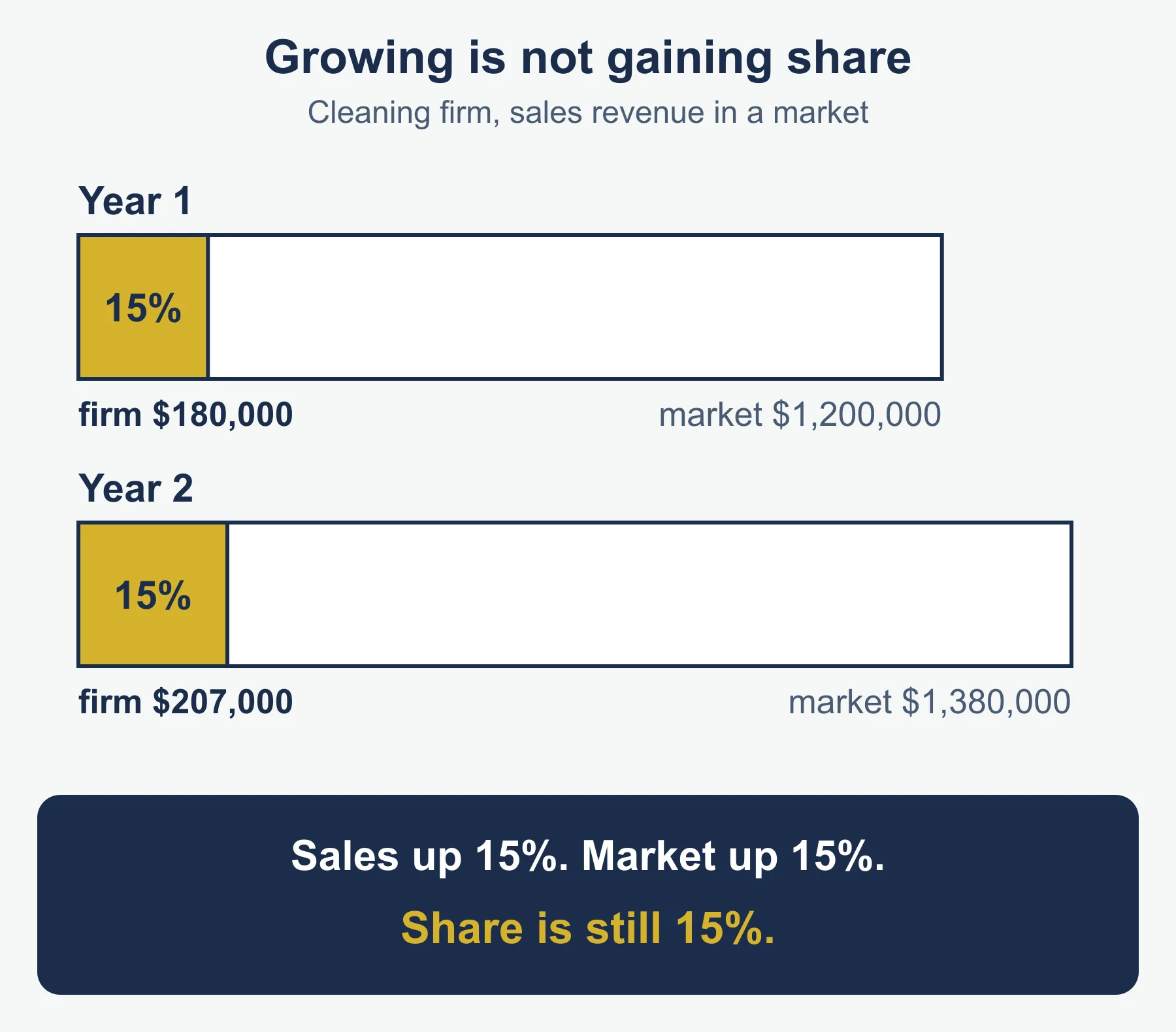
Worked example 5. A cleaning firm has sales revenue of 180,000 in a market worth 1,200,000. Market share = 180,000 ÷ 1,200,000 × 100 = 15%. Next year its sales revenue is 207,000 in a market now worth 1,380,000. Its share is still 207,000 ÷ 1,380,000 × 100 = 15%, so it has grown with the market but gained no share.
The syllabus gives survival, growth, profit and market share as examples; others, such as customer satisfaction, are possible.
Objectives of social enterprises
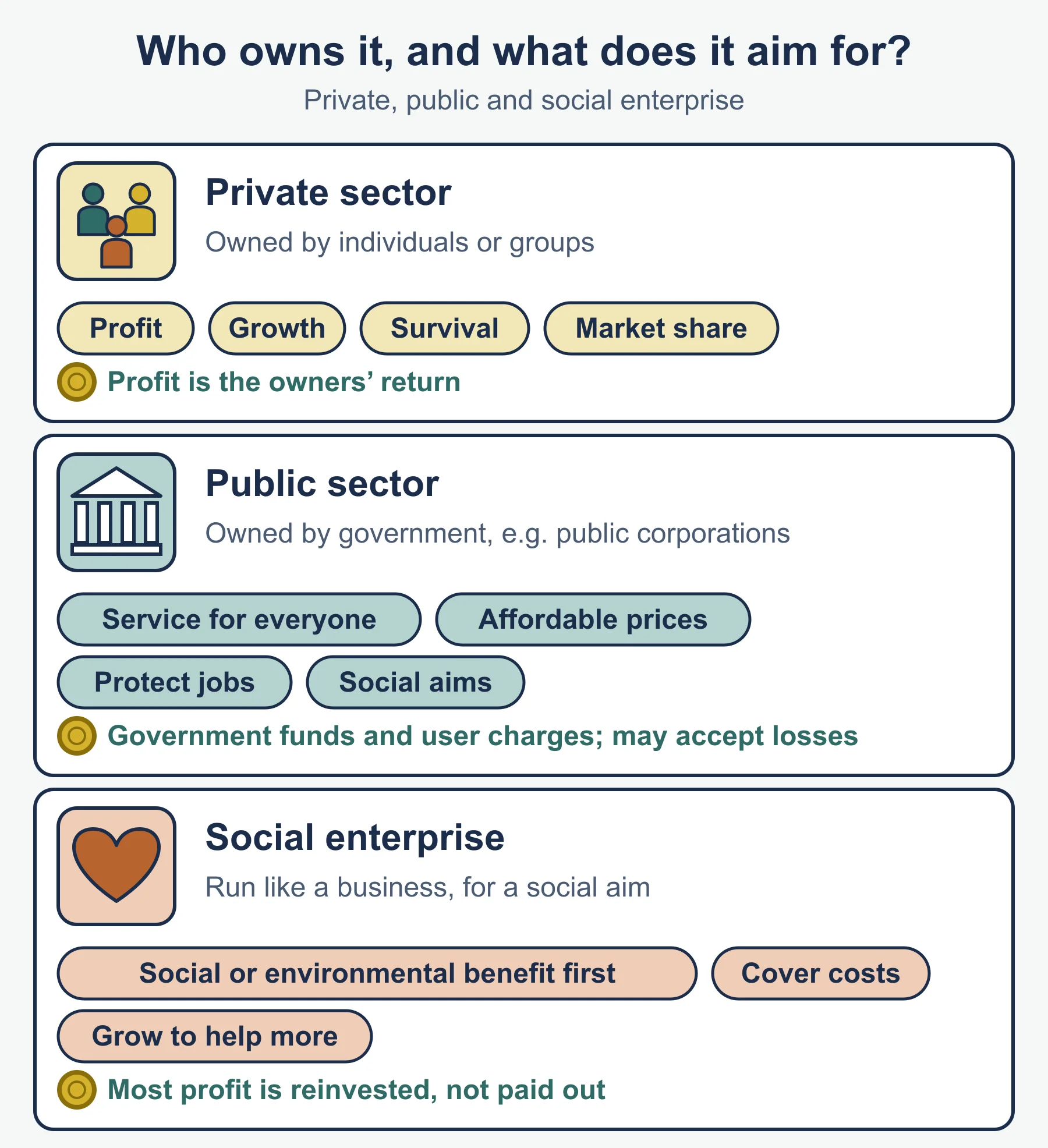
A social enterprise is run like a business but exists mainly to achieve a social or environmental aim. It sells goods or services and aims to cover its costs, but most or all of its profit is reinvested in its purpose rather than paid out to owners. An example is a café that trains young people who have been out of work. Its objectives are social benefit first, survival and covering costs second, and often growth so that it can help more people.
1.5.2 Stakeholders
A stakeholder is any person or group with an interest in a business and its activities, and who may be affected by it or influence it.
Internal stakeholders are inside the business: owners or shareholders, directors and managers, and employees. External stakeholders are outside it: customers, suppliers, lenders such as banks, the government, and the local community.
| Stakeholder | Typical objectives |
|---|---|
| Owners or shareholders | Profit, dividends, a rising share value, survival |
| Managers | Good pay, status, growth, a successful business |
| Employees | Fair pay, job security, good conditions, training |
| Customers | Good quality, fair prices, safe products, reliable service |
| Suppliers | Prompt payment, regular orders, a long relationship |
| Lenders | Repayment of the loan with interest on time |
| Government | Tax revenue, jobs, legal compliance |
| Local community | Local jobs, little pollution and noise, support for local causes |
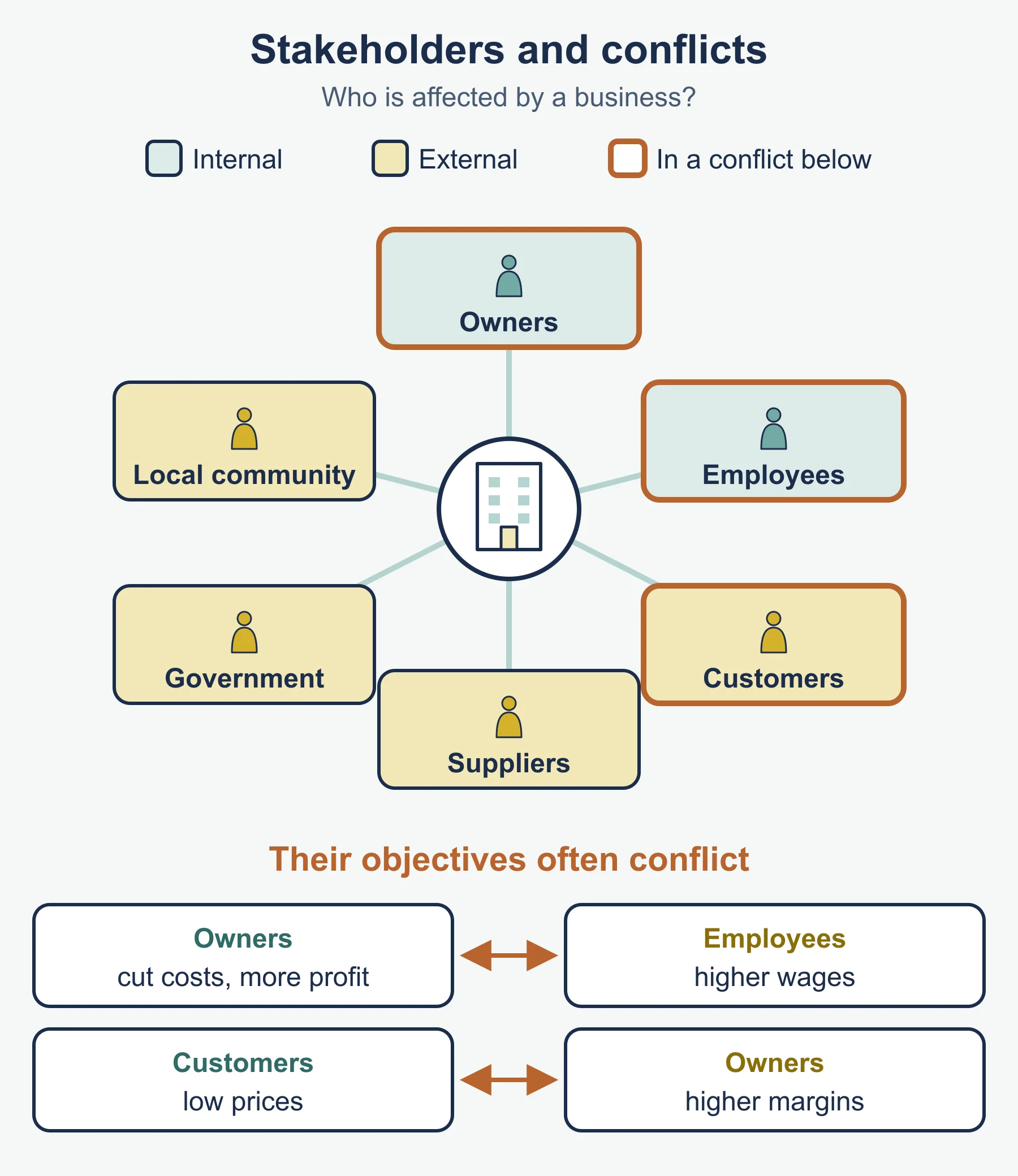
Conflicts between stakeholders
Objectives often conflict. Examples:
- Owners want higher profit, while employees want higher pay. Paying more reduces profit.
- Customers want low prices, while suppliers want higher prices for their goods. Squeezing suppliers helps customers but hurts the supplier relationship.
- The local community wants less noise and traffic, while managers want to expand a factory.
- Lenders want safe repayment, so may oppose a risky expansion that owners want.
Worked example 6. Barrowby Foods plc plans to move production to a cheaper site. Shareholders gain from lower costs, but employees at the old site lose jobs and the local community loses income. A good answer names each group, says what it gains or loses, and then makes a judgement about whose interest should count most.
1.5.3 Private sector and public sector objectives
Private sector enterprises are owned by individuals or groups, such as sole traders, partnerships and companies. Their main objectives are usually profit, growth, survival and market share, because owners expect a return on their money.
Public sector enterprises are owned by government. Their main objectives are usually to provide a service to everyone, keep prices low or affordable, protect jobs, and meet social aims such as access to transport or clean water. Many aim only to cover their costs, and some accept losses that the government covers.
Common errors
- Writing that a limited company’s owners “cannot lose money”. They can lose what they invested.
- Saying a partnership has limited liability. In the usual form it does not.
- Confusing private and public limited companies. The difference is whether shares can be sold to the general public.
- Giving a recommendation with no link to the facts in the question.
Frequently asked questions
How do you calculate market share in O Level Business 7115? Market share (%) = (the business’s sales ÷ total market sales) × 100, which is the standard form.
Does a partnership have limited liability? In the usual form, no. Partners normally have unlimited liability, so they can be personally responsible for the business’s debts.
Can shareholders in a limited company lose money? Yes. Limited liability means shareholders can lose what they invested in shares, but their personal assets are protected from the company’s debts.
What is a social enterprise? A social enterprise is run like a business but exists mainly to achieve a social or environmental aim. It sells goods or services and aims to cover its costs.
What is the difference between internal and external stakeholders? Internal stakeholders are inside the business, such as owners or shareholders, directors, managers and employees. External stakeholders are outside it, such as customers, suppliers, lenders, the government and the local community.
Official syllabus
Cambridge O Level Business Studies 7115 syllabus for examination in 2026, published by Cambridge International Education, sections 1.4.1 and 1.5.1 to 1.5.3.
Get free revision emails (optional)
Occasional emails with practice questions, worked explanations and links to free resources for the qualification and subjects you choose. No spam, and you can unsubscribe from any email. The free tools on this site never need an email.
Related resources
-
Practice questions
O Level Business: Types of business organisation and Business objectives and stakeholder objectives (Cambridge 7115) – Practice Questions
Twelve original practice questions with worked answers on organisation types, objectives and stakeholders for Cambridge O Level Business 7115.
Business · Cambridge · O Level
Try questions -
Revision notes
O Level Business: Types of business organisation and Business objectives and stakeholder objectives (Cambridge 7115) – Revision Notes
Condensed revision notes with tables, methods and a self-test on organisation types, objectives and stakeholders for Cambridge O Level Business 7115.
Business · Cambridge · O Level
Revise topic -
Study guides
Business Activity and Classification
Needs, wants, scarcity, opportunity cost, added value and classifying businesses by sector and by ownership, for Cambridge O Level Business Studies 7115.
Business · Cambridge · O Level
Read guide
Related articles
-
teaching
A Level tuition in Dubai: Cambridge or Pearson Edexcel International A Level?
Schools in Dubai and Abu Dhabi teach either Cambridge International AS & A Level or Pearson Edexcel International A Level. How the two are structured, why it matters for tuition, and how online classes from Lahore work.
9 October 2026
-
curriculum guides
Choosing subjects at IGCSE and A Level
How subject choices at 14 and 16 affect university options later, and how to keep pathways open without overloading a timetable.
28 July 2026
Studying this with a teacher
Working through Business O LEVELS?
This page is free and stays free. If you would rather be taught it, Marlbridge runs Business classes one-to-one and in small groups of up to 15, online in your own time zone. The first trial class is free. WhatsApp replies within an hour (8am–11pm Pakistan time, every day); email the same day.
Cambridge Business teachers at Marlbridge

