
Revision Notes
O Level Business: Enterprise, business growth and size (Cambridge 7115) – Revision Notes
Condensed notes, formulas, a self-test and common mistakes on enterprise, measuring size, growth and failure for Cambridge O Level Business Studies 7115.
- Subject
- Business
- Level
- O LEVELS
- Topic
- Understanding business activity
- Author
- Marlbridge Academic Team
- Updated
- Reviewed by
- Salman Ahmad (what this means)
Aligned to Cambridge O Level Business (7115), For examination in 2026. Official specification .
Syllabus page (what it covers and how it is assessed): Cambridge O Level Business.
Syllabus points this page covers
7115
- 1.3 Enterprise, business growth and size
Found an error? Report a correction.
Need help with this topic? Request a free trial class for O Level Business (7115).
These notes condense section 1.3 (Enterprise, business growth and size) of the Cambridge O Level Business Studies 7115 syllabus for examination in 2026. They cover 1.3.1 to 1.3.4 and use the syllabus’s own wording. For full explanations read the study guide, then test yourself with the practice questions. The wider course is on the Cambridge O Level Business hub and the printable checklist. To find weak spots first, try the free diagnostics. Money figures in worked reminders are in dollars.
1.3.1 Enterprise and entrepreneurship
What successful entrepreneurs tend to have. Typical examples:
- Willing to take calculated risks, not reckless ones.
- Self-motivated, with initiative and determination to keep going after setbacks.
- Creative or innovative: able to spot a gap in the market or a better way to serve customers.
- Organised and able to make decisions under pressure.
- Good at dealing with people: customers, suppliers and employees.
- Resilient when money or time is short.
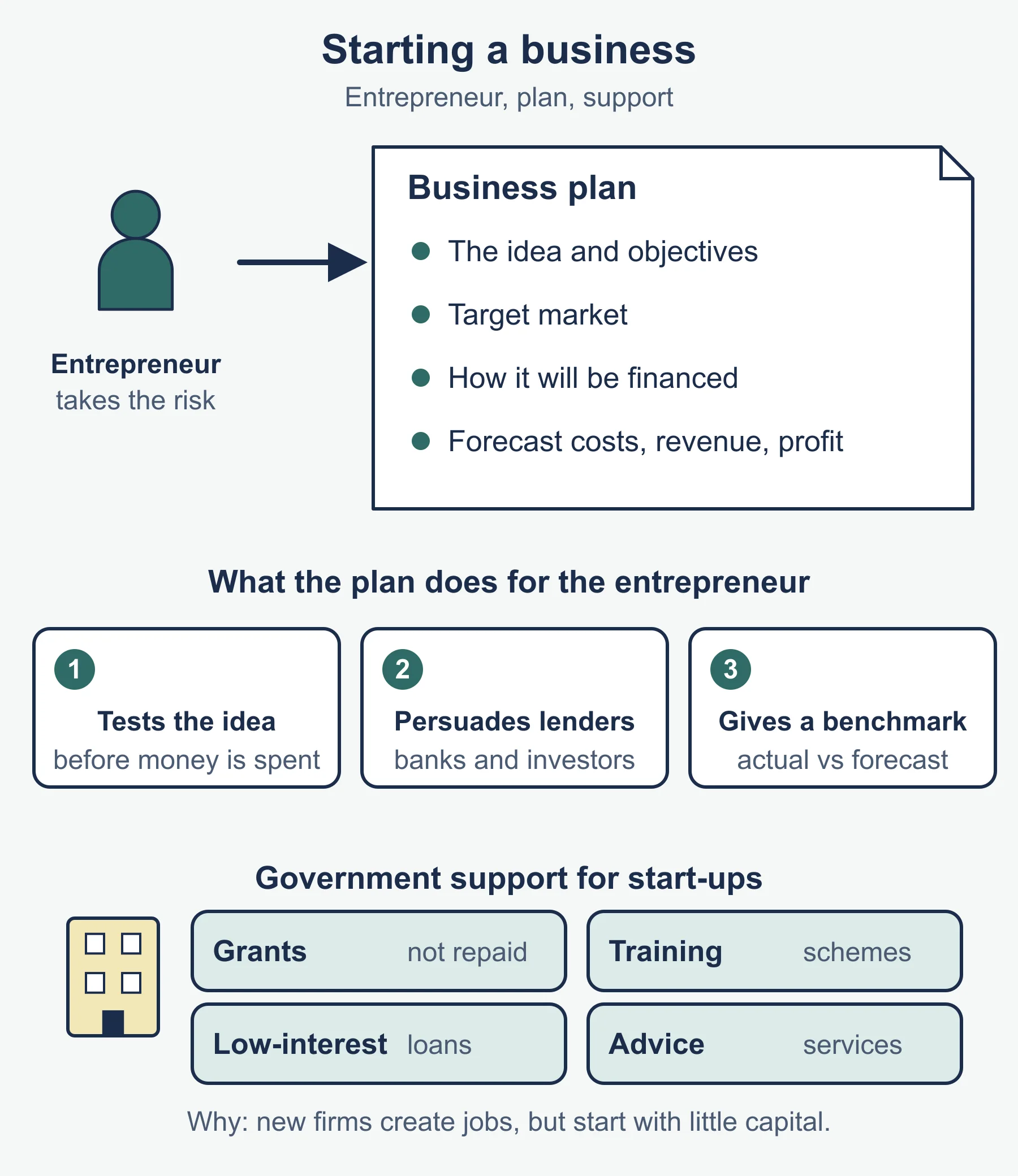
Contents of a business plan (typical contents; the syllabus asks you to know the contents and how the plan helps):
| Section | What it holds | Why it helps |
|---|---|---|
| Business idea and aims | What is sold, to whom, and the objectives | Forces clear thinking before money is spent |
| Market research findings | Target market, competitors, expected demand | Shows whether customers really exist |
| Marketing plan | Product, price, promotion and place | Links the idea to how sales will be won |
| Operations and staffing | Premises, equipment, who does what | Shows the business can actually deliver |
| Financial forecasts | Start-up costs, cash-flow forecast, expected profit | Shows how much finance is needed and when |
| Sources of finance | Owner’s capital, loans, grants | Lenders and investors can judge the risk |
How plans assist entrepreneurs: they help raise finance, give targets to compare real results against, show up weaknesses early, and reduce the chance of costly surprises.
Why governments support start-ups: more businesses means more jobs, more output and more tax revenue, and it increases competition. How: grants (money that does not usually have to be repaid), training schemes, and other help such as advice or cheaper loans (the syllabus names grants and training schemes as examples).
1.3.2 Measuring business size
| Method | Idea | Limitation |
|---|---|---|
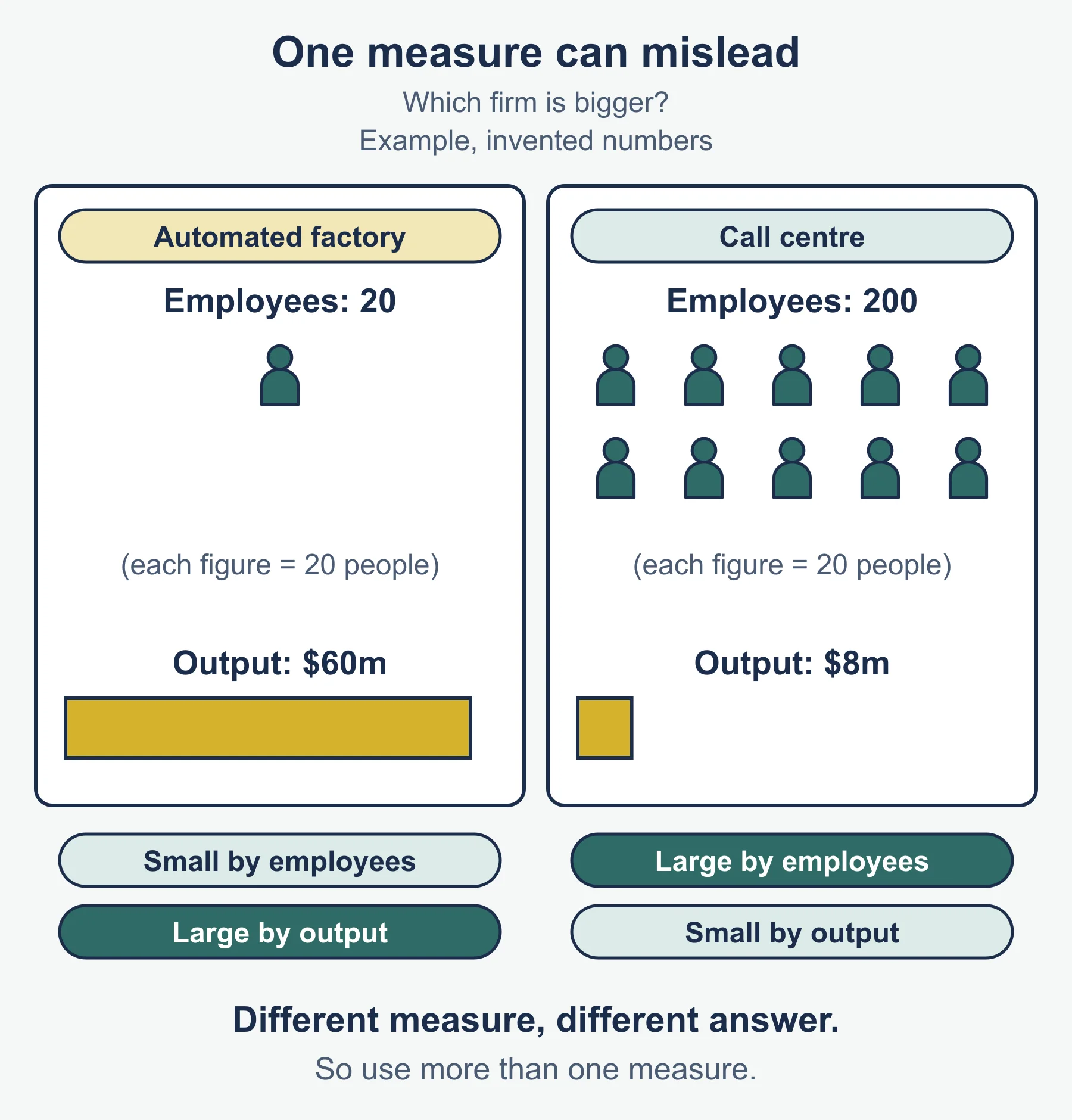
| Number of people employed | Count the workforce | Hides the effect of machines, and part-timers count the same as full-timers |
| Value of output | Total value of goods or services produced in a period | Prices change, and output of different goods is hard to compare across industries |
| Capital employed | Money invested in the business (see below) | Property-heavy firms look big; service firms with few assets look small |
The syllabus gives these as examples. It states in brackets that profit does not count as a size measure: profit shows performance, and two firms of very different size can report the same profit, or a giant can be loss-making while a one-person firm is in the black.
Standard form of capital employed (not given as a formula in this section of the syllabus): total equity plus non-current liabilities, which equals non-current assets plus net current assets.
Limitations in general: each method gives a different ranking of the same businesses, no single figure shows the whole picture, and the best method depends on the industry. Using two or more methods together gives a fairer view.
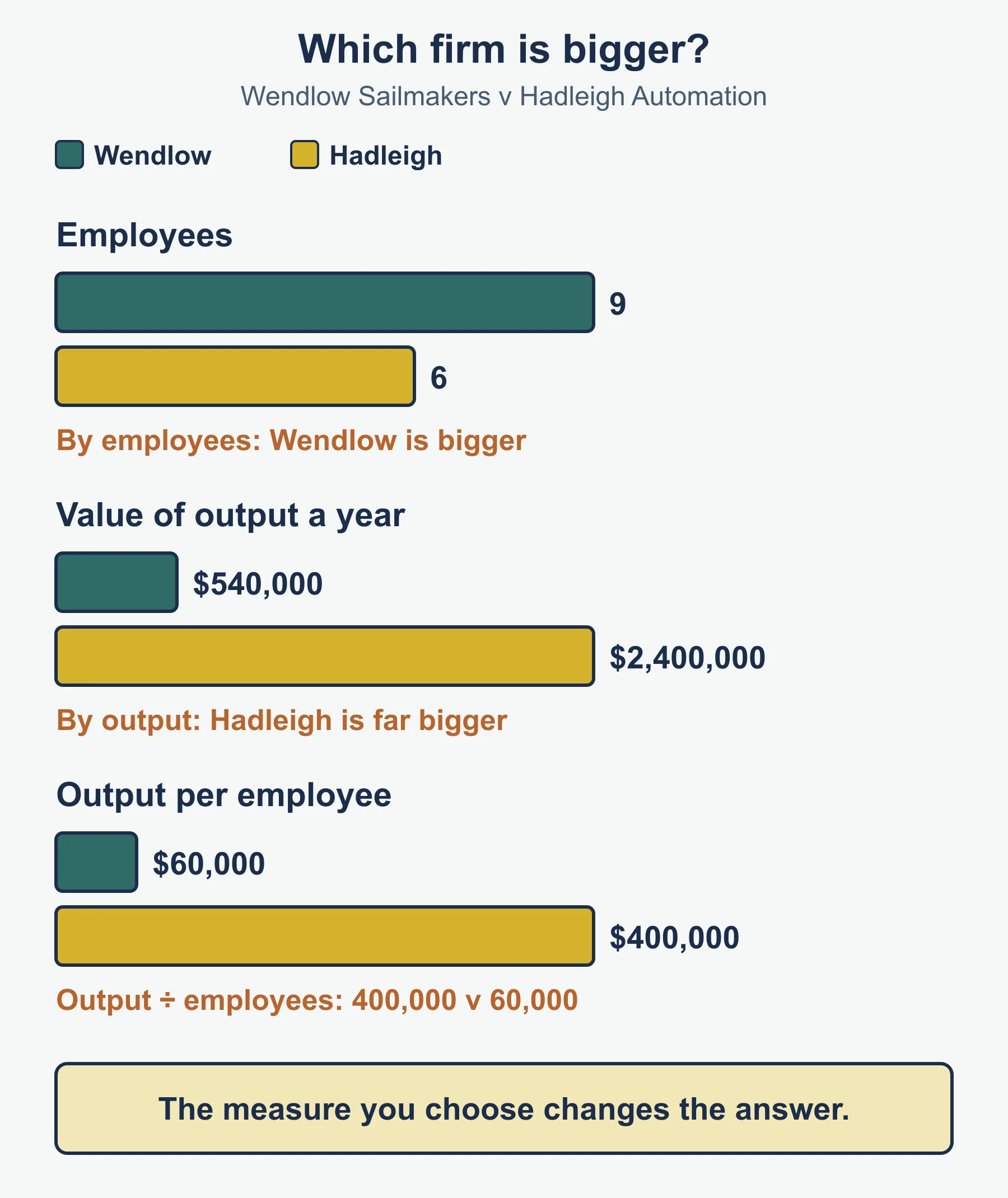
Worked reminder. Wendlow Sailmakers has 9 employees and an annual output worth 540,000. Hadleigh Automation has 6 employees and output worth 2,400,000. Output per employee (standard form: output divided by employees) is 60,000 and 400,000. By employees Wendlow is bigger; by output Hadleigh is far bigger. The measure chosen changes the answer.
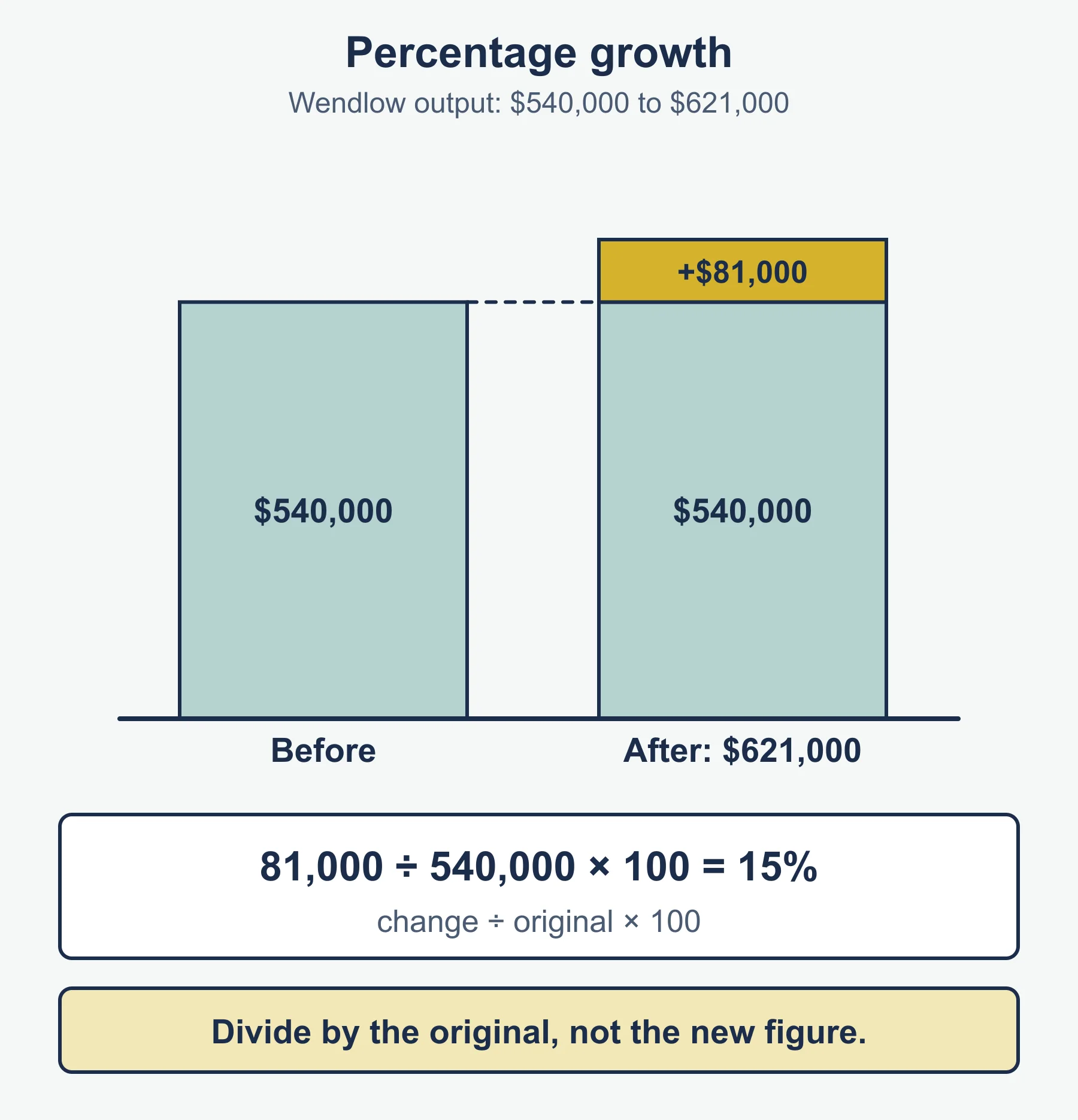
Percentage growth (standard form): change divided by original, times 100. If Wendlow’s output rises from 540,000 to 621,000, growth is 81,000 divided by 540,000, times 100, which is 15%.
1.3.3 Growth and staying small
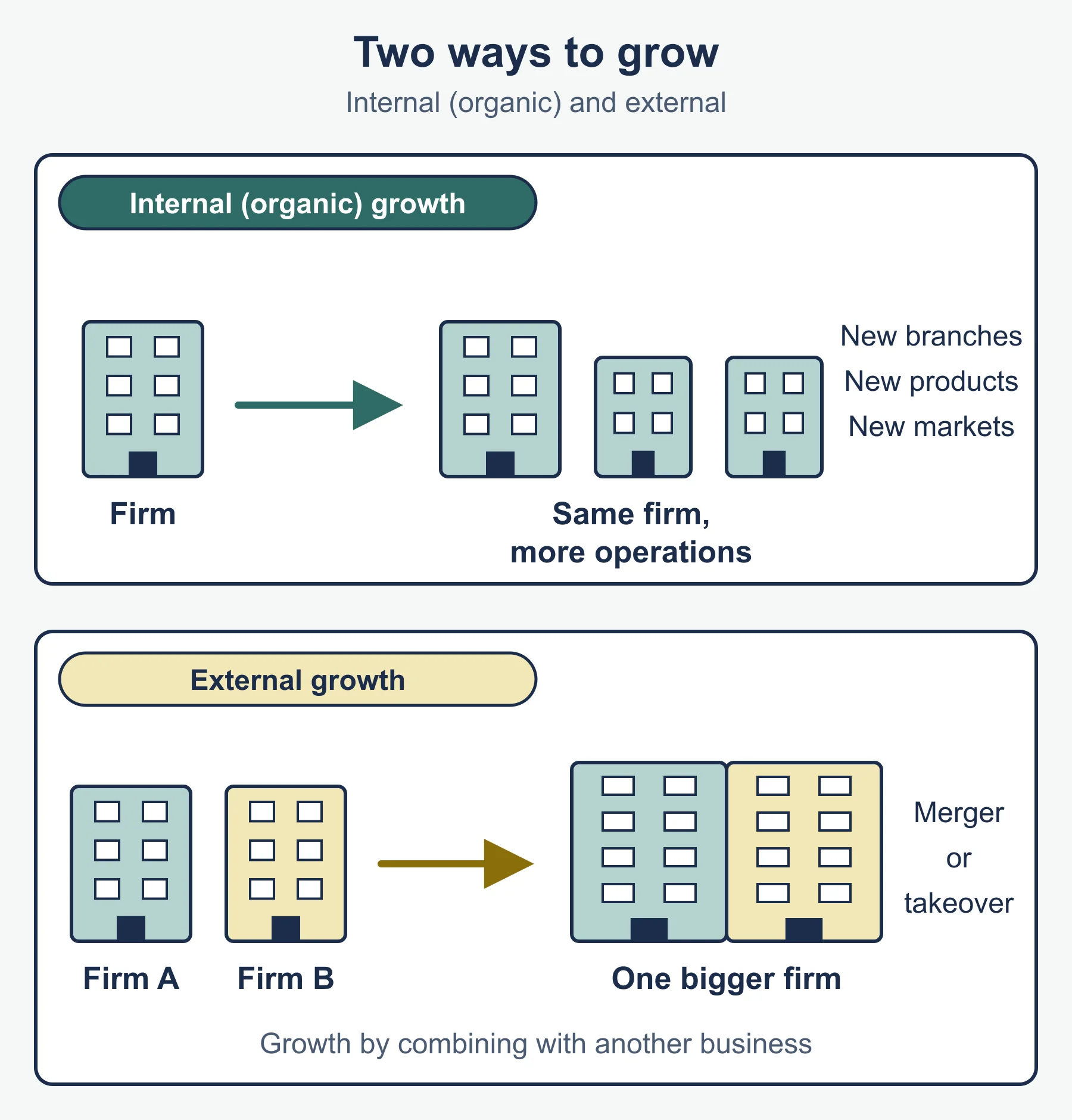
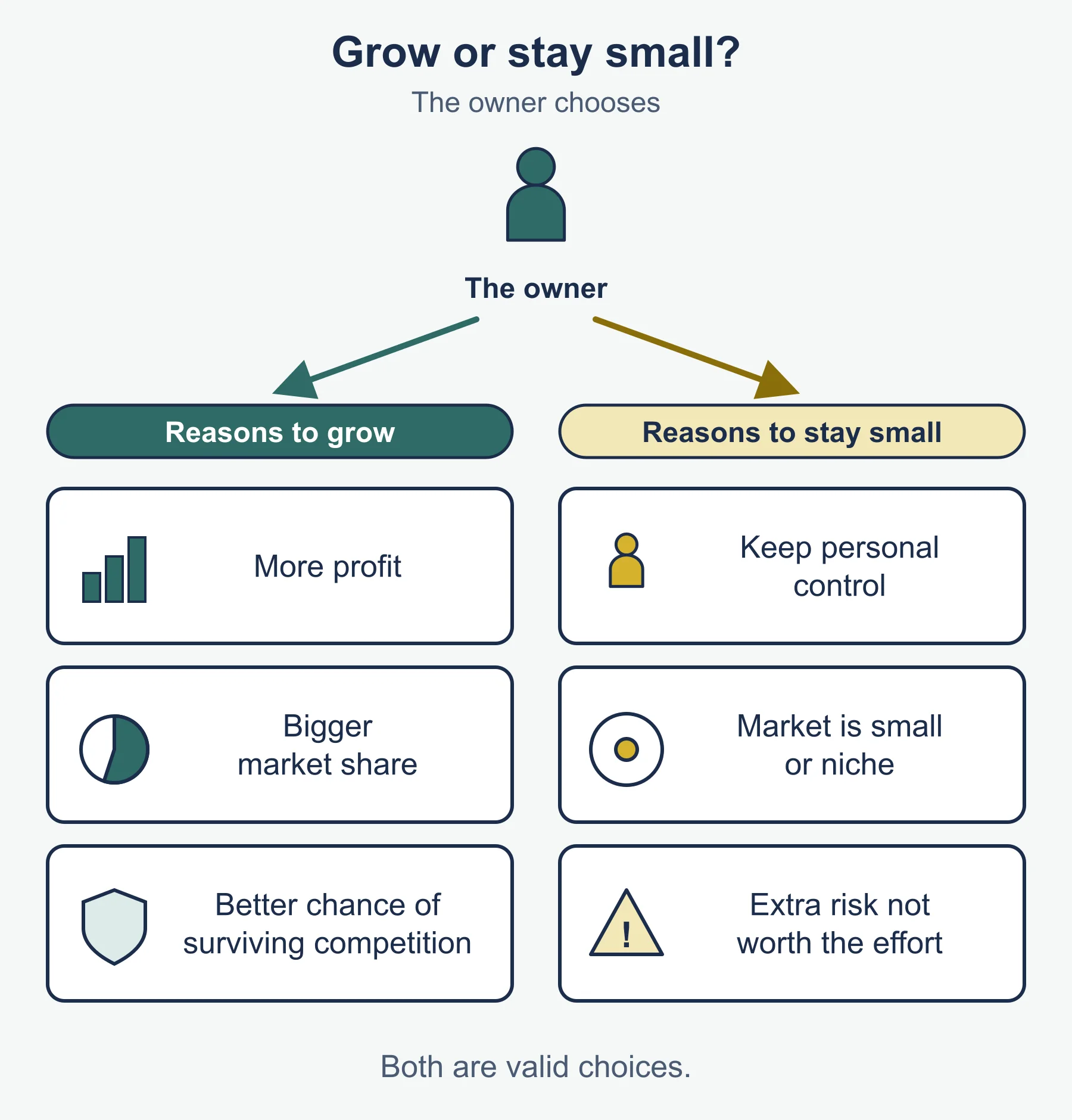
Why owners want to expand: higher profit, greater market share, survival against rivals, lower unit costs from economies of scale (covered in section 4.2), more status or security for the owner, and spreading risk across more products or markets.
Ways to grow
| Internal (organic) | External |
|---|---|
| Growth using the business’s own resources | Joining with or buying another business |
| New products, new outlets, more marketing, selling online | Merger (two firms agree to combine) or takeover (one firm buys control of another) |
| Slower, lower risk, easier to control | Faster, but costly and harder to blend two cultures |
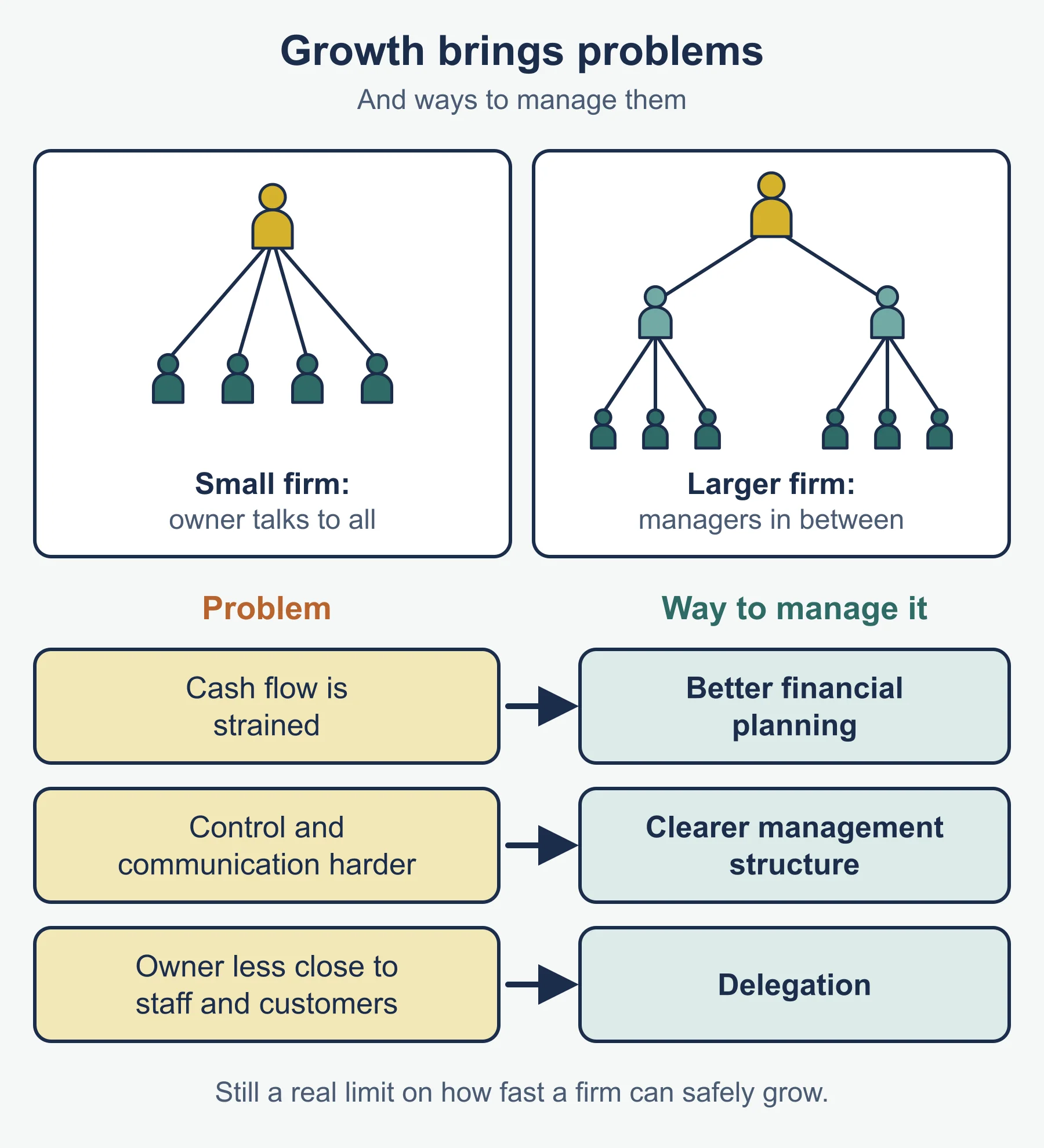
Problems linked to growth, and ways to overcome them
| Problem | Possible solution |
|---|---|
| Cash drains away as stock, staff and premises are paid for before sales arrive (overtrading) | Cash-flow forecasting, longer credit from suppliers, an overdraft or loan, growing in stages |
| Managers cannot control a larger workforce | Delegation, new management structure, training |
| Communication slows and staff feel distant | Team meetings, better communication systems, clear reporting lines |
| Costs per unit rise (diseconomies of scale) | Split into smaller units, simplify processes |
| Quality or customer service slips | Quality checks, staff training |
| Owner loses control (if new owners or shareholders join) | Limit how much outside finance is taken |
Why some businesses remain small: demand is limited to a small or local niche, the owner prefers a manageable workload and full say over decisions, finance is hard to get, the owner has no wish to take on extra risk, or the owner values a personal service that would be lost in a larger firm.
1.3.4 Business failure
Causes (examples from the syllabus in bold):
- Lack of management skills: poor decisions on pricing, stock or hiring, and weak financial control.
- Changes in the business environment: new competitors, changing tastes, higher costs, recession, new technology.
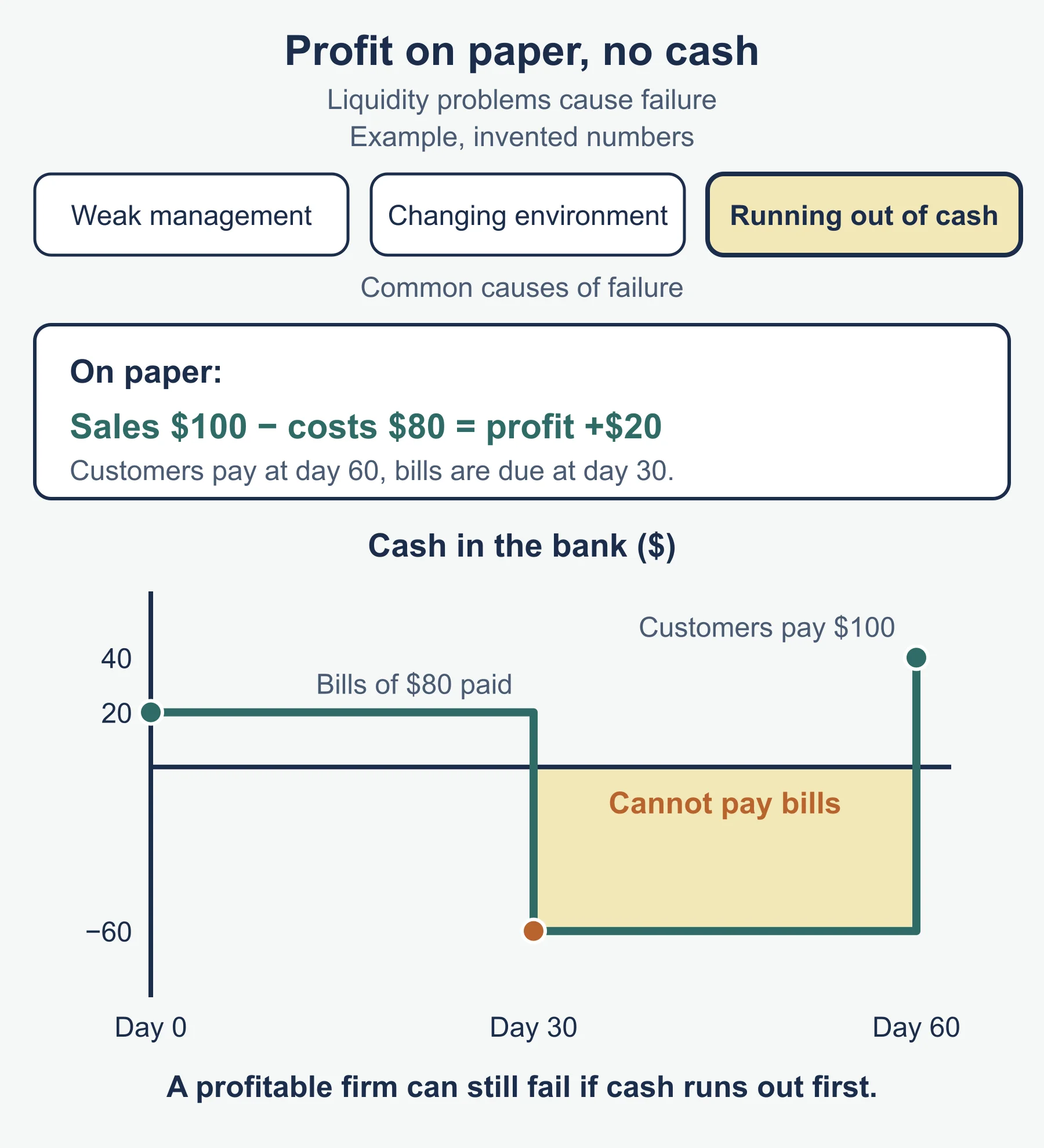
- Liquidity problems: not enough cash to pay bills when due, even if the business makes a profit on paper.
- Other examples: too little finance to start with, poor location, poor product quality.
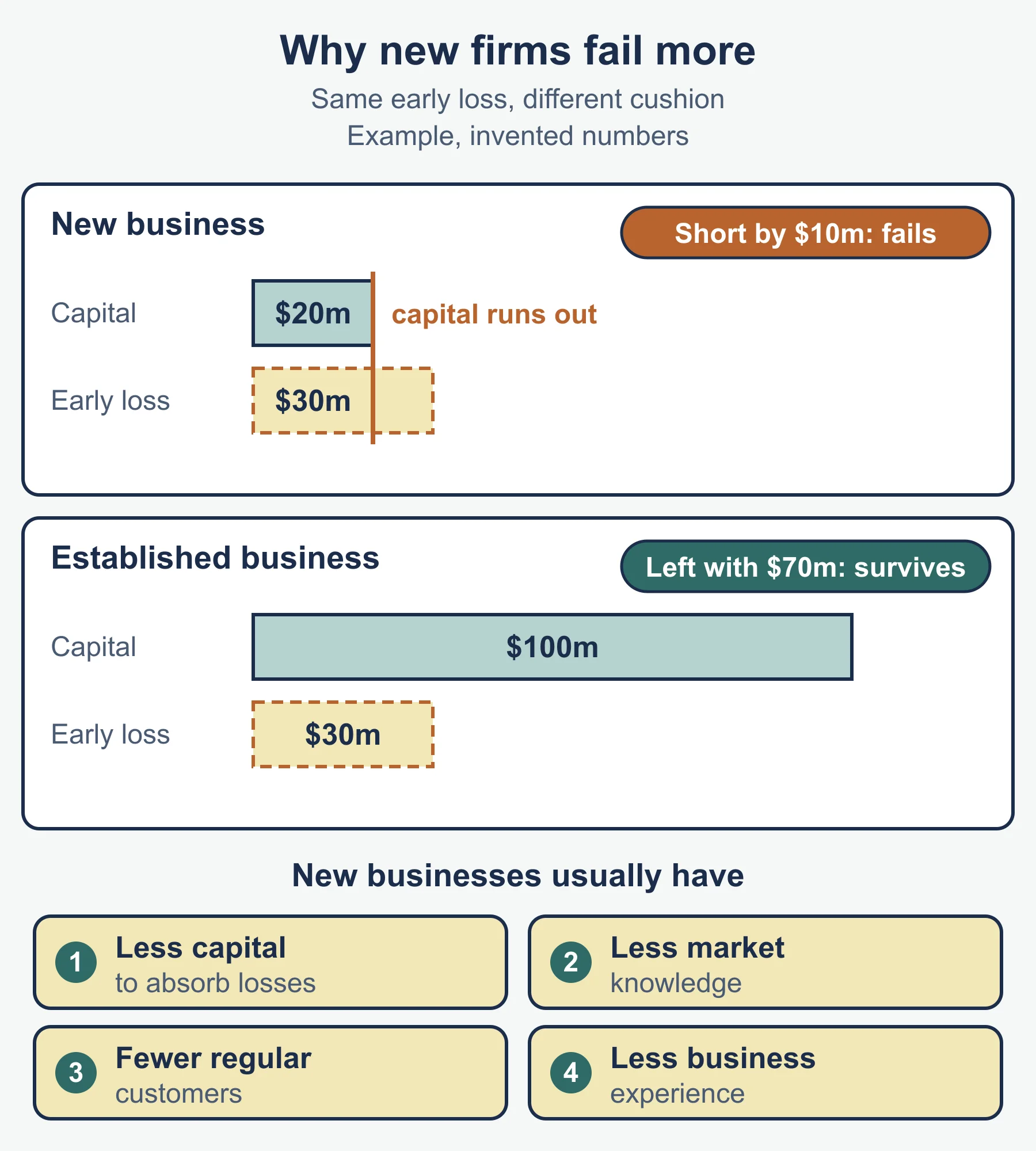
Why new businesses are at greater risk: little cash reserve, no established customers, no track record so lenders may refuse credit, owners still learning, and no knowledge yet of what works.
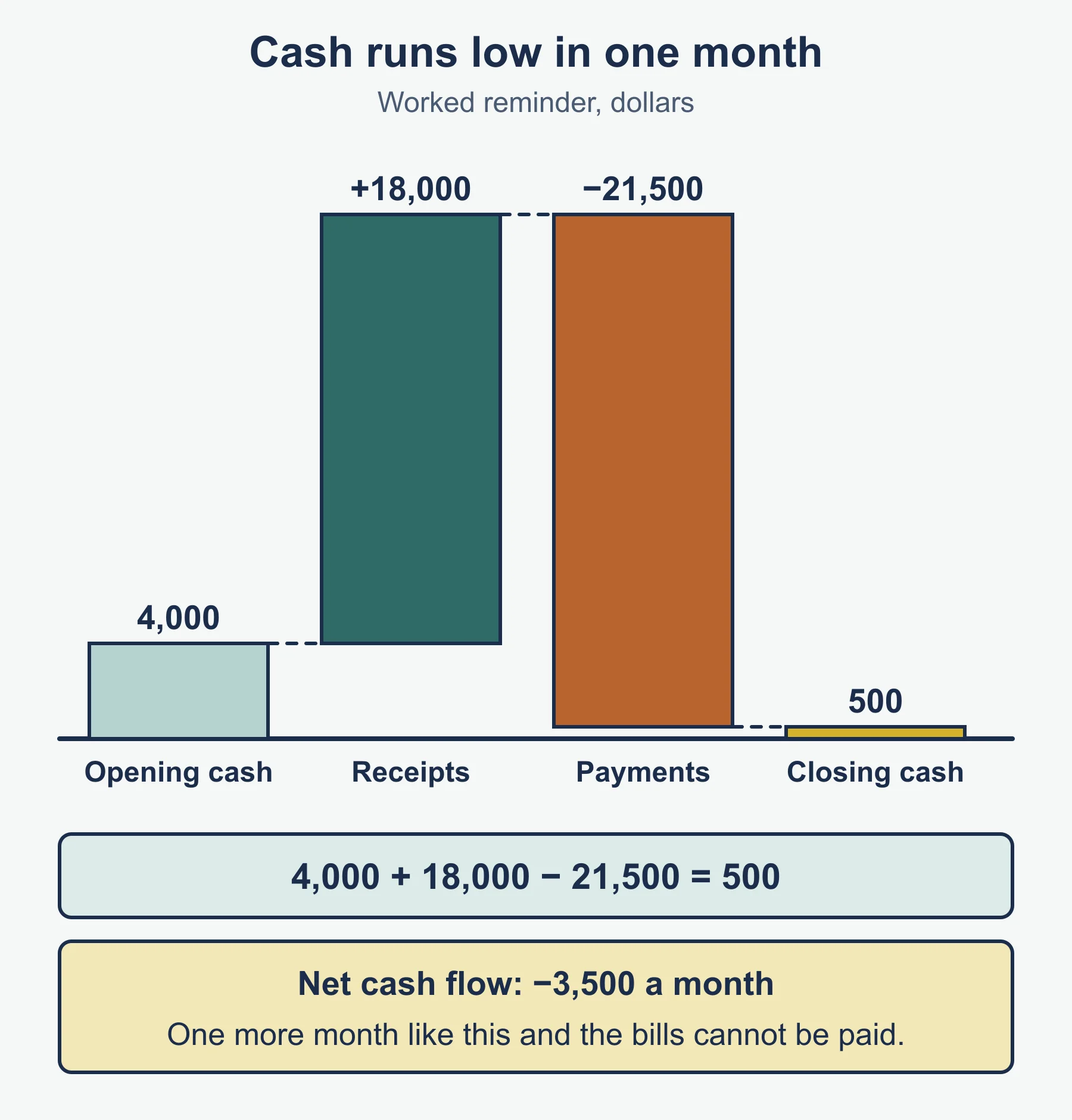
Worked reminder (liquidity). Opening cash 4,000. Receipts 18,000, payments 21,500. Net cash flow is minus 3,500, so closing cash is 500. One more month like that and the business cannot pay its bills, even if sales look healthy.
Must-know distinctions
- Profit is not size. Size is judged by employees, output or capital employed.
- Internal is not external. Own resources versus joining another business.
- Merger is not takeover. Agreement to combine versus one firm buying control.
- Profitable is not liquid. Profit measures earnings; liquidity is about having cash when bills fall due.
- Output is not employees. Output per employee compares efficiency; headcount compares workforce size.
Method in steps: a “recommend” or “evaluate” answer on growth
- State your decision clearly.
- Give one reason for it, using figures or facts from the case.
- Explain what that reason means for the business.
- Give the strongest point against your decision and say why it is weaker.
- Close with a judgement that depends on the case, for example the cash available.
Quick self-test
- Give two qualities that help someone run a new business.
- Name two contents of a business plan.
- Give one way a government can support a business start-up.
- A business has 14 employees and annual output worth 840,000. Calculate output per employee.
- Why can profit not be used to say how big a business is?
- A firm’s workforce rises from 40 to 50. Calculate the percentage increase.
- Is opening a second shop internal or external growth?
- Give one problem linked to growth and one way to overcome it.
- Give two reasons why an owner might keep a business small.
- A business starts the month with 2,500 cash, receives 9,000 and pays out 11,200. What is the closing balance?
- Why are new businesses more likely to fail?
Answers
- Any two: risk-taking, self-motivation, initiative, creativity, determination, organisation.
- Any two: business idea and aims, market research findings, marketing plan, financial forecasts, sources of finance, staffing.
- A grant or a training scheme (other help such as advice is also acceptable).
- 840,000 divided by 14 is 60,000.
- Profit shows how well a business performed, not its scale; a tiny firm may profit more than a large one that is loss-making.
- 10 divided by 40, times 100, is 25%.
- Internal: it uses the firm’s own resources.
- For example, cash shortage, solved by a cash-flow forecast or an overdraft; or loss of control, solved by delegation.
- For example, to keep personal control, because the market is small, or to avoid extra risk.
- 2,500 plus 9,000 minus 11,200 is 300.
- Less cash reserve, no established customers, less experience, and no track record to persuade lenders.
Where marks are usually lost
- Offering profit as a way to gauge size.
- Listing business plan contents without saying how each helps the entrepreneur.
- Calling any growth “external” because it sounds bigger; check whether another business is involved.
- Confusing a lack of profit with a lack of cash when discussing failure.
- Giving a benefit of growth when the question asks for a problem, or the reverse.
- Naming a solution that does not match the problem described.
- Stating a limitation of a size measure without explaining why it misleads.
- Leaving out units or the percentage sign in calculations.
- Concluding without a judgement in “evaluate” or “recommend” answers.
Frequently asked questions
Can profit be used to measure the size of a business? No. The Cambridge O Level Business Studies 7115 syllabus states that profit does not count as a size measure, because profit shows performance and firms of very different size can report the same profit.
What is the difference between a merger and a takeover? A merger is when two firms agree to combine. A takeover is when one firm buys control of another. Both are forms of external growth.
What is overtrading? Overtrading is when cash drains away during growth because stock, staff and premises are paid for before the extra sales bring in cash. Cash-flow forecasting, longer supplier credit, an overdraft or growing in stages can help.
Why do some businesses stay small? Demand may be limited to a small or local niche, the owner may prefer a manageable workload and full control, or finance may be hard to get.
Why do governments support business start-ups? More businesses mean more jobs, more output, more tax revenue and more competition. Support can include grants, which do not usually have to be repaid, and training schemes or advice.
Official syllabus
Source: Cambridge O Level Business Studies 7115 syllabus for examination in 2026, published by Cambridge University Press & Assessment, subject content 1.3. Check the current syllabus for your own examination series.
Get free revision emails (optional)
Occasional emails with practice questions, worked explanations and links to free resources for the qualification and subjects you choose. No spam, and you can unsubscribe from any email. The free tools on this site never need an email.
Related resources
-
Study guides
O Level Business: Types of business organisation and Business objectives and stakeholder objectives (Cambridge 7115)
Study guide to forms of business organisation, business objectives, stakeholders and public versus private sector aims for Cambridge O Level Business 7115.
Business · Cambridge · O Level
Read guide -
Practice questions
O Level Business: Types of business organisation and Business objectives and stakeholder objectives (Cambridge 7115) – Practice Questions
Twelve original practice questions with worked answers on organisation types, objectives and stakeholders for Cambridge O Level Business 7115.
Business · Cambridge · O Level
Try questions -
Revision notes
O Level Business: Types of business organisation and Business objectives and stakeholder objectives (Cambridge 7115) – Revision Notes
Condensed revision notes with tables, methods and a self-test on organisation types, objectives and stakeholders for Cambridge O Level Business 7115.
Business · Cambridge · O Level
Revise topic
Related articles
-
teaching
A Level tuition in Dubai: Cambridge or Pearson Edexcel International A Level?
Schools in Dubai and Abu Dhabi teach either Cambridge International AS & A Level or Pearson Edexcel International A Level. How the two are structured, why it matters for tuition, and how online classes from Lahore work.
9 October 2026
-
curriculum guides
Choosing subjects at IGCSE and A Level
How subject choices at 14 and 16 affect university options later, and how to keep pathways open without overloading a timetable.
28 July 2026
Studying this with a teacher
Working through Business O LEVELS?
This page is free and stays free. If you would rather be taught it, Marlbridge runs Business classes one-to-one and in small groups of up to 15, online in your own time zone. The first trial class is free. WhatsApp replies within an hour (8am–11pm Pakistan time, every day); email the same day.
Cambridge Business teachers at Marlbridge

