
Study Guides
Cambridge O Level Mathematics: Number (4024)
Study guide to every Number outcome in Cambridge O Level Mathematics 4024, from types of number and sets to surds, with worked examples throughout.
- Subject
- Mathematics
- Level
- O LEVELS
- Topic
- Number
- Author
- Marlbridge Academic Team
- Updated
- Reviewed by
- Sajawal Zahid (what this means)
Aligned to Cambridge O Level Mathematics (4024), 2025-2027. Official specification .
Syllabus page (what it covers and how it is assessed): Cambridge O Level Mathematics.
Syllabus points this page covers
4024
- 1 Number (whole topic)
Found an error? Report a correction.
Need help with this topic? Request a free trial class for O Level Mathematics (4024).
This study guide is aligned to the Cambridge O Level Mathematics (Syllabus D) 4024 syllabus for examination in 2025, 2026 and 2027. It covers all of syllabus topic 1, Number, sections 1.1 to 1.18. The syllabus is not tiered, so every candidate meets all of it. Paper 1 does not allow a calculator and Paper 2 requires a scientific calculator, so practise the by-hand methods below as well as the calculator skills in section 1.14.
Condensed recall is in the revision notes. Exam-style questions are in the number practice set. Use the course hub and the printable checklist to track progress, and take a free 10-minute diagnostic if you are unsure where to start.
| Section | Focus |
|---|---|
| 1.1 to 1.3 | Types of number, sets, powers and roots |
| 1.4 to 1.8 | Fractions, ordering, operations, indices, standard form |
| 1.9 to 1.12 | Estimation, bounds, ratio, rates |
| 1.13 to 1.18 | Percentages, calculator, time, money, growth and decay, surds |
1.1 Types of number
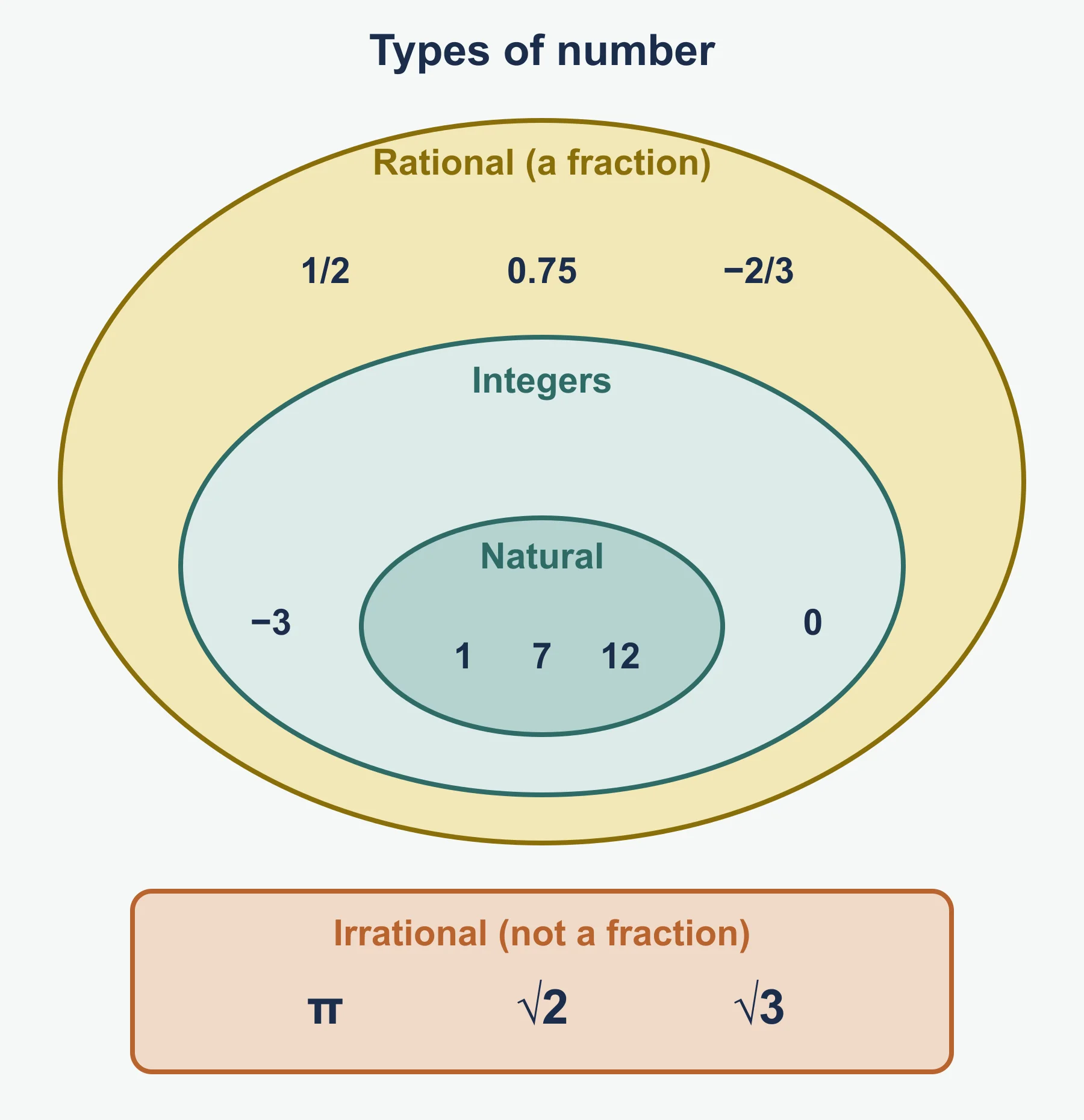
Natural numbers are 1, 2, 3 and so on; integers include zero and the negatives. A prime has exactly two factors. A rational number can be written as a fraction of two integers; an irrational number such as π cannot. The reciprocal of a number n is 1/n, so the reciprocal of 0.25 is 4 and the reciprocal of 9/4 is 4/9.
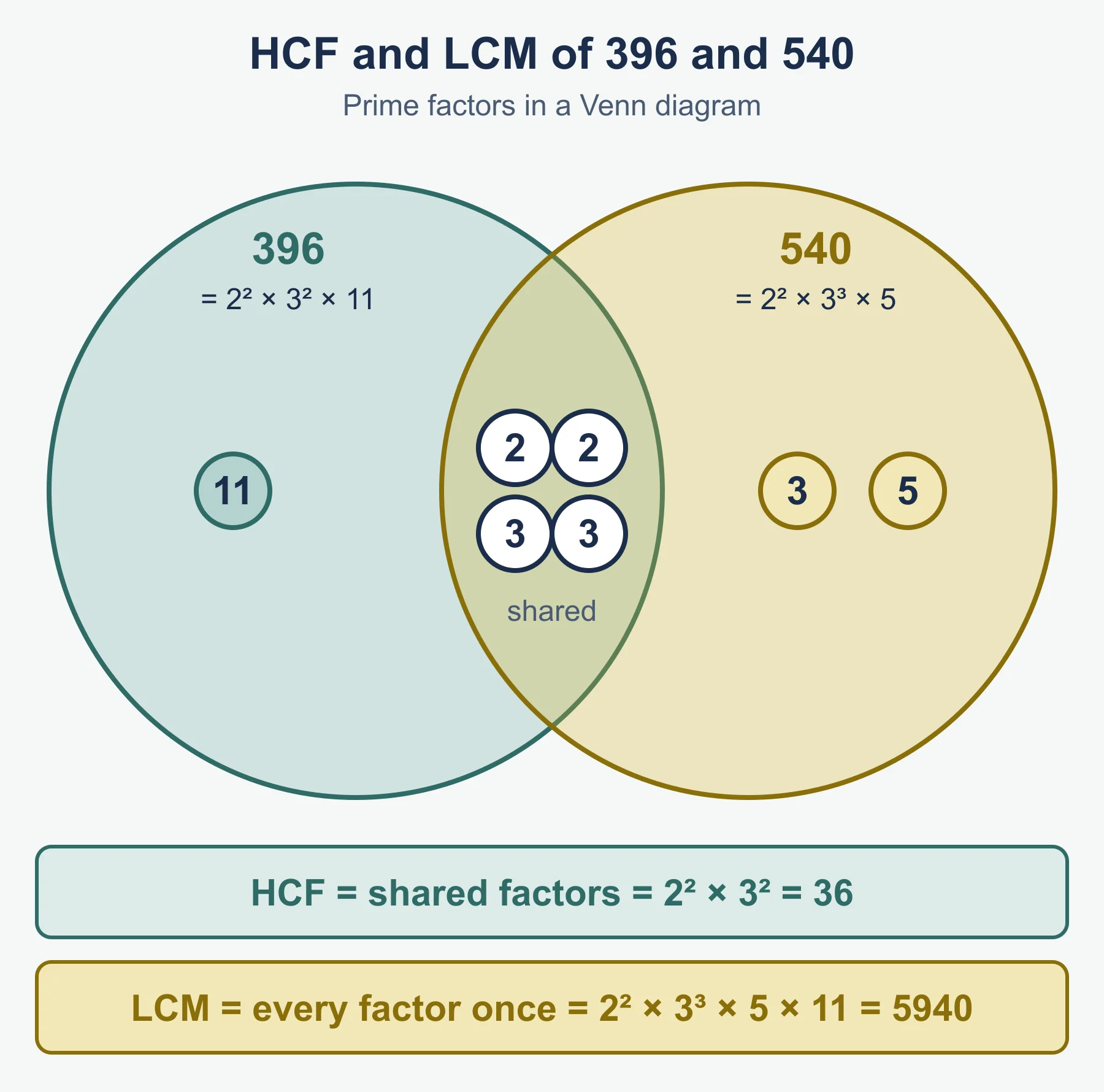
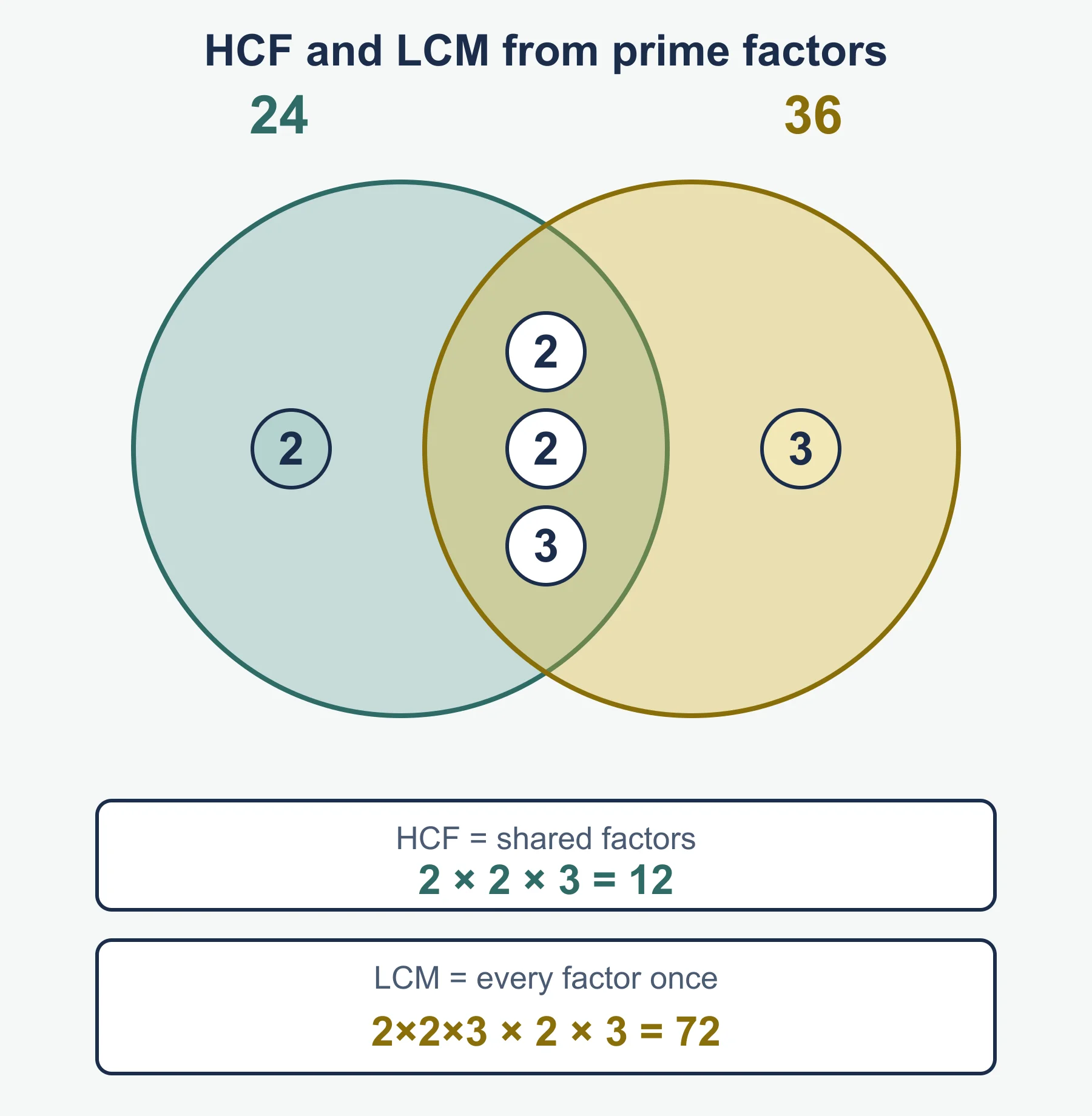
To find the HCF and LCM, write each number as a product of prime factors. The HCF takes the lowest power of each shared prime. The LCM takes the highest power of every prime that appears.
Worked example. Find the HCF and LCM of 396 and 540.
396 = 2² × 3² × 11
540 = 2² × 3³ × 5
HCF = 2² × 3² = 36
LCM = 2² × 3³ × 5 × 11 = 5940
Convert between words and numbers: 30 040 000 is thirty million and forty thousand, and 10 007 is ten thousand and seven.
1.2 Sets
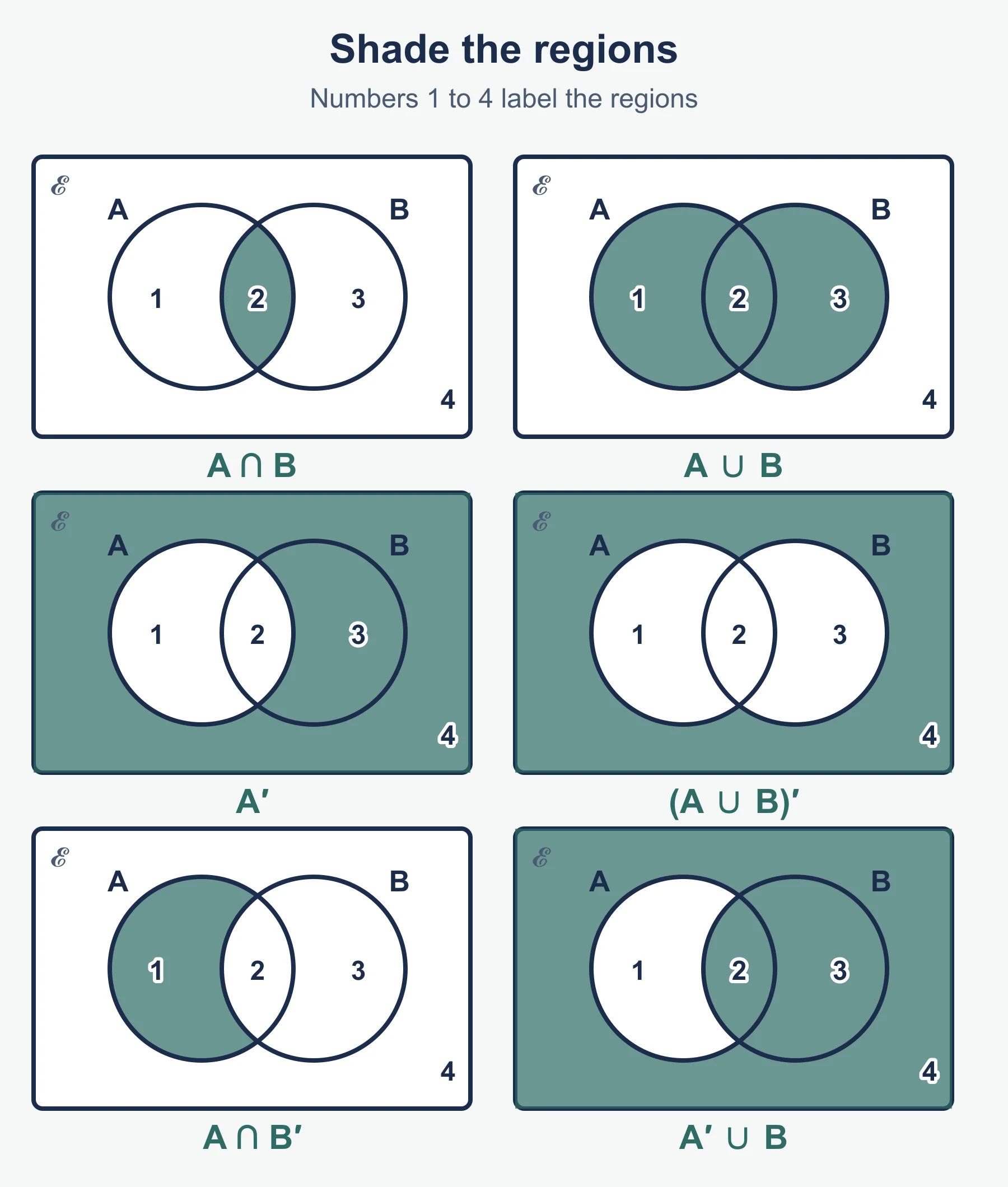
A set is a collection of elements written in braces. Notation: n(A) is the number of elements; ∈ and ∉ mean “is” and “is not an element of”; A′ is the complement; ∅ is the empty set; ξ is the universal set; ⊆ and ⊈ mean “is” and “is not a subset of”; ∪ is union and ∩ is intersection.
Sets can be defined by a rule, such as C = {x: 2 ⩽ x ⩽ 9}. Venn diagrams are limited to two or three sets. Fill the overlap first.
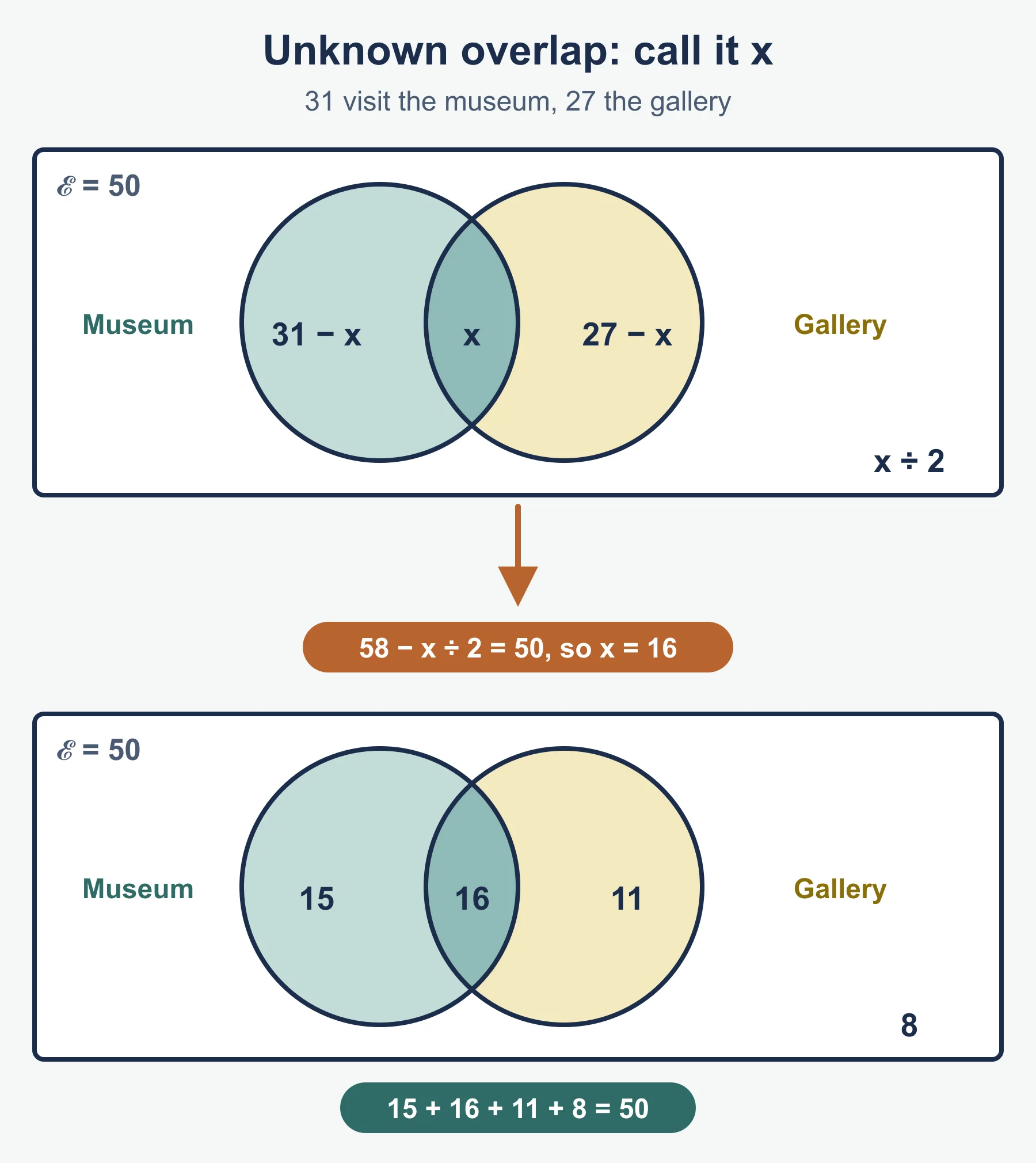
Worked example. Of 35 pupils, 20 play chess, 18 draw and 6 do neither. How many do both?
Pupils in at least one group = 35 − 6 = 29
n(C ∪ D) = n(C) + n(D) − n(C ∩ D)
29 = 20 + 18 − n(C ∩ D), so n(C ∩ D) = 9
Now take ξ = {1, 2, …, 20}, A = multiples of 3 and B = even numbers. A ∩ B = {6, 12, 18}, n(B) = 10, n(A ∪ B) = 13 and n((A ∪ B)′) = 7.
1.3 Powers and roots
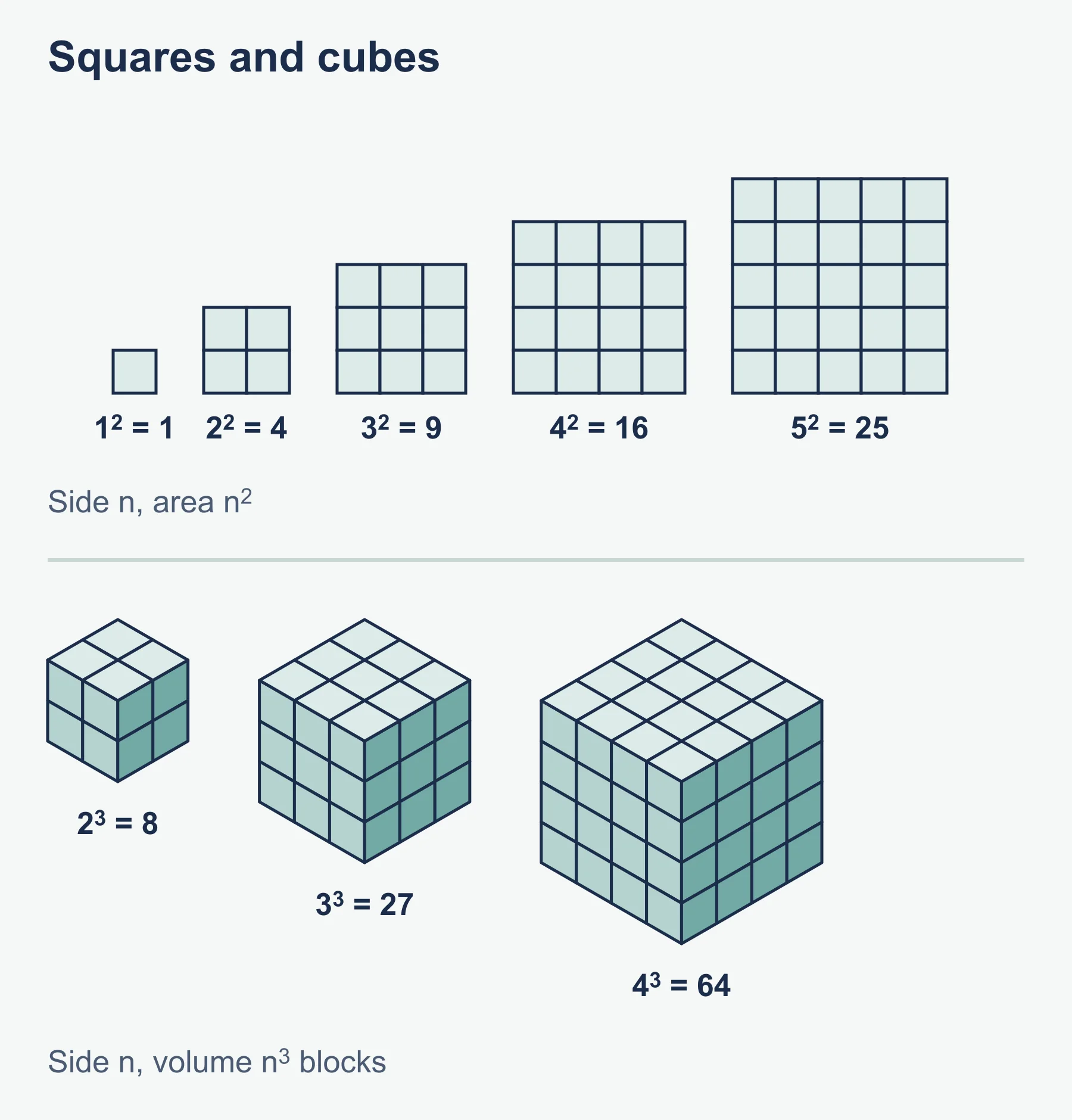
Know the squares and square roots from 1 to 15, and the cubes and cube roots of 1, 2, 3, 4, 5 and 10. So √169 = 13 and ∛125 = 5. Other powers and roots can be found with a calculator, for example 2⁷ = 128 and the fourth root of 81 is 3.
1.4 Fractions, decimals and percentages, 1.5 Ordering, 1.6 Four operations
Move freely between proper fractions, improper fractions, mixed numbers, decimals and percentages. Give fractions in simplest form.
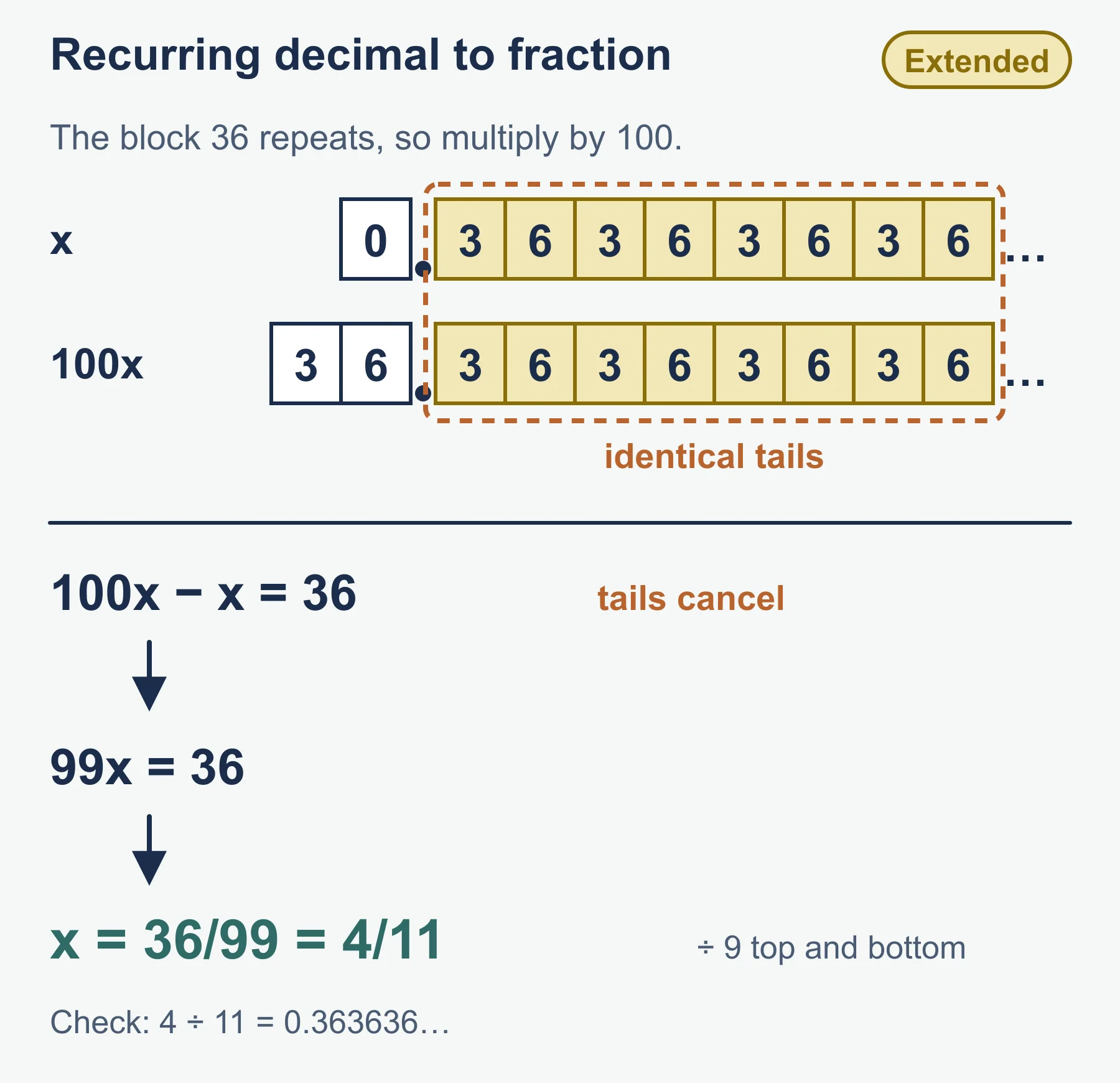
Recurring decimals use a dot over the repeating digit, or over the first and last digit of a longer block. So 0.1̇ is 0.111…, and 0.4̇5̇ is 0.454545…
Worked example. Write 0.8̇1̇ and 0.16̇ as fractions.
x = 0.8181...   100x = 81.8181...   99x = 81   x = 81/99 = 9/11
y = 0.1666...   10y = 1.666...  100y = 16.666...
90y = 15, so y = 1/6
To go the other way, divide: 7/12 = 0.58333…, written 0.583̇.
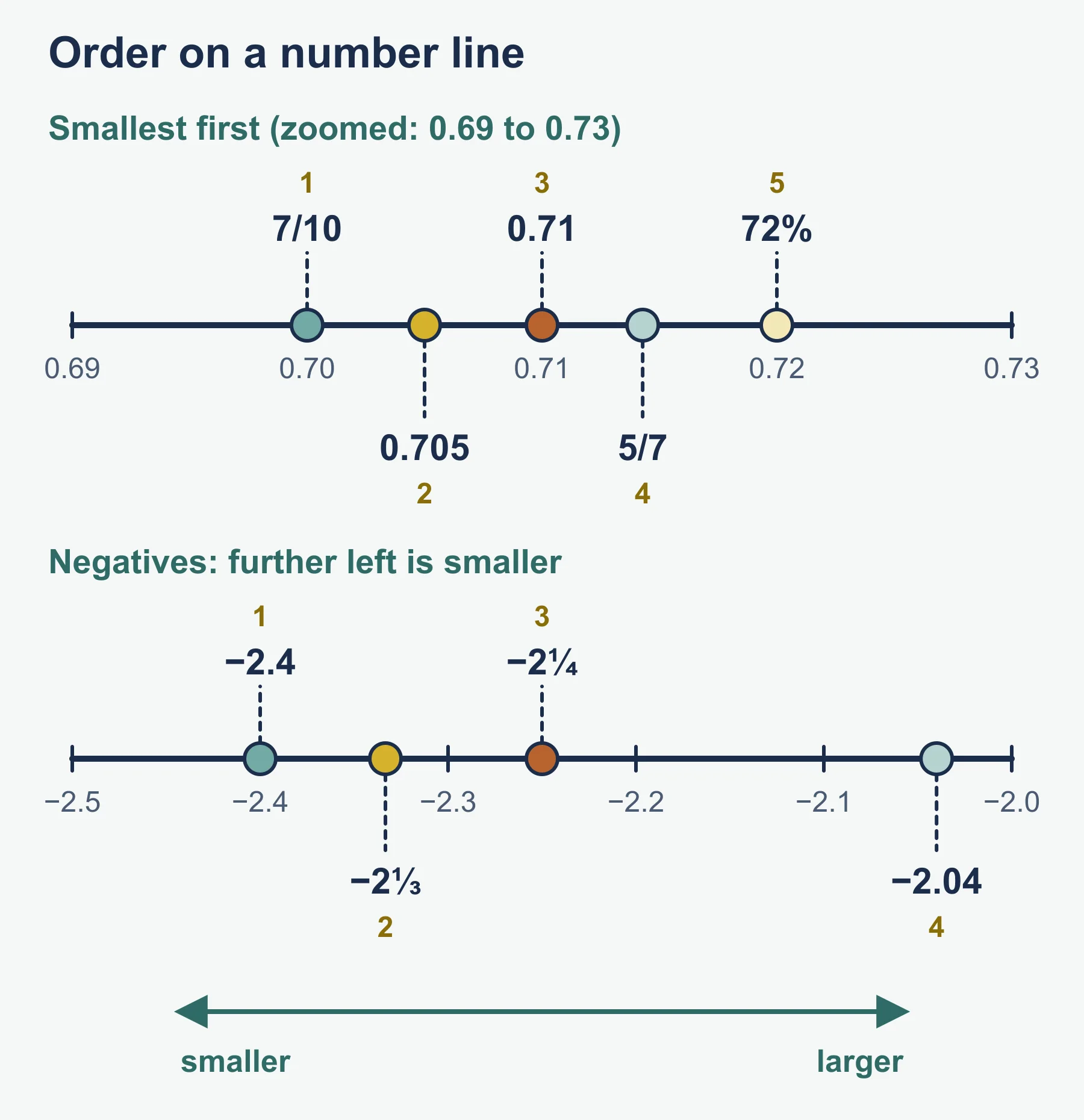
For ordering, use =, ≠, >, <, ⩾ and ⩽. Convert everything to decimals: 3/7, 0.45, 4/9 and 44% become 0.4286, 0.45, 0.4444 and 0.44, so ascending order is 3/7, 44%, 4/9, 0.45.
For the four operations follow brackets, indices, then division and multiplication, then addition and subtraction. Turn mixed numbers into improper fractions first. Negative numbers arise in practice: a temperature falling from 3 to −5 degrees changes by 8 degrees.
Worked example. Work out (3 2/5 − 1 7/10) × 2 2/3.
17/5 − 17/10 = 34/10 − 17/10 = 17/10
17/10 × 8/3 = 136/30 = 68/15 = 4 8/15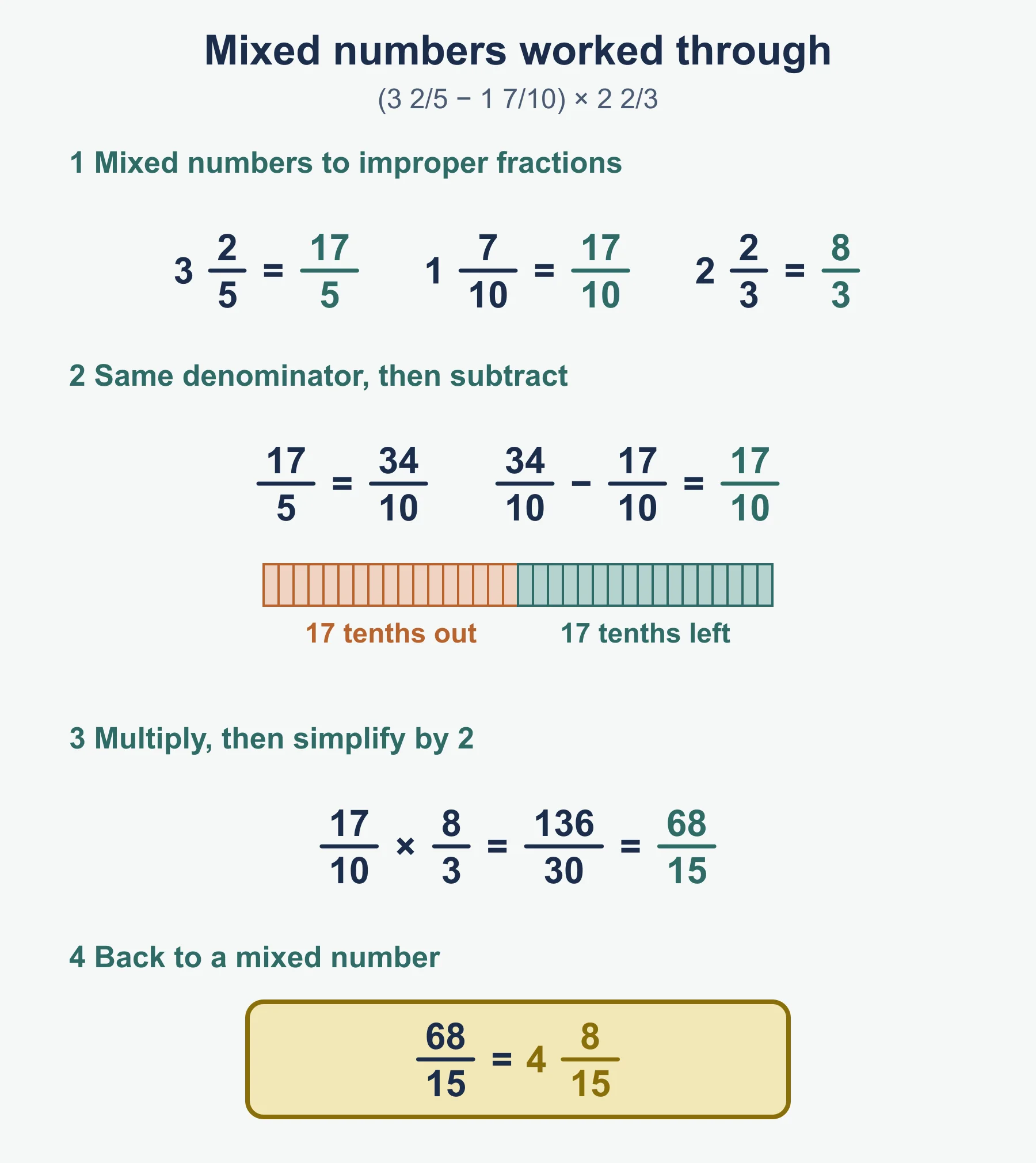
1.7 Indices
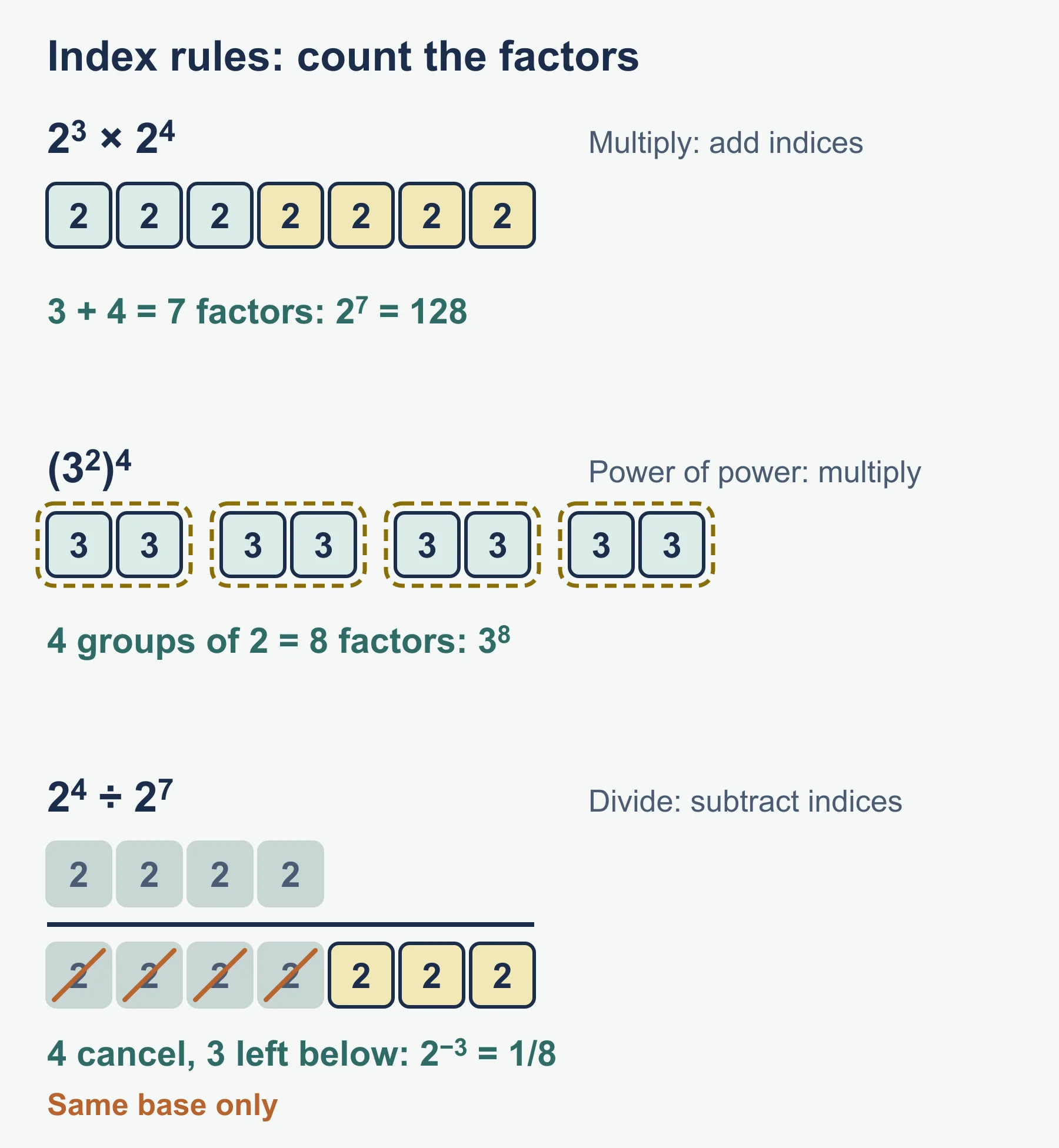
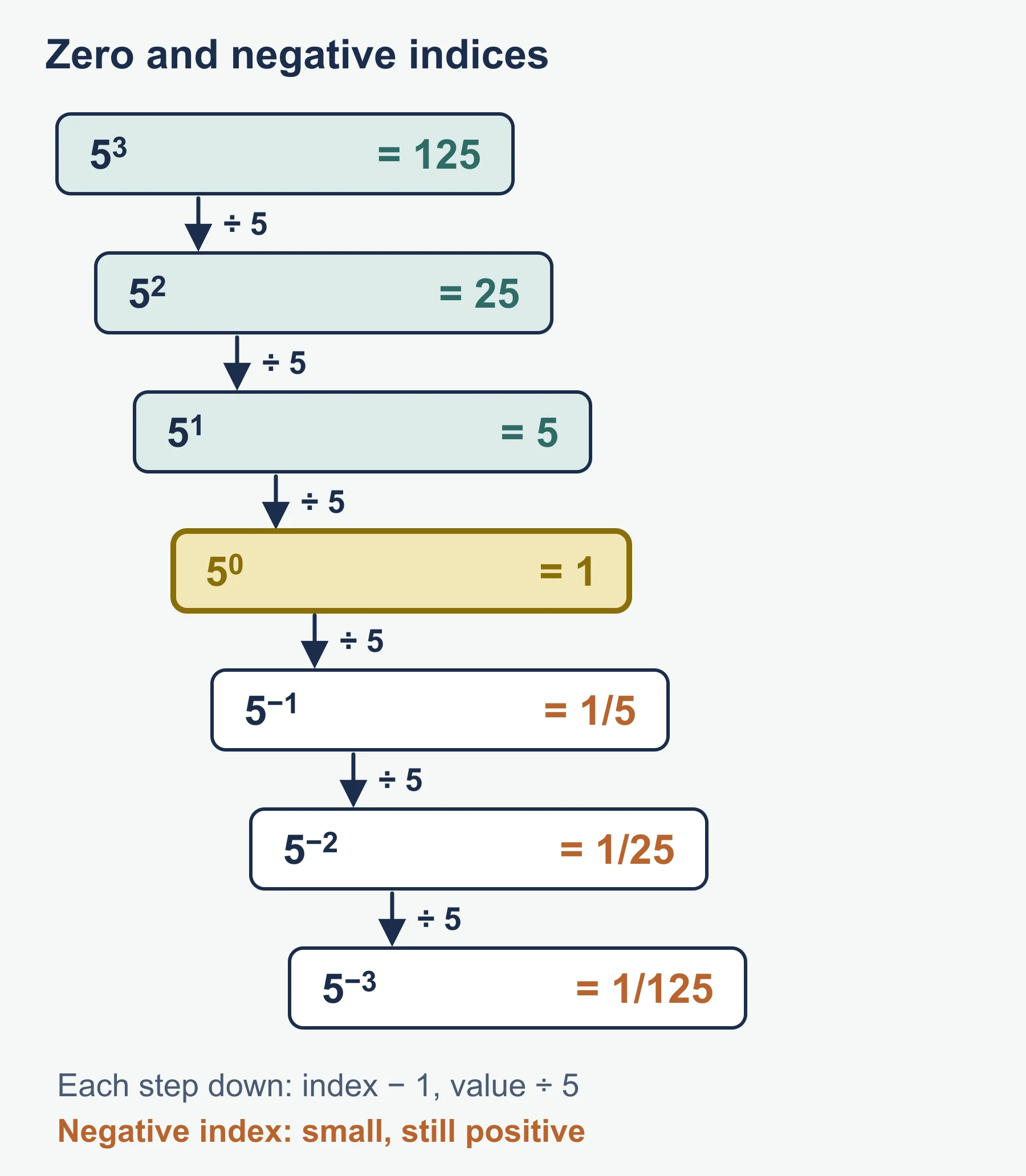
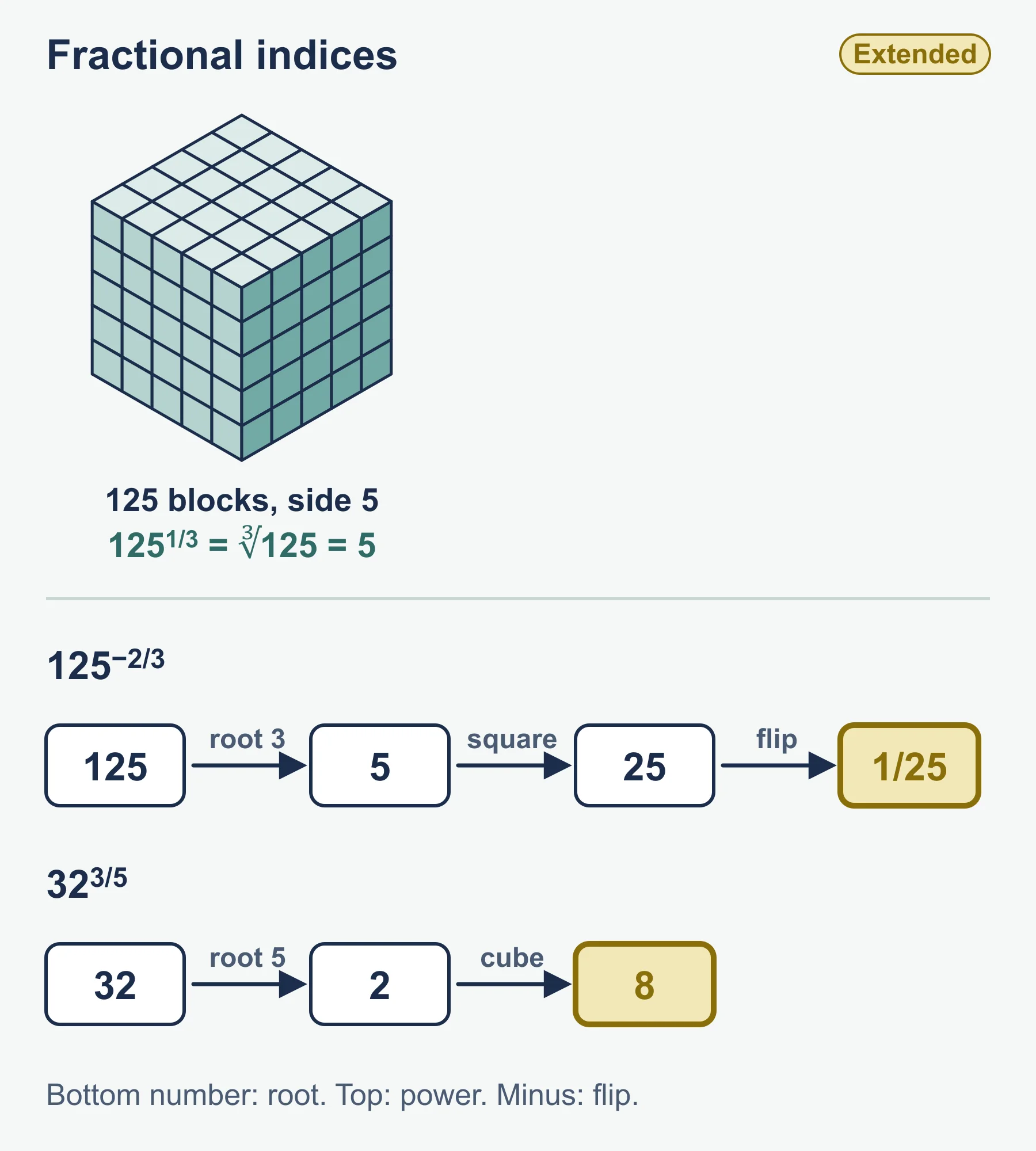
Zero power gives 1. A negative power means reciprocal. A fractional power means root: a^(1/n) is the nth root and a^(m/n) is the nth root raised to the power m. Add the powers when multiplying, subtract them when dividing, and multiply them for a power of a power. For example 2⁻³ × 2⁴ = 2 and (2³)² = 64.
Worked example. Evaluate (3/2)⁻³, 64^(2/3) and 125^(−1/3).
(3/2)⁻³ = (2/3)³ = 8/27
64^(2/3) = (∛64)² = 4² = 16
125^(−1/3) = 1/∛125 = 1/5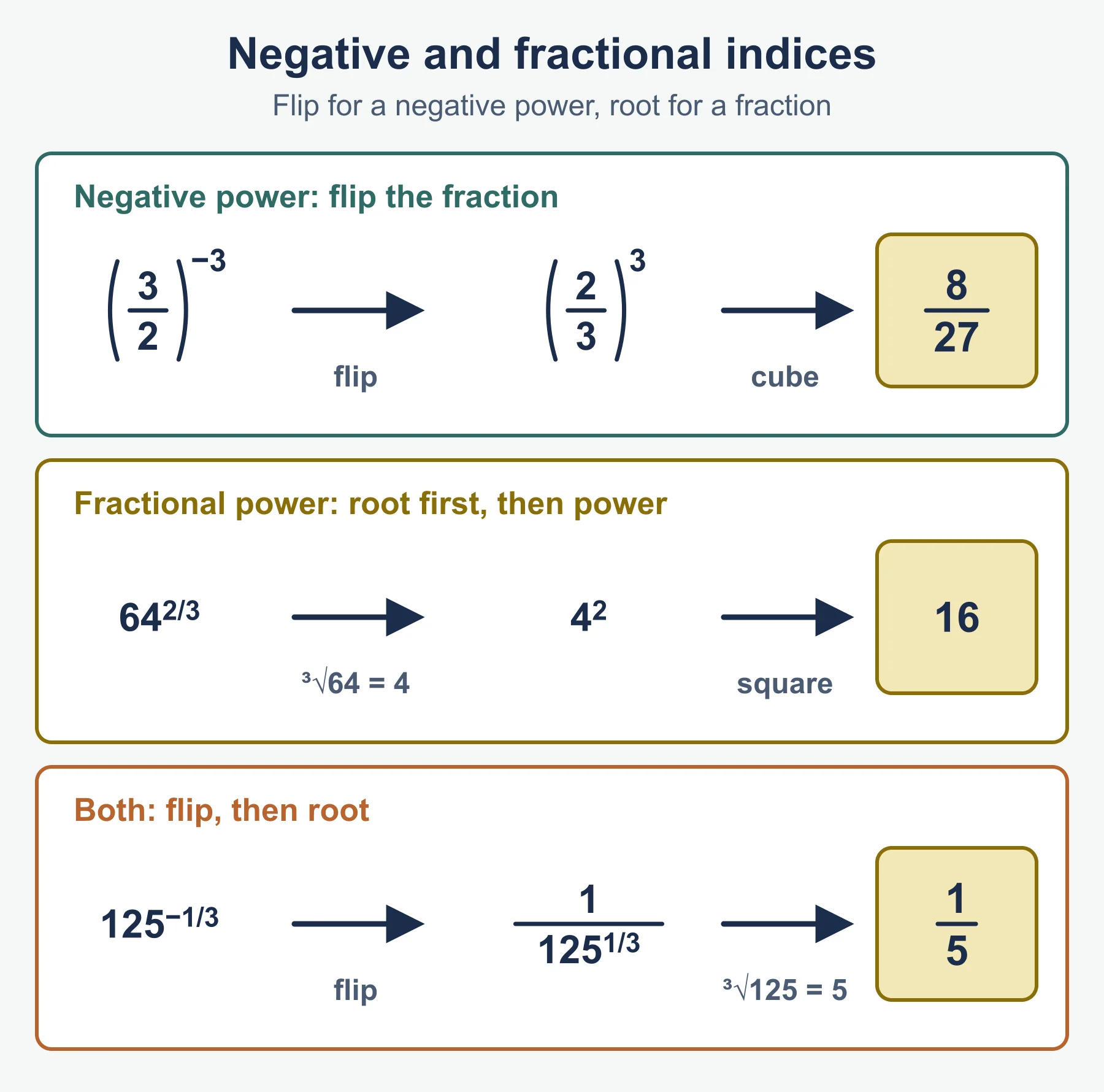
1.8 Standard form
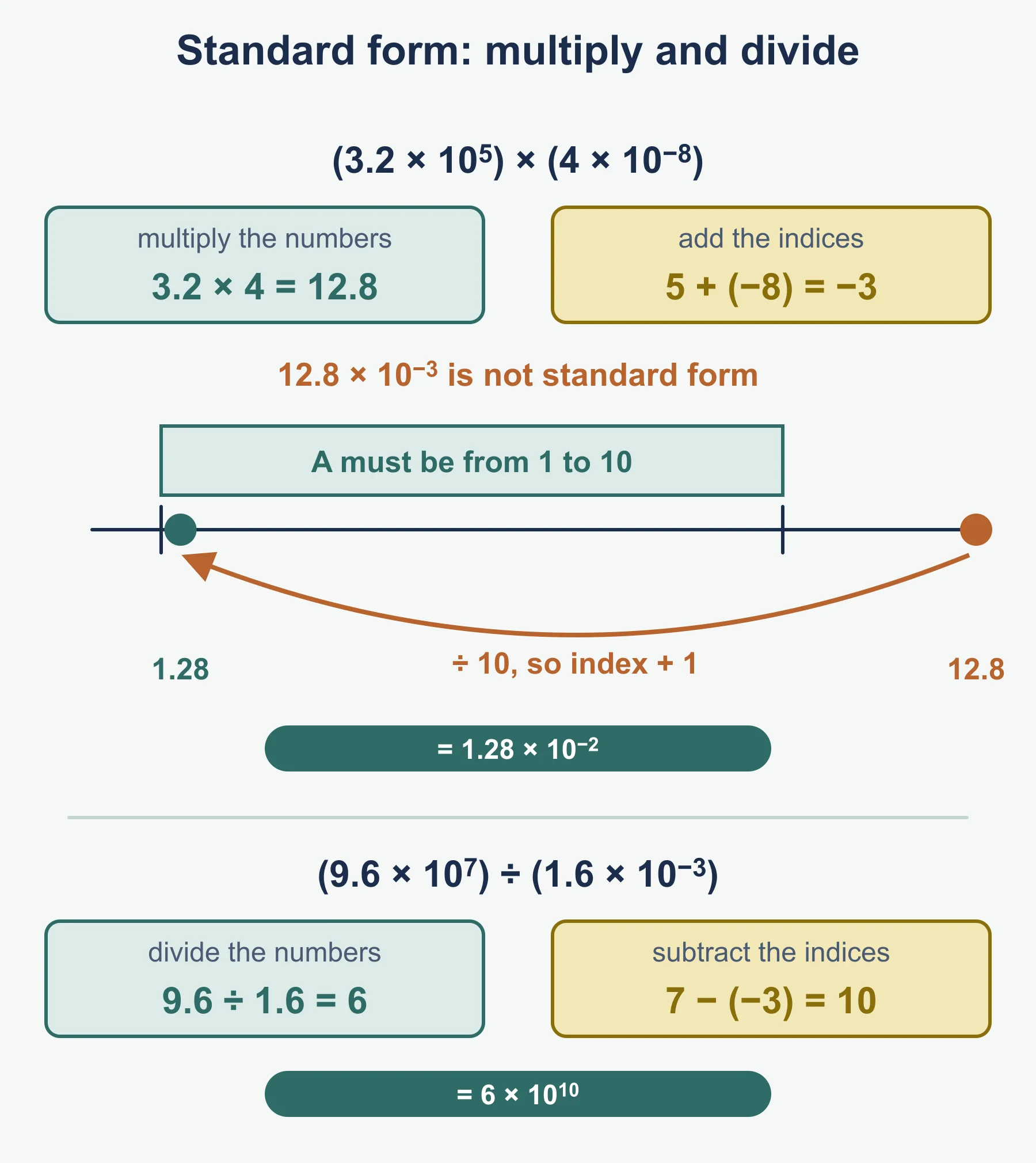
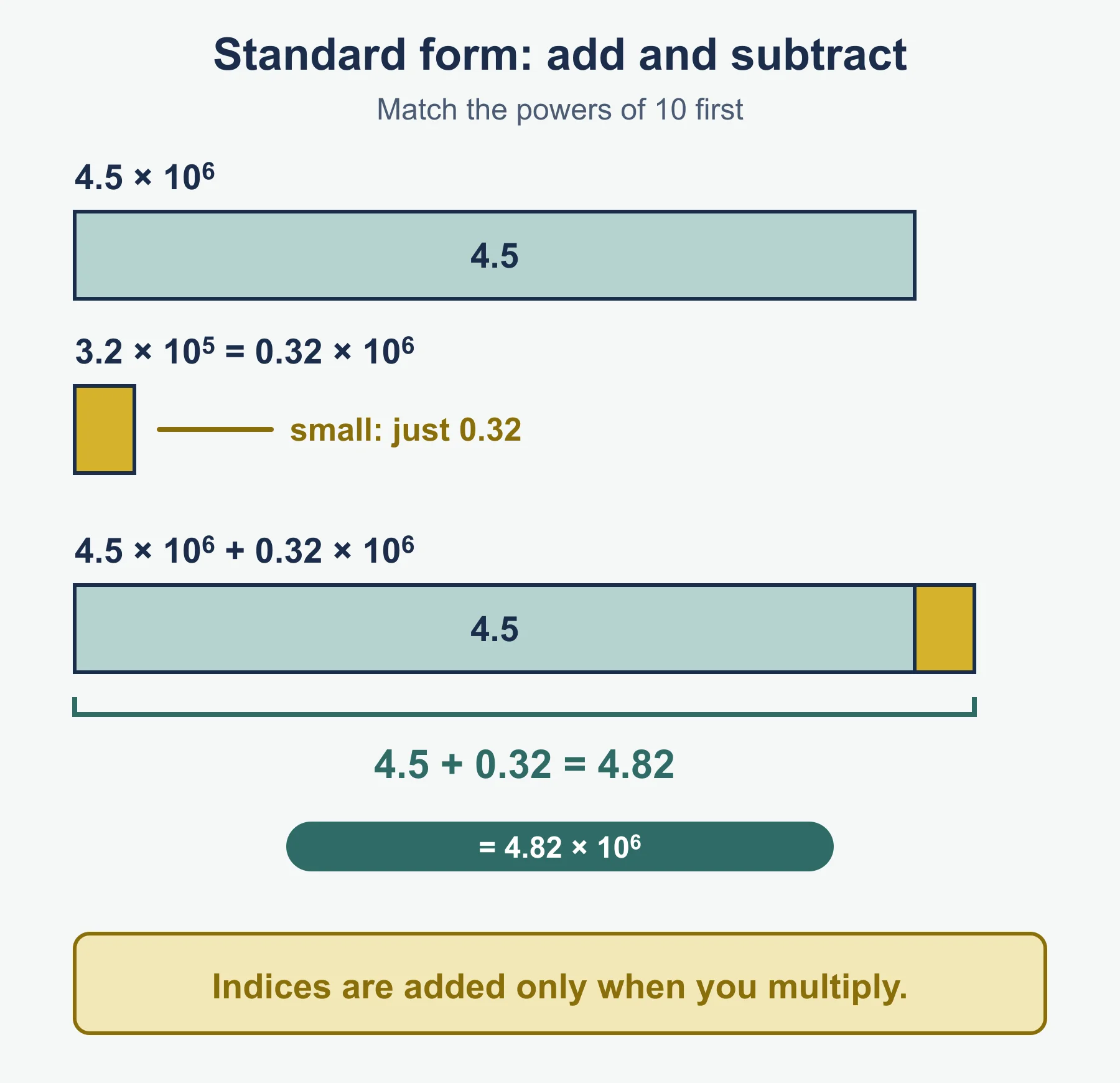
Standard form means A × 10ⁿ with A at least 1 but below 10, and n a whole number, positive or negative. So 0.00047 = 4.7 × 10⁻⁴. For products and quotients, treat the number parts and the powers of ten separately. To add or subtract, first write both with the same power.
(3.6 × 10⁵) × (2.5 × 10⁻²) = 9 × 10³
(7.2 × 10⁻³) ÷ (1.8 × 10⁻⁷) = 4 × 10⁴
4.2 × 10⁵ + 3.5 × 10⁴ = 4.2 × 10⁵ + 0.35 × 10⁵ = 4.55 × 10⁵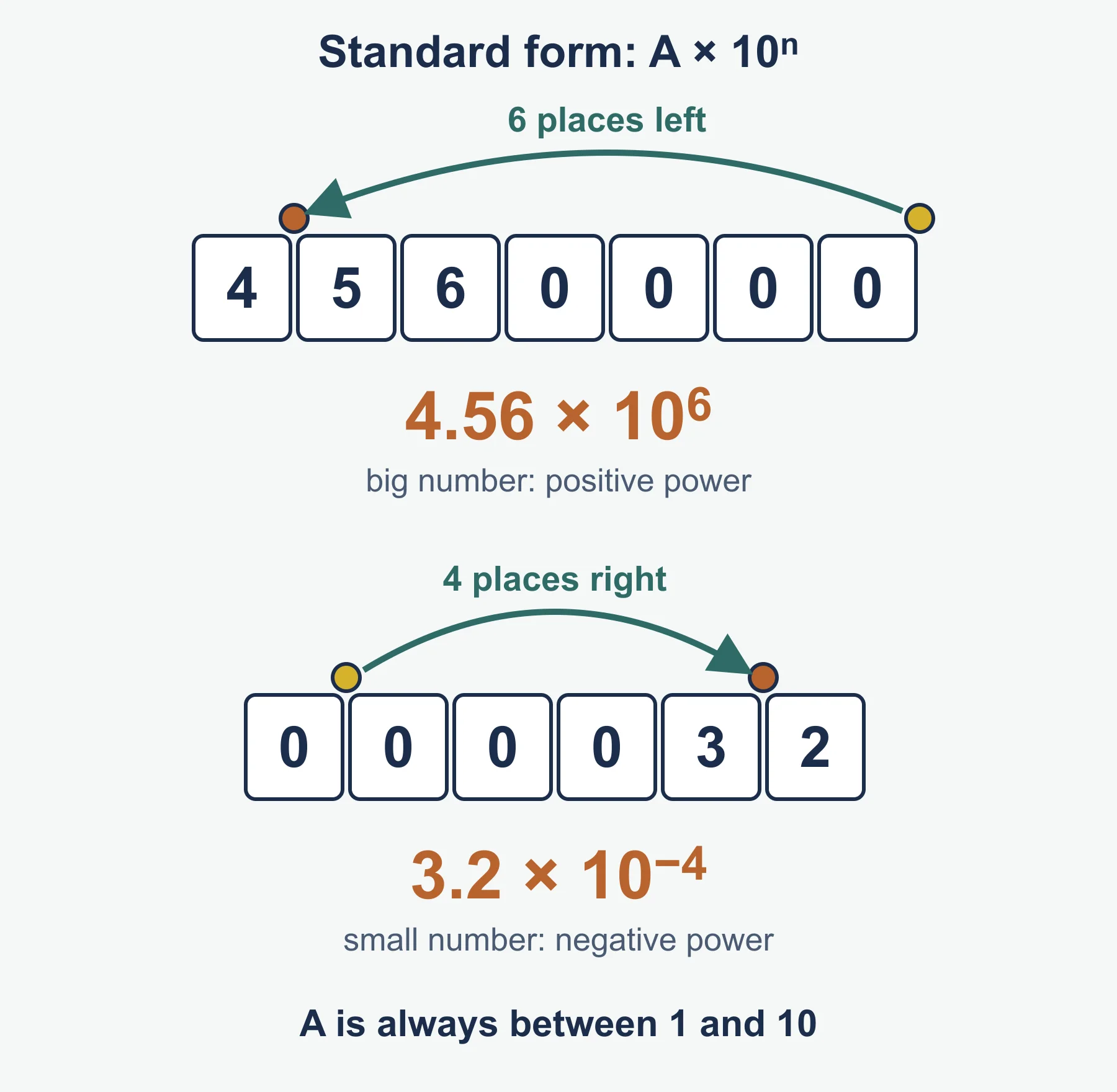
1.9 Estimation
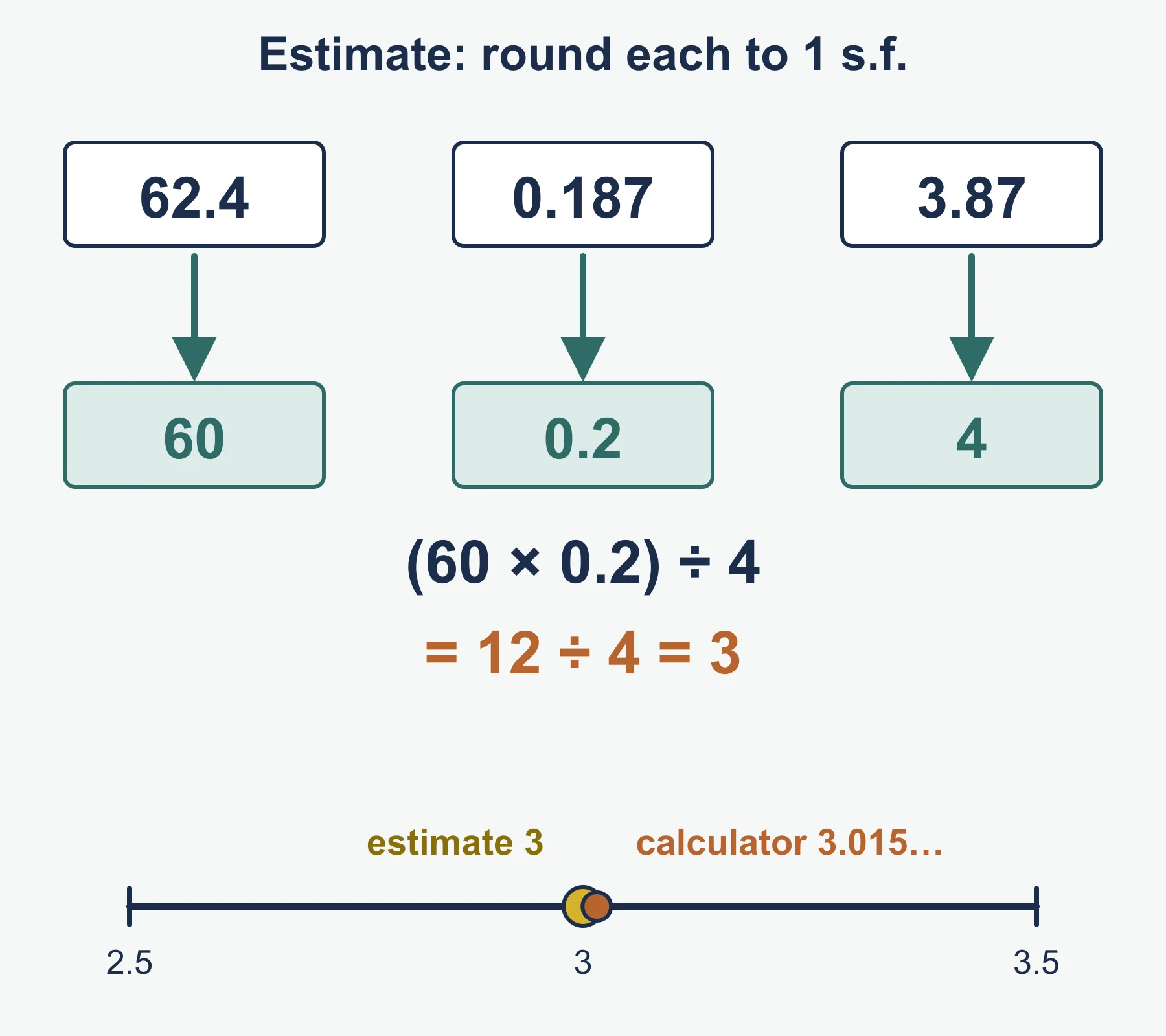
Round to decimal places (after the point) or significant figures (from the first non-zero digit). 38 462 is 38 500 to the nearest hundred, and 0.0070495 is 0.00705 to 3 significant figures. To estimate, round each value to 1 significant figure first.
Worked example. Estimate 7.82 × 19.6 ÷ 0.41.
Rounded: 8 × 20 ÷ 0.4 = 160 ÷ 0.4 = 400.
Never round in the middle of a calculation. In context, round the final answer sensibly: money to 2 decimal places, and people or whole items to a whole number.
1.10 Limits of accuracy
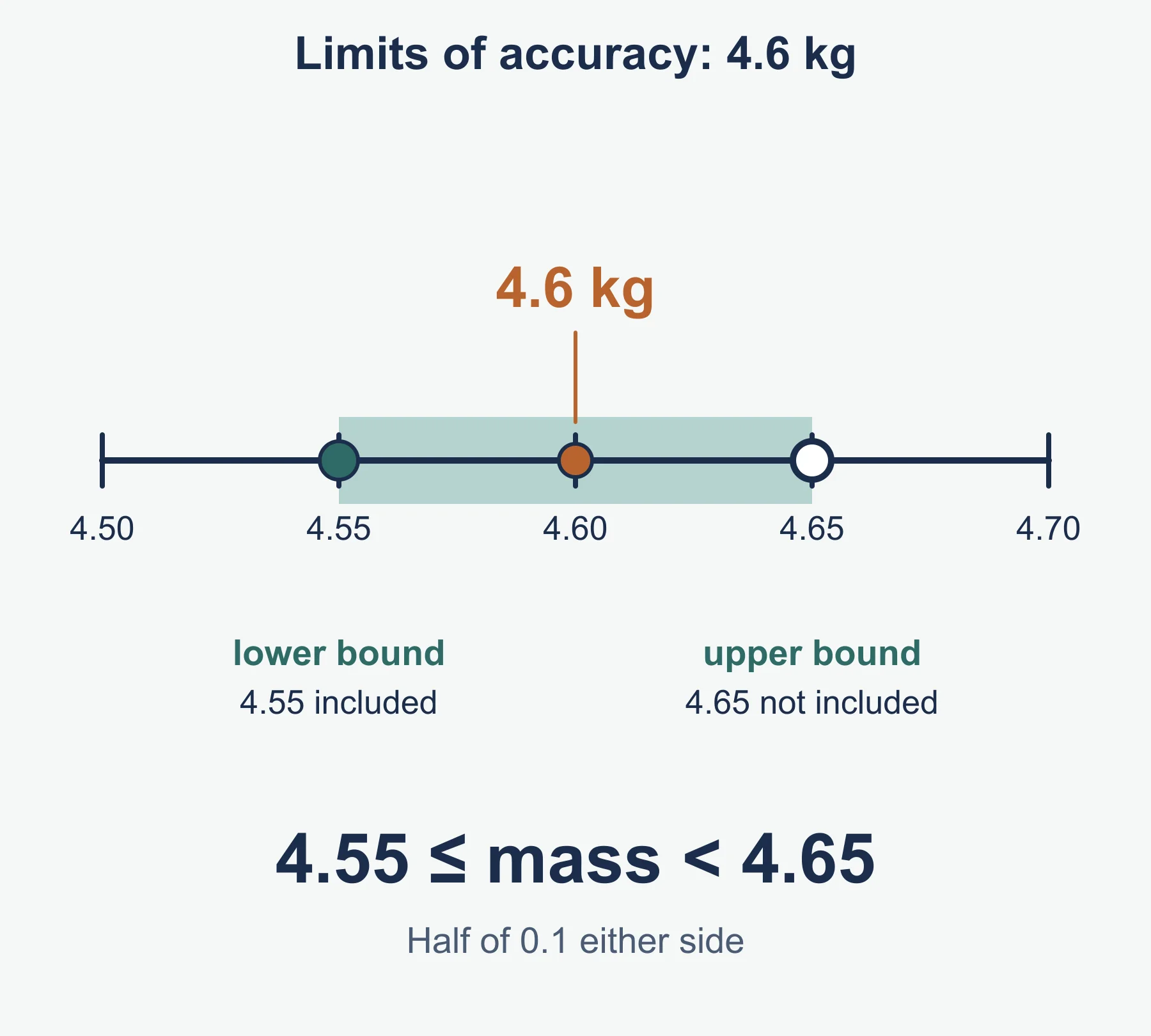
A value rounded to a given accuracy lies in a range. A length of 14.3 cm to 1 decimal place satisfies 14.25 ⩽ l < 14.35. The upper bound is 14.35. For calculations, choose the bounds that push the answer the way you want.
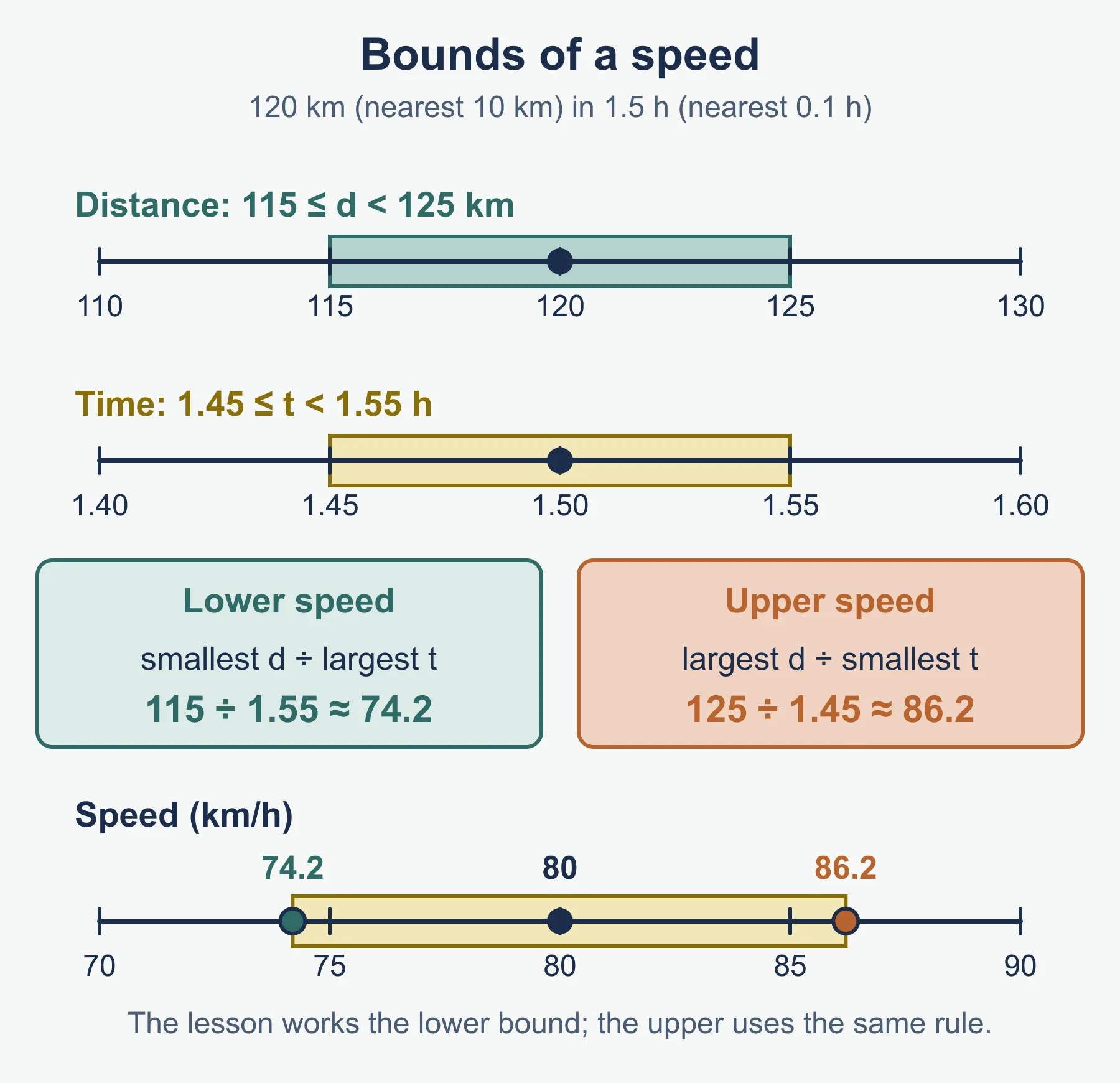
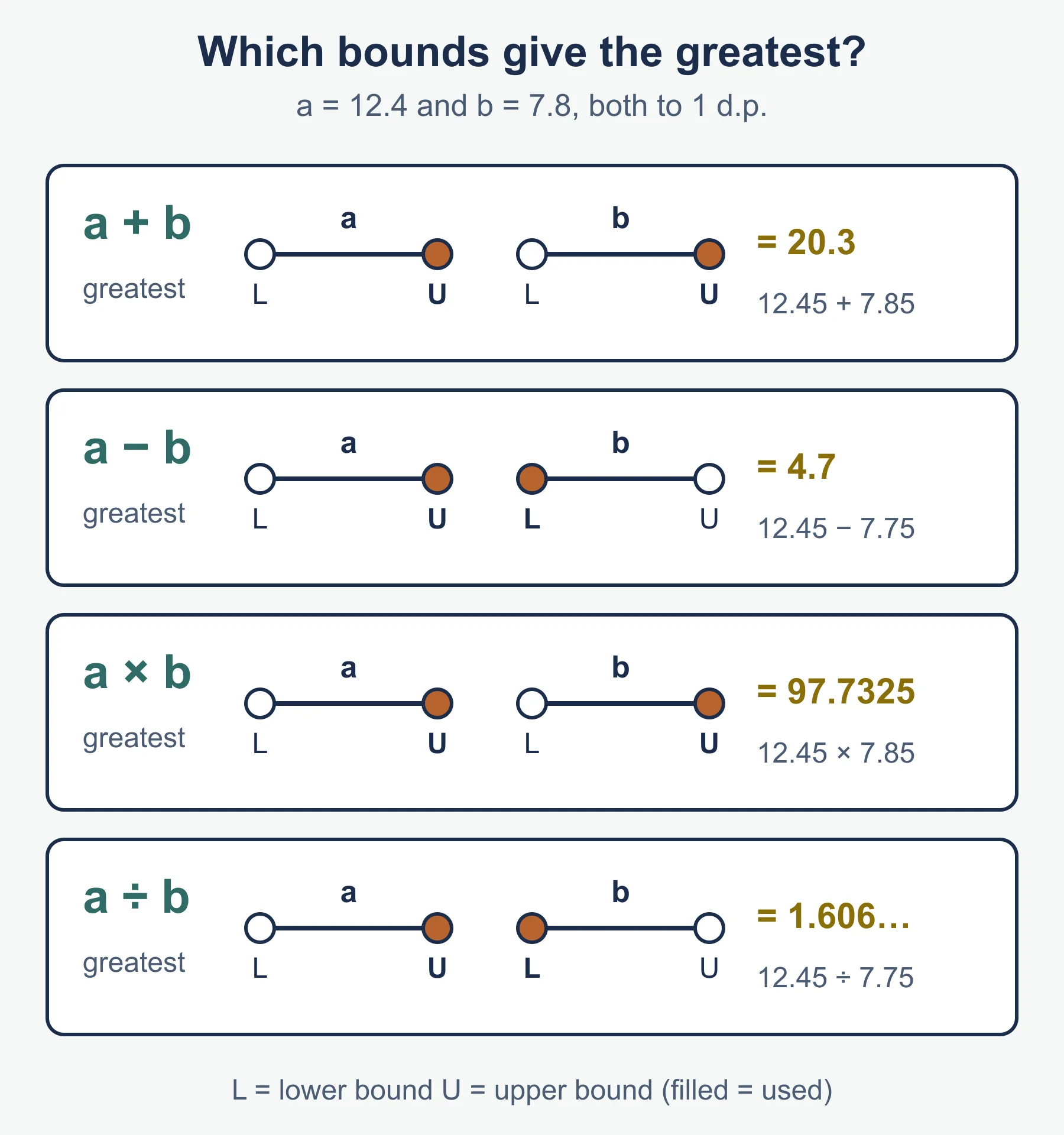
For a sum or product, use the upper values together for the upper bound. For a difference or quotient a − b or a ÷ b, the upper bound uses upper a with lower b, and the lower bound uses lower a with upper b.
Worked example. A rectangle measures 12 cm by 7 cm, each to the nearest cm. Bounds are 11.5 to 12.5 and 6.5 to 7.5. Upper perimeter = 2(12.5 + 7.5) = 40 cm. Upper area = 12.5 × 7.5 = 93.75 cm². Lower area = 11.5 × 6.5 = 74.75 cm².
Worked example. A distance of 120 km is given to the nearest 10 km and the time is 1.5 h to the nearest 0.1 h. Lower bound of speed = 115 ÷ 1.55 = 74.19…, so 74.2 km/h to 3 significant figures.
1.11 Ratio and proportion
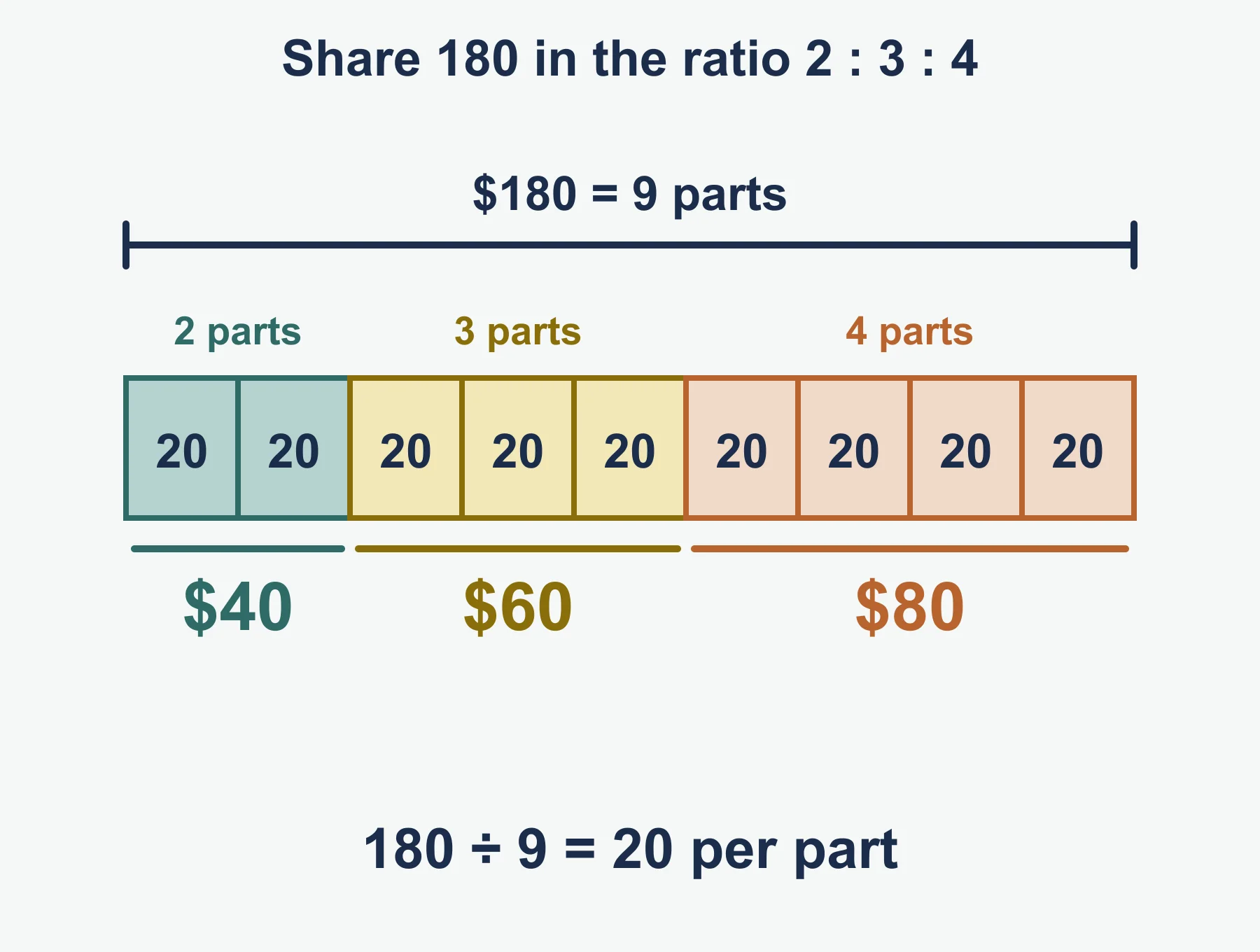
Simplify a ratio by dividing every part by a common factor, after putting them in the same units. To divide a quantity, add the parts, find one part, then multiply.
Worked example. A and B are in the ratio 3 : 5 and B has 24 more than A. Two parts equal 24, so one part is 12. A = 36, B = 60.
Direct proportion: a recipe for 6 uses 450 g of flour, so 10 portions need 450 ÷ 6 × 10 = 750 g. For best value, compare cost per 100 ml: 2.10 dollars for 750 ml is 28 cents, 3.12 dollars for 1.2 litres is 26 cents, so the larger bottle is better value.
1.12 Rates
Rates include pay per hour, exchange rates, flow rate, fuel consumption, pressure, density and population density. The syllabus says required formulas will be given in the question, but you must know speed = distance ÷ time. Write units as m/s or g/cm³.
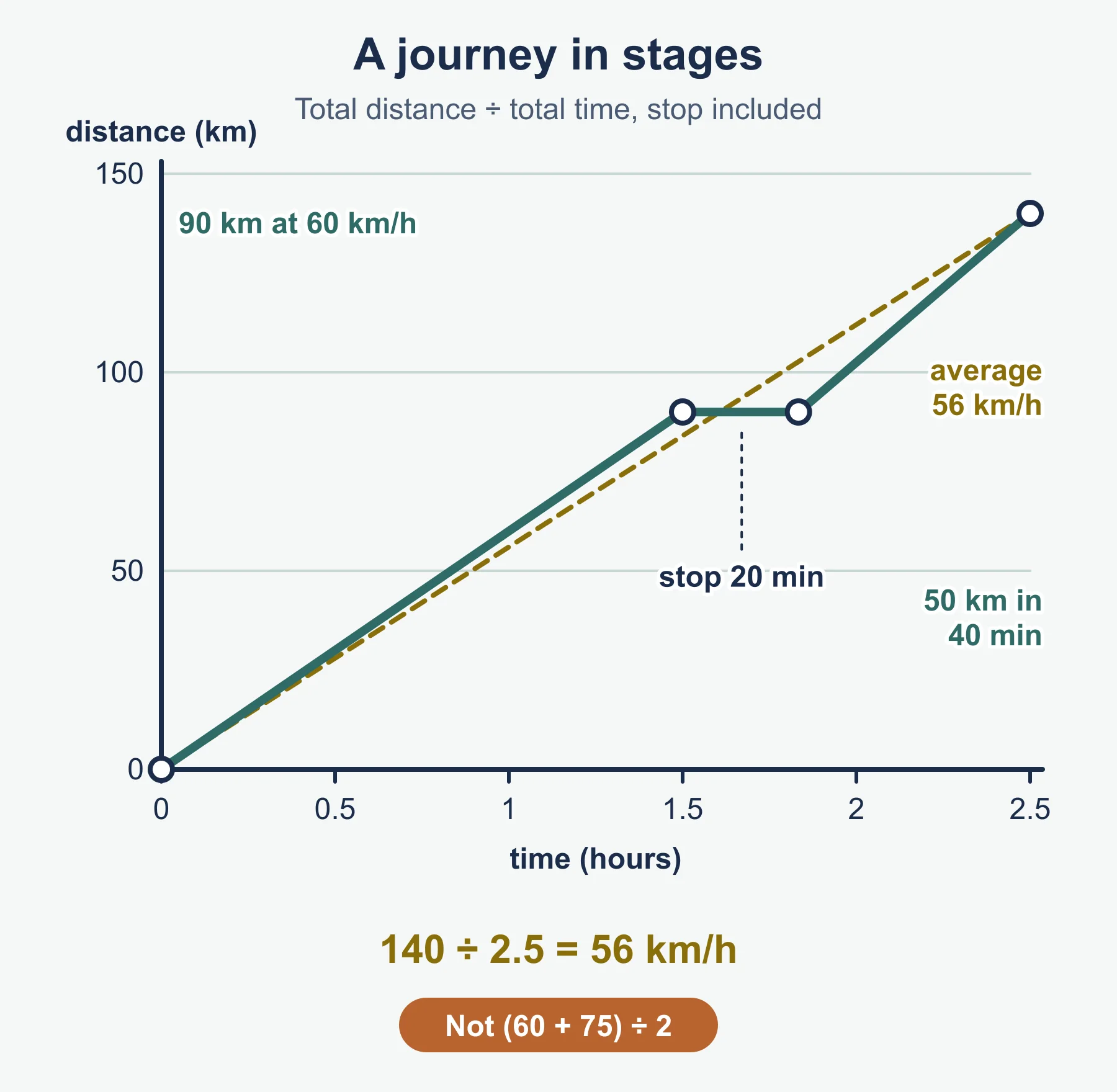
Worked example. (Average speed.) A car travels 60 km at 80 km/h, then 90 km at 60 km/h. Times: 0.75 h and 1.5 h. Average speed = total distance ÷ total time = 150 ÷ 2.25 = 66.7 km/h. It is not the mean of 80 and 60.
1.13 Percentages and 1.17 Exponential growth and decay
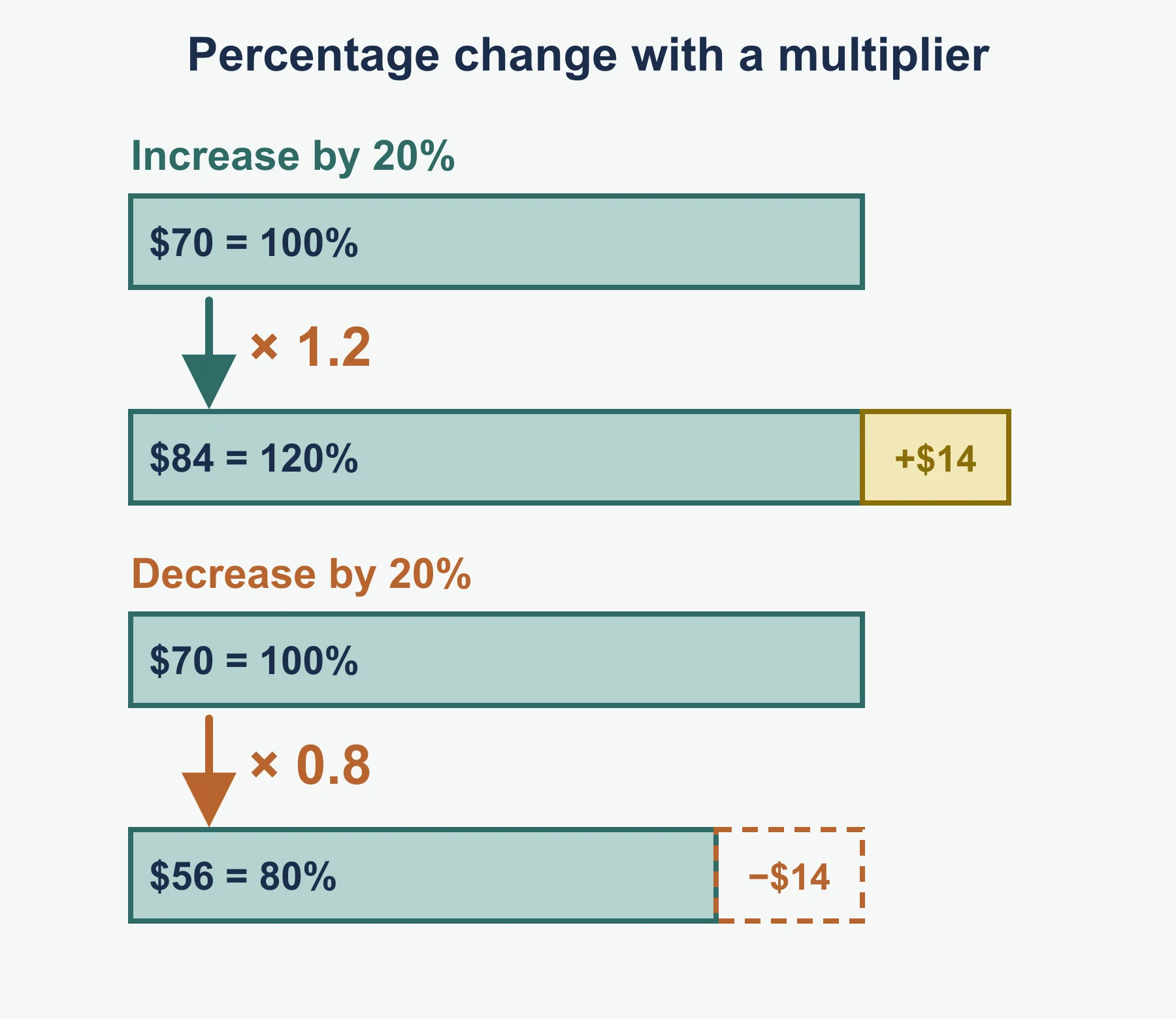
Percentage change = (change ÷ original) × 100. A price rising from 80 dollars to 98 dollars is a 22.5% increase. A value that is 135% of the original is an increase of 35%.
Simple interest is the same each year: 5000 dollars at 3.5% for 4 years gives 5000 × 0.035 × 4 = 700 dollars. Compound interest uses a repeated multiplier, here 1.035⁴, so the amount is 5737.62 dollars and the interest is 737.62 dollars. The syllabus says formulas are not given, so learn both.
Reverse percentages: divide by the multiplier. A selling price of 1092 dollars after a 30% profit means 1092 ÷ 1.3 = 840 dollars cost price.
Exponential change uses the same idea: amount = start × multiplier^n. A car worth 18 000 dollars depreciating 12% a year is worth 18 000 × 0.88⁵ = 9499.17 dollars after 5 years. A 40 mg dose decaying 15% an hour leaves 40 × 0.85⁶ = 15.1 mg after 6 hours. Knowledge of e is not required.
A 15% deposit on 2400 dollars is 360 dollars, leaving 2040 dollars, or 12 payments of 170 dollars.
1.14 Using a calculator
Keep full calculator values and round only the final answer. Enter 2 hours 30 minutes as 2.5, or with the degrees-minutes-seconds key. A money display of 4.8 means 4.80 in the currency, and a time display of 3.25 hours means 3 hours 15 minutes. So 150 km in 2 h 24 min is 150 ÷ 2.4 = 62.5 km/h, not 150 ÷ 2.24.
1.15 Time and 1.16 Money
Know seconds, minutes, hours, days, weeks, months and years; 1 year = 365 days. In the 24-hour clock 3.15 a.m. is 03 15 and 3.15 p.m. is 15 15. For time zones, add the flight time, then the time difference.
Worked example. A flight leaves at 22 40 local time and lasts 9 h 35 min. The destination is 5 hours ahead. Departure-zone arrival is 22 40 + 9 35 = 08 15 next day. Local arrival is 13 15.
For currency, multiply or divide by the quoted rate. If 1 euro = 1.25 dollars, then 600 euros = 750 dollars and 750 dollars = 600 euros. If you later sell 450 euros back at 1 euro = 1.20 dollars, you receive 450 × 1.2 = 540 dollars.
1.18 Surds
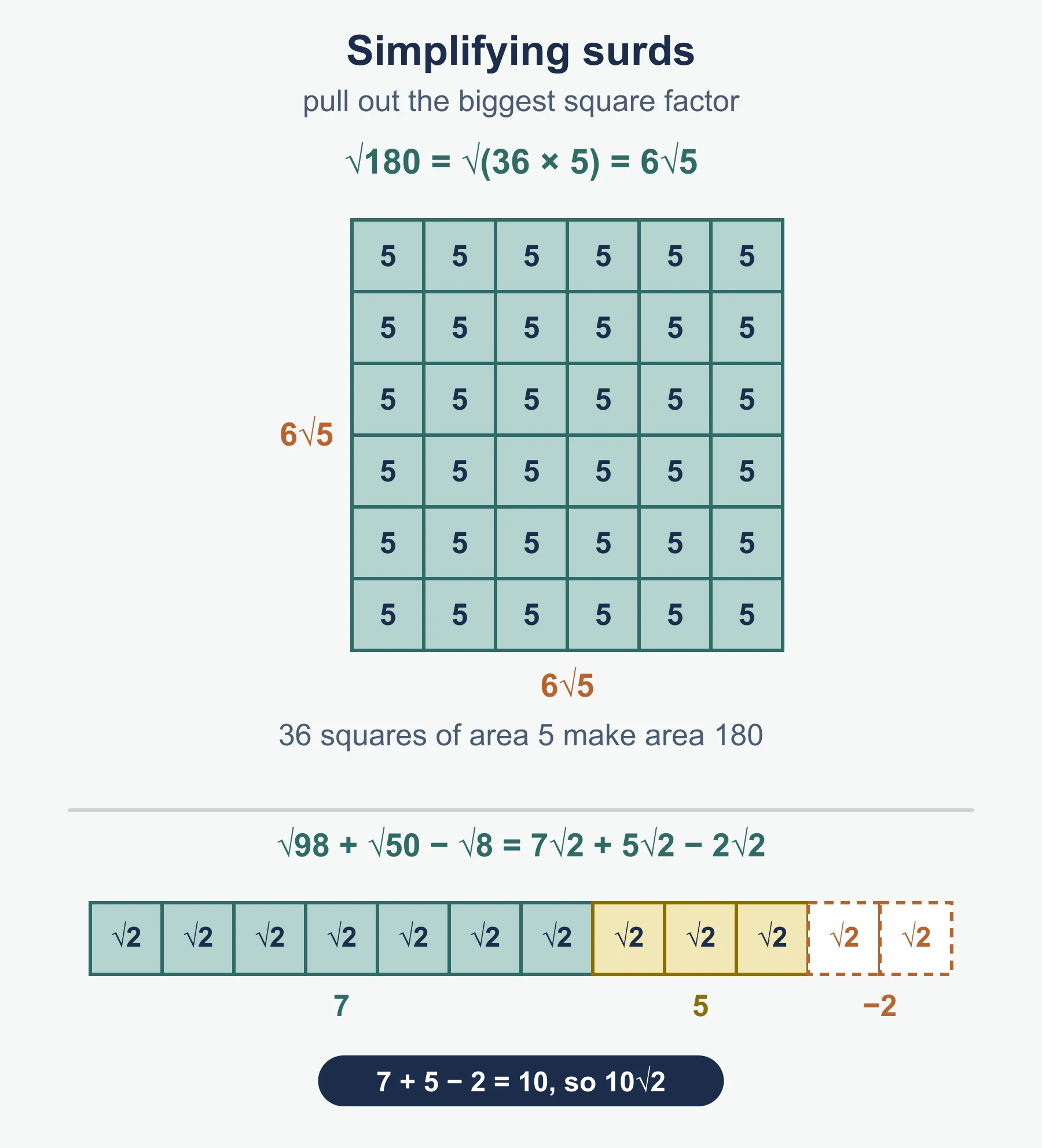
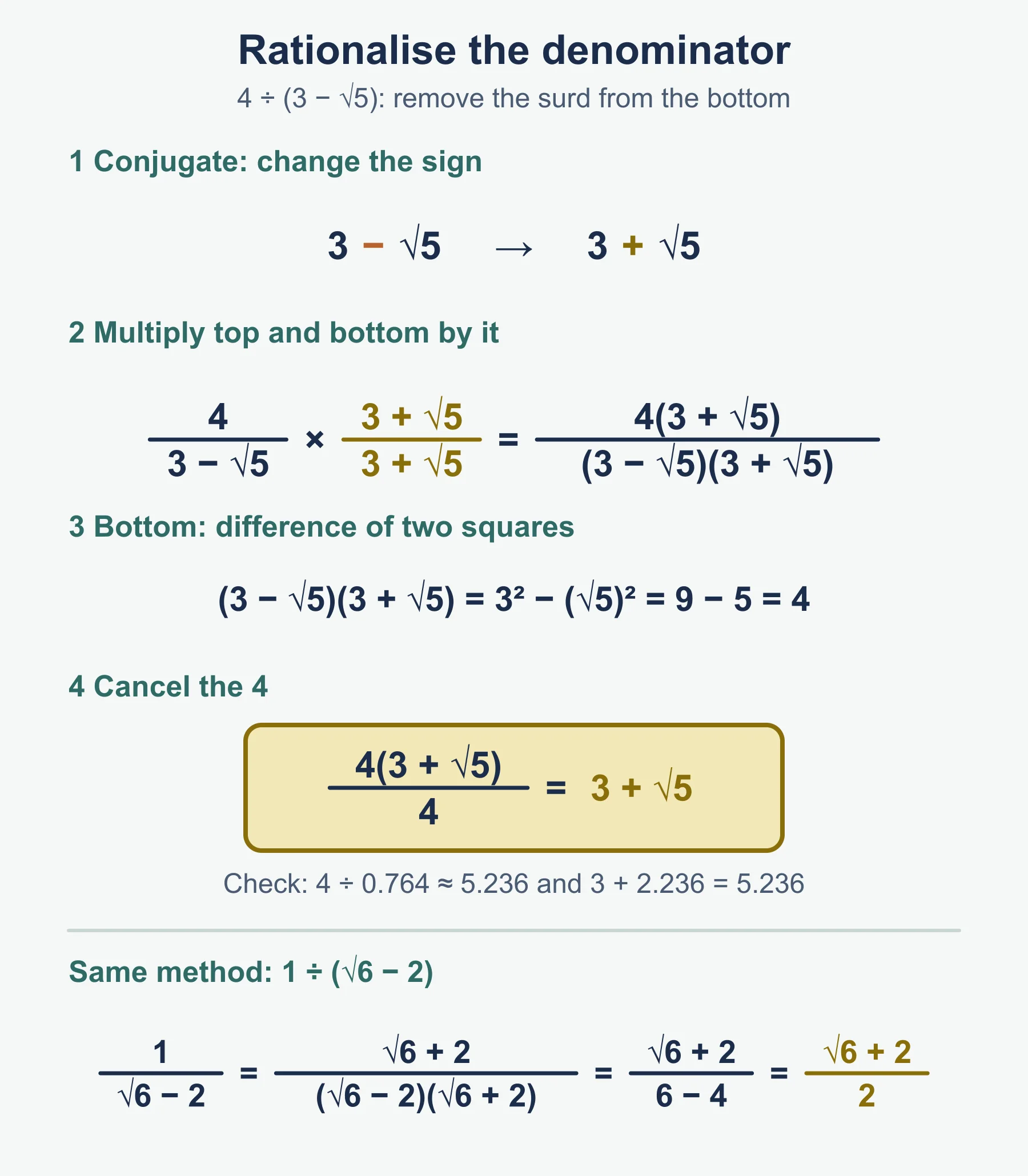
A surd is an irrational root such as √5. Simplify using the largest square factor: √180 = √(36 × 5) = 6√5. Rationalising removes the surd from the denominator: multiply top and bottom by the conjugate (the same terms with the sign between them changed).
Worked example. Simplify √98 + √50 − √8 = 7√2 + 5√2 − 2√2 = 10√2. Expand (5 + √2)(3 − √2) = 15 − 5√2 + 3√2 − 2 = 13 − 2√2. Rationalise 4/(3 − √5): multiply by (3 + √5)/(3 + √5) to get 4(3 + √5)/(9 − 5) = 3 + √5. Also 1/(√6 − 2) = (√6 + 2)/(6 − 4) = (√6 + 2)/2.
Common errors
- Writing the LCM when the HCF is asked, or using the highest power for the HCF.
- Reading 3.25 as 3 hours 25 minutes.
- Taking the mean of two speeds instead of total distance over total time.
Frequently asked questions
What does the Number topic cover in Cambridge O Level Mathematics 4024? Topic 1 runs from types of number and sets through powers and roots, fractions and percentages, indices, standard form, estimation, limits of accuracy, ratio, rates, calculator use, time, money, growth and decay, to surds.
How do you find average speed for a journey with two parts? Divide the total distance by the total time. Taking the mean of the two speeds gives the wrong answer.
How do you convert a recurring decimal to a fraction? Let x be the decimal, multiply by a power of 10 so the repeating part lines up, and subtract to remove it. For 0.6̇3̇, 100x − x = 63, so x = 63/99 = 7/11.
How do you handle time zones in Cambridge O Level Mathematics? Add the journey time to the departure time first, then add or subtract the time difference to get the local arrival time.
Is 3.25 hours the same as 3 hours 25 minutes? No. 0.25 of an hour is 15 minutes, so 3.25 hours is 3 hours 15 minutes. Reading it as 3 hours 25 minutes is a common error.
Official syllabus
Cambridge O Level Mathematics (Syllabus D) 4024, syllabus for examination in 2025, 2026 and 2027, published by Cambridge University Press & Assessment.
Get free revision emails (optional)
Occasional emails with practice questions, worked explanations and links to free resources for the qualification and subjects you choose. No spam, and you can unsubscribe from any email. The free tools on this site never need an email.
Related resources
-
Practice questions
O Level Mathematics: Number Practice Questions (Cambridge 4024)
Original Cambridge O Level Mathematics 4024 number questions on prime factors, HCF and LCM, percentages, ratio, surds, bounds and standard form, with answers.
Mathematics · Cambridge · O Level
Try questions -
Revision notes
Cambridge O Level Mathematics: Number (4024) – Revision Notes
Condensed revision notes for all of Number in Cambridge O Level Mathematics 4024: key methods, distinctions, a quick self-test and common lost marks.
Mathematics · Cambridge · O Level
Revise topic -
Study guides
Cambridge O Level Mathematics: Probability (4024)
Study guide to every Probability outcome in Cambridge O Level Mathematics 4024: the scale, relative frequency, expected frequency, Venn and tree diagrams.
Mathematics · Cambridge · O Level
Read guide
Related articles
-
exam preparation
Where IGCSE Mathematics marks are lost early
The first weeks of an IGCSE Mathematics course rarely go wrong on difficulty. They go wrong on method, command words, rounding and units — four habits that cost marks a student had already earned.
24 August 2026
-
teaching
A Level tuition in Dubai: Cambridge or Pearson Edexcel International A Level?
Schools in Dubai and Abu Dhabi teach either Cambridge International AS & A Level or Pearson Edexcel International A Level. How the two are structured, why it matters for tuition, and how online classes from Lahore work.
9 October 2026
Studying this with a teacher
Working through Mathematics O LEVELS?
This page is free and stays free. If you would rather be taught it, Marlbridge runs Mathematics classes one-to-one and in small groups of up to 15, online in your own time zone. The first trial class is free. WhatsApp replies within an hour (8am–11pm Pakistan time, every day); email the same day.
Cambridge Mathematics teachers at Marlbridge


