
Revision Notes
Cambridge O Level Mathematics: Trigonometry (4024) – Revision Notes
Condensed Cambridge O Level Mathematics revision notes on Pythagoras, sine, cosine and tangent, the sine and cosine rules, bearings and 3D trigonometry.
- Subject
- Mathematics
- Level
- O LEVELS
- Topic
- Trigonometry
- Author
- Marlbridge Academic Team
- Updated
- Reviewed by
- Sajawal Zahid (what this means)
Aligned to Cambridge O Level Mathematics (4024), 2025-2027. Official specification .
Syllabus page (what it covers and how it is assessed): Cambridge O Level Mathematics.
Syllabus points this page covers
4024
- 6 Trigonometry (whole topic)
Found an error? Report a correction.
Need help with this topic? Request a free trial class for O Level Mathematics (4024).
These notes condense topic 6, Trigonometry, from the Cambridge O Level Mathematics (Syllabus D) 4024 syllabus for 2025, 2026 and 2027, sections 6.1 to 6.4. The syllabus has no tiers, so everything here is for every candidate. For full explanations and longer worked examples, read the study guide. For testing, use the existing practice questions.
Related pages: the course hub, the checklist and the free diagnostics.
Assessment reminders
- Paper 1 is non-calculator and Paper 2 is a calculator paper, both written, 2 hours, 100 marks.
- Paper 2 asks for non-exact answers to 3 significant figures and angles in degrees to 1 decimal place, unless the question says otherwise.
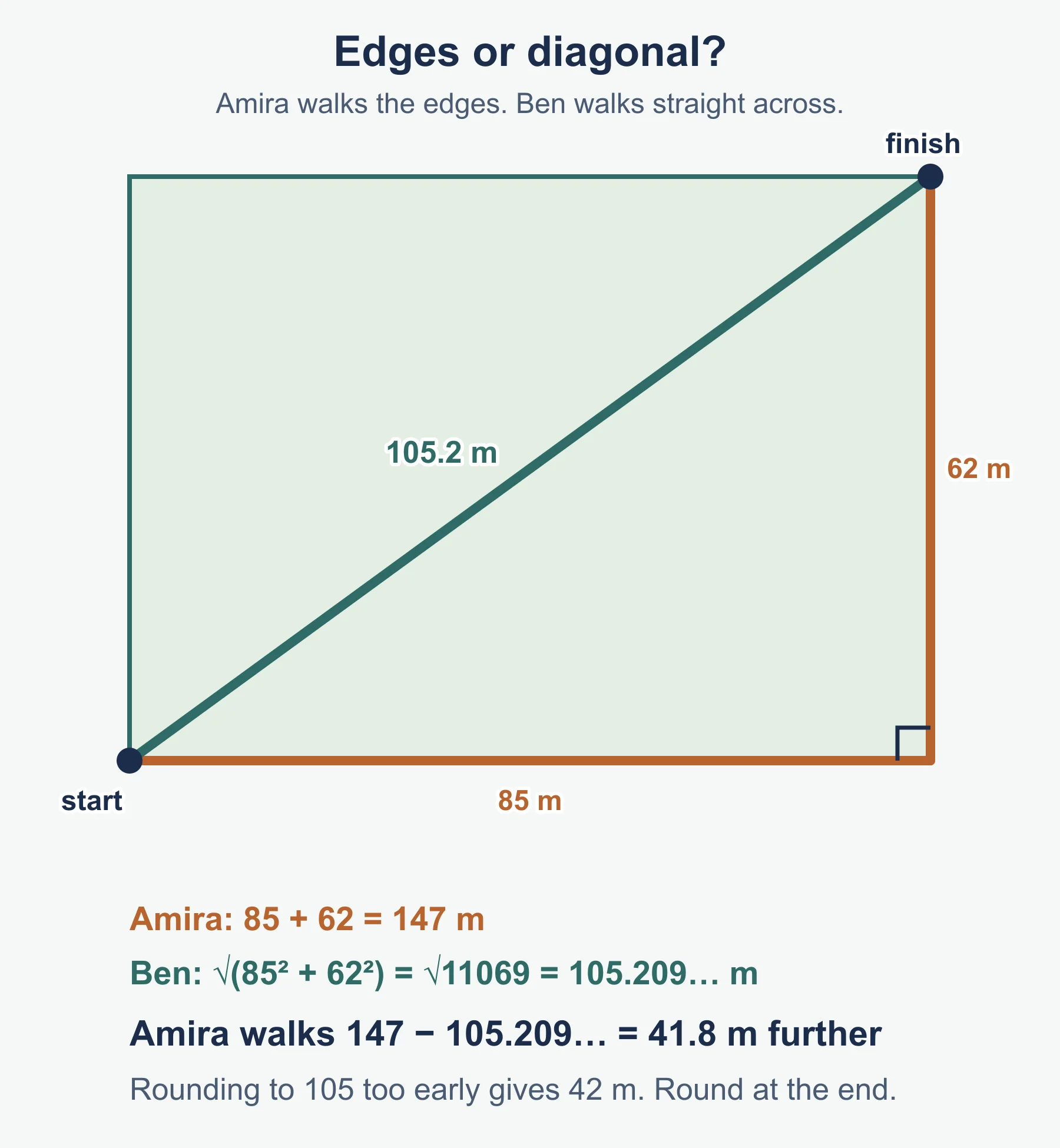
- The syllabus advises avoiding rounding until the final answer, and using the unrounded value if a later part needs it.
- The sine rule, cosine rule and area formula are in the List of formulas. You still need to know when to use each.
6.1 Pythagoras’ theorem
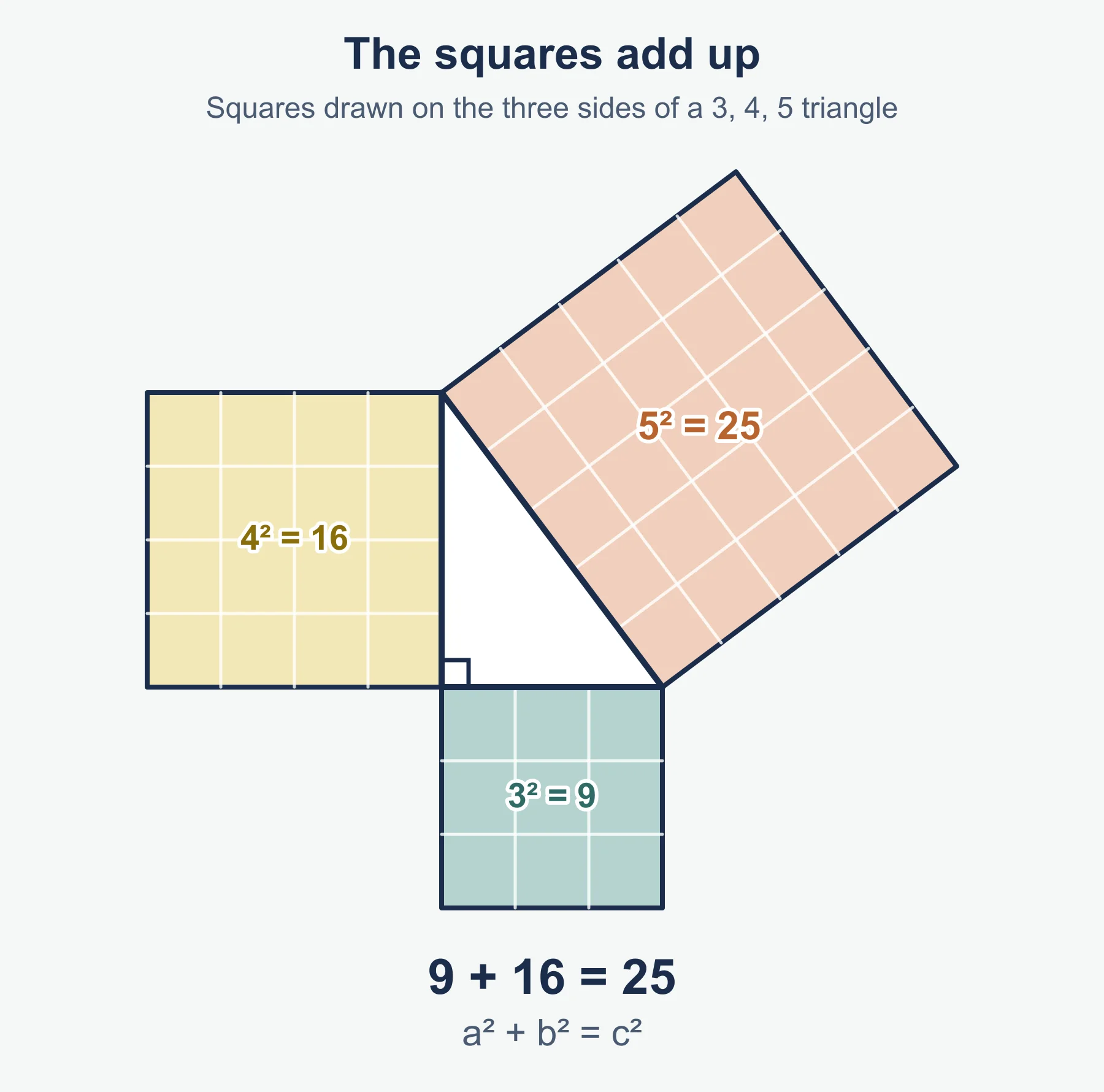
| Find | Formula |
|---|---|
| Hypotenuse c | c = √(a² + b²) |
| A shorter side a | a = √(c² - b²) |
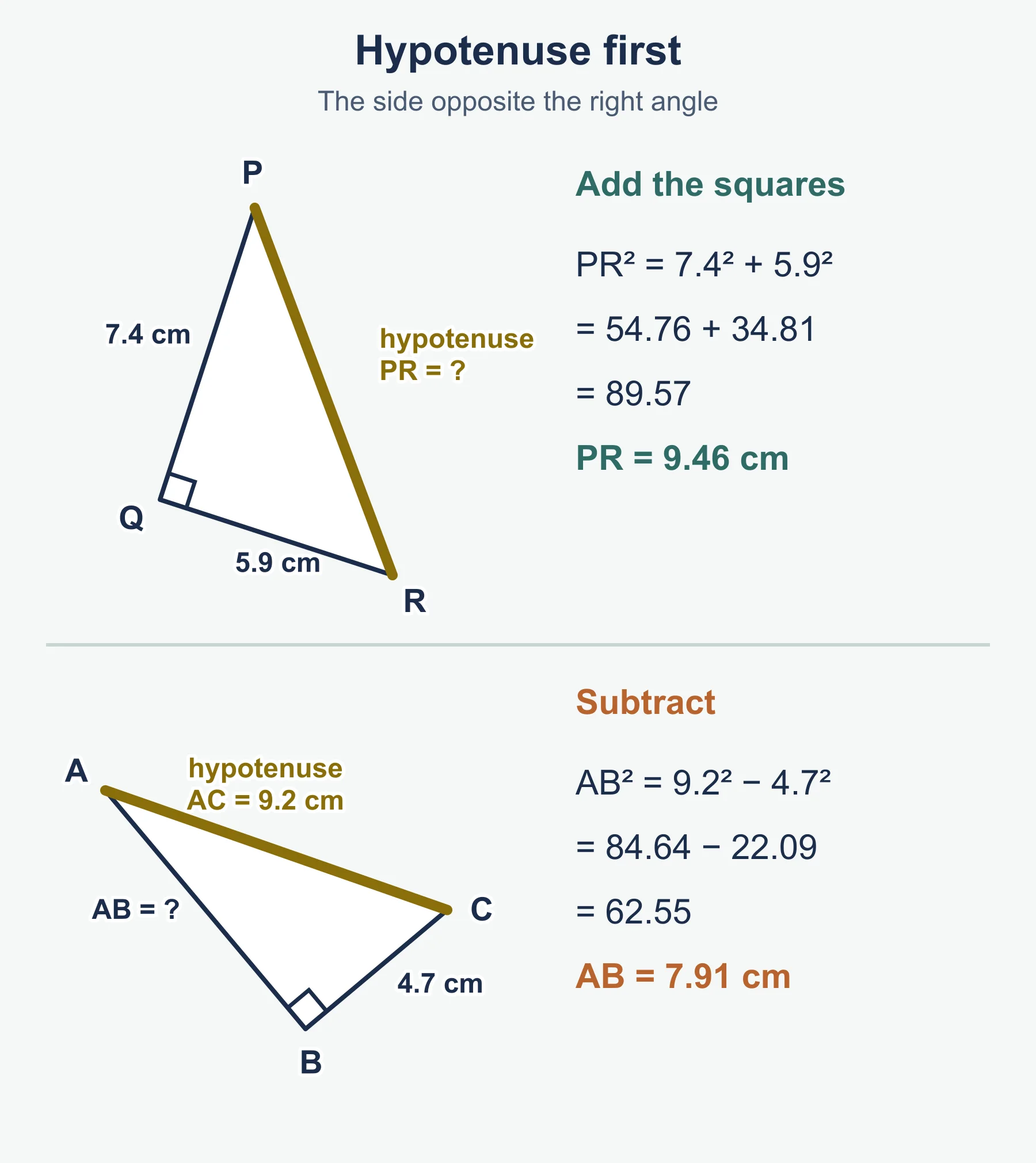
Method in steps:
- Identify the hypotenuse, the side opposite the right angle.
- Add the squares if you want the hypotenuse, subtract if you want a shorter side.
- Square root, then check the hypotenuse is the longest side.
Reminder: 9, 12, 15 and 5, 12, 13 are right-angled triangles. Spotting such sets saves time on Paper 1.
6.2 Right-angled triangles
| Ratio | Formula | Use when you have |
|---|---|---|
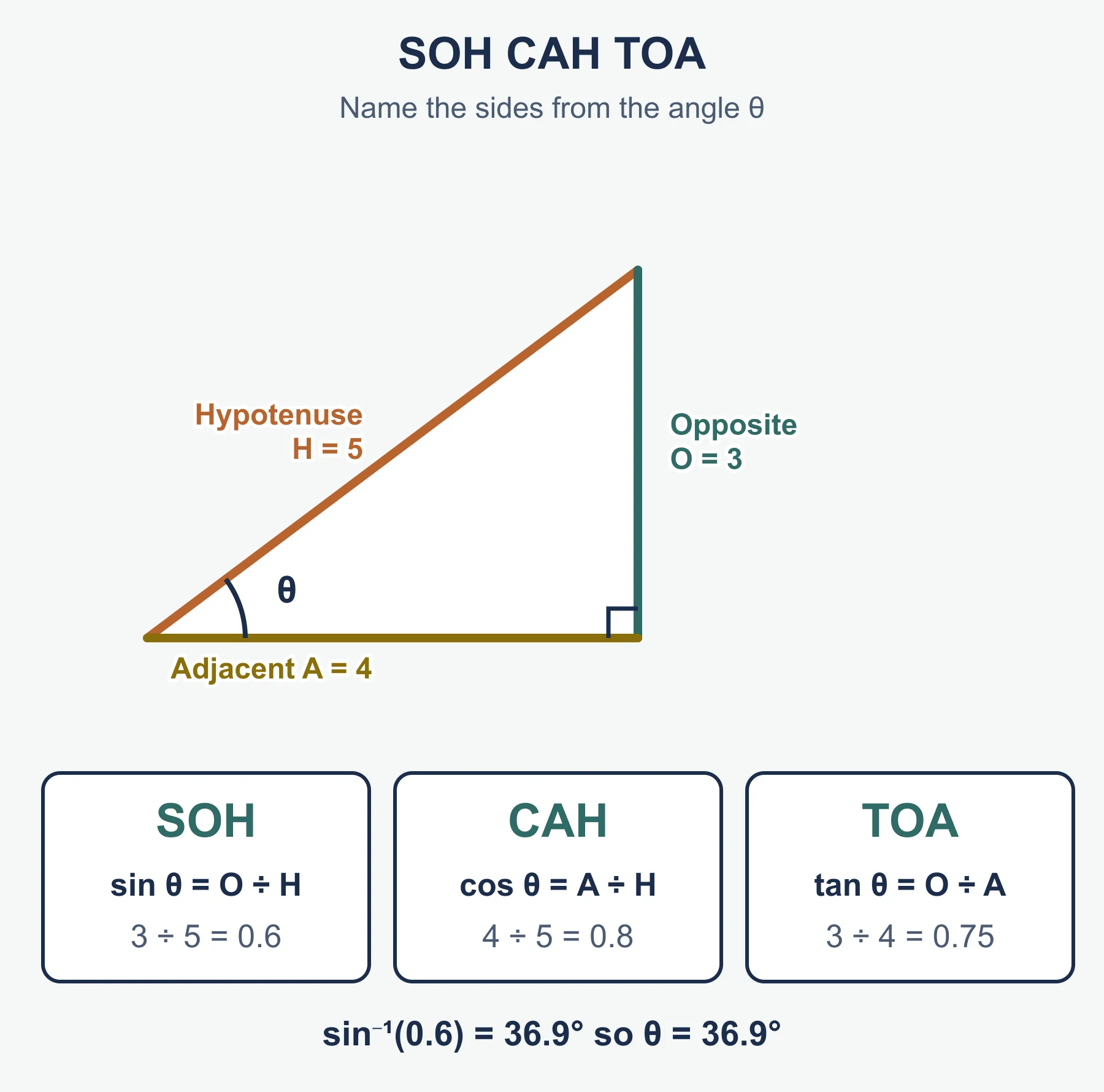
| sin θ | opposite / hypotenuse | opposite and hypotenuse |
| cos θ | adjacent / hypotenuse | adjacent and hypotenuse |
| tan θ | opposite / adjacent | opposite and adjacent |
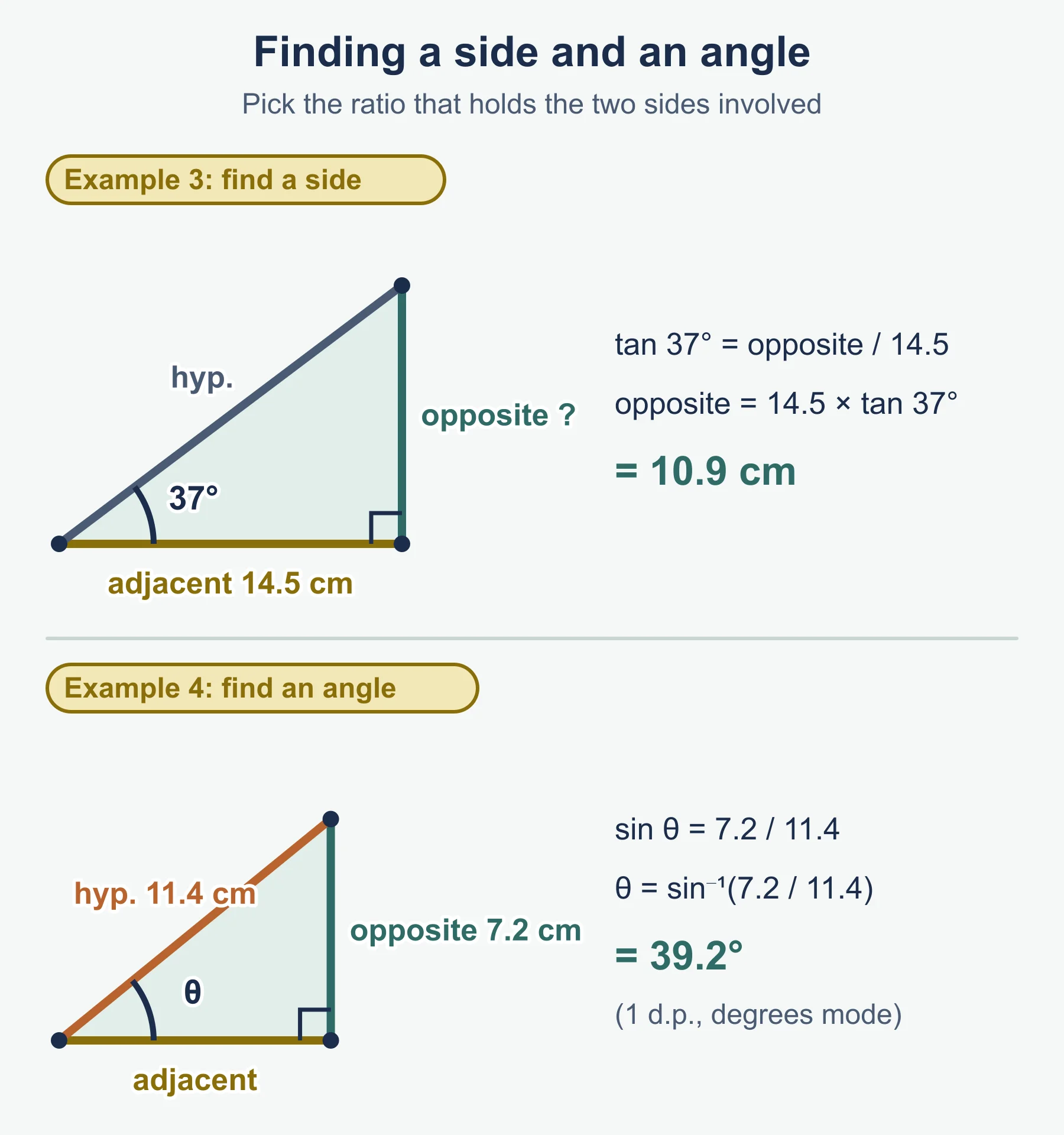
Method for a side:
- Label the sides from the angle you are using.
- Pick the ratio containing the known side and the wanted side.
- Write the equation and rearrange. If the unknown is on the bottom, swap it with the answer: x = 8 / sin 30° rather than dividing wrongly.
Method for an angle:
- Choose the ratio from the two known sides.
- Use the inverse (sin⁻¹, cos⁻¹, tan⁻¹).
- Give degrees to 1 decimal place.
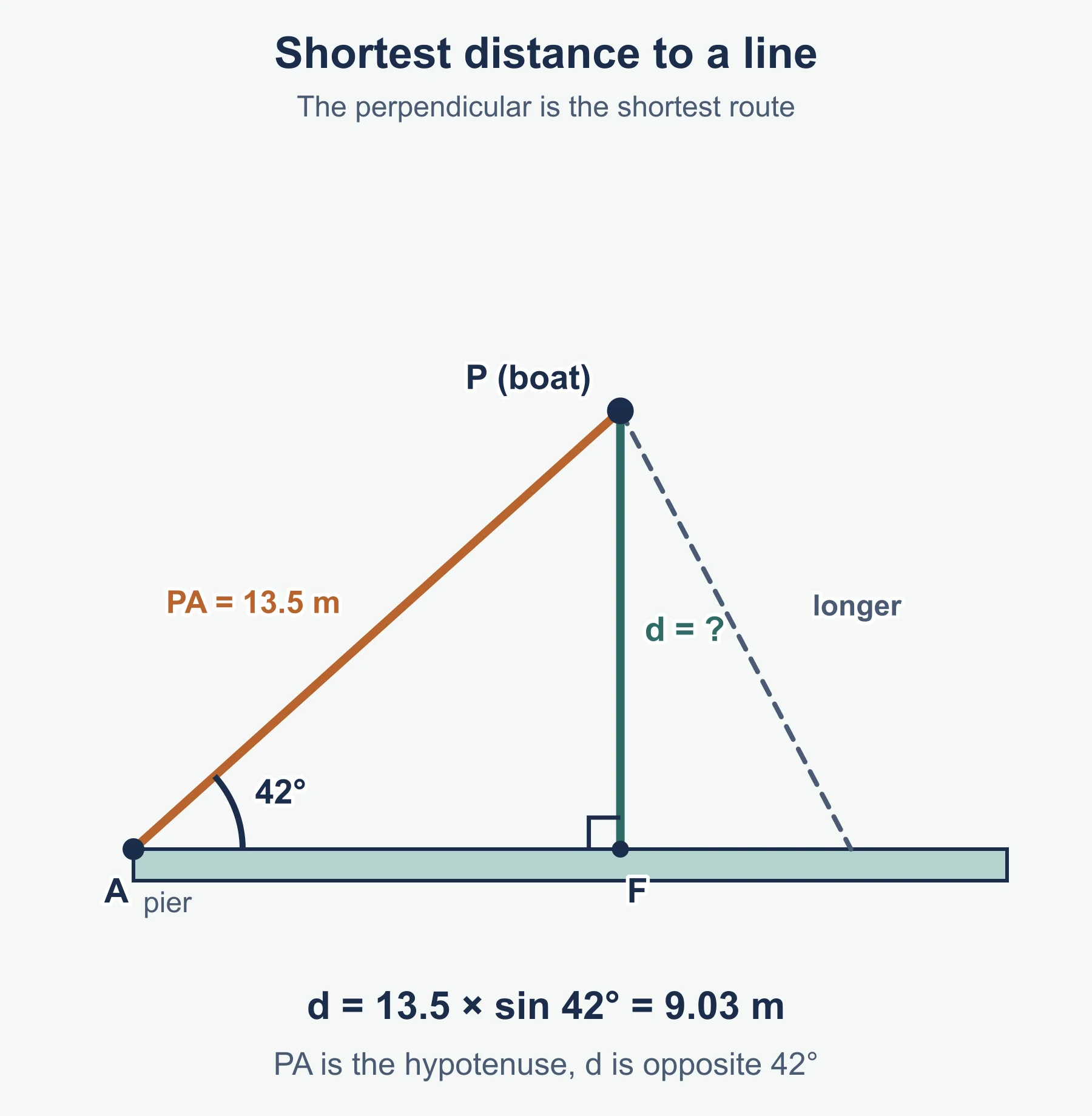
Shortest distance
The shortest distance from a point to a line is the perpendicular distance. Draw the perpendicular, then use a right-angled triangle.
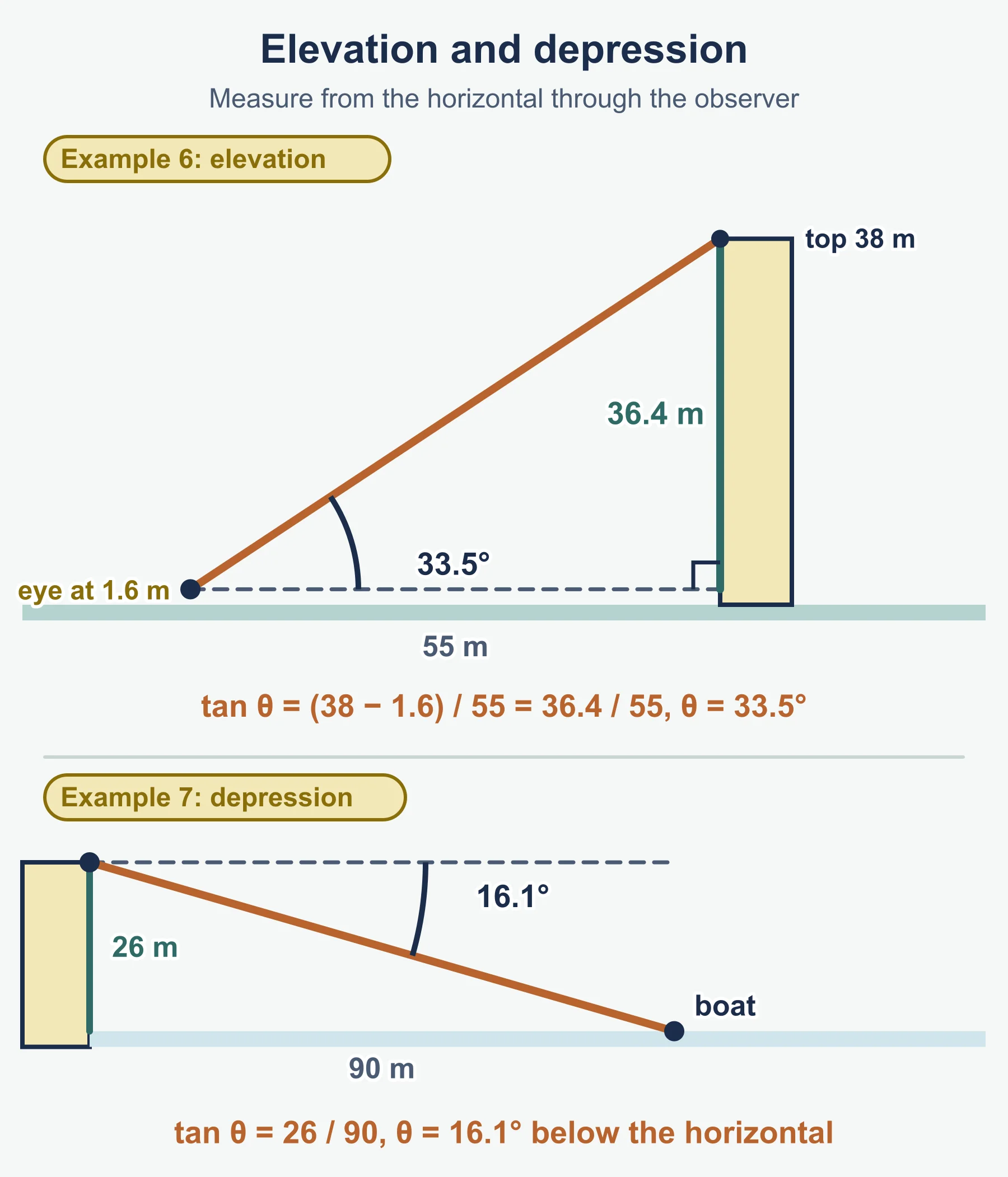
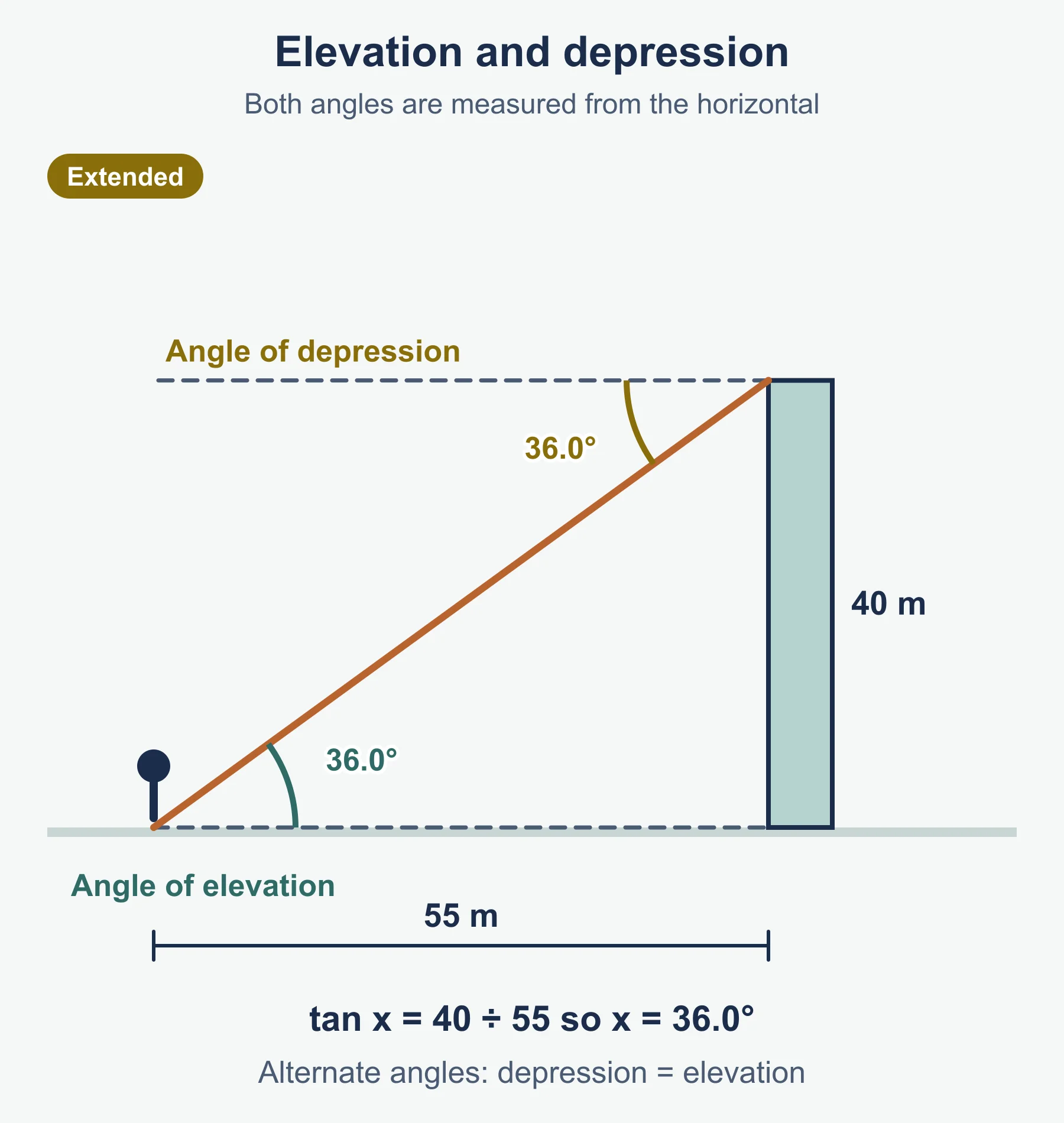
Elevation and depression
- Elevation: angle up from the horizontal to the line of sight.
- Depression: angle down from the horizontal to the line of sight.
- Alternate angles are equal, so the depression from A to B equals the elevation from B to A.
- Subtract eye height from the object’s height to get the vertical side.
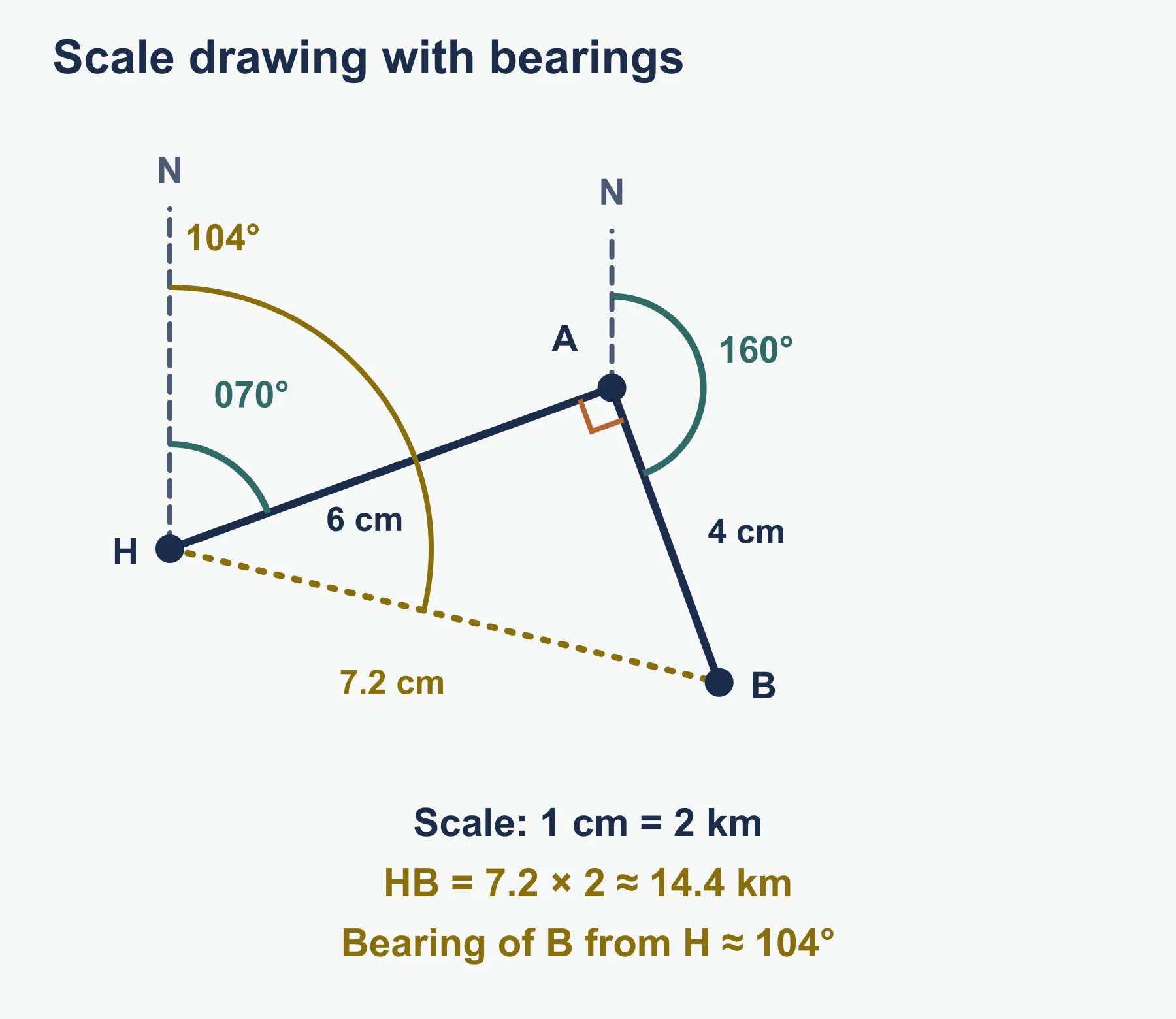
Bearings
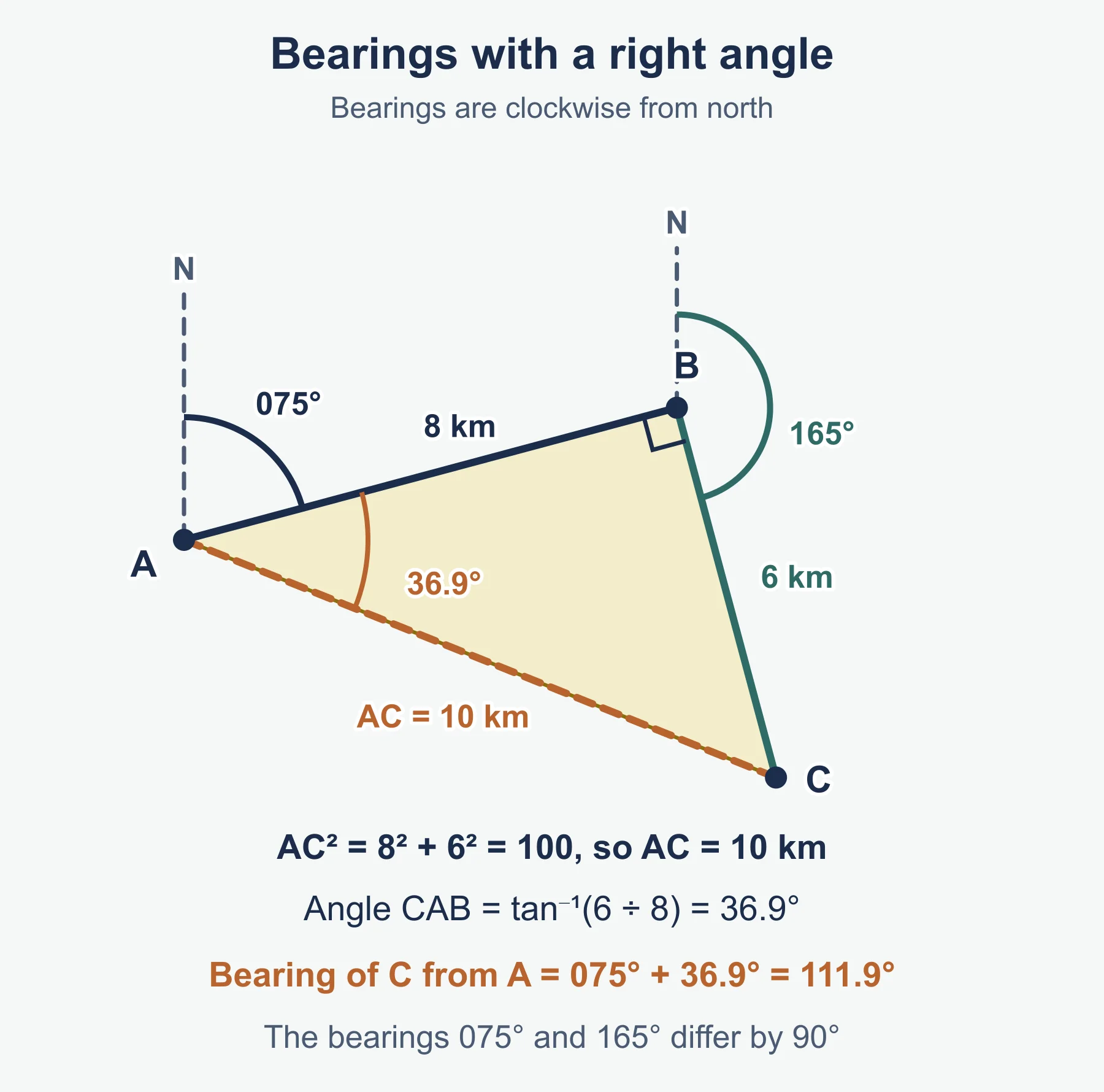
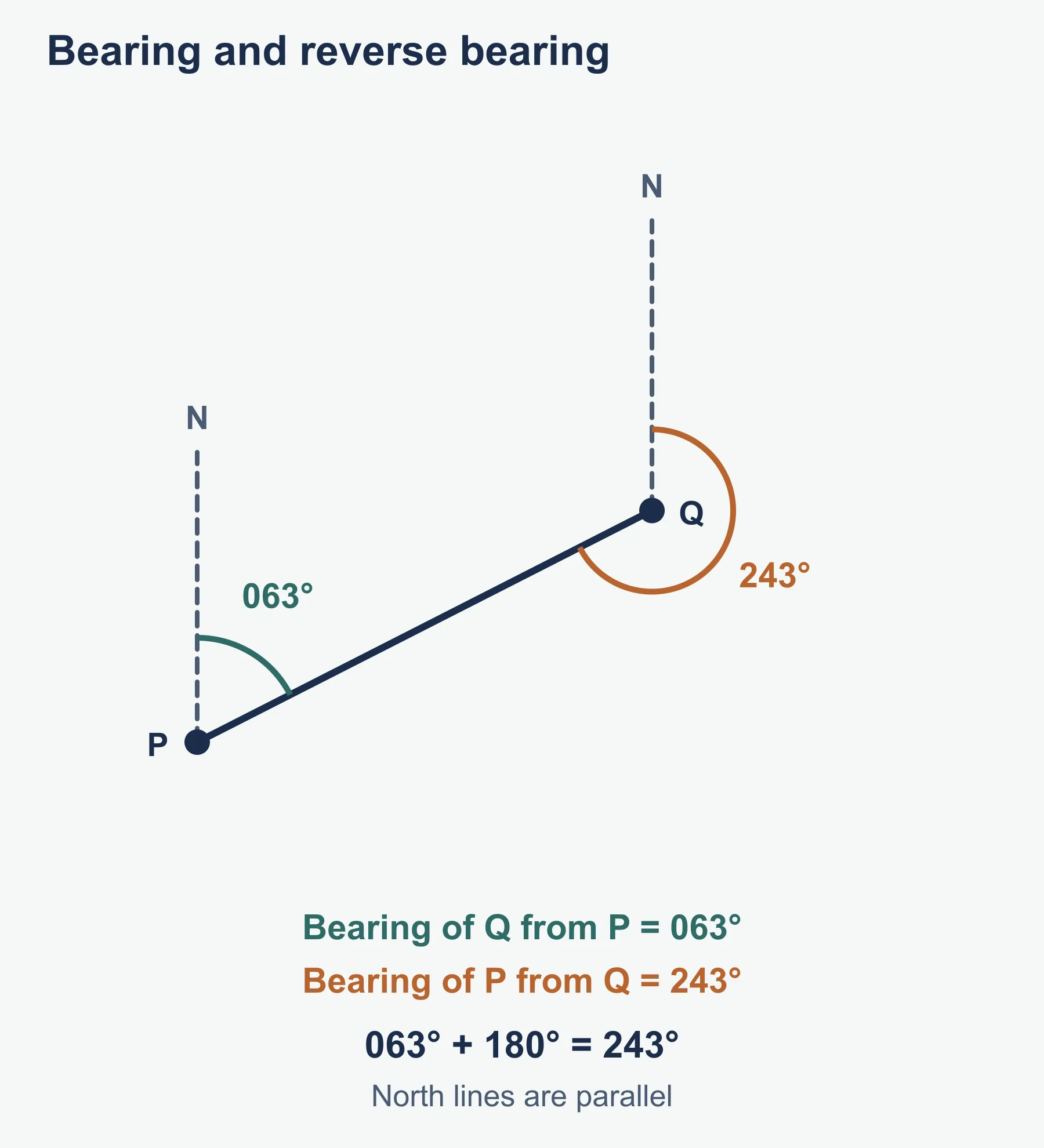
- Measured clockwise from north, with three figures: 040°, 305°.
- Back bearing: add 180° if the bearing is less than 180°, subtract 180° if it is 180° or more.
- Draw a north line at every point. Co-interior angles on parallel north lines add to 180°.
6.3 Non-right-angled triangles
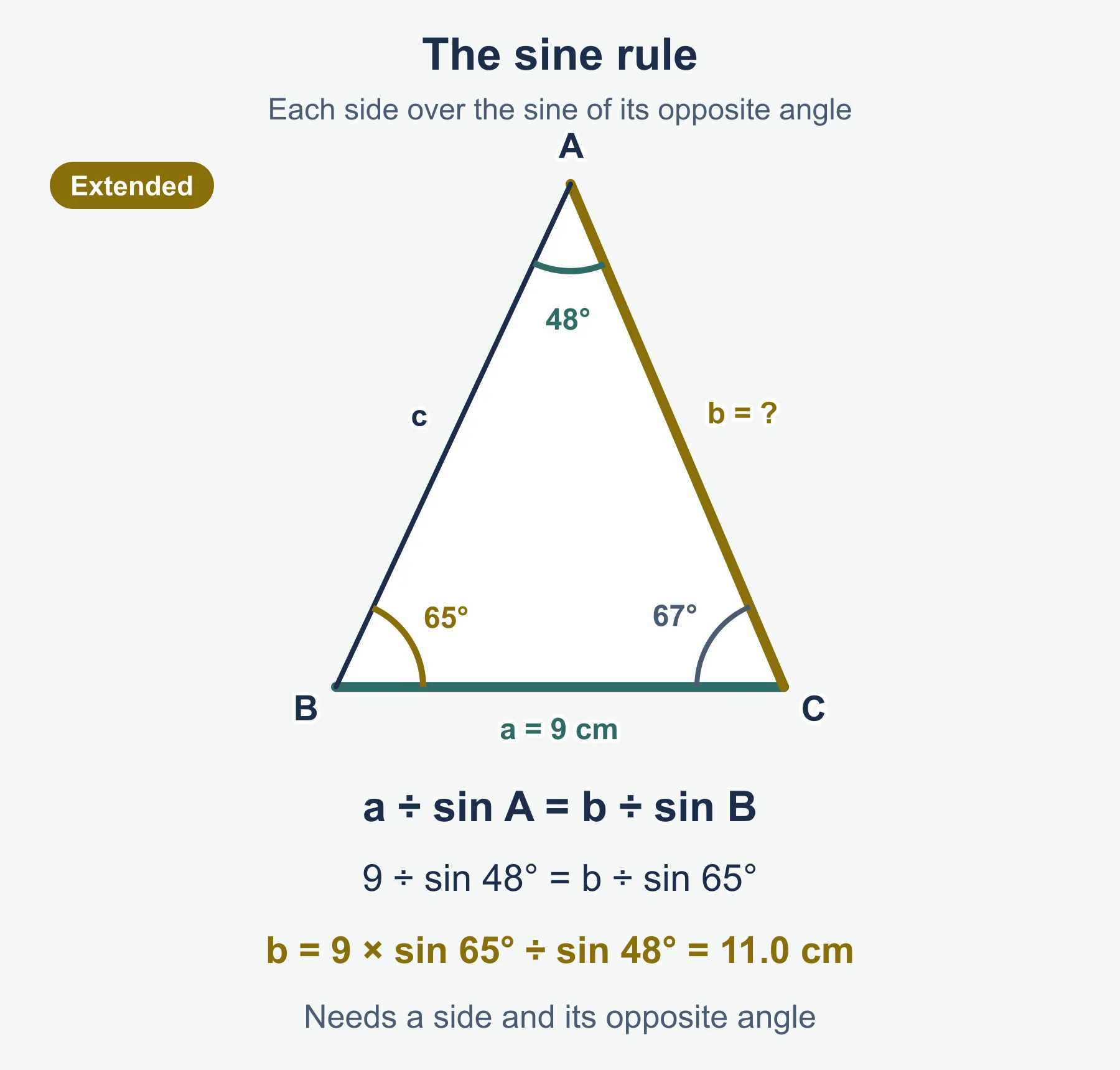
Label side a opposite angle A, and so on.
| Result | Formula |
|---|---|
| Sine rule (side) | a / sin A = b / sin B = c / sin C |
| Sine rule (angle) | sin A / a = sin B / b = sin C / c |
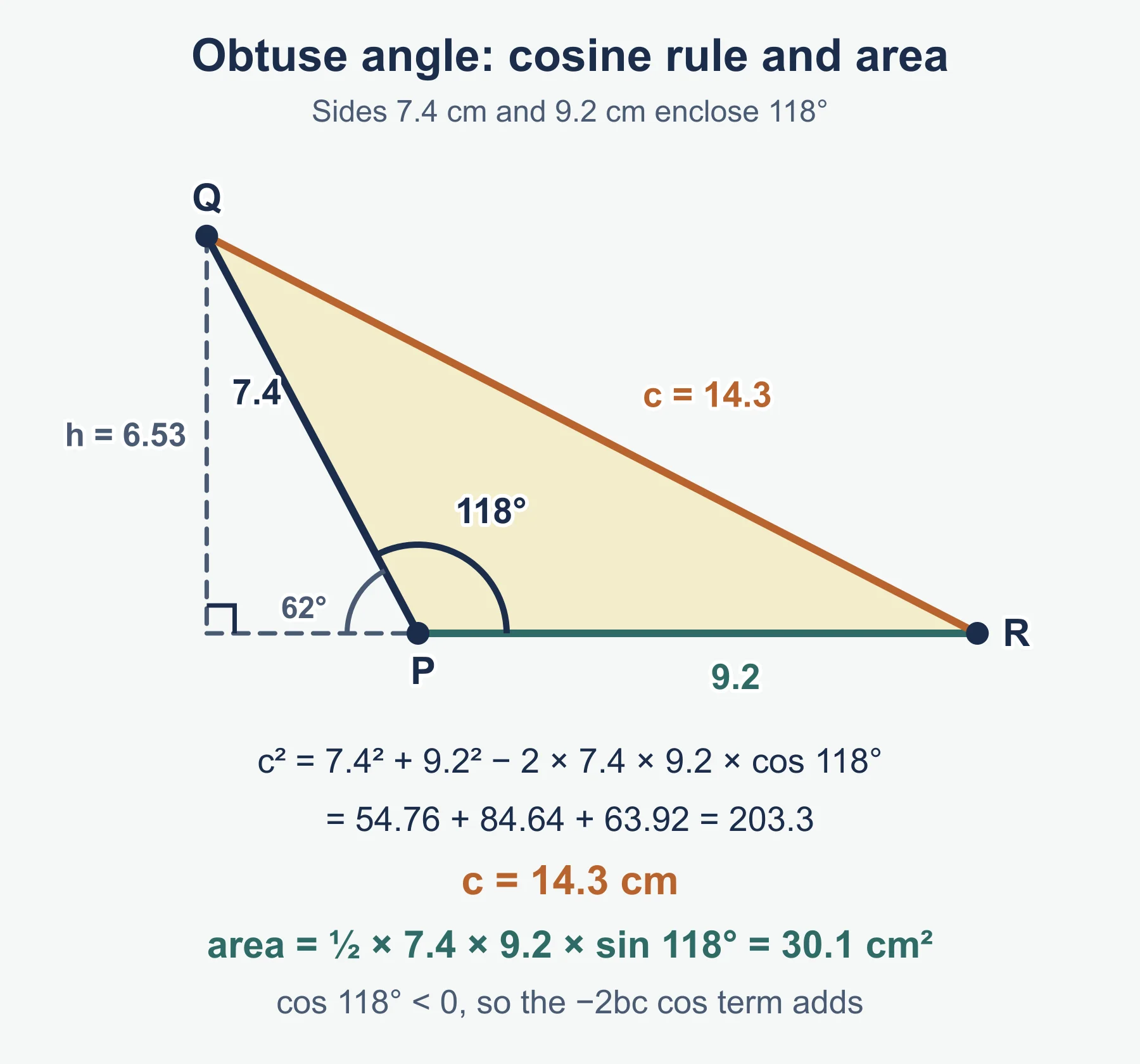
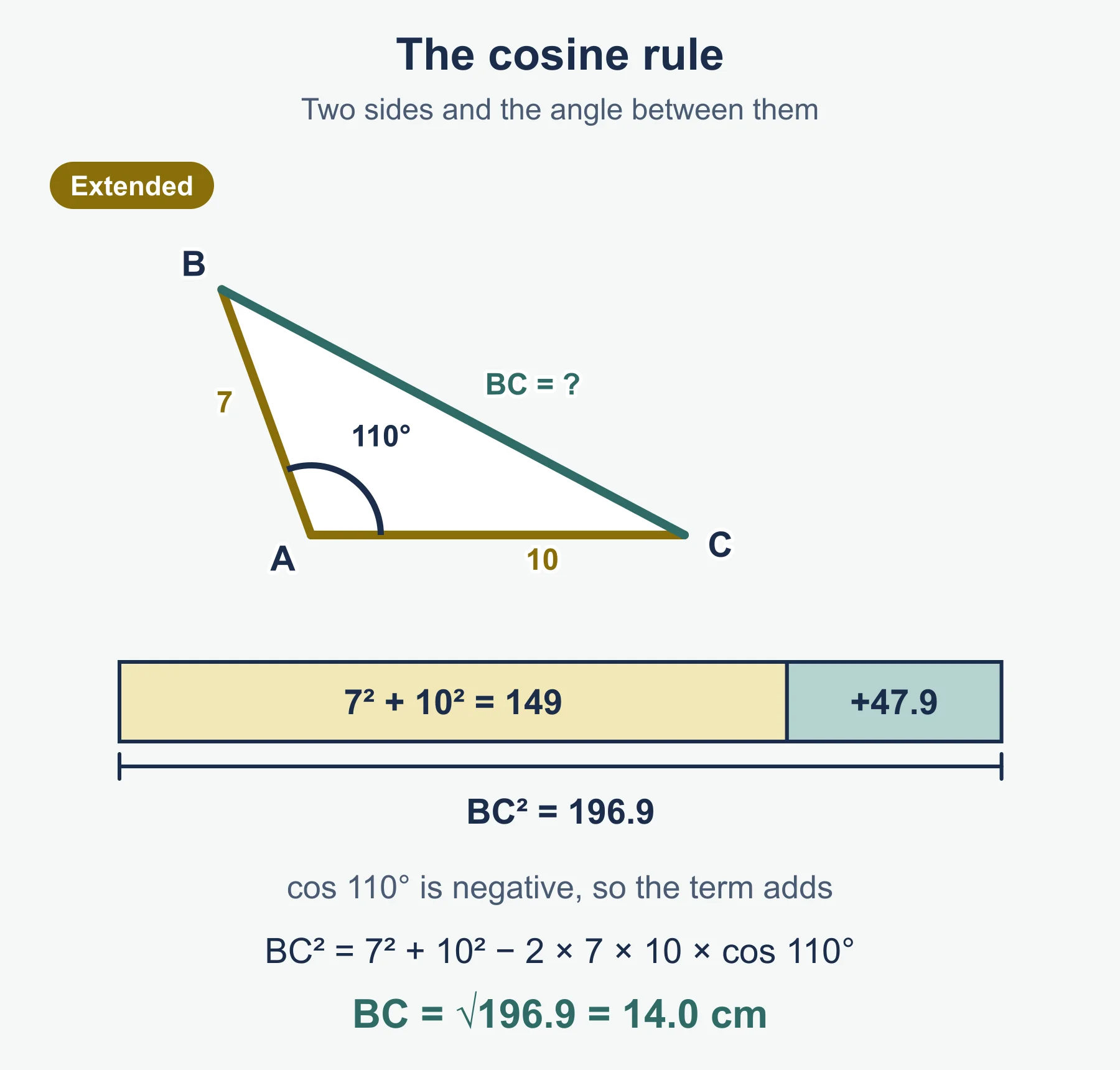
| Cosine rule (side) | a² = b² + c² - 2bc cos A |
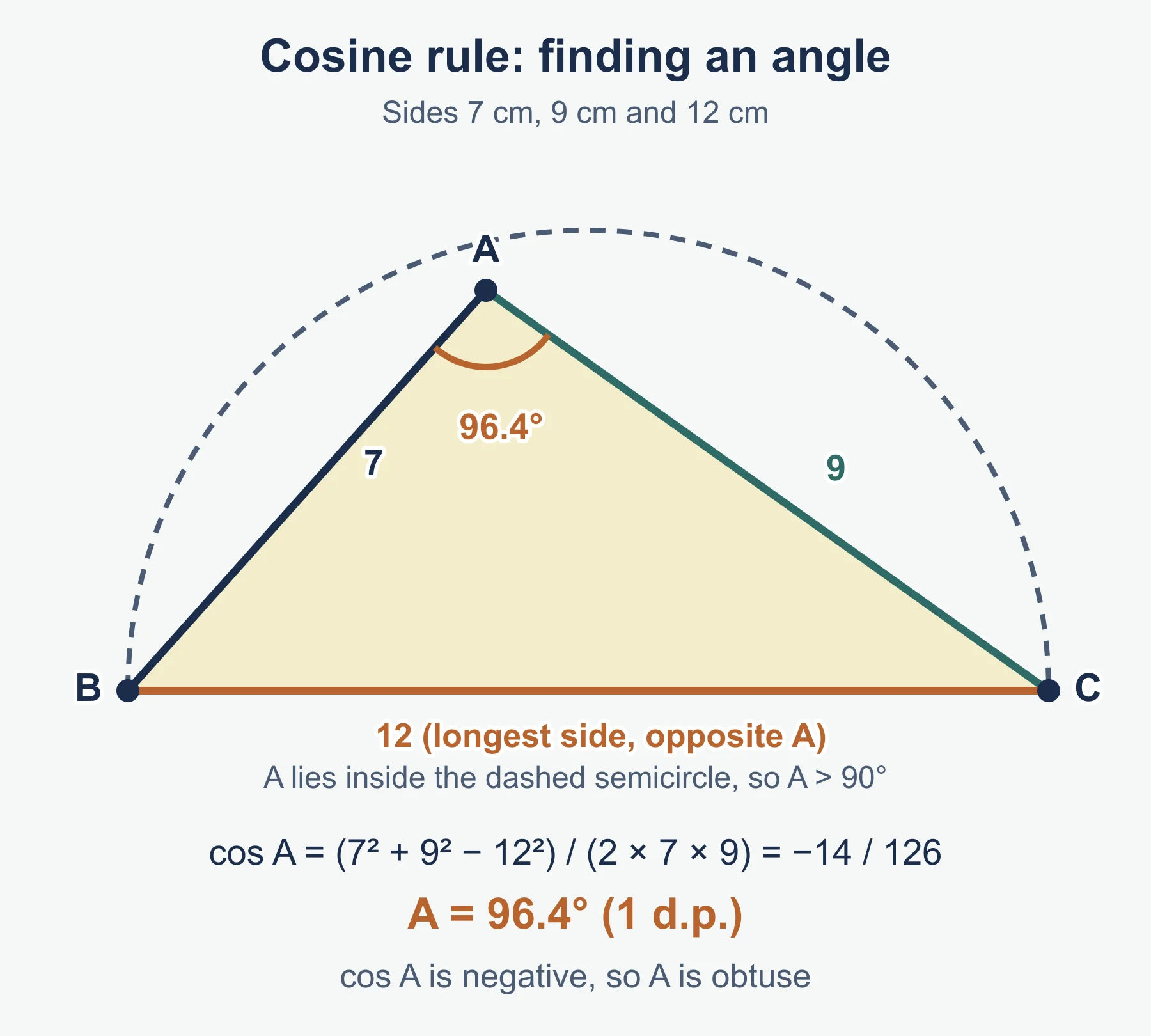
| Cosine rule (angle) | cos A = (b² + c² - a²) / (2bc) |
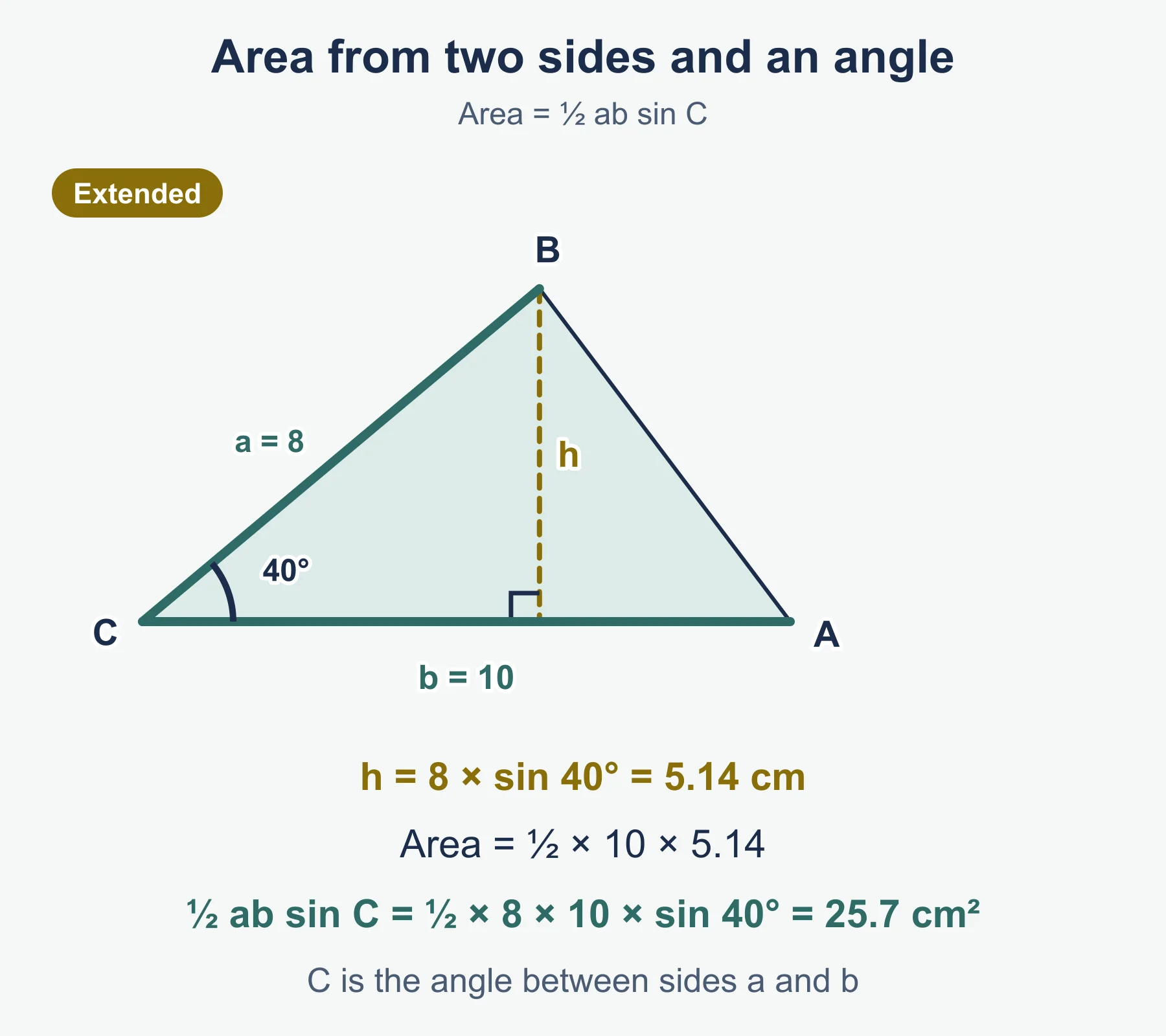
| Area | ½ab sin C |
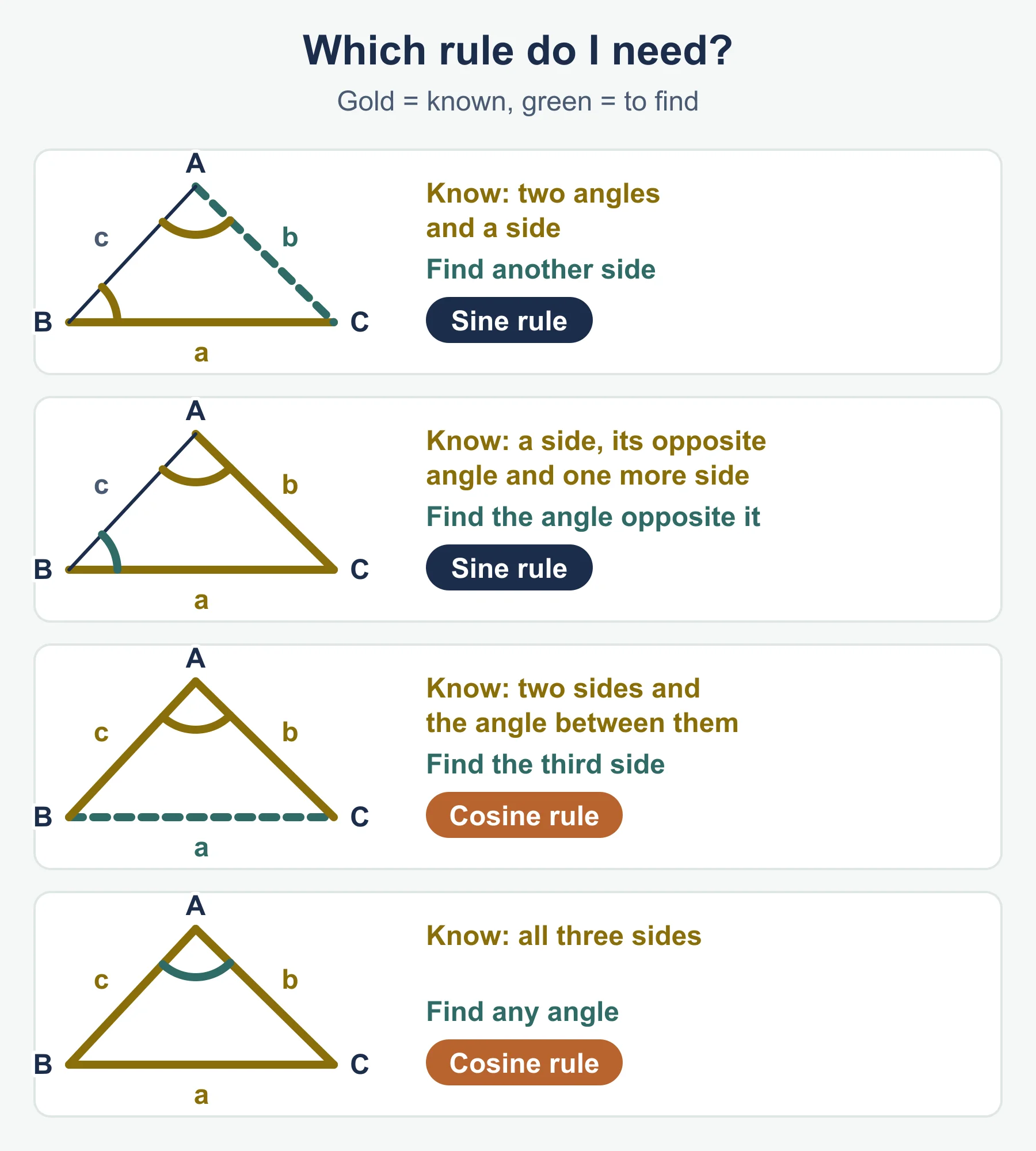
Which rule?
| Known | Wanted | Use |
|---|---|---|
| Side and opposite angle, plus one more | The other pair | Sine rule |
| Two sides and the included angle | Third side | Cosine rule |
| Three sides | An angle | Cosine rule (angle form) |
| Two sides and the included angle | Area | ½ab sin C |
Obtuse angles and the ambiguous case
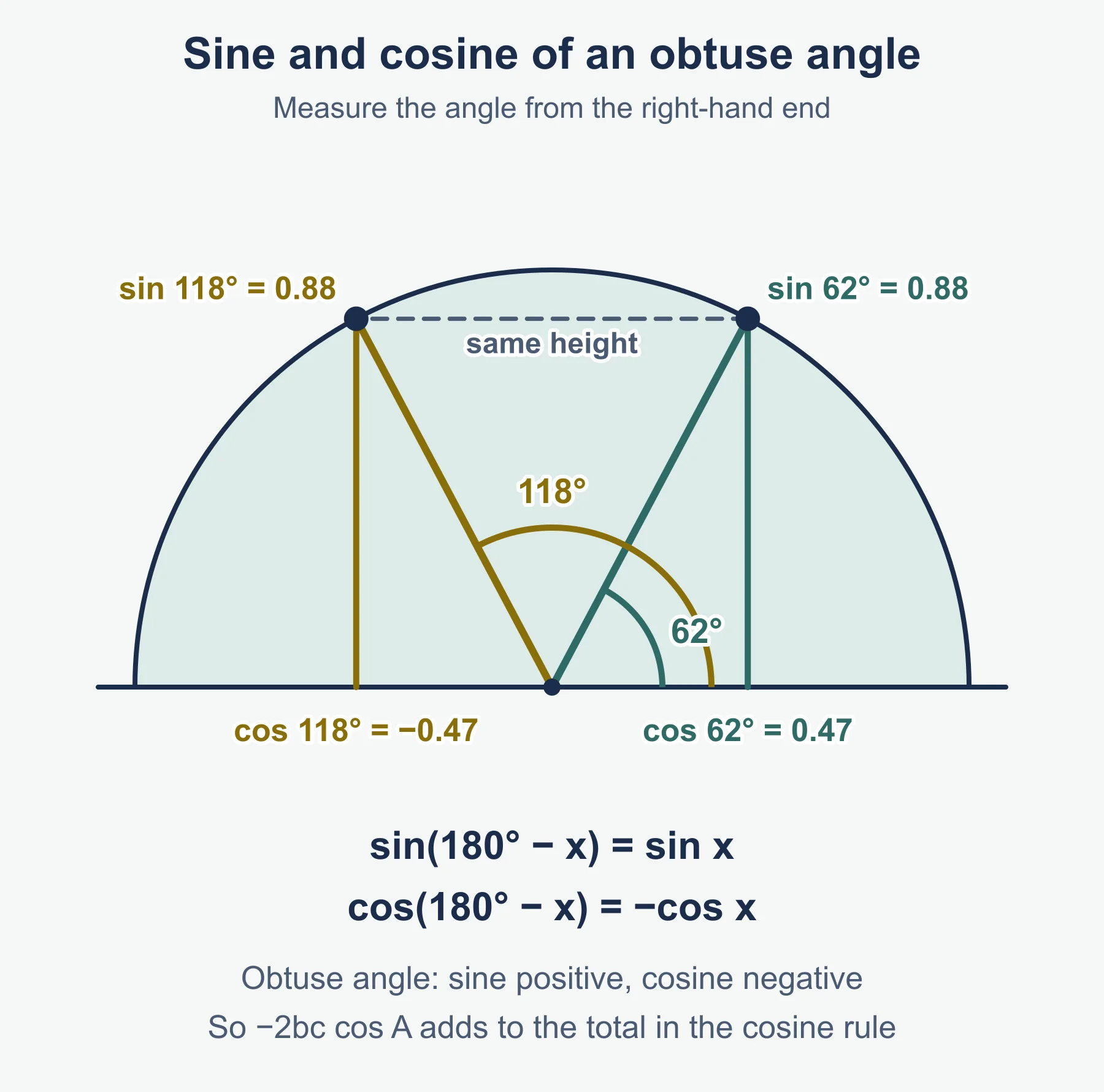
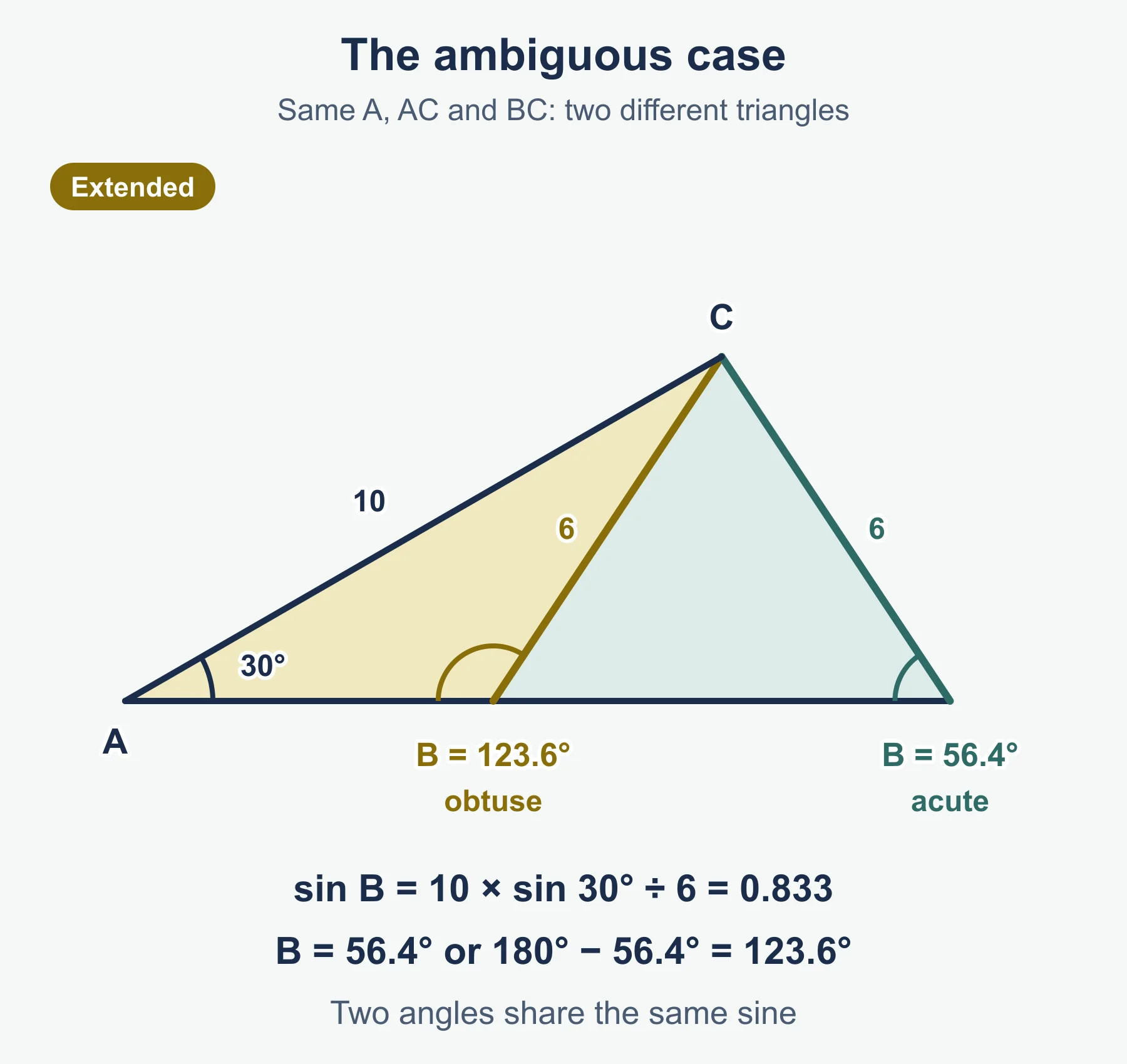
- sin(180° - x) = sin x, so an acute and an obtuse angle share a sine value.
- cos(180° - x) = -cos x. A negative cos A means A is obtuse.
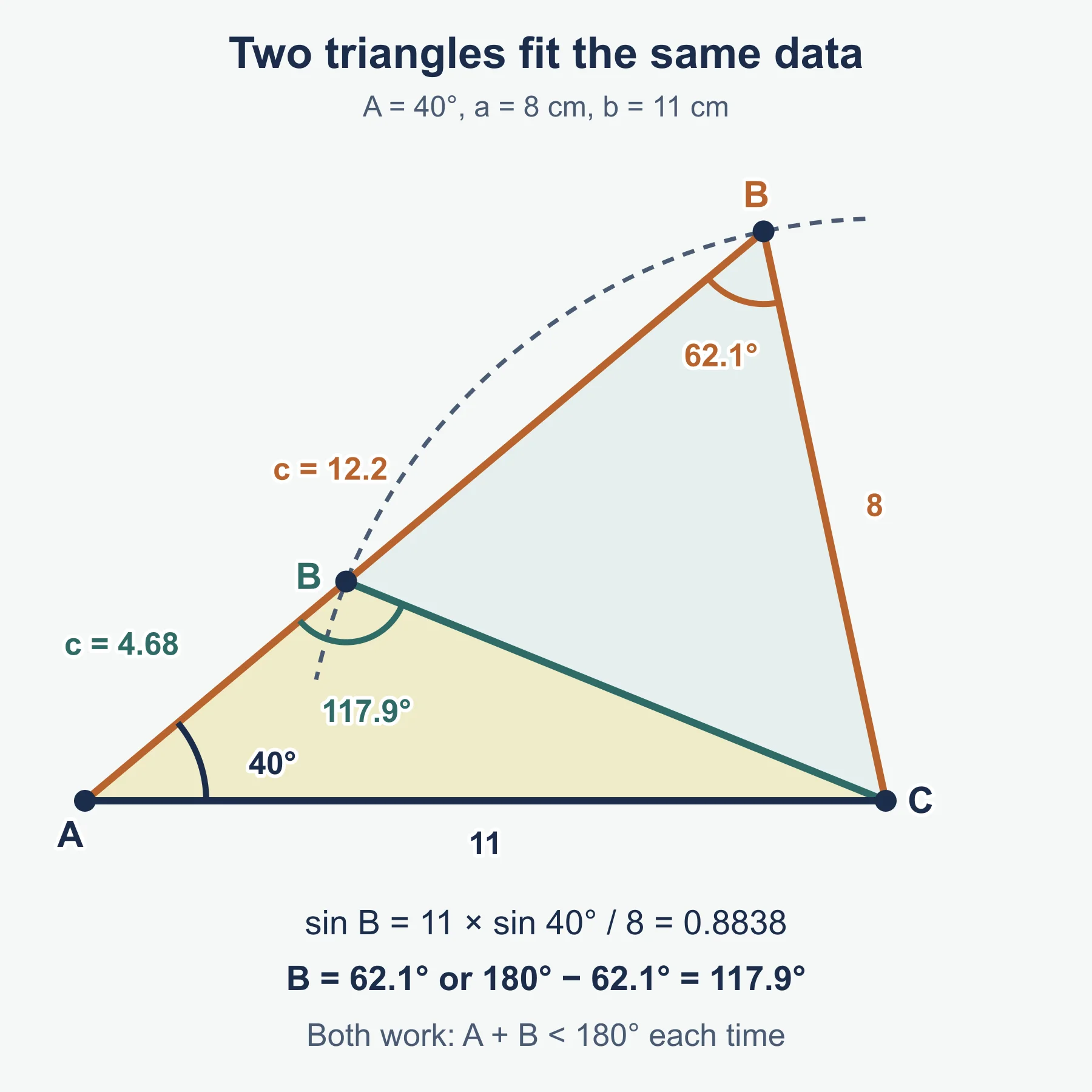
- With two sides and a non-included angle (SSA), the sine rule can give B and 180° - B. Keep the obtuse value only if the angle sum stays below 180°.
- No triangle exists if sin B comes out above 1.
- Two triangles are possible only when the given angle is opposite the shorter of the two given sides, and that side is longer than the perpendicular height.
Worked reminder: A = 30°, a = 6, b = 9 gives sin B = 9 sin 30° / 6 = 0.75, so B = 48.6° or 131.4°. Angle sums are 78.6° and 161.4°, both under 180°, so both triangles exist.
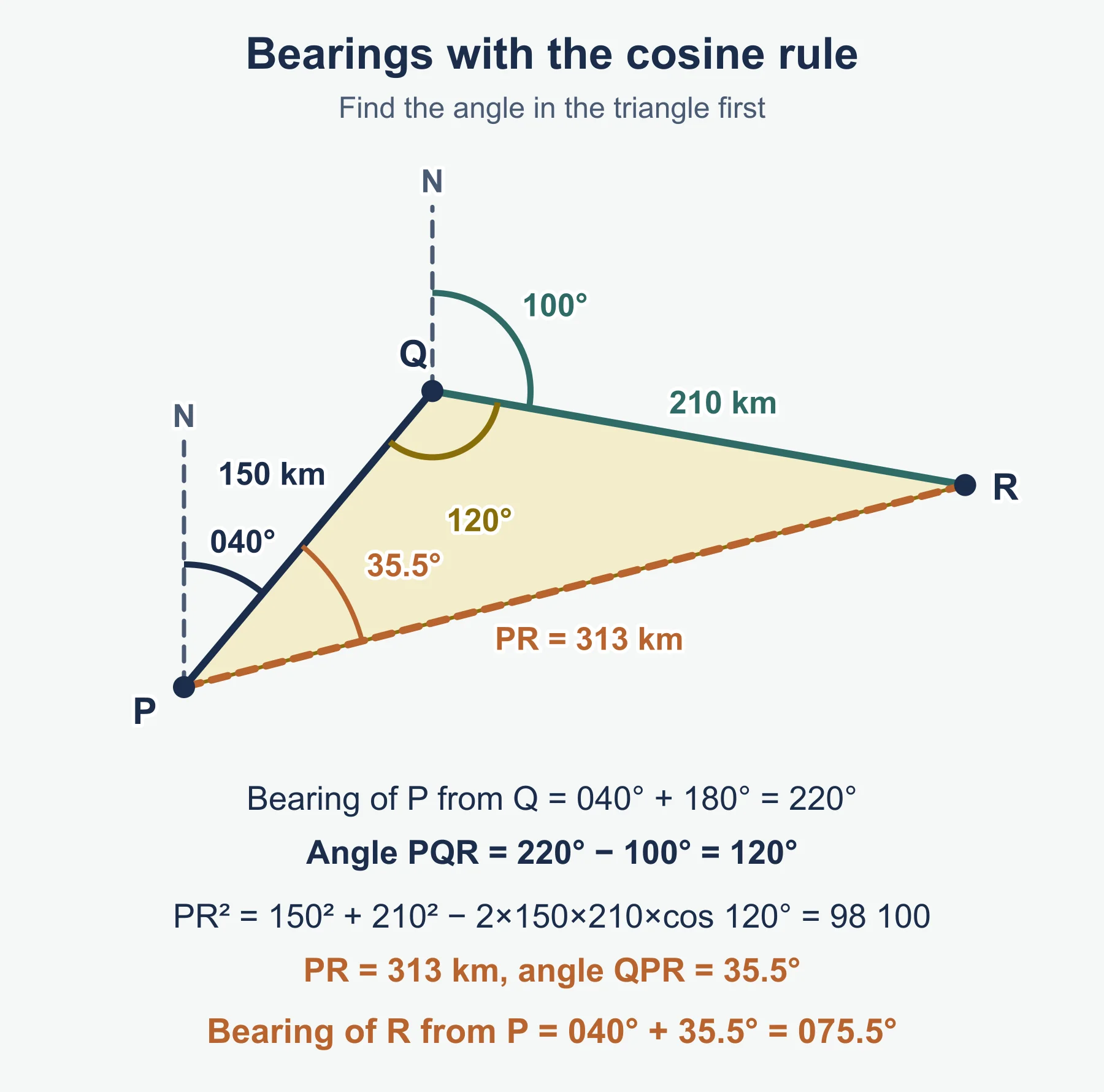
Method for a bearing problem with a triangle:
- Sketch the points and a north line at each.
- Work out the interior angle at the middle point using the back bearing.
- Choose the rule from the table above.
- Add or subtract the angle you find from a known bearing.
6.4 Trigonometry in 3D
- Break the solid into flat right-angled triangles and redraw each.
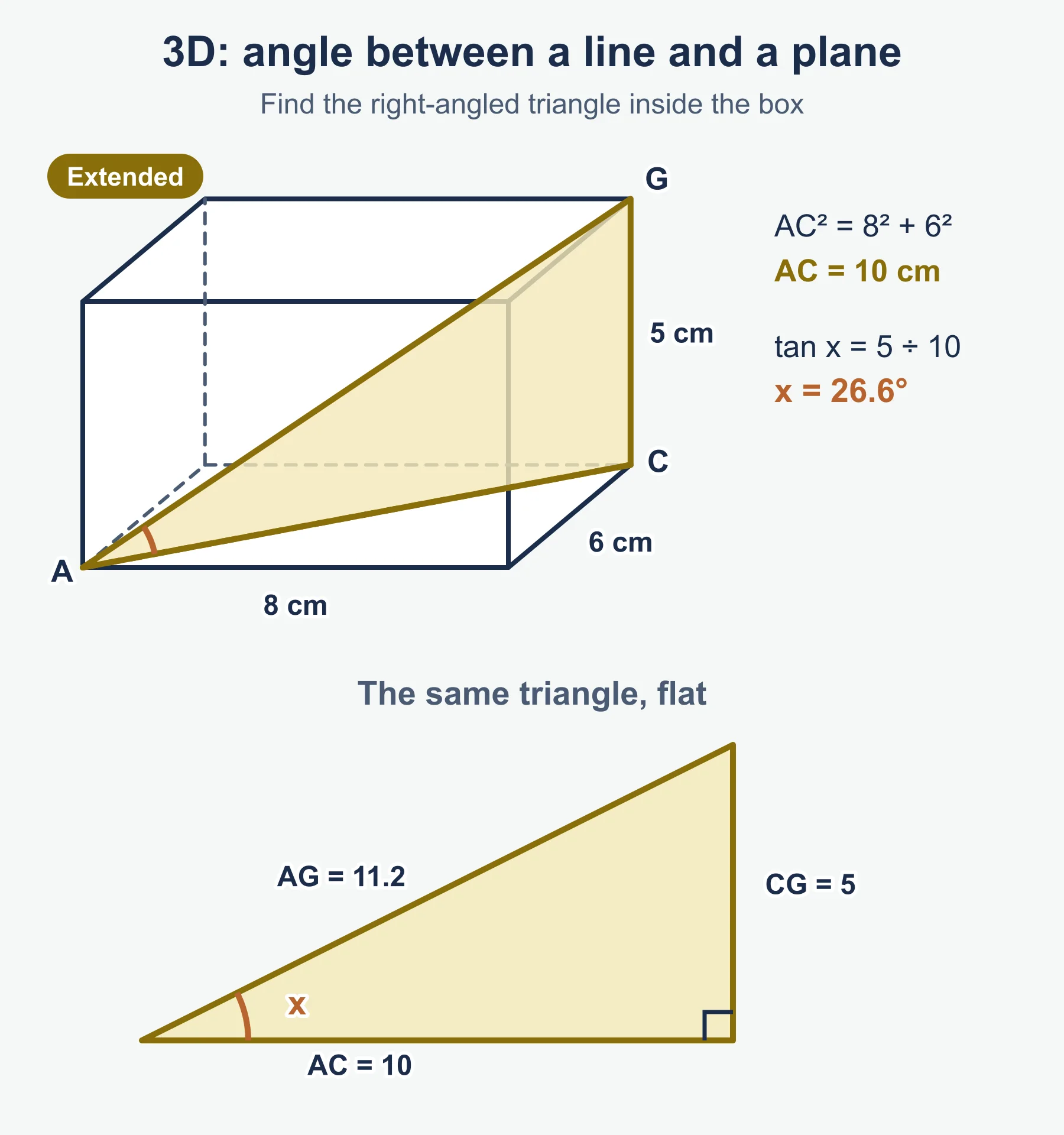
- Cuboid: base diagonal √(l² + w²), space diagonal √(l² + w² + h²).
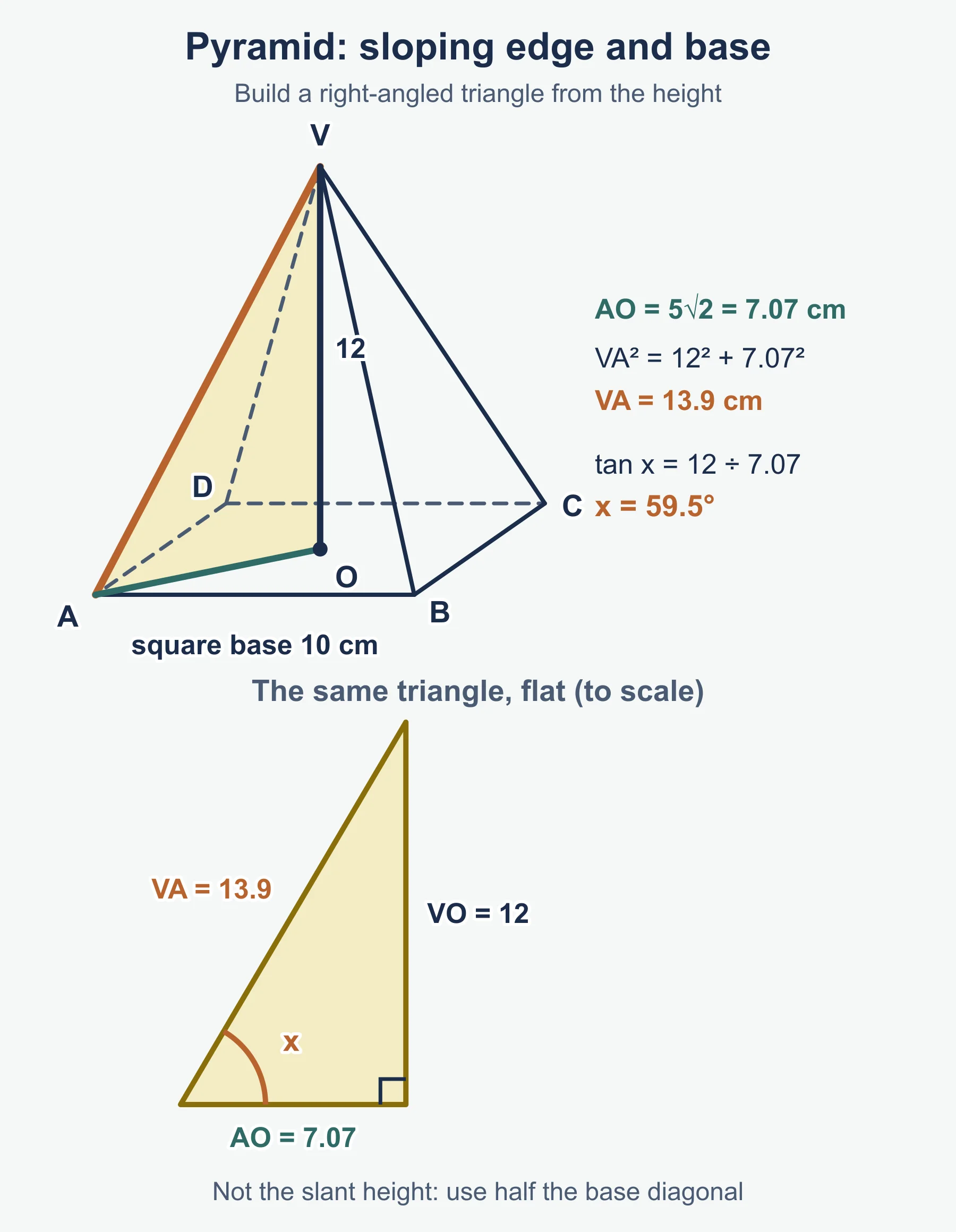
- Pyramid on a square base of side s: the centre is half a diagonal, s√2 / 2, from a corner.
- Angle between a line and a plane: the angle between the line and its projection on the plane. The projection runs from the foot of the perpendicular to the lower end of the line.
Method in steps:
- Identify the line and the plane.
- Mark the foot of the perpendicular from the top of the line to the plane.
- Draw the projection and the right-angled triangle formed.
- Use Pythagoras for missing lengths, then a ratio for the angle.
Worked reminder: a cuboid 4 cm by 3 cm by 12 cm. The base diagonal is 5 cm and the space diagonal is √(16 + 9 + 144) = 13 cm. The angle with the base is tan⁻¹(12 / 5) = 67.4°.
Non-calculator habits
Paper 1 can include any of this topic, so practise the structure without a calculator. Leave answers in a form such as 5√2 if the numbers allow, and recognise common Pythagorean sets like 3, 4, 5 and 8, 15, 17. Set out the equation clearly, because a correct method with a slip is easier to follow than a bare answer.
Must-know distinctions
- Sine rule or cosine rule: the sine rule needs an opposite pair, the cosine rule needs the included angle or all three sides.
- Elevation or depression: both are measured from the horizontal, never the vertical.
- Bearing of B from A or of A from B: they differ by 180°.
- Line and plane angle or line and line angle: the line-to-plane angle always uses the projection.
- Hypotenuse or longest side in a non-right-angled triangle: Pythagoras only works in a right-angled triangle.
Quick self-test
- A right-angled triangle has hypotenuse 15 cm and one shorter side 9 cm. Find the other side.
- Find the opposite side when the adjacent side is 9 cm and the angle is 50°.
- The opposite side is 5 cm and the adjacent side is 12 cm. Find the angle.
- The adjacent side is 4.5 cm and the hypotenuse is 9 cm. Find the angle.
- The bearing of Q from P is 130°. Find the bearing of P from Q.
- In a triangle, one side is 12 cm and the angle opposite it is 71°. Find the side opposite an angle of 48°.
- Two sides are 5 cm and 8 cm with an included angle of 60°. Find the third side.
- Find the area of a triangle with sides 10 cm and 13 cm and an included angle of 150°.
- Write sin 140° as the sine of an acute angle, and say whether cos 140° is positive or negative.
- A cuboid measures 4 cm by 3 cm by 12 cm. Find the angle between its space diagonal and the 4 by 3 base.
- In a triangle, A = 30°, a = 6 cm and b = 9 cm. How many possible values are there for angle B?
Answers
- 12 cm (√(225 - 81) = √144).
- 9 × tan 50° = 10.7 cm (3 s.f.).
- tan⁻¹(5 / 12) = 22.6°.
- cos⁻¹(0.5) = 60.0°.
- 130° + 180° = 310°.
- 12 × sin 48° / sin 71° = 9.43 cm (3 s.f.).
- √(25 + 64 - 40) = √49 = 7 cm.
- ½ × 10 × 13 × sin 150° = 32.5 cm².
- sin 140° = sin 40°. cos 140° is negative.
- tan⁻¹(12 / 5) = 67.4°.
- Two: 48.6° or 131.4°.
Where marks are usually lost
- Calculator in the wrong angle mode.
- Rounding too early, which can move the final digit of the answer.
- Giving an angle to the wrong accuracy: angles to 1 decimal place, other answers to 3 significant figures.
- Using the sine rule with a side and an angle that are not opposite each other.
- Using the cosine rule with an angle that is not between the two sides used.
- Missing the second answer in an ambiguous case, or keeping an obtuse angle that breaks the angle sum.
- Writing a bearing with two figures or measuring it from the wrong north line.
- Drawing no sketch in a 3D problem, so the wrong triangle is used.
- Forgetting units, such as cm² for area.
Frequently asked questions
Are the sine rule and cosine rule given in the Cambridge O Level Mathematics 4024 exam? Yes. The sine rule, cosine rule and area formula are in the List of formulas, but you still need to know when to use each one.
How accurate should trigonometry answers be in O Level Mathematics? Paper 2 asks for angles in degrees to 1 decimal place and other non-exact answers to 3 significant figures, unless the question says otherwise. Avoid rounding until the final answer.
What is the ambiguous case of the sine rule? When you know two sides and a non-included angle, the sine rule can give an angle B and also 180° − B, because both have the same sine. Keep the obtuse value only if the angle sum stays below 180°.
What is the difference between angles of elevation and depression? An angle of elevation is measured up from the horizontal to the line of sight, and an angle of depression is measured down from the horizontal. Both are measured from the horizontal, never the vertical.
How do you find the space diagonal of a cuboid? Use √(l² + w² + h²), which comes from applying Pythagoras’ theorem twice: once for the base diagonal and once with the height.
Official syllabus
Cambridge O Level Mathematics (Syllabus D) 4024 syllabus for examination in 2025, 2026 and 2027, topic 6 Trigonometry (Cambridge University Press & Assessment).
Get free revision emails (optional)
Occasional emails with practice questions, worked explanations and links to free resources for the qualification and subjects you choose. No spam, and you can unsubscribe from any email. The free tools on this site never need an email.
Related resources
-
Study guides
Cambridge O Level Mathematics: Trigonometry (4024)
A step-by-step Cambridge O Level Mathematics study guide to Pythagoras, right-angled and non-right-angled trigonometry, bearings and 3D problems.
Mathematics · Cambridge · O Level
Read guide -
Practice questions
O Level Mathematics: Trigonometry Practice Questions (Cambridge 4024)
Original Cambridge O Level Mathematics 4024 trigonometry questions on Pythagoras, right-angled triangles, the sine and cosine rules, triangle area and bearings.
Mathematics · Cambridge · O Level
Try questions -
Study guides
Sequences and Proportion
Find the nth term of linear, quadratic, cubic and exponential sequences, and solve direct and inverse proportion, for Cambridge O Level Maths 4024.
Mathematics · Cambridge · O Level
Read guide
Related articles
-
exam preparation
Where IGCSE Mathematics marks are lost early
The first weeks of an IGCSE Mathematics course rarely go wrong on difficulty. They go wrong on method, command words, rounding and units — four habits that cost marks a student had already earned.
24 August 2026
-
teaching
A Level tuition in Dubai: Cambridge or Pearson Edexcel International A Level?
Schools in Dubai and Abu Dhabi teach either Cambridge International AS & A Level or Pearson Edexcel International A Level. How the two are structured, why it matters for tuition, and how online classes from Lahore work.
9 October 2026
Studying this with a teacher
Working through Mathematics O LEVELS?
This page is free and stays free. If you would rather be taught it, Marlbridge runs Mathematics classes one-to-one and in small groups of up to 15, online in your own time zone. The first trial class is free. WhatsApp replies within an hour (8am–11pm Pakistan time, every day); email the same day.
Cambridge Mathematics teachers at Marlbridge


