
Study Guides
O Level Physics: Space physics (Cambridge 5054)
Study guide to space physics for Cambridge O Level Physics (5054): orbital speed, the Solar System, the Sun, the life cycle of stars and redshift.
- Subject
- Physics
- Level
- O LEVELS
- Topic
- Space physics
- Author
- Marlbridge Academic Team
- Updated
- Reviewed by
- Hassan (what this means)
Aligned to Cambridge O Level Physics (5054), 2026-2028. Official specification .
Syllabus page (what it covers and how it is assessed): Cambridge O Level Physics.
Syllabus points this page covers
5054
- 6.1 Earth and the Solar System
- 6.2 Stars and the Universe
Found an error? Report a correction.
Need help with this topic? Request a free trial class for O Level Physics (5054).
This guide teaches topic 6, Space physics, from the Cambridge O Level Physics (5054) syllabus for examination in 2026, 2027 and 2028. It covers sections 6.1 (Earth and the Solar System) and 6.2 (Stars and the Universe) in full. The syllabus does not split this topic into tiers.
Use it with the revision notes for the final weeks and the existing practice questions for exam-style questions. Your course page is at Cambridge O Level Physics, the printable list is the Physics checklist, and the free 10-minute diagnostics show which topics need work first.
What the topic covers
| Syllabus section | What you must be able to do |
|---|---|
| 6.1.1 The Earth | Know the Earth’s orbit, rotation, tilt, and the Moon and light travel times; define and use average orbital speed v = 2πr / T |
| 6.1.2 The Solar System | Describe the Sun, planets, minor planets, moons and smaller bodies; interpret planetary data; know how gravitational field strength varies; know the orbit force and the trend in orbital speed |
| 6.2.1 The Sun as a star | Know its size, composition, the radiation it emits and how stable stars are powered |
| 6.2.2 Stars | State facts about galaxies and light-years; describe the life cycle of a star |
| 6.2.3 The Universe | Know the size of the Milky Way and the number of galaxies; describe redshift; link it to the Big Bang theory |
6.1.1 The Earth
Know these five facts. They are a short list, and each one is a likely one-mark recall.
- The Earth is a planet that orbits the Sun once in approximately 365 days.
- The Earth’s orbit is an ellipse that is approximately circular.
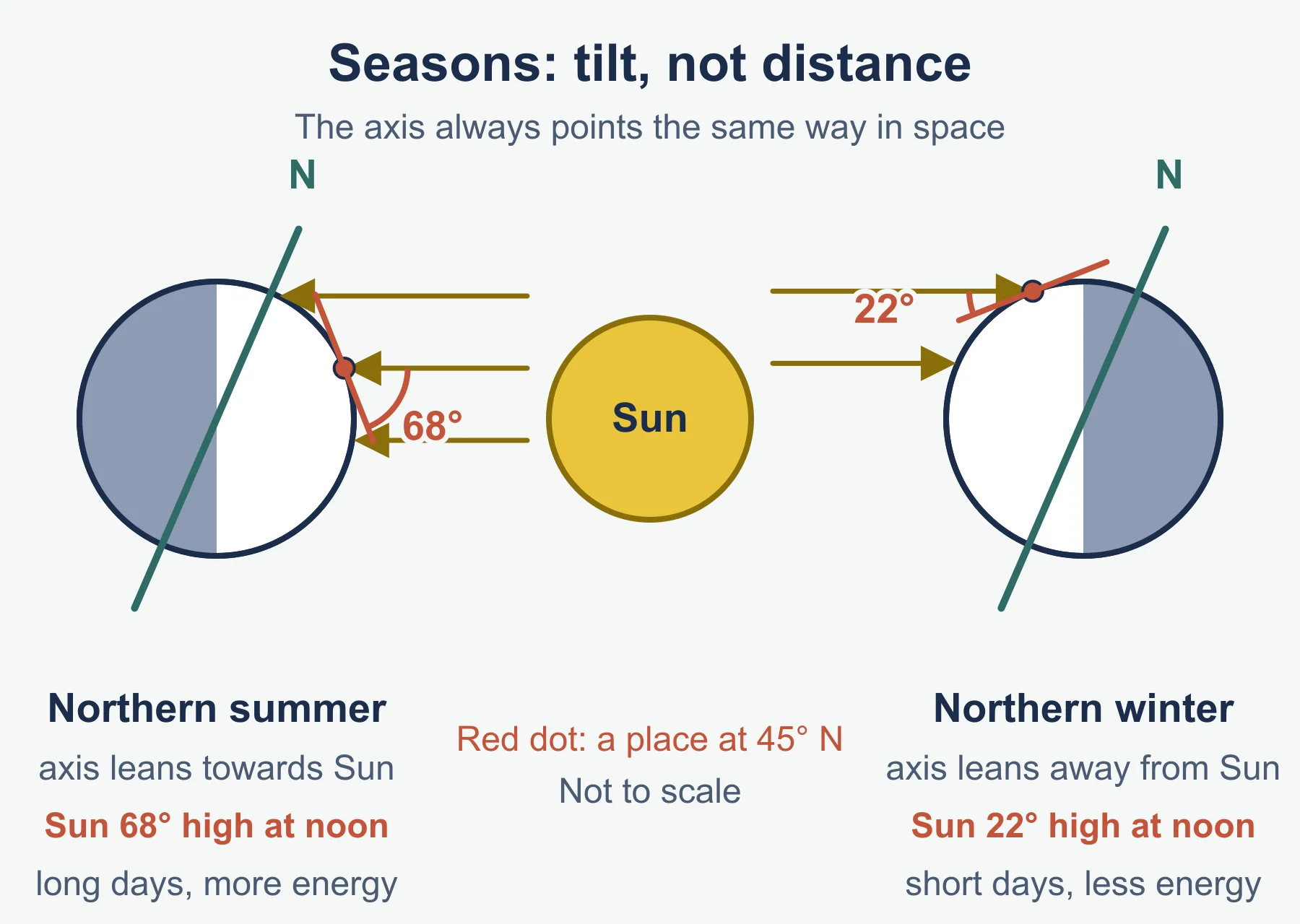
- The Earth rotates on its axis once in approximately 24 hours, and the axis is tilted.
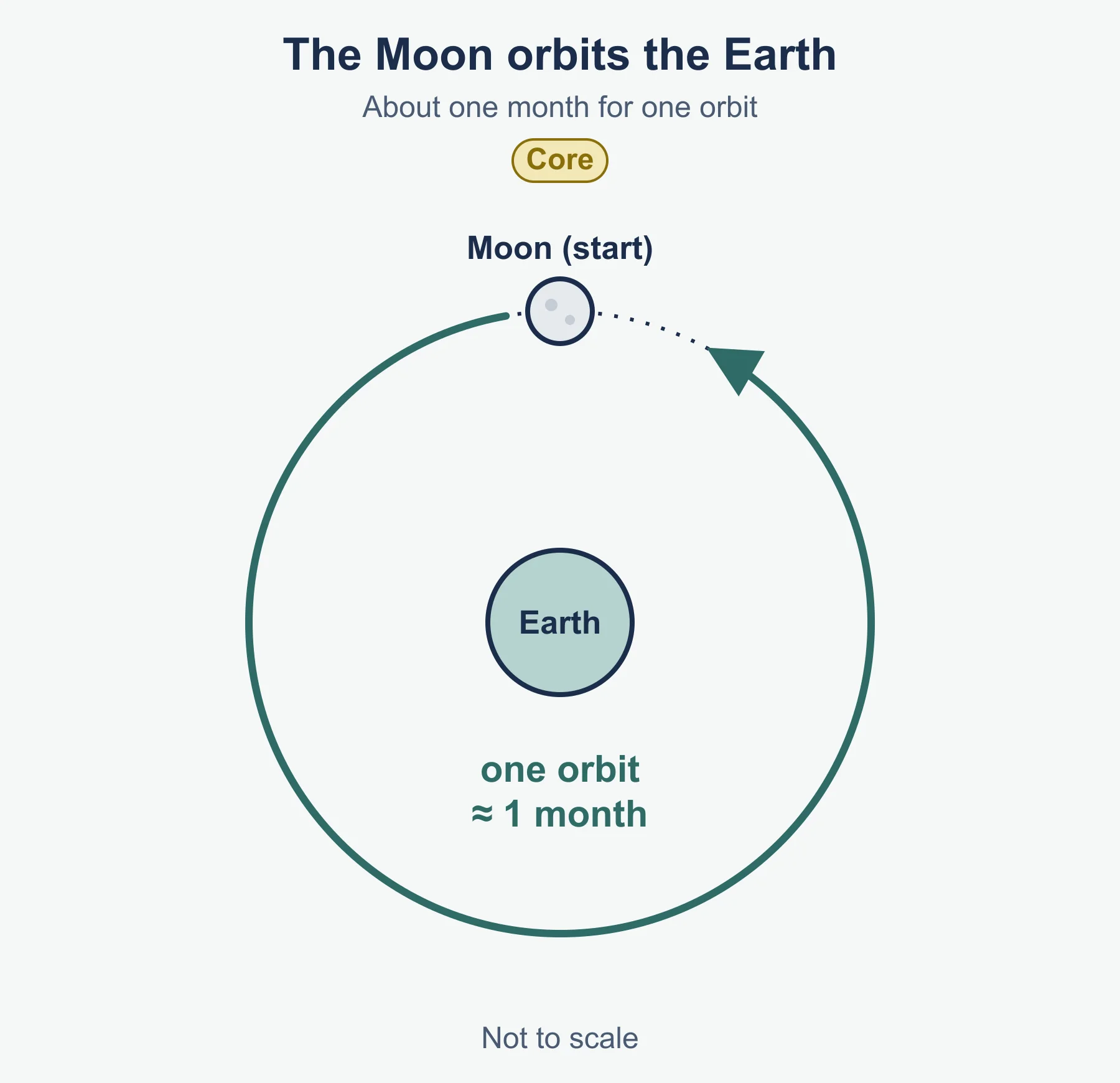
- The Moon takes approximately one month to orbit the Earth.
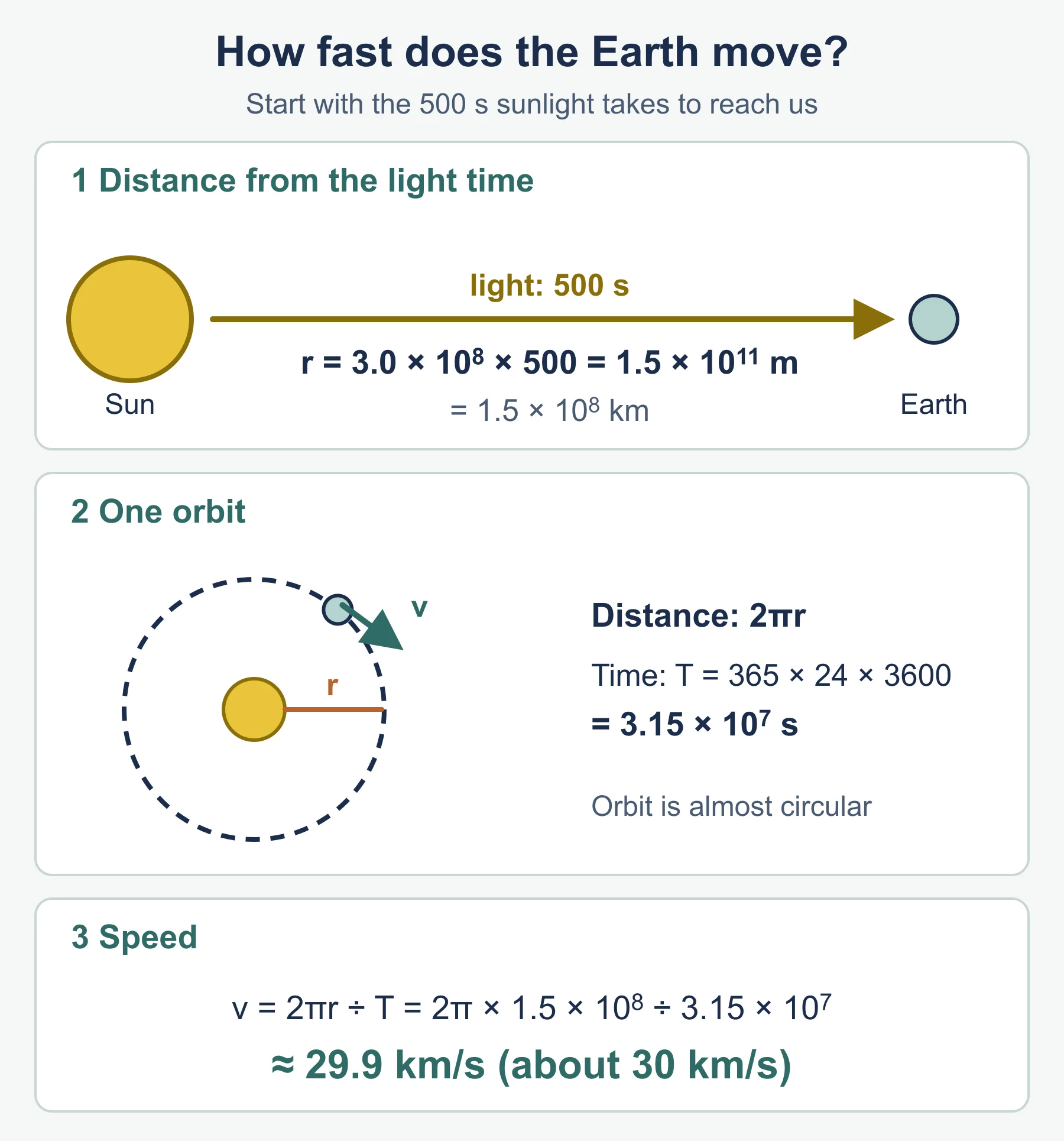
- Light takes approximately 500 s to reach the Earth from the Sun.
The last fact gives a quick distance check. Light travels at 3.0 × 10⁸ m/s, so the Sun is about 3.0 × 10⁸ × 500 = 1.5 × 10¹¹ m from the Earth, which is 1.5 × 10⁸ km. That distance is the average orbital radius of the Earth.
Average orbital speed
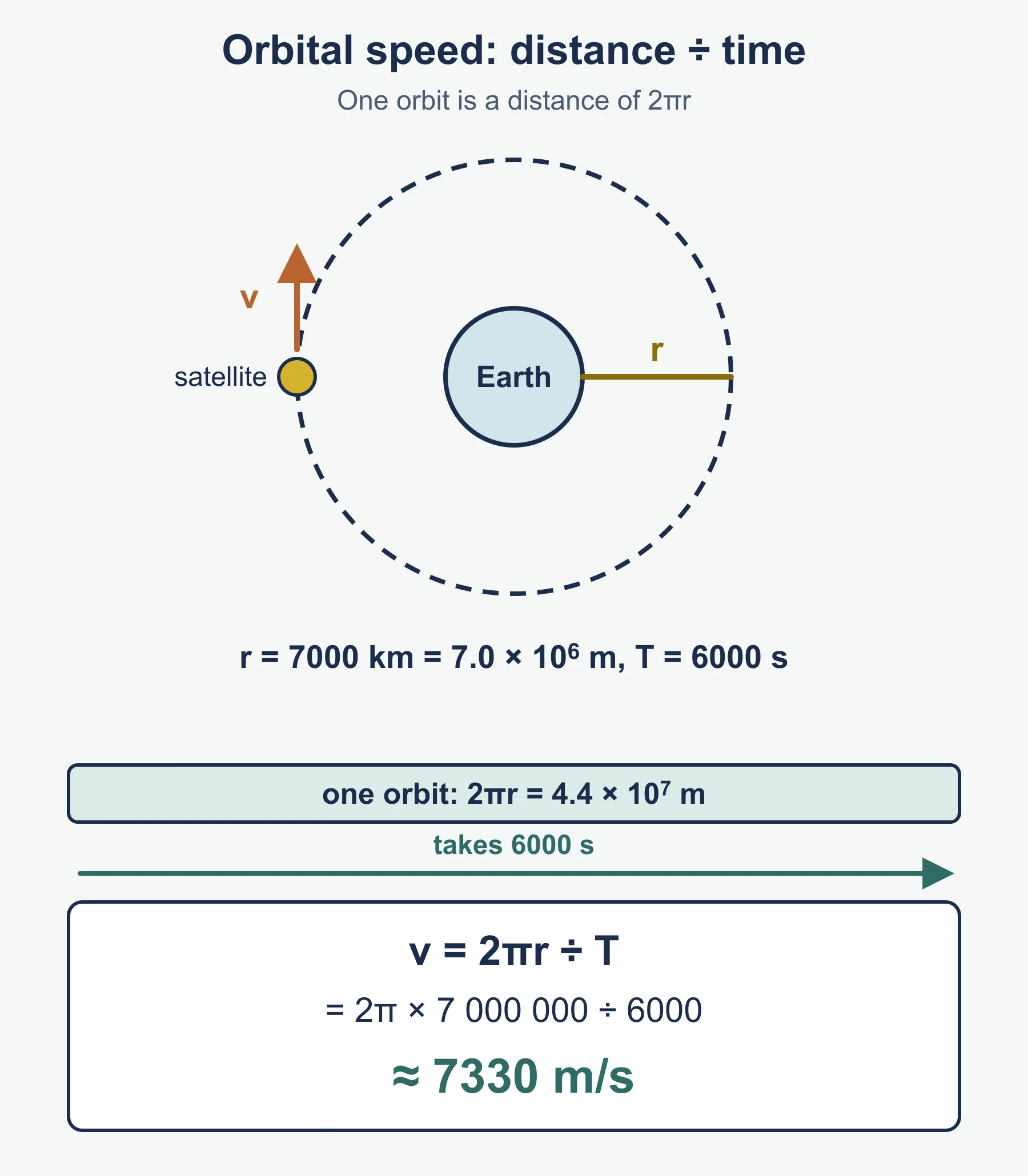
An orbiting body travels once round a path of radius r in one orbital period T. For a near-circular path, the distance travelled in one orbit is the circumference, 2πr. So:
average orbital speed v = 2πr / T
where r is the average radius of the orbit and T is the orbital period. If r is in km and T is in seconds, v is in km/s. If you want m/s, convert r to metres first.
Worked example 1: the Earth. Find the Earth’s average orbital speed in km/s, using r = 1.5 × 10⁸ km.
- Convert the period to seconds: T = 365 × 24 × 3600 = 3.15 × 10⁷ s.
- Substitute: v = 2π × 1.5 × 10⁸ / 3.15 × 10⁷.
- Calculate: v = 29.9 km/s, which is about 30 km/s.
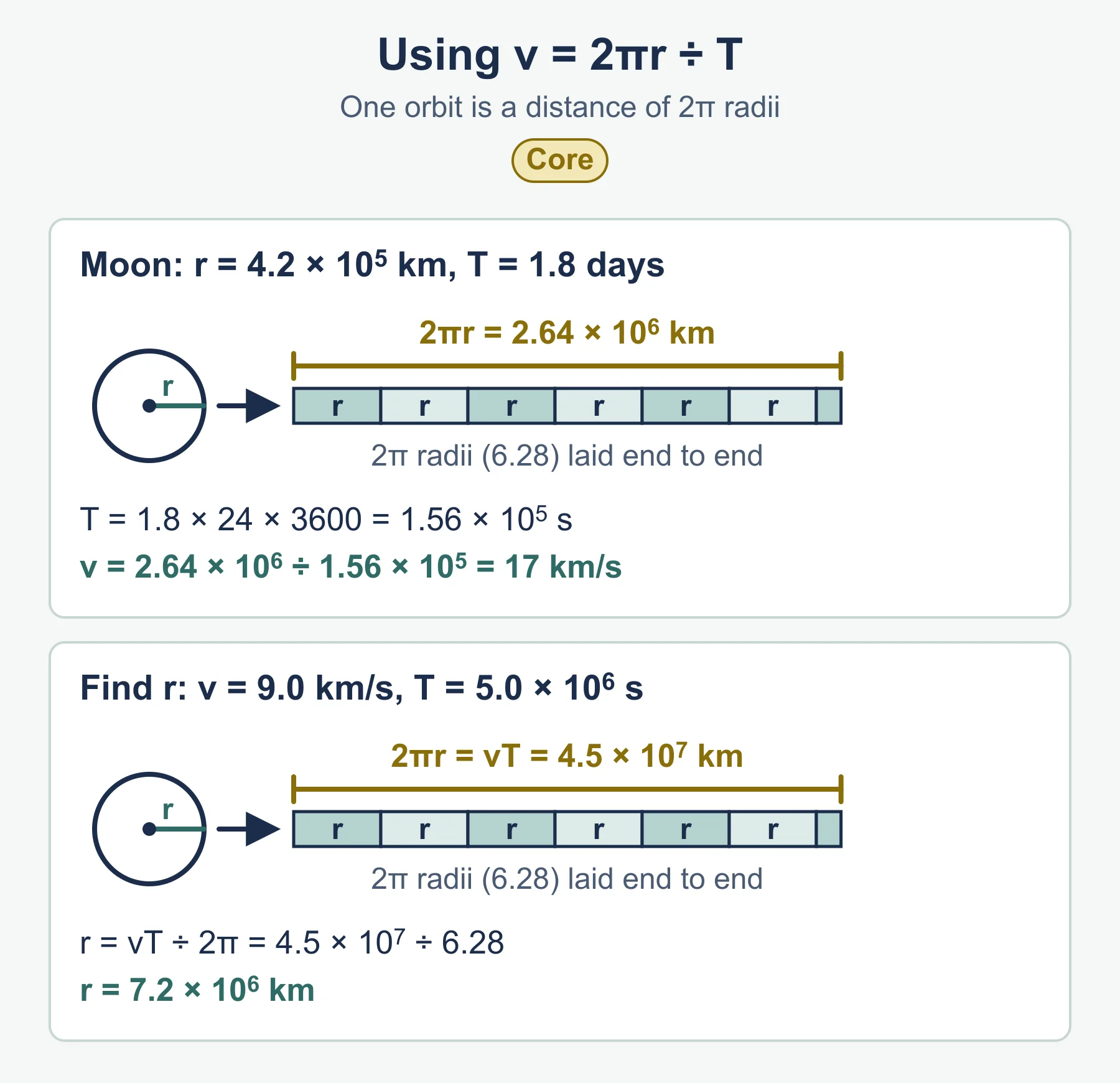
Worked example 2: a moon. A moon orbits its planet at an average radius of 4.2 × 10⁵ km in 1.8 days. Find its average orbital speed.
- T = 1.8 × 24 × 3600 = 1.56 × 10⁵ s.
- v = 2π × 4.2 × 10⁵ / 1.56 × 10⁵.
- v = 17 km/s.
Worked example 3: finding the radius. A body has average orbital speed 9.0 km/s and an orbital period of 5.0 × 10⁶ s. Rearrange v = 2πr / T to give r = vT / 2π.
r = 9.0 × 5.0 × 10⁶ / 2π = 7.2 × 10⁶ km.
For T, use T = 2πr / v.
6.1.2 The Solar System
What is in it
The Solar System contains:
- one star, the Sun;
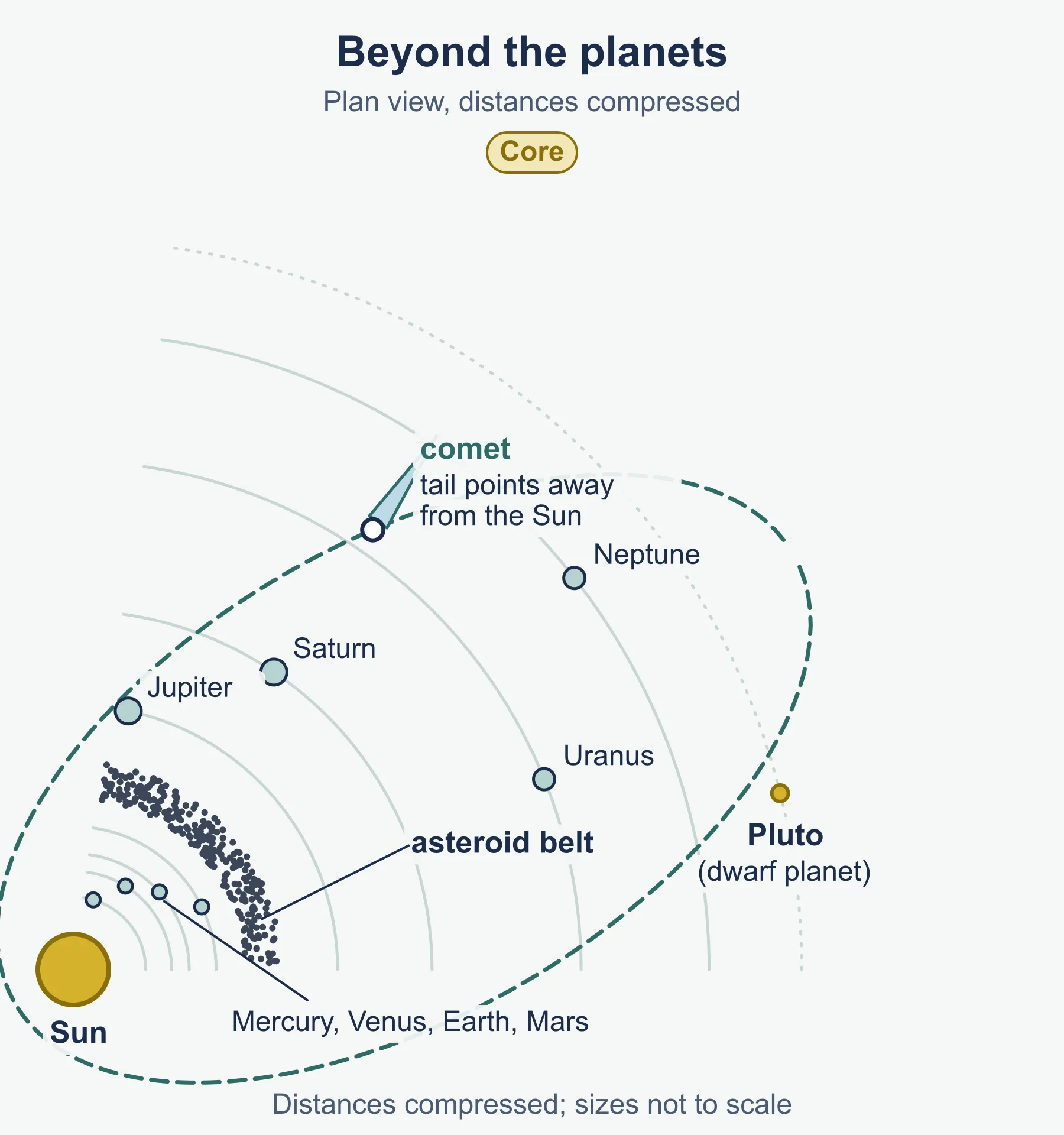
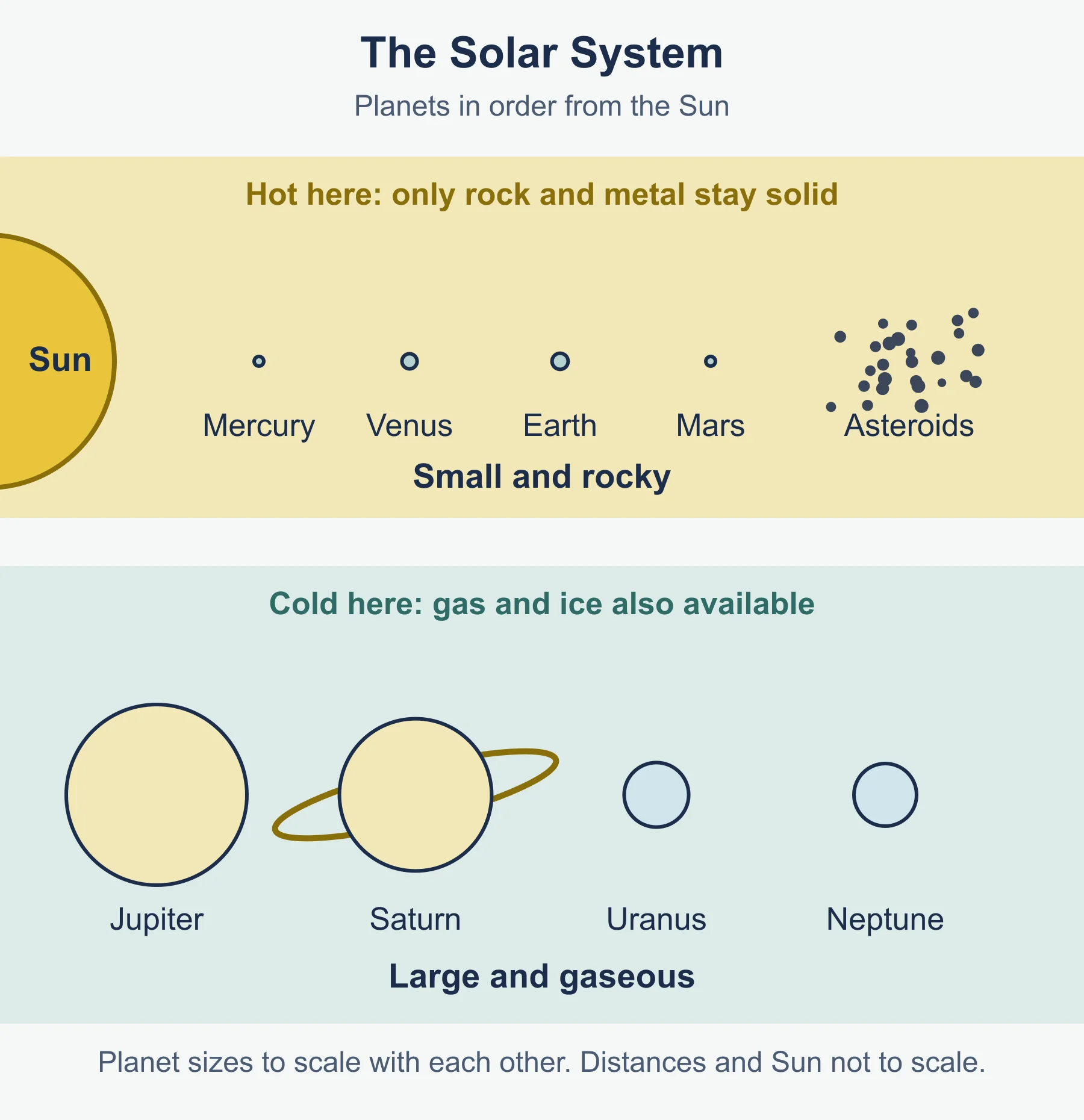
- eight named planets, in this order outwards from the Sun: Mercury, Venus, Earth, Mars, Jupiter, Saturn, Uranus, Neptune;
- minor planets that orbit the Sun, including dwarf planets such as Pluto and asteroids in the asteroid belt;
- moons, which orbit the planets;
- smaller Solar System bodies, including comets and natural satellites.
The Sun contains most of the mass of the Solar System.
Gravitational field strength
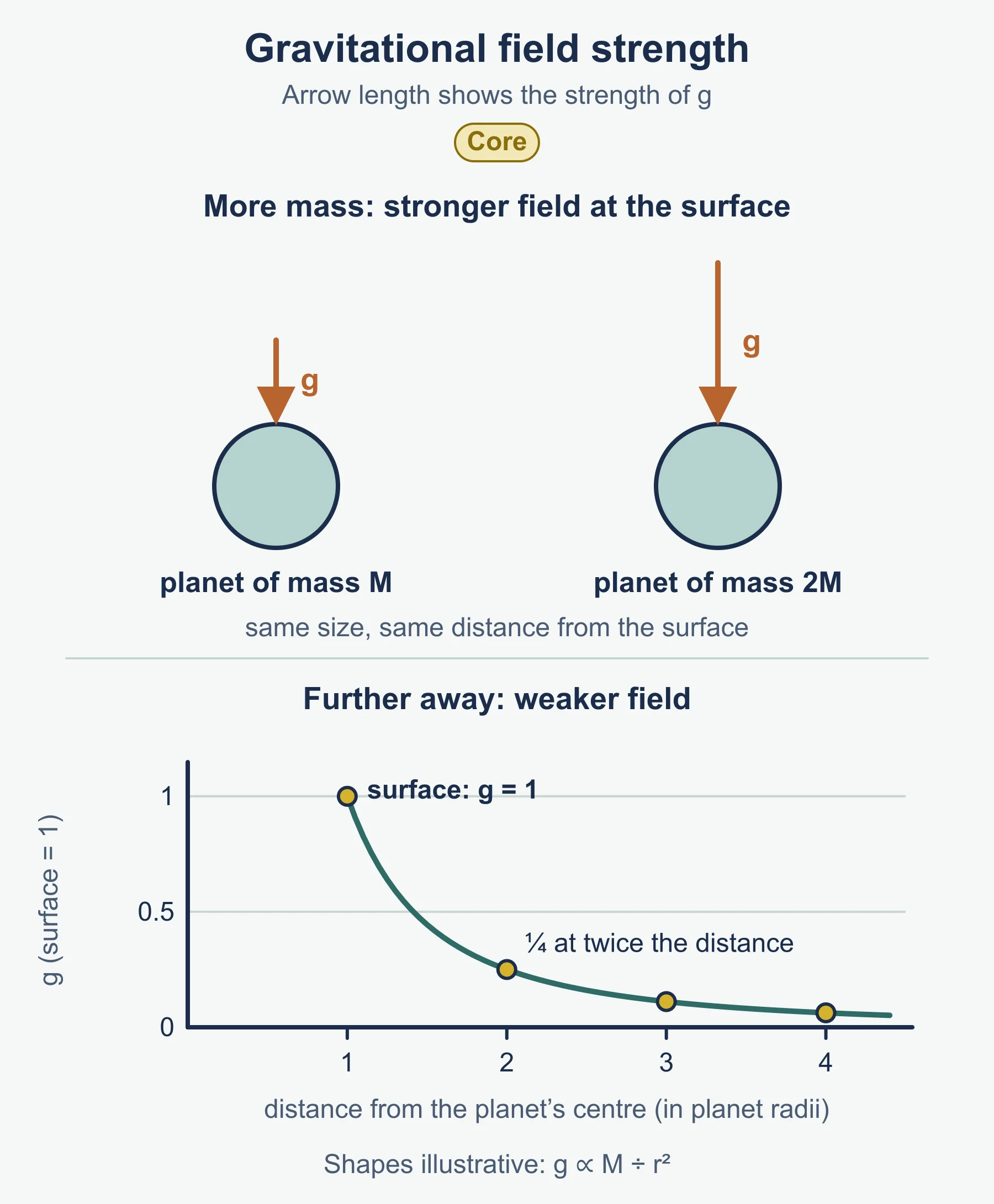
Three ideas link the strength of a gravitational field to mass and distance.
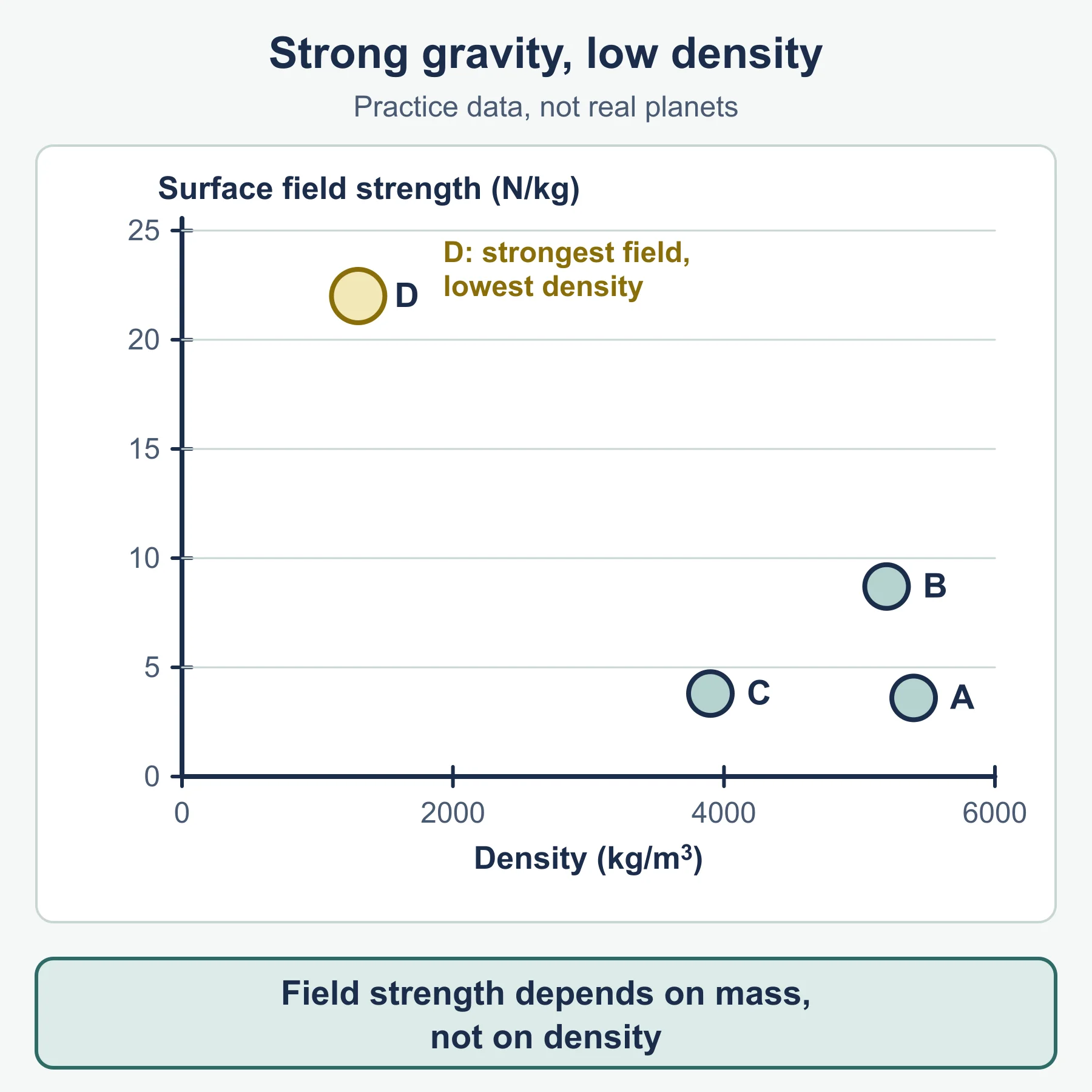
- The gravitational field strength at the surface of a planet depends on the mass of the planet. A planet with a larger mass has a stronger field at its surface.
- Around any planet, the field strength decreases as the distance from the planet increases.
- The field strength at the surface of the Sun is greater than at the surface of any of the planets, because the Sun has by far the most mass.
For the Earth, the field strength at the surface is 9.8 N/kg, about 10 N/kg (the syllabus gives the acceleration of free fall near the Earth’s surface as approximately 9.8 m/s², the same value). The topic text does not ask you to recall it. Other planets have different values, which you may be asked to compare in a table.
What keeps planets in orbit
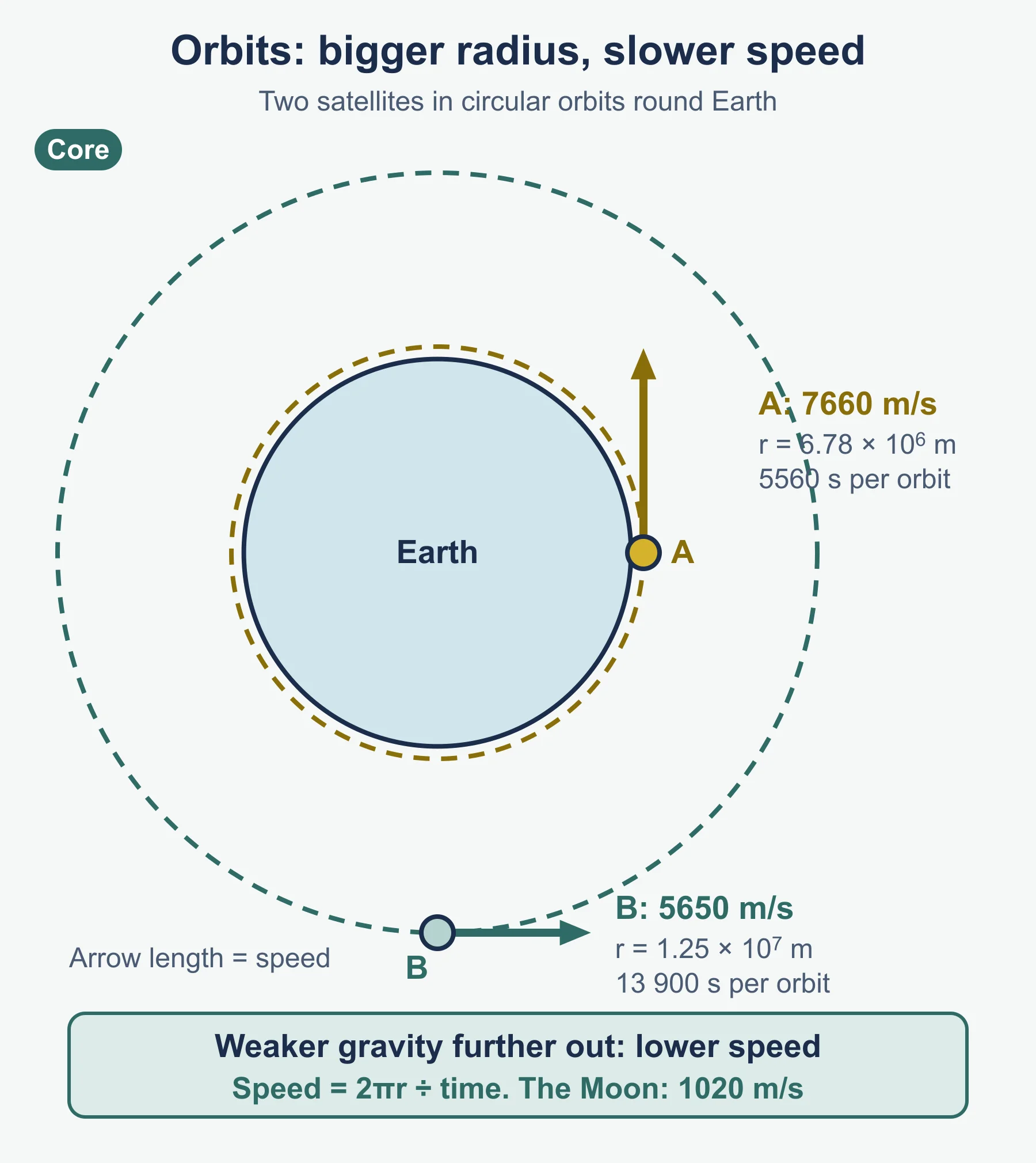
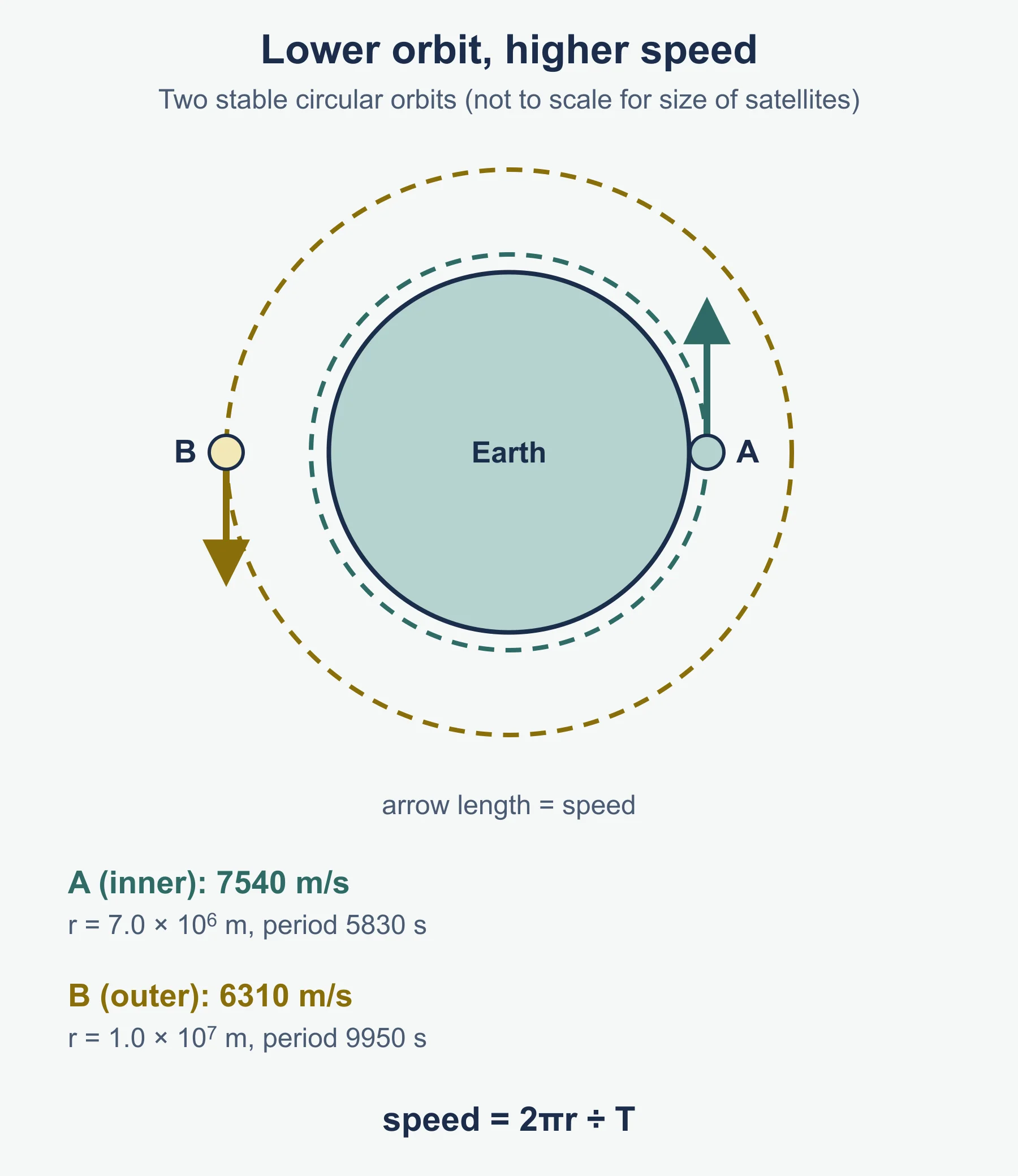
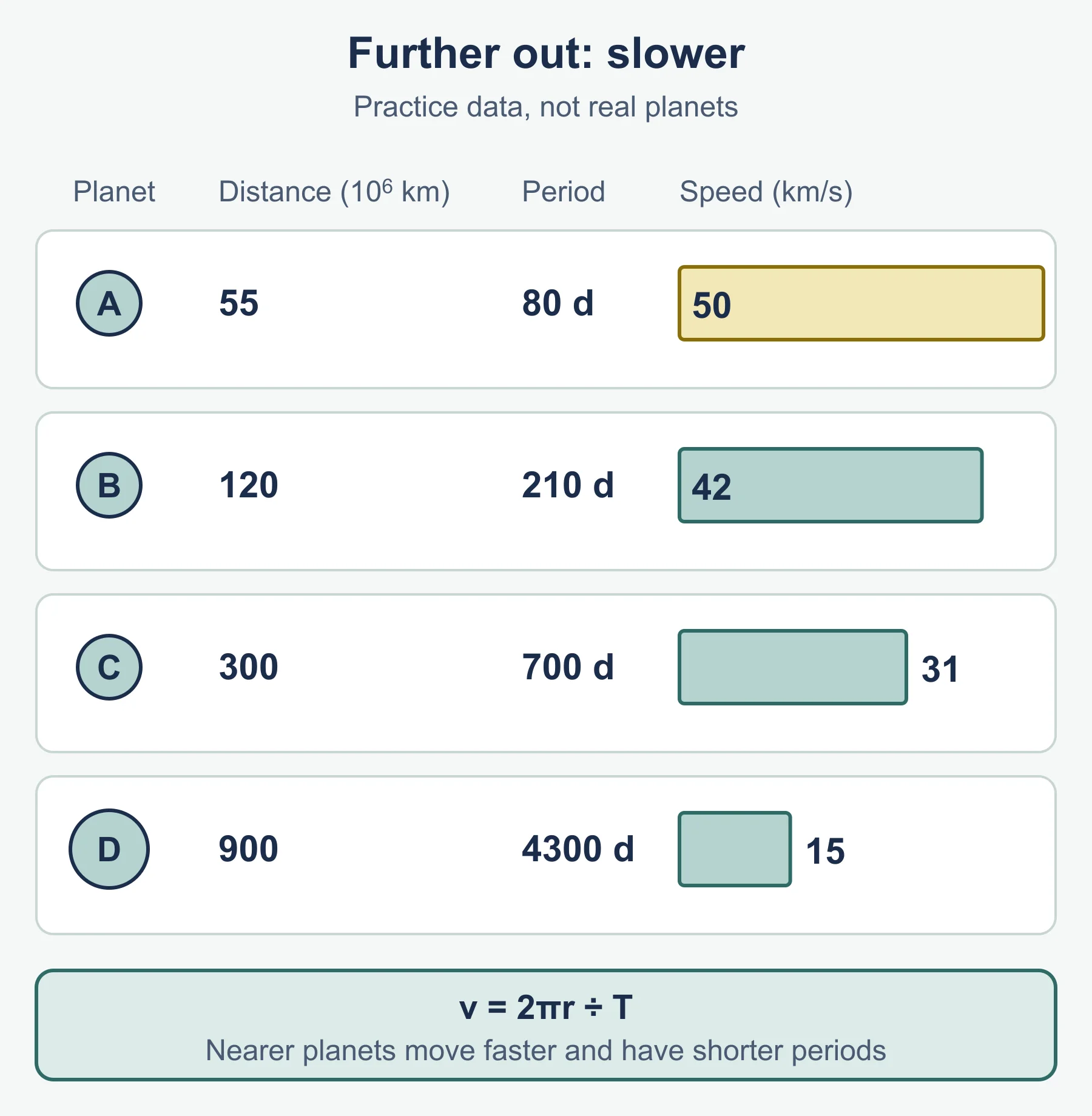
The force that keeps an object in orbit around the Sun is the gravitational attraction of the Sun. It acts towards the Sun. Two trends follow as the distance from the Sun increases:
- the strength of the Sun’s gravitational field decreases;
- the orbital speeds of the planets decrease.
So planets far from the Sun move more slowly and also have to travel a much longer path, so their orbital periods are much longer.
Interpreting planetary data
You must be able to analyse and interpret data about orbital distance, orbital period, density, surface temperature and gravitational field strength at the surface. Here is an invented set of data for four planets. It is for practice only and does not describe real planets.
| Planet | Orbital distance (10⁶ km) | Orbital period (days) | Density (kg/m³) | Surface temperature (°C) | Surface field strength (N/kg) |
|---|---|---|---|---|---|
| A | 55 | 80 | 5400 | 330 | 3.6 |
| B | 120 | 210 | 5200 | 90 | 8.7 |
| C | 300 | 700 | 3900 | -60 | 3.8 |
| D | 900 | 4300 | 1300 | -150 | 22 |
Worked example 4: using the table.
(a) Describe how the orbital period changes with orbital distance. The period increases as the orbital distance increases: 80 days at 55 million km, up to 4300 days at 900 million km.
(b) Calculate the average orbital speed of planet C in km/s. T = 700 × 24 × 3600 = 6.05 × 10⁷ s. v = 2π × 300 × 10⁶ / 6.05 × 10⁷ = 31 km/s.
(c) Do the speeds of A and D fit the trend you should expect? A: T = 80 × 24 × 3600 = 6.91 × 10⁶ s, and v = 2π × 55 × 10⁶ / 6.91 × 10⁶ = 50 km/s. D: T = 3.72 × 10⁸ s, so v = 2π × 900 × 10⁶ / 3.72 × 10⁸ = 15 km/s. The nearer planet moves faster, which fits the trend.
(d) Which planet has the strongest gravitational field at its surface? D, at 22 N/kg. Field strength at the surface depends on the planet’s mass, so D probably has the greatest mass. D has the lowest density, so do not say the densest planet has the strongest field.
When you describe a trend, quote figures with units.
6.2.1 The Sun as a star
Know these facts about the Sun.
- It is a star of medium size.
- It consists mostly of hydrogen and helium.
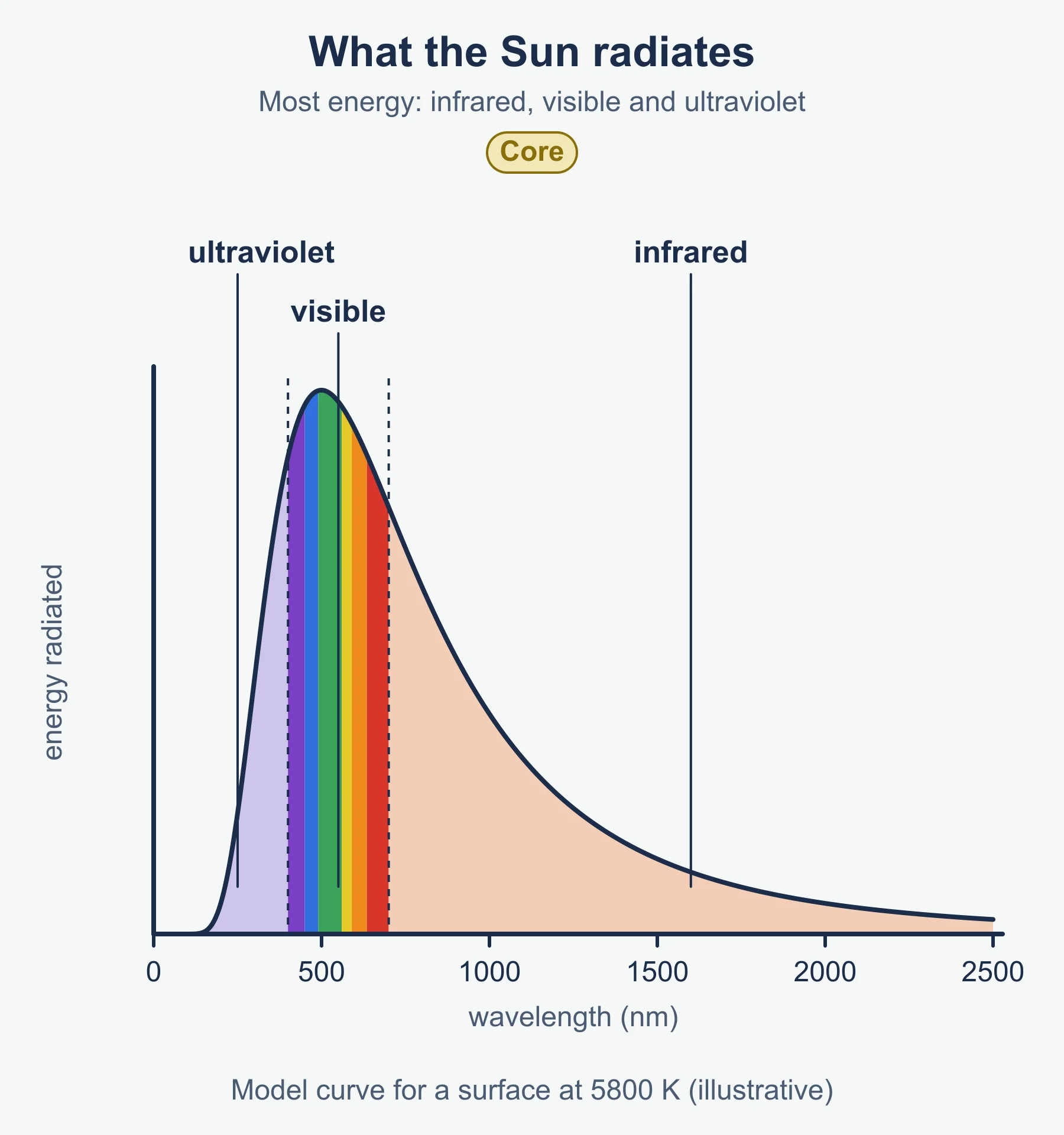
- It radiates most of its energy in the infrared, visible and ultraviolet regions of the electromagnetic spectrum.
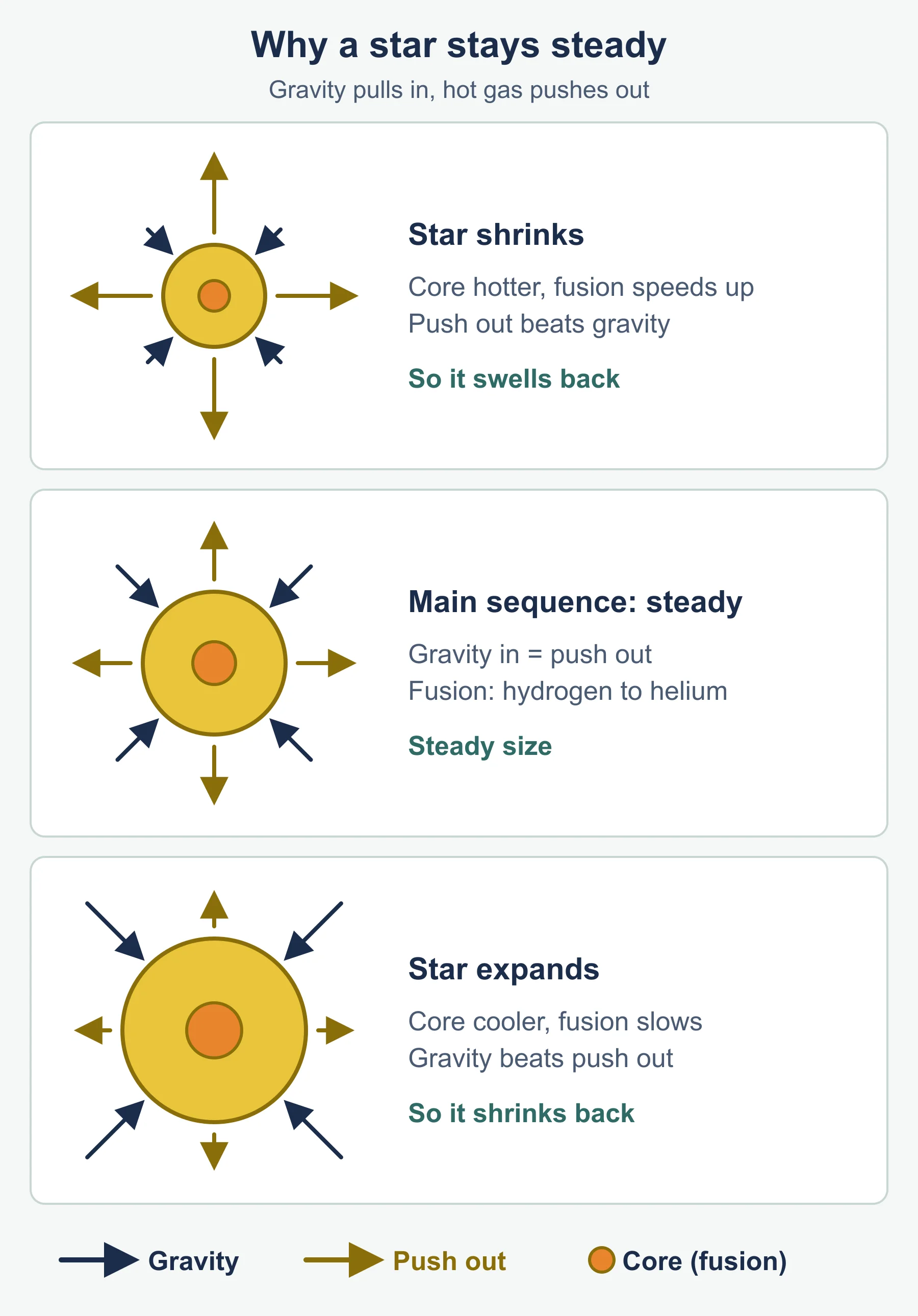
Stars are powered by nuclear reactions that release energy. In stable stars, such as the Sun, the reactions involve the fusion of hydrogen into helium. Fusion means nuclei join to form a heavier nucleus, and the reaction releases energy.
6.2.2 Stars
Galaxies and distances
- A galaxy is made up of many billions of stars.
- The Sun is a star in the galaxy known as the Milky Way.
- The other stars in the Milky Way are much further from the Earth than the Sun is from the Earth.
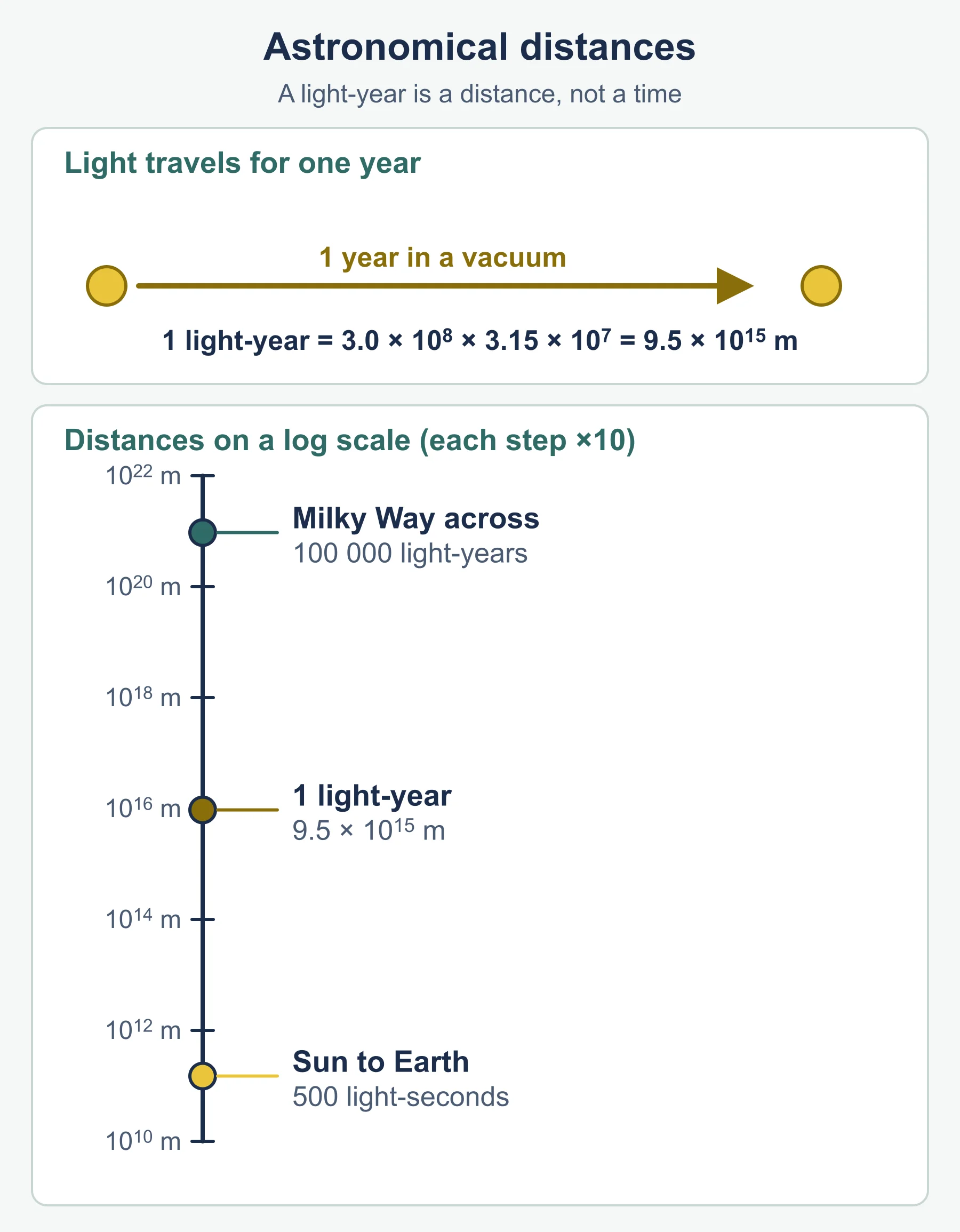
- Astronomical distances can be measured in light-years. One light-year is the distance travelled in a vacuum by light in one year.
A light-year is a distance, not a time. Using c = 3.0 × 10⁸ m/s and one year = 365 × 24 × 3600 s = 3.15 × 10⁷ s:
1 light-year = 3.0 × 10⁸ × 3.15 × 10⁷ = 9.5 × 10¹⁵ m (about 9.5 × 10¹² km).
The syllabus asks only for the definition, so treat this conversion as a useful extension that shows what the definition means.
The life cycle of a star
Learn the sequence in order.
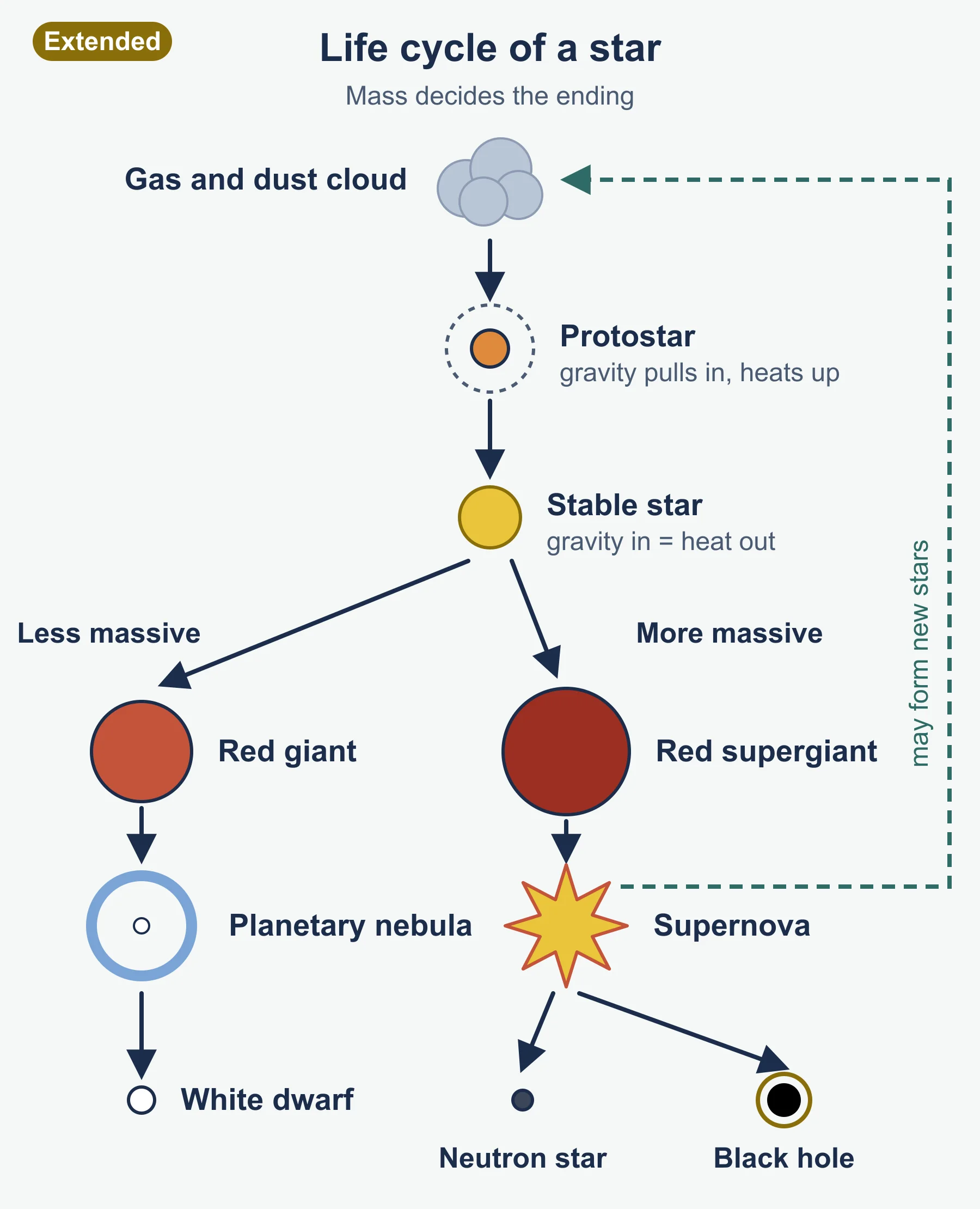
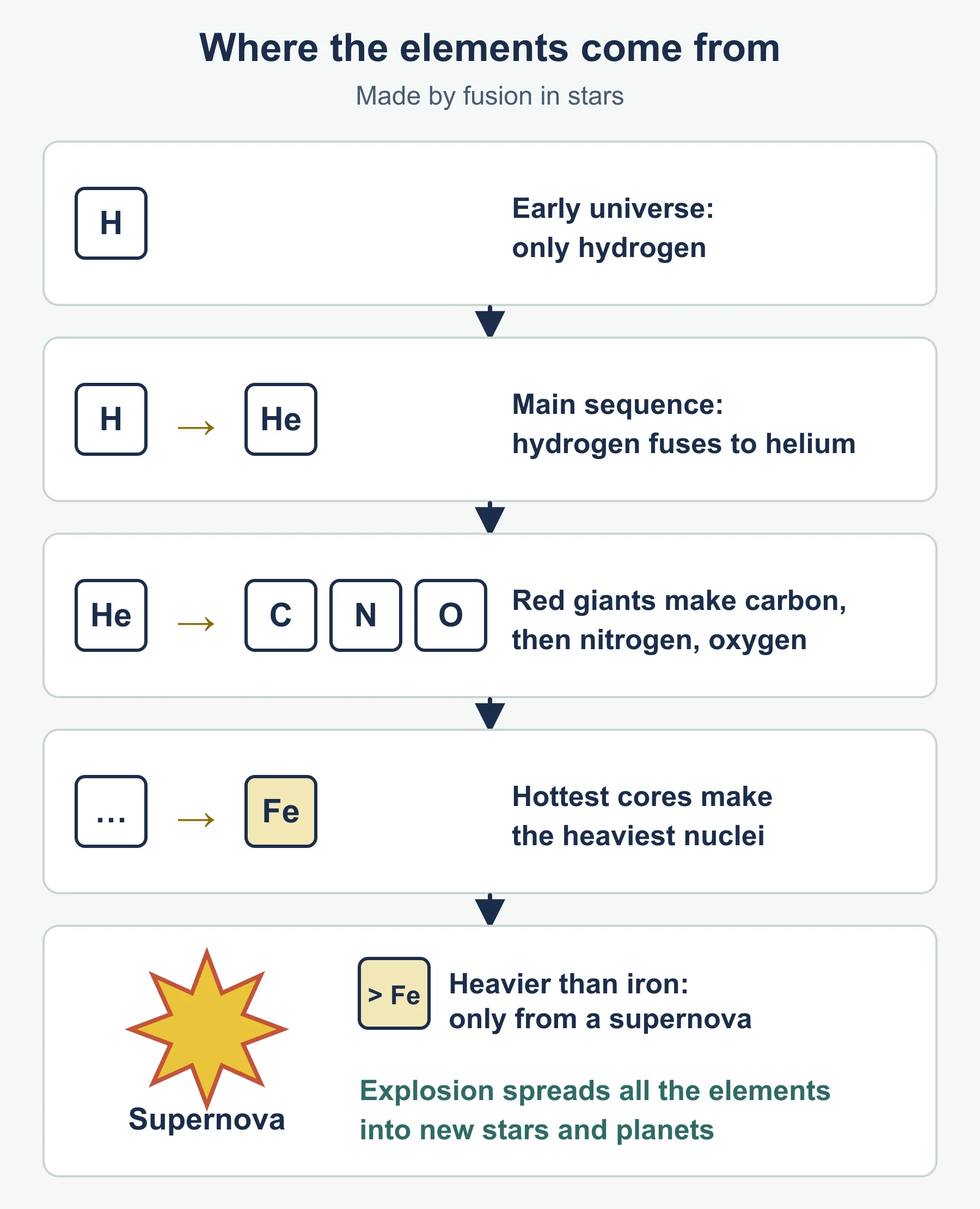
- Formation. A star forms from an interstellar cloud of gas and dust that contains hydrogen.
- Protostar. The cloud collapses and its temperature increases because of its own internal gravitational attraction. A collapsing cloud like this is a protostar.
- Stable star. The protostar becomes a stable star when the inward force of gravitational attraction is balanced by an outward force due to the high temperature in the centre of the star. Hydrogen is fusing into helium.
- Running out of fuel. All stars eventually run out of hydrogen as fuel for the nuclear reaction.
- Red giant or red supergiant. When most of the hydrogen in the centre of the star has been converted to helium, most stars expand to form red giants. More massive stars expand to form red supergiants.
- Less massive star. A red giant from a less massive star forms a planetary nebula with a white dwarf at its centre.
- More massive star. A red supergiant explodes as a supernova. This forms a nebula containing hydrogen and new heavier elements, and leaves behind a neutron star or a black hole at its centre.
- New stars. The nebula from a supernova may form new stars with orbiting planets.
The word “planetary” in “planetary nebula” does not mean the nebula contains planets.
6.2.3 The Universe
- The Milky Way is one of many billions of galaxies that make up the Universe.
- The diameter of the Milky Way is approximately 100 000 light-years. Light would take about 100 000 years to cross it.
Redshift
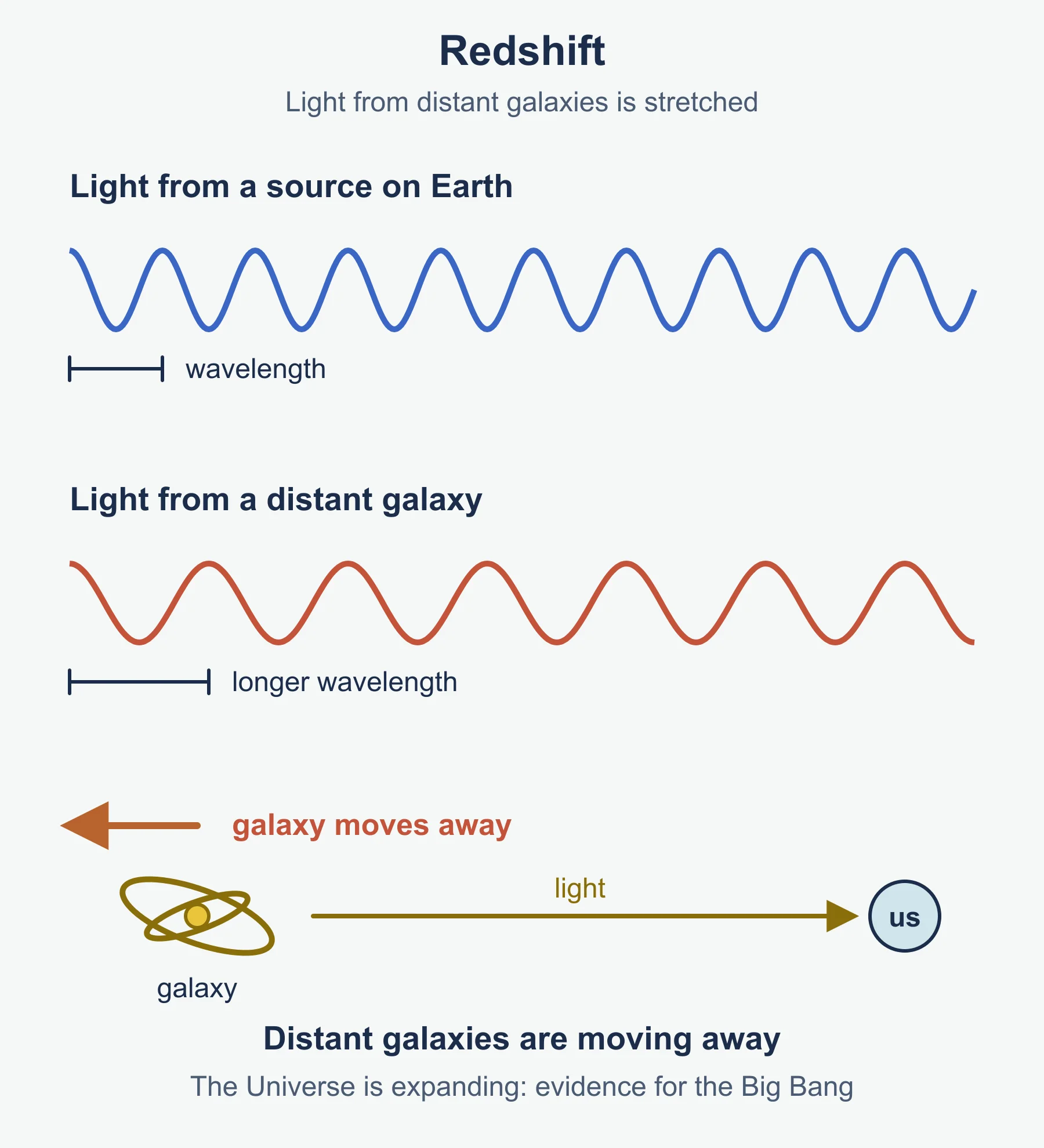
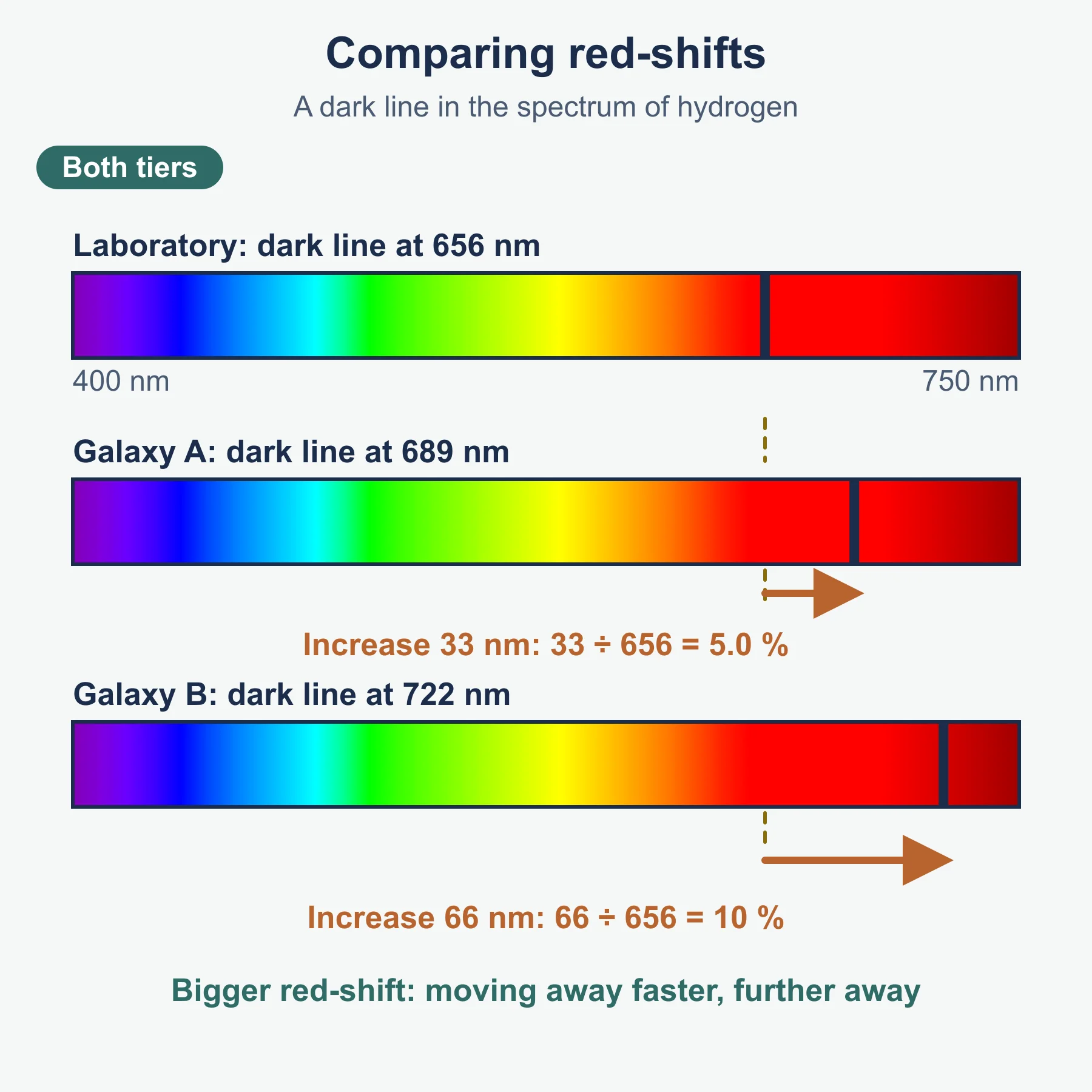
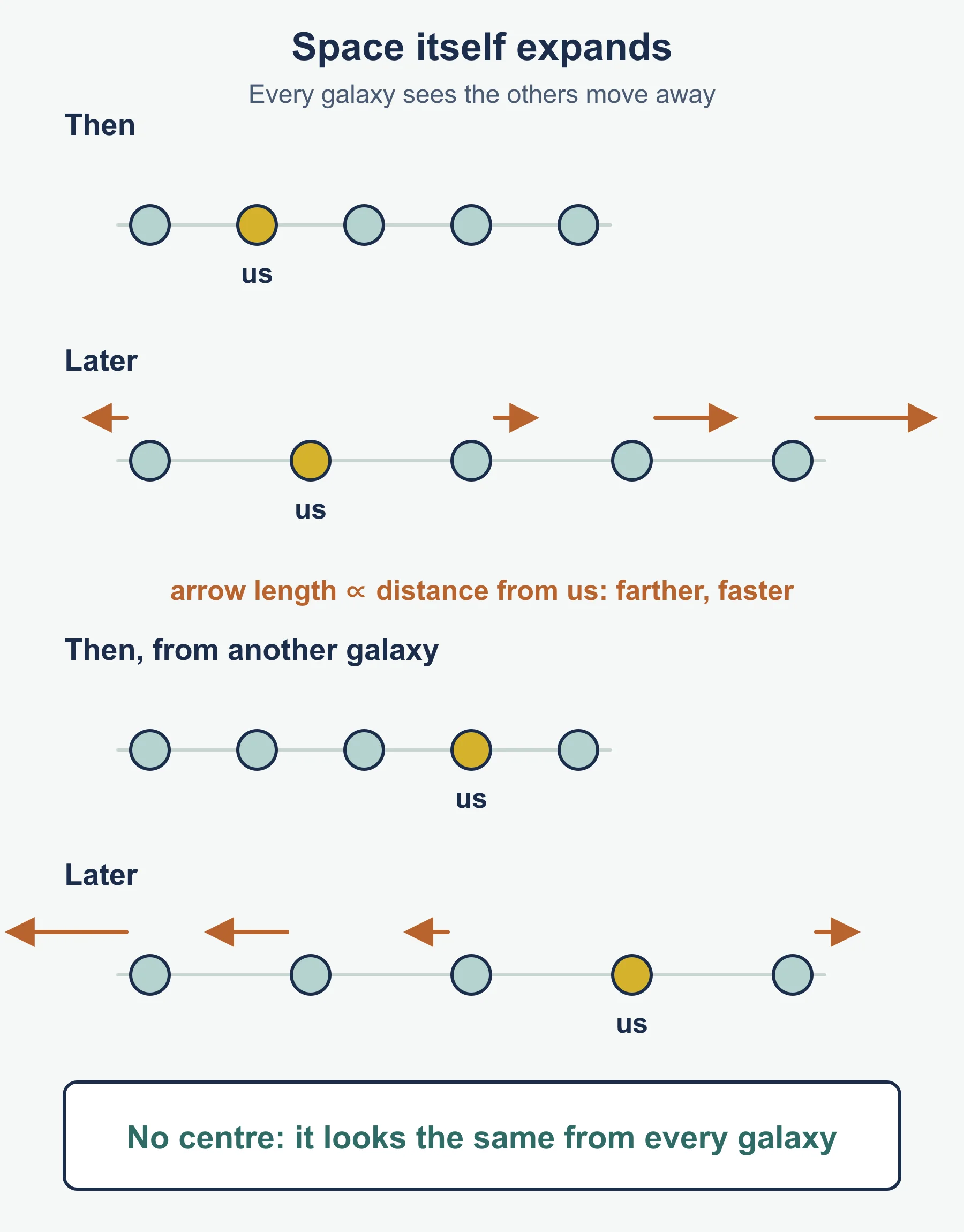
Redshift is an increase in the observed wavelength of electromagnetic radiation emitted from receding stars and galaxies. A receding source is one that is moving away from you. The wavelengths of its light are observed to be longer than the wavelengths emitted. Longer visible wavelengths lie towards the red end, hence the name.
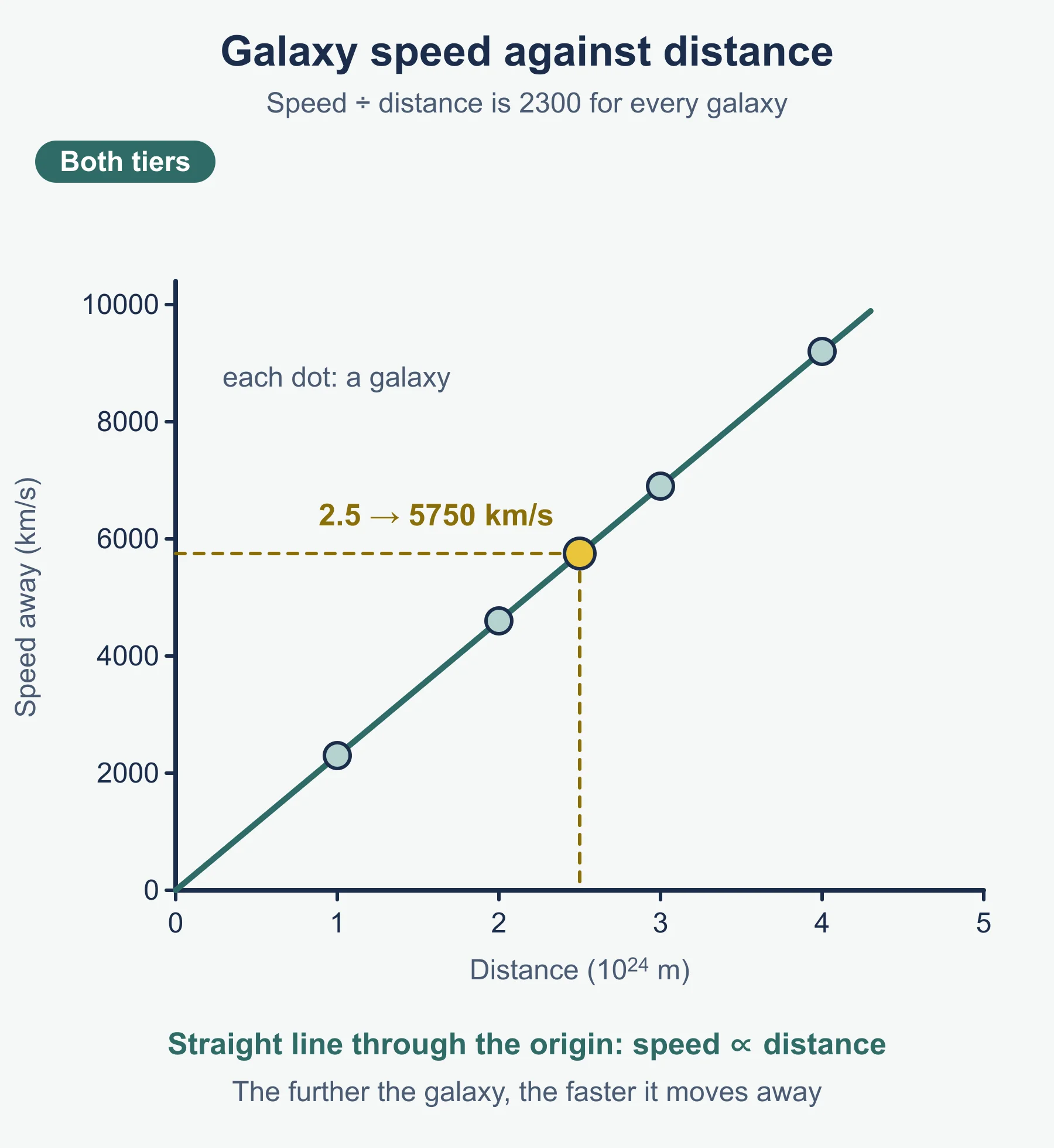
The light from distant galaxies shows redshift. The further away the galaxy, the greater the observed redshift, and the faster the galaxy is moving away from the Earth.
Evidence for the Big Bang
Describe this qualitatively, in three steps.
- Light from distant galaxies is redshifted, so the galaxies are moving away from us.
- The further the galaxy, the faster it recedes, so the Universe is expanding.
- Running the expansion backwards, everything was once much closer together, which is the idea of the Big Bang theory.
Common errors
- Writing a distance in light-years as a time, or the other way round.
- Using r instead of 2πr as the distance for one orbit.
- Mixing time units, for example using days with a radius in km and expecting km/s.
- Saying redshift means light changes colour to red. It means the wavelength increases.
- Sending a less massive star to a neutron star or black hole, or a massive star to a white dwarf.
- Calling the Milky Way the Universe. It is one galaxy among many billions.
Frequently asked questions
What powers the Sun? The Sun is a medium-sized star made mostly of hydrogen and helium. Like other stable stars, it is powered by nuclear fusion of hydrogen into helium, which releases energy.
What is redshift? Redshift is an increase in the observed wavelength of light from receding galaxies. It does not mean the light turns red; saying so is a common error.
What is the difference between the Milky Way and the Universe? The Milky Way is one galaxy among many billions of galaxies in the Universe. Calling the Milky Way the Universe is a frequent mistake.
What happens to stars of different masses at the end of their lives? Less massive stars become red giants and end as white dwarfs, while more massive stars become red supergiants, explode as supernovae and leave a neutron star or black hole.
Next steps
Try the practice questions, then use the revision notes for a quick recap. Check your progress against the checklist and the Cambridge O Level Physics hub. If you want guided help, book a free trial class.
Official syllabus
Cambridge O Level Physics 5054 syllabus for examination in 2026, 2027 and 2028, published by Cambridge International, topic 6 Space physics.
Get free revision emails (optional)
Occasional emails with practice questions, worked explanations and links to free resources for the qualification and subjects you choose. No spam, and you can unsubscribe from any email. The free tools on this site never need an email.
Related resources
-
Practice questions
O Level Physics: Space physics — Practice Questions (Cambridge 5054)
Original Cambridge O Level Physics 5054 space physics questions with worked answers on planets, gravity, orbital speed and period, stable stars and redshift.
Physics · Cambridge · O Level
Try questions -
Revision notes
O Level Physics: Space physics (Cambridge 5054) – Revision Notes
Condensed revision notes on space physics for Cambridge O Level Physics (5054): key facts, orbital speed method, star life cycle, redshift and a self-test.
Physics · Cambridge · O Level
Revise topic -
Study guides
O Level Physics: Thermal physics (Cambridge 5054)
Study guide to thermal physics for Cambridge O Level Physics 5054: particle model, gas laws, expansion, heat capacity, state changes, energy transfer.
Physics · Cambridge · O Level
Read guide
Related articles
-
study skills
How to revise for a science examination
Most science revision fails because it rereads notes instead of retrieving them. A practical method for revising physics, chemistry and biology in the weeks before a paper.
14 July 2026
-
teaching
A Level tuition in Dubai: Cambridge or Pearson Edexcel International A Level?
Schools in Dubai and Abu Dhabi teach either Cambridge International AS & A Level or Pearson Edexcel International A Level. How the two are structured, why it matters for tuition, and how online classes from Lahore work.
9 October 2026
Studying this with a teacher
Working through Physics O LEVELS?
This page is free and stays free. If you would rather be taught it, Marlbridge runs Physics classes one-to-one and in small groups of up to 15, online in your own time zone. The first trial class is free. WhatsApp replies within an hour (8am–11pm Pakistan time, every day); email the same day.
Cambridge Physics teachers at Marlbridge


