Study Guides
O Level Physics: Thermal physics (Cambridge 5054)
Study guide to thermal physics for Cambridge O Level Physics 5054: particle model, gas laws, expansion, heat capacity, state changes, energy transfer.
- Subject
- Physics
- Level
- O LEVELS
- Topic
- Thermal physics
- Author
- Marlbridge Academic Team
- Updated
- Reviewed by
- Hassan (what this means)
Aligned to Cambridge O Level Physics (5054), 2026-2028. Official specification .
Syllabus page (what it covers and how it is assessed): Cambridge O Level Physics.
Syllabus points this page covers
5054
- 2.1 Kinetic particle model of matter
- 2.2 Thermal properties and temperature
- 2.3 Transfer of thermal energy
Found an error? Report a correction.
Need help with this topic? Request a free trial class for O Level Physics (5054).
This guide teaches topic 2, Thermal physics, from the Cambridge O Level Physics 5054 syllabus for examination in 2026, 2027 and 2028. For quick recall, use the revision notes. For worked exam-style questions, try the existing practice set. The course hub is Cambridge O Level Physics, the printable list is the physics checklist, and the free diagnostics let you test yourself.
What this topic covers
| Syllabus section | What you must be able to do |
|---|---|
| 2.1.1 States of matter | Know the properties of solids, liquids and gases and the names of the changes of state |
| 2.1.2 Particle model | Describe particle structure, temperature, absolute zero, gas pressure, and the links between pressure, volume and temperature, including p1V1 = p2V2 |
| 2.2.1 Thermal expansion | Explain applications and particle causes, compare solids, liquids and gases, convert between kelvin and degrees Celsius |
| 2.2.2 Specific heat capacity | Link temperature to internal energy, define and use c = ΔE / (mΔθ), describe experiments |
| 2.2.3 Melting, boiling, evaporation | Describe energy changes at changes of state, boiling versus evaporation, cooling, latent heat |
| 2.3.1 to 2.3.3 | Describe conduction, convection and radiation and the experiments that show them |
| 2.3.4 Consequences | Explain pans, room heating, infrared thermometers and insulation |
2.1.1 States of matter
| State | Shape | Volume | Can be compressed? |
|---|---|---|---|
| Solid | Fixed | Fixed | Hardly at all |
| Liquid | Takes the shape of the container | Fixed | Hardly at all |
| Gas | Fills the container | Fills the container | Easily |
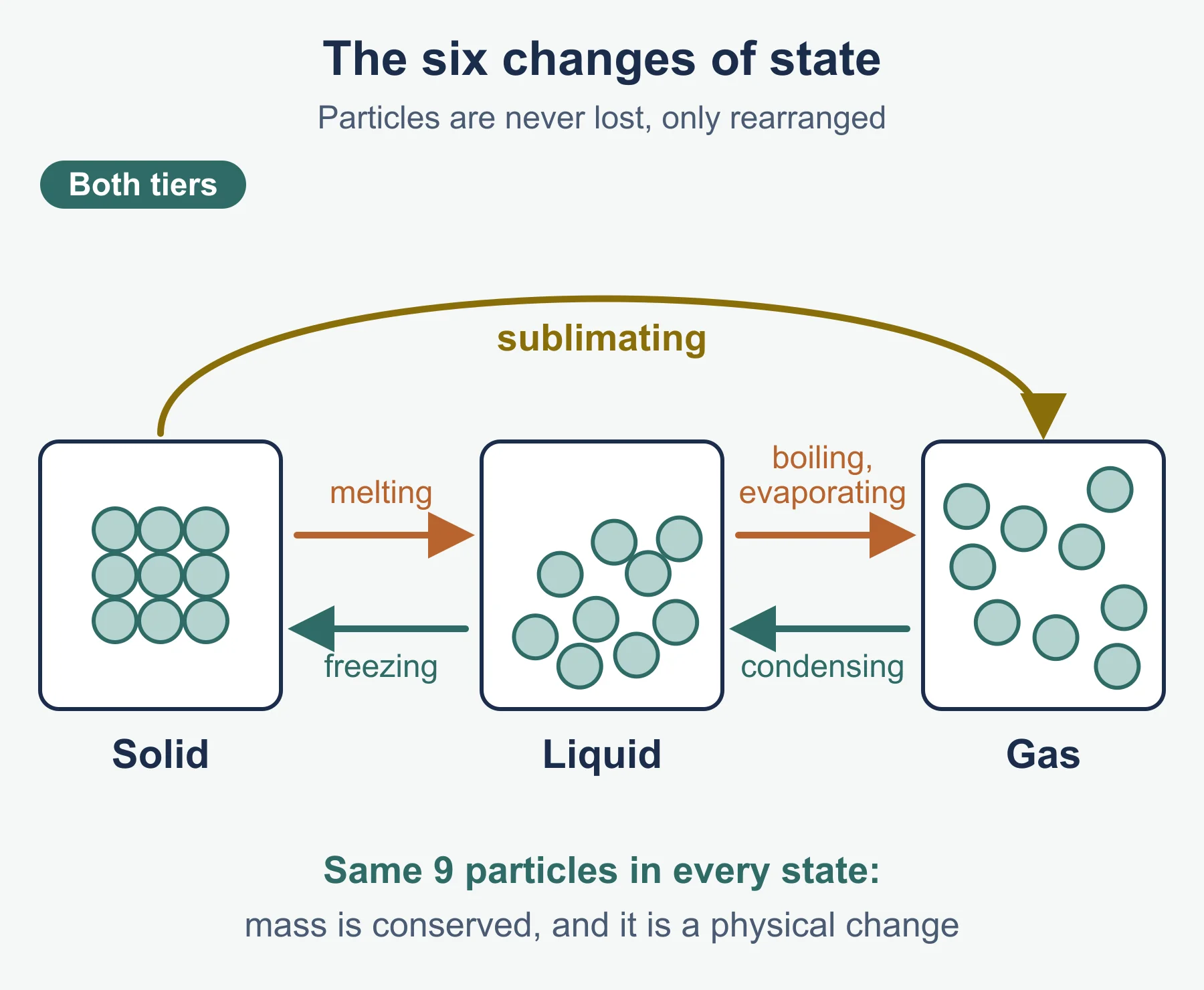
Changes of state: solid to liquid is melting, liquid to solid is solidification, liquid to gas is boiling (or evaporation), and gas to liquid is condensation. Direct gas-to-solid and solid-to-gas changes are not required.
2.1.2 The particle model
Structure and motion
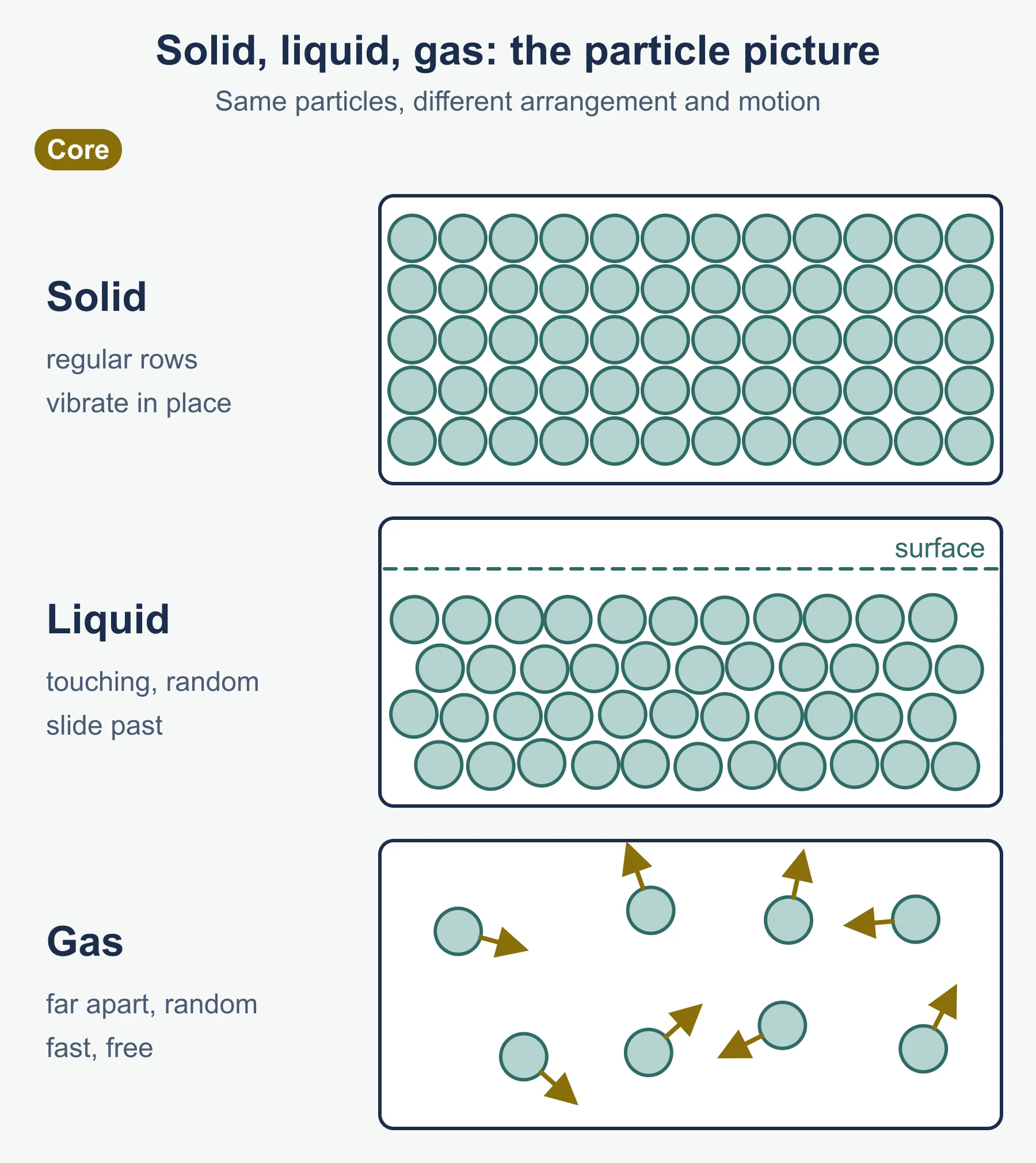
- Solid: particles are packed closely in a regular pattern. Strong forces hold each particle in place, so it only vibrates about a fixed position.
- Liquid: particles are close together but in no fixed pattern. They slide past one another. The forces are weaker than in a solid.
- Gas: particles are far apart and move quickly in random directions. The forces between them are negligible except during collisions.
Temperature and absolute zero
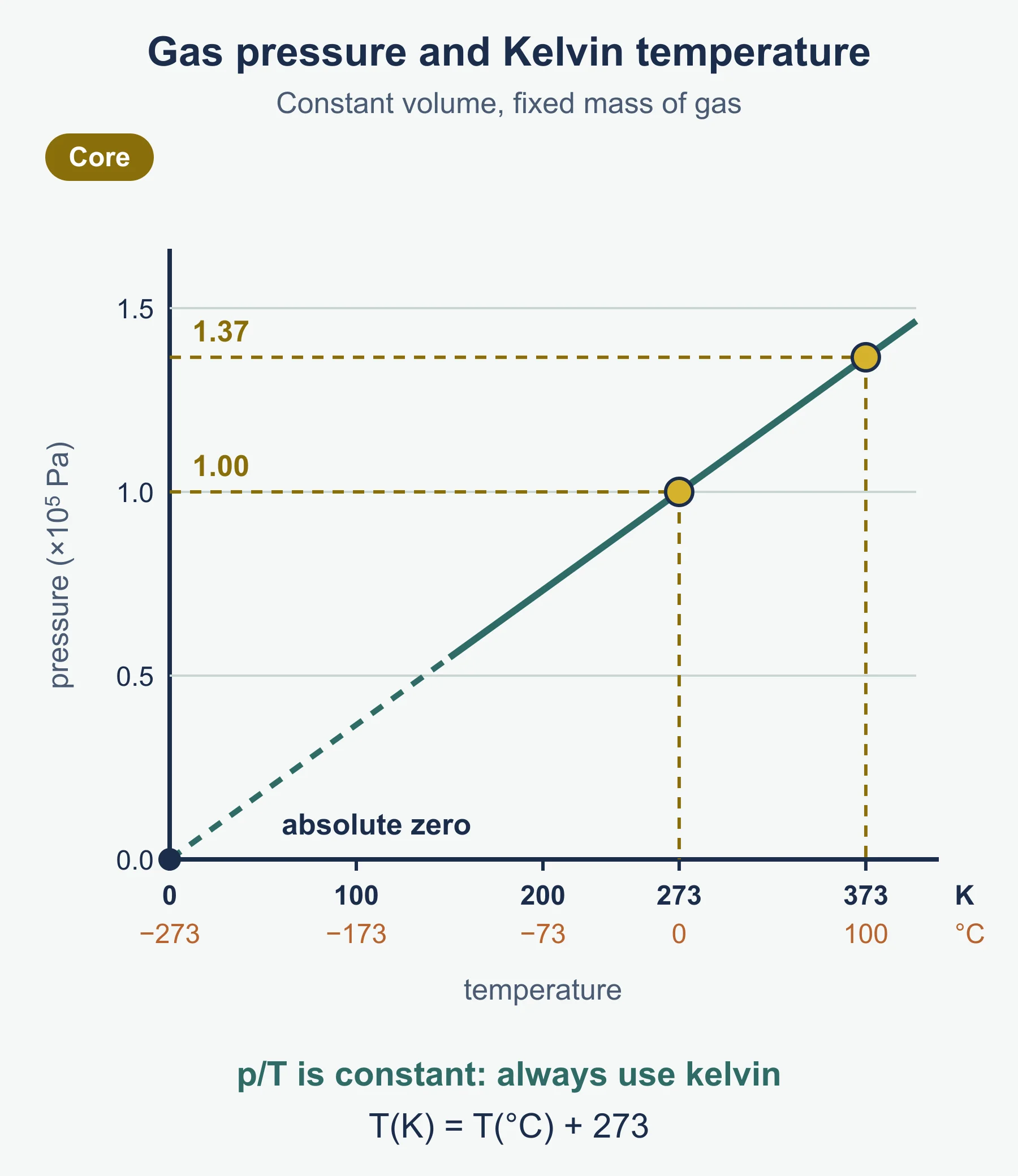
A higher temperature means a higher average kinetic energy of the particles, so they move faster. There is a lowest possible temperature, absolute zero, which is −273 °C. At absolute zero the particles have the least kinetic energy they can have.
Gas pressure
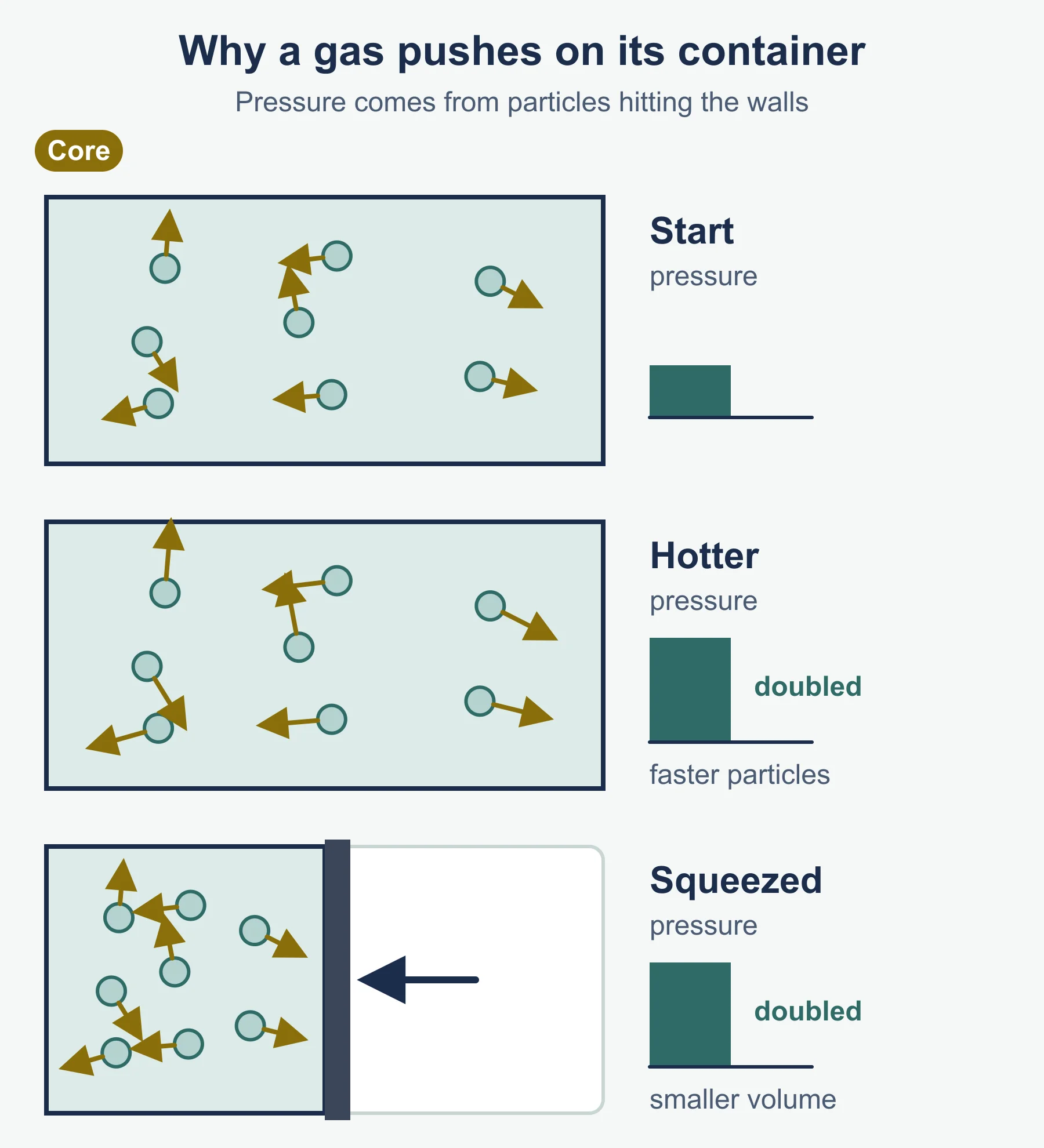
Gas particles collide with the walls of a container. A rebounding particle changes direction, so the wall pushes on it, and by the third law of motion the particle pushes back on the wall with an equal force. Huge numbers of collisions each second give a steady force on each unit of area of the wall. That force per unit area is the pressure.
The three relationships (qualitative)
- Pressure and temperature at constant volume. Heat the gas and the particles move faster. Collisions with the walls become more frequent and each one is more forceful, so the pressure rises.
- Volume and temperature at constant pressure. Faster particles would hit the walls harder and more often, so for the pressure to stay the same, the volume must increase and the walls are hit less often.
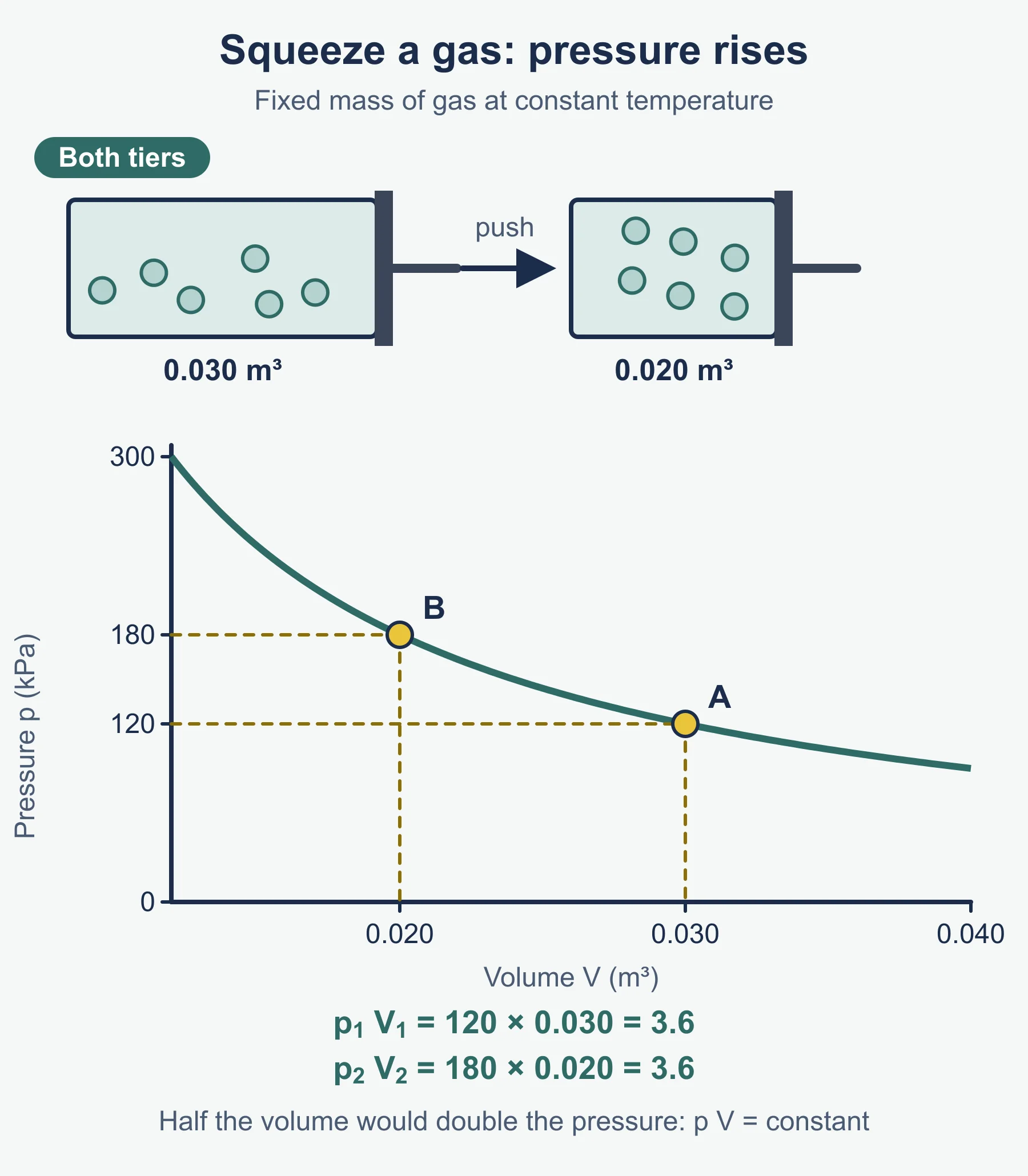
- Pressure and volume at constant temperature. The particles keep the same average speed. A smaller volume means they travel a shorter distance between wall collisions, so they hit the walls more often and the pressure rises.
The equation p1V1 = p2V2
If the mass of gas and its temperature are both fixed, the product pressure × volume does not change.
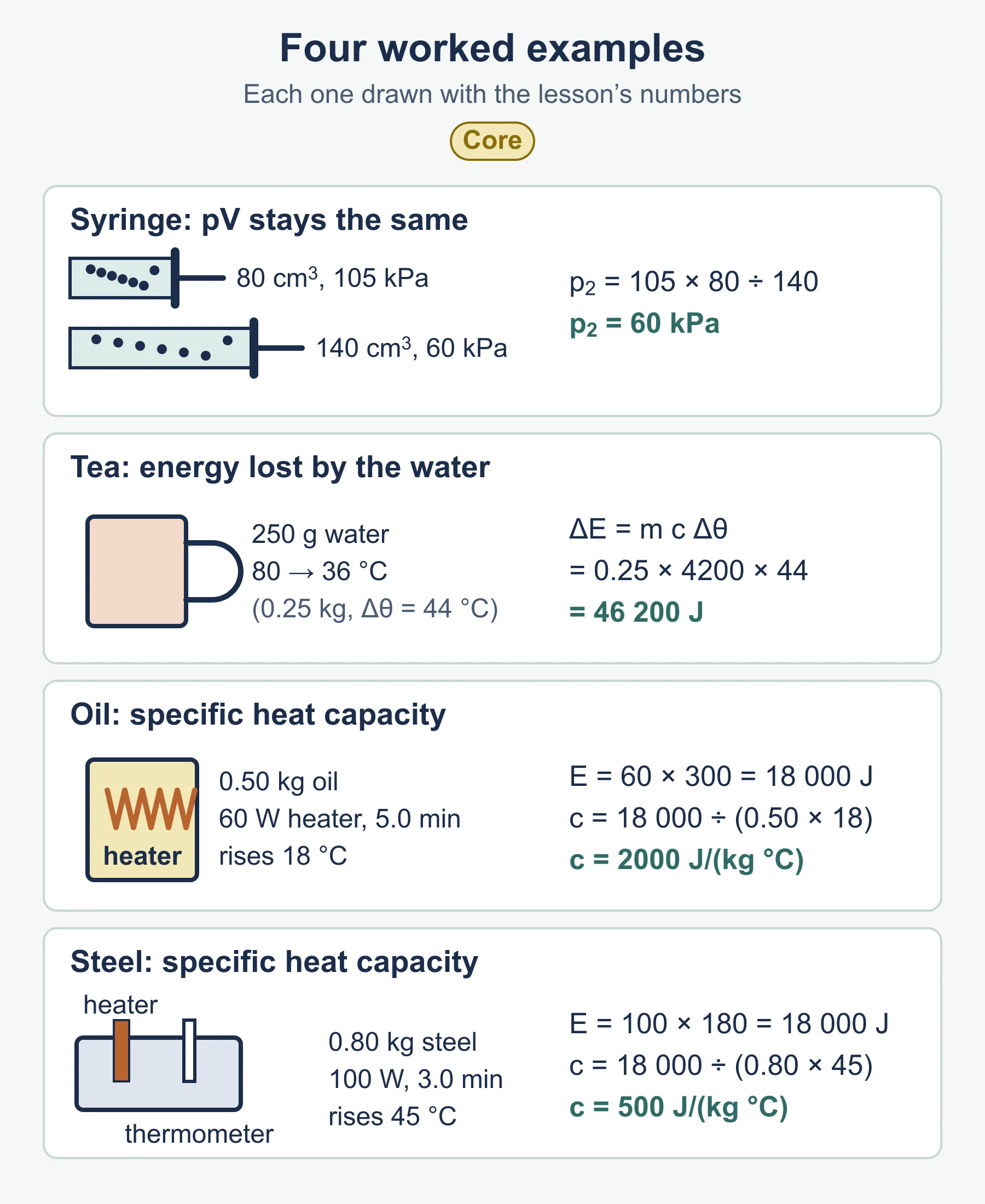
Worked example. A syringe holds 80 cm³ of air at 105 kPa. The plunger is pulled out slowly until the volume is 140 cm³, and the temperature does not change. Find the new pressure.
p1V1 = p2V2
105 × 80 = p2 × 140
p2 = 8400 / 140 = 60 kPa
The pressure fell because the volume rose.
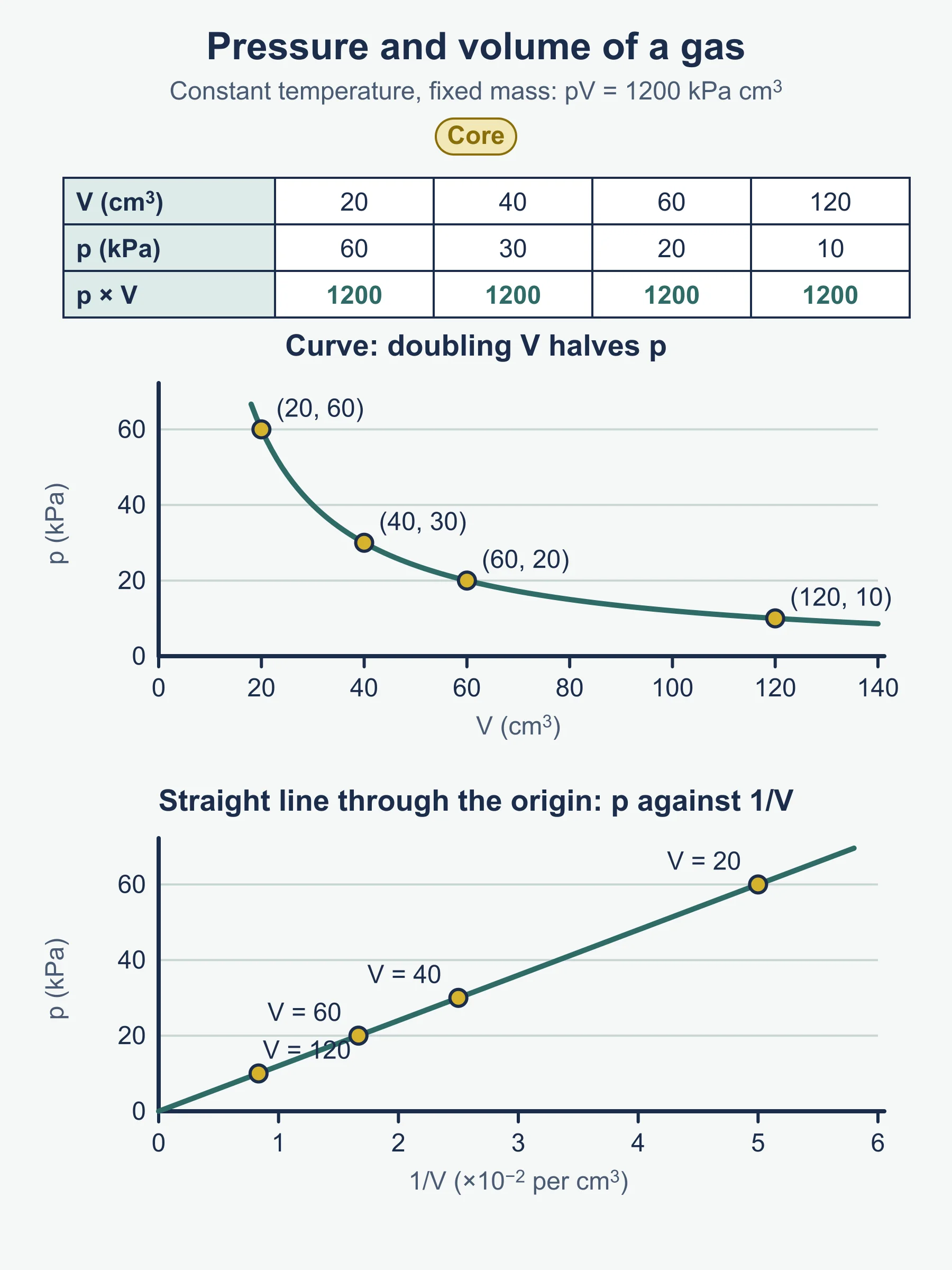
Graph. At constant temperature, a plot of pressure against volume is a curve that falls steeply and then flattens, never touching either axis. For example, with pV = 1200 (kPa cm³):
| V (cm³) | 20 | 40 | 60 | 120 |
|---|---|---|---|---|
| p (kPa) | 60 | 30 | 20 | 10 |
Doubling the volume halves the pressure. Drawing p against 1/V gives a straight line passing through the origin.
2.2.1 Thermal expansion
Particle explanation
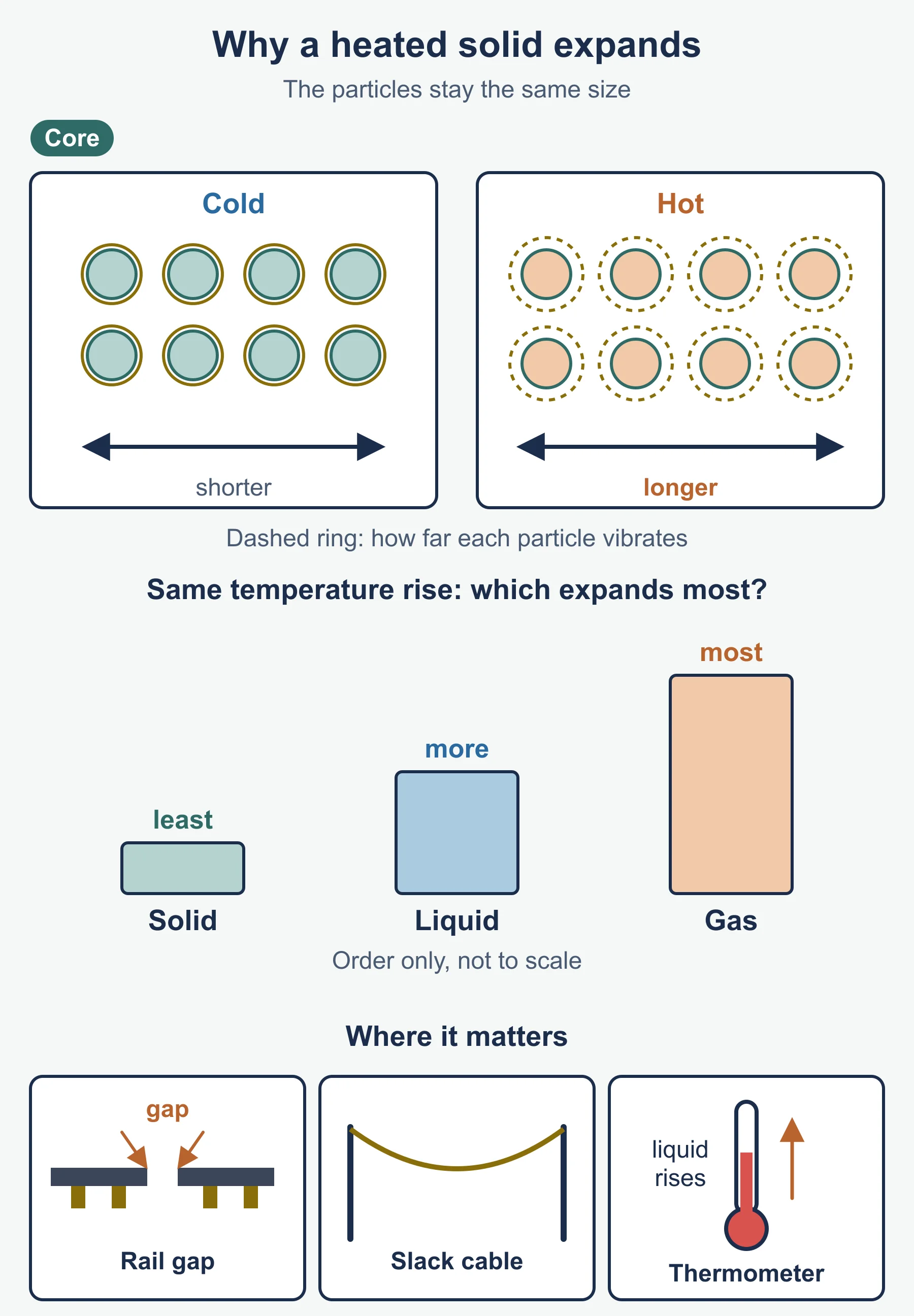
When a solid is heated, its particles vibrate with larger amplitude. They push slightly further apart on average, so the solid expands. The particles themselves do not get bigger. In a liquid and in a gas, faster-moving particles also move further apart on average. Gases expand far more than liquids, and liquids expand more than solids, for the same temperature rise. This is the relative order of magnitudes you are asked to state.
Applications and consequences
- Liquid-in-glass thermometer: the liquid in the bulb expands when warmed and rises up a narrow tube.
- Railway tracks and bridges: gaps or rollers let the metal expand on hot days without buckling.
- Overhead power cables: they are left slightly slack so that they do not snap when they contract in cold weather.
Kelvin and Celsius
T (in K) = θ (in °C) + 273
Worked example. Convert body temperature of 37 °C to kelvin, and 350 K to degrees Celsius.
37 + 273 = 310 K
350 - 273 = 77 °C
A change of 1 K equals a change of 1 °C. Absolute zero is 0 K.
2.2.2 Specific heat capacity
Internal energy and temperature
Raising the temperature of an object raises its internal energy. In particle terms, the average kinetic energy of all the particles in the object increases.
Definition and equation
Specific heat capacity is the energy required per unit mass per unit temperature increase.
c = ΔE / (mΔθ), which rearranges to ΔE = mcΔθ.
Use kilograms and joules, so c is in J/(kg °C).
Worked example 1. A tea maker has 250 g of water at 80 °C. It cools to 36 °C. Take c for water as 4200 J/(kg °C). How much energy does the water lose?
m = 250 g = 0.25 kg
Δθ = 80 - 36 = 44 °C
ΔE = mcΔθ = 0.25 × 4200 × 44 = 46 200 J
Experiment: specific heat capacity of a liquid
- Weigh an insulated beaker, add a known mass of liquid and record the mass.
- Place an electric immersion heater and a thermometer in the liquid. Stir.
- Record the starting temperature, switch on the heater, and note the power (or the current and voltage) and the time.
- Switch off, keep stirring, and record the highest temperature reached.
- Energy supplied = power × time. Then c = ΔE / (mΔθ).
Worked example 2. A 60 W heater warms 0.50 kg of oil for 5.0 minutes. The temperature rises by 18 °C.
E = 60 × 300 = 18 000 J
c = 18 000 / (0.50 × 18) = 2000 J/(kg °C)
Experiment: specific heat capacity of a solid
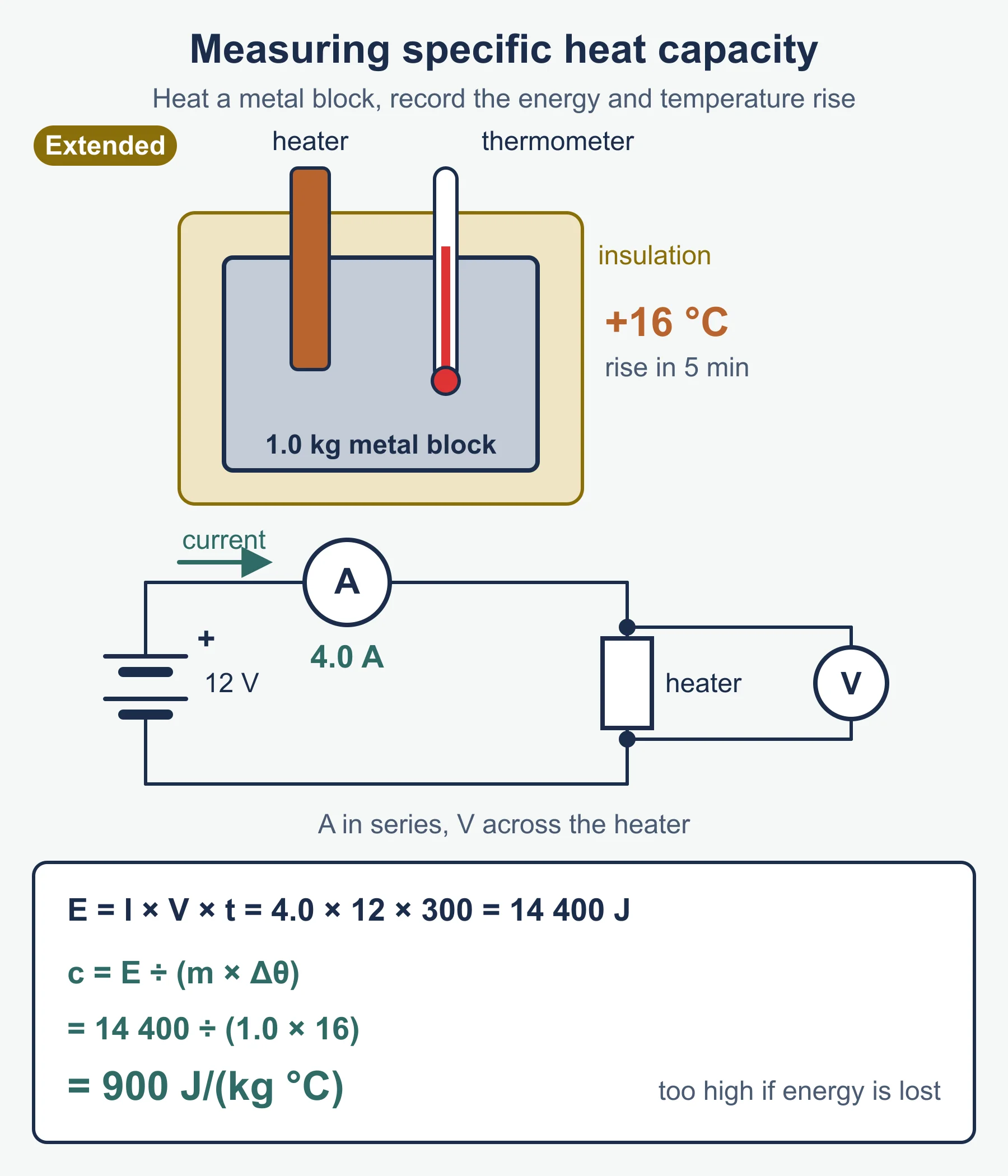
Use a metal block with two holes. Put the heater in one hole and the thermometer in the other, with a drop of oil in the thermometer hole for good contact. Wrap the block in insulation. Measure mass, power, time and temperature rise as before.
Worked example 3. A 100 W heater is on for 3.0 minutes in a 0.80 kg steel block. The temperature rises by 45 °C.
E = 100 × 180 = 18 000 J
c = 18 000 / (0.80 × 45) = 500 J/(kg °C)
Why the measured value is usually too high
Some energy leaks to the surroundings, so the temperature rise is smaller than expected. That makes c too large. Insulation reduces the error.
2.2.3 Melting, boiling and evaporation
Energy without a change in temperature
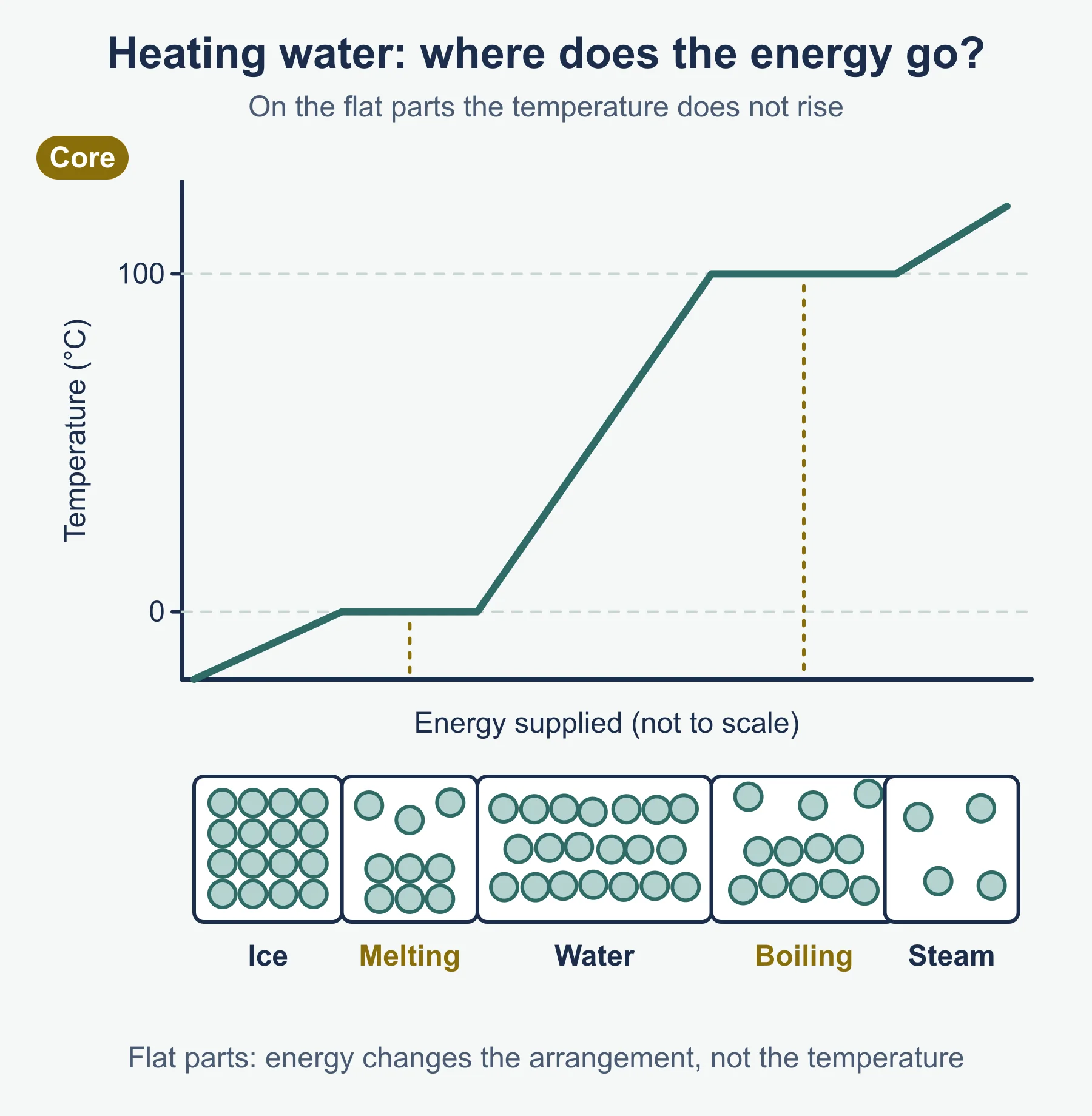
At melting and boiling, energy goes in, but the temperature stays constant until the change is complete. At solidification and condensation, energy goes out, again at constant temperature.
Under standard atmospheric pressure, water melts at 0 °C and its boiling temperature is 100 °C.
Latent heat
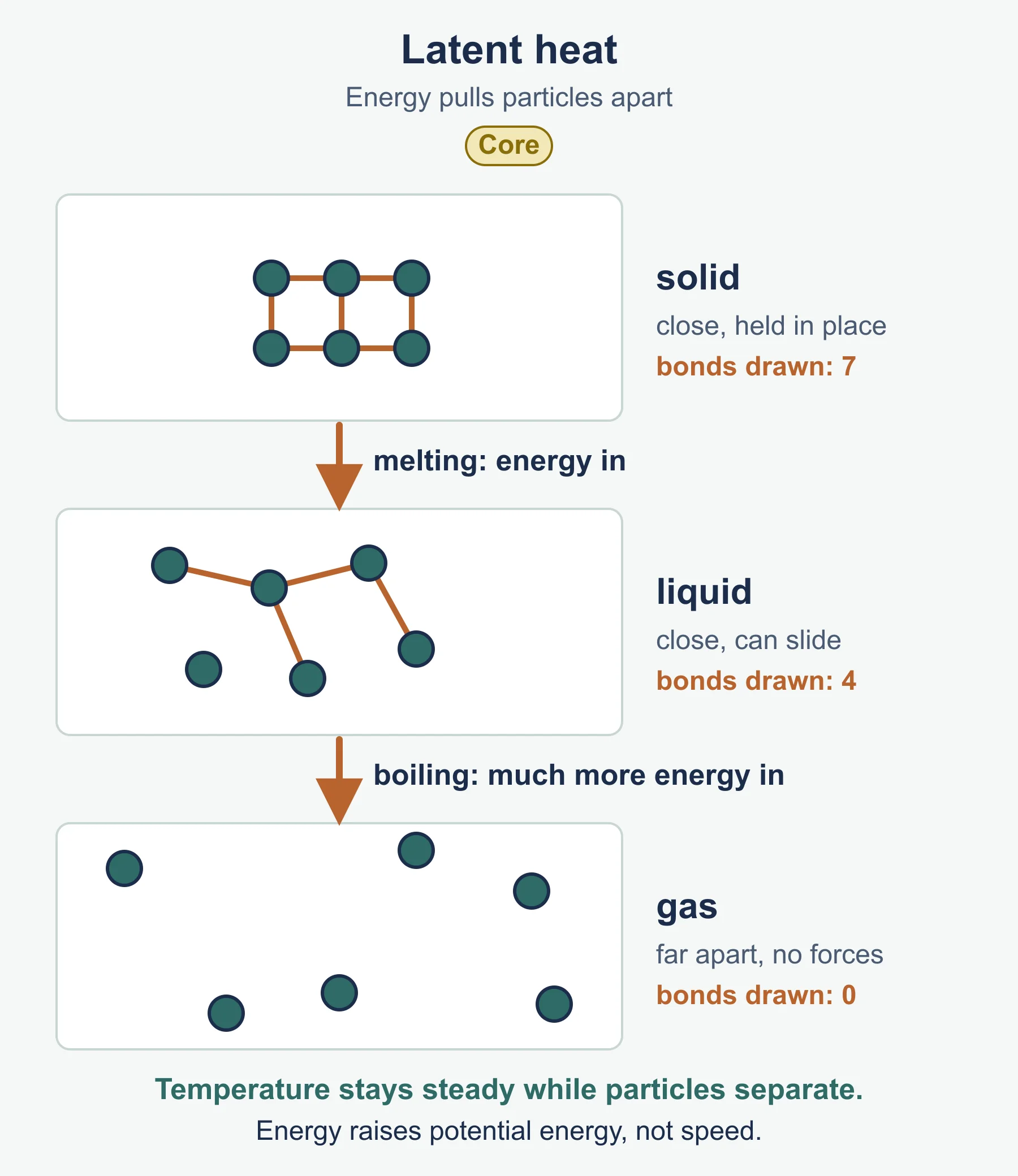
Latent heat is the energy that must be supplied or removed for a substance to change state. The energy does not raise the temperature. It increases the potential energy of the particles by pulling them apart against the forces between them. On melting, the particles break out of their fixed positions. On boiling, they separate completely, which needs much more energy.
Boiling and evaporation
| Boiling | Evaporation | |
|---|---|---|
| Temperature | Only at the boiling temperature | At any temperature |
| Where | Throughout the liquid, with bubbles forming | Only at the surface |
| Speed | Rapid | Slow |
How evaporation works and what affects it
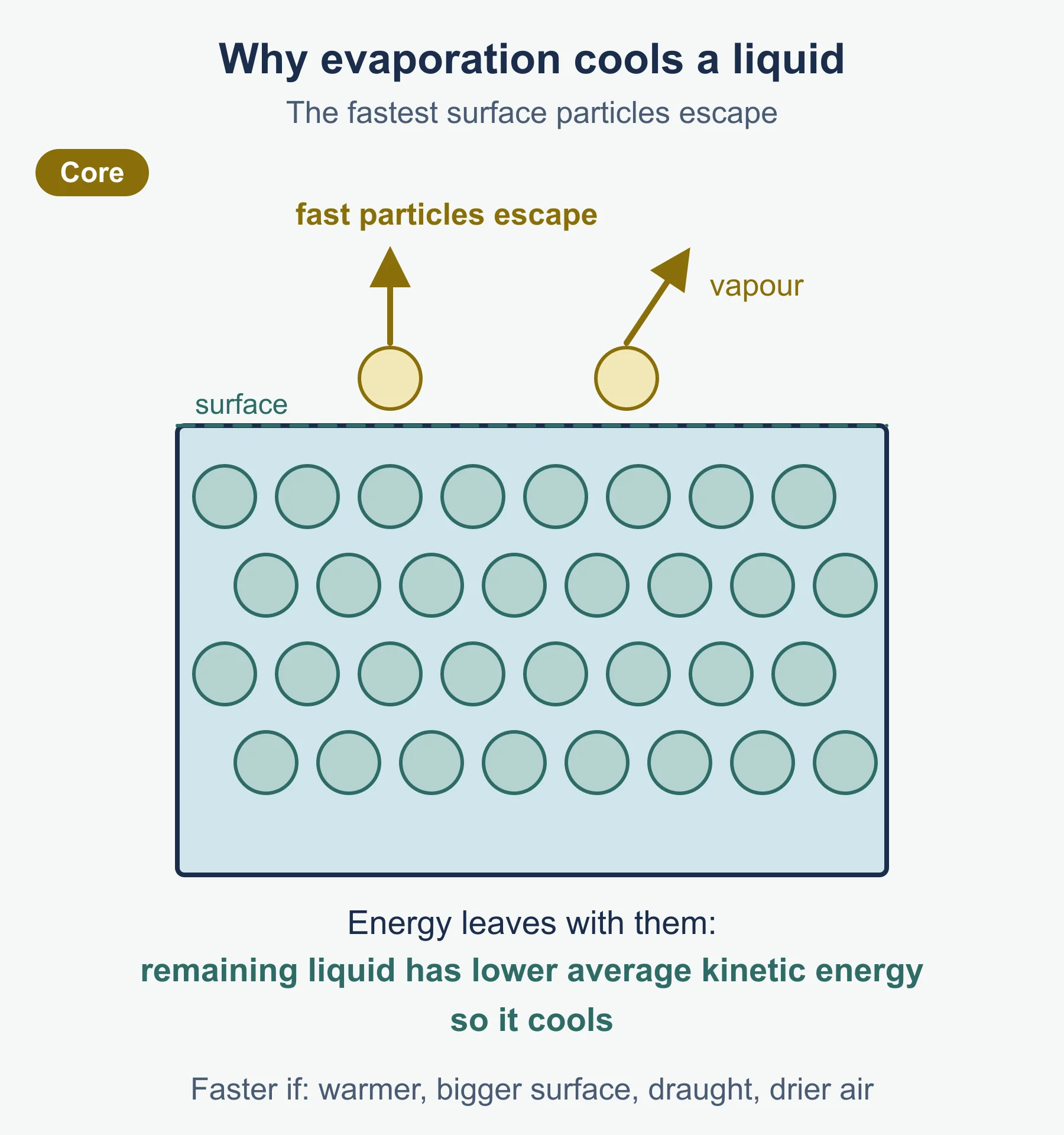
In a liquid, particles have a range of speeds. The more energetic particles near the surface can escape if they are moving fast enough to overcome the attractions of the others. These escaped particles leave the average kinetic energy of the remaining liquid lower, so the liquid cools.
Evaporation is faster when:
- the temperature is higher, since more particles have enough energy to escape
- the surface area is larger, since more particles are near the surface
- air moves over the surface, since it carries away escaped particles that might return.
2.3 Transfer of thermal energy
2.3.1 Conduction
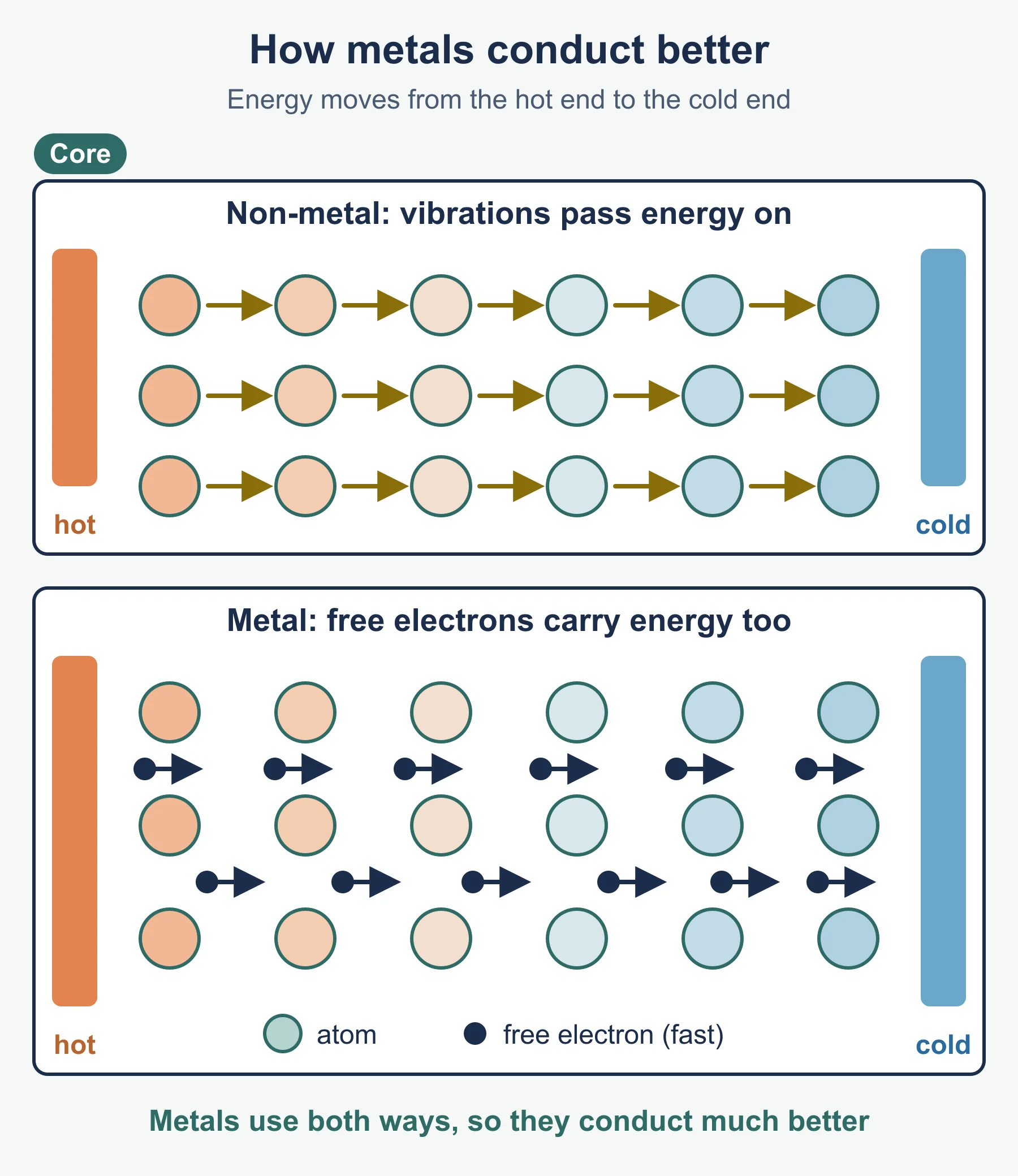
In a solid, vibrating atoms pass energy to their neighbours through the lattice. This happens in all solids. In metals there are also free (delocalised) electrons. They gain energy, move through the metal, and pass it on in collisions. So metals conduct much better than non-metals.
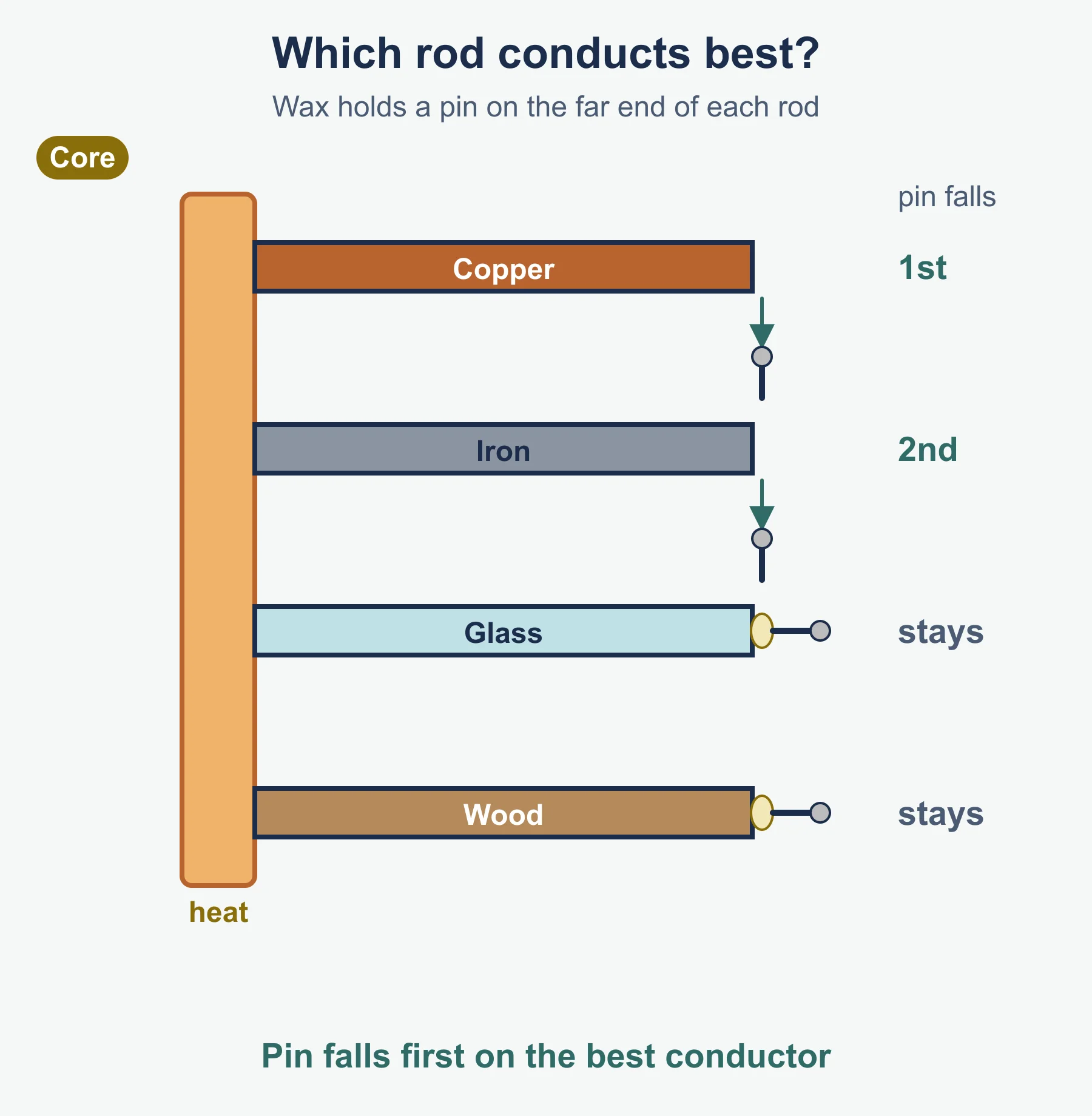
Experiment to compare conductors. Stand rods of different materials, with the same size, in hot water. Stick a pin to the free end of each with a blob of wax. The pin drops off first from the best conductor.
2.3.2 Convection
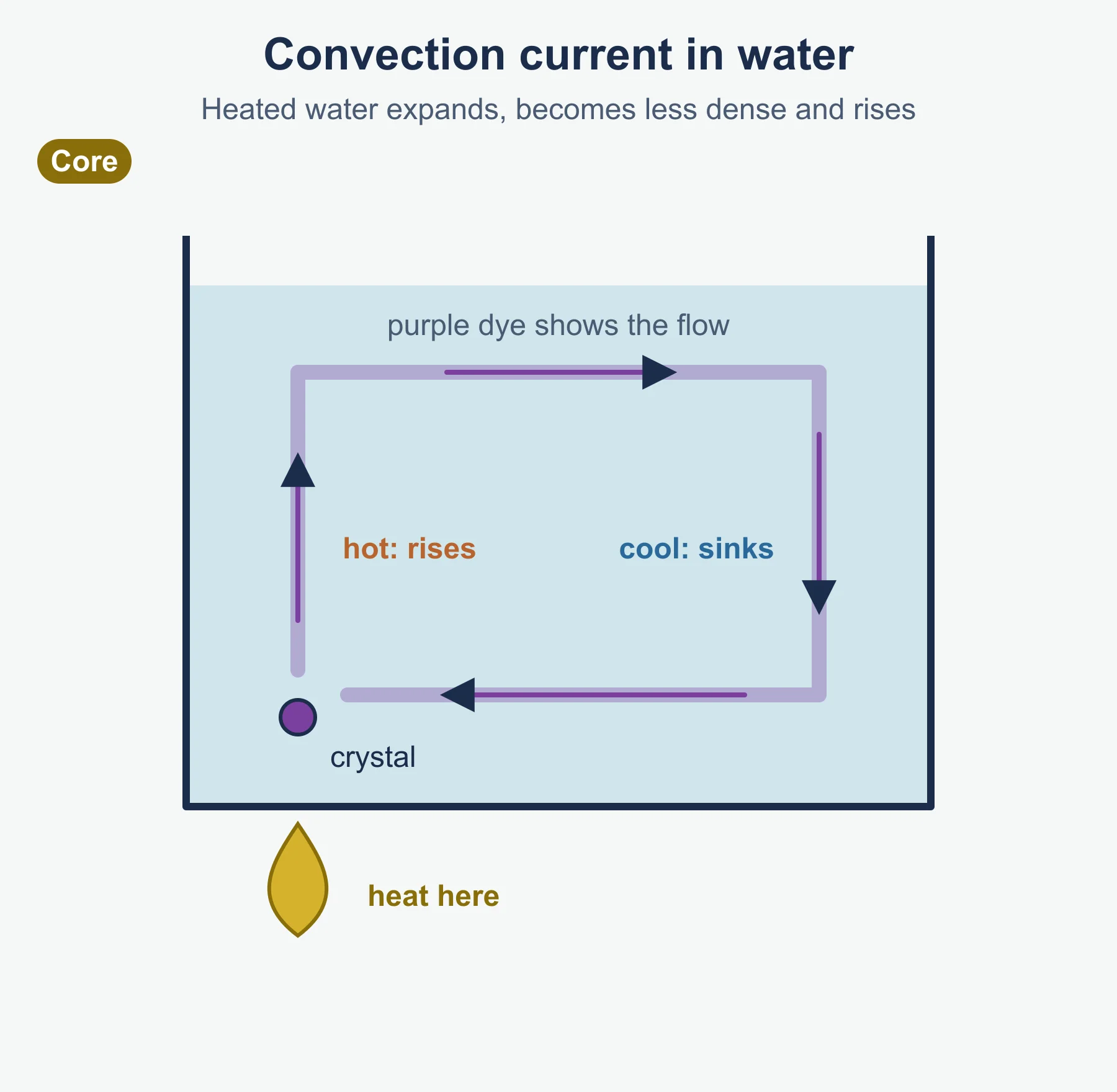
Convection happens in liquids and gases. A heated region of fluid expands, so its density decreases. It rises, and cooler, denser fluid sinks to take its place. A circulating convection current forms.
Experiment. Place one small crystal of potassium permanganate at the bottom of a beaker of water, near one edge, and heat the glass directly below it. The purple streak rises over the flame and sinks on the other side. In air, smoke shows the same circulation above a warm object.
2.3.3 Radiation
Infrared radiation transfers thermal energy as electromagnetic waves. It does not need a medium, which is how energy reaches Earth across space.
| Surface | Emits | Absorbs | Reflects |
|---|---|---|---|
| Dull black | Best | Best | Least |
| Shiny white or silver | Worst | Worst | Best |
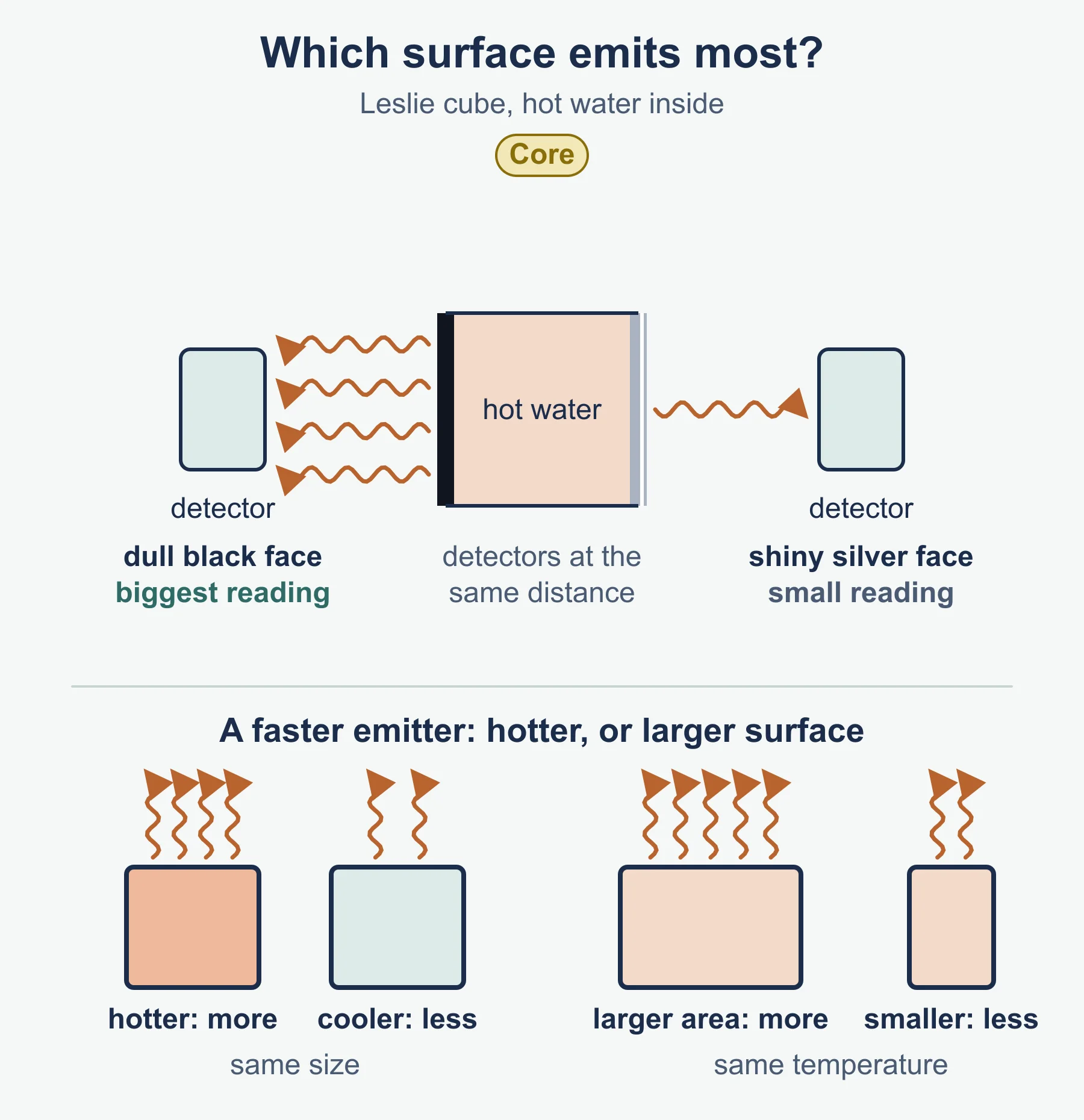
Dull surfaces emit and absorb better than shiny ones. A hotter object, and one with a larger surface area, emits radiation at a greater rate.
Experiments.
- Emitters: fill a Leslie cube (or identical cans with different surfaces) with hot water. Place a radiation detector or thermometer the same distance from each face. The dull black face gives the largest reading.
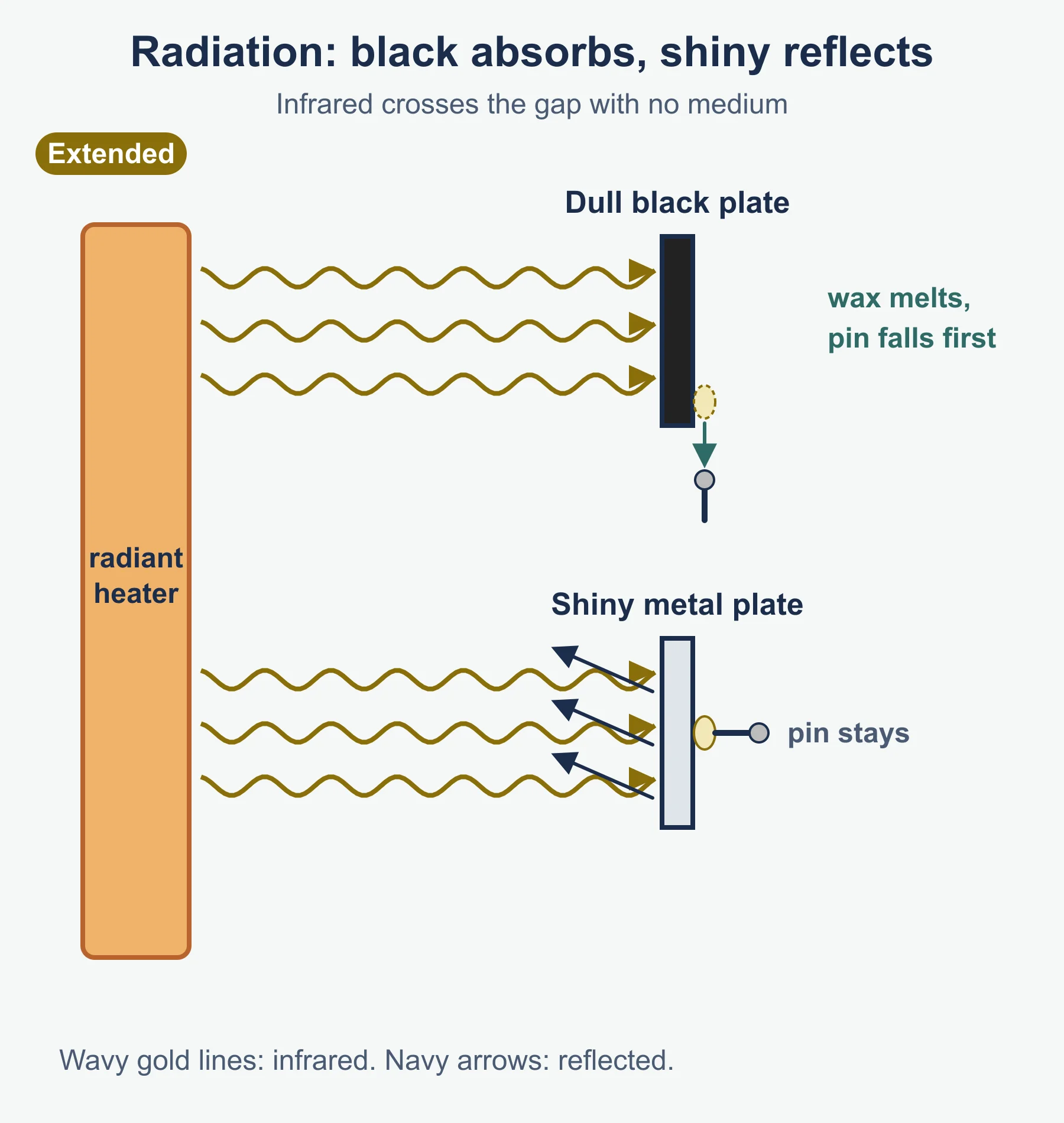
- Absorbers: place identical dull black and shiny metal plates the same distance from a heater. Attach a small piece of wax or a thermometer to the back of each. The wax on the black plate melts first, or its temperature rises faster.
2.3.4 Everyday applications
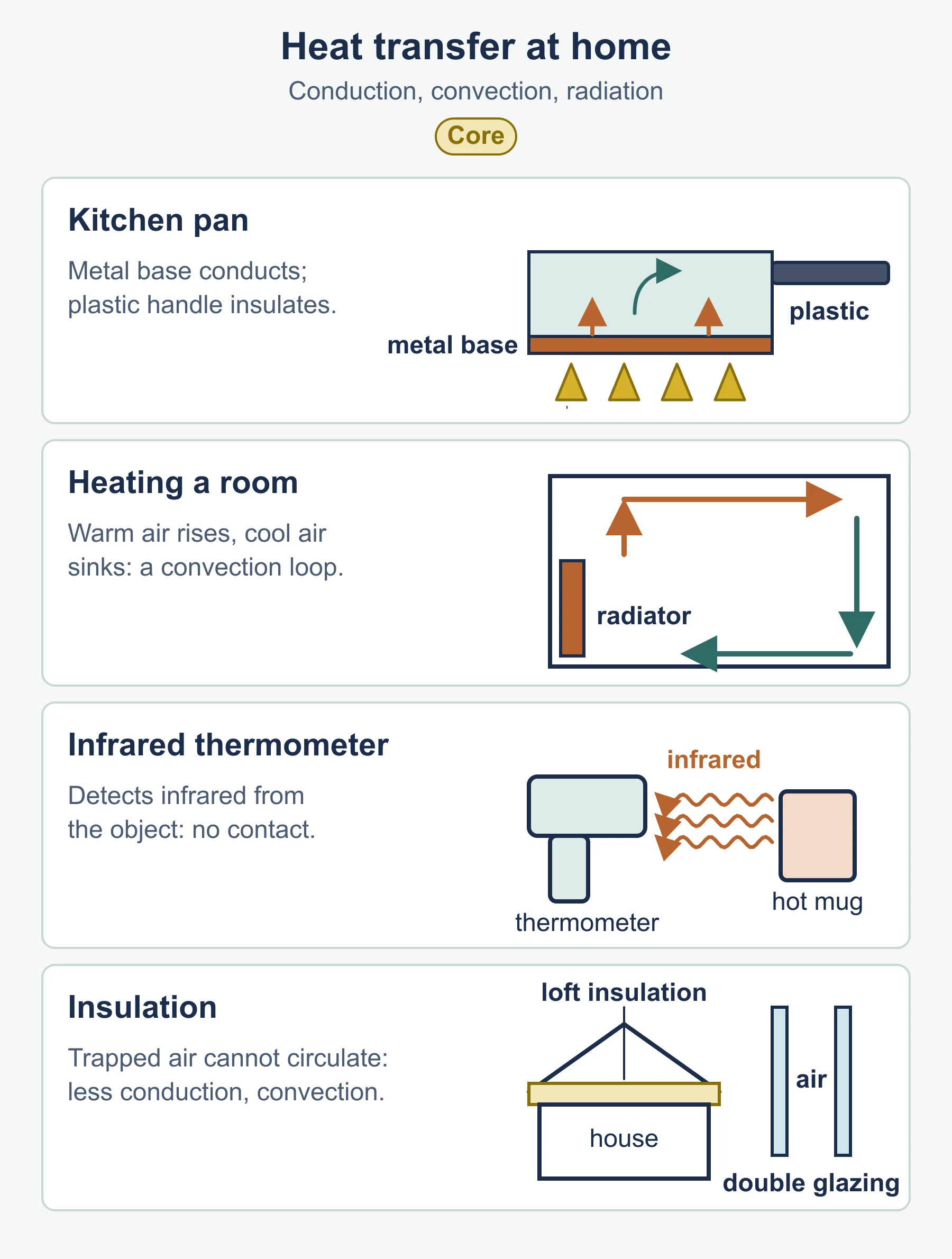
- Kitchen pans: a metal base conducts energy from the hob. The plastic handle is an insulator. Convection spreads energy through the liquid.
- Heating a room: a radiator warms the air around it. The air expands, becomes less dense and rises, while cooler air sinks and moves in. A convection current warms the whole room.
- Infrared thermometer: it detects the infrared radiation emitted by an object and shows its temperature without touching it.
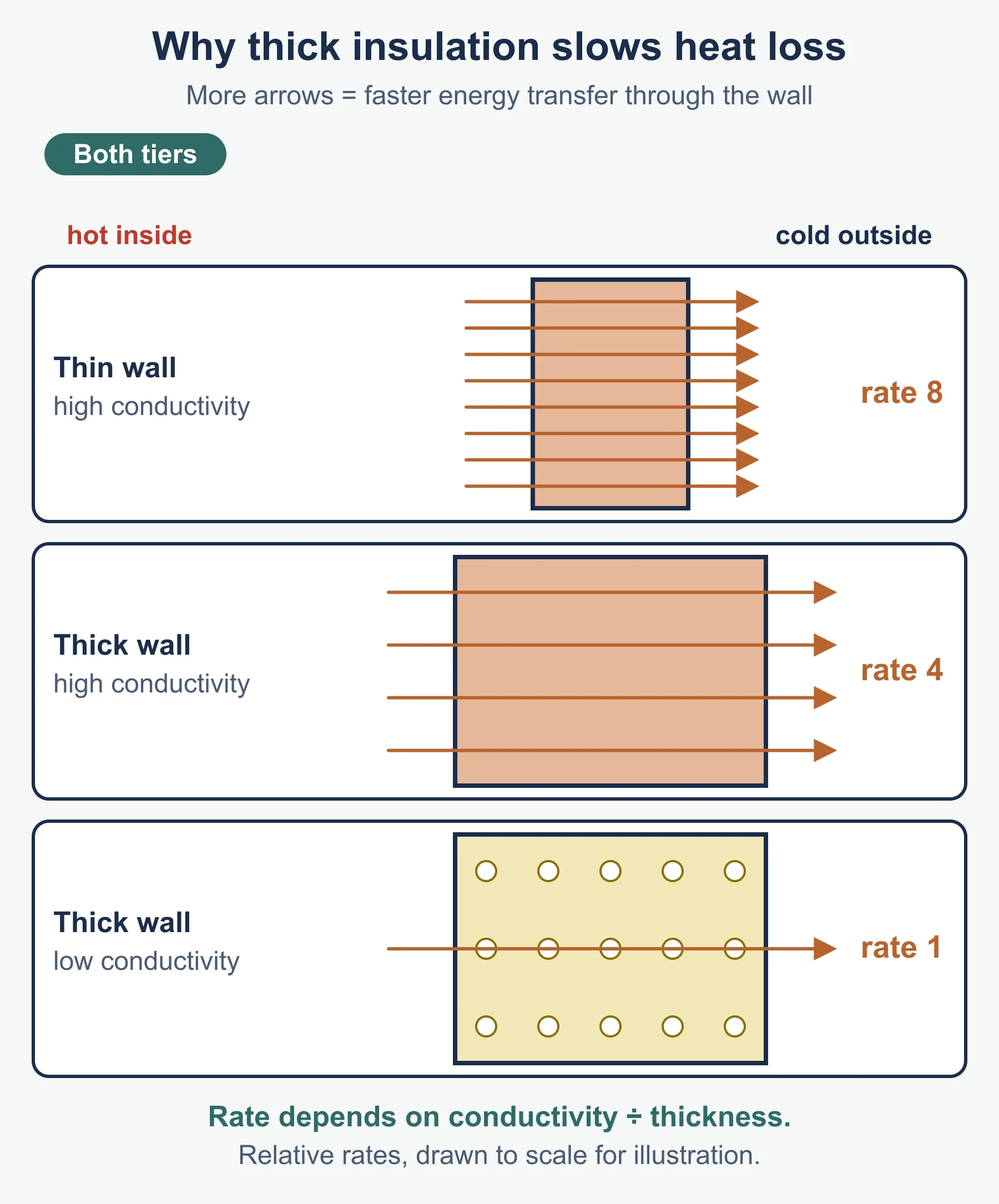
- Insulation: air trapped in small pockets is a poor conductor and cannot circulate. Loft insulation, double glazing and cavity walls use this to cut conduction and convection. Shiny foil reflects radiation. A lid on a hot drink reduces convection and evaporation.
Common errors
- Saying particles “expand” when heated. They vibrate or move faster. The material expands.
- Using grams for mass in ΔE = mcΔθ.
- Adding 273 to a temperature difference. A rise of 20 °C is a rise of 20 K.
- Saying that “cold rises” or “heat rises”. Warm fluid rises because it is less dense.
- Expecting the temperature to climb while a substance is melting or boiling, when it holds steady until the change is complete.
Frequently asked questions
Do you add 273 to a temperature change when converting to kelvin? No. A temperature difference is the same in kelvin and degrees Celsius, so a rise of 20 °C is a rise of 20 K. Add 273 only when converting a single temperature.
Why is a measured specific heat capacity usually too high? Some energy leaks to the surroundings, so the temperature rise is smaller than expected and the calculated value of c comes out too large. Insulating the apparatus reduces this error.
Why does warm air or water rise in convection? Warm fluid expands, becomes less dense and rises, while cooler, denser fluid sinks to replace it. Saying “heat rises” or “cold rises” is a common error.
What is latent heat? Latent heat is the energy that must be supplied or removed for a substance to change state. It does not raise the temperature; it increases the potential energy of the particles by pulling them apart against the forces between them.
Official syllabus
Cambridge O Level Physics 5054 syllabus for examination in 2026, 2027 and 2028, Cambridge International, topic 2 Thermal physics.
Get free revision emails (optional)
Occasional emails with practice questions, worked explanations and links to free resources for the qualification and subjects you choose. No spam, and you can unsubscribe from any email. The free tools on this site never need an email.
Related resources
-
Practice questions
O Level Physics: Thermal physics — Practice Questions (Cambridge 5054)
Original Cambridge O Level Physics 5054 thermal questions with worked answers on specific heat capacity, gas pressure, particle momentum and evaporation.
Physics · Cambridge · O Level
Try questions -
Revision notes
O Level Physics: Thermal physics – Revision Notes (Cambridge 5054)
Condensed revision notes for thermal physics in Cambridge O Level Physics 5054, with key equations, comparisons, a self-test and common mark losses.
Physics · Cambridge · O Level
Revise topic -
Practice questions
O Level Physics: Uses of an Oscilloscope — Practice Questions (Cambridge 5054)
Original Cambridge O Level Physics 5054 questions with worked answers on oscilloscope traces: Y-gain, timebase, p.d., period, frequency and short time gaps.
Physics · Cambridge · O Level
Try questions
Related articles
-
study skills
How to revise for a science examination
Most science revision fails because it rereads notes instead of retrieving them. A practical method for revising physics, chemistry and biology in the weeks before a paper.
14 July 2026
-
teaching
A Level tuition in Dubai: Cambridge or Pearson Edexcel International A Level?
Schools in Dubai and Abu Dhabi teach either Cambridge International AS & A Level or Pearson Edexcel International A Level. How the two are structured, why it matters for tuition, and how online classes from Lahore work.
9 October 2026
Studying this with a teacher
Working through Physics O LEVELS?
This page is free and stays free. If you would rather be taught it, Marlbridge runs Physics classes one-to-one and in small groups of up to 15, online in your own time zone. The first trial class is free. WhatsApp replies within an hour (8am–11pm Pakistan time, every day); email the same day.
Cambridge Physics teachers at Marlbridge