Revision Notes
O Level Physics: Thermal physics – Revision Notes (Cambridge 5054)
Condensed revision notes for thermal physics in Cambridge O Level Physics 5054, with key equations, comparisons, a self-test and common mark losses.
- Subject
- Physics
- Level
- O LEVELS
- Topic
- Thermal physics
- Author
- Marlbridge Academic Team
- Updated
- Reviewed by
- Hassan (what this means)
Aligned to Cambridge O Level Physics (5054), 2026-2028. Official specification .
Syllabus page (what it covers and how it is assessed): Cambridge O Level Physics.
Syllabus points this page covers
5054
- 2.1 Kinetic particle model of matter
- 2.2 Thermal properties and temperature
- 2.3 Transfer of thermal energy
Found an error? Report a correction.
Need help with this topic? Request a free trial class for O Level Physics (5054).
These notes condense topic 2, Thermal physics, from the Cambridge O Level Physics 5054 syllabus for examination in 2026, 2027 and 2028 (sections 2.1 to 2.3). For full explanations and worked examples, read the study guide. For longer questions, use the practice questions. See also the Cambridge O Level Physics hub, the physics checklist and the free diagnostics.
Key equations
| Quantity | Equation | Notes |
|---|---|---|
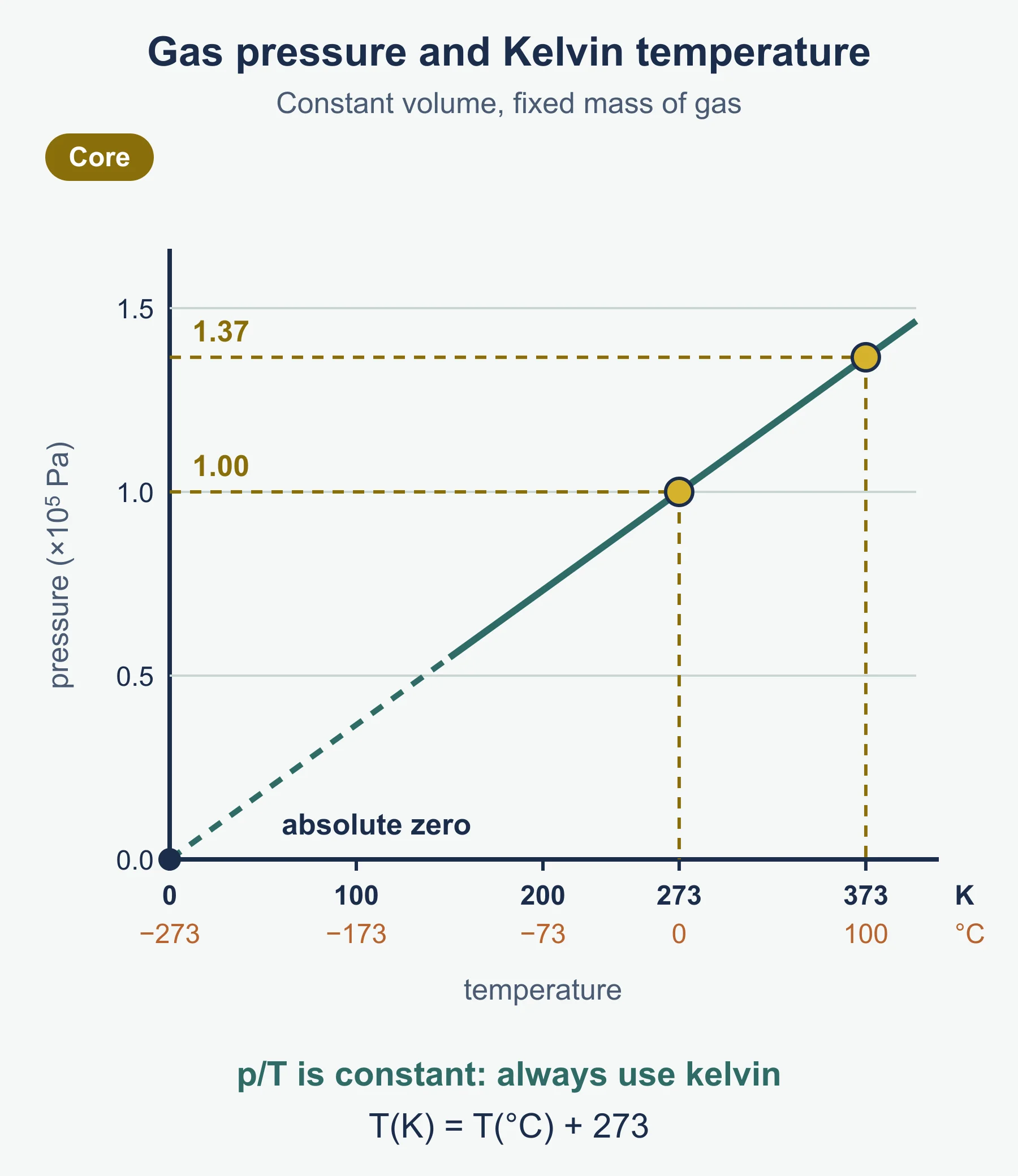
| Kelvin and Celsius | T = θ + 273 | T in K, θ in °C. A change of 1 K equals a change of 1 °C |
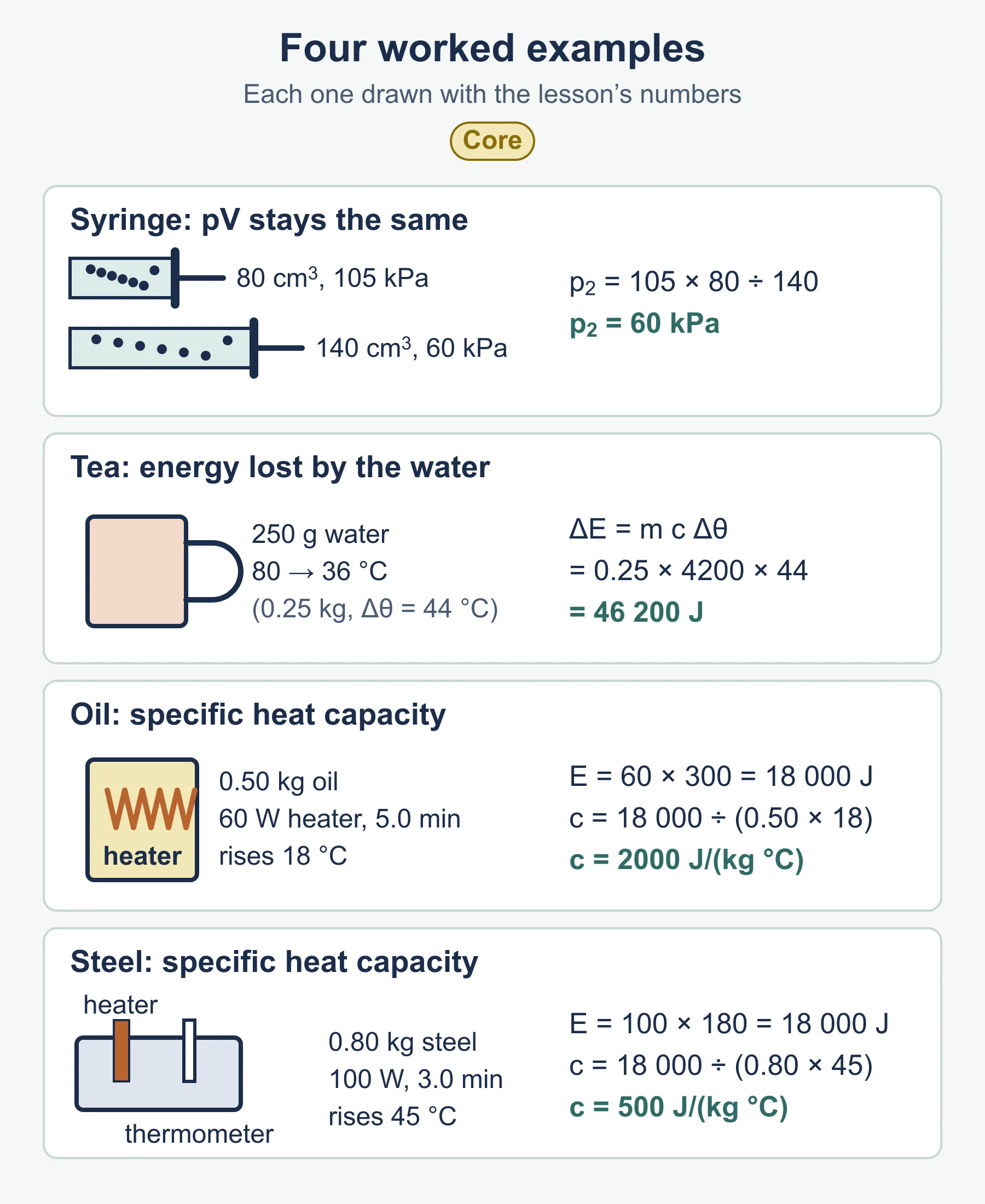
| Specific heat capacity | c = ΔE / (mΔθ) | m in kg, ΔE in J, c in J/(kg °C) |
| Energy for a temperature change | ΔE = mcΔθ | Rearranged from the line above |
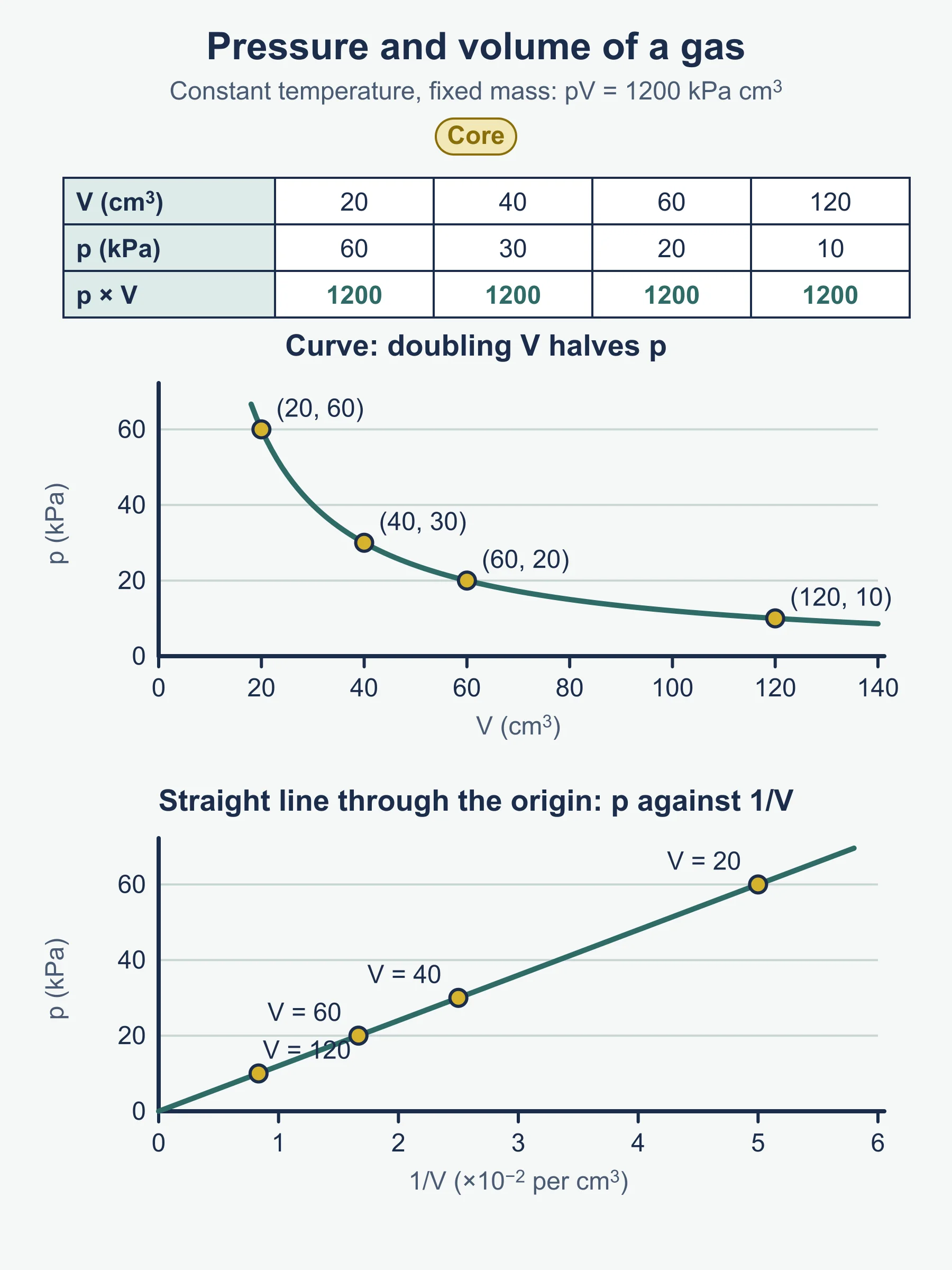
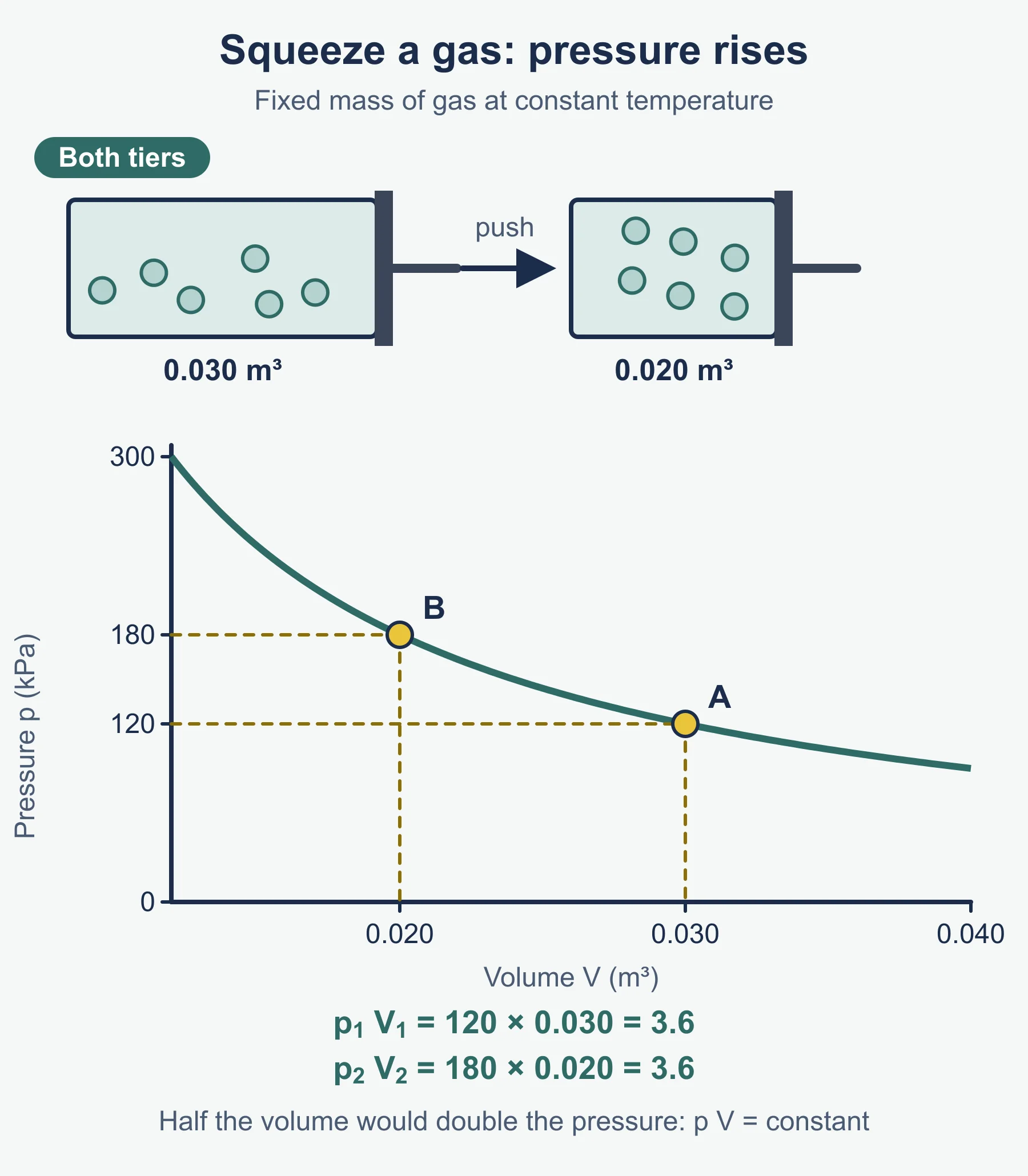
| Gas at constant temperature | p1V1 = p2V2 | Fixed mass of gas; same units on both sides |
| Electrical energy (for experiments) | E = P × t | t in seconds |
Fixed values to recall: absolute zero is −273 °C, which is 0 K. Under standard atmospheric pressure, water melts at 0 °C and its boiling temperature is 100 °C.
2.1 Particle model
States at a glance
| Solid | Liquid | Gas | |
|---|---|---|---|
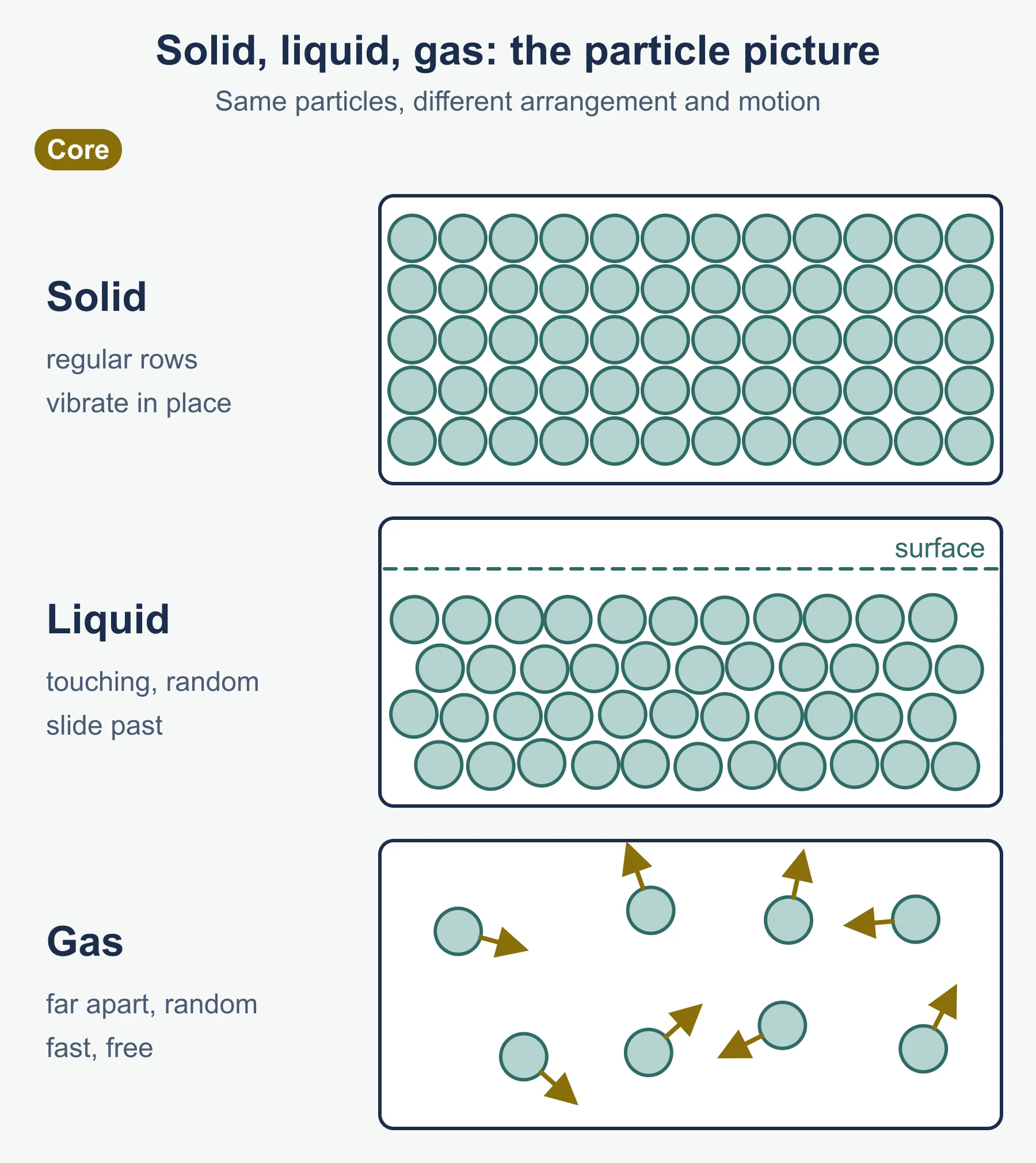
| Particle spacing | Close together | Close together | Far apart |
| Arrangement | Regular pattern | Irregular | Random |
| Movement | Vibrate in place | Slide past each other | Fast and random, with straight paths between collisions |
| Forces between particles | Strong | Weaker | Negligible |
| Shape and volume | Both fixed | Volume fixed, shape not | Neither fixed |
| Compressible? | No | No | Yes |
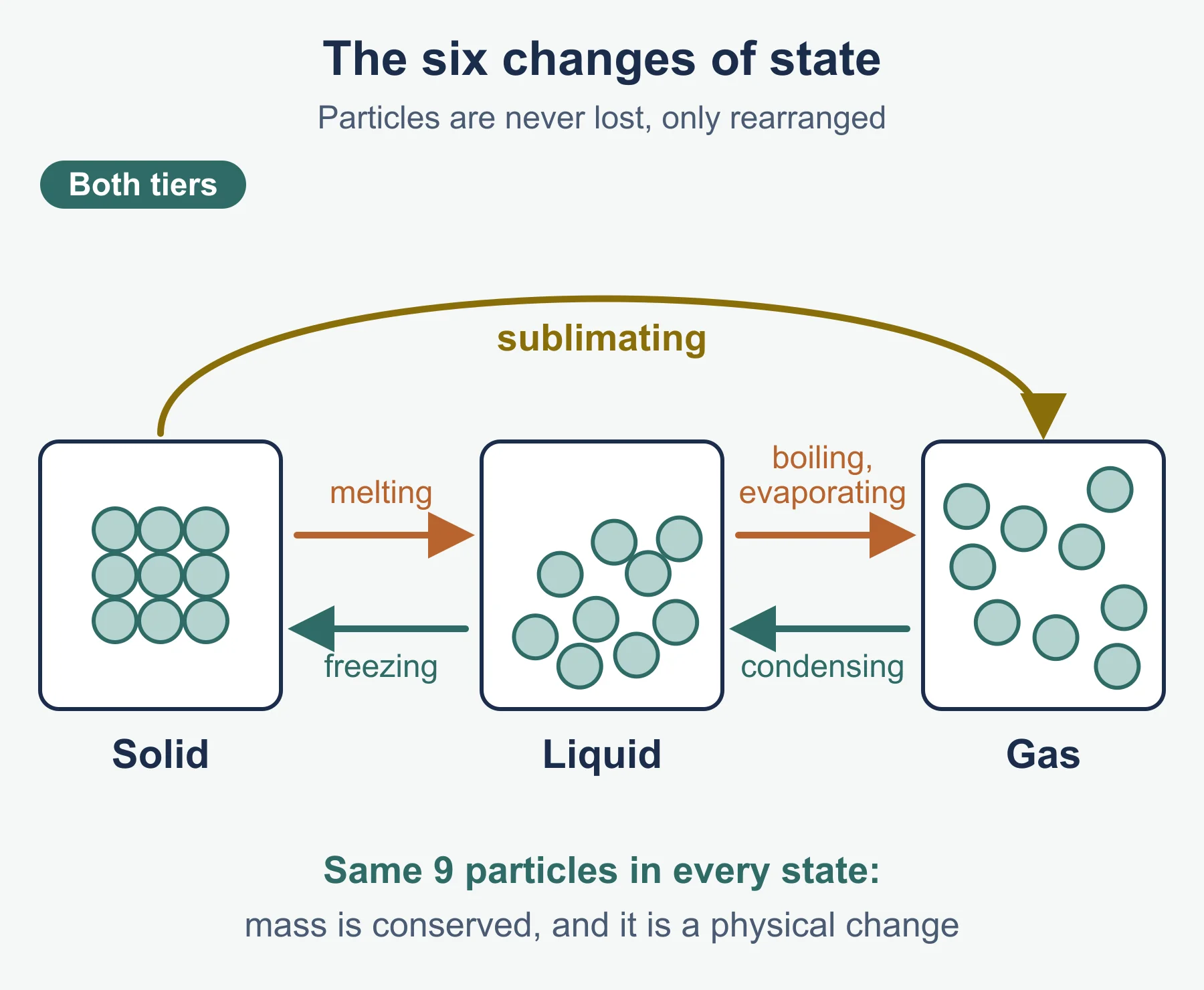
Names for changes: melting (solid to liquid), solidification (liquid to solid), boiling and evaporation (liquid to gas), condensation (gas to liquid).
Temperature and gas pressure
- Higher temperature means higher average kinetic energy of the particles.
- Absolute zero is the lowest possible temperature. The particles have their least kinetic energy.
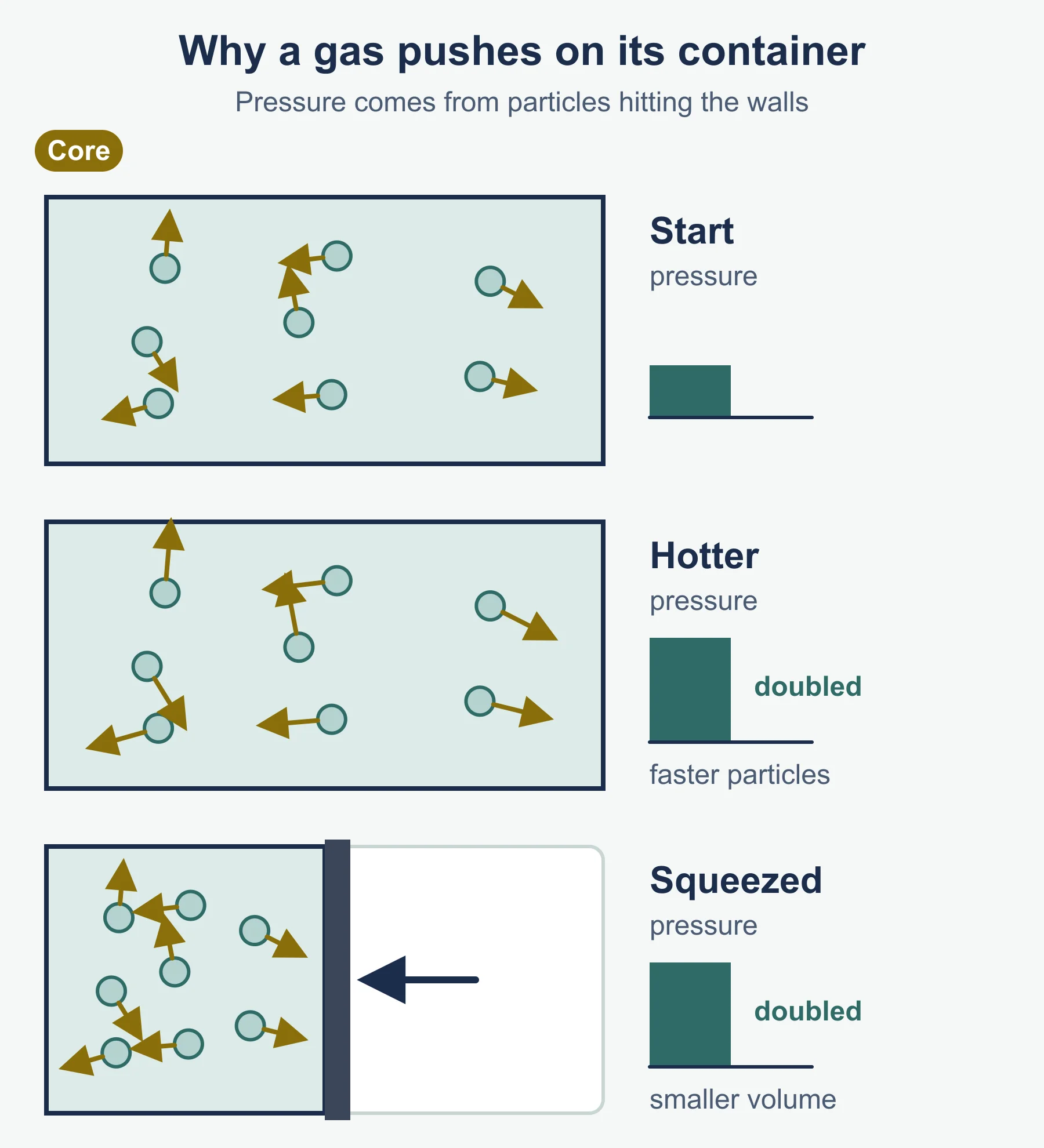
- Gas pressure is the force per unit area from particles colliding with a surface.
Link the three variables
| Fixed | Change | Particle explanation |
|---|---|---|
| Volume | Temperature up, pressure up | Faster particles hit the walls more often and harder |
| Pressure | Temperature up, volume up | Volume must grow so that, although the particles are faster, each wall is hit less often and the pressure stays the same |
| Temperature | Volume down, pressure up | Shorter distances between collisions, so more hits per second on each unit area |
Method: using p1V1 = p2V2
- Check the temperature and the mass of gas are constant.
- Put both volumes in the same unit, and both pressures in the same unit.
- Write p1V1 = p2V2 and rearrange for the unknown.
- Check direction: smaller volume means higher pressure.
The graph of p against V at constant temperature is a falling curve that never meets the axes. Plotting p against 1/V gives a straight line through the origin.
2.2.1 Expansion
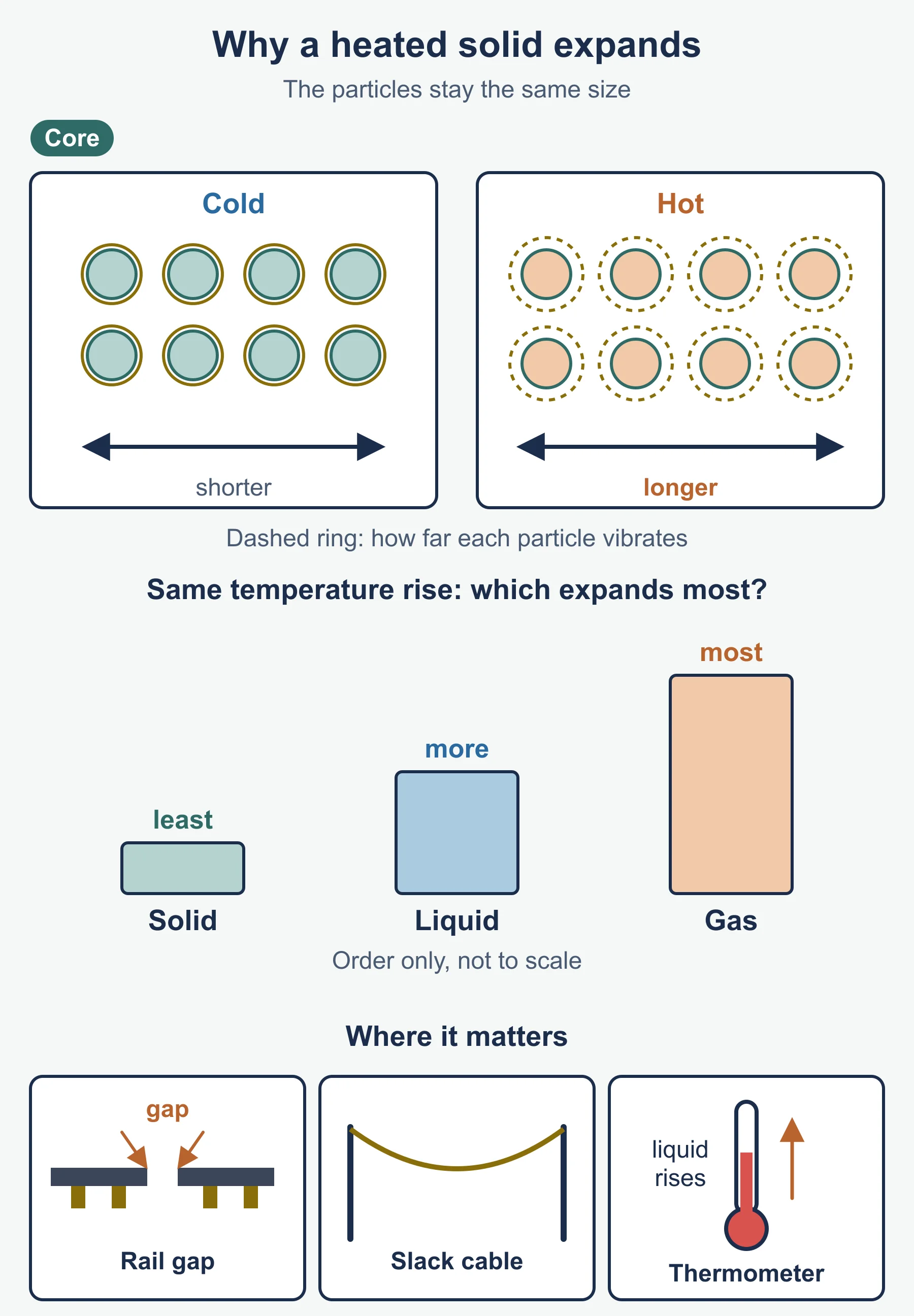
- Particles vibrate or move more strongly when heated, so the average spacing increases. The particles themselves stay the same size.
- Order of expansion for the same temperature rise: gases greatest, then liquids, then solids.
- Applications and consequences: liquid-in-glass thermometer (liquid expands up a narrow tube), expansion gaps in rails and bridges, slack overhead cables.
2.2.2 Specific heat capacity
- Higher temperature means higher internal energy and higher average kinetic energy of all the particles.
- Definition: specific heat capacity is the energy required per unit mass per unit temperature increase.
- A high value of c means much energy must be supplied to warm the substance by 1 °C, and much is released as it cools.
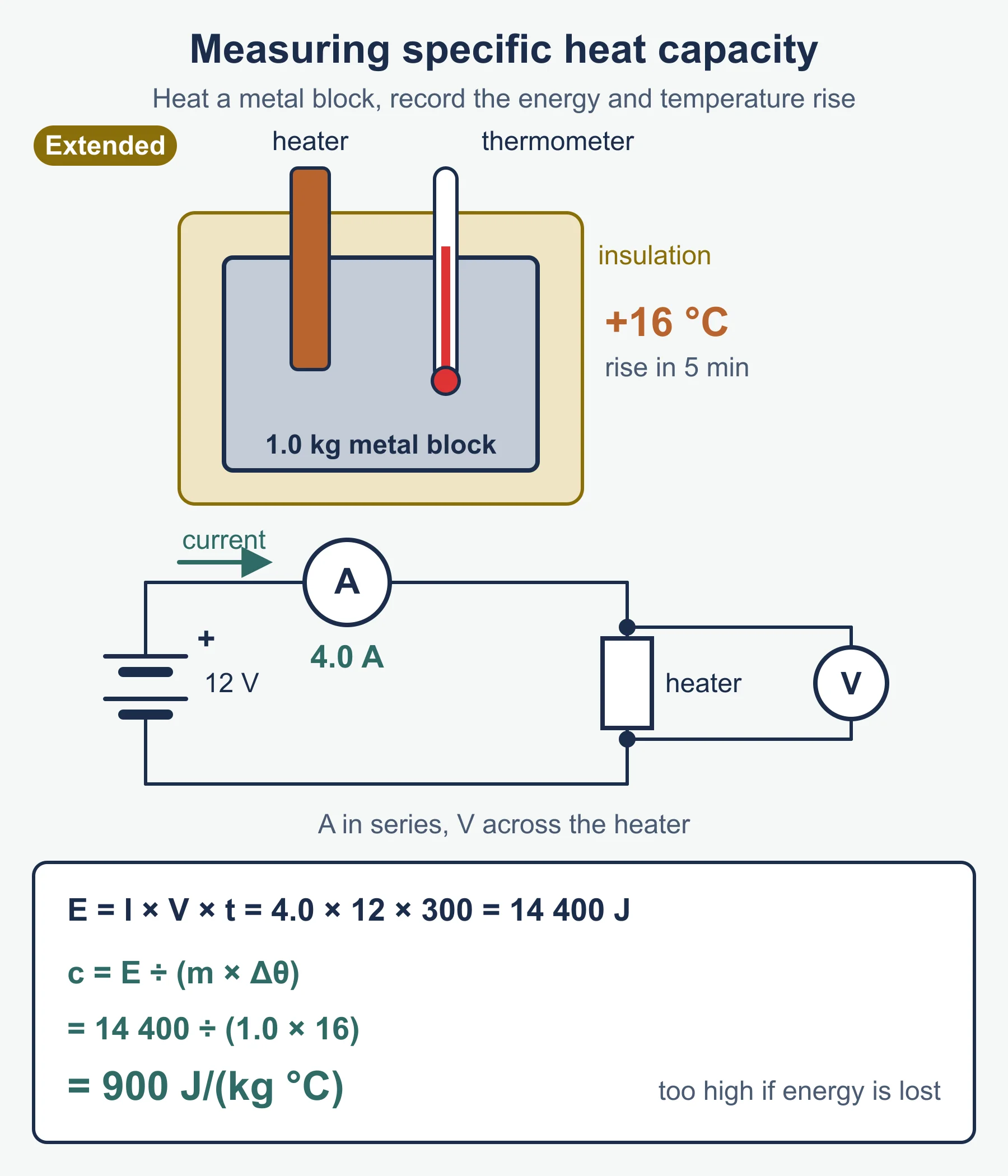
Method: measuring c in the laboratory
- Measure the mass of the solid block or the liquid in an insulated container.
- Fit a heater and thermometer. For a block, use a drop of oil in the thermometer hole. Stir a liquid.
- Record start temperature, power and time.
- Record the highest temperature reached.
- Calculate E = P × t, then c = E / (mΔθ).
- Expect the result to be a little high, since some energy escapes to the surroundings.
2.2.3 Changes of state
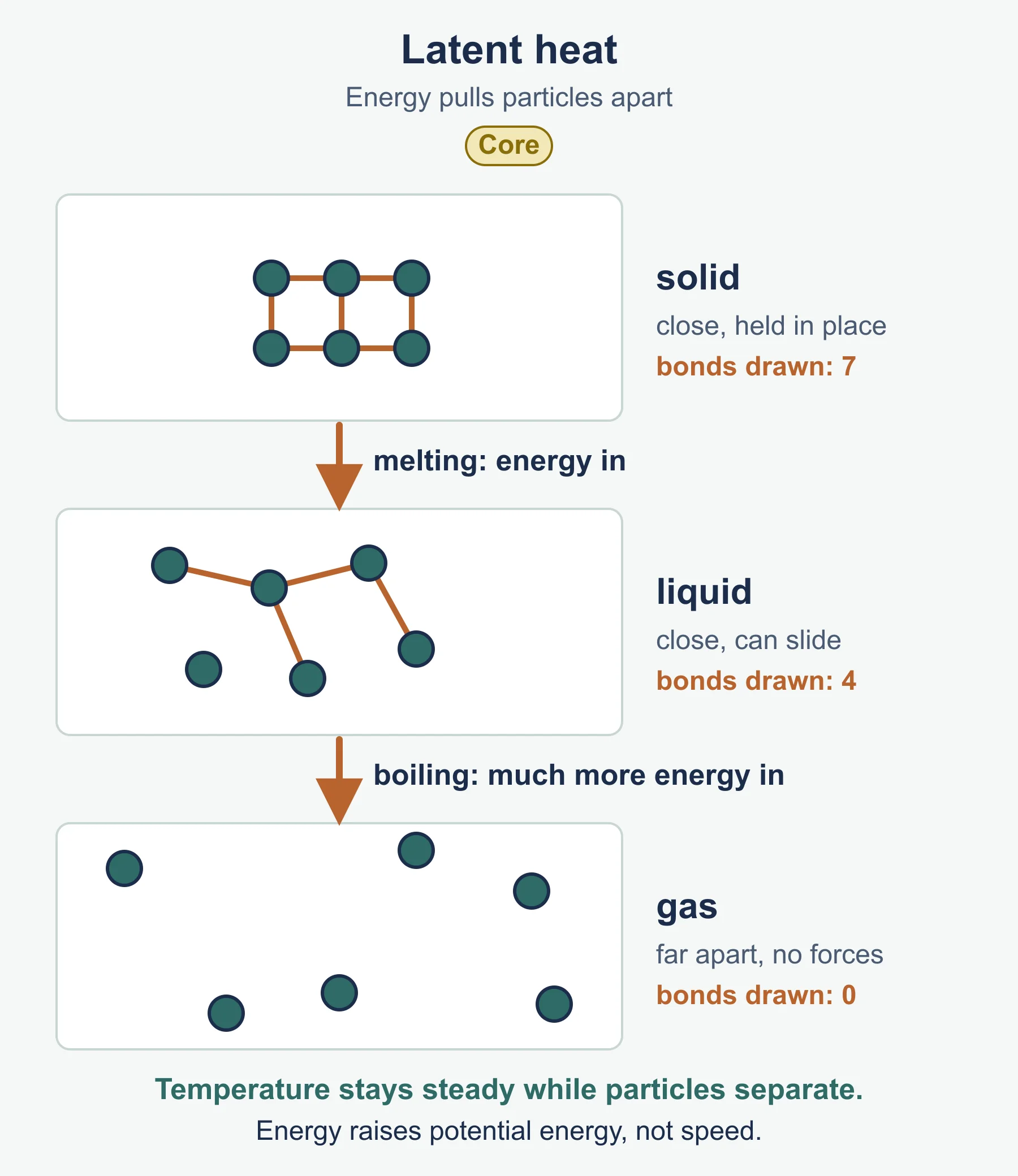
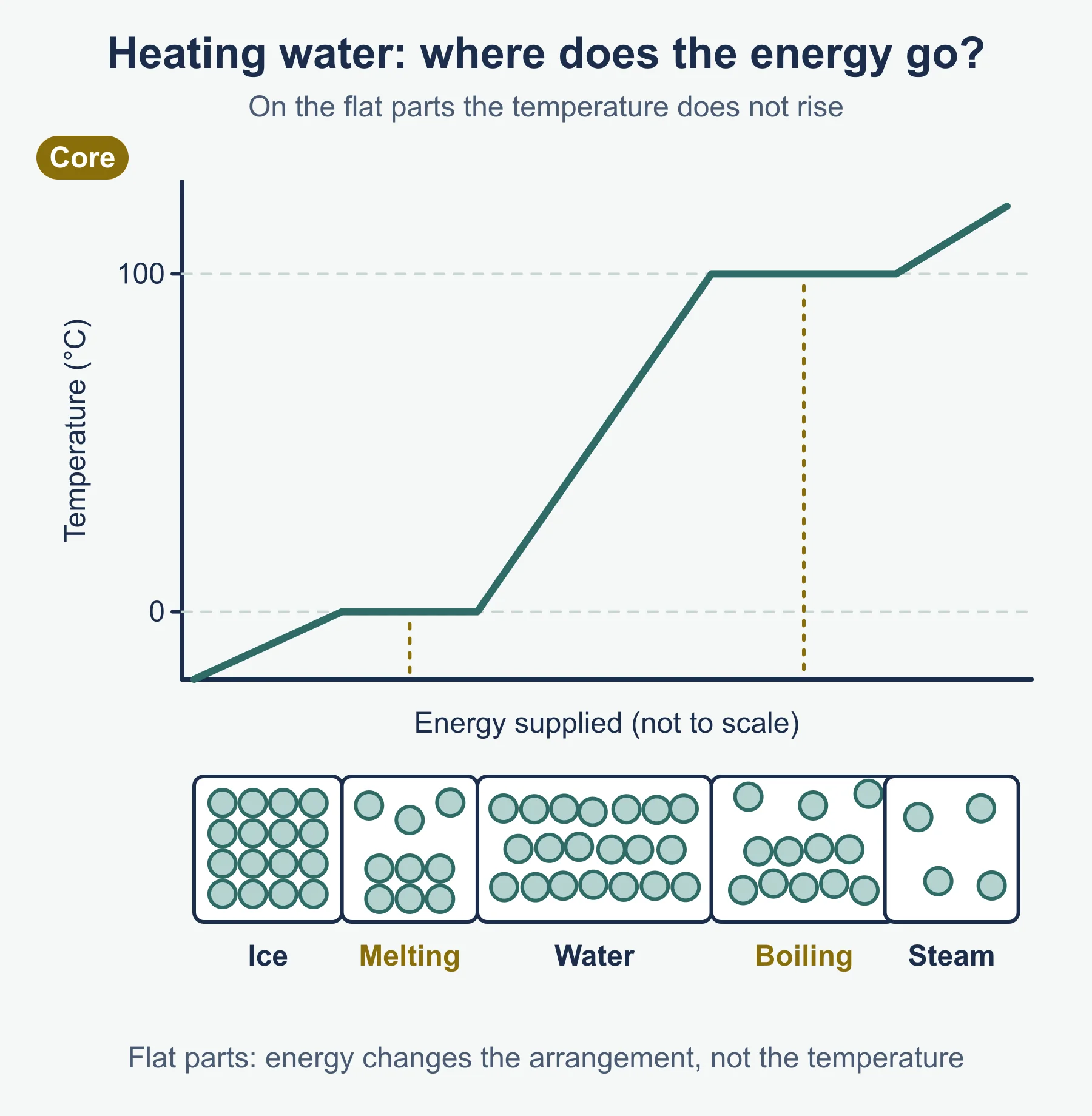
- Melting, solidification, boiling and condensation: energy is transferred but the temperature stays constant.
- Latent heat is the energy transferred for a substance to change state. It overcomes the forces between particles, increasing their potential energy rather than their kinetic energy.
- Boiling needs more latent heat than melting because the particles have to be separated completely.
Boiling versus evaporation
| Boiling | Evaporation | |
|---|---|---|
| Temperature | One fixed temperature | Any temperature |
| Location | Throughout the liquid | At the surface only |
| Bubbles | Yes | No |
| Rate | Fast | Slow |
Evaporation facts
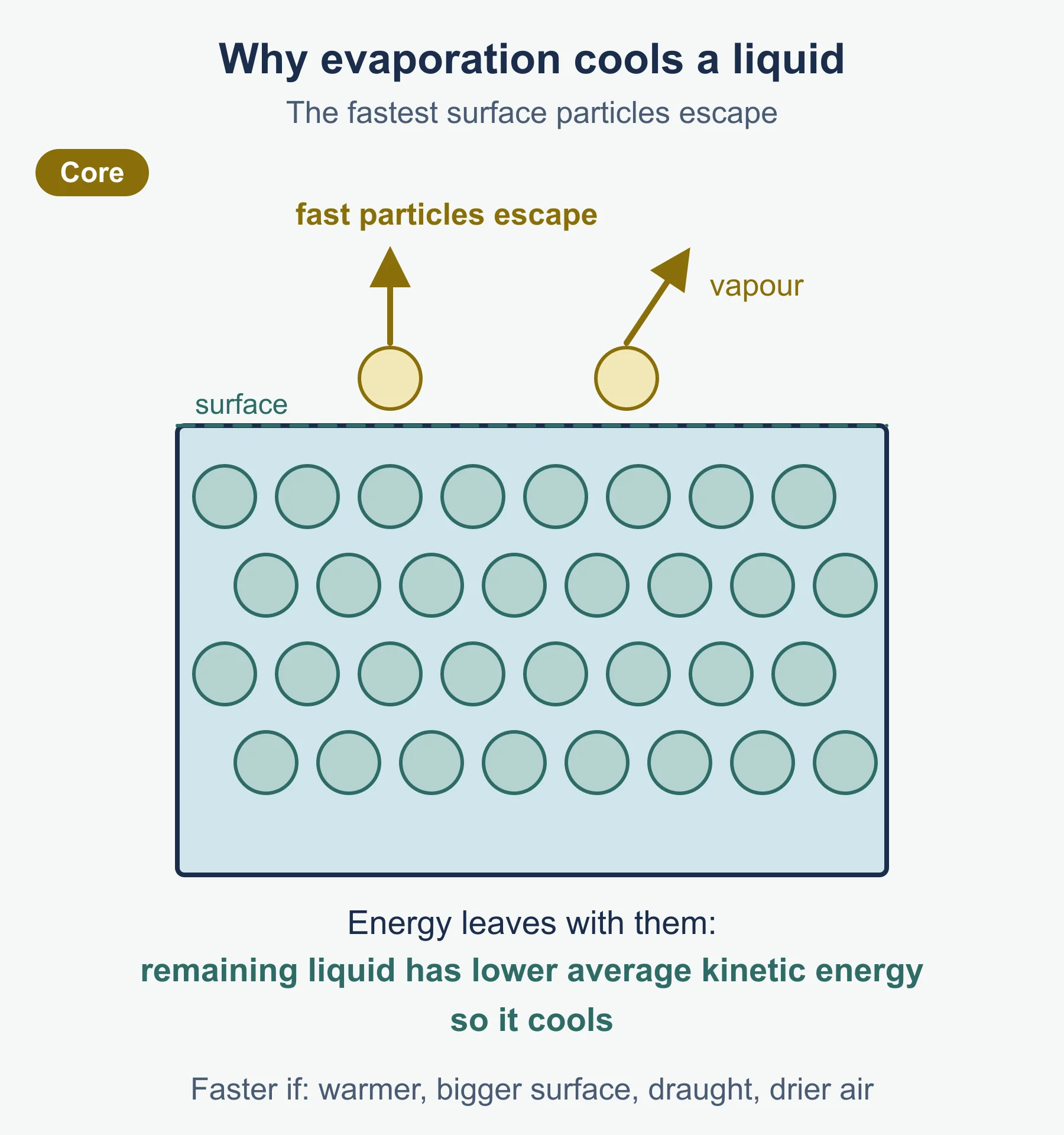
- Only the fastest particles at the surface leave, so the remaining liquid has a lower average kinetic energy. This is why evaporation causes cooling.
- Faster evaporation: higher temperature, larger surface area, moving air over the surface.
2.3 Transfer of thermal energy
| Conduction | Convection | Radiation | |
|---|---|---|---|
| Where | Solids (best), also liquids and gases poorly | Liquids and gases | Any, including a vacuum |
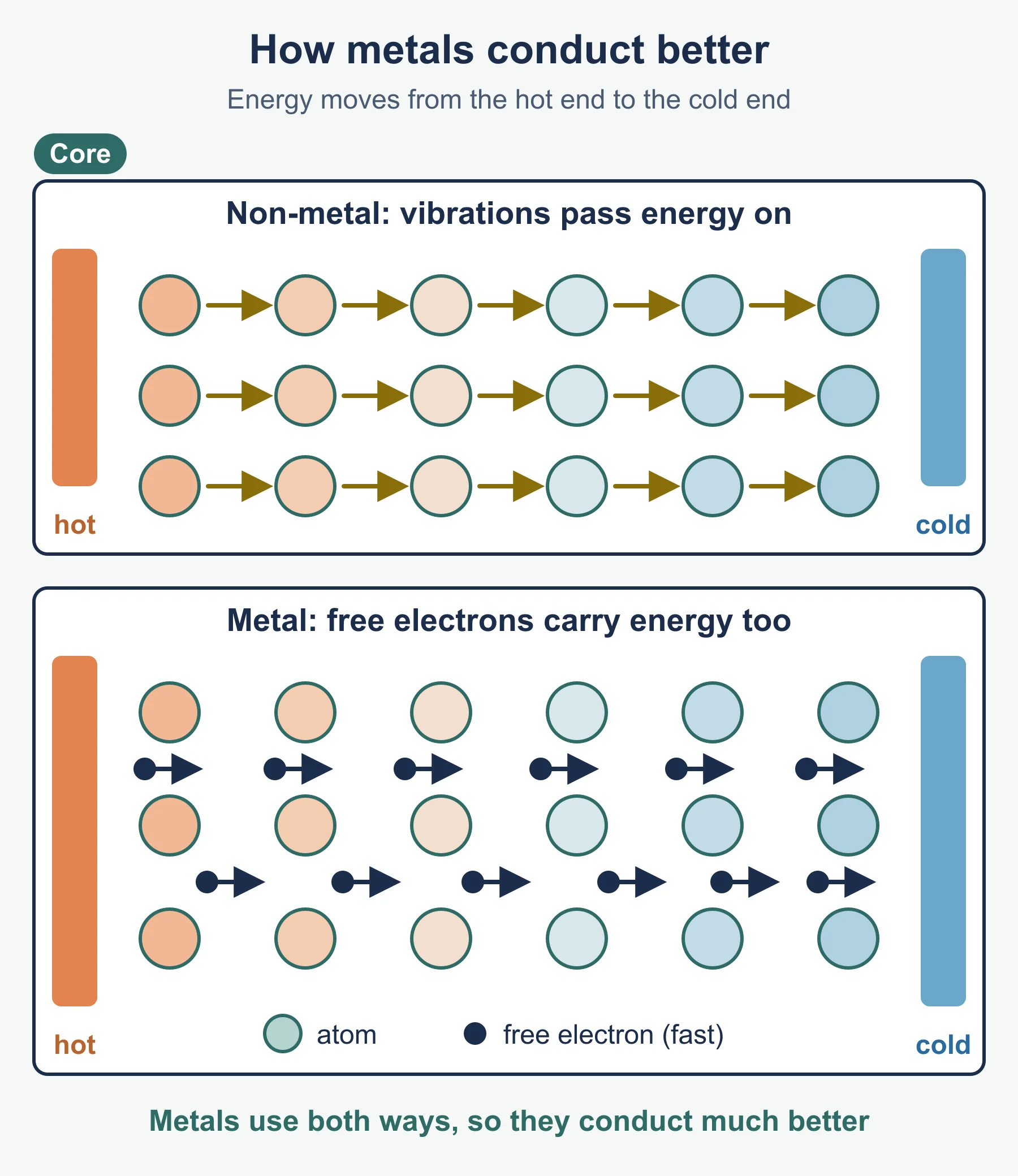
| Mechanism | Lattice vibrations; free electrons in metals | Density differences make warm fluid rise | Infrared electromagnetic waves |
| Needs a medium? | Yes | Yes | No |
Radiation by surface
| Surface | Emission | Absorption | Reflection |
|---|---|---|---|
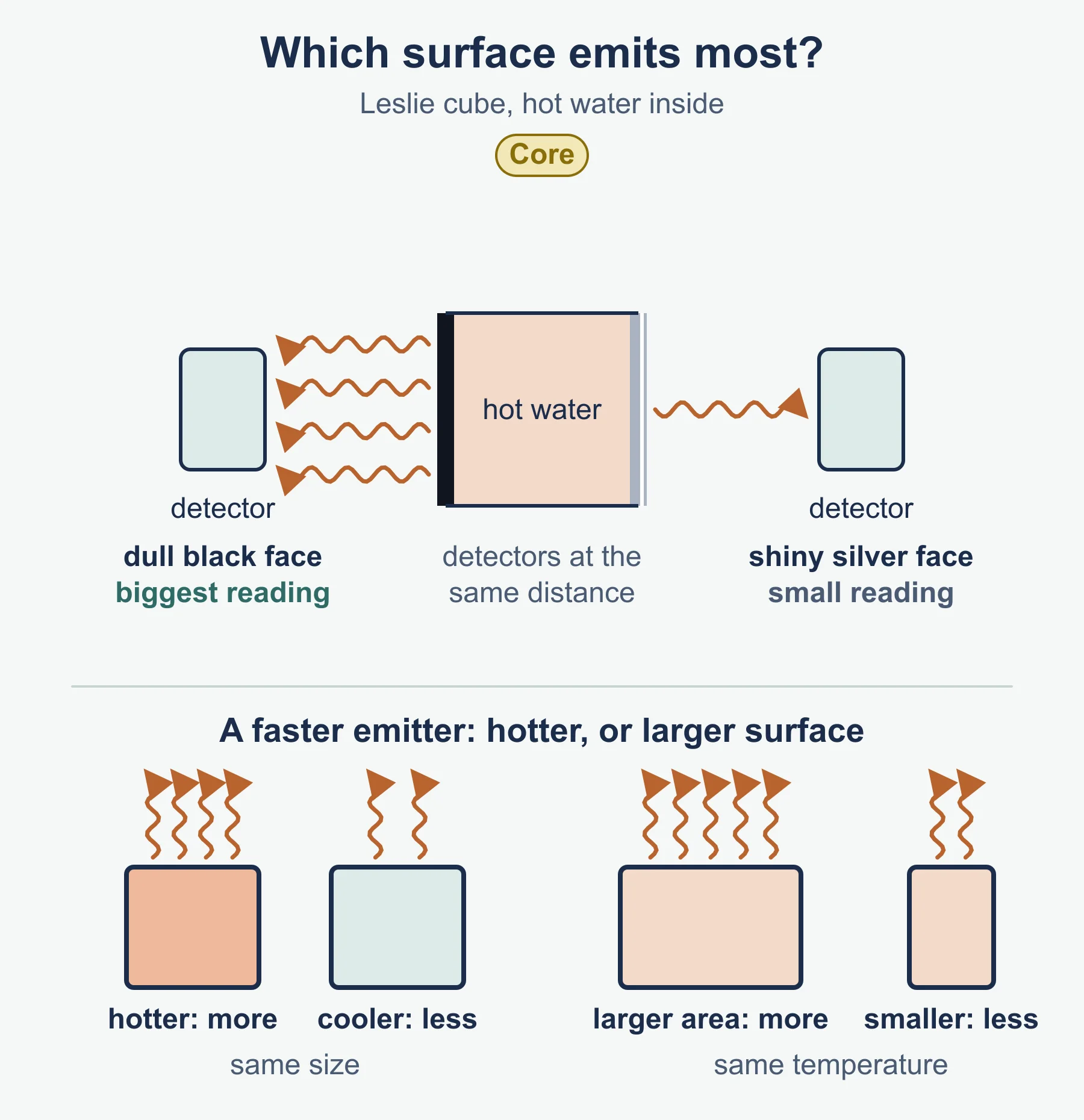
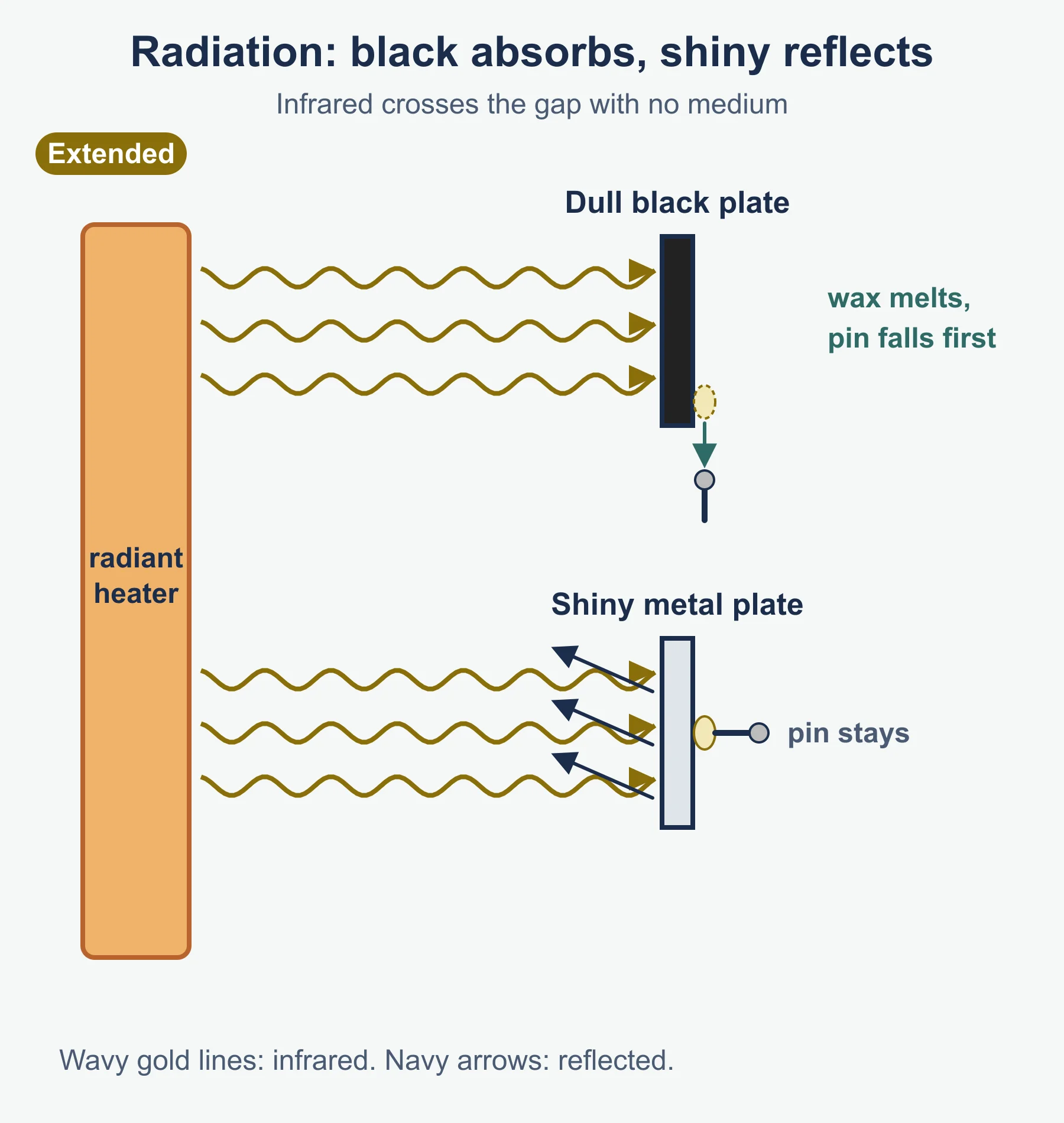
| Dull black | Best | Best | Worst |
| Shiny silver or white | Worst | Worst | Best |
A hotter object and a larger surface area both increase the rate of emission.
Experiments to remember
| Aim | Set-up | What you see |
|---|---|---|
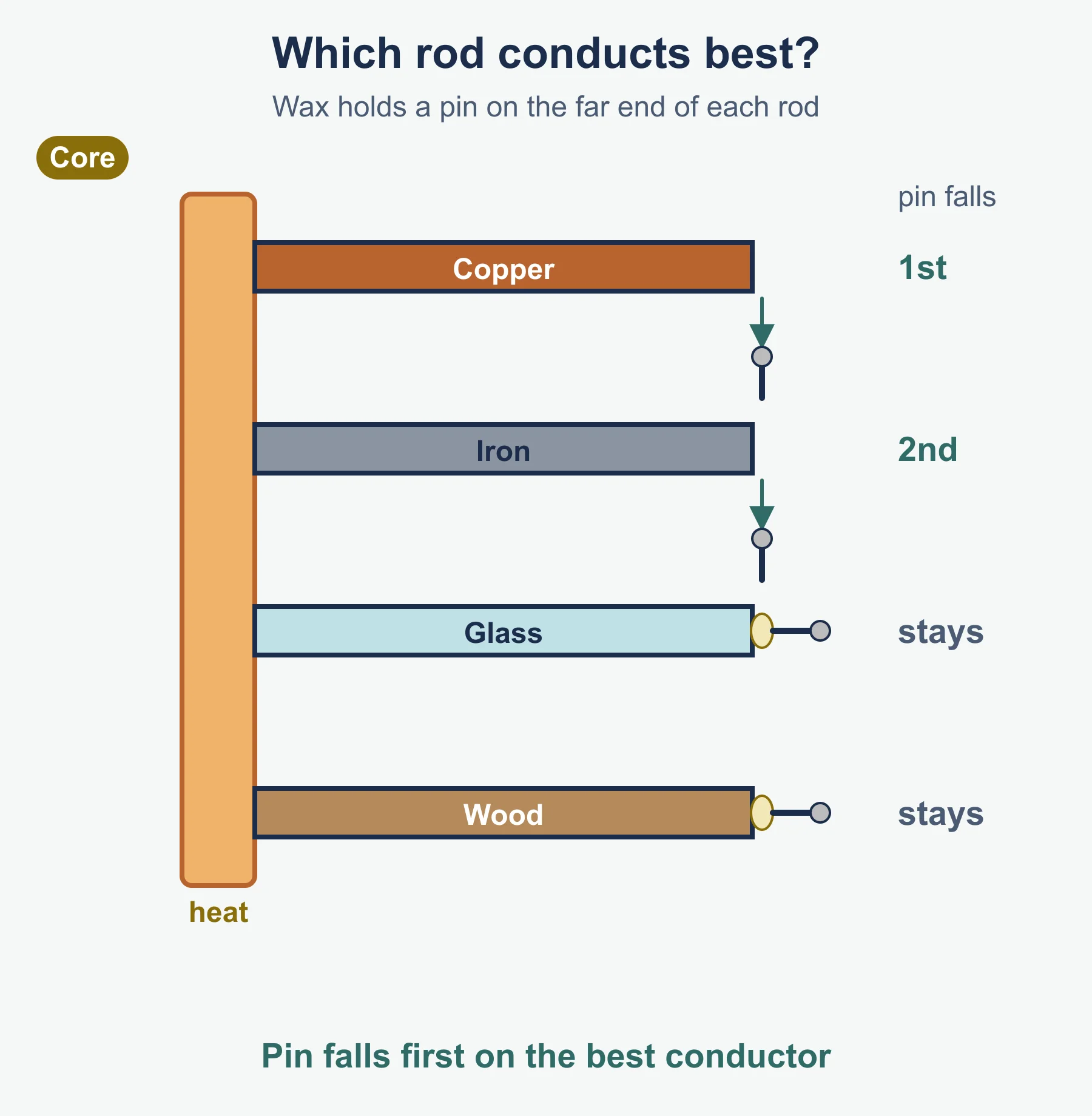
| Good and bad conductors | Rods of equal size heated at one end, pin stuck on with wax at the other | The pin falls first from the best conductor |
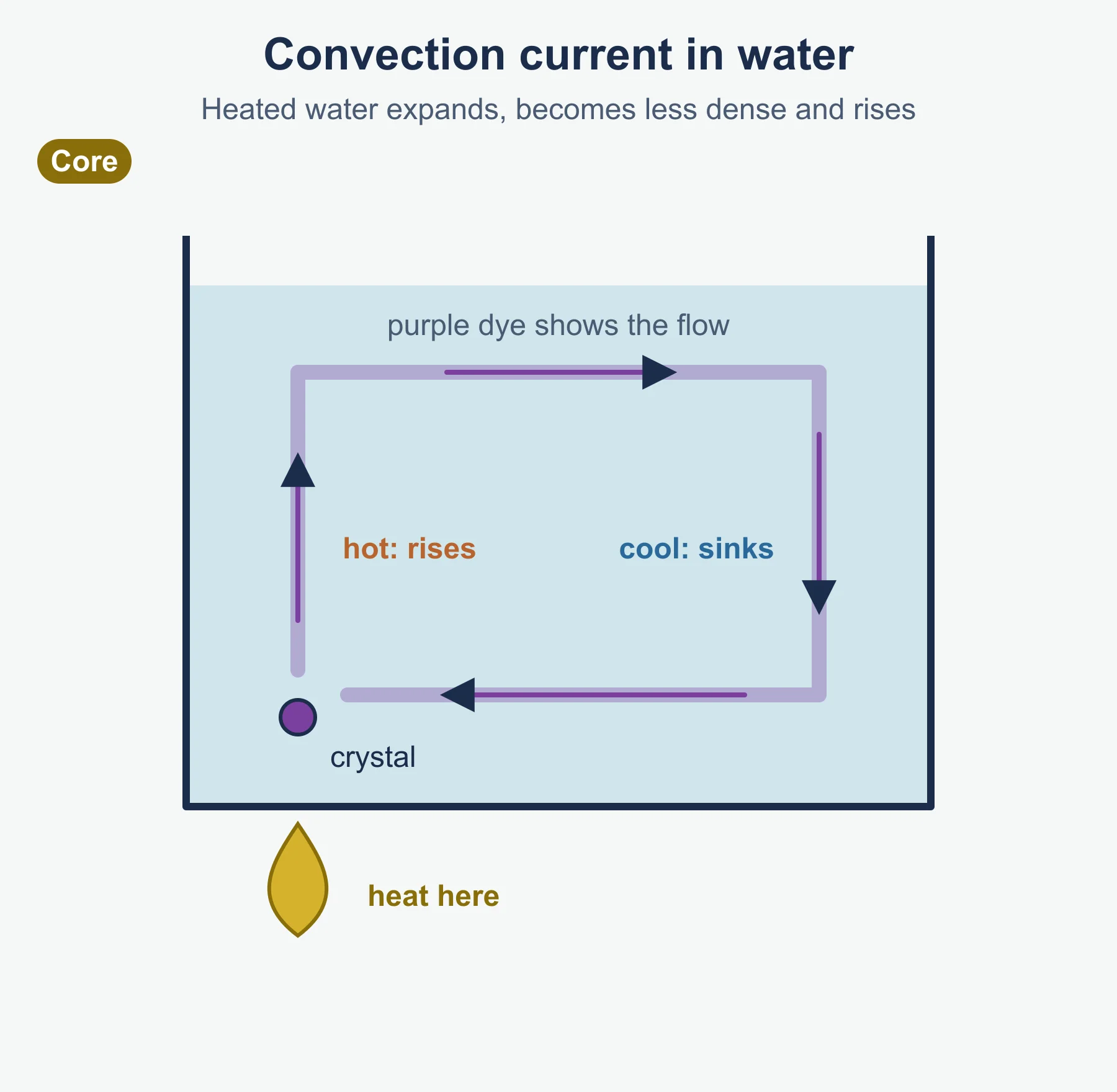
| Convection | Crystal of potassium permanganate in water, heated at one side | Coloured streaks rise on the heated side and sink on the other |
| Good and bad emitters | Identical containers of hot water with black and shiny surfaces, detector at equal distance | Higher reading from the black surface |
| Good and bad absorbers | Black and shiny plates the same distance from a heater, thermometer or wax behind each | Black plate warms faster |
Applications
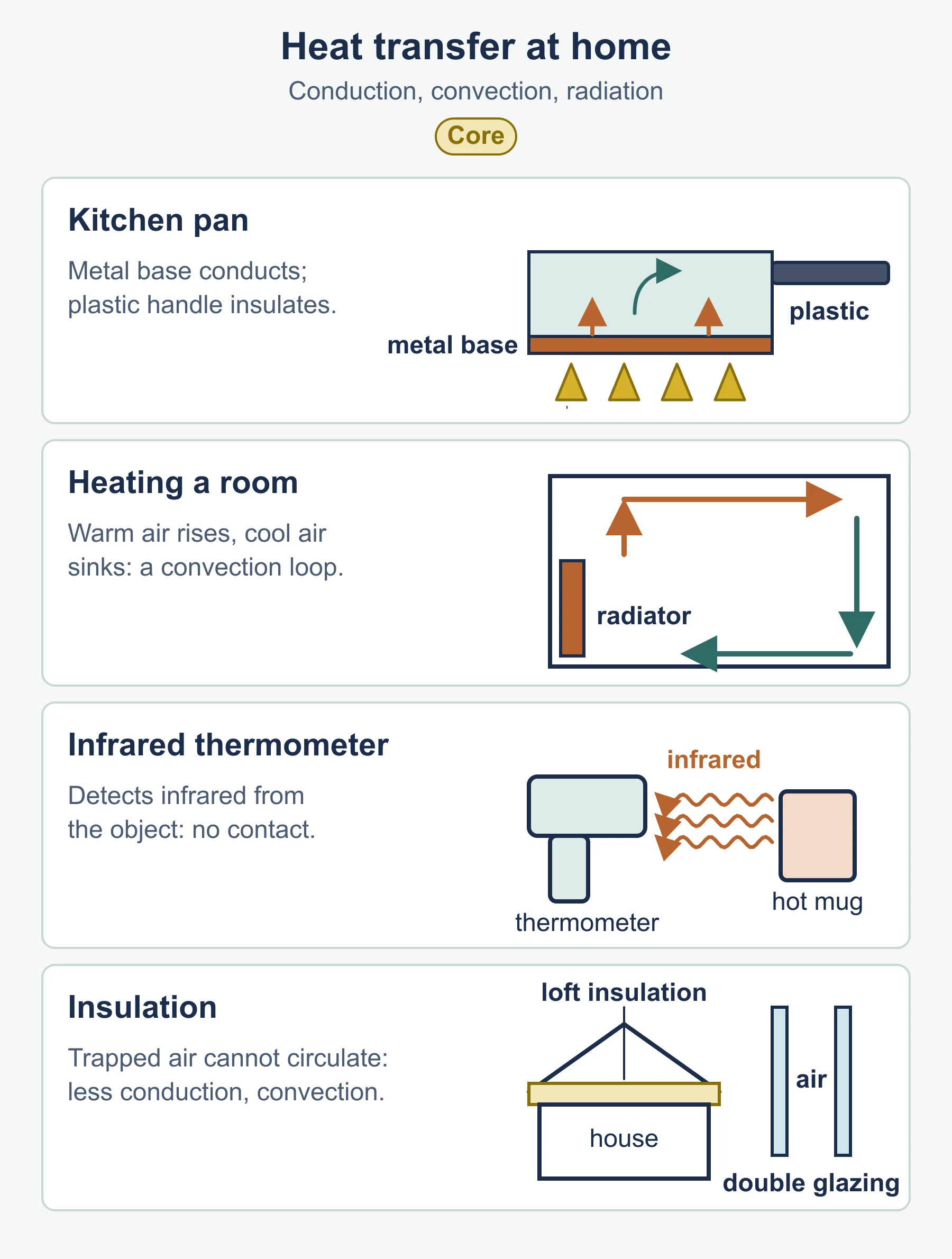
- Pans: metal base conducts, plastic handle insulates.
- Room heater: warm air rises, cool air sinks, a convection current warms the room.
- Infrared thermometer: detects infrared emitted by the object, no contact needed.
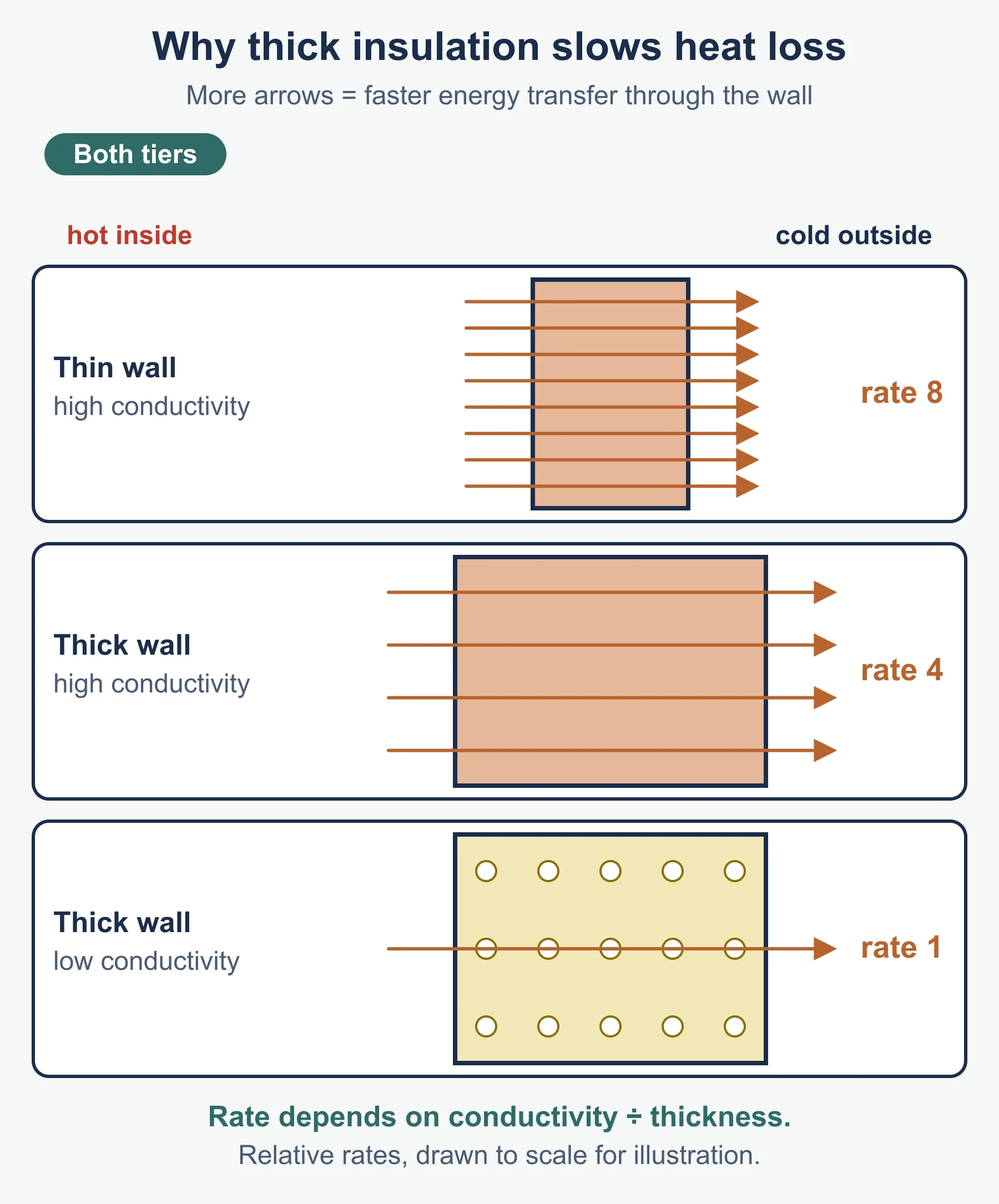
- Insulation: air trapped in small pockets cuts conduction and convection; shiny surfaces reduce radiation; a lid reduces evaporation and convection from a hot drink.
Must-know distinctions
- Heat and temperature: energy transferred versus average kinetic energy of the particles.
- Boiling and evaporation: see the table above.
- Conduction and convection: conduction passes energy between neighbouring particles that stay in place; convection moves the heated fluid itself.
- Absorbing and emitting: black is good at both, shiny is poor at both.
Quick self-test
- Convert 25 °C to kelvin.
- Convert 250 K to degrees Celsius.
- A fixed mass of gas at 90 kPa has a volume of 50 cm³. It is compressed to 30 cm³ at constant temperature. Find the new pressure.
- A fixed mass of gas at 120 kPa has a volume of 25 cm³. At constant temperature its pressure is raised to 200 kPa. Find the new volume.
- A heater raises the temperature of 2.0 kg of water by 10 °C in 5.0 minutes. Take c for water as 4200 J/(kg °C). Find the power, assuming no losses.
- A 0.40 kg copper block (c = 390 J/(kg °C)) absorbs 7800 J. Find its temperature rise.
- Give the particle explanation of why a gas in a rigid sealed tin has higher pressure when warm.
- State one reason why liquids that evaporate cool.
- Name the process by which thermal energy crosses a vacuum.
- Why is the water at the top of a hot-water tank warmer than the water at the bottom?
Answers
- 25 + 273 = 298 K
- 250 − 273 = −23 °C
- p2 = 90 × 50 / 30 = 150 kPa
- V2 = 120 × 25 / 200 = 15 cm³ (smaller, as expected for a higher pressure)
- E = 2.0 × 4200 × 10 = 84 000 J; P = 84 000 / 300 = 280 W
- Δθ = 7800 / (0.40 × 390) = 50 °C
- The particles move faster, hit the walls more often and with greater force, so the force per unit area increases.
- The fastest surface particles leave, so those remaining have a lower average kinetic energy.
- Radiation (infrared).
- Heated water expands and is less dense, so it rises by convection and collects at the top.
Where marks are usually lost
- Saying the particles expand or get bigger when a substance is heated.
- Leaving time in minutes or mass in grams in calculations.
- Giving only one effect of faster particles on pressure, not both frequency and force of collisions.
- Mixing up boiling and evaporation: bubbles throughout the liquid mean boiling, a slow change at the surface means evaporation.
- Writing that heat or cold rises, rather than that warm fluid is less dense and rises.
- Stating that conduction needs a vacuum, or that radiation needs a medium.
- Describing a comparison experiment without keeping it fair: equal rod size, equal distance and equal starting temperature.
- Saying the temperature rises during melting or boiling. Energy is transferred, but the temperature stays constant until the change is complete.
Frequently asked questions
What is the difference between heat and temperature? Heat is energy transferred, while temperature is linked to the average kinetic energy of the particles.
What is the difference between conduction and convection? In conduction, energy passes between neighbouring particles that stay in place. In convection, the heated fluid itself moves, carrying energy with it.
Which surfaces are good emitters and absorbers of radiation? Black surfaces are good at both absorbing and emitting radiation, while shiny surfaces are poor at both.
How does a higher temperature increase gas pressure? Faster particles hit the container walls more often and with more force. A full answer mentions both the frequency and the force of the collisions.
Official syllabus
Cambridge O Level Physics 5054 syllabus for examination in 2026, 2027 and 2028, Cambridge International, topic 2 Thermal physics.
Get free revision emails (optional)
Occasional emails with practice questions, worked explanations and links to free resources for the qualification and subjects you choose. No spam, and you can unsubscribe from any email. The free tools on this site never need an email.
Related resources
-
Study guides
O Level Physics: Thermal physics (Cambridge 5054)
Study guide to thermal physics for Cambridge O Level Physics 5054: particle model, gas laws, expansion, heat capacity, state changes, energy transfer.
Physics · Cambridge · O Level
Read guide -
Practice questions
O Level Physics: Thermal physics — Practice Questions (Cambridge 5054)
Original Cambridge O Level Physics 5054 thermal questions with worked answers on specific heat capacity, gas pressure, particle momentum and evaporation.
Physics · Cambridge · O Level
Try questions -
Practice questions
O Level Physics: Uses of an Oscilloscope — Practice Questions (Cambridge 5054)
Original Cambridge O Level Physics 5054 questions with worked answers on oscilloscope traces: Y-gain, timebase, p.d., period, frequency and short time gaps.
Physics · Cambridge · O Level
Try questions
Related articles
-
study skills
How to revise for a science examination
Most science revision fails because it rereads notes instead of retrieving them. A practical method for revising physics, chemistry and biology in the weeks before a paper.
14 July 2026
-
teaching
A Level tuition in Dubai: Cambridge or Pearson Edexcel International A Level?
Schools in Dubai and Abu Dhabi teach either Cambridge International AS & A Level or Pearson Edexcel International A Level. How the two are structured, why it matters for tuition, and how online classes from Lahore work.
9 October 2026
Studying this with a teacher
Working through Physics O LEVELS?
This page is free and stays free. If you would rather be taught it, Marlbridge runs Physics classes one-to-one and in small groups of up to 15, online in your own time zone. The first trial class is free. WhatsApp replies within an hour (8am–11pm Pakistan time, every day); email the same day.
Cambridge Physics teachers at Marlbridge