Revision Notes
Cambridge O Level Physics: Waves (5054) – Revision Notes
Condensed revision notes on Waves for Cambridge O Level Physics 5054: definitions, equations, light, sound, the EM spectrum, a self-test and common lost marks.
- Subject
- Physics
- Level
- O LEVELS
- Topic
- Waves
- Author
- Marlbridge Academic Team
- Updated
- Reviewed by
- Hassan (what this means)
Aligned to Cambridge O Level Physics (5054), 2026-2028. Official specification .
Syllabus page (what it covers and how it is assessed): Cambridge O Level Physics.
Syllabus points this page covers
5054
- 3.1 General properties of waves
- 3.2 Light
- 3.3 Electromagnetic spectrum
- 3.4 Sound
Found an error? Report a correction.
Need help with this topic? Request a free trial class for O Level Physics (5054).
Short notes on topic 3, Waves, from the Cambridge O Level Physics 5054 syllabus (examined 2026 to 2028), covering sections 3.1 to 3.4. The study guide has the longer explanations and worked examples. Once the self-test below goes well, try the practice questions. Also useful: the Physics course hub, a printable checklist and our free diagnostics.
Equations
| Quantity | Equation | Notes |
|---|---|---|
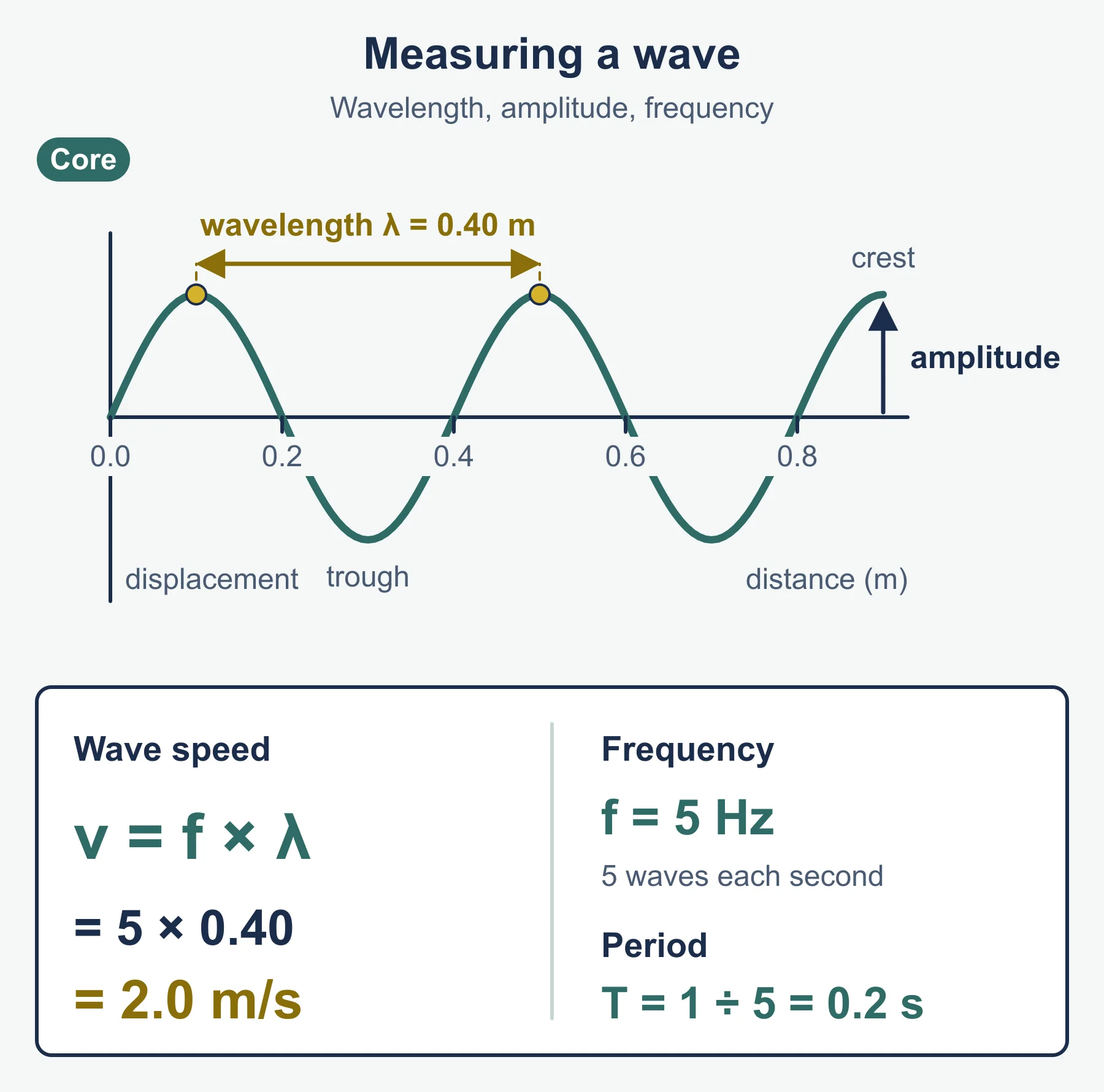
| Wave speed | v = fλ | Use m/s, Hz and m |
| Period | T = 1/f | T in s |
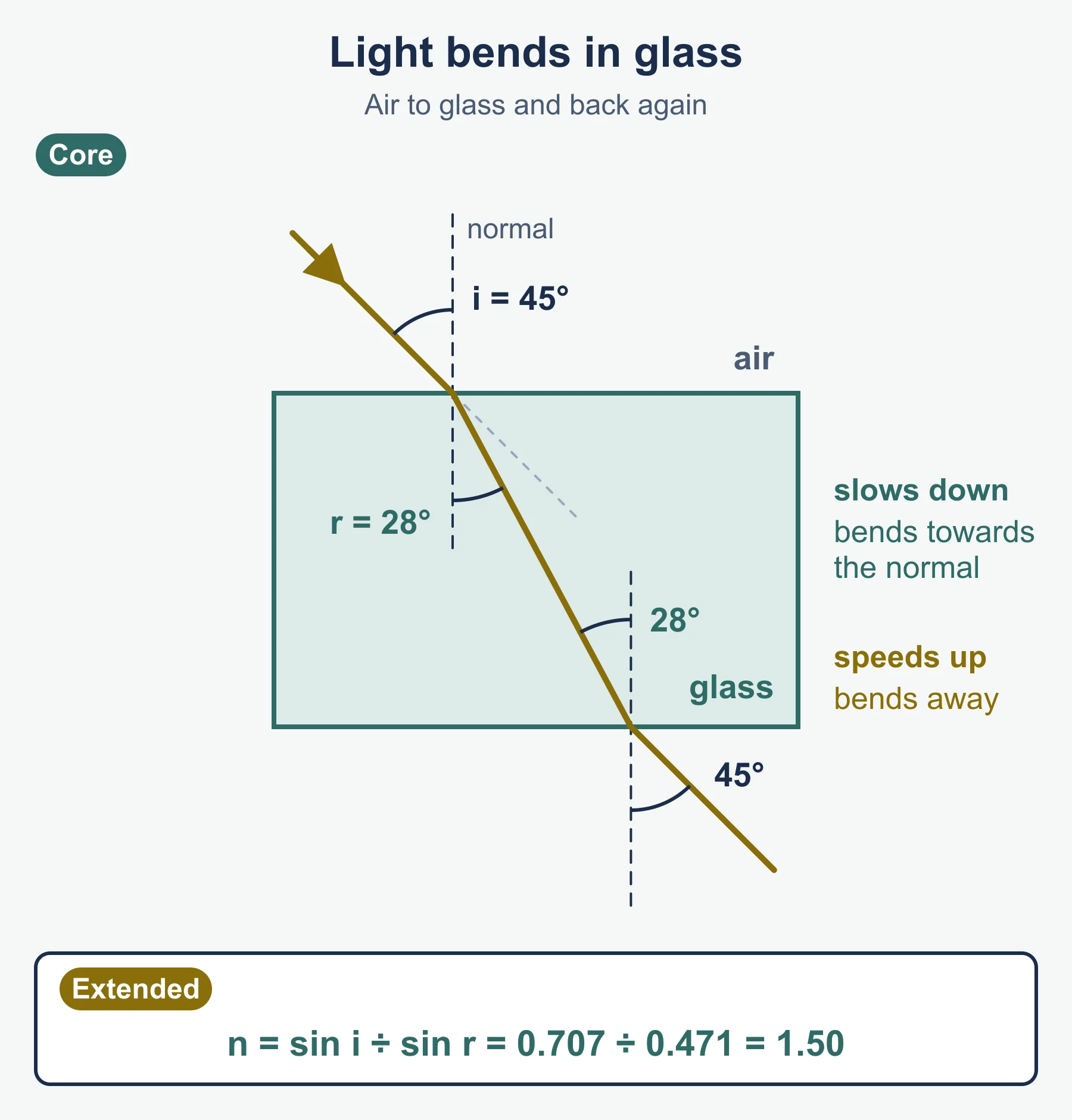
| Refractive index | n = sin i / sin r | i in the air, r in the material, both from the normal |
| Critical angle | n = 1 / sin c | Rearrange: sin c = 1/n |
| Linear magnification | image length / object length | No unit |
| Echo or sonar | distance = v × t / 2 | Halve: the pulse goes there and back |
| Speed of sound by echo | v = 2d / t | d is the distance to the reflector |
3.1 General properties of waves
Definitions to recite.
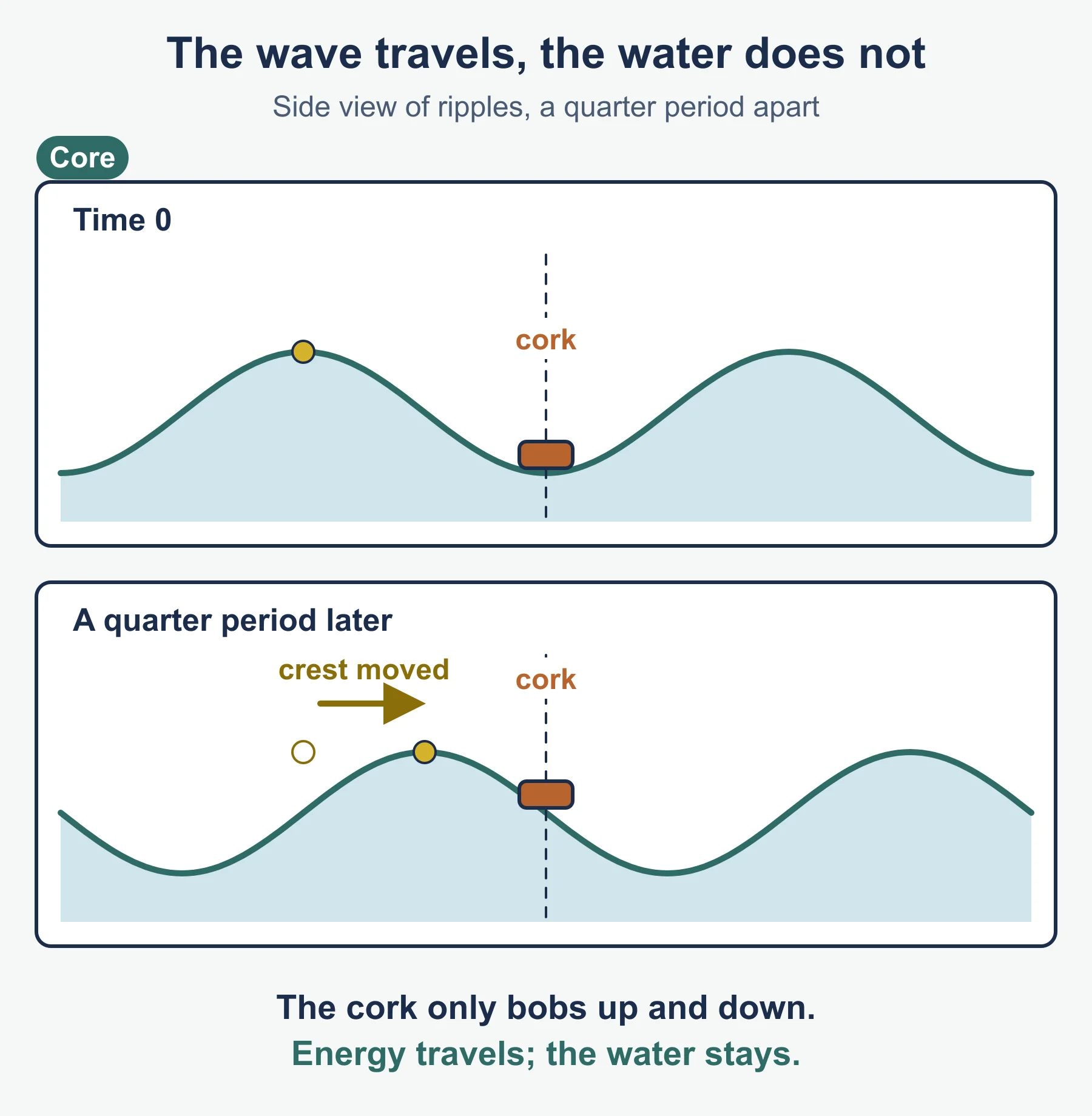
- Waves transfer energy without transferring matter.
- Frequency: the number of wavelengths that pass a point per unit time (Hz).
- Wavelength: the distance between two consecutive, identical points, such as two consecutive crests.
- Amplitude: the maximum distance from the mean position.
- Wavefront: a line joining points at the same stage of vibration.
- Crest (peak) and trough: highest and lowest points of a transverse wave.
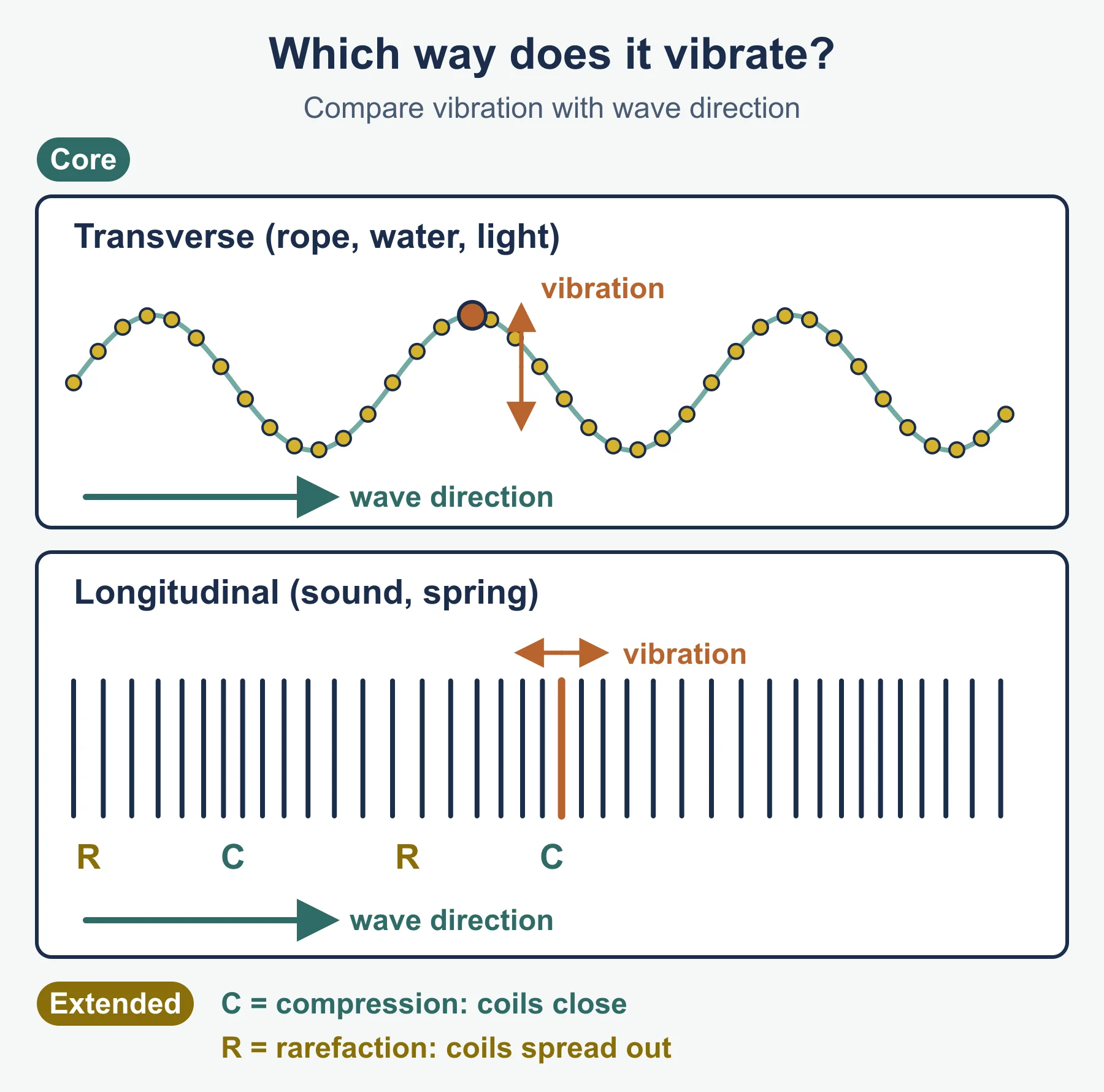
| Transverse | Longitudinal |
|---|---|
| Vibration at right angles to the direction of energy transfer | Vibration parallel to the direction of energy transfer |
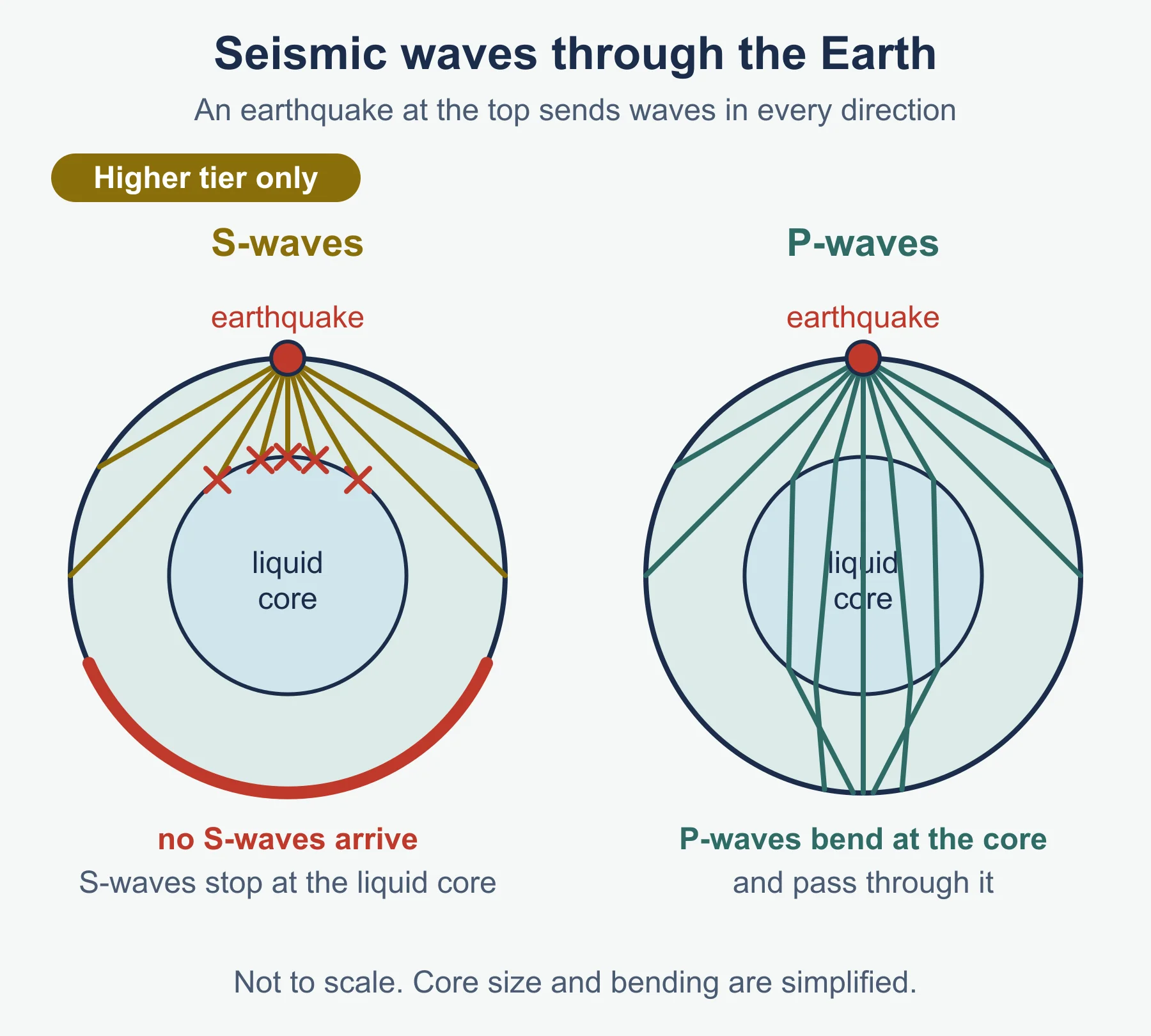
| Electromagnetic radiation, surface water waves, seismic S-waves (secondary) | Sound waves, seismic P-waves (primary) |
| Crests and troughs | Compressions and rarefactions |
Wave motion: shaking a rope or spring sends a pulse along it, and each part only vibrates about its rest position. Ripples in water show the same: a floating object bobs and stays put.
Three wave behaviours.
- Reflection at a plane surface: the wave bounces back.
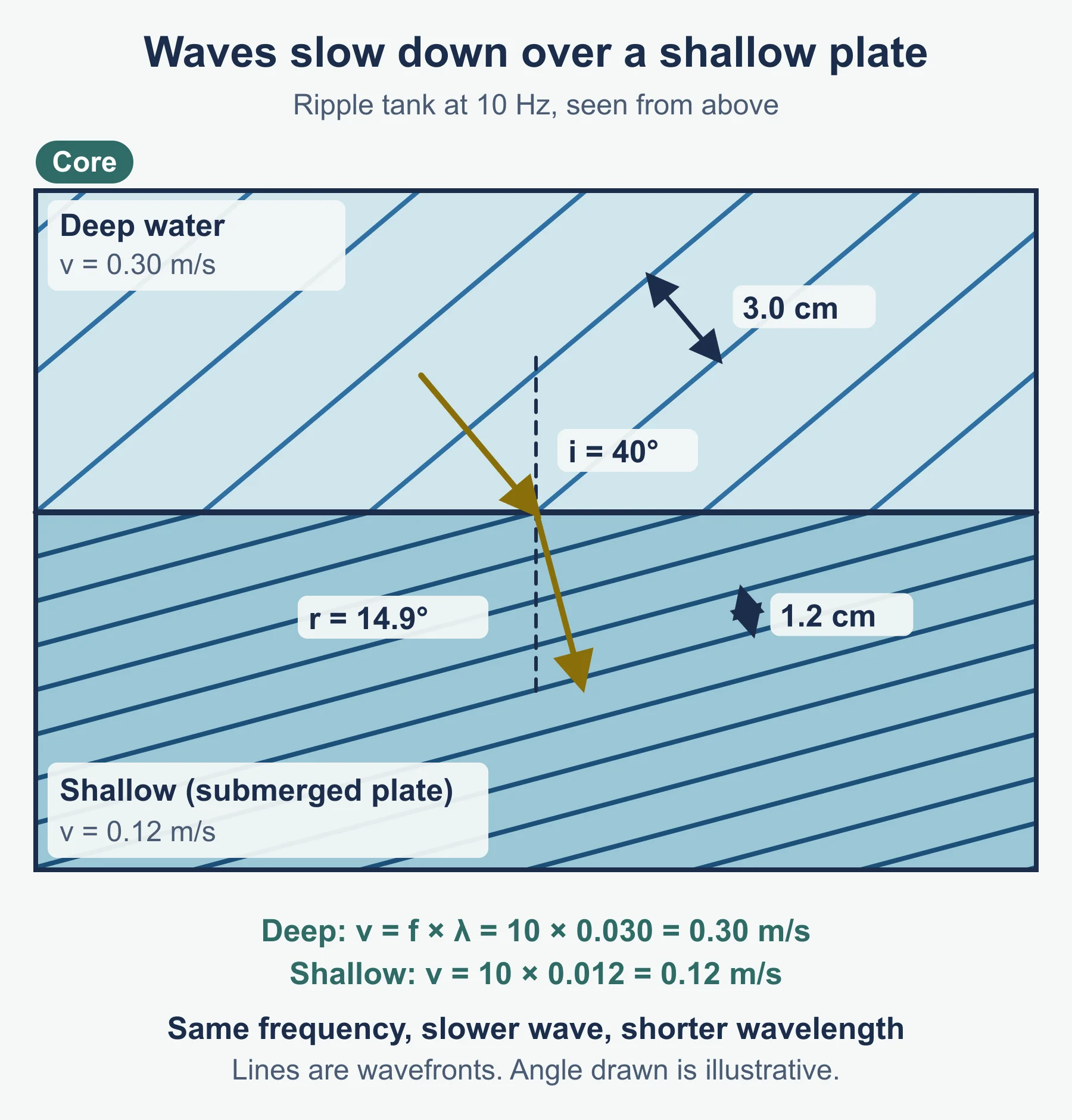
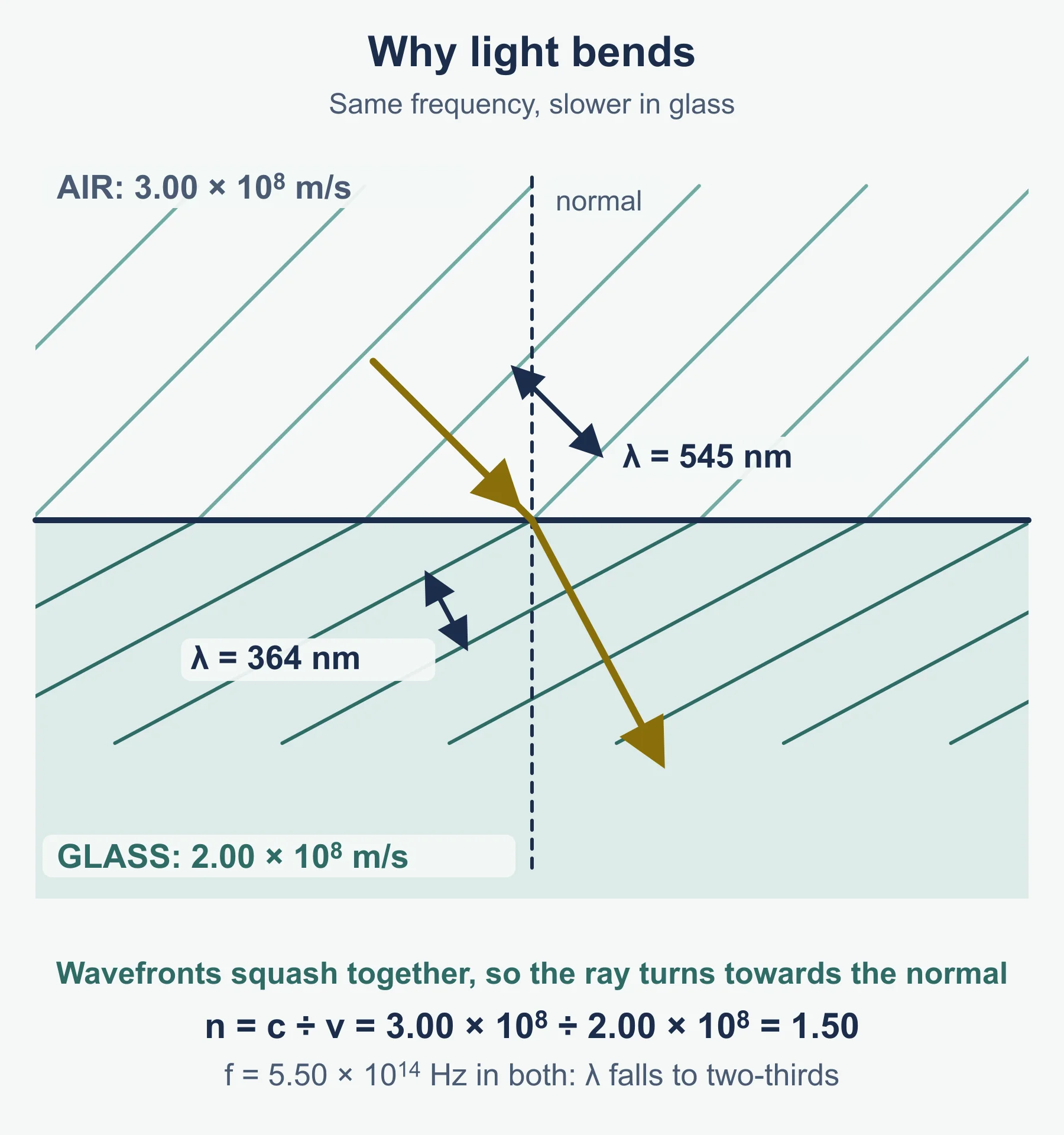
- Refraction: a change of direction caused by a change of speed. The frequency stays fixed, so the wavelength changes too.
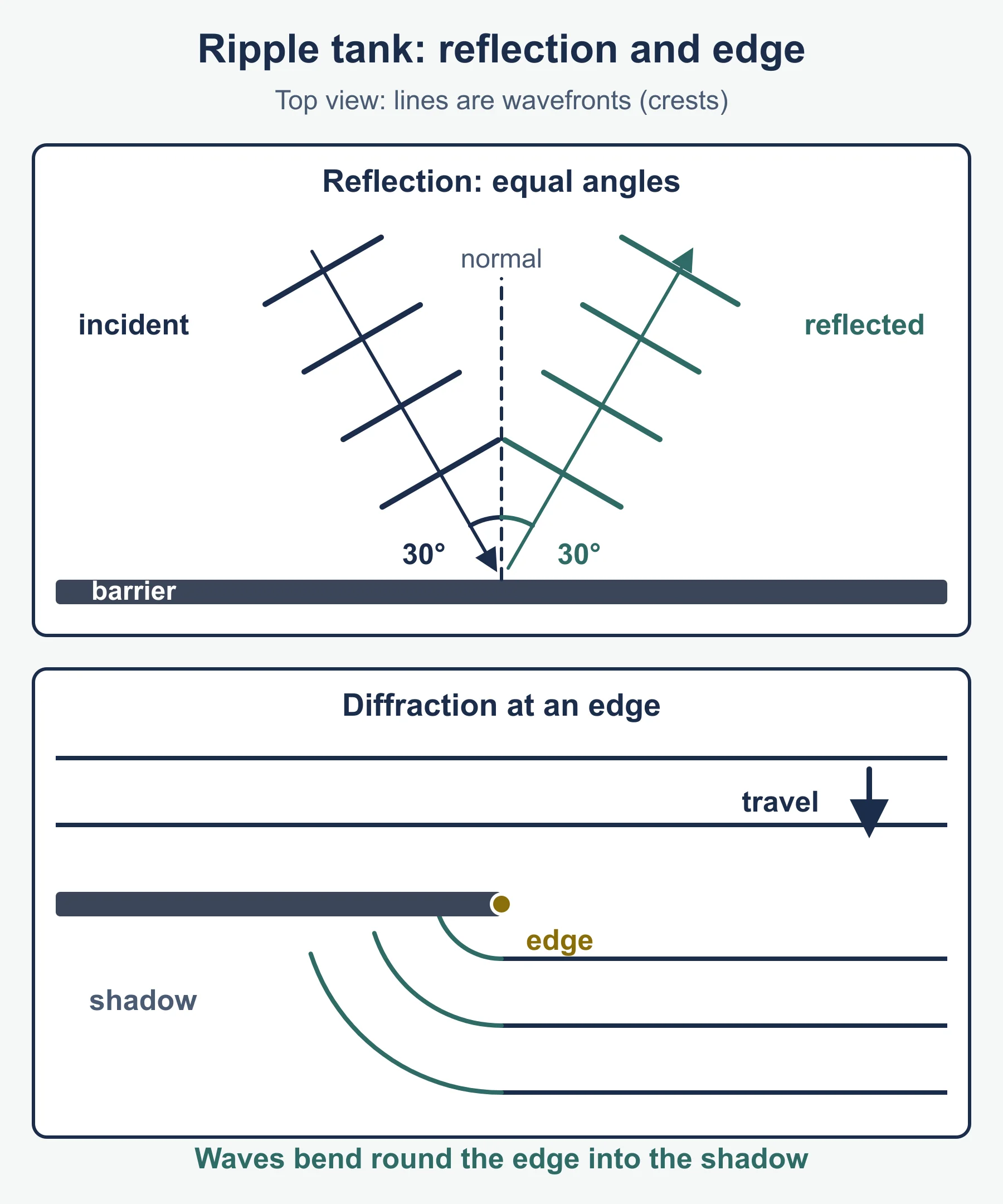
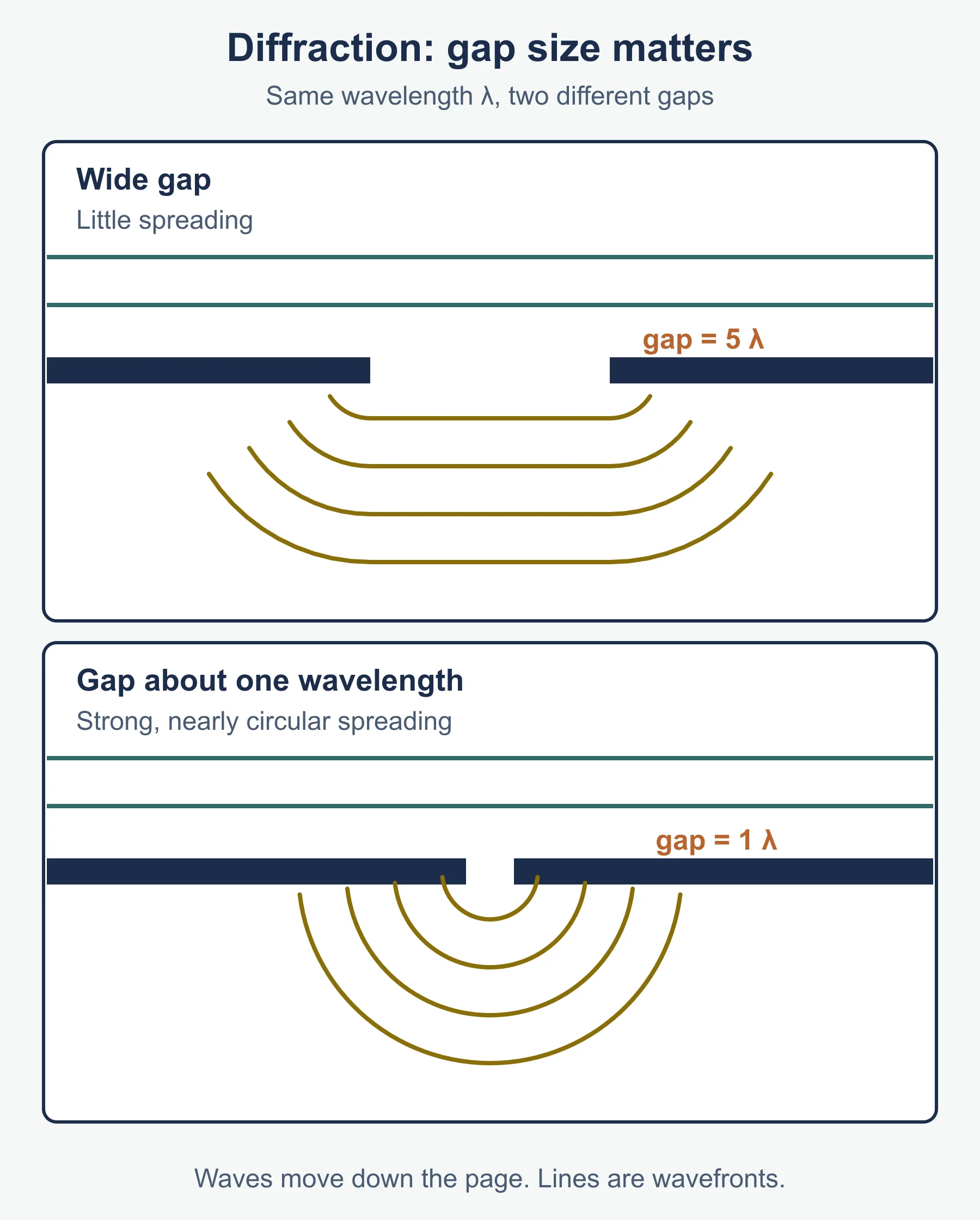
- Diffraction through a gap: spreading out. Most when the gap is about one wavelength. Less when the gap is much wider than the wavelength. A longer wavelength spreads more. At an edge a longer wavelength also bends round more.
Ripple tank, one line each.
- Reflection: a straight barrier turns the wavefronts back.
- Refraction: shallow water slows the waves, shortens the wavelength and changes direction.
- Gap: a narrow gap spreads the wavefronts into circles.
- Edge: the wavefronts curve round the end of a barrier.
Method: v = fλ.
- Write down the two known quantities with units.
- Convert units first (cm to m, kHz to Hz).
- Rearrange: v = fλ, f = v/λ, λ = v/f.
- Give the unit.
3.2 Light
Reflection
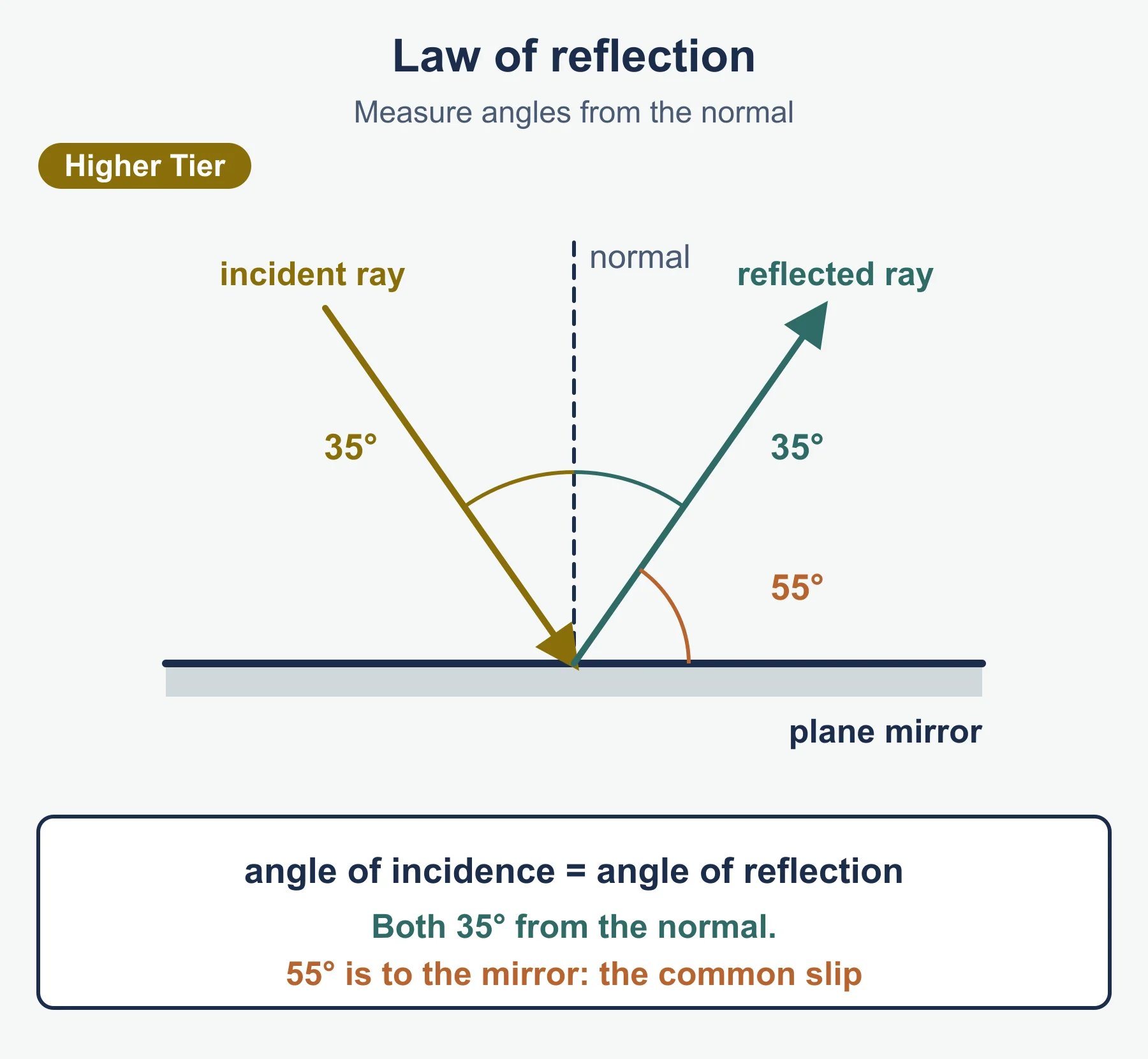
- The normal is at right angles to the surface. Angles of incidence and reflection are measured from it.
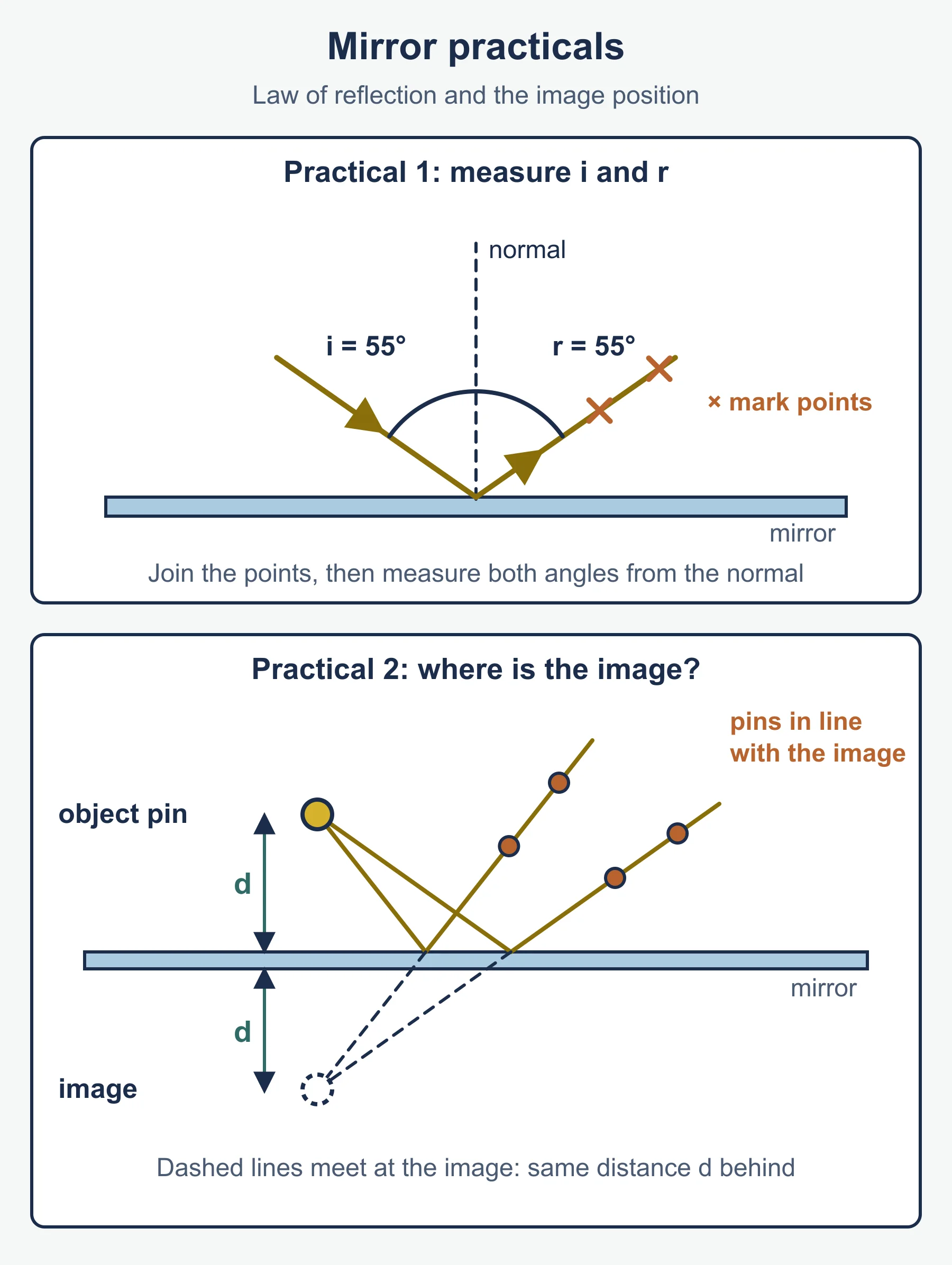
- Law of reflection: the two angles are equal.
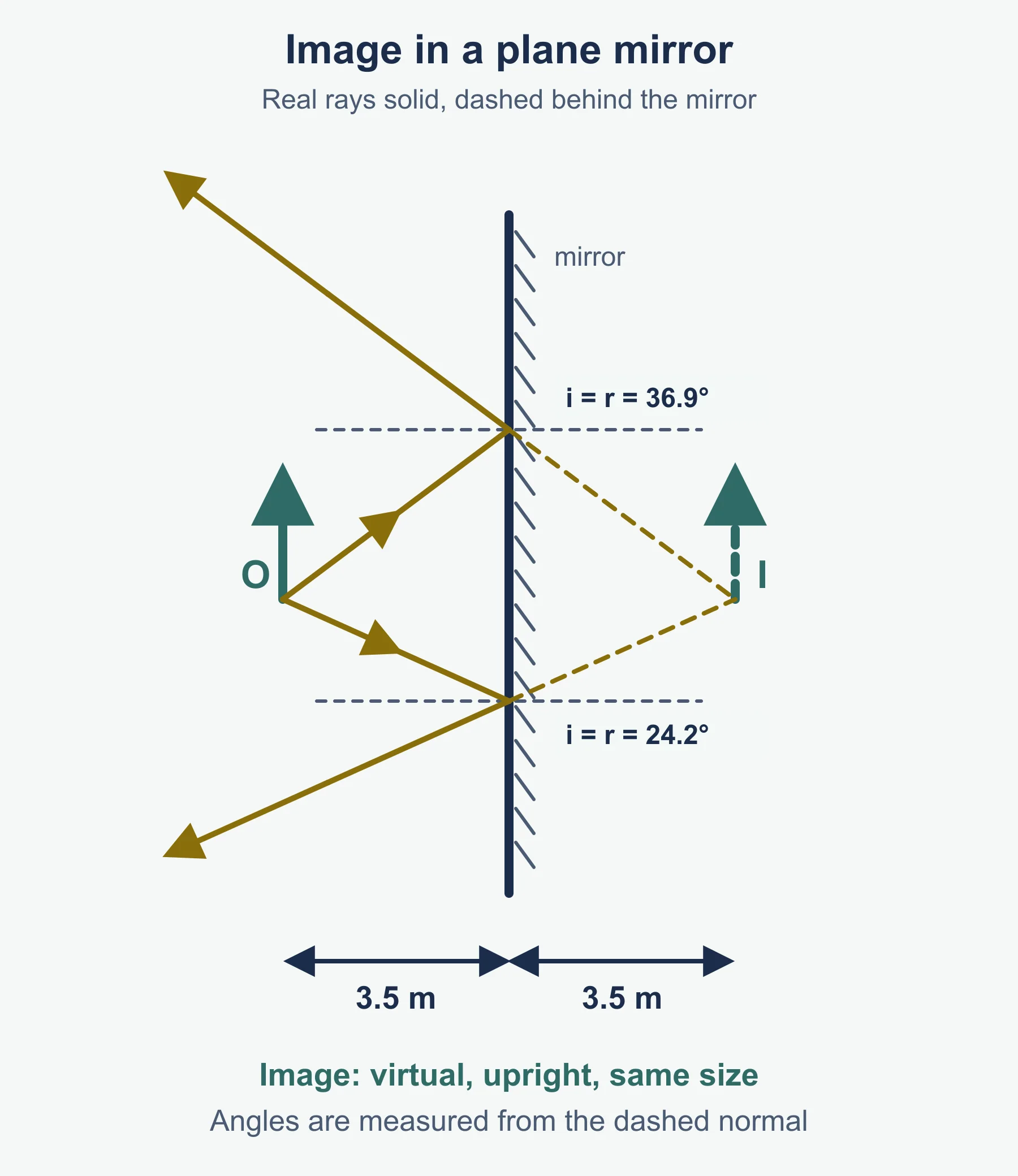
- Plane mirror image: matches the object in size, sits behind the mirror at the object’s distance in front, and is virtual.
- Experiment: ray box, mirror, paper. Mark the ray, join the points, measure from the normal, repeat.
- Image position: pins in line with the image from two directions. The lines cross at the image.
Refraction
- Slower medium: ray bends towards the normal. Faster medium: away from the normal.
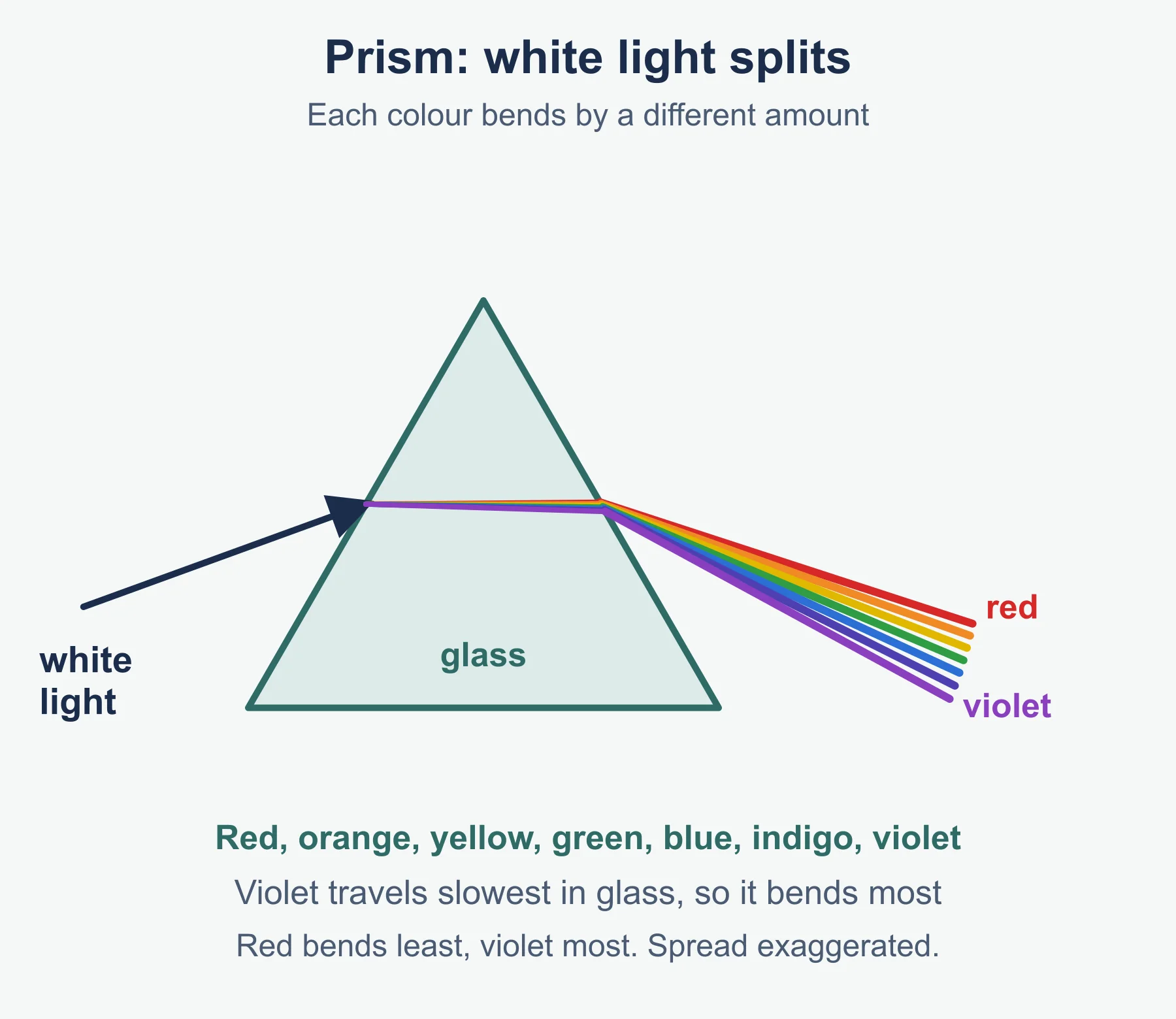
- Light through a rectangular block emerges parallel to its original path, shifted sideways. A triangular prism bends the ray towards its base.
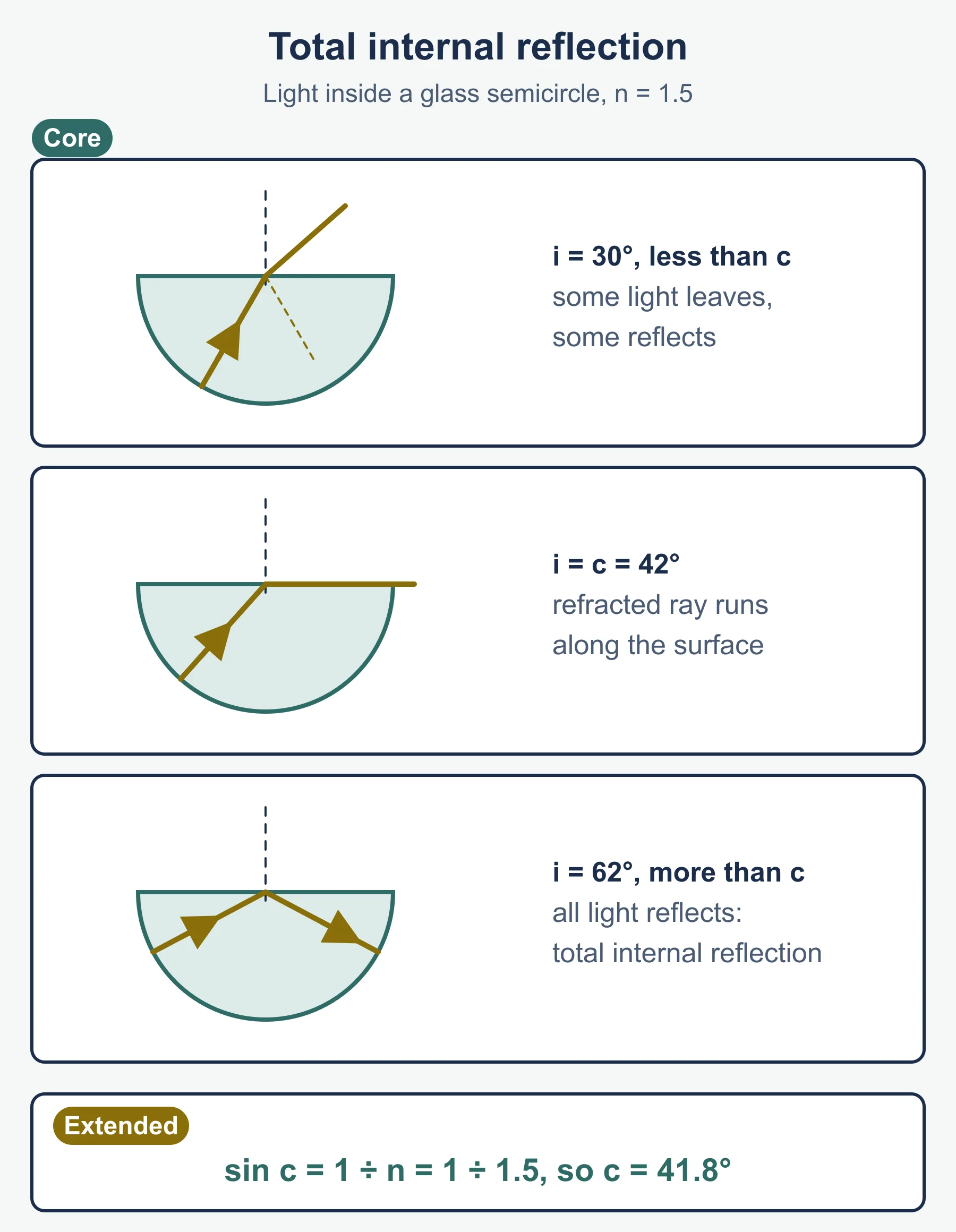
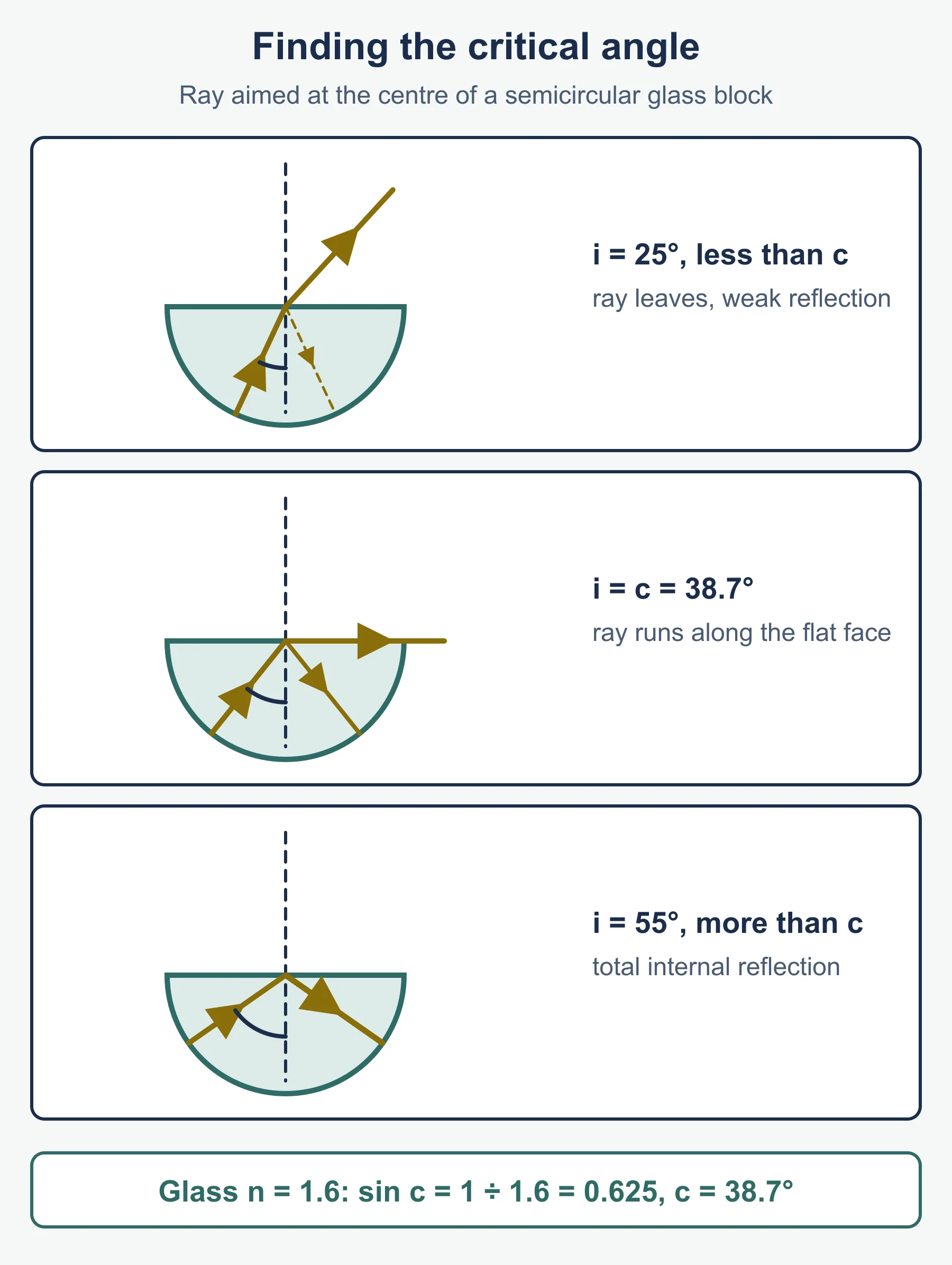
- Experiments: trace the ray through a block on paper at several angles. For internal reflection, aim a ray at the flat face of a semicircular block through the curved face and raise the angle until the refracted ray runs along the face (angle c), then beyond it.
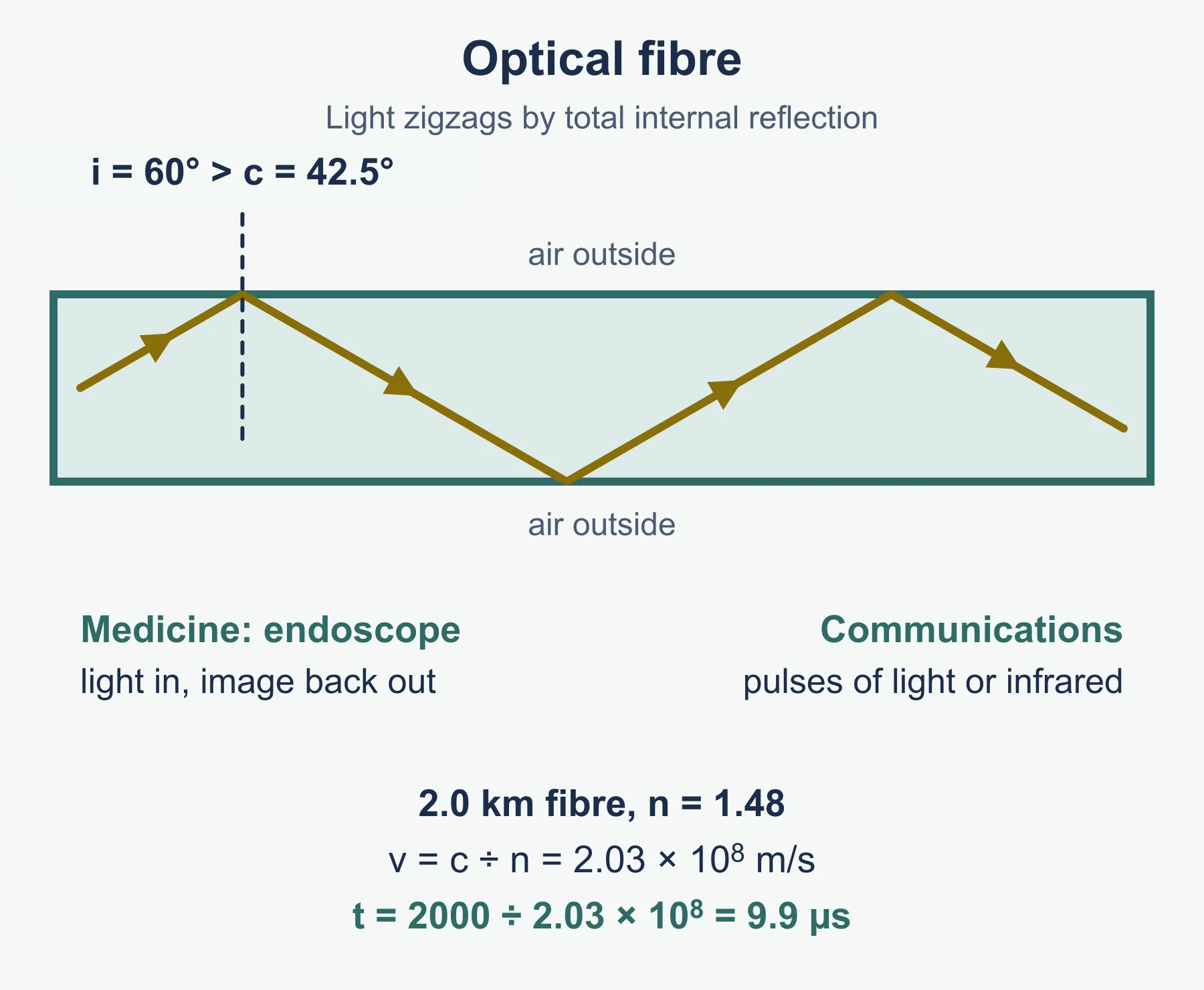
- Total internal reflection needs both: light travelling in the more dense medium towards the less dense, and i greater than c.
- At i equal to c, the refracted ray travels along the boundary.
- Optical fibres use total internal reflection. Used in telecommunications. Advantages: carry a large amount of information and avoid electrical interference. Use these as points, then add the context asked in the question.
Method: refractive index.
- Is the ray going into the material (use n = sin i / sin r) or out (use n = sin r / sin i with r now in air)?
- Put both angles measured from the normal.
- Take sin, divide, then take the inverse sin.
- Check: entering a denser medium, r is smaller than i.
Thin lenses
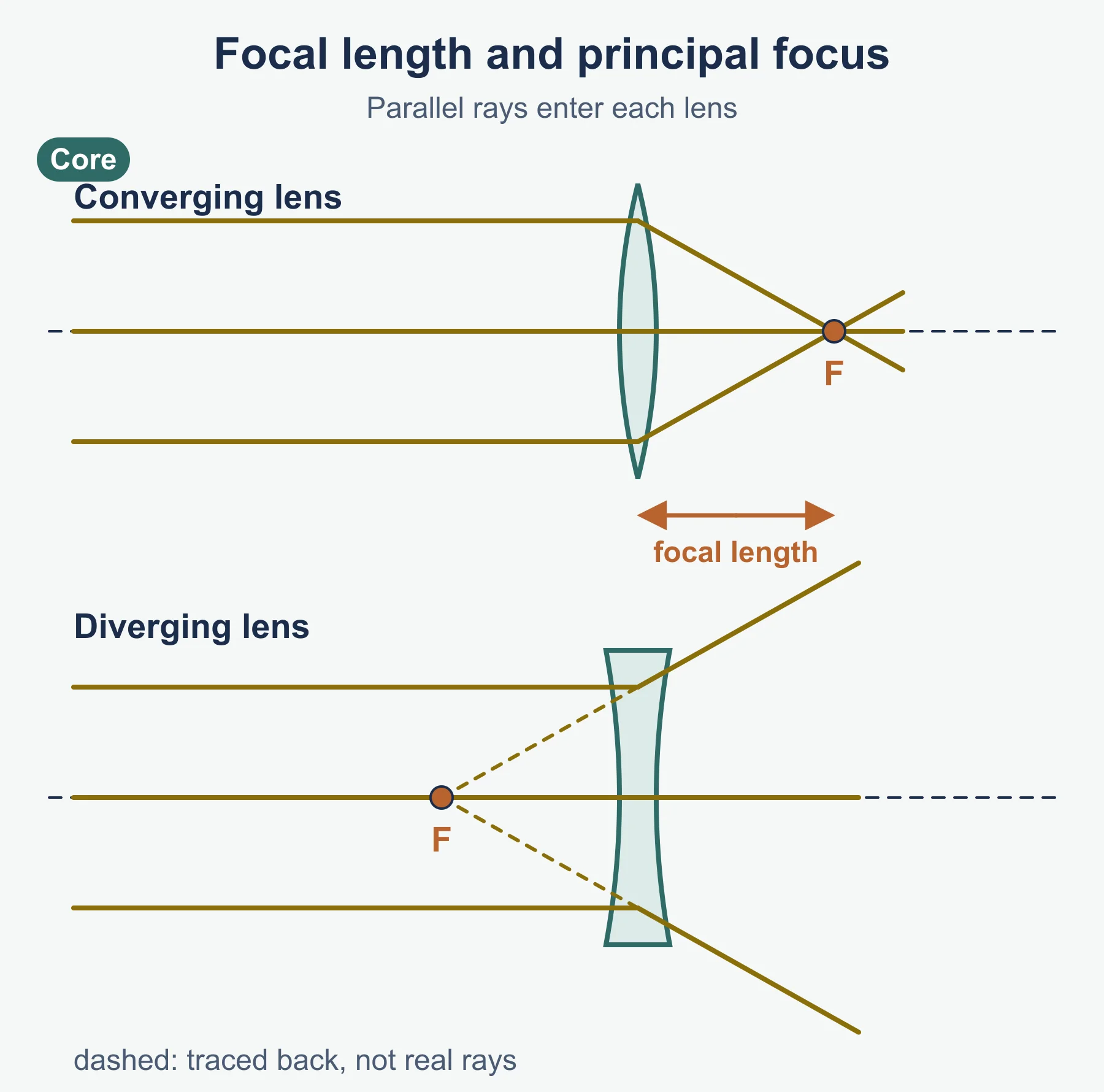
- Converging lens: parallel beam brought to the principal focus. Diverging lens: parallel beam spreads out.
- Focal length: lens centre to principal focus. Principal axis: line through the lens centre at right angles to it.
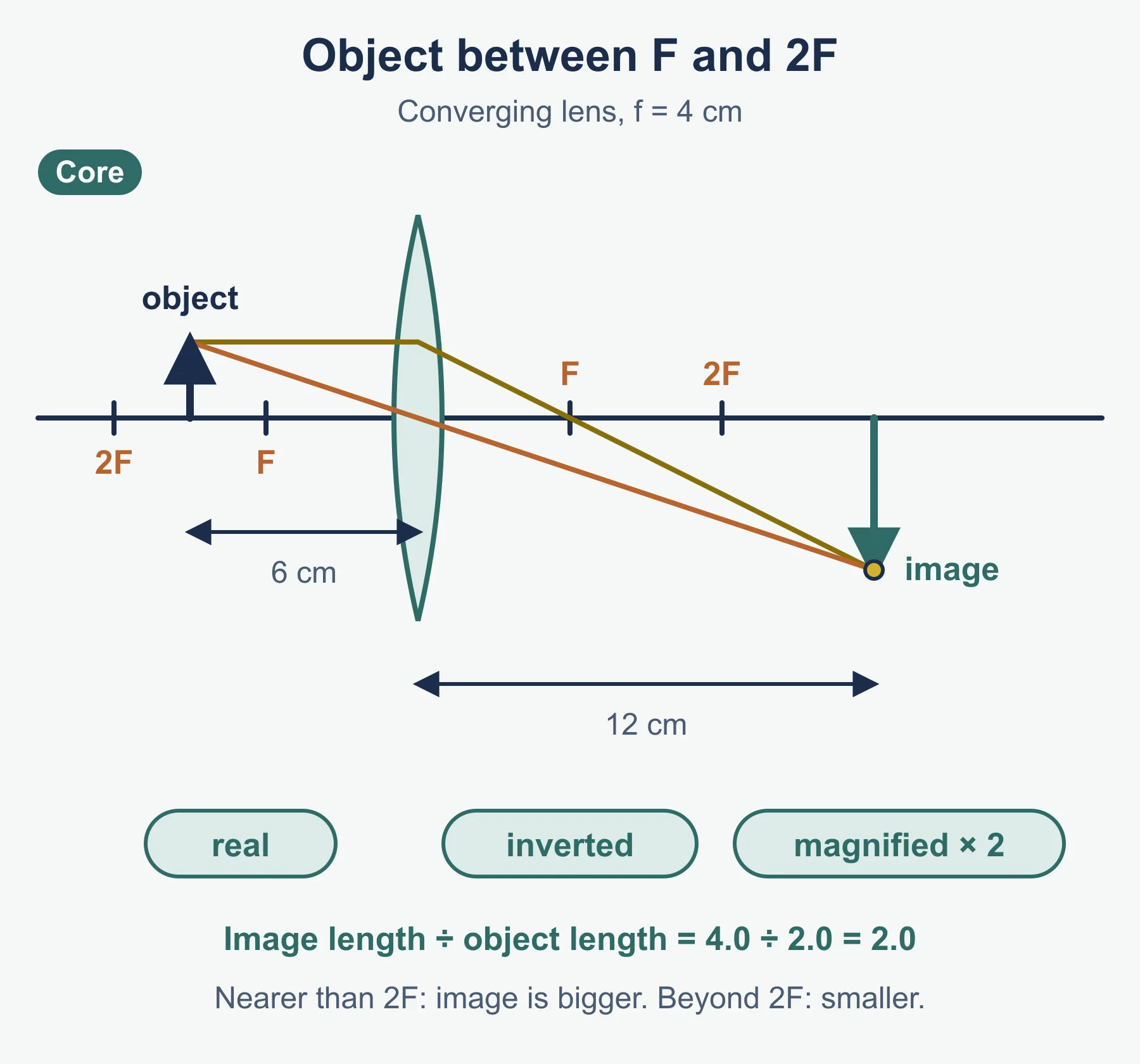
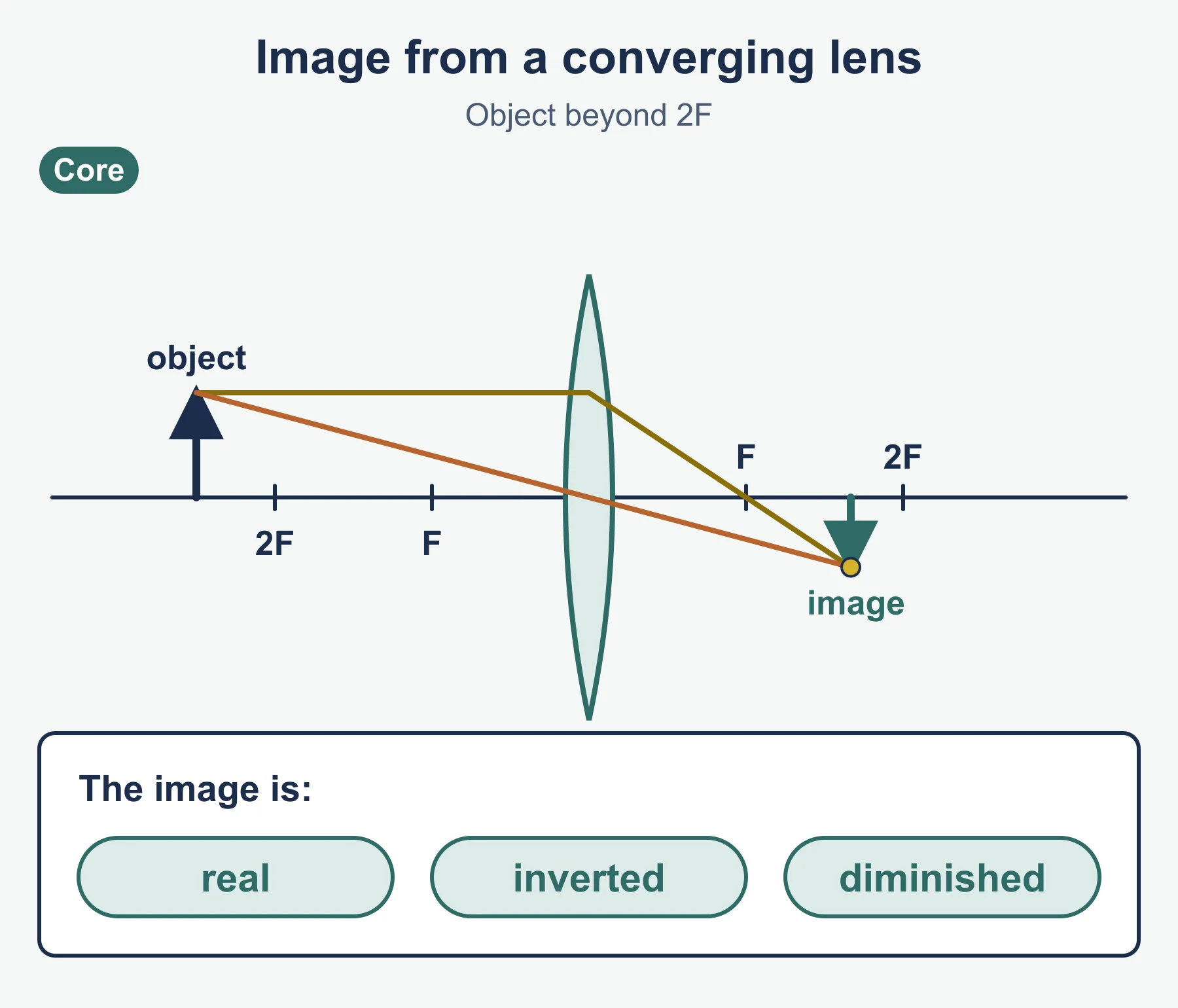
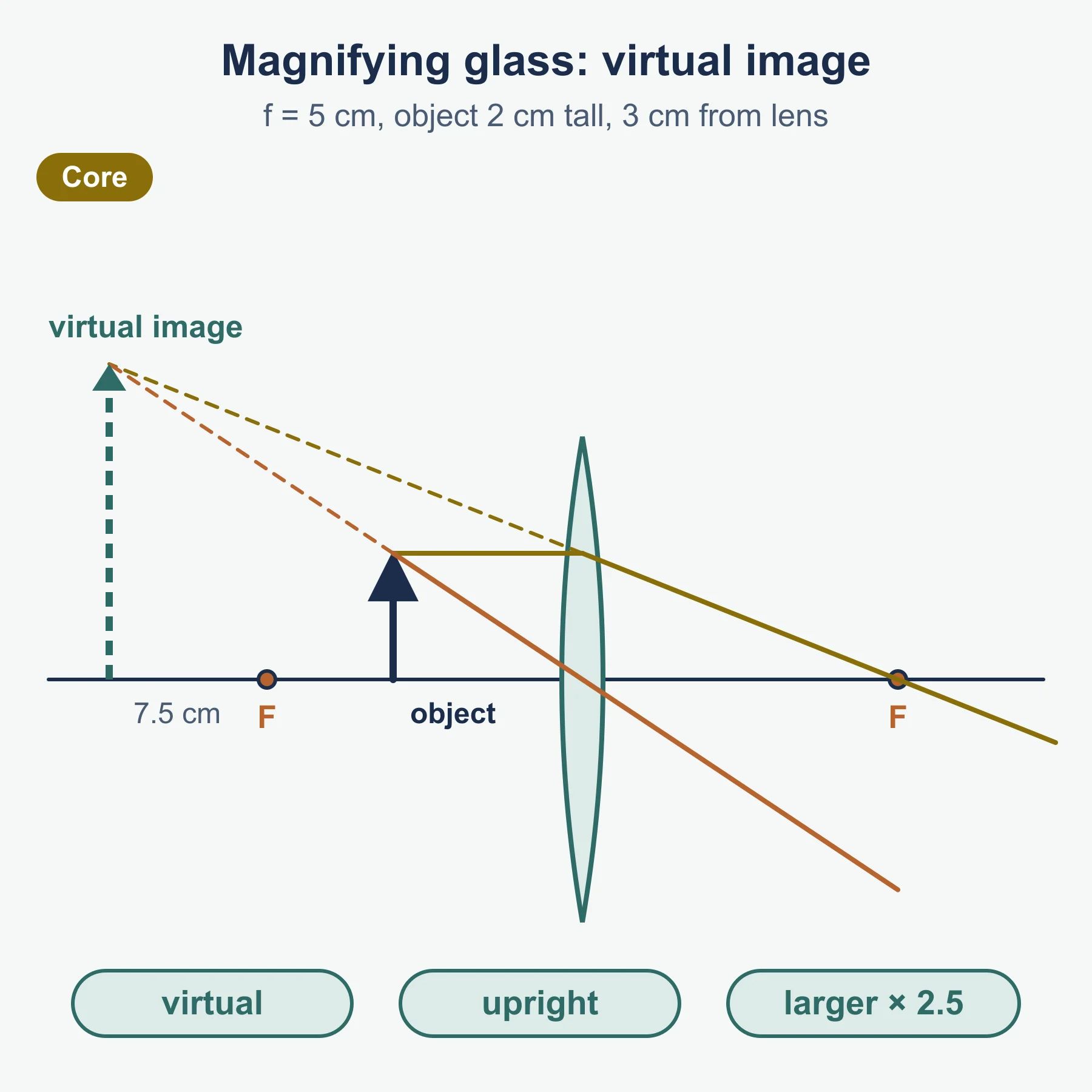
- Ray diagram: one ray parallel to the axis, through the focus after the lens; one ray through the centre, straight on.
| Converging lens, object at | Image |
|---|---|
| More than 2F away | Inverted, real, diminished |
| Between F and 2F | Inverted, real, magnified |
| Less than F away (magnifying glass) | Upright, virtual, magnified |
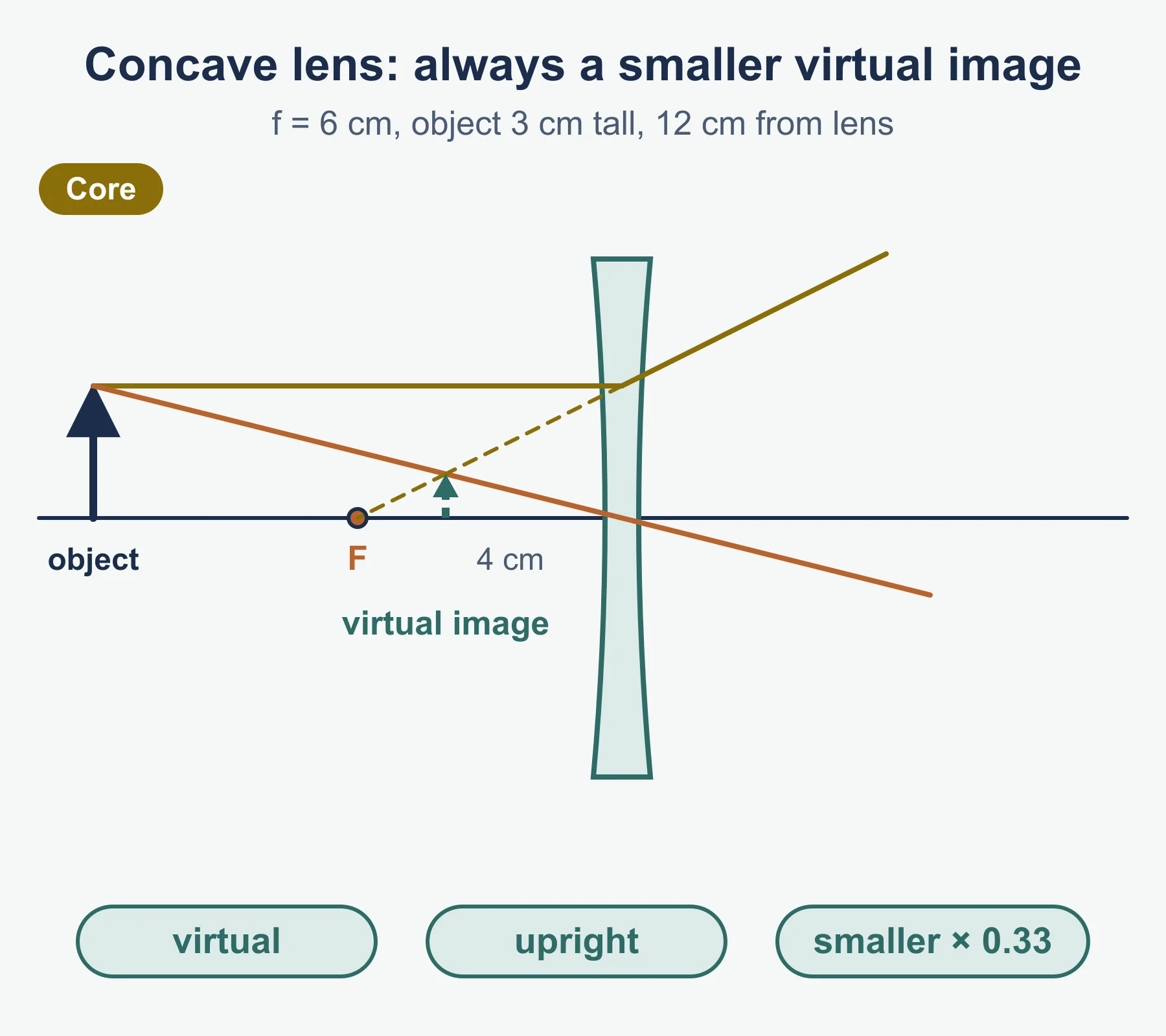
A diverging lens always gives a virtual, upright, smaller image.
- Real image: formed by converging rays. Virtual image: formed by diverging rays.
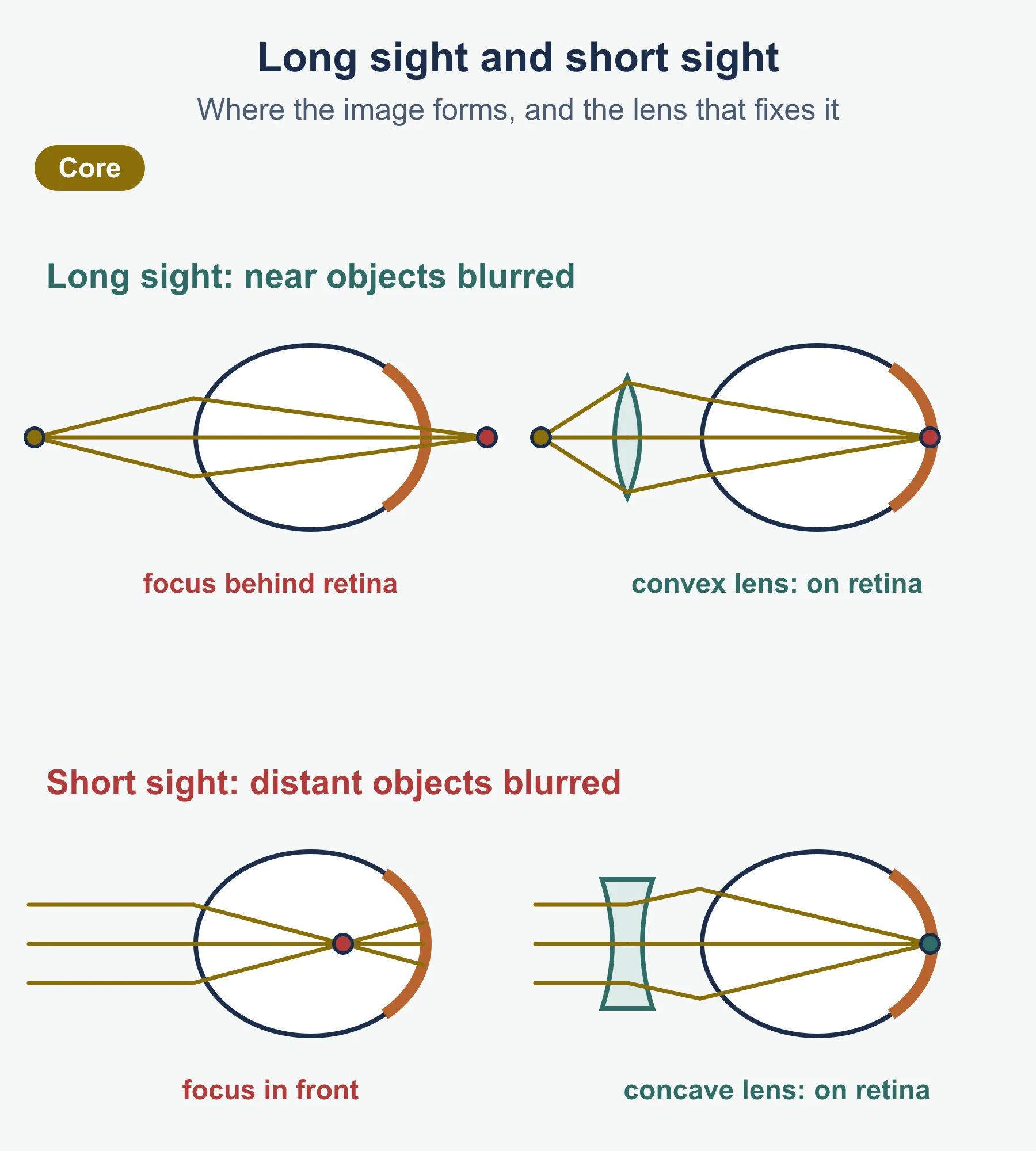
- Eye diagrams: a normal eye brings parallel rays to a focus on the retina. In short sight they focus in front of the retina, so a diverging lens spreads them first. In long sight the focus lies behind the retina, so a converging lens is used.
Dispersion
A prism refracts violet most and red least. Frequency increases: red, orange, yellow, green, blue, indigo, violet. Wavelength increases the other way.
3.3 Electromagnetic spectrum
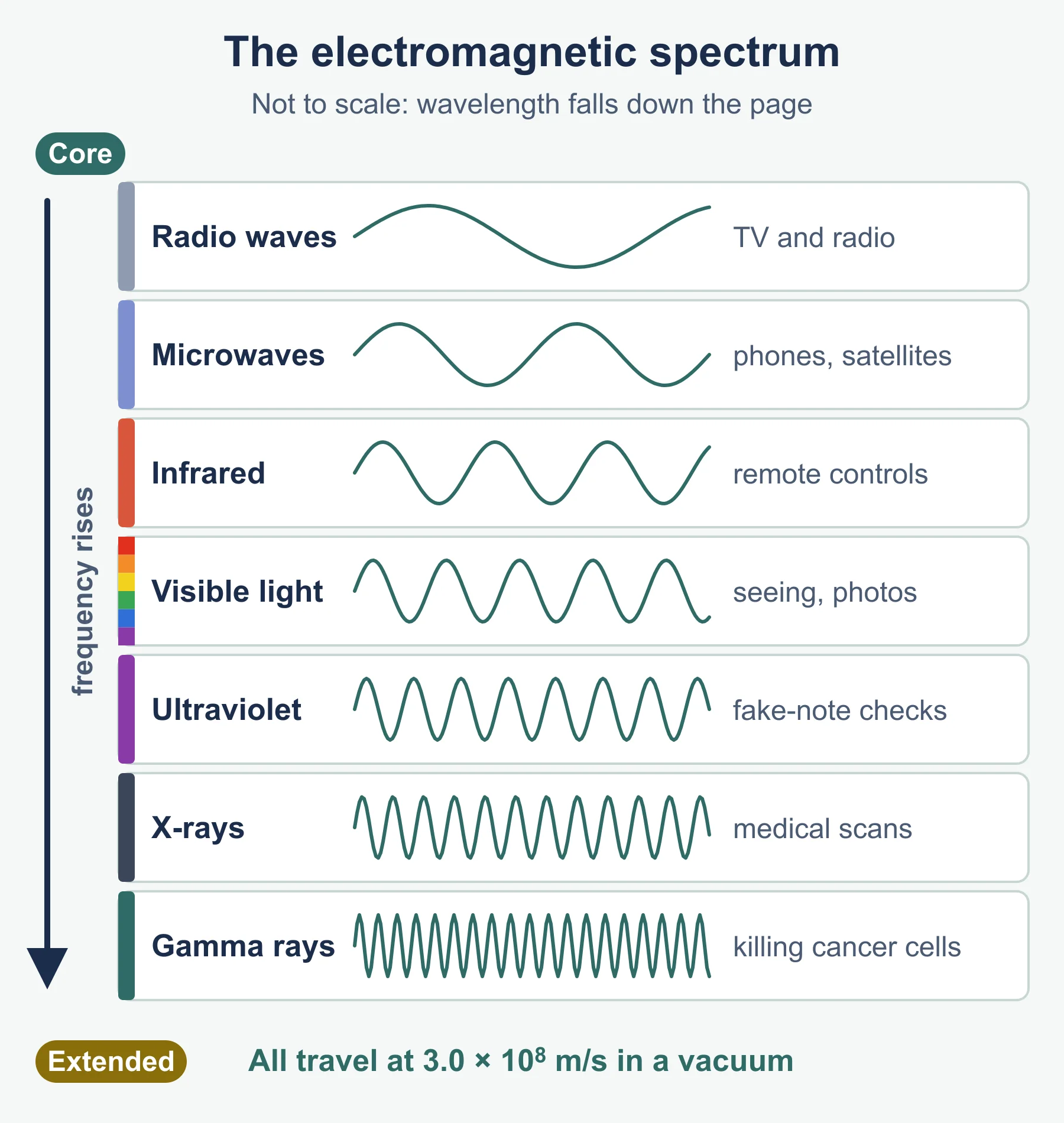
Increasing frequency, decreasing wavelength: radio waves, microwaves, infrared, visible light, ultraviolet, X-rays, gamma rays. Speed: 3.0 × 10⁸ m/s in a vacuum and about the same in air.
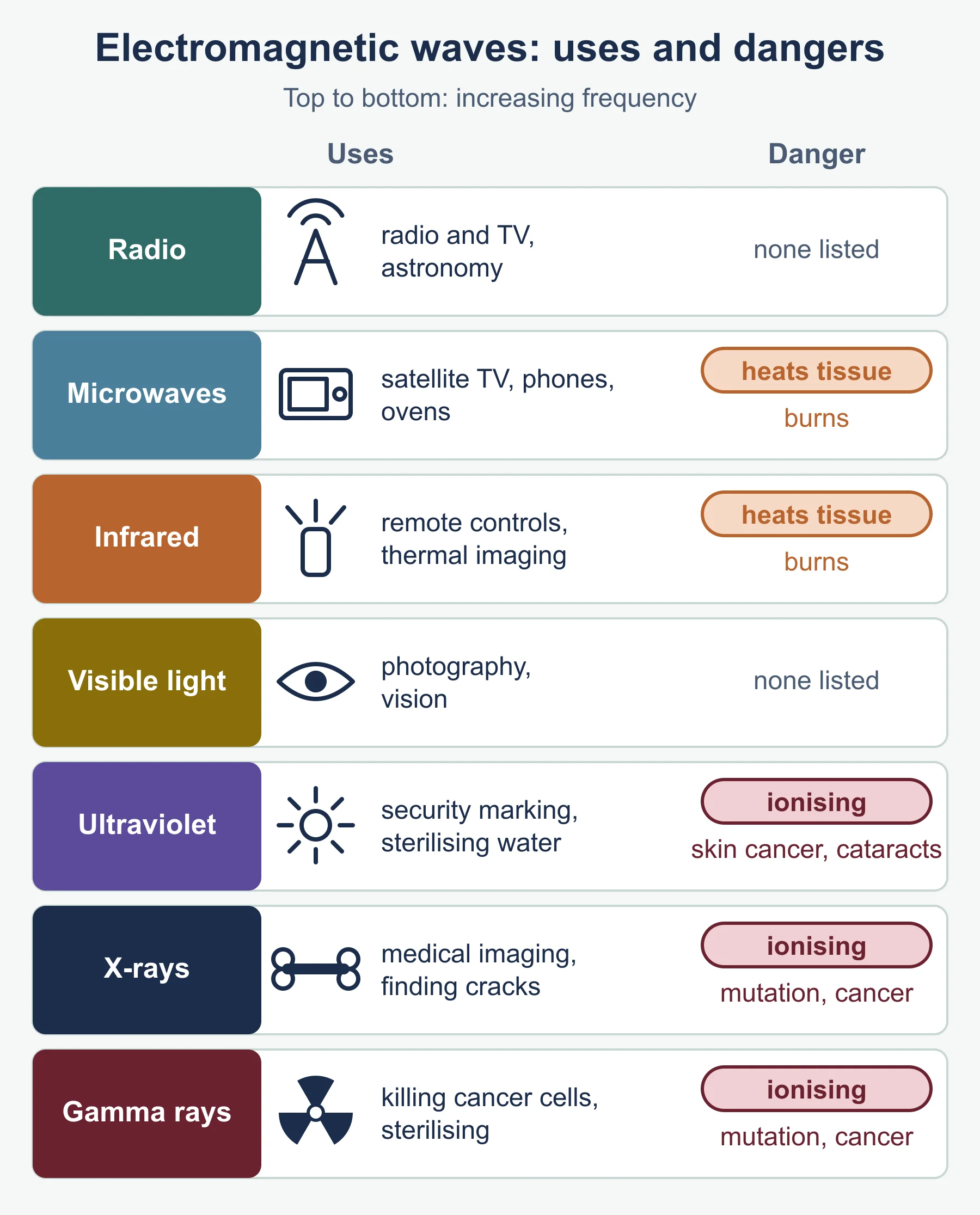
| Region | Uses to learn |
|---|---|
| Radio | Radio and television, astronomy |
| Microwave | Satellite television, mobile phones, Bluetooth, ovens |
| Infrared | Appliances, remote controllers, intruder alarms, thermal imaging, optical fibres |
| Visible | Photography, vision |
| Ultraviolet | Security marking, counterfeit notes, sterilising water |
| X-rays | Medical imaging, security scanners, killing cancer cells, cracks in metal |
| Gamma | Treating cancer, sterilising food and equipment, cracks in metal |
Dangers. Excess exposure heats soft tissue and burns. Ionising radiation: ultraviolet (skin cancer, cataracts); X-rays and gamma rays (cell mutation, cancer).
3.4 Sound
- Made by vibrating sources. Longitudinal, with compressions and rarefactions.
- Audible range for humans: 20 Hz to 20 000 Hz.
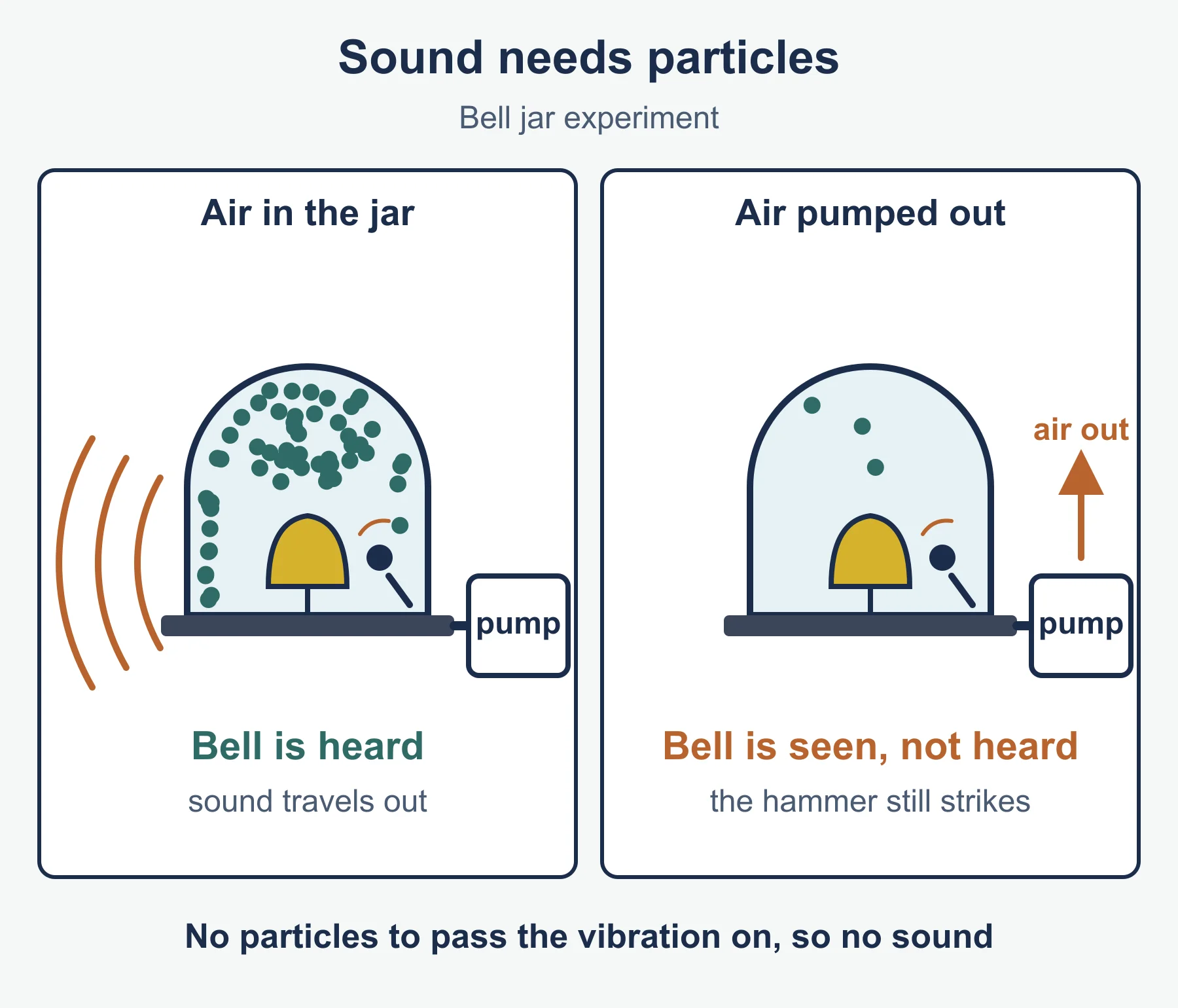
- Cannot travel in a vacuum because there are no particles to pass on the vibration. Demonstration: bell in an evacuated jar.
- Amplitude gives loudness. Frequency gives pitch.
- Timbre: the oscilloscope trace shape differs between sources even at the same pitch and loudness.
- Echo: reflection of sound. Show by directing sound at a hard board and detecting reflection.
- Speed in air: approximately 330 to 350 m/s. Solids faster than liquids, liquids faster than gases.
- Ultrasound: frequency above 20 kHz. Uses: cleaning, prenatal and other medical scanning, sonar.
Method: speed of sound in air. Measure the distance to a wall with a long tape. Clap and time the echo with a stopwatch. v = 2d/t. Repeat and average.
Method: echo or sonar depth. Distance travelled = v × t. Divide by 2 for the one-way distance.
Must-know distinctions
- Loudness is amplitude; pitch is frequency.
- Refraction changes speed and wavelength; frequency stays the same.
- Real image: can be caught on a screen. Virtual image: cannot.
- Critical angle belongs to the dense-to-less-dense direction; it does not exist going the other way.
- Ionising: ultraviolet, X-rays, gamma rays. Heating effect: microwaves and infrared.
Quick self-test
- Water waves have a frequency of 12 Hz and a wavelength of 0.25 m. Find the speed.
- A note has a frequency of 250 Hz. Find the period.
- A ray in air strikes glass (n = 1.5), making 30° with the normal. Find the angle of refraction.
- A microwave has a wavelength of 0.12 m. Find its frequency, using 3.0 × 10⁸ m/s.
- An image is 9.0 cm tall and the object is 2.0 cm tall. Find the magnification.
- A sonar pulse returns after 0.40 s. The speed in water is 1500 m/s. Find the depth.
- A ray goes from air into a plastic. The angle of incidence is 60° and the angle of refraction is 35°. Find n.
- A ray makes 62° with a plane mirror. Find the angle of reflection.
- Calculate the critical angle of a glass with n = 1.5.
- Sound at 170 Hz travels at 340 m/s. Find the wavelength.
- State why sound cannot pass through a vacuum.
- Give the property of a sound wave that sets its pitch.
Answers
- v = fλ = 12 × 0.25 = 3.0 m/s.
- T = 1/250 = 0.004 s.
- sin r = sin 30° / 1.5 = 0.333, so r = 19.5°.
- f = v/λ = 3.0 × 10⁸ / 0.12 = 2.5 × 10⁹ Hz.
- 9.0 / 2.0 = 4.5.
- 1500 × 0.40 / 2 = 300 m.
- n = sin 60° / sin 35° = 1.51.
- Angle of incidence = 90 − 62 = 28°, so the angle of reflection is 28°.
- sin c = 1/n = 0.667, giving c = 41.8°.
- λ = 340 / 170 = 2.0 m.
- There are no particles to vibrate and pass the energy on.
- The frequency.
Where marks are usually lost
- Using the surface rather than the normal as the line to measure angles from.
- Leaving out the halving step in echo and sonar questions.
- Quoting frequency, wavelength or speed without converting kHz, MHz or cm first.
- Writing that sound “goes faster in air than in water”.
- Describing the longitudinal wave as “up and down”.
- Stating total internal reflection without both conditions.
- Mixing up the order of the electromagnetic spectrum with the order of colours in dispersion.
- Saying a virtual image is “not there” instead of saying the rays only appear to come from it.
Frequently asked questions
What is the difference between loudness and pitch? Loudness depends on the amplitude of a sound wave, and pitch depends on its frequency.
What is the difference between a real and a virtual image? A real image can be caught on a screen. A virtual image cannot, because the rays only appear to come from it.
Which parts of the electromagnetic spectrum are ionising? Ultraviolet, X-rays and gamma rays are ionising, while microwaves and infrared mainly have a heating effect.
Does sound travel faster in air or in water? Sound travels faster in water than in air. Writing that sound goes faster in air than in water is a common error.
Official syllabus
Source: topic 3, Waves, of the Cambridge International Education O Level Physics 5054 syllabus for 2026 to 2028.
Get free revision emails (optional)
Occasional emails with practice questions, worked explanations and links to free resources for the qualification and subjects you choose. No spam, and you can unsubscribe from any email. The free tools on this site never need an email.
Related resources
-
Practice questions
O Level Physics: Electromagnetic Spectrum — Practice Questions (Cambridge 5054)
Original Cambridge O Level Physics 5054 questions with worked answers on the order of the EM spectrum, wave speed, uses of each region and radiation damage.
Physics · Cambridge · O Level
Try questions -
Study guides
Cambridge O Level Physics: Waves (5054)
Study guide to Waves for Cambridge O Level Physics 5054: wave properties, light, lenses, the electromagnetic spectrum and sound, with worked examples.
Physics · Cambridge · O Level
Read guide -
Practice questions
O Level Physics: Waves — Practice Questions (Cambridge 5054)
Original Cambridge O Level Physics 5054 waves questions with worked answers on sound, frequency, oscilloscope traces, diffraction, echoes, refraction, fibres.
Physics · Cambridge · O Level
Try questions
Related articles
-
study skills
How to revise for a science examination
Most science revision fails because it rereads notes instead of retrieving them. A practical method for revising physics, chemistry and biology in the weeks before a paper.
14 July 2026
-
teaching
A Level tuition in Dubai: Cambridge or Pearson Edexcel International A Level?
Schools in Dubai and Abu Dhabi teach either Cambridge International AS & A Level or Pearson Edexcel International A Level. How the two are structured, why it matters for tuition, and how online classes from Lahore work.
9 October 2026
Studying this with a teacher
Working through Physics O LEVELS?
This page is free and stays free. If you would rather be taught it, Marlbridge runs Physics classes one-to-one and in small groups of up to 15, online in your own time zone. The first trial class is free. WhatsApp replies within an hour (8am–11pm Pakistan time, every day); email the same day.
Cambridge Physics teachers at Marlbridge