
Study Guides
Cambridge O Level Physics: Waves (5054)
Study guide to Waves for Cambridge O Level Physics 5054: wave properties, light, lenses, the electromagnetic spectrum and sound, with worked examples.
- Subject
- Physics
- Level
- O LEVELS
- Topic
- Waves
- Author
- Marlbridge Academic Team
- Updated
- Reviewed by
- Hassan (what this means)
Aligned to Cambridge O Level Physics (5054), 2026-2028. Official specification .
Syllabus page (what it covers and how it is assessed): Cambridge O Level Physics.
Syllabus points this page covers
5054
- 3.1 General properties of waves
- 3.2 Light
- 3.3 Electromagnetic spectrum
- 3.4 Sound
Found an error? Report a correction.
Need help with this topic? Request a free trial class for O Level Physics (5054).
This guide works through topic 3, Waves, from the Cambridge O Level Physics 5054 syllabus (examined in 2026, 2027 and 2028), following the syllabus order. The syllabus does not mark any of it as extension content.
Companion pages: revision notes and practice questions. Also see the Physics course hub, a topic checklist and our free diagnostics.
What this guide covers
Sections 3.1 to 3.4: wave properties, light, the electromagnetic spectrum and sound. The lens, eye and radiation-use outcomes are briefest.
3.1 General properties of waves
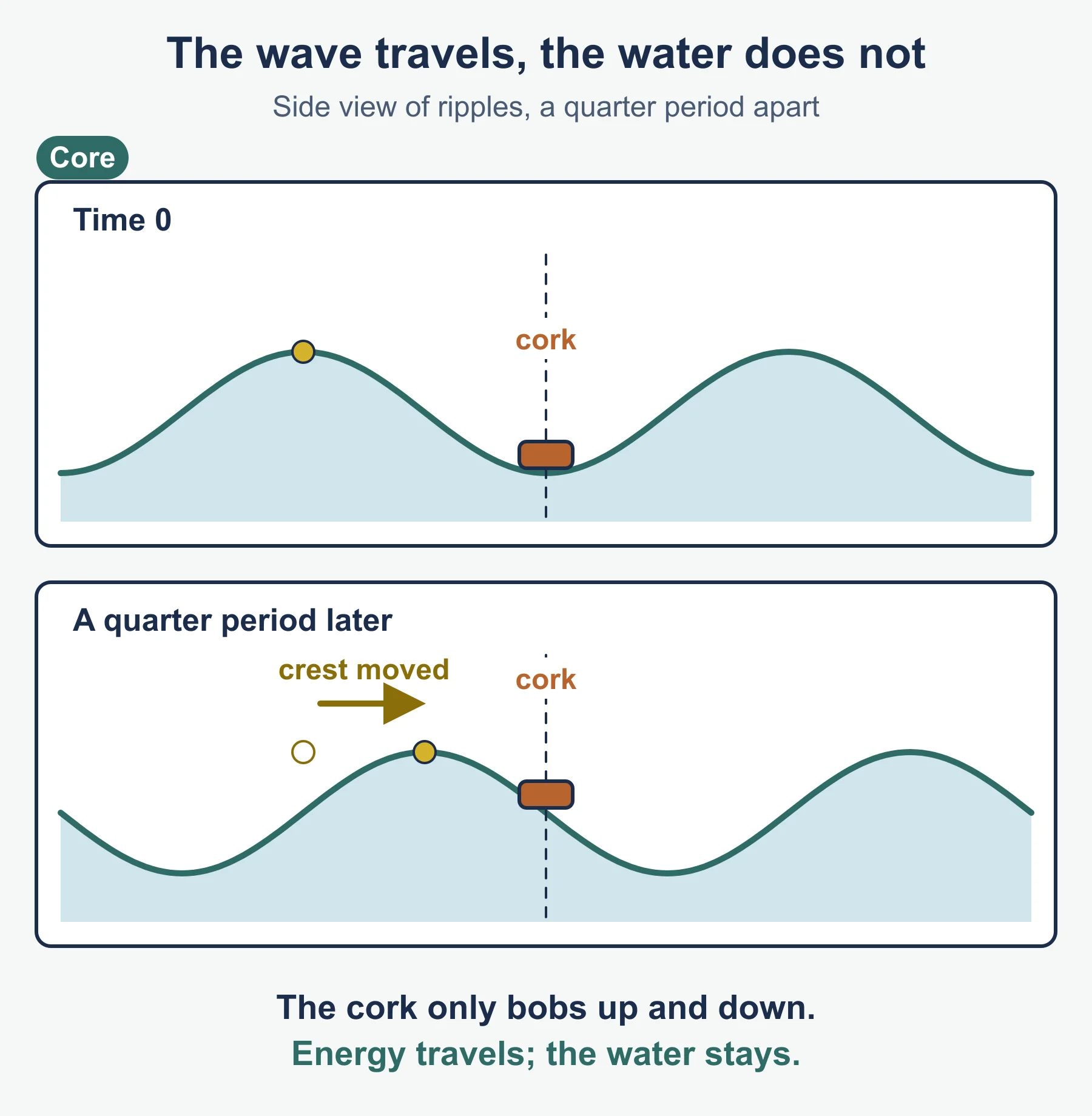
Waves carry energy from place to place, and no matter is carried along. A cork floating on a pond rises and falls as ripples go by, yet it stays where it is. In a rope or spring, shaking one end sends a pulse along it while each part only moves a short way and returns.
Wave features and definitions
- Wavefront: a line joining points at the same stage of vibration, such as a line along a crest.
- Crest (peak) and trough: the highest and lowest points of a transverse wave.
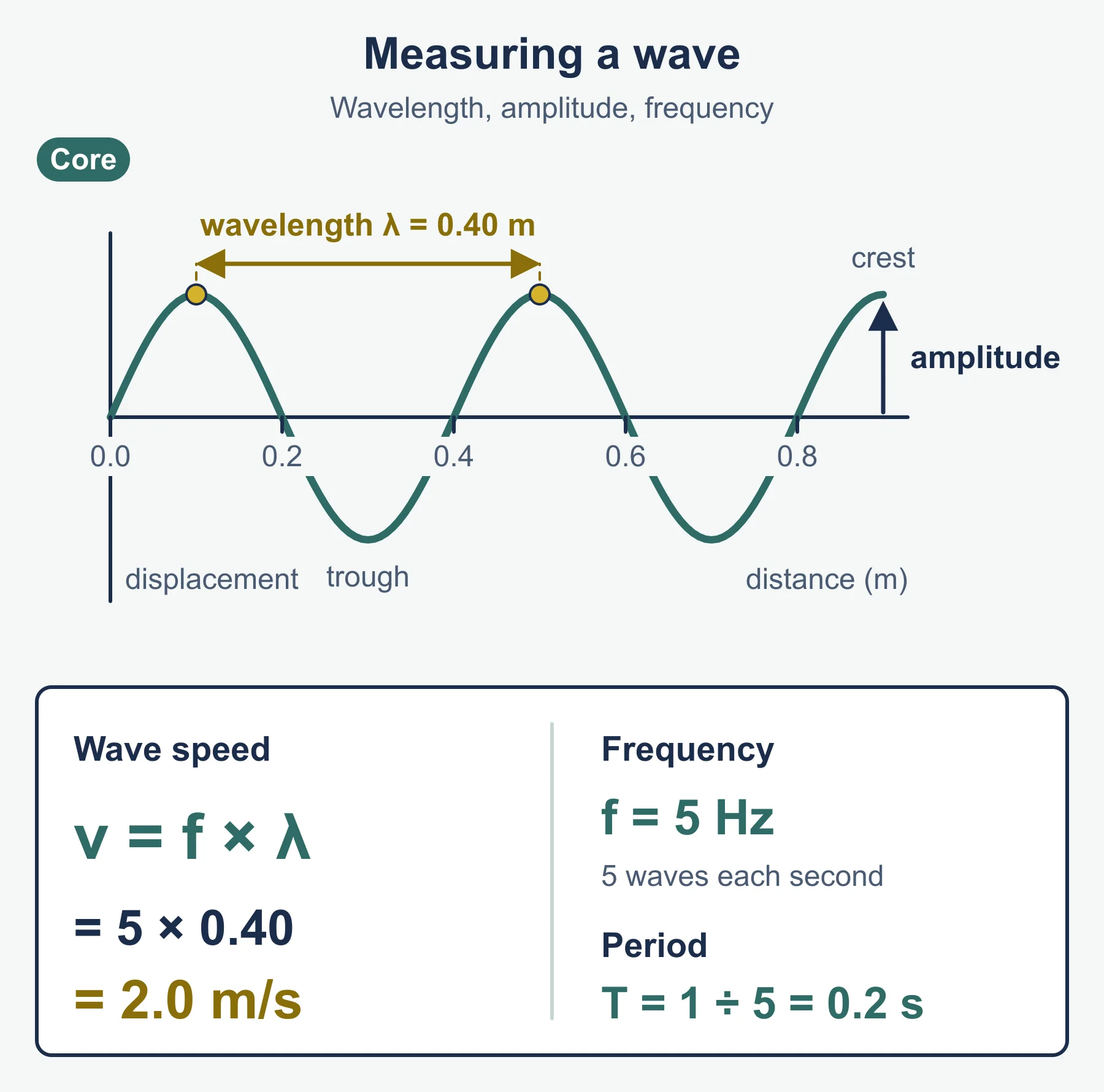
- Wavelength λ: the distance between two consecutive, identical points, such as two consecutive crests. Unit: metre, m.
- Frequency f: the number of wavelengths that pass a point per unit time. Unit: hertz, Hz (waves per second).
- Amplitude: the maximum distance from the mean position.
- Wave speed v: the distance the wave travels per unit time, in m/s.
The wave equation links them:
v = f × λ
Period T (time for one wave) is 1/f.
Worked example 1. A paddle makes water waves at 4 Hz with crests 0.15 m apart. v = fλ = 4 × 0.15 = 0.60 m/s, and the time between crests is T = 1/4 = 0.25 s.
Transverse and longitudinal waves
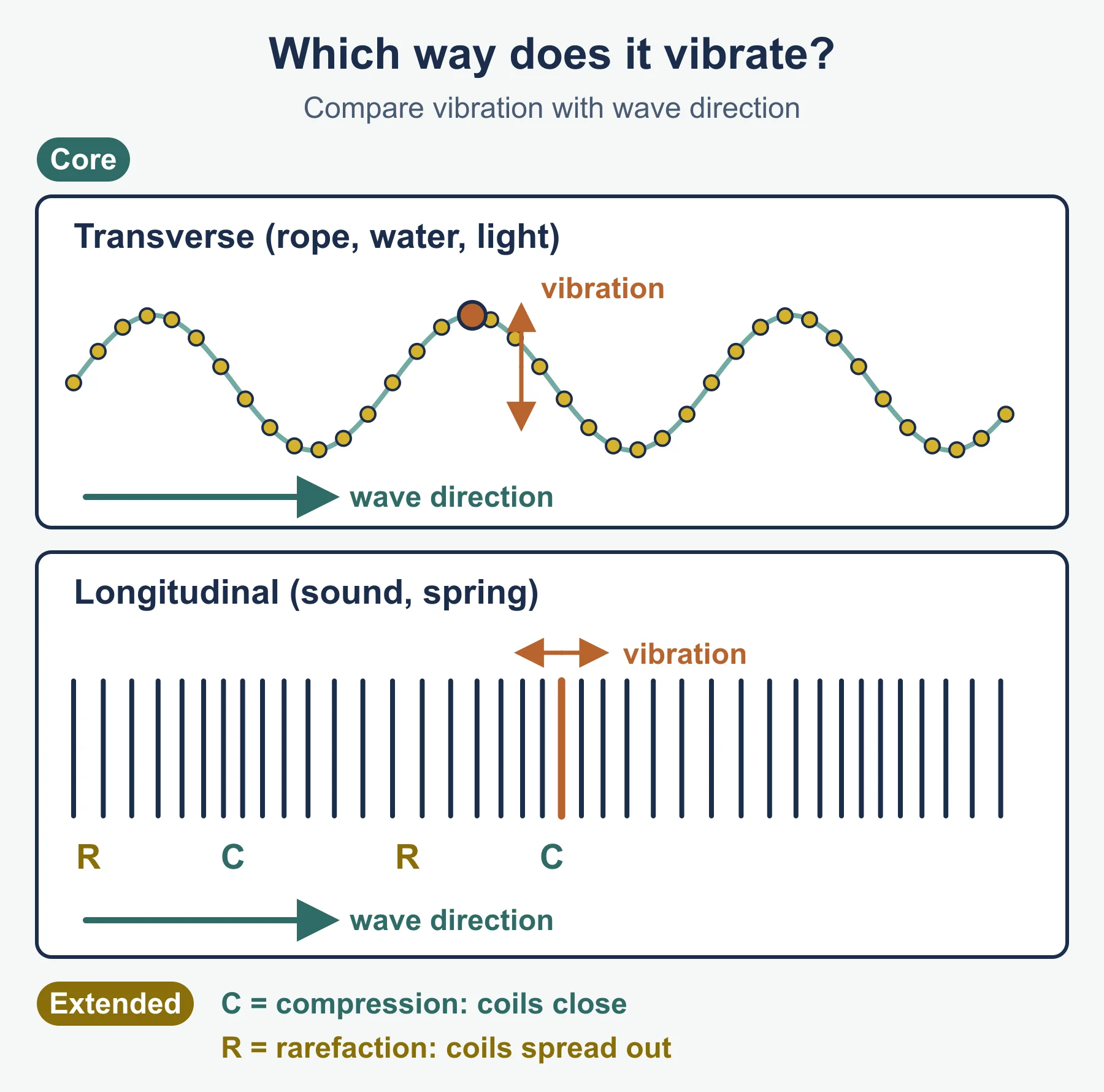
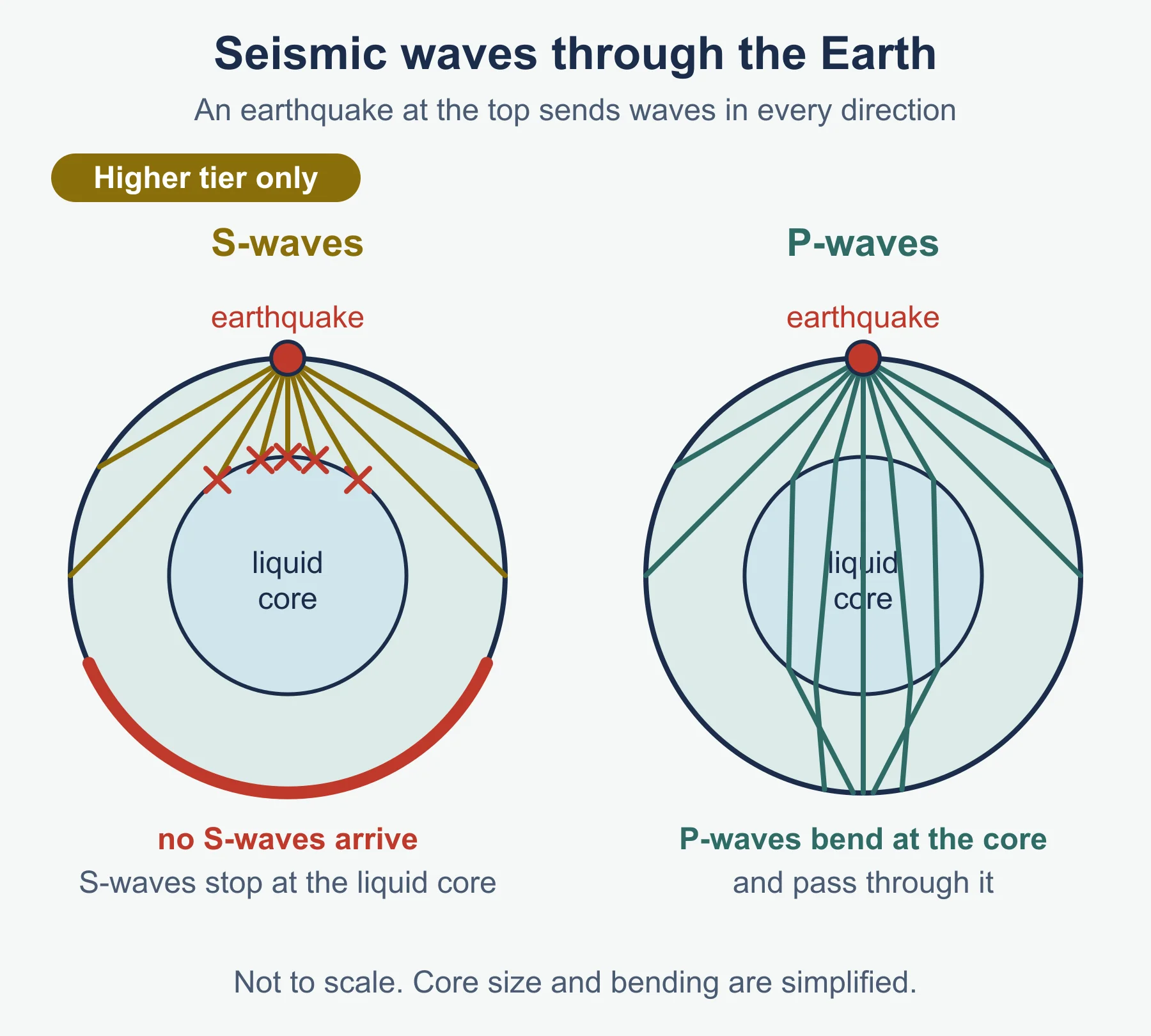
In a transverse wave, the vibration direction is at right angles to the direction of energy transfer. Examples: electromagnetic radiation, surface water waves and seismic S-waves (secondary).
In a longitudinal wave the vibration is parallel to the direction of energy transfer. Examples: sound waves and seismic P-waves (primary).
Reflection, refraction and diffraction
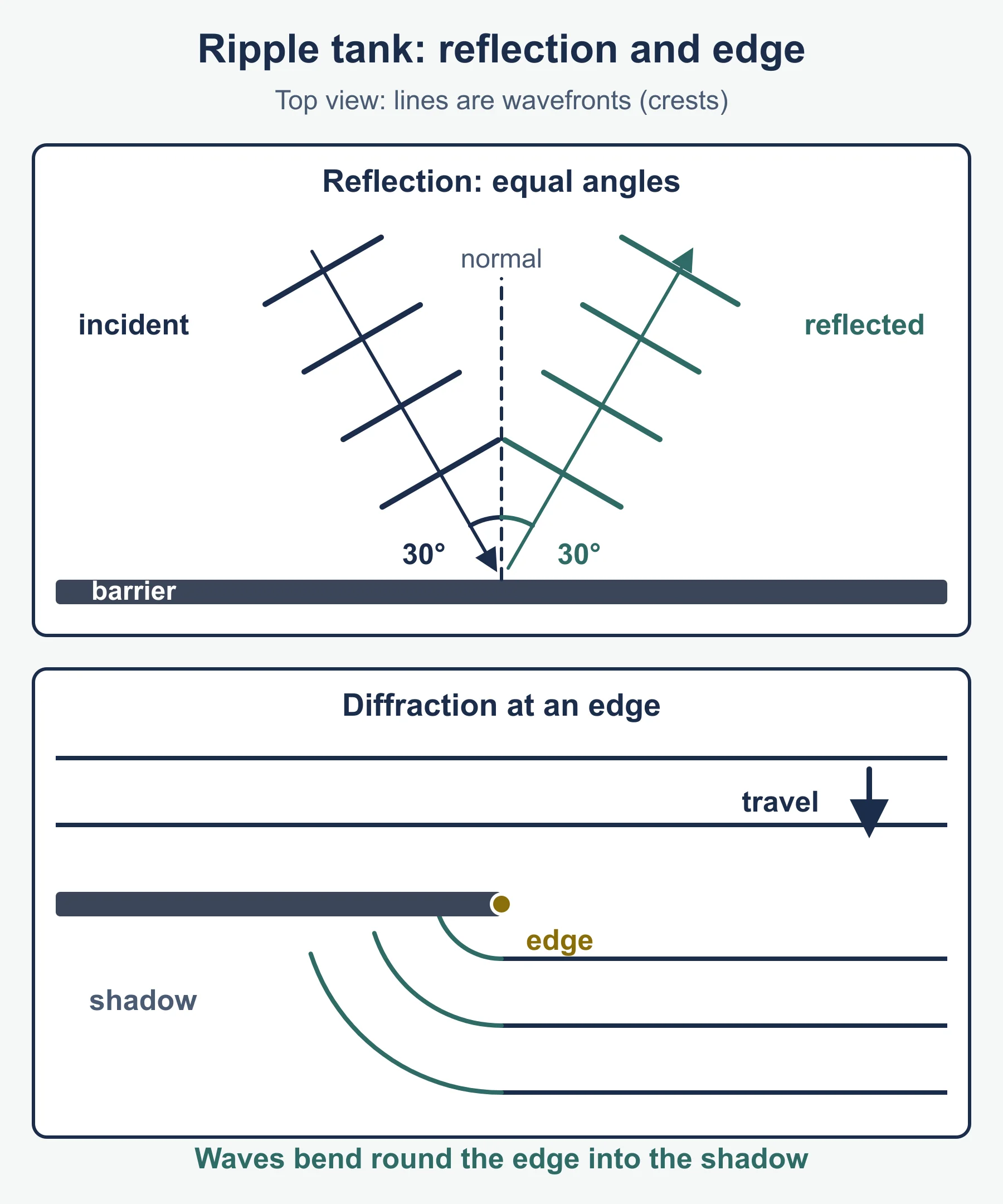
- Reflection at a plane surface: the wave bounces back; wavelength and speed do not change.
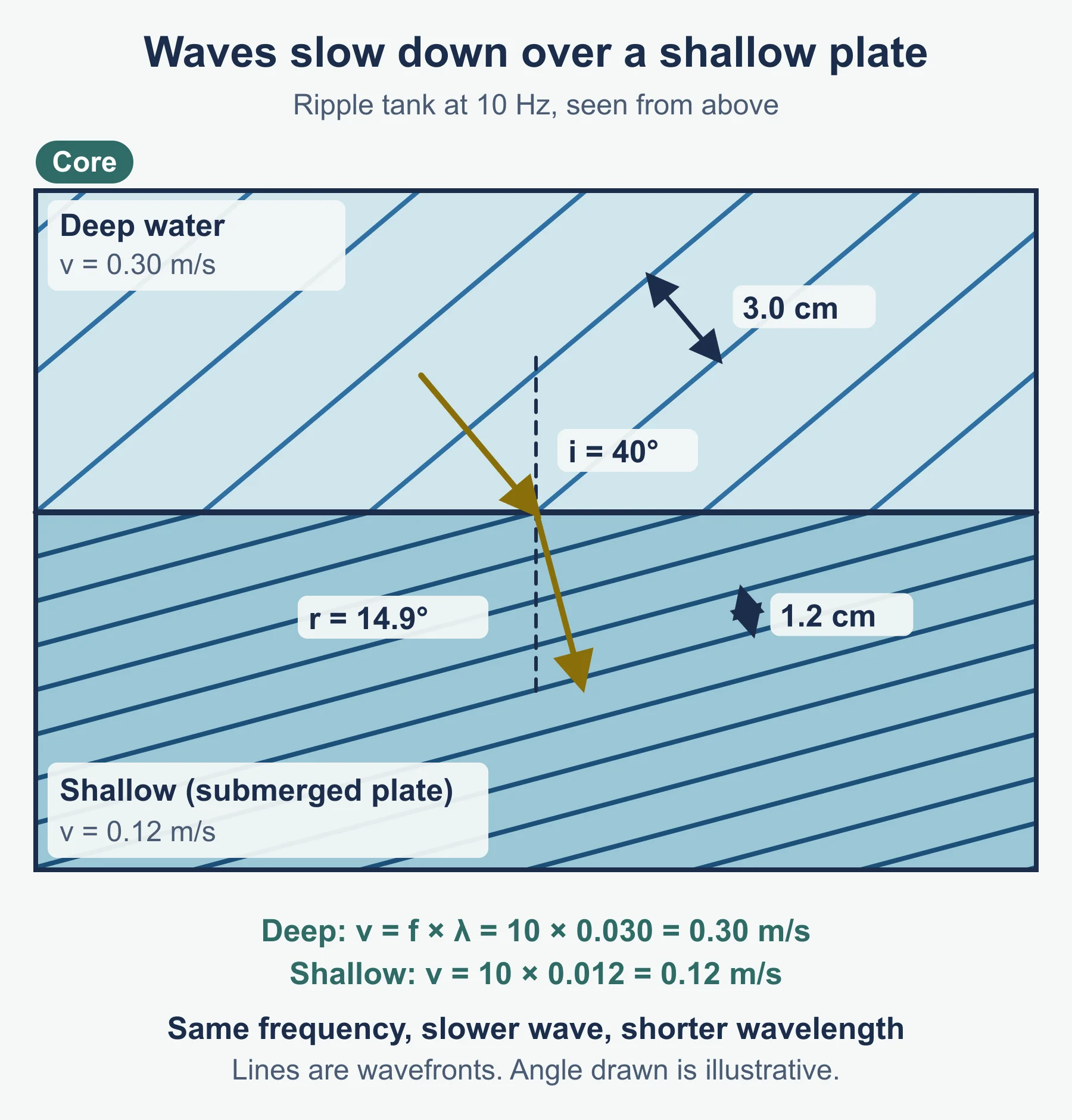
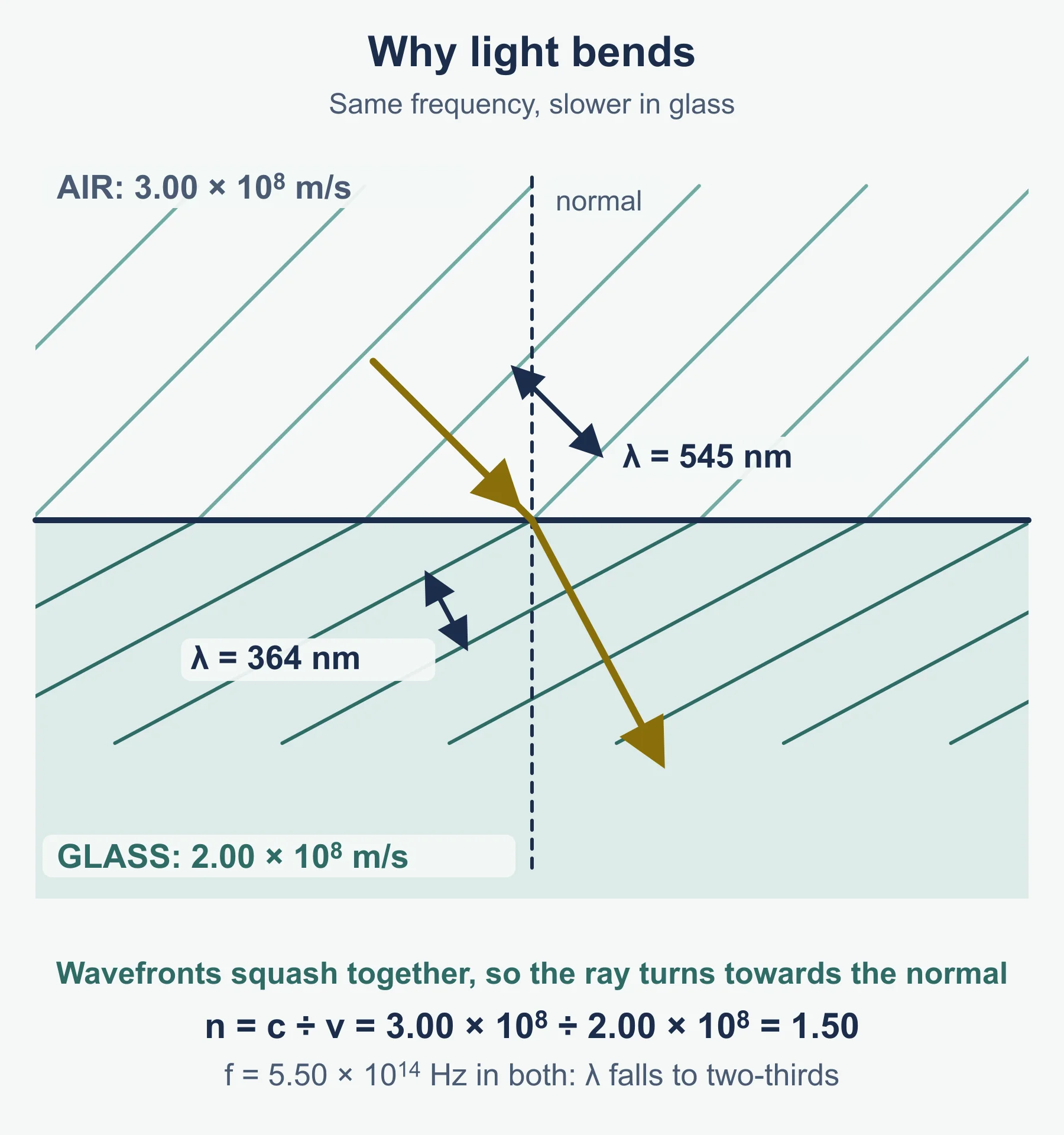
- Refraction: the wave changes direction because its speed changes. The frequency stays the same, so from v = fλ the wavelength changes with the speed.
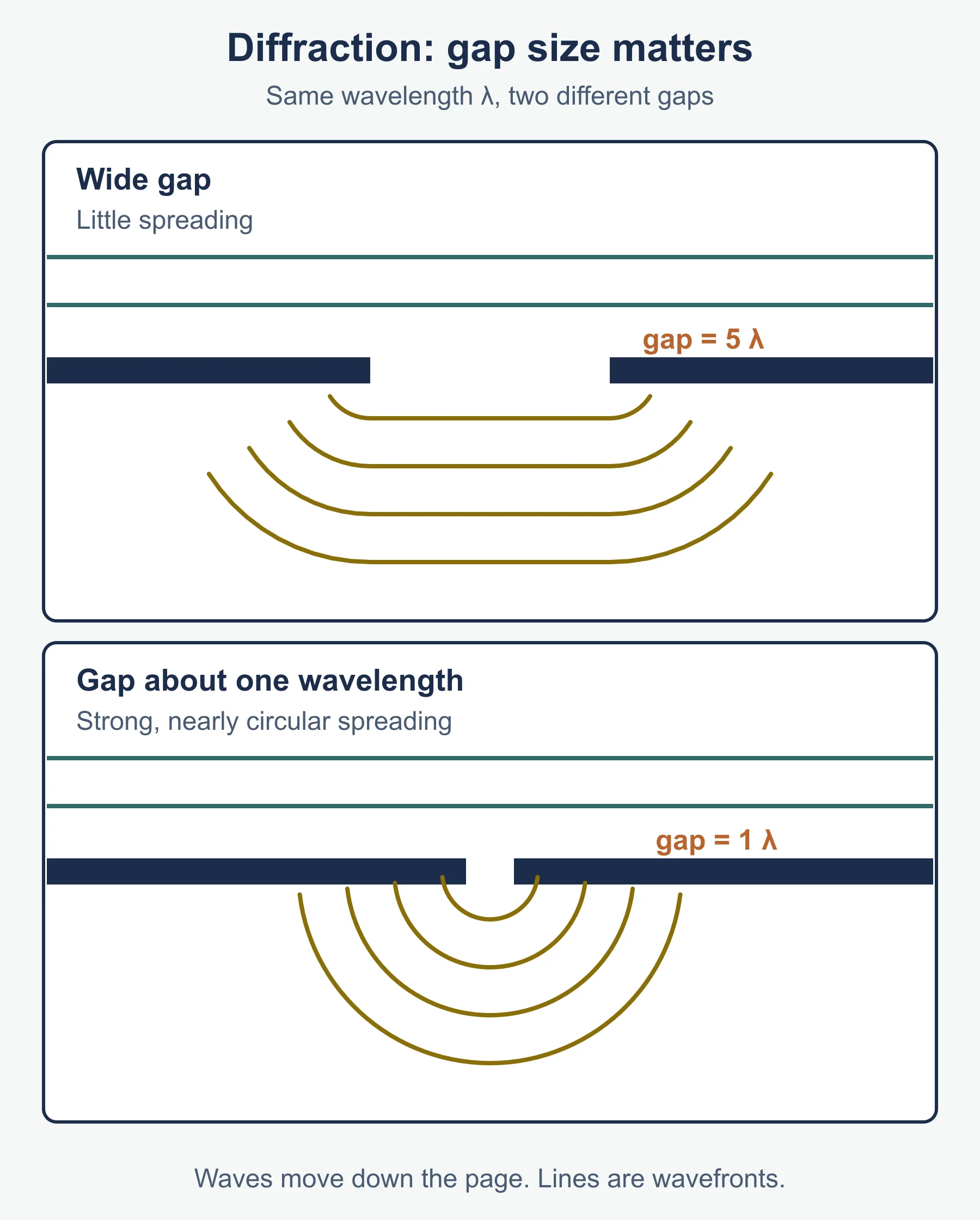
- Diffraction through a gap: the wave spreads out after passing through the gap. Spreading is strongest for a gap close to one wavelength wide, and weak for a gap far wider than the wavelength. A longer wavelength diffracts more through the same gap.
- Diffraction at an edge: waves bend round the edge into the shadow. A longer wavelength bends round more.
The ripple tank
A ripple tank is a shallow tray of water lit from above, so wavefronts show as lines on a screen below.
- Reflection: a straight barrier returns the wavefronts at the same angle to the barrier.
- Refraction: a submerged plate makes a shallow region. The waves travel more slowly over the plate, so the wavefronts bunch closer and turn.
- Diffraction at a gap: narrowing it towards one wavelength spreads the waves more.
- Diffraction at an edge: wavefronts curve round the end of a barrier.
Worked example 2. In a ripple tank at 10 Hz the wavelength is 3.0 cm in deep water and 1.2 cm in shallow water. Deep: v = 10 × 0.030 = 0.30 m/s. Shallow: v = 10 × 0.012 = 0.12 m/s. The frequency is unchanged and the wave is slower in the shallow region.
3.2 Light
3.2.1 Reflection of light
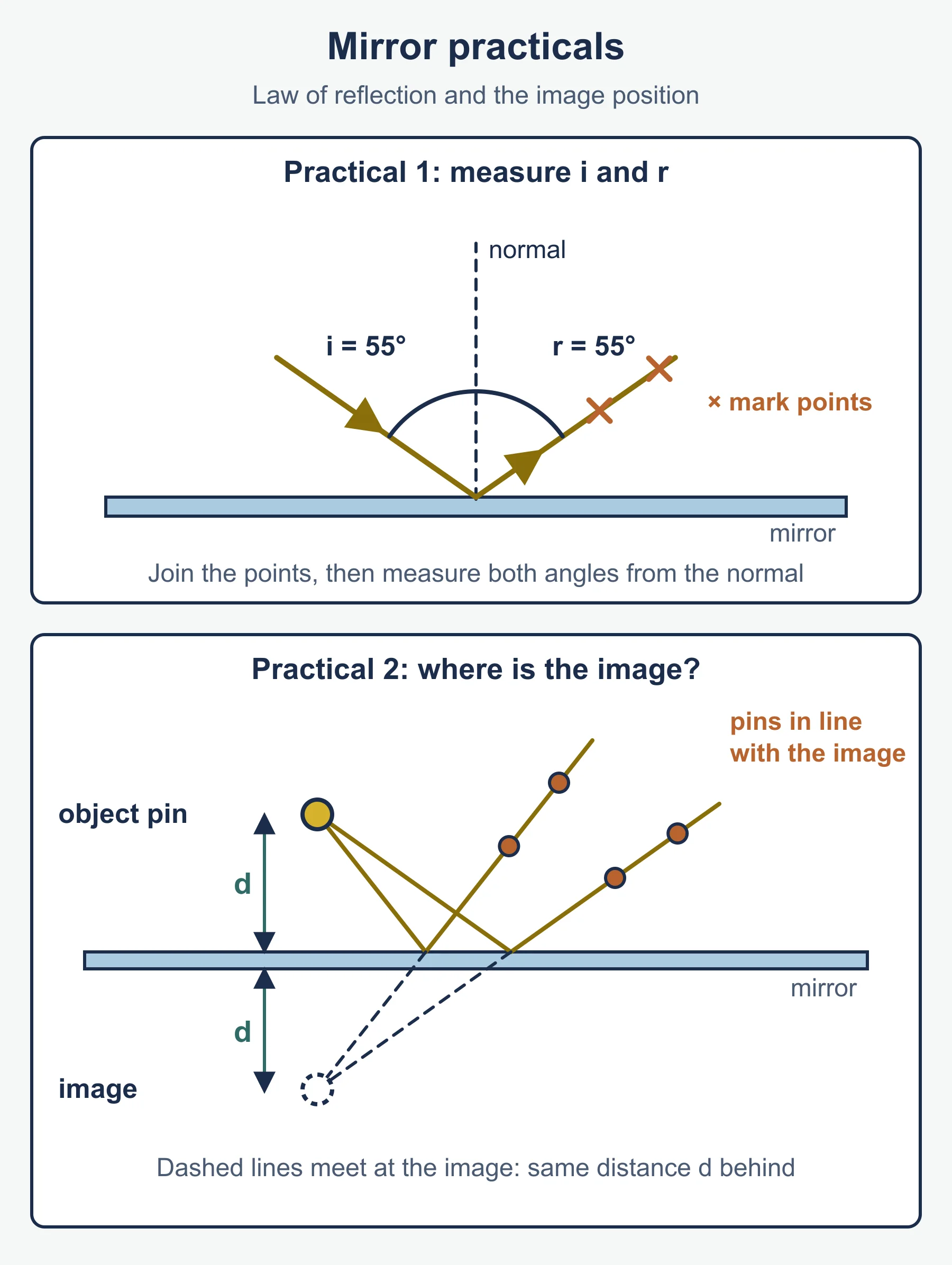
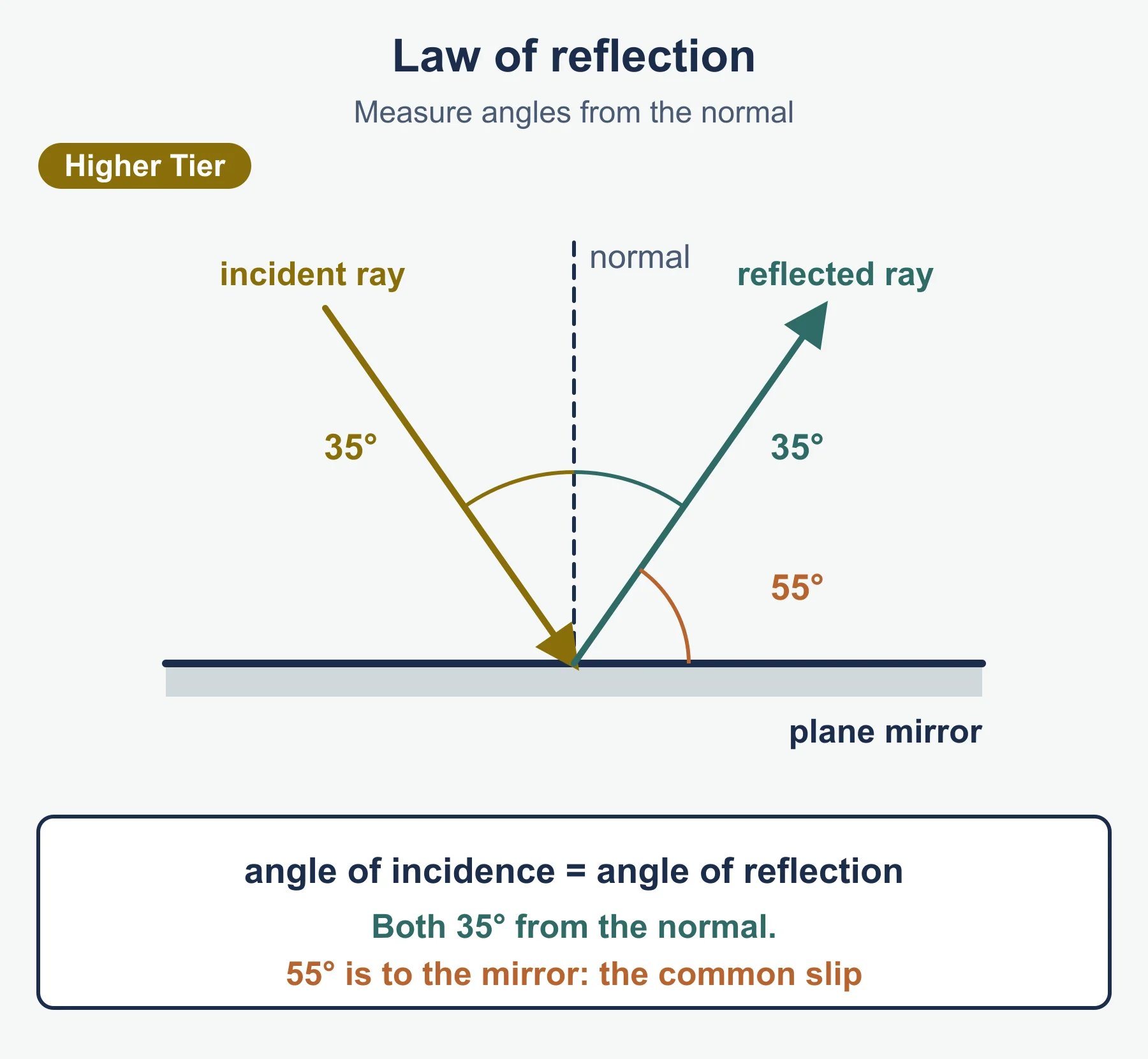
The normal is a line drawn at right angles to the surface where the ray meets it. The angle of incidence is between the incident ray and the normal. The angle of reflection is between the reflected ray and the normal. The law of reflection says the two angles are equal.
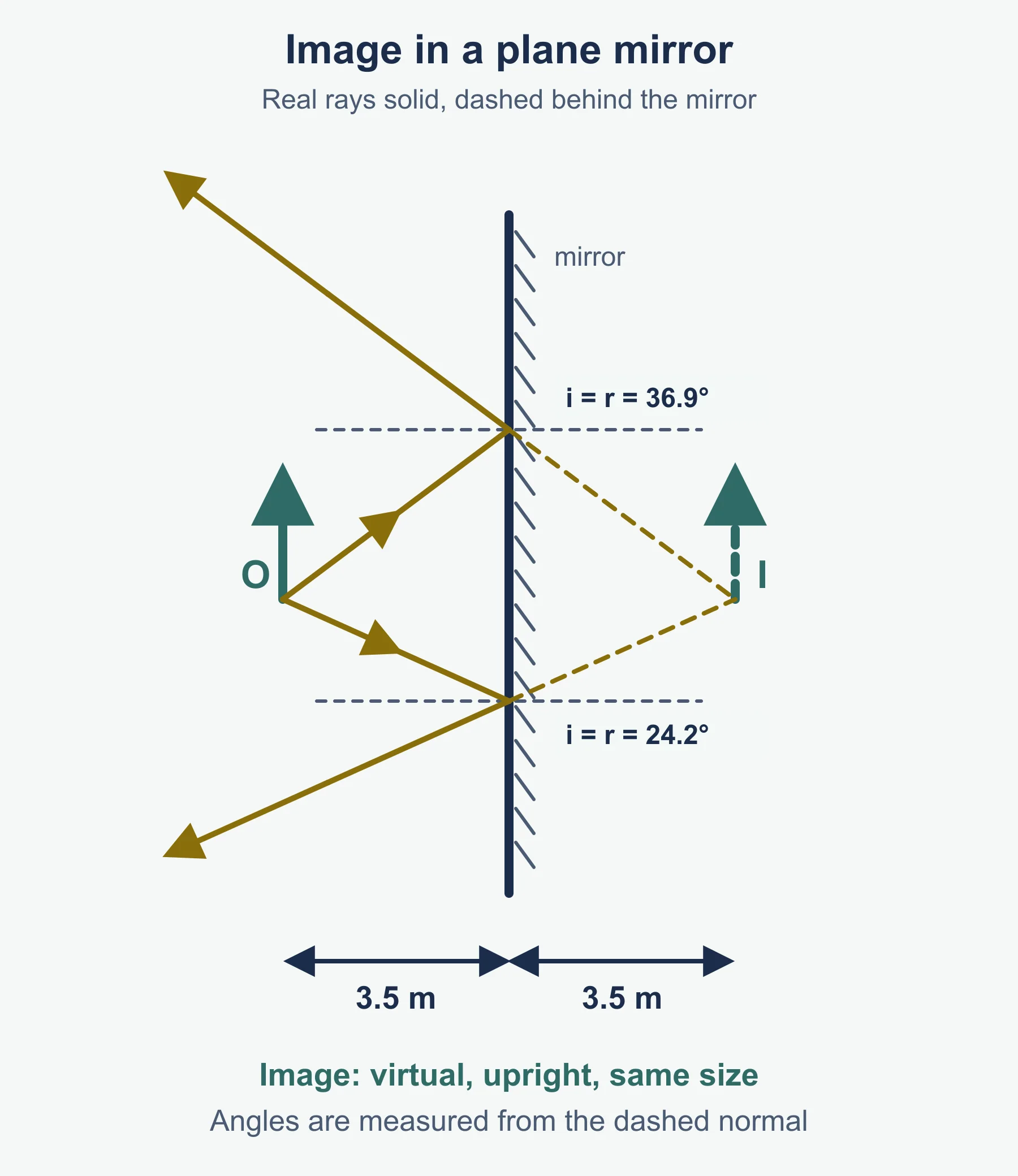
The image in a plane mirror is the same size as the object, as far behind the mirror as the object stands in front of it, and virtual (it cannot be projected onto a screen).
Experiment: the law of reflection. Stand a mirror upright on paper, draw its line and a normal, and shine a narrow ray at a chosen angle. Mark points on the reflected ray, remove the mirror, join the points and measure both angles from the normal.
Experiment: the plane mirror image. Sight two pins in line with the image of an object pin from two positions and draw the lines back behind the mirror. They cross at the image. Measure the distances to the mirror.
Worked example 3. A ray makes 35° with a mirror surface, so i = 55° and the rays are 110° apart.
3.2.2 Refraction of light
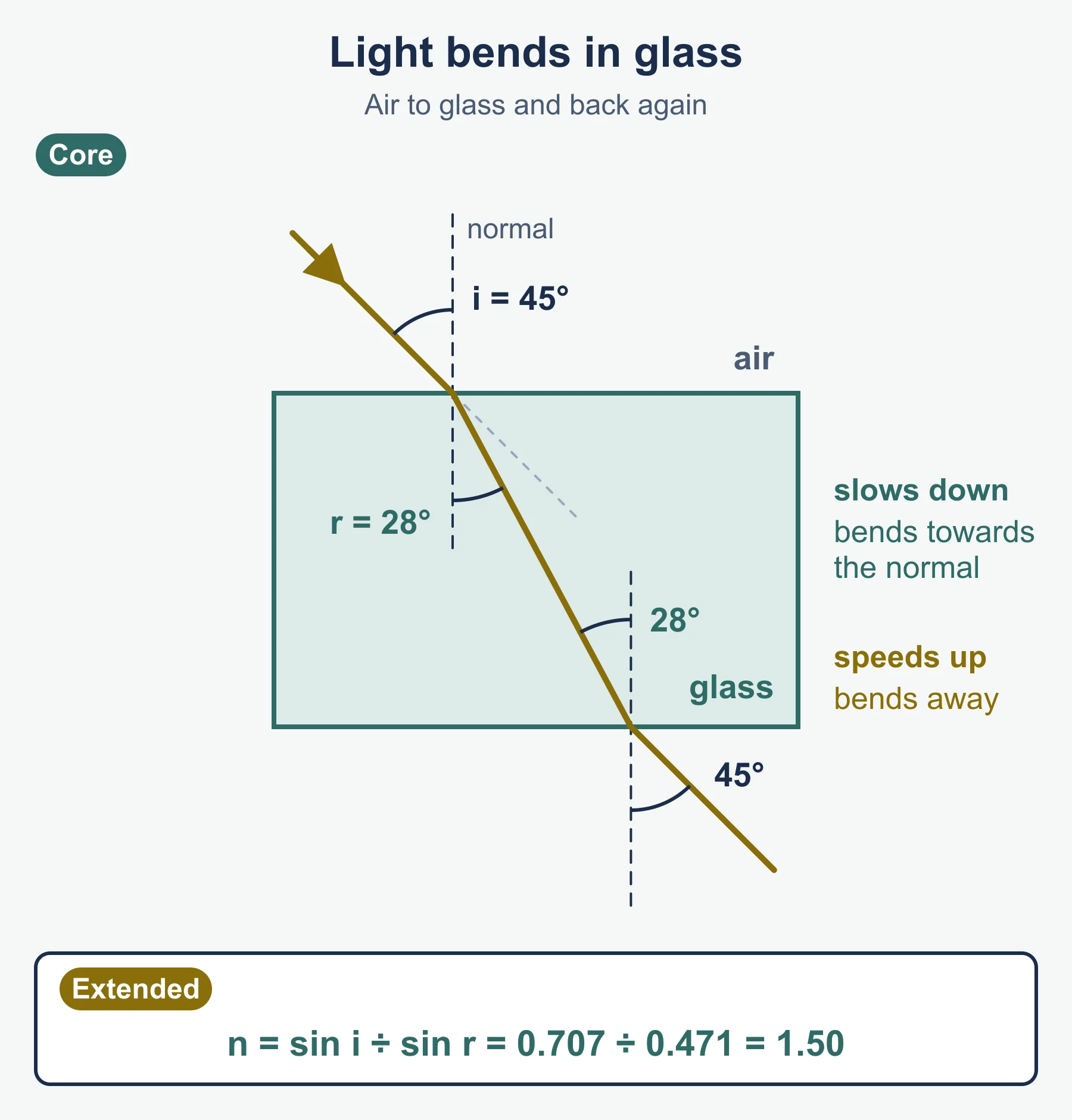
Light changes direction when it crosses a boundary and its speed changes. The angle of incidence i is in the first medium and the angle of refraction r in the second, both measured from the normal. Light entering a denser medium slows and bends towards the normal.
The refractive index n of a material is
n = sin i / sin r
(i in air or vacuum, r in the material).
Experiment: refraction by blocks. Draw round a block on paper, shine a ray in at several angles, mark the entering and leaving rays, remove the block and join the points. A rectangular block gives an emergent ray parallel to the incident ray but shifted sideways. A triangular prism bends the ray towards its base.
Worked example 4. A ray in air meets water at an angle of incidence of 50°. n for water is 1.33. Find r.
- sin r = sin 50° / 1.33 = 0.766 / 1.33 = 0.576.
- r = 35° (35.2°).
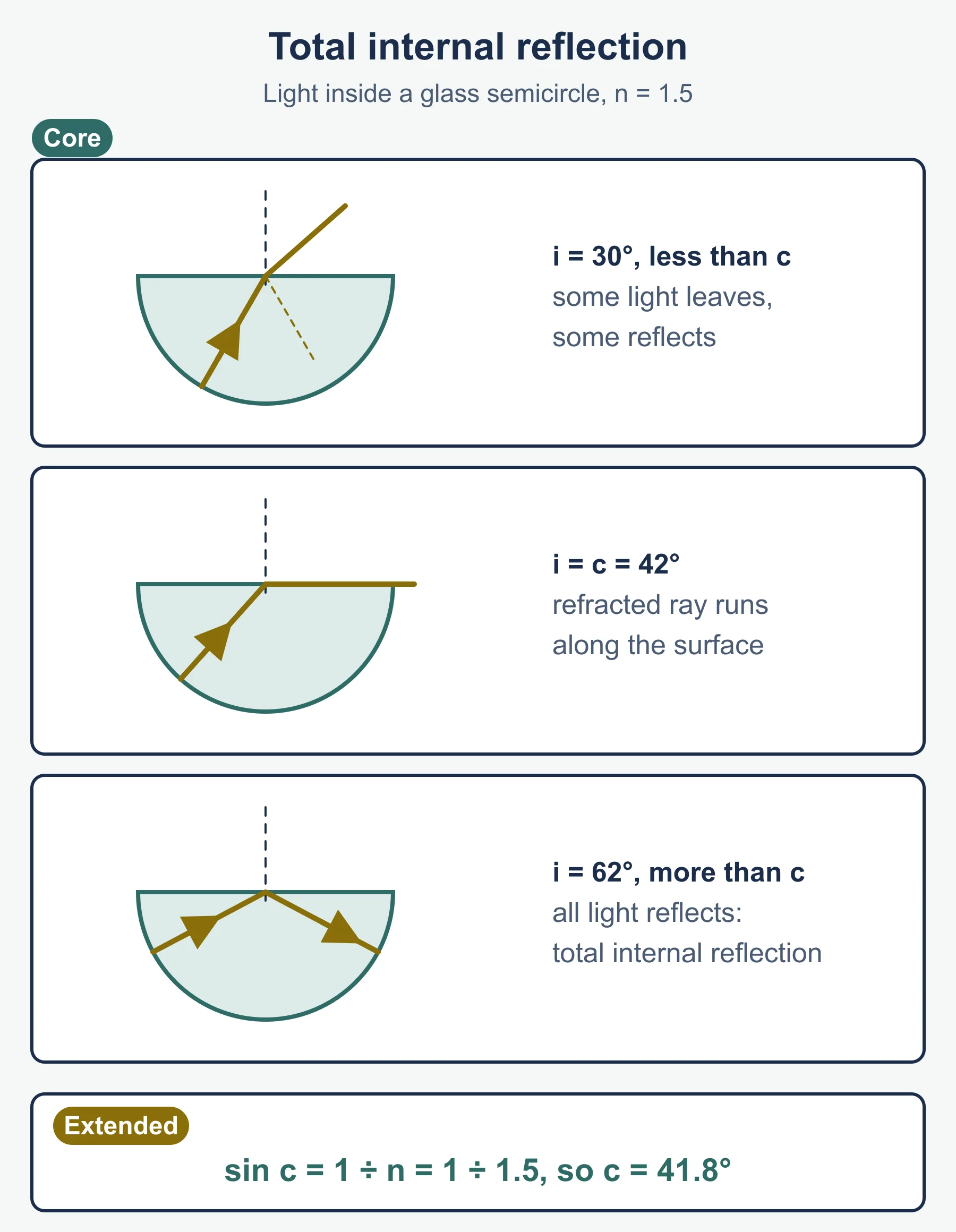
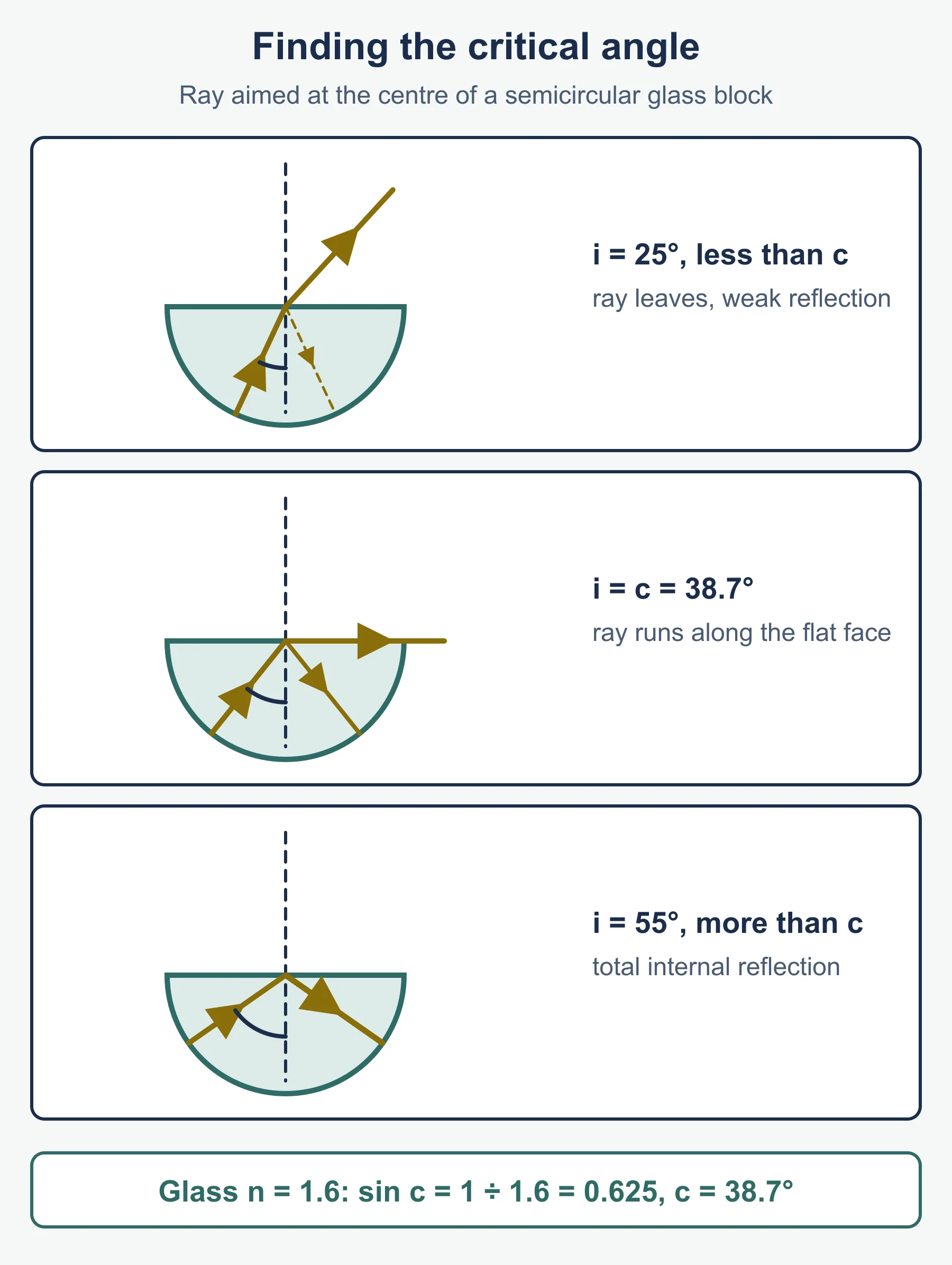
Critical angle and total internal reflection. Light passing out of a denser medium into a less dense one bends away from the normal. As i increases, a value is reached where the refracted ray travels along the boundary. That i is the critical angle c. Above that angle every bit of light stays in the denser medium, which is total internal reflection. Use
n = 1 / sin c
Conditions: light going from the denser to the less dense medium, and the angle of incidence greater than c.
Worked example 5. A plastic has c = 42° in air, so n = 1/sin 42° = 1.49. For a glass with n = 1.6, sin c = 1/1.6 = 0.625, so c = 38.7°.
Experiment. Send a ray through the curved face of a semicircular block, aimed at the centre of the flat face, and increase the angle. At first there is a refracted ray and a weak internally reflected ray. At c the refracted ray runs along the flat face. Beyond c only the reflected ray remains.
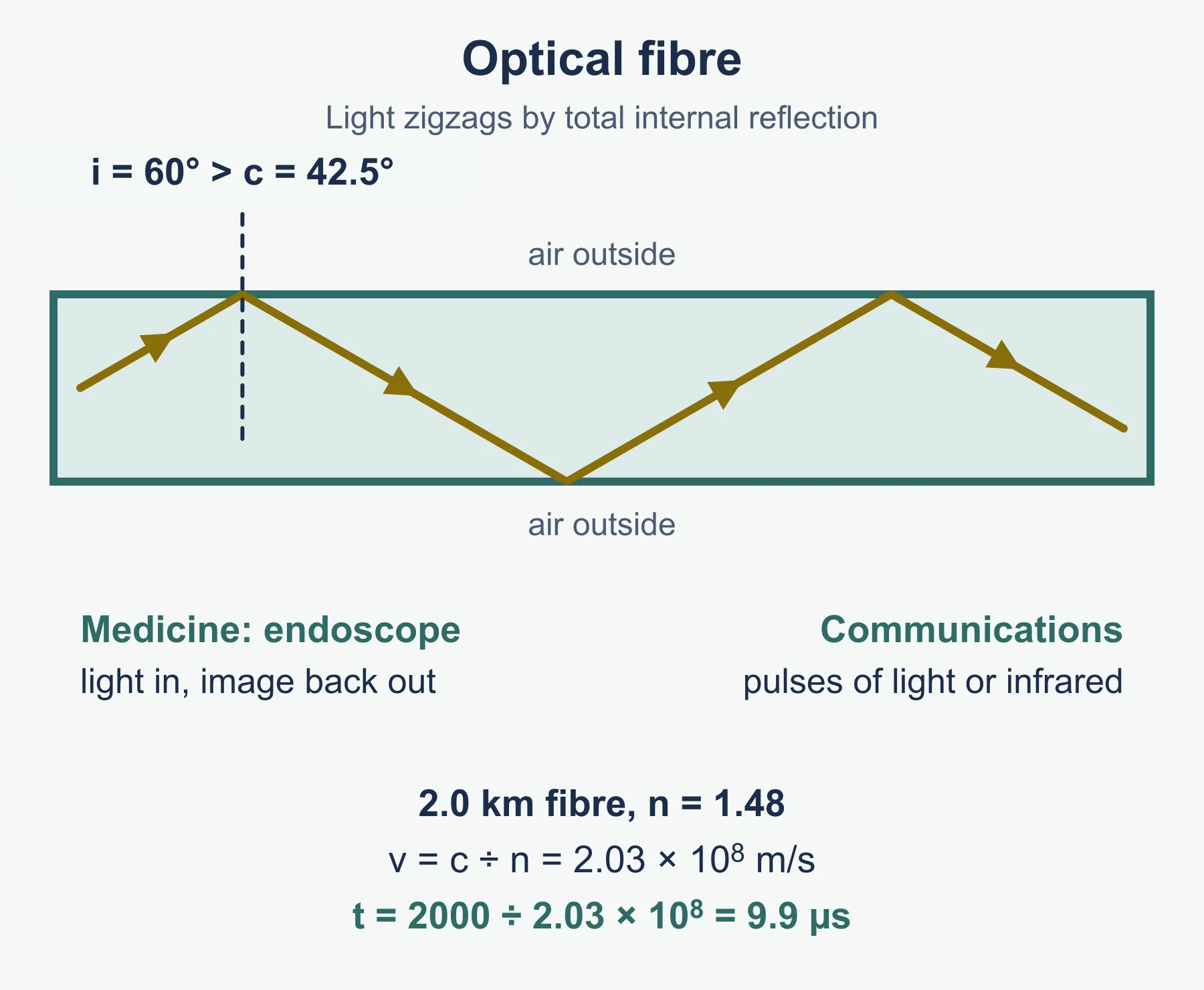
Optical fibres. A fibre is a thin glass or plastic strand in which light is totally internally reflected from wall to wall. In telecommunications, light pulses carry telephone and internet signals. Advantages over copper cable: more information per second and no electrical interference.
3.2.3 Thin lenses
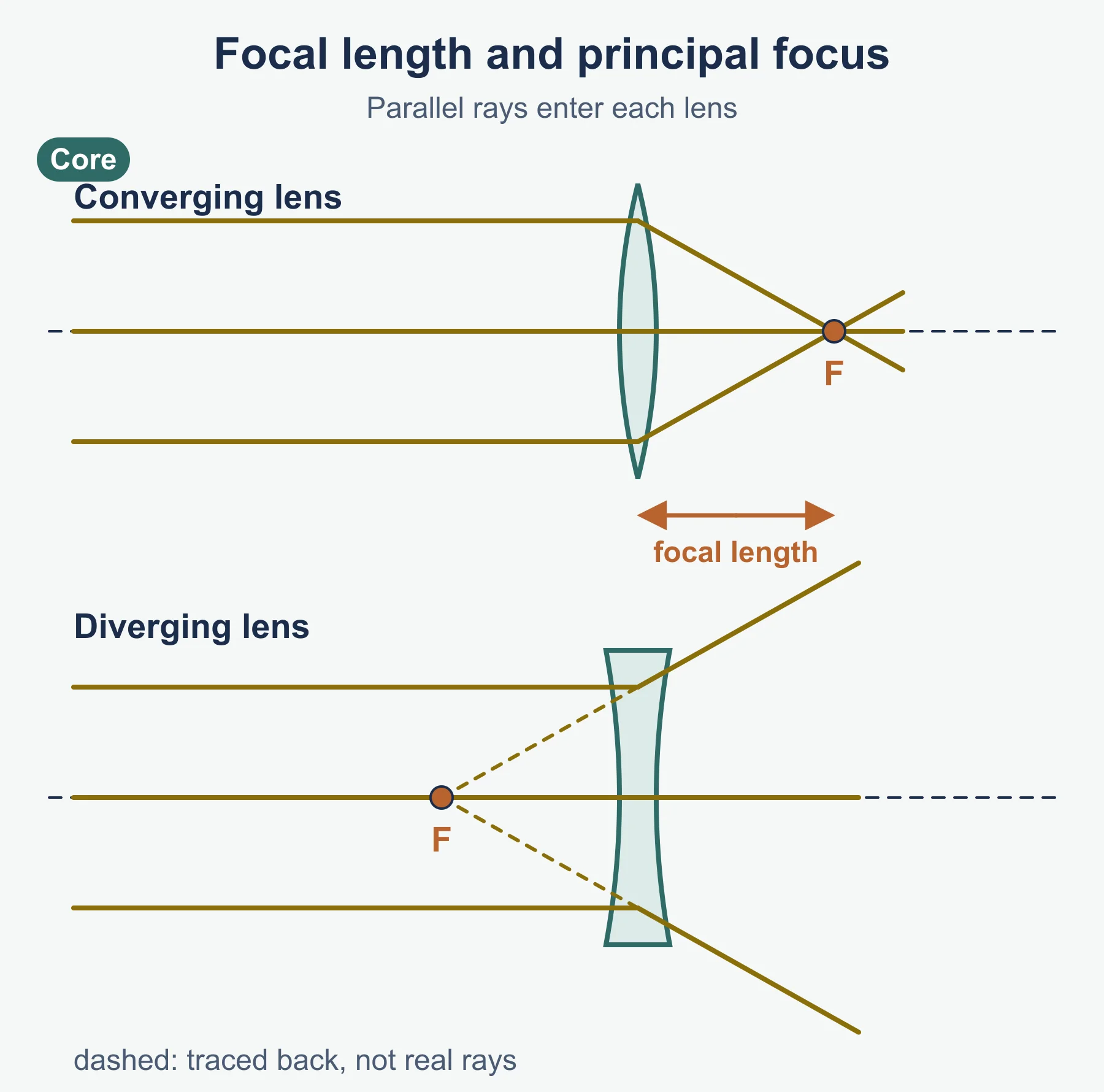
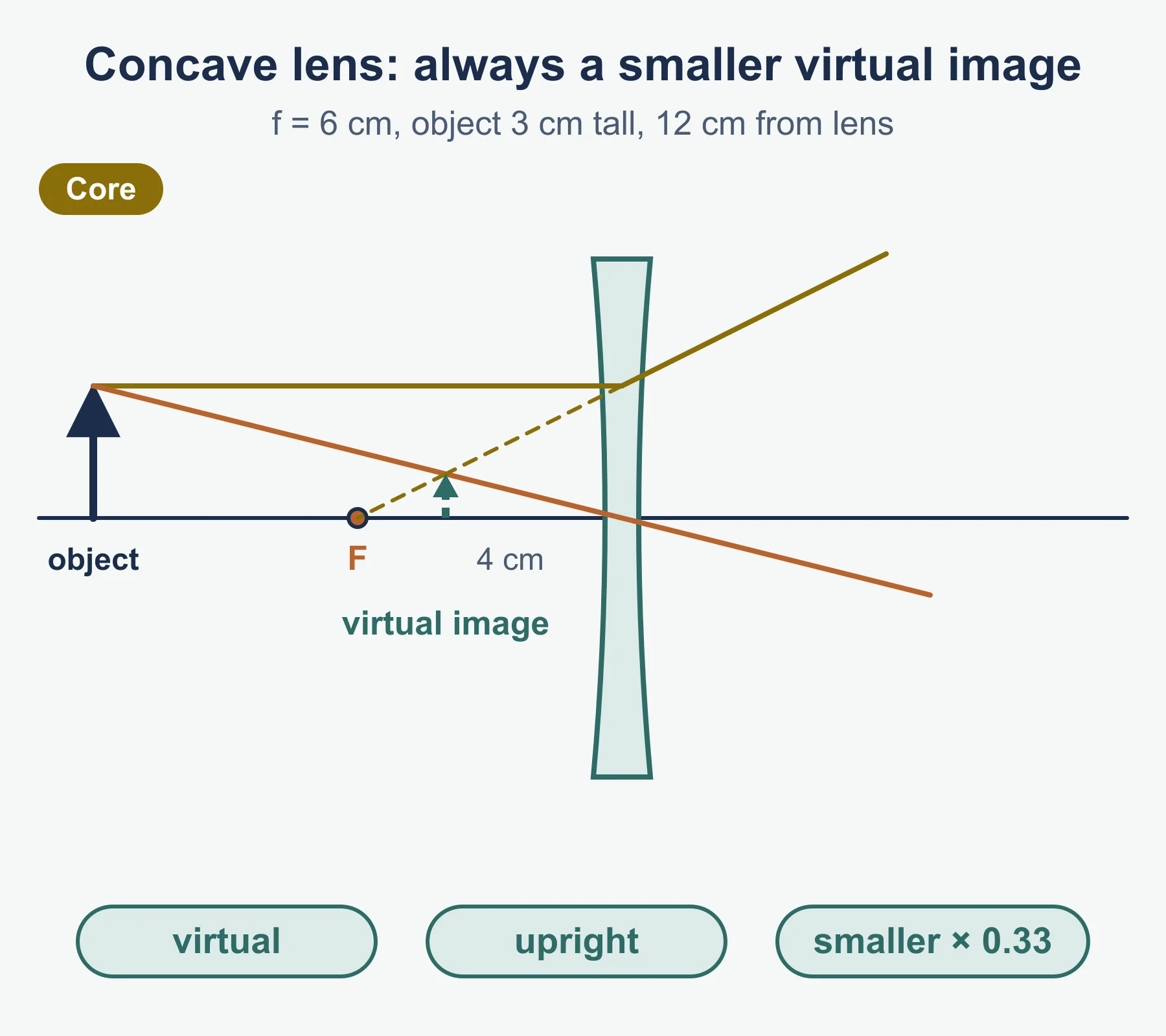
A thin converging lens makes a parallel beam converge to the principal focus (focal point) F. A thin diverging lens spreads a parallel beam out, as if from a focal point on the incoming side. The principal axis is the line through the centre of the lens at right angles to it. The focal length is the distance from the lens centre to F.
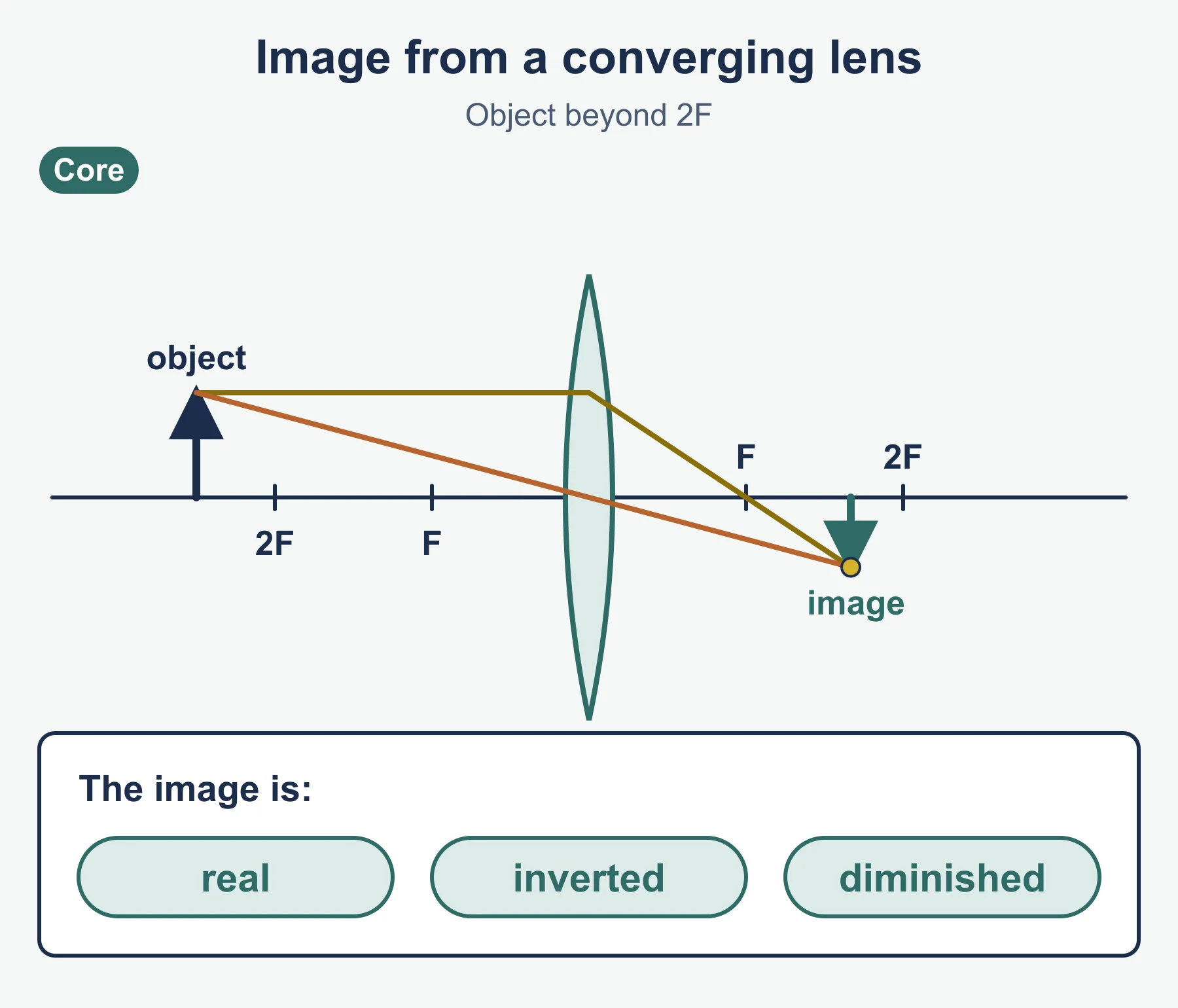
To build a ray diagram, take a ray leaving the top of the object parallel to the principal axis (it passes through the principal focus after the lens) and a ray through the centre of the lens (it carries straight on). Where they meet is the top of the image. For a converging lens:
| Object position | Image formed |
|---|---|
| Further than 2F | Inverted, real, diminished |
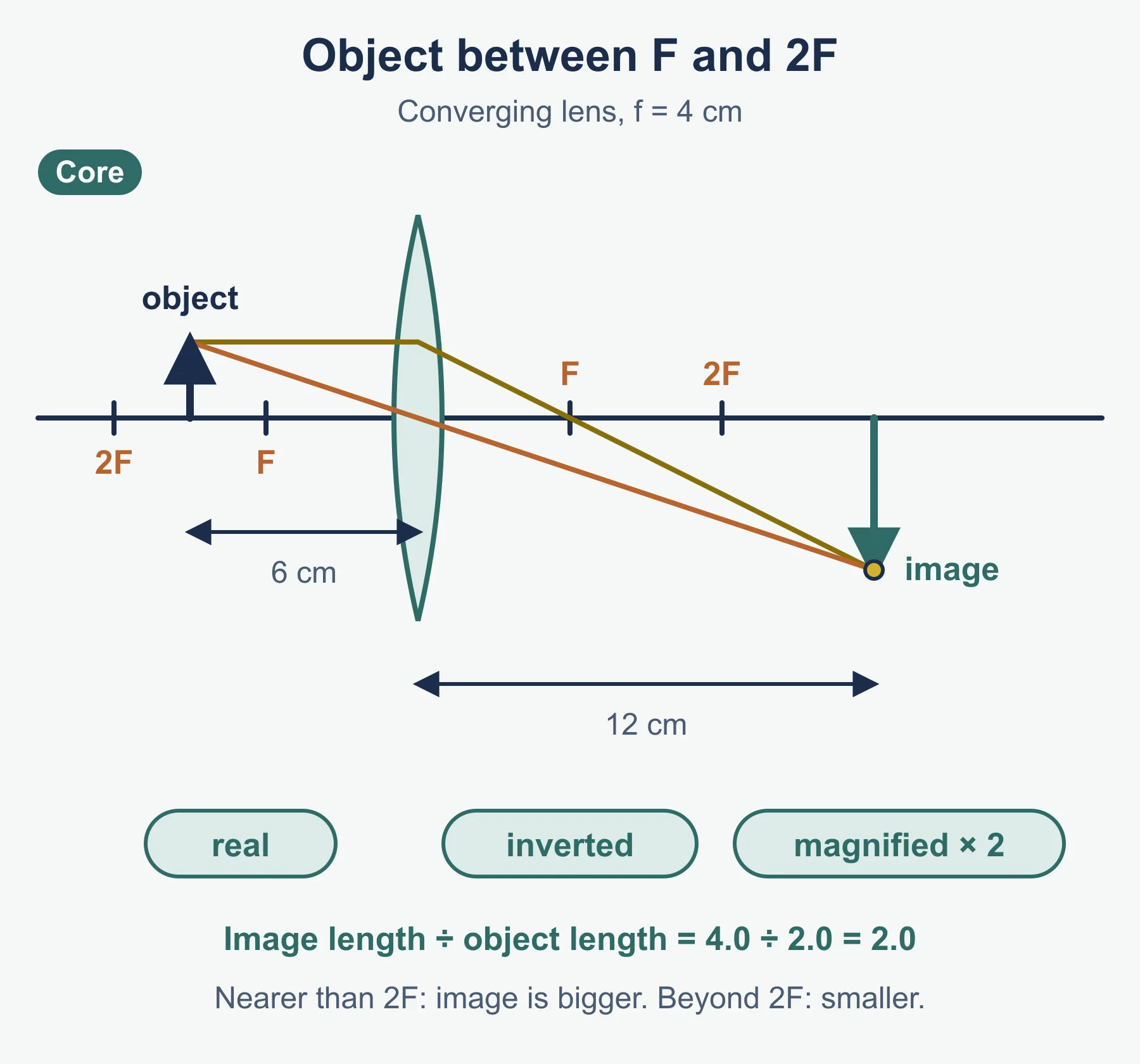
| Between F and 2F | Inverted, real, magnified |
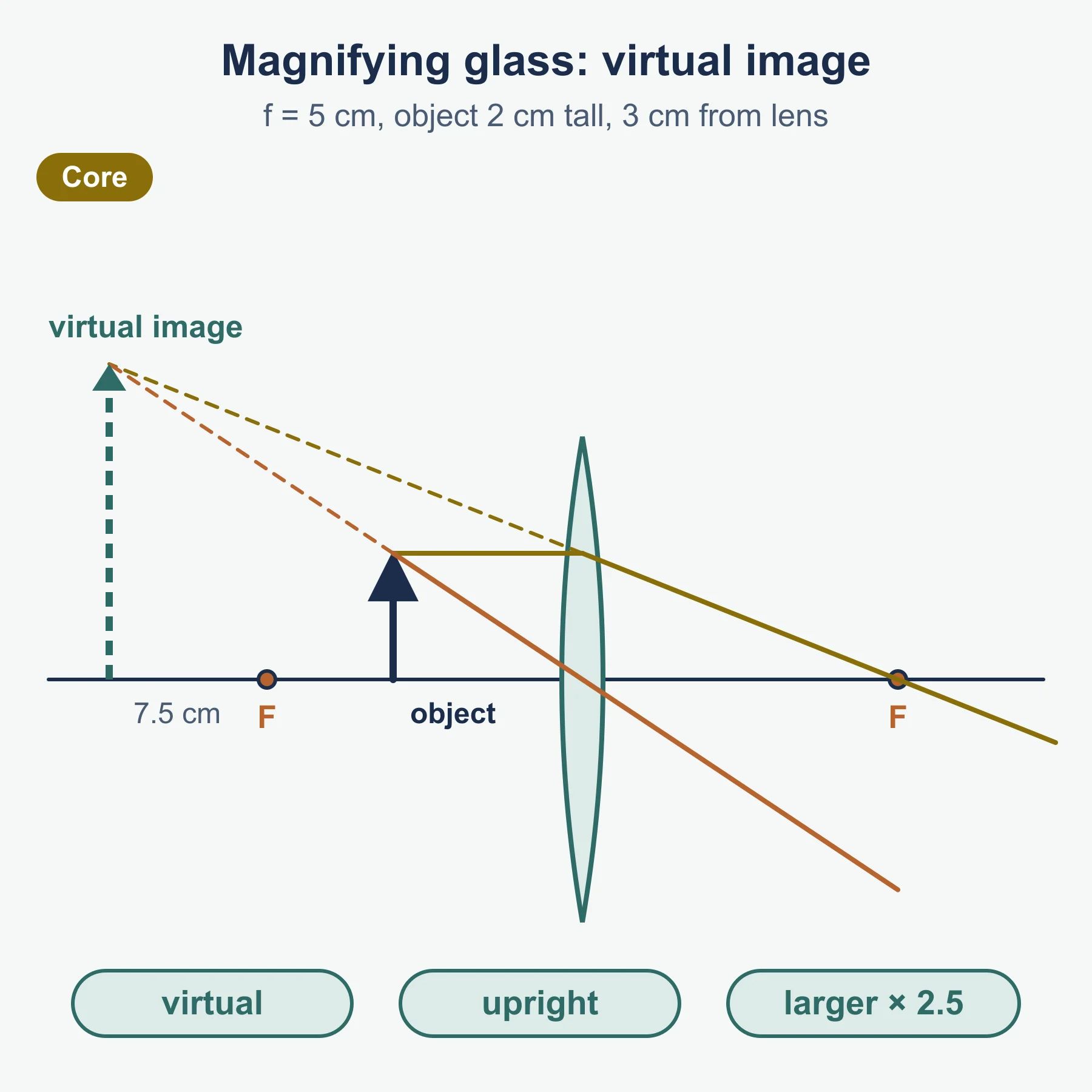
| Closer than F | Upright, virtual, magnified |
A real image is formed by converging rays. A virtual image is formed by diverging rays that only appear to come from it. A diverging lens always gives a virtual, upright, smaller image.
A magnifying glass is a converging lens with the object inside F, giving a virtual, upright, enlarged image.
linear magnification = image length / object length
Worked example 6: 1.6 cm object, 4.0 cm image, magnification 4.0/1.6 = 2.5.
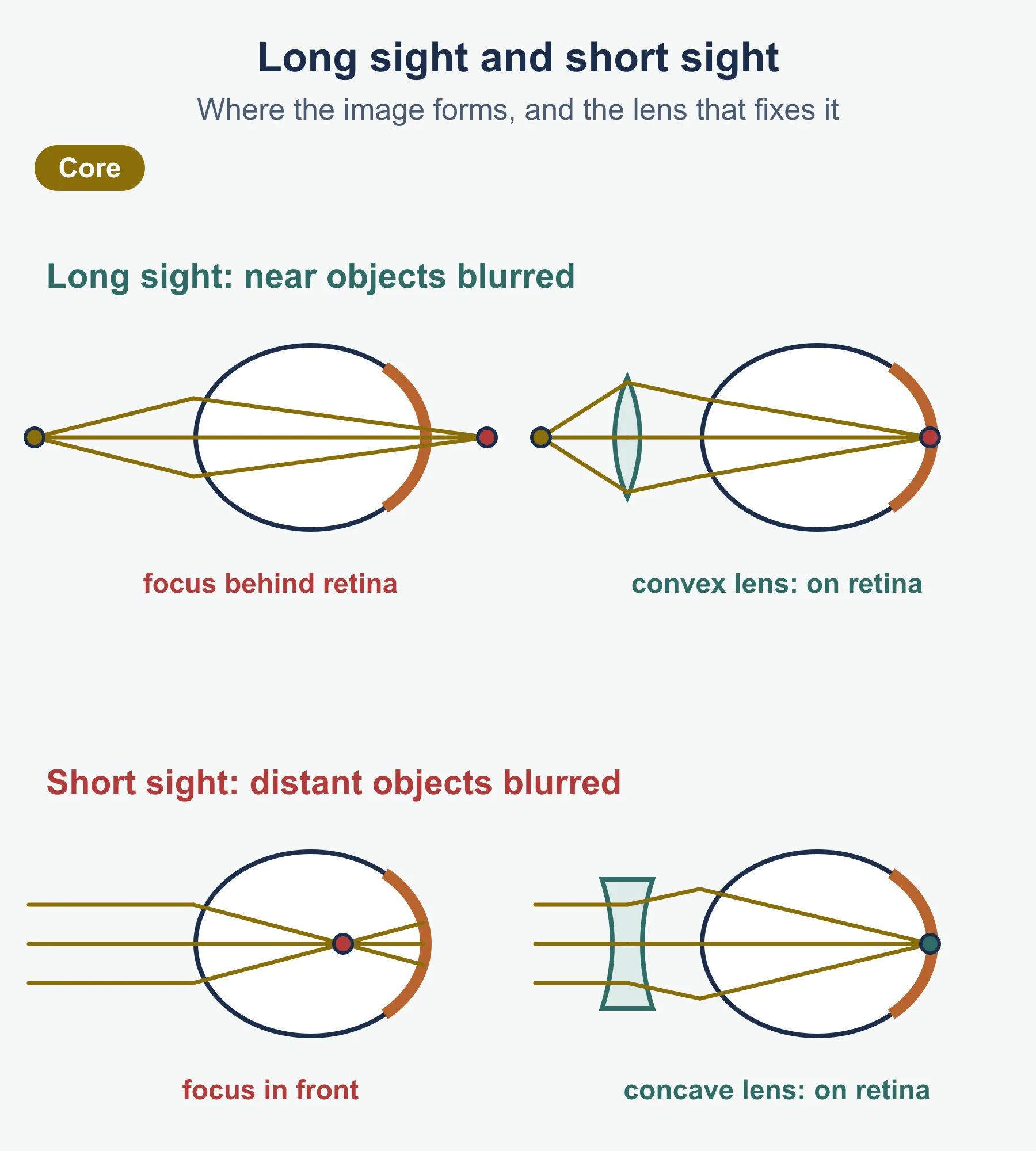
The eye. A normal eye focuses light from the object on the retina. A short-sighted eye focuses distant light in front of the retina; a diverging lens corrects it. A long-sighted eye focuses near light behind the retina; a converging lens corrects it.
3.2.4 Dispersion of light
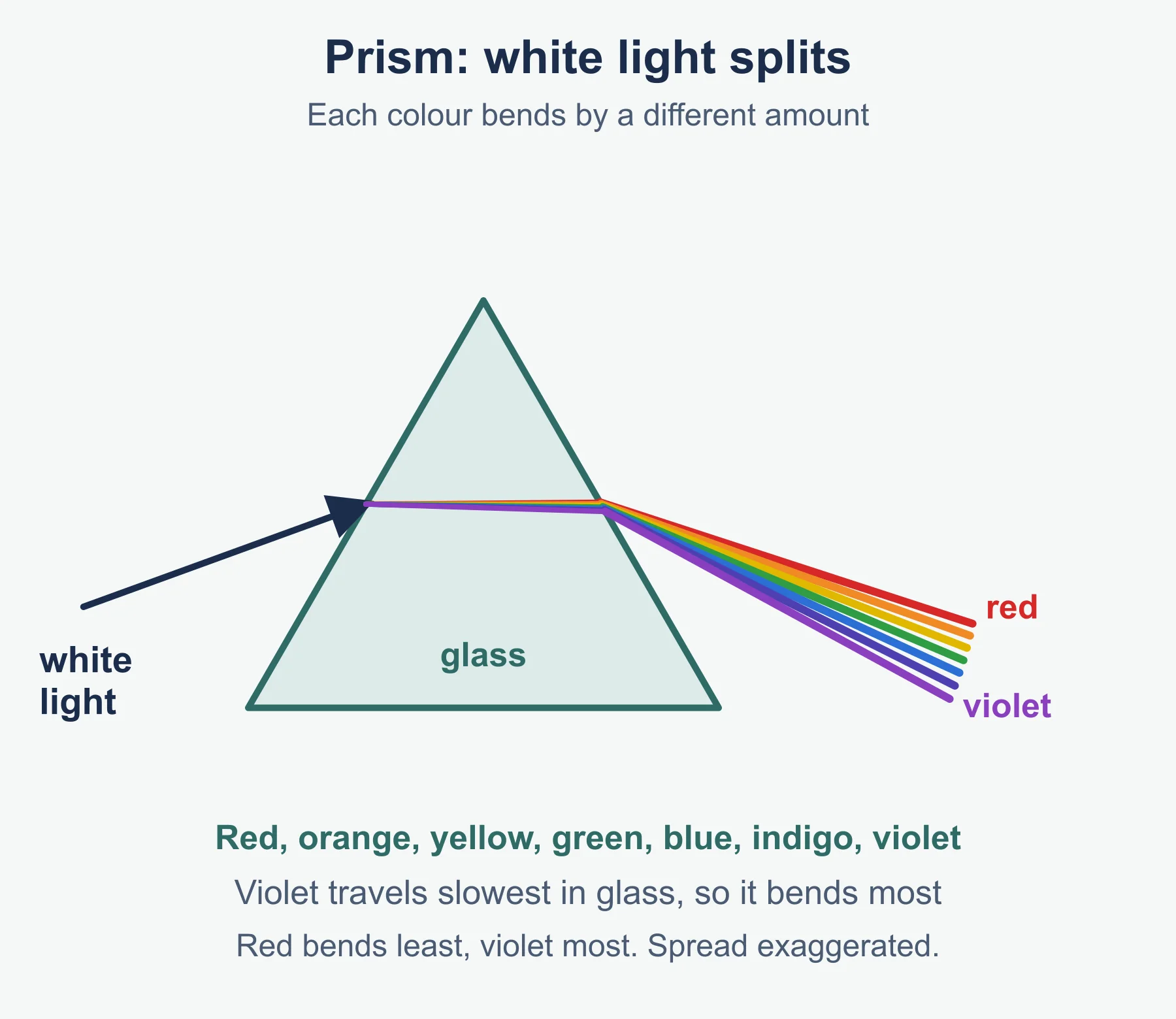
White light is a mixture of colours. A glass prism refracts each colour by a different amount, so white light spreads into a spectrum. In order of increasing frequency the seven colours are red, orange, yellow, green, blue, indigo, violet. In order of increasing wavelength the order is reversed. Violet bends most and red least.
3.3 Electromagnetic spectrum
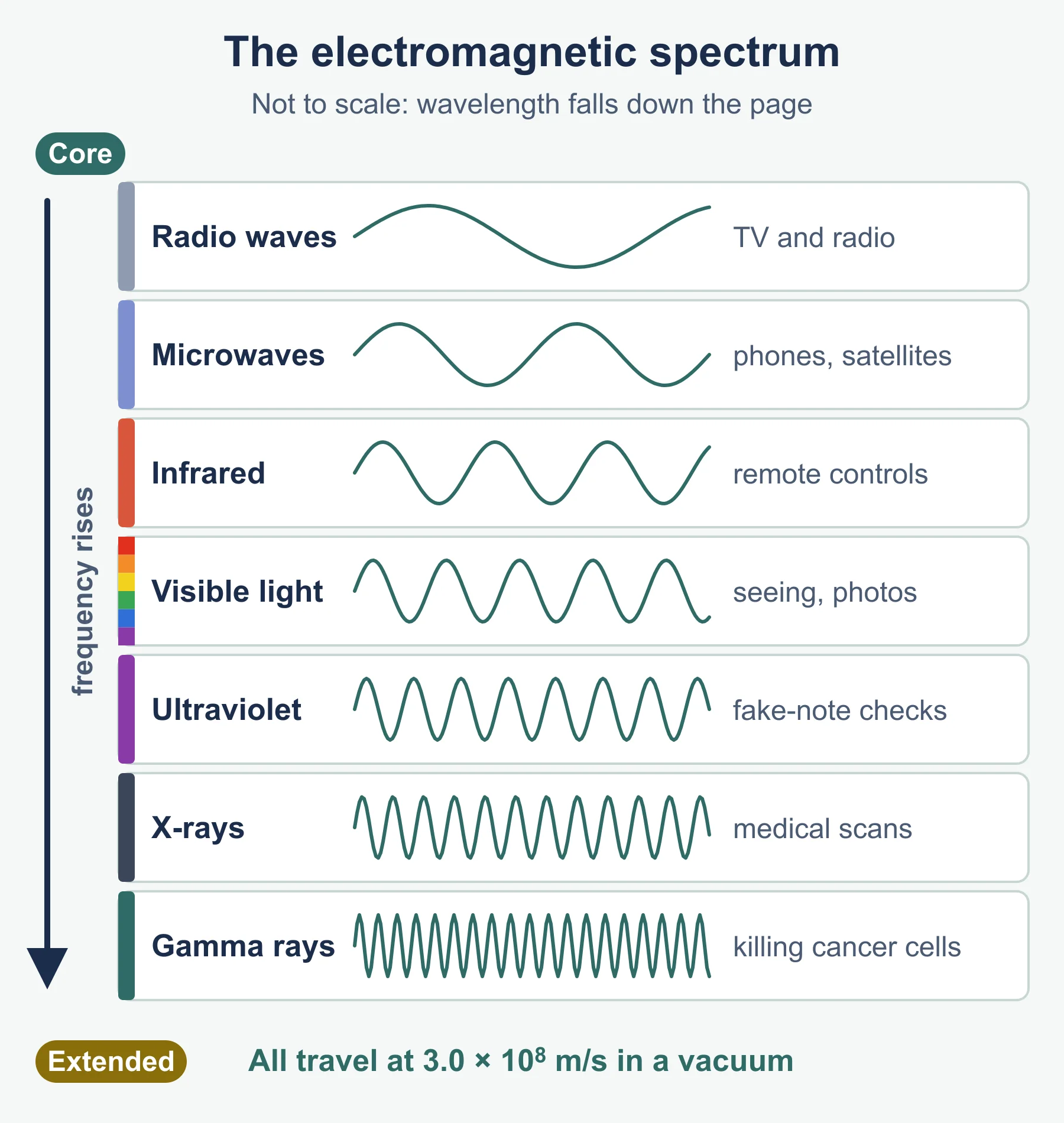
In order of increasing frequency (and decreasing wavelength): radio waves, microwaves, infrared, visible light, ultraviolet, X-rays, gamma rays. In a vacuum every one of them moves at 3.0 × 10⁸ m/s, and air changes this very little.
Worked example 7: a 100 MHz (1.0 × 10⁸ Hz) radio signal has λ = v/f = 3.0 × 10⁸ / 1.0 × 10⁸ = 3.0 m.
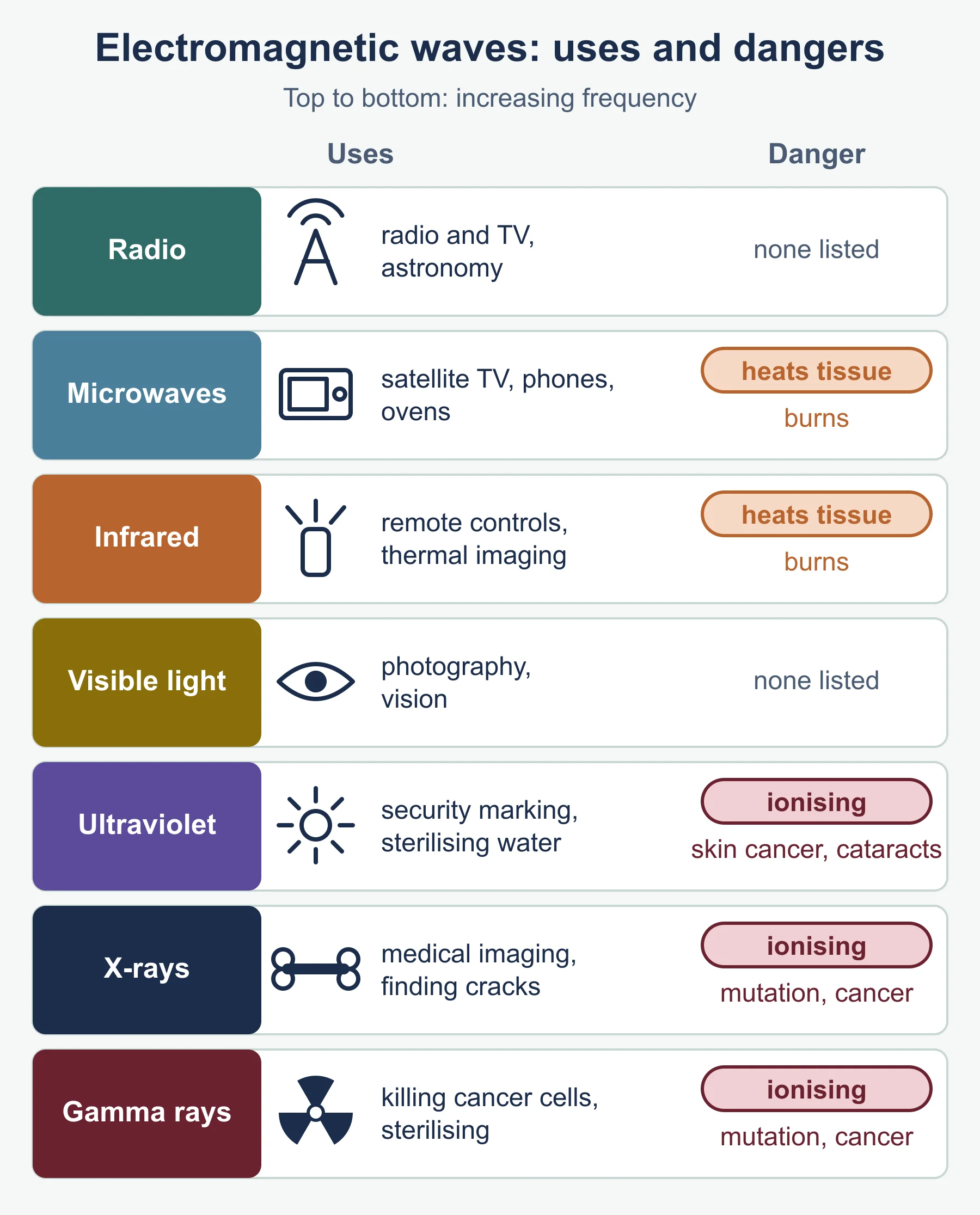
- Radio waves: radio and television, astronomy.
- Microwaves: satellite television, mobile phones, Bluetooth, microwave ovens.
- Infrared: household electrical appliances, remote controllers, intruder alarms, thermal imaging, optical fibres.
- Visible light: photography, vision.
- Ultraviolet: security marking, detecting counterfeit bank notes, sterilising water.
- X-rays: medical imaging, security scanners, killing cancerous cells, finding cracks in metal.
- Gamma rays: detecting and killing cancerous cells, sterilising food and medical equipment, finding cracks in metal.
Damage. Too much exposure to microwaves and infrared heats soft tissue and can cause burns. Ultraviolet (skin cancer, cataracts), X-rays and gamma rays (cell mutation, cancer) are ionising.
3.4 Sound
Sound is produced by a vibrating source, such as a tuning fork or a drum skin, which pushes on the air next to it.
Sound is a longitudinal wave. A compression is a region where particles are squeezed close and pressure is high; a rarefaction is where they are spaced out and pressure is low. Humans hear about 20 Hz to 20 000 Hz.
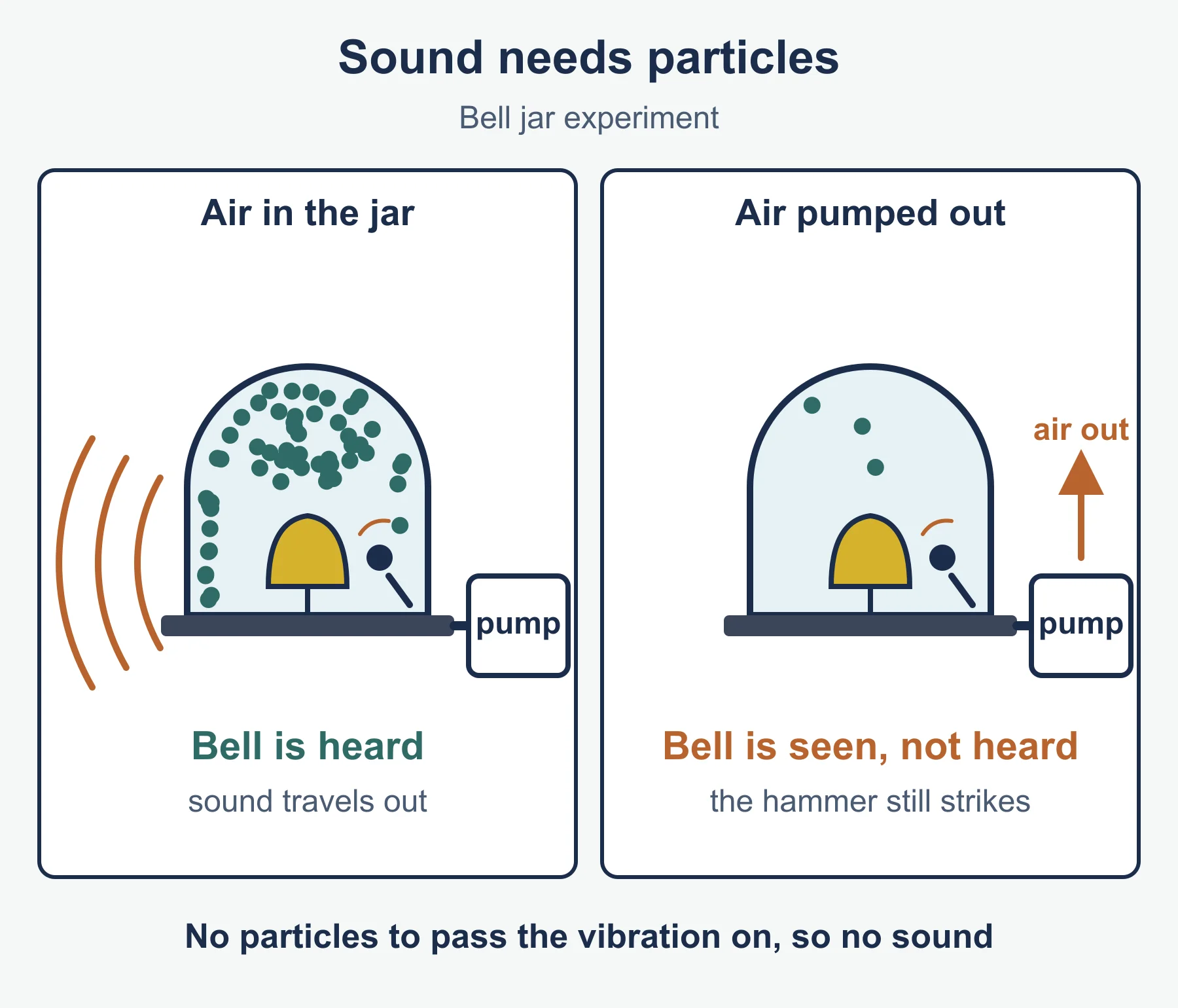
Sound needs particles to vibrate, so it cannot travel through a vacuum. Experiment: pump the air out of a jar containing a ringing bell. The sound fades although you still see the hammer strike.
- Loudness depends on amplitude: larger amplitude, louder sound.
- Pitch depends on frequency: higher frequency, higher pitch.
- Timbre (quality): two instruments playing the same note at the same loudness give different trace shapes on an oscilloscope.
An echo is a reflection of sound. To show reflection, direct sound down a tube towards a hard board and find the angle at which a second tube picks up the loudest echo.
Speed of sound. In air it is approximately 330–350 m/s. In general sound is fastest in solids, then liquids, then gases.
Method for the speed of sound in air. Measure the distance d to a large wall. Clap and time the interval t from the clap to the echo with a stopwatch. The sound travels 2d, so v = 2d/t. Repeat and average.
Worked example 8: 85 m to a wall and an echo after 0.50 s gives v = 2 × 85 / 0.50 = 340 m/s.
Ultrasound is sound with a frequency above 20 kHz. Uses: cleaning (vibrations loosen dirt in a bath), prenatal and other medical scanning (echoes from tissue boundaries build a picture) and sonar. For sonar, depth = v × t / 2.
Worked example 9: a sonar pulse returns after 0.08 s in water where v = 1500 m/s, so depth = 1500 × 0.08 / 2 = 60 m.
Common errors
- Saying a wave carries matter with it; only energy is carried.
- Taking angles from the surface of a mirror or block when they belong to the normal.
- Saying total internal reflection can happen from air into glass.
- Saying the frequency changes when a wave refracts. The speed and wavelength change.
Frequently asked questions
Does a wave carry matter? No. A wave transfers energy without carrying matter with it; the particles of the medium only vibrate about fixed positions.
Does frequency change when a wave refracts? No. When a wave refracts, its speed and wavelength change but its frequency stays the same.
Can total internal reflection happen when light goes from air into glass? No. Total internal reflection only happens when light travels from a denser material to a less dense one, such as glass to air, at an angle of incidence greater than the critical angle.
Where should angles of incidence and refraction be measured from? Measure them from the normal, a line at right angles to the surface, not from the surface of the mirror or block.
Official syllabus
Source: topic 3, Waves, of the Cambridge International Education O Level Physics 5054 syllabus for 2026 to 2028.
Get free revision emails (optional)
Occasional emails with practice questions, worked explanations and links to free resources for the qualification and subjects you choose. No spam, and you can unsubscribe from any email. The free tools on this site never need an email.
Related resources
-
Practice questions
O Level Physics: Waves — Practice Questions (Cambridge 5054)
Original Cambridge O Level Physics 5054 waves questions with worked answers on sound, frequency, oscilloscope traces, diffraction, echoes, refraction, fibres.
Physics · Cambridge · O Level
Try questions -
Revision notes
Cambridge O Level Physics: Waves (5054) – Revision Notes
Condensed revision notes on Waves for Cambridge O Level Physics 5054: definitions, equations, light, sound, the EM spectrum, a self-test and common lost marks.
Physics · Cambridge · O Level
Revise topic -
Practice questions
O Level Physics: Electromagnetic Spectrum — Practice Questions (Cambridge 5054)
Original Cambridge O Level Physics 5054 questions with worked answers on the order of the EM spectrum, wave speed, uses of each region and radiation damage.
Physics · Cambridge · O Level
Try questions
Related articles
-
study skills
How to revise for a science examination
Most science revision fails because it rereads notes instead of retrieving them. A practical method for revising physics, chemistry and biology in the weeks before a paper.
14 July 2026
-
teaching
A Level tuition in Dubai: Cambridge or Pearson Edexcel International A Level?
Schools in Dubai and Abu Dhabi teach either Cambridge International AS & A Level or Pearson Edexcel International A Level. How the two are structured, why it matters for tuition, and how online classes from Lahore work.
9 October 2026
Studying this with a teacher
Working through Physics O LEVELS?
This page is free and stays free. If you would rather be taught it, Marlbridge runs Physics classes one-to-one and in small groups of up to 15, online in your own time zone. The first trial class is free. WhatsApp replies within an hour (8am–11pm Pakistan time, every day); email the same day.
Cambridge Physics teachers at Marlbridge


