
Study Guides
OCR GCSE Business: Operations (J204)
Study guide to section 4 Operations in OCR GCSE (9-1) Business J204: production, quality, selling, consumer law, location, suppliers, with worked examples.
- Subject
- Business
- Level
- GCSE
- Topic
- Operations, finance and influences on business
- Author
- Marlbridge Academic Team
- Updated
- Reviewed by
- Salman Ahmad (what this means)
Aligned to OCR GCSE Business (J204), Version 2.0 (January 2026), for first assessment in 2019. Official specification .
Syllabus page (what it covers and how it is assessed): OCR GCSE Business.
Syllabus points this page covers
J204
- 4 Operations
Found an error? Report a correction.
Need help with this topic? Request a free trial class for GCSE Business (J204).
This guide teaches section 4, Operations, of the OCR GCSE (9-1) Business (J204) specification, Version 2.0 (January 2026), for first assessment in 2019. It covers topics 4.1 to 4.6. The content is assessed in Business 2: operations, finance and influences on business (J204/02), an 80-mark component with 15 marks of multiple choice in Section A and 65 marks in Section B. Section B uses stimulus material, so apply every idea below to the business you are given.
Use it with the revision notes and the practice questions. The wider component is covered in the Operations, Finance and Influences study guide, with more revision notes and mixed practice. Check your level on the free diagnostics, track progress on the course hub and tick topics off on the checklist.
What the specification lists
| Topic | Content you must cover |
|---|---|
| 4.1 Production processes | Job, batch and flow production and their impact on businesses. The influence of technology: automation, computers and robotics. |
| 4.2 Quality of goods and services | The concept of quality. Quality control and quality assurance. Why quality matters in goods and in services: reputation, gaining and retaining customers, fewer returns and recalls. |
| 4.3 Sales process and customer service | E-commerce, face to face and telesales. The influence of e-commerce. Good customer service, including after-sales service. Product knowledge and customer engagement. |
| 4.4 Consumer law | The impact of consumer law on businesses: reputation, safety and satisfactory quality of goods. |
| 4.5 Business location | Costs, proximity to market, labour and materials. |
| 4.6 Working with suppliers | The role of procurement. The impact of logistical and supply decisions: time, length of supply chain, reliability of supply, costs, customer service. |
4.1 Production processes
Operations is the part of a business that turns inputs into goods or services. The specification names three processes and asks about their impact on the business.
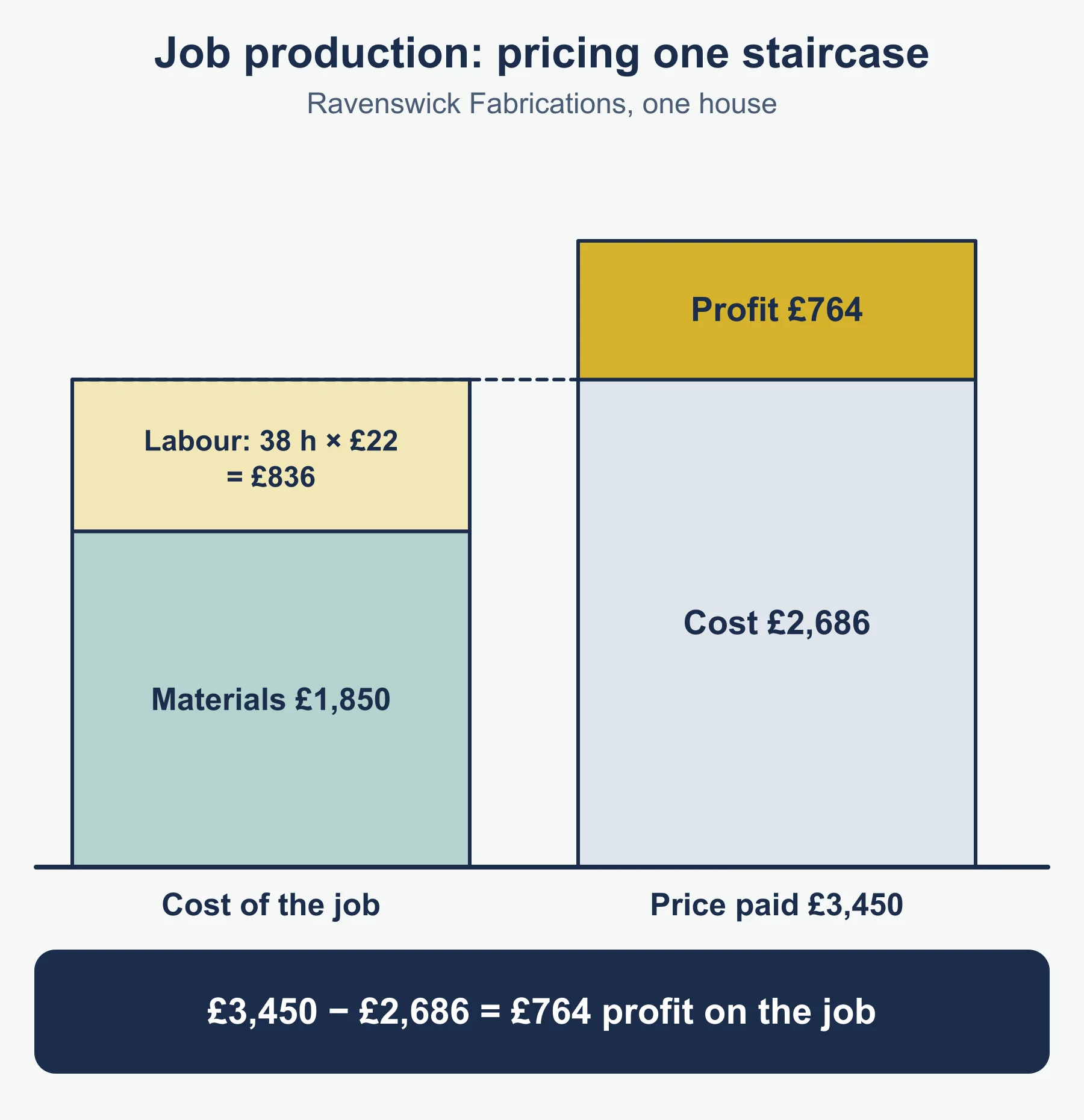
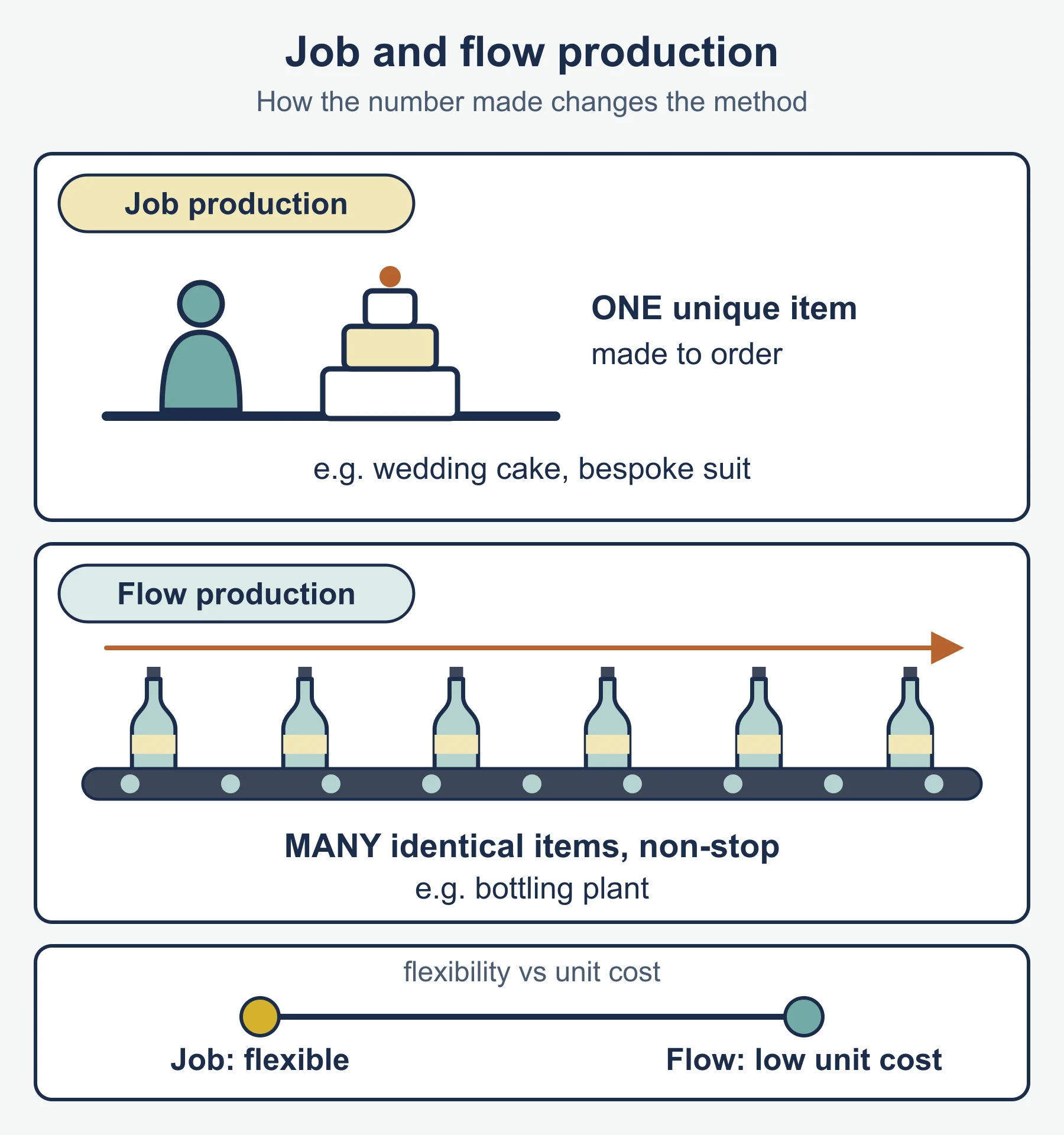
Job production makes one-off products to a customer’s order. Ravenswick Fabrications builds a staircase to fit a single house. The product is unique, so it can match the customer exactly and can sell at a high price. But it needs skilled, expensive labour and takes a long time, and nothing can be spread across many identical units.
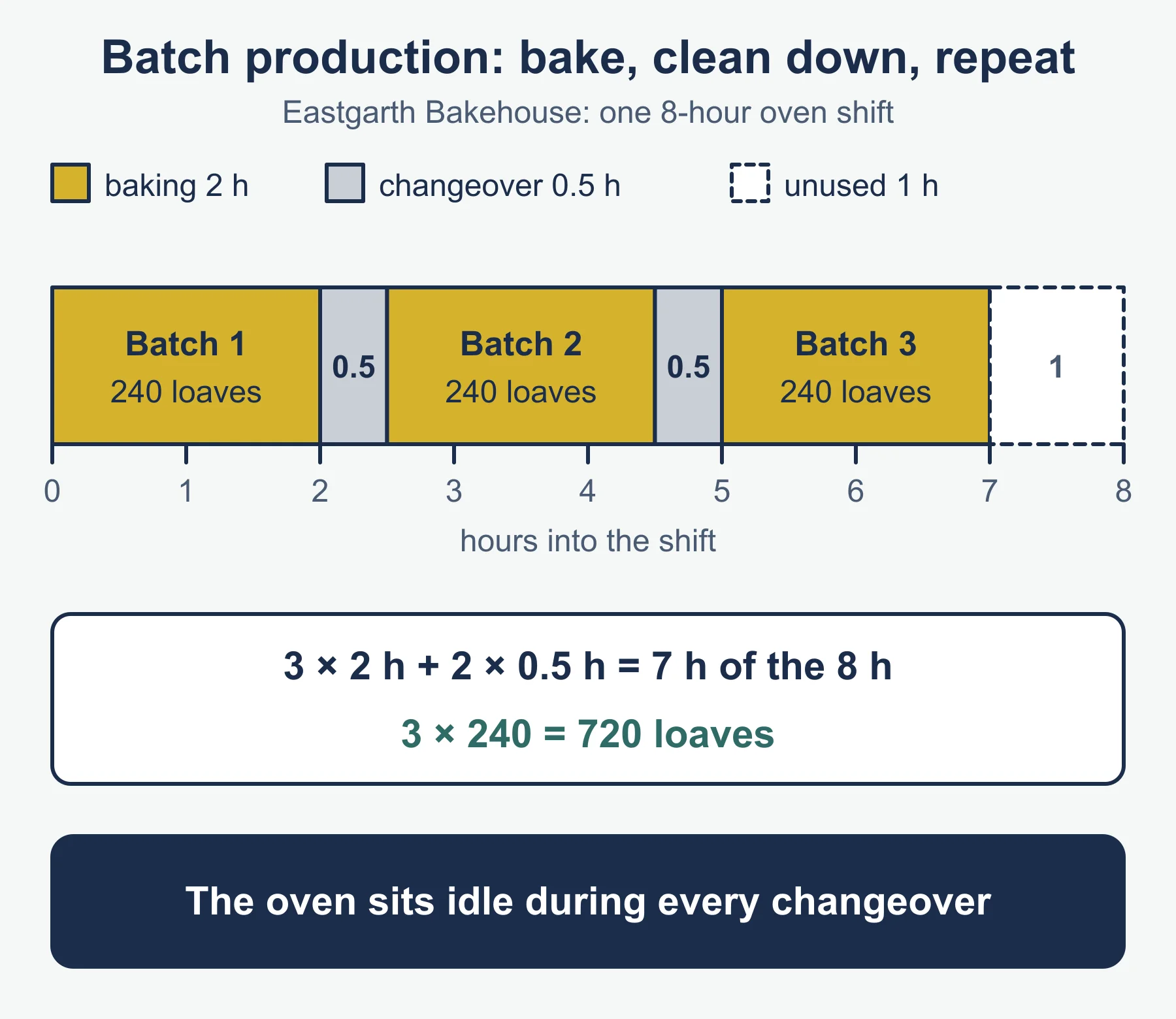
Batch production makes a set quantity of identical products, then switches to the next product. Eastgarth Bakehouse bakes 240 sourdough loaves, cleans down, then bakes a batch of seeded rolls. It can offer variety and respond to demand, but equipment is idle during changeovers and stock can sit waiting between stages.
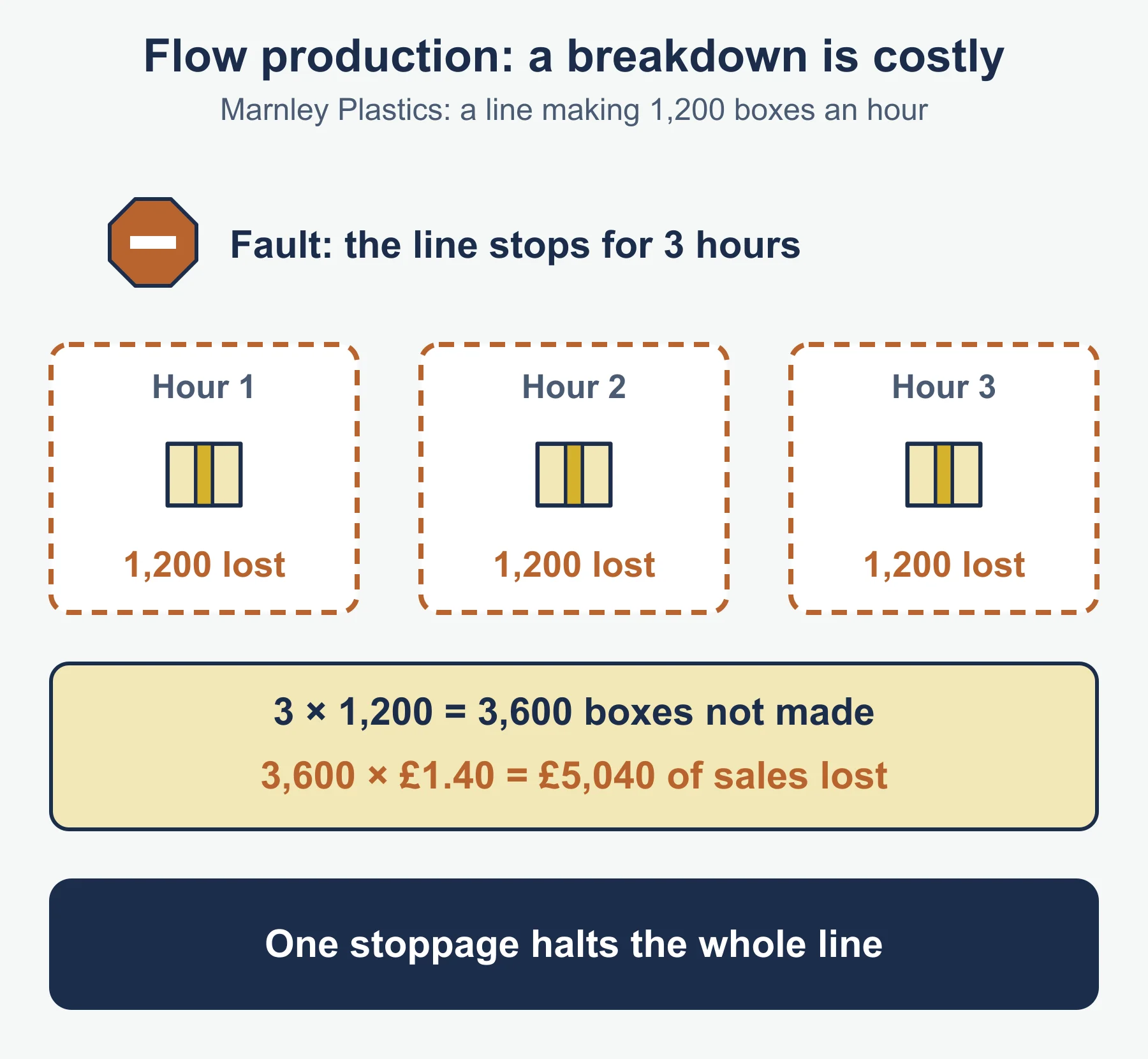
Flow production makes identical products continuously, often 24 hours a day, on a line. Marnley Plastics moulds storage boxes at a steady rate. Unit costs are low at high volume. The costs of that: a very expensive set-up, little flexibility, and a stoppage halts everything.
Worked example 1: batch and flow
Eastgarth runs its oven for an 8-hour shift. Each batch needs 2 hours of baking and a 30-minute changeover between batches.
- Three batches need 3 x 2 = 6 hours of baking plus 2 changeovers of 0.5 hours = 1 hour. Total 7 hours, so three batches fit.
- Output is 3 x 240 = 720 loaves.
Marnley’s line makes 1,200 boxes per hour. A fault stops it for 3 hours. Lost output is 3 x 1,200 = 3,600 boxes. At £1.40 each, that is £5,040 of sales that cannot be made. This is why flow production is vulnerable to breakdowns.
Worked example 2: job production
Ravenswick prices a staircase. Materials cost £1,850. Labour is 38 hours at £22 per hour = £836. Total cost is £2,686. If the customer pays £3,450, the profit on the job is £3,450 - £2,686 = £764.
Technology: automation, computers and robotics
Technology changes how any of the three processes work.
- Automation is machines carrying out tasks with little human input.
- Computers control machines, schedule production, track stock and record quality data.
- Robotics uses programmable machines for tasks such as welding, packing or moving stock.
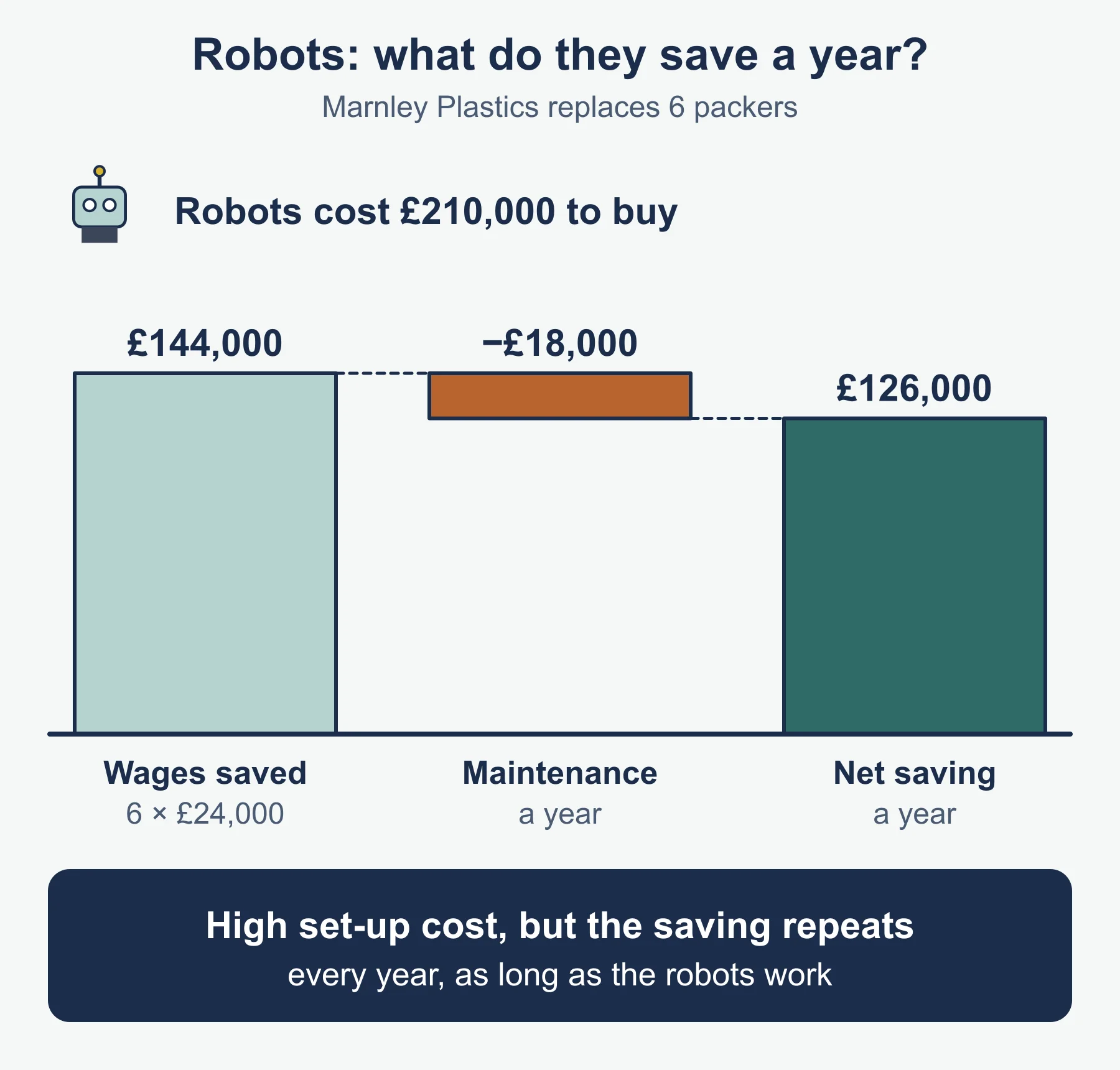
Impacts to weigh: output is more consistent and faster, fewer errors occur, and machines can work through the night. Against that, there is a high set-up cost, a need for maintenance and technical staff, fewer routine jobs, and possible staff worries.
Marnley buys robots for £210,000. They replace 6 packers paid £24,000 each, a wage saving of £144,000 a year. Maintenance costs £18,000 a year, so the yearly net saving is £126,000.
4.2 Quality of goods and services
Quality is how well a good or service meets the standard customers expect for its price. For a good, that includes reliability, finish and safety. For a service, it includes accuracy, speed, courtesy and consistency.
Two methods are named:
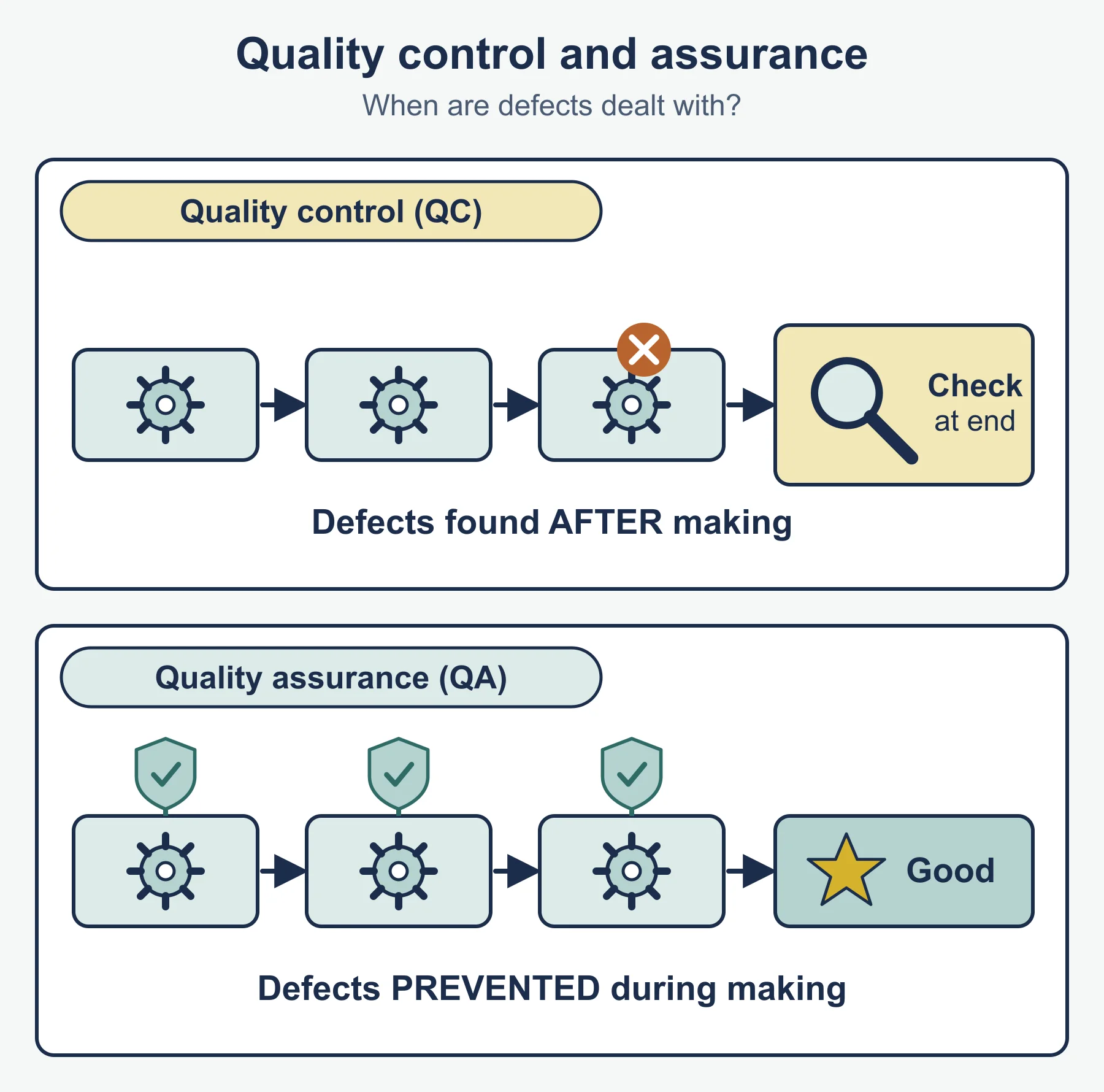
- Quality control inspects or tests products, usually at the end or at set points, and removes those that fail. It finds faults after they occur.
- Quality assurance builds quality into every stage: clear standards, staff training, checking materials on arrival, and fixing the cause of a fault. It aims to prevent faults.
Why quality matters:
- It protects the reputation of the business, which affects future sales.
- It helps to gain customers and to retain them, because a satisfied customer returns.
- It reduces product returns, which cost refunds, postage and staff time.
- It reduces the risk of a product recall, where a business must call back goods already sold.
Worked example 3: measuring quality
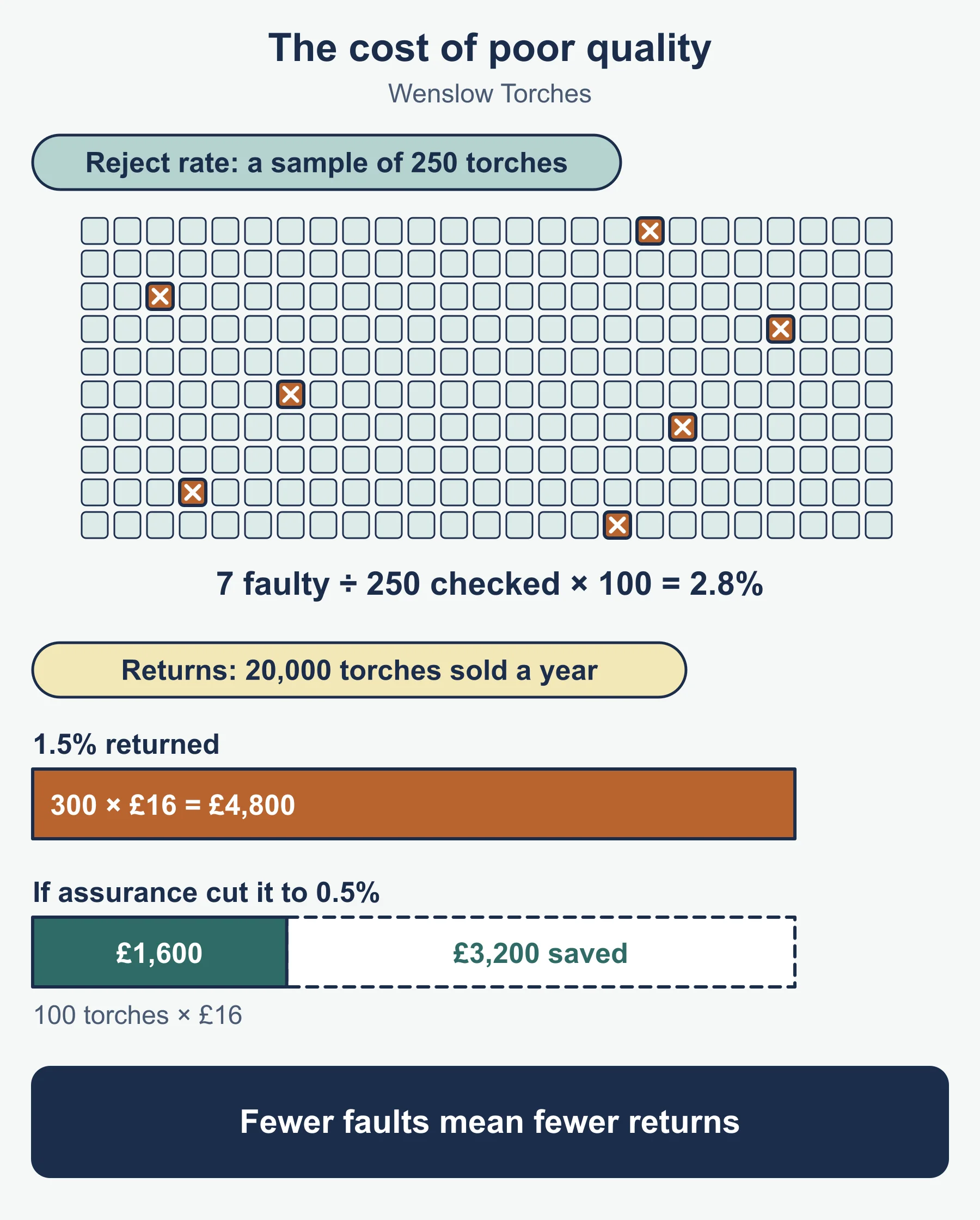
Wenslow Torches checks a sample of 250 torches and finds 7 faulty. The reject rate (standard form: faulty / checked x 100, not given in the specification) is 7 / 250 x 100 = 2.8%.
Wenslow sells 20,000 torches in a year and 1.5% are returned. Returns are 20,000 x 0.015 = 300 torches. At a £16 refund each, returns cost £4,800 (cost of returns = number returned x cost per return, the standard form). If assurance cut returns to 0.5%, only 100 torches would come back, saving £3,200 in refunds.
4.3 The sales process and customer service
Methods of selling named in the specification:
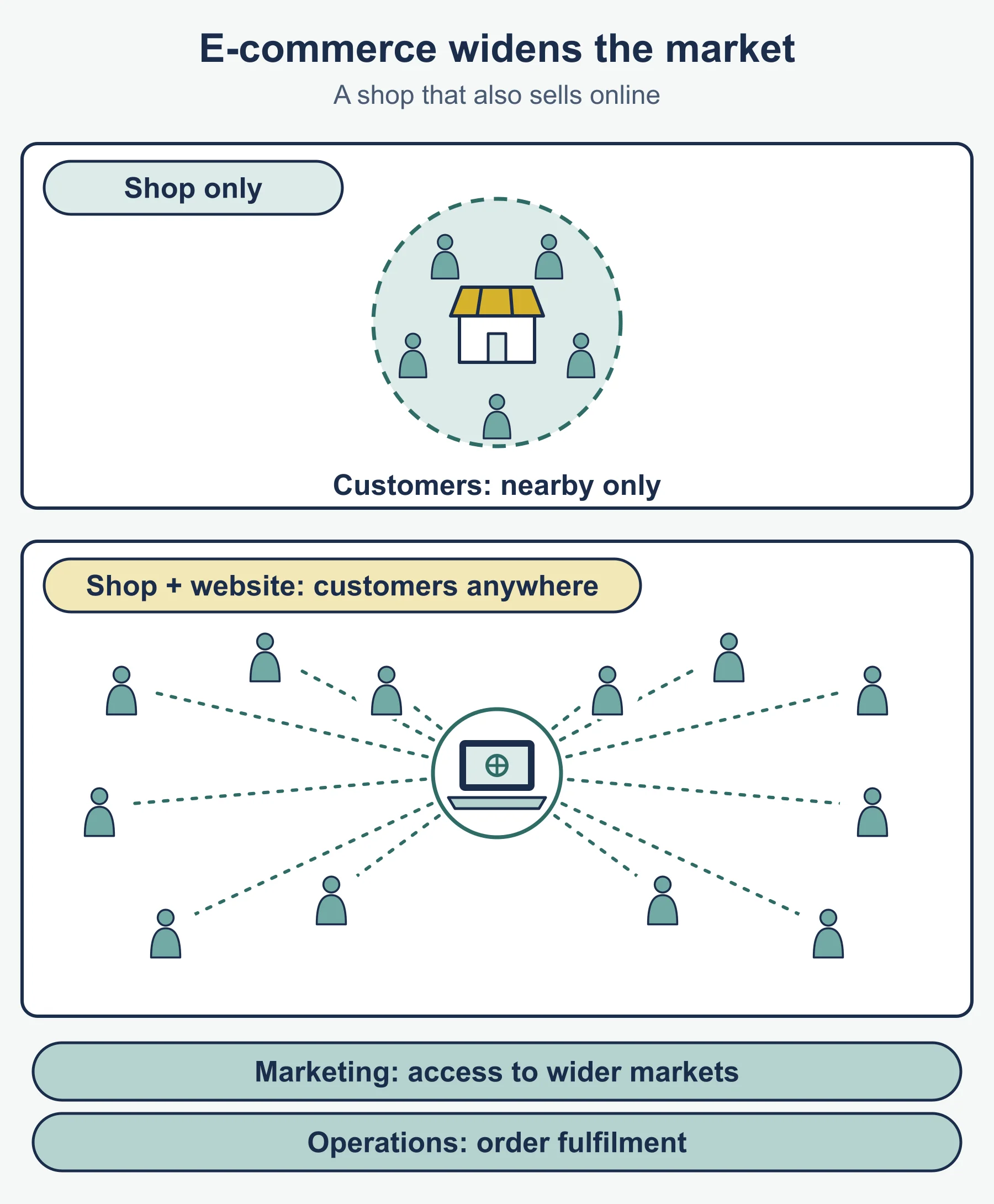
- E-commerce is selling online through a website or app. Customers can buy at any hour and the market is wider. But the business needs a reliable site, secure payment and delivery, and customers cannot handle the product.
- Face to face selling happens in a shop, at a stall or in a meeting. Staff can demonstrate, advise and close a sale, and customers see the goods. The costs include premises and staff, and reach is limited by location.
- Telesales sells by telephone. It is cheaper than a visit, allows direct questioning of the customer, and can follow up leads. Many people find unsolicited calls annoying, and the customer cannot see the product.
The influence of e-commerce on business activity. It lets small firms reach national and overseas customers, can reduce the need for expensive high-street premises, and gives data on what customers view and buy. It also increases competition, needs investment in a site and in packing and delivery, and can raise returns because customers cannot try goods first.
Worked example 4: sales by method
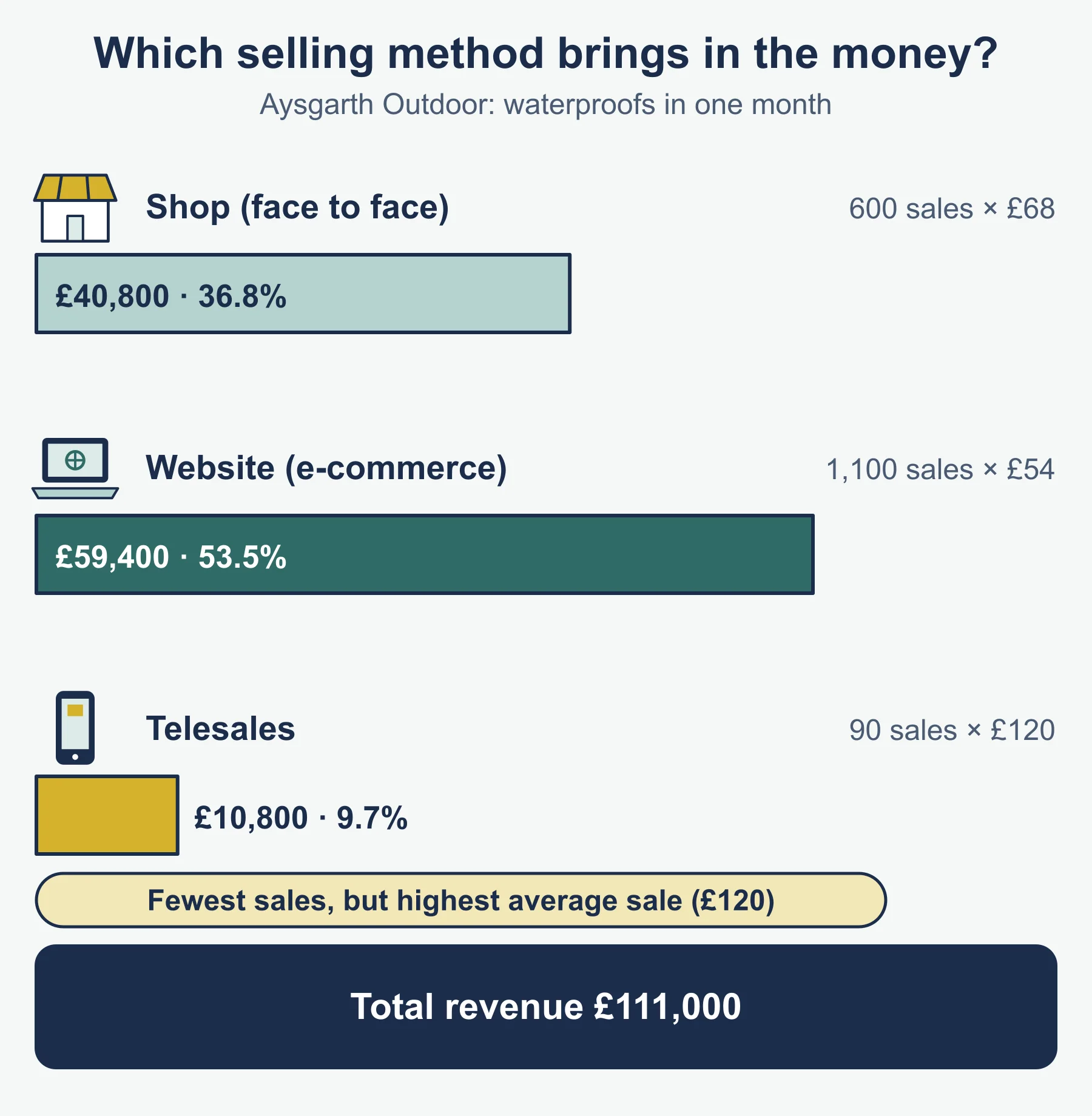
Aysgarth Outdoor sells waterproofs three ways in a month.
| Method | Sales | Average sale | Revenue |
|---|---|---|---|
| Shop (face to face) | 600 | £68 | £40,800 |
| Website (e-commerce) | 1,100 | £54 | £59,400 |
| Telesales | 90 | £120 | £10,800 |
Total revenue is £111,000. Website share is 59,400 / 111,000 x 100 = 53.5%, the shop is 36.8% and telesales 9.7%. Telesales has the fewest sales but the highest average sale, which suggests it suits large or repeat orders.
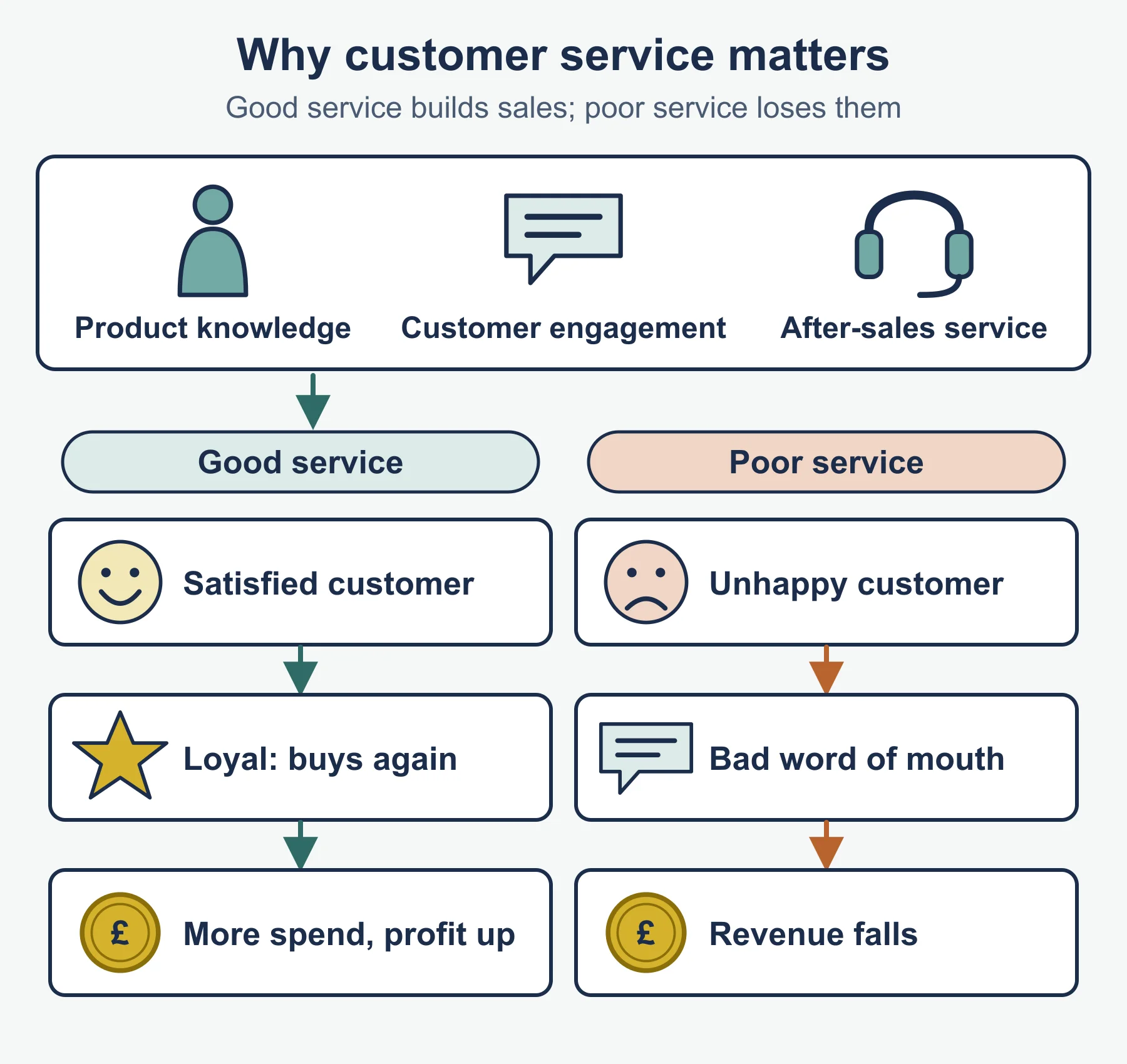
Customer service is the help and attention a customer gets before, during and after buying. Good service helps to gain customers and to retain them. After-sales service covers delivery updates, help using the product, repairs, and handling of returns or complaints. It matters because it can turn a problem into loyalty.
Two things contribute to good service:
- Product knowledge. Staff who understand the range can recommend the right item, answer questions and avoid wrong sales.
- Customer engagement. Listening, responding quickly, asking for feedback and keeping in touch makes customers feel valued and gives the business ideas to improve.
4.4 Consumer law
Consumer law sets rules that protect people who buy goods and services. The specification asks you to understand its impact on businesses, in particular safety and satisfactory quality of goods. The specification lists no particular Acts for this section, so focus on the effects.
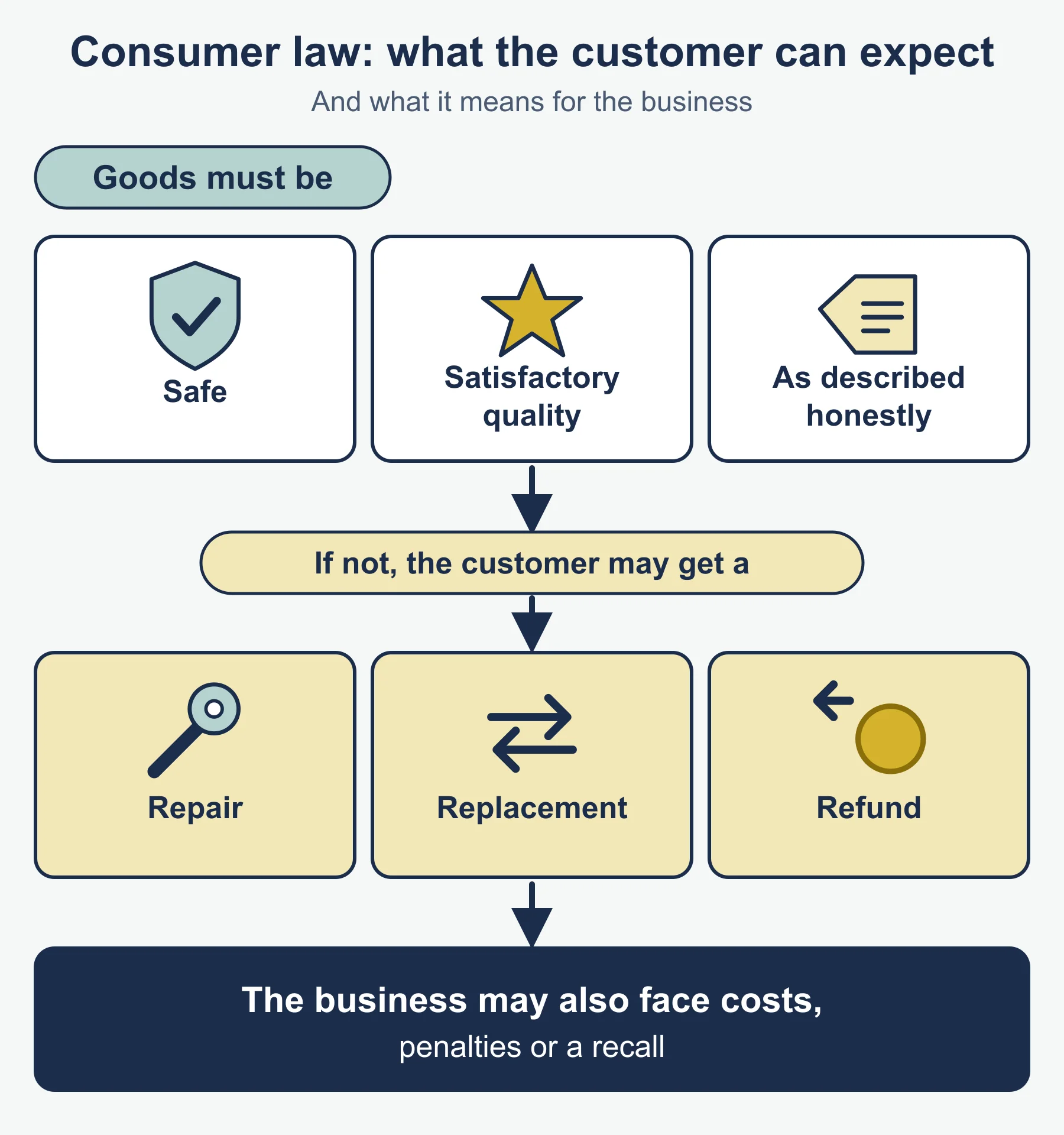
In general terms, businesses must sell goods that are safe, of satisfactory quality, and match how they were described. If they do not, the customer may be entitled to a repair, replacement or refund, and the business may face costs, penalties or a recall.
Impacts on a business:
- It must test and check products, so quality procedures (4.2) become a legal necessity as well as good practice.
- It must describe goods honestly in adverts and listings.
- It carries costs of refunds, replacements and staff training.
- It protects reputation: a firm known for fair treatment gains trust, while one that breaks the rules loses customers.
4.5 Business location
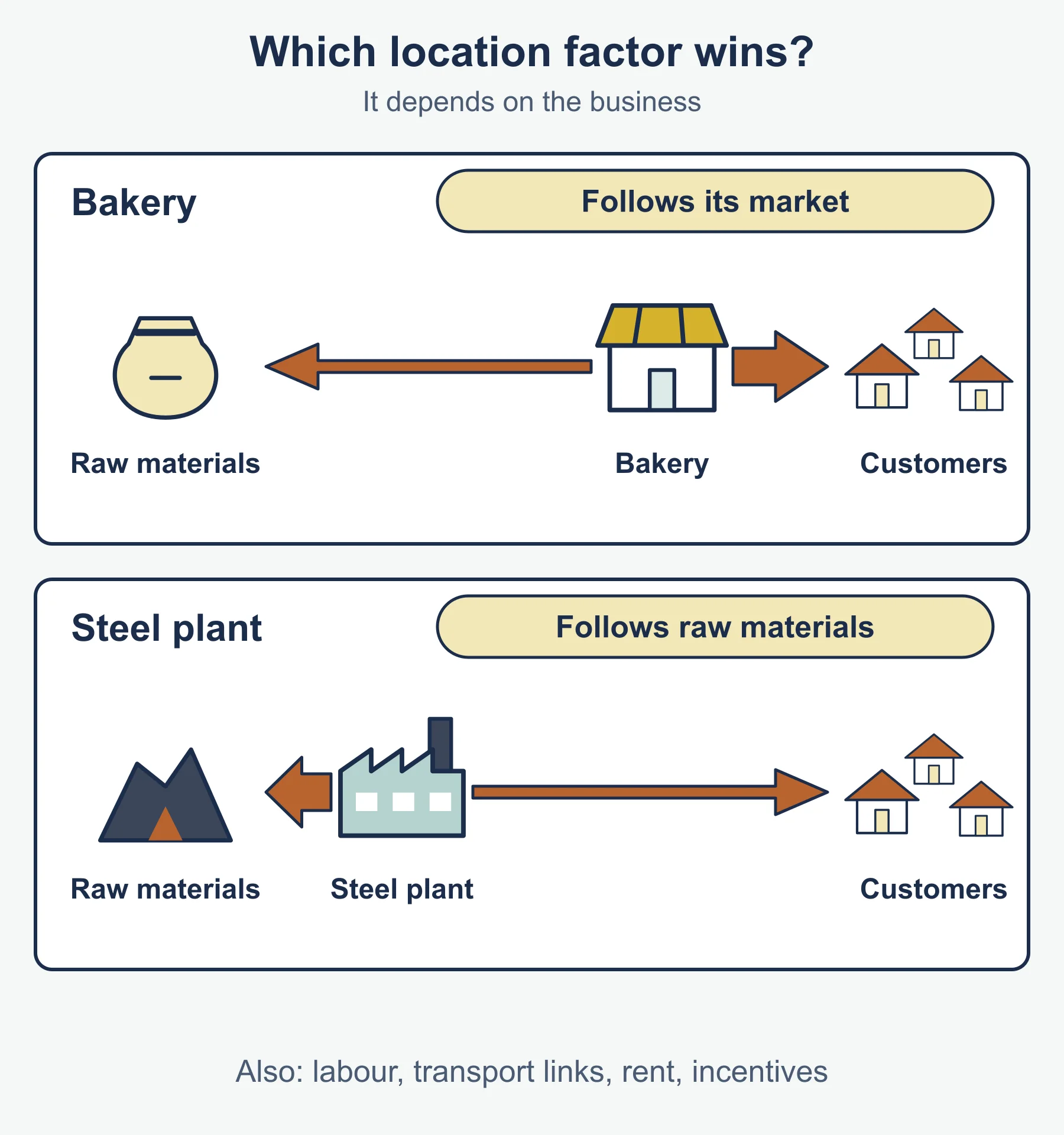
The specification lists four factors: costs, proximity to market, labour and materials. The best site depends on which factor matters most for that business.
- Costs: rent or purchase price, business rates, utilities and transport.
- Proximity to market: being near customers cuts delivery costs and time, and suits a business that customers visit, such as a shop or café.
- Labour: is there a supply of workers with the right skills at wages the business can afford?
- Materials: a business using heavy or bulky inputs often locates near them to cut transport costs.
Worked example 5: comparing sites
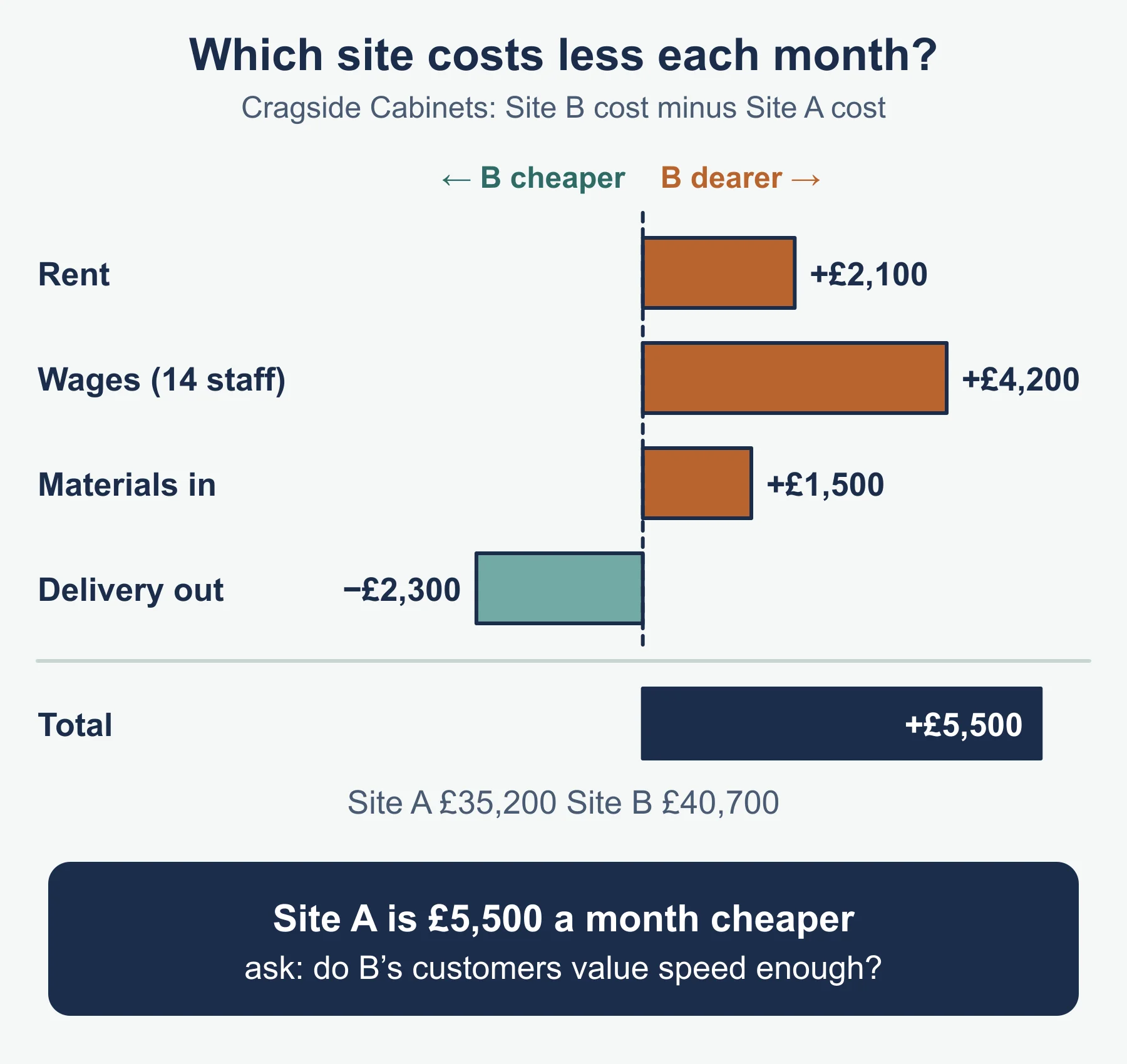
Cragside Cabinets employs 14 staff and compares two sites per month.
| Cost | Site A (near timber) | Site B (near customers) |
|---|---|---|
| Rent | £2,800 | £4,900 |
| Wages (14 staff) | 14 x £2,050 = £28,700 | 14 x £2,350 = £32,900 |
| Inbound materials | £600 | £2,100 |
| Delivery to customers | £3,100 | £800 |
| Total | £35,200 | £40,700 |
Summing each site’s monthly costs is a standard method, not a specification formula. Site A is £5,500 a month cheaper. A strong answer then asks about non-cost factors, such as whether Site B’s customers value speed enough to pay more.
4.6 Working with suppliers
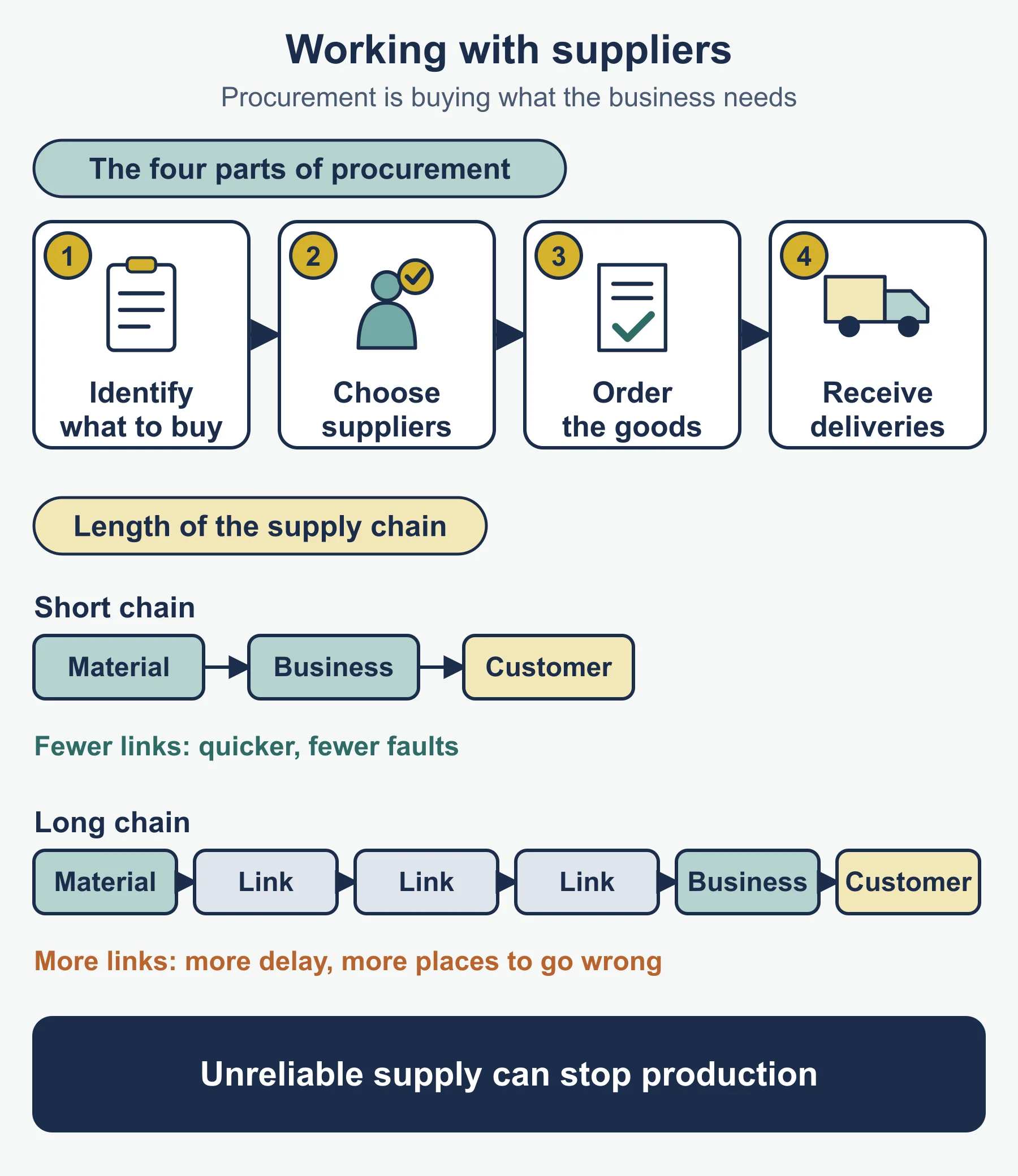
Procurement is buying the goods and services a business needs. The specification names four parts of the role:
- Identifying the goods and services to buy.
- Choosing suppliers.
- Ordering the goods and services.
- Receiving deliveries from suppliers.
Logistical and supply decisions affect the business through five named factors: time, length of supply chain, reliability of supply, costs and customer service. A longer supply chain, with more links between raw material and customer, usually means more delay and more places for things to go wrong. Unreliable supply can stop production and leave customers waiting.
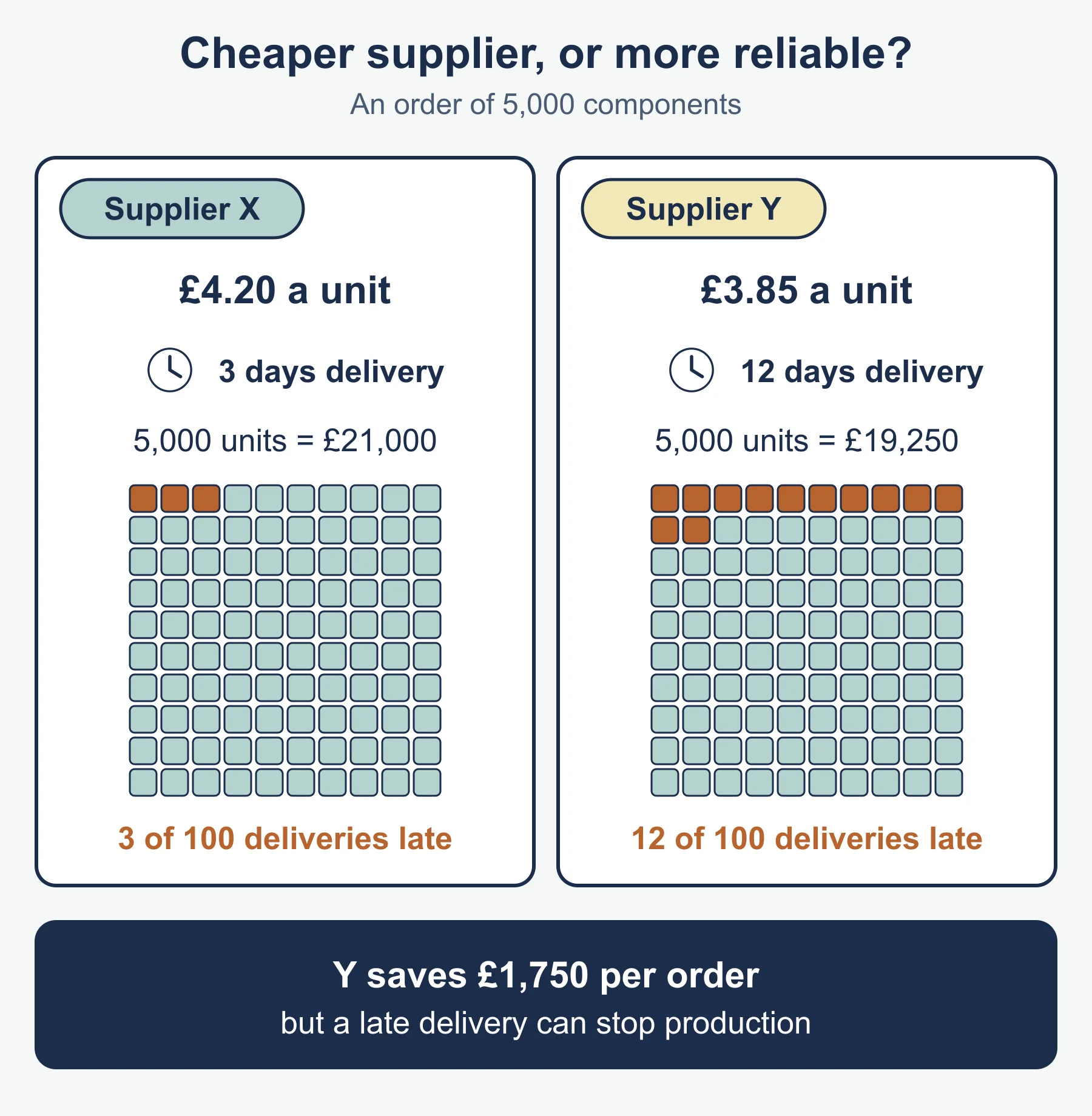
Worked example 6: choosing between suppliers
A business needs 5,000 components.
| Supplier X | Supplier Y | |
|---|---|---|
| Price per unit | £4.20 | £3.85 |
| Delivery time | 3 days | 12 days |
| Deliveries on time | 97% | 88% |
X costs 5,000 x £4.20 = £21,000. Y costs 5,000 x £3.85 = £19,250, so Y saves £1,750 per order. Out of 100 deliveries, X would be late about 3 times and Y about 12. If a late delivery stops production, the saving can disappear, and a stoppage hurts customer service. The answer depends on how costly a delay is.
Common errors
- Describing a process without linking it to the business: always say what it means for cost, flexibility, speed or quality there.
- Writing that quality control prevents faults. It finds them; assurance aims to prevent them.
- Treating e-commerce as purely good news: weigh competition, delivery and returns.
- Listing consumer law Acts instead of explaining the effect on the business.
- Choosing the cheapest location or supplier without weighing reliability, time and customer service.
For “evaluate” or “recommend”, weigh both sides, then give a supported judgement.
Frequently asked questions
What is the difference between job, batch and flow production? Job production makes one-off products to a customer’s order, batch production makes a set quantity of identical products before switching to the next, and flow production makes identical products continuously on a line. In OCR GCSE Business (J204) you should link the process to its effect on cost and flexibility for the business.
What are the four location factors in OCR GCSE Business? The specification lists costs, proximity to market, labour and materials. Which factor dominates depends on the business: proximity to market matters most for shops, cafes and fresh goods, while materials matter most for firms using heavy or bulky inputs.
How do logistical and supply decisions affect a business? The specification names five factors: time, length of supply chain, reliability of supply, costs and customer service. A longer supply chain usually means more delay and more places for things to go wrong.
What are the impacts of automation and robotics on a business? Output becomes faster and more consistent, fewer errors occur and machines can work through the night, which can lower labour cost per unit over time. Against that, there is a high set-up cost, a need for maintenance and technical staff, fewer routine jobs and possible staff worries.
What contributes to good customer service? Product knowledge and customer engagement both contribute: staff who understand the range can recommend the right item and answer questions. Good service helps a business gain and keep customers.
Official syllabus
OCR, GCSE (9-1) in Business (J204) Specification, Version 2.0 (January 2026), for first assessment in 2019, section 2c, Content of Business 2: operations, finance and influences on business, section 4 Operations.
Get free revision emails (optional)
Occasional emails with practice questions, worked explanations and links to free resources for the qualification and subjects you choose. No spam, and you can unsubscribe from any email. The free tools on this site never need an email.
Related resources
-
Study guides
OCR GCSE Business: Operations, Finance and Influences on Business (J204)
Component 02 of OCR GCSE Business J204 explained: operations, finance and influences on business, from production and quality to break-even and cash flow.
Business · OCR · GCSE
Read guide -
Practice questions
OCR GCSE Business: Operations, Finance and Influences — Practice Questions
Original OCR GCSE Business J204/02 practice with worked answers: a 15-question multiple-choice Section A plus operations, finance and influences questions.
Business · OCR · GCSE
Try questions -
Revision notes
OCR GCSE Business: Operations, Finance and Influences — Revision Notes
Condensed OCR GCSE Business J204 Component 02 revision notes: production, quality, finance formulas, break-even, cash versus profit and outside influences.
Business · OCR · GCSE
Revise topic
Related articles
-
teaching
A Level tuition in Dubai: Cambridge or Pearson Edexcel International A Level?
Schools in Dubai and Abu Dhabi teach either Cambridge International AS & A Level or Pearson Edexcel International A Level. How the two are structured, why it matters for tuition, and how online classes from Lahore work.
9 October 2026
-
curriculum guides
Choosing subjects at IGCSE and A Level
How subject choices at 14 and 16 affect university options later, and how to keep pathways open without overloading a timetable.
28 July 2026
Studying this with a teacher
Working through Business GCSE?
This page is free and stays free. If you would rather be taught it, Marlbridge runs Business classes one-to-one, online in your own time zone. One-to-one only for this course: Rs 6,000 per class in Pakistan, with other currencies on the fees page. The first trial class is free. WhatsApp replies within an hour (8am–11pm Pakistan time, every day); email the same day.
OCR Business teachers at Marlbridge
