
Study Guides
OxfordAQA International A-level Psychology (9685): 3.1.1 Memory
Study guide to OxfordAQA 9685 section 3.1.1 Memory: multi-store and working memory models, types of long-term memory, eyewitness testimony and model answers.
- Subject
- Psychology
- Level
- AS LEVEL
- Topic
- Unit 1 – Introductory Topics in Psychology
- Author
- Marlbridge Academic Team
- Updated
- Reviewed by
- Kanwal Aslam (what this means)
Aligned to OxfordAQA A Level Psychology (9685), Version 3.1. Official specification .
Syllabus page (what it covers and how it is assessed): OxfordAQA A Level Psychology.
Syllabus points this page covers
9685 (AS Level)
- 3.1.1 Memory
This guide covers 3.1.1 Memory of the OxfordAQA International AS and A-level Psychology (9685) specification, Version 3.1. Memory is Section A of the Unit 1 exam, which the specification gives as 30 marks of compulsory questions within a 1 hour 30 minute, 90-mark paper. The specification lists four areas: the multi-store model (sensory register, short-term memory and long-term memory, with the coding, capacity and duration of each); the working memory model (central executive, phonological loop, visuo-spatial sketchpad and episodic buffer, with coding and capacity); types of long-term memory (episodic, semantic and procedural); and eyewitness testimony, including leading questions, post-event discussion and the cognitive interview.
The introductory topics study guide gives a one-page overview. This guide adds the research evidence behind each claim, evaluation you can use in extended answers, and worked answers. Condense it with the memory revision notes and test yourself with the memory practice questions.
The multi-store model
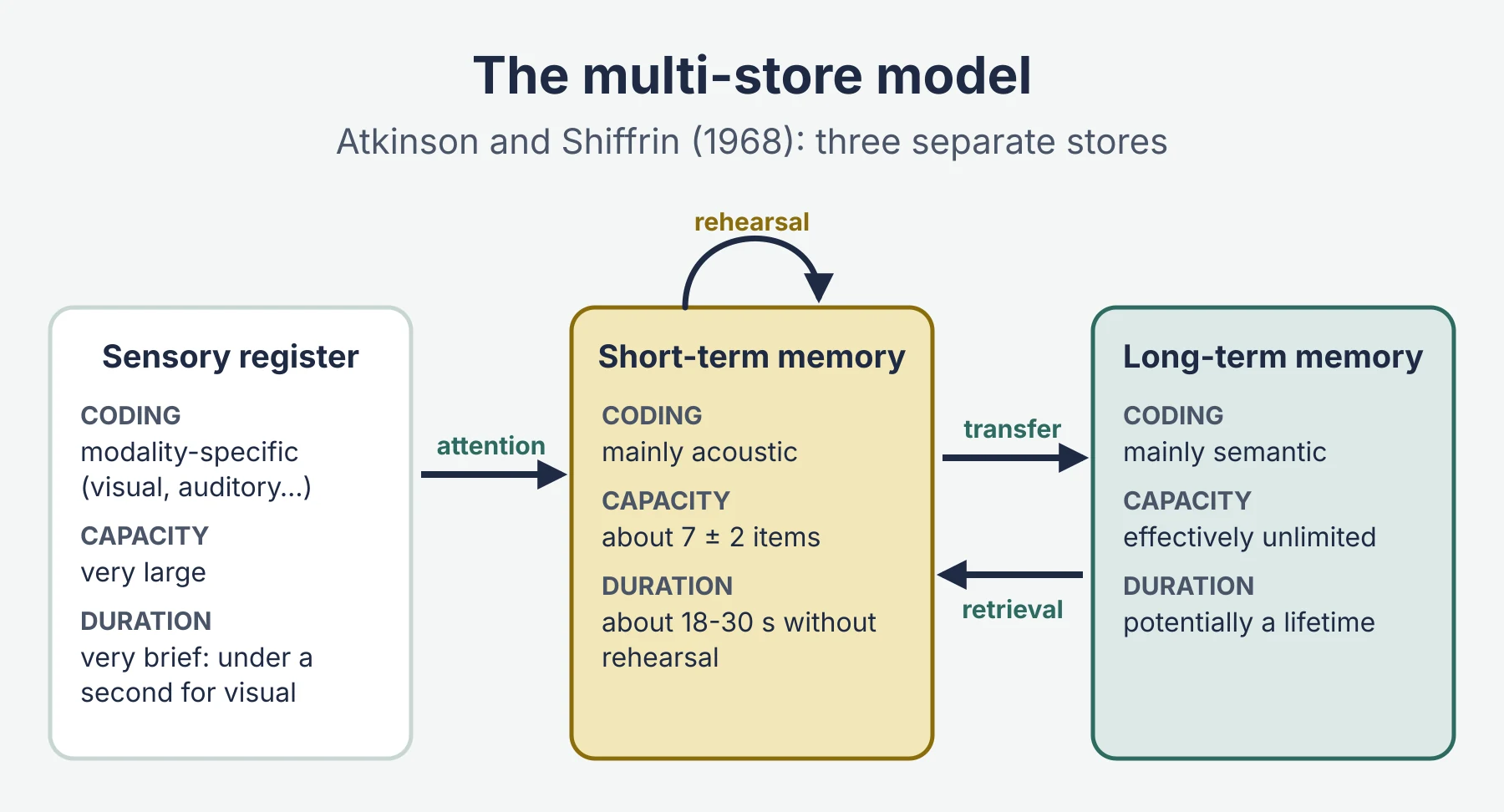
Atkinson and Shiffrin (1968) proposed that information flows through three separate stores. Attention moves information from the sensory register to short-term memory; rehearsal keeps it there and can transfer it to long-term memory; retrieval brings it back to short-term memory when needed.
| Store | Coding | Capacity | Duration |
|---|---|---|---|
| Sensory register | Modality-specific (visual, auditory and so on) | Very large | Very brief, under a second for visual information |
| Short-term memory | Mainly acoustic | Limited, about 7 plus or minus 2 items | About 18 to 30 seconds without rehearsal |
| Long-term memory | Mainly semantic | Effectively unlimited | Potentially a lifetime |
Evidence for each feature:
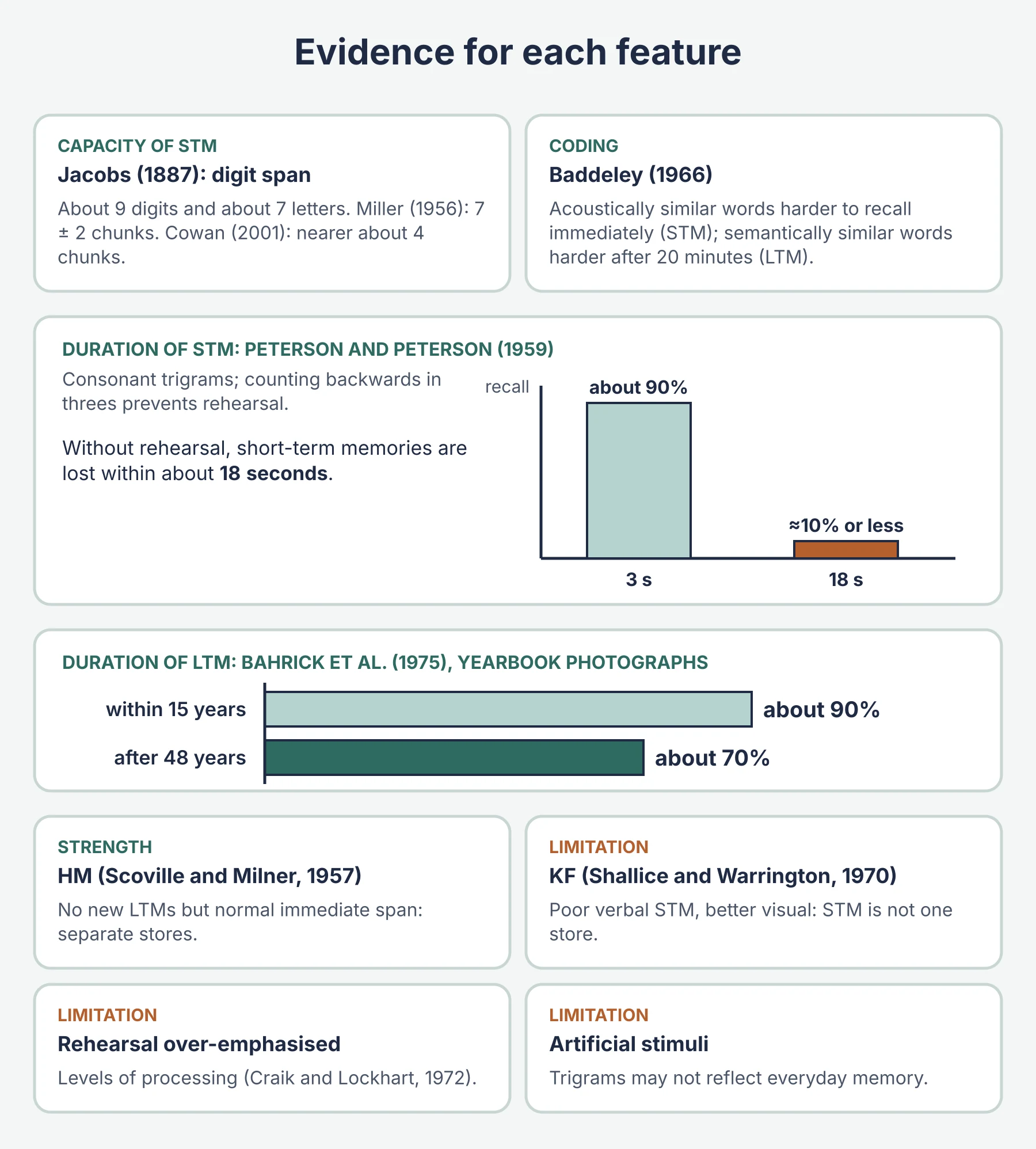
- Capacity of STM: Jacobs (1887) measured digit span and found that participants could repeat back on average about 9 digits and about 7 letters. Miller (1956) argued that STM holds about 7 plus or minus 2 “chunks”, and chunking – grouping items into meaningful units – extends what can be held. Later work by Cowan (2001) suggested the limit may be closer to about four chunks.
- Duration of STM: Peterson and Peterson (1959) gave participants consonant trigrams and then had them count backwards in threes to prevent rehearsal. Recall was about 90% after 3 seconds but fell to around 10% or less after 18 seconds.
- Coding: Baddeley (1966) found that lists of acoustically similar words were harder to recall immediately, suggesting acoustic coding in STM, whereas semantically similar words were harder to recall after 20 minutes, suggesting semantic coding in LTM.
- Duration of LTM: Bahrick et al. (1975) tested people’s memory of school classmates using yearbook photographs: recognition was about 90% accurate within 15 years of leaving school and still about 70% after 48 years.
Evaluation. Case studies support separate stores: after surgery to remove parts of his medial temporal lobes, patient HM (Scoville and Milner, 1957) could not form new long-term memories but had a normal immediate memory span. However, patient KF (Shallice and Warrington, 1970) had poor short-term recall of spoken information but better recall of visual information, suggesting STM is not a single store – a problem the working memory model addresses. The model also over-emphasises rehearsal: people remember many things they never rehearse, which Craik and Lockhart’s (1972) levels of processing approach explains by depth of processing. Much supporting research used artificial stimuli such as trigrams, which may not reflect everyday memory.
The working memory model
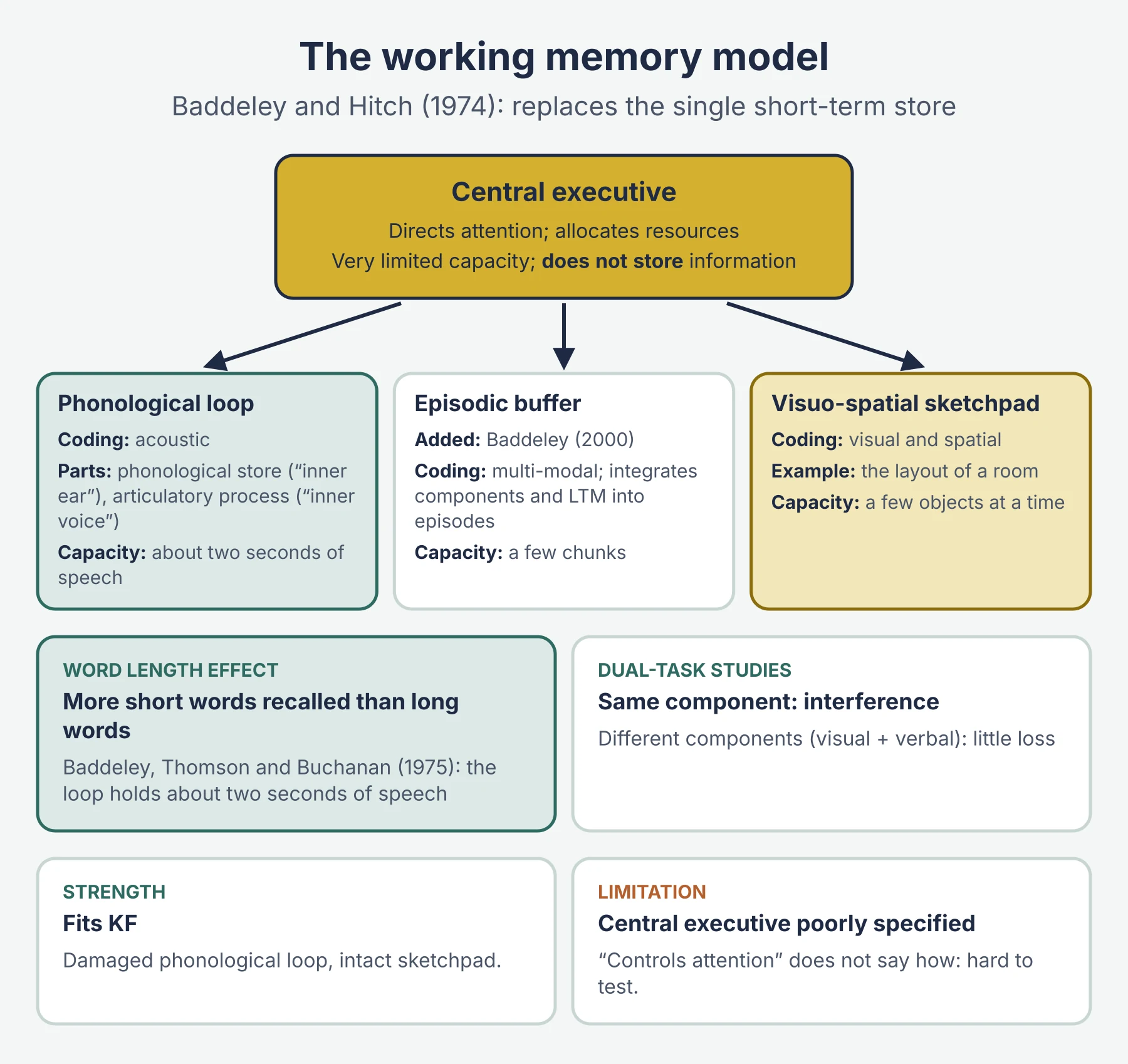
Baddeley and Hitch (1974) replaced the single short-term store with a multi-component system for actively working on information.
- Central executive: directs attention and allocates resources to the other components. It has a very limited capacity and does not store information itself.
- Phonological loop: holds speech-based information. It has a phonological store (“inner ear”) and an articulatory process (“inner voice”) that rehearses words. Its capacity is roughly what can be said in about two seconds: Baddeley, Thomson and Buchanan (1975) found people recall more short words than long words – the word length effect.
- Visuo-spatial sketchpad: holds visual and spatial information, such as the layout of a room. Its capacity is limited to a few objects at a time.
- Episodic buffer: added by Baddeley (2000), it integrates information from the other components and from long-term memory into single episodes. It has a limited capacity of a few chunks.
Coding therefore differs by component: acoustic in the phonological loop, visual and spatial in the sketchpad, and multi-modal in the episodic buffer.
Evaluation. Dual-task studies support separate components: two tasks using the same component (such as two visual tasks) interfere with each other, while tasks using different components (one visual, one verbal) can be done together with little loss. KF’s pattern fits damage to the phonological loop with an intact sketchpad. A limitation is that the central executive is poorly specified: saying it “controls attention” does not explain how, which makes it hard to test.
Types of long-term memory
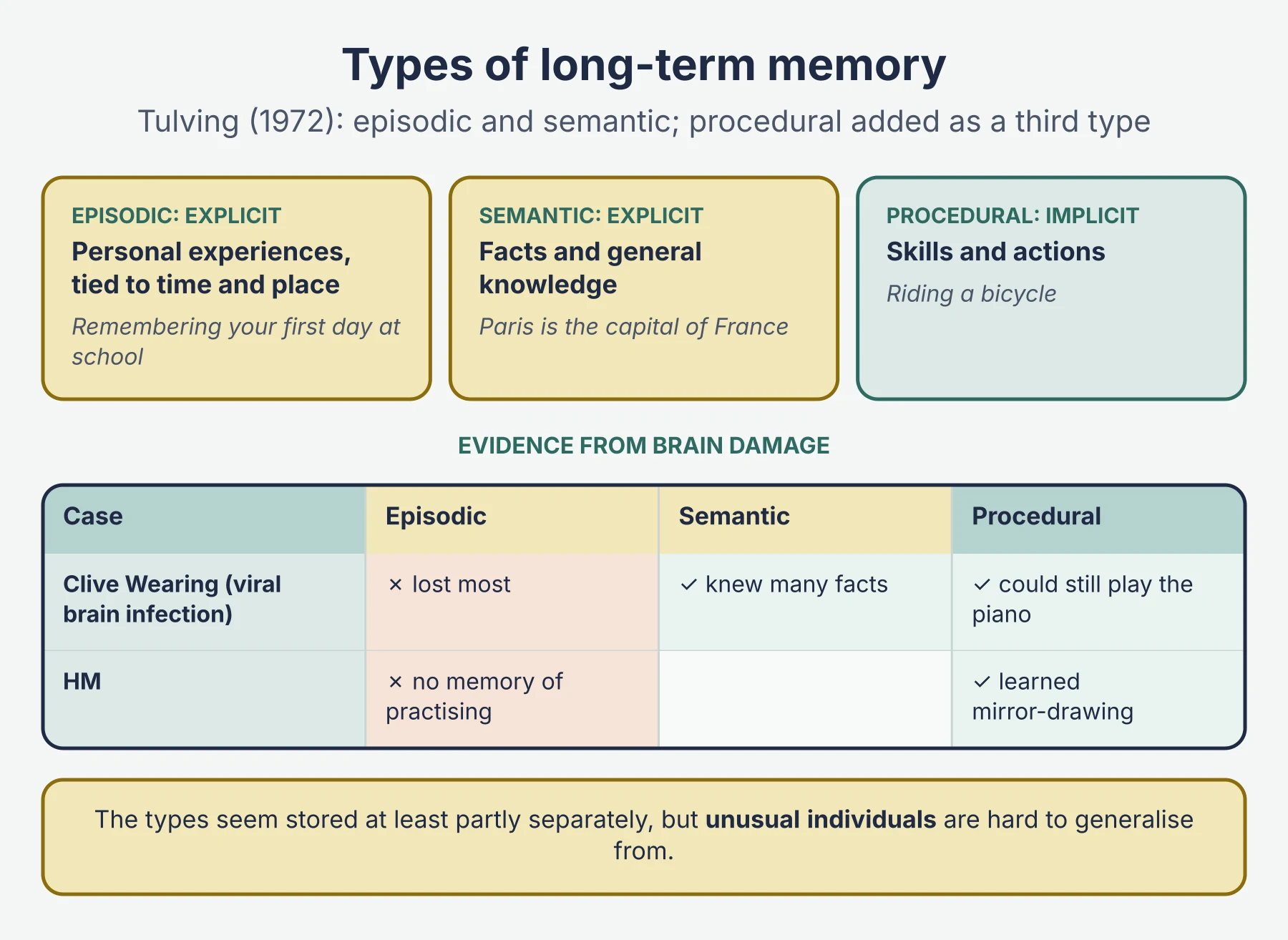
Tulving (1972) distinguished episodic from semantic memory, and procedural memory is added as a third type.
| Type | Content | Conscious recall? | Example |
|---|---|---|---|
| Episodic | Personal experiences, tied to time and place | Yes (explicit) | Remembering your first day at school |
| Semantic | Facts and general knowledge | Yes (explicit) | Knowing that Paris is the capital of France |
| Procedural | Skills and actions | No (implicit) | Riding a bicycle |
Evidence comes from brain damage. Clive Wearing, a musician who developed severe amnesia after a viral brain infection, lost most episodic memories yet could still play the piano (procedural) and knew many facts (semantic). HM could learn a new mirror-drawing skill while having no memory of practising it. These cases suggest the types are stored at least partly separately, although case studies of unusual individuals are hard to generalise.
Eyewitness testimony
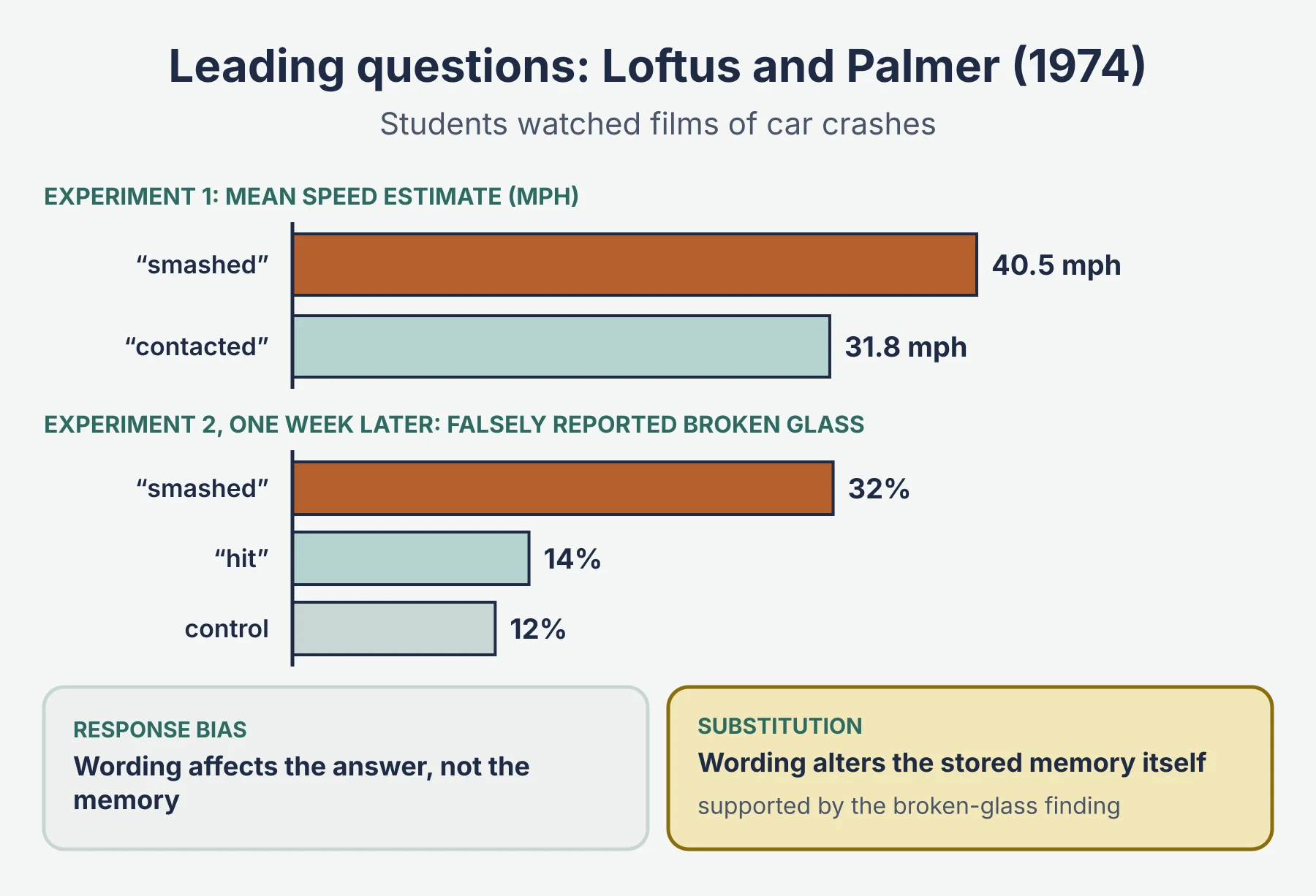
Leading questions. Loftus and Palmer (1974) showed students films of car crashes. When asked “About how fast were the cars going when they smashed into each other?”, estimates averaged 40.5 mph, compared with 31.8 mph when the verb was “contacted”. In a second experiment a week later, 32% of the “smashed” group falsely reported seeing broken glass, compared with 14% of the “hit” group and 12% of the control group. Two explanations compete: response bias (the wording influences the answer but not the memory) and substitution (the wording alters the stored memory itself); the broken-glass finding supports substitution.
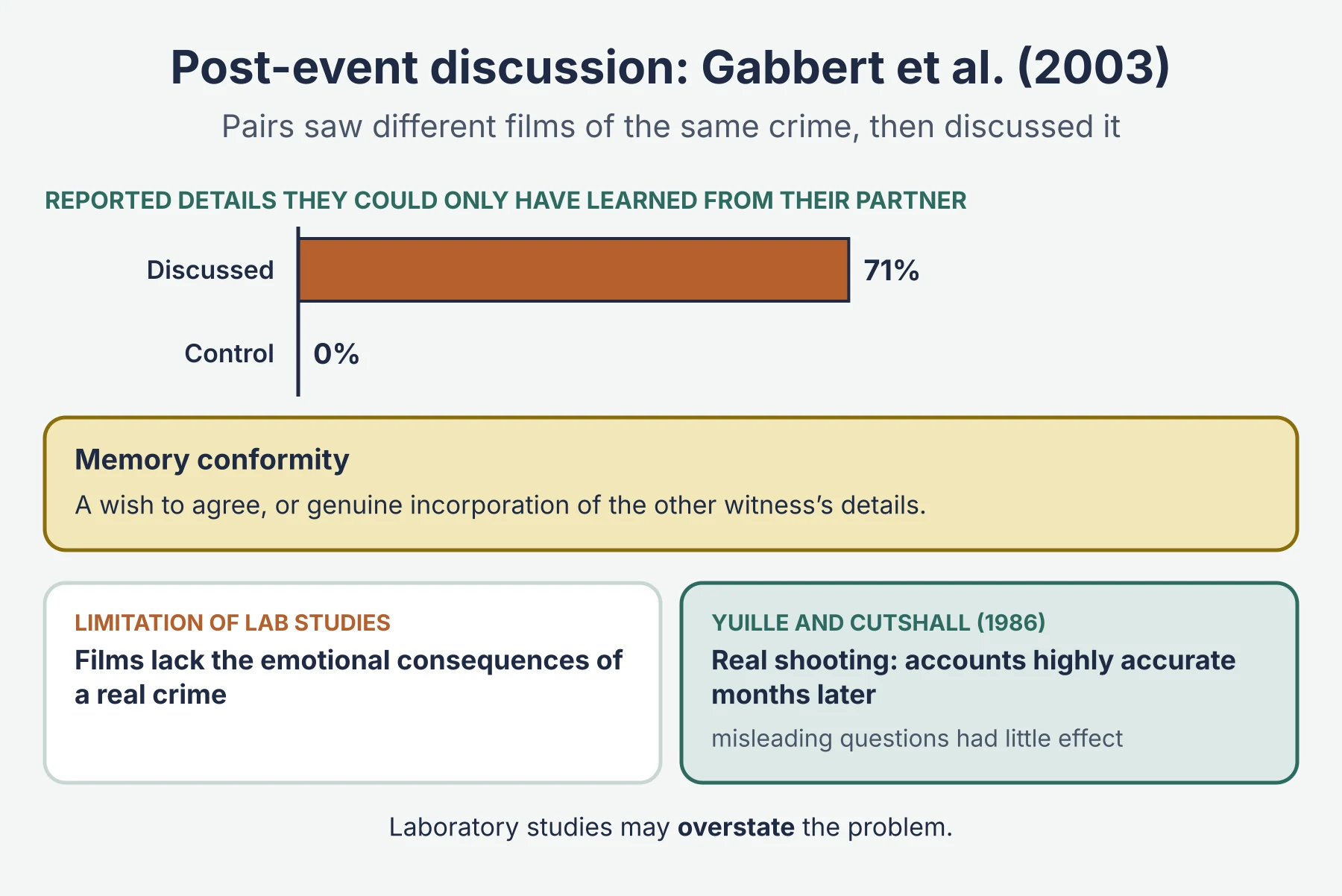
Post-event discussion. Gabbert et al. (2003) showed pairs of participants different films of the same crime, then let them discuss it. 71% of participants who discussed the event later reported details they could only have learned from their partner, compared with 0% in a control group. This memory conformity may reflect a wish to agree, or genuine incorporation of the other witness’s details.
Evaluation. Laboratory films lack the emotional consequences of a real crime. Yuille and Cutshall (1986) interviewed witnesses to a real shooting months later and found their accounts remained highly accurate, and misleading questions had little effect. This suggests laboratory studies may overstate the problem.
The cognitive interview
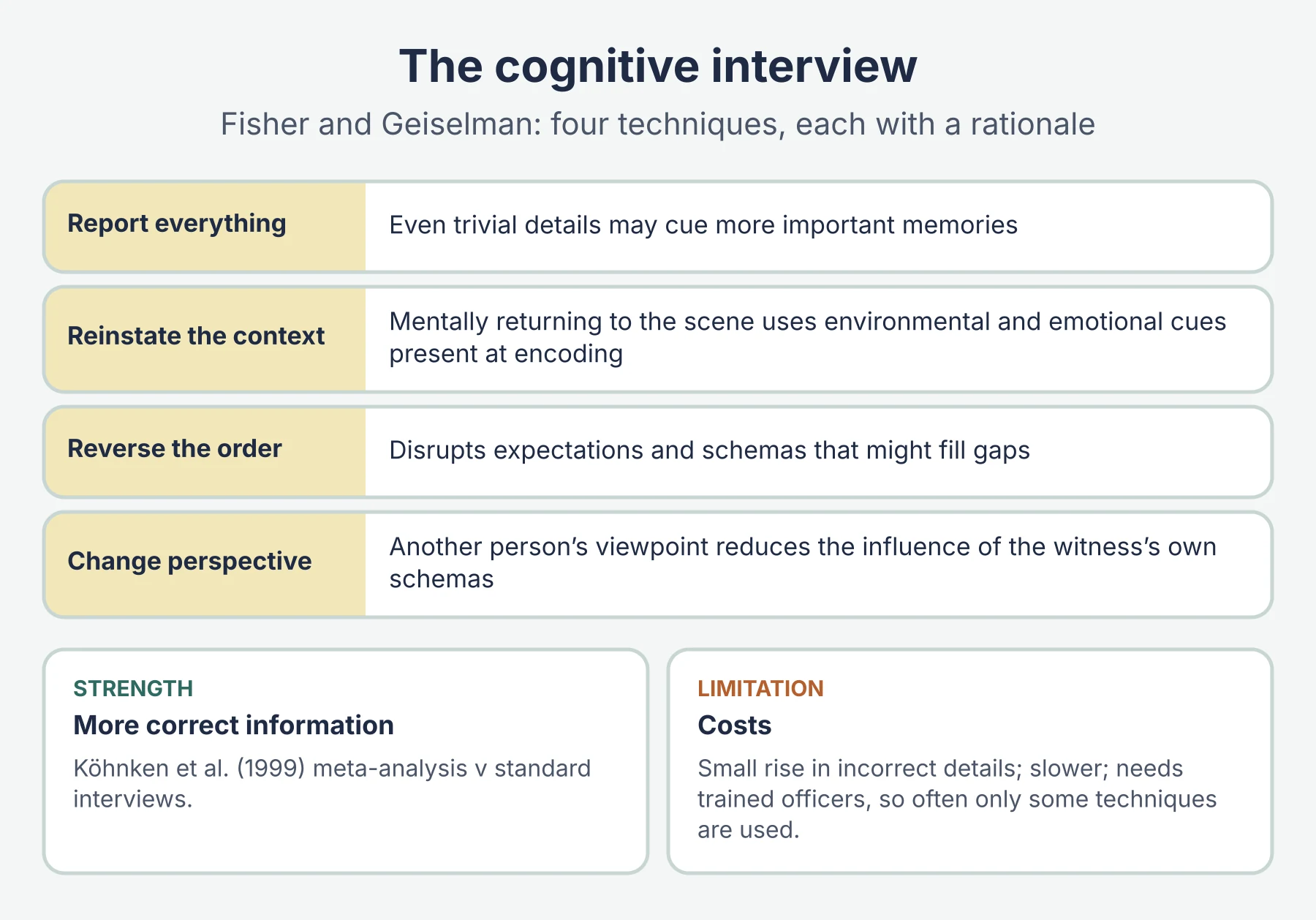
Fisher and Geiselman developed the cognitive interview to improve recall. Its four techniques each have a rationale:
- Report everything – even trivial details may cue more important memories.
- Reinstate the context – mentally returning to the scene uses environmental and emotional cues present at encoding.
- Reverse the order – recalling events in a different order disrupts expectations and schemas that might fill gaps.
- Change perspective – recalling from another person’s viewpoint reduces the influence of the witness’s own schemas.
Evaluation. A meta-analysis by Köhnken et al. (1999) found that the cognitive interview produced more correct information than standard interviews, but also a small increase in incorrect details. It takes more time than a standard police interview and needs trained officers, so in practice forces often use only some of the techniques.
Worked example: an application answer
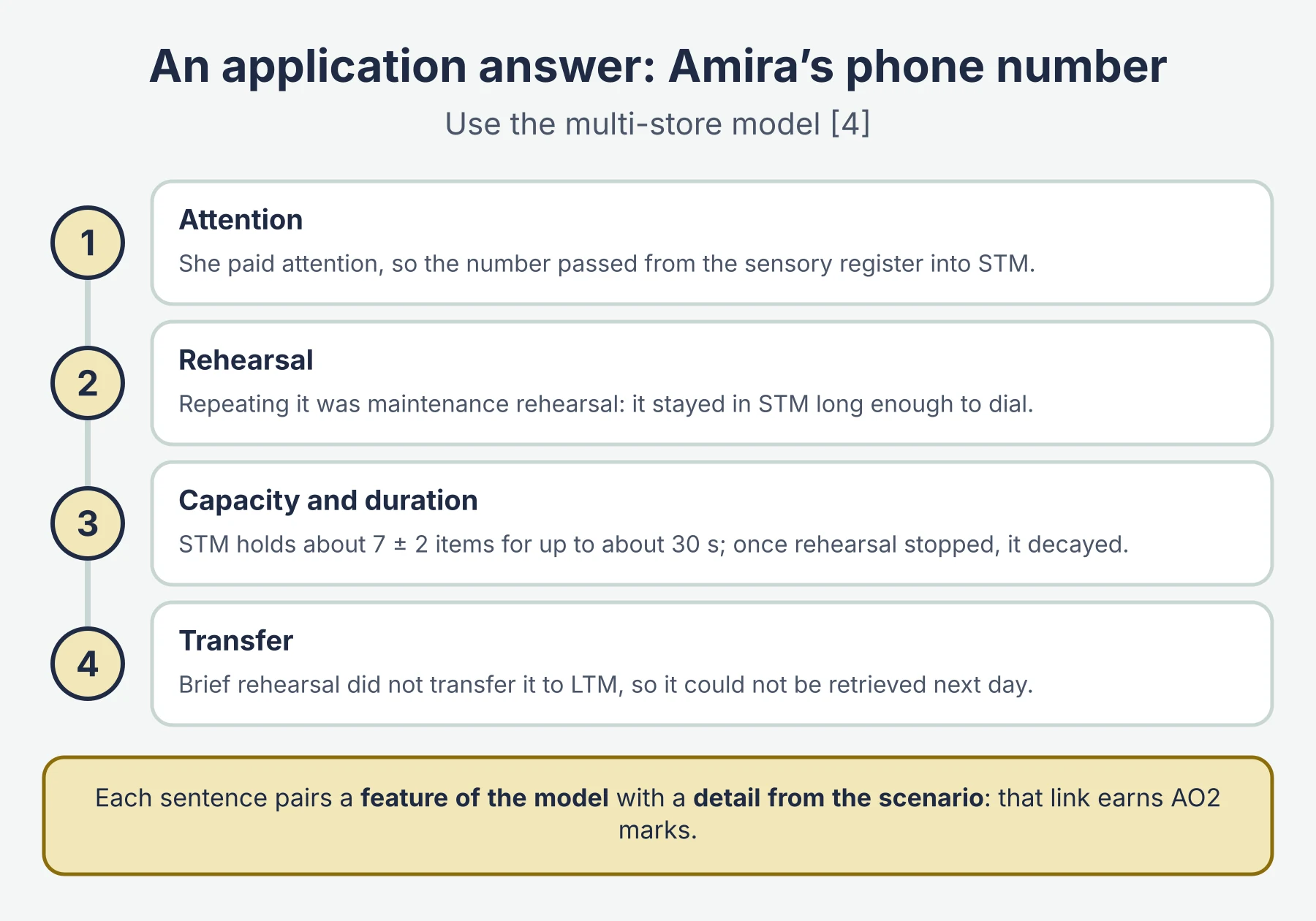
Scenario: Amira hears a new phone number, repeats it to herself and dials it a few seconds later. Next day she cannot remember it. Use the multi-store model to explain this. [4]
The number entered Amira’s sensory register and, because she paid attention, passed into short-term memory (attention). Repeating it was maintenance rehearsal, which kept it in STM long enough to dial (rehearsal, linked to the scenario). STM holds about 7 plus or minus 2 items for up to about 30 seconds, so once she stopped rehearsing, the number decayed (duration, capacity). Because rehearsal was brief, it was not transferred to long-term memory, so it could not be retrieved the next day (transfer).
Each sentence pairs a feature of the model with a detail from the scenario – that link is what application (AO2) marks reward.
Exam technique
- Outline / describe: accurate features with detail (names, numbers, components).
- Explain: show how or why, for example why acoustically similar words are confused in STM.
- Apply: link every point to the scenario’s wording.
- Evaluate / discuss: strengths and limitations supported by named evidence, with a conclusion.
Common mistakes
- Confusing capacity (how much) with duration (how long).
- Saying the working memory model replaces long-term memory; it replaces only STM.
- Describing the central executive as a store.
- Reporting Loftus and Palmer’s findings without the verbs or figures.
- Listing cognitive interview techniques without saying why each works.
More resources on this topic
- Memory revision notes
- Memory practice questions
- Introductory topics study guide
- Research methods 1 study guide
Official syllabus
OxfordAQA International AS and A-level Psychology (9685) specification, Version 3.1, section 3.1.1 Memory, assessed in Unit 1: Introductory topics in psychology, Section A.
Related resources
-
Practice questions
OxfordAQA International A-level Psychology (9685): 3.1.1 Memory – Practice Questions
Twelve original OxfordAQA 9685 memory questions: store features, dual-task and recall data, eyewitness scenarios and extended evaluations, with answers.
Psychology · OxfordAQA · AS Level
Try questions -
Revision notes
OxfordAQA International A-level Psychology (9685): 3.1.1 Memory – Revision Notes
Condensed OxfordAQA 9685 memory notes: store features, working memory components, long-term memory types, eyewitness studies, exam traps and a self-test.
Psychology · OxfordAQA · AS Level
Revise topic -
Study guides
OxfordAQA International A-level Psychology (9685): 3.1.3 Psychopathology
Study guide to OxfordAQA 9685 section 3.1.3 Psychopathology: definitions of abnormality, phobias, depression, behavioural and cognitive treatments.
Psychology · OxfordAQA · AS Level
Read guide
Studying Psychology?
This page is free and stays free. Marlbridge is not offering Psychology classes at the moment, so there is no tuition to book for it. The free study resources stay open to everyone.
Get free revision emails (optional)
Occasional emails with practice questions, worked explanations and links to free resources for the qualification and subjects you choose. No spam, and you can unsubscribe from any email. The free tools on this site never need an email.