
Study Guides
OxfordAQA International A-level Psychology (9685): 3.1.3 Psychopathology
Study guide to OxfordAQA 9685 section 3.1.3 Psychopathology: definitions of abnormality, phobias, depression, behavioural and cognitive treatments.
- Subject
- Psychology
- Level
- AS LEVEL
- Topic
- Unit 1 – Introductory Topics in Psychology
- Author
- Marlbridge Academic Team
- Updated
- Reviewed by
- Kanwal Aslam (what this means)
Aligned to OxfordAQA A Level Psychology (9685), Version 3.1. Official specification .
Syllabus page (what it covers and how it is assessed): OxfordAQA A Level Psychology.
Syllabus points this page covers
9685 (AS Level)
- 3.1.3 Psychopathology
This guide covers 3.1.3 Psychopathology of the OxfordAQA International AS and A-level Psychology (9685) specification, Version 3.1. It is Section C of the Unit 1 exam: 30 marks of compulsory questions in a 1 hour 30 minute, 90-mark paper. The specification lists four areas: definitions of abnormality (deviation from social norms, failure to function adequately, statistical infrequency and deviation from ideal mental health); the defining characteristics of phobias and depression; the behavioural explanation and treatment of phobias (the two-process model, systematic desensitisation and flooding); and the cognitive explanation and treatment of depression (Beck’s negative triad, Ellis’s ABC model and cognitive behaviour therapy).
The introductory topics study guide gives an overview. This guide develops each definition with an example and limitation, sets out the characteristics in the three categories examiners expect, and evaluates every explanation and therapy. Condense it with the psychopathology revision notes and test yourself with the psychopathology practice questions.
Definitions of abnormality
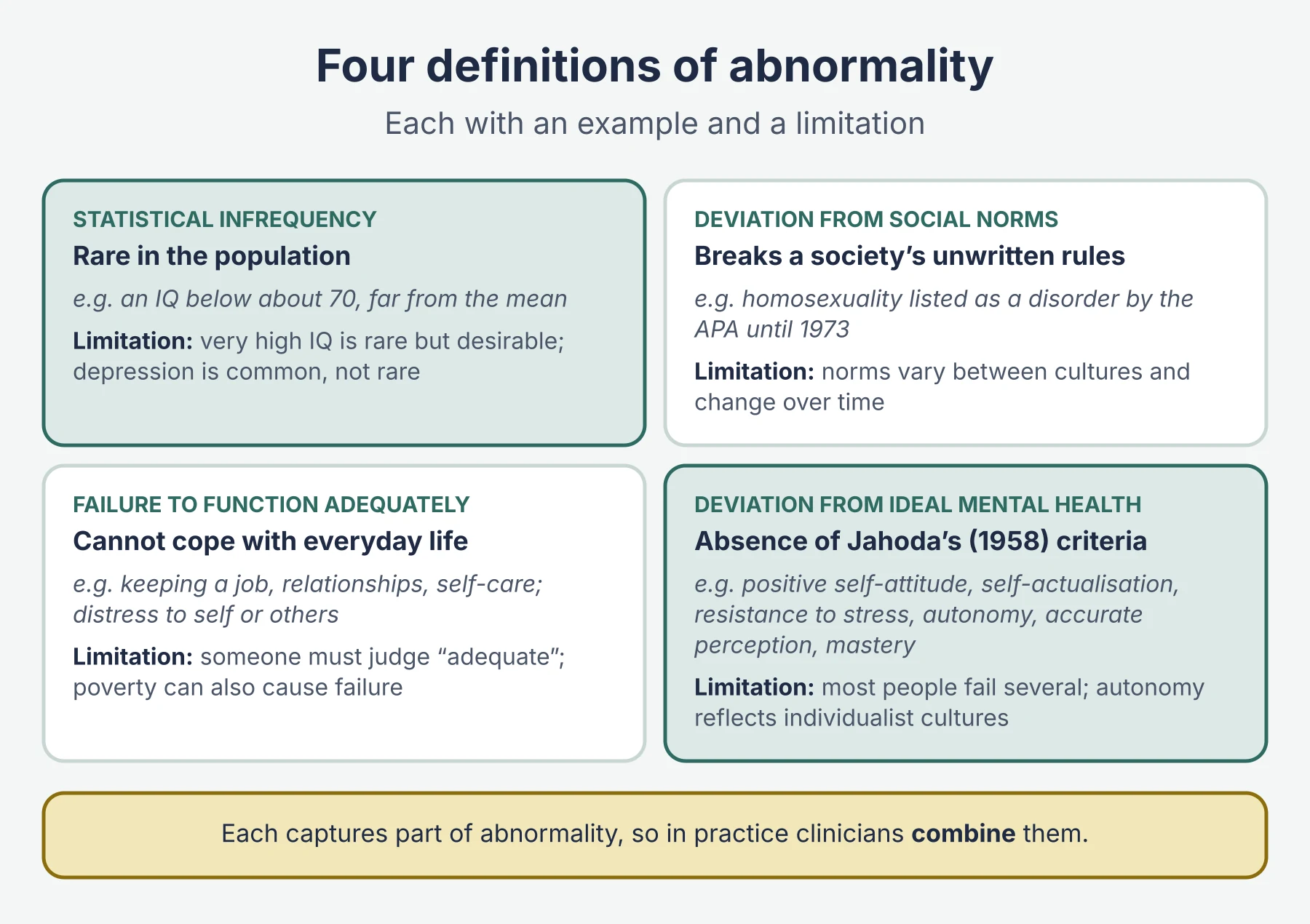
Statistical infrequency. Behaviour is abnormal if it is rare in the population. Many characteristics, such as IQ, are normally distributed, so scores far from the mean – for example an IQ below about 70 – are statistically unusual. Limitation: some rare characteristics are desirable, such as very high IQ, and some common conditions, such as depression, are not rare at all, so rarity alone cannot define abnormality.
Deviation from social norms. Behaviour is abnormal if it breaks the unwritten rules a society expects people to follow. Limitation: norms vary between cultures and change over time. Homosexuality was listed as a mental disorder by the American Psychiatric Association until 1973, which shows how the definition can be used to label behaviour that is simply disapproved of.
Failure to function adequately. A person is abnormal if they cannot cope with everyday life – keeping a job, maintaining relationships, looking after themselves – or if their behaviour causes distress to themselves or others. Limitation: someone must judge what counts as adequate functioning, and some people with serious disorders function well, while others fail to function for reasons such as poverty.
Deviation from ideal mental health. Jahoda (1958) proposed criteria for ideal mental health, including a positive attitude to the self, self-actualisation, resistance to stress, autonomy, an accurate perception of reality and mastery of the environment. Abnormality is the absence of these. Limitation: the criteria are so demanding that most people would fail several, and ideas such as autonomy reflect individualist cultures.
Each definition captures part of abnormality, so in practice clinicians combine them.
Defining characteristics
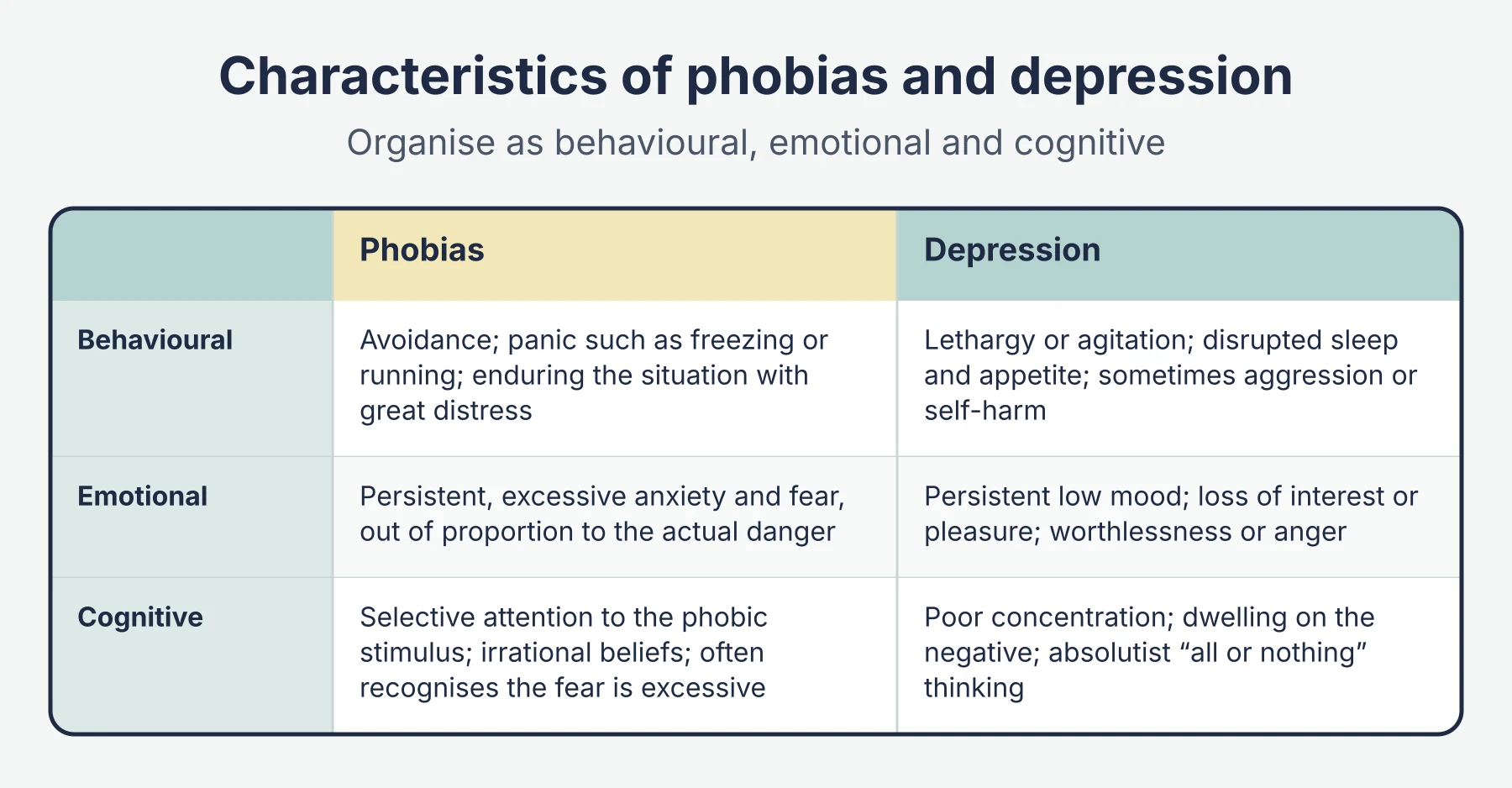
Organise characteristics as behavioural, emotional and cognitive – this structure earns full marks on “outline the characteristics” questions.
| Phobias | Depression | |
|---|---|---|
| Behavioural | Avoidance of the feared object or situation; panic, such as freezing or running; enduring the situation with great distress | Changed activity levels (lethargy or agitation); disrupted sleep and appetite; sometimes aggression or self-harm |
| Emotional | Persistent, excessive anxiety and fear; response out of proportion to the actual danger | Persistent low mood; loss of interest or pleasure; feelings of worthlessness or anger |
| Cognitive | Selective attention to the phobic stimulus; irrational beliefs about it; often recognises the fear is excessive | Poor concentration; dwelling on the negative; absolutist “all or nothing” thinking |
The two-process model of phobias
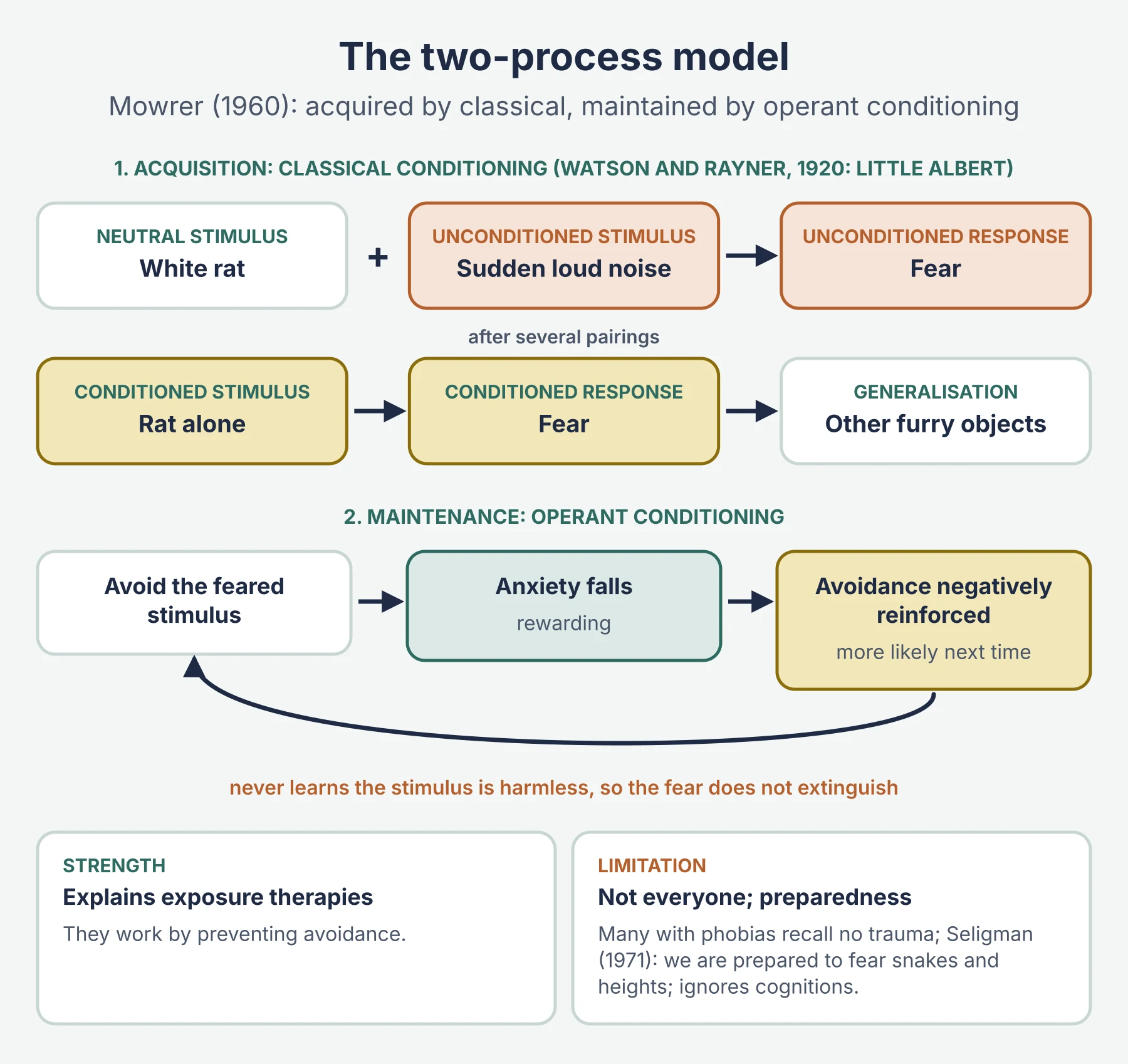
Mowrer (1960) proposed that phobias are acquired by classical conditioning and maintained by operant conditioning.
Acquisition. A neutral stimulus is paired with an unconditioned stimulus that naturally causes fear. Watson and Rayner (1920) paired a white rat with a sudden loud noise in an infant known as Little Albert; after several pairings, the rat alone produced fear, which then generalised to other furry objects.
Maintenance. Avoiding the conditioned stimulus reduces anxiety. Because the reduction is rewarding, avoidance is negatively reinforced and becomes more likely. Avoidance also prevents the person from learning that the stimulus is harmless, so the fear does not extinguish.
Evaluation. The model explains why exposure therapies work: they prevent avoidance. However, many people who have frightening experiences do not develop phobias, and many people with phobias recall no traumatic event. Seligman (1971) proposed biological preparedness: humans are predisposed to fear stimuli that threatened our ancestors, such as snakes and heights, which explains why these phobias are far more common than phobias of modern dangers such as cars. The model also ignores the cognitive characteristics, such as irrational beliefs.
Behavioural treatments
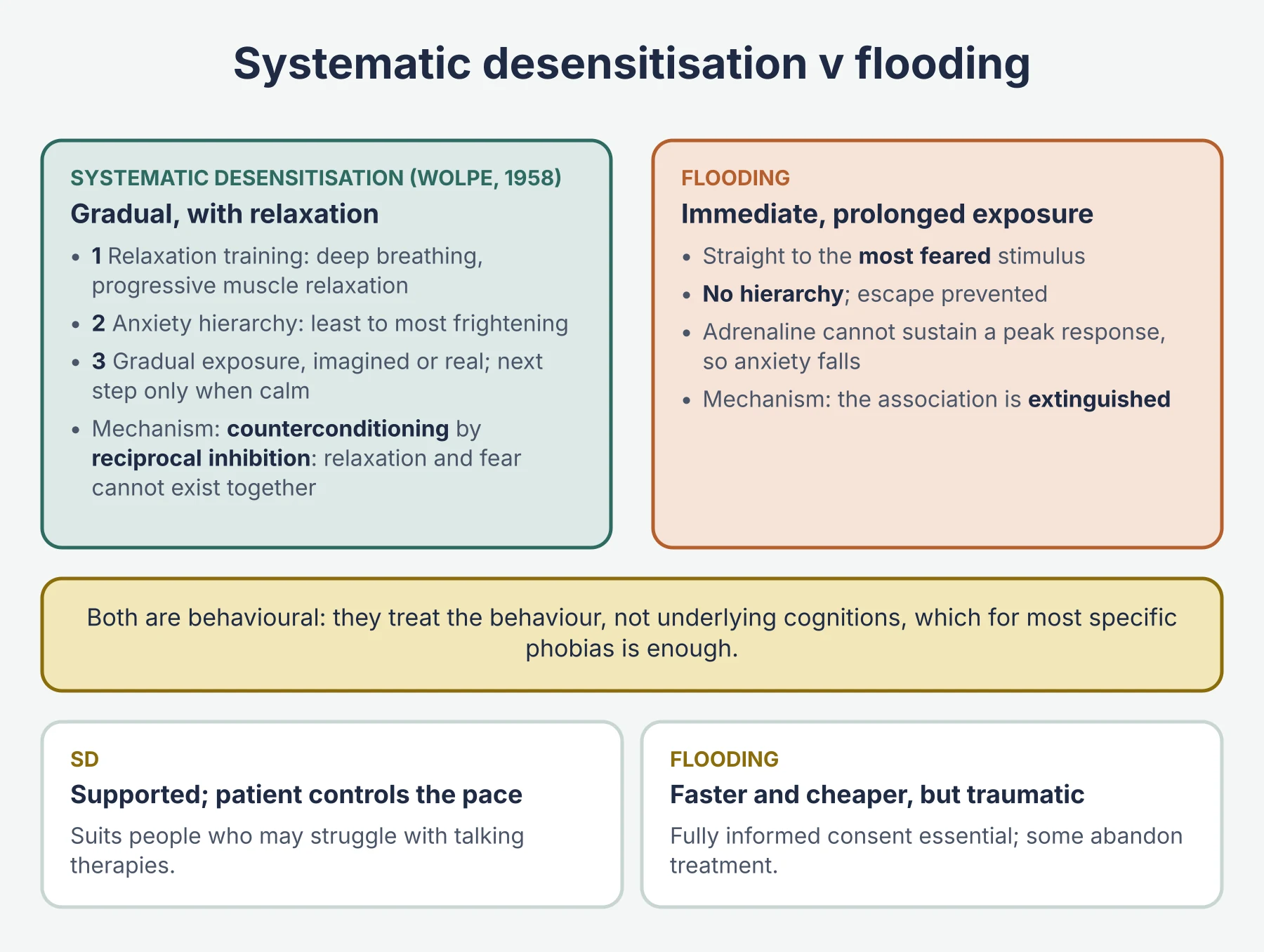
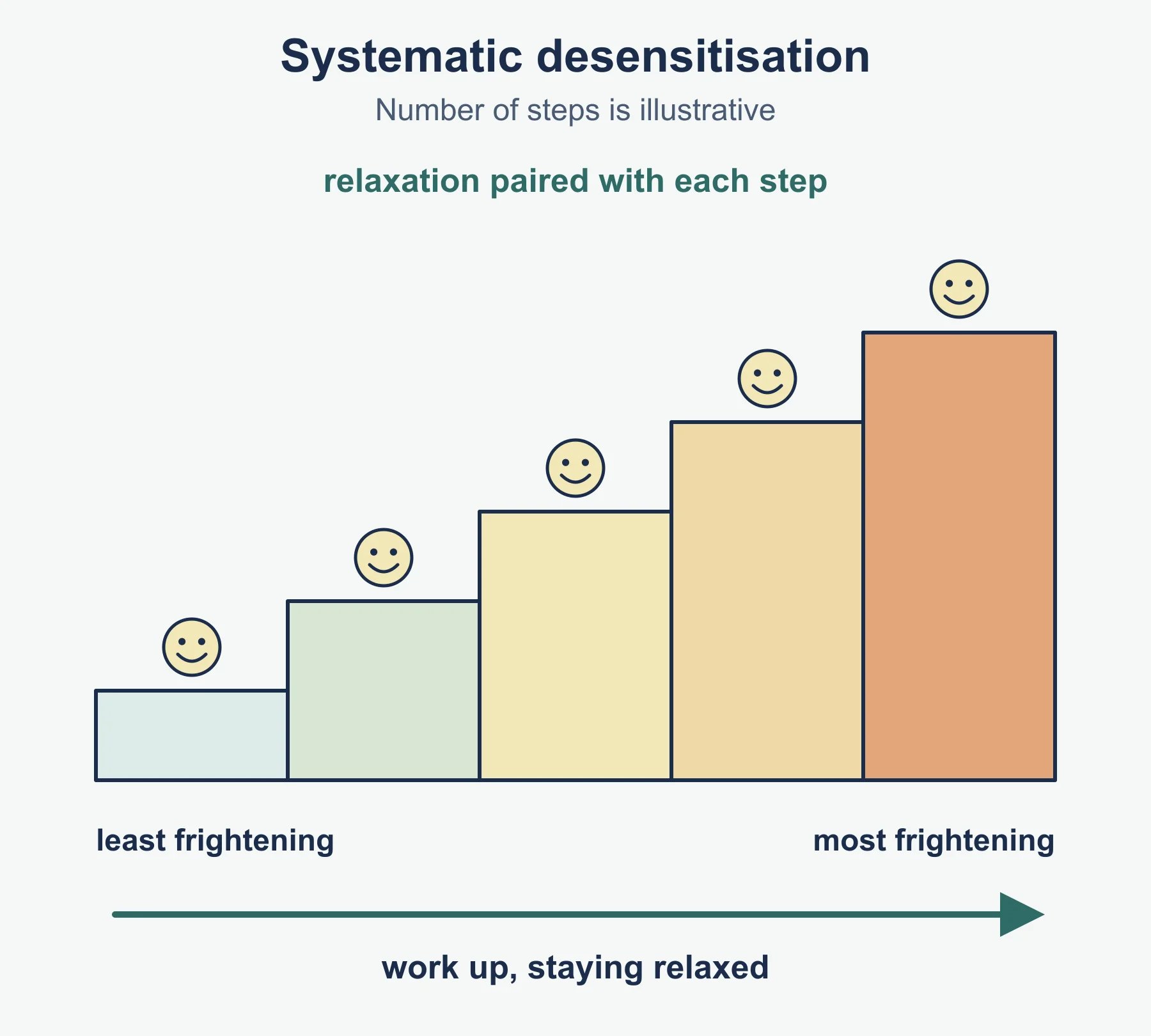
Systematic desensitisation (SD), developed by Wolpe (1958), uses counterconditioning: a new response of relaxation replaces fear, because the two cannot exist together (reciprocal inhibition).
- Relaxation training: the patient learns techniques such as deep breathing or progressive muscle relaxation.
- Anxiety hierarchy: patient and therapist list feared situations from least to most frightening.
- Gradual exposure: the patient works up the hierarchy while relaxed, moving to the next step only when calm at the current one. Exposure may be imagined or real.
Flooding exposes the patient immediately to the most feared stimulus, without a hierarchy, for a prolonged session. Because escape is prevented, the patient learns the stimulus is harmless; adrenaline cannot sustain a peak response indefinitely, so anxiety falls and the association is extinguished.
Evaluation. Research generally supports SD for specific phobias, and it is suitable for patients who might struggle with talking therapies, such as some people with learning difficulties. The patient keeps control over the pace, which makes it more acceptable. Flooding can work faster and more cheaply, but it is highly traumatic, so fully informed consent is essential and some patients abandon treatment. Both treat the behaviour, not any underlying cognitions, although for most specific phobias this is enough.
The cognitive explanation of depression
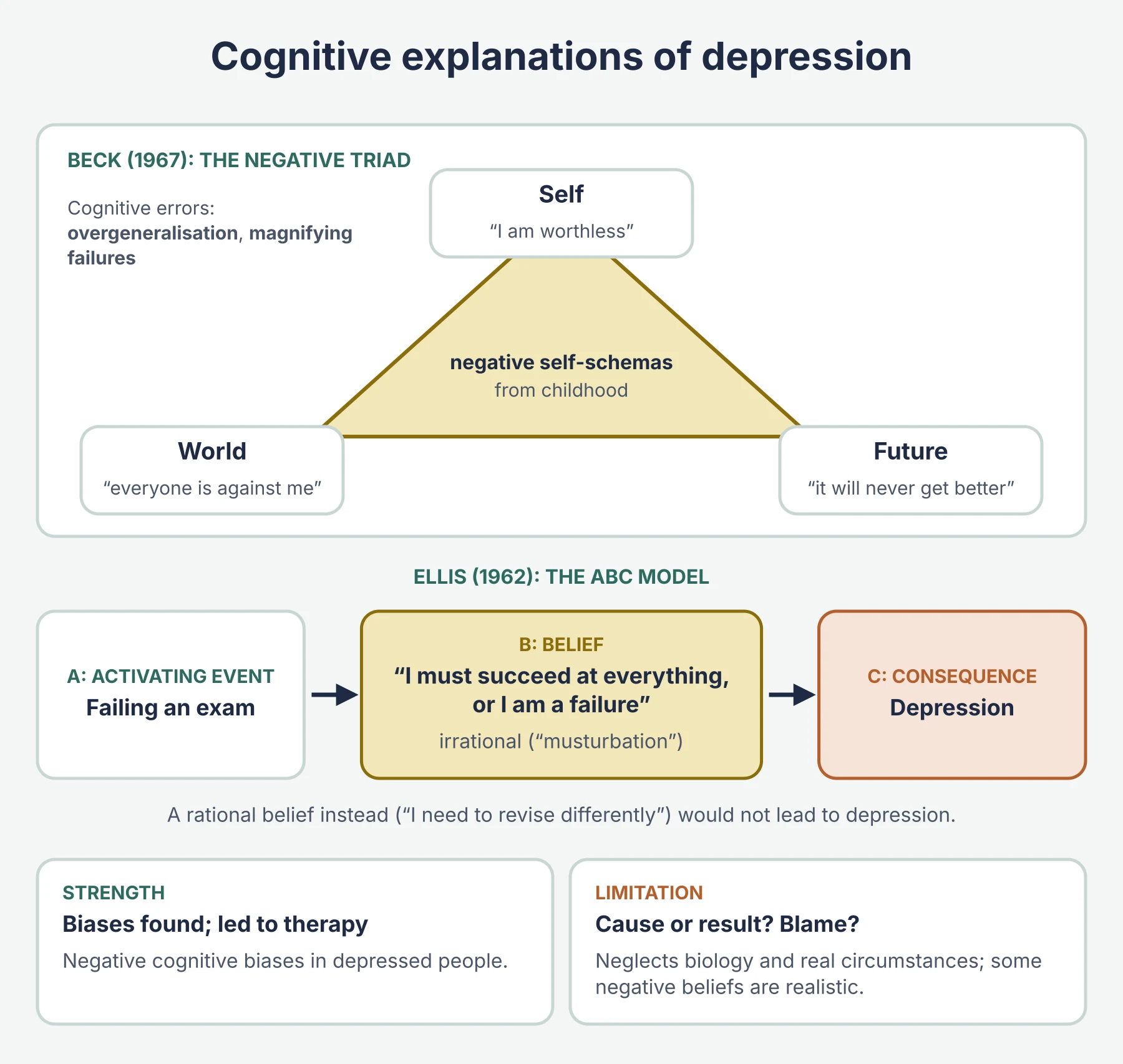
Beck’s negative triad. Beck (1967) argued that depressed people have negative self-schemas formed in childhood and process information in a biased way, through cognitive errors such as overgeneralisation and magnifying failures. This produces negative automatic thoughts about three things: the self (“I am worthless”), the world (“everyone is against me”) and the future (“it will never get better”).
Ellis’s ABC model. Ellis (1962) argued that depression comes from irrational beliefs rather than events themselves. An Activating event (failing an exam) leads to a Belief about it, rational (“I need to revise differently”) or irrational (“I must succeed at everything, or I am a failure”), which produces the Consequence (depression). Ellis called absolute demands such as “I must” musturbation.
Evaluation. Research has found negative cognitive biases in depressed people, and the explanation has led directly to effective therapy. However, it is unclear whether negative thinking causes depression or results from it. The explanation can seem to blame patients for their thinking and neglects biological factors and difficult life circumstances: some negative beliefs are realistic. It also explains low mood better than some other features of severe depression.
Cognitive behaviour therapy
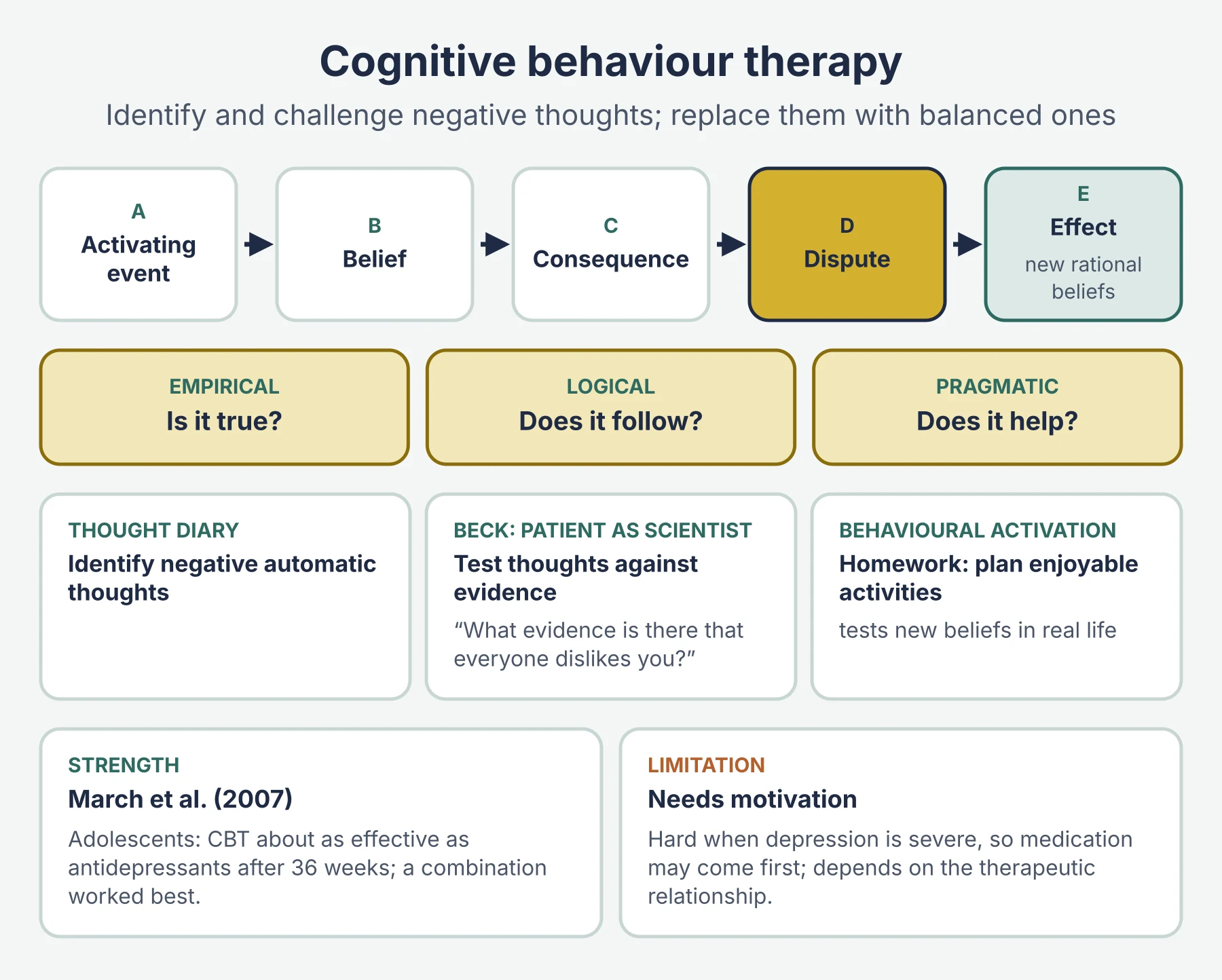
CBT aims to identify and challenge irrational or negative thoughts and replace them with more balanced ones.
- The patient and therapist identify negative automatic thoughts, often using a thought diary.
- In Beck’s approach, the patient acts as a scientist, testing thoughts against evidence (“What evidence is there that everyone dislikes you?”).
- In Ellis’s approach (rational emotive behaviour therapy), the ABC is extended to D for disputing irrational beliefs – empirical (is it true?), logical (does it follow?) and pragmatic (does it help?) – and E for the effect of new, rational beliefs.
- Behavioural activation and homework, such as planning enjoyable activities, test new beliefs in real life.
Evaluation. March et al. (2007) found that, for adolescents with depression, CBT was about as effective as antidepressant medication after 36 weeks, and a combination worked best. CBT gives patients skills to manage future difficulties. However, it requires motivation and effort, which may be difficult when depression is severe, so medication may be needed first. Success also depends on the quality of the therapeutic relationship.
Worked example: an application answer
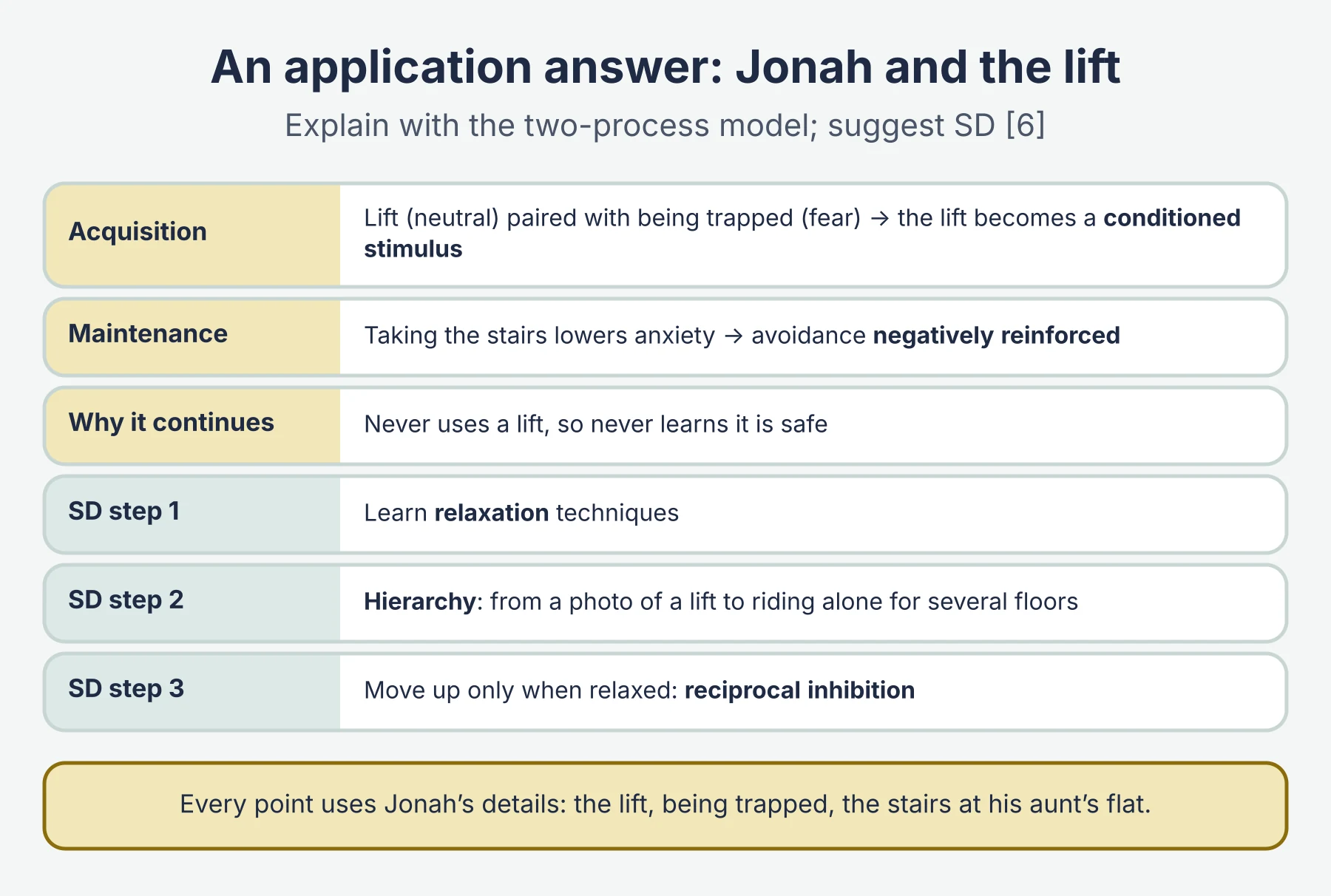
Scenario: Jonah, aged 15, has avoided lifts since being trapped in one for an hour. He climbs eight flights of stairs at his aunt’s flat rather than use the lift. Use the two-process model to explain Jonah’s phobia and suggest how systematic desensitisation could treat it. [6]
The lift was a neutral stimulus paired with being trapped, which caused fear, so through classical conditioning the lift became a conditioned stimulus for anxiety (acquisition, linked). Each time Jonah takes the stairs, his anxiety falls, which negatively reinforces avoidance through operant conditioning (maintenance). Because he never uses a lift, he never learns it is safe, so the fear persists (why it continues). In SD, Jonah would first learn relaxation techniques (step 1). He and the therapist would build a hierarchy, from looking at a photo of a lift to riding it alone for several floors (step 2, applied). He would move up only when relaxed at each stage, so relaxation replaces fear through reciprocal inhibition (step 3 and mechanism).
Common mistakes
- Stating a definition without an example or limitation.
- Mixing characteristics of phobias with those of depression.
- Saying classical conditioning maintains the phobia; operant conditioning does.
- Describing flooding as rapid systematic desensitisation without saying that there is no hierarchy.
- Confusing Beck’s triad (self, world, future) with Ellis’s ABC.
- Evaluating CBT without evidence.
More resources on this topic
- Psychopathology revision notes
- Psychopathology practice questions
- Introductory topics study guide
- Schizophrenia study guide
Official syllabus
OxfordAQA International AS and A-level Psychology (9685) specification, Version 3.1, section 3.1.3 Psychopathology, assessed in Unit 1: Introductory topics in psychology, Section C.
Related resources
-
Practice questions
OxfordAQA International A-level Psychology (9685): 3.1.3 Psychopathology – Practice Questions
Twelve original OxfordAQA 9685 psychopathology questions: definitions, treatment data, phobia and depression scenarios and extended evaluations, with answers.
Psychology · OxfordAQA · AS Level
Try questions -
Revision notes
OxfordAQA International A-level Psychology (9685): 3.1.3 Psychopathology – Revision Notes
Condensed OxfordAQA 9685 psychopathology notes: four definitions, phobia and depression characteristics, two-process model, SD, flooding, CBT and a self-test.
Psychology · OxfordAQA · AS Level
Revise topic -
Study guides
OxfordAQA International A-level Psychology (9685): 3.1.2 Social Psychology
Study guide to OxfordAQA 9685 section 3.1.2 Social psychology: conformity, Asch's variables, obedience, Milgram's variations, resistance and model answers.
Psychology · OxfordAQA · AS Level
Read guide
Studying Psychology?
This page is free and stays free. Marlbridge is not offering Psychology classes at the moment, so there is no tuition to book for it. The free study resources stay open to everyone.
Get free revision emails (optional)
Occasional emails with practice questions, worked explanations and links to free resources for the qualification and subjects you choose. No spam, and you can unsubscribe from any email. The free tools on this site never need an email.