
Revision Notes
OxfordAQA International A-level Psychology (9685): 3.1.3 Psychopathology – Revision Notes
Condensed OxfordAQA 9685 psychopathology notes: four definitions, phobia and depression characteristics, two-process model, SD, flooding, CBT and a self-test.
- Subject
- Psychology
- Level
- AS LEVEL
- Topic
- Unit 1 – Introductory Topics in Psychology
- Author
- Marlbridge Academic Team
- Updated
- Reviewed by
- Kanwal Aslam (what this means)
Aligned to OxfordAQA A Level Psychology (9685), Version 3.1. Official specification .
Syllabus page (what it covers and how it is assessed): OxfordAQA A Level Psychology.
Syllabus points this page covers
9685 (AS Level)
- 3.1.3 Psychopathology
Condensed recall for 3.1.3 Psychopathology (OxfordAQA International AS and A-level Psychology 9685, Unit 1, Section C). For explanations, evaluation and a worked answer, read the psychopathology study guide; then try the psychopathology practice questions.
What the specification lists
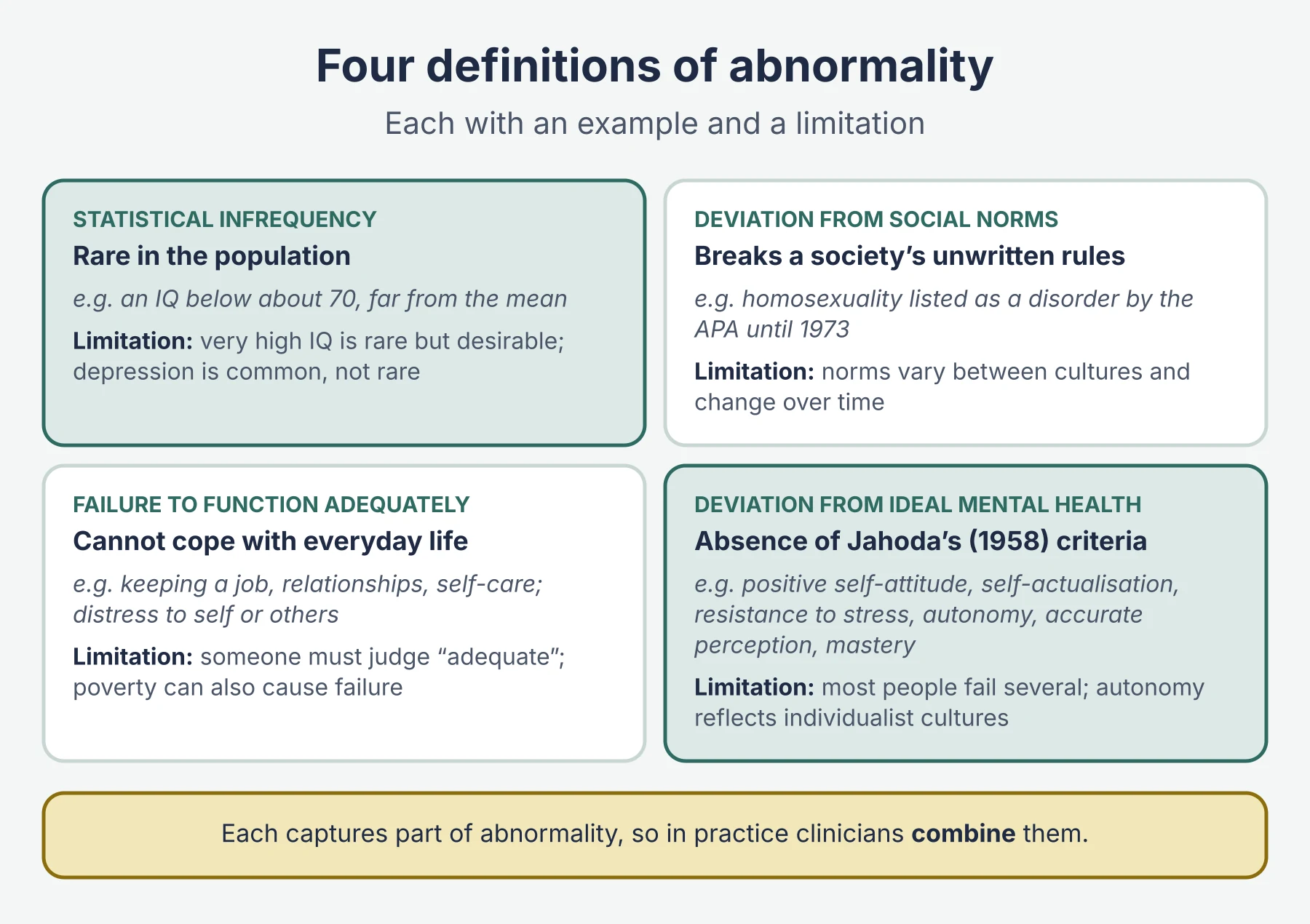
- Definitions of abnormality: deviation from social norms, failure to function adequately, statistical infrequency, deviation from ideal mental health.
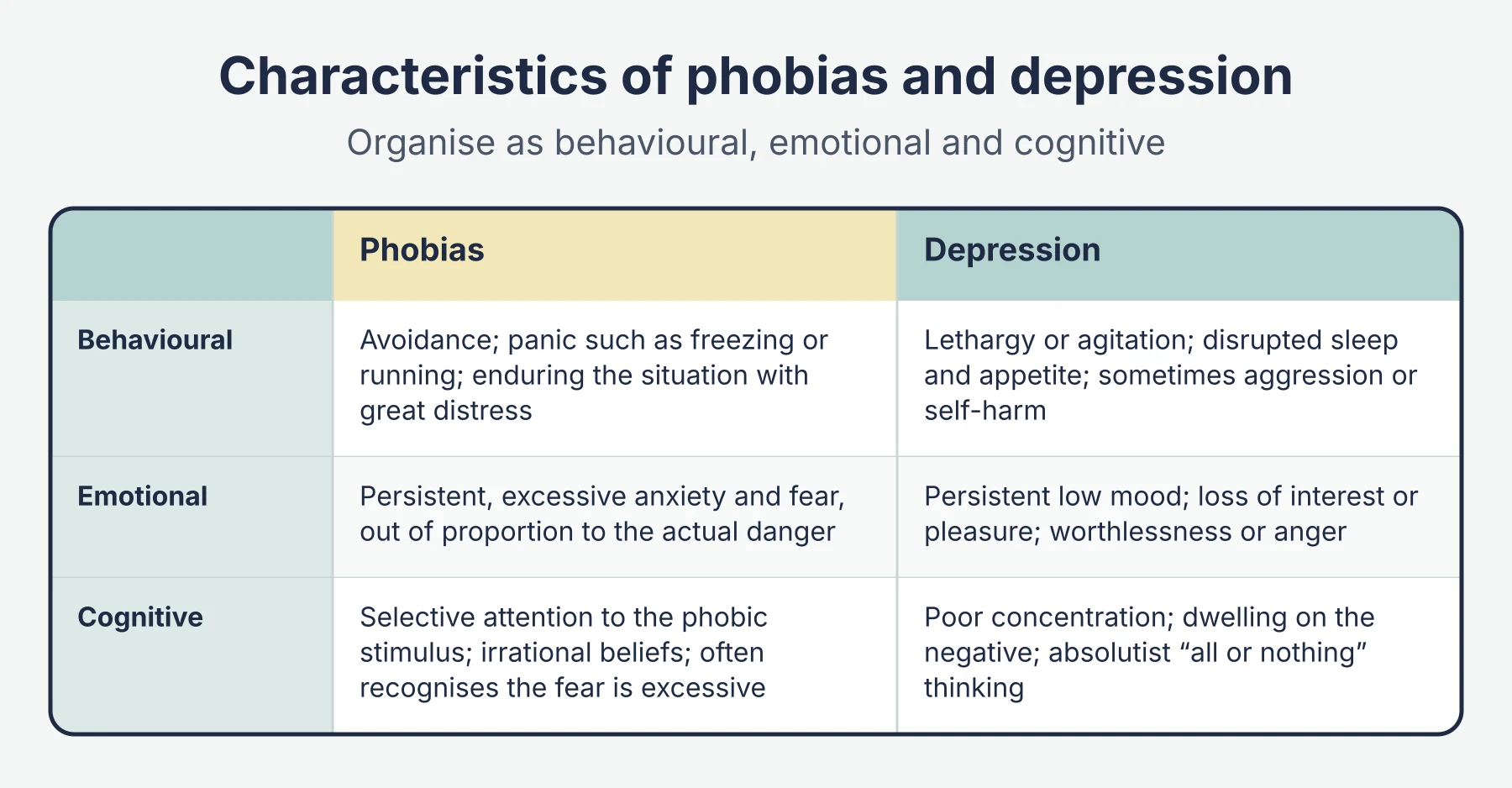
- The defining characteristics of phobias and depression.
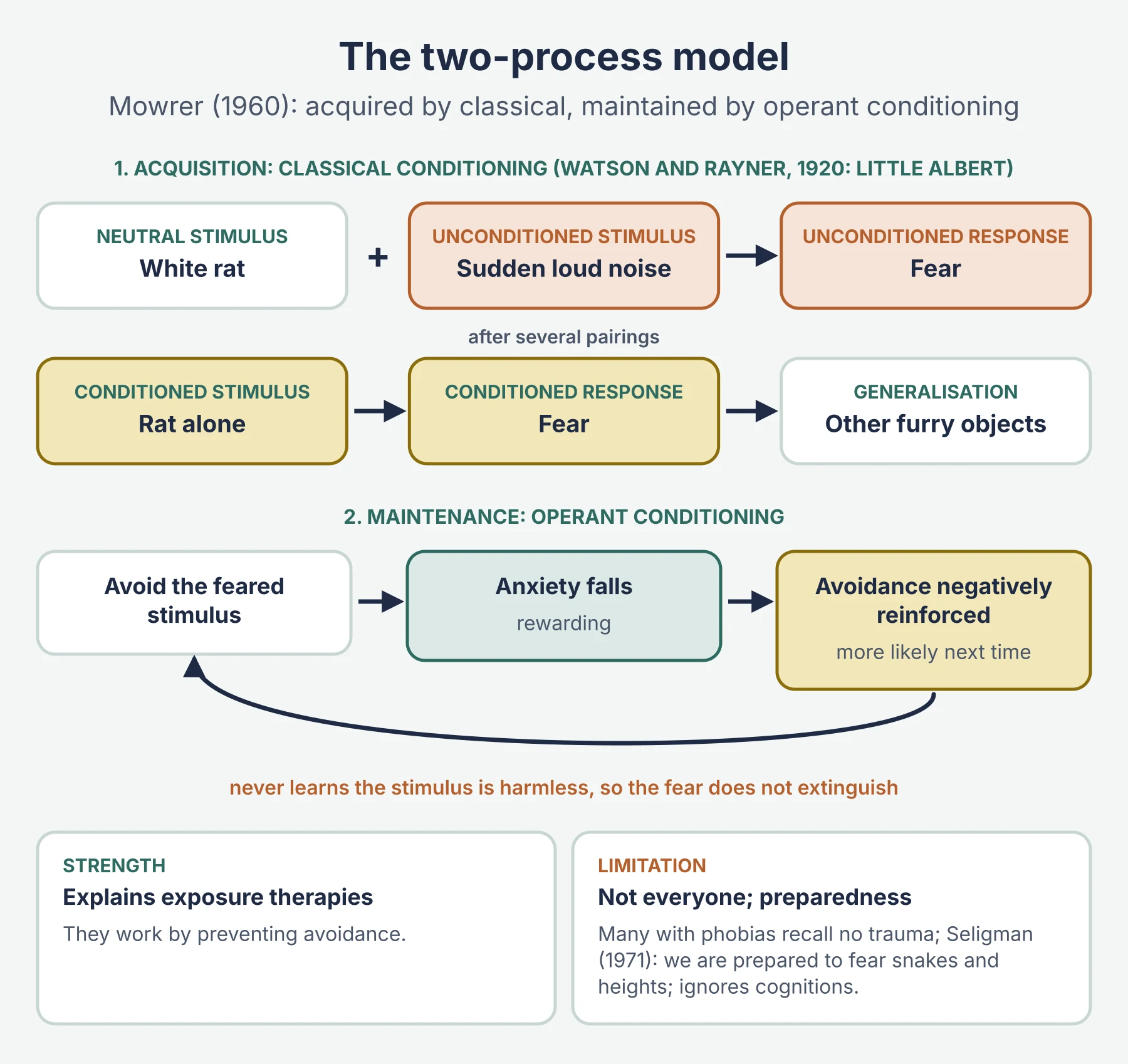
- Behavioural explanation and treatment of phobias: the two-process model (classical and operant conditioning); systematic desensitisation (relaxation and hierarchy); flooding.
- Cognitive explanation and treatment of depression: Beck’s negative triad and Ellis’s ABC model; cognitive behaviour therapy, including challenging irrational thoughts.
Only two disorders are named in this section: phobias and depression.
Definitions at a glance
| Definition | Abnormal means | Example | Main limitation |
|---|---|---|---|
| Statistical infrequency | Rare in the population | IQ below about 70 | Rare can be desirable; common disorders are not rare |
| Deviation from social norms | Breaking society’s unwritten rules | Behaviour others find threatening | Norms vary by culture and era; open to misuse |
| Failure to function adequately | Unable to cope with daily life, or causing distress | Unable to keep a job or wash | Who decides what is adequate? |
| Deviation from ideal mental health | Lacking Jahoda’s (1958) criteria | Low self-esteem, poor stress resistance | Too demanding; culture-bound |
Jahoda’s criteria: positive attitude to the self, self-actualisation, resistance to stress, autonomy, accurate perception of reality, environmental mastery.
Characteristics
| Phobias | Depression | |
|---|---|---|
| Behavioural | Avoidance; panic; endurance with distress | Changed activity; disrupted sleep and appetite; aggression or self-harm |
| Emotional | Excessive, persistent fear and anxiety; disproportionate to danger | Low mood; loss of pleasure; worthlessness; anger |
| Cognitive | Selective attention; irrational beliefs; insight that fear is excessive | Poor concentration; negative focus; absolutist thinking |
Key terms
| Term | Meaning |
|---|---|
| Classical conditioning | Learning by association between a neutral stimulus and an unconditioned stimulus |
| Operant conditioning | Learning through consequences of behaviour |
| Negative reinforcement | A behaviour is strengthened because it removes something unpleasant |
| Generalisation | Fear spreads to stimuli similar to the conditioned stimulus |
| Preparedness | Biological readiness to fear stimuli that threatened ancestors (Seligman, 1971) |
| Counterconditioning | Replacing one conditioned response with another |
| Reciprocal inhibition | Two incompatible responses (relaxation and fear) cannot occur together |
| Anxiety hierarchy | List of feared situations from least to most frightening |
| Extinction | A conditioned response weakens when the conditioned stimulus occurs without the unconditioned stimulus |
| Negative self-schema | A pessimistic framework for interpreting information about the self |
| Cognitive errors | Biased processing, such as overgeneralisation or magnification |
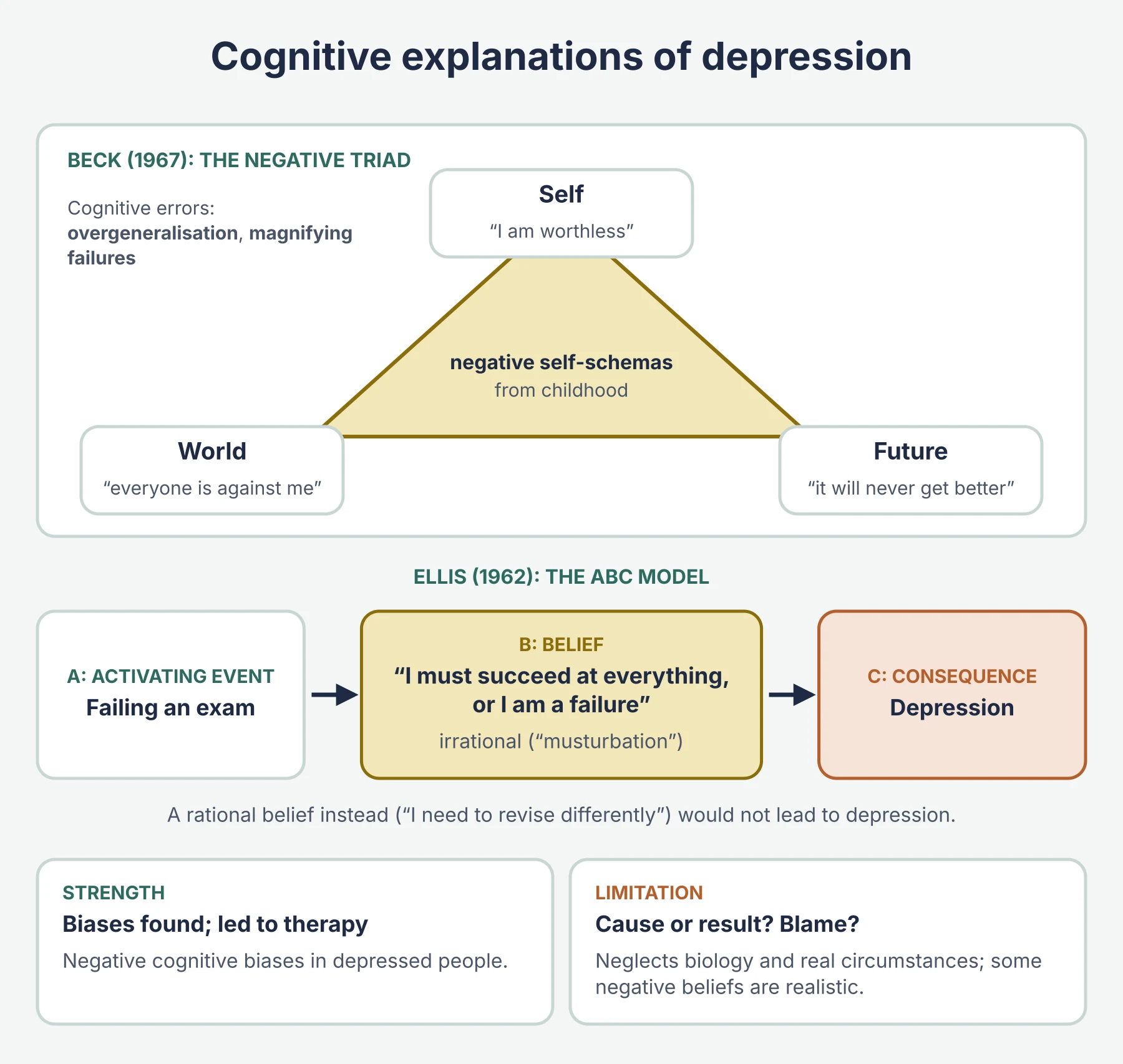
| Negative triad | Negative views of the self, the world and the future (Beck, 1967) |
| ABC model | Activating event, Belief, Consequence (Ellis, 1962) |
| Musturbation | Ellis’s term for absolute demands such as “I must succeed” |
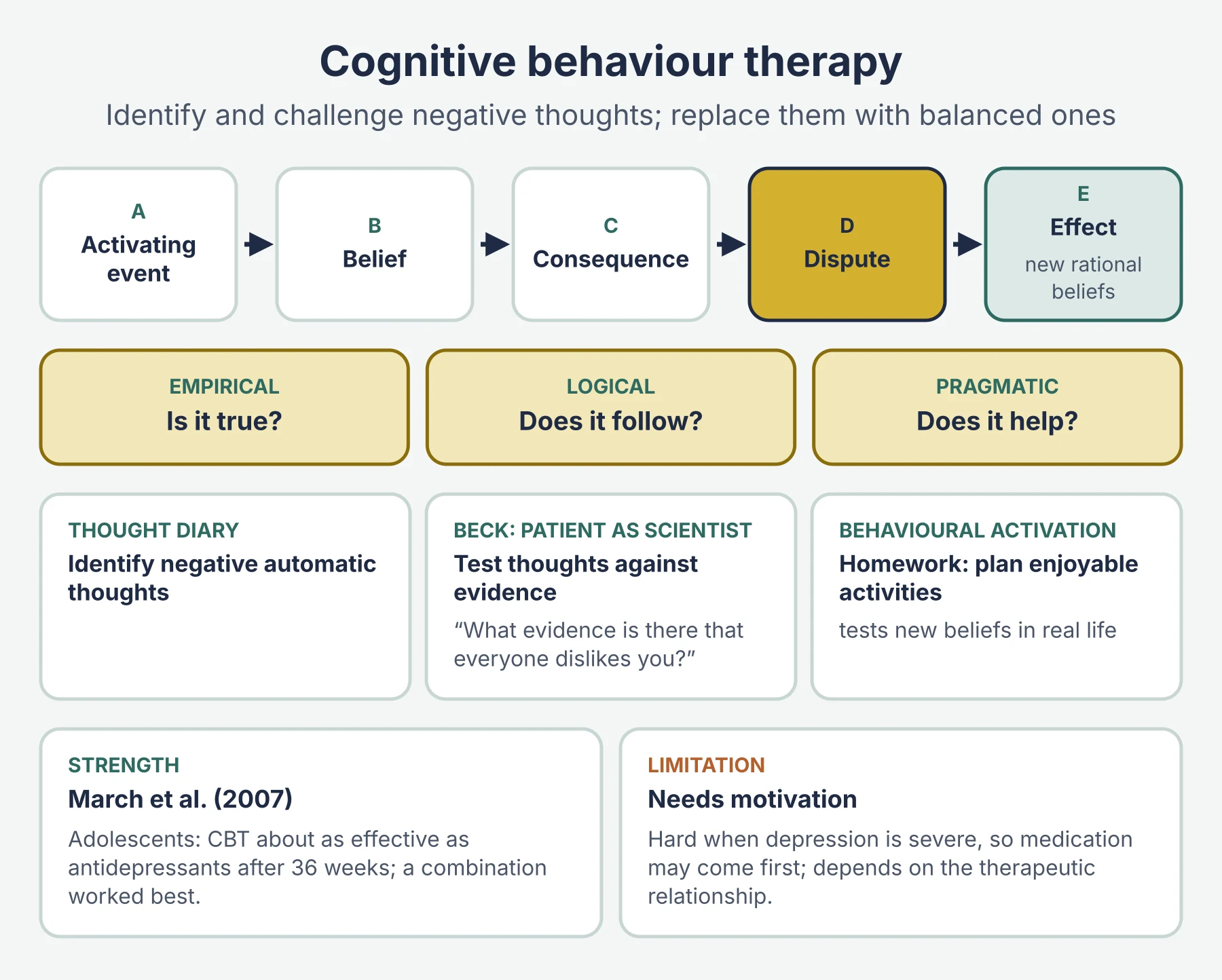
| Disputing | Challenging irrational beliefs: empirical, logical and pragmatic |
Explanations and treatments in brief
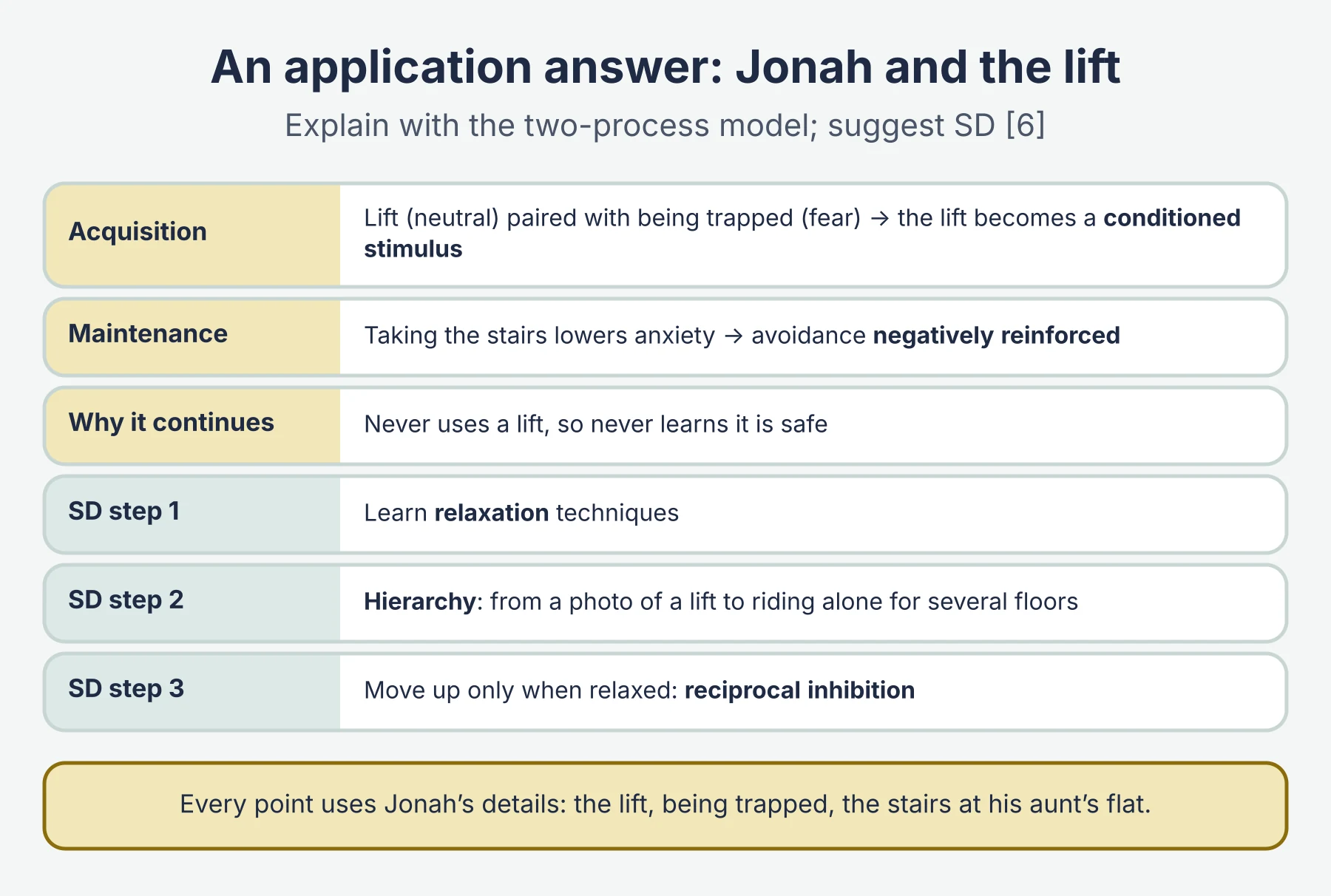
Two-process model (Mowrer, 1960). Classical conditioning acquires the fear (Little Albert: white rat paired with a loud noise; fear generalised). Operant conditioning maintains it: avoidance reduces anxiety, so it is negatively reinforced, and the person never learns the stimulus is safe.
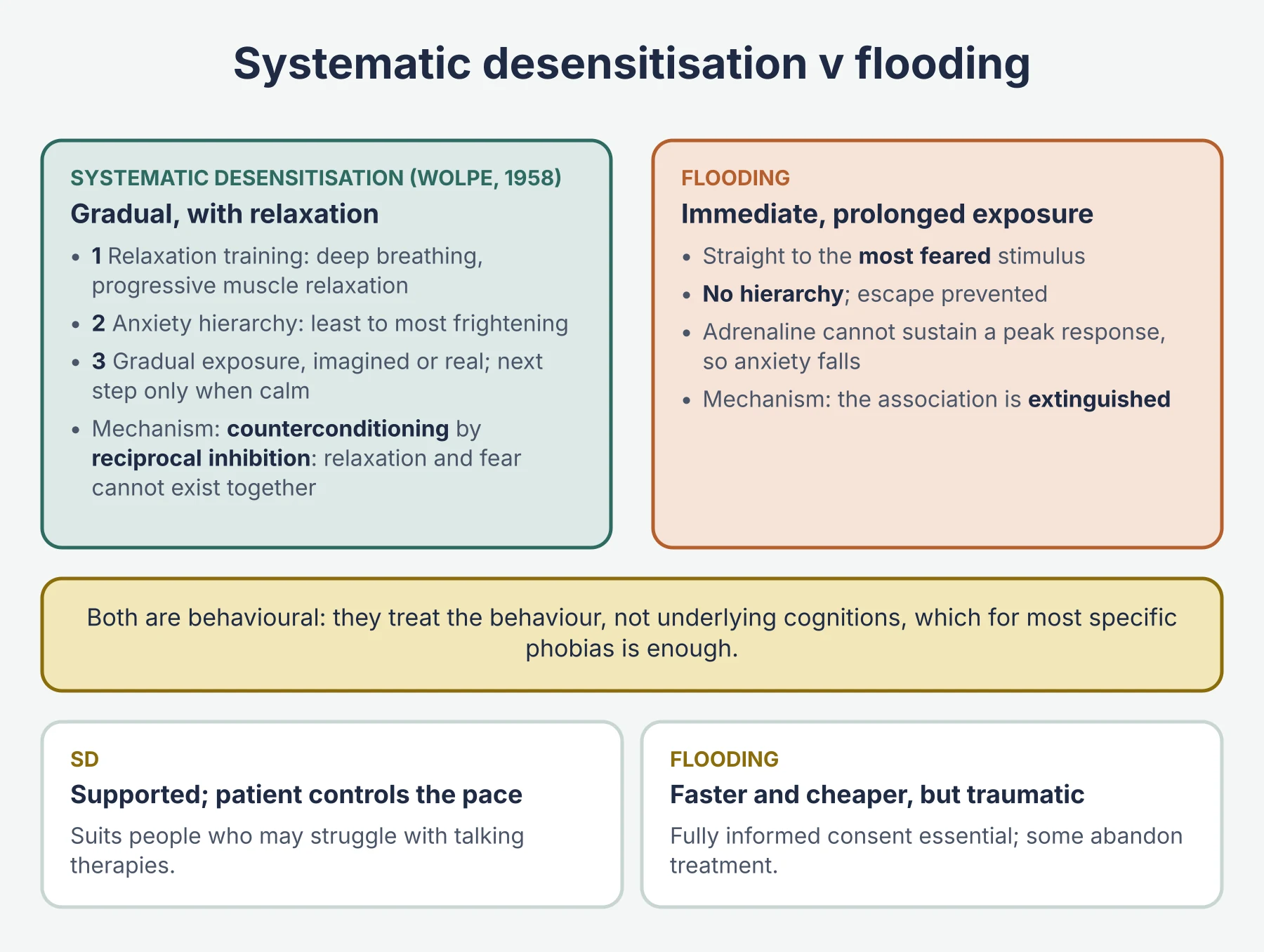
Systematic desensitisation (Wolpe, 1958). Relaxation training, anxiety hierarchy, gradual exposure while relaxed. Works through counterconditioning and reciprocal inhibition. Patient controls the pace.
Flooding. Immediate, prolonged exposure to the most feared stimulus with no escape and no hierarchy. Anxiety peaks then falls; the association is extinguished.
Beck. Negative self-schemas and cognitive errors produce automatic negative thoughts about self, world and future.
Ellis. Irrational beliefs about an activating event, not the event itself, produce depression.
CBT. Identify negative thoughts (thought diaries); challenge them by testing against evidence (Beck) or disputing (Ellis); behavioural activation and homework; replace with balanced beliefs.
Evaluation points
- Definitions: each captures part of abnormality; all involve value judgements; culture-bound.
- Two-process model: explains why exposure works; not all phobias follow trauma, and not all trauma produces phobias; preparedness explains which phobias are common; ignores cognition.
- SD: well supported for specific phobias; suitable for patients who struggle with talking therapies; slower than flooding.
- Flooding: fast and cheap, but traumatic; informed consent essential; some patients drop out.
- Cognitive explanation: supported by evidence of negative biases; cause or effect is unclear; can blame the patient; neglects biology and circumstances.
- CBT: March et al. (2007): about as effective as medication for adolescents after 36 weeks, combination best; needs motivation; severe cases may need medication first.
Exam traps
- Giving a definition with no example or limitation.
- Putting avoidance under emotional characteristics: it is behavioural.
- Reversing the two processes (classical acquires, operant maintains).
- Describing flooding as gradual.
- Writing “Beck’s ABC model” – the ABC model is Ellis’s.
- Describing CBT without saying how thoughts are challenged.
- Writing about OCD, which this section does not name.
Self-test
- Give one limitation of statistical infrequency.
- Why is deviation from social norms culturally relative?
- Name three of Jahoda’s criteria.
- Give one cognitive characteristic of phobias.
- Give one behavioural characteristic of depression.
- Which process in the two-process model maintains a phobia, and how?
- What did Watson and Rayner (1920) show?
- What is reciprocal inhibition?
- How does flooding differ from systematic desensitisation?
- Name the three parts of Beck’s negative triad.
- What does each letter stand for in Ellis’s ABC model?
- Name the three types of disputing in Ellis’s approach.
Answers: 1. Some rare characteristics, such as very high IQ, are desirable (or common disorders are not rare). 2. What counts as a norm differs between cultures and changes over time. 3. For example positive attitude to the self, resistance to stress, autonomy. 4. Selective attention to the phobic stimulus (or irrational beliefs). 5. Disrupted sleep (or changed activity levels, changed appetite). 6. Operant conditioning: avoidance reduces anxiety, so it is negatively reinforced. 7. Fear can be classically conditioned: a white rat paired with a loud noise came to produce fear in an infant, which generalised to similar objects. 8. Relaxation and fear cannot occur together, so relaxation can replace fear. 9. Flooding exposes the patient immediately to the most feared stimulus, with no hierarchy. 10. Self, world and future. 11. Activating event, Belief, Consequence. 12. Empirical, logical and pragmatic.
More resources on this topic
Related resources
-
Study guides
OxfordAQA International A-level Psychology (9685): 3.1.2 Social Psychology
Study guide to OxfordAQA 9685 section 3.1.2 Social psychology: conformity, Asch's variables, obedience, Milgram's variations, resistance and model answers.
Psychology · OxfordAQA · AS Level
Read guide -
Practice questions
OxfordAQA International A-level Psychology (9685): 3.1.2 Social Psychology – Practice Questions
Twelve original OxfordAQA 9685 social psychology questions: conformity and obedience data, resistance scenarios and extended evaluations of Asch and Milgram.
Psychology · OxfordAQA · AS Level
Try questions -
Revision notes
OxfordAQA International A-level Psychology (9685): 3.1.2 Social Psychology – Revision Notes
Condensed OxfordAQA 9685 social psychology notes: conformity types, Asch's variables, obedience explanations, Milgram's figures, resistance and a self-test.
Psychology · OxfordAQA · AS Level
Revise topic
Studying Psychology?
This page is free and stays free. Marlbridge is not offering Psychology classes at the moment, so there is no tuition to book for it. The free study resources stay open to everyone.
Get free revision emails (optional)
Occasional emails with practice questions, worked explanations and links to free resources for the qualification and subjects you choose. No spam, and you can unsubscribe from any email. The free tools on this site never need an email.