
Revision Notes
OxfordAQA International A-level Psychology (9685): 3.1.2 Social Psychology – Revision Notes
Condensed OxfordAQA 9685 social psychology notes: conformity types, Asch's variables, obedience explanations, Milgram's figures, resistance and a self-test.
- Subject
- Psychology
- Level
- AS LEVEL
- Topic
- Unit 1 – Introductory Topics in Psychology
- Author
- Marlbridge Academic Team
- Updated
- Reviewed by
- Kanwal Aslam (what this means)
Aligned to OxfordAQA A Level Psychology (9685), Version 3.1. Official specification .
Syllabus page (what it covers and how it is assessed): OxfordAQA A Level Psychology.
Syllabus points this page covers
9685 (AS Level)
- 3.1.2 Social psychology
Condensed recall for 3.1.2 Social psychology (OxfordAQA International AS and A-level Psychology 9685, Unit 1, Section B). For procedures, evaluation and a worked answer, read the social psychology study guide; then try the social psychology practice questions.
What the specification lists
- Types of conformity, including internalisation and compliance; explanations, including normative and informational influence.
- Variables affecting conformity as investigated by Asch: group size, unanimity and task difficulty.
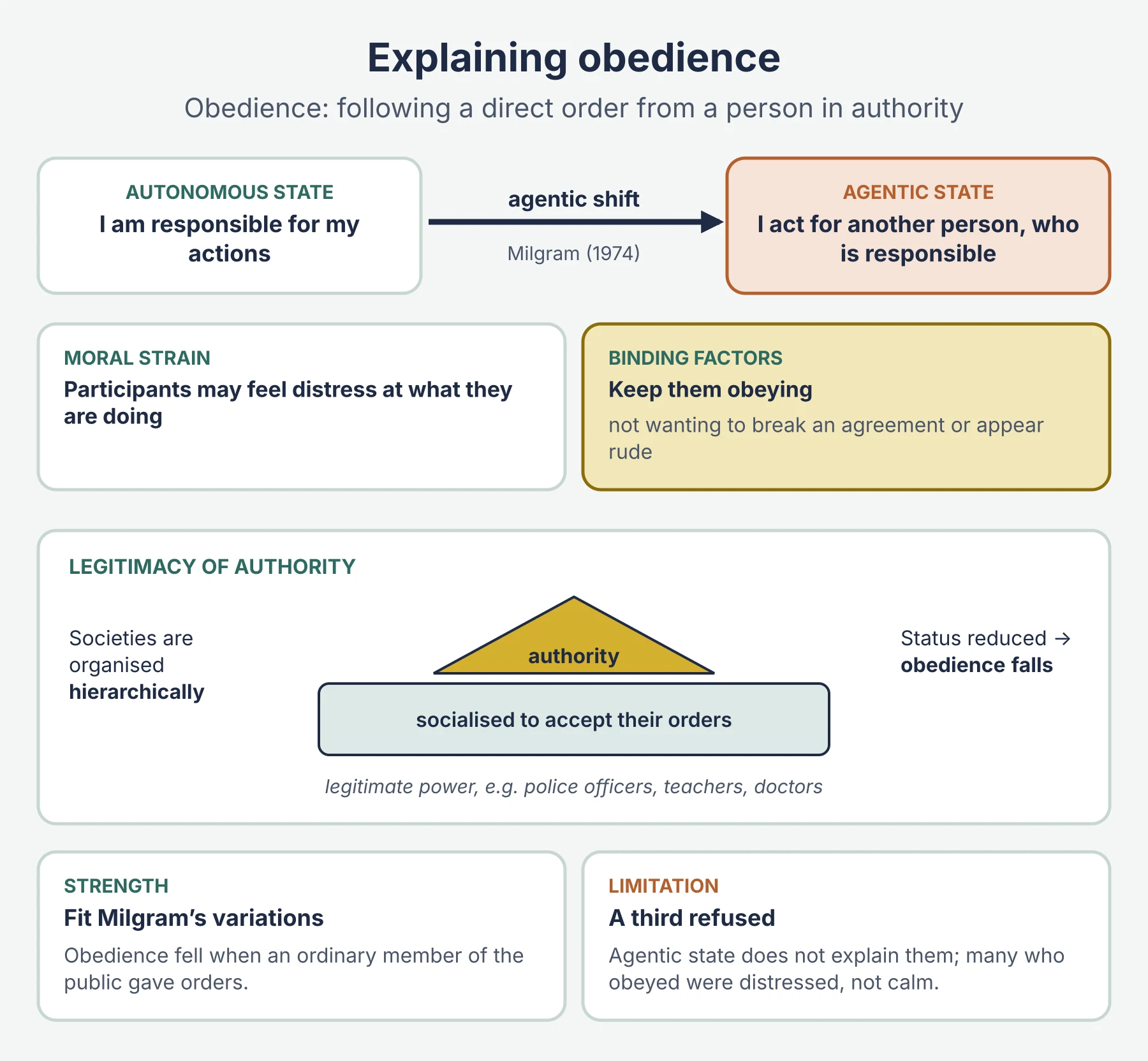
- Explanations for obedience: agentic state and legitimacy of authority; situational variables investigated by Milgram, including proximity and location.
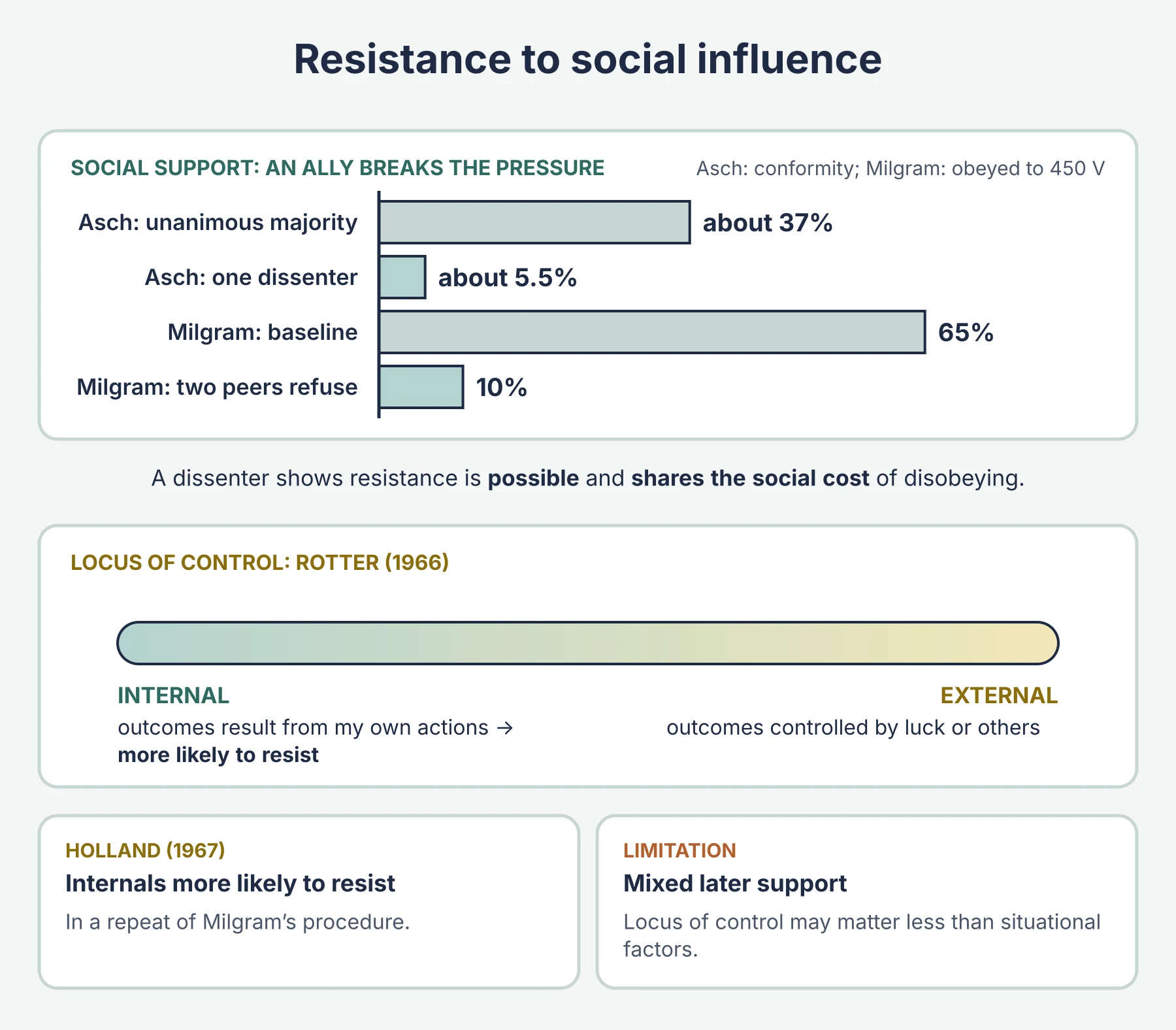
- Explanations of resistance to social influence: social support and locus of control.
Key terms
| Term | Meaning |
|---|---|
| Conformity | Changing behaviour or belief in response to real or imagined group pressure |
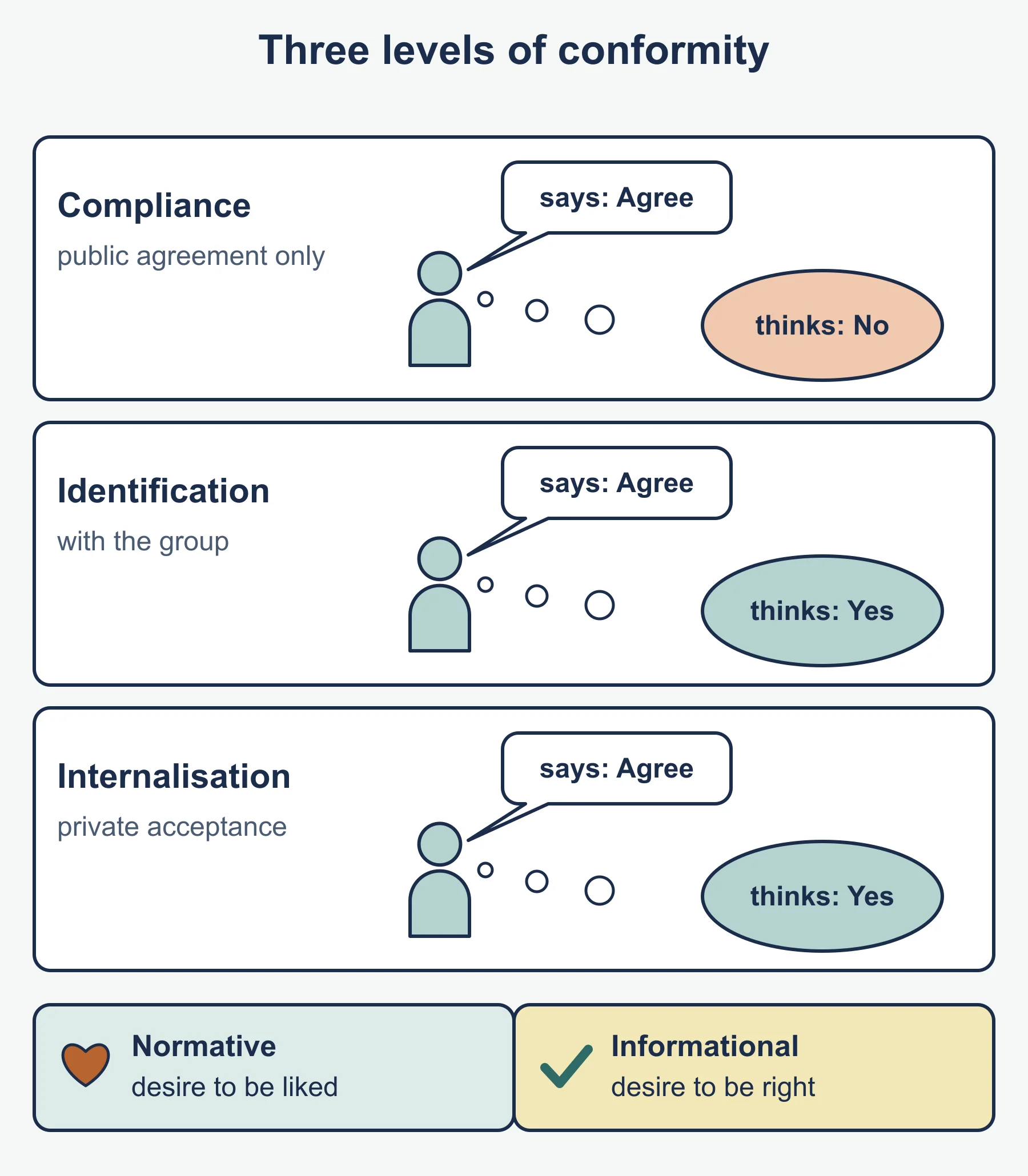
| Compliance | Public agreement, private disagreement; stops when the group is absent |
| Identification | Adopting group views because you value belonging to the group |
| Internalisation | Genuine private acceptance of the group’s view; persists without the group |
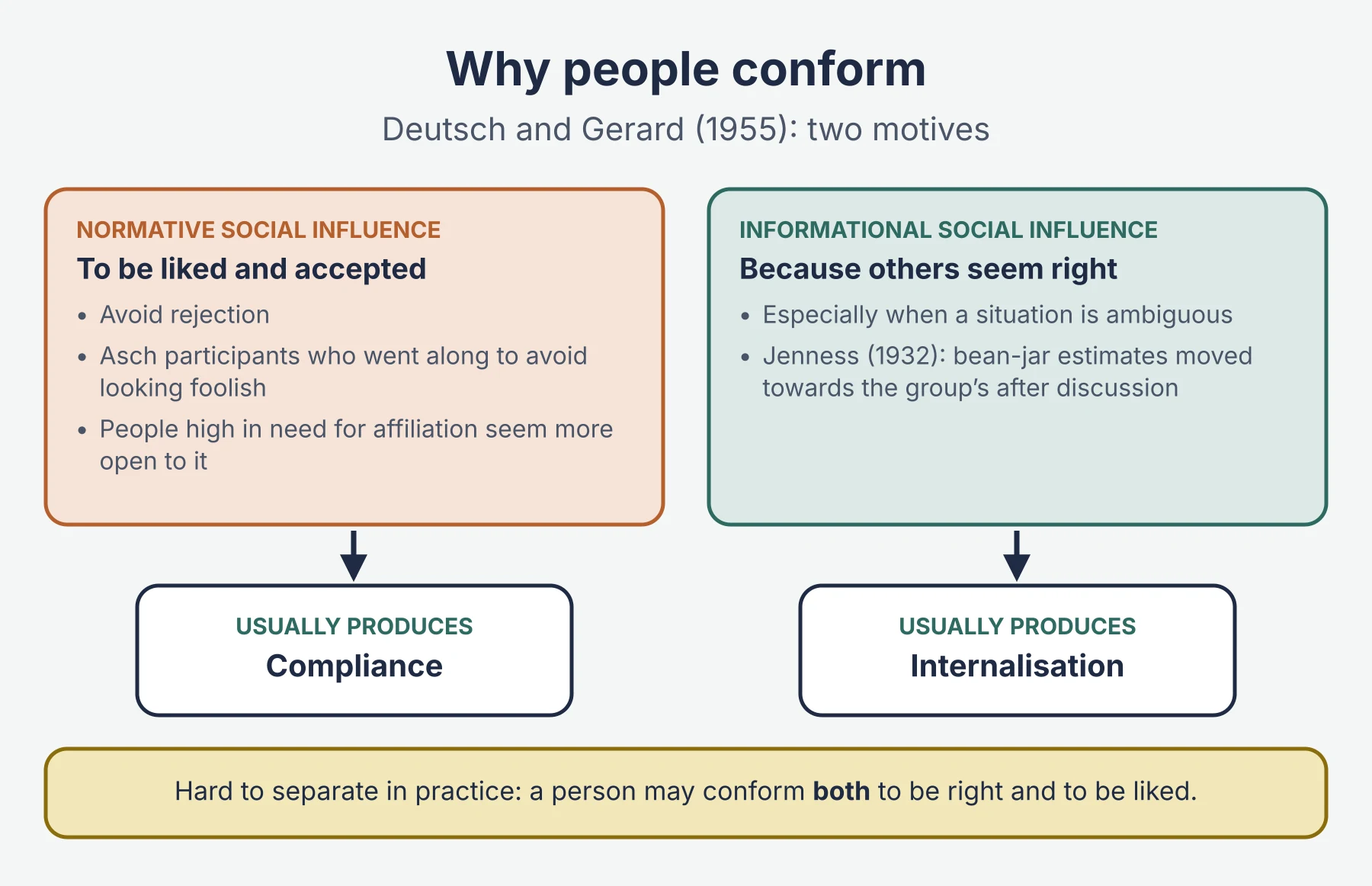
| Normative social influence | Conforming to be liked and accepted |
| Informational social influence | Conforming because others are believed to be right |
| Obedience | Following a direct order from an authority figure |
| Agentic state | Seeing yourself as acting for an authority, so responsibility passes to them |
| Autonomous state | Feeling responsible for your own actions |
| Agentic shift | Moving from the autonomous to the agentic state |
| Moral strain | Distress from acting against your conscience on orders |
| Binding factors | Aspects of the situation that keep a person obeying despite moral strain |
| Legitimacy of authority | Accepting that someone has a socially sanctioned right to give orders |
| Social support | The presence of others who resist, making resistance easier |
| Locus of control | Belief about whether outcomes are controlled by yourself (internal) or by luck and others (external) |
Asch: the numbers
| Condition | Approximate conformity |
|---|---|
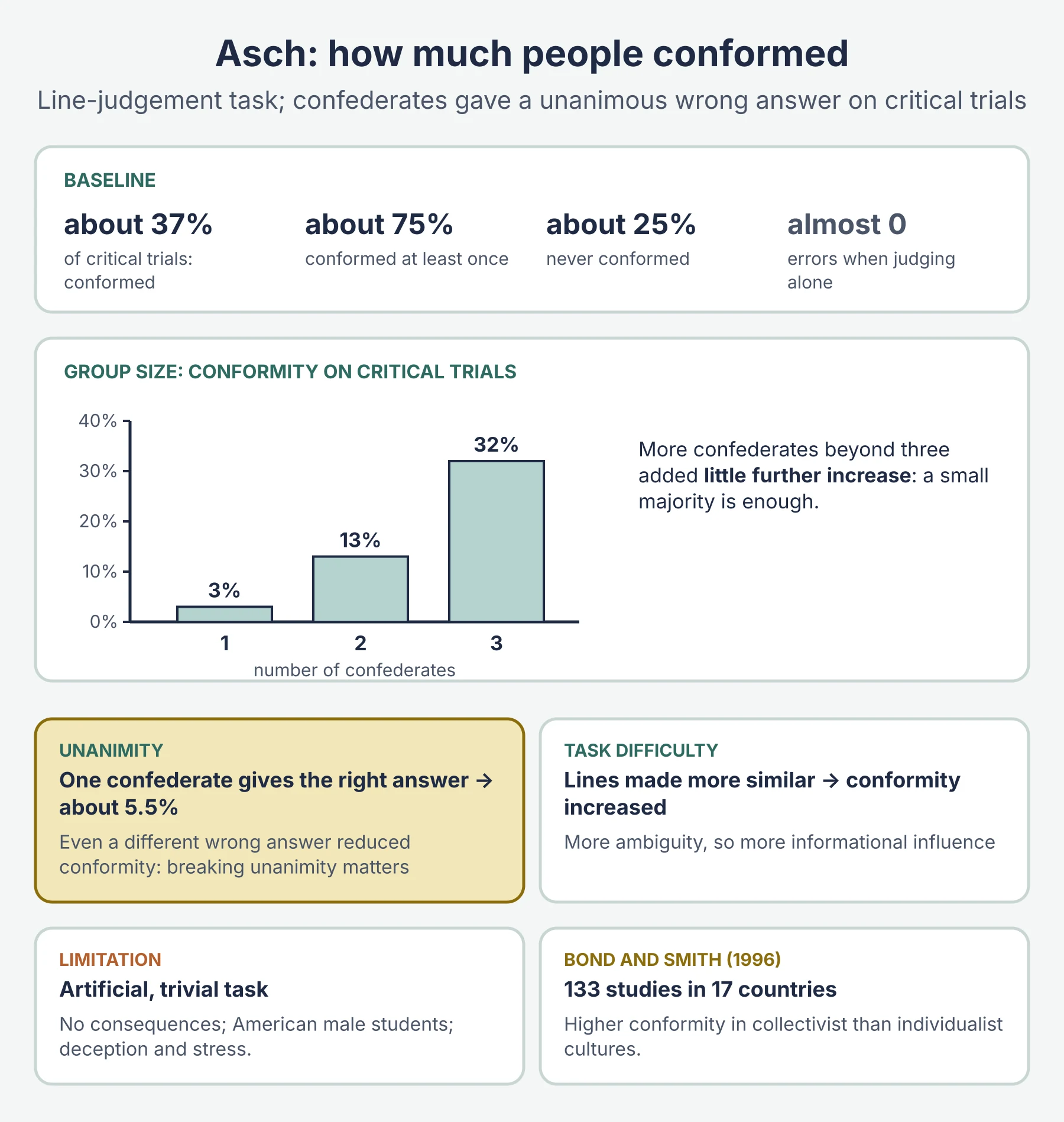
| Baseline, critical trials | About 37% of responses; about 75% conformed at least once; about 25% never |
| One confederate | About 3% |
| Two confederates | About 13% |
| Three confederates | About 32%; little increase beyond this |
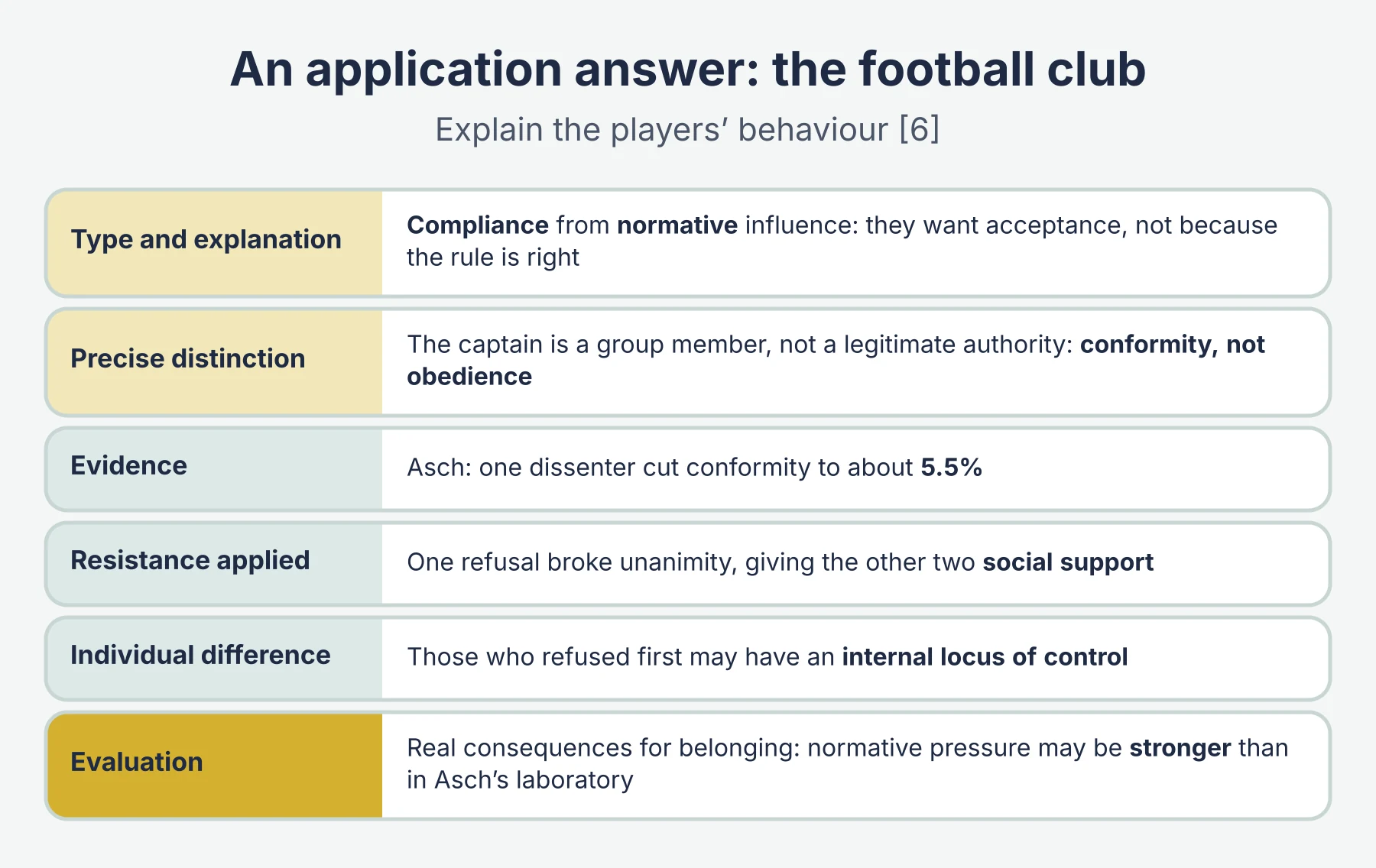
| One dissenter giving the right answer | About 5.5% |
| Harder task (lines more similar) | Increased |
Milgram: the numbers
| Condition | Obedience to 450 volts |
|---|---|
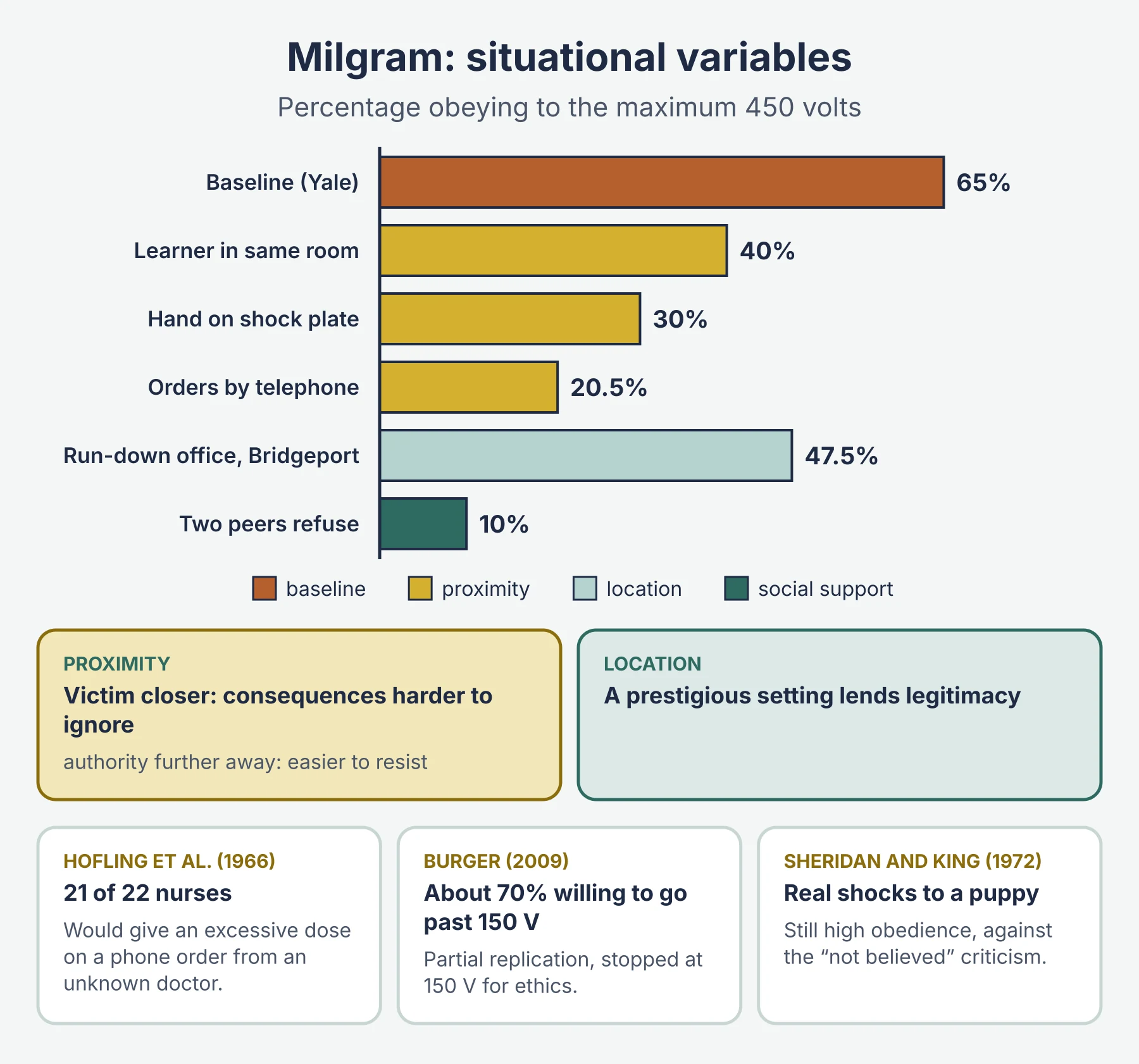
| Baseline (Yale, learner in another room) | 65%; all 40 reached 300 volts |
| Location: run-down office in Bridgeport | 47.5% |
| Proximity: learner in the same room | 40% |
| Touch proximity: participant forces the learner’s hand onto a plate | 30% |
| Experimenter gives orders by telephone | 20.5% |
| Ordinary member of the public gives orders | 20% |
| Two disobedient peers (social support) | 10% |
Other studies at a glance
| Study | Finding | Use it for |
|---|---|---|
| Kelman (1958) | Three types of conformity | Types |
| Deutsch and Gerard (1955) | Normative and informational influence | Explanations |
| Jenness (1932) | Bean-jar estimates converged after discussion | Informational influence |
| Bond and Smith (1996) | Meta-analysis of 133 studies in 17 countries: higher conformity in collectivist cultures | Evaluating Asch |
| Hofling et al. (1966) | 21 of 22 nurses obeyed an unknown doctor’s telephone order | Real-world obedience |
| Sheridan and King (1972) | High obedience when giving real shocks to a puppy | Answering the “they knew it was fake” criticism |
| Burger (2009) | About 70% willing to continue past 150 volts | Obedience persists today |
| Rotter (1966) | Internal-external locus of control | Resistance |
| Holland (1967) | Internals more likely to resist in a Milgram-type procedure | Resistance |
Evaluation points
- Asch: artificial, low-stakes task; American male student sample; culture-bound (Bond and Smith); deception.
- Explanations of conformity: normative and informational motives overlap; individual differences such as need for affiliation.
- Milgram: high control and many variations; possible disbelief in shocks, though Sheridan and King found similar obedience with real shocks; deception and distress.
- Agentic state: fits the variations but does not explain the 35% who refused or the distress of those who obeyed.
- Legitimacy: supported by the falls in obedience at Bridgeport and with an ordinary member of the public.
- Locus of control: some supporting evidence, but research is mixed and situation may matter more.
Exam traps
- Calling Milgram’s studies conformity research.
- Using “compliance” to mean obedience: in this topic, compliance is a type of conformity.
- Matching the right percentage to the wrong variation.
- Explaining task difficulty with normative rather than informational influence.
- Writing about minority influence or social roles, which this section does not list.
- Describing social support without saying how it reduces pressure.
Self-test
- Distinguish compliance from internalisation.
- Which type of social influence usually leads to internalisation?
- What happened to conformity in Asch’s study when group size rose from one to three confederates?
- What effect did one dissenter have on conformity?
- Why does task difficulty increase conformity?
- What percentage of Milgram’s baseline participants went to 450 volts?
- What was obedience when orders were given by telephone?
- Define the agentic state.
- How does the Bridgeport variation support legitimacy of authority?
- What did Bond and Smith (1996) find?
- What happened to obedience with two disobedient peers?
- Why might someone with an internal locus of control resist social influence?
Answers: 1. Compliance is public agreement with private disagreement; internalisation is genuine private acceptance. 2. Informational social influence. 3. It rose from about 3% to about 32%. 4. Conformity fell to about 5.5%. 5. An ambiguous task makes people look to others for information. 6. 65%. 7. 20.5%. 8. A state in which a person sees themselves as acting for an authority and passes responsibility to them. 9. Obedience fell to 47.5% in a less prestigious setting, so the institution lent the authority legitimacy. 10. Conformity was higher in collectivist than individualist cultures. 11. It fell to 10%. 12. They believe outcomes depend on their own actions, so they rely on their own judgement rather than others’.
More resources on this topic
Related resources
-
Practice questions
OxfordAQA A Level Psychology: Introductory Topics — Practice Questions
Practice questions with worked answers on memory, social psychology and psychopathology for Unit 1 of OxfordAQA International A-Level Psychology 9685.
Psychology · OxfordAQA · AS Level
Try questions -
Revision notes
OxfordAQA A Level Psychology: Introductory Topics — Revision Notes
Condensed recall notes on social influence, memory and psychopathology for International A Level Psychology.
Psychology · OxfordAQA · AS Level
Revise topic -
Study guides
OxfordAQA International A-Level Psychology: Introductory Topics (9685)
Memory, social psychology, and psychopathology – the full content of Unit 1 for OxfordAQA International AS and A-Level Psychology (9685).
Psychology · OxfordAQA · AS Level
Read guide
Studying Psychology?
This page is free and stays free. Marlbridge is not offering Psychology classes at the moment, so there is no tuition to book for it. The free study resources stay open to everyone.
Get free revision emails (optional)
Occasional emails with practice questions, worked explanations and links to free resources for the qualification and subjects you choose. No spam, and you can unsubscribe from any email. The free tools on this site never need an email.