
Study Guides
OxfordAQA International A-level Psychology (9685): 3.1.2 Social Psychology
Study guide to OxfordAQA 9685 section 3.1.2 Social psychology: conformity, Asch's variables, obedience, Milgram's variations, resistance and model answers.
- Subject
- Psychology
- Level
- AS LEVEL
- Topic
- Unit 1 – Introductory Topics in Psychology
- Author
- Marlbridge Academic Team
- Updated
- Reviewed by
- Kanwal Aslam (what this means)
Aligned to OxfordAQA A Level Psychology (9685), Version 3.1. Official specification .
Syllabus page (what it covers and how it is assessed): OxfordAQA A Level Psychology.
Syllabus points this page covers
9685 (AS Level)
- 3.1.2 Social psychology
This guide covers 3.1.2 Social psychology of the OxfordAQA International AS and A-level Psychology (9685) specification, Version 3.1. It is Section B of the Unit 1 exam: 30 marks of compulsory questions in a 1 hour 30 minute, 90-mark paper. The specification lists four areas: types of conformity (including internalisation and compliance) and explanations (including normative and informational influence); variables affecting conformity as investigated by Asch (group size, unanimity and task difficulty); explanations for obedience (agentic state and legitimacy of authority) and situational variables investigated by Milgram (including proximity and location); and resistance to social influence (social support and locus of control).
The introductory topics study guide summarises the topic and discusses the temporal validity of Asch’s findings. This guide goes further into procedures, the numbers you can quote, and evaluation for each area. Use the social psychology revision notes to condense it and the social psychology practice questions to test it.
Types of conformity
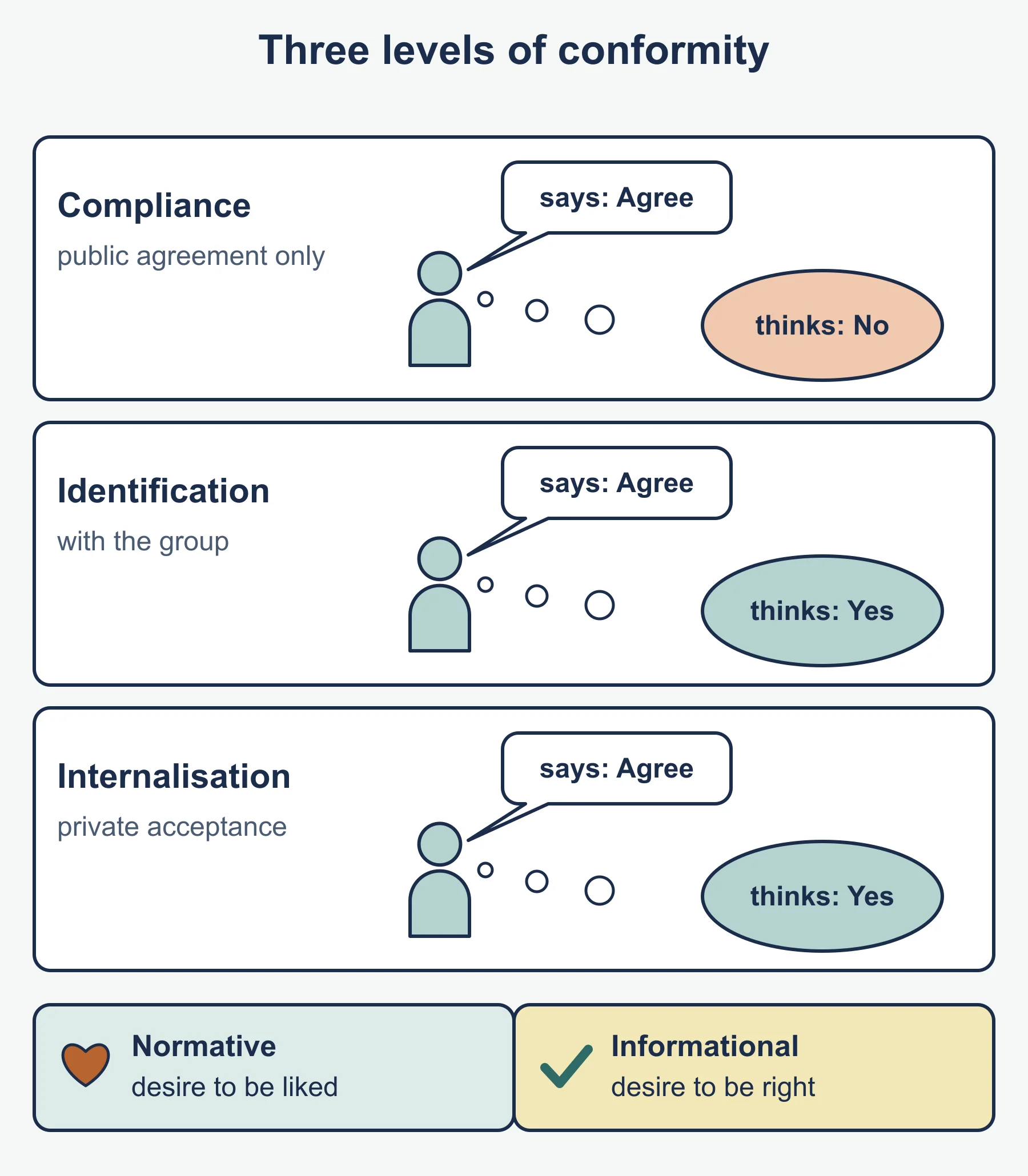
Conformity is a change in behaviour or belief in response to real or imagined group pressure. Kelman (1958) described three types:
- Compliance: going along with the group publicly while privately disagreeing. The change stops when the group is absent.
- Identification: adopting the group’s views because you value membership of the group; the change lasts while you identify with it.
- Internalisation: genuinely accepting the group’s view as correct, so the change is private as well as public and persists without the group.
The specification names internalisation and compliance; knowing identification helps you show they lie on a scale of depth.
Explanations: normative and informational influence
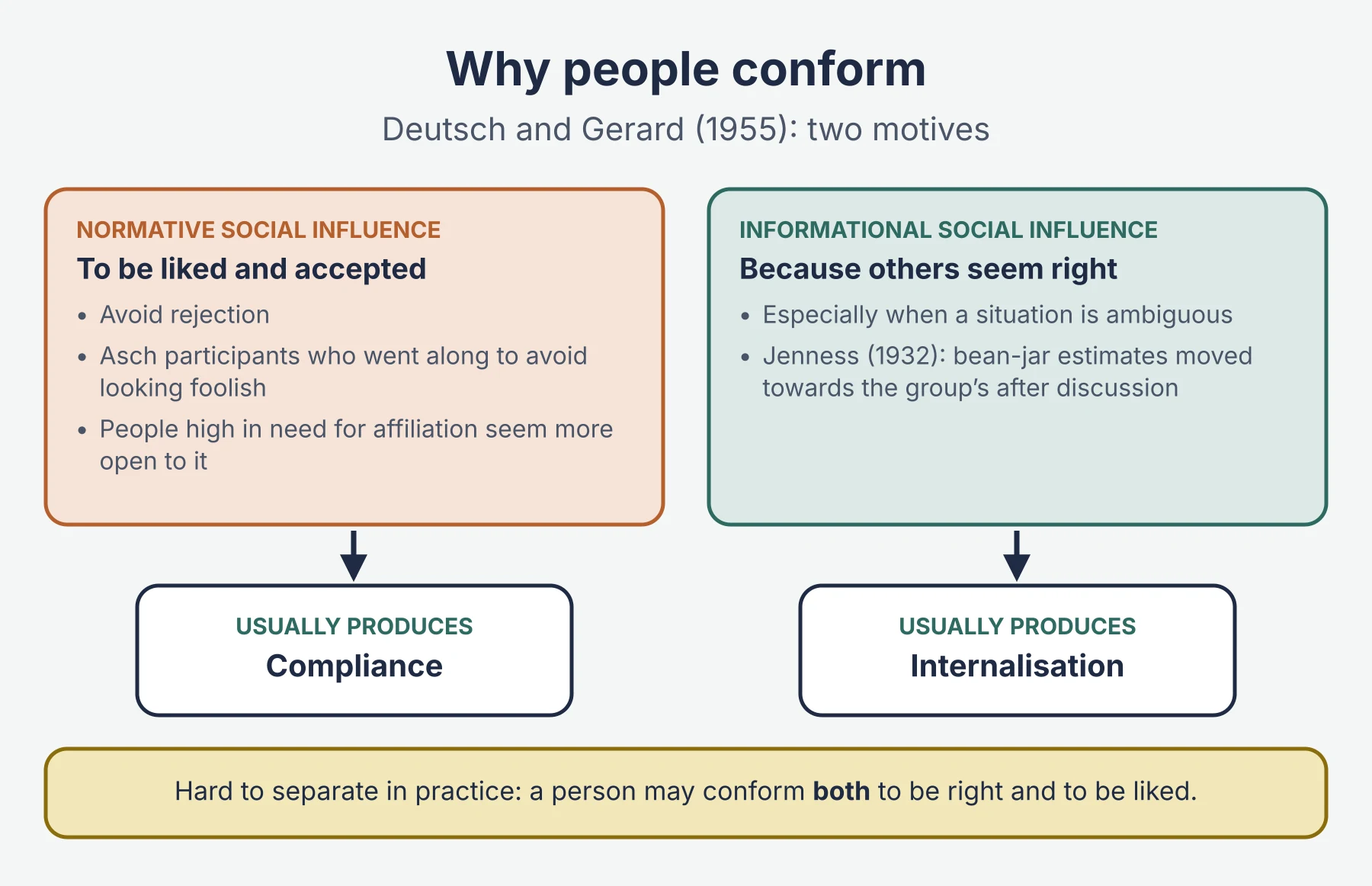
Deutsch and Gerard (1955) distinguished two motives.
- Normative social influence – conforming to be liked or accepted and to avoid rejection. It usually produces compliance. Asch’s participants who later said they went along to avoid looking foolish illustrate it.
- Informational social influence – conforming because you believe others are right, especially when a situation is ambiguous. It usually produces internalisation. Jenness (1932) asked people to estimate the number of beans in a jar alone and then after group discussion; individual estimates moved towards the group’s, as people used others’ views as information.
Evaluation. The two explanations are hard to separate in practice: a participant may conform both to be right and to be liked. Individual differences also matter: people with a high need for affiliation appear more open to normative influence.
Asch’s research and its variables
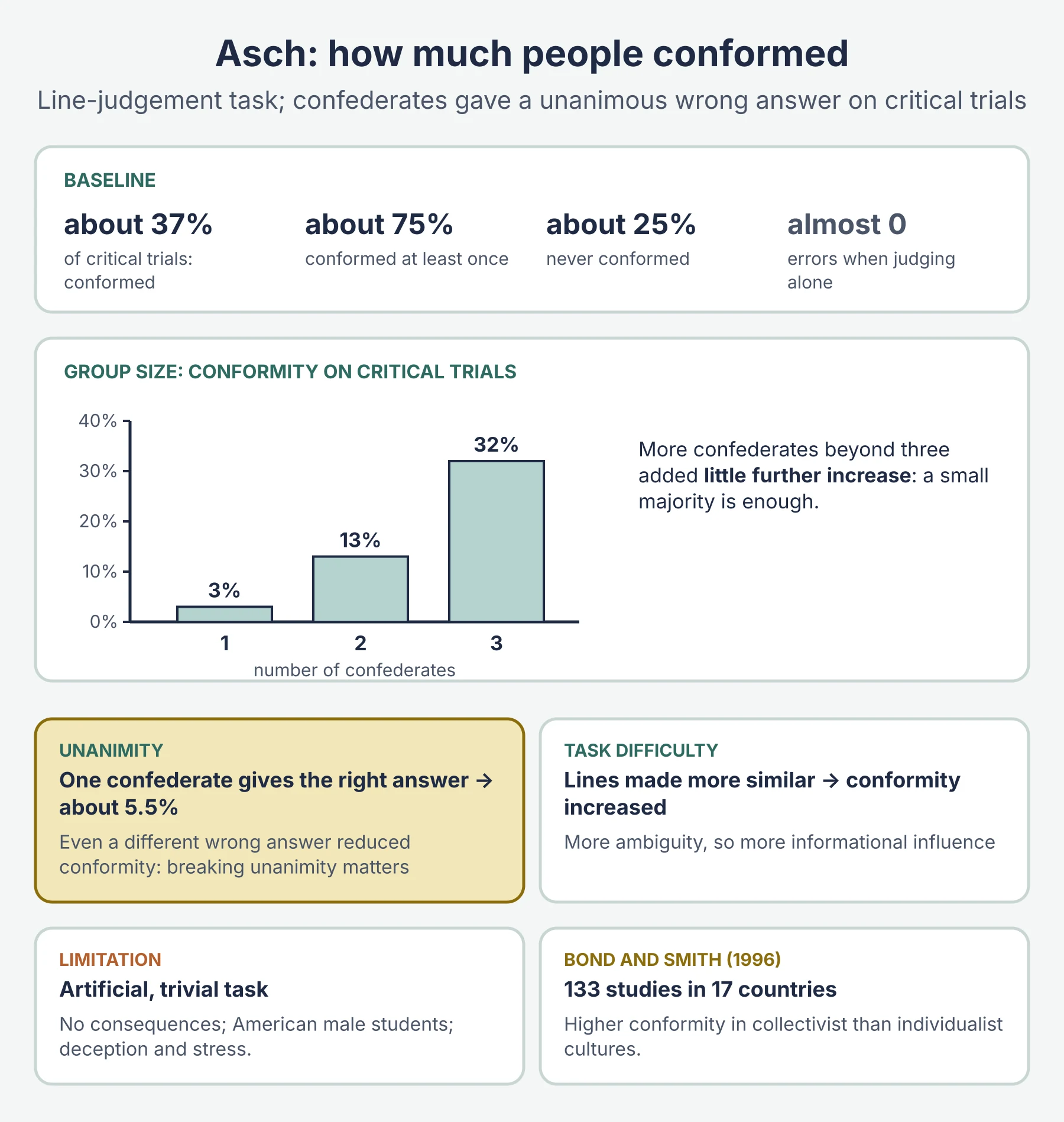
In Asch’s line-judgement studies, a genuine participant sat with confederates who, on critical trials, unanimously gave a clearly wrong answer about which comparison line matched a standard line. On critical trials, participants conformed about 37% of the time; about 75% conformed at least once, and about 25% never conformed. Control participants judging alone made almost no errors, so the task was unambiguous.
Group size. With one confederate, conformity was about 3%; with two, about 13%; with three, about 32%. Adding more confederates produced little further increase. A small majority is enough to create strong pressure.
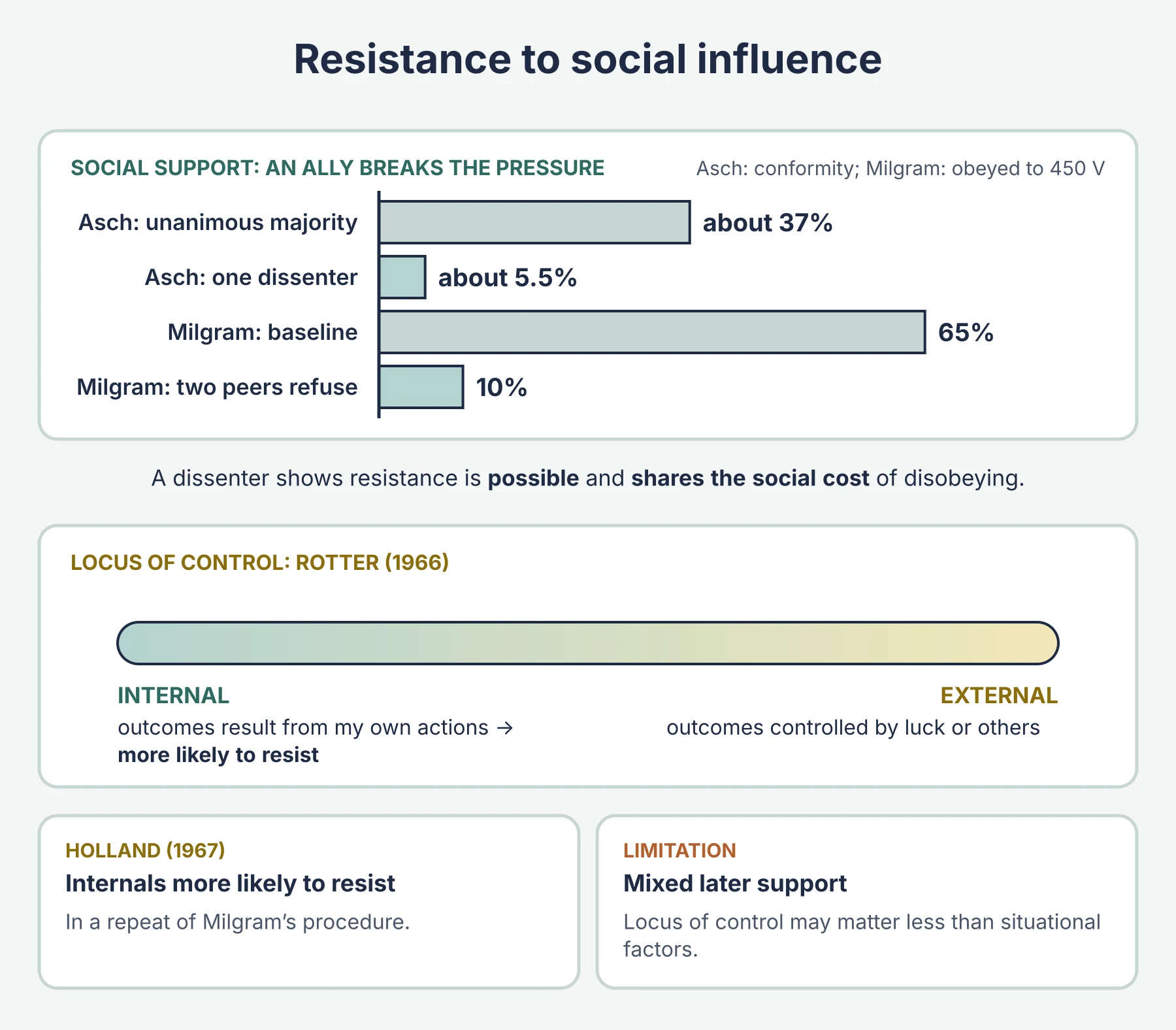
Unanimity. When one confederate gave the correct answer, conformity fell to about 5.5%. Even a dissenter who gave a different wrong answer reduced conformity, suggesting that breaking the group’s unanimity matters as much as support for the truth.
Task difficulty. When the comparison lines were made more similar, conformity increased. A harder task makes the situation ambiguous, so informational influence grows.
Evaluation of Asch. The task was artificial and trivial: there were no consequences for being wrong, so findings may not generalise to important decisions. The sample was American male students, limiting generalisation. A meta-analysis by Bond and Smith (1996), covering 133 Asch-type studies in 17 countries, found higher conformity in collectivist cultures than individualist ones. Participants were deceived about the purpose of the study and some felt stressed, raising ethical issues.
Explanations for obedience
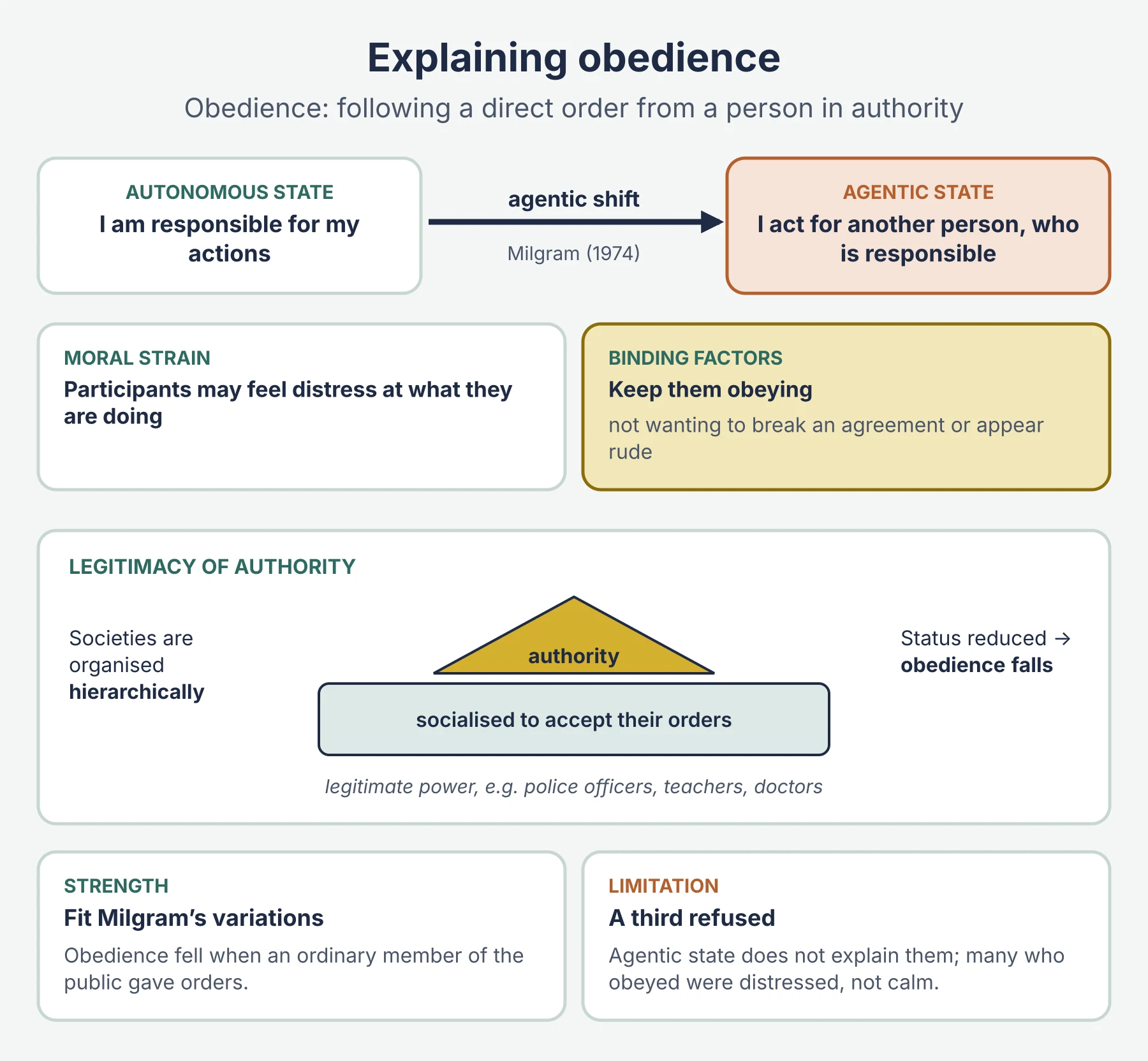
Obedience is following a direct order from a person in authority.
Agentic state. Milgram (1974) proposed that people move from an autonomous state, in which they feel responsible for their actions, to an agentic state, in which they see themselves as acting for another person and pass responsibility to them – the agentic shift. Participants may experience moral strain, but binding factors, such as not wanting to break an agreement or appear rude, keep them obeying.
Legitimacy of authority. Societies are organised hierarchically, and people are socialised to accept that some individuals have legitimate power to give orders, such as police officers, teachers or doctors. Obedience depends on the authority being seen as legitimate; when status is reduced, obedience falls.
Evaluation. Both explanations fit Milgram’s variations, especially the fall in obedience when the experimenter was replaced by an ordinary member of the public. However, the agentic state does not explain why a third of participants in the baseline study refused to continue, and many who obeyed showed great distress rather than calm acceptance.
Milgram’s research and situational variables
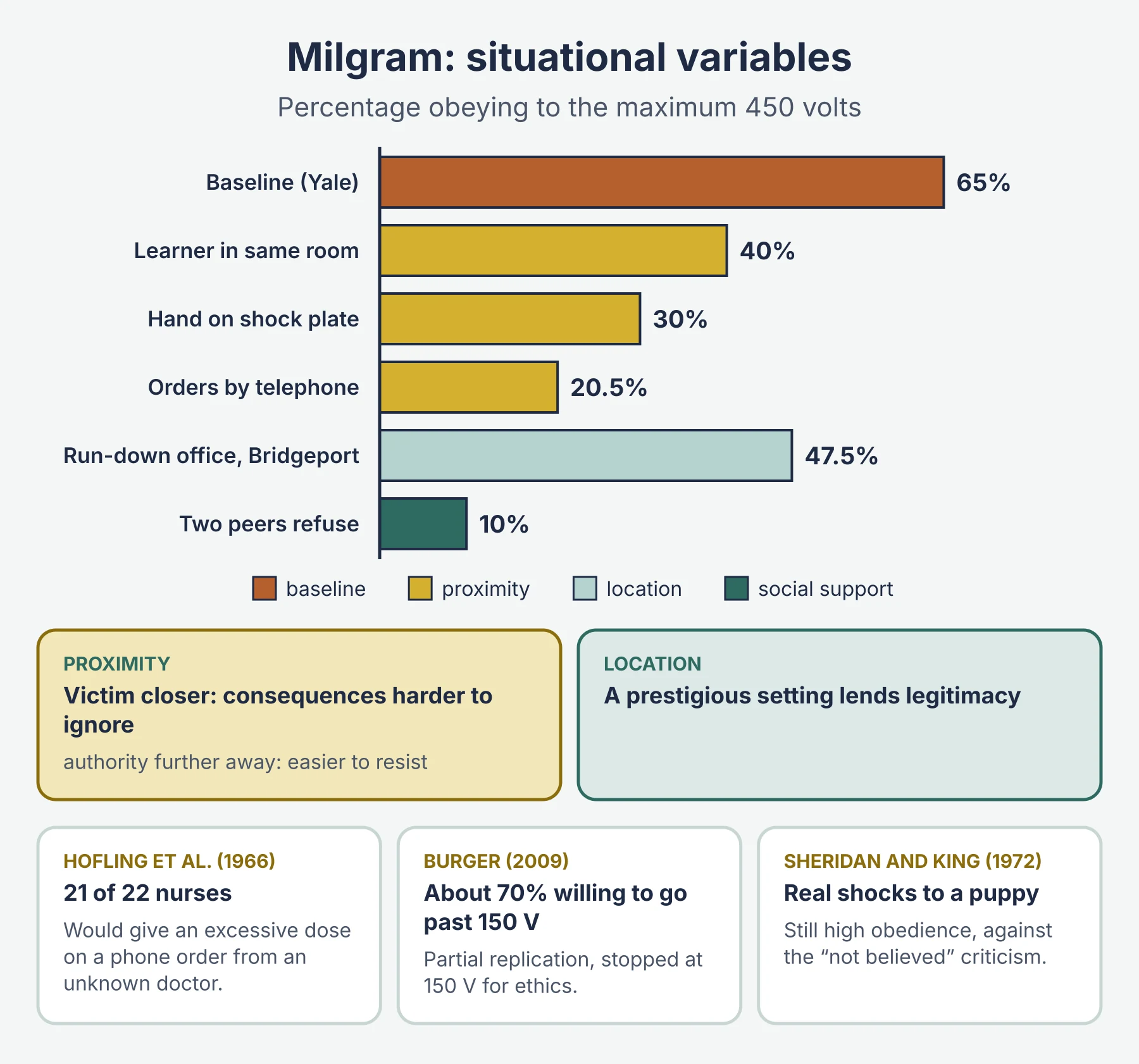
In Milgram’s (1963) baseline study, 40 men from the New Haven area were told they were taking part in a learning experiment. They were instructed to give increasingly strong “shocks” to a learner, actually a confederate, for wrong answers. All 40 went to at least 300 volts, and 65% continued to the maximum of 450 volts.
Proximity. When the learner was in the same room, obedience fell to 40%; when the participant had to press the learner’s hand onto a shock plate, it fell to 30%. When the experimenter gave orders by telephone from another room, obedience fell to 20.5%. Proximity to the victim makes consequences harder to ignore; distance from the authority makes it easier to resist.
Location. When the study moved from prestigious Yale University to a run-down office building in Bridgeport, obedience fell to 47.5%. The setting lends legitimacy to the authority.
Evaluation. Hofling et al. (1966) found that 21 of 22 nurses were prepared to give an excessive dose of an unfamiliar drug on a telephone order from an unknown doctor, suggesting obedience to legitimate authority occurs in real settings. Burger (2009) ran a partial replication stopping at 150 volts for ethical reasons and found about 70% of participants were willing to continue past that point. Critics argued some participants may not have believed the shocks were real, although Sheridan and King (1972), using real shocks to a puppy, still found high obedience. Ethical criticisms include deception and psychological distress, although Milgram debriefed participants and most later said they were glad to have taken part.
Resistance to social influence
Social support. Having an ally reduces pressure. In Asch’s unanimity variation, a single dissenter cut conformity sharply. In one of Milgram’s variations, when two confederate “teachers” refused to continue, obedience to 450 volts fell to 10%. The dissenter shows that resistance is possible and shares the social cost of disobeying.
Locus of control. Rotter (1966) described a continuum from an internal locus of control (believing outcomes result from your own actions) to an external one (believing outcomes are controlled by luck or others). People with an internal locus of control are more likely to rely on their own judgement and resist pressure. Holland (1967) repeated Milgram’s procedure and reported that participants with an internal locus of control were more likely to resist. Later research has given mixed support, so locus of control may matter less than situational factors.
Worked example: an application answer
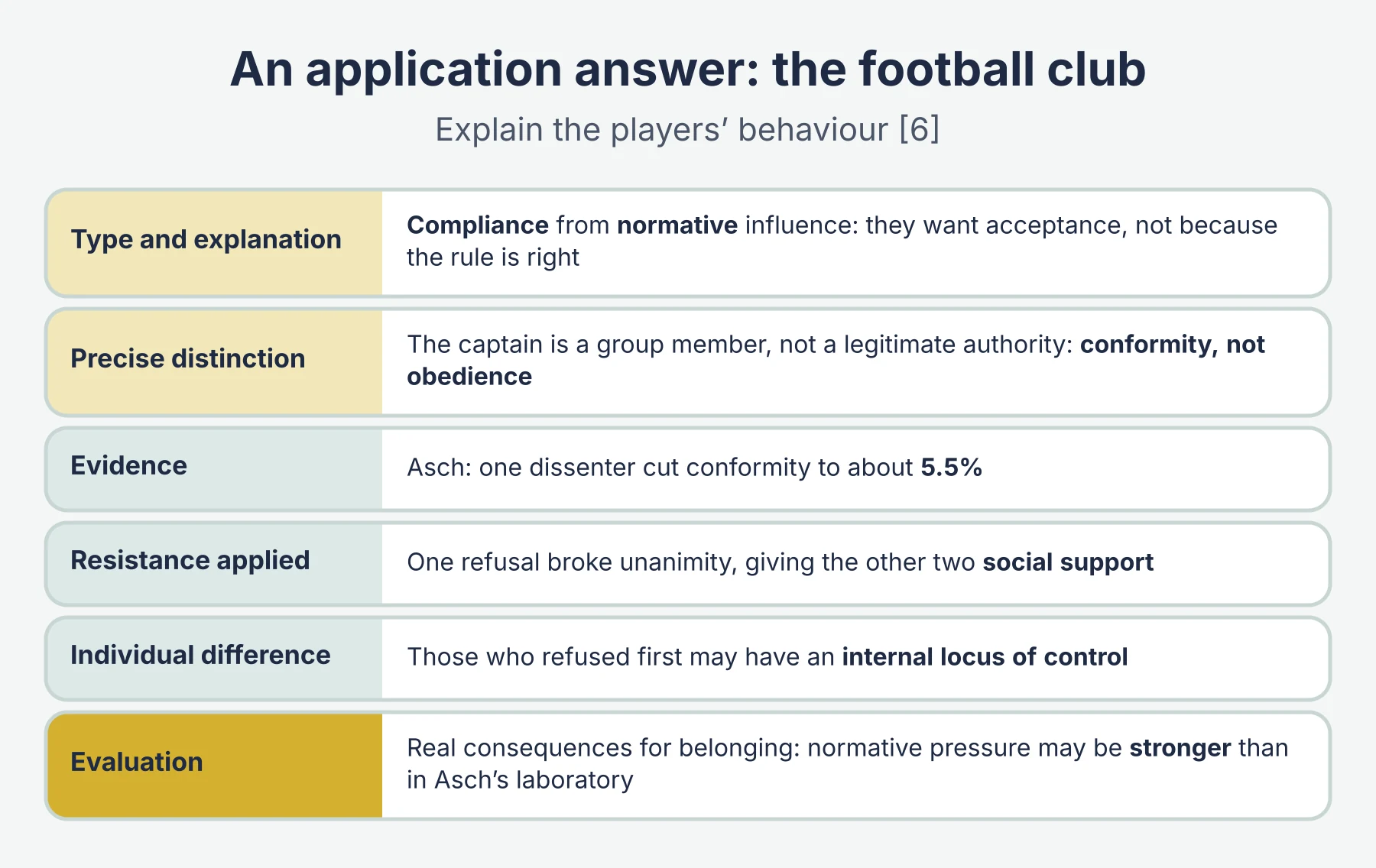
Scenario: In a football club, most new players follow the captain’s rule that everyone stays late to clean the changing room, even though the coach has never asked for it. When one new player openly refuses, two others stop staying too. Use psychological research to explain the players’ behaviour. [6]
Staying late is likely to be compliance driven by normative influence: the new players want to be accepted by the team, not because they believe the rule is right (type and explanation, linked). The captain is a group member rather than a legitimate authority, so this is conformity, not obedience (precise distinction). Asch found that conformity collapsed when unanimity was broken – one dissenter cut it to about 5.5% (evidence). Similarly, once one player refused, the majority was no longer unanimous, giving the other two social support to resist (application of resistance). Those who refused first may have an internal locus of control, trusting their own judgement (individual difference). The team setting has real consequences for belonging, so normative pressure may be stronger than in Asch’s laboratory (evaluation linked to scenario).
Common mistakes
- Calling Milgram’s research a study of conformity.
- Treating compliance and internalisation as the same.
- Quoting variation percentages for the wrong variable.
- Describing locus of control without linking it to resistance.
- Evaluating studies only on ethics, ignoring validity and generalisation.
More resources on this topic
- Social psychology revision notes
- Social psychology practice questions
- Introductory topics study guide
- Research methods 1 study guide
Official syllabus
OxfordAQA International AS and A-level Psychology (9685) specification, Version 3.1, section 3.1.2 Social psychology, assessed in Unit 1: Introductory topics in psychology, Section B.
Related resources
-
Practice questions
OxfordAQA International A-level Psychology (9685): 3.1.2 Social Psychology – Practice Questions
Twelve original OxfordAQA 9685 social psychology questions: conformity and obedience data, resistance scenarios and extended evaluations of Asch and Milgram.
Psychology · OxfordAQA · AS Level
Try questions -
Revision notes
OxfordAQA International A-level Psychology (9685): 3.1.2 Social Psychology – Revision Notes
Condensed OxfordAQA 9685 social psychology notes: conformity types, Asch's variables, obedience explanations, Milgram's figures, resistance and a self-test.
Psychology · OxfordAQA · AS Level
Revise topic -
Practice questions
OxfordAQA A Level Psychology: Introductory Topics — Practice Questions
Practice questions with worked answers on memory, social psychology and psychopathology for Unit 1 of OxfordAQA International A-Level Psychology 9685.
Psychology · OxfordAQA · AS Level
Try questions
Studying Psychology?
This page is free and stays free. Marlbridge is not offering Psychology classes at the moment, so there is no tuition to book for it. The free study resources stay open to everyone.
Get free revision emails (optional)
Occasional emails with practice questions, worked explanations and links to free resources for the qualification and subjects you choose. No spam, and you can unsubscribe from any email. The free tools on this site never need an email.