
Revision Notes
OxfordAQA International A-level Psychology (9685): 3.1.1 Memory – Revision Notes
Condensed OxfordAQA 9685 memory notes: store features, working memory components, long-term memory types, eyewitness studies, exam traps and a self-test.
- Subject
- Psychology
- Level
- AS LEVEL
- Topic
- Unit 1 – Introductory Topics in Psychology
- Author
- Marlbridge Academic Team
- Updated
- Reviewed by
- Kanwal Aslam (what this means)
Aligned to OxfordAQA A Level Psychology (9685), Version 3.1. Official specification .
Syllabus page (what it covers and how it is assessed): OxfordAQA A Level Psychology.
Syllabus points this page covers
9685 (AS Level)
- 3.1.1 Memory
Condensed recall for 3.1.1 Memory (OxfordAQA International AS and A-level Psychology 9685, Unit 1, Section A). For explanations and worked answers, read the memory study guide; then try the memory practice questions.
What the specification lists
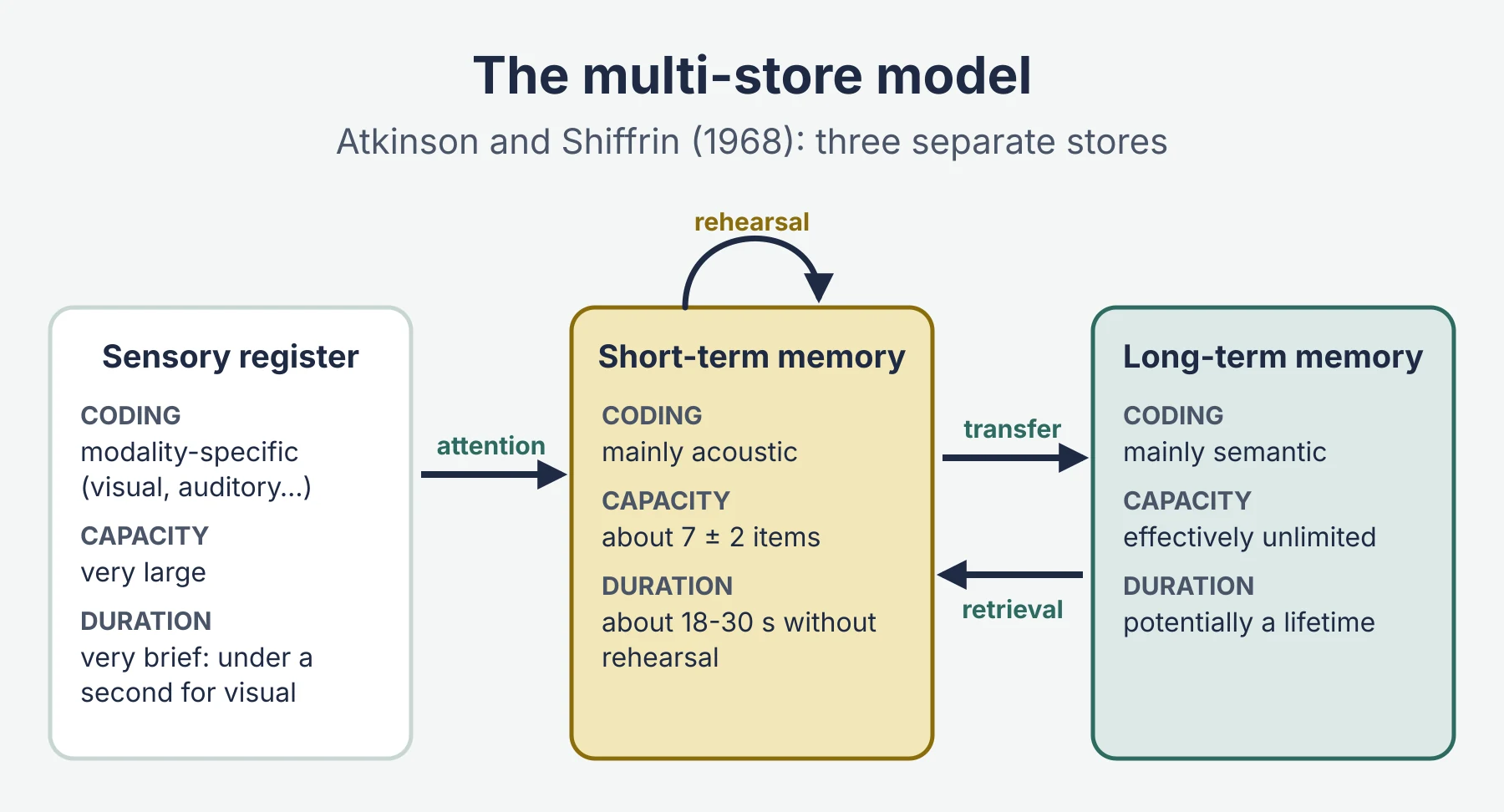
- The multi-store model: sensory register, short-term memory and long-term memory; coding, capacity and duration of each store.
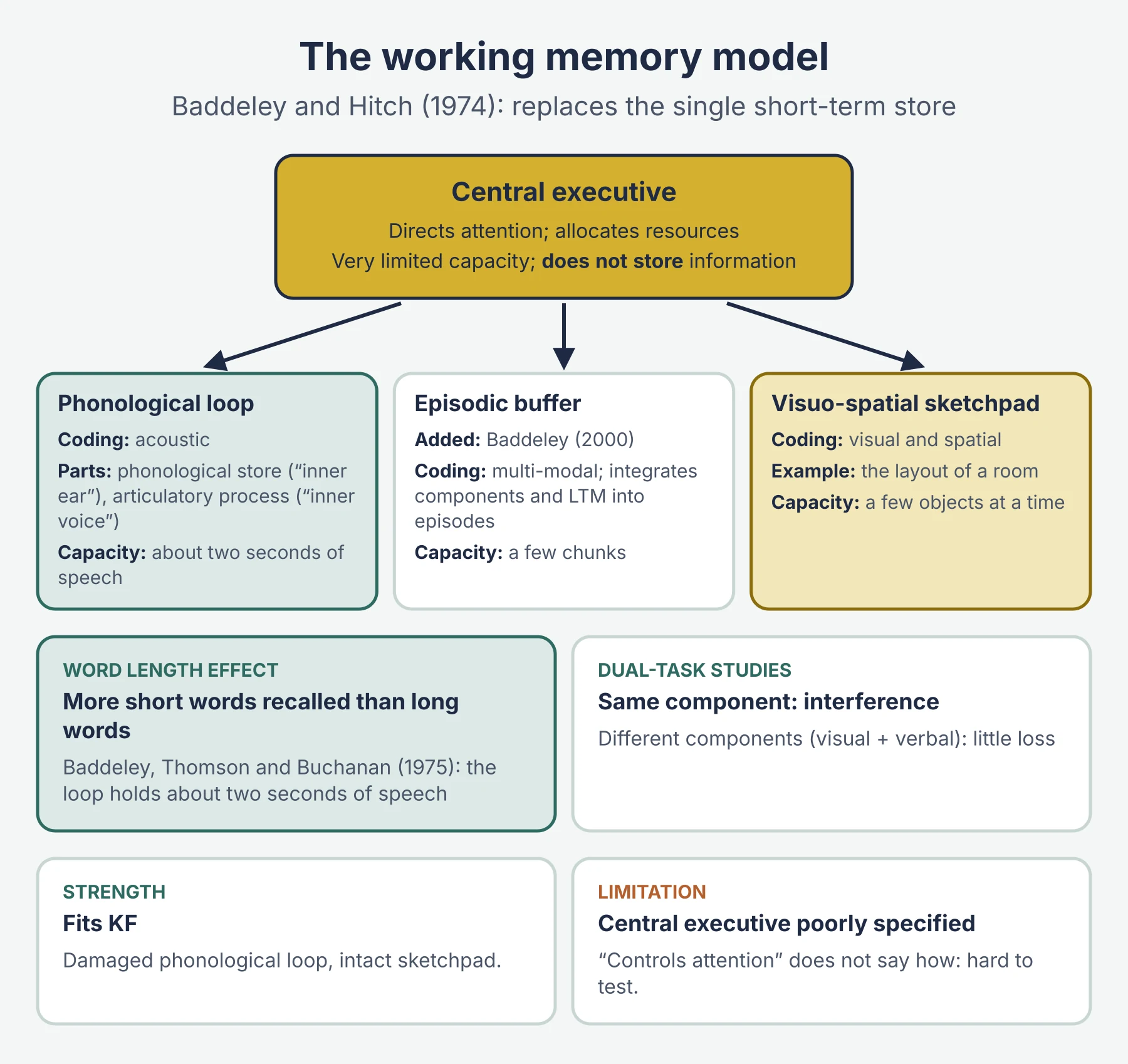
- The working memory model: central executive, phonological loop, visuo-spatial sketchpad and episodic buffer; coding and capacity.
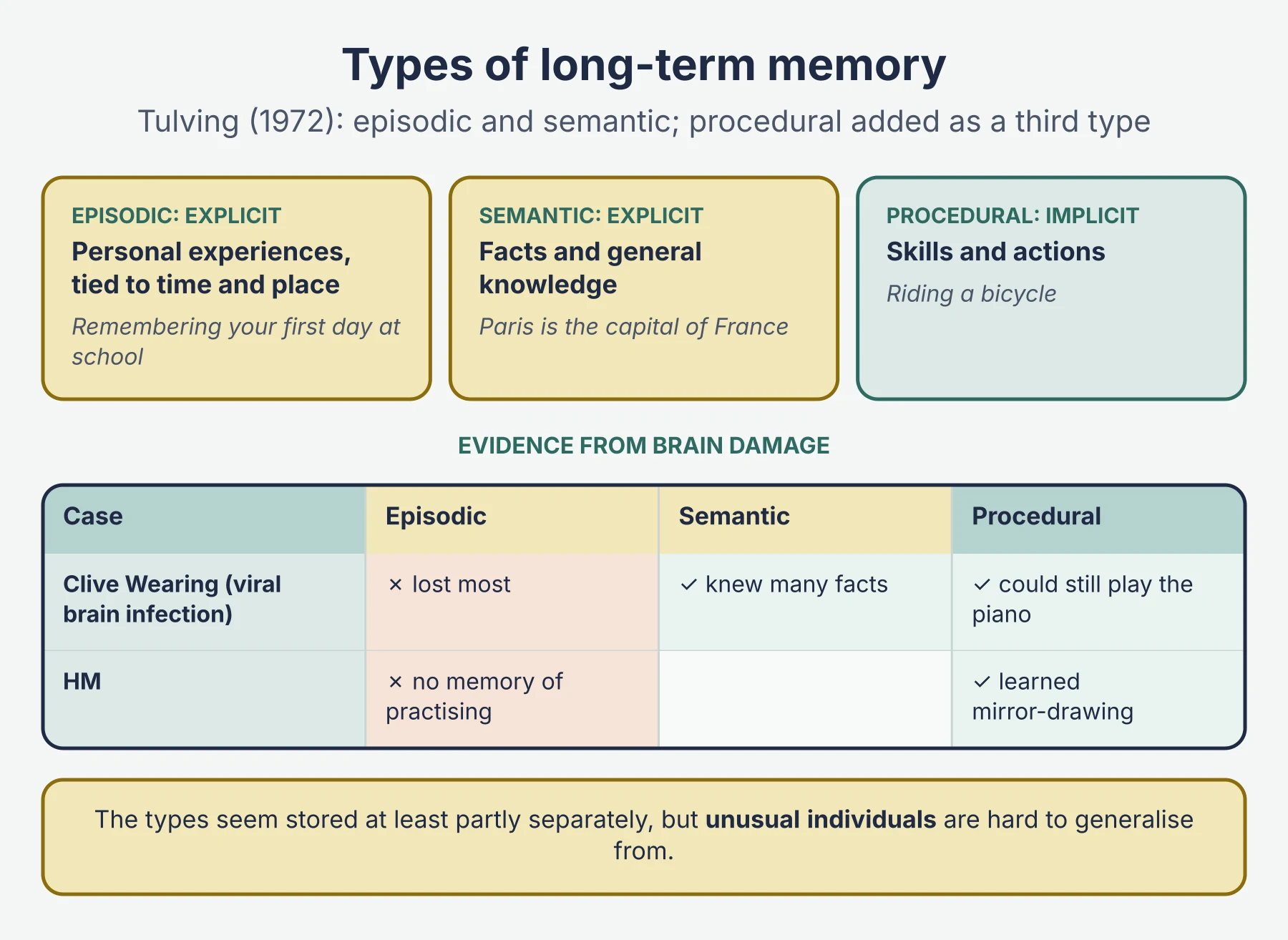
- Types of long-term memory: episodic, semantic and procedural.
- Factors affecting the accuracy of eyewitness testimony, including leading questions and post-event discussion; the cognitive interview.
Explanations of forgetting are not listed in this section.
Multi-store model in one table
| Store | Coding | Capacity | Duration | Key evidence |
|---|---|---|---|---|
| Sensory register | Modality-specific | Very large | Under a second (visual) | Sperling (1960): more letters briefly available than can be reported |
| STM | Acoustic | About 7 plus or minus 2 items | About 18-30 s | Jacobs (1887); Miller (1956); Peterson and Peterson (1959) |
| LTM | Semantic | Effectively unlimited | Up to a lifetime | Baddeley (1966); Bahrick et al. (1975) |
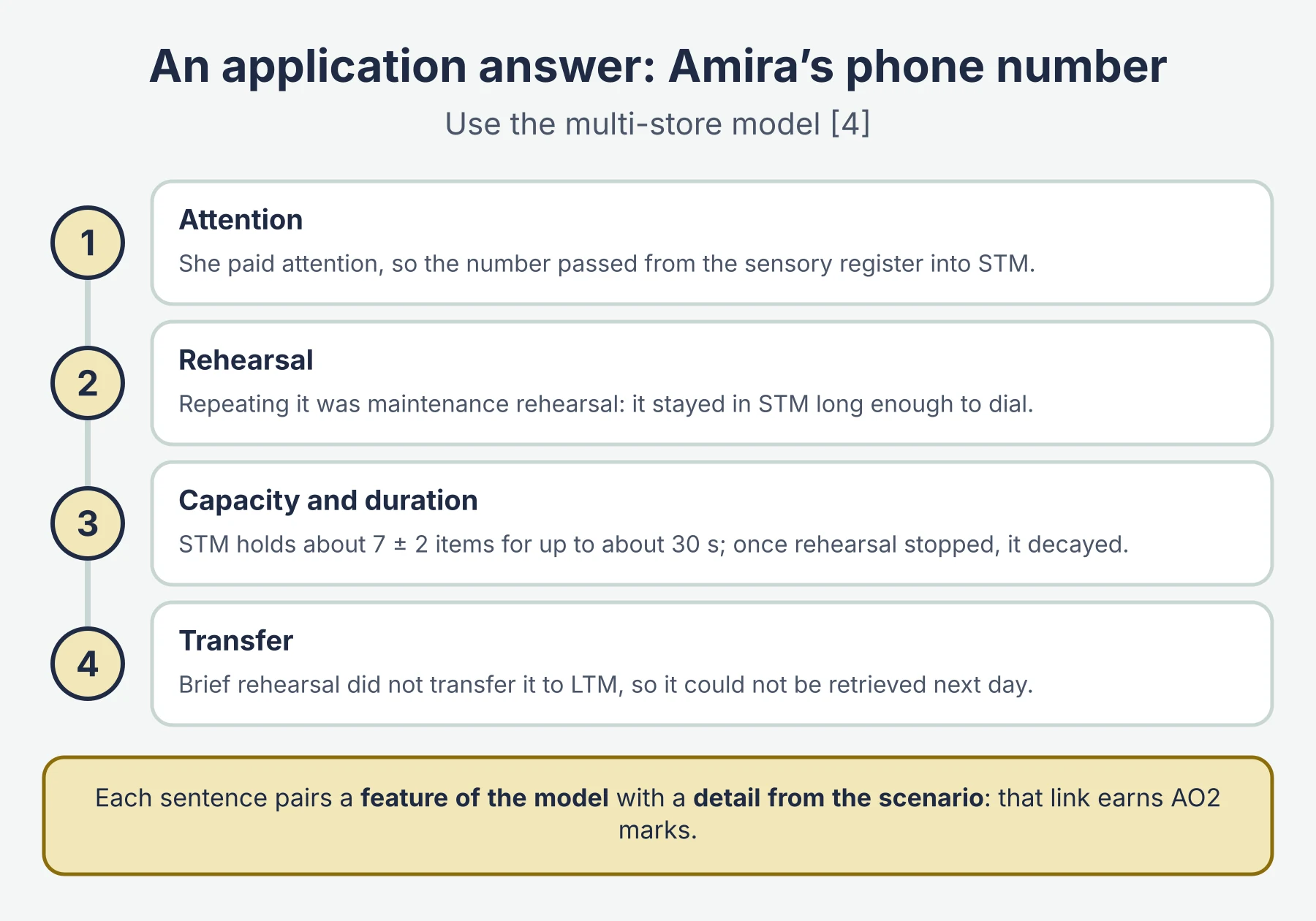
Processes: attention (sensory register to STM), maintenance rehearsal (keeps information in STM and transfers it to LTM), retrieval (LTM back to STM).
Working memory model in one table
| Component | Role | Coding | Capacity |
|---|---|---|---|
| Central executive | Directs attention, allocates resources | Modality-free; stores nothing | Very limited |
| Phonological loop | Speech-based information; phonological store and articulatory process | Acoustic | About two seconds of speech |
| Visuo-spatial sketchpad | Visual and spatial information | Visual and spatial | A few objects |
| Episodic buffer (added 2000) | Integrates information into episodes; links to LTM | Multi-modal | A few chunks |
Key terms
| Term | Meaning |
|---|---|
| Coding | The form in which information is stored |
| Capacity | How much information a store can hold |
| Duration | How long information stays in a store |
| Chunking | Grouping items into meaningful units to increase STM capacity |
| Maintenance rehearsal | Repeating information to keep it in STM |
| Word length effect | People recall more short words than long words, because the loop holds about two seconds of speech |
| Dual-task technique | Doing two tasks at once to test whether they share a component |
| Explicit (declarative) memory | Memory that can be consciously recalled: episodic and semantic |
| Implicit (non-declarative) memory | Memory shown in performance without conscious recall: procedural |
| Leading question | A question whose wording suggests a particular answer |
| Post-event discussion | Witnesses talking about an event after it, which can alter their accounts |
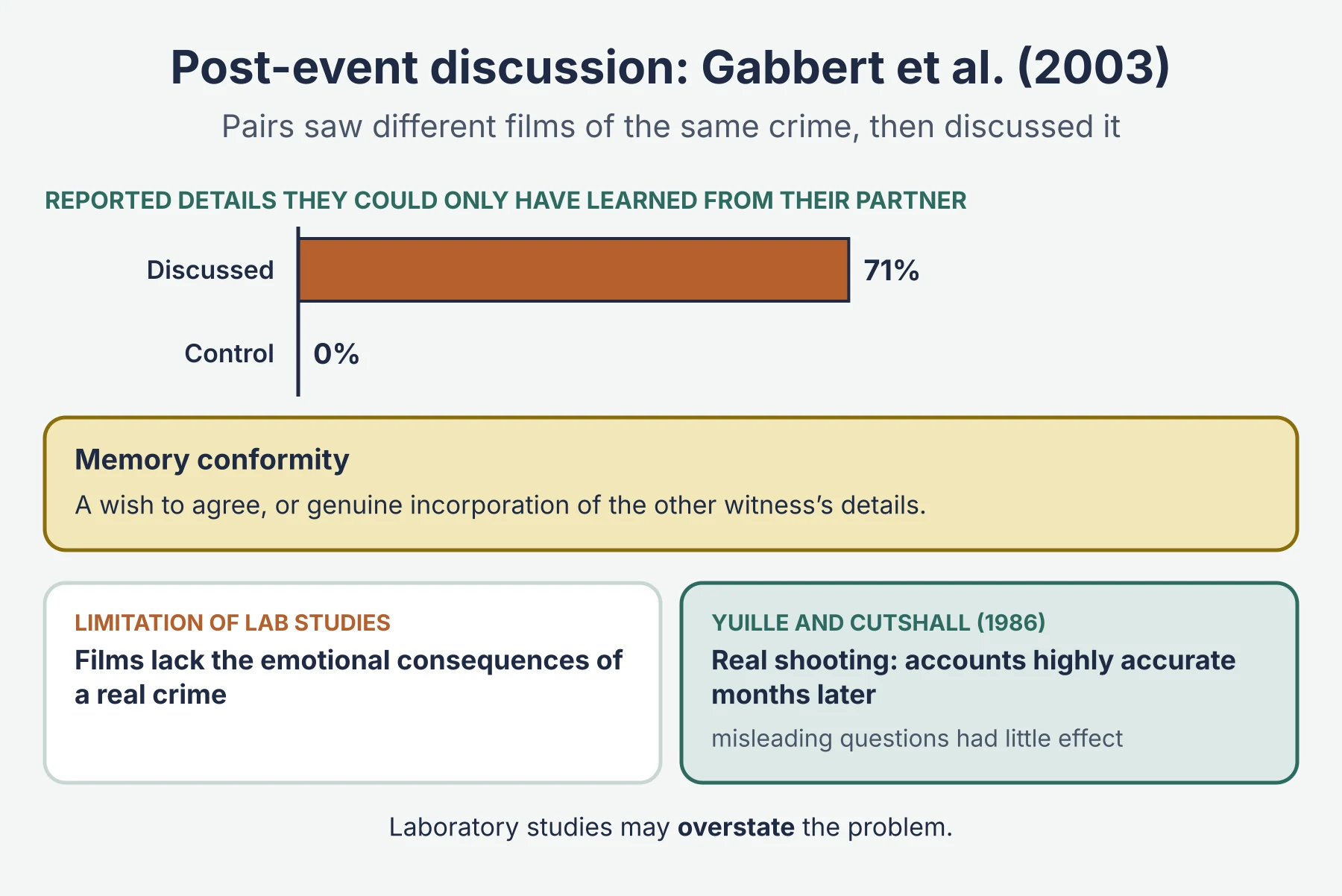
| Memory conformity | Witnesses adopting details from another witness’s account |
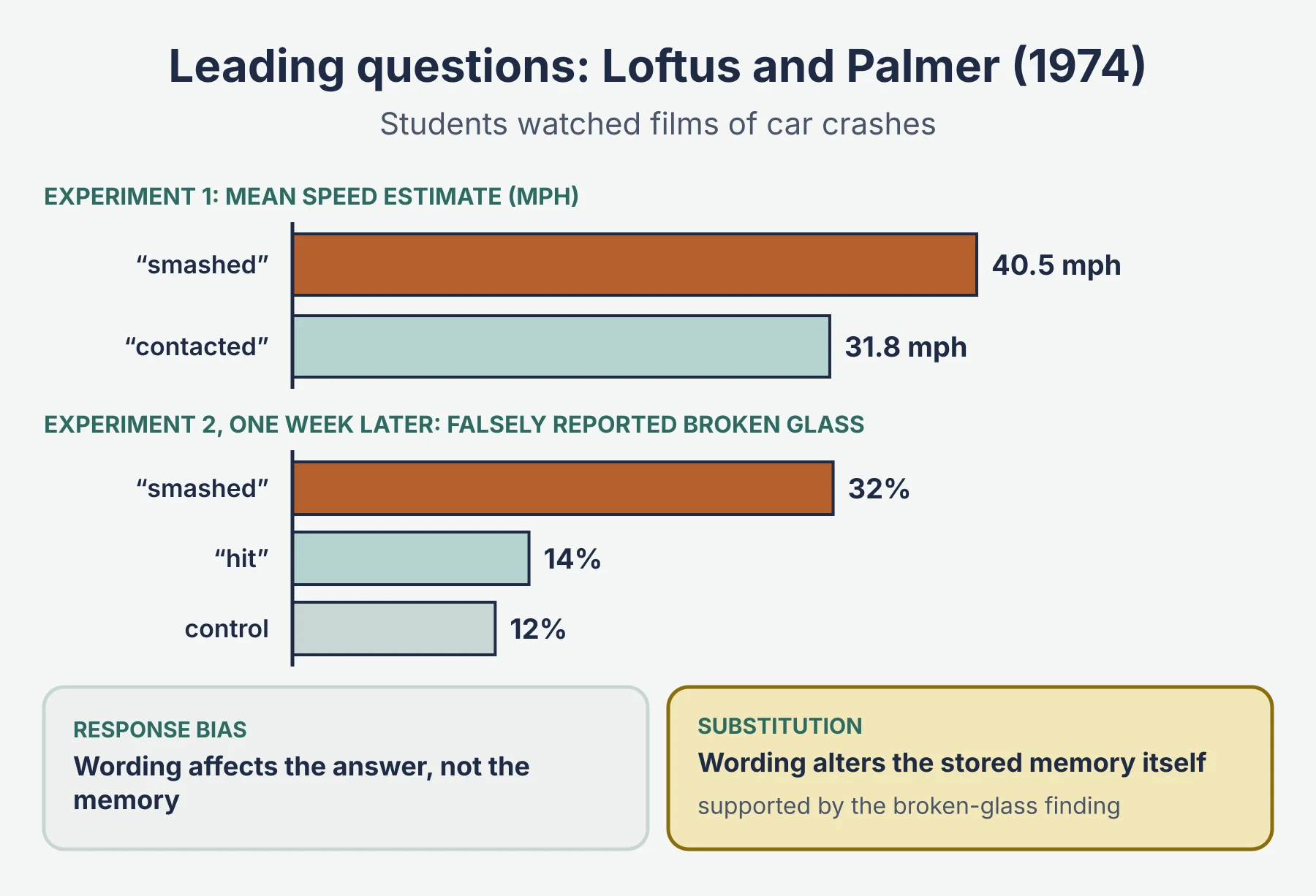
| Response bias | Wording affects the answer given, not the memory itself |
| Substitution | Misleading information replaces part of the original memory |
Studies at a glance
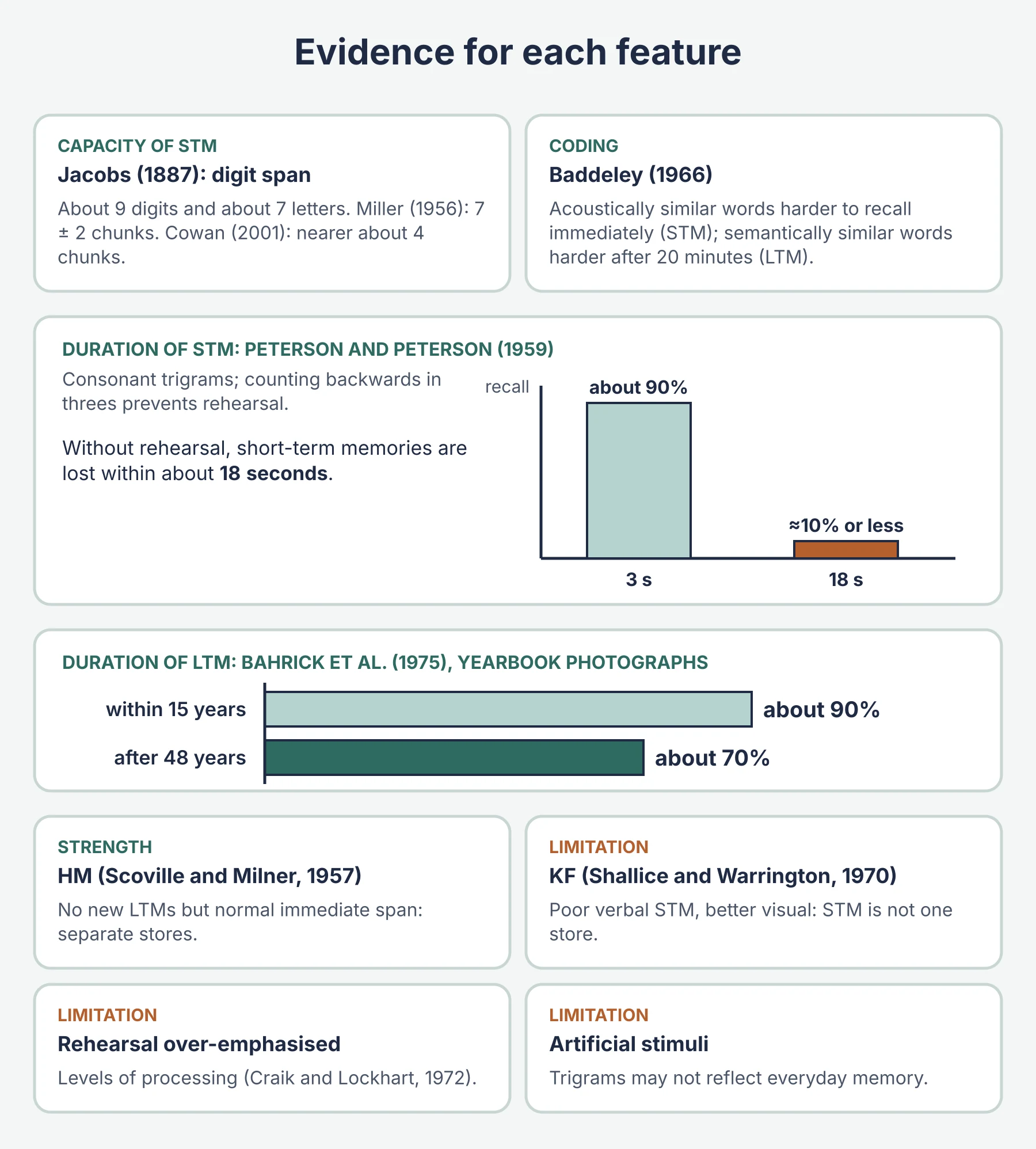
| Study | Finding | Use it for |
|---|---|---|
| Peterson and Peterson (1959) | Trigram recall about 90% after 3 s, around 10% or less after 18 s | STM duration |
| Baddeley (1966) | Acoustic confusion in immediate recall; semantic confusion after 20 minutes | Coding in STM and LTM |
| Bahrick et al. (1975) | About 90% face recognition after 15 years, about 70% after 48 years | LTM duration |
| HM (Scoville and Milner, 1957) | Could not form new LTMs; normal immediate span | Separate STM and LTM |
| KF (Shallice and Warrington, 1970) | Poor verbal STM, better visual STM | STM is not one store |
| Baddeley, Thomson and Buchanan (1975) | Word length effect | Capacity of the phonological loop |
| Clive Wearing | Lost episodic memory; kept procedural and much semantic | Types of LTM |
| Loftus and Palmer (1974) | “Smashed” 40.5 mph vs “contacted” 31.8 mph; 32% vs 14% vs 12% reported broken glass | Leading questions |
| Gabbert et al. (2003) | 71% of discussing witnesses reported details from the partner; 0% of controls | Post-event discussion |
| Yuille and Cutshall (1986) | Real-crime witnesses accurate months later | Limitation of lab EWT research |
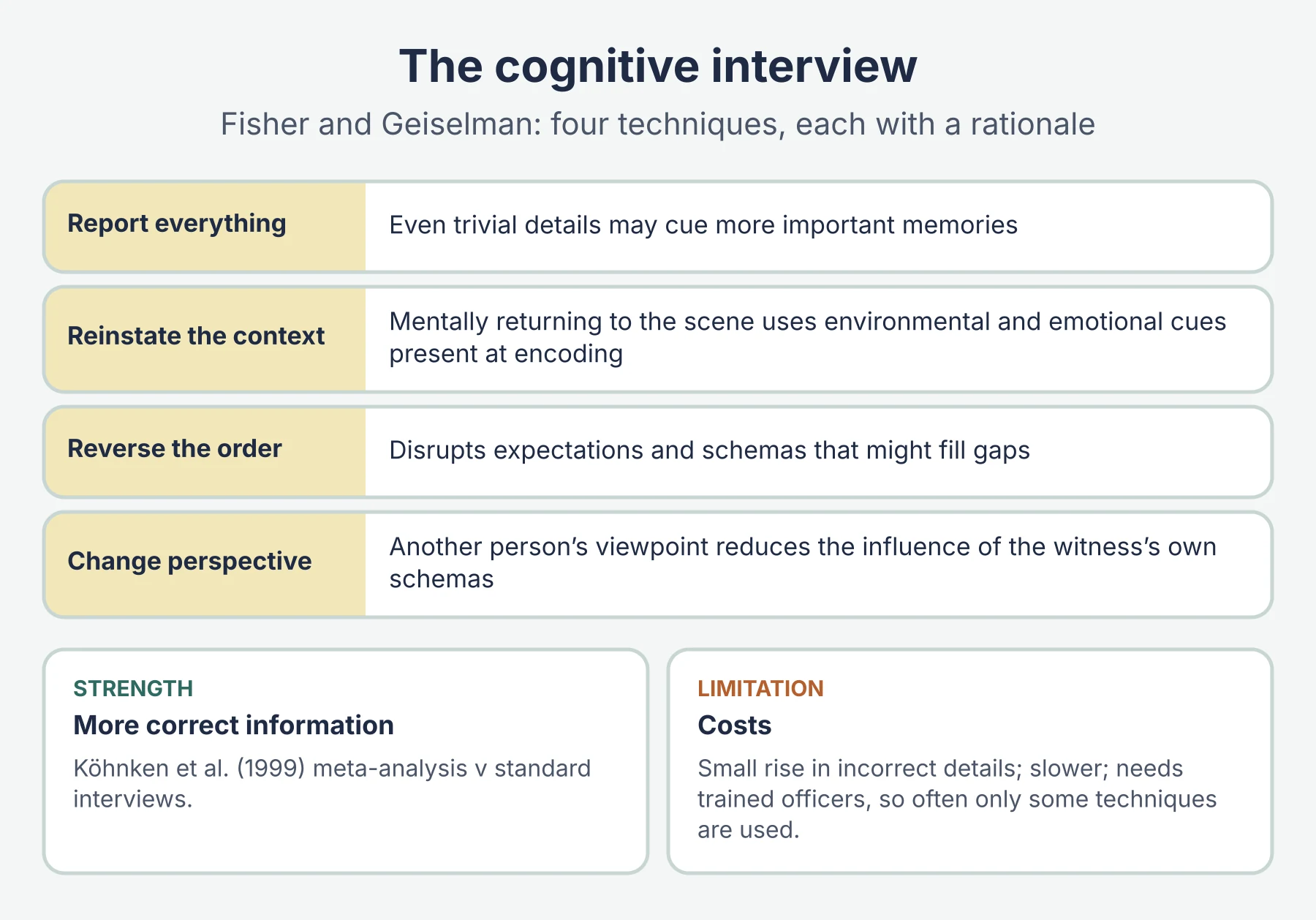
| Köhnken et al. (1999) | Meta-analysis: more correct information, slight rise in errors | Effectiveness of the cognitive interview |
The cognitive interview
| Technique | Why it helps |
|---|---|
| Report everything | Minor details can cue major ones |
| Reinstate the context | Cues present at encoding aid retrieval |
| Reverse the order | Disrupts schema-driven reconstruction |
| Change perspective | Reduces the effect of the witness’s own expectations |
Evaluation points to use
- Multi-store model: supported by coding and duration studies and by HM; challenged by KF and by learning without rehearsal; much evidence uses artificial stimuli.
- Working memory model: supported by dual-task studies, the word length effect and KF; central executive vague and hard to test.
- Types of LTM: clinical evidence supports separation, but case studies are hard to generalise and may involve damage to several areas.
- EWT research: high control and causal conclusions, but artificial films lack real consequences.
- Cognitive interview: increases correct recall but takes time and training.
Exam traps
- Mixing up capacity and duration, or giving the right figure for the wrong store.
- Saying the working memory model explains long-term memory.
- Naming the central executive as a store.
- Describing a study without a finding, or a finding with no study.
- Giving cognitive interview techniques with no explanation of how they work.
- Writing about forgetting, which this section does not list.
Self-test
- What is the coding, capacity and duration of STM?
- What did Peterson and Peterson (1959) do to stop rehearsal?
- What did Baddeley (1966) show about coding?
- Why does KF’s case challenge the multi-store model?
- Name the two parts of the phonological loop.
- What is the word length effect, and what does it show?
- Why was the episodic buffer added?
- What does a dual-task study show?
- Distinguish episodic and semantic memory.
- What were the mean speed estimates for “smashed” and “contacted” in Loftus and Palmer (1974)?
- What did Gabbert et al. (2003) find?
- Give the rationale for “reinstate the context”.
Answers: 1. Mainly acoustic; about 7 plus or minus 2 items; about 18-30 seconds without rehearsal. 2. They had participants count backwards in threes. 3. STM codes mainly acoustically and LTM mainly semantically. 4. KF had impaired verbal STM but better visual STM, so STM seems to have separate components. 5. The phonological store and the articulatory process. 6. More short words than long words are recalled; the loop holds about two seconds of speech. 7. To explain how information from different components and LTM is combined into single episodes. 8. Tasks using the same component interfere; tasks using different components do not. 9. Episodic is personal experience tied to time and place; semantic is general knowledge. 10. 40.5 mph and 31.8 mph. 11. 71% of witnesses who discussed the event reported details they had not seen, against 0% of controls. 12. Cues present when the memory was formed help retrieval.
More resources on this topic
Related resources
-
Study guides
OxfordAQA International A-level Psychology (9685): 3.1.3 Psychopathology
Study guide to OxfordAQA 9685 section 3.1.3 Psychopathology: definitions of abnormality, phobias, depression, behavioural and cognitive treatments.
Psychology · OxfordAQA · AS Level
Read guide -
Practice questions
OxfordAQA International A-level Psychology (9685): 3.1.3 Psychopathology – Practice Questions
Twelve original OxfordAQA 9685 psychopathology questions: definitions, treatment data, phobia and depression scenarios and extended evaluations, with answers.
Psychology · OxfordAQA · AS Level
Try questions -
Revision notes
OxfordAQA International A-level Psychology (9685): 3.1.3 Psychopathology – Revision Notes
Condensed OxfordAQA 9685 psychopathology notes: four definitions, phobia and depression characteristics, two-process model, SD, flooding, CBT and a self-test.
Psychology · OxfordAQA · AS Level
Revise topic
Studying Psychology?
This page is free and stays free. Marlbridge is not offering Psychology classes at the moment, so there is no tuition to book for it. The free study resources stay open to everyone.
Get free revision emails (optional)
Occasional emails with practice questions, worked explanations and links to free resources for the qualification and subjects you choose. No spam, and you can unsubscribe from any email. The free tools on this site never need an email.