
Revision Notes
OxfordAQA IGCSE Accounting: Internal financial statements of limited companies (9215) – Revision Notes
Condensed recall notes, a layout checklist and a self-test on limited company income statements and statements of financial position, OxfordAQA 9215.
- Subject
- Accounting
- Level
- IGCSE
- Topic
- Preparation of financial statements
- Author
- Marlbridge Academic Team
- Updated
- Reviewed by
- Javaid Iqbal Sabri (what this means)
Aligned to OxfordAQA IGCSE Accounting (9215), First teaching 2024, first examined 2026. Official specification .
Syllabus page (what it covers and how it is assessed): OxfordAQA IGCSE Accounting.
Syllabus points this page covers
9215
- Internal financial statements of limited companies
Found an error? Report a correction.
Need help with this topic? Request a free trial class for IGCSE Accounting (9215).
These notes are aligned to the OxfordAQA International GCSE Accounting (9215) specification, version 1.2, for exams from May/June 2026 onwards. They cover the limited companies row of section 3.4, Preparation of financial statements, which is assessed in Paper 2: Financial Statements. For full explanations and a long worked example, read the study guide. Test yourself with the practice questions.
Related pages: the course hub, the printable checklist and the free diagnostics. Amounts are in dollars and every business is invented.
What the specification lists
- Prepare and comment on the internal financial statements of limited liability companies.
- The statements are the income statement and the statement of financial position. They are for internal use and not for publication.
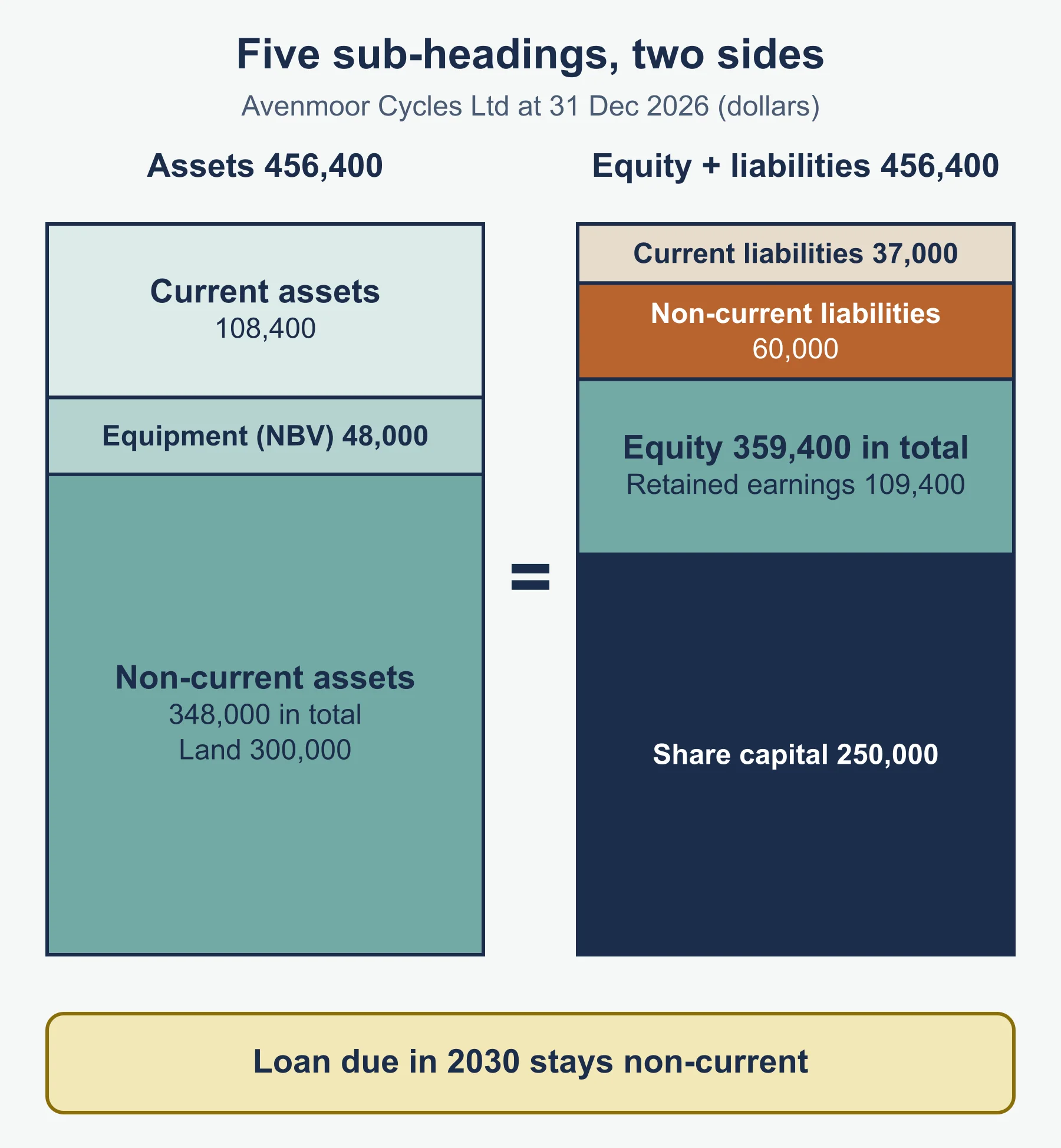
- The statement of financial position has five sub-headings: non-current assets, current assets, equity, non-current liabilities and current liabilities.
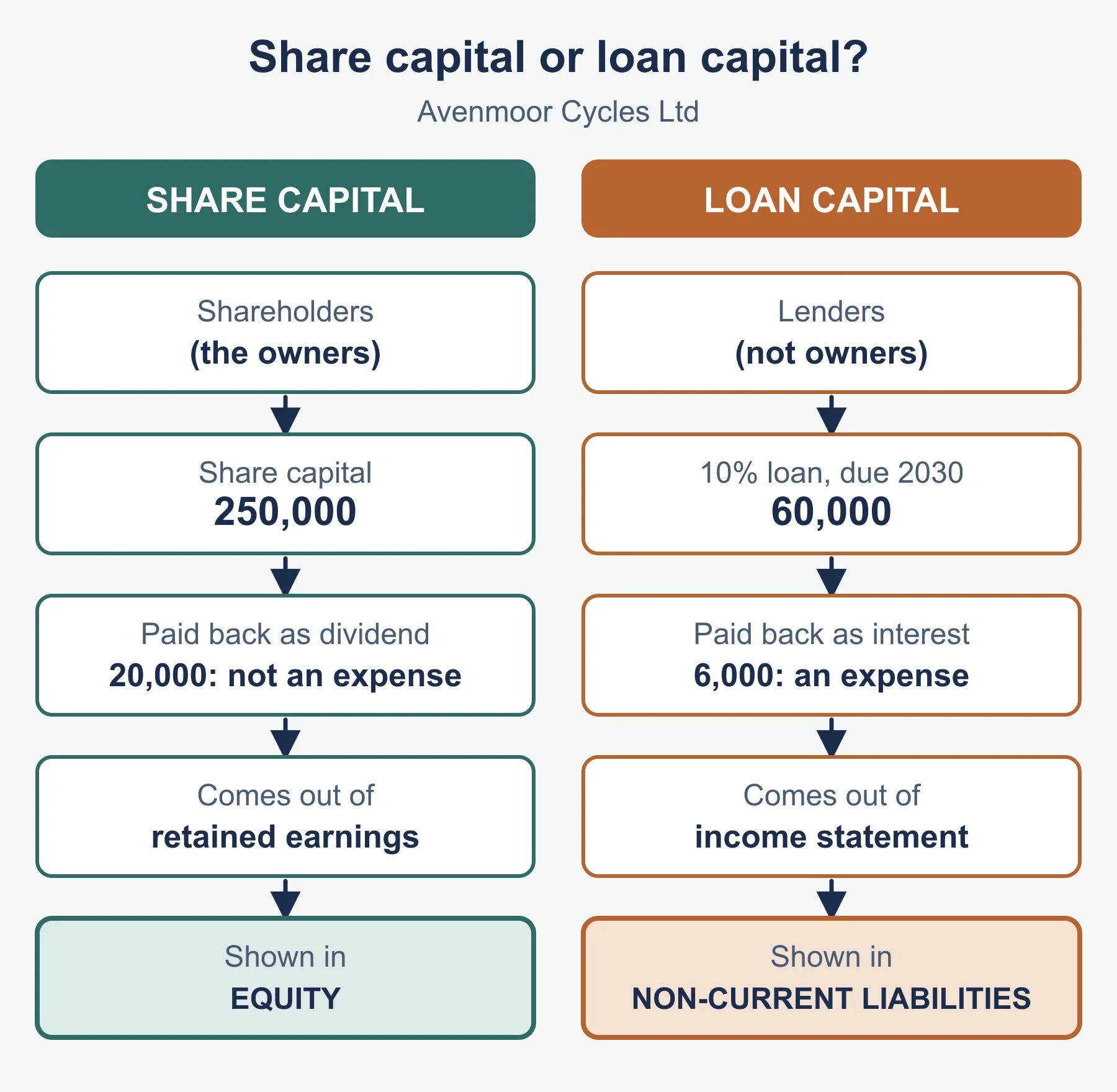
- Distinguish between share capital and loan capital.
- Not examined: statement of changes in equity, preference shares, general reserves, rights issues, bonus issues and the revaluation of non-current assets.
Key distinctions
| Point | Share capital | Loan capital |
|---|---|---|
| Provider | Owners (shareholders) | Lenders |
| Return | Dividend, only if the company chooses to pay | Interest, a fixed cost |
| Section of the statement | Equity | Non-current liabilities, or current if due within a year |
| Income statement effect | None; dividends come out of retained earnings | Interest reduces profit for the year |
Layout checklist: income statement
- Revenue.
- Less cost of sales: opening inventory plus purchases, less closing inventory.
- Gross profit.
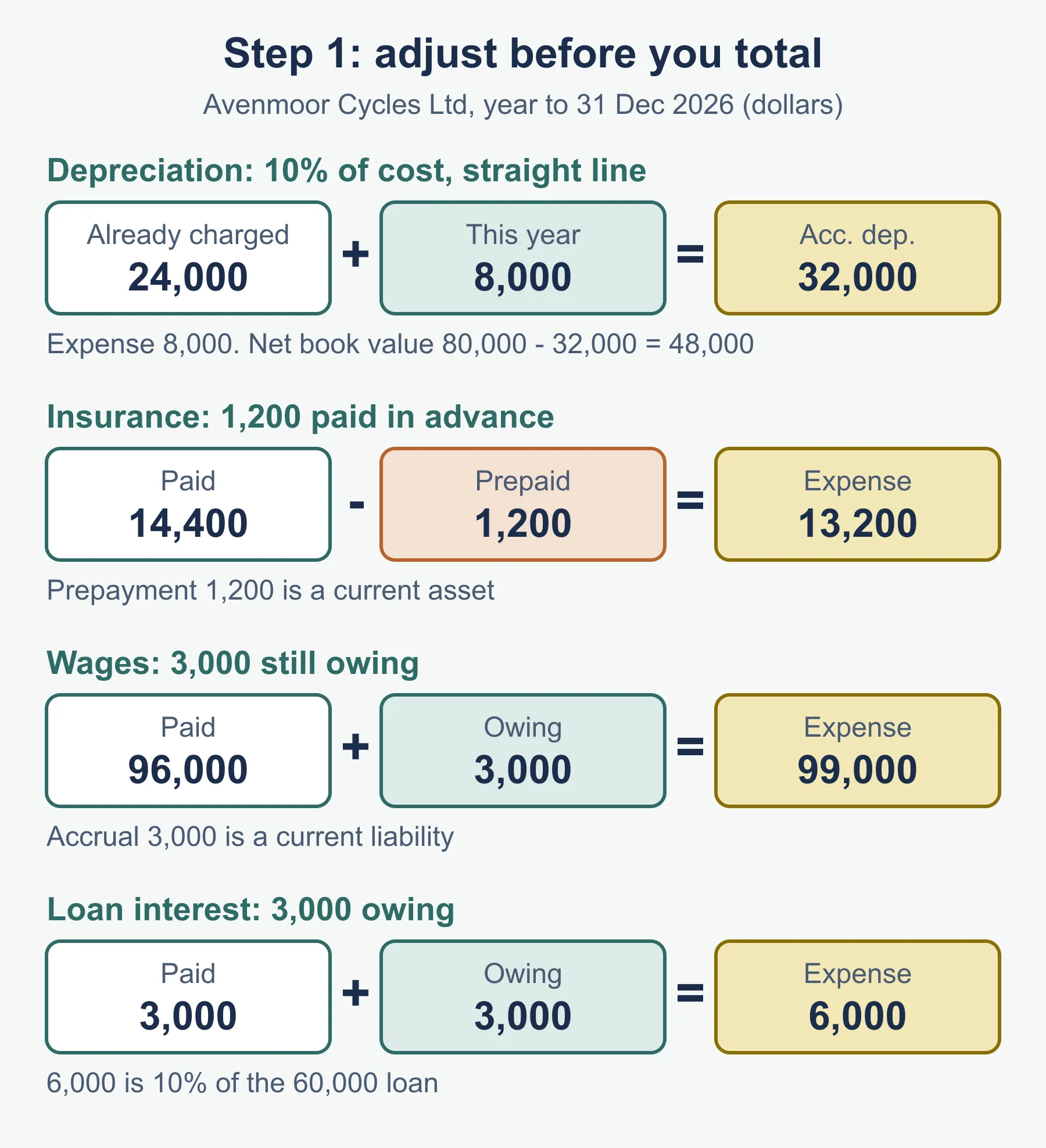
- Less expenses, after adjusting for accruals, prepayments, depreciation, irrecoverable debts and the change in the provision for doubtful debts.
- Operating profit.
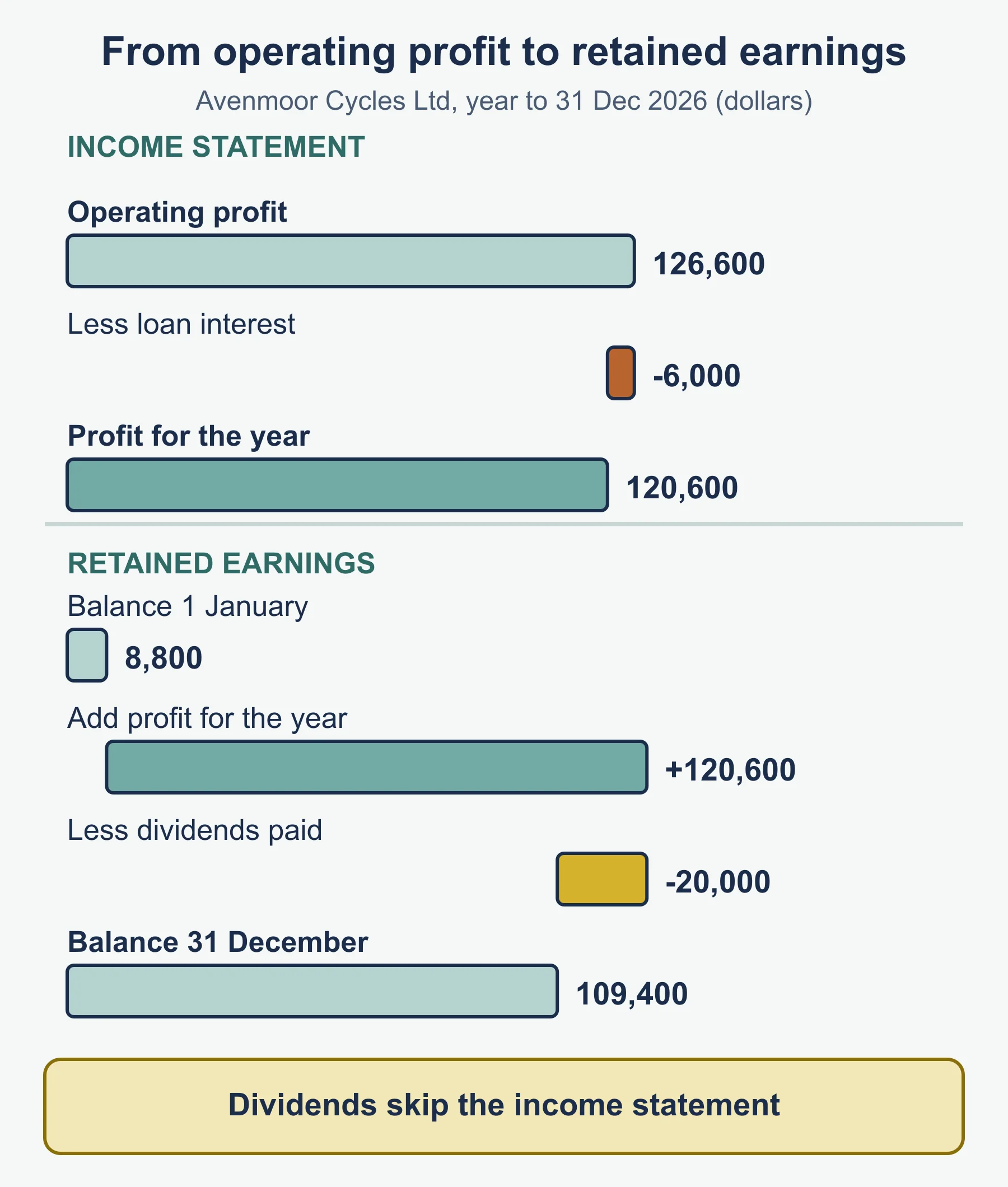
- Less loan interest (paid plus owing).
- Profit for the year.
- Working underneath: retained earnings at the start, plus profit for the year, less dividends paid, equals retained earnings at the end.
Layout checklist: statement of financial position
| Section | Contents | Notes |
|---|---|---|
| Non-current assets | Cost, accumulated depreciation, net book value | Land is not depreciated |
| Current assets | Inventory, trade receivables less provision, prepayments, bank | Closing inventory, not opening |
| Equity | Share capital plus retained earnings | Use the closing retained earnings |
| Non-current liabilities | Loans due after more than a year | |
| Current liabilities | Trade payables, accruals, overdraft, loan part due within a year |
The balancing check is: non-current assets plus current assets, less all liabilities, equals equity.
Method in steps
- Read the adjustments and work each one out on scrap paper before you start.
- Write the income statement top to bottom, keeping a running profit.
- Deduct loan interest, then find profit for the year.
- Roll retained earnings forward using the trial balance figure at the start of the year.
- Build the statement of financial position by sub-heading.
- Check that equity equals net assets. If it does not, look first at retained earnings and the accruals.
Worked reminder: Ketterby Candles Ltd
At the year end Ketterby Candles Ltd has these balances. Vehicles have a net book value of 36,000 and equipment 14,000. Inventory is 9,000, trade receivables 12,500, bank 4,300 and a prepayment 700. Trade payables are 8,200 and accrued expenses 1,100. A loan of 20,000 is repayable in six years. Ordinary share capital is 40,000.
| Item | Working | Amount |
|---|---|---|
| Non-current assets | 36,000 + 14,000 | 50,000 |
| Current assets | 9,000 + 12,500 + 4,300 + 700 | 26,500 |
| Current liabilities | 8,200 + 1,100 | 9,300 |
| Net assets | 50,000 + 26,500 - 9,300 - 20,000 | 47,200 |
| Retained earnings | 47,200 - 40,000 | 7,200 |
Equity is 40,000 plus 7,200 which is 47,200. The statement balances. Retained earnings can be found as the balancing figure, but only when every asset and liability is already correct.
Must-know distinctions
- Dividend and interest: interest is an expense, a dividend is a distribution of profit.
- Operating profit and profit for the year: loan interest sits between them.
- Accrual and prepayment: an accrual is a liability, a prepayment is an asset.
- Cost of the loan and the loan itself: interest goes in the income statement, the loan balance goes in the statement of financial position.
- Non-current and current liability: the test is whether repayment is due within one year of the date of the statement.
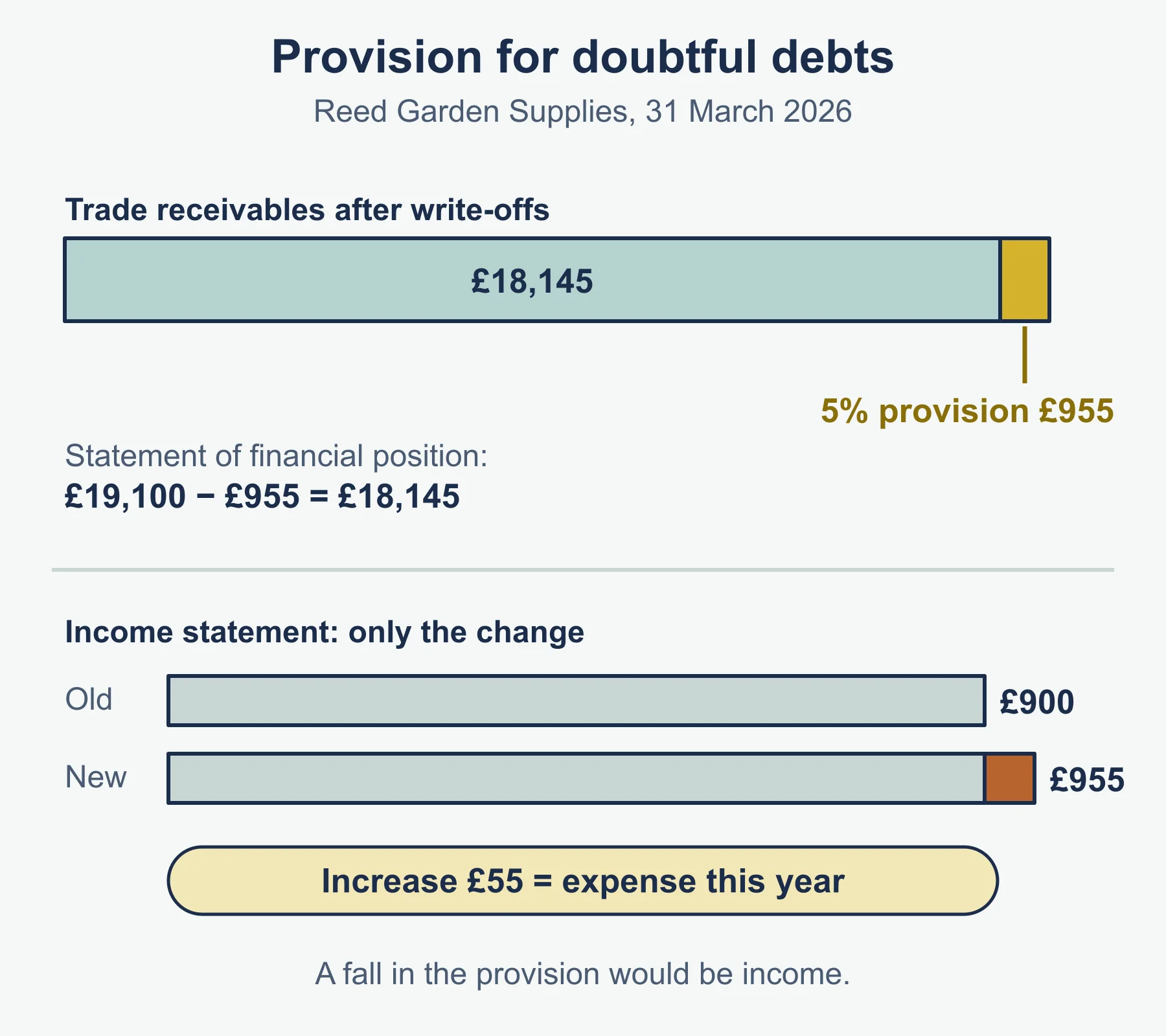
- Provision charge and provision balance: the income statement shows only the change, the statement of financial position shows the whole balance deducted from trade receivables.
Commenting on the statements
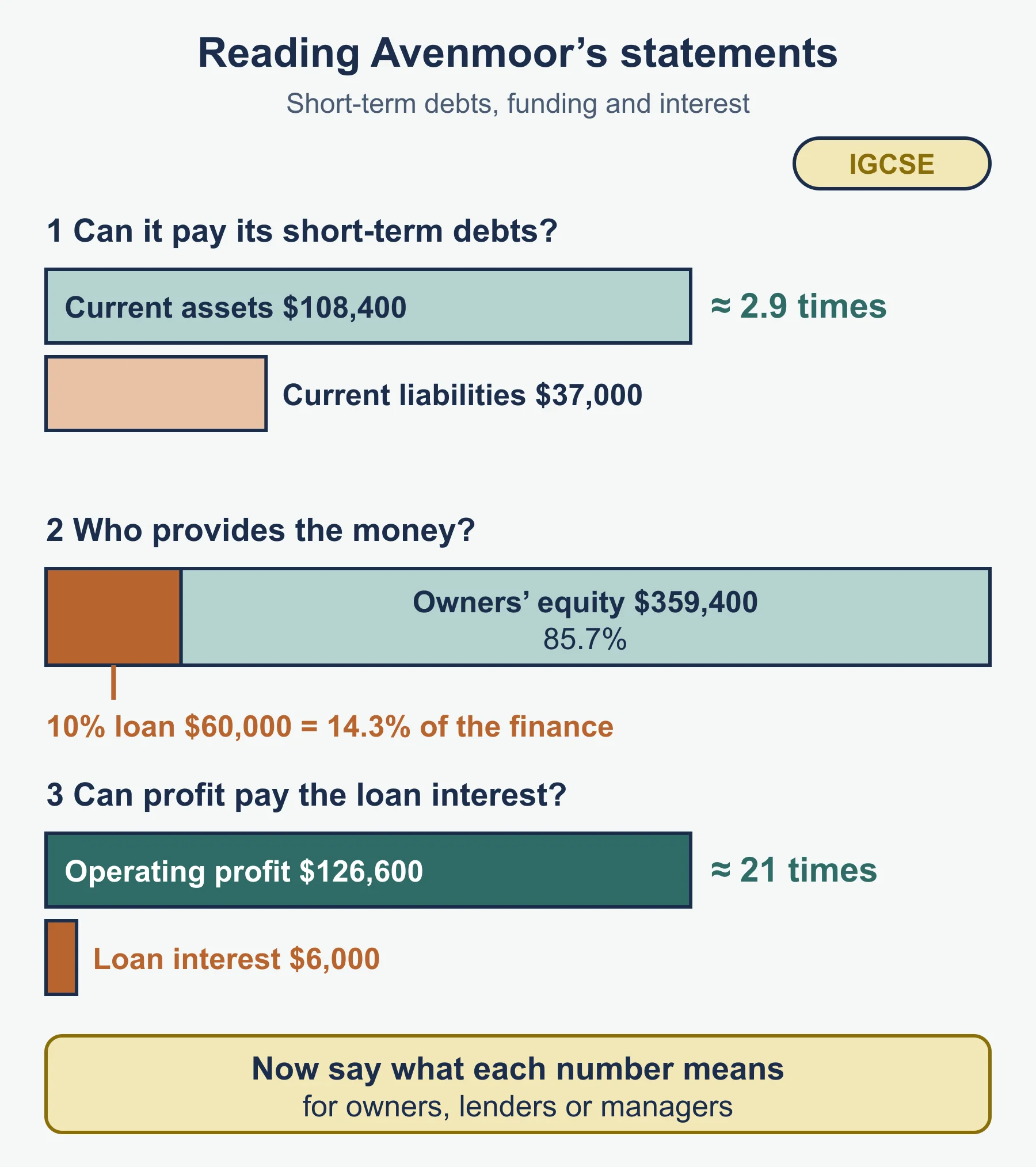
The specification says to prepare and comment. A good comment has three parts: a figure, a comparison and a meaning.
- Profit: state the profit for the year as a share of revenue and say whether it is higher or lower than the previous year or another business.
- Liquidity: compare current assets with current liabilities and say whether short-term debts can be paid.
- Finance: compare loan capital with equity. A business with a lot of loan capital has fixed interest to pay whether or not it makes a profit.
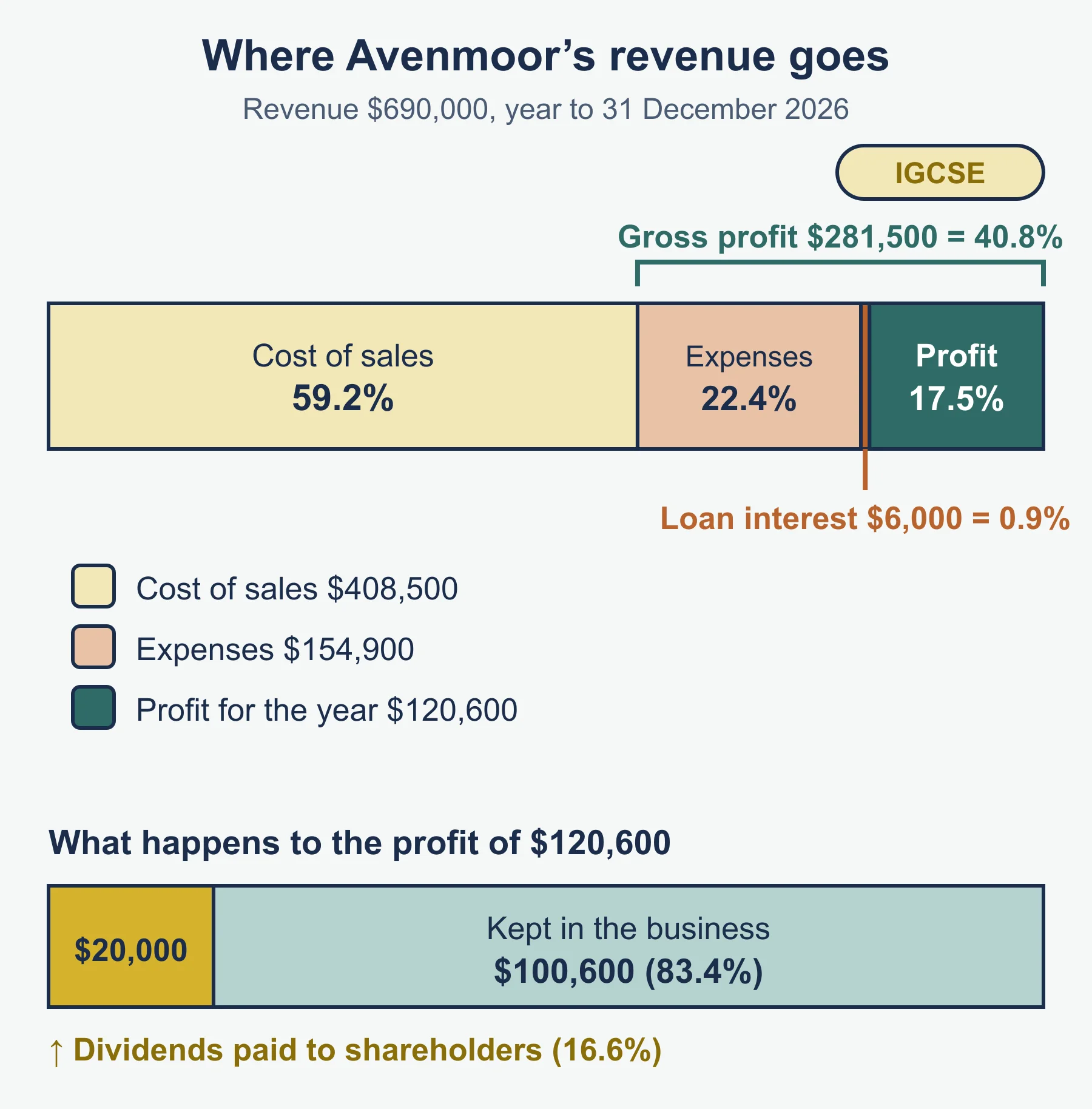
- Distribution: compare dividends with profit for the year to show how much is kept in the business.
- Limit: say what the figures do not show, for example that one year is not a trend.
The specification does not list ratio formulas for this row, so use the measures your course teaches and explain them in words.
Worked reminder: interest and dividend
A company has a 5% loan of 80,000 for the whole year and paid 2,000 of interest. It has 200,000 ordinary shares and pays 3 cents a share.
| Item | Working | Result |
|---|---|---|
| Interest for the year | 5% of 80,000 | 4,000 |
| Interest owing | 4,000 - 2,000 | 2,000 |
| Dividend | 200,000 x 0.03 | 6,000 |
The income statement deducts 4,000 of interest. The owing 2,000 is a current liability. The dividend of 6,000 is deducted in the retained earnings working. Interest goes against profit before it is found. Dividends go against profit after it is found.
Why a company is set up
Shareholders have limited liability, so they cannot lose more than they paid for their shares. The company can raise capital by selling shares and by borrowing. The cost is more rules and a shared say in how the business is run. A sole trader has none of the extra rules but is personally liable for the business debts.
Quick self-test
- A company pays a dividend. Does it appear among the expenses in the income statement?
- A 6% loan of 50,000 was held all year. Interest paid was 1,800. What is the interest owing at the year end?
- Retained earnings at the start were 12,400, profit for the year was 9,100 and dividends were 4,000. What is the closing figure?
- A company has 150,000 ordinary shares and pays 8 cents a share. How much is the total dividend?
- Equipment cost 40,000 and has accumulated depreciation of 18,000. It is depreciated at 20% reducing balance. What is the charge and the new net book value?
- Trade receivables are 25,000. The provision is to be 4%. The old provision was 700. What is the amount charged in the income statement?
- Total assets are 120,000, current liabilities 15,000 and non-current liabilities 25,000. What is equity?
- In which section of the statement of financial position does a bank overdraft appear?
- A loan is repayable in eight months from the year end. Where is it shown?
- Name two items the specification says will not be examined for limited companies.
- Who provides share capital and who provides loan capital?
- State one reason a company statement of this kind may differ from a published statement.
Answers
- No. It is deducted from retained earnings.
- Full-year interest is 3,000, so 1,200 is owing.
- 12,400 + 9,100 - 4,000 = 17,500.
- 150,000 x 0.08 = 12,000.
- Net book value before the charge is 22,000, so the charge is 4,400 and the new net book value is 17,600.
- 4% of 25,000 is 1,000, less 700, so 300 is charged.
- 120,000 - 15,000 - 25,000 = 80,000.
- Current liabilities.
- Current liabilities, because it falls due within a year.
- Any two of: statement of changes in equity, preference shares, general reserves, rights issues, bonus issues, revaluation of non-current assets.
- Shareholders provide share capital. Lenders provide loan capital.
- These statements are for internal use. They are not prepared in a format for publication.
Where marks are usually lost
- Missing the heading or date on a statement.
- Showing dividends as an expense.
- Forgetting interest owing, or putting a loan repayable in several years among current liabilities.
- Depreciating land, or using the wrong base for reducing balance.
- Using opening inventory in current assets.
- Giving the full provision for doubtful debts as the expense.
- Adding up a total correctly but putting an item under the wrong sub-heading.
- Commenting without a figure, or giving a figure without a reason.
- Mixing up the retained earnings at the start with the retained earnings at the end.
Frequently asked questions
Is a dividend an expense in a company’s income statement? No. A dividend is a distribution of profit and is deducted from retained earnings. Loan interest, by contrast, is an expense in the income statement.
How do you decide if a loan is a current or non-current liability? The test is whether repayment is due within one year of the date of the statement. If it is, the loan is a current liability; otherwise it is non-current.
How is loan interest owing treated at the year end? Charge the full year’s interest in the income statement and show any unpaid amount as a current liability. For example, a 5% loan of 80,000 has interest of 4,000; if 2,000 was paid, 2,000 is owing.
What makes a good comment on company financial statements? A good comment has three parts: a figure, a comparison and a reason or consequence. A figure without a reason, or a comment without a figure, earns little.
What is the balancing check for a company’s statement of financial position? Non-current assets plus current assets, less all liabilities, equals equity, which is share capital plus retained earnings.
Official syllabus
OxfordAQA International GCSE Accounting (9215), version 1.2, for International GCSE exams May/June 2026 onwards, published by OxfordAQA. Section 3.4, limited companies.
Get free revision emails (optional)
Occasional emails with practice questions, worked explanations and links to free resources for the qualification and subjects you choose. No spam, and you can unsubscribe from any email. The free tools on this site never need an email.
Related resources
-
Study guides
OxfordAQA IGCSE Accounting: Manufacturing accounts (9215)
Study guide to manufacturing accounts for OxfordAQA International GCSE Accounting 9215: prime cost, overheads, factory cost and final statements.
Accounting · OxfordAQA · IGCSE
Read guide -
Practice questions
OxfordAQA IGCSE Accounting: Manufacturing accounts (9215) – Practice Questions
Original practice questions with worked answers on manufacturing accounts for OxfordAQA International GCSE Accounting 9215, prime cost to final statements.
Accounting · OxfordAQA · IGCSE
Try questions -
Revision notes
OxfordAQA IGCSE Accounting: Manufacturing accounts (9215) – Revision Notes
Condensed revision notes on manufacturing accounts for OxfordAQA International GCSE Accounting 9215, with layouts, a worked reminder and a self-test.
Accounting · OxfordAQA · IGCSE
Revise topic
Related articles
-
teaching
A Level tuition in Dubai: Cambridge or Pearson Edexcel International A Level?
Schools in Dubai and Abu Dhabi teach either Cambridge International AS & A Level or Pearson Edexcel International A Level. How the two are structured, why it matters for tuition, and how online classes from Lahore work.
9 October 2026
-
curriculum guides
Choosing subjects at IGCSE and A Level
How subject choices at 14 and 16 affect university options later, and how to keep pathways open without overloading a timetable.
28 July 2026
Studying this with a teacher
Working through Accounting IGCSE?
This page is free and stays free. If you would rather be taught it, Marlbridge runs Accounting classes one-to-one and in small groups of up to 15, online in your own time zone. The first trial class is free. WhatsApp replies within an hour (8am–11pm Pakistan time, every day); email the same day.
OxfordAQA Accounting teachers at Marlbridge

