
Study Guides
OxfordAQA IGCSE Accounting: Manufacturing accounts (9215)
Study guide to manufacturing accounts for OxfordAQA International GCSE Accounting 9215: prime cost, overheads, factory cost and final statements.
- Subject
- Accounting
- Level
- IGCSE
- Topic
- Preparation of financial statements
- Author
- Marlbridge Academic Team
- Updated
- Reviewed by
- Javaid Iqbal Sabri (what this means)
Aligned to OxfordAQA IGCSE Accounting (9215), First teaching 2024, first examined 2026. Official specification .
Syllabus page (what it covers and how it is assessed): OxfordAQA IGCSE Accounting.
Syllabus points this page covers
9215
- Manufacturing accounts
Found an error? Report a correction.
Need help with this topic? Request a free trial class for IGCSE Accounting (9215).
This guide follows the OxfordAQA International GCSE Accounting (9215) specification, version 1.2, for exams from May/June 2026. It covers the manufacturing organisations part of section 3.4, Preparation of financial statements. The qualification is untiered, and the specification lists content 3 to 5 for Paper 2, Financial Statements. You learn how a business that makes its own goods works out what the goods cost, and how that figure feeds the income statement and the statement of financial position. Use it with the revision notes and the practice questions. Start from the OxfordAQA IGCSE Accounting hub, tick topics off on the checklist and find weak spots with the free diagnostics. The routine around Paper 2 is in Two 75-Mark Papers and How to Work Them, and the trial balance behind every statement is covered in Verification of Accounting Records. All amounts below are in dollars.
What the specification asks for
| Specification point | Where it is taught here |
|---|---|
| Financial statements of manufacturers: manufacturing account, income statement, statement of financial position | Sections 1, 5, 6, 7 |
| Prime costs | Section 2 |
| Overhead cost | Section 3 |
| Factory cost of finished goods | Section 4 |
| Adjustments from the use of concepts (other payables, other receivables, depreciation, provision for doubtful debts, goods taken for own use, inventory) | Sections 3, 5, 7 |
| Comment on the statements | Section 8 |
The specification says the provision for unrealised profit will not be examined. That means finished goods are moved from the factory to the income statement at cost, with no profit added by the factory.
1. Why a manufacturer needs a manufacturing account
A trading business buys goods and sells them. A manufacturer buys materials, pays workers and runs machines to turn them into goods. The manufacturing account collects every cost of making the goods and ends with one figure, the factory cost of finished goods. That figure then takes the place of purchases in the income statement.
The three statements fit together like this.
| Statement | Question it answers | Ends with |
|---|---|---|
| Manufacturing account | What did it cost to make the goods finished this year? | Factory cost of finished goods |
| Income statement | Did selling the goods make a profit? | Profit for the year |
| Statement of financial position | What does the business own and owe on the last day? | Net assets equal to equity |
2. Prime cost
Prime cost is the cost of the materials used in the goods plus the wages of the people who make them. Both are direct costs, which means you can trace them to the goods.
| Line | Treatment |
|---|---|
| Opening inventory of raw materials | Add |
| Purchases of raw materials | Add |
| Carriage inwards on raw materials | Add |
| Returns outwards of raw materials | Deduct |
| Closing inventory of raw materials | Deduct |
| Cost of raw materials used | The result |
| Direct wages | Add |
| Prime cost | Raw materials used plus direct wages |
Carriage inwards is the cost of bringing materials to the factory, so it belongs here. Carriage outwards is the cost of delivering to customers, so it belongs in the income statement.
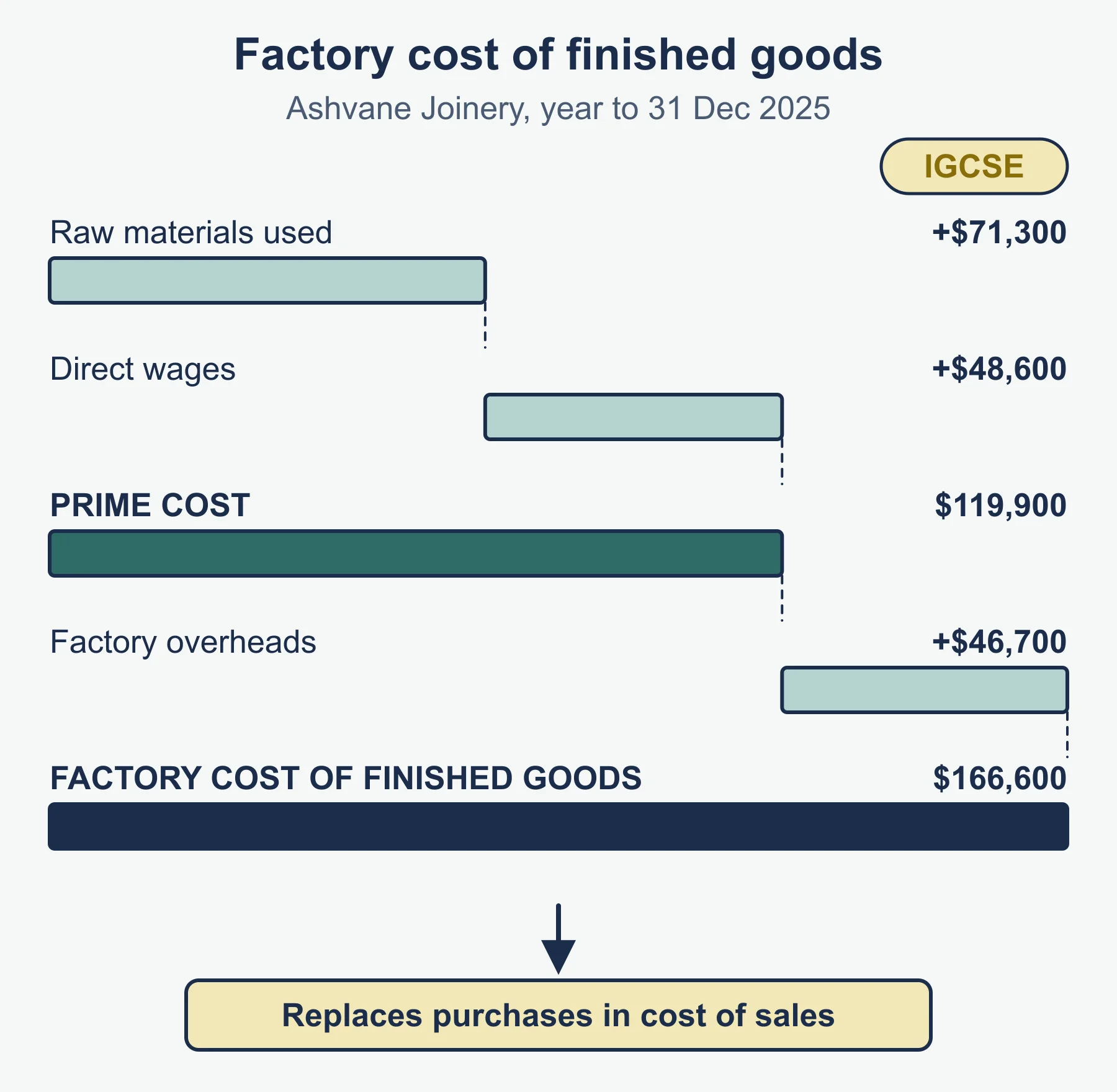
3. Overhead cost
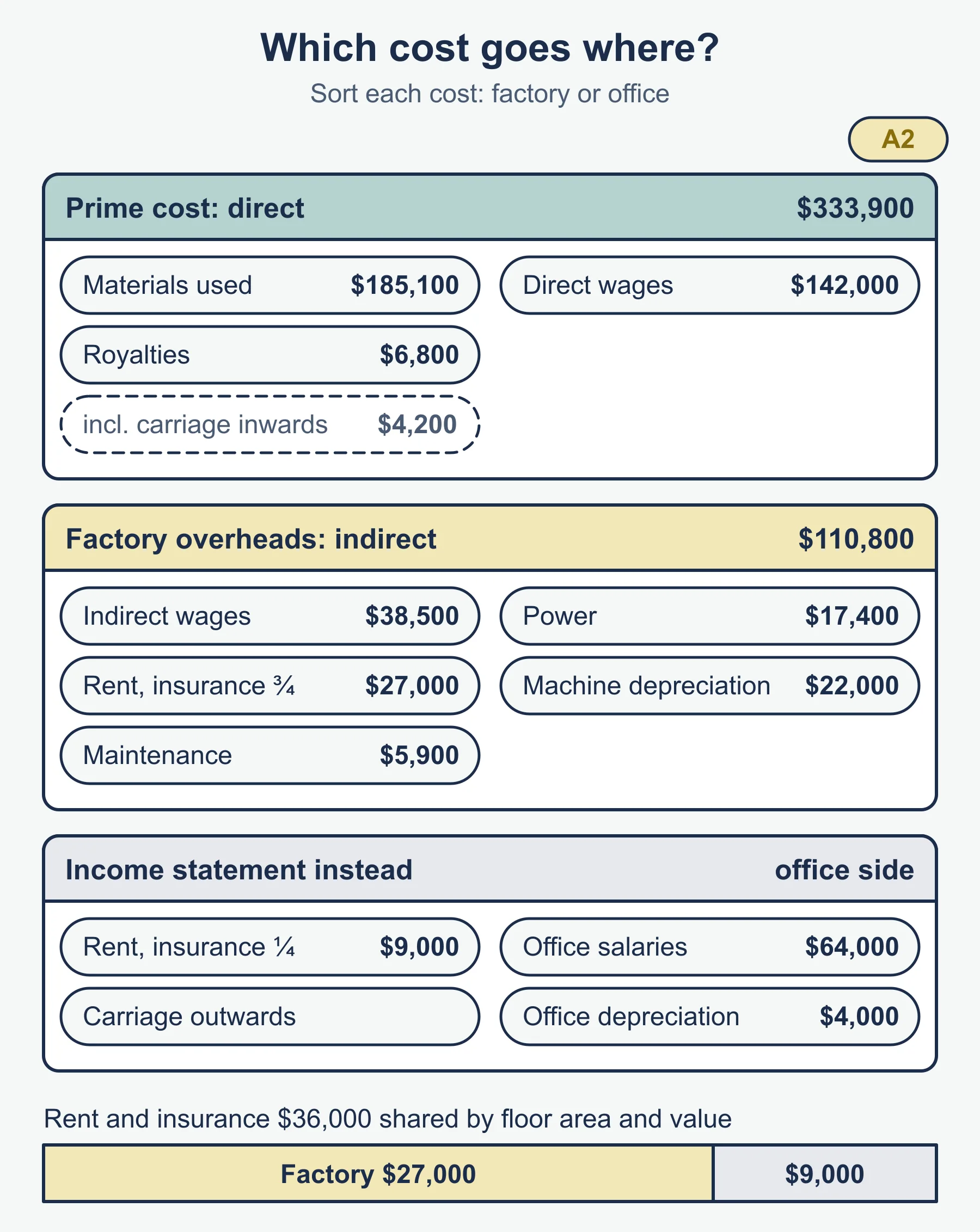
Overheads (factory overheads) are the costs of running the factory that you cannot trace to one unit of output. Typical items are indirect wages (supervisors, cleaners, maintenance staff), factory power, factory insurance, factory rent and rates, and depreciation of machinery.
Four rules from the adjustments in the specification apply.
- Other payables. A cost owing at the year end is added to the amount paid. Power paid plus power owing gives the power cost for the year.
- Other receivables. A cost paid in advance is deducted from the amount paid. A prepayment is an other receivable in the statement of financial position.
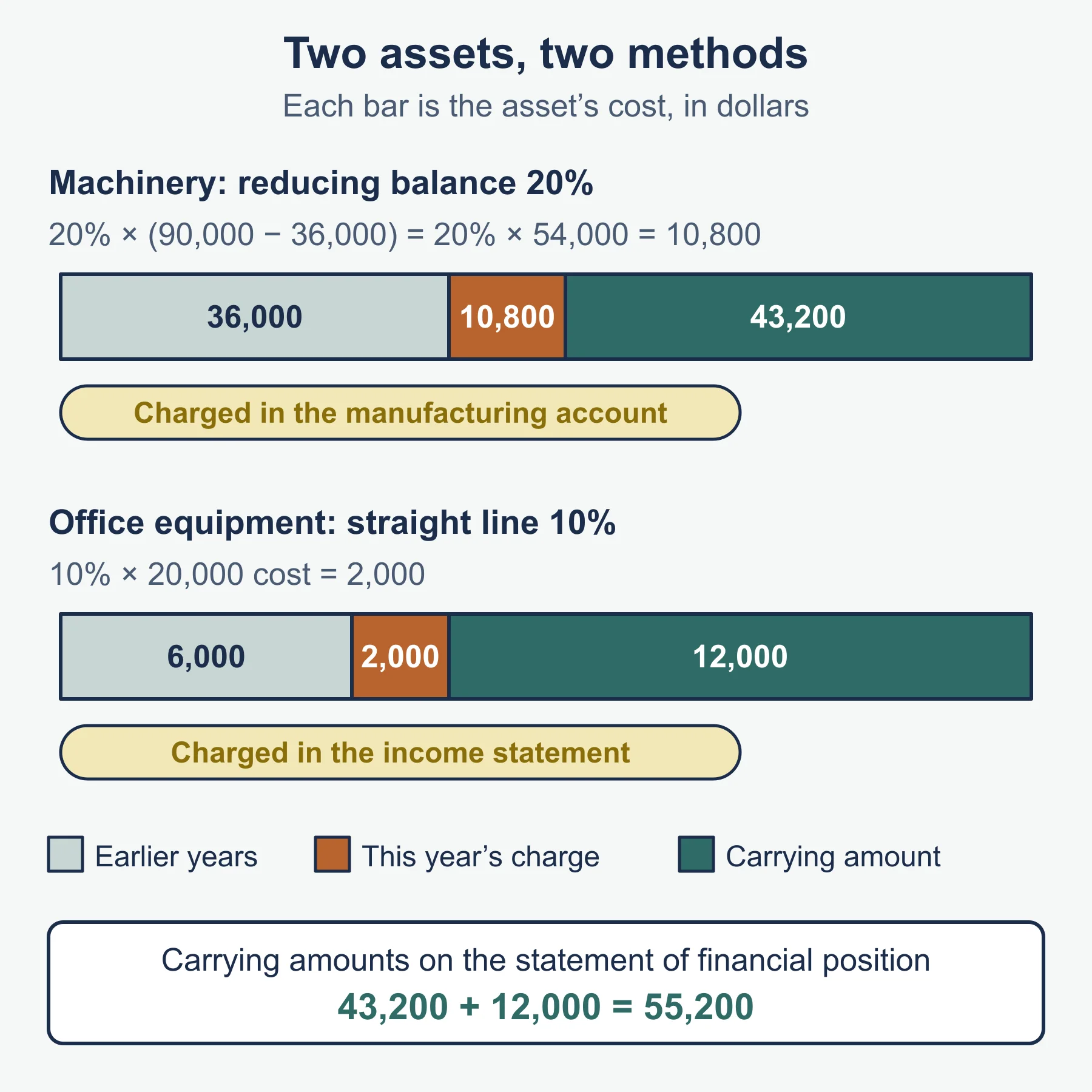
- Depreciation. Depreciation of factory machinery is a factory overhead. Depreciation of office equipment is not. The specification names the straight line and reducing balance methods.
- Shared costs. When one bill covers both the factory and the office, split it on the basis the question gives, such as floor area, and charge each part to its own section.
4. Factory cost of finished goods
Add the overheads to the prime cost:
Factory cost of finished goods = prime cost + overheads
The result is the cost of the goods completed in the year. The factory then passes the goods to the finished goods store at this cost. The specification does not name work in progress as a topic, so the examples here have none. If a question gives work in progress figures, treat them as a further adjustment and follow the instruction on the paper.
5. The income statement of a manufacturer
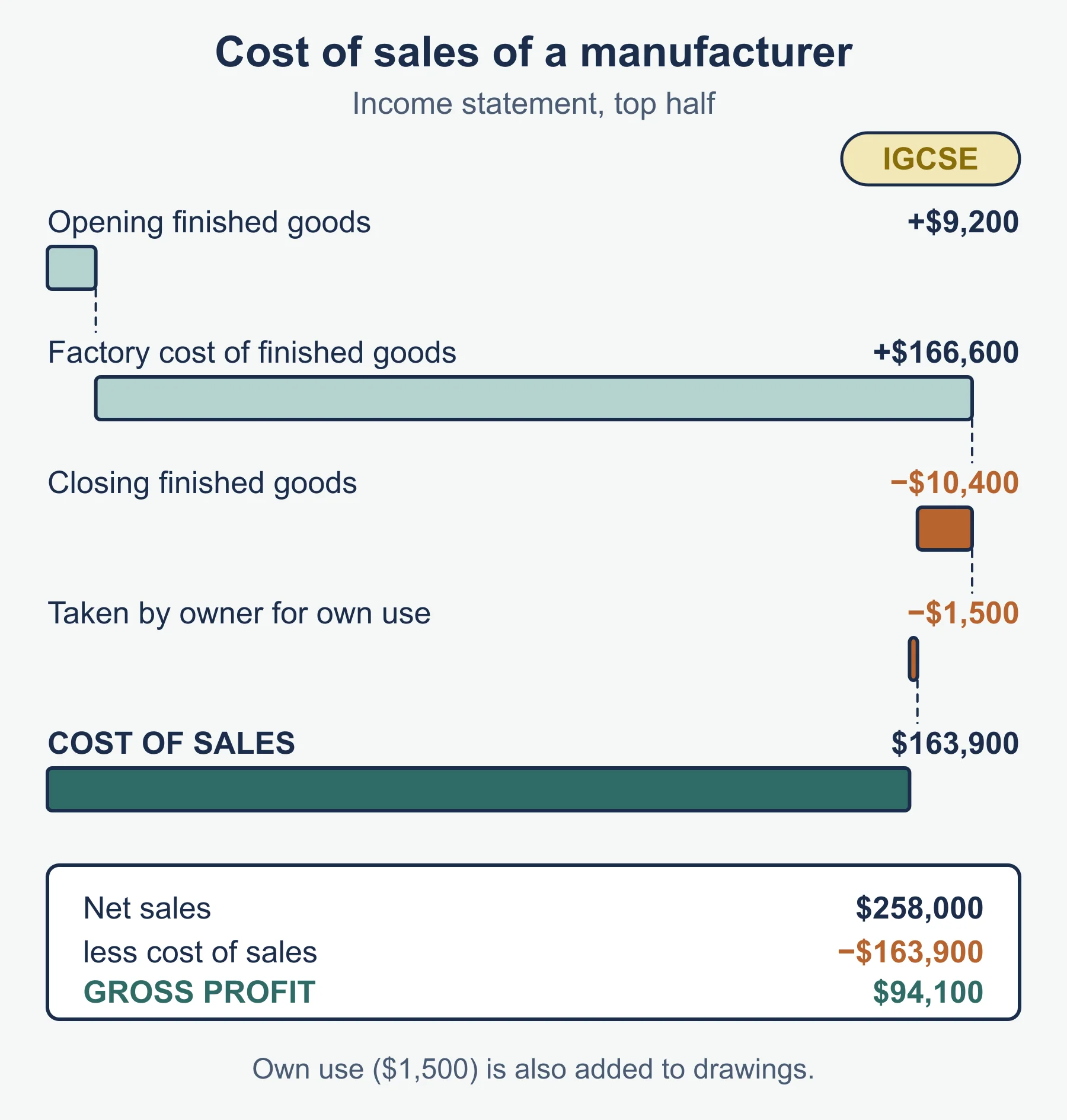
The top half changes. The cost of sales uses the factory cost, not purchases.
| Line | Treatment |
|---|---|
| Revenue less sales returns | Net sales |
| Opening inventory of finished goods | Add |
| Factory cost of finished goods | Add |
| Closing inventory of finished goods | Deduct |
| Goods taken by the owner for own use | Deduct, then debit drawings |
| Cost of sales | The result |
| Gross profit | Net sales less cost of sales |
Below gross profit, list the expenses of selling, distribution and administration, including adjustments for the provision for doubtful debts and irrecoverable debts. Gross profit less these expenses is the profit for the year.
6. The statement of financial position
The headings are the ones used for any sole trader. A manufacturer has two things to remember.
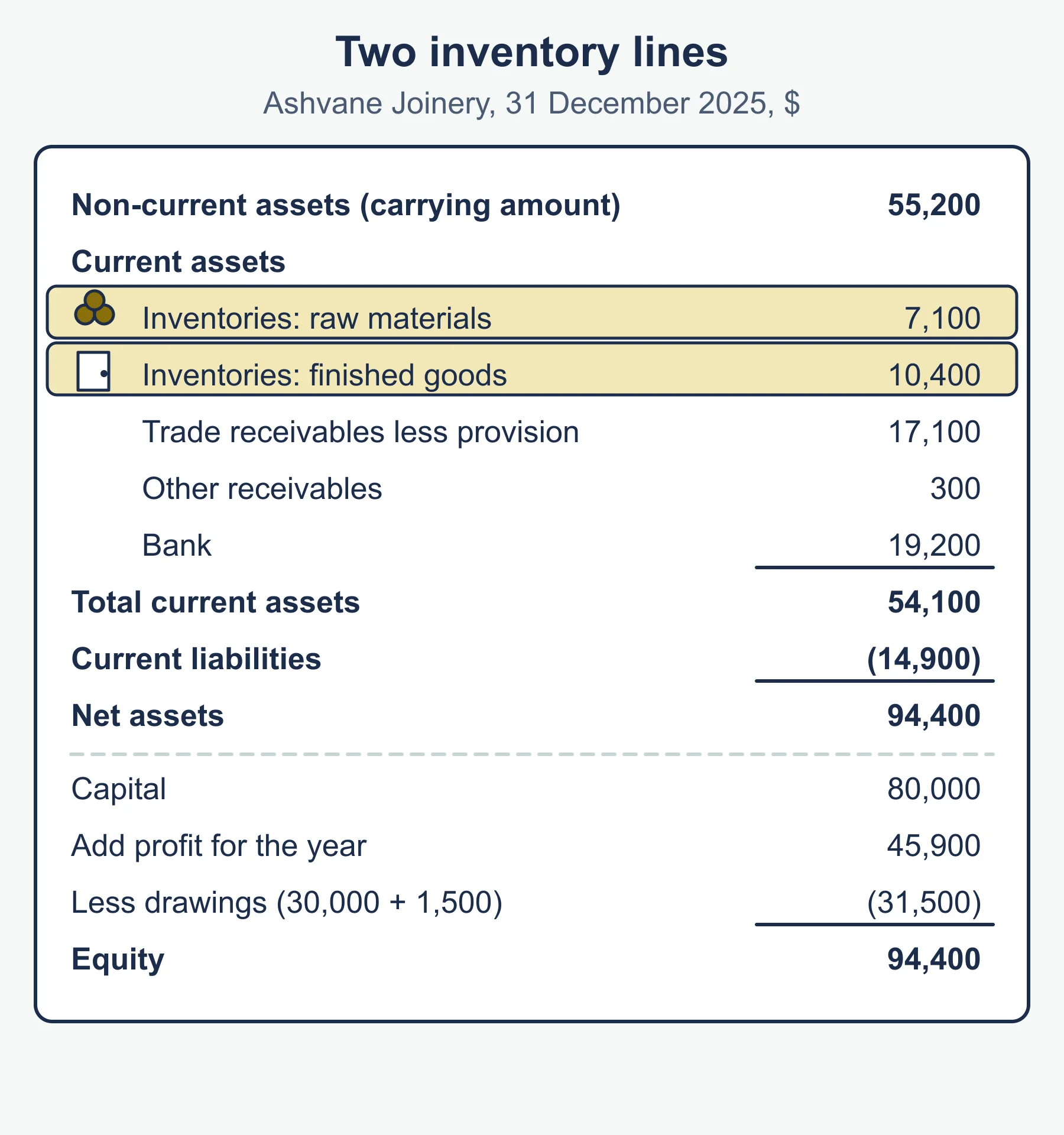
- Inventories are shown in two lines: raw materials and finished goods. Both are current assets at the closing figures used in the statements.
- Machinery and factory buildings sit with the non-current assets, at cost less accumulated depreciation.
7. Worked example: Ashvane Joinery
Ashvane Joinery, owned by Bilal Ashvane, makes wooden doors. The year ended 31 December 2025. These are the balances after the trial balance, with the year-end information.
| Item | Amount |
|---|---|
| Inventories at 1 January: raw materials / finished goods | 6,400 / 9,200 |
| Purchases of raw materials | 71,500 |
| Carriage inwards (raw materials) | 2,000 |
| Returns outwards (raw materials) | 1,500 |
| Direct wages | 48,600 |
| Indirect factory wages | 14,300 |
| Factory power paid | 8,900 |
| Rent and rates | 16,000 |
| Machinery at cost / accumulated depreciation | 90,000 / 36,000 |
| Office equipment at cost / accumulated depreciation | 20,000 / 6,000 |
| Revenue / sales returns | 262,000 / 4,000 |
| Selling expenses / office salaries / office expenses | 11,800 / 24,000 / 5,400 |
| Trade receivables / provision for doubtful debts | 18,000 / 600 |
| Trade payables | 13,200 |
| Capital / drawings / bank (debit balance) | 80,000 / 30,000 / 19,200 |
Year-end information:
- Closing inventories: raw materials 7,100; finished goods 10,400.
- Power owing 700. Office salaries owing 1,000. Office expenses prepaid 300.
- Rent and rates are shared three-quarters factory, one-quarter office.
- Machinery is depreciated at 20% a year on the reducing balance. Office equipment is depreciated at 10% a year on cost, which is the straight line method.
- The provision for doubtful debts is to be 5% of trade receivables.
- Bilal took finished goods that cost 1,500 for his own use.
Manufacturing account for the year ended 31 December 2025
| Dollars | Dollars | |
|---|---|---|
| Opening inventory of raw materials | 6,400 | |
| Purchases of raw materials | 71,500 | |
| Carriage inwards | 2,000 | |
| Less returns outwards | (1,500) | 72,000 |
| 78,400 | ||
| Less closing inventory of raw materials | (7,100) | |
| Cost of raw materials used | 71,300 | |
| Direct wages | 48,600 | |
| Prime cost | 119,900 | |
| Indirect factory wages | 14,300 | |
| Factory power (8,900 + 700) | 9,600 | |
| Rent and rates (three-quarters of 16,000) | 12,000 | |
| Depreciation of machinery (20% of 54,000) | 10,800 | |
| Overheads | 46,700 | |
| Factory cost of finished goods | 166,600 |
The machinery depreciation uses the carrying amount of 90,000 less 36,000, which is 54,000.
Income statement for the year ended 31 December 2025
| Dollars | Dollars | |
|---|---|---|
| Revenue | 262,000 | |
| Less sales returns | (4,000) | |
| Net sales | 258,000 | |
| Opening inventory of finished goods | 9,200 | |
| Factory cost of finished goods | 166,600 | |
| 175,800 | ||
| Less closing inventory of finished goods | (10,400) | |
| Less goods taken for own use | (1,500) | |
| Cost of sales | (163,900) | |
| Gross profit | 94,100 | |
| Selling expenses | 11,800 | |
| Office salaries (24,000 + 1,000) | 25,000 | |
| Office expenses (5,400 − 300) | 5,100 | |
| Rent and rates (one-quarter) | 4,000 | |
| Depreciation of office equipment | 2,000 | |
| Increase in provision for doubtful debts | 300 | |
| Total expenses | (48,200) | |
| Profit for the year | 45,900 |
The provision rises from 600 to 5% of 18,000, which is 900, so the increase is 300.
Statement of financial position at 31 December 2025
| Cost | Depreciation | Carrying amount | |
|---|---|---|---|
| Machinery | 90,000 | 46,800 | 43,200 |
| Office equipment | 20,000 | 8,000 | 12,000 |
| Non-current assets | 110,000 | 54,800 | 55,200 |
| Current assets | Dollars | Dollars |
|---|---|---|
| Inventories: raw materials | 7,100 | |
| Inventories: finished goods | 10,400 | |
| Trade receivables less provision (18,000 − 900) | 17,100 | |
| Other receivables (prepaid expenses) | 300 | |
| Bank | 19,200 | 54,100 |
| Current liabilities | ||
| Trade payables | 13,200 | |
| Other payables (700 + 1,000) | 1,700 | (14,900) |
| Net assets | 94,400 | |
| Capital | 80,000 | |
| Add profit for the year | 45,900 | |
| Less drawings (30,000 + 1,500) | (31,500) | |
| Equity | 94,400 |
Net assets are 55,200 + 54,100 − 14,900 = 94,400, which equals equity. That agreement is your check.
8. Commenting on the statements
You may be asked to comment on a manufacturer’s results. Work from figures you can calculate from the statements.
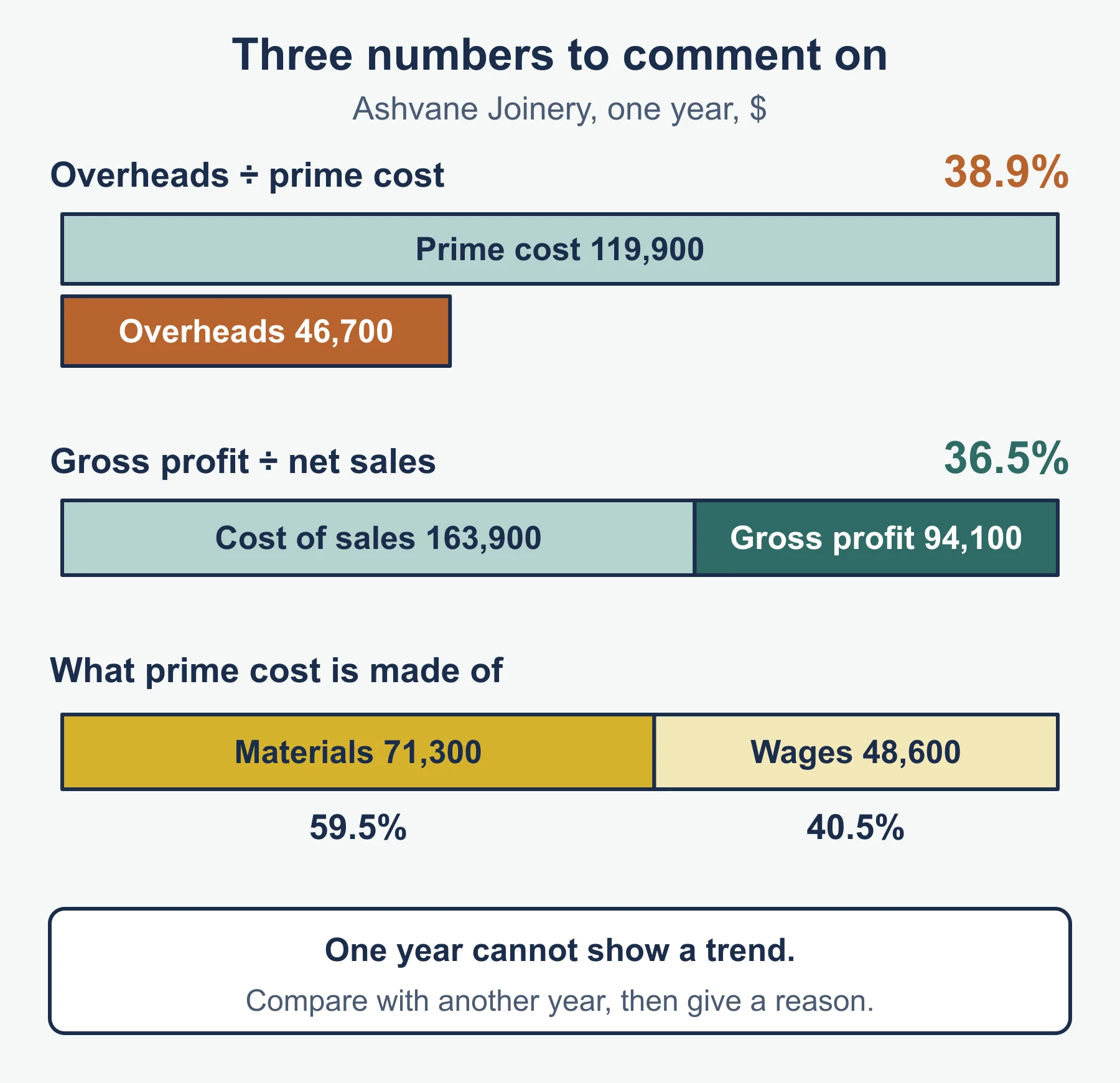
- Overheads as a share of prime cost. Ashvane’s overheads are 46,700 against a prime cost of 119,900, or 38.9%. If this share rises year on year, ask whether factory running costs are being controlled.
- Gross profit margin. Gross profit of 94,100 on net sales of 258,000 is 36.5%. A fall in the margin can come from a higher factory cost or lower selling prices.
- Cost of materials against wages. Materials used (71,300) and direct wages (48,600) are the two parts of prime cost. A change in either points to a different problem: a price from suppliers, or labour hours.
A comment needs a figure, a comparison and a reason. State that a limit applies: one year of figures cannot show a trend.
9. Common errors
- Putting office depreciation or office salaries in the manufacturing account.
- Deducting closing inventory of finished goods in the manufacturing account. It belongs in the income statement.
- Using purchases of raw materials as the prime cost without adjusting for inventory.
- Charging all of a shared bill to the factory.
- Forgetting that goods taken for own use are deducted from cost of sales and added to drawings.
- Showing only one inventories line in the statement of financial position.
Frequently asked questions
What is prime cost in OxfordAQA International GCSE Accounting 9215? Prime cost is the cost of the materials used in the goods plus the wages of the people who make them. Carriage inwards on raw materials is part of the materials cost; carriage outwards is a selling cost.
How do you calculate the factory cost of finished goods? Factory cost of finished goods = prime cost + overheads. It is the cost of the goods completed in the year, and it replaces purchases in the manufacturer’s cost of sales.
What are factory overheads? Factory overheads are the costs of running the factory that cannot be traced to one unit of output, such as indirect wages for supervisors and cleaners, factory power, insurance, rent and rates, and depreciation of machinery.
How are a manufacturer’s inventories shown in the statement of financial position? Inventories are shown in two lines, raw materials and finished goods, both as current assets at the closing date.
How should I comment on a manufacturer’s results? Work from figures you can calculate, such as overheads as a share of prime cost, and give a figure, a comparison and a reason. One year of figures alone cannot show a trend.
Official syllabus
OxfordAQA International GCSE Accounting (9215), version 1.2, for exams from May/June 2026, published by OxfordAQA. This guide covers the manufacturing organisations content of section 3.4.
Get free revision emails (optional)
Occasional emails with practice questions, worked explanations and links to free resources for the qualification and subjects you choose. No spam, and you can unsubscribe from any email. The free tools on this site never need an email.
Related resources
-
Practice questions
OxfordAQA IGCSE Accounting: Manufacturing accounts (9215) – Practice Questions
Original practice questions with worked answers on manufacturing accounts for OxfordAQA International GCSE Accounting 9215, prime cost to final statements.
Accounting · OxfordAQA · IGCSE
Try questions -
Revision notes
OxfordAQA IGCSE Accounting: Manufacturing accounts (9215) – Revision Notes
Condensed revision notes on manufacturing accounts for OxfordAQA International GCSE Accounting 9215, with layouts, a worked reminder and a self-test.
Accounting · OxfordAQA · IGCSE
Revise topic -
Study guides
OxfordAQA IGCSE Accounting: Partnership financial statements and partners capital and current accounts (9215)
Study guide to partnership income statements, appropriation accounts, capital and current accounts and statements of financial position for OxfordAQA 9215.
Accounting · OxfordAQA · IGCSE
Read guide
Related articles
-
teaching
A Level tuition in Dubai: Cambridge or Pearson Edexcel International A Level?
Schools in Dubai and Abu Dhabi teach either Cambridge International AS & A Level or Pearson Edexcel International A Level. How the two are structured, why it matters for tuition, and how online classes from Lahore work.
9 October 2026
-
curriculum guides
Choosing subjects at IGCSE and A Level
How subject choices at 14 and 16 affect university options later, and how to keep pathways open without overloading a timetable.
28 July 2026
Studying this with a teacher
Working through Accounting IGCSE?
This page is free and stays free. If you would rather be taught it, Marlbridge runs Accounting classes one-to-one and in small groups of up to 15, online in your own time zone. The first trial class is free. WhatsApp replies within an hour (8am–11pm Pakistan time, every day); email the same day.
OxfordAQA Accounting teachers at Marlbridge

