
Study Guides
OxfordAQA IGCSE Accounting: Partnership financial statements and partners capital and current accounts (9215)
Study guide to partnership income statements, appropriation accounts, capital and current accounts and statements of financial position for OxfordAQA 9215.
- Subject
- Accounting
- Level
- IGCSE
- Topic
- Preparation of financial statements
- Author
- Marlbridge Academic Team
- Updated
- Reviewed by
- Javaid Iqbal Sabri (what this means)
Aligned to OxfordAQA IGCSE Accounting (9215), First teaching 2024, first examined 2026. Official specification .
Syllabus page (what it covers and how it is assessed): OxfordAQA IGCSE Accounting.
Syllabus points this page covers
9215
- Financial statements and capital and current accounts of partnerships
Found an error? Report a correction.
Need help with this topic? Request a free trial class for IGCSE Accounting (9215).
This guide follows the OxfordAQA International GCSE Accounting (9215) specification, version 1.2, for exams from May/June 2026 onwards. It covers the partnerships part of section 3.4, Preparation of financial statements. The specification lists Content 3 to 5 as the content assessed in Paper 2, so this topic sits in that paper. All amounts below are in dollars.
Course home: OxfordAQA IGCSE Accounting. Printable checklist. Find weak spots first with the free diagnostics. Companion pages: revision notes and practice questions. For how the two papers work, see exam preparation.
What the specification asks for
| Specification point (3.4, Partnerships) | Where it is taught here |
|---|---|
| Prepare and comment on the financial statements of partnerships: income statement, appropriation account, statement of financial position | Sections 1 to 3, Example 1, commenting |
| Interest on capital | Appropriation account, Example 1 |
| Interest on drawings | Appropriation account, Example 1 |
| Partnership salaries | Appropriation account, Examples 1 and 2 |
| Interest on a partner’s loan | Income statement, Example 1 |
| Shares of profit and losses | Examples 1 and 2 |
| Prepare and comment on the capital and current accounts of partners | Section 4, Example 1, commenting |
The specification states that admission, retirement of a partner, dissolution of partnerships and changes to the profit sharing ratio will not be examined. This guide does not cover them.
1. Three statements, one flow
A partnership has two or more owners who share the profit. Its accounts follow the same chain as a sole trader’s, with one extra step.
- The income statement finds the profit for the year (or loss).
- The appropriation account shows how that profit is shared between the partners.
- The statement of financial position shows the assets, liabilities and the partners’ equity at the year end.
Every figure you need comes from the question: the partnership agreement is given as rates, amounts and a ratio. Use only the items the question mentions. Do not add interest or salaries that are not stated.
2. The income statement
The income statement is prepared exactly as for a sole trader: revenue, cost of sales, gross profit, expenses, profit for the year. Two points are specific to partnerships.
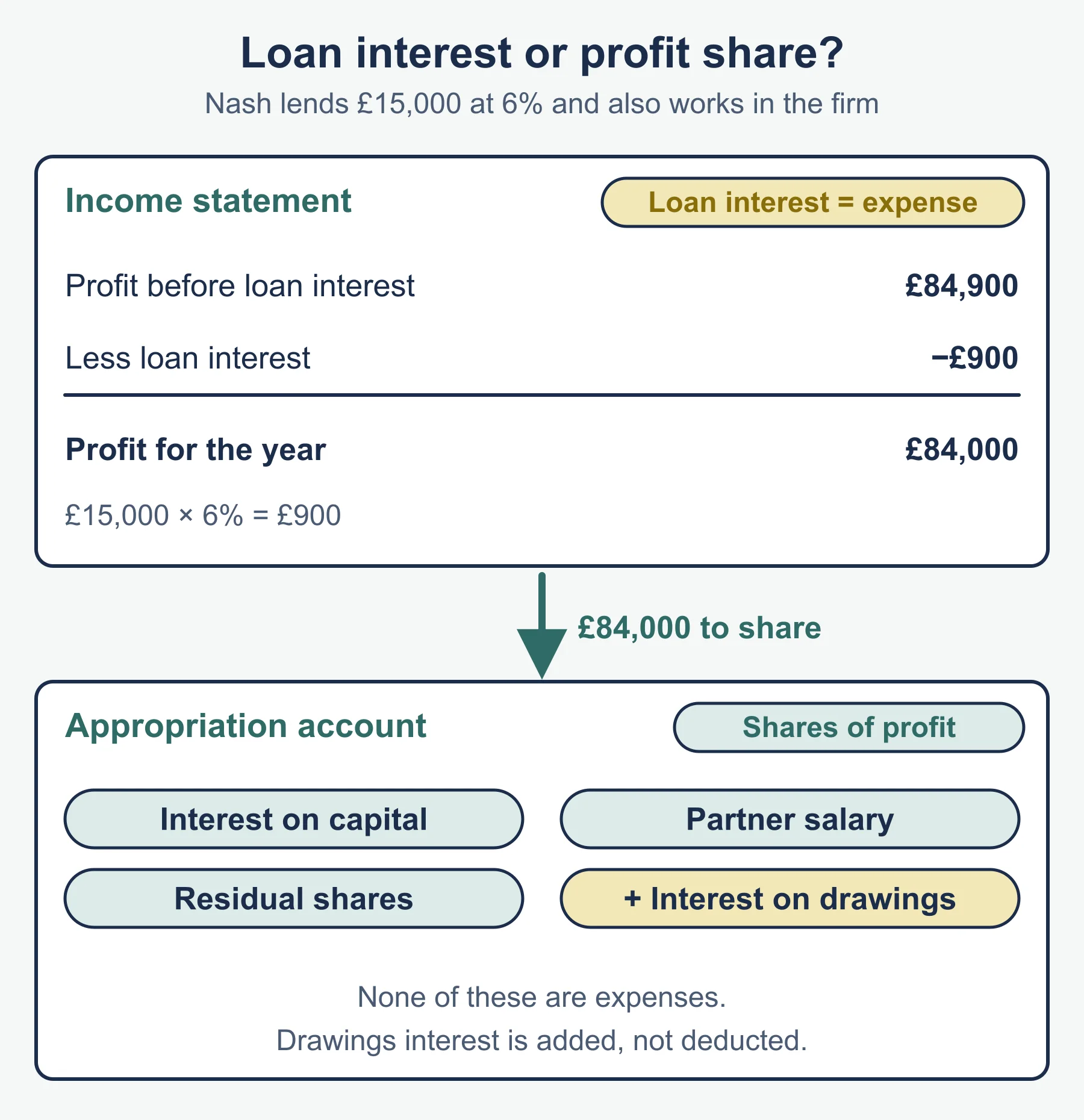
- Interest on a partner’s loan is an expense. A loan from a partner is a liability of the firm, so its interest is charged in the income statement before the profit for the year is reached. It does not go in the appropriation account.
- Partners’ salaries and drawings are not expenses. They are shares of profit, so they appear in the appropriation account and in the partners’ accounts, never in the income statement.
3. The appropriation account
The appropriation account starts with the profit for the year and divides it. Work down the following items in this order.
| Item | Effect on the amount shared | Credited to the partner’s current account? |
|---|---|---|
| Interest on drawings | Added to profit (the firm earns it) | No, it is debited to the partner |
| Interest on capital | Deducted | Yes |
| Partnership salaries | Deducted | Yes |
| Residual profit (or deficit) | Shared in the profit sharing ratio | Yes (a deficit is debited) |
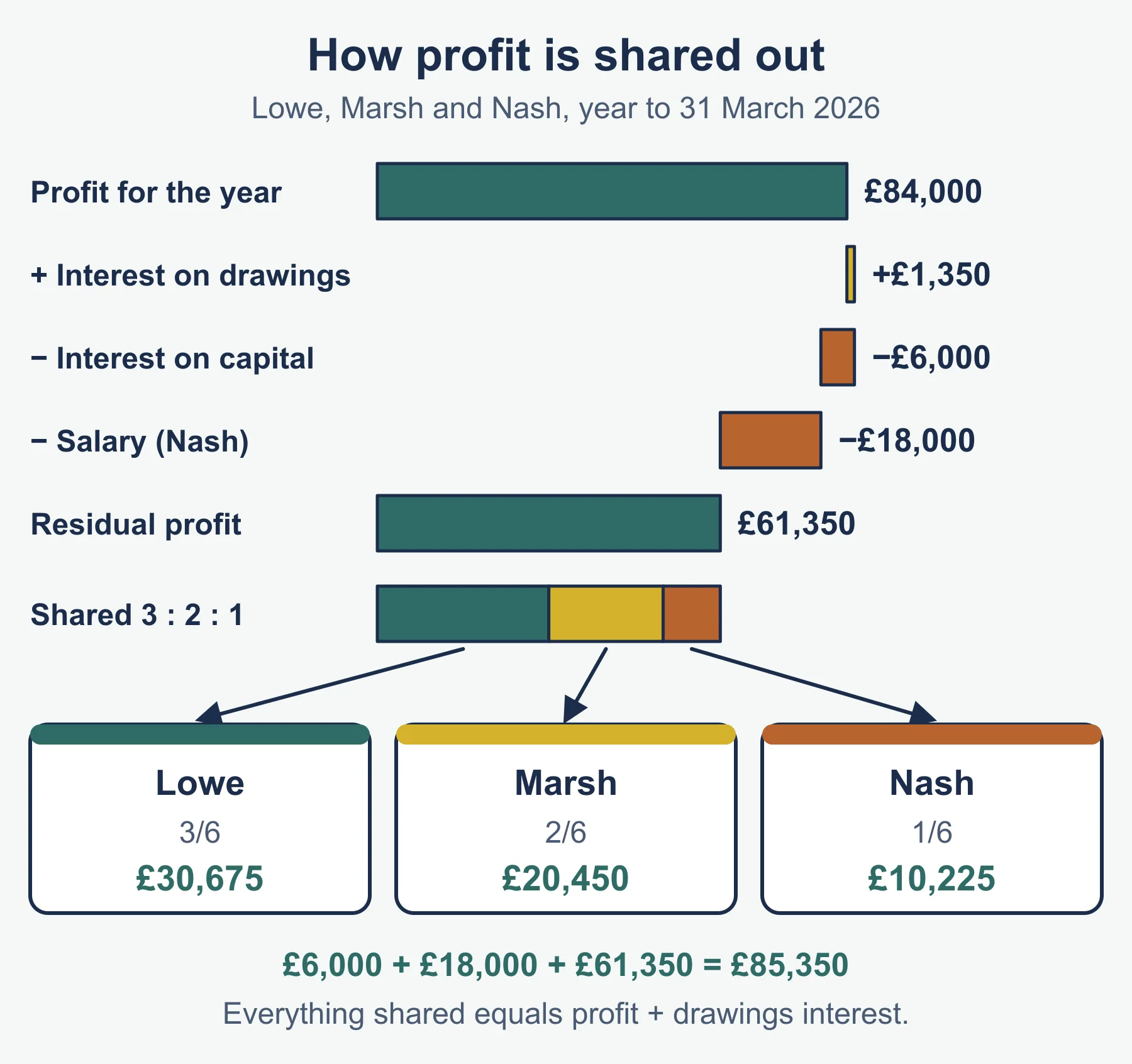
The residual profit is what remains after interest on capital and salaries. It is the figure that is shared in the ratio. Each partner’s total share is their interest on capital plus their salary plus their part of the residual, less their interest on drawings.
Why each item exists: interest on capital rewards a partner who invests more; salaries reward a partner who works more in the business; interest on drawings discourages large early withdrawals; the ratio shares what is left.
4. Capital and current accounts
Each partner has two accounts. The two serve different purposes.
| Capital account | Current account | |
|---|---|---|
| What it records | The long-term investment the partner has put in | The yearly flow of profit and drawings |
| Normal entries | The agreed capital, which changes only by agreement | Interest on capital, salary, share of profit (credit); drawings and interest on drawings (debit) |
| Usual balance | Credit | Credit if the firm owes the partner; debit if the partner has taken out more than earned |
| Where it appears | Statement of financial position, equity | Statement of financial position, equity |
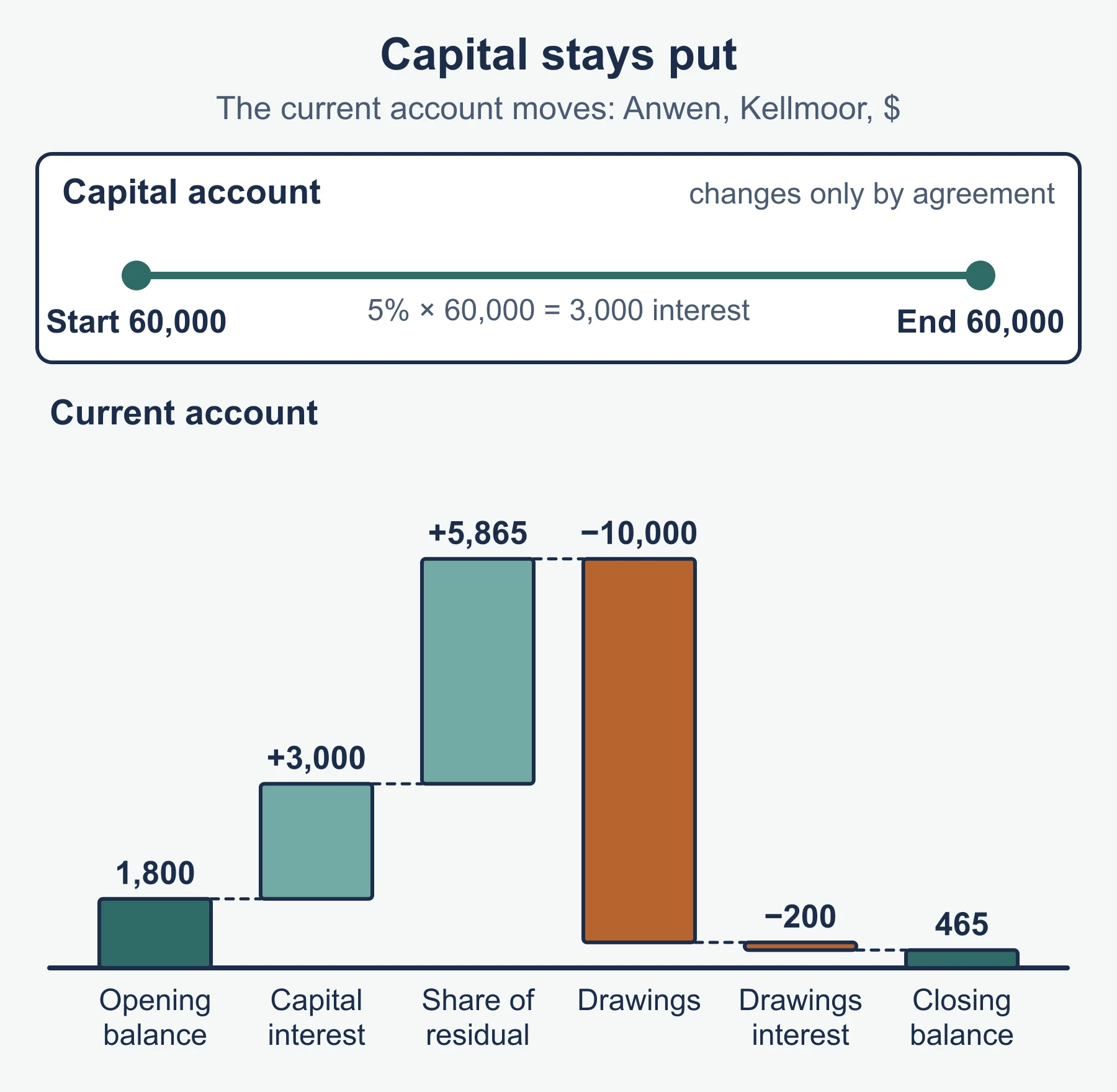
Keeping the two apart means the capital, which decides the interest on capital, stays fixed. Day-to-day movements go through the current account. In this guide the capital accounts do not change during the year.
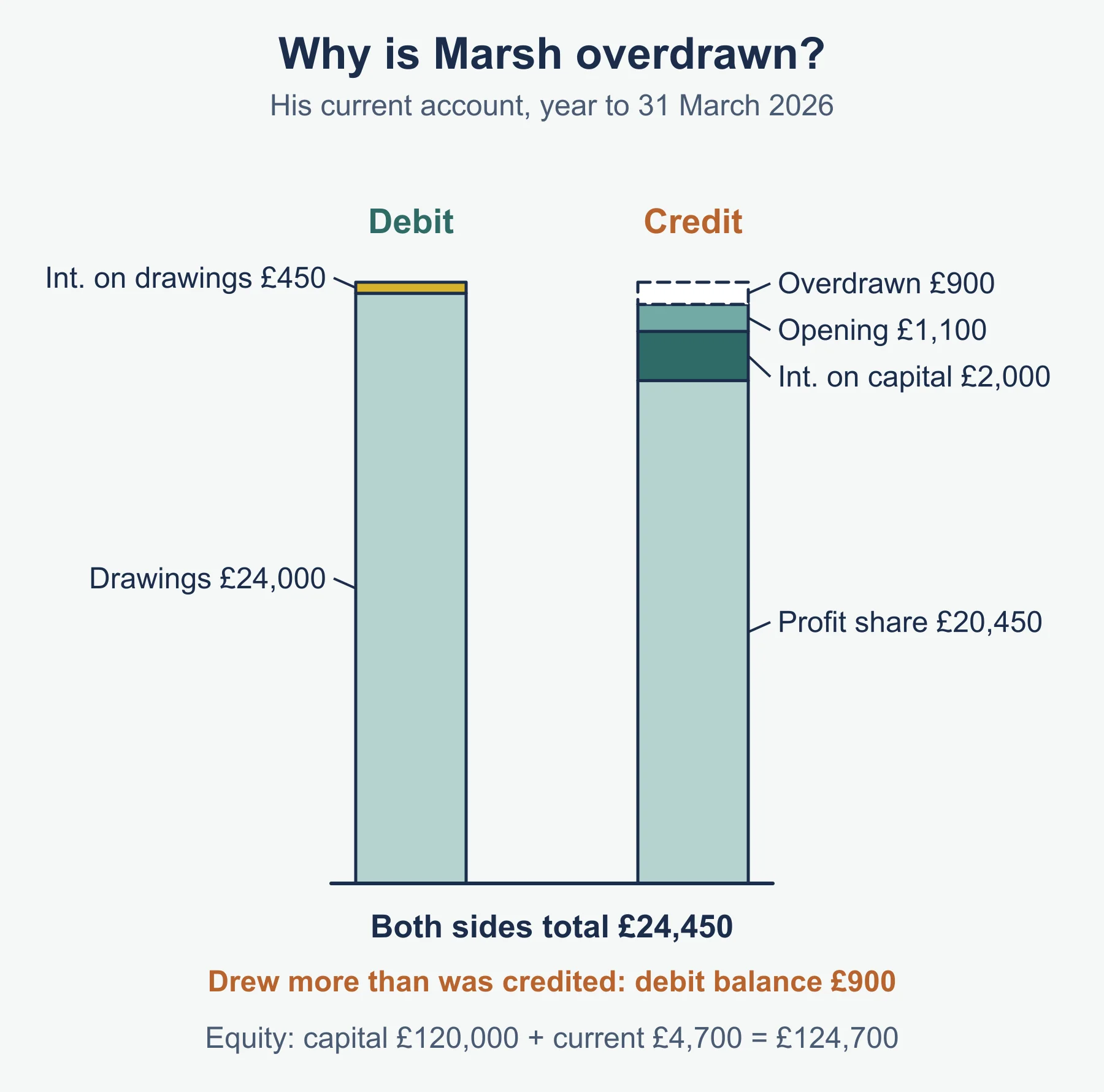
A debit balance on a current account means the partner has taken out more than the profit allocated. It is shown in brackets in equity and reduces the total.
Example 1: Kellmoor Bicycle Works
Kellmoor Bicycle Works is owned by Anwen, Bashir and Chidi. The year ended 30 June 2026. The partnership agreement gives:
- capital: Anwen 60,000; Bashir 40,000; Chidi 20,000
- interest on capital 5% per year
- salaries: Bashir 12,000; Chidi 6,000
- interest on drawings 2% of each partner’s drawings for the year
- residual profit shared 3 : 2 : 1
- Bashir has lent the firm 10,000 at 6% per year, paid in full during the year
Other figures: revenue 214,000; opening inventory 16,500; purchases 118,300; closing inventory 19,400; wages 36,400; rent and rates 11,600; general expenses 8,570; depreciation 6,300. These expenses are already adjusted for accruals and prepayments. Drawings: Anwen 10,000; Bashir 11,000; Chidi 9,000. Opening current accounts: Anwen credit 1,800; Bashir credit 900; Chidi debit 400.
Income statement for the year ended 30 June 2026
Revenue                                          214,000
Opening inventory                    16,500
Purchases                           118,300
                                    134,800
Less closing inventory               19,400
Cost of sales                                    115,400
Gross profit                                      98,600
Wages                                36,400
Rent and rates                       11,600
General expenses                      8,570
Depreciation                          6,300
Interest on partner's loan              600      63,470
Profit for the year                               35,130
Loan interest is 10,000 x 6% = 600.
Appropriation account
Profit for the year                                       35,130
Interest on drawings: Anwen 200, Bashir 220, Chidi 180       600
                                                          35,730
Less interest on capital: Anwen 3,000, Bashir 2,000,
   Chidi 1,000                                  6,000
Less salaries: Bashir 12,000, Chidi 6,000      18,000     24,000
Residual profit                                           11,730
Shared 3:2:1: Anwen 5,865, Bashir 3,910, Chidi 1,955      11,730
Interest on drawings: 2% of 10,000, 11,000 and 9,000. The residual is divided into six parts of 1,955.
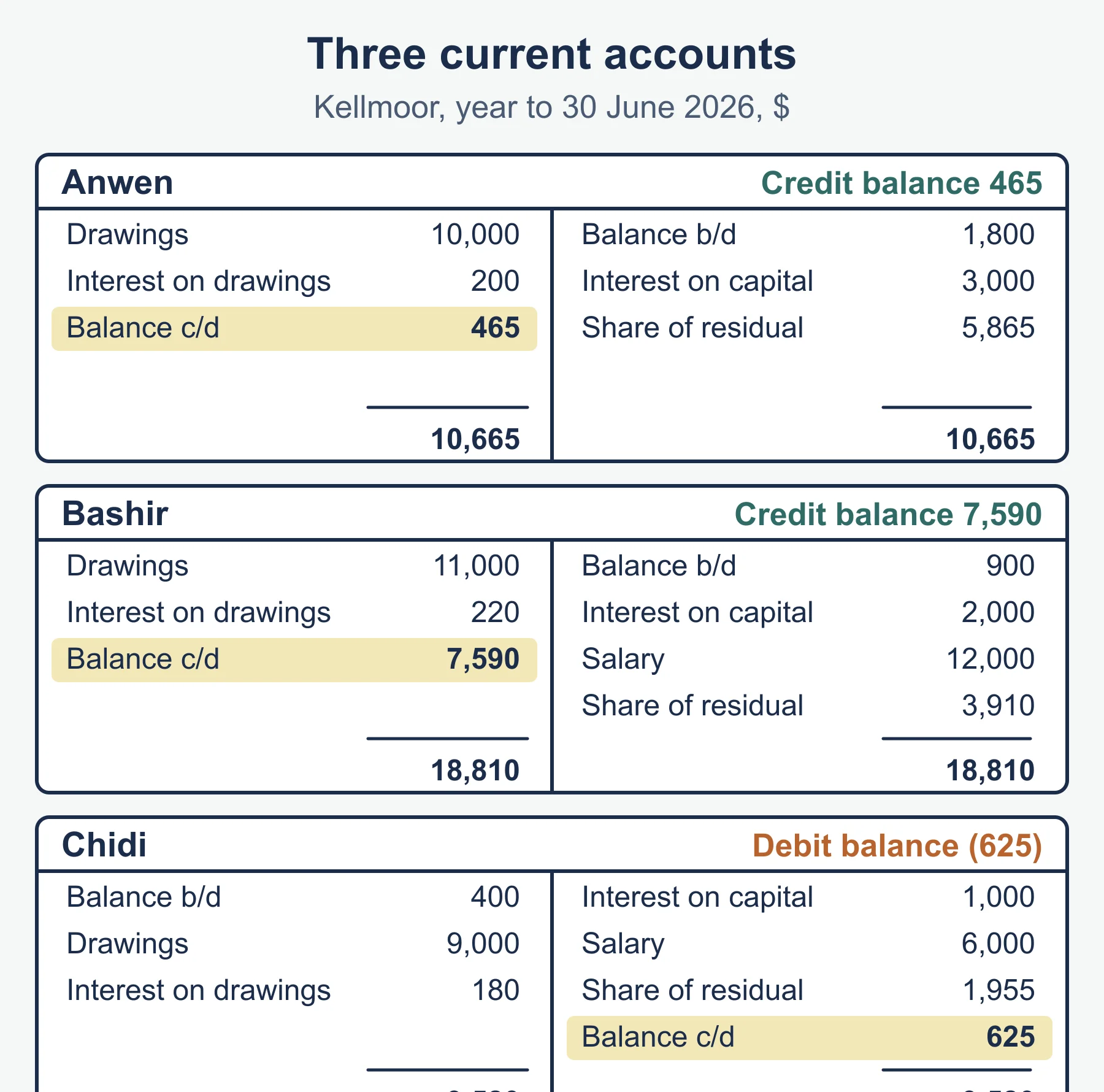
Current accounts (columns: Anwen, Bashir, Chidi)
Debit                          A       B       C
Balance b/d                    -       -     400
Drawings                  10,000  11,000   9,000
Interest on drawings         200     220     180
Balance c/d                  465   7,590       -
                          10,665  18,810   9,580

Credit                         A       B       C
Balance b/d                1,800     900       -
Interest on capital        3,000   2,000   1,000
Salaries                       -  12,000   6,000
Share of residual          5,865   3,910   1,955
Balance c/d                    -       -     625
                          10,665  18,810   9,580
Chidi’s debit balance of 625 is the balancing figure on the credit side. Chidi drew 9,180 in cash and interest against an entitlement of 8,955, plus the opening debit of 400.
Statement of financial position at 30 June 2026
Non-current assets
Equipment and vehicles at cost                  150,000
Less accumulated depreciation                    38,200
Net book value                                  111,800
Current assets
Inventory                            19,400
Trade receivables                    16,900
Other receivables                       700
Bank                                  1,580     38,580
Current liabilities
Trade payables                       12,300
Other payables                          650     12,950
Net current assets                               25,630
Total assets less current liabilities           137,430
Non-current liabilities
Loan from Bashir                                 10,000
Net assets                                      127,430

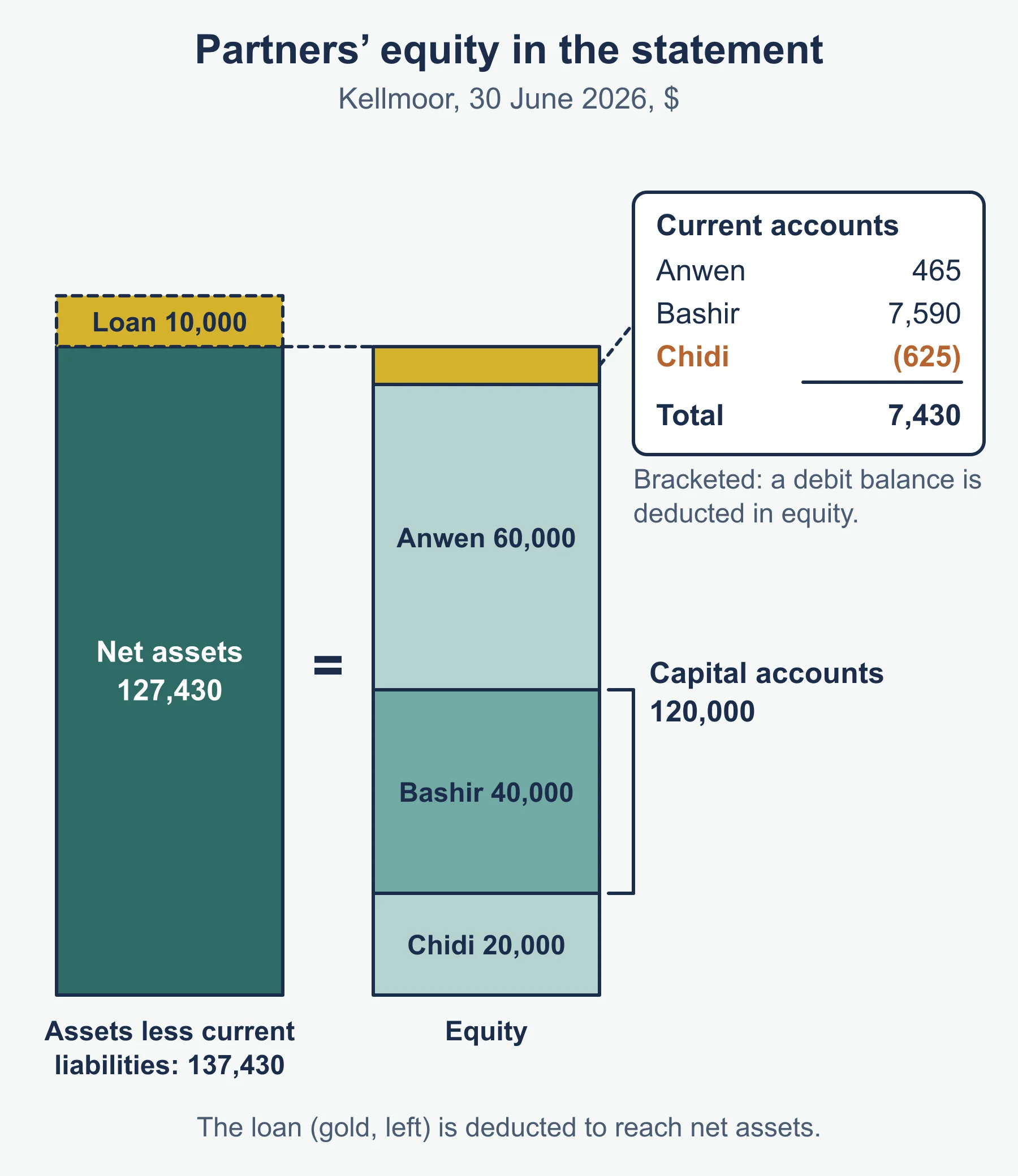
Equity (capital accounts)
Anwen 60,000; Bashir 40,000; Chidi 20,000       120,000
Current accounts
Anwen 465; Bashir 7,590; Chidi (625)              7,430
Total equity                                    127,430
The two sides agree at 127,430. Bashir’s loan sits below the current liabilities because it is repayable later.
Example 2: Fernhaven Print Studio
Fernhaven Print Studio is a service business owned by Dara (capital 50,000) and Eilidh (capital 30,000). The agreement gives 4% interest on capital, a salary of 9,000 to Eilidh, and residual profit or loss shared 2 : 1. There are no drawings in this extract. The table shows two possible years.
| Profit of 11,000 | Loss of 4,000 | |
|---|---|---|
| Profit or (loss) for the year | 11,000 | (4,000) |
| Interest on capital: Dara 2,000, Eilidh 1,200 | 3,200 | 3,200 |
| Salary: Eilidh | 9,000 | 9,000 |
| Total taken before the ratio | 12,200 | 12,200 |
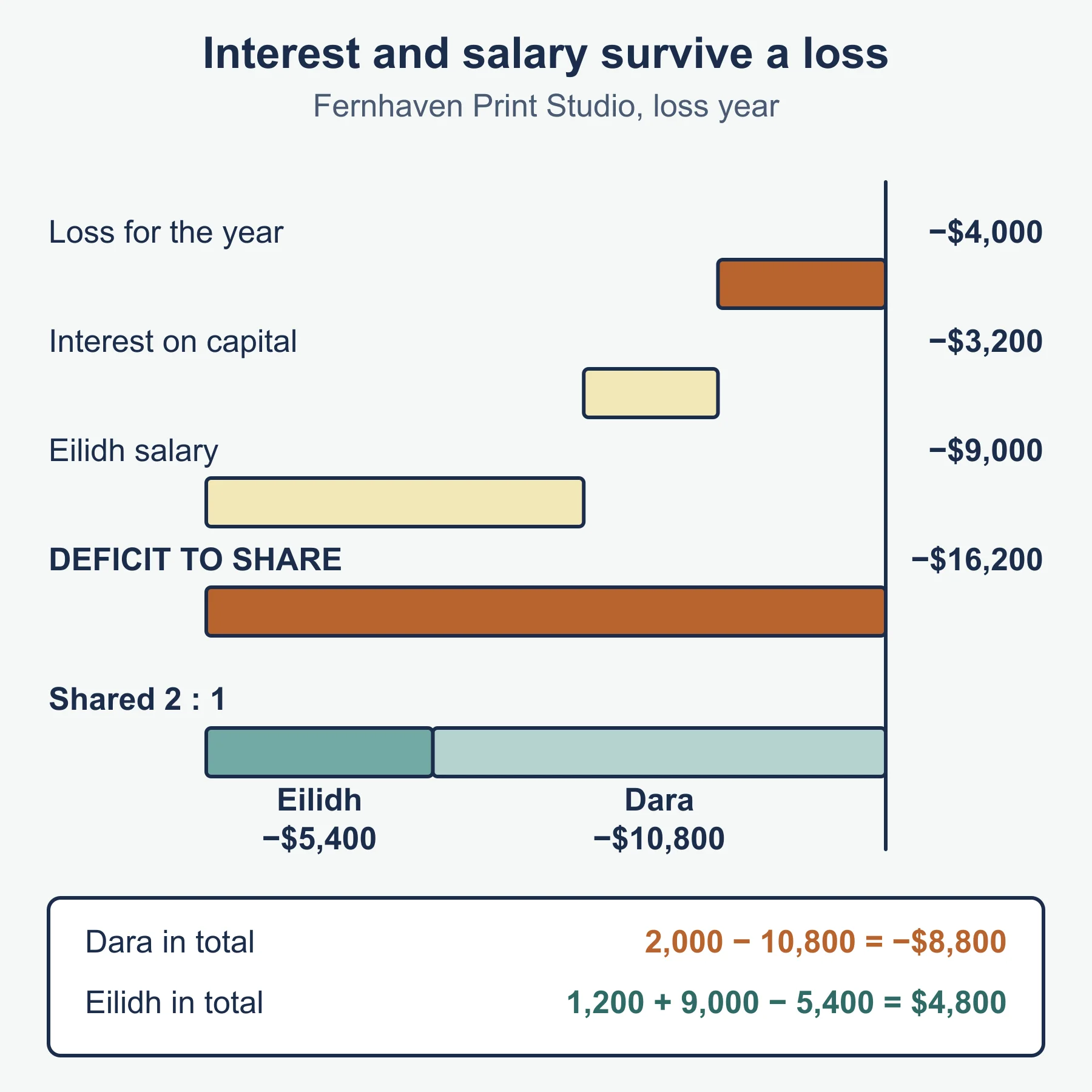
| Residual (deficit) | (1,200) | (16,200) |
| Dara 2/3 | (800) | (10,800) |
| Eilidh 1/3 | (400) | (5,400) |
| Dara credited in total | 1,200 | (8,800) |
| Eilidh credited in total | 9,800 | 4,800 |
Even when the firm makes a loss, the agreed interest and salary are still credited, so the loss plus those items becomes a larger deficit. The deficit is shared in the ratio and debited to the partners. Dara’s account is debited by 8,800 in total in the second year, which is worth a comment: Dara bears most of the loss but is paid no salary.
5. Commenting on partnership statements
The specification asks you to comment as well as prepare. A good comment states a figure, says what it means and links it to the partners or the business. Useful points:
- Overdrawn current account. Chidi’s debit balance means a partner has taken out more than has been allocated. The firm’s funds are in effect financing that partner. A sensible suggestion is to agree a drawings limit or raise the interest rate on drawings.
- Salary and interest take most of the profit. In Example 1, 24,000 of 35,730 is allocated before the ratio. The ratio then affects only a third of the profit, so it matters less to the partners than the salaries.
- Loan versus capital. Bashir’s loan earns a fixed 600 whatever the profit, which is taken before profit is shared. Interest on capital is not an expense: it is an appropriation, so in a poor year it adds to the deficit that the partners share.
- Liquidity. Bank is 1,580 against current liabilities of 12,950. The partnership depends on its receivables and inventory to meet its payables.
- Fairness. A partner with a large capital but no salary (Dara in Example 2) may feel the agreement is not fair in a poor year.
Common errors
- Putting salaries or drawings in the income statement.
- Putting interest on a partner’s loan in the appropriation account.
- Deducting interest on drawings from profit instead of adding it.
- Sharing the profit for the year in the ratio before deducting interest on capital and salaries.
- Dropping the interest and salaries in a loss year.
- Forgetting that a debit balance on a current account is deducted in equity.
- Adding the current accounts to the capital accounts and then adding the loan again.
Frequently asked questions
What is a partnership appropriation account? The appropriation account follows the income statement and shows how the profit for the year is shared between the partners. Interest on drawings is added, then interest on capital and partnership salaries are deducted, and the residual profit is split in the profit sharing ratio.
Is interest on a partner’s loan an expense or an appropriation of profit? Interest on a partner’s loan is an expense, so it goes in the income statement before the profit for the year is found. Interest on capital and partnership salaries are appropriations, so they belong in the appropriation account instead.
What is the difference between a partner’s capital account and current account? The capital account holds the fixed amount each partner has invested, which usually stays the same from year to year. The current account records the partner’s share of profit, interest and salary, less drawings and interest on drawings, so it changes every year.
What does a debit balance on a partner’s current account mean? A debit balance means the partner has withdrawn more than the profit, interest and salary credited to them. It is shown as a deduction within the current accounts on the statement of financial position and is worth commenting on as a sign the partner is overdrawing.
Are admission and retirement of partners examined in OxfordAQA IGCSE Accounting 9215? No. The 9215 specification states that admission, retirement of a partner, dissolution of partnerships and changes to the profit sharing ratio will not be examined.
Official syllabus
OxfordAQA International GCSE Accounting (9215), specification version 1.2, first teaching 2024, first examined 2026 (OxfordAQA, an Oxford University Press and AQA partnership). Subject content section 3.4, Partnerships.
Get free revision emails (optional)
Occasional emails with practice questions, worked explanations and links to free resources for the qualification and subjects you choose. No spam, and you can unsubscribe from any email. The free tools on this site never need an email.
Related resources
-
Practice questions
OxfordAQA IGCSE Accounting: Partnership statements and partner accounts (9215) – Practice Questions
Original practice questions with worked answers on partnership appropriation accounts, current accounts and equity for OxfordAQA 9215.
Accounting · OxfordAQA · IGCSE
Try questions -
Revision notes
OxfordAQA IGCSE Accounting: Partnership statements and partner accounts (9215) – Revision Notes
Condensed revision notes on partnership appropriation accounts, current and capital accounts and equity for OxfordAQA International GCSE Accounting 9215.
Accounting · OxfordAQA · IGCSE
Revise topic -
Study guides
OxfordAQA IGCSE Accounting: Sole traders: financial statements and comparison with other organisations (9215)
Study guide to sole traders' income statements, statements of financial position and adjustments, plus the pros and cons of each business type, for 9215.
Accounting · OxfordAQA · IGCSE
Read guide
Related articles
-
teaching
A Level tuition in Dubai: Cambridge or Pearson Edexcel International A Level?
Schools in Dubai and Abu Dhabi teach either Cambridge International AS & A Level or Pearson Edexcel International A Level. How the two are structured, why it matters for tuition, and how online classes from Lahore work.
9 October 2026
-
curriculum guides
Choosing subjects at IGCSE and A Level
How subject choices at 14 and 16 affect university options later, and how to keep pathways open without overloading a timetable.
28 July 2026
Studying this with a teacher
Working through Accounting IGCSE?
This page is free and stays free. If you would rather be taught it, Marlbridge runs Accounting classes one-to-one and in small groups of up to 15, online in your own time zone. The first trial class is free. WhatsApp replies within an hour (8am–11pm Pakistan time, every day); email the same day.
OxfordAQA Accounting teachers at Marlbridge

