
Study Guides
OxfordAQA IGCSE Accounting: Sole traders: financial statements and comparison with other organisations (9215)
Study guide to sole traders' income statements, statements of financial position and adjustments, plus the pros and cons of each business type, for 9215.
- Subject
- Accounting
- Level
- IGCSE
- Topic
- Preparation of financial statements
- Author
- Marlbridge Academic Team
- Updated
- Reviewed by
- Javaid Iqbal Sabri (what this means)
Aligned to OxfordAQA IGCSE Accounting (9215), First teaching 2024, first examined 2026. Official specification .
Syllabus page (what it covers and how it is assessed): OxfordAQA IGCSE Accounting.
Syllabus points this page covers
9215
- Sole traders, partnerships and limited companies compared
Found an error? Report a correction.
Need help with this topic? Request a free trial class for IGCSE Accounting (9215).
This guide follows the OxfordAQA International GCSE Accounting (9215) specification, version 1.2, for exams from May/June 2026 onwards (first teaching 2024, first examined 2026). It covers part of section 3.4, Preparation of financial statements (topic 4): how accounting concepts shape the figures, the advantages and disadvantages of sole traders, partnerships and limited companies, and sole traders’ income statements and statements of financial position for service and trading businesses. The specification lists Paper 2 as assessing content 3 to 5. All amounts are in dollars.
Related pages: revision notes, practice questions, recording guide, verification guide, the subject hub, the checklist and the free diagnostics.
What the specification asks for
| Specification wording | You must be able to |
|---|---|
| Use of concepts in preparing statements | Record other payables and receivables, depreciation (straight line and reducing balance), disposals, provision for doubtful debts, irrecoverable debts, income due, income received in advance, goods taken for own use and inventory |
| Advantages and disadvantages of different organisations | Compare sole traders, partnerships and limited companies |
| Sole traders | Prepare statements from ledger accounts and from a trial balance, with adjustments, for service and trading businesses, and comment on them |
The specification says that the FIFO, AVCO and LIFO methods of inventory valuation will not be examined. Inventory is valued at cost or net realisable value (section 3.3).
Concepts behind the adjustments
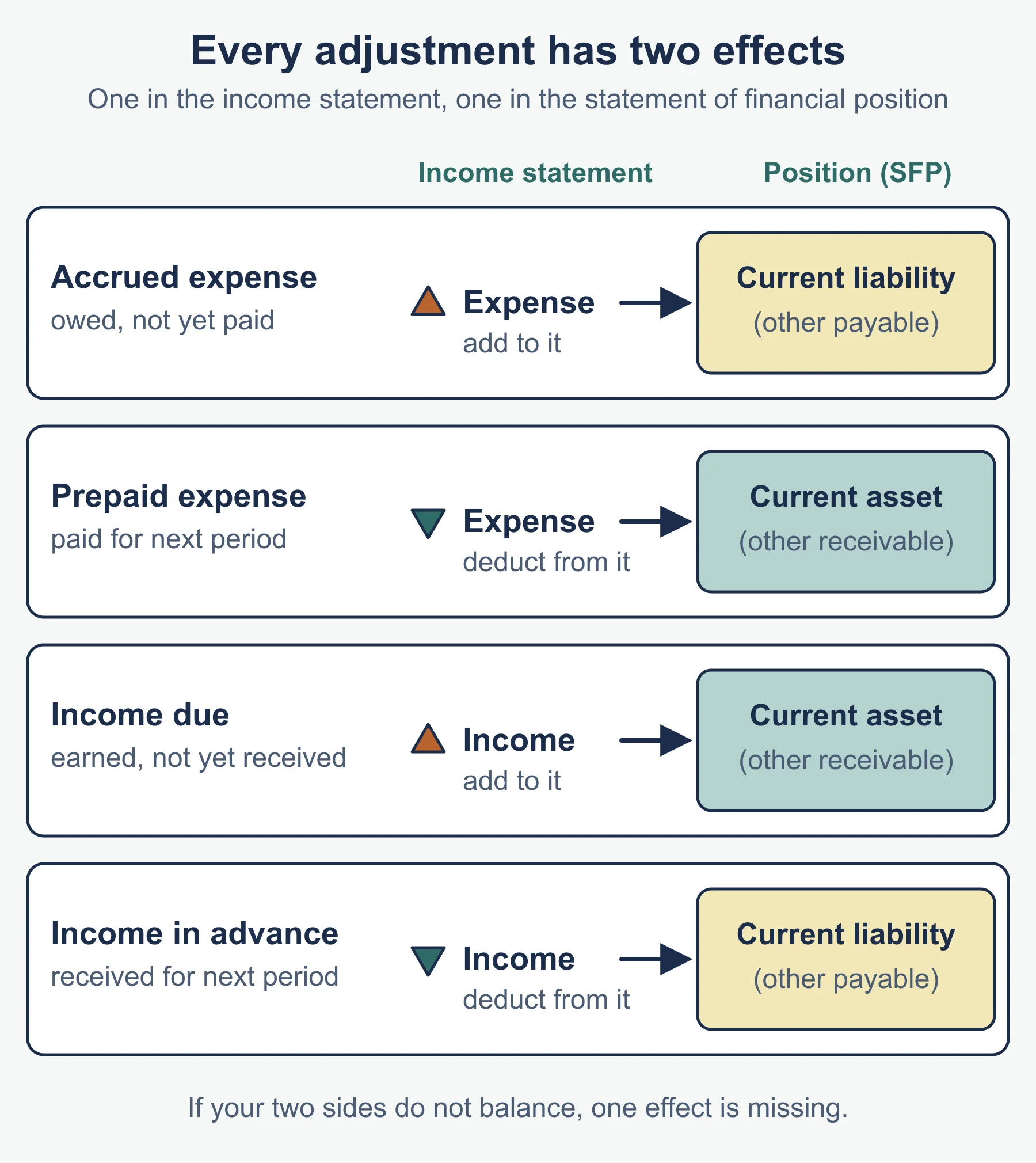
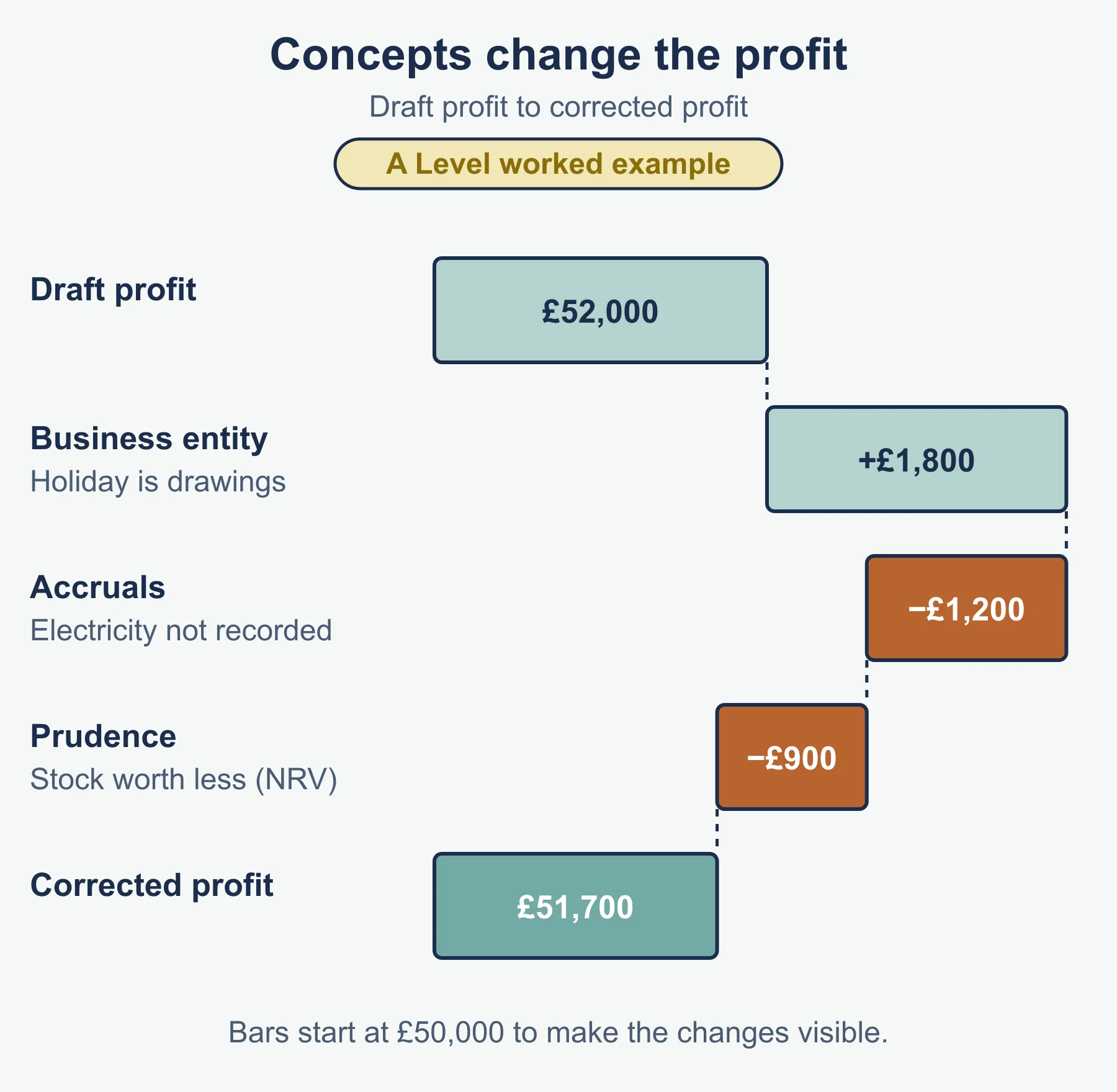
Each adjustment applies a concept. Knowing which one lets you explain a treatment, not just perform it.
| Adjustment | Concept | Effect |
|---|---|---|
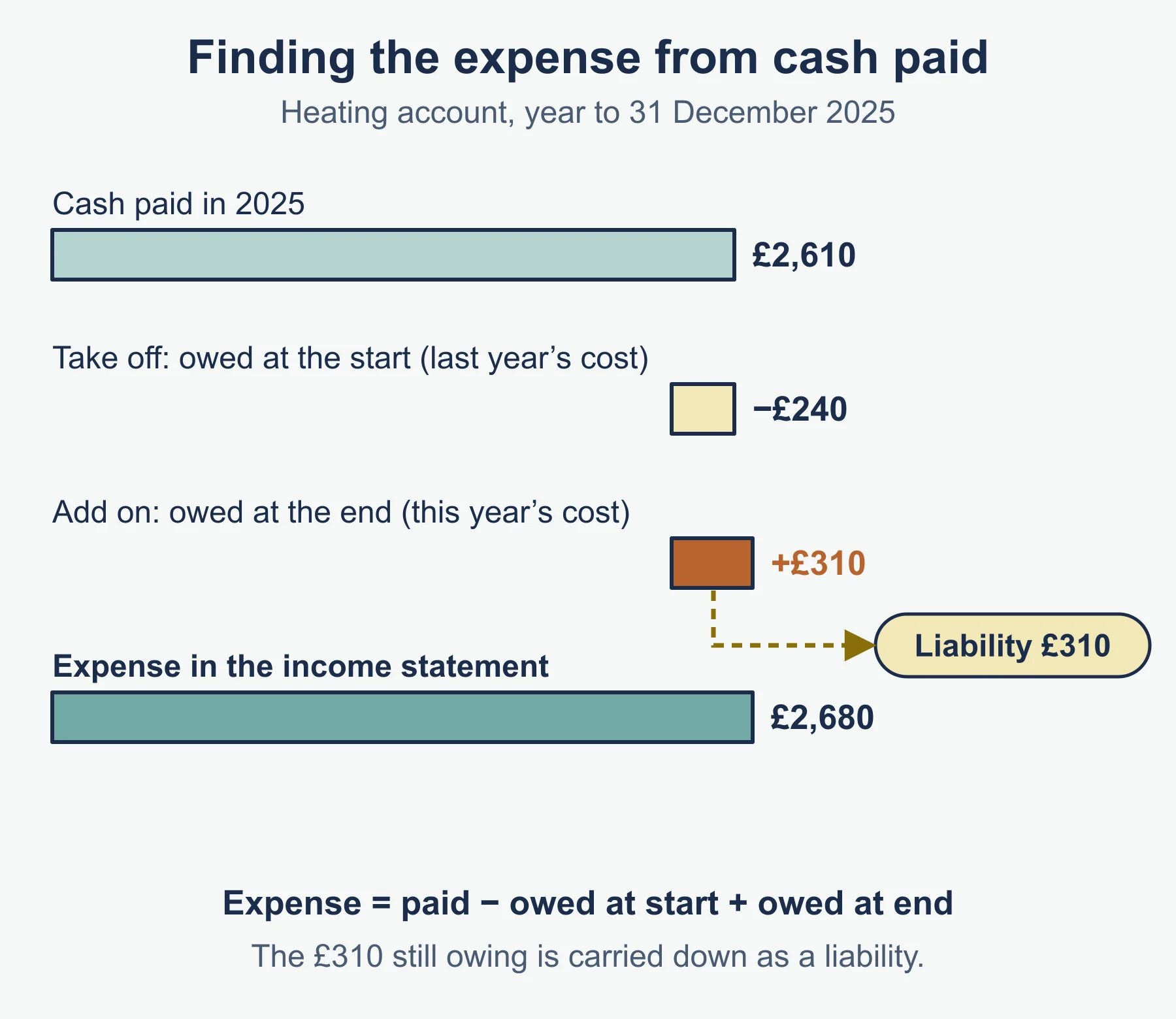
| Other payables (expense owing) | Accruals | Add to the expense; liability in current liabilities |
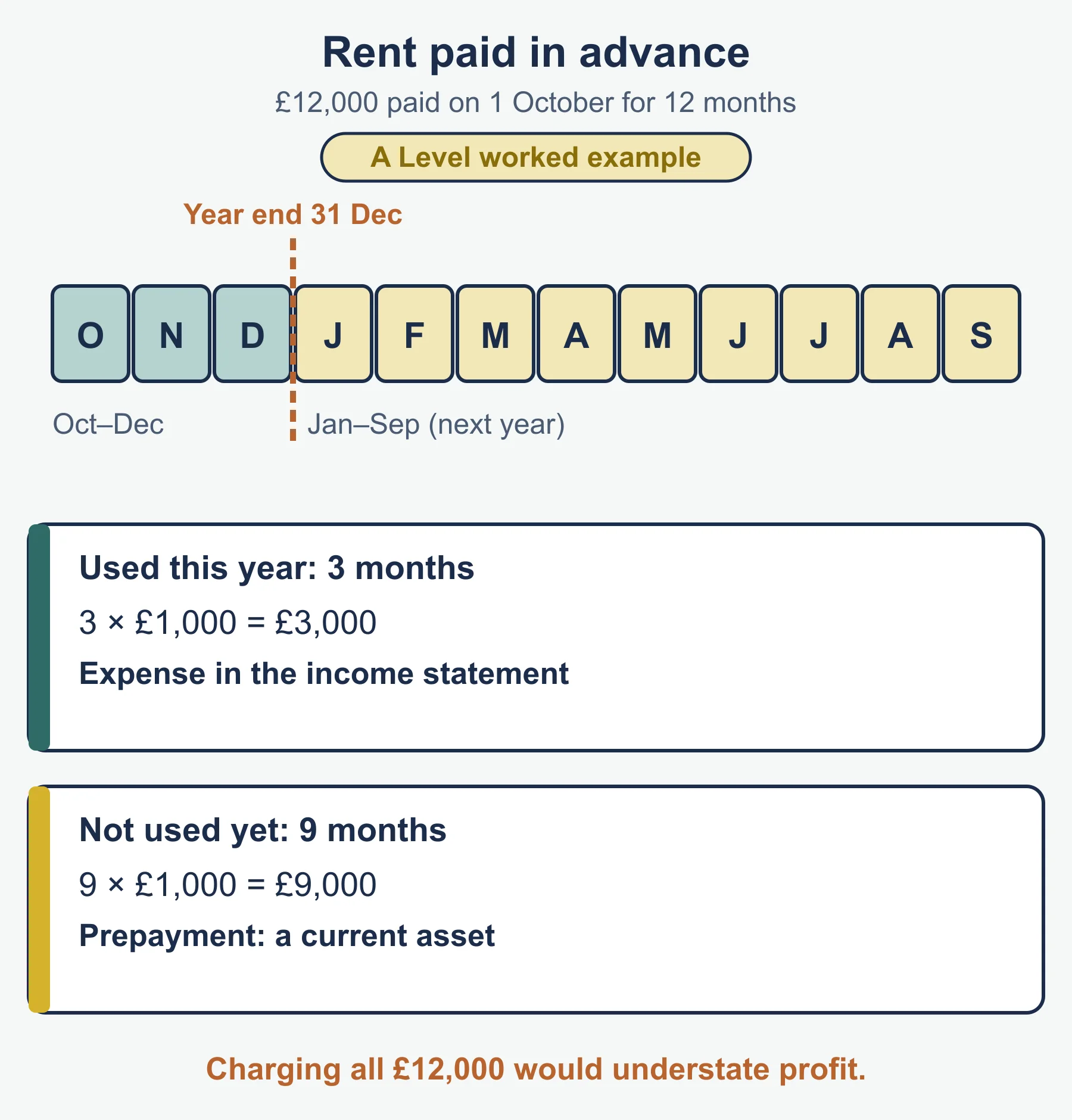
| Other receivables (expense paid in advance) | Accruals | Deduct from the expense; asset in current assets |
| Income due / received in advance | Accruals, realisation | Add or deduct so that income belongs to the year earned |
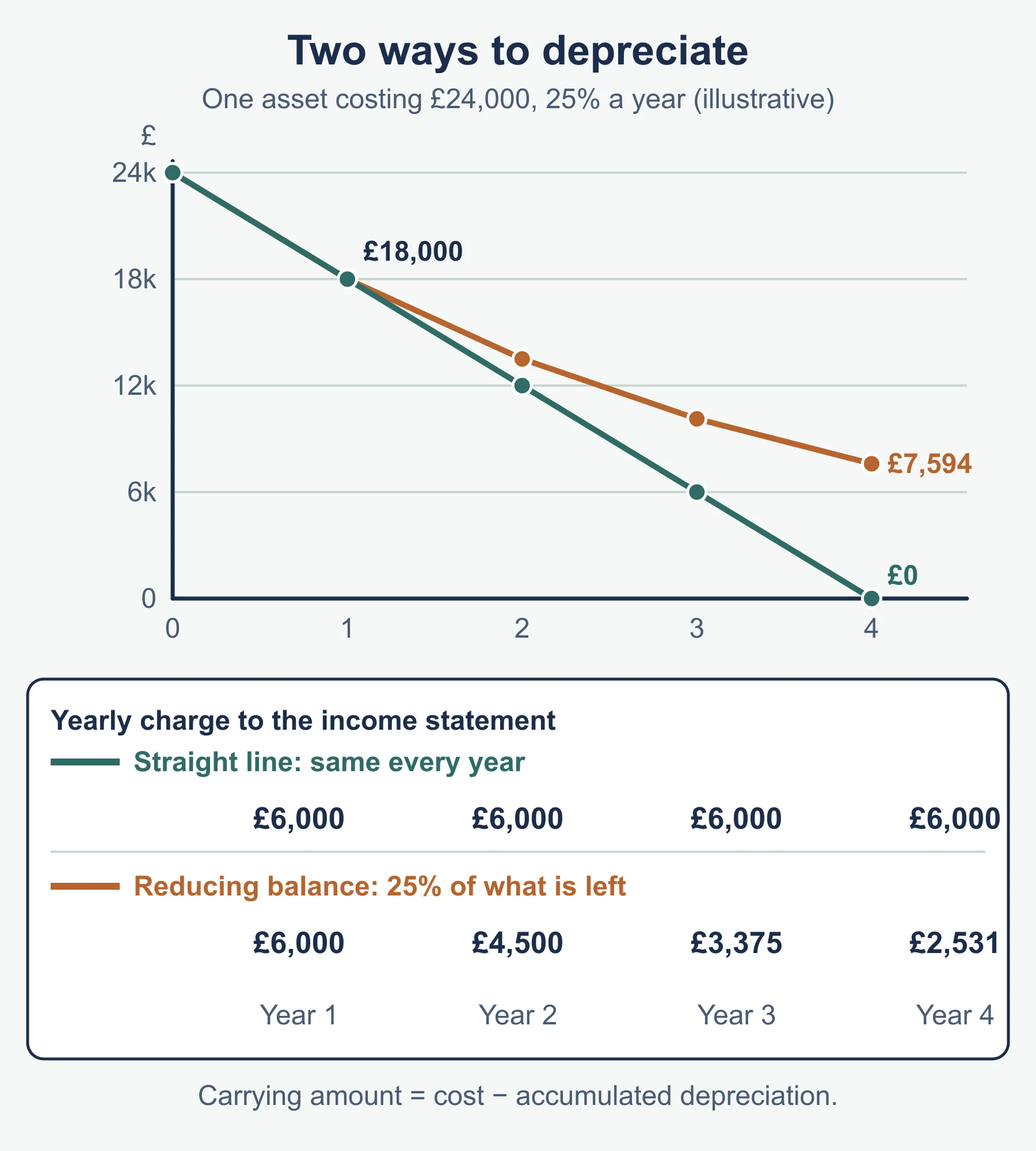
| Depreciation | Going concern, historic cost, consistency | Spreads cost over use; a non-cash expense; keep the same method year to year |
| Irrecoverable debt | Prudence | Expense; trade receivables reduced |
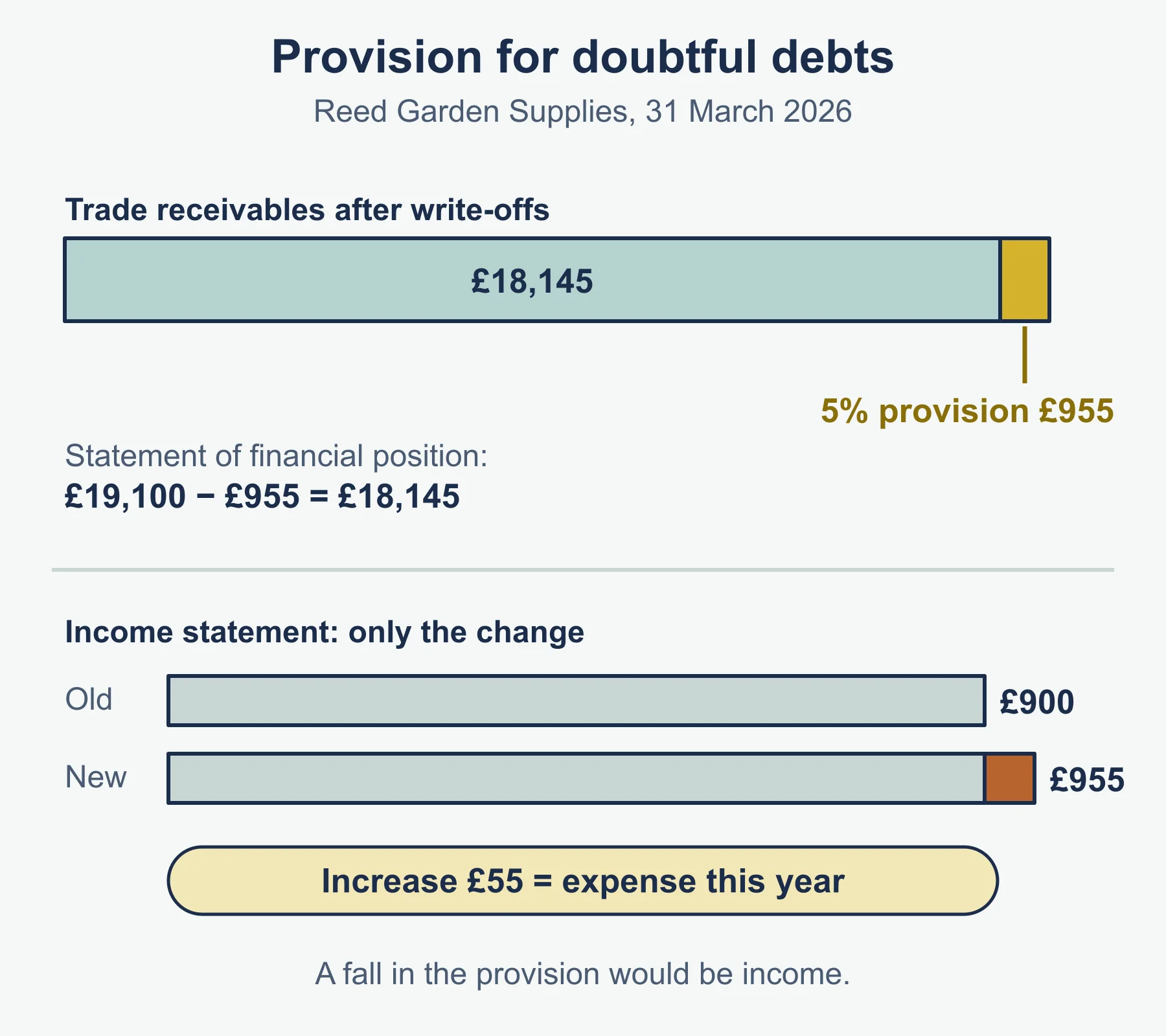
| Provision for doubtful debts | Prudence | Only the change in the provision is charged |
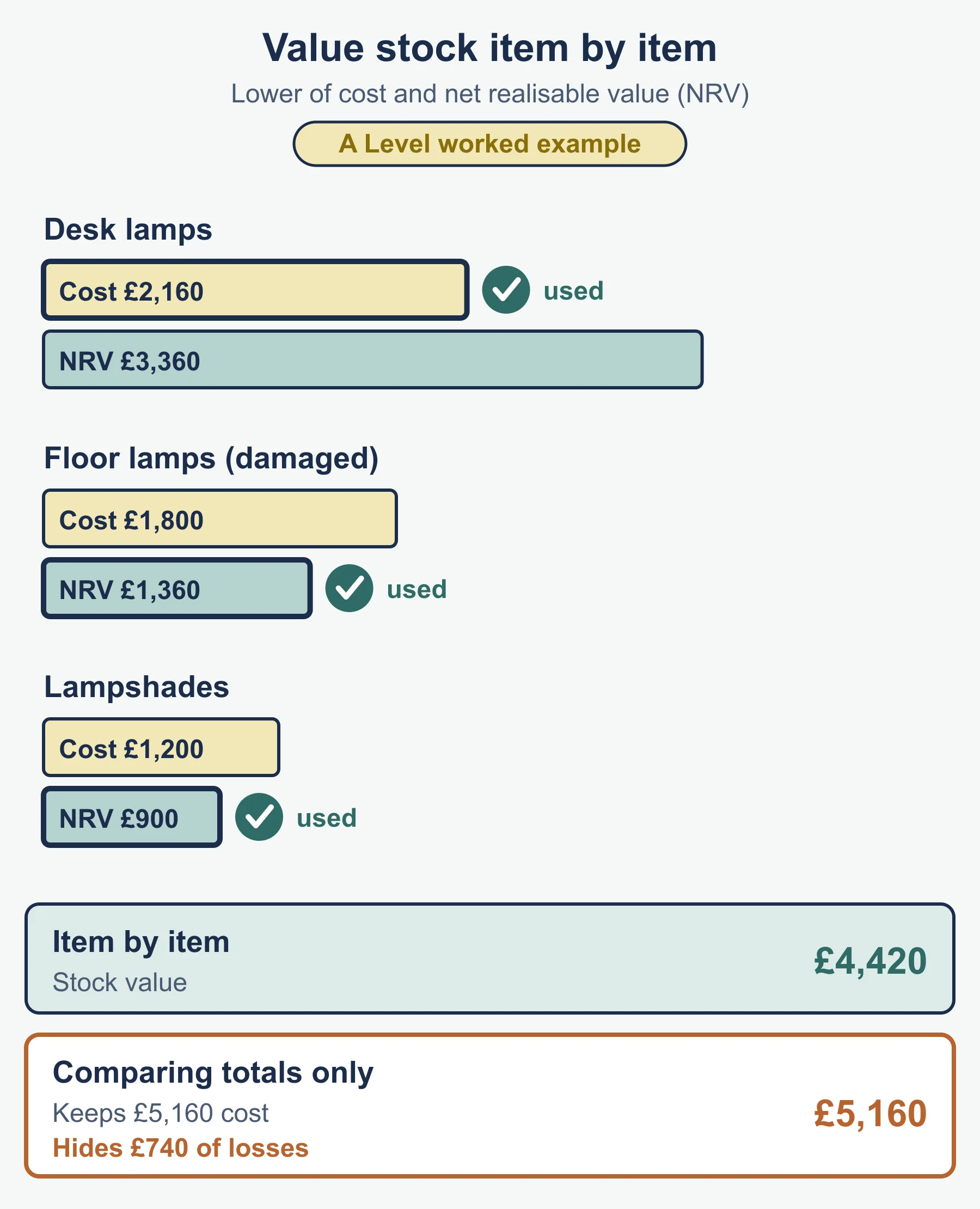
| Inventory at cost or net realisable value | Prudence | Lower figure used, so profit is not overstated |
| Goods taken for own use | Business entity | Drawings at cost, not an expense |
Worked example 1: a trading business
Nerys Mallory runs Cobham Canvas Supplies. The year ends on 31 December 2025.
| Trial balance | Debit | Credit |
|---|---|---|
| Inventory at 1 January 2025 | 9,200 | |
| Purchases | 84,200 | |
| Carriage inwards | 1,300 | |
| Wages | 18,400 | |
| Rent paid | 6,000 | |
| Insurance | 2,400 | |
| Electricity | 3,100 | |
| Delivery vehicle at cost | 24,000 | |
| Shop fittings at cost | 12,000 | |
| Trade receivables | 11,500 | |
| Bank | 6,300 | |
| Drawings | 14,000 | |
| Sales | 138,000 | |
| Trade payables | 9,800 | |
| Provision for depreciation: vehicle | 6,000 | |
| Provision for depreciation: fittings | 3,000 | |
| Provision for doubtful debts | 400 | |
| Rent received | 3,000 | |
| Bank loan (repayable 2029) | 10,000 | |
| Capital at 1 January 2025 | 22,200 | |
| Totals | 192,400 | 192,400 |
Adjustments:
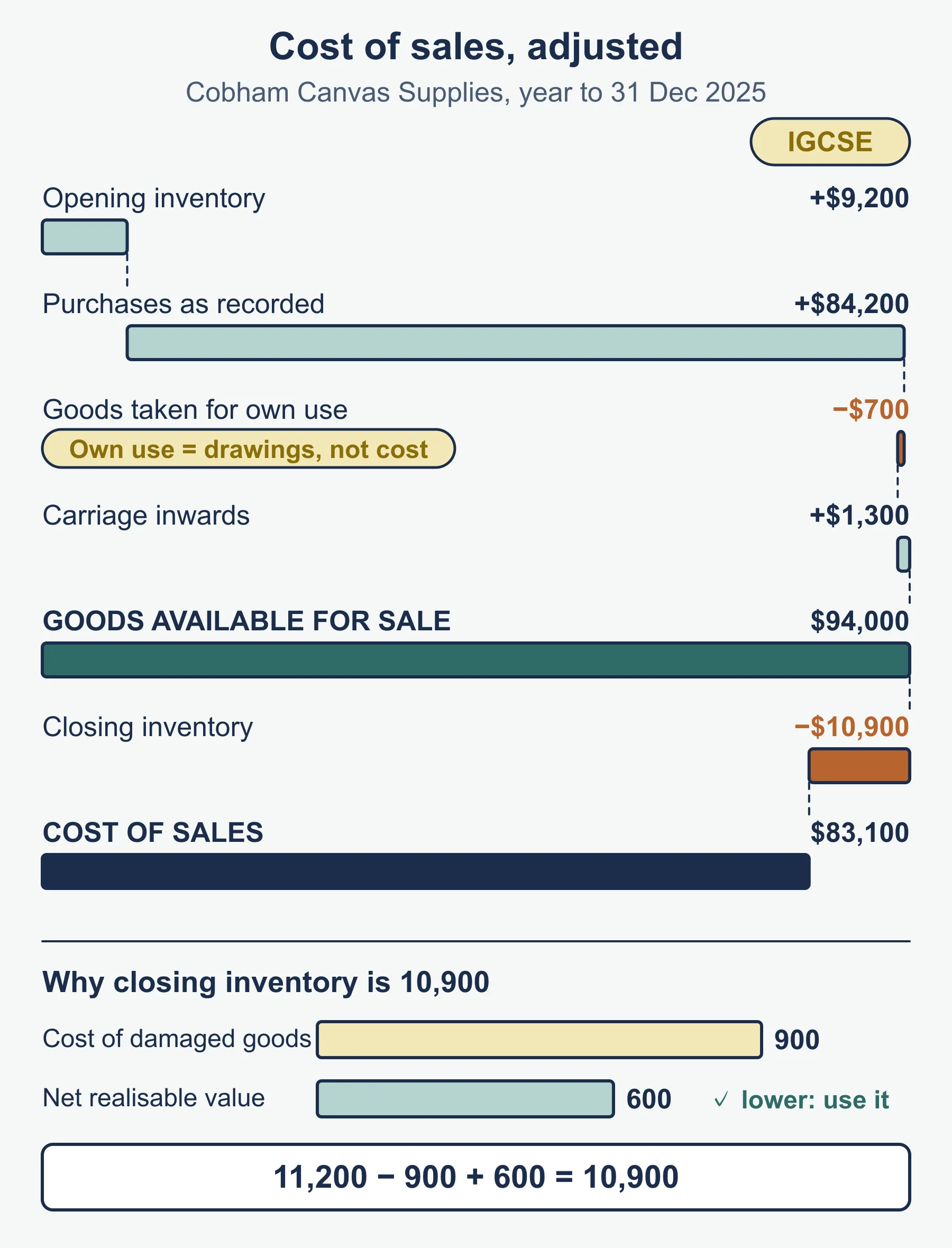
- Closing inventory at cost is 11,200. It includes goods that cost 900 but can only be sold for 600 after costs.
- Electricity owing is 420.
- Insurance paid in advance is 600.
- Rent received includes 500 for next year.
- An irrecoverable debt of 500 is to be written off, then the provision set at 5% of remaining trade receivables.
- The vehicle is depreciated by the straight line method (residual value 4,000, five years). The fittings are depreciated by the reducing balance method at 20%.
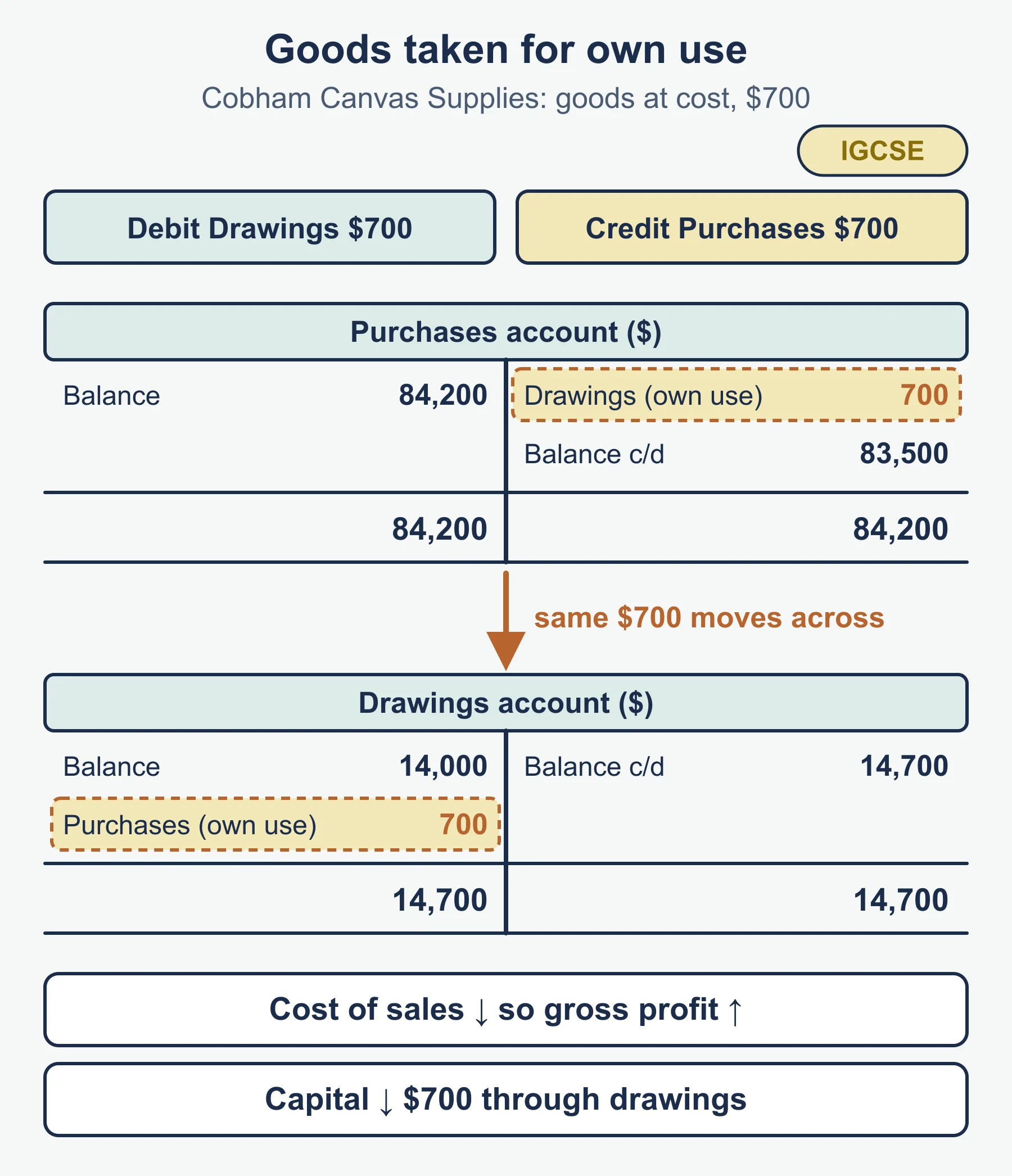
- Nerys took goods that cost 700 for her own use. They are still in purchases.
Workings, each checked:
| Item | Working | Result |
|---|---|---|
| Closing inventory | 11,200 - 900 + 600 | 10,900 |
| Purchases | 84,200 - 700 | 83,500 |
| Provision | 5% of (11,500 - 500) = 550; 550 - 400 | Increase of 150 |
| Vehicle | (24,000 - 4,000) / 5 | 4,000 |
| Fittings | 20% of (12,000 - 3,000) | 1,800 |
| Drawings | 14,000 + 700 | 14,700 |
Income statement for the year ended 31 December 2025
| Amount | Total | |
|---|---|---|
| Revenue | 138,000 | |
| Opening inventory | 9,200 | |
| Purchases (after own use) | 83,500 | |
| Carriage inwards | 1,300 | |
| 94,000 | ||
| Less closing inventory | 10,900 | |
| Cost of sales | 83,100 | |
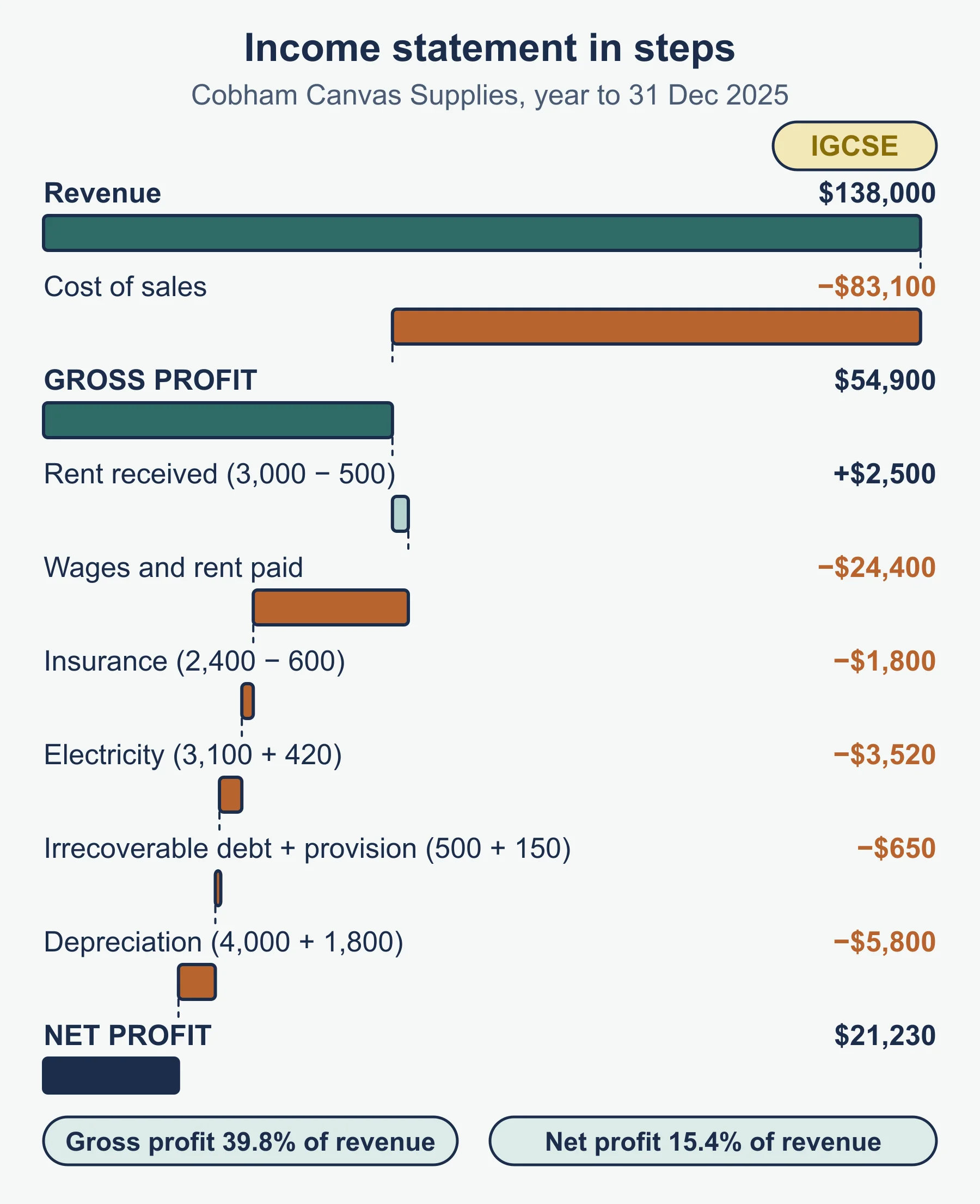
| Gross profit | 54,900 | |
| Rent received (3,000 - 500) | 2,500 | |
| 57,400 | ||
| Wages | 18,400 | |
| Rent paid | 6,000 | |
| Insurance (2,400 - 600) | 1,800 | |
| Electricity (3,100 + 420) | 3,520 | |
| Irrecoverable debt | 500 | |
| Increase in provision for doubtful debts | 150 | |
| Depreciation: vehicle | 4,000 | |
| Depreciation: fittings | 1,800 | |
| Total expenses | 36,170 | |
| Net profit | 21,230 |
Statement of financial position at 31 December 2025
| Cost | Depreciation | Net | |
|---|---|---|---|
| Non-current assets | |||
| Delivery vehicle | 24,000 | 10,000 | 14,000 |
| Shop fittings | 12,000 | 4,800 | 7,200 |
| 36,000 | 14,800 | 21,200 | |
| Current assets | |||
| Inventory | 10,900 | ||
| Trade receivables (11,000 - 550) | 10,450 | ||
| Other receivables (insurance) | 600 | ||
| Bank | 6,300 | 28,250 | |
| Current liabilities | |||
| Trade payables | 9,800 | ||
| Other payables (electricity) | 420 | ||
| Income received in advance | 500 | (10,720) | |
| Net current assets | 17,530 | ||
| Non-current liabilities: bank loan | (10,000) | ||
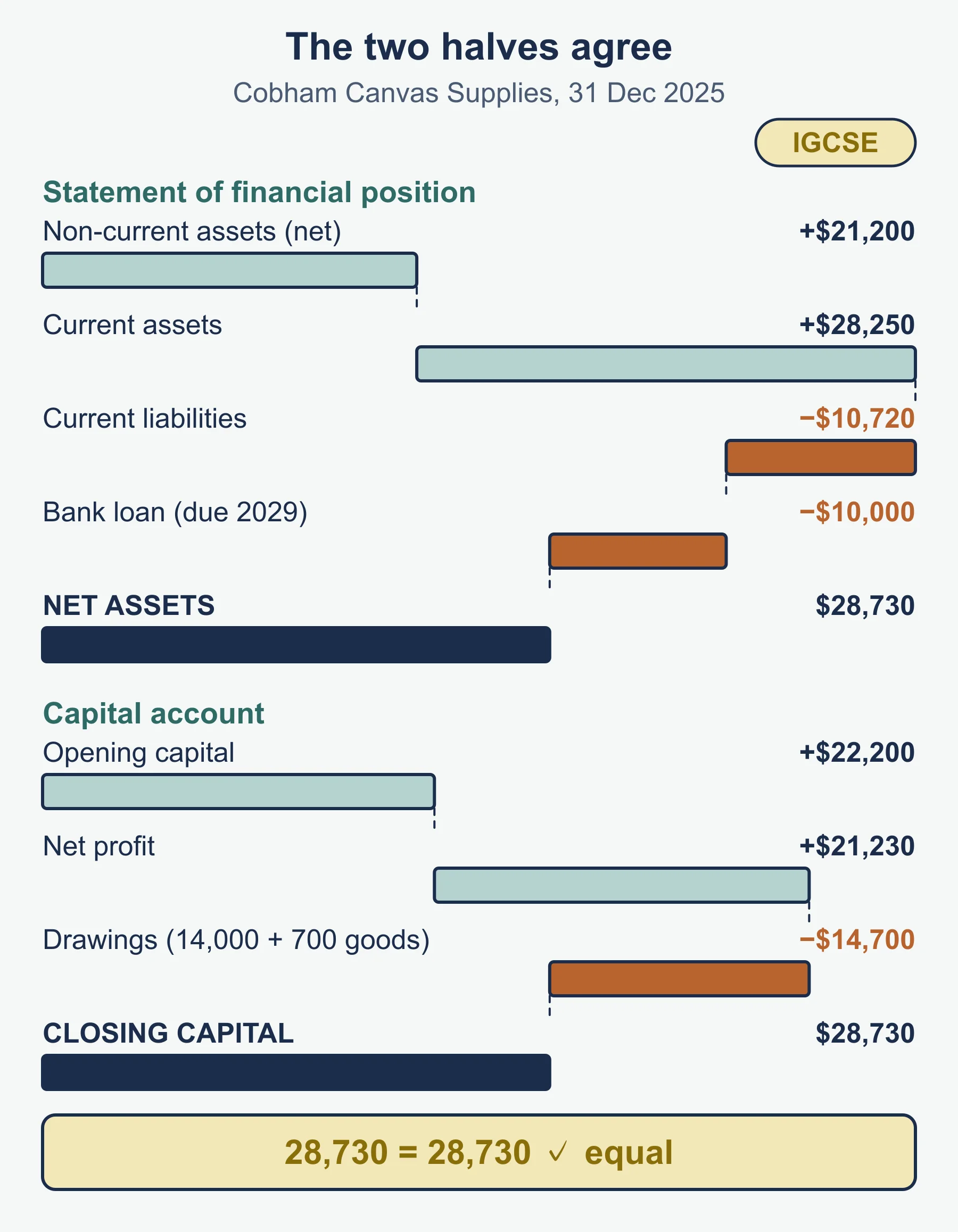
| Net assets | 28,730 | ||
| Capital at start | 22,200 | ||
| Add net profit | 21,230 | ||
| Less drawings | (14,700) | ||
| Closing capital | 28,730 |
The two halves agree, which is your check on the whole exercise.
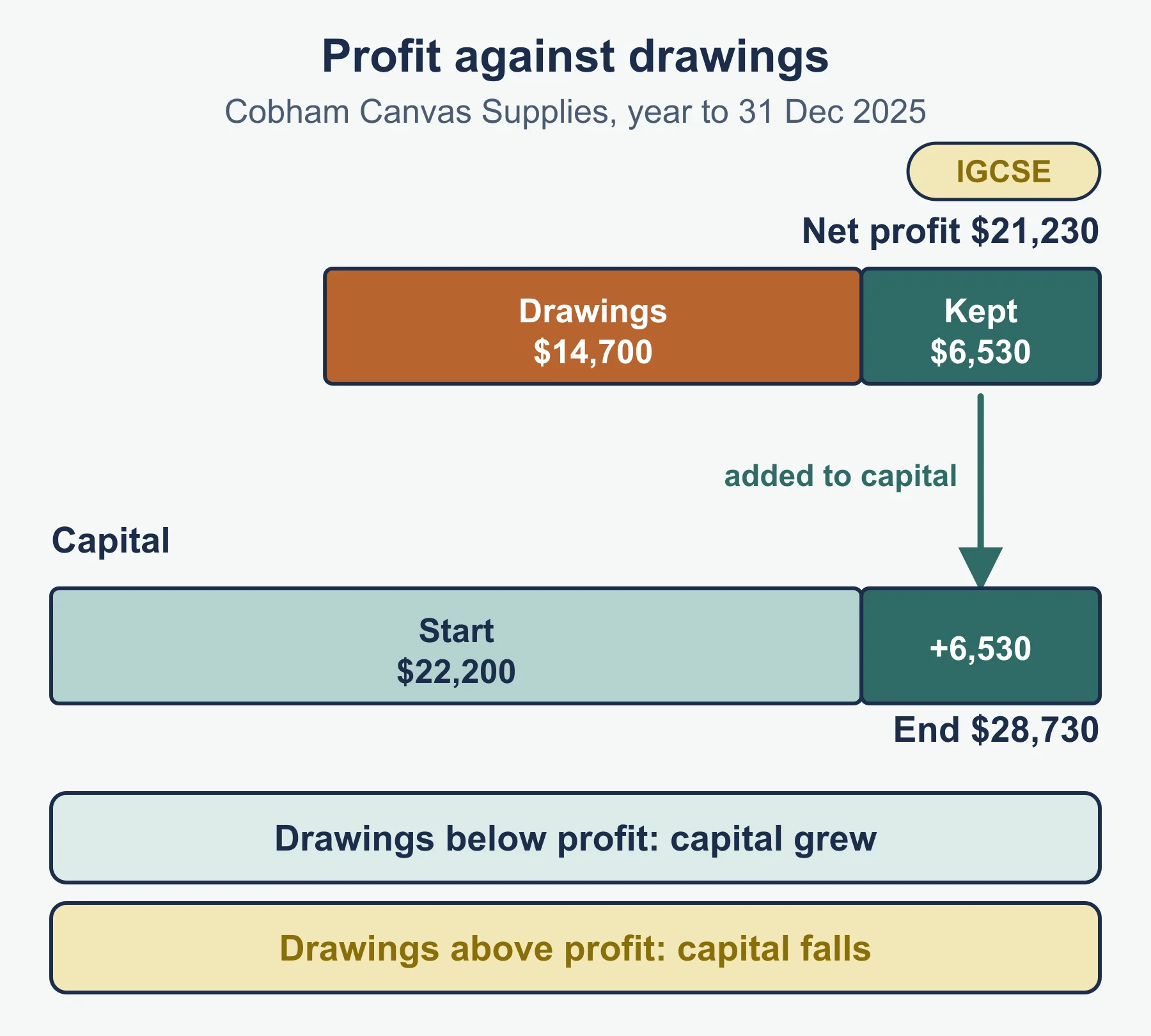
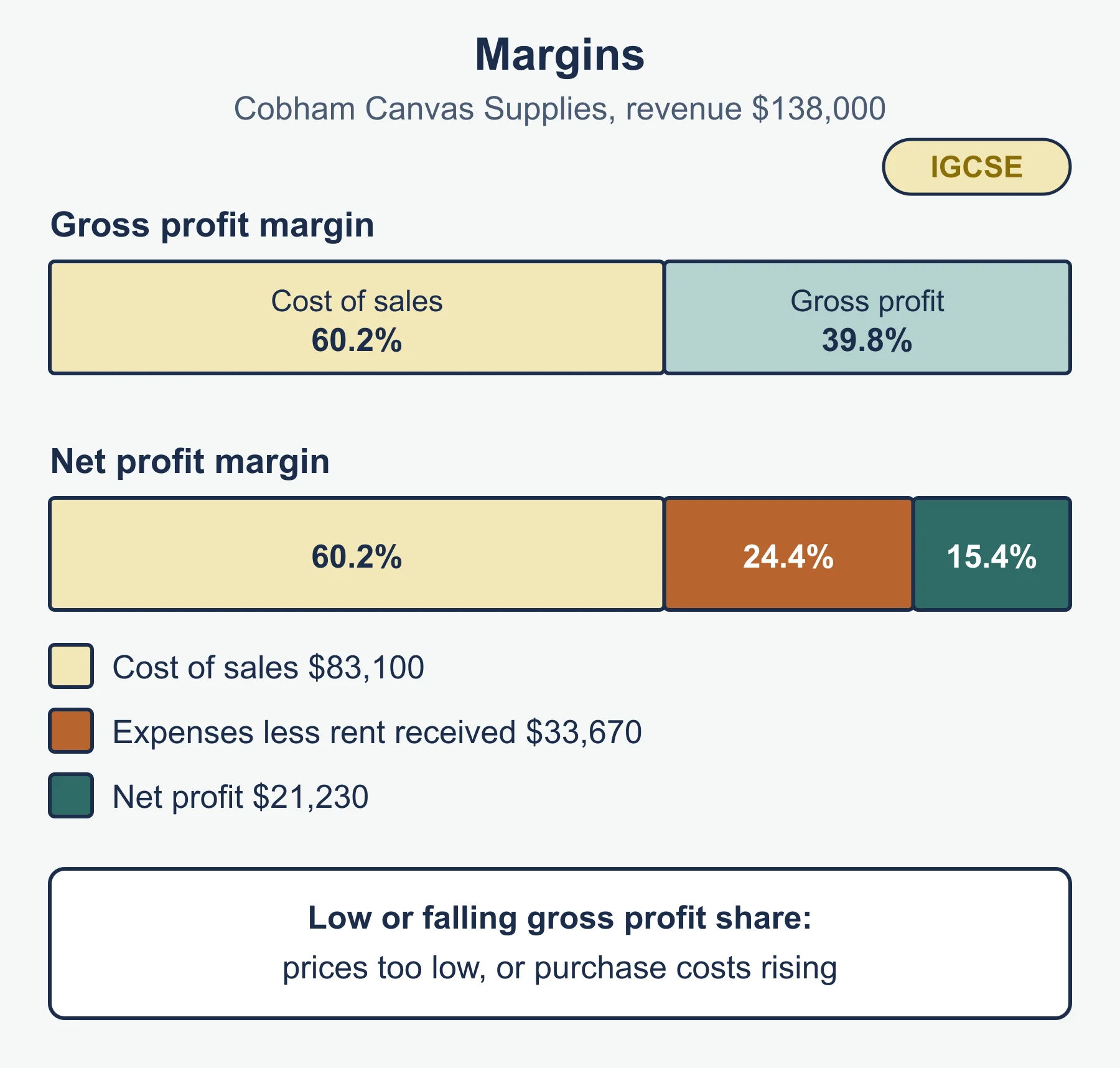
Commentary a marker would credit: gross profit is 54,900 on revenue of 138,000 (39.8%) and net profit is 15.4% of revenue. Drawings of 14,700 are well below profit, so capital grew. Net current assets of 17,530 show the business can meet its short-term debts. The loan is long term, so it does not threaten that position.
Worked example 2: a service business with ledger accounts
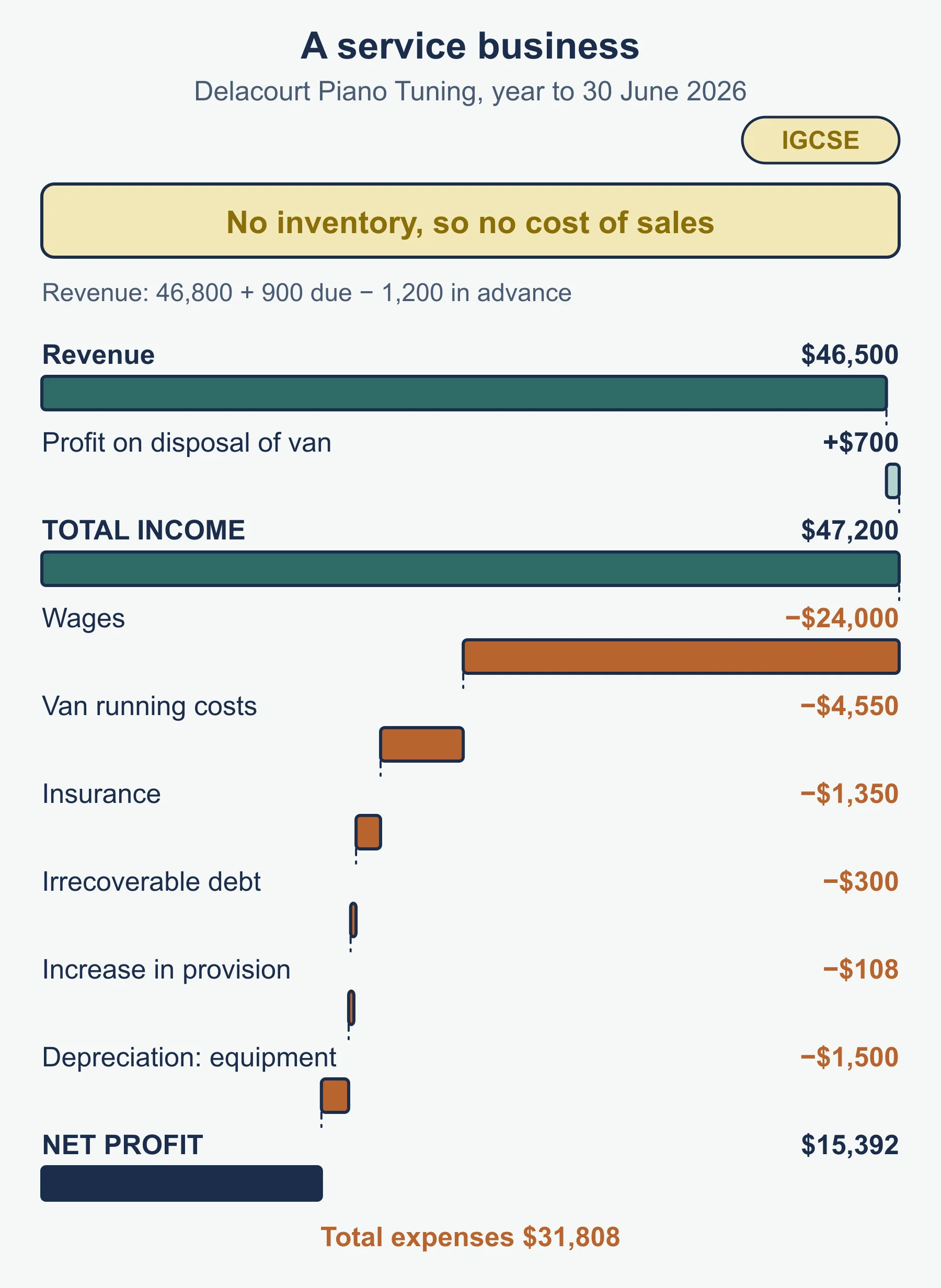
Lowenna Delacourt runs Delacourt Piano Tuning (year end 30 June 2026). A service business has no inventory, so there is no cost of sales and the income statement starts with revenue and goes straight to expenses.
Ledger accounts show how the adjustments arise:
Insurance account                      Van running costs account
Paid        1,800 | Income st  1,350   Paid        4,200 | Income st  4,550
            | Other rec. c/d    450    Owing c/d     350 |
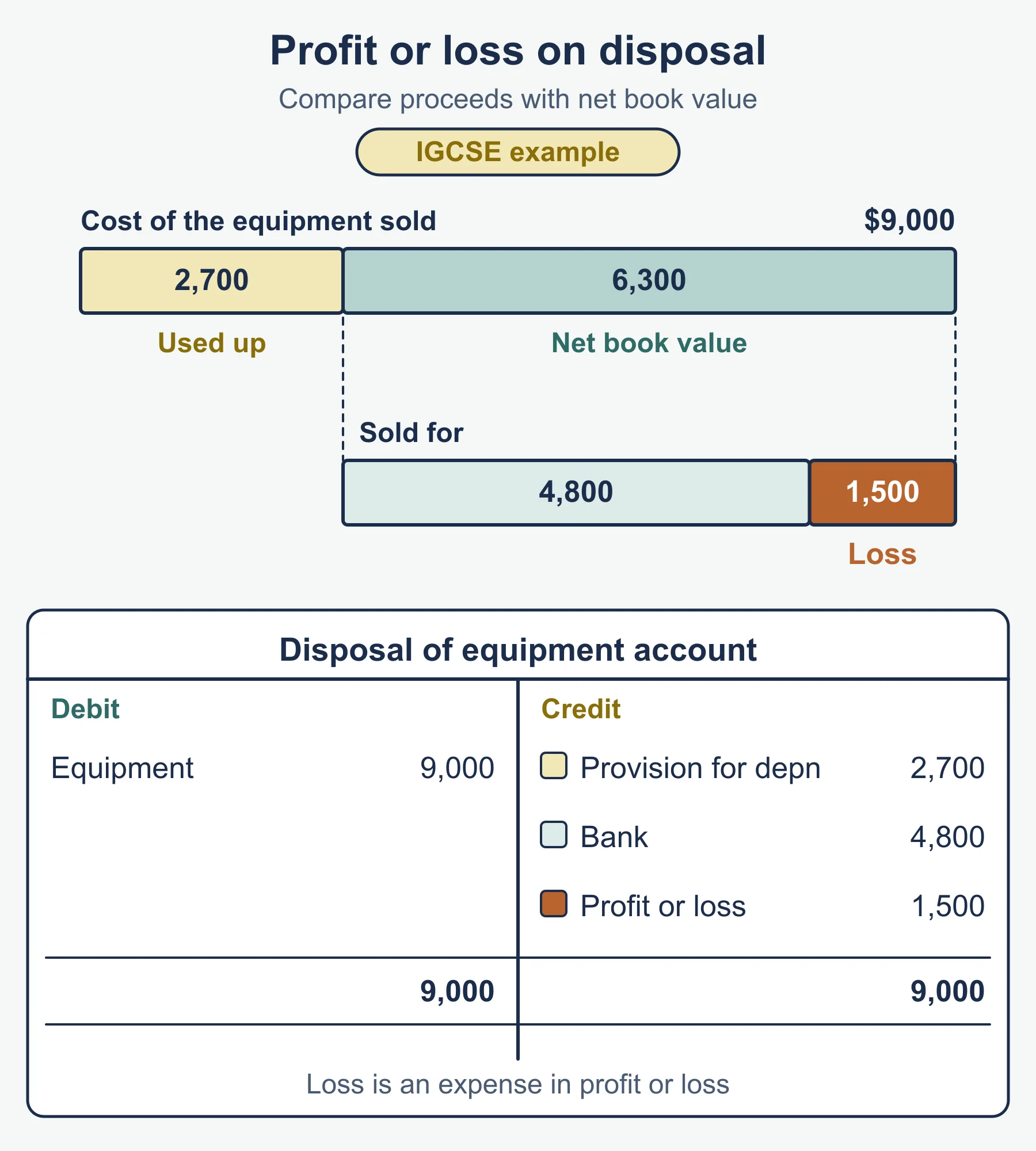
Disposal of van account
Van at cost 15,000 | Provision for depreciation 12,300
Profit to income st 700 | Bank (proceeds) 3,400
15,700 | 15,700
Provision for doubtful debts account
Balance c/d 288 | Balance b/d 180
| Income statement 108
288 | 288Fee revenue in the trial balance is 46,800. Fees of 900 are due, and 1,200 was received in advance, so revenue is 46,800 + 900 - 1,200 = 46,500. Wages are 24,000, an irrecoverable debt is 300, and the 4% provision applies to receivables of 7,500 - 300 = 7,200. Equipment depreciation is 25% of a net book value of 6,000, which is 1,500.
| Income statement (extract) | Amount |
|---|---|
| Revenue | 46,500 |
| Profit on disposal of van | 700 |
| Total income | 47,200 |
| Wages | 24,000 |
| Van running costs | 4,550 |
| Insurance | 1,350 |
| Irrecoverable debt | 300 |
| Increase in provision for doubtful debts | 108 |
| Depreciation: equipment | 1,500 |
| Total expenses | 31,808 |
| Net profit | 15,392 |
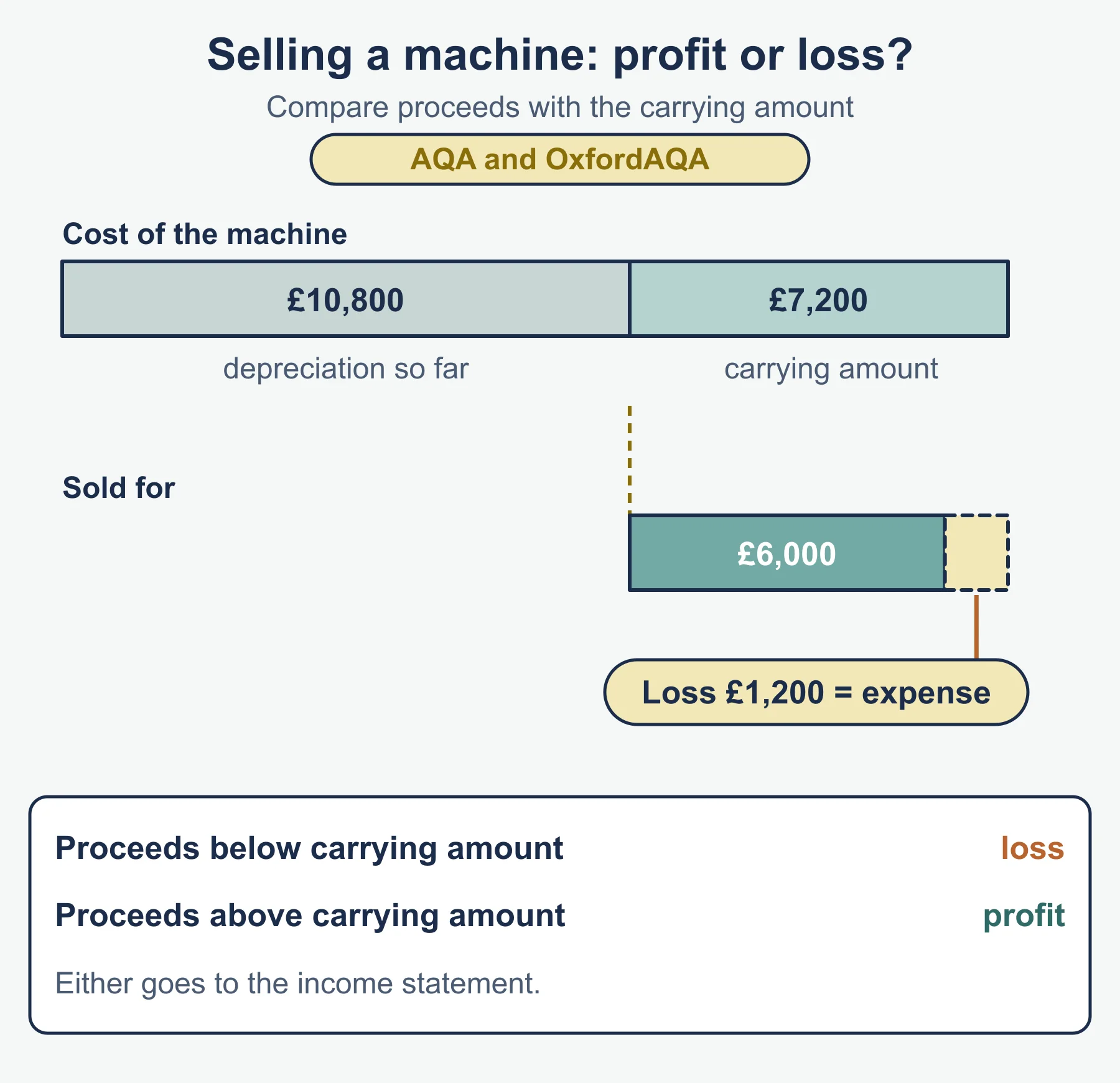
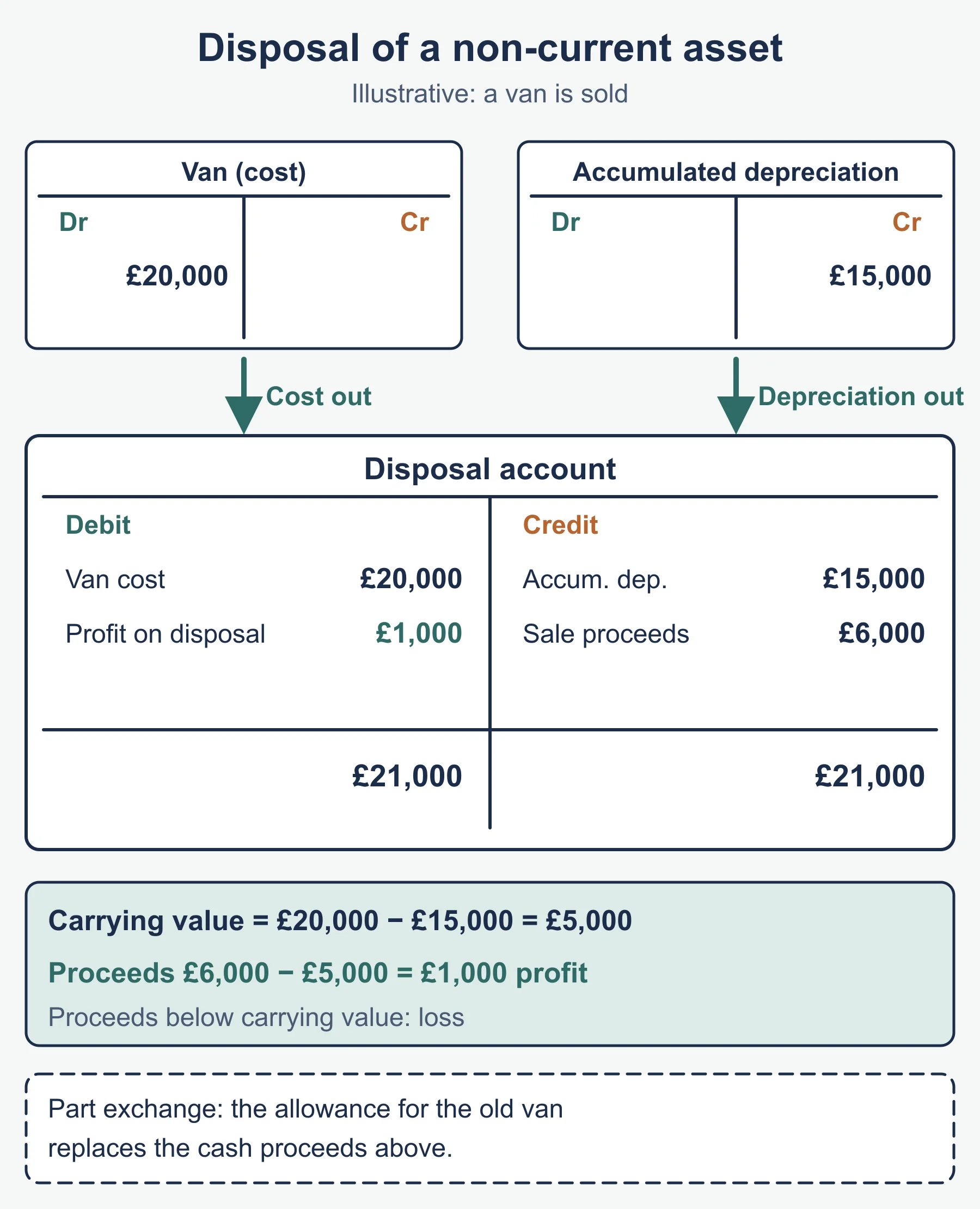
The disposal account compares net book value (15,000 - 12,300 = 2,700) with proceeds of 3,400. Proceeds above net book value mean a profit. A loss would be an expense.
Goods taken for own use
The owner and the business are separate (business entity). Taking stock is drawings, valued at cost. Debit drawings, credit purchases. This lowers cost of sales, so gross profit rises, while capital falls by the same cost through drawings.
Comparing sole traders, partnerships and limited companies
| Advantages | Disadvantages | |
|---|---|---|
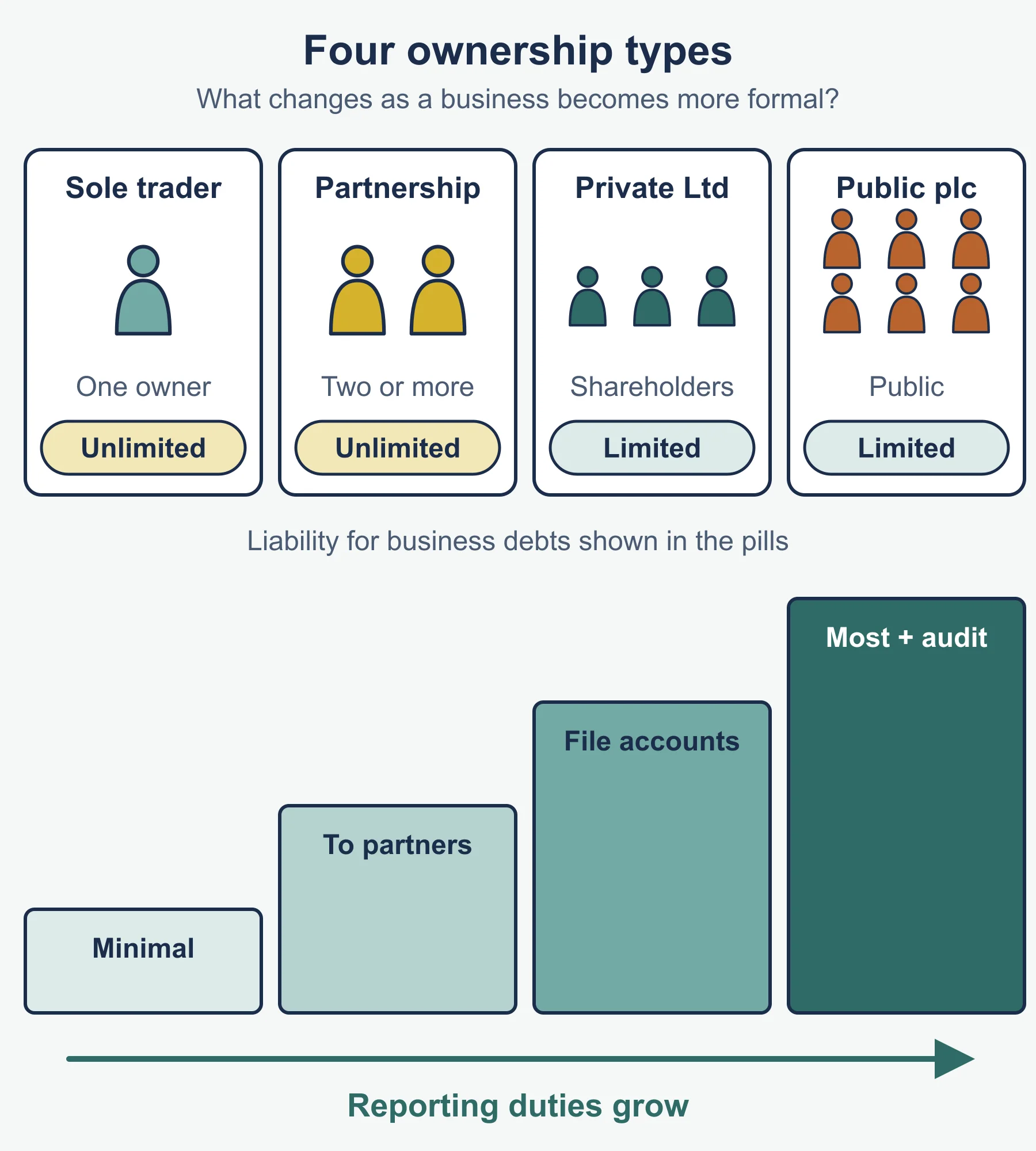
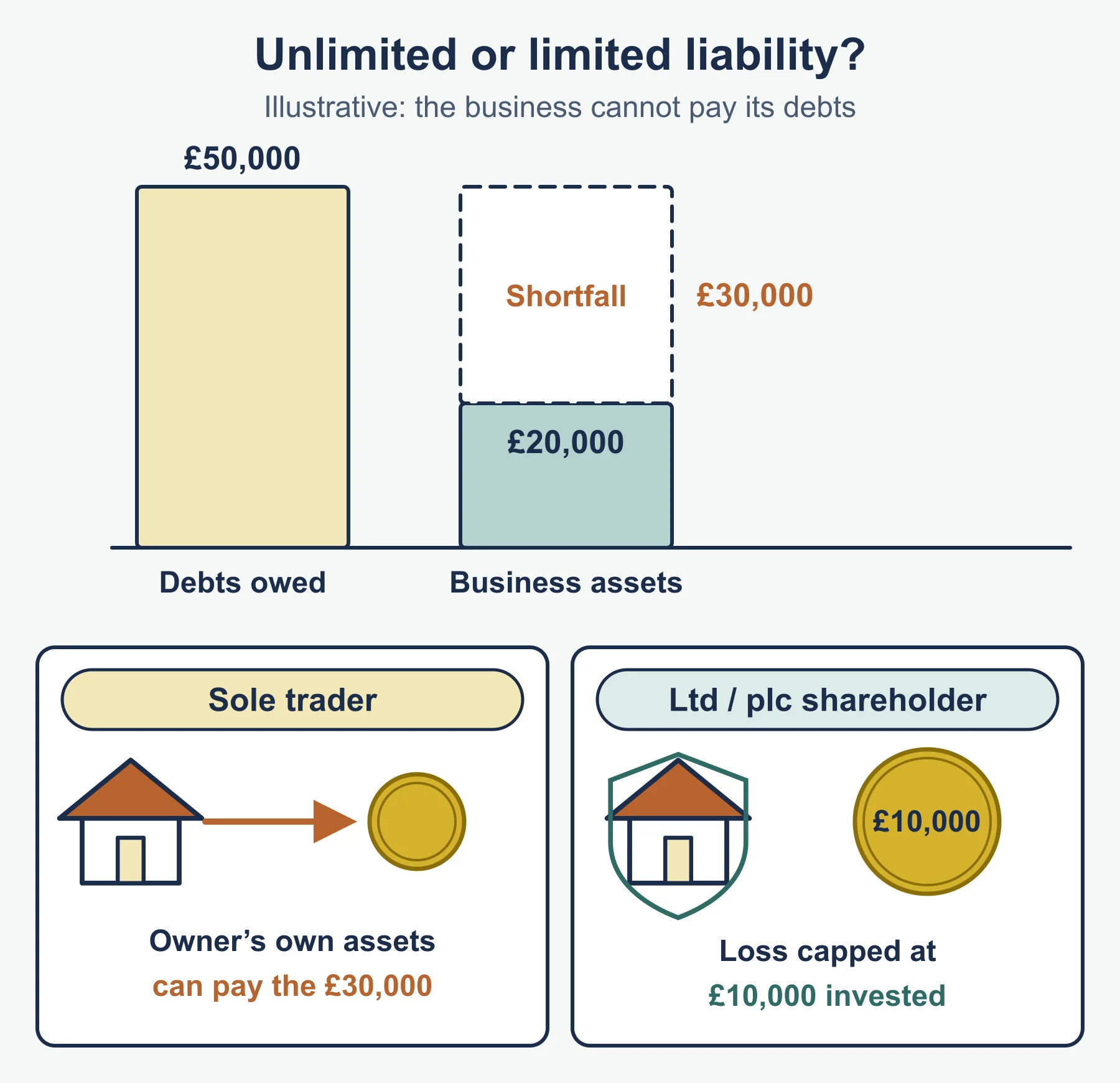
| Sole trader | Owner keeps all profit and all control; quick decisions; simple to start | Unlimited liability; capital limited to the owner’s own funds and borrowing; business ends or depends on one person |
| Partnership | More capital and skills; workload and risk shared | Partners usually share unlimited liability; disagreements; profit is shared |
| Limited company | Limited liability for shareholders; shares can raise large sums; continues if owners change | More rules to follow; owners may lose control to other shareholders; setting up costs more |
Match points to the case. A sole trader wanting to raise a large sum for a second site could consider a company for the capital, but the answer should weigh the loss of control and extra rules.
A method for any trial balance question
- Read every adjustment first and mark which accounts it touches.
- Work out each adjusted figure on rough paper: expense charge, income earned, depreciation, change in provision, closing inventory.
- Build the income statement from revenue down, then add any income and deduct expenses.
- Build the statement of financial position, placing each balance under non-current assets, current assets, current liabilities or non-current liabilities.
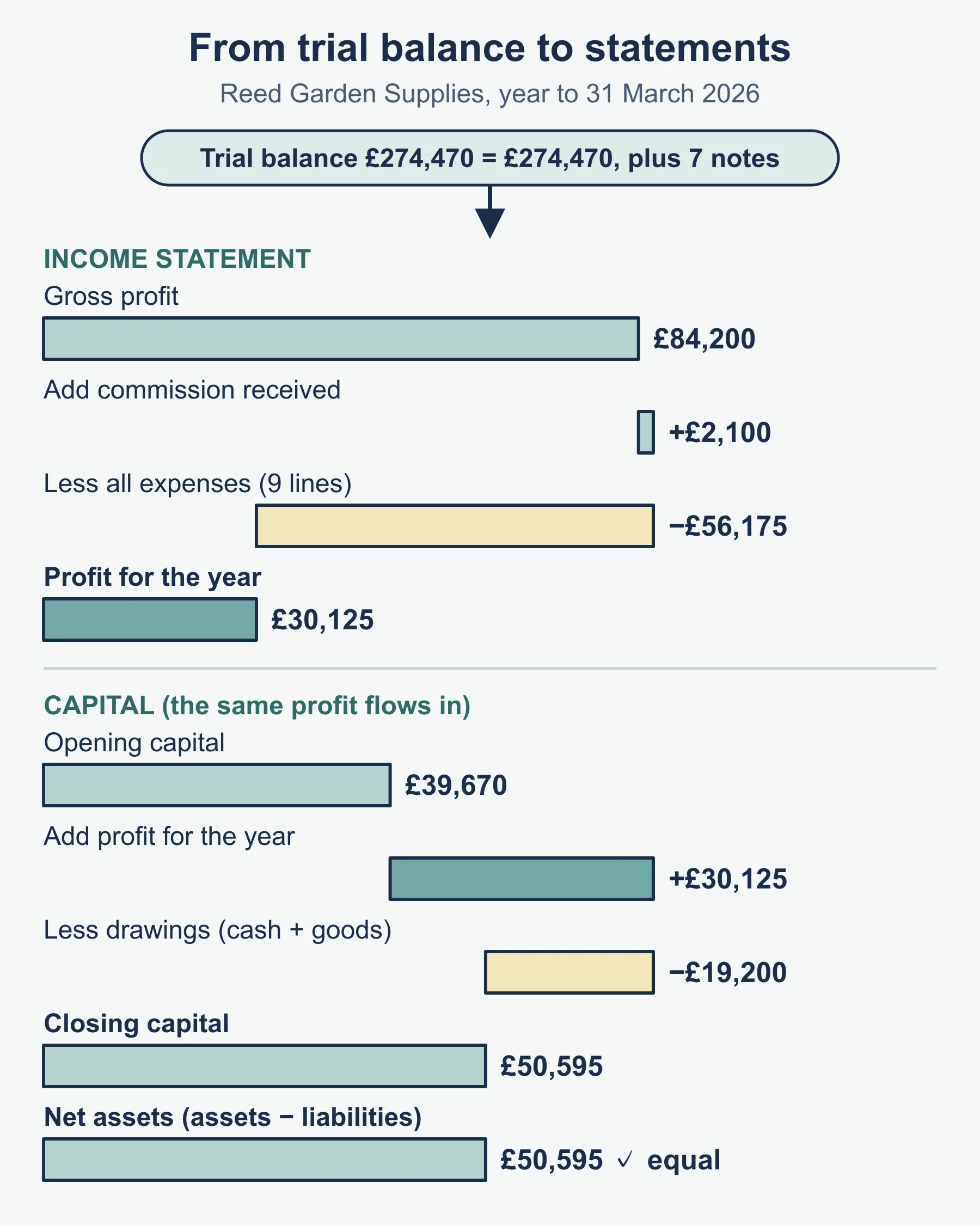
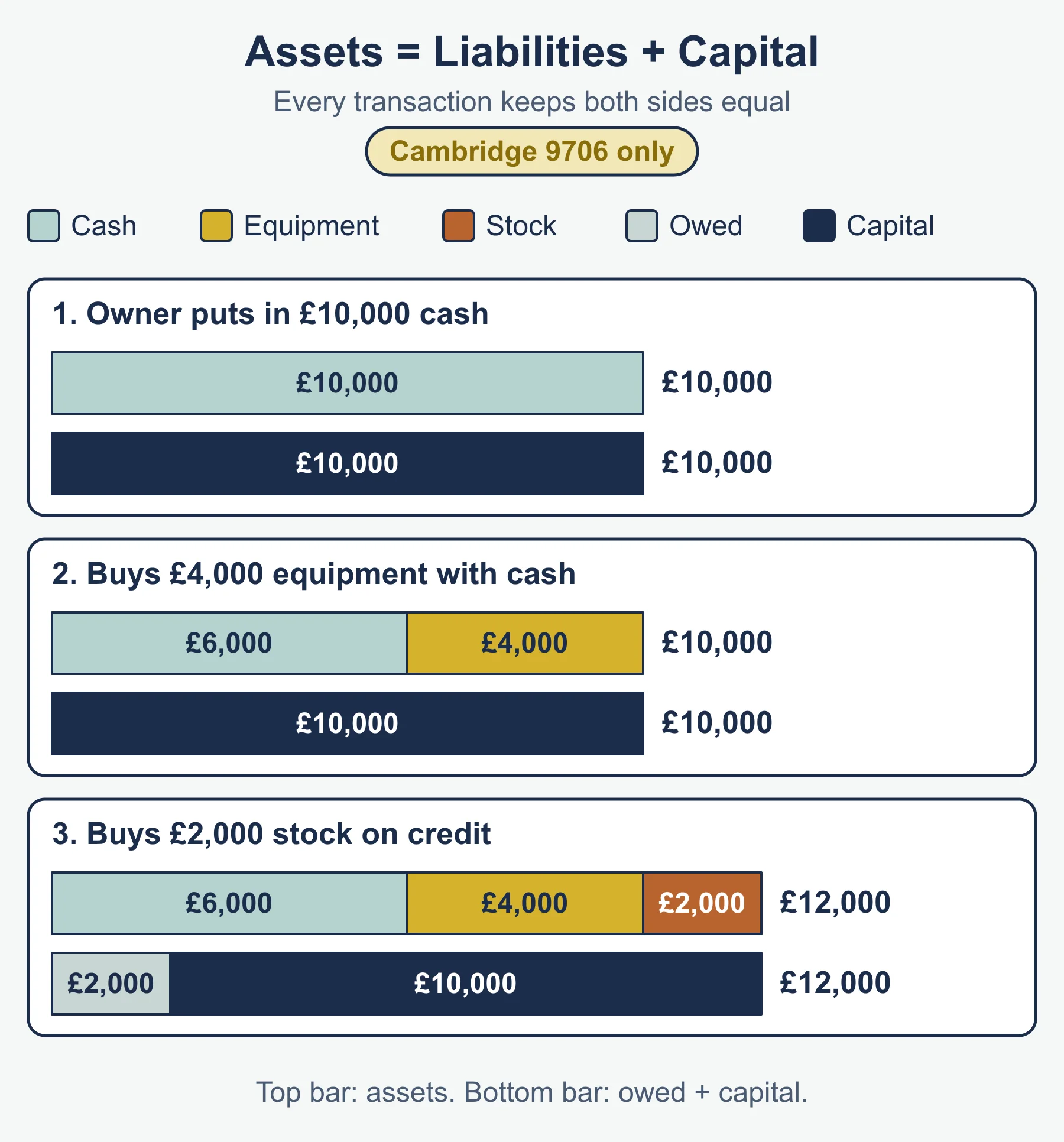
- Roll capital forward: opening capital plus net profit less drawings. If net assets differ from closing capital, look for an adjustment entered once instead of twice.
Commenting on the statements
The specification asks you to comment, so numbers alone do not earn full credit. Say what the figure shows, then why it matters to the owner. Useful angles:
- Profit against drawings: if drawings exceed net profit, capital is falling, so the owner is taking out more than the business earns.
- Gross profit against revenue: a low or falling share may mean selling prices are too low or purchase costs are rising.
- Net current assets: positive figures suggest short-term debts can be paid, but check whether the cash sits in inventory that may not sell quickly.
- Long-term borrowing: a loan repayable in several years is a non-current liability and has less effect on short-term cash.
Common errors
- Charging the whole provision for doubtful debts to the income statement instead of the change.
- Treating goods taken for own use as an expense or leaving them in cost of sales.
- Adding a prepaid expense to the expense instead of deducting it.
- Valuing inventory at selling price or at cost when net realisable value is lower.
- Forgetting that net profit is added to capital and drawings deducted.
Frequently asked questions
Which accounting concepts explain the year-end adjustments? Accruals explains expenses owing and paid in advance, depreciation draws on going concern, historic cost and consistency, prudence explains irrecoverable debts, provisions for doubtful debts and valuing inventory at the lower of cost and net realisable value, and business entity explains treating goods taken by the owner as drawings.
How do you calculate profit or loss on disposal of a non-current asset? Compare the net book value of the asset (cost less accumulated depreciation) with the proceeds of sale. If proceeds exceed net book value there is a profit on disposal; if they are lower there is a loss, which is shown in the income statement.
What are the advantages of a limited company over a sole trader? A limited company gives its shareholders limited liability, can raise larger amounts of capital through shares and loans, and continues if an owner leaves. A sole trader keeps all the profit and makes quick decisions alone, but has unlimited liability and limited sources of finance.
What should you write when asked to comment on a sole trader’s financial statements? Use the figures to make a judgement, for example comparing gross and net profit margins or comparing drawings with net profit. If drawings exceed net profit, the owner’s capital falls, which is a point a marker would expect you to state and explain.
Official syllabus
OxfordAQA International GCSE Accounting (9215), specification version 1.2, section 3.4, for exams from May/June 2026 onwards. Published by OxfordAQA.
Get free revision emails (optional)
Occasional emails with practice questions, worked explanations and links to free resources for the qualification and subjects you choose. No spam, and you can unsubscribe from any email. The free tools on this site never need an email.
Related resources
-
Practice questions
OxfordAQA IGCSE Accounting: Sole traders and other organisations (9215) – Practice Questions
Original practice questions with worked answers on sole traders' income statements, adjustments, financial position and business types for 9215.
Accounting · OxfordAQA · IGCSE
Try questions -
Revision notes
OxfordAQA IGCSE Accounting: Sole traders and other organisations (9215) – Revision Notes
Condensed revision notes on sole traders' income statements, statement of financial position adjustments and comparing business types for OxfordAQA 9215.
Accounting · OxfordAQA · IGCSE
Revise topic -
Study guides
OxfordAQA IGCSE Accounting: Clubs and non-profit making organisations (9215)
Study guide to OxfordAQA International GCSE Accounting 9215 club accounts: receipts and payments, trading account, income and expenditure, position.
Accounting · OxfordAQA · IGCSE
Read guide
Related articles
-
teaching
A Level tuition in Dubai: Cambridge or Pearson Edexcel International A Level?
Schools in Dubai and Abu Dhabi teach either Cambridge International AS & A Level or Pearson Edexcel International A Level. How the two are structured, why it matters for tuition, and how online classes from Lahore work.
9 October 2026
-
curriculum guides
Choosing subjects at IGCSE and A Level
How subject choices at 14 and 16 affect university options later, and how to keep pathways open without overloading a timetable.
28 July 2026
Studying this with a teacher
Working through Accounting IGCSE?
This page is free and stays free. If you would rather be taught it, Marlbridge runs Accounting classes one-to-one and in small groups of up to 15, online in your own time zone. The first trial class is free. WhatsApp replies within an hour (8am–11pm Pakistan time, every day); email the same day.
OxfordAQA Accounting teachers at Marlbridge

