
Study Guides
OxfordAQA IGCSE Accounting: Clubs and non-profit making organisations (9215)
Study guide to OxfordAQA International GCSE Accounting 9215 club accounts: receipts and payments, trading account, income and expenditure, position.
- Subject
- Accounting
- Level
- IGCSE
- Topic
- Preparation of financial statements
- Author
- Marlbridge Academic Team
- Updated
- Reviewed by
- Javaid Iqbal Sabri (what this means)
Aligned to OxfordAQA IGCSE Accounting (9215), First teaching 2024, first examined 2026. Official specification .
Syllabus page (what it covers and how it is assessed): OxfordAQA IGCSE Accounting.
Syllabus points this page covers
9215
- Financial statements of clubs and non-profit making organisations
Found an error? Report a correction.
Need help with this topic? Request a free trial class for IGCSE Accounting (9215).
This study guide follows the OxfordAQA International GCSE Accounting (9215) specification, version 1.2, for exams from May/June 2026 onwards. It covers the clubs and non-profit making organisations part of section 3.4, Preparation of financial statements. The specification places this content on Paper 2: Financial Statements, which assesses content 3 to 5. Go to the OxfordAQA IGCSE Accounting hub for the full course, tick off skills on the printable checklist, and use the free diagnostics to find weak spots. The matching revision notes and practice questions are on separate pages.
All amounts on this page are in dollars. All clubs and people are invented.
What the specification asks you to do
The specification says you must prepare and comment on the financial statements of clubs and non-profit making organisations. It names four statements.
| Statement | What it shows | Basis |
|---|---|---|
| Receipts and payments account | A summary of the cash and bank money that came in and went out | Cash only |
| Trading account | Gross profit or loss on an activity such as a bar, a shop or a café | Accruals |
| Income and expenditure account | The surplus or deficit for the year | Accruals |
| Statement of financial position | Assets, liabilities and the accumulated fund at the year end | Accruals |
The same accounting concepts used elsewhere in section 3.4 apply here. You may be asked to record other payables, other receivables, depreciation, disposal of non-current assets, income due, income received in advance and inventory. Those are the adjustments in the worked example below. The specification says FIFO, AVCO and LIFO inventory valuation methods will not be examined.
Why clubs do not have profit and capital
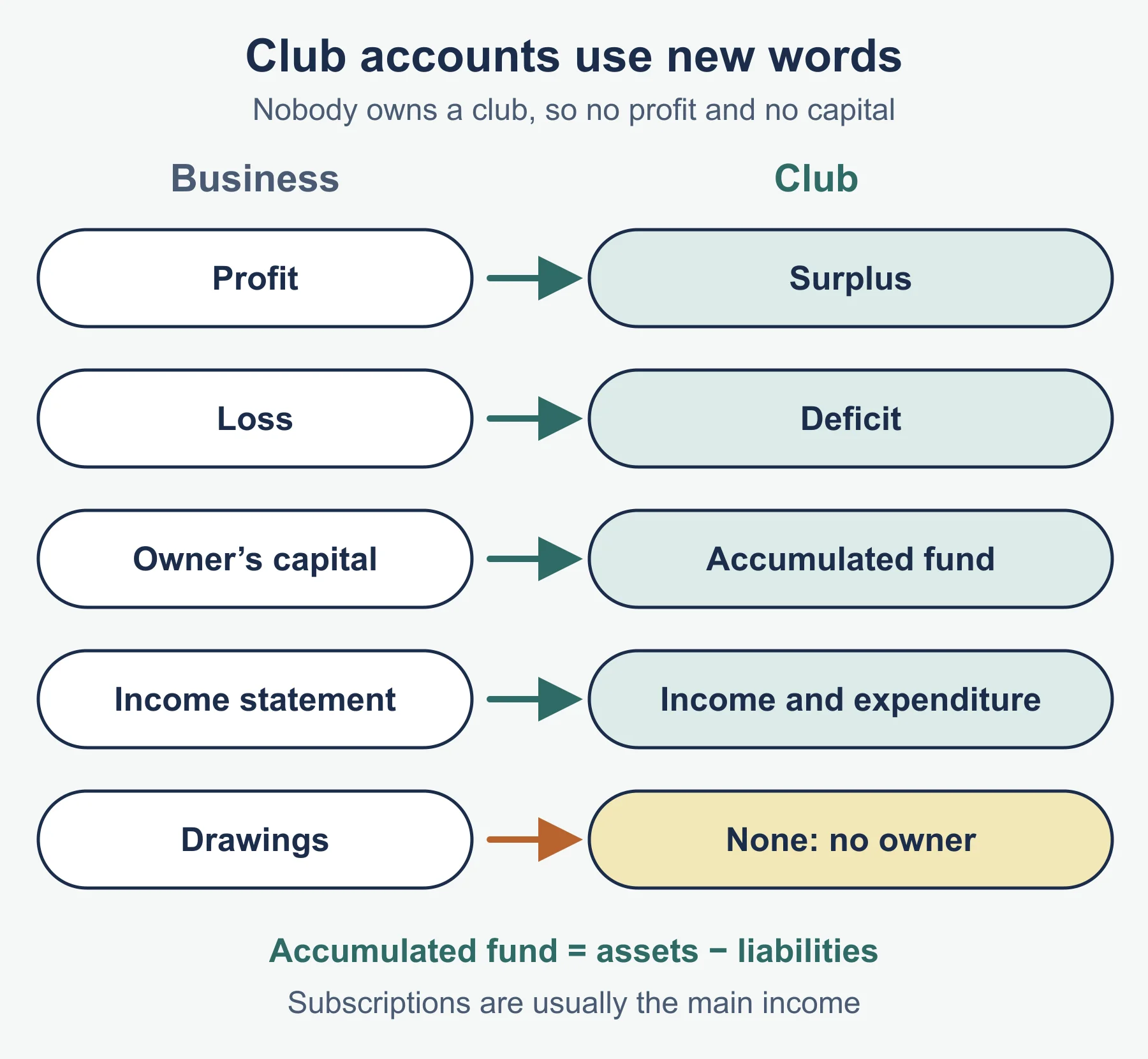
A club exists to provide a service to its members, not to make a profit for an owner. So the language changes.
- A surplus (income greater than expenditure) replaces profit. A deficit replaces loss.
- The accumulated fund replaces the owner’s capital. It is the club’s net assets: assets less liabilities.
- There are no drawings, because nobody owns the club.
- Members pay subscriptions. These are usually the main source of income.
The income and expenditure account is the club’s version of the income statement. It is prepared on the accruals basis, so it matches income and expenditure to the year they belong to, whether or not cash moved.
The receipts and payments account
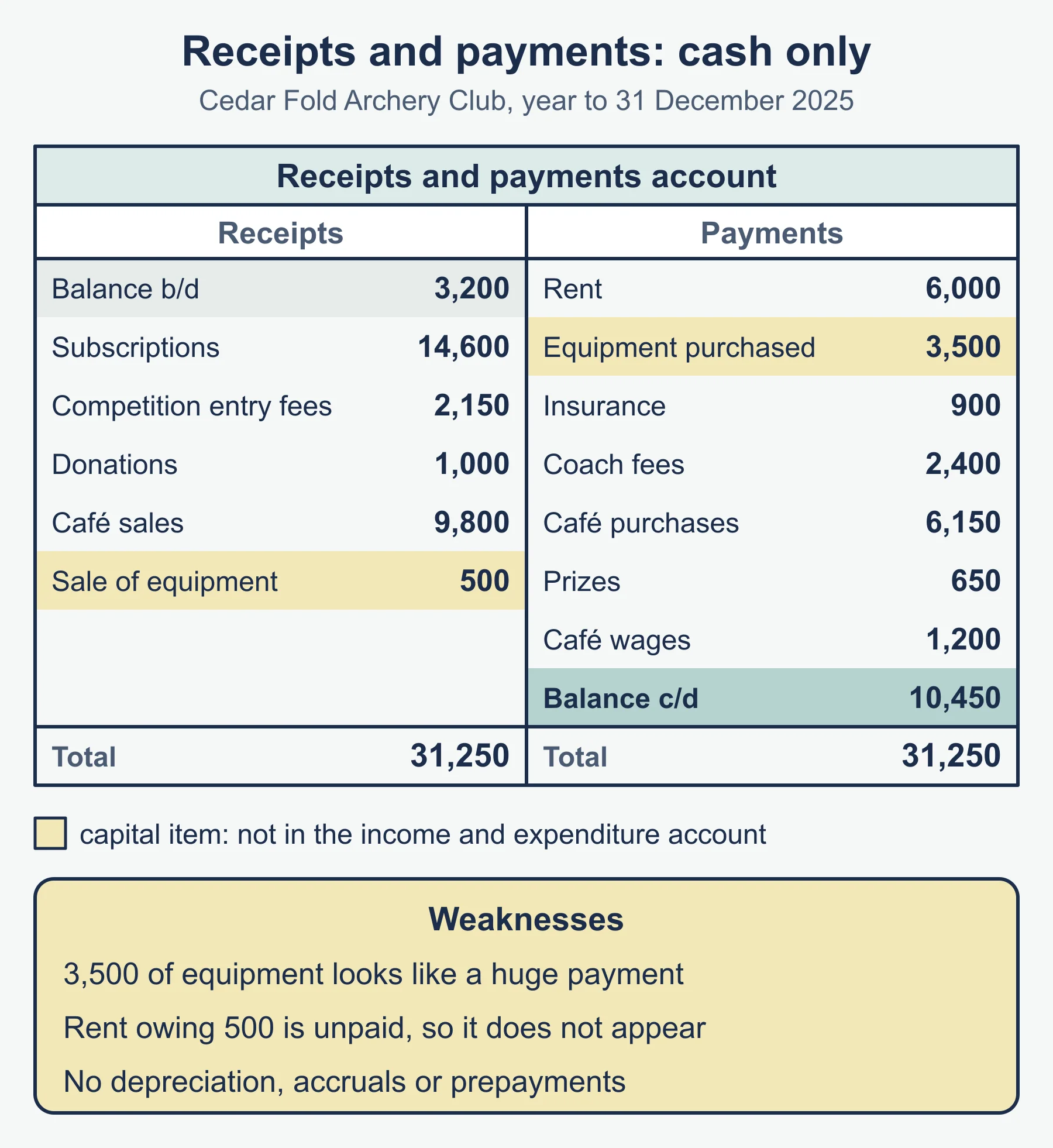
A receipts and payments account is a summary of the cash book. Small clubs often keep only this. Its rules are simple.
- Receipts go on the left and payments on the right.
- The opening balance of cash and bank goes on the left. The closing balance is the balancing figure on the right.
- It includes all cash received and paid, whatever year the item relates to.
- It includes capital items, such as buying or selling equipment.
- It has no depreciation, no accruals and no prepayments, because these are not cash movements.
Its weakness is that it does not show whether the club did well. A big equipment purchase could make payments look huge, while unpaid bills do not appear at all. That is why the income and expenditure account is needed.
Worked example: Cedar Fold Archery Club
The club’s year ended 31 December 2025. It runs a café for members.
Balances at 1 January 2025
| Item | Amount |
|---|---|
| Equipment at cost | 12,000 |
| Accumulated depreciation on equipment | 4,800 |
| Bank | 3,200 |
| Subscriptions owing (arrears) | 300 |
| Subscriptions received in advance | 200 |
| Rent owing | 400 |
| Café inventory | 640 |
| Café payable (amount owed to suppliers) | 380 |
Receipts and payments account for the year ended 31 December 2025
| Receipts | Amount | Payments | Amount |
|---|---|---|---|
| Balance b/d | 3,200 | Rent | 6,000 |
| Subscriptions | 14,600 | Equipment purchased | 3,500 |
| Competition entry fees | 2,150 | Insurance | 900 |
| Donations | 1,000 | Coach fees | 2,400 |
| Café sales | 9,800 | Café purchases | 6,150 |
| Sale of equipment | 500 | Prizes | 650 |
| Café wages | 1,200 | ||
| Balance c/d | 10,450 | ||
| Total | 31,250 | Total | 31,250 |
Further information at 31 December 2025
- Subscriptions owing are 520 and subscriptions received in advance are 330.
- Rent owing is 500. Insurance prepaid is 150.
- Café inventory is 710. Café payables are 520.
- Equipment that cost 2,000, with accumulated depreciation of 1,600, was sold during the year for 500. This is the sale in the receipts.
- Depreciation is 20% a year on the cost of equipment held at the year end, straight line.
Step 1: opening accumulated fund
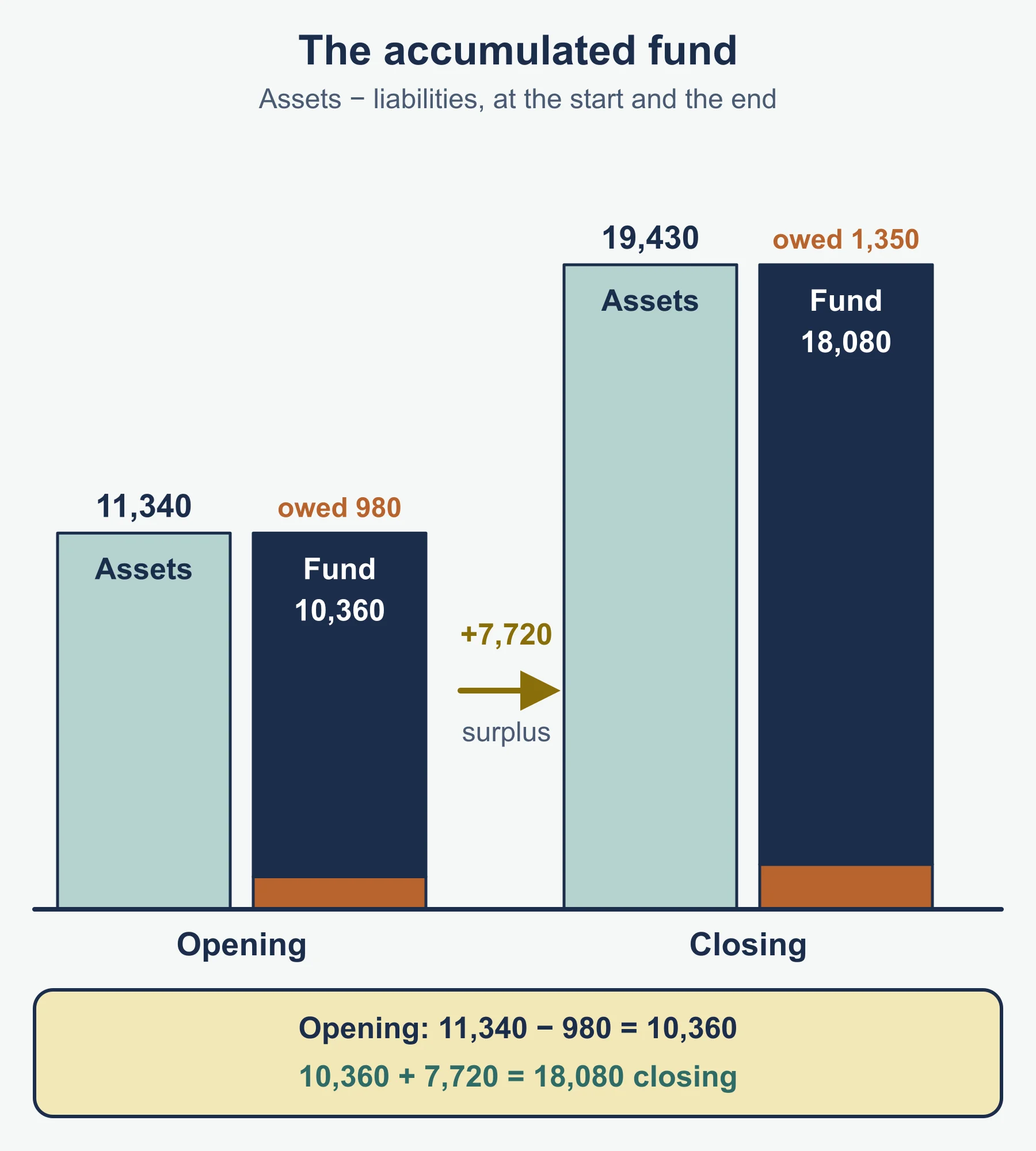
At the start there was no stated fund, so find it from the balances.
Assets: equipment net book value 7,200 (12,000 less 4,800), bank 3,200, subscriptions owing 300, inventory 640. Total 11,340. Liabilities: subscriptions in advance 200, rent owing 400, café payable 380. Total 980. Accumulated fund at 1 January 2025 = 11,340 less 980 = 10,360.
Step 2: subscriptions account
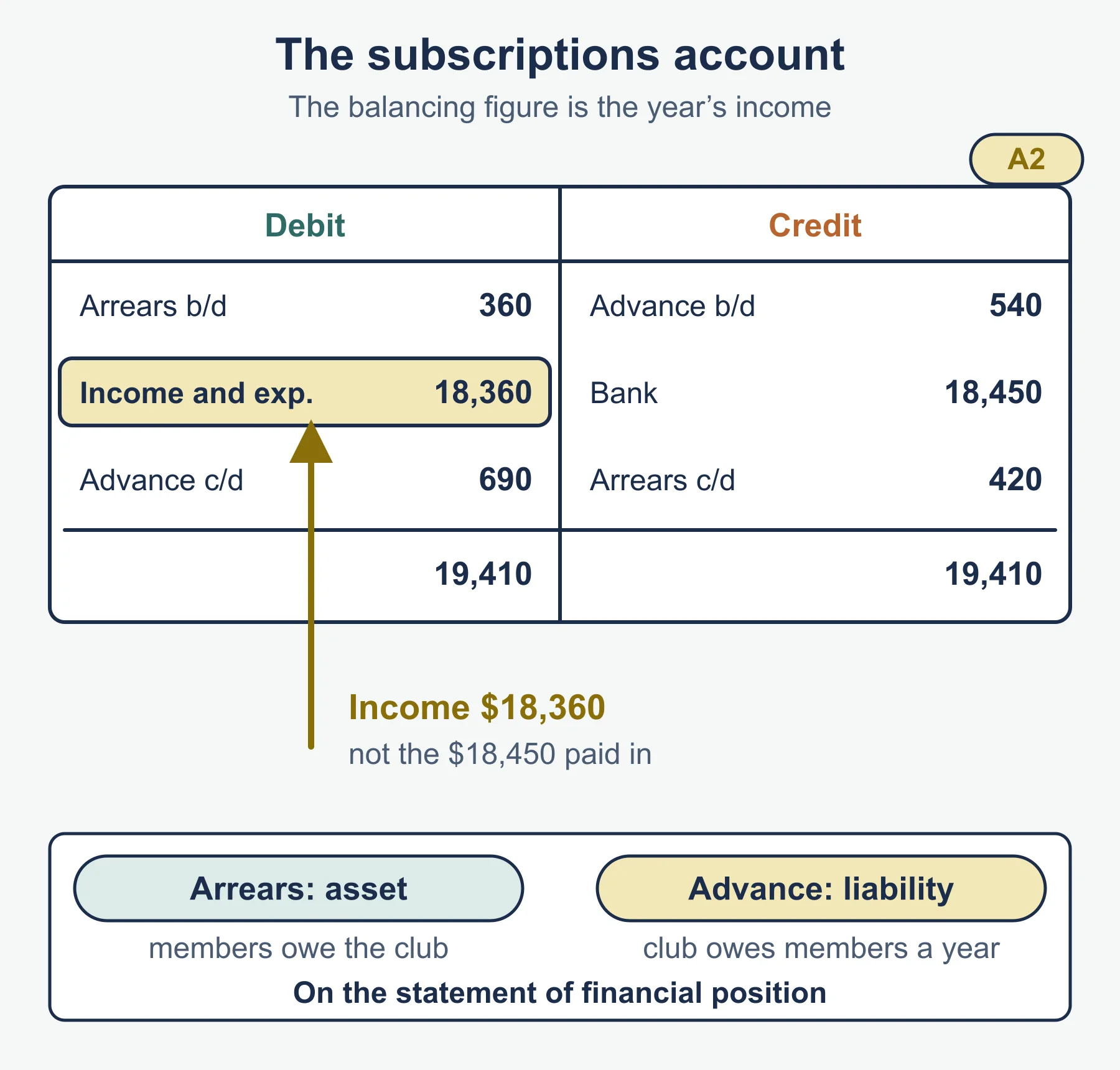
Subscriptions income is the amount that belongs to this year. Build the account and find the missing figure.
| Subscriptions account | Amount | Amount | |
|---|---|---|---|
| Balance b/d: arrears | 300 | Balance b/d: in advance | 200 |
| Income and expenditure (balancing figure) | 14,690 | Bank | 14,600 |
| Balance c/d: in advance | 330 | Balance c/d: arrears | 520 |
| 15,320 | 15,320 |
Subscriptions income is 14,690. The opening arrears (300) were paid this year but belong to last year, so they are not this year’s income. The opening advance (200) was received last year but belongs to this year, so it is.
Step 3: other expenses and the disposal
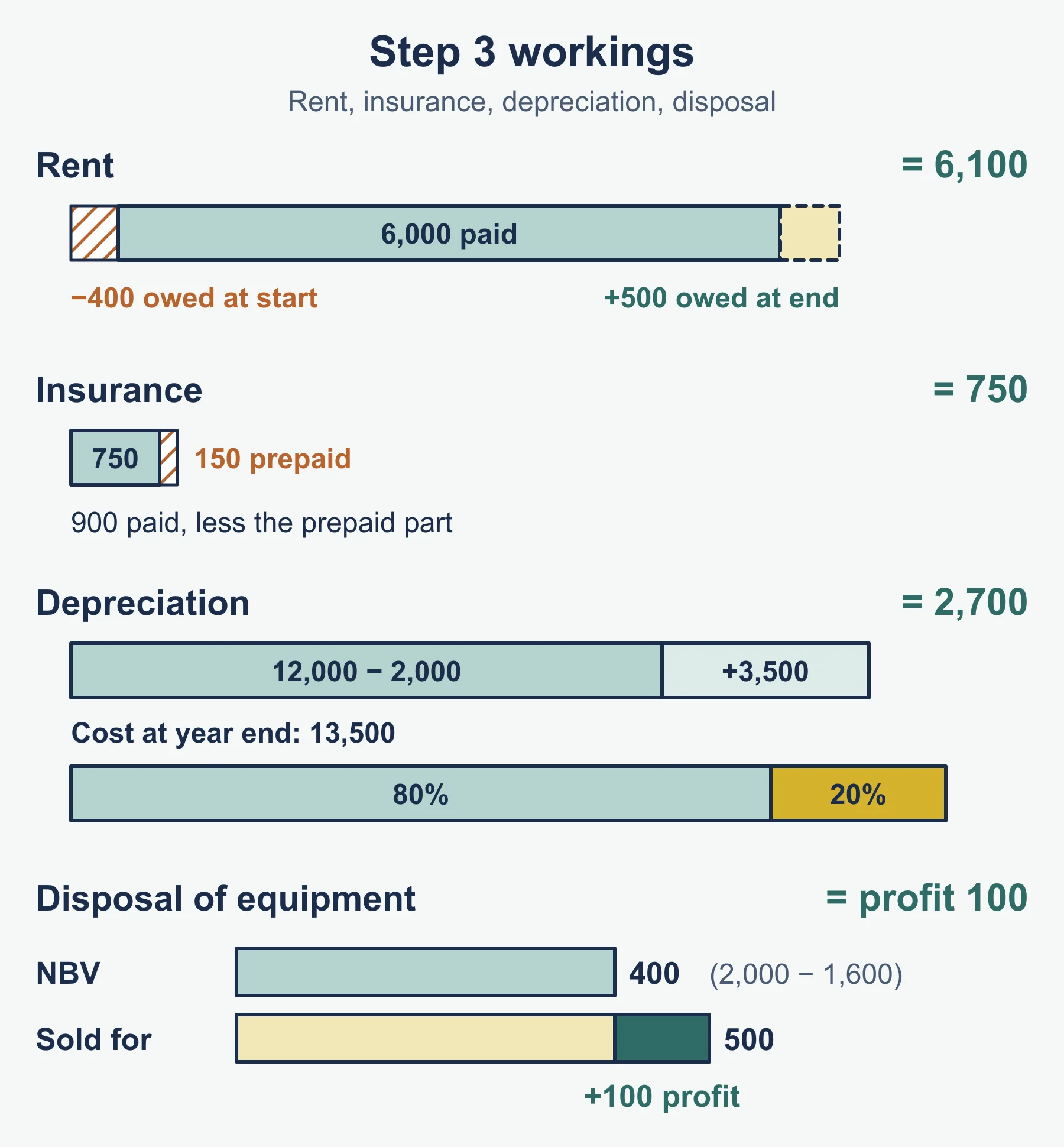
- Rent: 6,000 paid less 400 owing at the start plus 500 owing at the end = 6,100.
- Insurance: 900 paid less 150 prepaid = 750.
- Depreciation: equipment at cost at the year end is 12,000 less 2,000 sold plus 3,500 bought = 13,500. At 20% the charge is 2,700. Accumulated depreciation at the end is 4,800 less 1,600 plus 2,700 = 5,900. Net book value is 13,500 less 5,900 = 7,600.
- Disposal: the equipment sold had a net book value of 2,000 less 1,600 = 400. It was sold for 500, so there is a profit on disposal of 100. This goes in the income and expenditure account as income, not in the trading account.
Step 4: trading account for the café
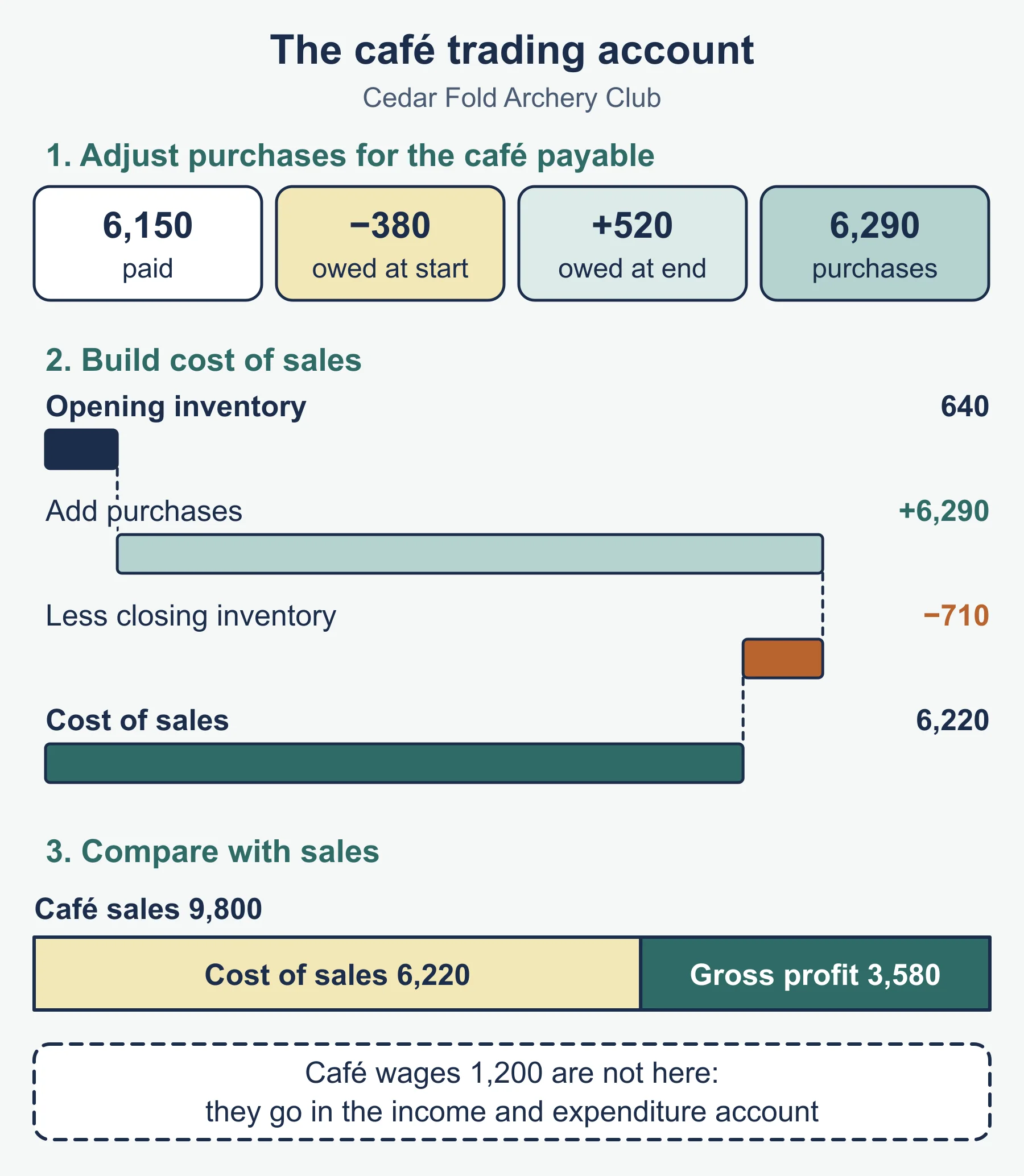
Purchases must be adjusted for the café payable. Purchases = 6,150 paid less 380 owed at the start plus 520 owed at the end = 6,290.
| Café trading account for the year ended 31 December 2025 | Amount | Total |
|---|---|---|
| Café sales | 9,800 | |
| Opening inventory | 640 | |
| Add purchases | 6,290 | |
| 6,930 | ||
| Less closing inventory | 710 | |
| Cost of sales | 6,220 | |
| Gross profit | 3,580 |
Café wages (1,200) are an expense of the income and expenditure account, because the trading account in this example stops at gross profit.
Step 5: income and expenditure account
| Income and expenditure account for the year ended 31 December 2025 | Amount | Total |
|---|---|---|
| Income | ||
| Subscriptions | 14,690 | |
| Competition entry fees | 2,150 | |
| Donations | 1,000 | |
| Café gross profit | 3,580 | |
| Profit on disposal of equipment | 100 | |
| 21,520 | ||
| Expenditure | ||
| Rent | 6,100 | |
| Insurance | 750 | |
| Coach fees | 2,400 | |
| Prizes | 650 | |
| Café wages | 1,200 | |
| Depreciation of equipment | 2,700 | |
| 13,800 | ||
| Surplus for the year | 7,720 |
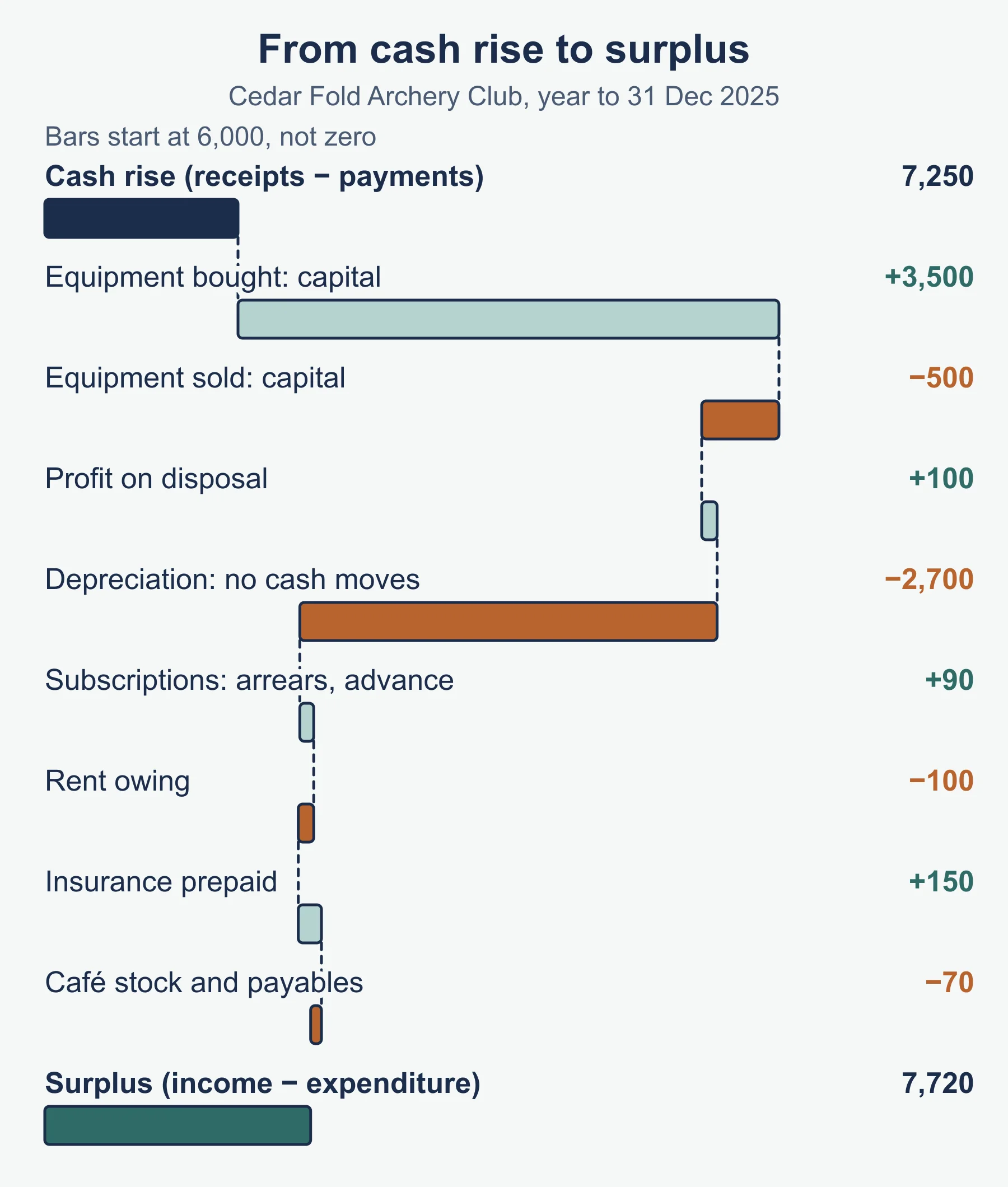
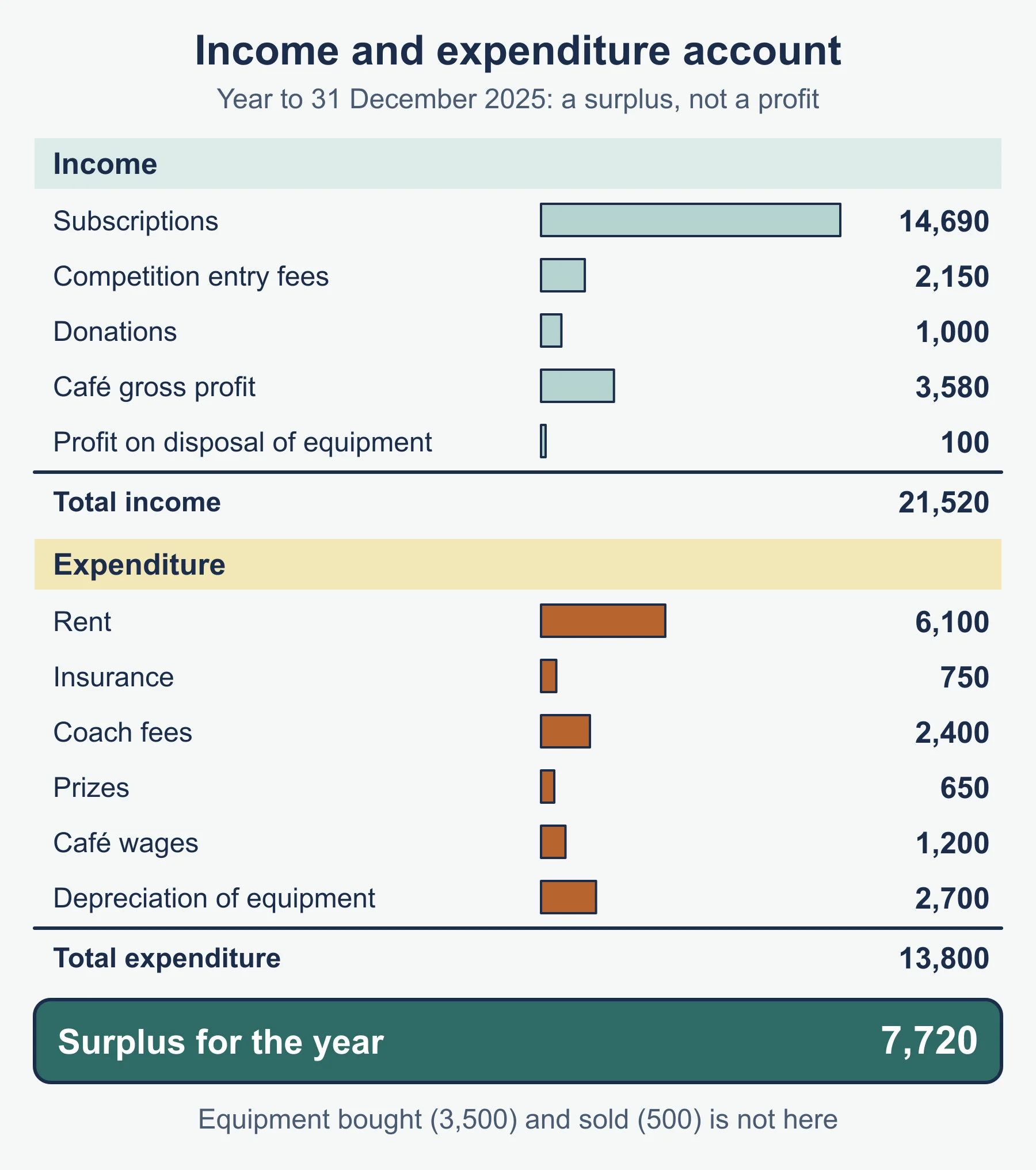
Notice what is missing. The 3,500 spent on new equipment and the 500 sale proceeds are in the receipts and payments account but not here. Equipment is a capital item. Only its depreciation and any profit or loss on disposal reach the income and expenditure account.
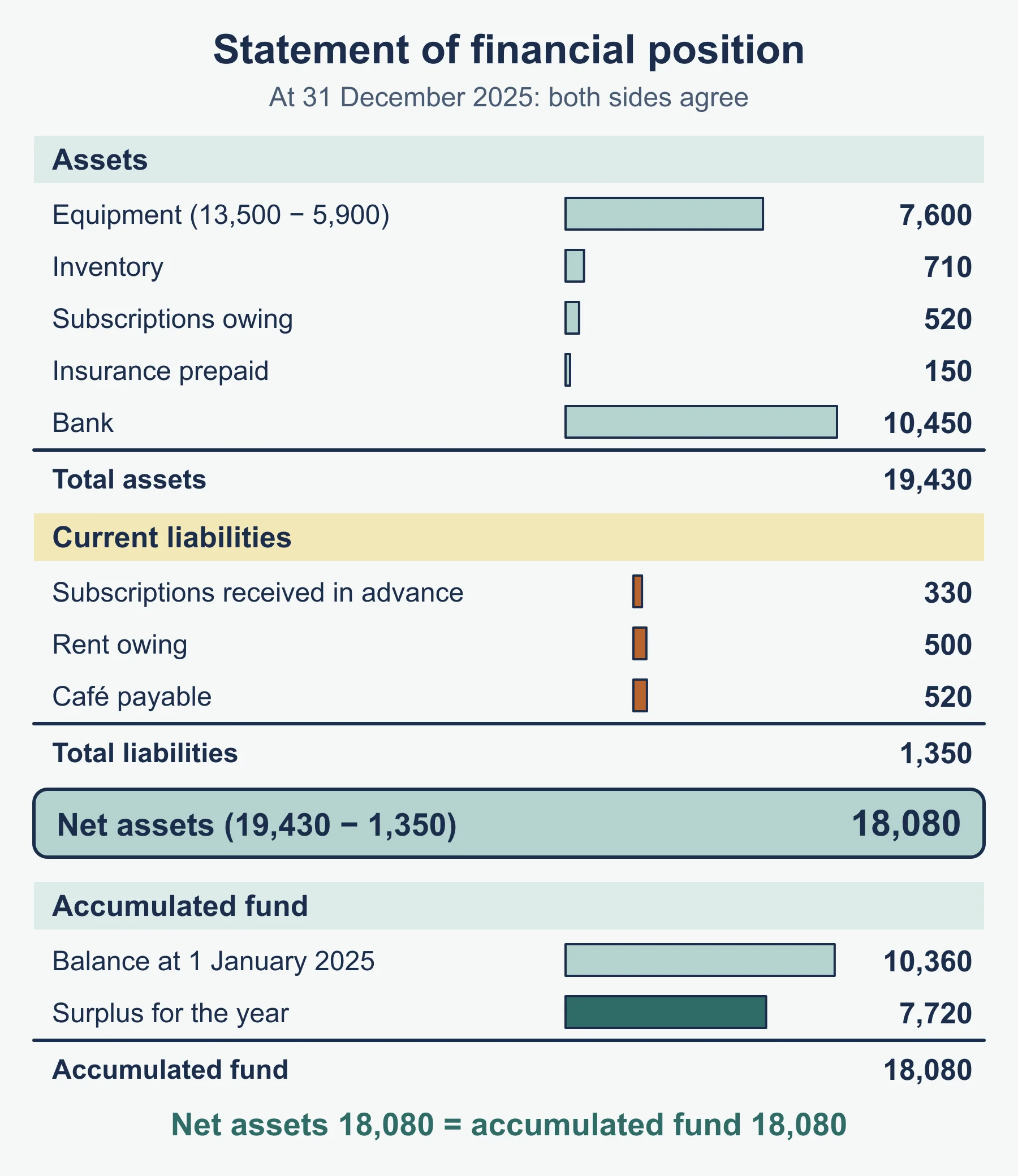
Step 6: statement of financial position
| Statement of financial position at 31 December 2025 | Amount | Amount | Total |
|---|---|---|---|
| Non-current assets | Cost | Acc. dep. | NBV |
| Equipment | 13,500 | 5,900 | 7,600 |
| Current assets | |||
| Inventory | 710 | ||
| Subscriptions owing | 520 | ||
| Insurance prepaid | 150 | ||
| Bank | 10,450 | ||
| 11,830 | |||
| Total assets | 19,430 | ||
| Current liabilities | |||
| Subscriptions received in advance | 330 | ||
| Rent owing | 500 | ||
| Café payable | 520 | ||
| 1,350 | |||
| Net assets | 18,080 | ||
| Accumulated fund | |||
| Balance at 1 January 2025 | 10,360 | ||
| Surplus for the year | 7,720 | ||
| 18,080 |
The two sides agree: net assets of 18,080 equal the accumulated fund of 18,080. If they do not, check the bank balance from the receipts and payments account and the opening fund first.
Commenting on the statements
The specification asks you to comment as well as prepare. Good comments use the figures and name a consequence.
- Surplus or deficit. A surplus of 7,720 on income of 21,520 means the club covered its costs comfortably. A club with a deficit may need to raise subscriptions or cut costs.
- Café performance. Gross profit of 3,580 on sales of 9,800 is a margin of about 36.5%. If the club wants more money for coaching, it could look at café prices or supplier costs.
- Cash position. The bank balance of 10,450 is large compared with current liabilities of 1,350, so the club can pay its bills. It could also fund new equipment.
- Comparing the two accounts. The receipts and payments account shows receipts exceeding payments by 7,250. The surplus is 7,720. The difference arises from accruals, prepayments, depreciation and the capital items.
- Limits. A surplus is not the aim of a club. Comment on whether the members get value, not only on size of surplus.
Common errors
- Treating the full cash received for subscriptions as income. Adjust for arrears and advance.
- Putting equipment purchases and sale proceeds in the income and expenditure account.
- Adding opening arrears of subscriptions to the year’s income instead of deducting them (and the reverse for opening advance).
- Forgetting the opening accumulated fund. It is a balancing figure from opening assets and liabilities.
- Using the word profit for a club’s overall result. The overall result is a surplus or a deficit.
- Putting café sales on the income side. Only the gross profit goes across.
- Charging depreciation on opening equipment only. Read the question: here the charge is on cost at the year end.
Next steps
Work through the revision notes, then test yourself with the practice questions. Return to the course hub to choose your next topic.
Frequently asked questions
Why do clubs not have profit and capital? A club exists to provide a service to its members, not to make a profit for an owner. A surplus or deficit replaces profit or loss, and the accumulated fund replaces capital.
What is a receipts and payments account? A summary of the cash book, starting with the opening cash and bank balance, listing receipts and payments, and ending with the closing balance. It does not show whether the club did well: a big equipment purchase can make payments look huge, while unpaid bills do not appear at all.
How is the opening accumulated fund calculated? If it is not given, it is a balancing figure: opening assets minus opening liabilities, including subscriptions owing and in advance.
Do equipment purchases appear in the income and expenditure account? No. Equipment bought and sale proceeds appear in the receipts and payments account but not in the income and expenditure account, which shows only depreciation and any profit or loss on disposal.
How should I comment on a club’s statements in OxfordAQA 9215? Use the figures and name a consequence, for example by stating the surplus or deficit against the club’s income and saying what it means for the club.
Official syllabus
OxfordAQA International GCSE Accounting (9215), version 1.2, for International GCSE exams May/June 2026 onwards, section 3.4 Preparation of financial statements (clubs and non-profit making organisations), published by OxfordAQA.
Get free revision emails (optional)
Occasional emails with practice questions, worked explanations and links to free resources for the qualification and subjects you choose. No spam, and you can unsubscribe from any email. The free tools on this site never need an email.
Related resources
-
Practice questions
OxfordAQA IGCSE Accounting: Clubs and non-profit making organisations (9215) – Practice Questions
Original practice questions with full worked answers on club accounts for OxfordAQA International GCSE Accounting 9215: subscriptions, trading and surplus.
Accounting · OxfordAQA · IGCSE
Try questions -
Revision notes
OxfordAQA IGCSE Accounting: Clubs and non-profit making organisations (9215) – Revision Notes
Condensed revision notes for OxfordAQA International GCSE Accounting 9215 club accounts, with formulas, method steps, a worked reminder and a self-test.
Accounting · OxfordAQA · IGCSE
Revise topic -
Study guides
OxfordAQA IGCSE Accounting: Incomplete records and single entry (9215)
Statements of affairs, profit from changes in capital, missing figures, and single versus double entry for OxfordAQA International GCSE Accounting 9215.
Accounting · OxfordAQA · IGCSE
Read guide
Related articles
-
teaching
A Level tuition in Dubai: Cambridge or Pearson Edexcel International A Level?
Schools in Dubai and Abu Dhabi teach either Cambridge International AS & A Level or Pearson Edexcel International A Level. How the two are structured, why it matters for tuition, and how online classes from Lahore work.
9 October 2026
-
curriculum guides
Choosing subjects at IGCSE and A Level
How subject choices at 14 and 16 affect university options later, and how to keep pathways open without overloading a timetable.
28 July 2026
Studying this with a teacher
Working through Accounting IGCSE?
This page is free and stays free. If you would rather be taught it, Marlbridge runs Accounting classes one-to-one and in small groups of up to 15, online in your own time zone. The first trial class is free. WhatsApp replies within an hour (8am–11pm Pakistan time, every day); email the same day.
OxfordAQA Accounting teachers at Marlbridge

