
Revision Notes
OxfordAQA IGCSE Accounting: Clubs and non-profit making organisations (9215) – Revision Notes
Condensed revision notes for OxfordAQA International GCSE Accounting 9215 club accounts, with formulas, method steps, a worked reminder and a self-test.
- Subject
- Accounting
- Level
- IGCSE
- Topic
- Preparation of financial statements
- Author
- Marlbridge Academic Team
- Updated
- Reviewed by
- Javaid Iqbal Sabri (what this means)
Aligned to OxfordAQA IGCSE Accounting (9215), First teaching 2024, first examined 2026. Official specification .
Syllabus page (what it covers and how it is assessed): OxfordAQA IGCSE Accounting.
Syllabus points this page covers
9215
- Financial statements of clubs and non-profit making organisations
Found an error? Report a correction.
Need help with this topic? Request a free trial class for IGCSE Accounting (9215).
These revision notes condense the clubs and non-profit making organisations part of section 3.4 of the OxfordAQA International GCSE Accounting (9215) specification, version 1.2, for exams from May/June 2026 onwards. The specification places this content on Paper 2: Financial Statements. For full explanations and a longer worked example, read the study guide. Then try the practice questions. Course pages: OxfordAQA IGCSE Accounting hub, checklist and free diagnostics.
Amounts on this page are in dollars. All clubs are invented.
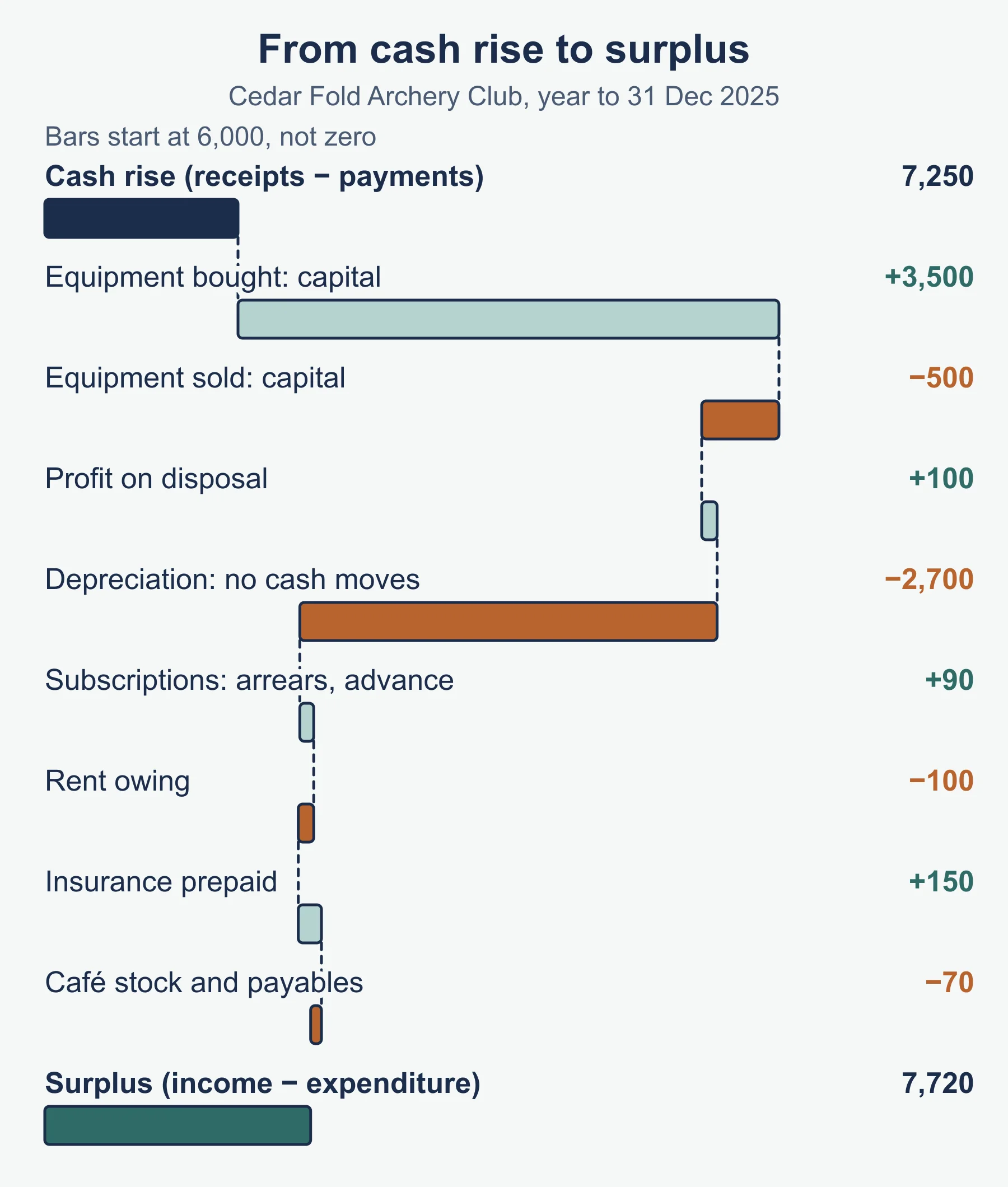
The four statements at a glance
| Statement | Basis | Includes | Excludes |
|---|---|---|---|
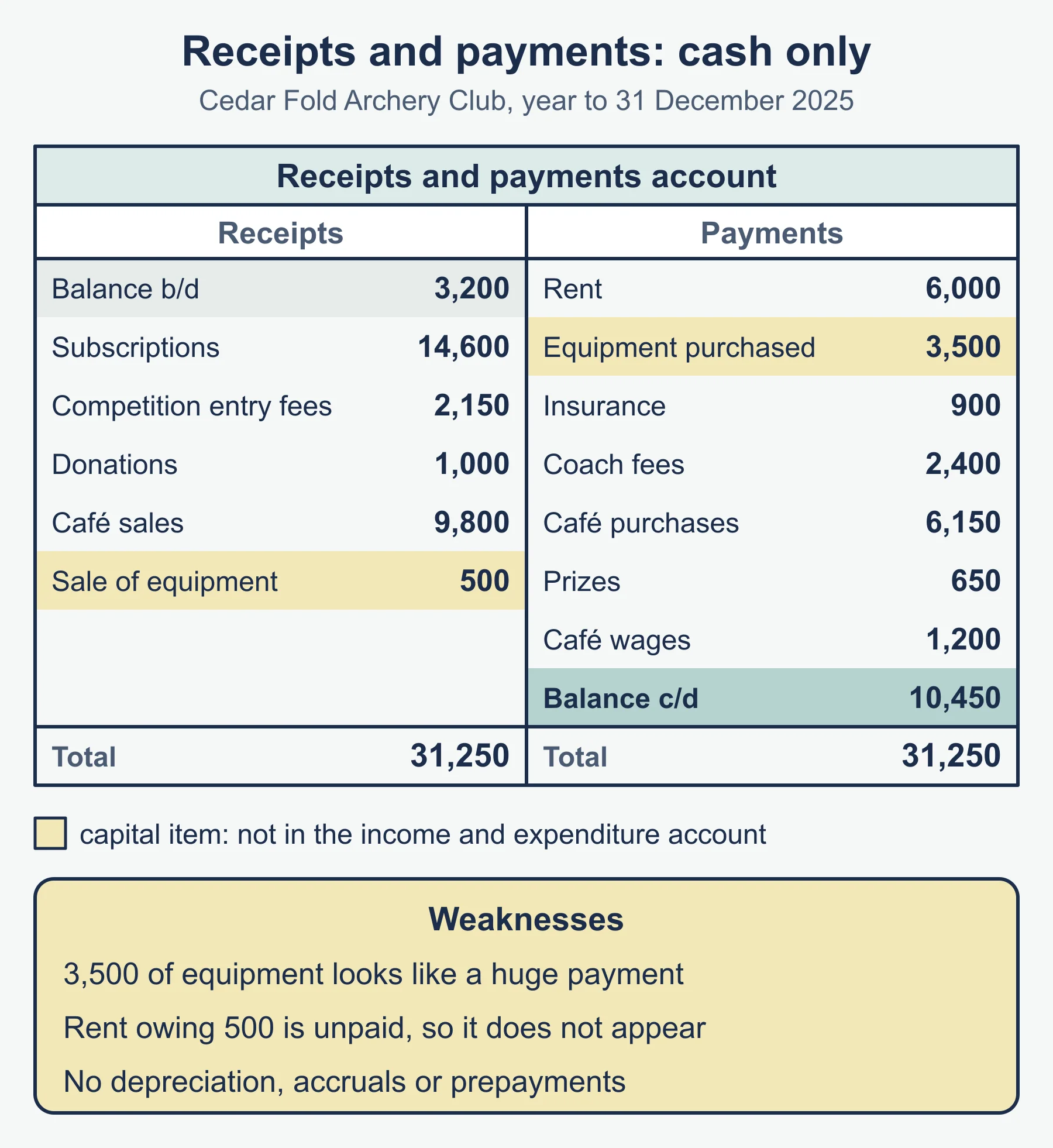
| Receipts and payments account | Cash only | Every cash and bank receipt and payment, capital items, opening and closing balance | Depreciation, accruals, prepayments, arrears, inventory |
| Trading account | Accruals | Sales, opening inventory, purchases, closing inventory, gross profit or loss for one activity (bar, shop, café) | Wages and running costs of the activity, unless the question says otherwise |
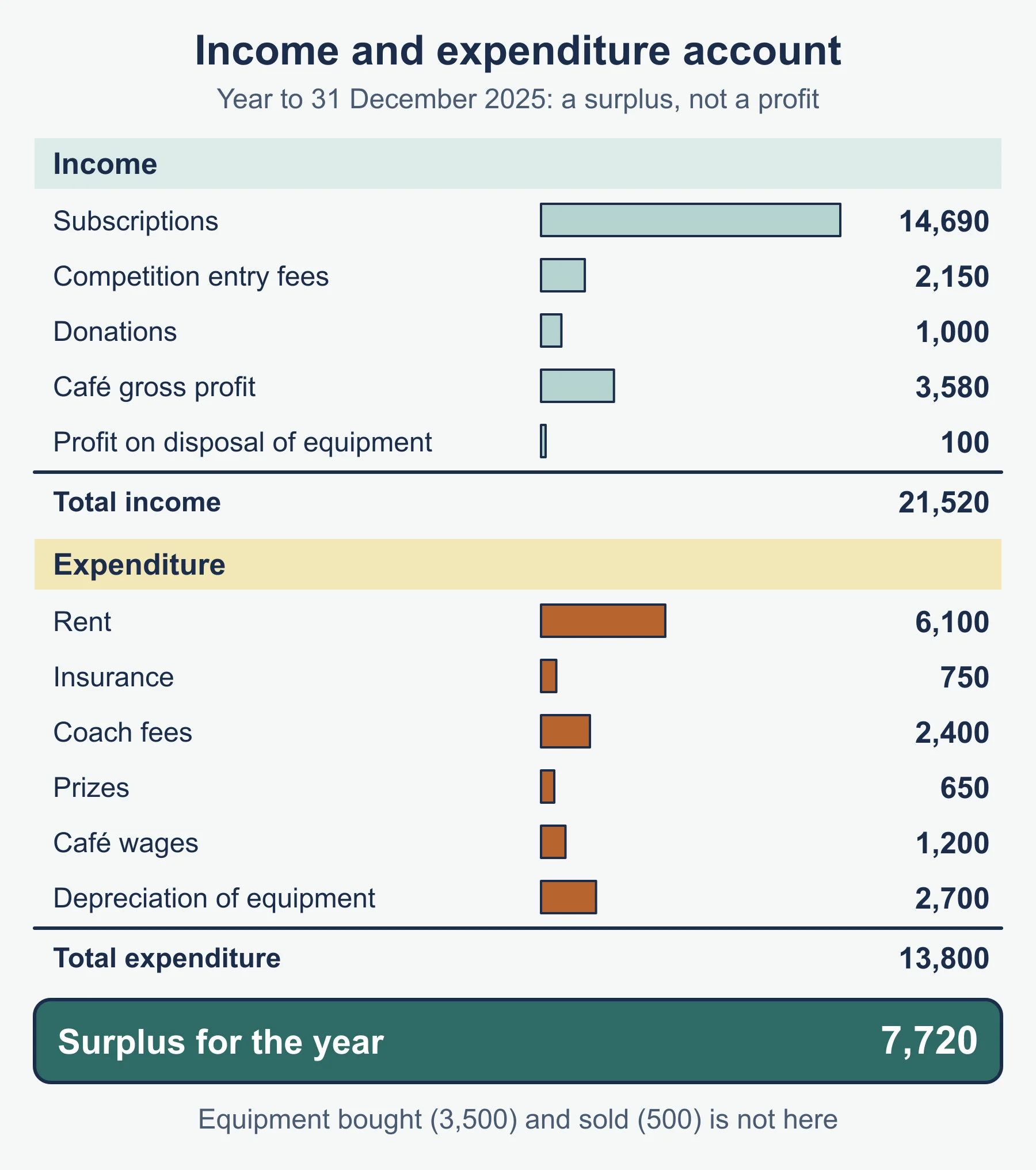
| Income and expenditure account | Accruals | Income and expenditure belonging to the year, depreciation, profit or loss on disposal | Capital expenditure, sale proceeds, owner drawings |
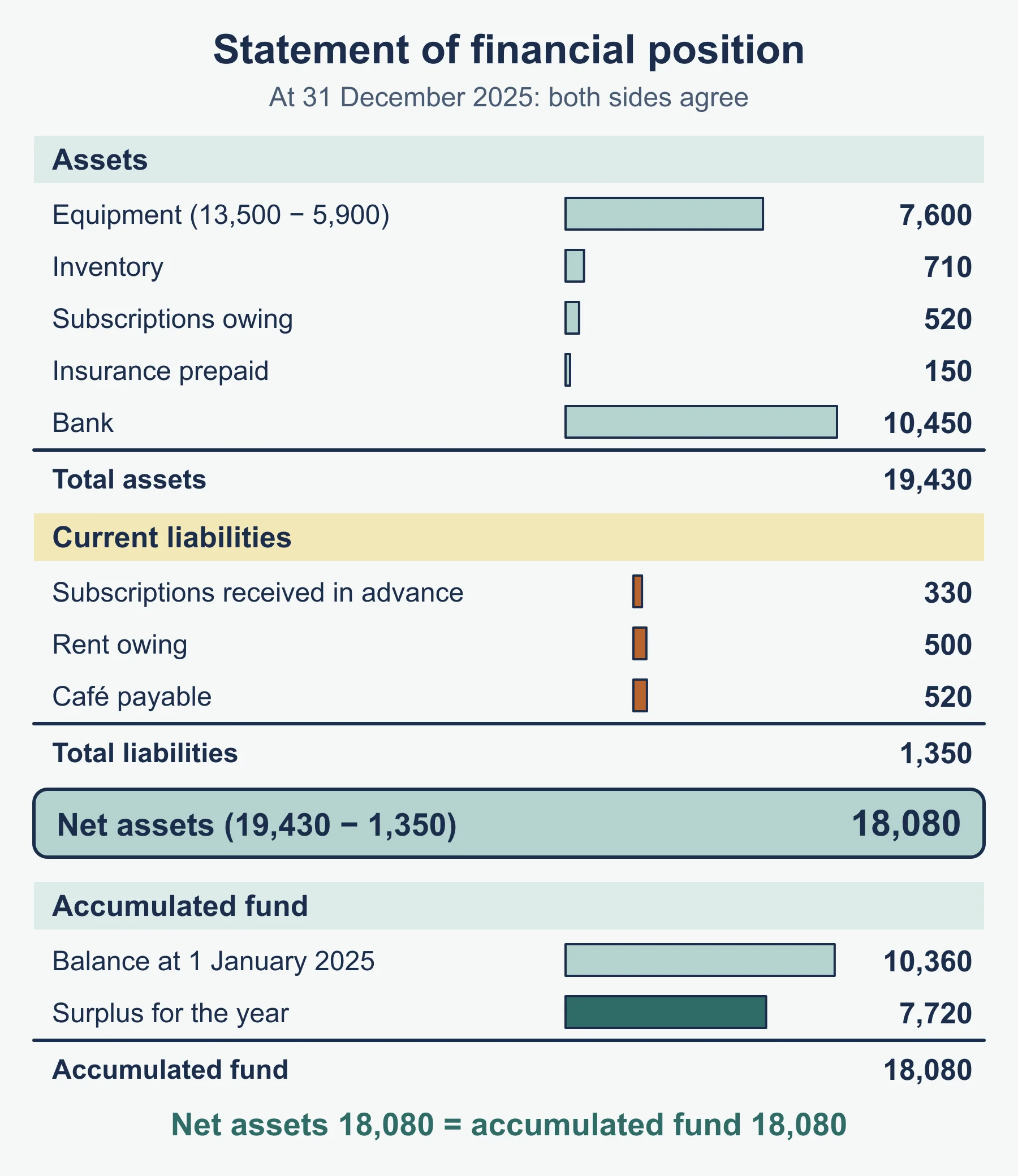
| Statement of financial position | Accruals | Non-current assets, current assets, current liabilities, accumulated fund | Income and expenditure items |
Key terms
- Non-profit making organisation: exists to serve its members or a cause. It does not aim to make a profit for owners.
- Surplus: income greater than expenditure. Deficit: expenditure greater than income.
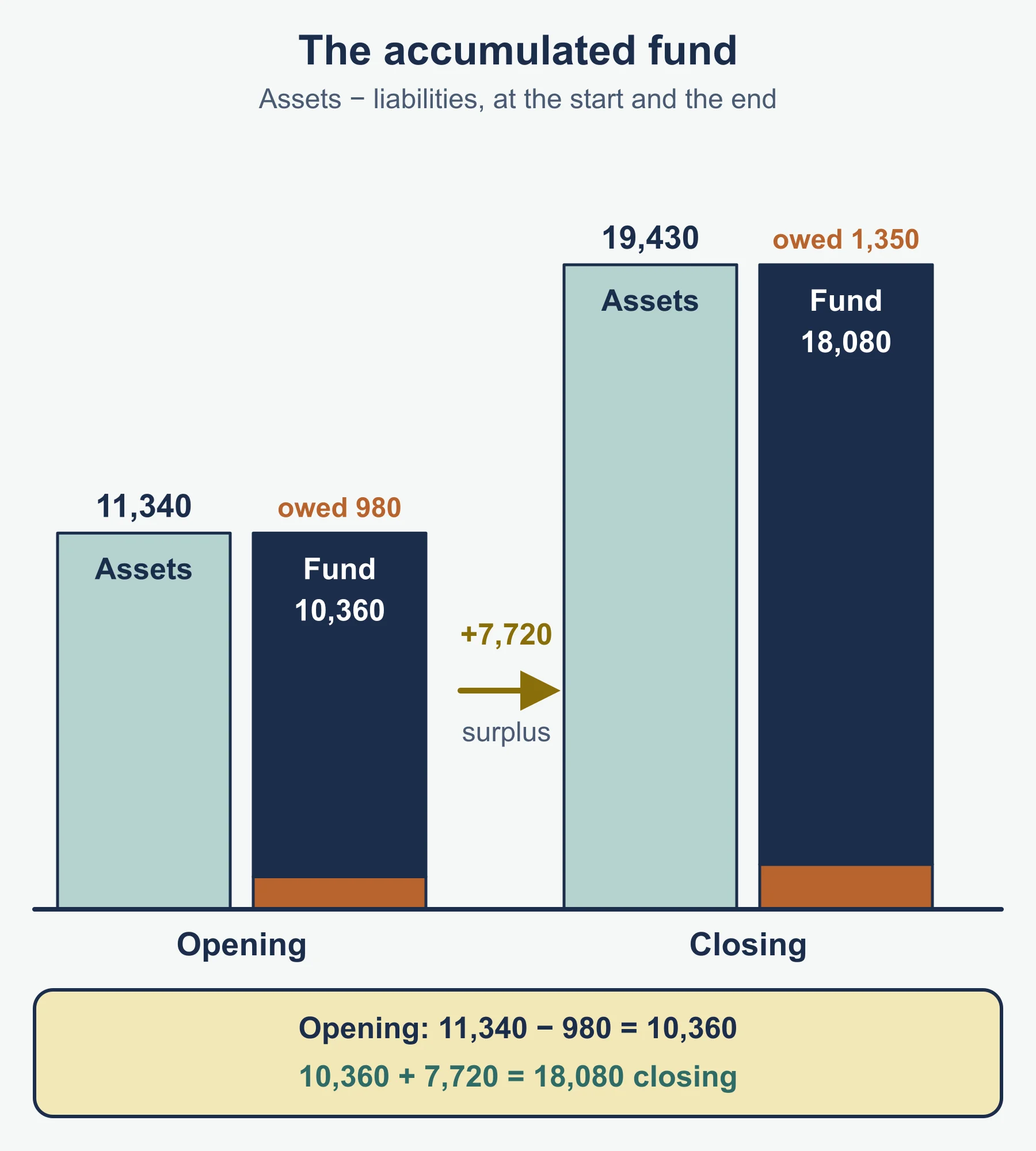
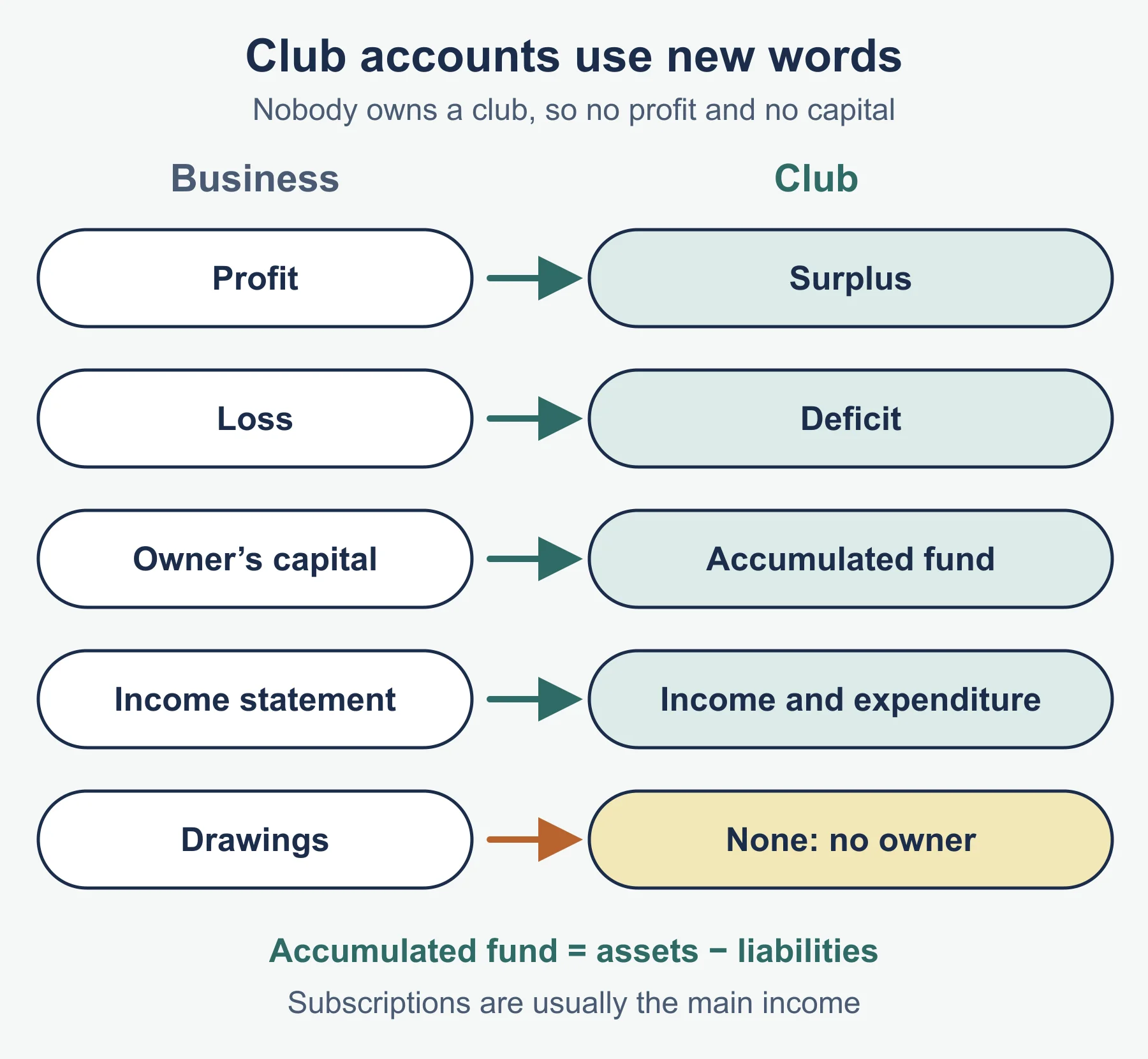
- Accumulated fund: the club’s capital: assets less liabilities. It rises by a surplus and falls by a deficit.
- Subscriptions in arrears: owed by members. A current asset (other receivable).
- Subscriptions in advance: received for next year. A current liability (income received in advance).
- Income due: earned but not yet received, such as hall hire. A current asset.
- Other payable: an expense owing at the year end. A current liability.
- Other receivable (prepayment): an expense paid for the future. A current asset.
Formulas and relationships
| Item | Calculation |
|---|---|
| Opening accumulated fund | Opening assets less opening liabilities |
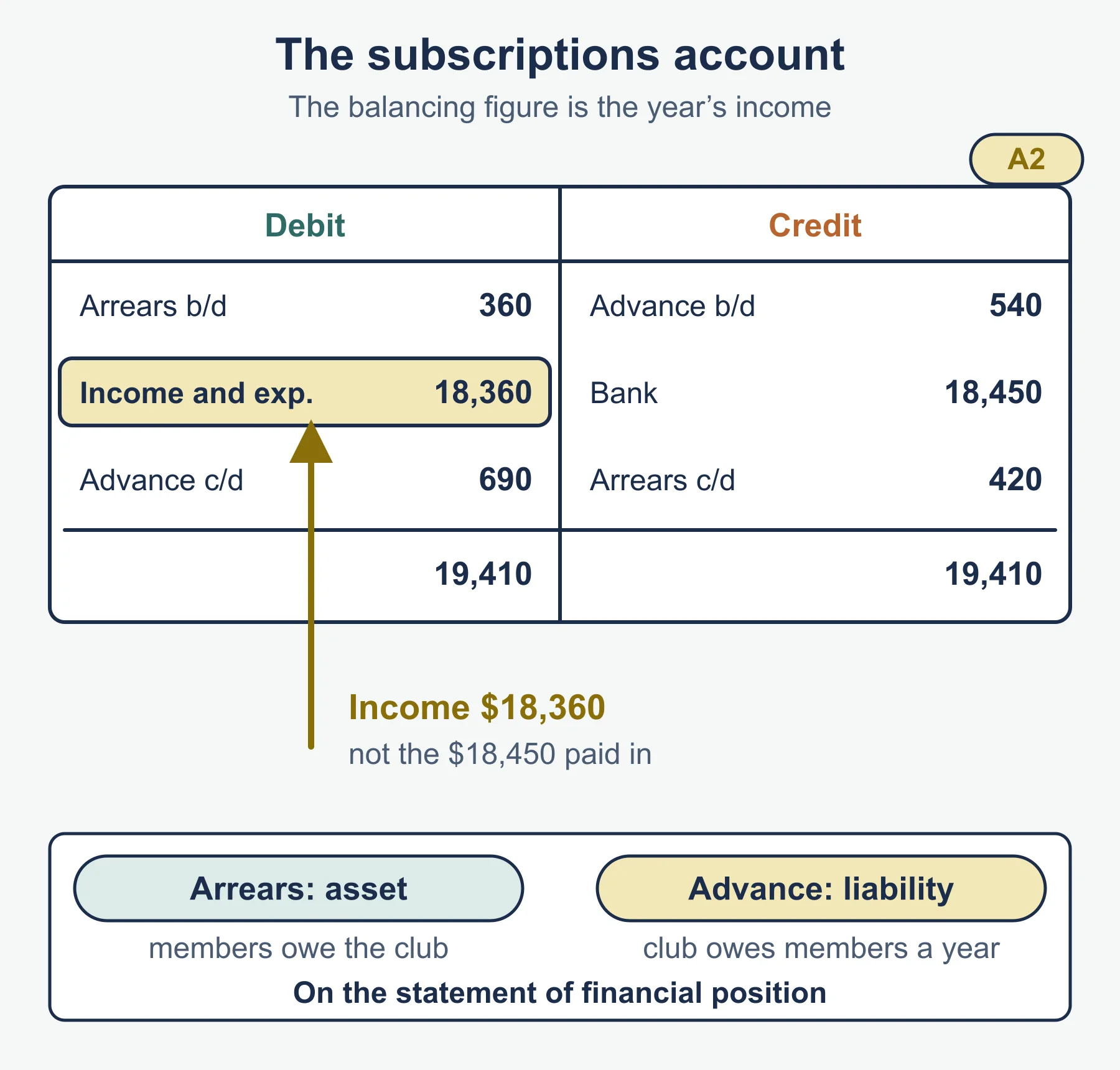
| Subscriptions income | Cash received, less opening arrears, plus closing arrears, plus opening advance, less closing advance |
| Income from other sources | Cash received, less opening income due, plus closing income due, plus opening advance, less closing advance |
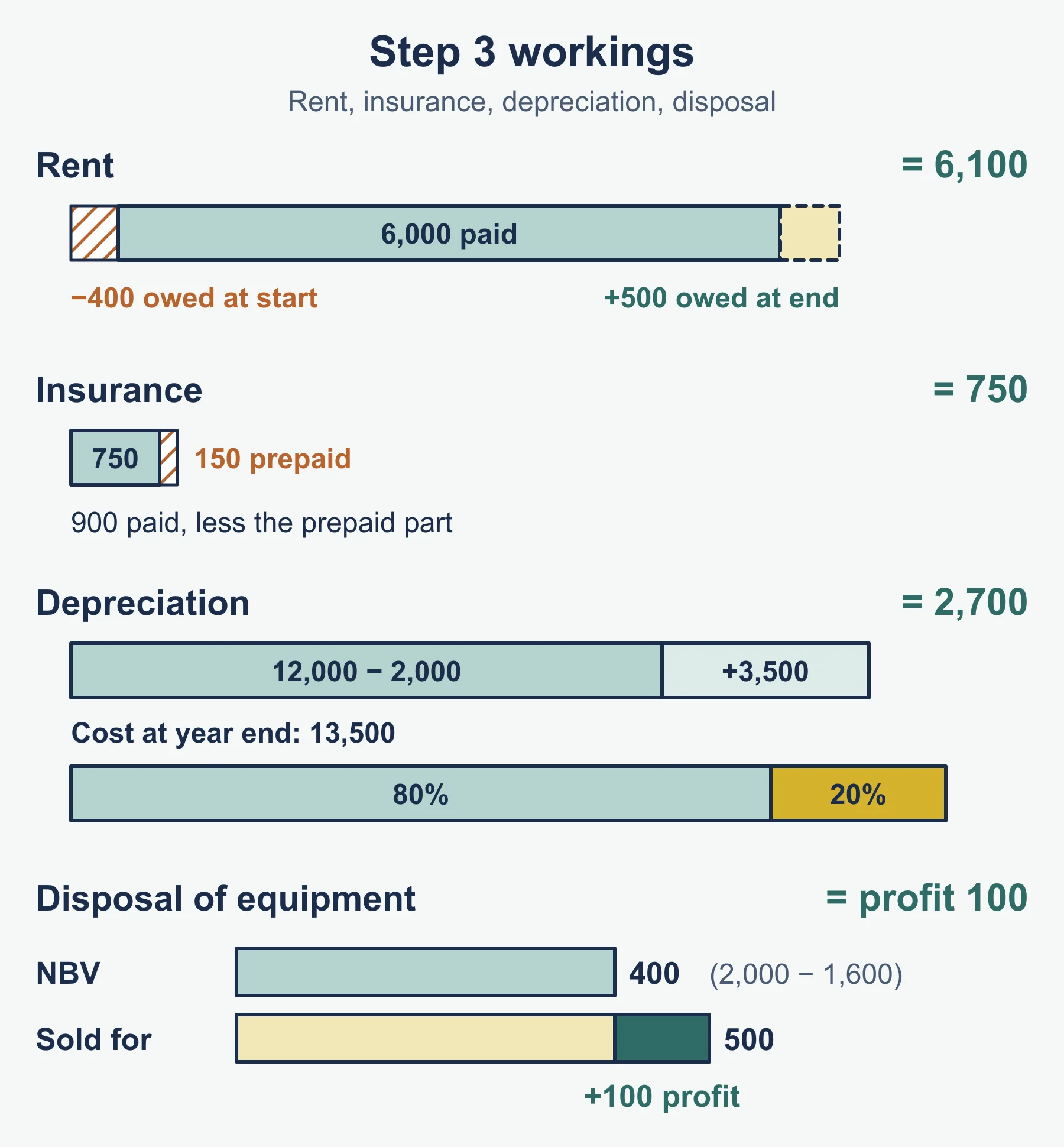
| Expense for the year | Cash paid, less opening amount owing, plus closing amount owing, plus opening prepayment, less closing prepayment |
| Purchases for the trading account | Cash paid to suppliers, less opening payable, plus closing payable |
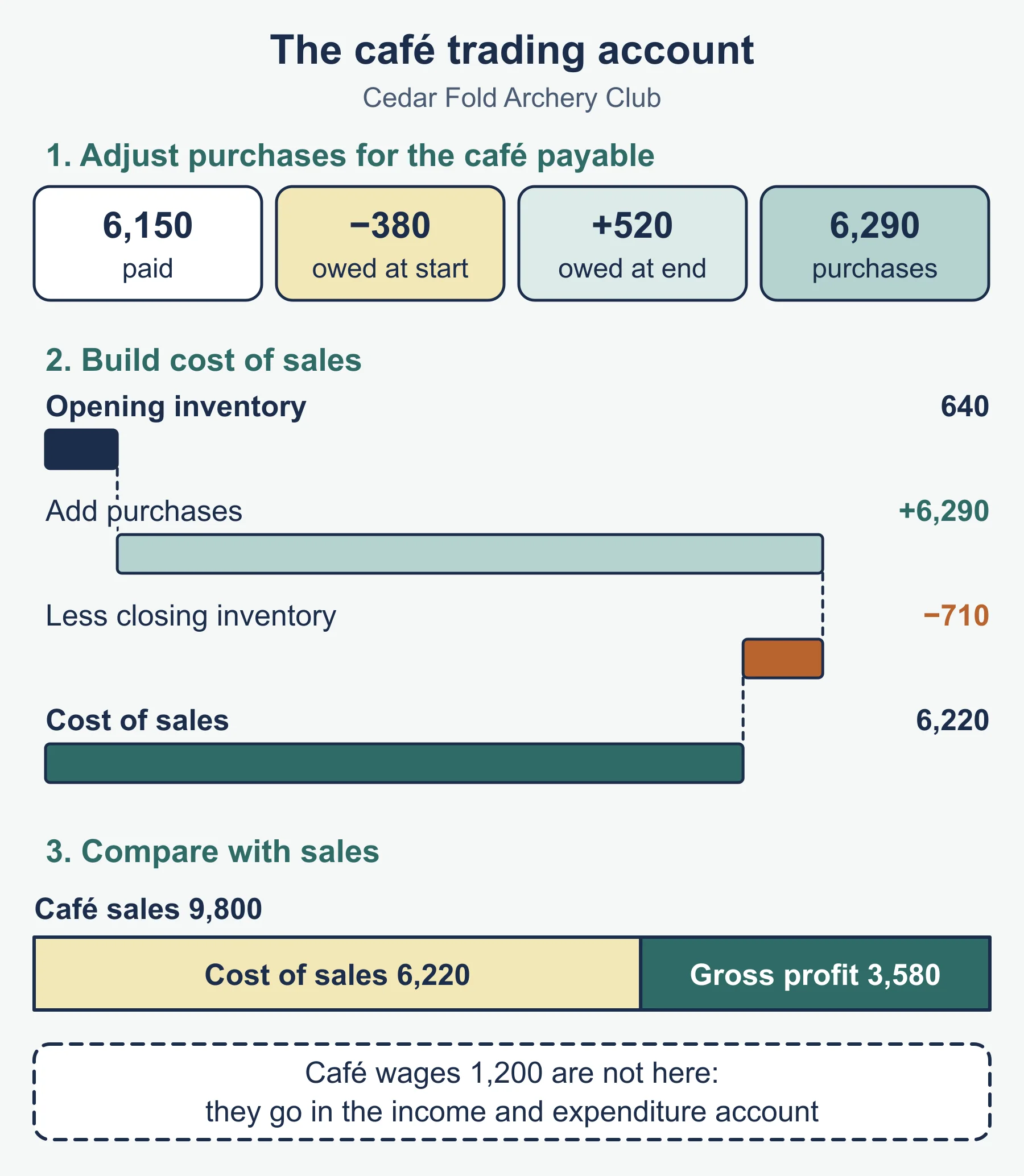
| Cost of sales | Opening inventory plus purchases less closing inventory |
| Gross profit | Sales less cost of sales |
| Straight line depreciation | (Cost less any residual value) divided by years, or a fixed percentage of cost |
| Reducing balance depreciation | Fixed percentage of net book value each year |
| Profit or loss on disposal | Proceeds less net book value (cost less accumulated depreciation) |
| Surplus or deficit | Total income less total expenditure |
| Closing accumulated fund | Opening fund plus surplus (or less deficit) |
Remember the expense row as a story: cash paid, take off what you paid for last year (owing at the start), add what belongs to this year but is unpaid (owing at the end), add what was paid last year for this year (prepaid at the start), and take off what is paid for next year (prepaid at the end).
Method in steps
To prepare club accounts from a receipts and payments account and extra information
- Find the opening accumulated fund from the opening assets and liabilities (if not given).
- Write a subscriptions account (arrears and advance on opposite sides) and find the balancing figure.
- Adjust each expense for amounts owing and prepaid.
- Work out depreciation and any profit or loss on disposal.
- Prepare the trading account for any bar, shop or café.
- Prepare the income and expenditure account: income first, then expenditure, then the surplus or deficit.
- Prepare the statement of financial position. Check that net assets equal opening fund plus surplus.
To comment on the results
- State the surplus or deficit with its figure.
- Compare with income, the activity margin or the previous year if given.
- Name a consequence: raise subscriptions, change prices, save for equipment, or review a cost.
Worked reminder: Linden Bay Rowing Club
Year ended 30 June 2026. Use these figures to check you can find each adjustment.
| Item | Figure |
|---|---|
| Subscriptions received | 6,200 |
| Subscriptions in arrears: opening / closing | 150 / 210 |
| Subscriptions in advance: opening / closing | 90 / 120 |
| Boat hire received | 1,400 |
| Hire due: opening / closing | 70 / 180 |
| Hire received in advance: opening / closing | 60 / nil |
| Refreshment stall sales | 3,000 |
| Stall inventory: opening / closing | 180 / 210 |
| Paid to stall suppliers | 1,700 |
| Stall supplier owed: opening / closing | 90 / 130 |
| Boats at cost, depreciated 10% on cost | 14,000 |
| Boathouse rent, insurance, repairs charged | 2,300, 640, 460 |
Workings
- Subscriptions: 6,200 less 150 plus 210 plus 90 less 120 = 6,230.
- Boat hire: 1,400 less 70 plus 180 plus 60 = 1,570.
- Stall purchases: 1,700 less 90 plus 130 = 1,740. Cost of sales: 180 plus 1,740 less 210 = 1,710. Gross profit: 3,000 less 1,710 = 1,290.
- Depreciation: 10% of 14,000 = 1,400.
- Income: 6,230 plus 1,570 plus 1,290 = 9,090. Expenditure: 2,300 plus 1,400 plus 640 plus 460 = 4,800. Surplus 4,290.
Must-know distinctions
| Compare | Key difference |
|---|---|
| Receipts and payments account vs income and expenditure account | Cash only, with capital items, versus accruals, without capital items, with depreciation |
| Surplus vs profit | The same idea, but a club uses surplus and deficit |
| Accumulated fund vs capital | The club’s equity, with no owner and no drawings |
| Arrears vs advance | Arrears is an asset (money owed to the club). Advance is a liability (the club owes next year’s service) |
| Trading account vs income and expenditure account | The trading account finds gross profit on one activity. The income and expenditure account finds the overall result |
| Straight line vs reducing balance | Same charge each year on cost, versus a falling charge on a falling net book value |
Quick self-test
Answer these before looking at the answers. Use dollars.
- State two items that appear in a receipts and payments account but not in an income and expenditure account.
- A club received 8,400 in subscriptions. Opening arrears were 250 and closing arrears 180. Opening advance was 120 and closing advance 160. Calculate subscriptions income.
- A club began the year with equipment at net book value 5,000, bank 1,800, inventory 300 and liabilities 400. Calculate the opening accumulated fund.
- A bar had sales of 5,600, opening inventory 220, closing inventory 260, and 3,100 paid to suppliers. Suppliers were owed 150 at the start and 190 at the end. Calculate gross profit.
- Calculate the first-year depreciation on equipment costing 15,000 at 10% straight line, and on equipment with net book value 9,000 at 20% reducing balance.
- Equipment cost 3,000 with accumulated depreciation 2,100 was sold for 700. State the profit or loss on disposal.
- A club paid 1,200 for insurance, of which 300 was for next year. State the expense.
- A club received 900 for ground hire. 100 was due at the start and 140 is due at the end. Calculate hire income.
- Income was 12,400 and expenditure 10,950. Opening accumulated fund was 6,700. State the surplus and the closing fund.
- Give two comments a treasurer could make about a deficit.
Answers
- Any two of: purchase of equipment, proceeds from selling equipment, the opening or closing bank balance.
- 8,400 less 250 plus 180 plus 120 less 160 = 8,290.
- Assets 5,000 plus 1,800 plus 300 = 7,100. Less 400 = 6,700.
- Purchases 3,100 less 150 plus 190 = 3,140. Cost of sales 220 plus 3,140 less 260 = 3,100. Gross profit 5,600 less 3,100 = 2,500.
- Straight line: 10% of 15,000 = 1,500. Reducing balance: 20% of 9,000 = 1,800.
- Net book value 3,000 less 2,100 = 900. Proceeds 700, so a loss of 200.
- 1,200 less 300 = 900.
- 900 less 100 plus 140 = 940.
- Surplus 12,400 less 10,950 = 1,450. Closing fund 6,700 plus 1,450 = 8,150.
- For example: costs exceeded income, so subscriptions or event fees may need to rise; the club could cut a cost or run a fundraising event; the fund is falling, so reserves may not last.
Where marks are usually lost
- Using cash received as income without adjusting for arrears and advance.
- Putting equipment purchases or sale proceeds in the income and expenditure account.
- Leaving out depreciation, or charging it on the wrong base.
- Forgetting that profit on disposal is income and loss is expenditure.
- Calling the result a profit or the fund capital when the question uses club terms.
- Showing café sales in the income and expenditure account instead of the gross profit.
- Copying the cash payment for an expense without adjusting for amounts owing or prepaid.
- Writing a comment such as “the club did well” without a figure or a reason.
- Not labelling statements with the title and the period or date.
Frequently asked questions
What is the difference between a receipts and payments account and an income and expenditure account? A receipts and payments account is cash only and includes capital items. An income and expenditure account uses accruals, excludes capital items and includes depreciation.
What is the accumulated fund? The accumulated fund is a club’s equity, taking the place of capital. There is no owner and no drawings.
Are subscriptions in arrears an asset? Yes. Arrears are money owed to the club, so they are an asset. Subscriptions received in advance are a liability, because the club owes members next year’s service.
Where does a profit or loss on disposal go in club accounts? A profit on disposal is income and a loss is expenditure in the income and expenditure account. The sale proceeds themselves appear only in the receipts and payments account.
How do you calculate an expense for a club? Start with the cash paid, take off what was paid for last year (owing at the start), add what is still owed at the end, and adjust for any amounts prepaid.
Official syllabus
OxfordAQA International GCSE Accounting (9215), version 1.2, for International GCSE exams May/June 2026 onwards, section 3.4 Preparation of financial statements (clubs and non-profit making organisations), published by OxfordAQA.
Get free revision emails (optional)
Occasional emails with practice questions, worked explanations and links to free resources for the qualification and subjects you choose. No spam, and you can unsubscribe from any email. The free tools on this site never need an email.
Related resources
-
Study guides
OxfordAQA IGCSE Accounting: Incomplete records and single entry (9215)
Statements of affairs, profit from changes in capital, missing figures, and single versus double entry for OxfordAQA International GCSE Accounting 9215.
Accounting · OxfordAQA · IGCSE
Read guide -
Practice questions
OxfordAQA IGCSE Accounting: Incomplete records and single entry (9215) – Practice Questions
Original questions with worked answers on statements of affairs, profit from capital, totals accounts and single entry for OxfordAQA IGCSE Accounting 9215.
Accounting · OxfordAQA · IGCSE
Try questions -
Revision notes
OxfordAQA IGCSE Accounting: Incomplete records and single entry (9215) – Revision Notes
Condensed revision notes on statements of affairs, profit from capital, totals accounts and single versus double entry for OxfordAQA IGCSE Accounting 9215.
Accounting · OxfordAQA · IGCSE
Revise topic
Related articles
-
teaching
A Level tuition in Dubai: Cambridge or Pearson Edexcel International A Level?
Schools in Dubai and Abu Dhabi teach either Cambridge International AS & A Level or Pearson Edexcel International A Level. How the two are structured, why it matters for tuition, and how online classes from Lahore work.
9 October 2026
-
curriculum guides
Choosing subjects at IGCSE and A Level
How subject choices at 14 and 16 affect university options later, and how to keep pathways open without overloading a timetable.
28 July 2026
Studying this with a teacher
Working through Accounting IGCSE?
This page is free and stays free. If you would rather be taught it, Marlbridge runs Accounting classes one-to-one and in small groups of up to 15, online in your own time zone. The first trial class is free. WhatsApp replies within an hour (8am–11pm Pakistan time, every day); email the same day.
OxfordAQA Accounting teachers at Marlbridge

