
Revision Notes
OxfordAQA IGCSE Accounting: Incomplete records and single entry (9215) – Revision Notes
Condensed revision notes on statements of affairs, profit from capital, totals accounts and single versus double entry for OxfordAQA IGCSE Accounting 9215.
- Subject
- Accounting
- Level
- IGCSE
- Topic
- Preparation of financial statements
- Author
- Marlbridge Academic Team
- Updated
- Reviewed by
- Javaid Iqbal Sabri (what this means)
Aligned to OxfordAQA IGCSE Accounting (9215), First teaching 2024, first examined 2026. Official specification .
Syllabus page (what it covers and how it is assessed): OxfordAQA IGCSE Accounting.
Syllabus points this page covers
9215
- Incomplete records and single entry
Found an error? Report a correction.
Need help with this topic? Request a free trial class for IGCSE Accounting (9215).
These notes are aligned to the OxfordAQA International GCSE Accounting (9215) specification, version 1.2, for exams from May/June 2026 onwards. They cover the incomplete records content of section 3.4 (topic 4, Preparation of financial statements): the profit of an organisation with insufficient records to prepare income statements, statements of affairs, and the benefits and limitations of different record-keeping systems including single and double entry. Amounts are in dollars. For full explanations read the study guide, then try the practice questions. Related pages: the course hub, the checklist, the free diagnostics and the page on correcting errors and the effect of errors on profit.
Key definitions
| Term | Meaning |
|---|---|
| Incomplete records | Records that are not enough to prepare an income statement and a statement of financial position directly |
| Single entry | Each transaction recorded once, often only cash and bank movements |
| Double entry | Each transaction recorded as a debit and a credit, so a trial balance can be taken out |
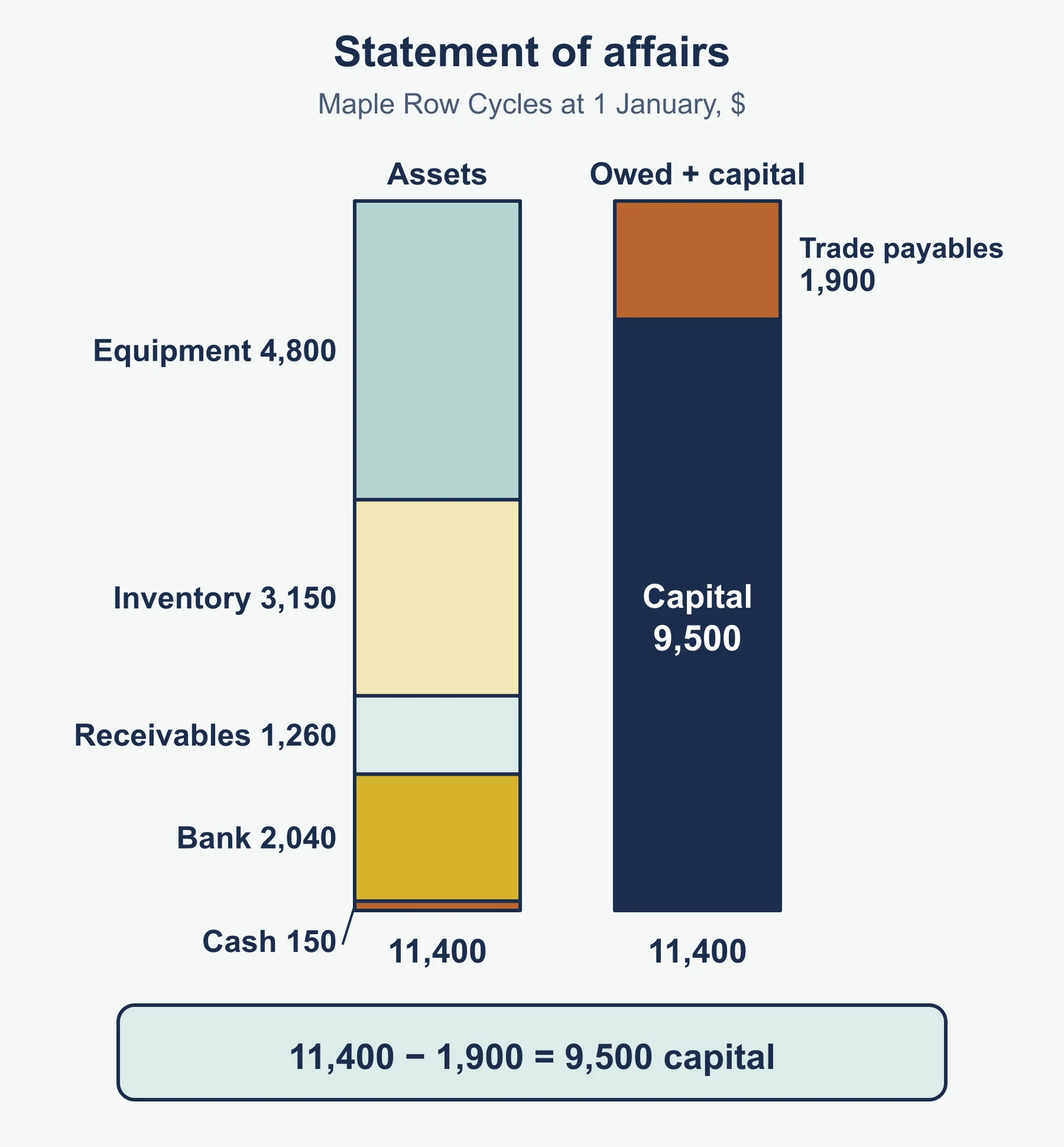
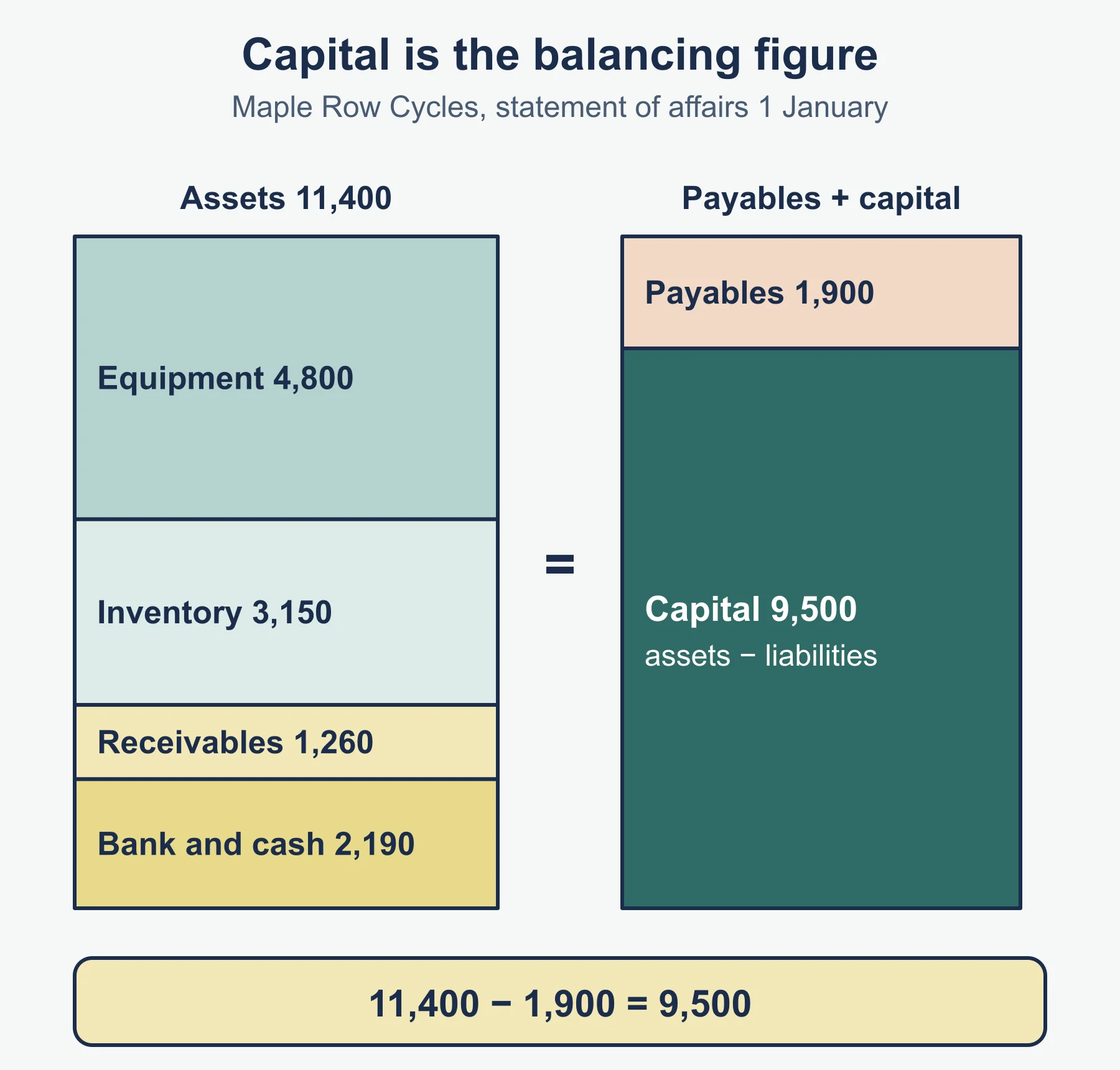
| Statement of affairs | A list of assets and liabilities at one date, with capital as the balancing figure |
| Capital | What the business owes the owner: assets − liabilities |
| Drawings | Cash or goods the owner takes for personal use; not an expense |
| Capital introduced | Money or assets the owner puts in; not profit |
Formulas to recall
| Purpose | Formula |
|---|---|
| Capital | Assets − liabilities |
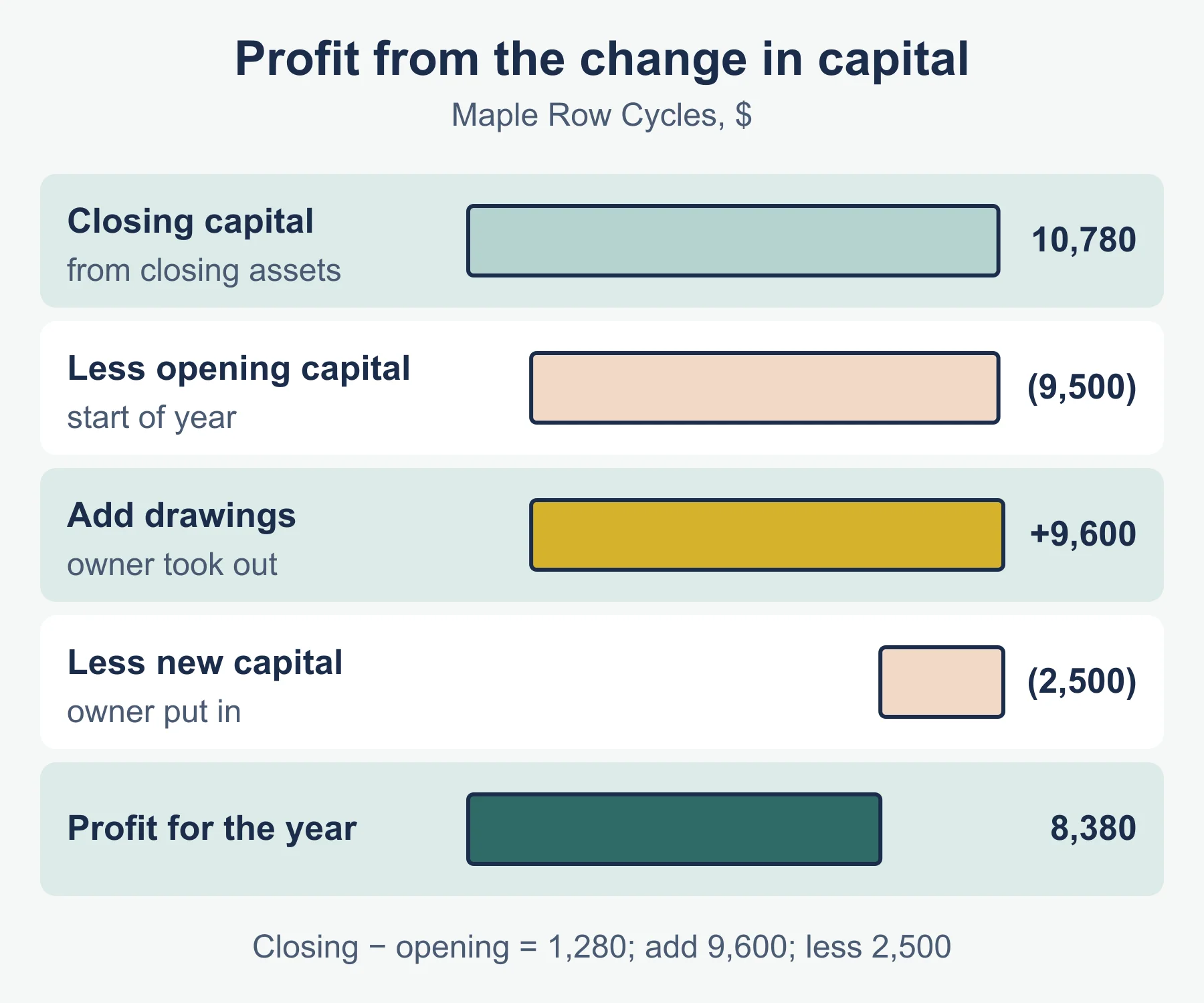
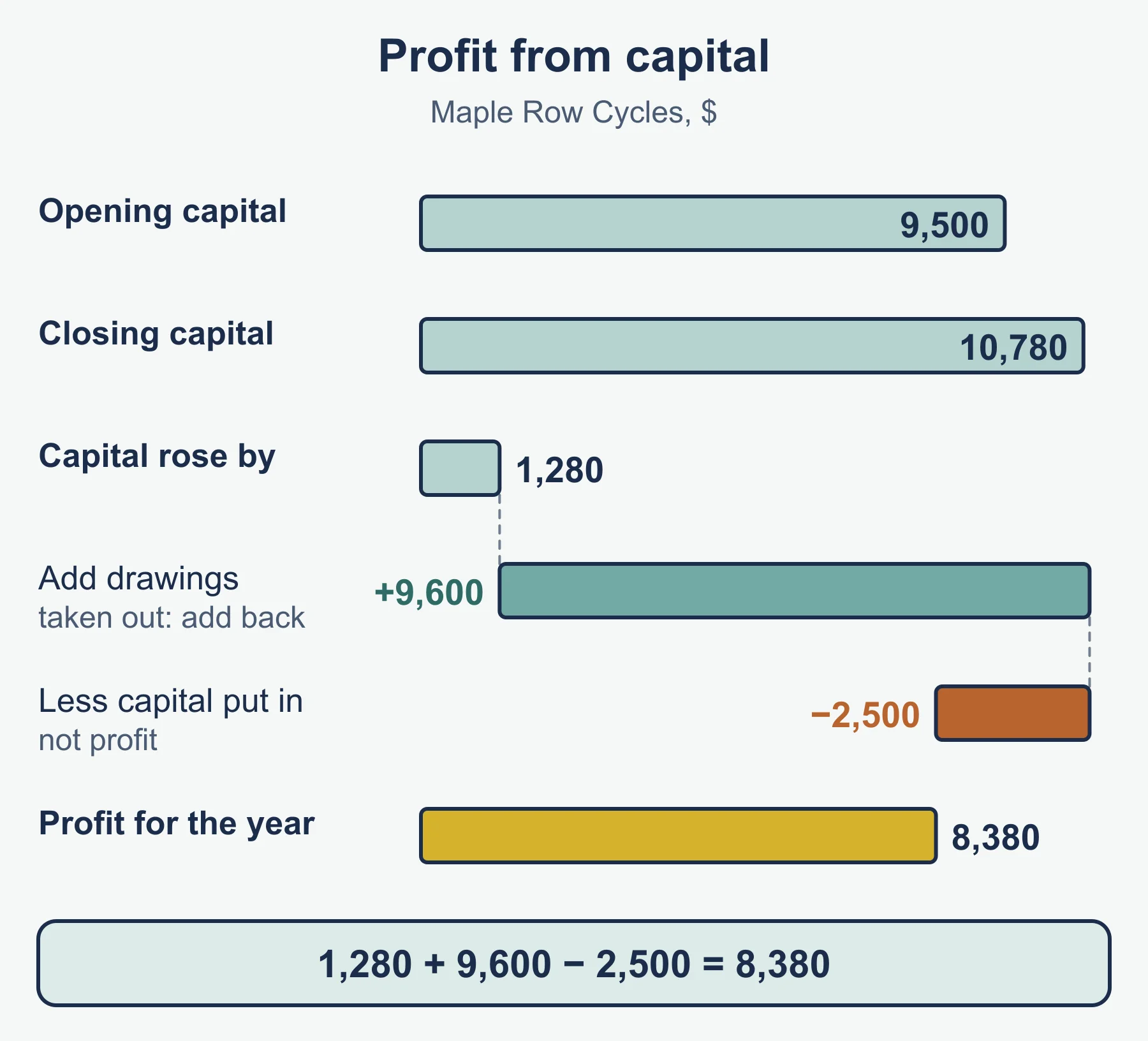
| Profit or loss | Closing capital − opening capital + drawings − capital introduced |
| Credit sales | Closing receivables + cash received + discount allowed + irrecoverable debts + returns inwards − opening receivables |
| Credit purchases | Closing payables + cash paid + discount received + returns outwards − opening payables |
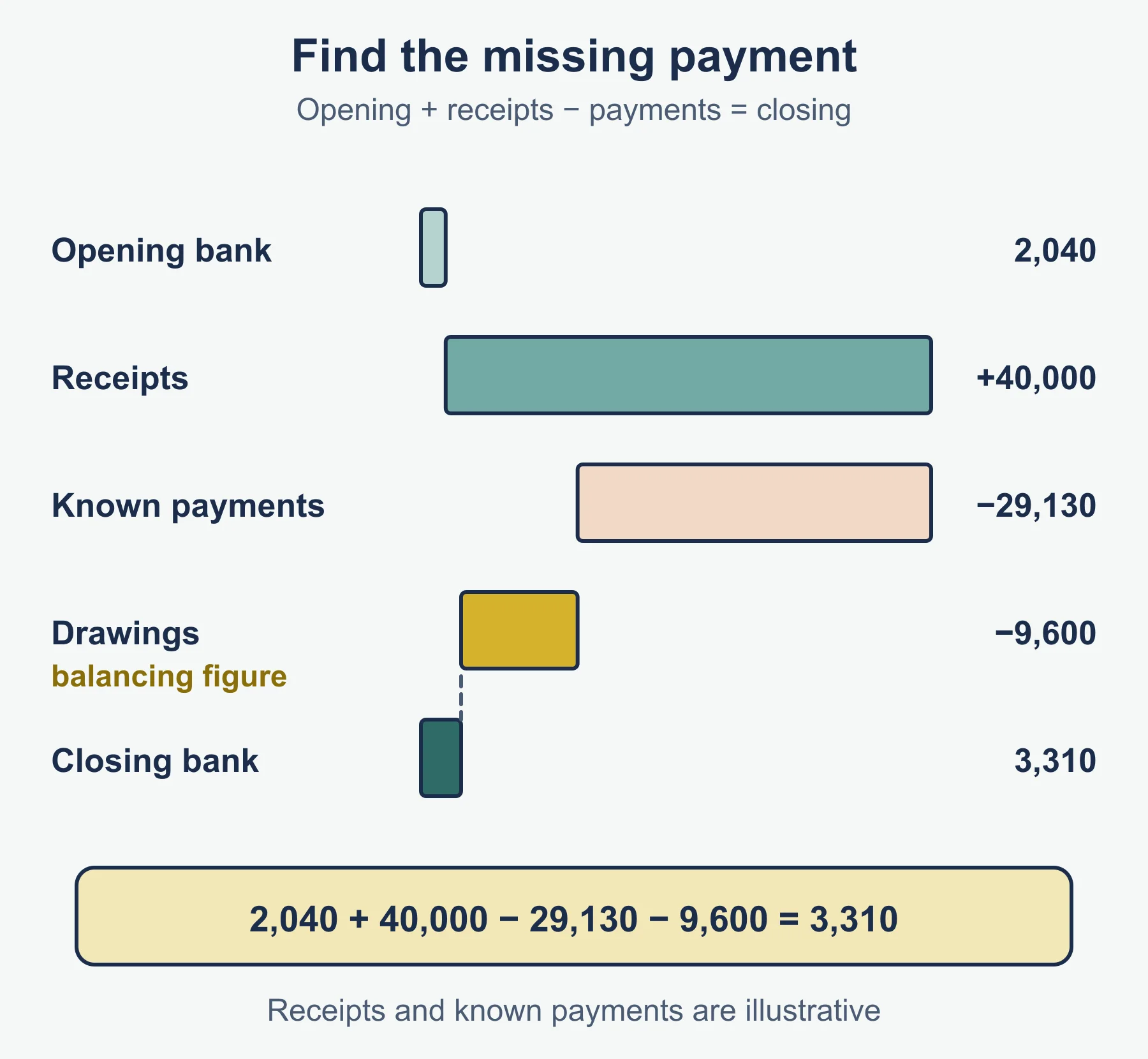
| Missing cash or bank item | Opening balance + receipts − payments = closing balance |
| Total sales | Credit sales + cash sales |
Method: profit from a statement of affairs
- Draw the opening statement of affairs. Total the assets, deduct liabilities, and write opening capital.
- Draw the closing statement of affairs in the same way. Write closing capital.
- Find the change in capital (closing − opening).
- Add drawings, including goods taken for own use if given.
- Deduct any capital introduced.
- Write the answer as profit or loss, and say which.
Worked reminder: a loss
Bright Loom Crafts, a sole trader, has these figures.
| Item | 1 January | 31 December |
|---|---|---|
| Equipment | 2,600 | 2,340 |
| Inventory | 1,850 | 1,700 |
| Trade receivables | 740 | 690 |
| Bank | 910 | 420 |
| Cash | 90 | 60 |
| Total assets | 6,190 | 5,210 |
| Trade payables | (1,120) | (1,380) |
| Capital | 5,070 | 3,830 |
Capital fell by 1,240. Drawings were 900 and nothing was introduced. Profit = 3,830 − 5,070 + 900 = loss of 340. The owner took out 900, so capital fell even though the loss was smaller than the fall.
Method: finding a missing figure from a bank summary
Pennant Kites banked all takings. For the year: opening bank 1,200; cheques from customers 18,400; cash sales banked 3,100; paid to suppliers 11,900; expenses paid 4,350; closing bank 1,450. Drawings were not recorded.
Drawings = 1,200 + 18,400 + 3,100 − 11,900 − 4,350 − 1,450 = 5,000.
Always check the sign of each balance. A bank overdraft at the start counts as a negative opening balance.
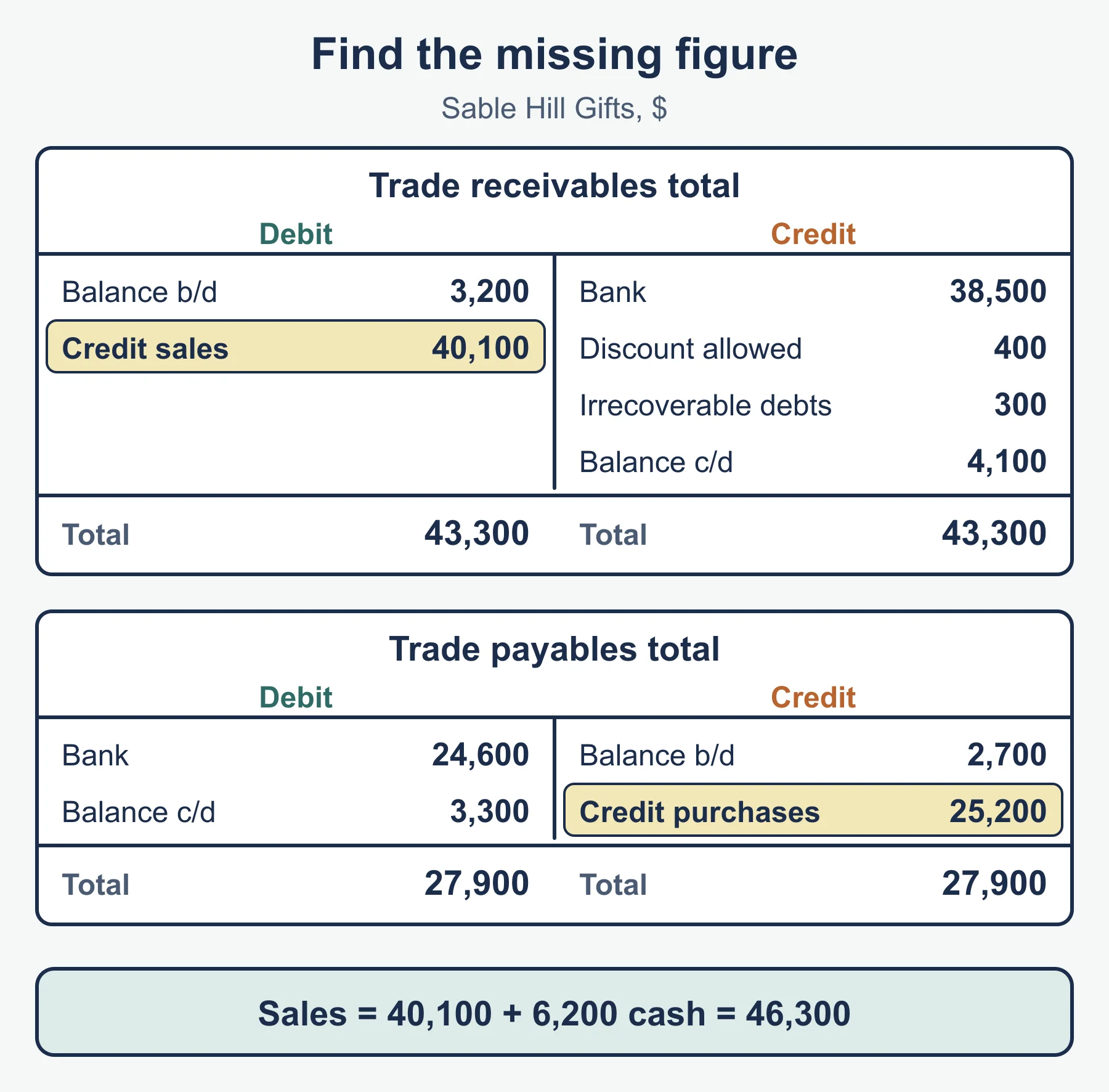
Method: totals accounts
| Account | Set out as | Missing figure |
|---|---|---|
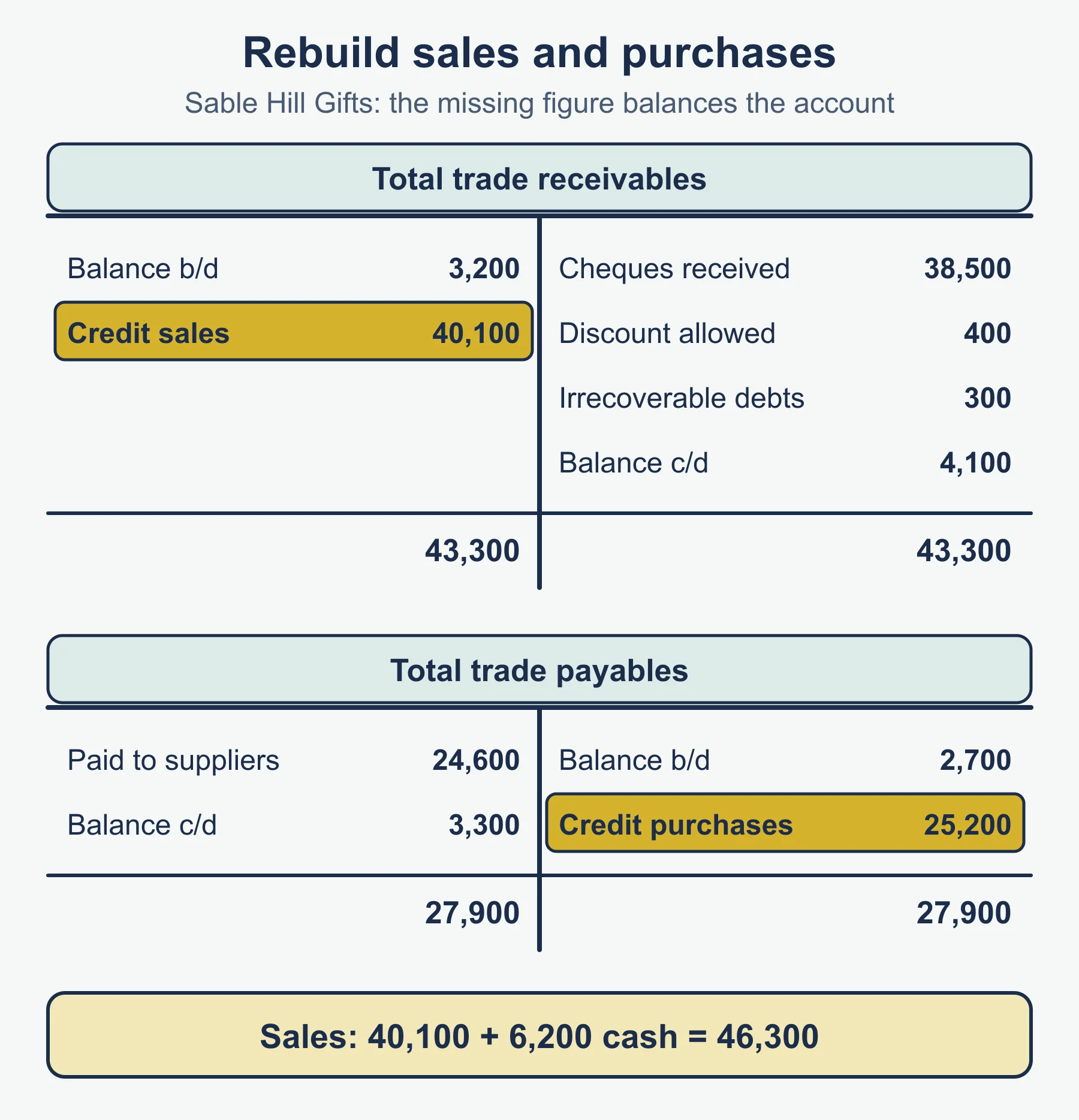
| Trade receivables | Debit: opening balance and credit sales. Credit: cash received, discount allowed, irrecoverable debts, returns inwards and closing balance | Credit sales |
| Trade payables | Credit: opening balance and credit purchases. Debit: cash paid, discount received, returns outwards and closing balance | Credit purchases |
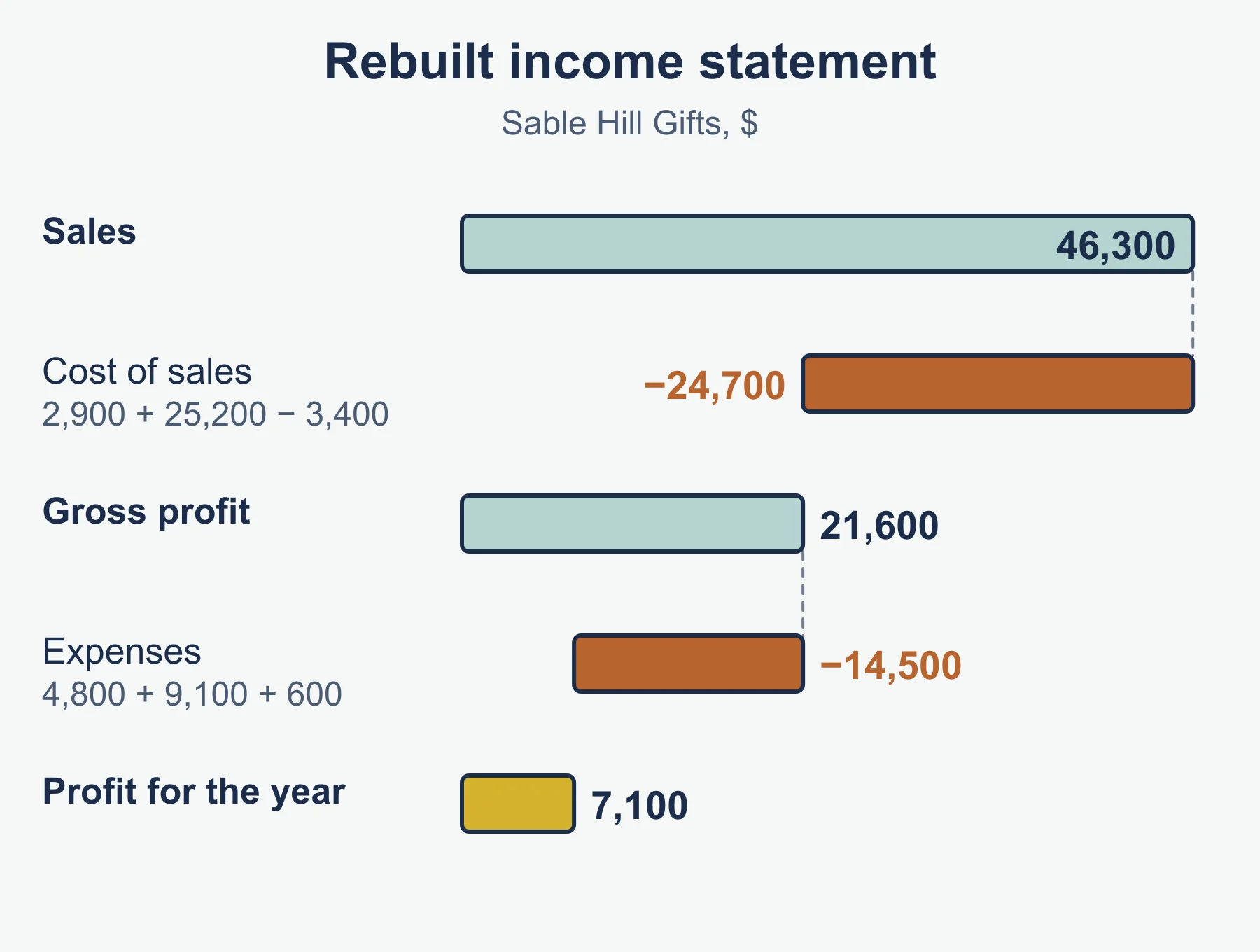
Once you have credit sales and credit purchases, add cash sales to find total sales. Then use opening and closing inventory to find cost of sales and gross profit. Check expenses for accruals and prepayments before deducting them.
Adjusting values before profit
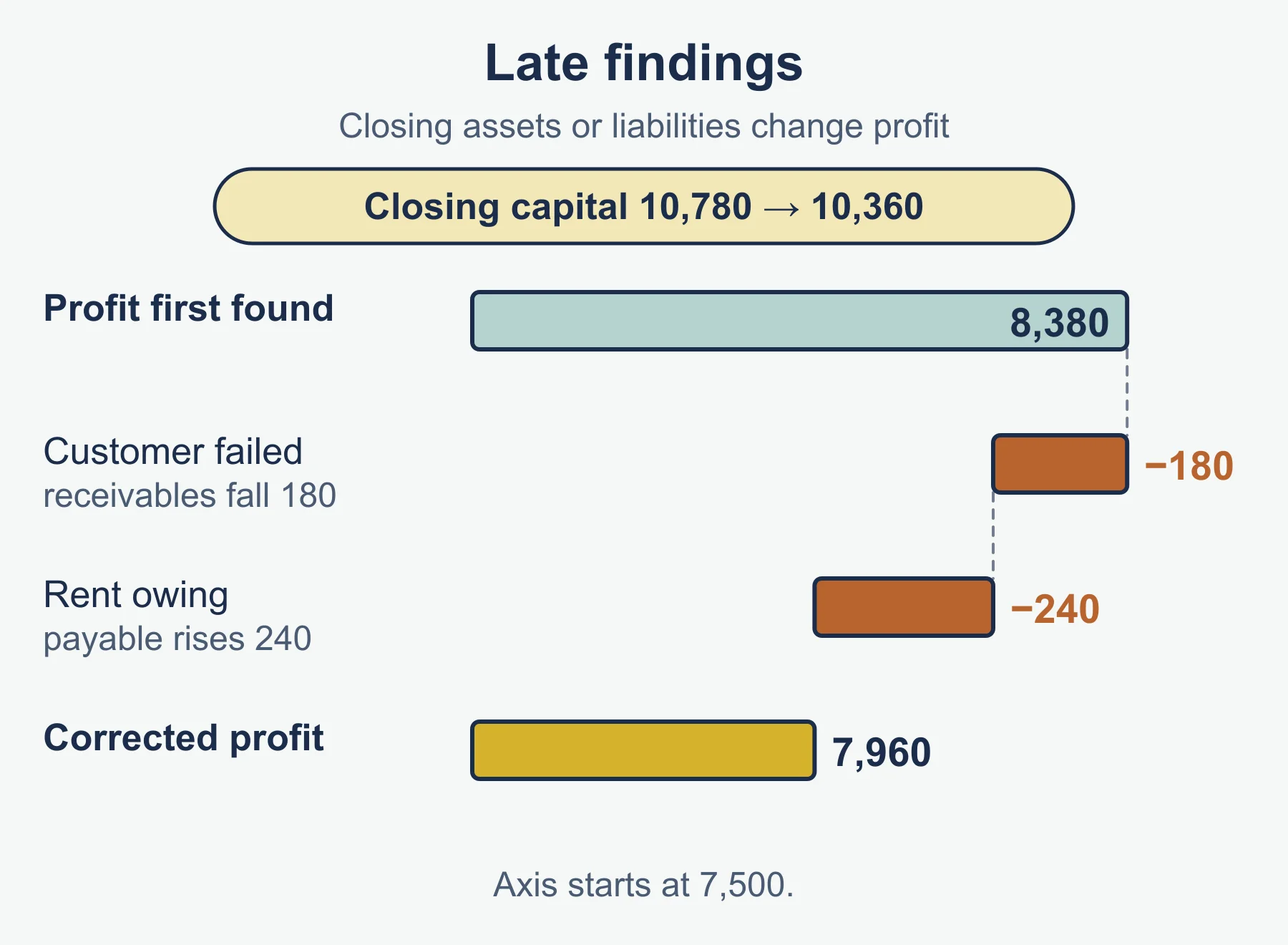
Any asset or liability changed at the closing date changes closing capital and profit by the same amount.
| Late information | Effect on closing capital and profit |
|---|---|
| Irrecoverable debt written off | Decrease |
| Provision for doubtful debts created or increased | Decrease |
| Depreciation not yet recorded | Decrease |
| Other payable (expense owing) | Decrease |
| Income due (other receivable) | Increase |
| Prepaid expense | Increase |
| Income received in advance | Decrease |
| Inventory valued lower | Decrease |
Worked reminder: an overdraft and a loan
A statement of affairs may include a bank overdraft or a loan. These are liabilities, not negative assets to be ignored. Take a trader with equipment 3,500 and inventory 2,000. The business has a bank overdraft of 600 and trade payables of 900.
Total assets are 5,500. Total liabilities are 600 + 900 = 1,500. Capital is 5,500 − 1,500 = 4,000.
If the same trader also had a loan repayable in three years, you would list it under non-current liabilities, and capital would fall by the loan amount.
Writing a good comment on a system
A comment earns credit when it names a feature, gives its effect and links it to the business. A useful pattern is: feature, so effect, which matters because of the business.
- Single entry has no trial balance, so errors are not flagged, which matters for a trader with many credit customers.
- Double entry produces ledger accounts for each item, so the owner can see which expenses are rising, which matters when the owner wants to control costs.
- Single entry is cheap to keep, which matters for a stall with a handful of daily sales.
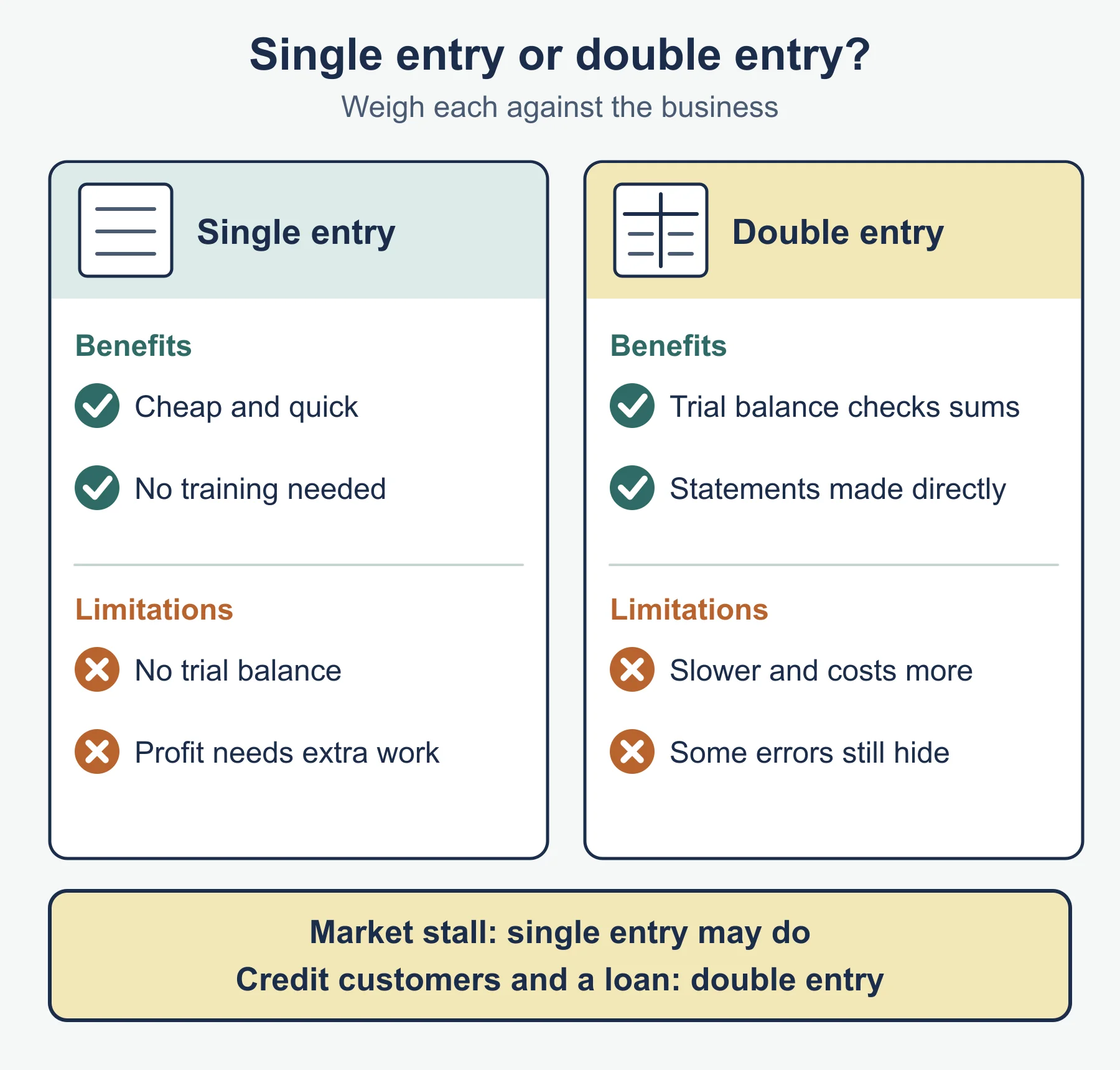
Single entry versus double entry
| Single entry | Double entry | |
|---|---|---|
| Benefits | Cheap, quick and simple; little training; enough for a very small business | Complete ledger accounts; trial balance gives an arithmetic check; statements prepared directly; easier to prove figures |
| Limitations | No trial balance; errors and fraud are harder to find; profit needs extra calculations; information is limited | More time and cost; needs bookkeeping skill; some errors still not revealed by a trial balance |
Points to use in a judgement answer: size of the business, number of credit customers and suppliers, whether a lender or tax authority needs reliable statements, and whether the owner wants to compare expenses year to year.
Must-know distinctions
- Profit from capital gives one figure. An income statement shows how it was earned.
- Drawings are deducted from capital in the statement of financial position but are not an expense in the income statement.
- Capital introduced is an addition to capital, not income.
- A trial balance that agrees does not prove the records are correct.
- A statement of affairs is built from counted and valued items; a statement of financial position is built from the ledger. Their layout can look the same.
Quick self-test
- Assets are 9,300 and liabilities are 3,900. Find capital.
- Opening capital is 5,400, closing capital is 7,100, and drawings are 4,000. No capital was introduced. Find profit.
- Opening capital is 12,000, closing capital is 11,200, drawings are 3,000 and the owner introduced 1,000. Find profit or loss.
- Name the missing figure found from a trade receivables total account.
- Opening receivables 1,800; closing receivables 2,100; cash received 14,200; irrecoverable debts 150. Find credit sales.
- Opening payables 900; closing payables 1,250; paid to suppliers 8,000. Find credit purchases.
- State two limitations of single entry.
- State two benefits of double entry.
- Does an irrecoverable debt discovered after the count raise or lower profit calculated from capital?
- Is capital introduced added to or deducted from the change in capital when finding profit?
Answers
- 5,400.
- 7,100 − 5,400 + 4,000 = profit of 5,700.
- 11,200 − 12,000 + 3,000 − 1,000 = profit of 1,200.
- Credit sales.
- 14,200 + 150 + 2,100 − 1,800 = 14,650.
- 8,000 + 1,250 − 900 = 8,350.
- For example: no trial balance to check arithmetic; errors are hard to locate; profit needs extra work; information about expenses and sales is limited.
- For example: trial balance gives an arithmetic check; income statement and statement of financial position can be prepared directly; records are fuller and easier to prove.
- Lowers it, because trade receivables and closing capital fall by that amount.
- Deducted, because it increases capital without being profit.
Where marks are usually lost
- Adding capital introduced instead of deducting it, or deducting drawings instead of adding them back.
- Forgetting to subtract opening capital, so closing capital is quoted as profit.
- Counting trade payables as an asset or leaving out a loan.
- Ignoring late information such as an irrecoverable debt or an accrued expense.
- Leaving out opening trade receivables or payables when finding credit sales or purchases.
- Writing a loss as a profit, or giving no label.
- Using one-word comments on systems, such as “easy” or “accurate”, with no link to the business described.
- Writing that double entry removes all errors.
- Mixing up the statement of affairs with a trial balance.
Frequently asked questions
How do you calculate profit from changes in capital? Profit = closing capital − opening capital + drawings − capital introduced. If the result is negative, it is a loss.
How do you find drawings from a bank summary? Take the opening bank balance, add all receipts and deduct all known payments; the remaining amount needed to reach the closing balance is the missing figure, such as drawings. Treat an opening overdraft as a negative balance.
Are a bank overdraft and a loan shown in a statement of affairs? Yes, as liabilities, not negative assets. A loan repayable in three years would be listed under non-current liabilities, and capital would fall by the loan amount.
What is the difference between a statement of affairs and a statement of financial position? A statement of affairs is built from counted and valued items; a statement of financial position is built from the ledger. Their layout can look the same.
Does late information change the profit from capital? Yes. Any asset or liability changed at the closing date, such as an irrecoverable debt or an accrued expense found after the count, changes closing capital and profit by the same amount.
Official syllabus
OxfordAQA International GCSE Accounting (9215), specification version 1.2, for International GCSE exams May/June 2026 onwards (OxfordAQA). Section 3.4, Preparation of financial statements: accounting for organisations with incomplete records.
Get free revision emails (optional)
Occasional emails with practice questions, worked explanations and links to free resources for the qualification and subjects you choose. No spam, and you can unsubscribe from any email. The free tools on this site never need an email.
Related resources
-
Study guides
OxfordAQA IGCSE Accounting: Internal financial statements of limited companies (9215)
Prepare and comment on a limited company's internal income statement and statement of financial position for OxfordAQA International GCSE Accounting.
Accounting · OxfordAQA · IGCSE
Read guide -
Practice questions
OxfordAQA IGCSE Accounting: Internal financial statements of limited companies (9215) – Practice Questions
Original questions with worked answers on limited company income statements, statements of financial position and share and loan capital, OxfordAQA 9215.
Accounting · OxfordAQA · IGCSE
Try questions -
Revision notes
OxfordAQA IGCSE Accounting: Internal financial statements of limited companies (9215) – Revision Notes
Condensed recall notes, a layout checklist and a self-test on limited company income statements and statements of financial position, OxfordAQA 9215.
Accounting · OxfordAQA · IGCSE
Revise topic
Related articles
-
teaching
A Level tuition in Dubai: Cambridge or Pearson Edexcel International A Level?
Schools in Dubai and Abu Dhabi teach either Cambridge International AS & A Level or Pearson Edexcel International A Level. How the two are structured, why it matters for tuition, and how online classes from Lahore work.
9 October 2026
-
curriculum guides
Choosing subjects at IGCSE and A Level
How subject choices at 14 and 16 affect university options later, and how to keep pathways open without overloading a timetable.
28 July 2026
Studying this with a teacher
Working through Accounting IGCSE?
This page is free and stays free. If you would rather be taught it, Marlbridge runs Accounting classes one-to-one and in small groups of up to 15, online in your own time zone. The first trial class is free. WhatsApp replies within an hour (8am–11pm Pakistan time, every day); email the same day.
OxfordAQA Accounting teachers at Marlbridge

