
Study Guides
OxfordAQA IGCSE Accounting: Incomplete records and single entry (9215)
Statements of affairs, profit from changes in capital, missing figures, and single versus double entry for OxfordAQA International GCSE Accounting 9215.
- Subject
- Accounting
- Level
- IGCSE
- Topic
- Preparation of financial statements
- Author
- Marlbridge Academic Team
- Updated
- Reviewed by
- Javaid Iqbal Sabri (what this means)
Aligned to OxfordAQA IGCSE Accounting (9215), First teaching 2024, first examined 2026. Official specification .
Syllabus page (what it covers and how it is assessed): OxfordAQA IGCSE Accounting.
Syllabus points this page covers
9215
- Incomplete records and single entry
Found an error? Report a correction.
Need help with this topic? Request a free trial class for IGCSE Accounting (9215).
This guide is aligned to the OxfordAQA International GCSE Accounting (9215) specification, version 1.2, for exams from May/June 2026 onwards. It covers the last content group of specification section 3.4 (topic 4, Preparation of financial statements): accounting for organisations with incomplete records. The specification asks for two things. You must calculate the profit of an organisation where there are insufficient records to prepare income statements, and you must explain the benefits and limitations of different record-keeping systems, including single and double entry. It adds that calculations could include statements of affairs. All amounts on this page are in dollars.
Use it with the revision notes and the practice questions. Profit corrections are also covered in the guide on correcting errors and the effect of errors on profit. Track your progress on the course hub, the checklist and the free diagnostics.
What you must be able to do
| Specification point | What it means in practice |
|---|---|
| Calculate profit where records are insufficient to prepare income statements | Compare the owner’s capital at two dates and adjust for drawings and capital introduced |
| Calculations could include statements of affairs | List assets and liabilities at a date and find capital as the difference |
| Benefits and limitations of different systems, including single and double entry | Judge what each system tells the owner and what it cannot show |
The specification does not list every technique used to rebuild missing figures. The totals accounts in the later section are common supporting methods. Treat the statement of affairs as the core skill.
Why records are incomplete
A small trader may record only some receipts and payments, keep no ledger accounts, or lose records. With single entry, each transaction is noted once, often in a cash book or notebook, and there is no matching second entry. Without full double entry there is no trial balance and no ready-made income statement.
The owner still needs to know whether the business made a profit. The answer comes from the accounting equation:
Capital = assets − liabilities
If capital rose during the year, the business has done well, once you allow for money the owner took out and money the owner put in.
The statement of affairs
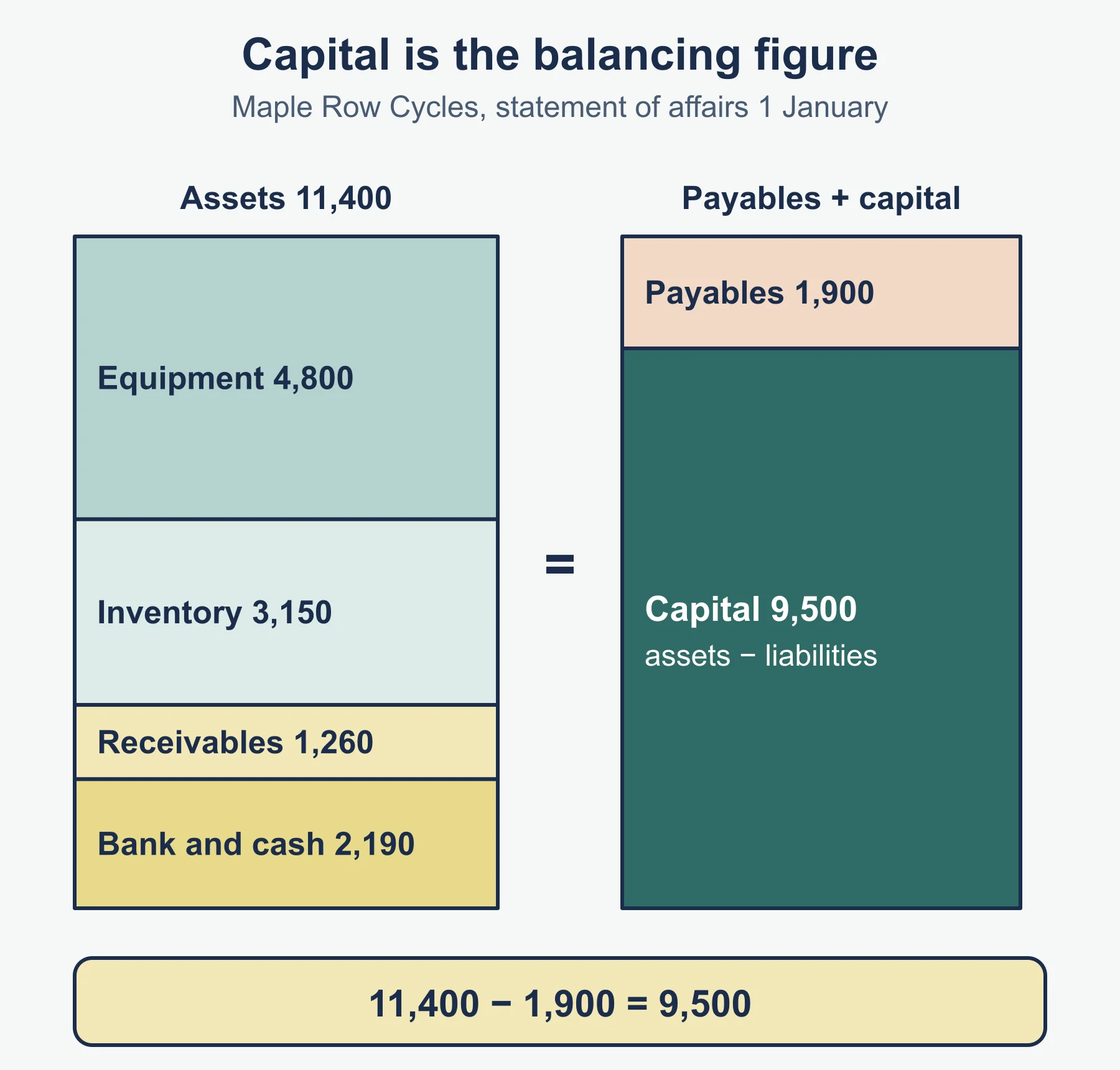
A statement of affairs lists the assets and liabilities of a business at one date. The balancing figure is capital. It looks like a statement of financial position, but it is built from a count and valuation of items rather than from a trial balance. Group items under the headings you know: non-current assets, current assets, current liabilities and non-current liabilities.
Worked example 1: Maple Row Cycles
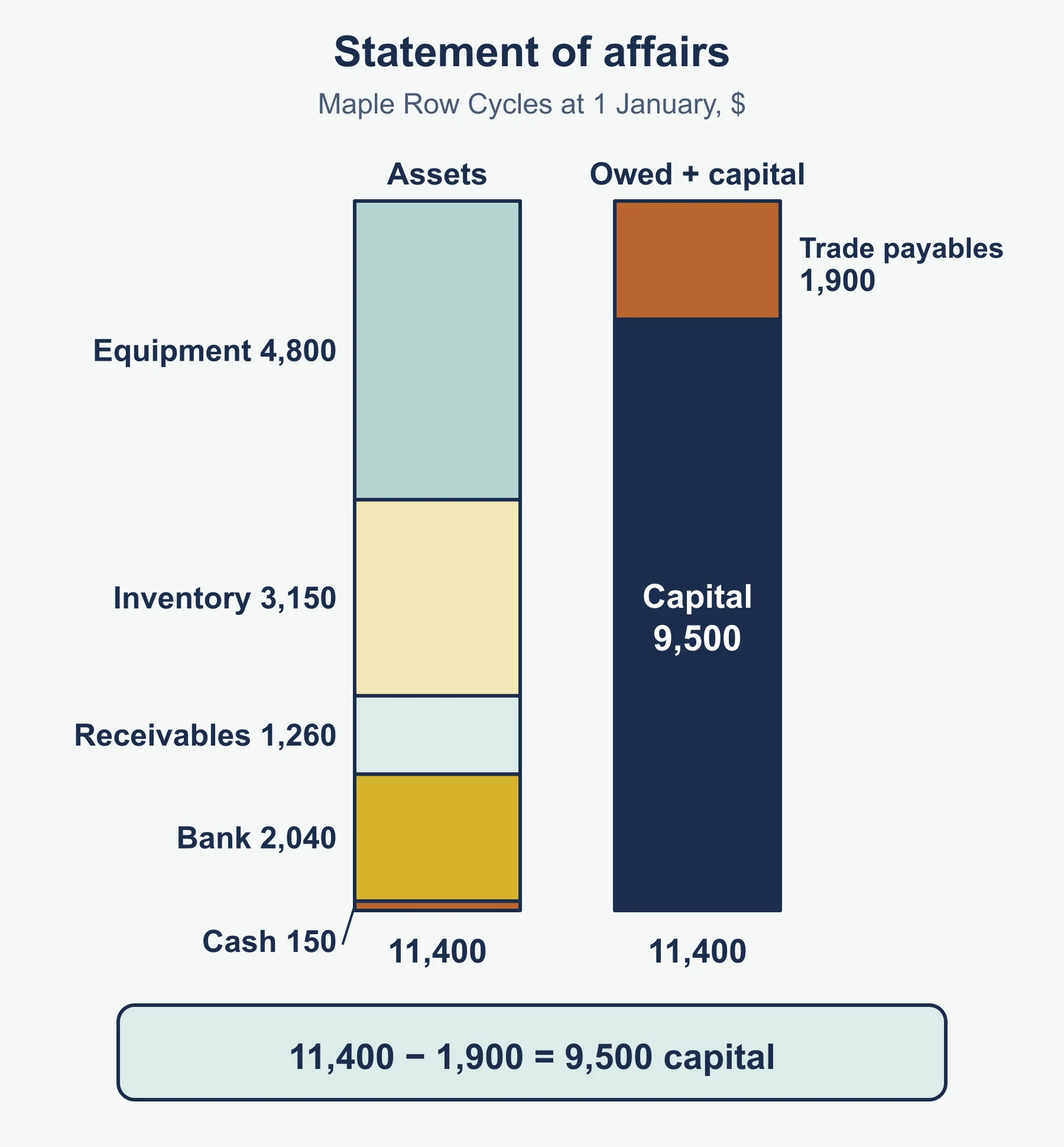
Maple Row Cycles is a sole trader business that sells and repairs bicycles. The owner kept no ledger. At the start of the year the owner listed: equipment 4,800; inventory 3,150; trade receivables 1,260; bank 2,040; cash 150; trade payables 1,900.
Statement of affairs at 1 January:
| Item | Amount |
|---|---|
| Equipment | 4,800 |
| Inventory | 3,150 |
| Trade receivables | 1,260 |
| Bank | 2,040 |
| Cash | 150 |
| Total assets | 11,400 |
| Less trade payables | (1,900) |
| Capital | 9,500 |
Opening capital is 9,500. Notice that it is a balancing figure. If you are told opening capital and some assets, you can work backwards to find one missing asset or liability in the same way.
Calculating profit from capital
Profit is the increase in capital that came from trading. Drawings reduce capital but are not an expense. Capital introduced raises capital but is not profit. So:
| Step | Calculation |
|---|---|
| Closing capital | Closing assets − closing liabilities |
| Less opening capital | From the opening statement of affairs |
| Increase (or decrease) in capital | Closing capital − opening capital |
| Add drawings | Money and goods the owner took out |
| Less capital introduced | New money or assets the owner put in |
| Profit (or loss) | The result |
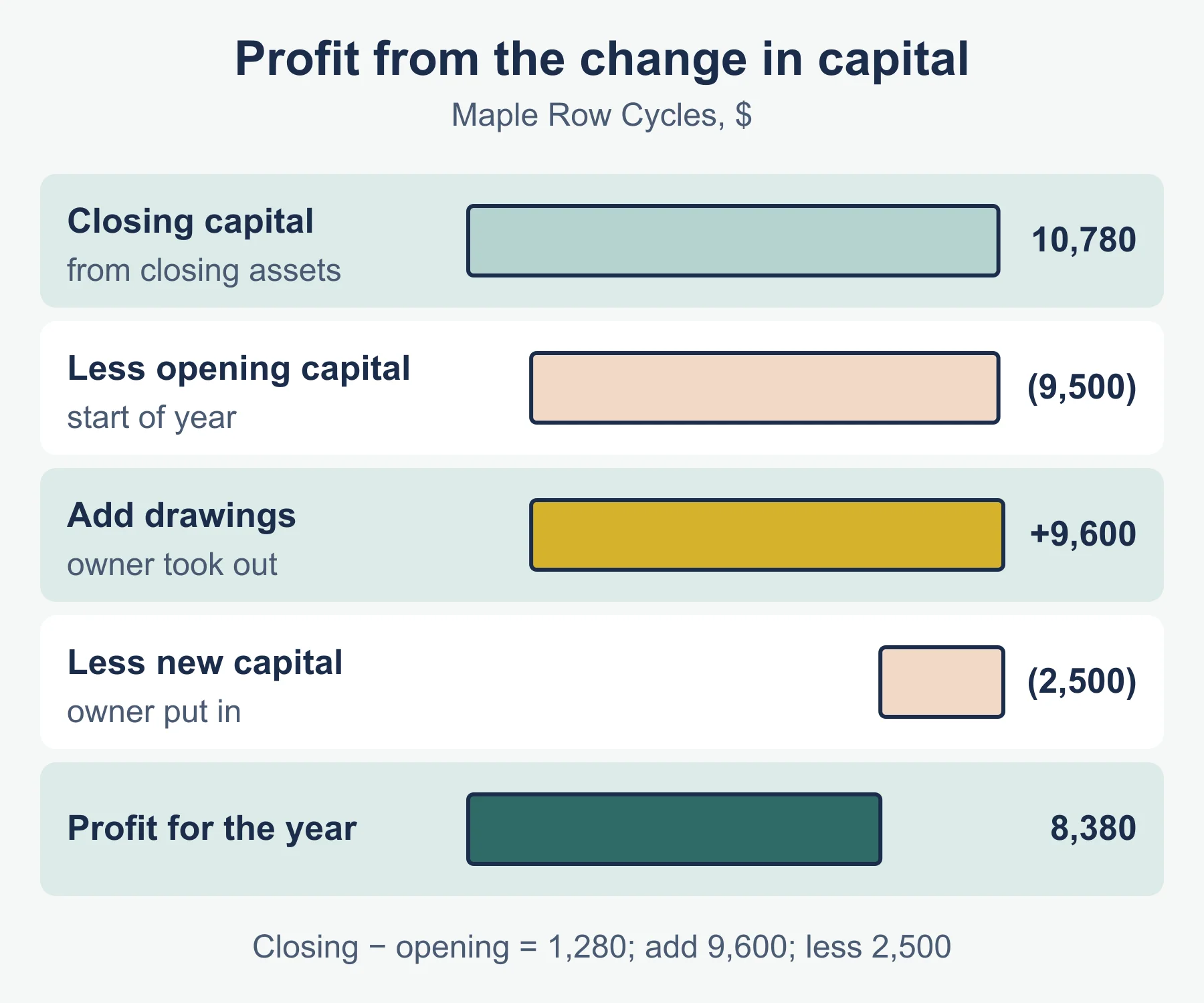
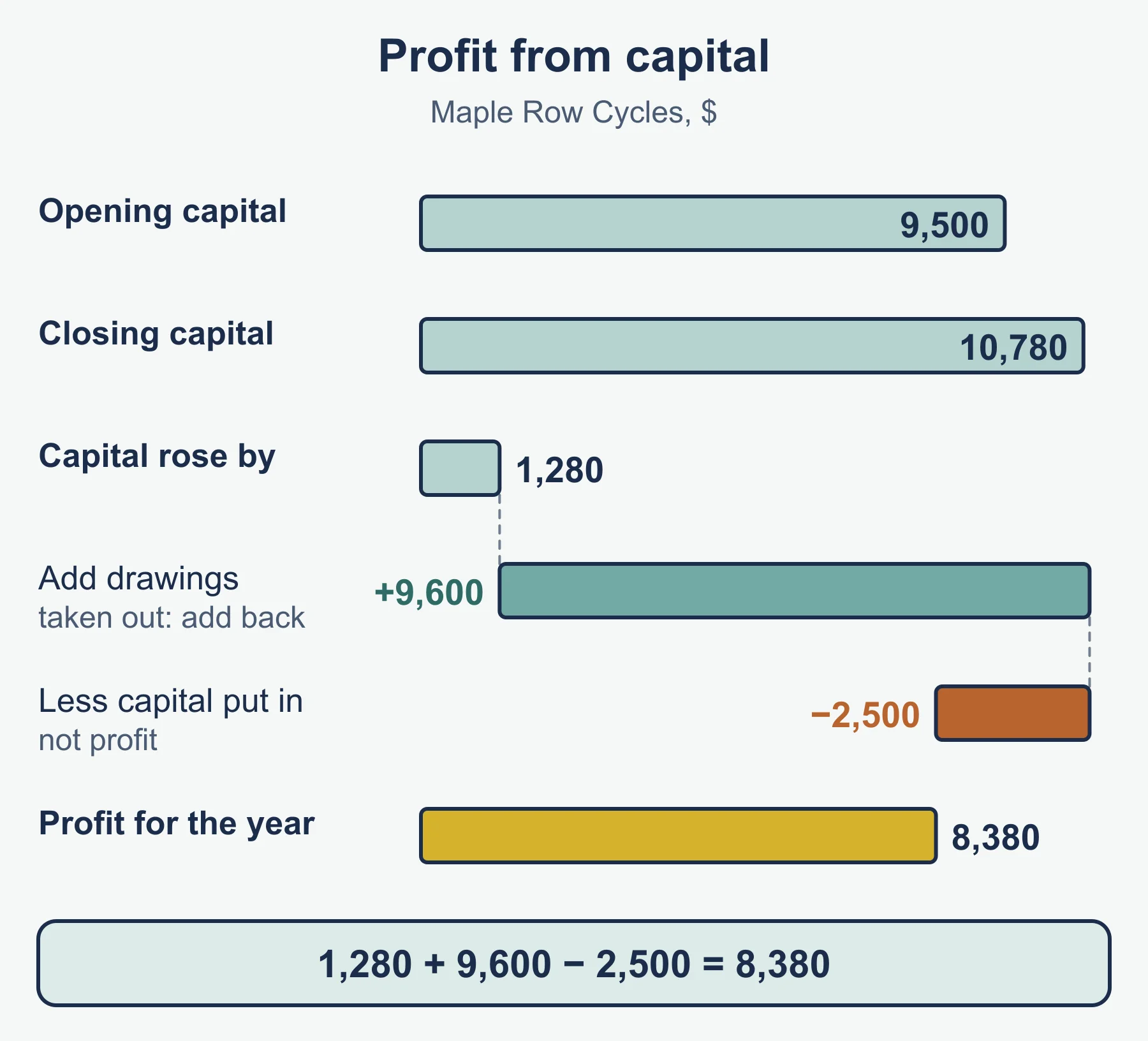
Many candidates reverse the drawings and capital introduced lines. Think about what happened. If the owner took 9,600 out and capital still rose, the business must have earned more than the rise shows, so drawings are added back. If the owner put 2,500 in, part of the rise is not profit, so it is deducted.
Worked example 2: Maple Row Cycles continued
At 31 December the owner counted: equipment 4,320 (after the year’s use); inventory 3,600; trade receivables 1,580; bank 3,310; cash 210; trade payables 2,240. During the year drawings were 9,600 and the owner paid 2,500 of personal savings into the business bank account.
Closing statement of affairs:
| Item | Amount |
|---|---|
| Equipment | 4,320 |
| Inventory | 3,600 |
| Trade receivables | 1,580 |
| Bank | 3,310 |
| Cash | 210 |
| Total assets | 13,020 |
| Less trade payables | (2,240) |
| Closing capital | 10,780 |
Profit calculation:
| Line | Amount |
|---|---|
| Closing capital | 10,780 |
| Less opening capital | (9,500) |
| Increase in capital | 1,280 |
| Add drawings | 9,600 |
| Less capital introduced | (2,500) |
| Profit for the year | 8,380 |
Adjusting for information found later
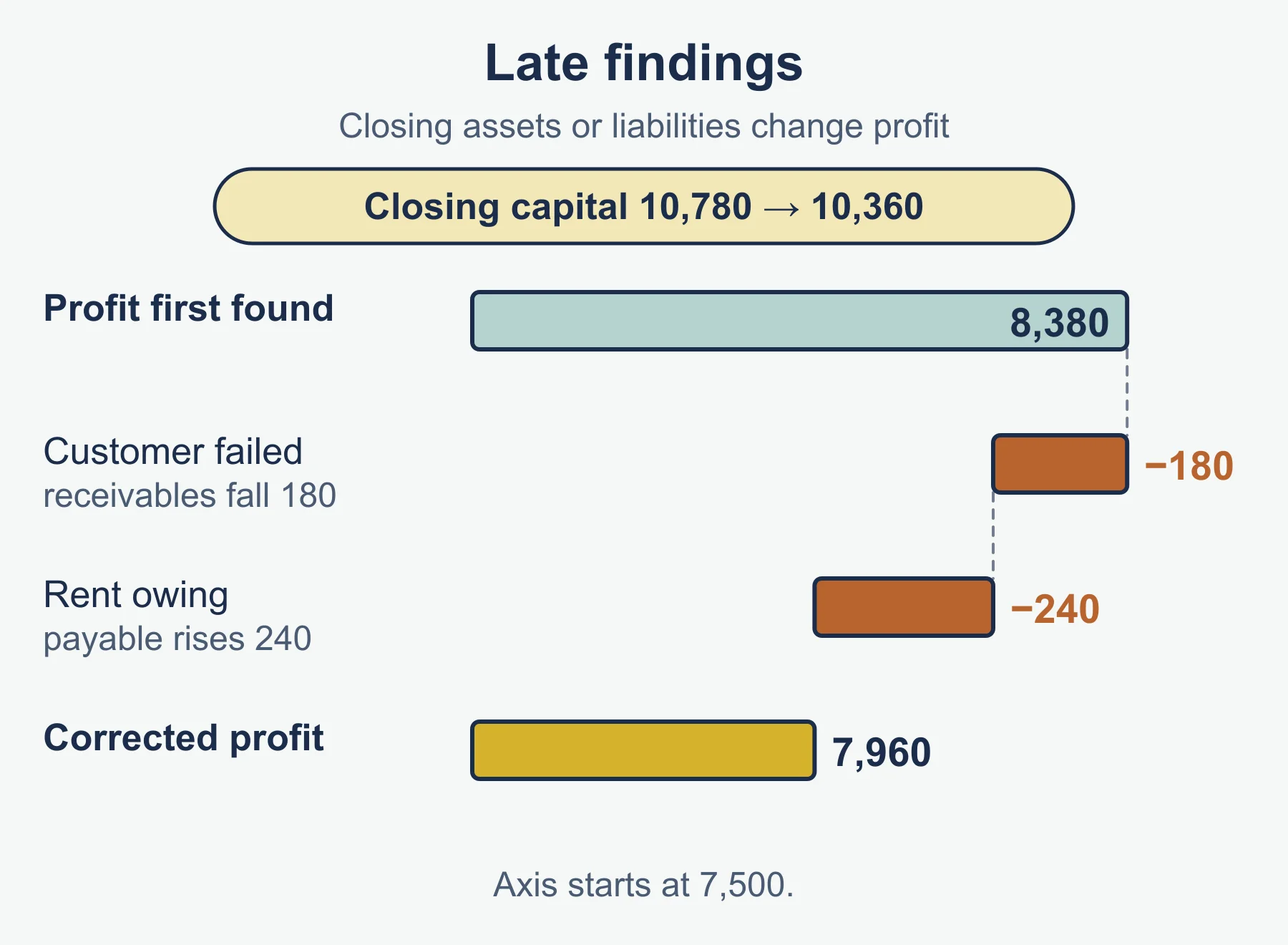
The count may miss items. Suppose the owner then finds that a customer owing 180 has gone out of business and that 240 of rent for the last month is unpaid. The first is an irrecoverable debt, so trade receivables fall by 180. The second is an other payable (an expense owing), so liabilities rise by 240. Closing capital falls by 420 to 10,360. Profit falls by the same amount, to 7,960.
The rule is that any correction to an asset or liability at the closing date changes closing capital, and therefore profit, by the same amount. A correction to the opening position works in reverse. This links to the idea of recording depreciation, provision for doubtful debts, income due and income received in advance in the main financial statements: here you apply them by changing the value of the asset or liability.
What a profit figure from capital cannot show
The method gives one figure, net profit or loss. It does not give sales, cost of sales, gross profit or expenses. It cannot tell the owner which costs are too high. The figure is also only as good as the valuations. If inventory is counted badly or non-current assets are valued casually, profit moves by the same amount.
Rebuilding missing figures
When some records survive, you can often reconstruct sales, purchases and expenses so that an income statement can be prepared. These are supporting techniques, not separate specification headings.
Summary of receipts and payments
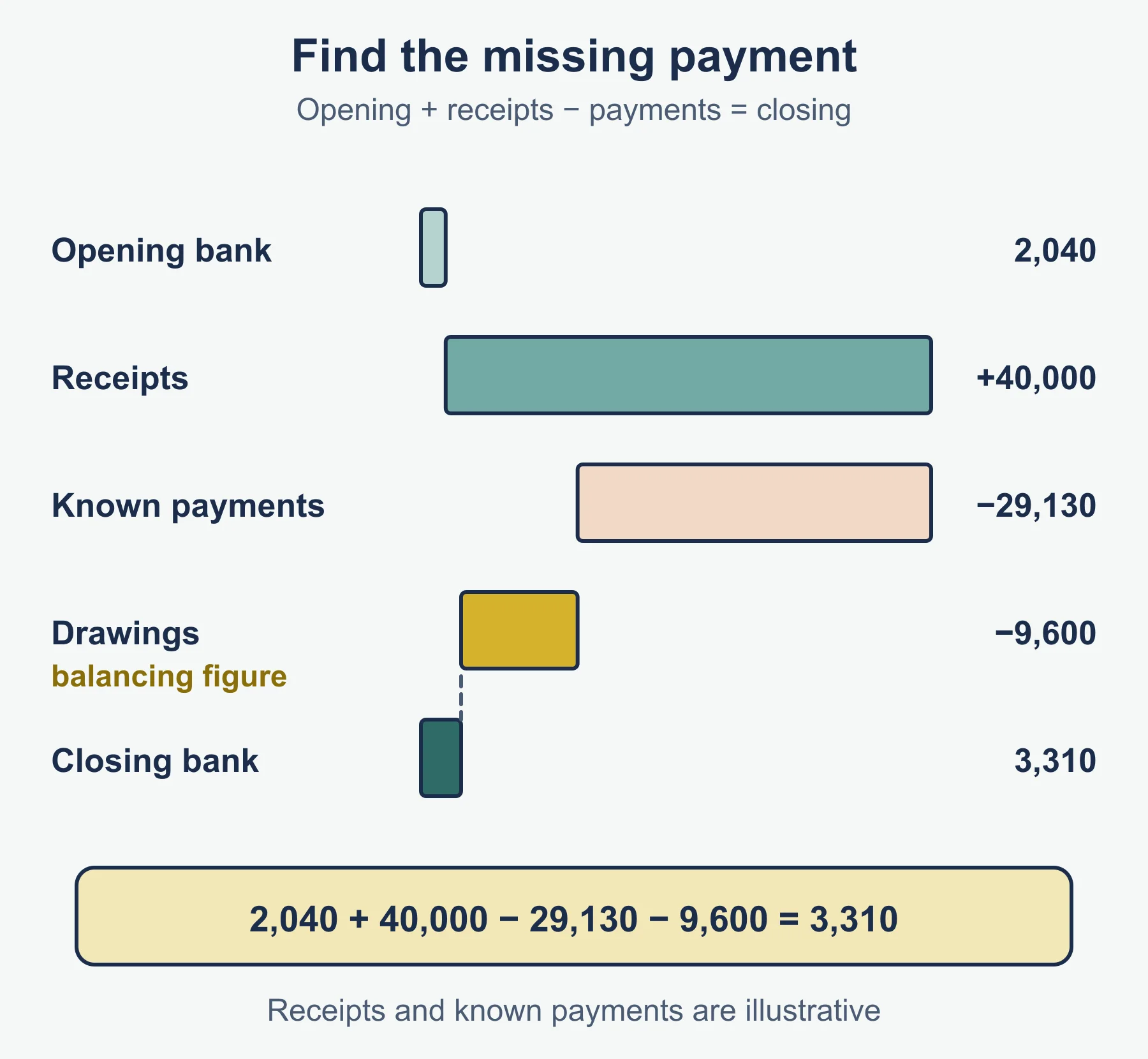
If the owner kept bank statements or a cash book summary, total each type of receipt and payment. A missing figure, such as drawings or an expense, is found as the balancing figure:
Opening balance + receipts − payments = closing balance
Totals accounts for trade receivables and trade payables
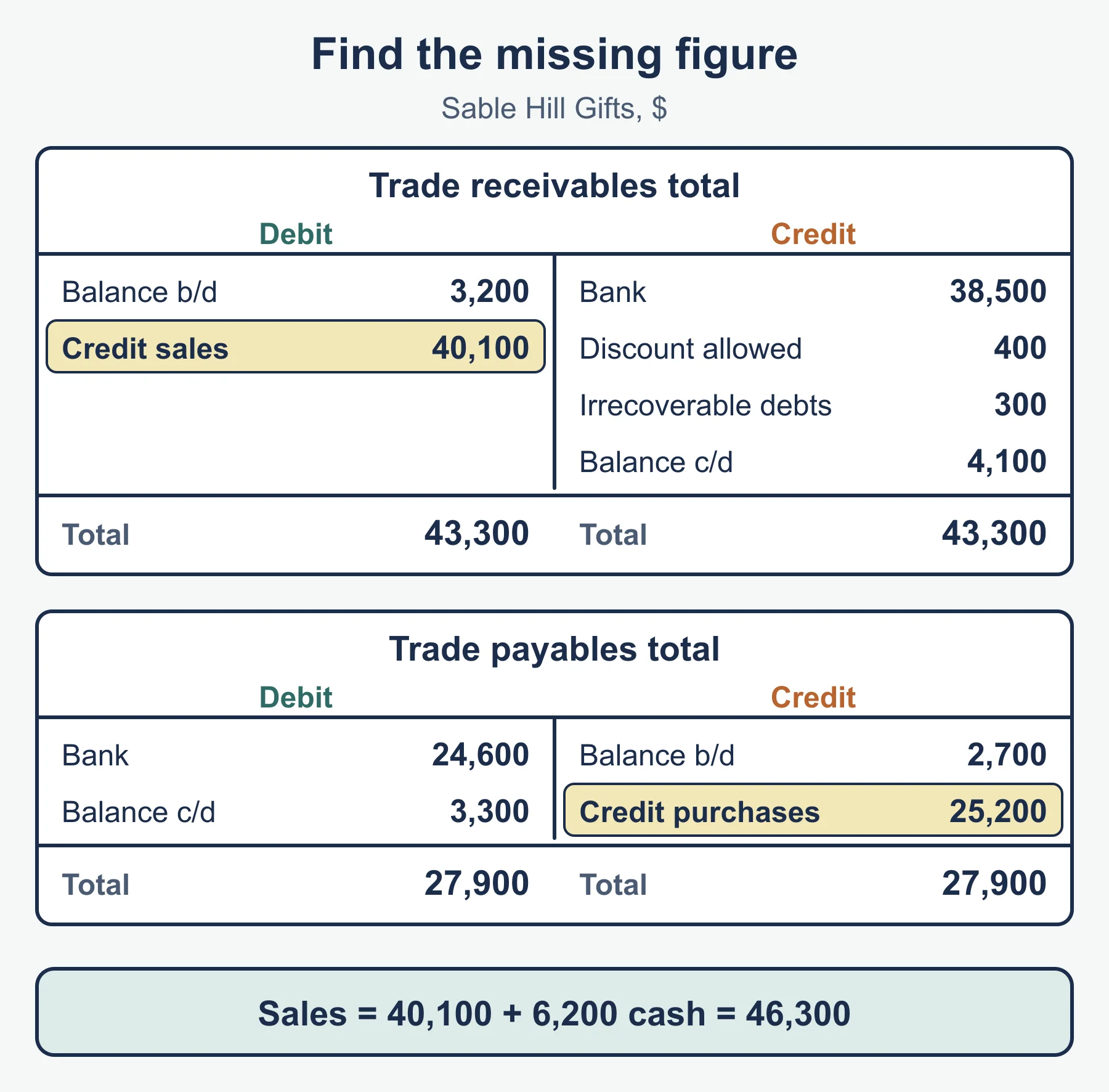
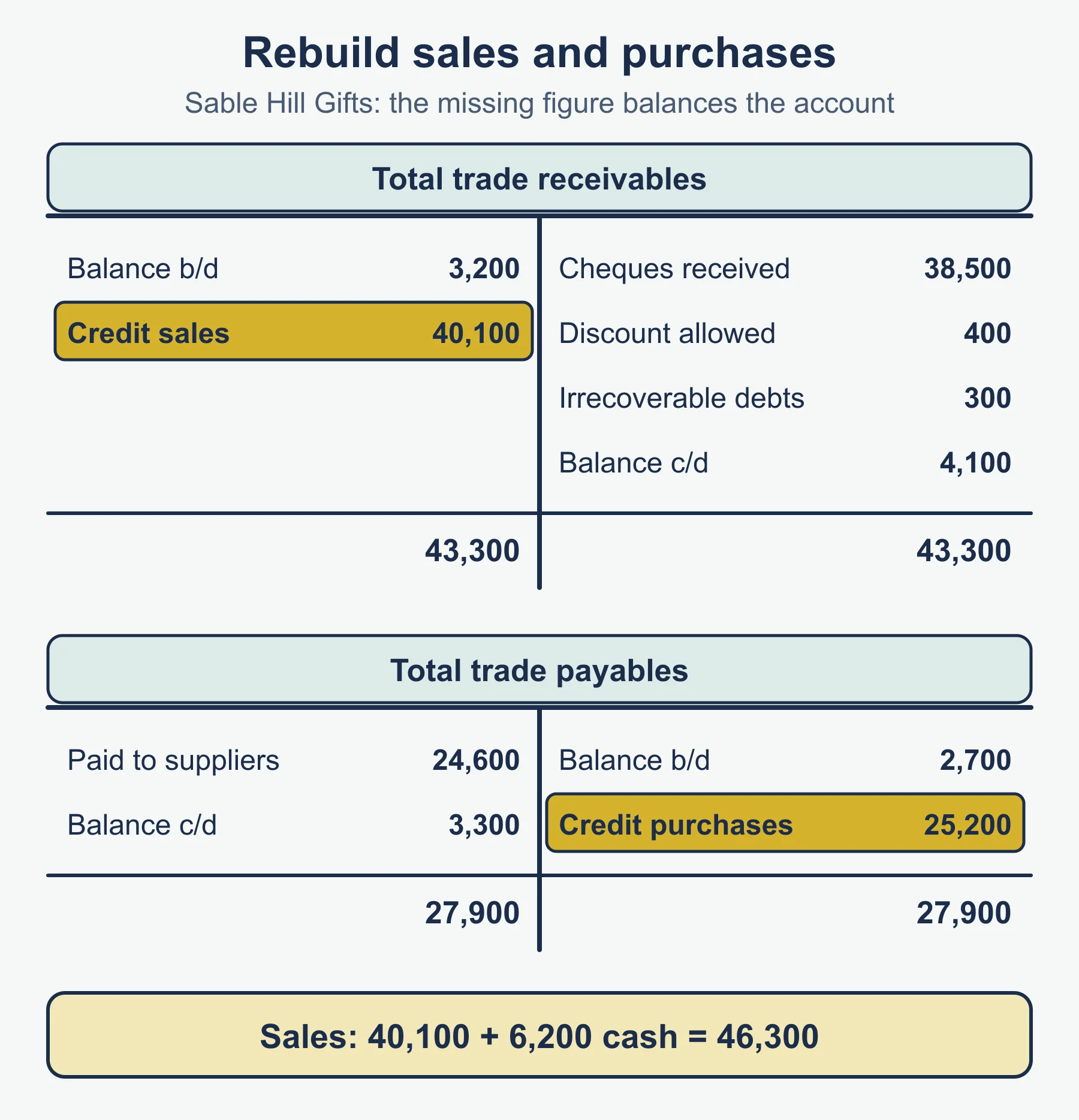
Build a total trade receivables account from the opening balance, the closing balance and the cash received. Credit sales is the missing figure. Do the same for trade payables to find credit purchases.
Trade receivables: opening balance + credit sales = cash received + discount allowed + irrecoverable debts + returns inwards + closing balance.
Trade payables: opening balance + credit purchases = cash paid + discount received + returns outwards + closing balance.
Worked example 3: Sable Hill Gifts
Sable Hill Gifts kept bank statements but no sales or purchases ledgers. Facts for the year:
| Item | Amount |
|---|---|
| Trade receivables, opening | 3,200 |
| Trade receivables, closing | 4,100 |
| Cheques received from customers | 38,500 |
| Discount allowed | 400 |
| Irrecoverable debts written off | 300 |
| Cash sales | 6,200 |
| Trade payables, opening | 2,700 |
| Trade payables, closing | 3,300 |
| Paid to suppliers | 24,600 |
| Inventory, opening | 2,900 |
| Inventory, closing | 3,400 |
| Rent paid | 4,800 |
| Wages paid | 9,100 |
| Depreciation | 600 |
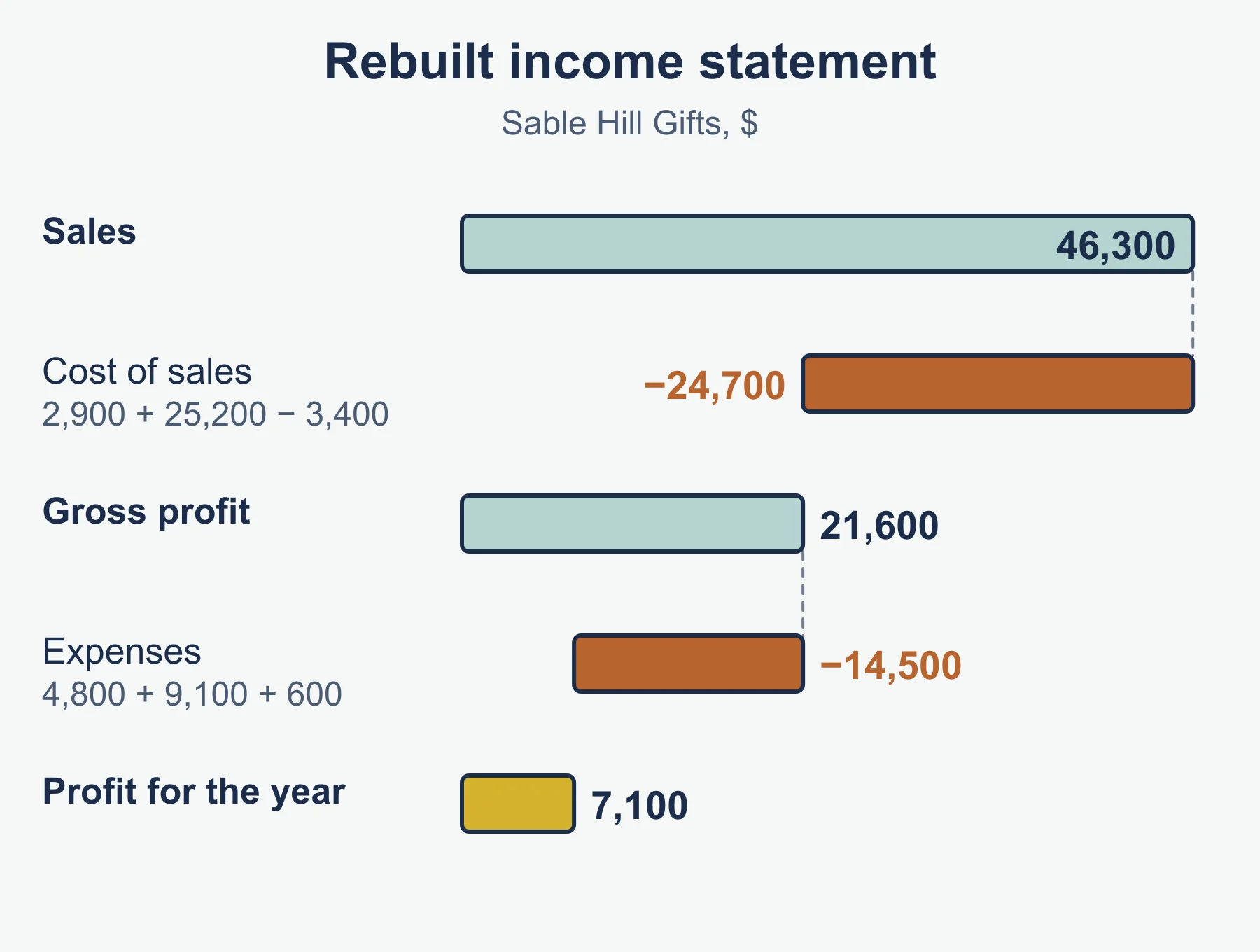
Credit sales = 4,100 + 38,500 + 400 + 300 − 3,200 = 40,100. Sales = 40,100 + 6,200 = 46,300.
Credit purchases = 3,300 + 24,600 − 2,700 = 25,200.
| Income statement extract | Amount |
|---|---|
| Sales | 46,300 |
| Opening inventory | 2,900 |
| Add purchases | 25,200 |
| Less closing inventory | (3,400) |
| Cost of sales | (24,700) |
| Gross profit | 21,600 |
| Less expenses: rent 4,800, wages 9,100, depreciation 600 | (14,500) |
| Profit for the year | 7,100 |
If rent or wages were also owing or prepaid, adjust them first. The total rent paid is not automatically the rent expense.
Single entry and double entry compared
In double entry every transaction has a debit and a credit, so the books balance and a trial balance can be extracted. Single entry records one side, usually cash and bank movements.
| Single entry | Double entry | |
|---|---|---|
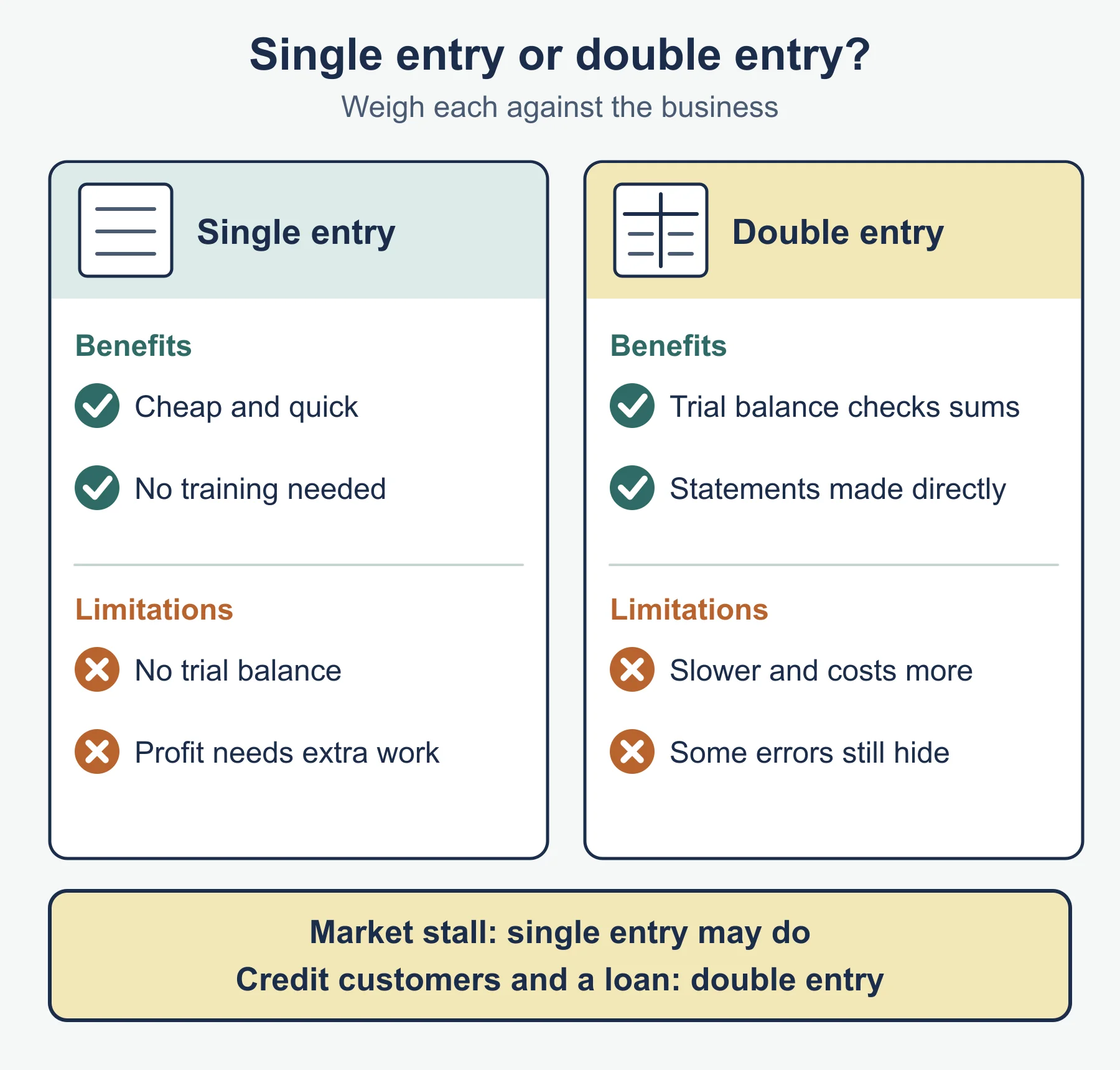
| Benefits | Cheap and quick to keep; no training needed; suits very small, simple businesses | Full ledger accounts; trial balance checks arithmetic; income statement and statement of financial position can be prepared directly |
| Limitations | No trial balance, so errors are hard to find; profit needs extra work; gaps in the records make figures hard to prove to a tax authority or lender | Takes longer, costs more and needs bookkeeping knowledge; errors such as omission or compensating errors can still hide |
Weigh them against the business. A market stall with a few customers might manage on single entry. A trader with credit customers, a bank loan and several staff needs the control double entry gives. A lender or buyer is more likely to trust statements built from double entry records.
Note that double entry does not guarantee accuracy. A trial balance only proves that debits equal credits.
Common errors
- Starting the profit calculation from closing capital but forgetting to subtract opening capital.
- Treating drawings as an expense, or treating capital introduced as income.
- Using the owner’s drawings from the cash book while ignoring goods taken for own use.
- Putting trade payables as an asset in a statement of affairs.
- Leaving out accrued expenses or irrecoverable debts found after the count.
- Finding credit sales without using the opening receivables balance.
- Giving only one-word comments on systems, such as “cheaper”, without saying why it matters to this business.
Next steps
Test yourself on the practice questions, then use the revision notes for quick recall. Take a free diagnostic to find weak areas.
Frequently asked questions
What is a statement of affairs? A statement of affairs lists the assets and liabilities of a business at one date, and the balancing figure is its capital. It is used when the business has not kept full double entry records.
Why are drawings added back when calculating profit from capital? Drawings reduced capital during the year but are not an expense, so they are added back to the increase in capital. Capital introduced raised capital without being a profit, so it is deducted.
What can profit from capital not show? The method gives one figure, net profit or loss. It does not give sales, cost of sales, gross profit or individual expenses, which an income statement would show.
How do you find credit sales from a totals account? Use opening trade receivables + credit sales = cash received + discount allowed + irrecoverable debts + returns + closing trade receivables, and solve for credit sales. Add cash sales to find total sales.
Does double entry guarantee accurate records? No. A trial balance only proves that debits equal credits, so some errors can remain. Double entry does, however, give more control and information than single entry for a business with many credit customers.
Official syllabus
OxfordAQA International GCSE Accounting (9215), specification version 1.2, for International GCSE exams May/June 2026 onwards (OxfordAQA). Section 3.4, Preparation of financial statements: accounting for organisations with incomplete records.
Get free revision emails (optional)
Occasional emails with practice questions, worked explanations and links to free resources for the qualification and subjects you choose. No spam, and you can unsubscribe from any email. The free tools on this site never need an email.
Related resources
-
Practice questions
OxfordAQA IGCSE Accounting: Incomplete records and single entry (9215) – Practice Questions
Original questions with worked answers on statements of affairs, profit from capital, totals accounts and single entry for OxfordAQA IGCSE Accounting 9215.
Accounting · OxfordAQA · IGCSE
Try questions -
Revision notes
OxfordAQA IGCSE Accounting: Incomplete records and single entry (9215) – Revision Notes
Condensed revision notes on statements of affairs, profit from capital, totals accounts and single versus double entry for OxfordAQA IGCSE Accounting 9215.
Accounting · OxfordAQA · IGCSE
Revise topic -
Study guides
OxfordAQA IGCSE Accounting: Internal financial statements of limited companies (9215)
Prepare and comment on a limited company's internal income statement and statement of financial position for OxfordAQA International GCSE Accounting.
Accounting · OxfordAQA · IGCSE
Read guide
Related articles
-
teaching
A Level tuition in Dubai: Cambridge or Pearson Edexcel International A Level?
Schools in Dubai and Abu Dhabi teach either Cambridge International AS & A Level or Pearson Edexcel International A Level. How the two are structured, why it matters for tuition, and how online classes from Lahore work.
9 October 2026
-
curriculum guides
Choosing subjects at IGCSE and A Level
How subject choices at 14 and 16 affect university options later, and how to keep pathways open without overloading a timetable.
28 July 2026
Studying this with a teacher
Working through Accounting IGCSE?
This page is free and stays free. If you would rather be taught it, Marlbridge runs Accounting classes one-to-one and in small groups of up to 15, online in your own time zone. The first trial class is free. WhatsApp replies within an hour (8am–11pm Pakistan time, every day); email the same day.
OxfordAQA Accounting teachers at Marlbridge

