
Study Guides
OxfordAQA IGCSE Accounting: Correcting errors and the effect of errors on profit (9215)
Journal entries, the suspense account and corrected profit for every error type in OxfordAQA International GCSE Accounting 9215, with full worked examples.
- Subject
- Accounting
- Level
- IGCSE
- Topic
- Verification of accounting records
- Author
- Marlbridge Academic Team
- Updated
- Reviewed by
- Javaid Iqbal Sabri (what this means)
Aligned to OxfordAQA IGCSE Accounting (9215), First teaching 2024, first examined 2026. Official specification .
Syllabus page (what it covers and how it is assessed): OxfordAQA IGCSE Accounting.
Syllabus points this page covers
9215
- How to correct errors in double entry records
Found an error? Report a correction.
Need help with this topic? Request a free trial class for IGCSE Accounting (9215).
This guide is aligned to the OxfordAQA International GCSE Accounting (9215) specification, version 1.2, for exams from May/June 2026 onwards. It covers the last two content points of specification section 3.2 (topic 2, Verification of accounting records): how to correct errors in double entry records, and the effect of errors on profit calculations. The specification says correcting errors includes the use of the general journal and the suspense account, and that the effect of errors includes adjusting profit or loss for a period after correction. All amounts on this page are in dollars.
Trial balances, control accounts and bank reconciliation statements are covered in the wider verification study guide. This page goes deeper on correction. Pair it with the revision notes and the practice questions. The older revision notes and practice set on the whole topic are also available. Check your progress on the course hub, the checklist and the free diagnostics.
What you must be able to do
| Specification point | What it means in practice |
|---|---|
| How to correct errors in double entry records | Identify the error, write the correcting entry in the general journal, and use the suspense account where a trial balance disagreed |
| The effect of errors on profit calculations | Show how each correction changes profit or loss, and produce a corrected profit figure |
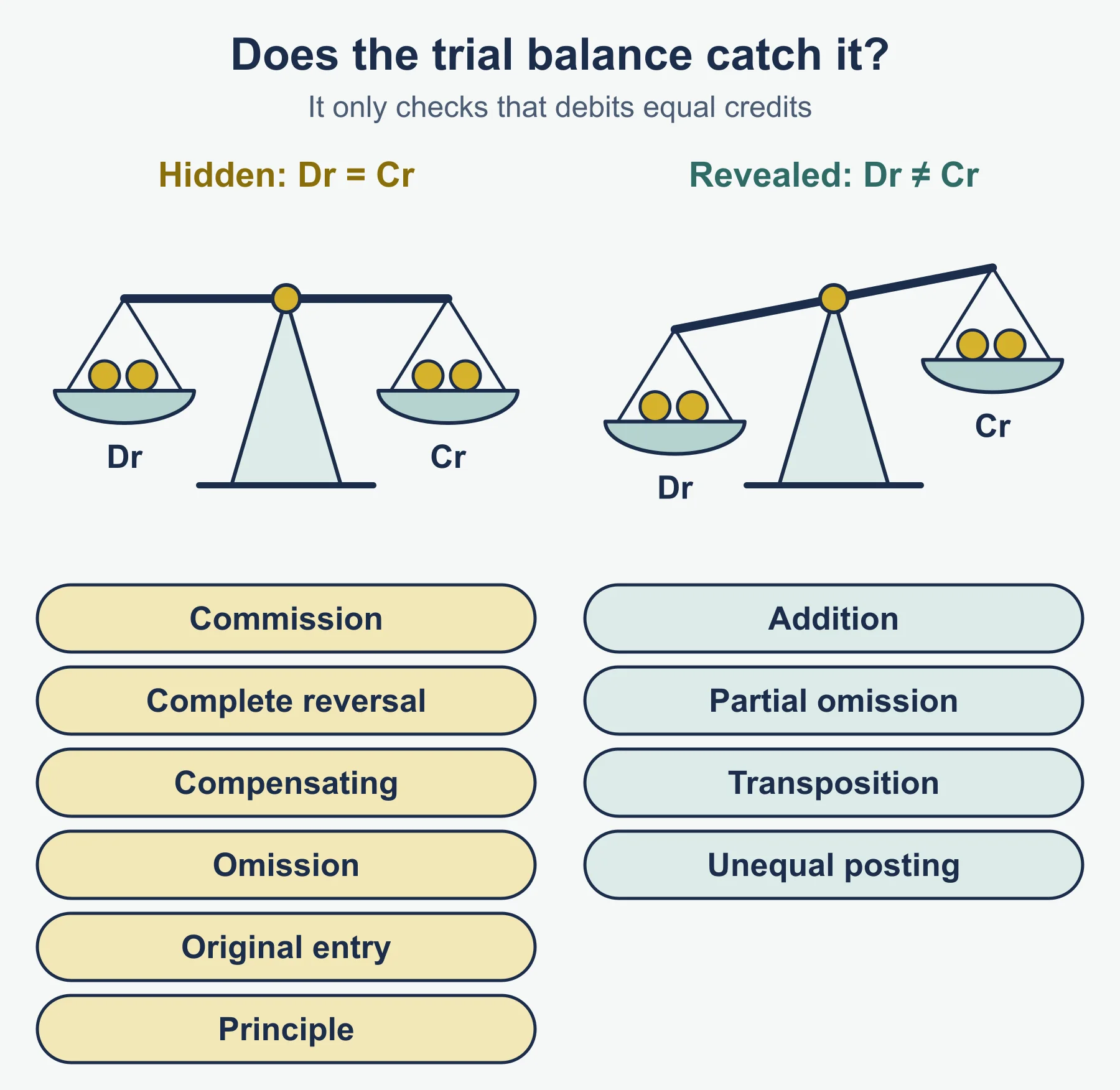
The error names used by the specification are in two groups. Errors not revealed by a trial balance are commission, complete reversal, compensating, omission, original entry and principle (six in all). Errors revealed by a trial balance: addition, partial omission, transposition and unequal posting.
The general journal
The general journal is the book of original entry for transactions that do not belong in any other book, and it is where corrections are recorded. Every journal entry has the same layout: the date, the account to debit, the account to credit, the amounts, and a short narrative.
| Date | Account | Debit | Credit |
|---|---|---|---|
| 14 Mar | Account to be debited | 500 | |
| Account to be credited | 500 | ||
| Narrative: being correction of … |
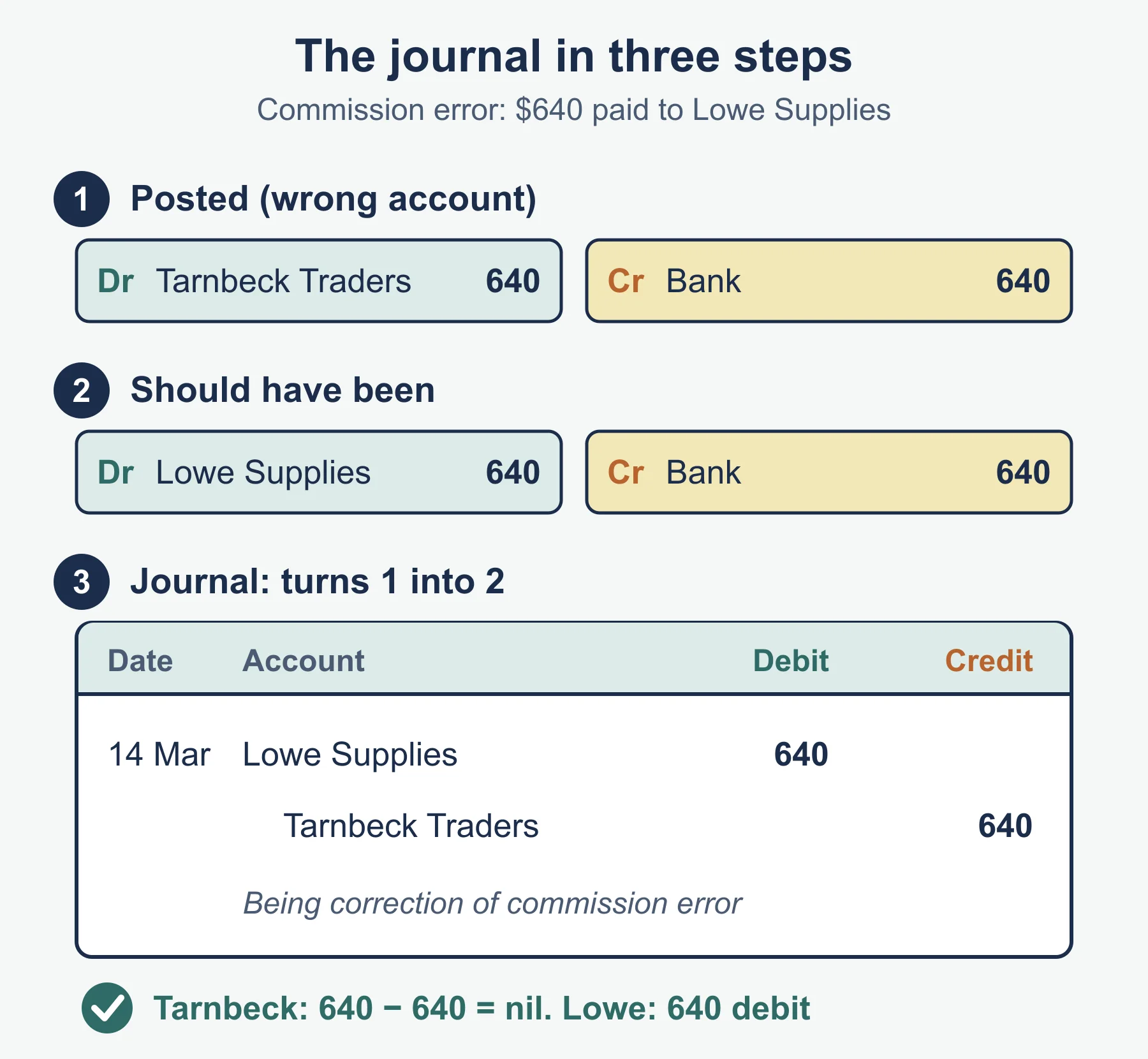
Work in three steps. First, write what was actually posted. Second, write what should have been posted. Third, the journal is whatever turns the first into the second. Most mistakes come from skipping the first step.
Errors the trial balance does not reveal
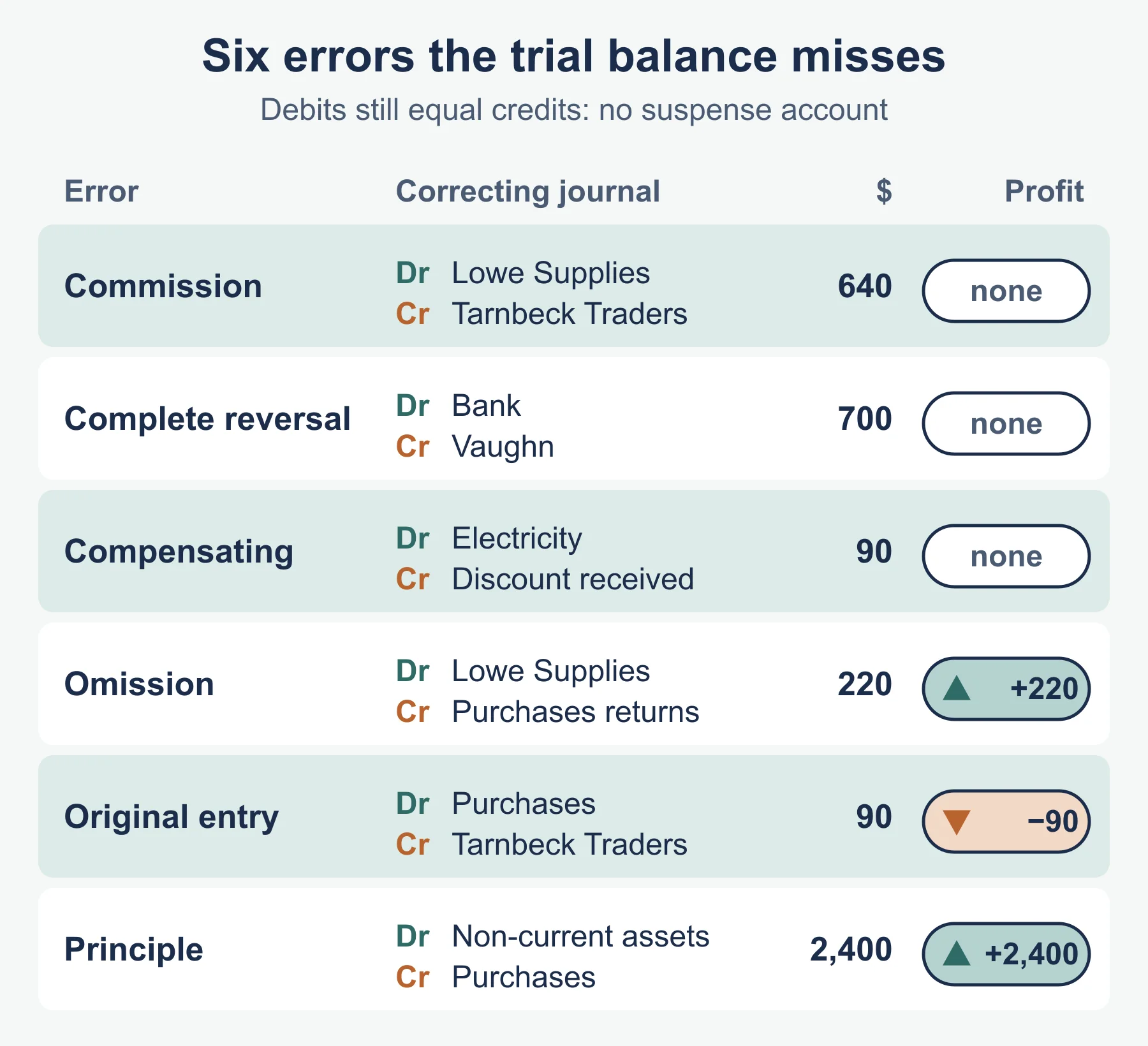
In each of these, total debits still equal total credits, so no suspense account is used. The journal alone corrects the books.
| Error | Example | Correcting journal | Effect on profit |
|---|---|---|---|
| Commission: right class of account, wrong account | A payment of 640 to Lowe Supplies was debited to the account of Tarnbeck Traders | Debit Lowe Supplies 640; credit Tarnbeck Traders 640 | None |
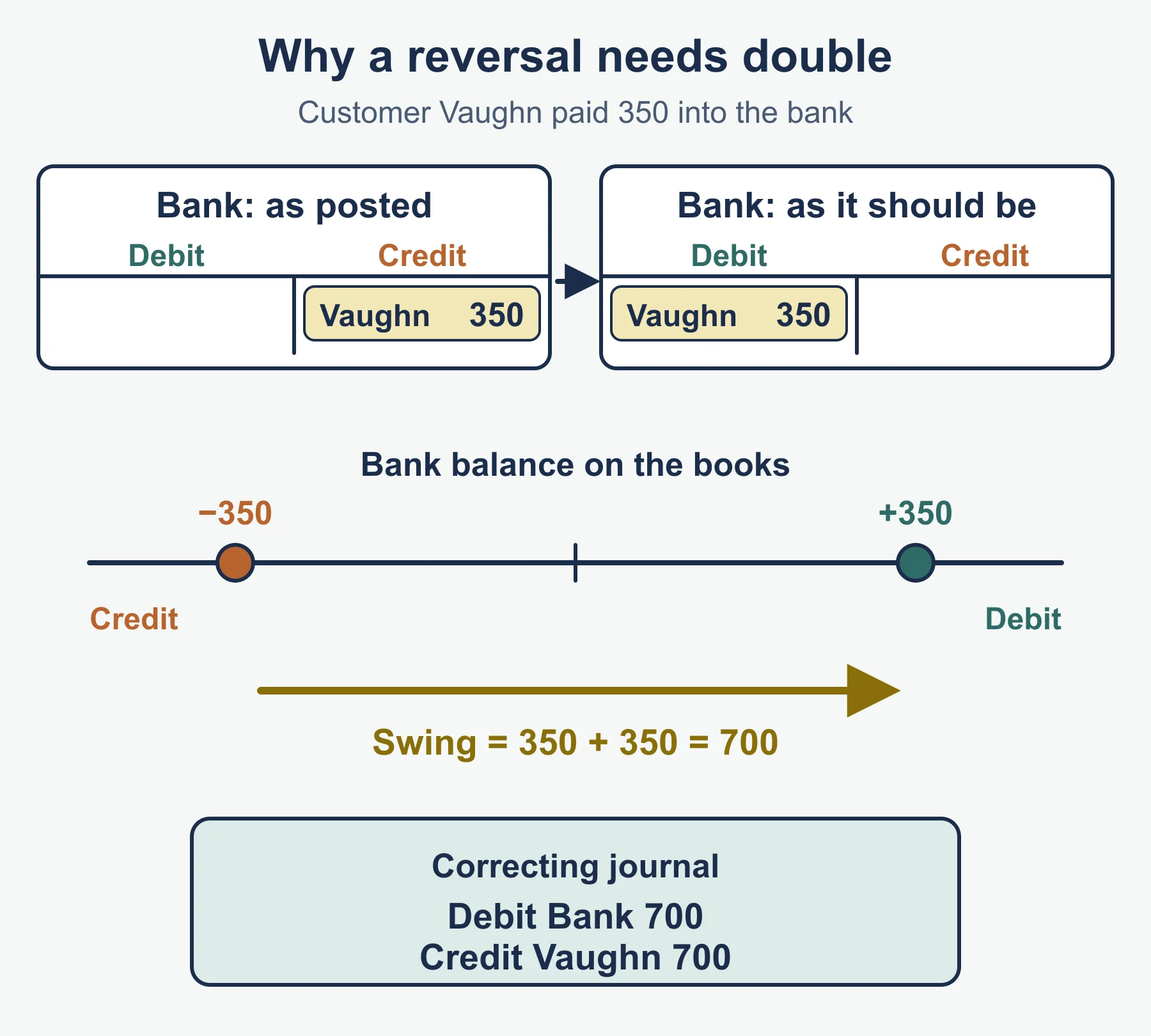
| Complete reversal: right accounts, wrong sides | Cash received from customer Vaughn, 350, was debited to Vaughn and credited to bank | Debit bank 700; credit Vaughn 700 | None |
| Compensating: two errors that cancel in the totals | The electricity account (a debit) and the discount received account (a credit) were both undercast by 90 | Debit electricity 90; credit discount received 90 | None overall: the two effects are equal and opposite |
| Omission: transaction missing entirely | Goods returned to Lowe Supplies, 220, were never recorded | Debit Lowe Supplies 220; credit purchases returns 220 | Profit rises by 220 |
| Original entry: wrong amount on both sides | A credit purchase of 1,870 was recorded as 1,780 in purchases and in the supplier account | Debit purchases 90; credit Tarnbeck Traders 90 | Profit falls by 90 |
| Principle: wrong class of account | Shelving costing 2,400 was paid by bank and debited to purchases | Debit non-current assets (shelving) 2,400; credit purchases 2,400 | Profit rises by 2,400 |
A complete reversal needs double the original figure because the first entry must be cancelled and then the right entry made. Check this by drawing the bank account: it should end up with a debit of 350, but currently has a credit of 350, so the swing is 700.
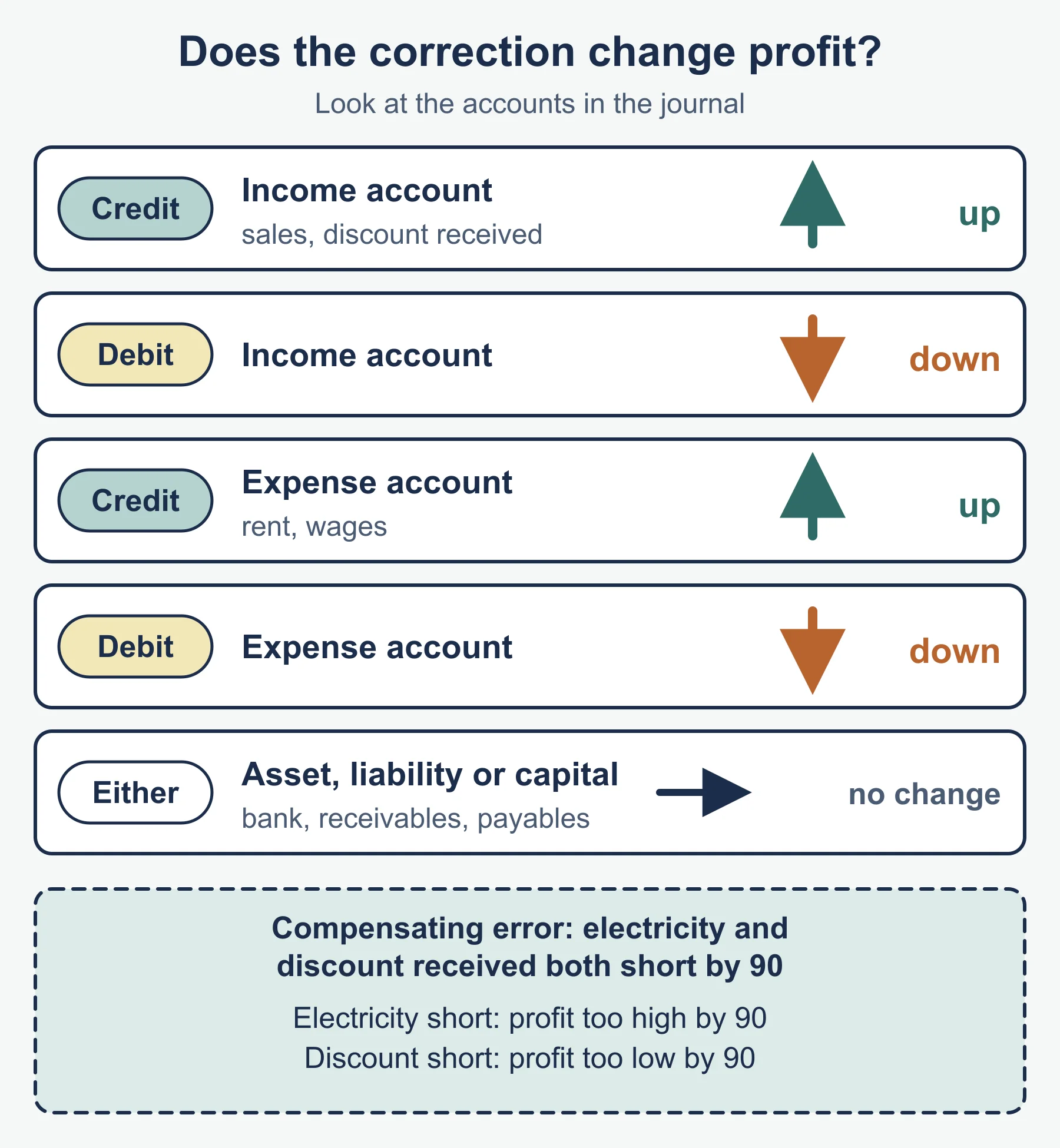
For the compensating error, the profit effect needs care. Electricity is an expense, so undercasting it overstated profit by 90. Discount received is income, so undercasting it understated profit by 90. The mistakes cancel, but each individual account was wrong.
Errors the trial balance does reveal, and the suspense account
These errors break the equality of debits and credits.
| Error | What goes wrong |
|---|---|
| Addition | A ledger account is added up wrongly |
| Partial omission | One side of an entry is posted, the other is not |
| Transposition | Digits are swapped when posting (5,430 for 5,340) |
| Unequal posting | The debit and the credit are posted at different amounts |
Transposition is revealed only when the swap happens on one side of the entry. If both sides were posted as 5,430, the trial balance agrees and the mistake is an error of original entry.
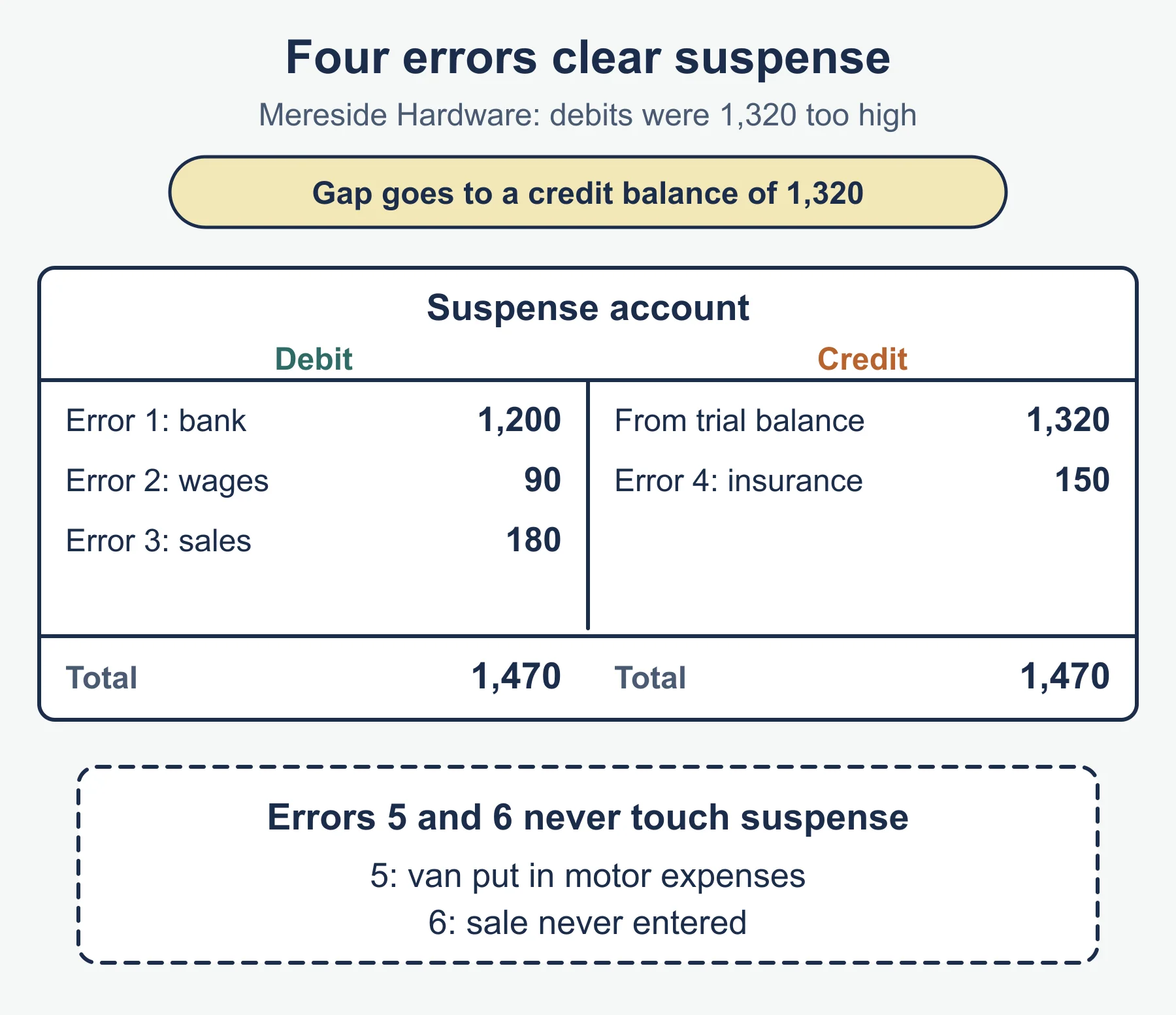
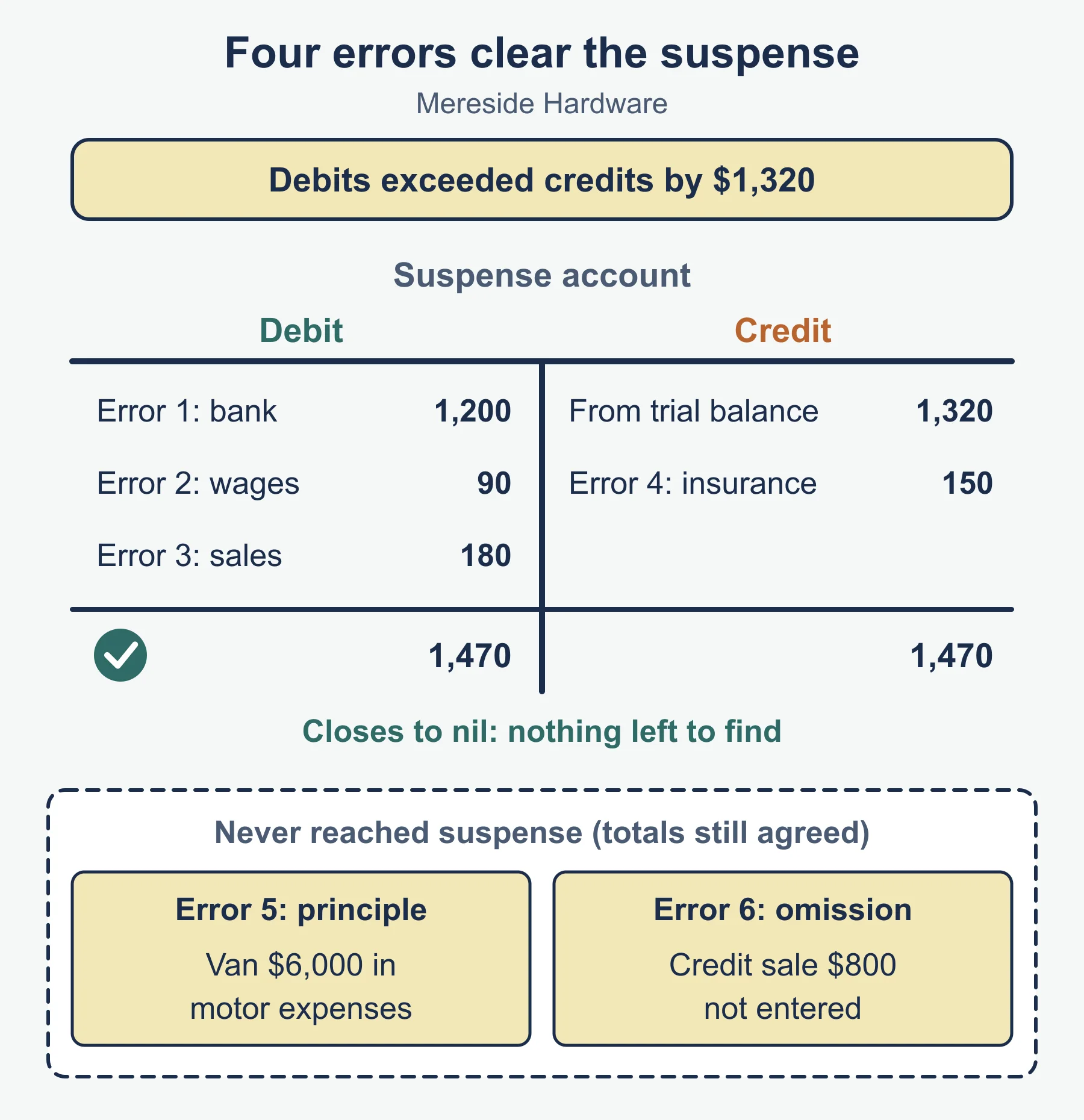
If the two totals of a trial balance differ, the gap is parked in a suspense account, which lets the trial balance be finished while the causes are hunted down. If credits exceed debits, the suspense account is a debit balance. If debits exceed credits, it is a credit balance. Each error found is then corrected by a journal that passes through the suspense account. When all errors are found, the suspense account closes to nil. A balance left over means at least one error is still unfound.
Worked example: Mereside Hardware
The trial balance of Mereside Hardware did not agree. Debits exceeded credits, so a credit balance of 1,320 was opened in a suspense account. The profit for the year as first calculated was 41,600. Six errors were then found.
- Rent of 1,200 was debited to the rent account but the credit to bank was never posted.
- Wages of 5,340 paid by bank were debited to the wages account as 5,430.
- A cash sale of 2,750 was debited to bank correctly, but credited to sales as 2,570.
- The insurance account was undercast by 150 on the debit side.
- A delivery van costing 6,000, paid by bank, was debited to motor expenses.
- A credit sale invoice for 800 to a customer was never entered.
Step 1: classify and journalise.
| Error | Type | Debit | Credit | Amount |
|---|---|---|---|---|
| 1 | Partial omission | Suspense | Bank | 1,200 |
| 2 | Transposition | Suspense | Wages | 90 |
| 3 | Unequal posting | Suspense | Sales | 180 |
| 4 | Addition | Insurance | Suspense | 150 |
| 5 | Principle | Motor vehicles (non-current asset) | Motor expenses | 6,000 |
| 6 | Omission | Trade receivables | Sales | 800 |
Step 2: suspense account. Errors 5 and 6 are not revealed by the trial balance, so they do not touch it.
| Suspense account | Debit | Credit |
|---|---|---|
| Balance from the trial balance | 1,320 | |
| Error 1: bank | 1,200 | |
| Error 2: wages | 90 | |
| Error 3: sales | 180 | |
| Error 4: insurance | 150 | |
| Totals | 1,470 | 1,470 |
The account closes to nil, which confirms that the four errors explain the whole difference.
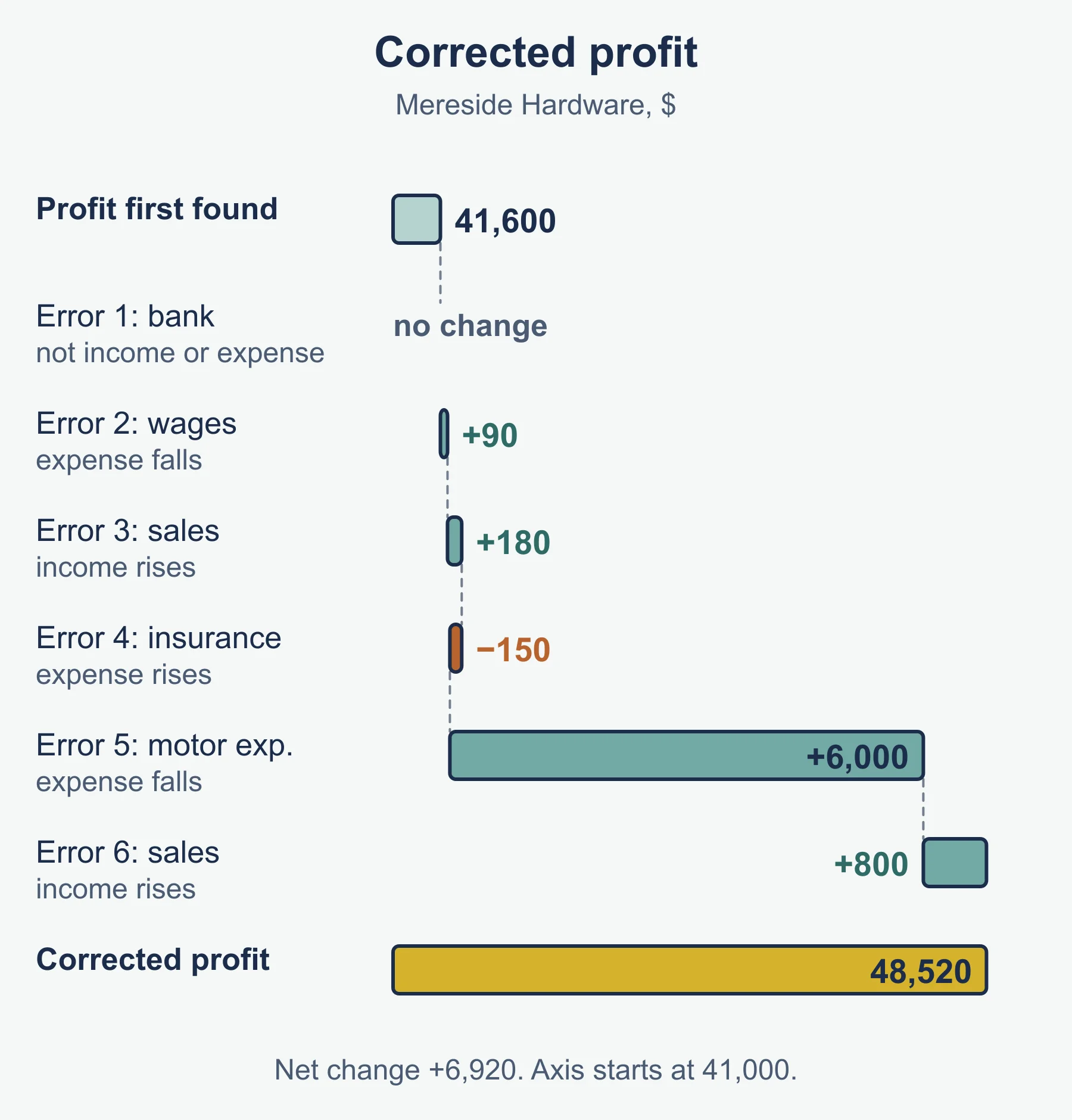
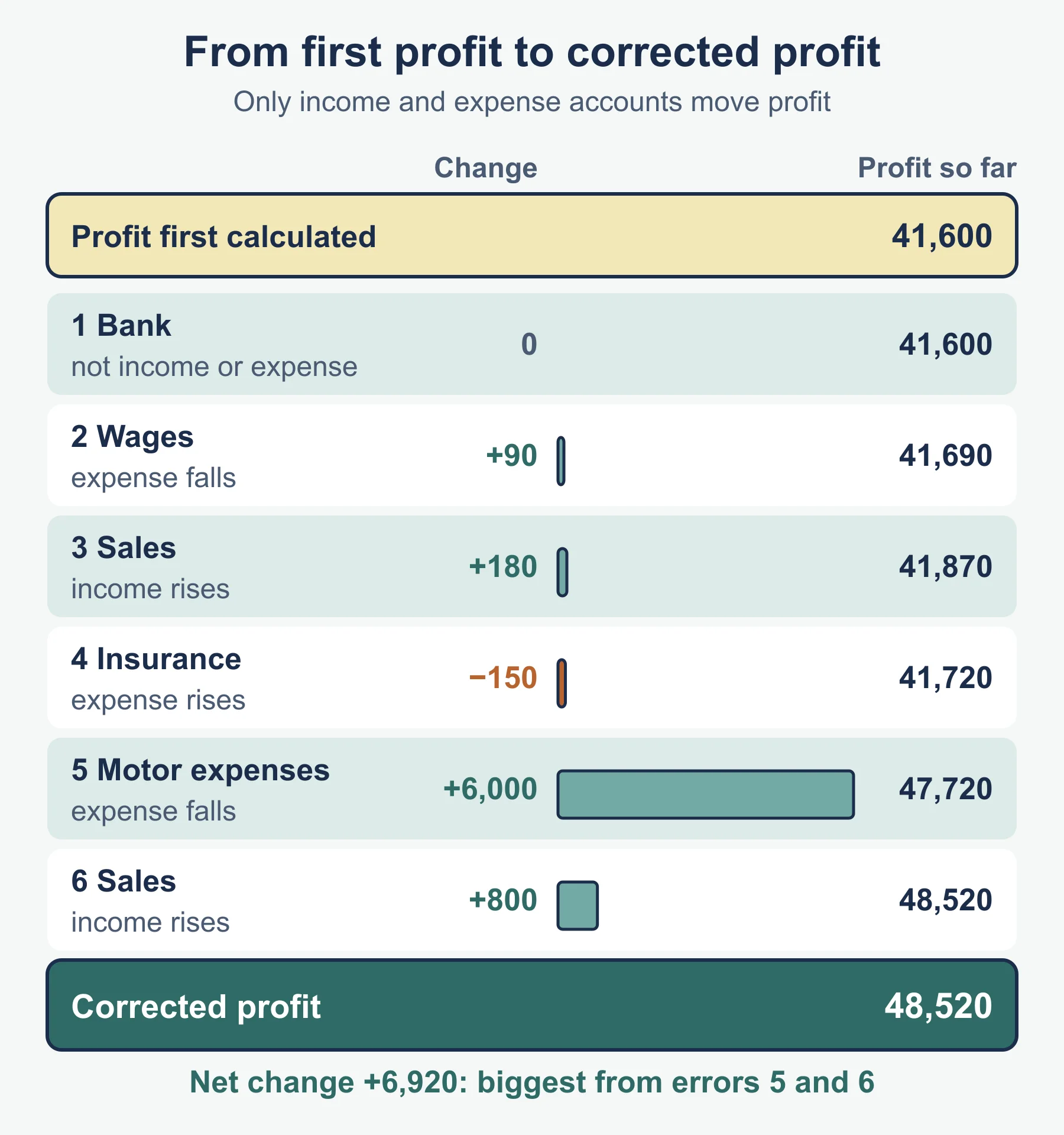
Step 3: corrected profit. Ask of each correction whether it touches an income or expense account, and whether it raises or lowers profit.
| Item | Effect | Profit |
|---|---|---|
| Profit as first calculated | 41,600 | |
| Error 1 | Bank is not an income or expense account | no change |
| Error 2: wages credited by 90 | expense falls | +90 |
| Error 3: sales credited by 180 | income rises | +180 |
| Error 4: insurance debited by 150 | expense rises | -150 |
| Error 5: motor expenses credited by 6,000 | expense falls | +6,000 |
| Error 6: sales credited by 800 | income rises | +800 |
| Corrected profit | 48,520 |
The net adjustment is an increase of 6,920. The two largest effects come from errors the trial balance never showed.
The effect of errors on profit
The test is simple. Profit is income less expenses, so a correction changes profit only if one of the two accounts in the journal is an income or an expense account.
| The correcting journal does this | Profit |
|---|---|
| Credits an income account, such as sales or discount received | Increases |
| Debits an income account | Decreases |
| Credits an expense account | Increases |
| Debits an expense account | Decreases |
| Moves value between asset, liability or capital accounts only | No change |
A mistake in sales or purchases moves gross profit and net profit by an equal sum. An error in an expense account changes only profit for the year. A statement of corrected profit starts with the original figure, adds the corrections that raise profit, deducts those that lower it, and ends with the corrected figure. Show each item on its own line with a plus or minus.
If the question gives a loss, treat a loss as a negative profit: a correction that raises profit by 500 turns a loss of 300 into a profit of 200.
Common errors in answers
- Using the suspense account for an error that the trial balance did not reveal. If debits equalled credits, the journal goes straight between the two real accounts.
- Debiting and crediting the wrong way round in a complete reversal, or forgetting to double the figure.
- Reversing the effect on profit: an expense that was too high means profit was too low, so the correction adds to profit.
- Treating every correction as a profit adjustment. Bank, receivables, payables, non-current assets and capital do not change profit.
- Leaving out the narrative, or the name of the error type when the question asks for it.
Frequently asked questions
What is the general journal used for in correcting errors? The general journal is the book of original entry for transactions that do not belong in any other book, including the correction of errors. Write what was posted, then what should have been posted, and the journal entry is the difference.
Why does a complete reversal need double the original figure? The first entry must be cancelled and the correct entry made, so each account is corrected by twice the amount that was posted on the wrong side.
When is a transposition error revealed by the trial balance? Only when the swapped digits appear on one side of the entry. If both sides were posted with the same swapped figure, the trial balance agrees and the error is an error of original entry.
Which corrections change profit? A correction changes profit only if one of the accounts involved is an income or expense account. Corrections between bank, receivables, payables, non-current assets and capital do not change profit.
How do you correct a loss figure for errors? Treat a loss as a negative profit: a correction that raises profit reduces the loss by the same amount.
Official syllabus
OxfordAQA International GCSE Accounting (9215) specification, version 1.2, for International GCSE exams May/June 2026 onwards, published by OxfordAQA. See section 3.2, Verification of accounting records.
Get free revision emails (optional)
Occasional emails with practice questions, worked explanations and links to free resources for the qualification and subjects you choose. No spam, and you can unsubscribe from any email. The free tools on this site never need an email.
Related resources
-
Practice questions
OxfordAQA IGCSE Accounting: Correcting errors and the effect of errors on profit (9215) – Practice Questions
Twelve original questions with worked answers on journal corrections, the suspense account and corrected profit for OxfordAQA Accounting 9215.
Accounting · OxfordAQA · IGCSE
Try questions -
Revision notes
OxfordAQA IGCSE Accounting: Correcting errors and the effect of errors on profit (9215) – Revision Notes
Condensed recall notes, method steps and a ten-question self-test on journal corrections, the suspense account and corrected profit for OxfordAQA 9215.
Accounting · OxfordAQA · IGCSE
Revise topic -
Study guides
OxfordAQA IGCSE Accounting: Trade payables and trade receivables control accounts (9215)
Study guide to preparing, understanding and interpreting trade receivables and trade payables ledger control accounts for OxfordAQA IGCSE Accounting.
Accounting · OxfordAQA · IGCSE
Read guide
Related articles
-
teaching
A Level tuition in Dubai: Cambridge or Pearson Edexcel International A Level?
Schools in Dubai and Abu Dhabi teach either Cambridge International AS & A Level or Pearson Edexcel International A Level. How the two are structured, why it matters for tuition, and how online classes from Lahore work.
9 October 2026
-
curriculum guides
Choosing subjects at IGCSE and A Level
How subject choices at 14 and 16 affect university options later, and how to keep pathways open without overloading a timetable.
28 July 2026
Studying this with a teacher
Working through Accounting IGCSE?
This page is free and stays free. If you would rather be taught it, Marlbridge runs Accounting classes one-to-one and in small groups of up to 15, online in your own time zone. The first trial class is free. WhatsApp replies within an hour (8am–11pm Pakistan time, every day); email the same day.
OxfordAQA Accounting teachers at Marlbridge

