
Study Guides
OxfordAQA IGCSE Accounting: Trade payables and trade receivables control accounts (9215)
Study guide to preparing, understanding and interpreting trade receivables and trade payables ledger control accounts for OxfordAQA IGCSE Accounting.
- Subject
- Accounting
- Level
- IGCSE
- Topic
- Verification of accounting records
- Author
- Marlbridge Academic Team
- Updated
- Reviewed by
- Javaid Iqbal Sabri (what this means)
Aligned to OxfordAQA IGCSE Accounting (9215), First teaching 2024, first examined 2026. Official specification .
Syllabus page (what it covers and how it is assessed): OxfordAQA IGCSE Accounting.
Syllabus points this page covers
9215
- Prepare, understand and interpret trade payables and trade receivables ledger control accounts
Found an error? Report a correction.
Need help with this topic? Request a free trial class for IGCSE Accounting (9215).
This guide covers the control accounts content of section 3.2 (Topic 2, Verification of accounting records) in the OxfordAQA International GCSE Accounting (9215) specification, version 1.2, for exams from May/June 2026. It teaches you to prepare, understand and interpret trade receivables and trade payables ledger control accounts. All amounts below are in dollars.
For the other verification techniques, use the Topic 2 study guide. For quick recall, use the control accounts revision notes, then test yourself with the control accounts practice questions. The course hub is OxfordAQA IGCSE Accounting and the printable list of points is the accounting checklist. If you are not sure where you stand, take a free diagnostic first.
What the specification asks for
| Specification point | What you must be able to do | Where it is taught |
|---|---|---|
| Prepare trade receivables and trade payables ledger control accounts | Build each account from totals taken from the books of prime entry | Sections 2 to 4 |
| Control accounts are memorandum records | Explain that they are not part of the double entry | Section 1 |
| Contra entries | Show them in both control accounts | Section 5 |
| Interest charged on overdue accounts | Place the entry on the correct side in each account | Sections 3 and 4 |
| Debit balances in the payables ledger | Show opening and closing debit balances | Section 4 |
| Credit balances in the receivables ledger | Show opening and closing credit balances | Section 3 |
| Transactions stated or implied elsewhere | Include sales, purchases, returns, discounts, receipts, payments, irrecoverable debts and dishonoured cheques | Sections 2 to 4 |
| Understand and interpret | Compare with the list of balances and explain differences | Section 6 |
The topic 1 content on source documents and books of prime entry supplies most of the totals. If you are unsure where a total comes from, revisit the sources and recording of data guide.
1. What a control account is
The receivables ledger holds one account for each credit customer. The payables ledger holds one account for each credit supplier. A trade receivables ledger control account is a single summary account that shows what all those customers owe in total. A trade payables ledger control account does the same for suppliers.
Because the specification calls them memorandum records, you should explain two points. First, they sit outside the double-entry system: the individual customer and supplier accounts are still the accounts that hold the real entries. Second, their job is checking. The closing balance of the control account is compared with the total of the individual balances. If the two agree, that is evidence the ledger is arithmetically sound. If they do not, something needs investigating.
Only credit transactions with trade customers and suppliers appear. Cash sales and cash purchases do not pass through a customer or supplier account, so they are left out.
2. Where each entry comes from
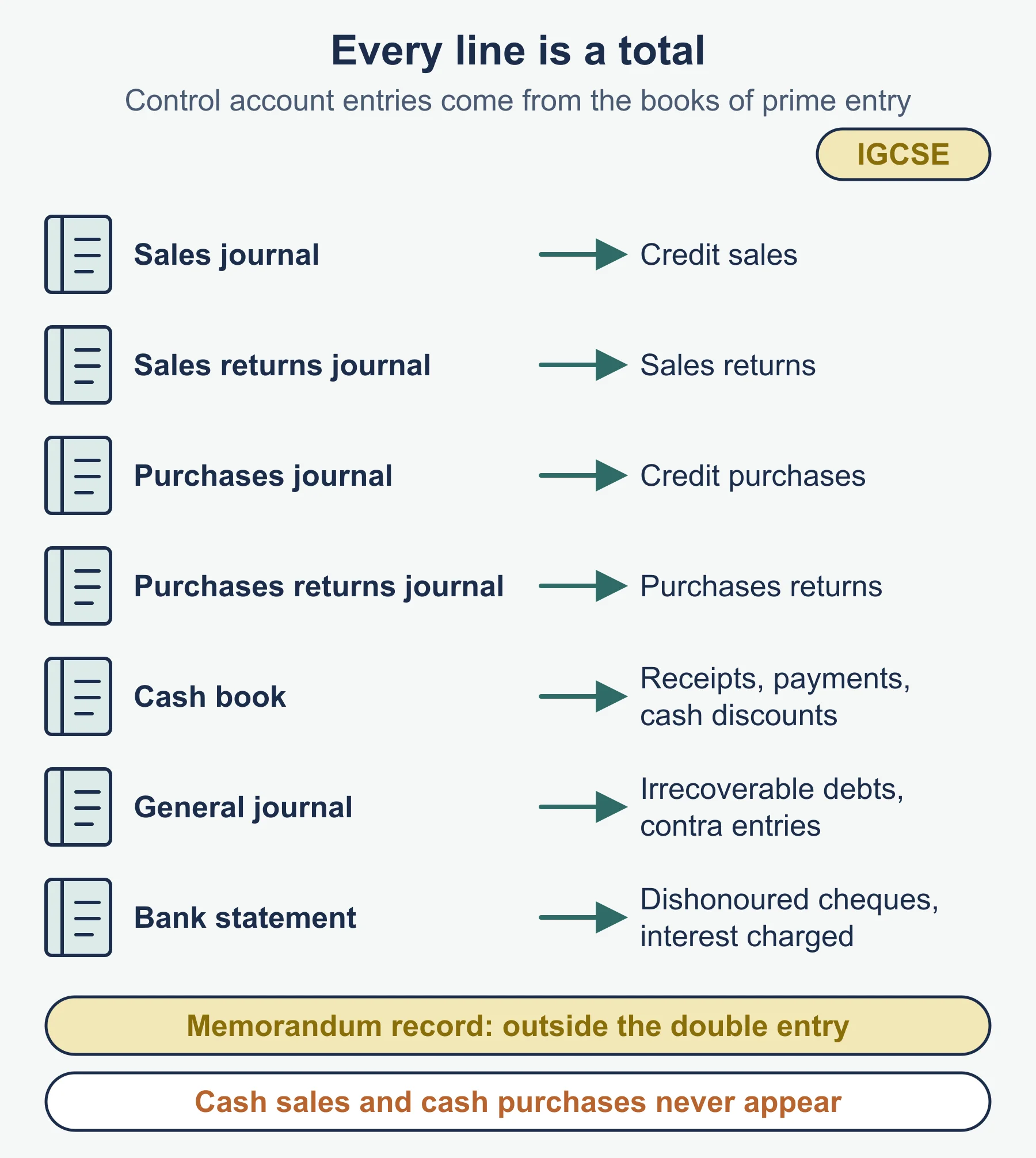
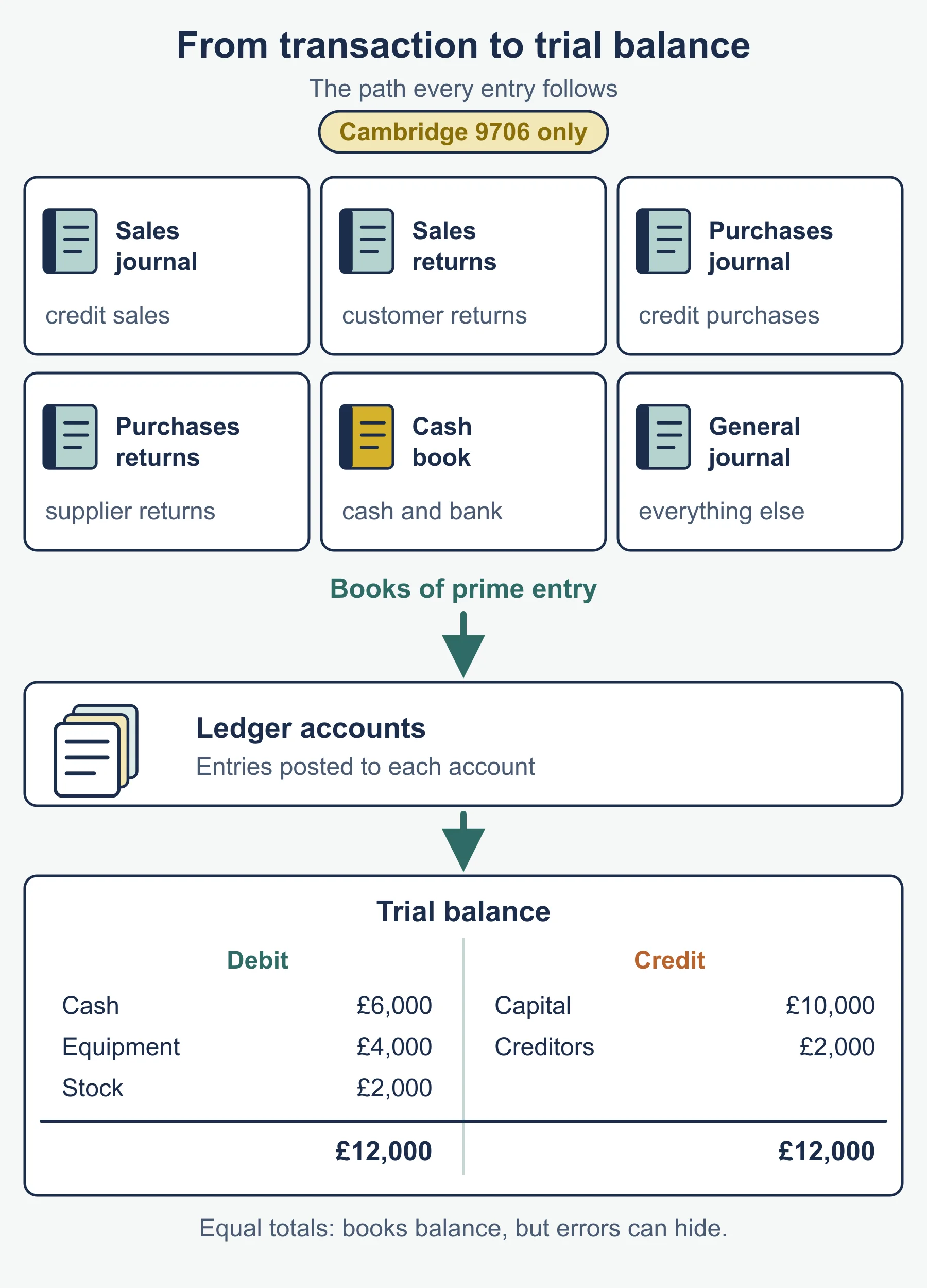
Each line in a control account is a total, not a single invoice. Use the books of prime entry:
| Control account line | Source of the total |
|---|---|
| Credit sales | Sales journal total |
| Sales returns | Sales returns journal total |
| Credit purchases | Purchases journal total |
| Purchases returns | Purchases returns journal total |
| Receipts from customers, payments to suppliers, cash discounts | Cash book totals |
| Irrecoverable debts, contra entries | General journal |
| Dishonoured cheques, interest charged | Bank statement or general journal |
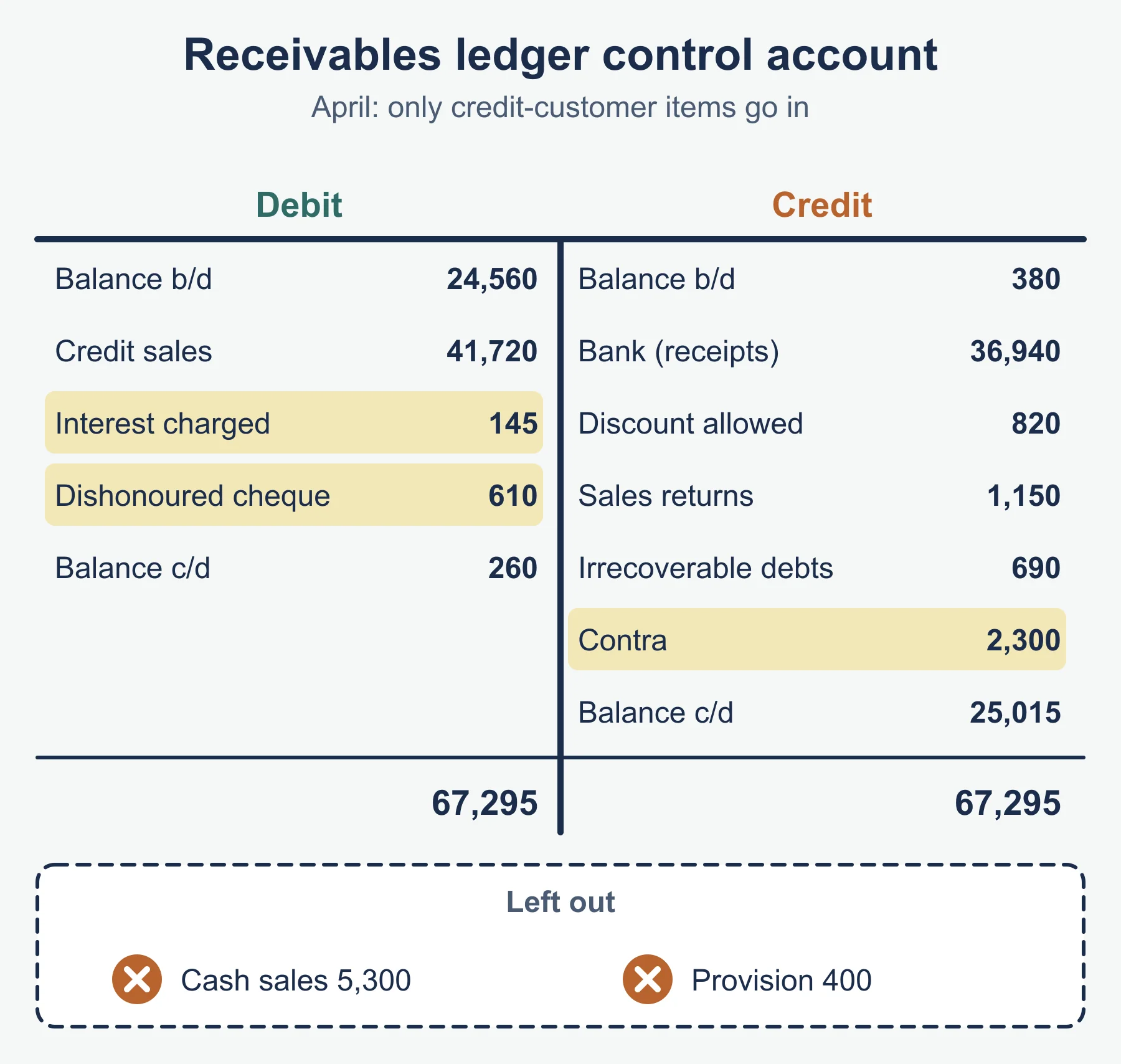
The receivables control account is laid out like a customer account. Anything that increases what customers owe goes on the debit side. Anything that reduces it goes on the credit side. The payables control account is laid out like a supplier account, so the sides are reversed: anything that increases what you owe goes on the credit side, and anything that reduces it goes on the debit side.
3. Trade receivables ledger control account
Worked example: Crestfield Traders, month of March
Opening position: customers owe 18,400 in total (debit balances). Two customers had overpaid, leaving credit balances of 260 in total. During March:
- credit sales 61,350
- cheques and bank transfers received from customers 54,900
- cash discount allowed 1,180
- sales returns 2,360
- irrecoverable debts written off 620
- a customer’s cheque for 900 was dishonoured
- interest charged on overdue accounts 140
- contra entry with the payables ledger 700 (see section 5)
- credit balances at 31 March: 340
Trade receivables ledger control account - Crestfield Traders
Debit side                          Credit side
Balance b/d (debit balances) 18,400  Balance b/d (credit balances)   260
Credit sales                 61,350  Bank                         54,900
Dishonoured cheque              900  Cash discount allowed         1,180
Interest on overdue accounts    140  Sales returns                 2,360
Balance c/d (credit balances)   340  Irrecoverable debts             620
                                     Contra: payables ledger         700
                                     Balance c/d (debit balances) 21,110
                             -------                              -------
                             81,130                               81,130
The closing debit balances are the balancing figure, found by totalling the debit side (81,130) and subtracting the other credit-side items (60,020), which gives 21,110.
Notice what each entry does:
- A dishonoured cheque reverses an earlier receipt, so the customer owes the money again. It goes on the debit side.
- Interest charged on overdue accounts is added to what the customer owes, so it is a debit. The matching credit goes to an interest income account in the general ledger.
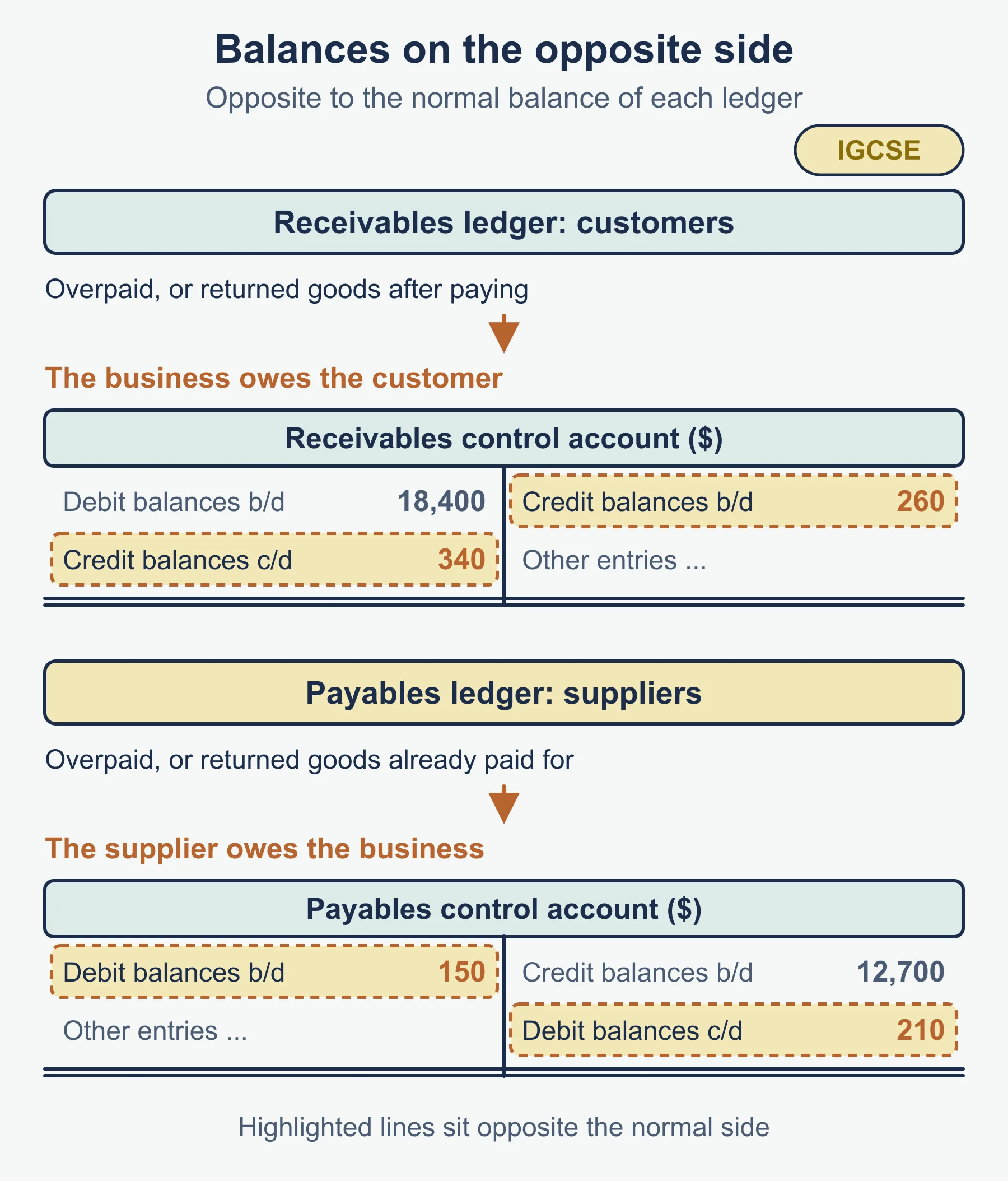
- Credit balances in the receivables ledger arise when a customer has overpaid or has returned goods after paying. The business owes that customer. They are carried down on the debit side and brought down on the credit side, so that the closing debit balances figure stays accurate.
4. Trade payables ledger control account
Worked example: Selwick Hardware, month of March
Opening position: Selwick Hardware owes suppliers 12,700 (credit balances). It had overpaid one supplier by 150 (a debit balance in the payables ledger). During March:
- credit purchases 38,200
- payments to suppliers 33,640
- cash discount received 720
- purchases returns 1,540
- interest charged to Selwick Hardware by a supplier for overdue payment 85
- contra entry with the receivables ledger 500
- debit balances at 31 March: 210
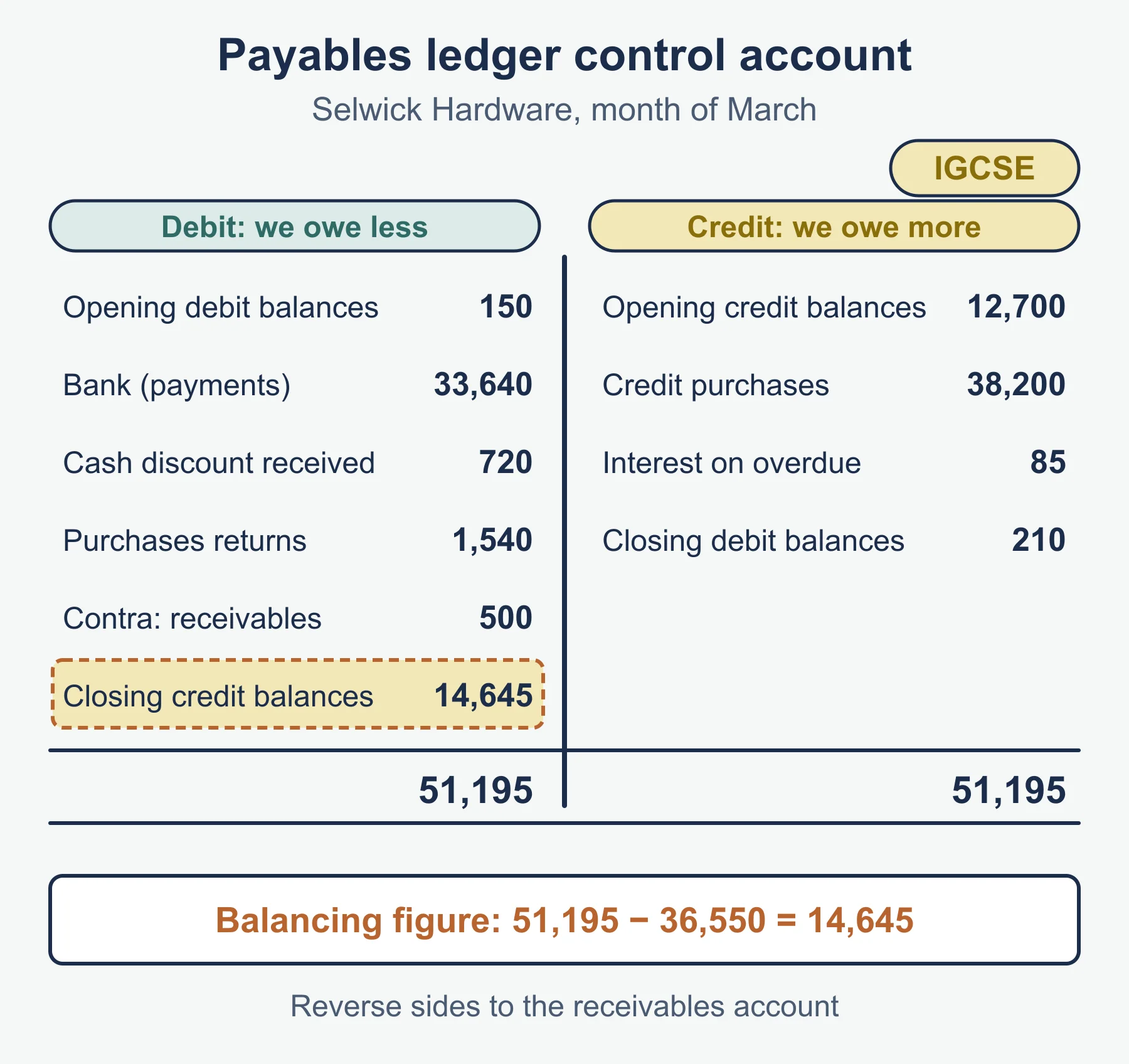
Trade payables ledger control account - Selwick Hardware
Debit side                           Credit side
Balance b/d (debit balances)    150  Balance b/d (credit balances) 12,700
Bank                         33,640  Credit purchases              38,200
Cash discount received          720  Interest on overdue accounts      85
Purchases returns             1,540  Balance c/d (debit balances)     210
Contra: receivables ledger      500
Balance c/d (credit balances) 14,645
                             -------                               -------
                             51,195                                51,195
Here the credit side totals 51,195, the debit items other than the closing balance total 36,550, and the balancing figure is 14,645.
The debit balances in the payables ledger mirror the credit balances in the receivables ledger. They arise from an overpayment or from returning goods that were already paid for. The supplier owes the business, so these sit on the opposite side to the normal supplier balances.
5. Contra entries
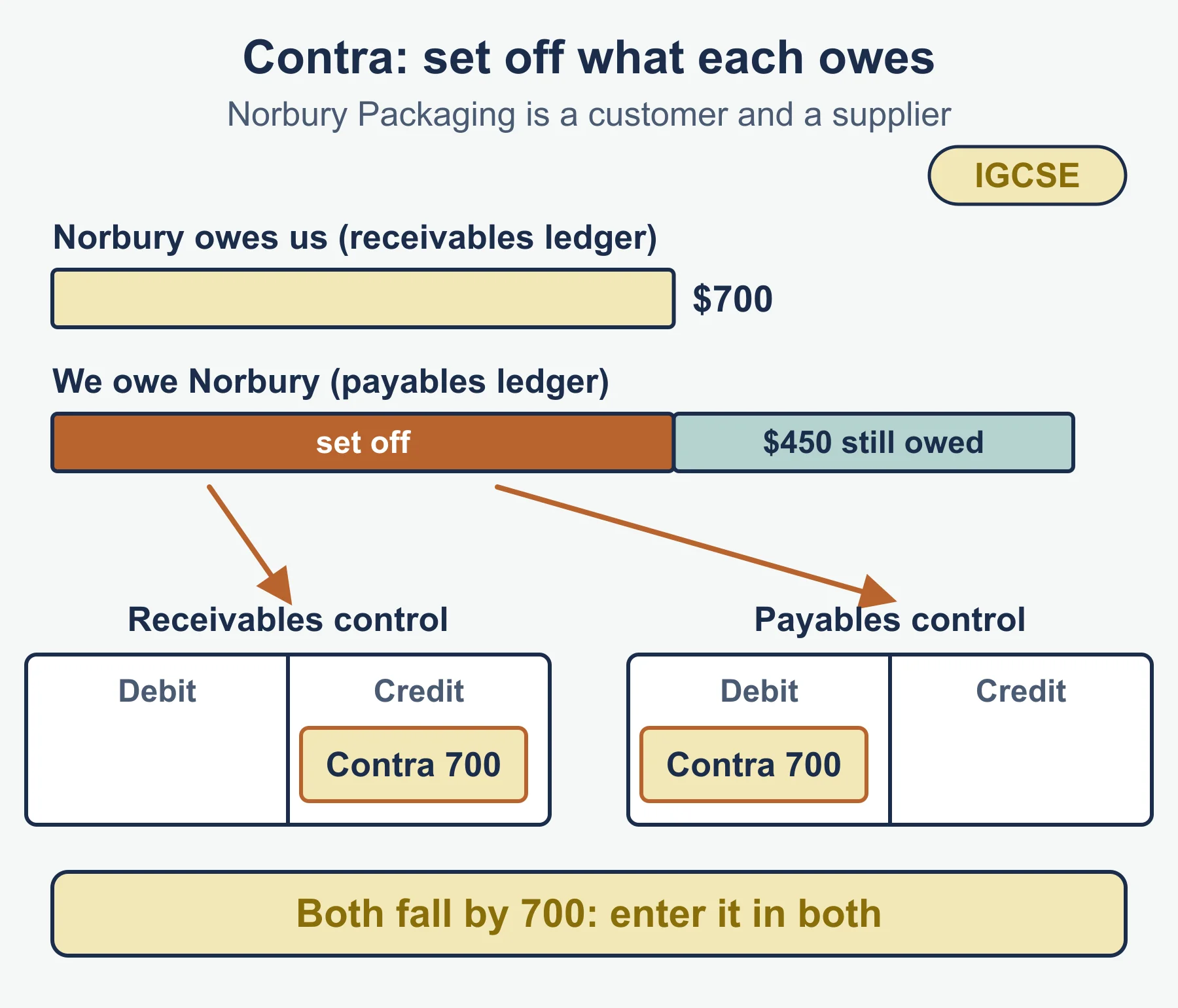
A contra entry is used when one trader is both a customer and a supplier. Suppose Norbury Packaging owes Crestfield Traders 700 for goods bought on credit, and Crestfield Traders owes Norbury Packaging 1,150 for packaging. The two amounts can be set off against each other. The smaller amount, 700, is the contra.
The general journal records it as: debit Norbury Packaging in the payables ledger 700, credit Norbury Packaging in the receivables ledger 700. In the control accounts that means:
- credit side of the receivables control account: 700 (debts owed by customers fall)
- debit side of the payables control account: 700 (amounts owed to suppliers fall)
After the contra, Crestfield Traders still owes Norbury Packaging 450 (1,150 less 700). The contra entry must appear in both control accounts. If you put it in only one, the two control accounts will no longer agree with their ledgers.
6. Understanding and interpreting a control account
Once a control account is complete, compare its closing balance with the total of the list of individual balances taken from the ledger. Keep debit balances and credit balances separate in your working, as they are in the control account.
Worked interpretation: Crestfield Traders
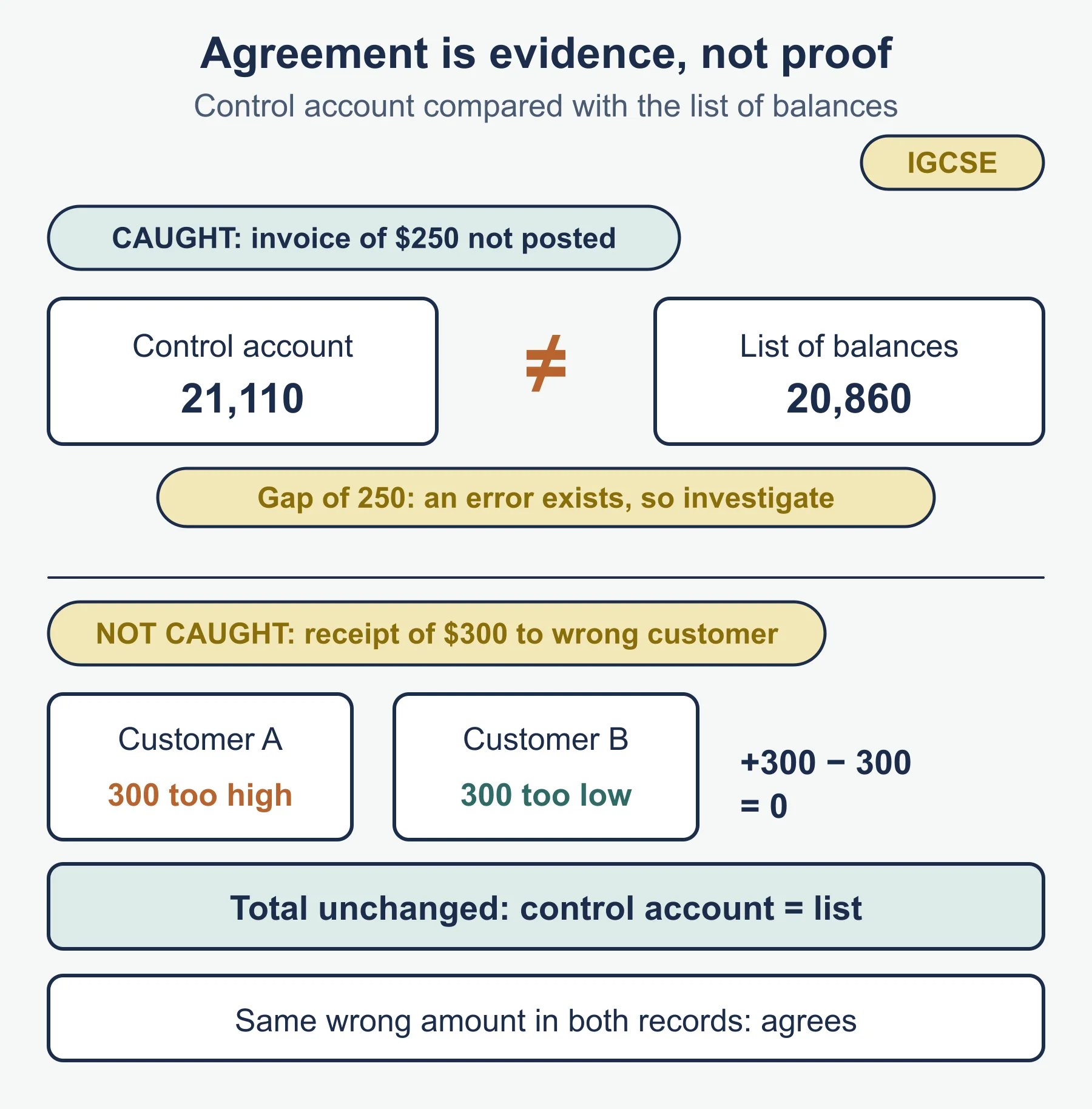
The control account shows closing debit balances of 21,110. The list of individual customer debit balances adds up to 20,860. The difference is 250, and the list is lower.
Ask what could cause the gap:
- a sales invoice for 250 was entered in the sales journal total but never posted to a customer’s account
- a receipt or discount of 250 was posted twice to individual accounts
- the list of balances was added up wrongly
- the sales journal total used in the control account was added up wrongly (in which case the control account, not the ledger, is wrong)
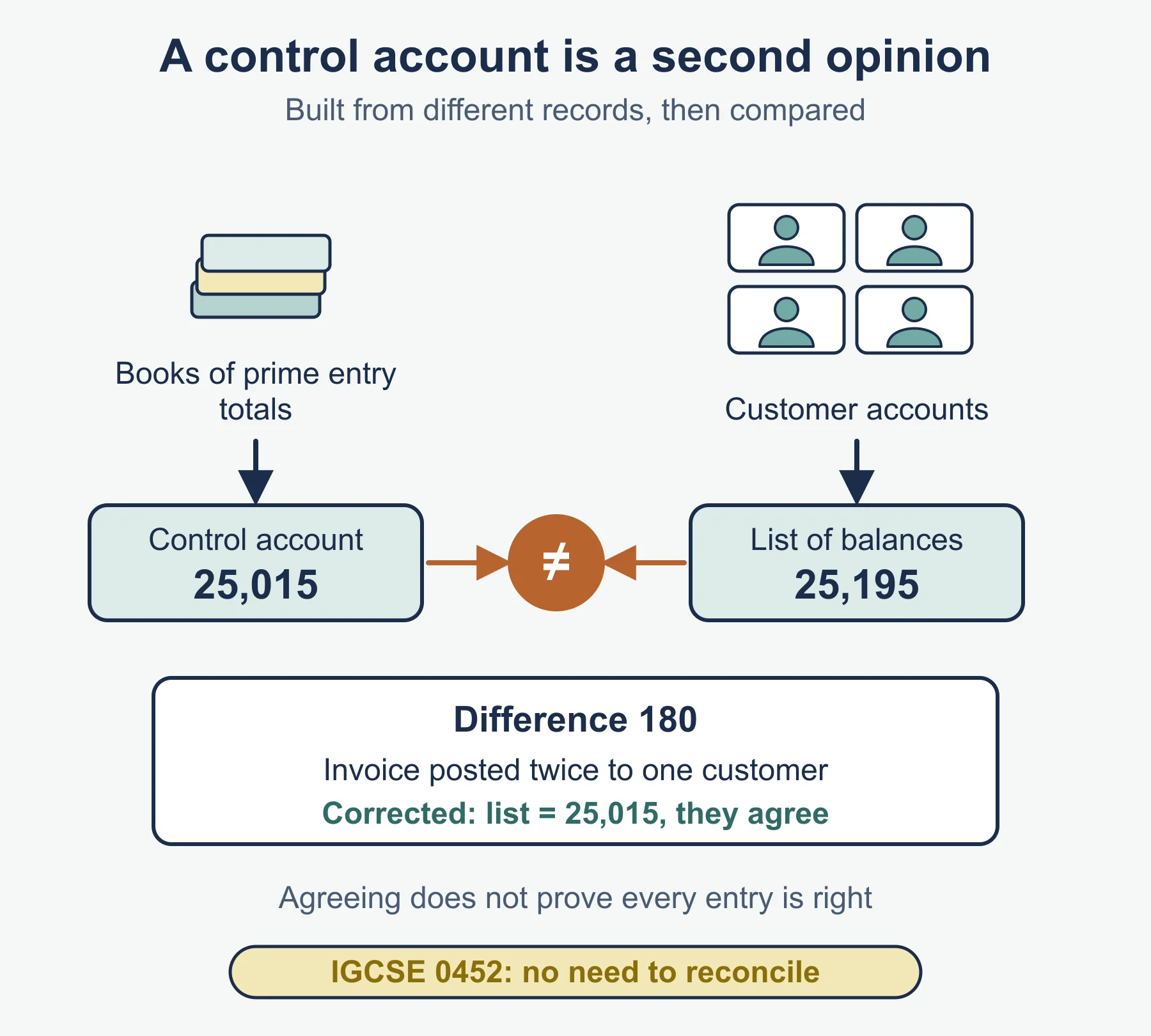
The control account tells you that an error exists. It does not say which account contains it. You must then check the individual accounts and the totals used. When the cause is found, correct the faulty record and see whether the two figures now agree.
Know the limits of this check. If a receipt of 300 is posted to the wrong customer’s account, the control account and the list still agree, because the total is unchanged. If the same wrong amount is put into both the control account and the ledger, they also agree. So agreement is helpful evidence, not proof that every account is right.
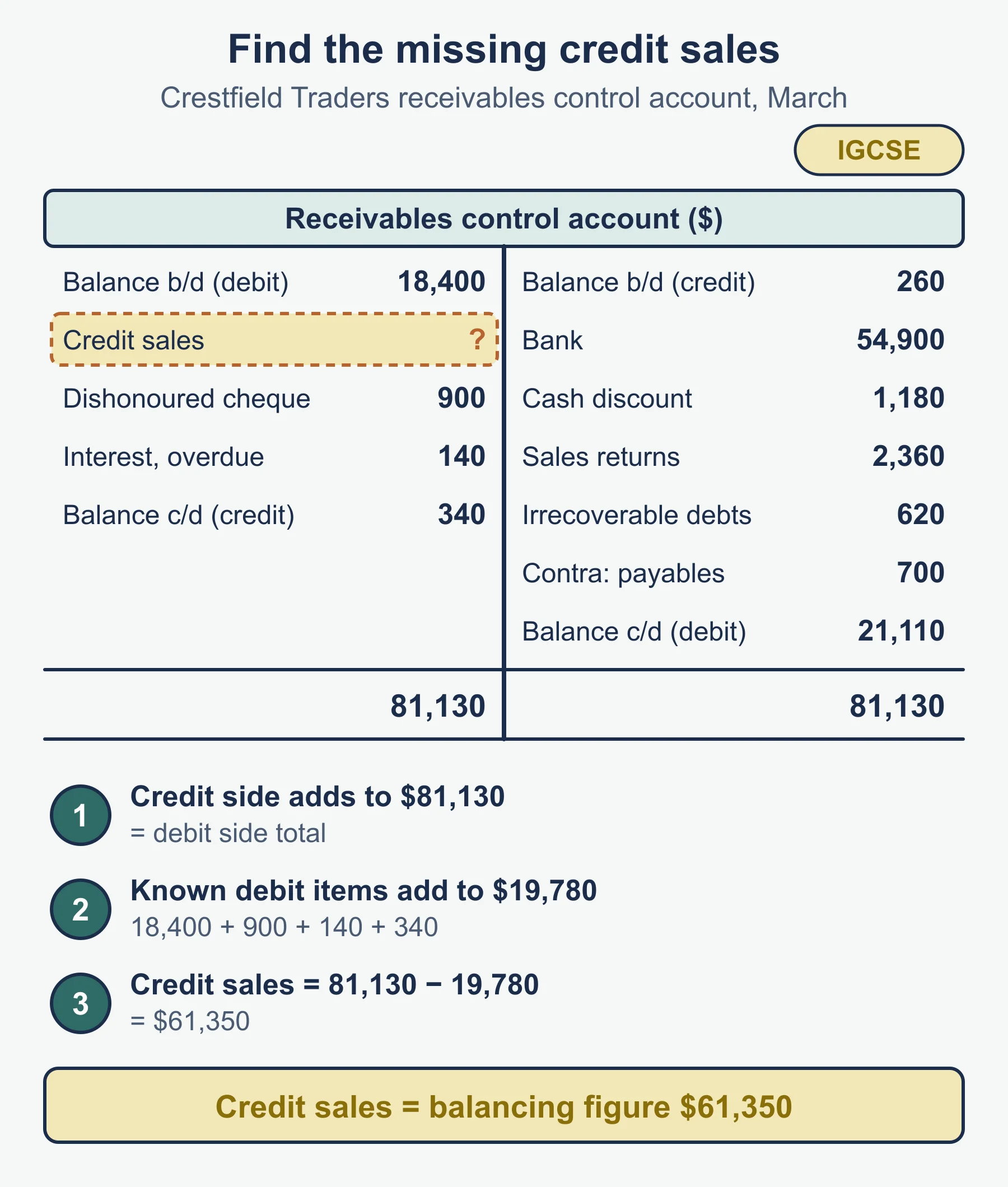
A control account can also be used to find a missing figure. If you know the opening balance, closing balance and every item except credit sales, the balancing figure is credit sales. This is a common way of using the account when records are incomplete.
Common errors
- Putting a payables control account entry on the receivables side. Check which ledger you are working in and remember that the sides are opposite.
- Leaving out the debit balances in the payables ledger or the credit balances in the receivables ledger, so the closing balance is wrong.
- Entering a contra on the same side in both accounts. It reduces both totals.
- Including cash sales or cash purchases.
- Treating the control account as part of the double entry, or forgetting to state that it is a memorandum record.
- Calling the difference between the control account and the list an error in the ledger, without allowing for an error in a journal total.
Frequently asked questions
What is the purpose of control accounts in accounting? Control accounts give a single total of the amounts owed by credit customers or owed to credit suppliers, and act as a check on the accuracy of the individual ledger accounts. They help locate errors and can be used to find missing figures.
Where do the figures in a control account come from? Each line is a total taken from a book of prime entry or a source record, such as credit sales from the sales journal, returns from the returns journals and receipts or payments from the cash book. Individual invoices are not posted one by one.
How is a dishonoured cheque recorded in a trade receivables control account? A dishonoured cheque reverses an earlier receipt, so it is entered on the debit side of the receivables control account. This increases the amount the customer owes again.
What should you do if a control account balance does not agree with the list of balances? Check the arithmetic of the list first, then the control account totals, then the individual postings. The difference shows that an error exists and its size can suggest the cause, but each possible error must be confirmed against the records.
Official syllabus
This page is based on the OxfordAQA International GCSE Accounting (9215) specification, version 1.2, section 3.2, Verification of accounting records, published by OxfordAQA.
Get free revision emails (optional)
Occasional emails with practice questions, worked explanations and links to free resources for the qualification and subjects you choose. No spam, and you can unsubscribe from any email. The free tools on this site never need an email.
Related resources
-
Practice questions
OxfordAQA IGCSE Accounting: Trade payables and trade receivables control accounts (9215) – Practice Questions
Original practice questions with worked answers on trade receivables and trade payables control accounts for OxfordAQA IGCSE Accounting.
Accounting · OxfordAQA · IGCSE
Try questions -
Revision notes
OxfordAQA IGCSE Accounting: Trade payables and trade receivables control accounts (9215) – Revision Notes
Condensed revision notes on trade receivables and trade payables control accounts, with a self-test, for OxfordAQA International GCSE Accounting.
Accounting · OxfordAQA · IGCSE
Revise topic -
Study guides
OxfordAQA IGCSE Accounting: Verification of double entry records and the trial balance (9215)
Guide to preparing, correcting and judging a trial balance, with every error type it does and does not reveal, for OxfordAQA IGCSE Accounting 9215.
Accounting · OxfordAQA · IGCSE
Read guide
Related articles
-
teaching
A Level tuition in Dubai: Cambridge or Pearson Edexcel International A Level?
Schools in Dubai and Abu Dhabi teach either Cambridge International AS & A Level or Pearson Edexcel International A Level. How the two are structured, why it matters for tuition, and how online classes from Lahore work.
9 October 2026
-
curriculum guides
Choosing subjects at IGCSE and A Level
How subject choices at 14 and 16 affect university options later, and how to keep pathways open without overloading a timetable.
28 July 2026
Studying this with a teacher
Working through Accounting IGCSE?
This page is free and stays free. If you would rather be taught it, Marlbridge runs Accounting classes one-to-one and in small groups of up to 15, online in your own time zone. The first trial class is free. WhatsApp replies within an hour (8am–11pm Pakistan time, every day); email the same day.
OxfordAQA Accounting teachers at Marlbridge

