
Revision Notes
OxfordAQA IGCSE Accounting: Correcting errors and the effect of errors on profit (9215) – Revision Notes
Condensed recall notes, method steps and a ten-question self-test on journal corrections, the suspense account and corrected profit for OxfordAQA 9215.
- Subject
- Accounting
- Level
- IGCSE
- Topic
- Verification of accounting records
- Author
- Marlbridge Academic Team
- Updated
- Reviewed by
- Javaid Iqbal Sabri (what this means)
Aligned to OxfordAQA IGCSE Accounting (9215), First teaching 2024, first examined 2026. Official specification .
Syllabus page (what it covers and how it is assessed): OxfordAQA IGCSE Accounting.
Syllabus points this page covers
9215
- How to correct errors in double entry records
Found an error? Report a correction.
Need help with this topic? Request a free trial class for IGCSE Accounting (9215).
These notes are aligned to the OxfordAQA International GCSE Accounting (9215) specification, version 1.2, exams from May/June 2026 onwards. They condense the last two content points of section 3.2, Verification of accounting records: how to correct errors in double entry records, and the effect of errors on profit calculations. The specification names the general journal and the suspense account for correction, and the adjustment of profit or loss after correction. Amounts are in dollars.
For full explanations and a long worked example, read the study guide. When you are ready to test yourself, use the practice questions. The wider topic is covered in the verification study guide, verification notes and verification practice set. Other links: course hub, checklist and diagnostics.
The ten error types at a glance
| Error | One-line definition | Trial balance shows it? | Suspense account? |
|---|---|---|---|
| Commission | Right class of account, wrong account | No | No |
| Complete reversal | Right accounts, debit and credit swapped | No | No |
| Compensating | Two errors that cancel in the totals | No | No |
| Omission | Whole transaction left out | No | No |
| Original entry | Wrong amount, same on both sides | No | No |
| Principle | Posted to the wrong class of account | No | No |
| Addition | Account added up wrongly | Yes | Yes |
| Partial omission | Only one side of the entry posted | Yes | Yes |
| Transposition | Digits swapped on one side | Yes | Yes |
| Unequal posting | Debit and credit posted at different amounts | Yes | Yes |
The test for the first six: after the error, total debits still equal total credits. The test for the last four: they do not.
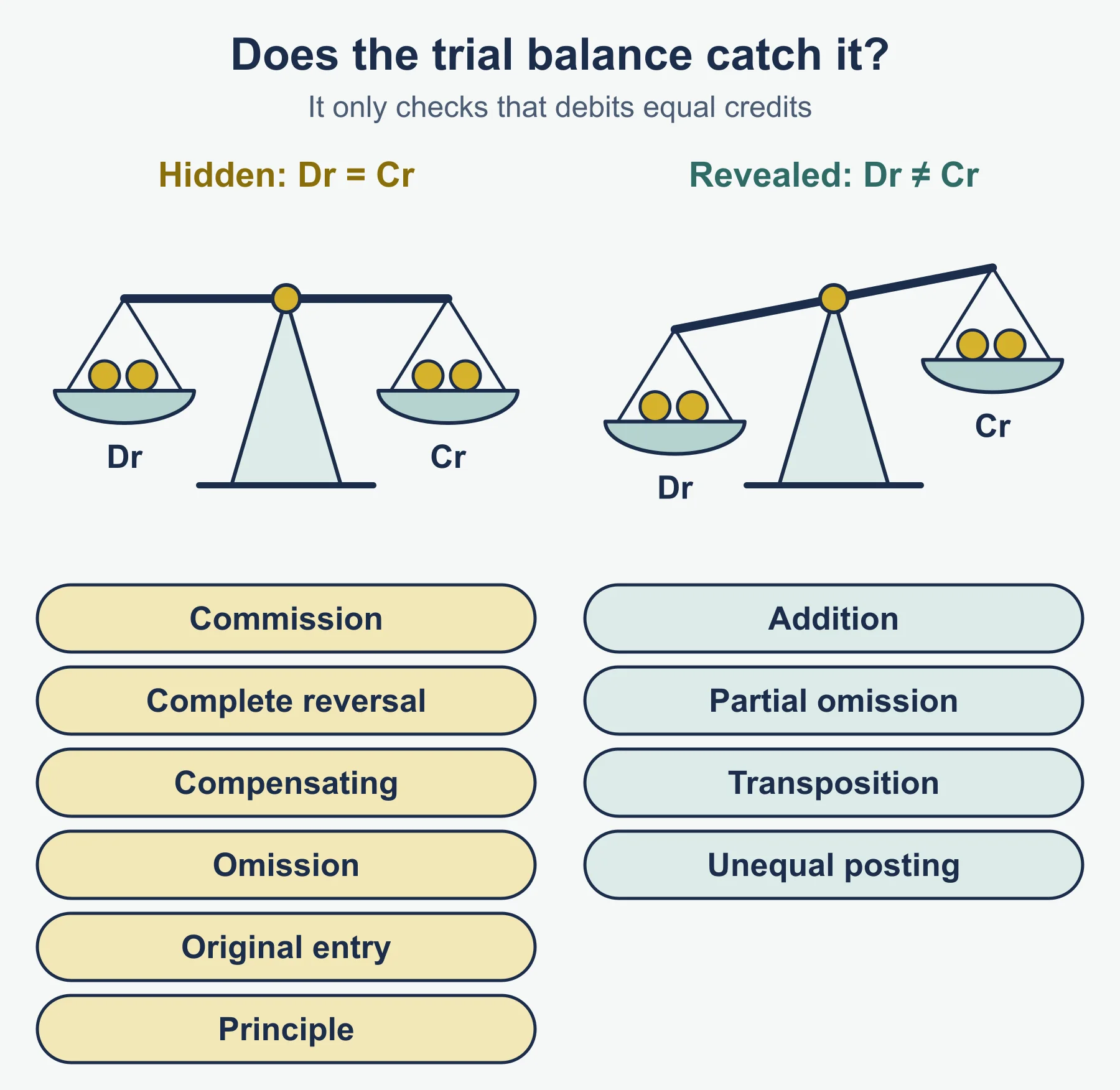
Method: correcting one error
- Name the error type from the table.
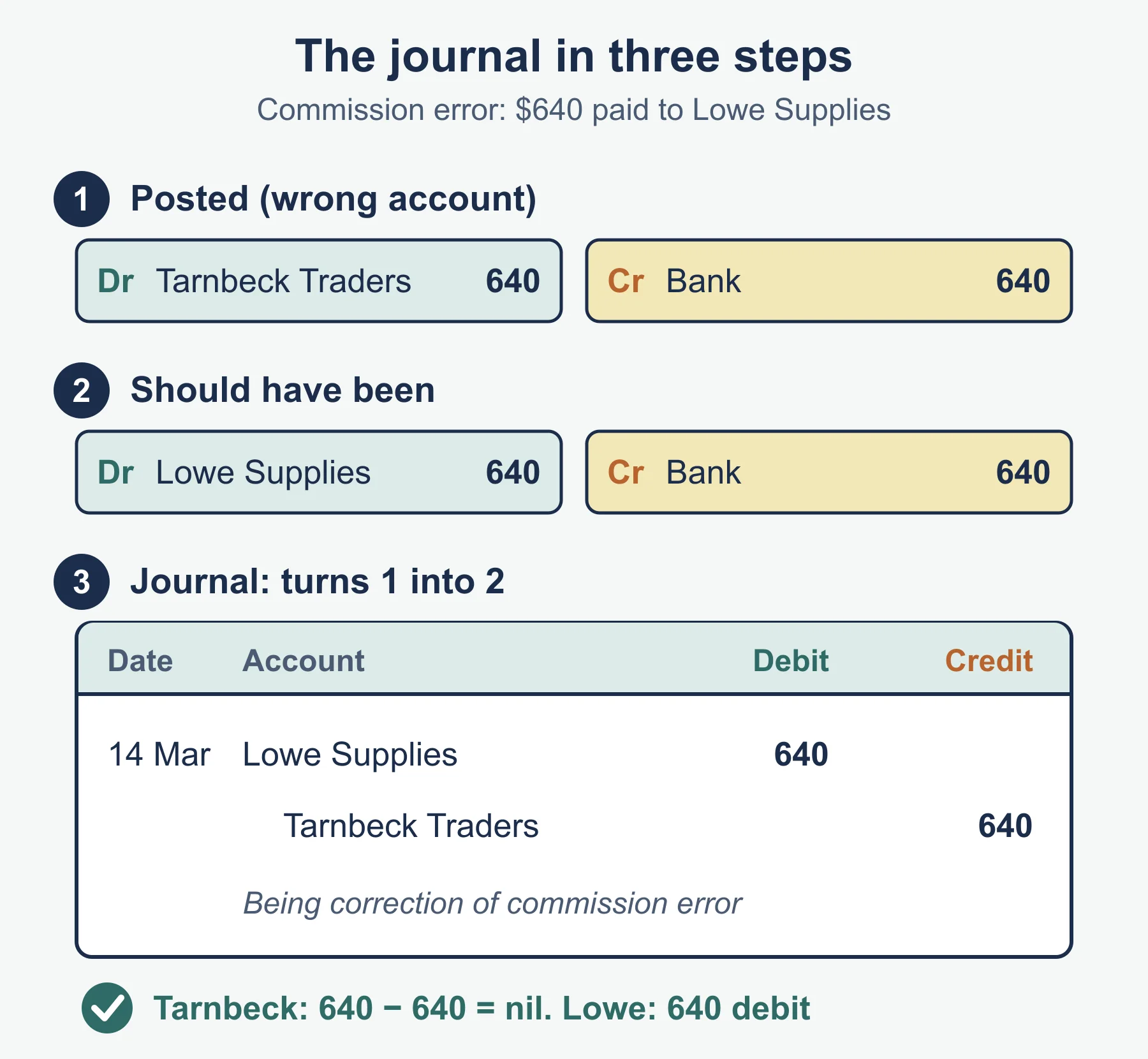
- Write what was posted: which account was debited, which credited, and for how much.
- Write what should have been posted.
- Journal the difference. If the trial balance disagreed, one side of the journal is the suspense account.
- Add a short narrative beginning “being correction of”.
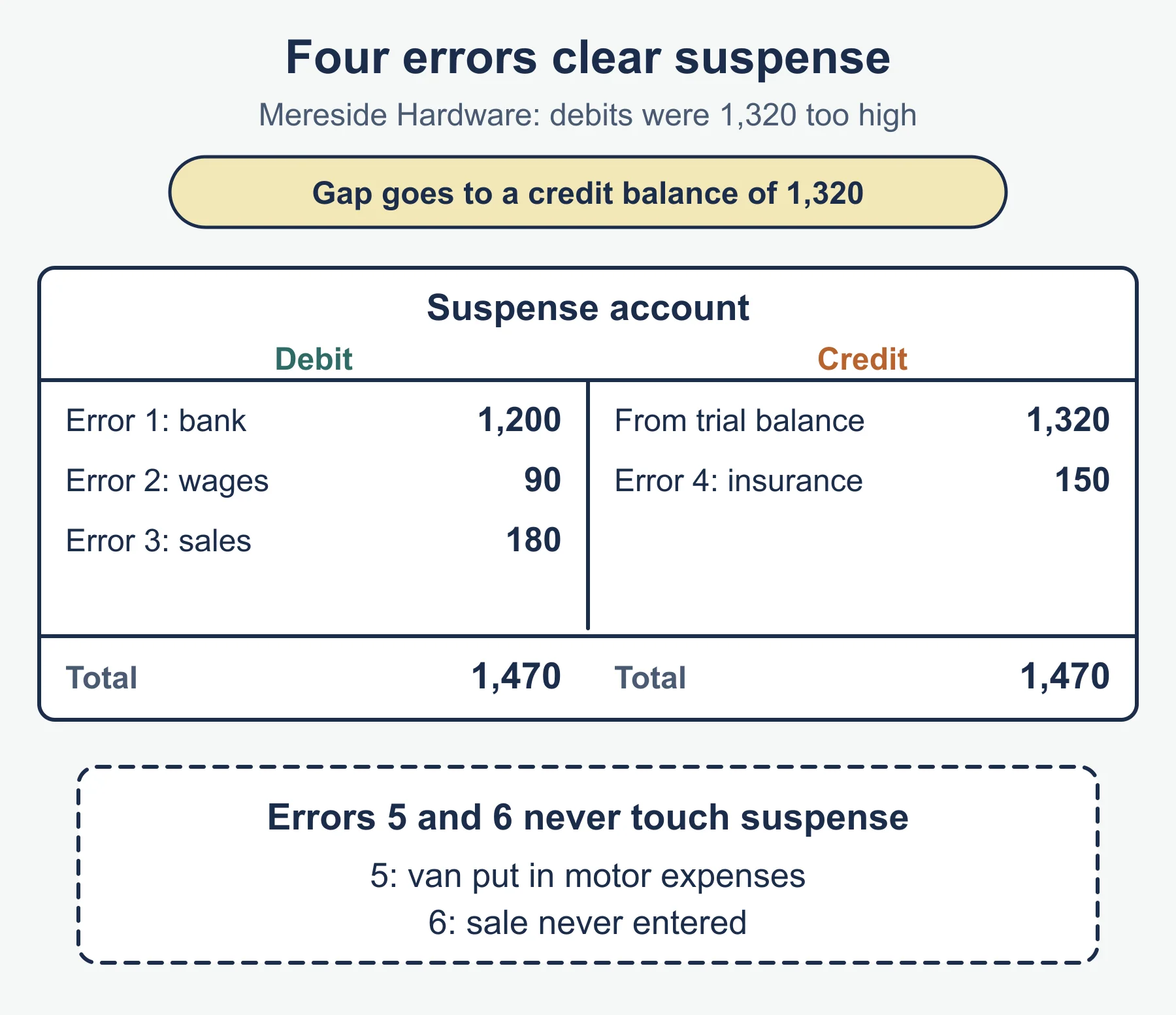
Method: the suspense account
- Total the debit and credit columns of the trial balance.
- Put the difference on the smaller side. If credits are bigger, suspense is a debit. If debits are bigger, suspense is a credit.
- Journal each revealed error through suspense: an error that left too much on the debit side is corrected by debiting suspense, and the reverse for too much on the credit side.
- Post the corrections to the suspense account.
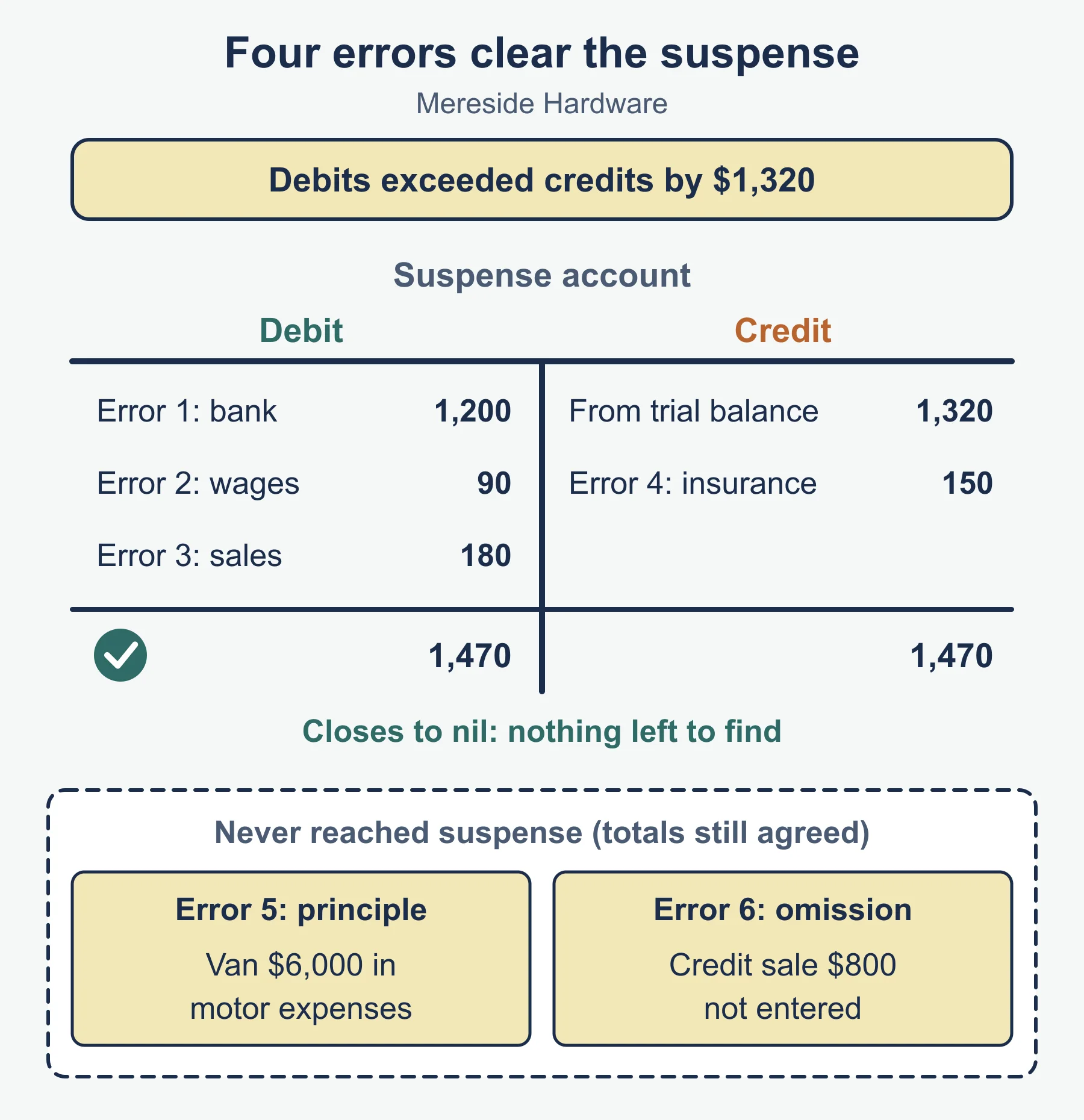
- The account should close to nil. A leftover balance means an error is still missing.
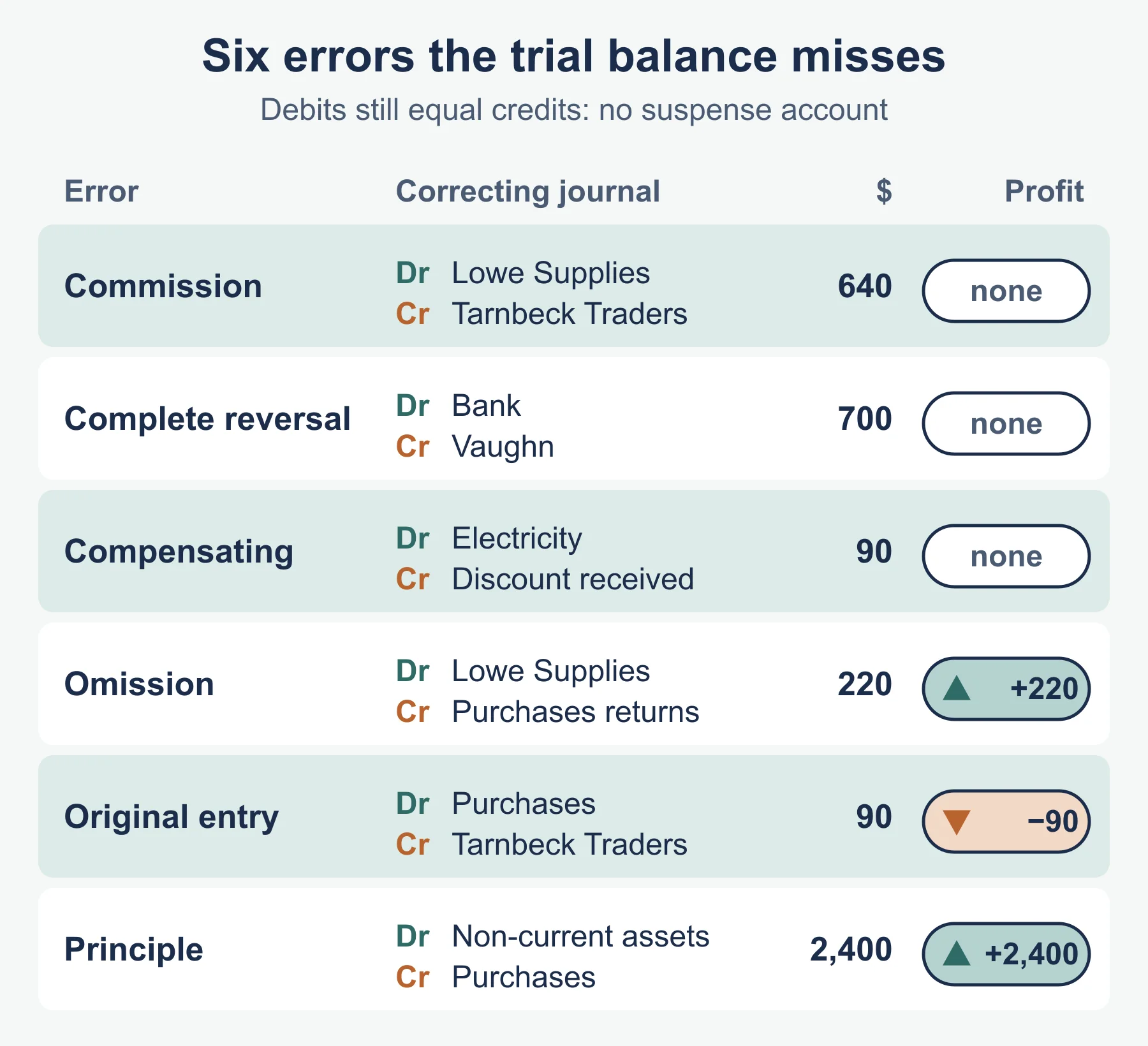
Remember that errors in the first group of six never pass through suspense.
Method: statement of corrected profit
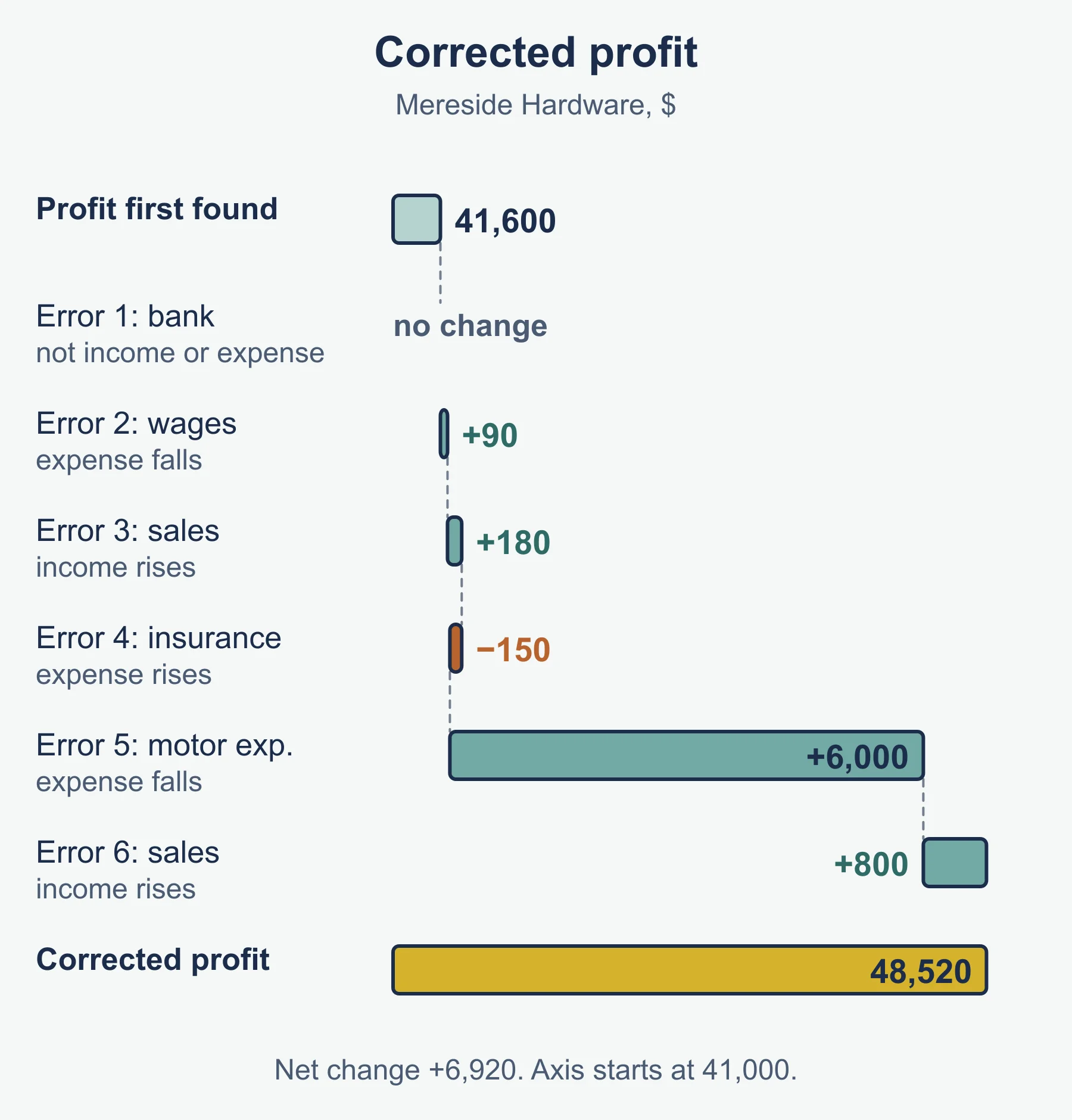
- Start with the profit as first calculated.
- For each correction, look at the journal. If neither account is an income or expense account, the effect is nil.
- Credit to an income account, or credit to an expense account: add.
- Debit to an income account, or debit to an expense account: deduct.
- Total the adjustments, then state the corrected profit.
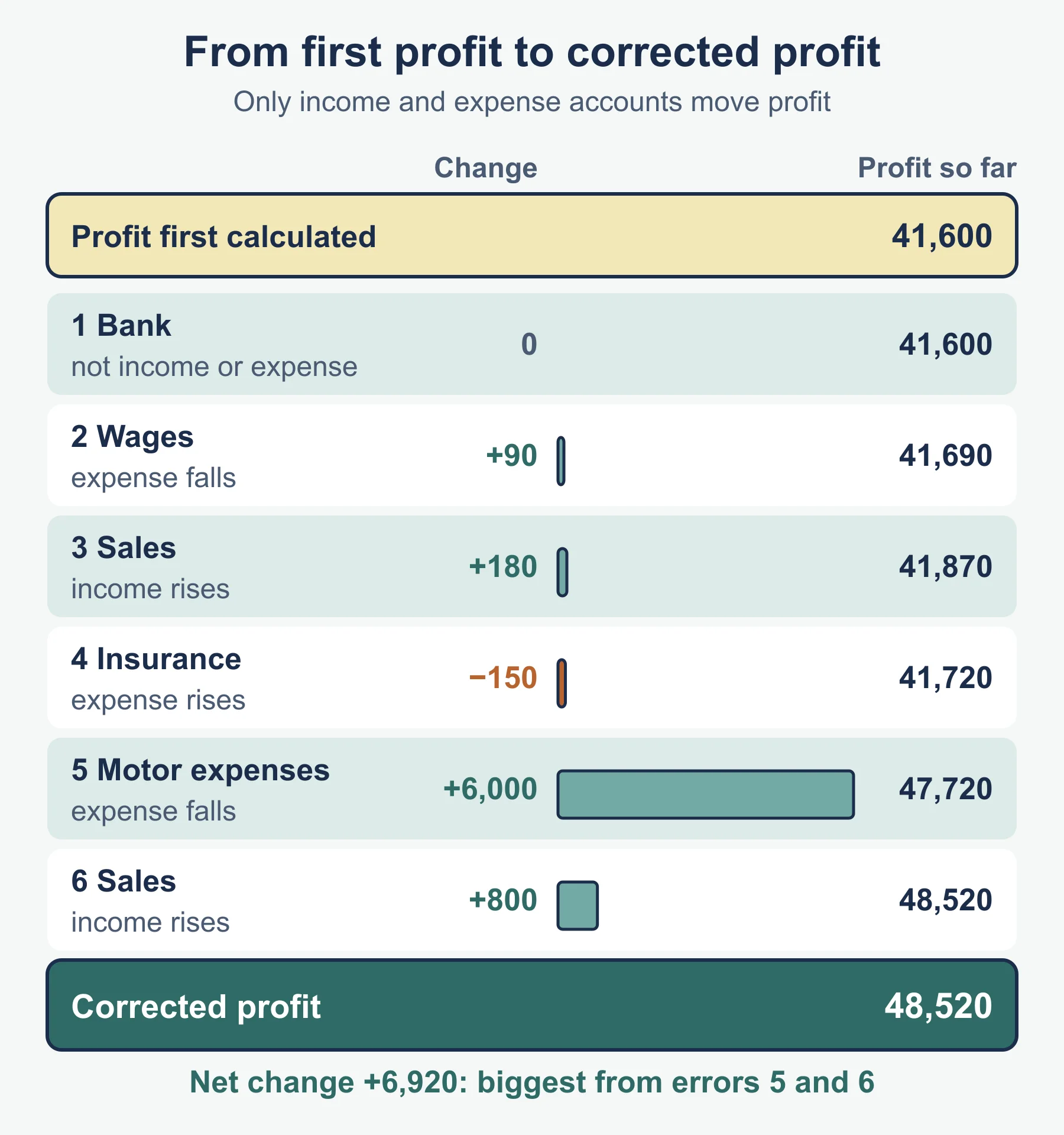
| Journal touches | Direction | Profit |
|---|---|---|
| Income account | Credit | Up |
| Income account | Debit | Down |
| Expense account | Credit | Up |
| Expense account | Debit | Down |
| Asset, liability or capital only | Either | No change |
Worked reminder: Oakhurst Tiles
Oakhurst Tiles calculated a profit for the year of 18,900. The trial balance disagreed and a credit balance of 600 was held in suspense. Three errors were found.
- The rent account was overcast by 600 on the debit side.
- A credit sale of 1,400 was never recorded.
- Bank charges of 250 on the statement were never entered.
| Error | Type | Journal | Profit |
|---|---|---|---|
| 1 | Addition | Debit suspense 600; credit rent 600 | +600 |
| 2 | Omission | Debit trade receivables 1,400; credit sales 1,400 | +1,400 |
| 3 | Omission | Debit bank charges 250; credit bank 250 | -250 |
Suspense: opening credit 600, then debit 600 from error 1, leaving nil. Corrected profit: 18,900 + 600 + 1,400 - 250 = 20,650.
Only error 1 used suspense. Errors 2 and 3 are omissions, which a trial balance cannot show, so they were found some other way, such as a customer query or a bank statement check.
Must-know distinctions
- Commission or principle? Commission stays inside the same class of account (one supplier for another, gas for electricity). Principle crosses classes, such as an asset treated as an expense.
- Transposition or original entry? If only one side carries the swapped digits, the trial balance disagrees and it is transposition. If both sides carry them, the trial balance agrees and it is original entry.
- Omission or partial omission? Omission leaves out both sides. Partial omission leaves out one side. Only partial omission shows on the trial balance.
- Compensating or original entry? Compensating involves two separate mistakes in different accounts. Original entry is one mistake carried through both sides.
- Gross profit or profit for the year? A sales or purchases error moves both by an equal sum. An expense error alters profit for the year only.
- Suspense or journal? Suspense is only the holding place for the trial balance difference. The journal is the correcting entry in every case.
Quick self-test
- List the four errors that a trial balance reveals.
- Credits exceed debits by 340. Which side is the suspense balance?
- A gas bill of 130 was debited to the telephone account. Name the error and give the journal.
- A payment of 410 to supplier Tarnbeck Traders was debited to bank and credited to Tarnbeck Traders. Give the journal.
- Repairs to a van costing 380 were debited to motor vehicles. Name the error, give the journal and state the effect on profit.
- The wages account was overcast by 700. Give the journal using suspense and state the effect on profit.
- Profit is 12,800. Commission received of 300 was never recorded. State the corrected profit.
- Profit is 9,500. Insurance was undercast by 400 and a sale of 650 was omitted. State the corrected profit.
- Bank charges of 85 have not been entered. Does profit rise or fall when this is corrected?
- A suspense account closes to nil. Does that prove the books are now free of errors? Explain.
Answers
- Addition, partial omission, transposition and unequal posting.
- A debit balance, because the smaller side (debits) receives the balancing figure.
- Gas and telephone are both expenses, so commission. Debit gas 130; credit telephone 130.
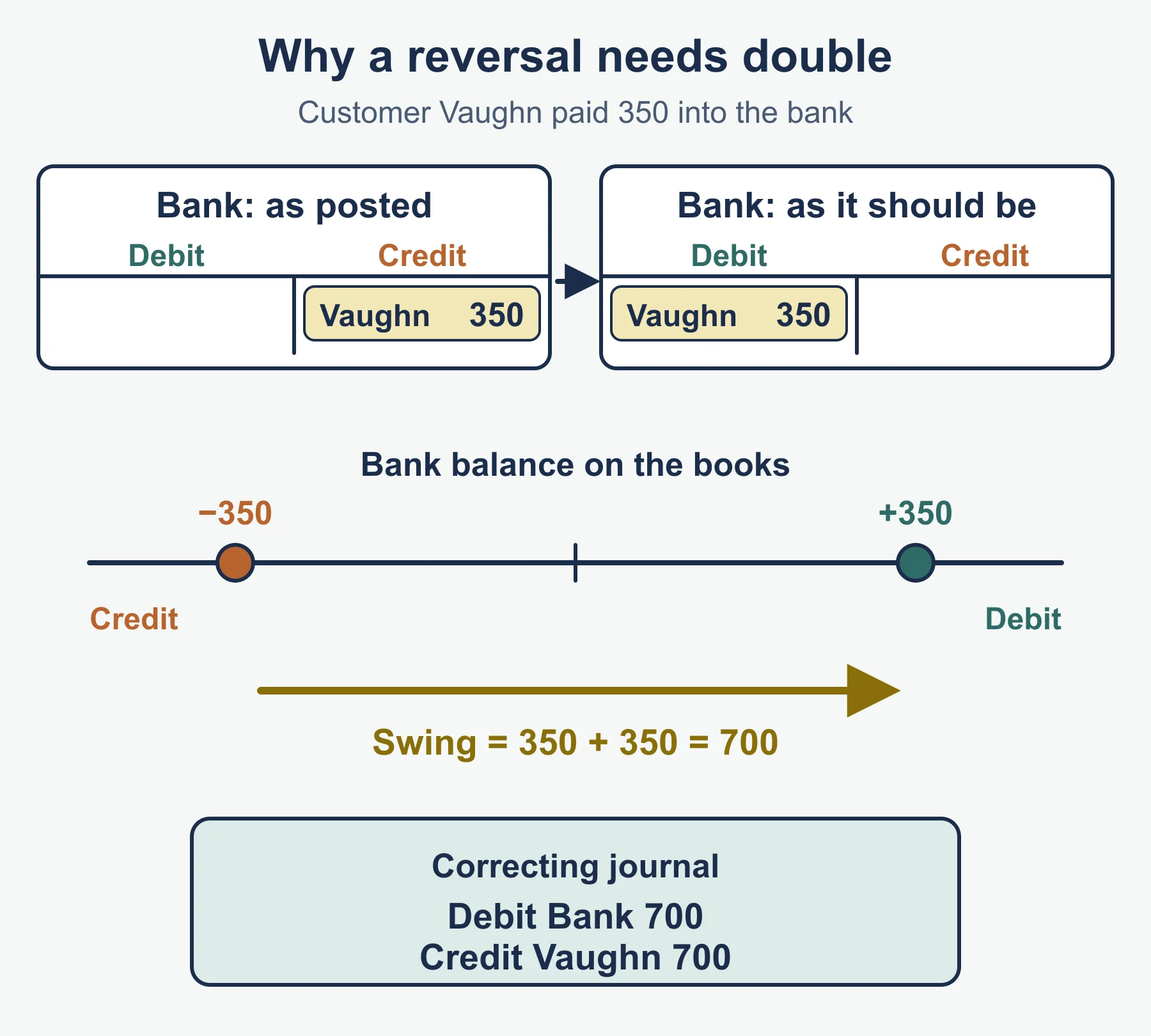
- Complete reversal. Debit Tarnbeck Traders 820; credit bank 820.
- Principle. Debit motor expenses 380; credit motor vehicles 380. Profit falls by 380.
- Debit suspense 700; credit wages 700. Profit rises by 700 because an expense is reduced.
- 12,800 + 300 = 13,100.
- 9,500 - 400 + 650 = 9,750.
- Profit falls by 85, because an expense is added.
- No. Only errors revealed by the trial balance pass through suspense. Errors such as omission, principle and compensating errors would remain undiscovered.
Quick rules for the journal
- The account that has too much debit is credited, and the account that has too little debit is debited. The same rule applies to credits in reverse.
- The journal never needs the suspense account if total debits equalled total credits before the correction.
- A complete reversal is the only error in the list where the journal figure is double the original.
- Commission and principle journals usually have the same amount on both lines as the original posting, because the right value went to the wrong account.
- In an original entry error, use the difference between the wrong and the right figures, never either full figure.
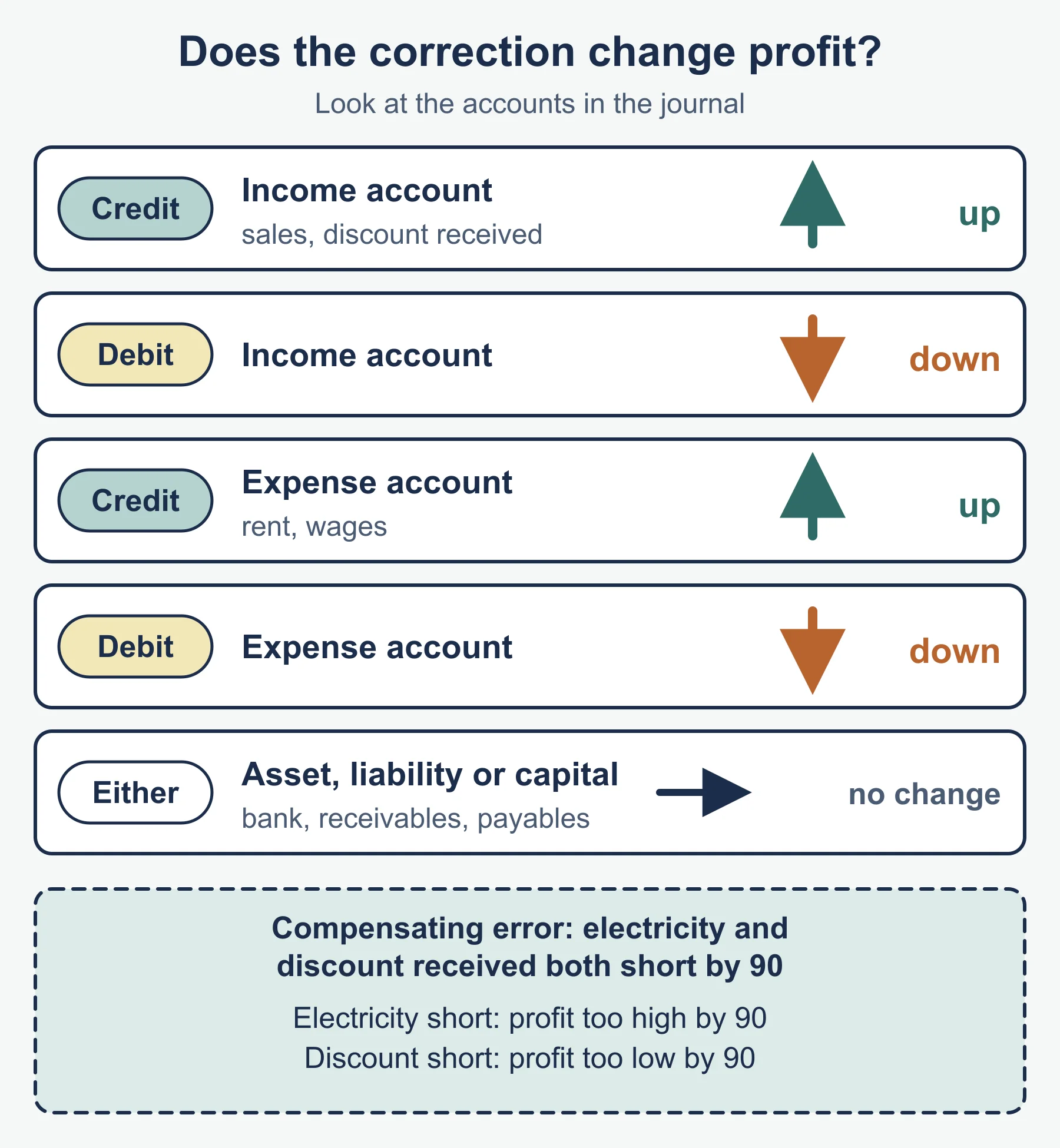
- A compensating error needs one journal with two accounts, each corrected by the difference. State both profit effects before you net them.
- When a question asks for the effect on profit, name the account involved, say whether it is an income or an expense, and give the direction and the amount.
Where marks are usually lost
- Naming the error type but leaving out the journal, or writing the journal without the type, when the question asks for both.
- Using the suspense account when the trial balance had agreed.
- Posting a complete reversal correction at the original amount instead of double.
- Putting the suspense balance on the wrong side because the debit and credit totals were compared the wrong way round.
- Adding an expense error to profit when the expense was too high.
- Changing profit for a correction that only moves balances between bank, receivables, payables or capital accounts.
- Leaving the original profit figure out of a statement of corrected profit, so there is no starting point.
- Failing to show a plus or minus on each adjustment line, which makes the total hard to follow.
Frequently asked questions
How many error types are in OxfordAQA International GCSE Accounting 9215? Ten. Six are not revealed by a trial balance (commission, principle, original entry, omission, complete reversal and compensating), and four are revealed: addition, partial omission, transposition and unequal posting.
What is the difference between a transposition error and an error of original entry? If only one side carries the swapped digits, the trial balance disagrees and it is a transposition. If both sides carry them, the trial balance agrees and it is an error of original entry.
Which side does the suspense account balance go on? Put the difference on the smaller side of the trial balance. If credits exceed debits, the suspense account has a debit balance.
What is the difference between a compensating error and an error of original entry? A compensating error involves two separate mistakes in different accounts that cancel out. An error of original entry is one mistake carried through both sides of the entry.
Does an error in sales or purchases affect gross profit? Yes. A sales or purchases error moves gross profit and profit for the year by an equal amount, while an expense error alters profit for the year only.
Official syllabus
OxfordAQA International GCSE Accounting (9215) specification, version 1.2, for International GCSE exams May/June 2026 onwards, published by OxfordAQA. See section 3.2, Verification of accounting records.
Get free revision emails (optional)
Occasional emails with practice questions, worked explanations and links to free resources for the qualification and subjects you choose. No spam, and you can unsubscribe from any email. The free tools on this site never need an email.
Related resources
-
Study guides
OxfordAQA IGCSE Accounting: Trade payables and trade receivables control accounts (9215)
Study guide to preparing, understanding and interpreting trade receivables and trade payables ledger control accounts for OxfordAQA IGCSE Accounting.
Accounting · OxfordAQA · IGCSE
Read guide -
Practice questions
OxfordAQA IGCSE Accounting: Trade payables and trade receivables control accounts (9215) – Practice Questions
Original practice questions with worked answers on trade receivables and trade payables control accounts for OxfordAQA IGCSE Accounting.
Accounting · OxfordAQA · IGCSE
Try questions -
Revision notes
OxfordAQA IGCSE Accounting: Trade payables and trade receivables control accounts (9215) – Revision Notes
Condensed revision notes on trade receivables and trade payables control accounts, with a self-test, for OxfordAQA International GCSE Accounting.
Accounting · OxfordAQA · IGCSE
Revise topic
Related articles
-
teaching
A Level tuition in Dubai: Cambridge or Pearson Edexcel International A Level?
Schools in Dubai and Abu Dhabi teach either Cambridge International AS & A Level or Pearson Edexcel International A Level. How the two are structured, why it matters for tuition, and how online classes from Lahore work.
9 October 2026
-
curriculum guides
Choosing subjects at IGCSE and A Level
How subject choices at 14 and 16 affect university options later, and how to keep pathways open without overloading a timetable.
28 July 2026
Studying this with a teacher
Working through Accounting IGCSE?
This page is free and stays free. If you would rather be taught it, Marlbridge runs Accounting classes one-to-one and in small groups of up to 15, online in your own time zone. The first trial class is free. WhatsApp replies within an hour (8am–11pm Pakistan time, every day); email the same day.
OxfordAQA Accounting teachers at Marlbridge

