
Study Guides
OxfordAQA IGCSE Accounting: Verification of double entry records and the trial balance (9215)
Guide to preparing, correcting and judging a trial balance, with every error type it does and does not reveal, for OxfordAQA IGCSE Accounting 9215.
- Subject
- Accounting
- Level
- IGCSE
- Topic
- Verification of accounting records
- Author
- Marlbridge Academic Team
- Updated
- Reviewed by
- Javaid Iqbal Sabri (what this means)
Aligned to OxfordAQA IGCSE Accounting (9215), First teaching 2024, first examined 2026. Official specification .
Syllabus page (what it covers and how it is assessed): OxfordAQA IGCSE Accounting.
Syllabus points this page covers
9215
- Verification of the double entry records
Found an error? Report a correction.
Need help with this topic? Request a free trial class for IGCSE Accounting (9215).
This guide follows the OxfordAQA International GCSE Accounting (9215) specification, version 1.2, for International GCSE exams May/June 2026 onwards. It covers the first two content points of section 3.2 Verification of accounting records: verification of the double entry records, and preparing and understanding the use of a trial balance. All amounts in this guide are in dollars.
Related pages: the Verification of accounting records study guide covers control accounts, bank reconciliation, the journal and the suspense account, and the revision notes and practice set cover the whole topic. For this unit only, use the trial balance revision notes and the trial balance practice questions. Recording transactions is in the sources and recording of data guide. Course hub: OxfordAQA IGCSE Accounting. Printable list: checklist. To find weak spots first, take a free diagnostic.
What this unit covers
| Specification point | What you must be able to do | Where here |
|---|---|---|
| Verification of the double entry records | Name the four verification techniques, starting with the trial balance | Section 1 |
| Prepare a trial balance | Build one from a list of balances | Section 2 |
| Correct a trial balance | Find and fix errors that stop the totals agreeing | Section 3 |
| Use and limitations | Explain what it shows and what it cannot show | Sections 4 and 5 |
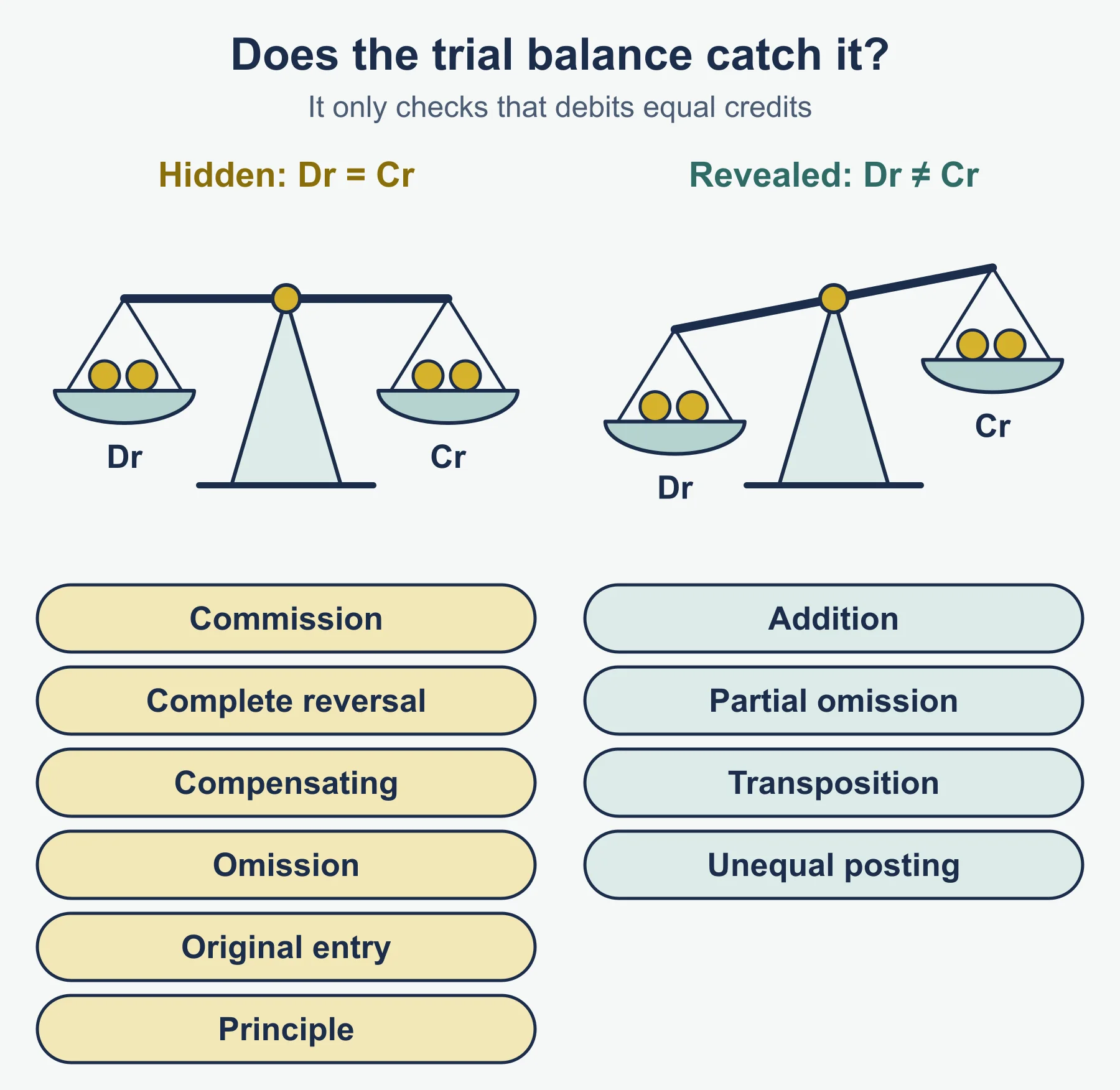
| Errors not revealed | Commission, complete reversal, compensating, omission, original entry, principle | Section 4 |
| Errors revealed | Addition, partial omission, transposition, unequal posting | Section 5 |
1. Why records are verified
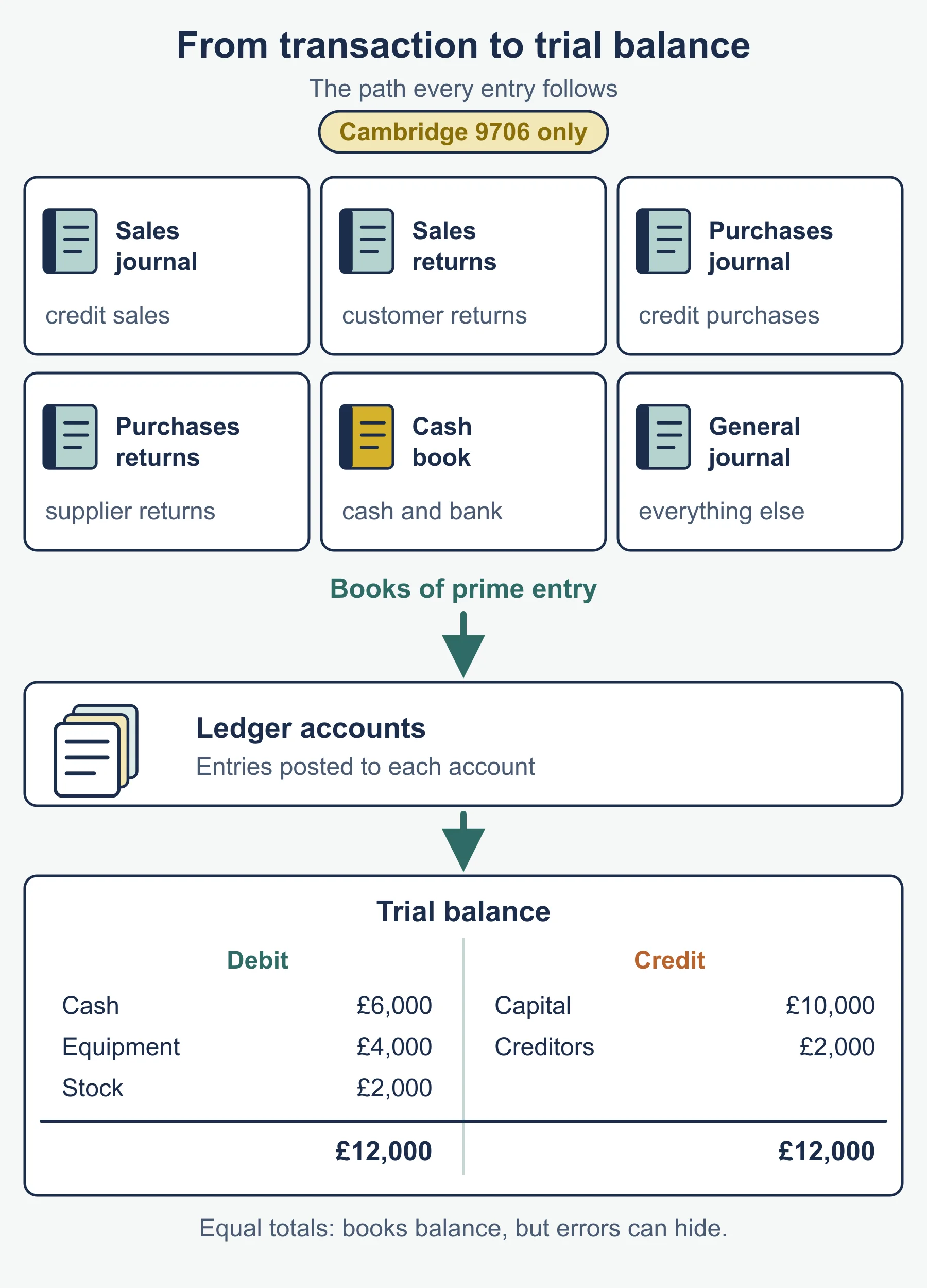
Under double entry, each transaction is entered as equal and opposite debit and credit amounts in two accounts. Mistakes still happen when entries are made, copied or added up. Verification means checking the records for accuracy. The specification lists four techniques:
- Trial balance: checks that total debit balances equal total credit balances.
- Trade receivables ledger control accounts: checks the total owed by credit customers against the individual customer accounts.
- Trade payables ledger control account: does the same for amounts owed to suppliers.
- Bank reconciliation statement: checks the cash book against the bank statement.
This guide deals with the first. The other three are in the topic guide linked above. Each technique tests a different part of the records, so passing one does not excuse you from the others.
2. Preparing a trial balance from a list of balances
A trial balance is a list of all ledger account balances at one date, split into a debit column and a credit column. If every entry had two equal sides, the two columns add to the same total.
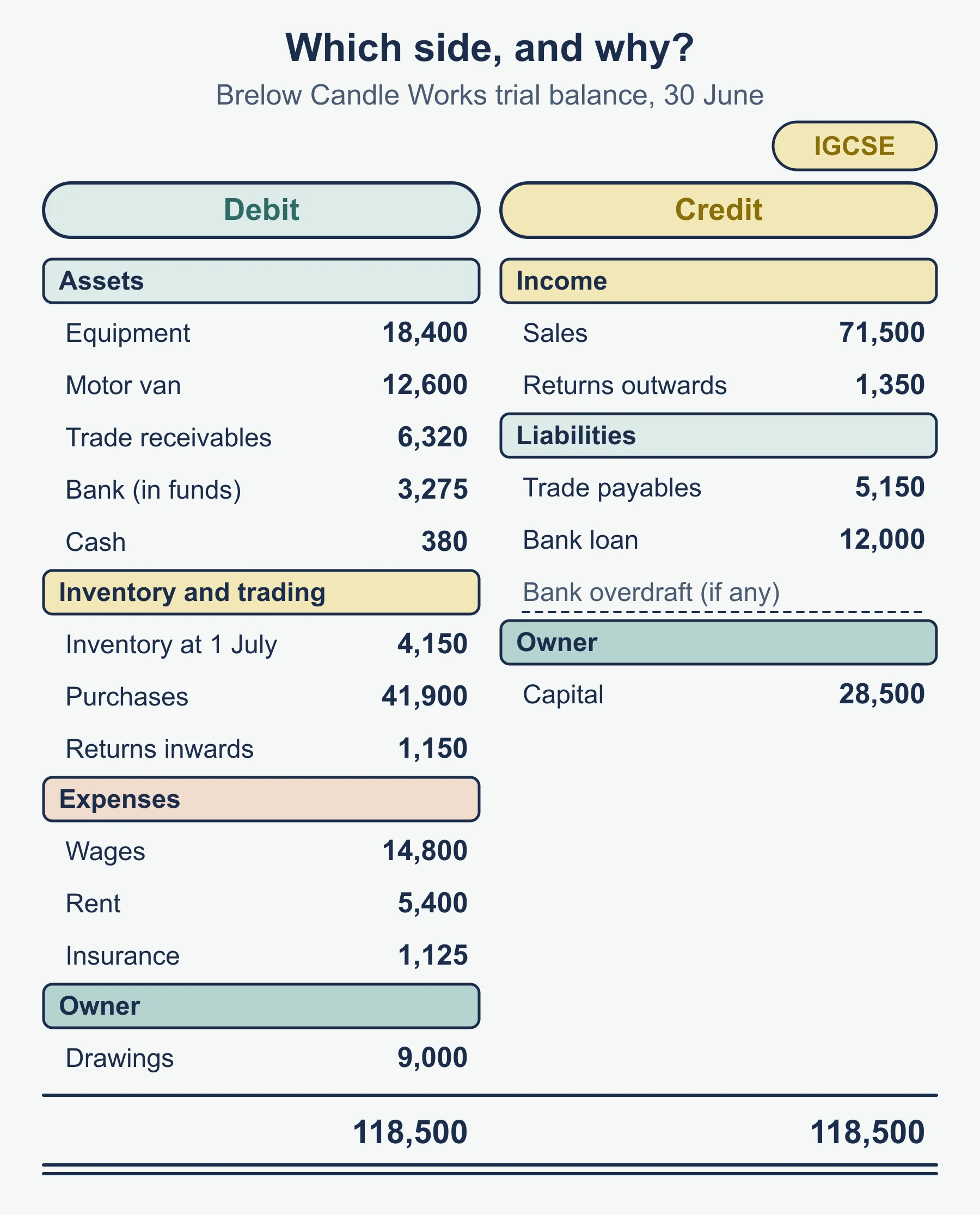
First place each balance on the correct side. Use the nature of the account.
| Debit balances | Credit balances |
|---|---|
| Assets: equipment, motor vehicles, trade receivables, bank (in funds), cash | Capital |
| Expenses: wages, rent, insurance | Income: sales, fees income |
| Purchases and returns inwards | Returns outwards |
| Drawings | Liabilities: trade payables, loans, bank overdraft |
| Inventory at the start of the period |
Method:
- Write the heading with the business name and the date.
- Go down the list and put each balance in the debit or credit column.
- Add each column separately.
- Compare the totals.
Worked example: Brelow Candle Works
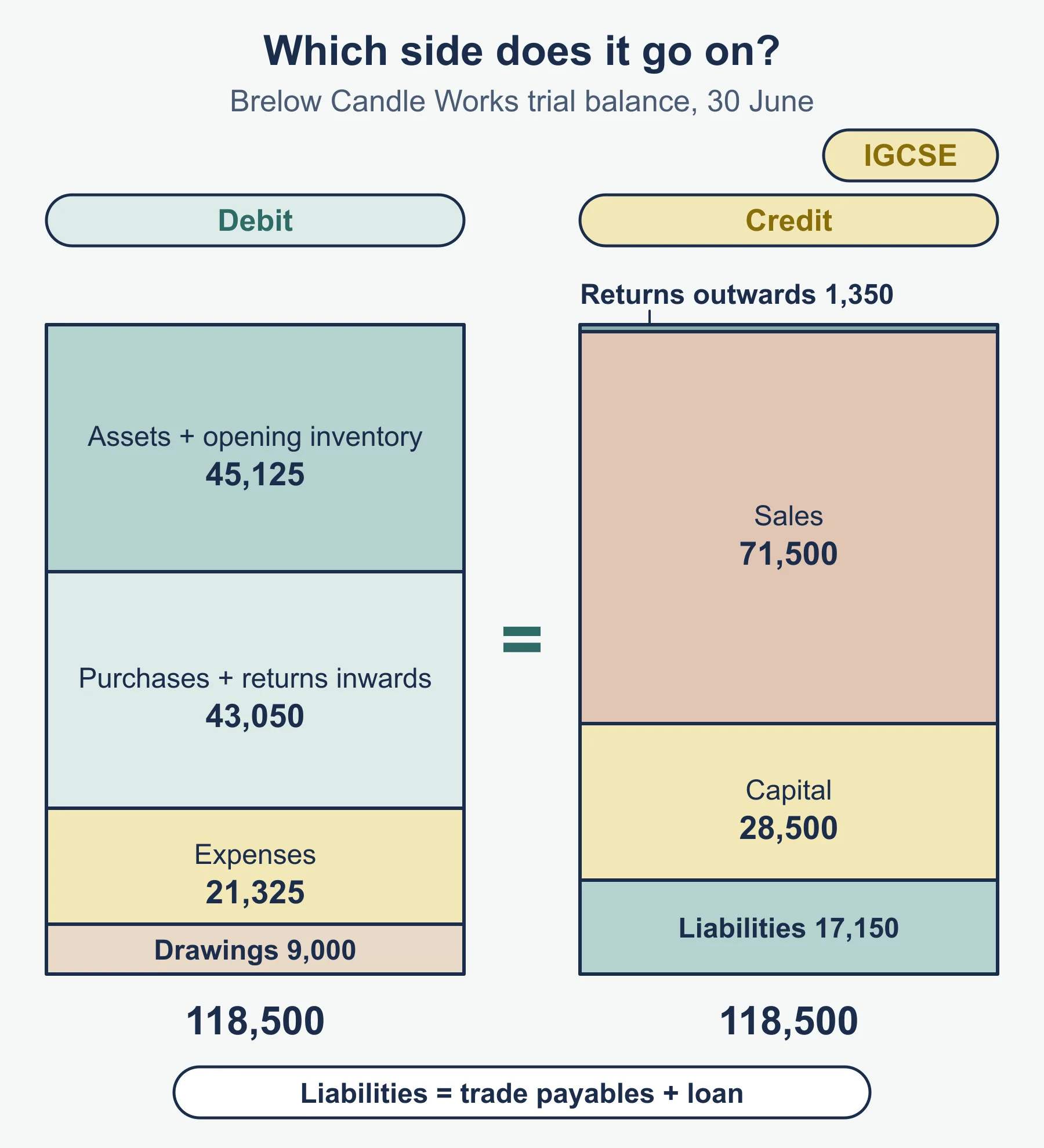
Balances at 30 June, in the order the bookkeeper found them: bank loan 12,000; wages 14,800; equipment 18,400; sales 71,500; trade payables 5,150; inventory at 1 July 4,150; capital 28,500; purchases 41,900; rent 5,400; trade receivables 6,320; insurance 1,125; motor van 12,600; drawings 9,000; returns outwards 1,350; bank 3,275 (in funds); returns inwards 1,150; cash 380.
Trial balance of Brelow Candle Works at 30 June
| Account | Debit | Credit |
|---|---|---|
| Equipment | 18,400 | |
| Motor van | 12,600 | |
| Inventory at 1 July | 4,150 | |
| Trade receivables | 6,320 | |
| Bank | 3,275 | |
| Cash | 380 | |
| Purchases | 41,900 | |
| Returns inwards | 1,150 | |
| Wages | 14,800 | |
| Rent | 5,400 | |
| Insurance | 1,125 | |
| Drawings | 9,000 | |
| Sales | 71,500 | |
| Returns outwards | 1,350 | |
| Trade payables | 5,150 | |
| Bank loan | 12,000 | |
| Capital | 28,500 | |
| Totals | 118,500 | 118,500 |
The columns agree, so the arithmetic of the double entry is consistent. The inventory shown is the opening figure from the ledger, not a closing count.
3. Correcting a trial balance that does not agree
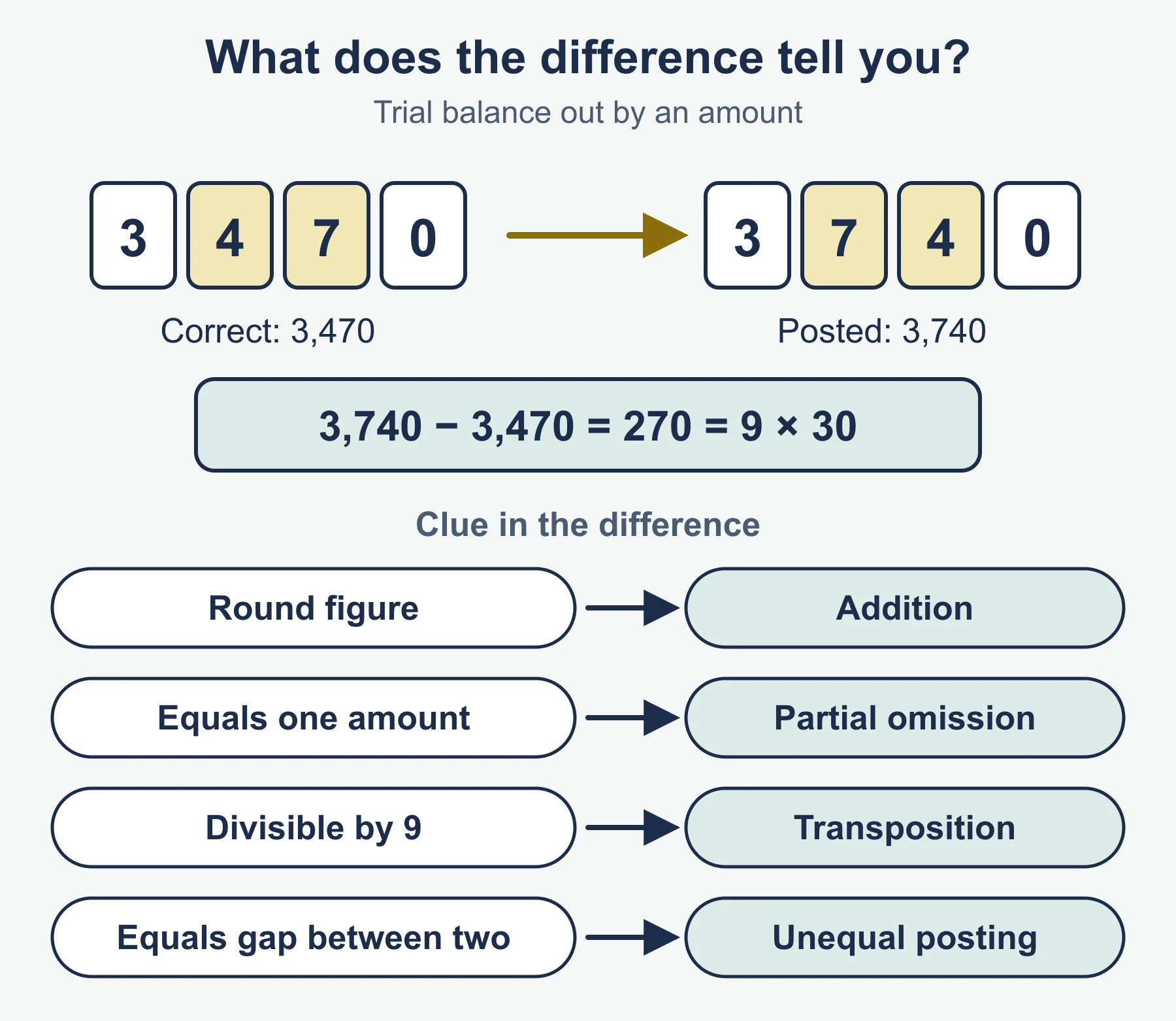
If the totals differ, an error exists somewhere. Do not force the totals to match. Look for the cause. The size of the difference gives clues:
| Clue | Possible cause |
|---|---|
| Difference is exactly twice one balance | That balance was put in the wrong column |
| Difference equals one balance | That balance was left off the list, or only one side of an entry was posted |
| Difference divides exactly by 9 | Two digits may have been swapped (transposition) |
| Difference is a round amount such as 100 or 1,000 | A column or ledger account may have been added wrongly |
These are only clues. Confirm each one by checking the balance back to its ledger account.
Worked example: Orsolo Tutoring
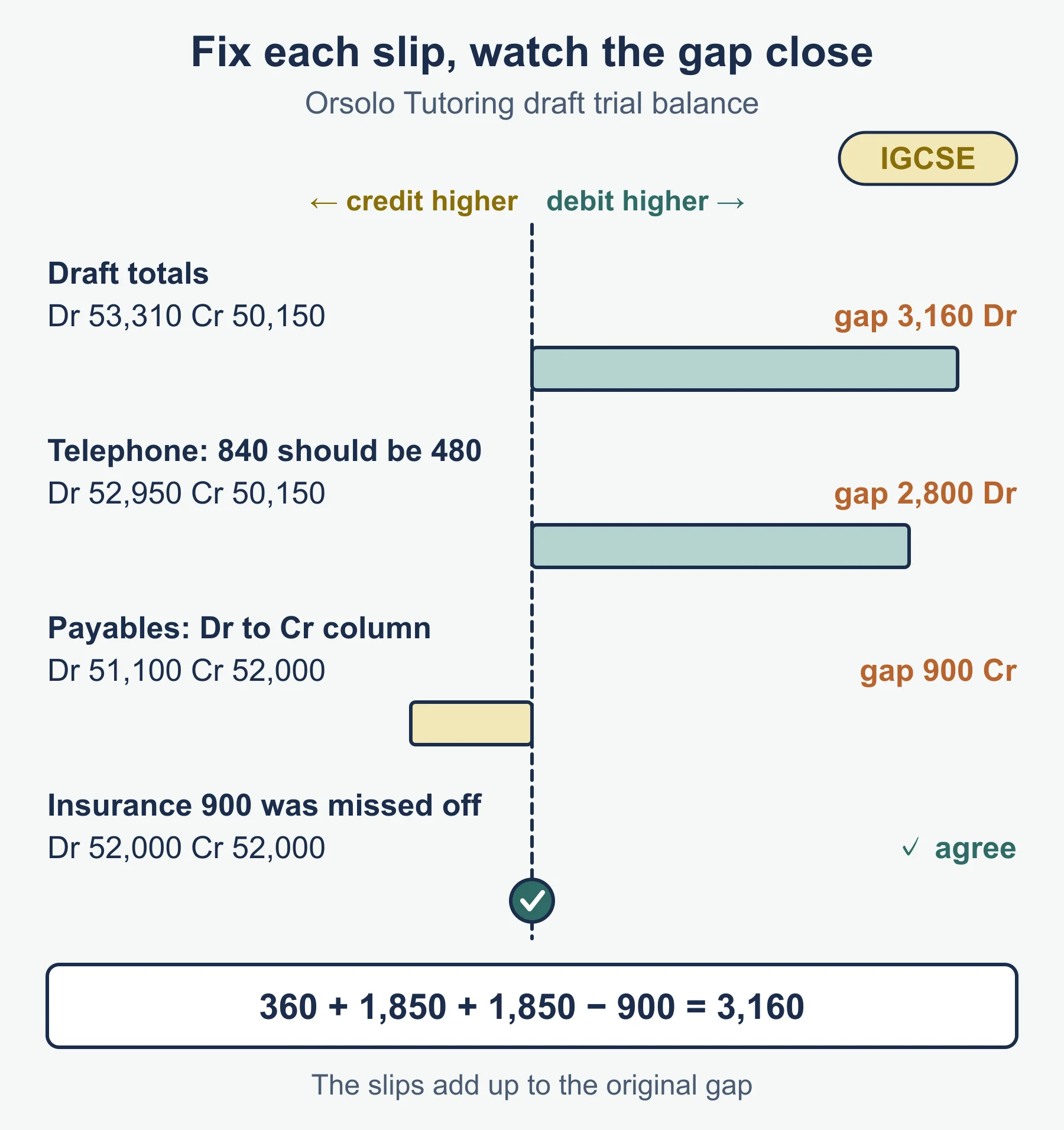
A trainee prepared a draft trial balance. The debit column totalled 53,310 and the credit column totalled 50,150. Checking each balance back to the ledger found three slips:
- Telephone, correct balance 480, was entered as 840.
- Trade payables, 1,850, was entered in the debit column.
- Insurance, 900, was missed off the list.
Step 1: difference = 53,310 − 50,150 = 3,160 (debit column too high).
Step 2: effect of each slip on the debit column and credit column.
| Slip | Debit column | Credit column |
|---|---|---|
| Telephone 840 not 480 | 360 too high | no change |
| Payables in debit column | 1,850 too high | 1,850 too low |
| Insurance missed off | 900 too low | no change |
Step 3: apply the corrections.
| Debit column | Credit column | |
|---|---|---|
| Draft totals | 53,310 | 50,150 |
| Telephone: subtract 360 | (360) | |
| Payables: subtract 1,850 from debit, add 1,850 to credit | (1,850) | 1,850 |
| Insurance: add 900 | 900 | |
| Corrected totals | 52,000 | 52,000 |
Check: 360 + 1,850 + 1,850 − 900 = 3,160, which is the original difference. Leaving a balance off a list is a slip in the trial balance, not the ledger error called omission in section 4. The ledger was right here.
4. Use and limitations: errors the trial balance does not reveal
Uses of a trial balance:
- It gives a quick arithmetic check on the double entry.
- It shows that debits equal credits, which is a necessary condition for correct records.
- It provides the list of balances from which the financial statements are drawn up.
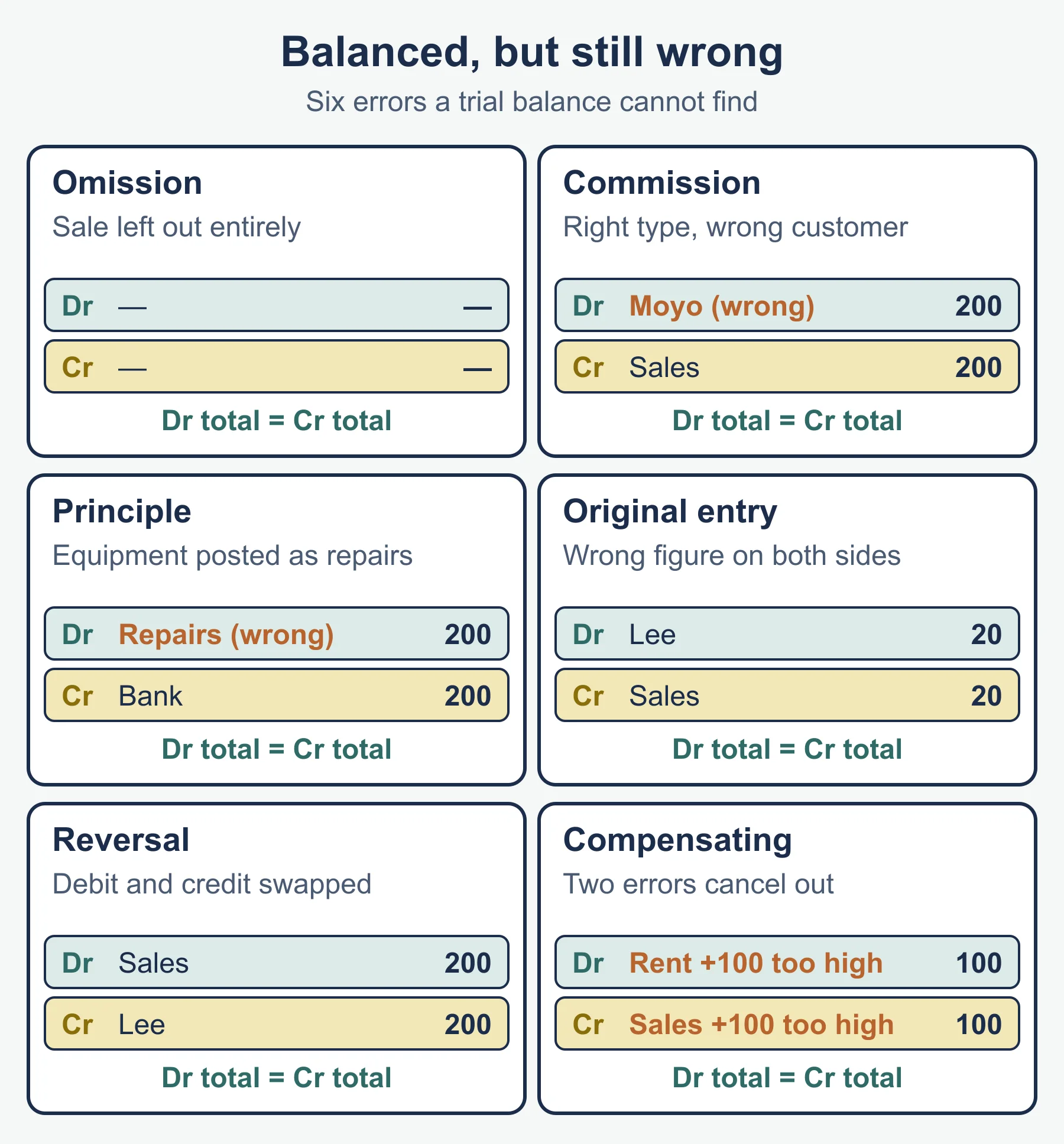
The limitation is that it only compares totals. An error that keeps the debit total equal to the credit total passes unseen. Six such errors are named in the specification.
| Error | What happens | Example | Totals still agree? |
|---|---|---|---|
| Commission | Right class of account, wrong account | A 360 sale to Mr Haldane is debited to the account of Mr Haldain | Yes |
| Complete reversal | Right accounts and amount, but debit and credit swapped | Cash of 540 received from a customer is debited to the customer and credited to bank | Yes |
| Compensating | Two separate errors of equal size, one on each side, cancel out | Rent account overadded by 150 and fees received account overadded by 150 | Yes |
| Omission | A transaction is left out of the books altogether | A supplier invoice for 620 is never recorded | Yes |
| Original entry | Wrong amount taken from the source document, then posted correctly to both accounts | An invoice for 1,780 is read as 1,870 | Yes |
| Principle | Posted to the wrong class of account | A printer costing 950 is debited to office expenses instead of a non-current assets account | Yes |
Compare the pairs that look alike. In a complete reversal the amount is right but both sides are swapped. In original entry the sides are right but the amount is wrong on both. In commission the class of account is right, but in principle the class is wrong (an expense account where an asset belongs, for example).
So a trial balance that agrees shows only that the two totals match. It does not prove that every entry is complete, correctly valued, in the right account or in the right class.
5. Errors the trial balance does reveal
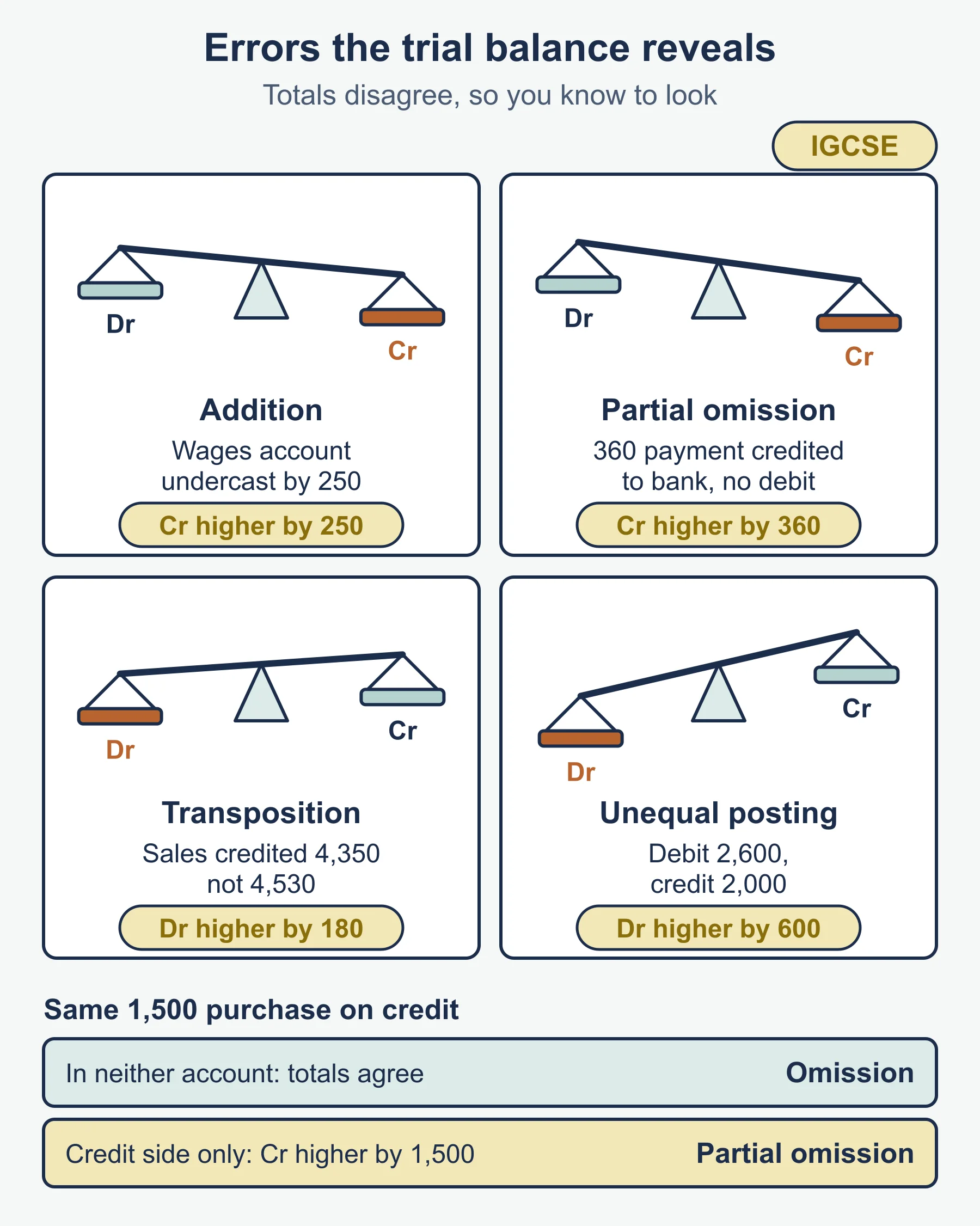
These four errors destroy the equality of the two totals, so the columns disagree.
| Error | What happens | Example | Which total is higher? |
|---|---|---|---|
| Addition | A ledger account or column is added up wrongly | The wages account is undercast by 250 | Credit column, by 250 |
| Partial omission | One side of a transaction is recorded and the other is not | A payment of 360 to a supplier is credited to bank but never debited to the supplier | Credit column, by 360 |
| Transposition | Digits are swapped when copying a figure | Sales of 4,530 are debited to the customer correctly but credited to sales as 4,350 | Debit column, by 180 |
| Unequal posting | Different amounts are posted to the debit and the credit | An expense is debited as 2,600 but the bank is credited with 2,000 | Debit column, by 600 |
Transposition differences always divide by 9, which is why that clue helps. Do not assume the reverse: a difference that divides by 9 may have another cause.
Worked example: deciding what the trial balance will show
Ask two questions of any error. First, does it affect the debit total and the credit total equally, or only one? Second, which total moves, and by how much?
Case: purchases on credit of 1,500 are credited to the supplier’s account but the debit to purchases is missed. Only the credit side has been recorded, so credits exceed debits by 1,500. This is partial omission, and the trial balance will reveal it.
Case: the same purchase is entered in neither account. Both totals are missing the same 1,500 of activity, so they still agree. This is omission, and the trial balance will not reveal it.
Common errors in answers
- Saying a trial balance proves the accounts are accurate. It proves only that totals agree.
- Placing a bank overdraft in the debit column. It is a liability and belongs on the credit side.
- Mixing up omission (nothing recorded) and partial omission (one side recorded).
- Calling a balance left off the trial balance list an error of omission.
- Naming the error without stating whether the totals would still agree.
- Adding the columns of a draft trial balance wrongly, then hunting for a ledger error that does not exist. Add both columns twice.
Next steps
Test yourself with the trial balance revision notes, then attempt the practice questions. Tick off topics on the checklist and see all free diagnostics.
Frequently asked questions
What is a trial balance in IGCSE Accounting? A trial balance is a list of all ledger account balances at a date, set out in debit and credit columns. If the two totals agree, the arithmetic of the double entry is correct; in OxfordAQA 9215 it is one of four verification techniques, alongside the two ledger control accounts and the bank reconciliation statement.
What are the uses and limitations of a trial balance? A trial balance gives a quick arithmetic check on the double entry and a convenient list of balances for preparing financial statements. Its limitation is that it only compares totals, so errors such as omission, commission or principle are not revealed.
How do you correct a trial balance that does not agree? Work out the difference between the two totals, then trace each error and calculate its effect on the debit or credit column. Applying the corrections should remove the whole difference, which is your check.
Why do transposition differences divide by 9? Swapping two digits changes a number by a multiple of 9, for example 840 instead of 480 is a difference of 360. This is why a trial balance difference divisible by 9 is a clue to a transposition.
Official syllabus
OxfordAQA International GCSE Accounting (9215), specification version 1.2, section 3.2 Verification of accounting records, published by OxfordAQA.
Get free revision emails (optional)
Occasional emails with practice questions, worked explanations and links to free resources for the qualification and subjects you choose. No spam, and you can unsubscribe from any email. The free tools on this site never need an email.
Related resources
-
Practice questions
OxfordAQA IGCSE Accounting: Double entry verification and the trial balance (9215) – Practice Questions
Ten original questions with worked answers on preparing, correcting and evaluating a trial balance for OxfordAQA International GCSE Accounting 9215.
Accounting · OxfordAQA · IGCSE
Try questions -
Revision notes
OxfordAQA IGCSE Accounting: Double entry verification and the trial balance (9215) – Revision Notes
Condensed recall notes on preparing and correcting a trial balance and on the ten error types, for OxfordAQA International GCSE Accounting 9215.
Accounting · OxfordAQA · IGCSE
Revise topic -
Practice questions
OxfordAQA IGCSE Accounting: Verification of Accounting Records — Practice Questions (9215)
Exam-style practice questions with worked answers on trial balances, control accounts, bank reconciliation and suspense accounts for OxfordAQA IGCSE 9215.
Accounting · OxfordAQA · IGCSE
Try questions
Related articles
-
teaching
A Level tuition in Dubai: Cambridge or Pearson Edexcel International A Level?
Schools in Dubai and Abu Dhabi teach either Cambridge International AS & A Level or Pearson Edexcel International A Level. How the two are structured, why it matters for tuition, and how online classes from Lahore work.
9 October 2026
-
curriculum guides
Choosing subjects at IGCSE and A Level
How subject choices at 14 and 16 affect university options later, and how to keep pathways open without overloading a timetable.
28 July 2026
Studying this with a teacher
Working through Accounting IGCSE?
This page is free and stays free. If you would rather be taught it, Marlbridge runs Accounting classes one-to-one and in small groups of up to 15, online in your own time zone. The first trial class is free. WhatsApp replies within an hour (8am–11pm Pakistan time, every day); email the same day.
OxfordAQA Accounting teachers at Marlbridge

