
Revision Notes
OxfordAQA IGCSE Accounting: Double entry verification and the trial balance (9215) – Revision Notes
Condensed recall notes on preparing and correcting a trial balance and on the ten error types, for OxfordAQA International GCSE Accounting 9215.
- Subject
- Accounting
- Level
- IGCSE
- Topic
- Verification of accounting records
- Author
- Marlbridge Academic Team
- Updated
- Reviewed by
- Javaid Iqbal Sabri (what this means)
Aligned to OxfordAQA IGCSE Accounting (9215), First teaching 2024, first examined 2026. Official specification .
Syllabus page (what it covers and how it is assessed): OxfordAQA IGCSE Accounting.
Syllabus points this page covers
9215
- Verification of the double entry records
Found an error? Report a correction.
Need help with this topic? Request a free trial class for IGCSE Accounting (9215).
These notes condense the first two content points of section 3.2 Verification of accounting records in the OxfordAQA International GCSE Accounting (9215) specification, version 1.2, for International GCSE exams May/June 2026 onwards. For full explanations and longer worked examples, read the trial balance study guide. Amounts here are in dollars.
Links: practice questions for this unit; whole-topic revision notes for control accounts, bank reconciliation and error correction; course hub; checklist; free diagnostics.
Key definitions
| Term | Meaning |
|---|---|
| Verification | Checking that the double entry records are accurate |
| Trial balance | A two-column list of all the ledger account balances at a chosen date, debits on one side and credits on the other |
| Agreeing | The debit total equals the credit total |
| Verification techniques named in 3.2 | Trial balance; control accounts (receivables ledger, payables ledger); bank reconciliation statements |
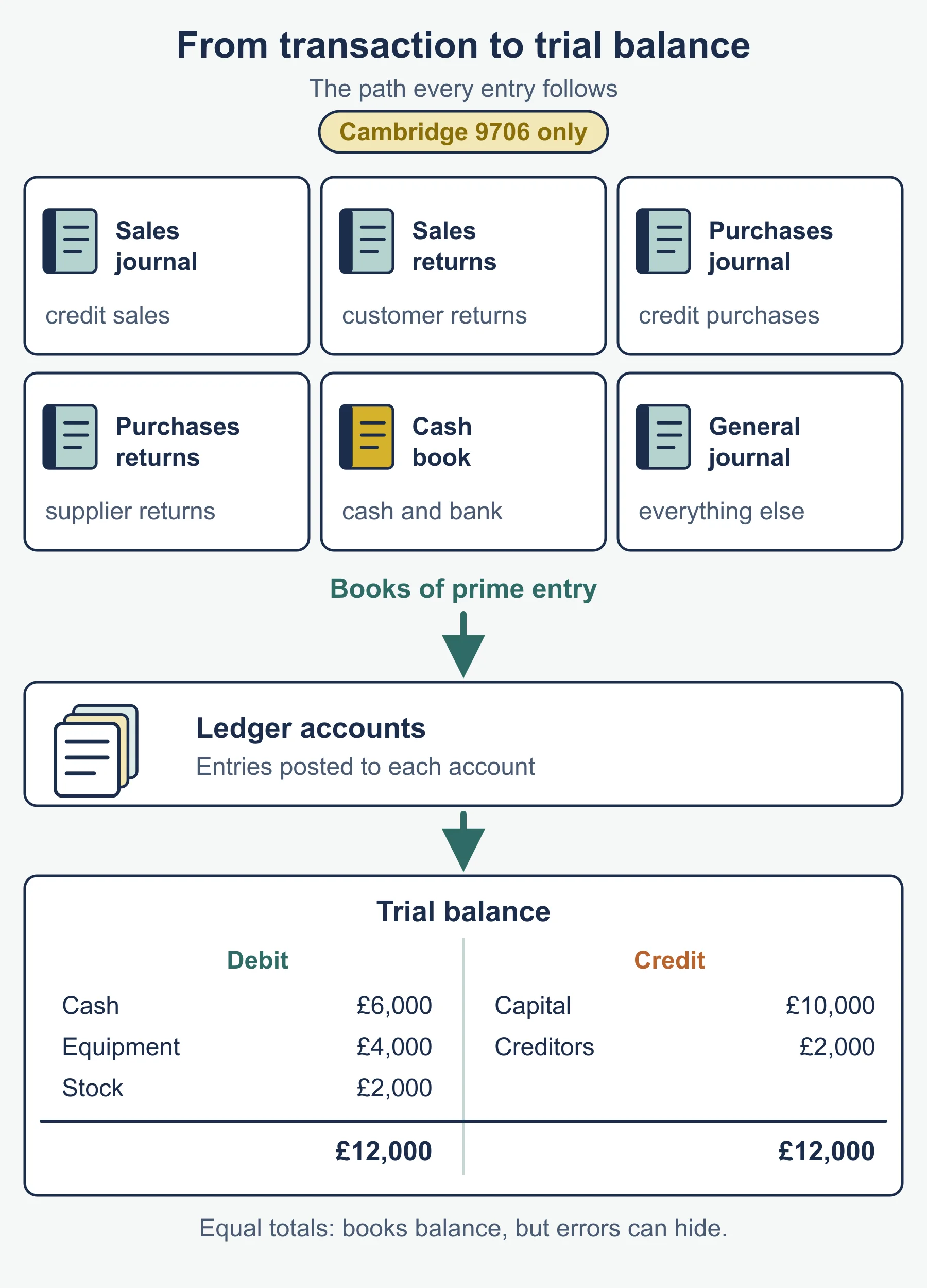
A trial balance tests arithmetic agreement only. It does not test whether each entry is right.
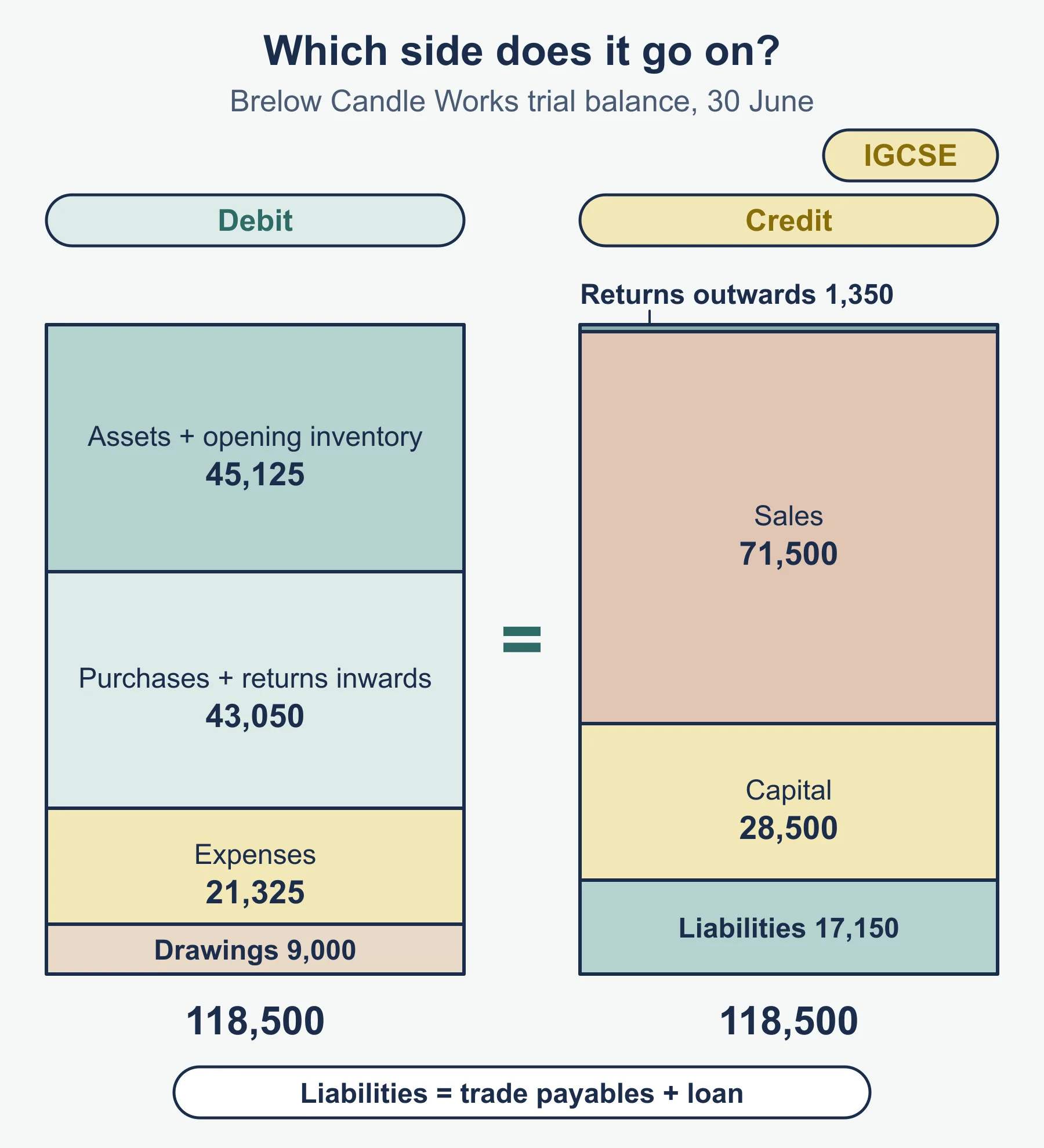
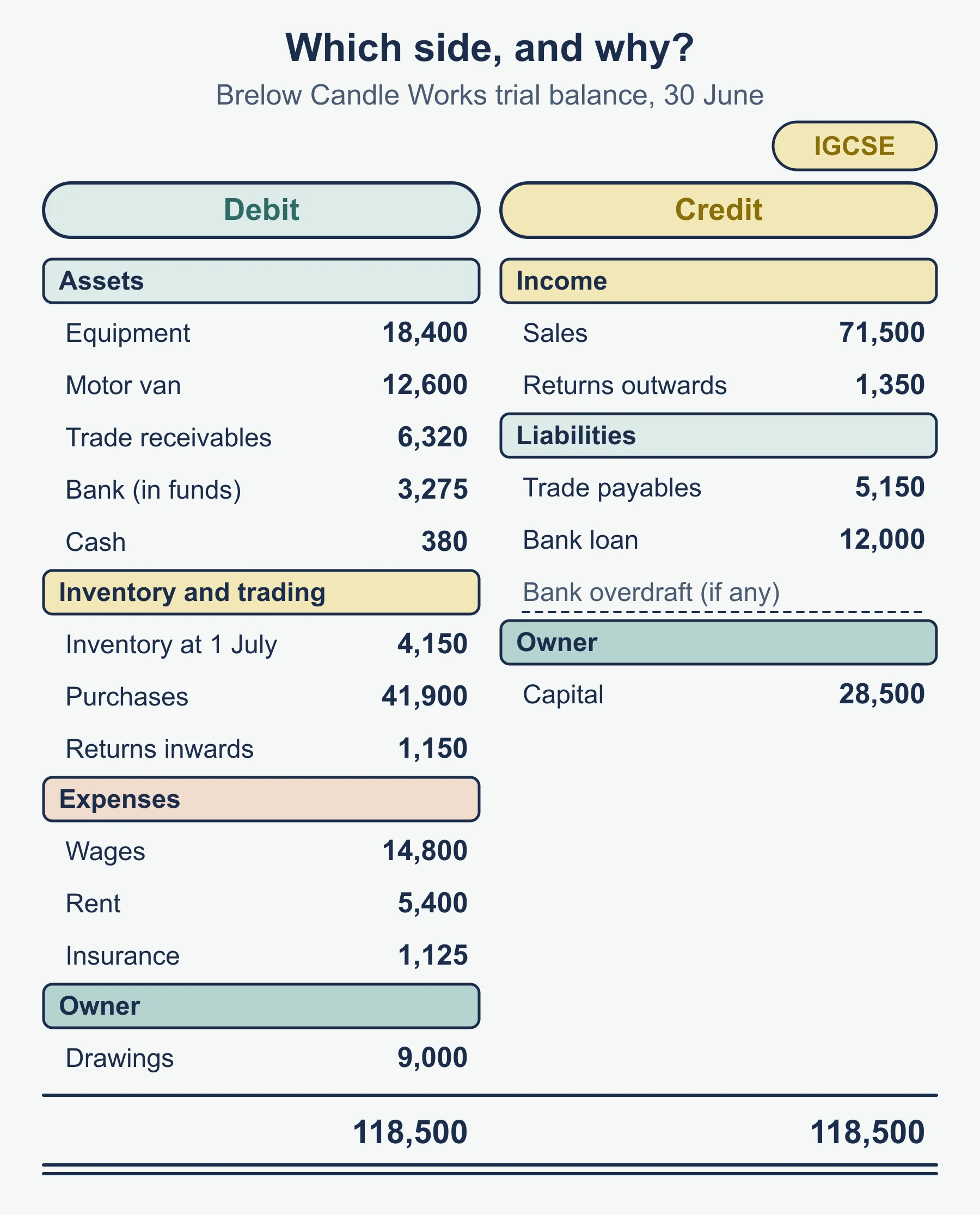
Which column?
| Debit | Credit |
|---|---|
| Assets (equipment, vehicles, trade receivables, cash, bank in funds) | Capital |
| Expenses (wages, rent, insurance) | Income (sales, fees income) |
| Purchases, returns inwards | Returns outwards |
| Drawings | Liabilities (trade payables, loans, bank overdraft) |
| Inventory at the start of the period |
Memory aid: things the business owns or spends are debits. Things it owes, earns or was given by the owner are credits. Returns inwards reduce sales, but they are listed as a debit balance in the trial balance.
Method: preparing a trial balance
- Head it with the business name and the date.
- List each account name once.
- Put each balance in the debit or credit column.
- Add each column and write the totals on one line.
- If the totals differ, do not adjust any figure to force agreement. Start the search for the error.
Small reminder: Sandeford Ceramics
Balances: kiln 8,200; inventory at 1 January 2,300; trade receivables 1,950; purchases 9,600; rent 3,000; drawings 4,500; sales 21,400; trade payables 1,850; capital 6,300.
| Column | Items | Total |
|---|---|---|
| Debit | 8,200 + 2,300 + 1,950 + 9,600 + 3,000 + 4,500 | 29,550 |
| Credit | 21,400 + 1,850 + 6,300 | 29,550 |
Method: when the totals do not agree
- Add both columns again.
- Work out the difference and note which column is higher.
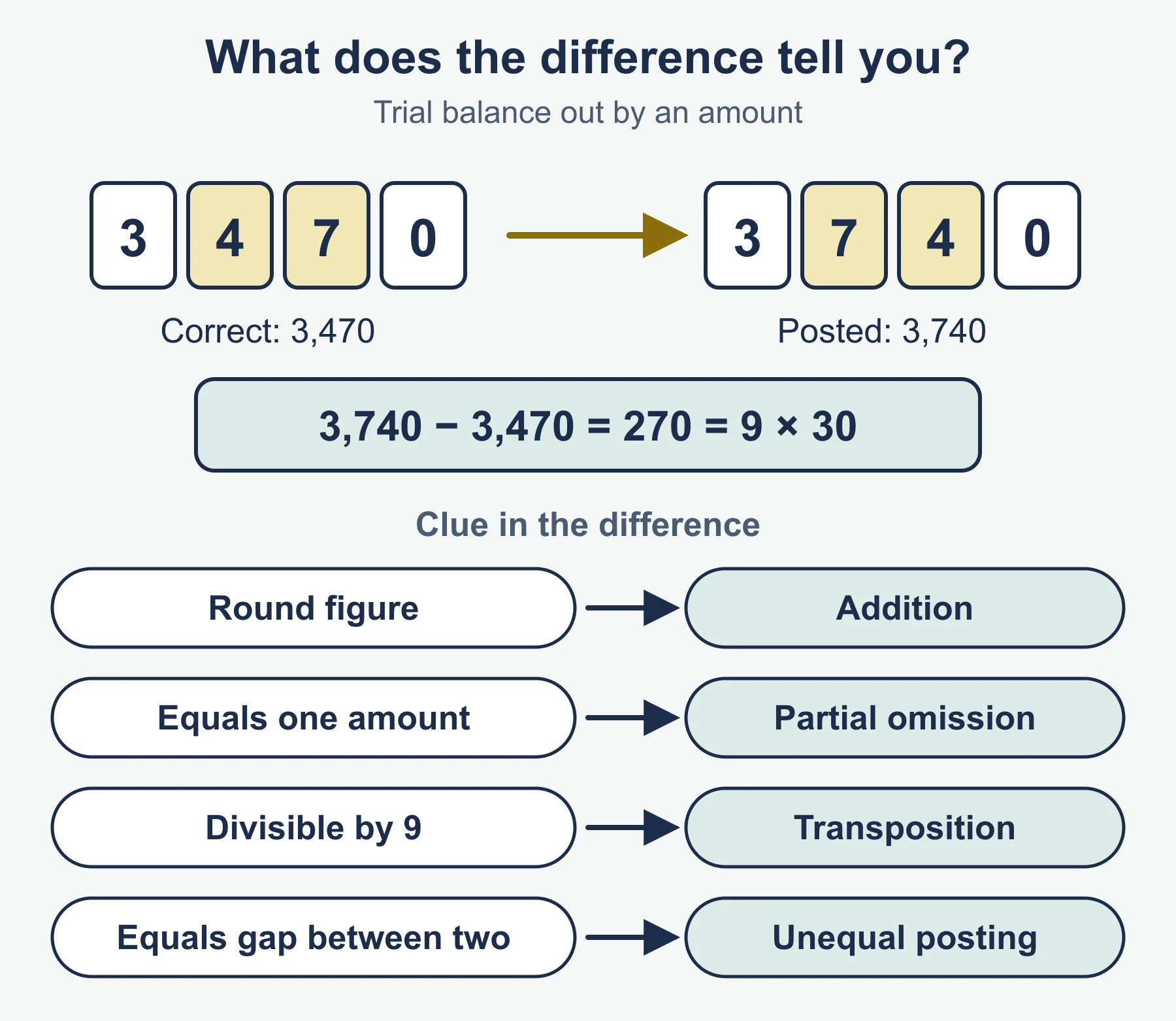
- Test the clues in the table below.
- Trace the suspect balance back to its ledger account.
- Correct the column totals and show both agreeing.
| Difference | Test | Possible cause |
|---|---|---|
| Twice a balance | Halve it and look for that balance | Balance in the wrong column |
| Equal to a balance | Look for that figure | Balance left off the list, or only one side posted |
| Divisible by 9 | Check for swapped digits | Transposition |
| Round figure | Re-add the accounts | Addition error |
Reminder example: debit column 45,260, credit column 44,720. Difference 540, debit higher. Half is 270, so a credit balance of 270 may sit in the debit column. 540 divides by 9, so a transposition may exist. A credit balance of 540 may be missing from the list. Only the ledger can say which.
The ten error types
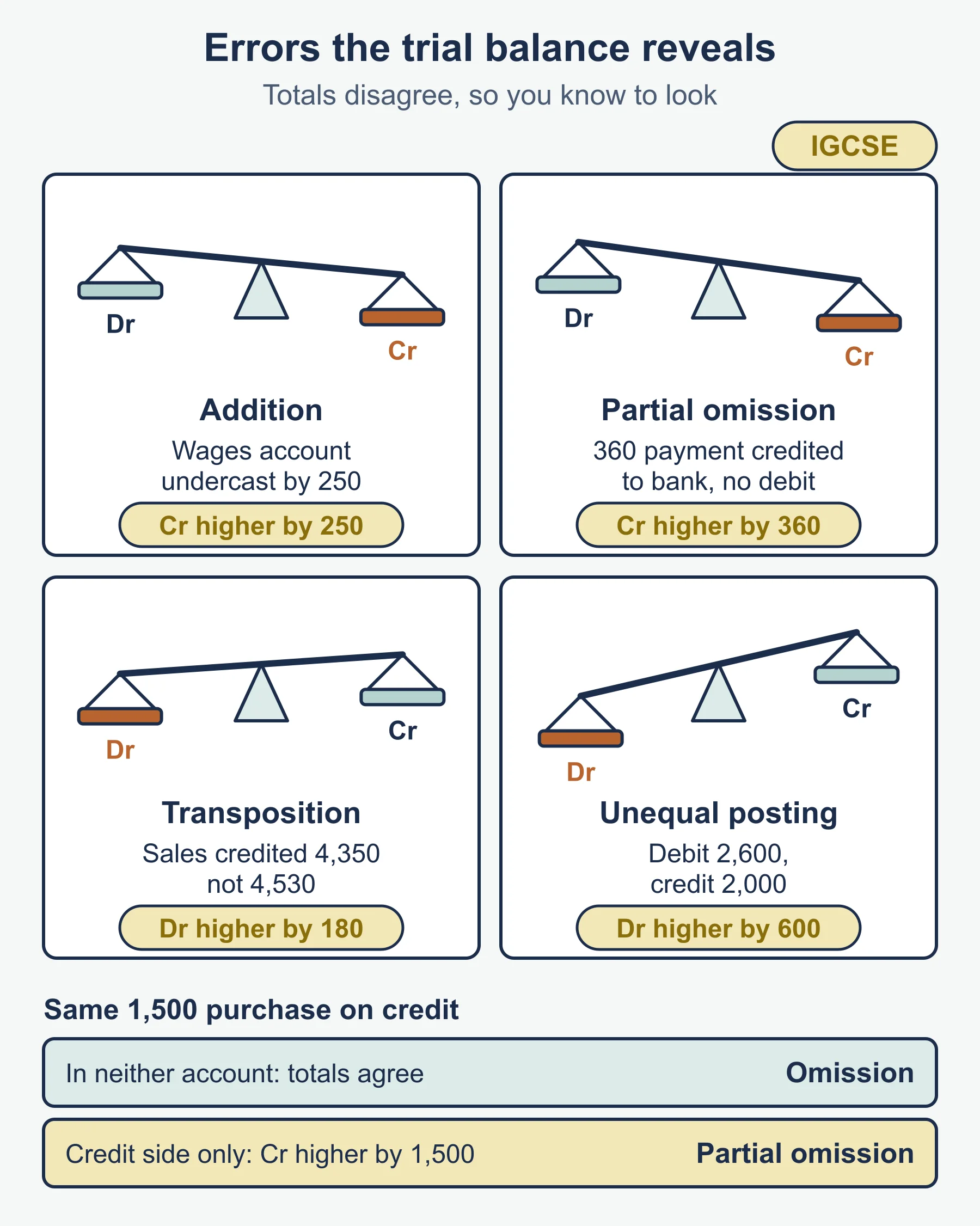
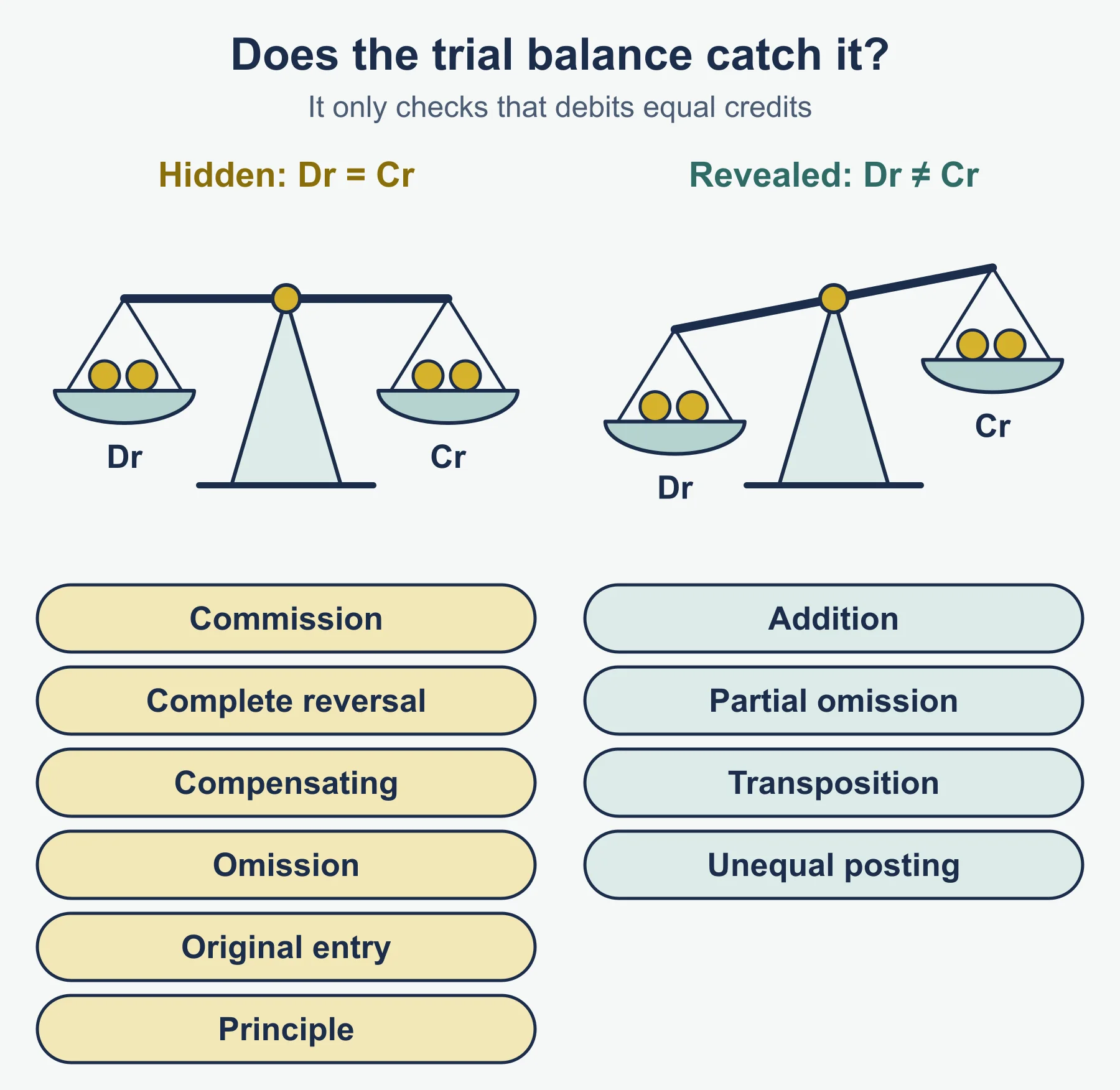
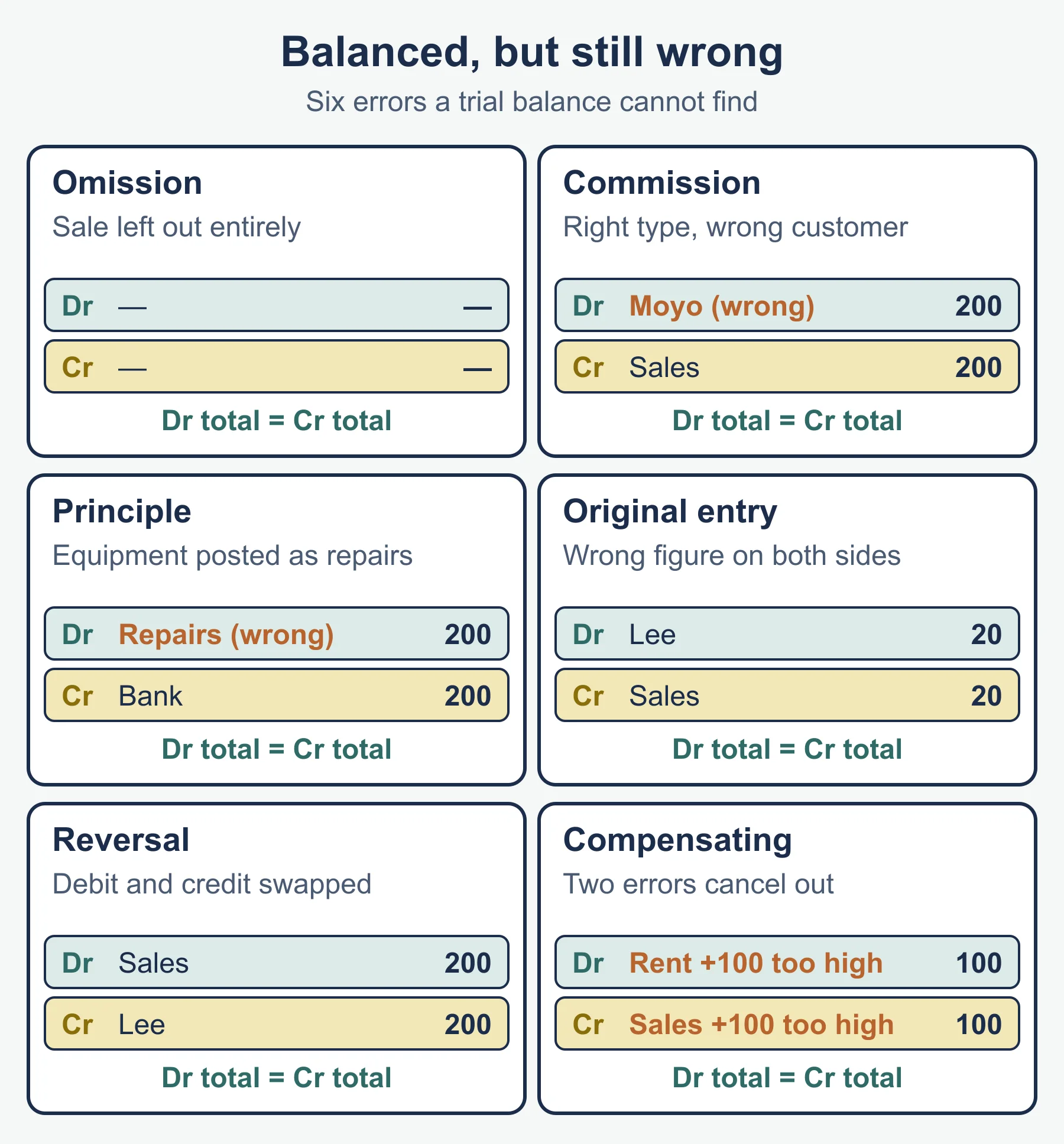
Learn them as two lists. If the debit total and credit total are still equal after the error, the trial balance cannot reveal it.
Not revealed (totals still agree)
| Error | Key idea | Short example |
|---|---|---|
| Commission | Right class, wrong account | A cheque from Mr Kessock is credited to the account of Mr Kessick |
| Complete reversal | Right accounts, sides swapped | A 410 cheque paid to a supplier is credited to the supplier and debited to bank |
| Compensating | Two errors cancel in the totals | Sales overadded by 300 and wages overadded by 300 |
| Omission | Whole transaction missing | A 90 cash expense never entered |
| Original entry | Wrong amount at source, both sides equal | A receipt for 2,160 is read as 2,610 and posted that way twice |
| Principle | Wrong class of account | A new counter is debited to repairs |
Revealed (totals disagree)
| Error | Key idea | Short example |
|---|---|---|
| Addition | Wrong adding up | A purchases account is overcast by 200 |
| Partial omission | One side of the entry missing | Discount received credited, but the debit is never made |
| Transposition | Digits swapped | 3,270 posted as 3,720 on one side |
| Unequal posting | Debit and credit amounts differ | Debit 800, credit 780 |
Look-alike pairs:
- Omission has nothing recorded. Partial omission has one side recorded.
- Complete reversal swaps the sides. Original entry has the wrong amount on both sides.
- Commission uses the wrong account in the right class. Principle uses the wrong class.
- Compensating has two errors. The others have one.
Worked reminder: correcting the totals
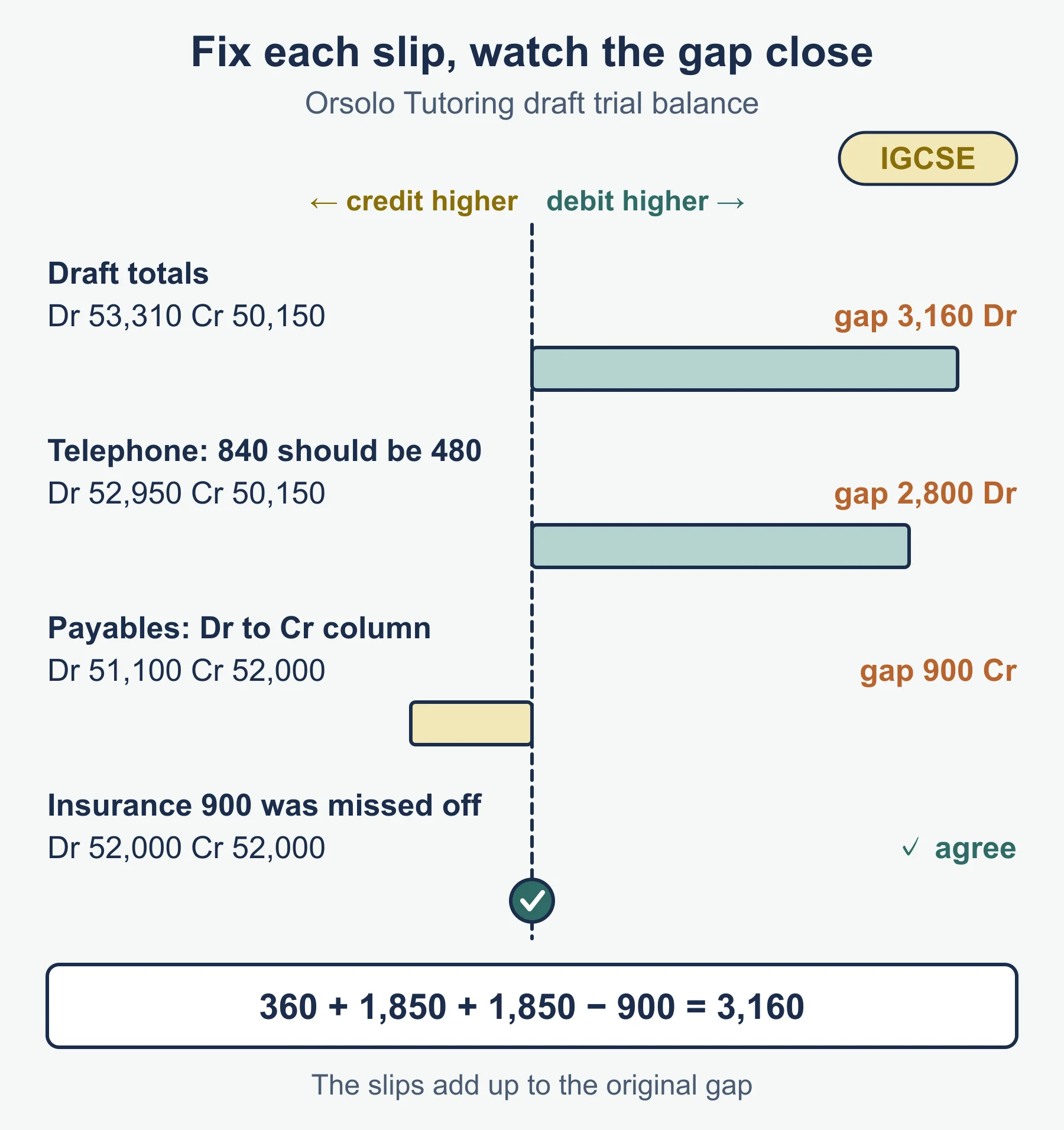
A draft trial balance shows a debit total of 28,980 and a credit total of 31,200. The ledger check finds two slips: rent of 1,200 was put in the credit column, and electricity of 680 was listed as 860.
| Debit column | Credit column | |
|---|---|---|
| Draft totals | 28,980 | 31,200 |
| Electricity: 860 should be 680 | (180) | |
| Rent: move 1,200 from credit to debit | 1,200 | (1,200) |
| Corrected totals | 30,000 | 30,000 |
Check: the draft difference is 31,200 − 28,980 = 2,220. Rent accounts for 2 × 1,200 = 2,400 and electricity for 180 the other way, and 2,400 − 180 = 2,220.
How to name an error
Ask these questions in order.
- Is the whole transaction missing from the books? Then it is omission.
- Is only one side missing, or do the two sides differ? Then it is partial omission or unequal posting, and the totals disagree.
- Are the sides swapped but the accounts and amount right? Then it is complete reversal.
- Is the amount wrong in the same way on both sides? Then it is original entry.
- Is the account wrong, and in the same class? Then it is commission. In a different class? Then it is principle.
- Are two unrelated errors cancelling? Then it is compensating.
- Are digits swapped on one side only, or an account added up wrongly? Then it is transposition or addition.
Uses and limitations of a trial balance
| Uses | Limitations |
|---|---|
| Quick arithmetic check of double entry | Errors that leave totals equal pass unseen (the six above) |
| Shows an error exists when columns differ | Does not say where the error is |
| Source of the balances for financial statements | Does not show the amounts are valued correctly |
| Easier than checking every account one by one | Agreement does not mean the accounts are free from error |
When asked to explain the use and the limit, state both and give one example of an undetected error.
Quick self-test
- In which column does a returns outwards balance go?
- A bank overdraft of 1,640 is entered in the debit column. By how much do the column totals differ, and which is higher?
- A balance of 3,270 is listed as 3,720. Find the effect on the debit total and say why the difference suggests transposition.
- Name the six errors not revealed by a trial balance.
- Name the four errors revealed.
- A sale of 720 to customer Kessock is posted to the account of customer Kessick. Name the error and say whether the trial balance agrees.
- State the difference between omission and partial omission.
- A 410 payment to a supplier is credited to the supplier and debited to bank. Name the error.
- Give one use and one limitation of a trial balance.
- The debit column is 45,260 and the credit column is 44,720. State two possible causes.
Answers
- Credit.
- The overdraft should be a credit, so the debit column is 1,640 too high and the credit column 1,640 too low. The difference is 2 × 1,640 = 3,280, with debit higher.
- The debit total is 3,720 − 3,270 = 450 too high. 450 divides exactly by 9 (450 ÷ 9 = 50).
- Commission, complete reversal, compensating, omission, original entry, principle.
- Addition, partial omission, transposition, unequal posting.
- Commission. The totals still agree.
- Omission: the whole transaction is missing. Partial omission: one side is recorded and the other missing, so the totals differ.
- Complete reversal.
- Use: a quick check that debits equal credits. Limitation: some errors, such as compensating errors, leave the totals equal and are not shown.
- Any two of: a credit balance of 270 in the debit column; a credit balance of 540 left off the list; a transposition giving a difference of 540.
Where marks are usually lost
- Writing that a trial balance proves the accounts are correct.
- Putting a bank overdraft, loan or trade payables in the debit column.
- Treating drawings as an expense. Drawings are the owner’s withdrawals and are a debit balance in their own right.
- Forgetting the opening inventory line, or using a closing inventory figure that does not belong on the trial balance.
- Giving the name of an error without saying whether the columns still agree.
- Confusing omission with partial omission, or commission with principle.
- Answering a “explain a limitation” question with a general comment instead of naming an error that goes undetected.
- Stating a total without showing the adding, so one slip loses the whole answer.
- Forcing the totals to agree, for example by changing a figure, rather than tracing the error.
- Describing a missing balance on a draft list as an error of omission in the ledger.
Frequently asked questions
What does a trial balance check? A trial balance checks that total debit balances equal total credit balances, which tests the arithmetic of the double entry. It does not prove that every transaction has been recorded in the right account or at the right amount.
Which errors are not revealed by a trial balance? Six errors leave the totals in agreement: commission, complete reversal, compensating errors, omission, original entry and principle. In each case the debit and credit entries remain equal.
Which errors are revealed by a trial balance? Addition errors, partial omission, transposition in one entry and unequal posting of debit and credit make the trial balance totals disagree, because the two sides no longer match.
What is the difference between an error of commission and an error of principle? An error of commission posts an amount to the wrong account of the right class, such as the wrong customer’s account. An error of principle posts it to the wrong class of account, such as debiting a new non-current asset to repairs.
Official syllabus
OxfordAQA International GCSE Accounting (9215), specification version 1.2, section 3.2 Verification of accounting records, published by OxfordAQA.
Get free revision emails (optional)
Occasional emails with practice questions, worked explanations and links to free resources for the qualification and subjects you choose. No spam, and you can unsubscribe from any email. The free tools on this site never need an email.
Related resources
-
Practice questions
OxfordAQA IGCSE Accounting: Verification of Accounting Records — Practice Questions (9215)
Exam-style practice questions with worked answers on trial balances, control accounts, bank reconciliation and suspense accounts for OxfordAQA IGCSE 9215.
Accounting · OxfordAQA · IGCSE
Try questions -
Study guides
OxfordAQA IGCSE Accounting: Verification of Accounting Records (9215)
OxfordAQA International GCSE Accounting 9215 Topic 2 guide to trial balances, control accounts, bank reconciliation and correcting errors, with examples.
Accounting · OxfordAQA · IGCSE
Read guide -
Revision notes
OxfordAQA IGCSE Accounting: Verification of Accounting Records — Revision Notes
Condensed recall notes on trial balances, control accounts, bank reconciliation and error correction for OxfordAQA International GCSE Accounting Topic 2 (9215).
Accounting · OxfordAQA · IGCSE
Revise topic
Related articles
-
teaching
A Level tuition in Dubai: Cambridge or Pearson Edexcel International A Level?
Schools in Dubai and Abu Dhabi teach either Cambridge International AS & A Level or Pearson Edexcel International A Level. How the two are structured, why it matters for tuition, and how online classes from Lahore work.
9 October 2026
-
curriculum guides
Choosing subjects at IGCSE and A Level
How subject choices at 14 and 16 affect university options later, and how to keep pathways open without overloading a timetable.
28 July 2026
Studying this with a teacher
Working through Accounting IGCSE?
This page is free and stays free. If you would rather be taught it, Marlbridge runs Accounting classes one-to-one and in small groups of up to 15, online in your own time zone. The first trial class is free. WhatsApp replies within an hour (8am–11pm Pakistan time, every day); email the same day.
OxfordAQA Accounting teachers at Marlbridge

