
Revision Notes
OxfordAQA IGCSE Accounting: Partnership statements and partner accounts (9215) – Revision Notes
Condensed revision notes on partnership appropriation accounts, current and capital accounts and equity for OxfordAQA International GCSE Accounting 9215.
- Subject
- Accounting
- Level
- IGCSE
- Topic
- Preparation of financial statements
- Author
- Marlbridge Academic Team
- Updated
- Reviewed by
- Javaid Iqbal Sabri (what this means)
Aligned to OxfordAQA IGCSE Accounting (9215), First teaching 2024, first examined 2026. Official specification .
Syllabus page (what it covers and how it is assessed): OxfordAQA IGCSE Accounting.
Syllabus points this page covers
9215
- Financial statements and capital and current accounts of partnerships
Found an error? Report a correction.
Need help with this topic? Request a free trial class for IGCSE Accounting (9215).
These revision notes condense the partnerships part of section 3.4 of the OxfordAQA International GCSE Accounting (9215) specification, version 1.2, for exams from May/June 2026 onwards. Full explanations and a complete worked set of statements are in the study guide. When you are ready to test yourself, use the practice questions.
Links: OxfordAQA IGCSE Accounting home, printable checklist, free diagnostics. Amounts on this page are in dollars.
The specification says that admission, retirement of a partner, dissolution of partnerships and changes to the profit sharing ratio will not be examined. These notes leave them out.
Key terms
| Term | Meaning |
|---|---|
| Partnership | A business owned by two or more people who share its profit |
| Income statement | Finds the profit or loss for the year |
| Appropriation account | Shows how the profit for the year is shared between partners |
| Interest on capital | A reward for the capital a partner has invested; credited to the partner |
| Interest on drawings | A charge on the cash a partner takes out; debited to the partner |
| Partnership salary | A reward for work done in the business; credited to the partner, not an expense |
| Interest on a partner’s loan | Interest on money lent to the firm; an expense in the income statement |
| Residual profit | Profit left after interest on capital and salaries; shared in the ratio |
| Capital account | Records the partner’s long-term investment |
| Current account | Records the partner’s yearly share of profit and drawings |
Where each item goes
| Item | Statement | Direction |
|---|---|---|
| Interest on a partner’s loan | Income statement | Expense, reduces profit for the year |
| Interest on drawings | Appropriation account | Added to profit; debit to current account |
| Interest on capital | Appropriation account | Deducted; credit to current account |
| Salaries | Appropriation account | Deducted; credit to current account |
| Share of residual | Appropriation account | Shared in ratio; credit to current account |
| Drawings | Current account | Debit |
| Loan from a partner | Statement of financial position | Non-current liability, not equity |
| Capital and current accounts | Statement of financial position | Equity |
Method in steps: appropriation account
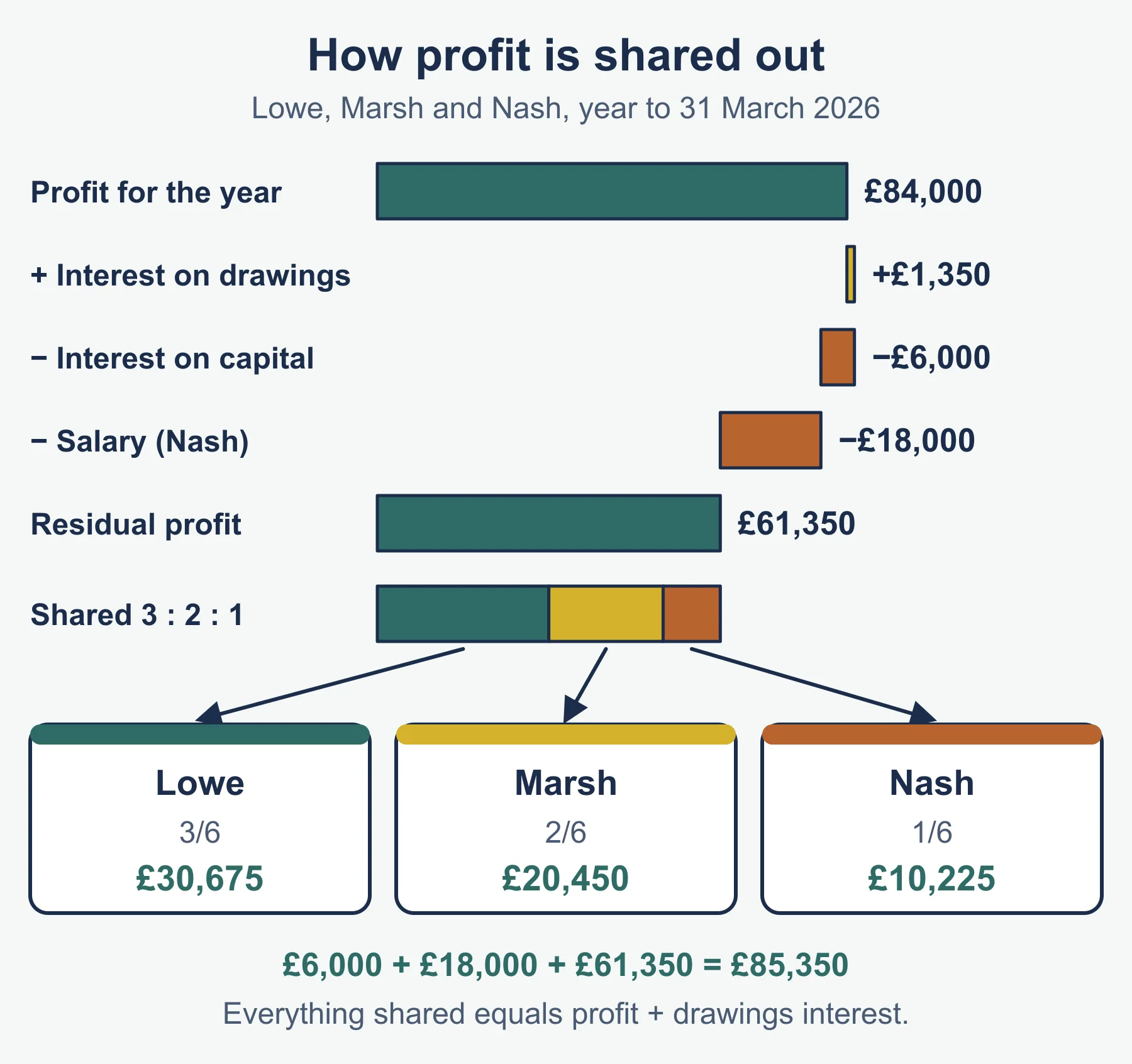
- Start with the profit for the year from the income statement (a loss starts as a negative figure).
- Add interest on drawings.
- Deduct interest on capital.
- Deduct partnership salaries.
- The balance is the residual profit (or deficit).
- Share it in the profit sharing ratio.
- Check: the total of the appropriation account equals the profit for the year plus interest on drawings.
Worked reminder: Pelham Row Catering
Pelham Row Catering is a service business owned by Tobias and Salma. The agreement gives 3% interest on capital, a salary of 8,000 to Salma, 4% interest on drawings and residual shared 3 : 2. Capital: Tobias 40,000; Salma 25,000. Drawings: Tobias 9,000; Salma 7,500. Salma lent 8,000 at 5%. Profit before loan interest is 28,040.
Profit before loan interest                  28,040
Interest on partner's loan (8,000 x 5%)         400
Profit for the year                          27,640
Interest on drawings: Tobias 360, Salma 300     660
                                             28,300
Interest on capital: Tobias 1,200, Salma 750  1,950
Salary: Salma                                 8,000   9,950
Residual profit                              18,350
Tobias 3/5 = 11,010; Salma 2/5 = 7,340       18,350
Current accounts (opening: Tobias debit 300, Salma credit 1,200):
| Tobias | Salma | |
|---|---|---|
| Opening balance | (300) | 1,200 |
| Interest on capital | 1,200 | 750 |
| Salary | 0 | 8,000 |
| Share of residual | 11,010 | 7,340 |
| Drawings | (9,000) | (7,500) |
| Interest on drawings | (360) | (300) |
| Closing balance | 2,550 credit | 9,490 credit |
Equity extract: capital accounts 65,000, current accounts 12,040, total equity 77,040. Salma’s loan of 8,000 is listed separately under non-current liabilities.
Loss years and deficits
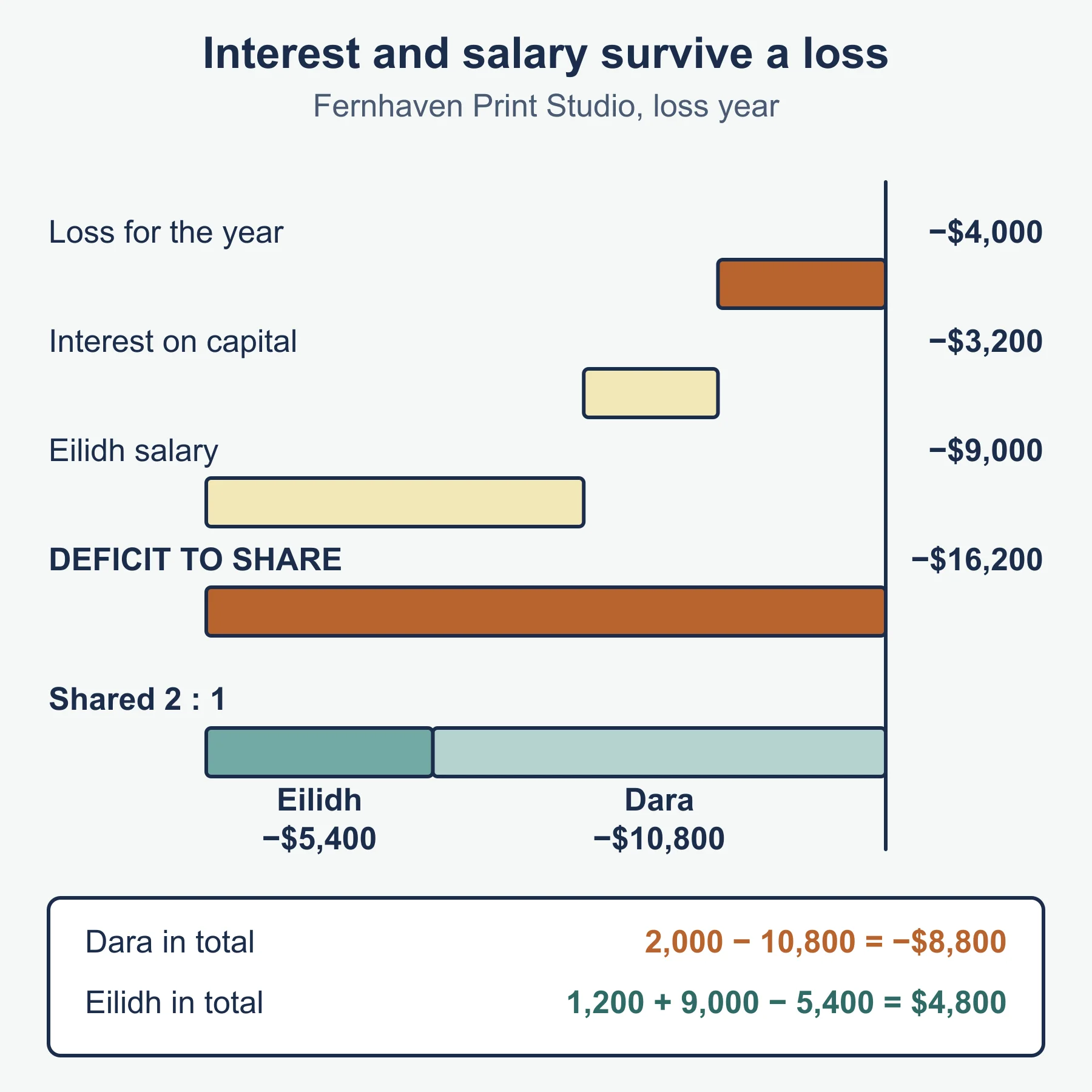
If the profit is smaller than interest on capital plus salaries, the residual is a deficit. The interest and salaries are still credited. The deficit is shared in the ratio and debited.
Pelham Row example: if the profit for the year were 6,000, the entitlements before the ratio total 9,950 (1,950 plus 8,000), so the deficit is 3,950 (ignoring interest on drawings to keep the point clear). Tobias bears 3/5, which is 2,370, and Salma bears 2/5, which is 1,580.
| If | Then |
|---|---|
| Profit is above interest and salaries | Residual profit, credited |
| Profit is below interest and salaries | Deficit, debited in ratio |
| The firm makes a loss | The loss is added to the deficit and shared in ratio |
Statement of financial position reminders
- Non-current assets, current assets and current liabilities are laid out as for a sole trader. Other receivables and other payables from year-end adjustments sit with current assets and current liabilities.
- Under non-current liabilities, list any loan from a partner. It is repaid before partners take their equity and it earns fixed interest.
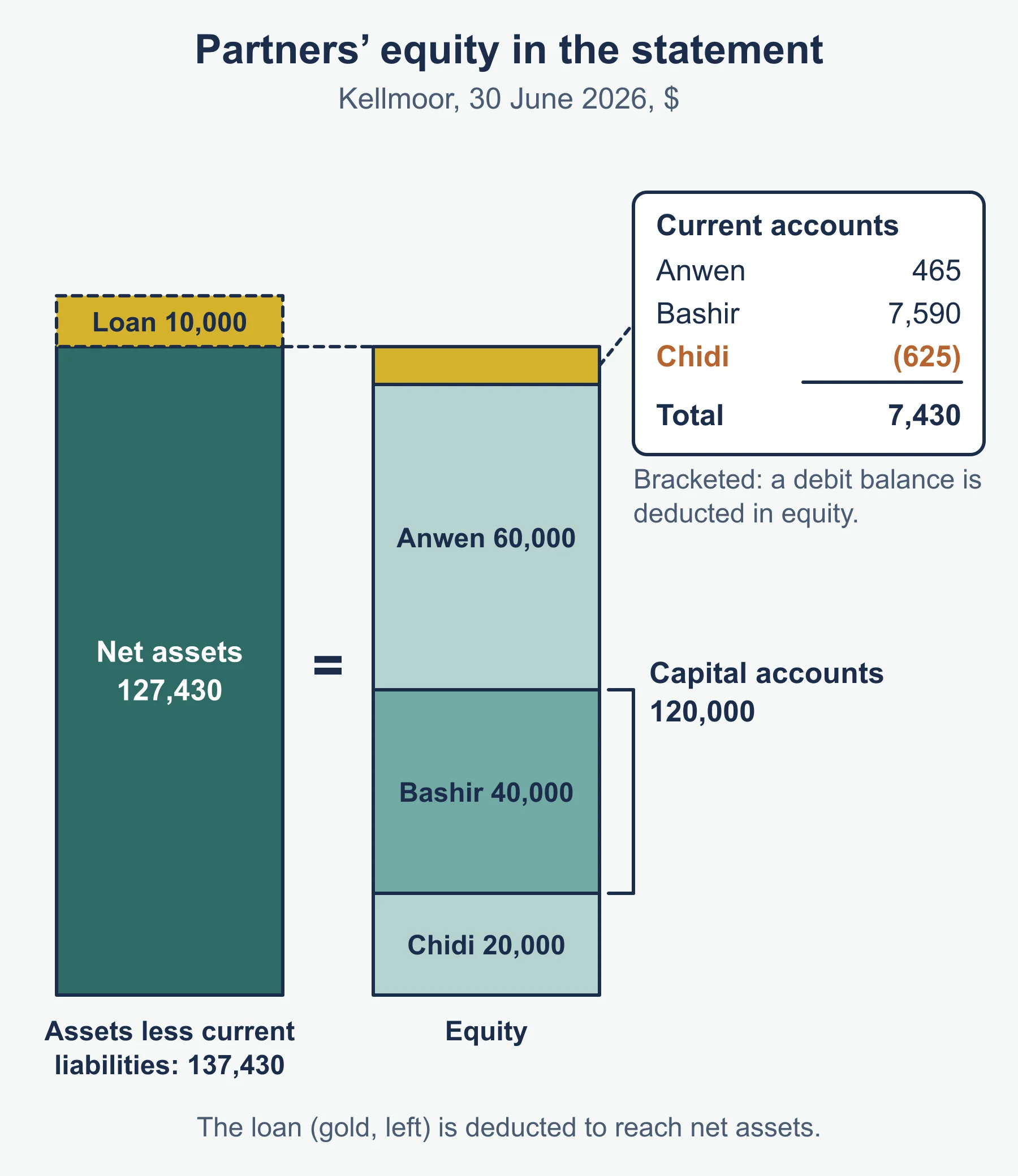
- Equity lists each partner’s capital account, then each partner’s current account, with debit balances in brackets and deducted.
- The check: net assets equal total equity. If they differ, recheck the closing current account balances first.
Must-know distinctions
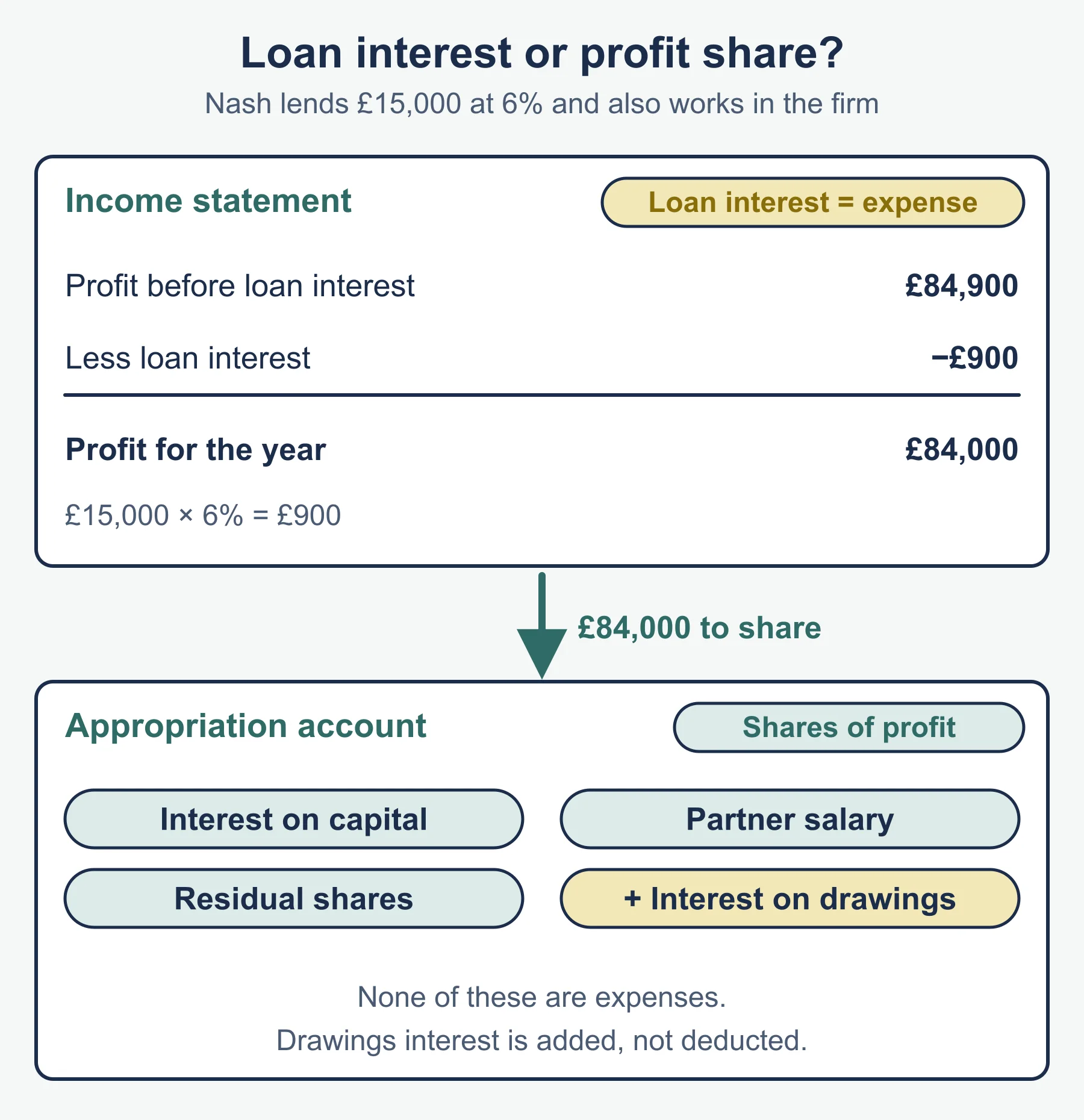
- Loan interest or interest on capital? Loan interest is an expense, paid whatever the profit. Interest on capital is an appropriation of profit, not an expense, so it does not reduce the profit for the year.
- Salary or wages? Wages paid to employees are expenses. A partner’s salary is an appropriation of profit.
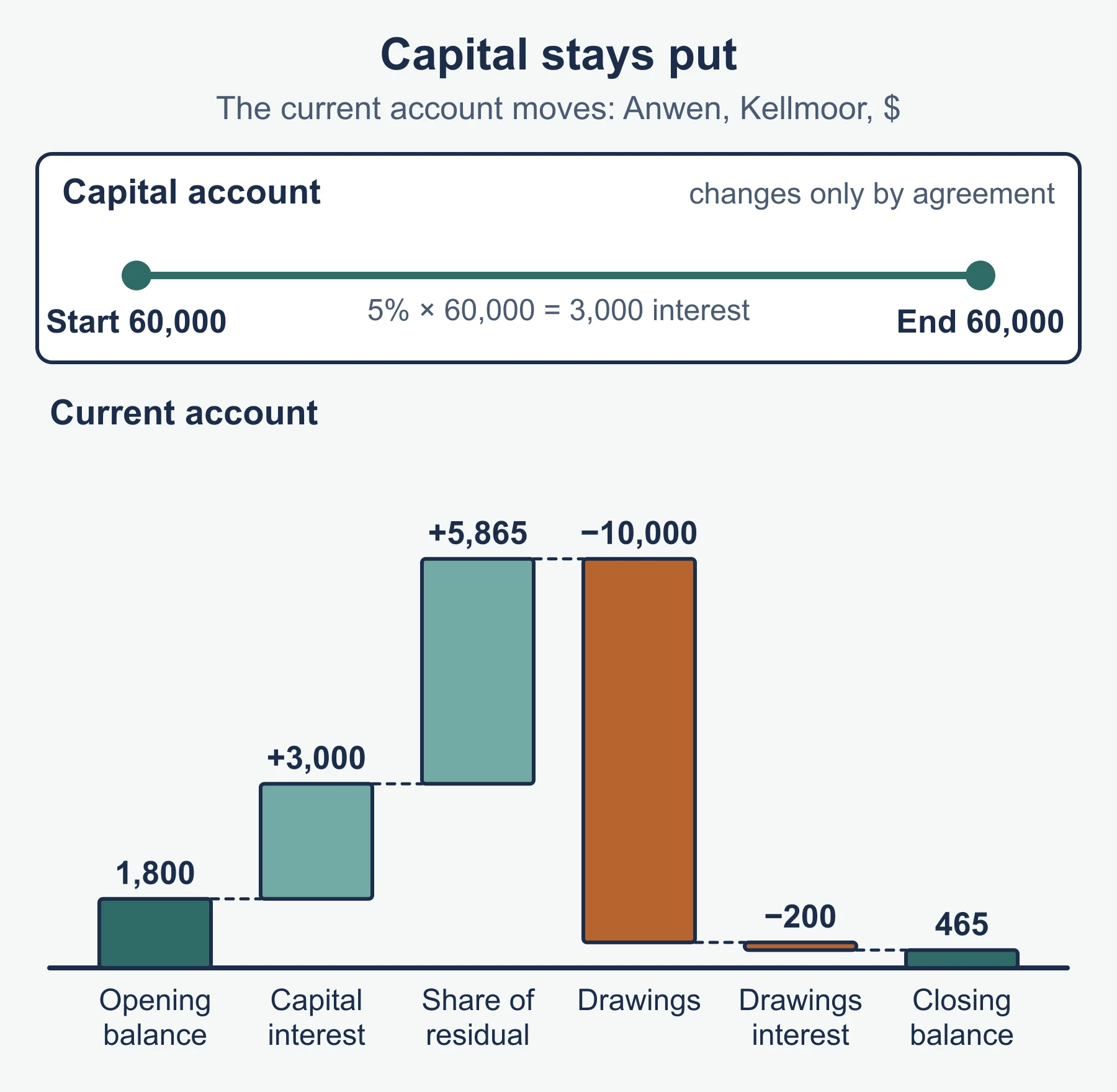
- Capital or current account? Capital is fixed and long term. The current account moves each year.
- Drawings or interest on drawings? Drawings reduce the current account. Interest on drawings is an extra charge on top.
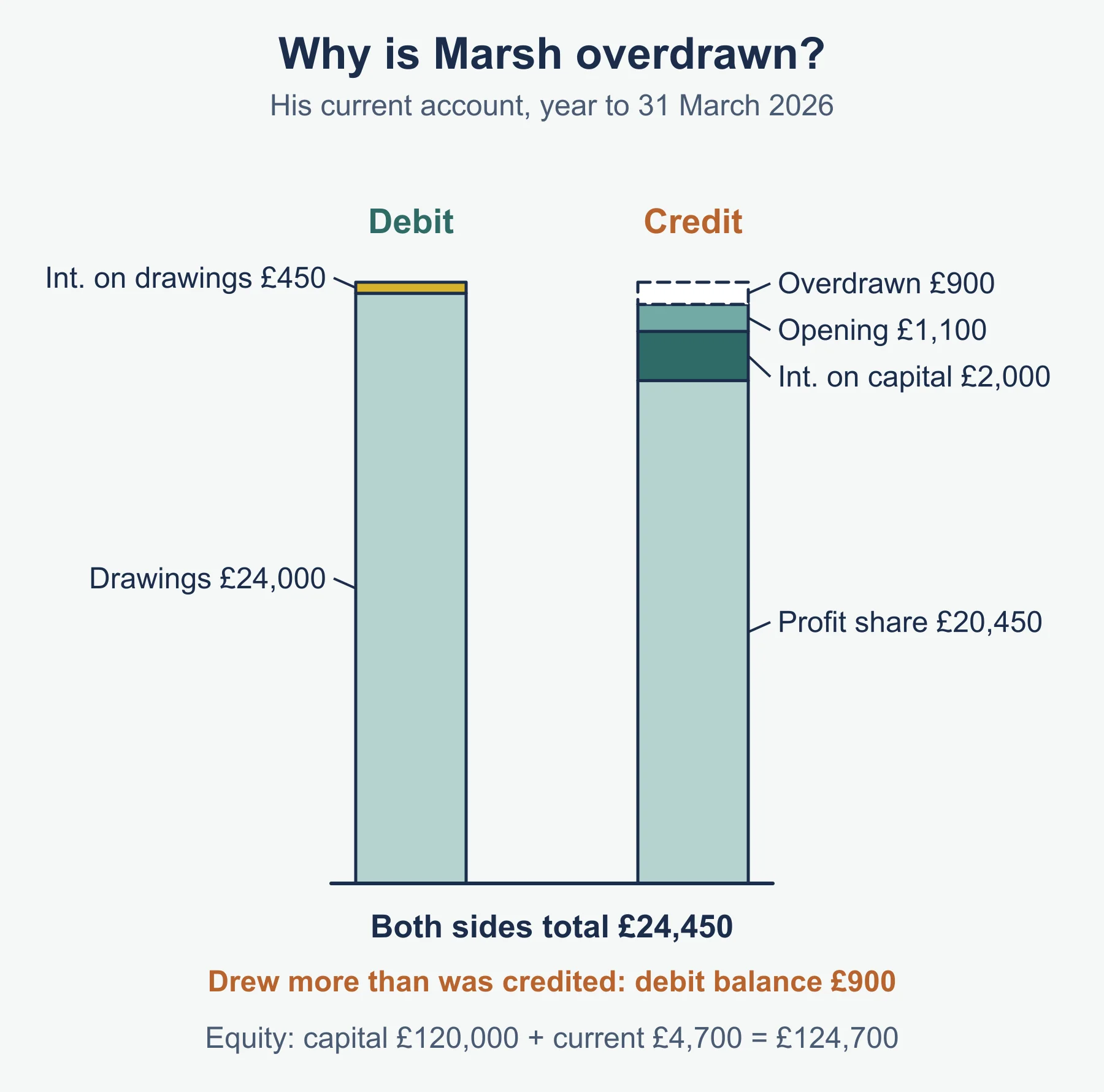
- Credit or debit balance? A credit current balance is owed to the partner. A debit balance means the partner has taken out more than allocated.
Capital and current accounts: layout reminders
| Side | Entries |
|---|---|
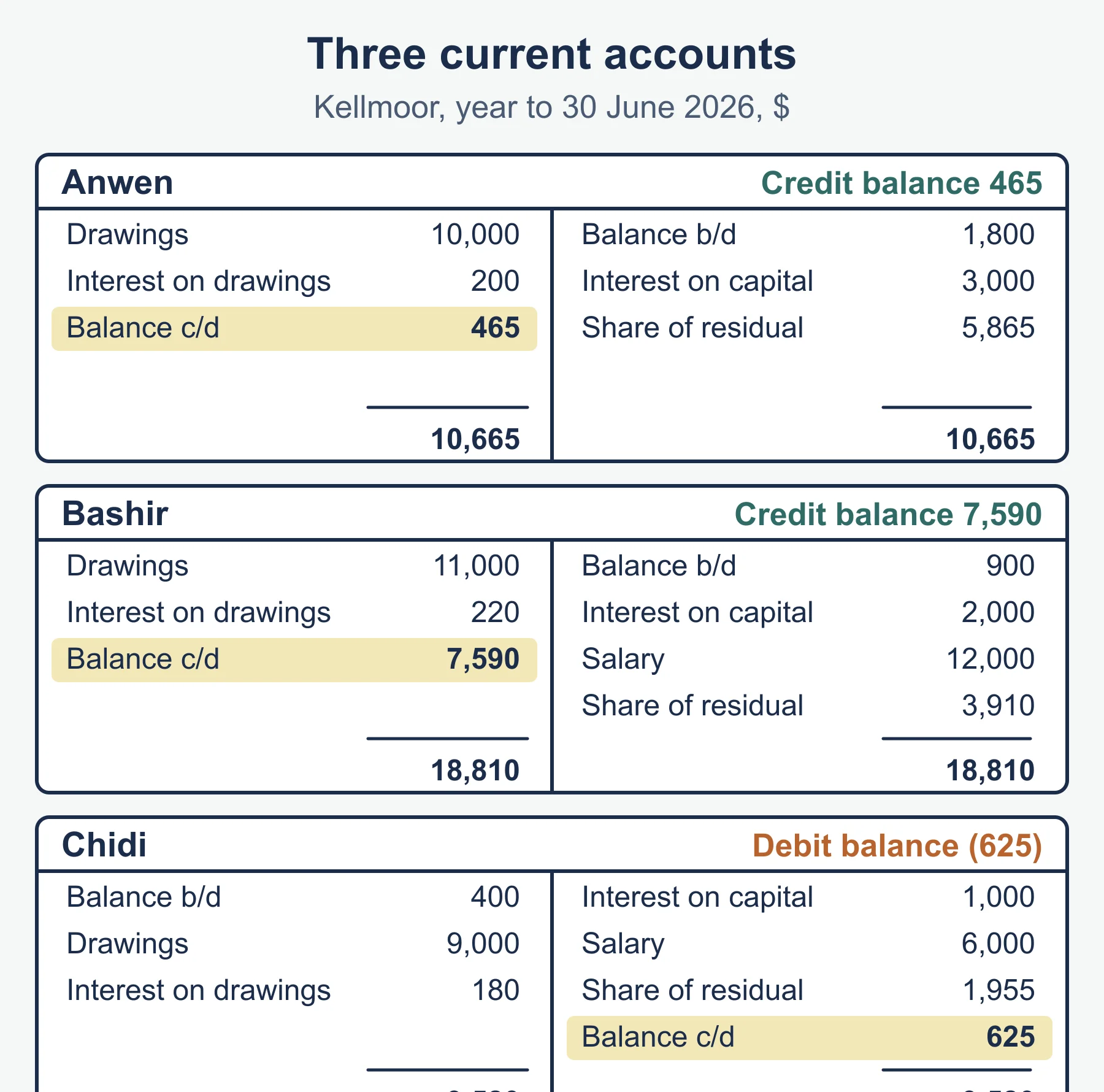
| Debit | Opening debit balance, drawings, interest on drawings, share of deficit or loss, closing credit balance carried down |
| Credit | Opening credit balance, interest on capital, salary, share of residual profit, closing debit balance carried down |
Each partner has a column. Both sides must total the same.
Commenting in a sentence
- An overdrawn partner: state the debit balance and suggest a drawings limit.
- A large salary: say the ratio then affects less profit.
- A low bank balance: say the firm may struggle to pay its payables.
- A loan: say its interest is fixed and paid before profit is shared.
- A deficit: say the partners’ accounts are debited and ask whether the agreement still suits the business.
Quick self-test
- Calculate 5% interest on capital of 36,000.
- Two partners hold capital of 20,000 and 15,000. Interest on capital is 3%. Calculate each partner’s interest.
- Calculate interest on drawings at 2.5% of drawings of 12,000.
- A partner lends the firm 15,000 at 6%. Calculate the interest and name the statement where it is shown.
- After a salary of 10,000 to one partner, the remaining 20,000 of profit is shared equally. What does each partner receive in total?
- A deficit of 3,000 is shared 2 : 1. What does each partner bear and is the current account debited or credited?
- A partner has an opening current account debit of 500, interest on capital 1,200, salary 6,000, share of profit 4,300, drawings 9,000 and interest on drawings 270. Find the closing balance.
- A loss of 9,000 is shared 3 : 1. State each partner’s share.
- Is a debit balance on a current account added to or deducted from the capital accounts in equity?
- Give two differences between a capital account and a current account.
Answers
- 1,800.
- 600 and 450.
-
- 900; the income statement.
- The partner with the salary: 10,000 plus 10,000 which is 20,000 in total. The other partner: 10,000. Check: 30,000.
- 2,000 and 1,000; debited.
- 1,730 credit. Credits are 1,200 + 6,000 + 4,300 = 11,500. Debits are 500 + 9,000 + 270 = 9,770. The difference is 1,730.
- 6,750 and 2,250.
- Deducted.
- Capital is fixed and long term, while the current account changes each year. Capital decides interest on capital, while the current account records salaries, drawings and profit shares.
Where marks are usually lost
- Charging salaries or drawings in the income statement.
- Showing a partner’s loan interest in the appropriation account.
- Subtracting interest on drawings from profit instead of adding it.
- Applying the ratio to the profit for the year, not the residual.
- Leaving out interest and salaries in a year with a loss or deficit.
- Not showing each partner’s figures separately in the appropriation account.
- Forgetting the opening balance on the current account.
- Treating a debit current account balance as an addition in equity.
- Putting a partner’s loan in equity, not in non-current liabilities.
- Comments that repeat a figure without saying what it means for the partners.
Frequently asked questions
Is a partner’s salary an expense in the income statement? No. Wages paid to employees are expenses, but a partner’s salary is an appropriation of profit shown in the appropriation account.
Is interest on a partner’s loan an appropriation? No. Loan interest is an expense in the income statement, paid whatever the profit. Interest on capital is an appropriation of profit and does not reduce the profit for the year.
What does a debit balance on a partner’s current account mean? It means the partner has taken out more than has been allocated to them. A credit current account balance is owed to the partner.
Which partnership topics are not examined in OxfordAQA International GCSE Accounting 9215? The specification says that admission, retirement of a partner, dissolution of partnerships and changes to the profit sharing ratio will not be examined.
Where does a partner’s loan go in the statement of financial position? A partner’s loan is shown under non-current liabilities, not in equity.
Official syllabus
OxfordAQA International GCSE Accounting (9215), specification version 1.2, first teaching 2024, first examined 2026 (OxfordAQA). Subject content section 3.4, Partnerships.
Get free revision emails (optional)
Occasional emails with practice questions, worked explanations and links to free resources for the qualification and subjects you choose. No spam, and you can unsubscribe from any email. The free tools on this site never need an email.
Related resources
-
Study guides
OxfordAQA IGCSE Accounting: Sole traders: financial statements and comparison with other organisations (9215)
Study guide to sole traders' income statements, statements of financial position and adjustments, plus the pros and cons of each business type, for 9215.
Accounting · OxfordAQA · IGCSE
Read guide -
Practice questions
OxfordAQA IGCSE Accounting: Sole traders and other organisations (9215) – Practice Questions
Original practice questions with worked answers on sole traders' income statements, adjustments, financial position and business types for 9215.
Accounting · OxfordAQA · IGCSE
Try questions -
Revision notes
OxfordAQA IGCSE Accounting: Sole traders and other organisations (9215) – Revision Notes
Condensed revision notes on sole traders' income statements, statement of financial position adjustments and comparing business types for OxfordAQA 9215.
Accounting · OxfordAQA · IGCSE
Revise topic
Related articles
-
teaching
A Level tuition in Dubai: Cambridge or Pearson Edexcel International A Level?
Schools in Dubai and Abu Dhabi teach either Cambridge International AS & A Level or Pearson Edexcel International A Level. How the two are structured, why it matters for tuition, and how online classes from Lahore work.
9 October 2026
-
curriculum guides
Choosing subjects at IGCSE and A Level
How subject choices at 14 and 16 affect university options later, and how to keep pathways open without overloading a timetable.
28 July 2026
Studying this with a teacher
Working through Accounting IGCSE?
This page is free and stays free. If you would rather be taught it, Marlbridge runs Accounting classes one-to-one and in small groups of up to 15, online in your own time zone. The first trial class is free. WhatsApp replies within an hour (8am–11pm Pakistan time, every day); email the same day.
OxfordAQA Accounting teachers at Marlbridge

