
Study Guides
OxfordAQA IGCSE Business: Business operations (9225)
Study guide to production methods, JIT, Kaizen, suppliers, quality, TQM and customer service for OxfordAQA International GCSE Business operations.
- Subject
- Business
- Level
- IGCSE
- Topic
- Business operations
- Author
- Marlbridge Academic Team
- Updated
- Reviewed by
- Salman Ahmad (what this means)
Aligned to OxfordAQA IGCSE Business (9225), First teaching September 2020, first examined May/June 2022. Official specification .
Syllabus page (what it covers and how it is assessed): OxfordAQA IGCSE Business.
Syllabus points this page covers
9225
- 3 Business operations (whole topic)
Found an error? Report a correction.
Need help with this topic? Request a free trial class for IGCSE Business (9225).
This guide covers section 3.3 Business operations of the OxfordAQA International GCSE Business (9225) specification, version 3.1, for exams from May/June 2022 onwards. The official text divides the topic into four parts, listed in the map below. Business operations is assessed on Paper 1, alongside business in the real world, influences on business and human resources. Every business and figure in this guide is invented. Use the course hub and the printable checklist to track the rest of the course, and the free diagnostics to find weak spots. The matching revision notes and practice questions follow this page.
Map of the topic
| Section | What the specification asks for |
|---|---|
| 3.3.1 Production processes | Job, batch, flow and cell production, and when each is appropriate; making production more efficient with JIT stock control and Kaizen |
| 3.3.2 The role of procurement | Managing stock with JIT, including evaluating it for a given business; the cost of buffer stock; choosing suppliers on price, quality and reliability |
| 3.3.3 The concept of quality | Customer expectations; spotting and measuring quality problems; consequences of poor quality; TQM; costs and benefits of quality; quality issues as a business grows, outsourcing and franchising |
| 3.3.4 Good customer services | Product knowledge, customer engagement and post-sales service; benefits of good service and dangers of poor service; websites, e-commerce and social media |
The official text says you will not be asked to draw or interpret stock control charts. Most questions ask you to apply an idea to a business in a stem, so practise linking each point to the context.
3.3.1 Production processes
Operations covers how a business converts its inputs into the goods or services it sells. The specification names four methods and expects you to know when each is appropriate.
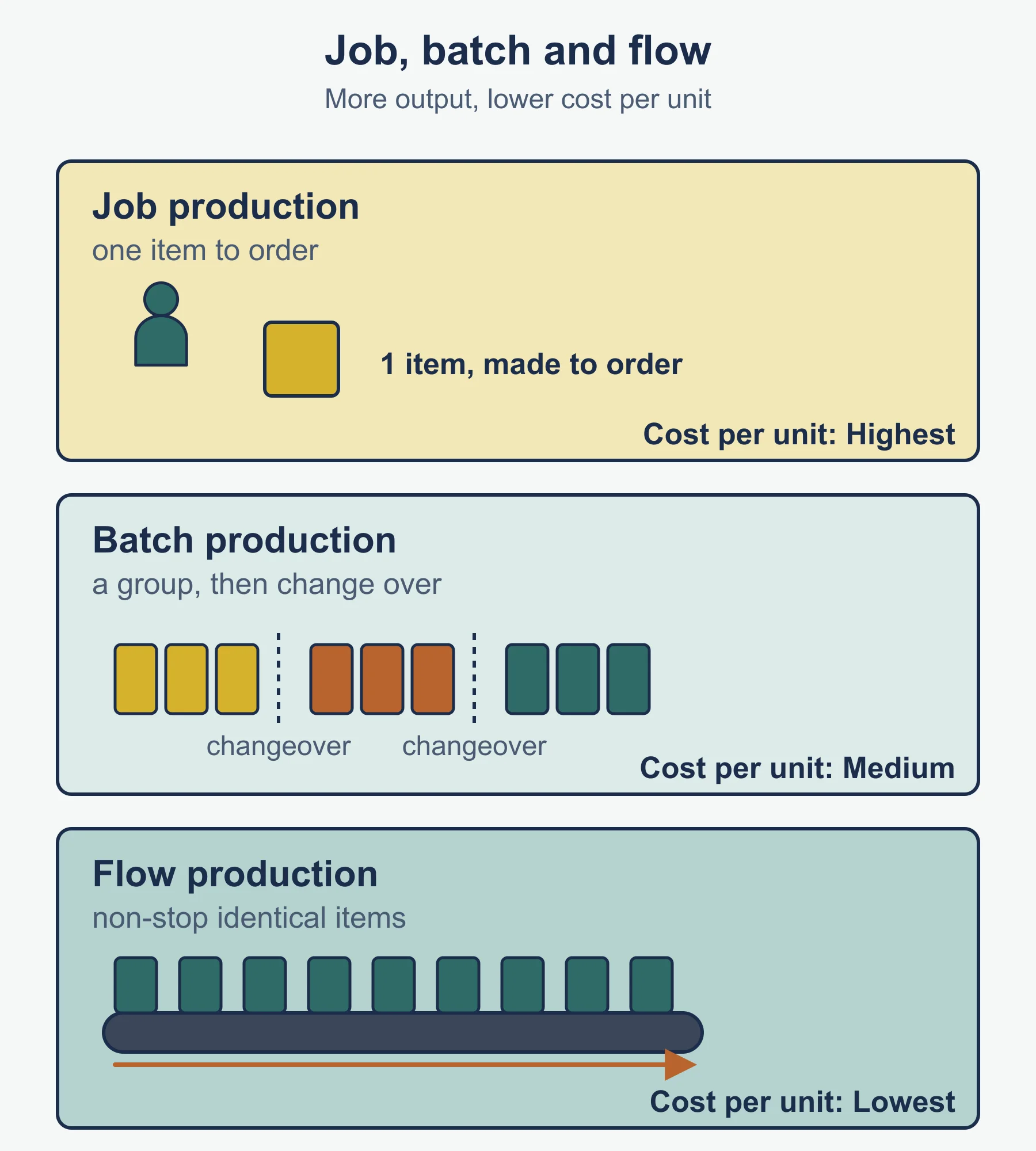
| Method | What happens | Suits | Main drawback |
|---|---|---|---|
| Job | One item made at a time to a customer’s own order | Unique, high-value, made-to-measure products | Slow and costly per item; skilled labour needed |
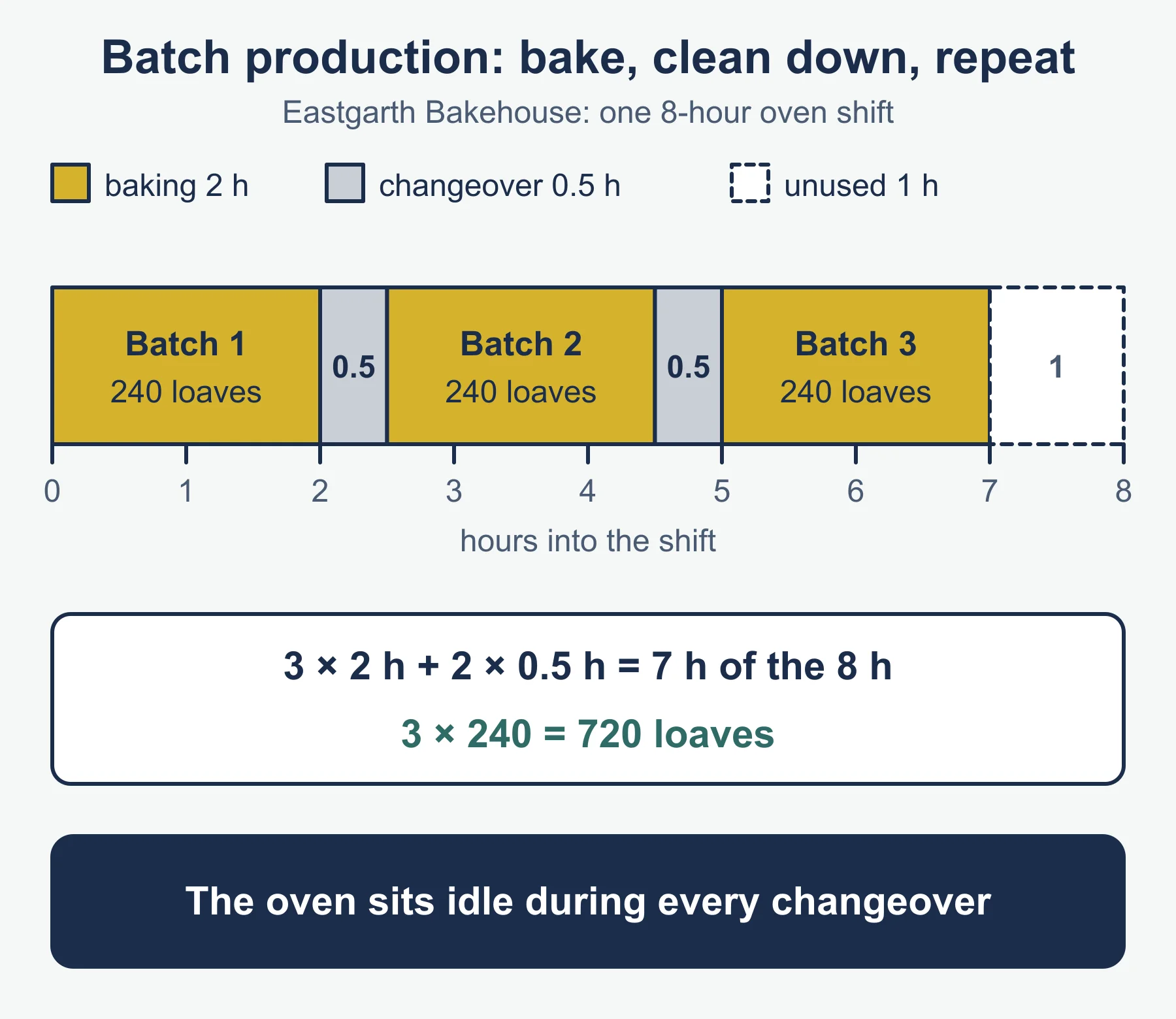
| Batch | Identical items made in a group, then a changeover to the next group | Products sold in set quantities or varieties, such as a bakery making one recipe after another | Machines idle between batches; stock may build up |
| Flow | Continuous production of a standard product along a line | Very large demand for identical items | Costly equipment; hard to change the product |
| Cell | Production split into small self-contained teams, each making a complete part or product | Medium volumes where teamwork and variety matter | Needs trained, flexible staff |
Examples of fit. Savernake Joinery builds fitted wardrobes to each customer’s room measurements, so it uses job production. Gleneagle Bakery bakes 400 seeded loaves, then 400 white loaves, then 400 rolls, so it uses batch production. Pendragon Cycles assembles one standard model of children’s bike at high volume on a moving line, so flow production fits. Ormskirk Print Works splits its factory into teams, each handling a customer’s brochure from design to binding, which is cell production.
Efficiency in production
Efficiency means producing more with the resources used, or producing the same with fewer resources, so that cost per unit falls. The specification points you to two techniques.
- Just in time (JIT): materials arrive when they are needed, so the business holds little stock. Section 3.3.2 covers it in detail.
- Continuous improvement (Kaizen): all employees look for small, regular improvements, such as a quicker way to set up a machine or a layout that cuts walking time. Many small gains add up, and staff who suggest changes may feel more involved.
When you evaluate Kaizen, consider the benefits (lower waste, lower costs, better ideas from the people who do the job) against the costs (time in meetings, training, and the risk that staff stop suggesting ideas if nothing is acted on).
3.3.2 The role of procurement
Procurement is buying the materials, components and services a business needs.
Managing stock with JIT
Under JIT the business orders small amounts often, timed to arrive just before use. The benefits are lower costs: less cash tied up in stock, smaller storage needs and less risk of waste or damage. The specification says these savings must be set against two costs: paying for deliveries more often, and losing purchasing economies of scale (the bulk-buying discounts that come with large orders). JIT also depends on reliable suppliers, because a late delivery can stop production.
Buffer stock is spare stock kept to satisfy demand if sales jump or a delivery is late. Its benefit is that orders can still be filled. Its cost is the cost of holding it: storage, insurance, possible damage or going out of date, and cash tied up.
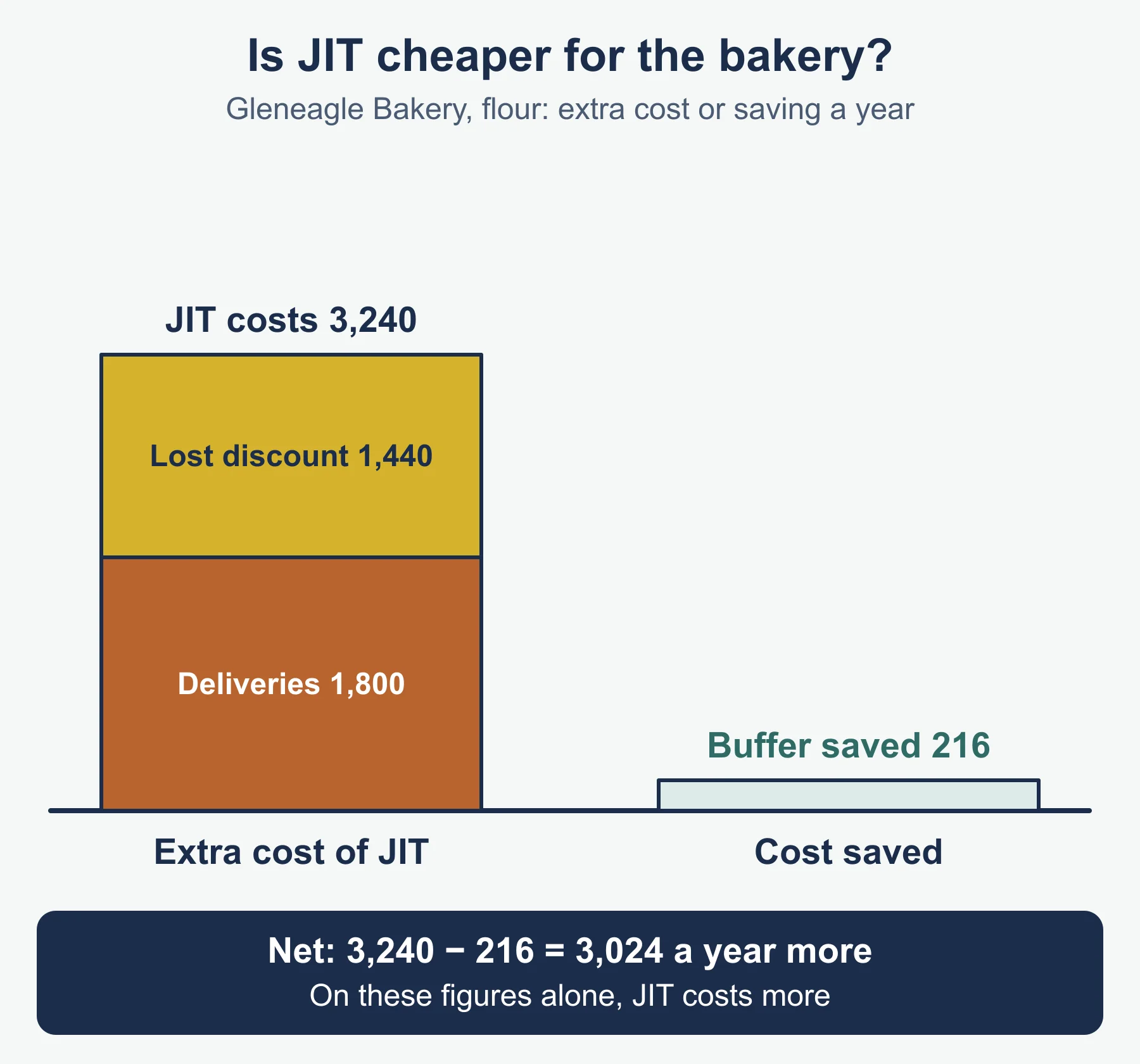
Worked example. Gleneagle Bakery buys 9,600 bags of flour a year. Now it takes 12 deliveries at 2.40 a bag and holds a buffer of 600 bags. Holding costs are 15% of stock value a year. A supplier offers JIT: 52 deliveries a year, but each delivery costs 45 and the bag price rises to 2.55.
- Buffer holding cost now: 600 x 2.40 x 0.15 = 216 a year.
- Extra delivery cost under JIT: (52 - 12) x 45 = 1,800.
- Lost discount: 9,600 x (2.55 - 2.40) = 1,440.
- Net extra cost of JIT: 1,800 + 1,440 - 216 = 3,024 a year.
On these figures alone JIT costs more. The bakery would only switch if the saving from freed space, less waste and less cash tied up is worth more than 3,024, or if it can negotiate cheaper deliveries. A good evaluation says this and gives a judgement.
Factors affecting choice of supplier
For a given business you should analyse price, quality and reliability.
- Price: the lowest quoted price is not always the lowest cost once delivery, discounts and credit terms are counted.
- Quality: poor materials lead to faulty products, returns and a poor reputation.
- Reliability: delivering the right goods on time, every time. This matters most for a business using JIT.
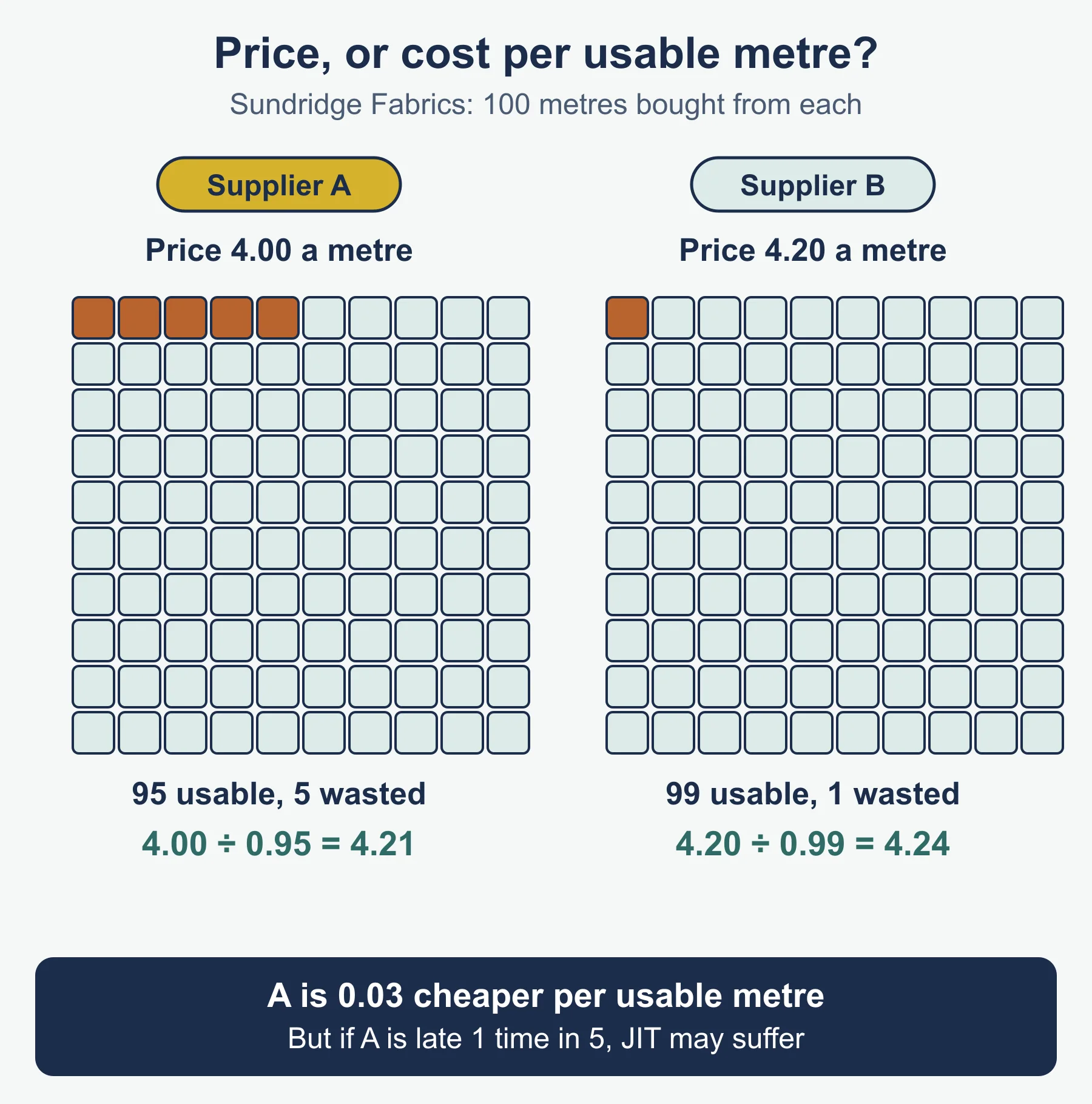
Worked example. Sundridge Fabrics needs cloth. Supplier A charges 4.00 a metre but 5% arrives unusable. Supplier B charges 4.20 and only 1% is unusable. Cost per usable metre: A = 4.00 / 0.95 = 4.21; B = 4.20 / 0.99 = 4.24. A is cheaper by about 0.03 per usable metre. If A also delivers late one time in five, and Sundridge runs JIT, the cheaper price may not be worth it. State the numbers, then make the judgement for this business.
3.3.3 The concept of quality
Quality means meeting customer expectations. For goods this is usually durability, safety, performance and finish. For services it is usually accuracy, speed, courtesy and a consistent experience. Expectations depend on price and market: customers expect more from a premium product than from a budget one.
Identifying and measuring quality problems
A business can identify problems through inspection, customer complaints, returns and refunds, customer reviews and surveys, and staff reports. It can measure quality with the percentage of items that are defective, the return rate, the number of complaints, repeat-purchase rate and customer satisfaction scores.
Consequences of poor quality
Faulty goods lead to refunds, replacements and repair costs. Wider consequences include lost sales, a damaged reputation, lower customer loyalty, falling staff morale and possible legal problems if goods are unsafe.
Methods of maintaining consistent quality: TQM
Total quality management (TQM) treats quality as the job of every employee in every department, so that faults are prevented at each stage rather than found only by final inspection. Advantages for a business: fewer defects and less waste, lower costs of rework and returns, happier and more loyal customers, a reputation that may support higher prices, and staff who feel involved. Costs include training, time to change habits, and the need for management commitment.
Costs and benefits of maintaining quality
Costs: better materials, training, equipment and checking. Benefits: fewer returns, stronger reputation, loyalty and often higher prices. A business should compare them.
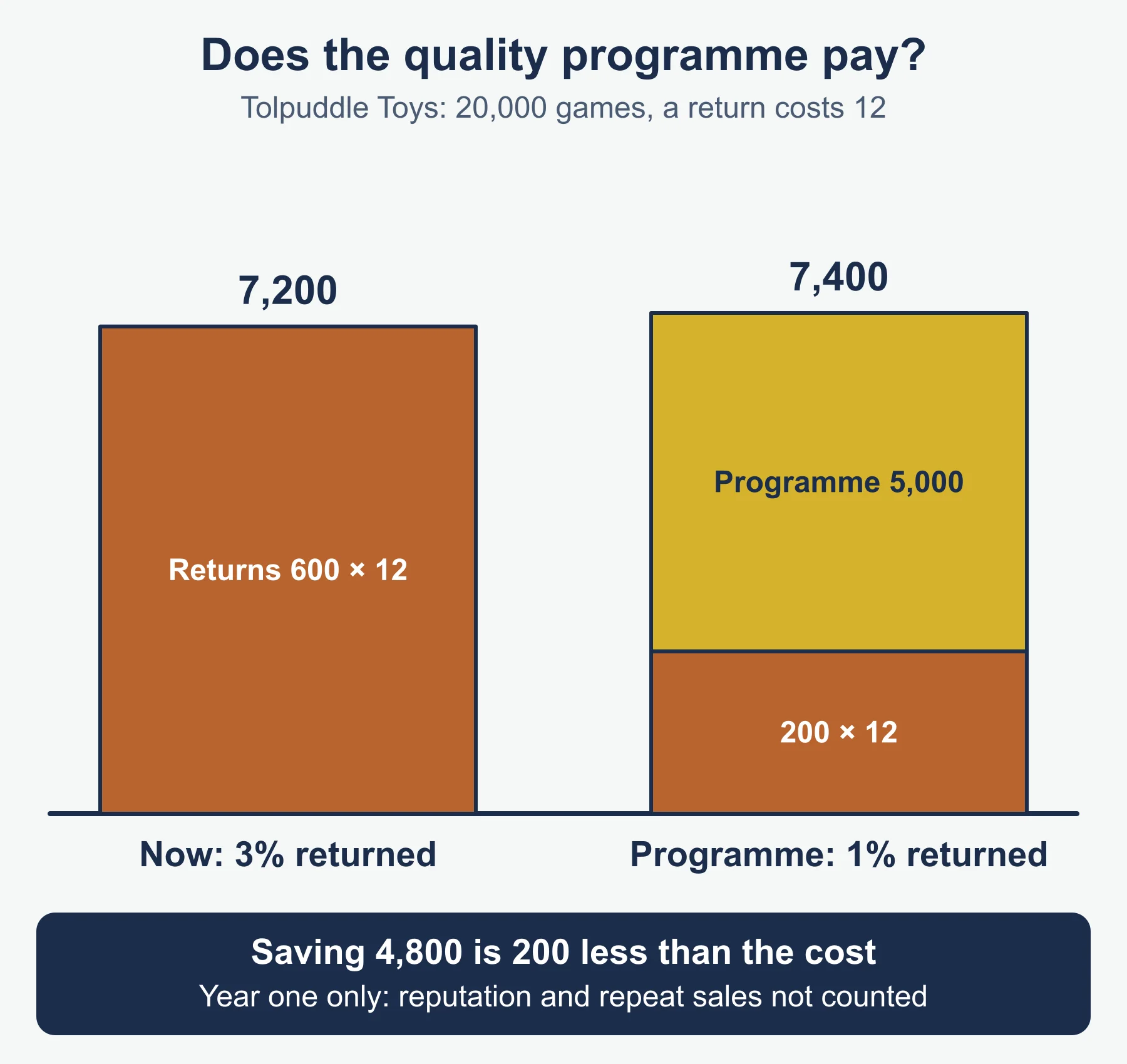
Worked example. Tolpuddle Toys sold 20,000 games last year. Three per cent were returned, each return costing 12 to handle and replace, so returns cost 600 x 12 = 7,200. A quality programme costing 5,000 a year should cut returns to 1%: 200 x 12 = 2,400. The saving is 7,200 - 2,400 = 4,800, which is 200 less than the cost. On direct costs alone the programme does not pay for itself in year one. A fuller answer adds the harder-to-measure gains, such as reputation and repeat sales, and may recommend going ahead.
Quality as a business grows
Growth can put quality at risk. Managers see less of the daily work, new staff need training, and demand may outrun the business’s ability to check. Two routes carry particular risks.
- Outsourcing: another firm does part of the work. The business has less direct control, and the supplier may cut corners; it still carries the blame if customers are unhappy.
- Franchising: independent owners run outlets under the brand name. A weak franchisee can damage the brand everywhere, so the franchisor needs clear standards, training and inspections.
3.3.4 Good customer services
Customer service is the help and attention a business gives before, during and after a sale.
Methods of good service
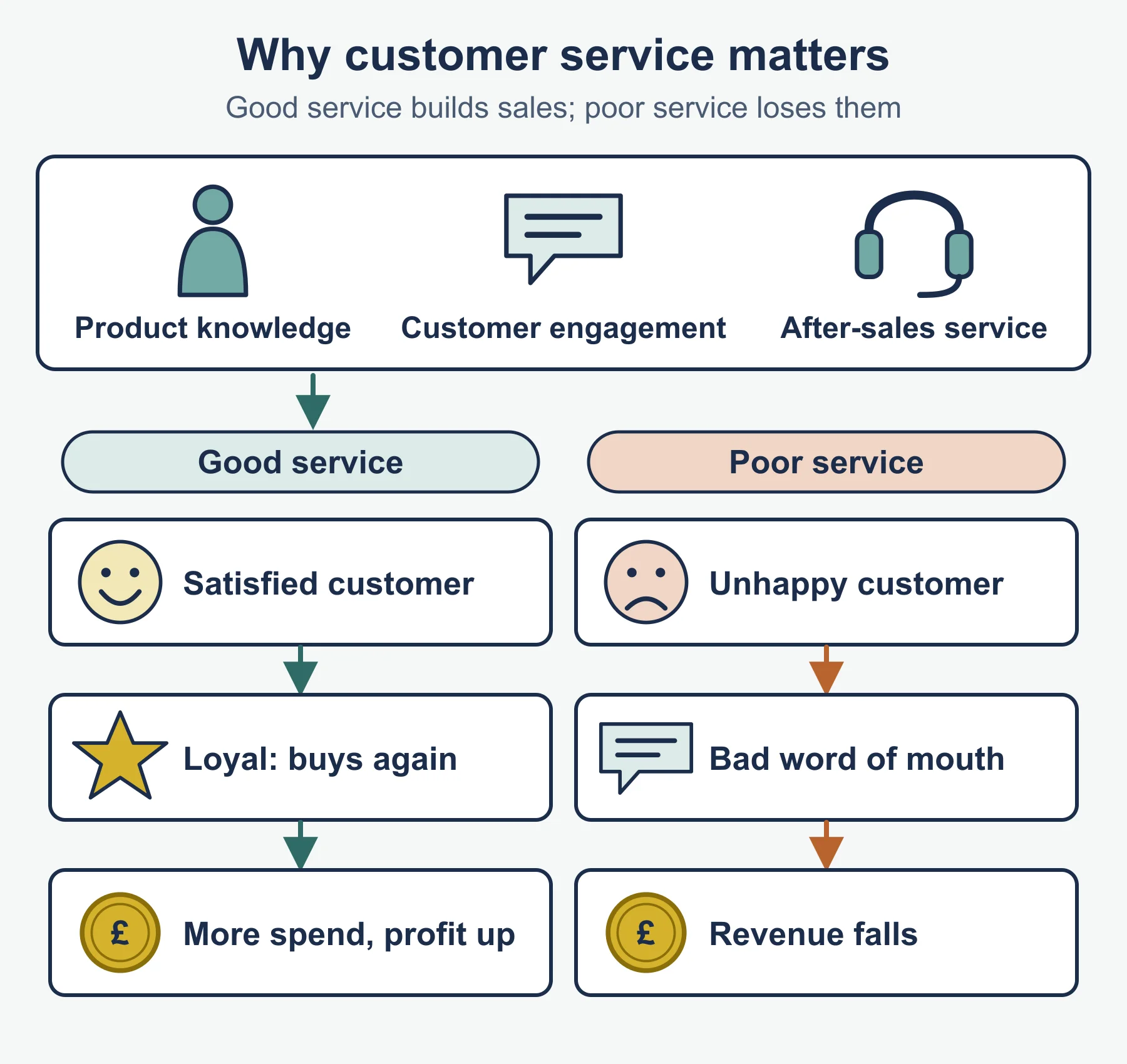
- Product knowledge: staff who understand what they sell can advise accurately, match the product to the need and answer questions.
- Customer engagement: creating a positive experience, for example friendly greetings, listening, personal recommendations and quick handling of problems.
- Post-sales services: help after purchase, such as user training, help lines and servicing.
Benefits and dangers
Benefits of good service include greater customer satisfaction, loyalty and repeat custom, good word of mouth and the chance to charge more. Costs of poor service include dissatisfied customers, a poor reputation and lost sales. Good service itself costs money in training, staff time and systems, so businesses weigh it against the return.
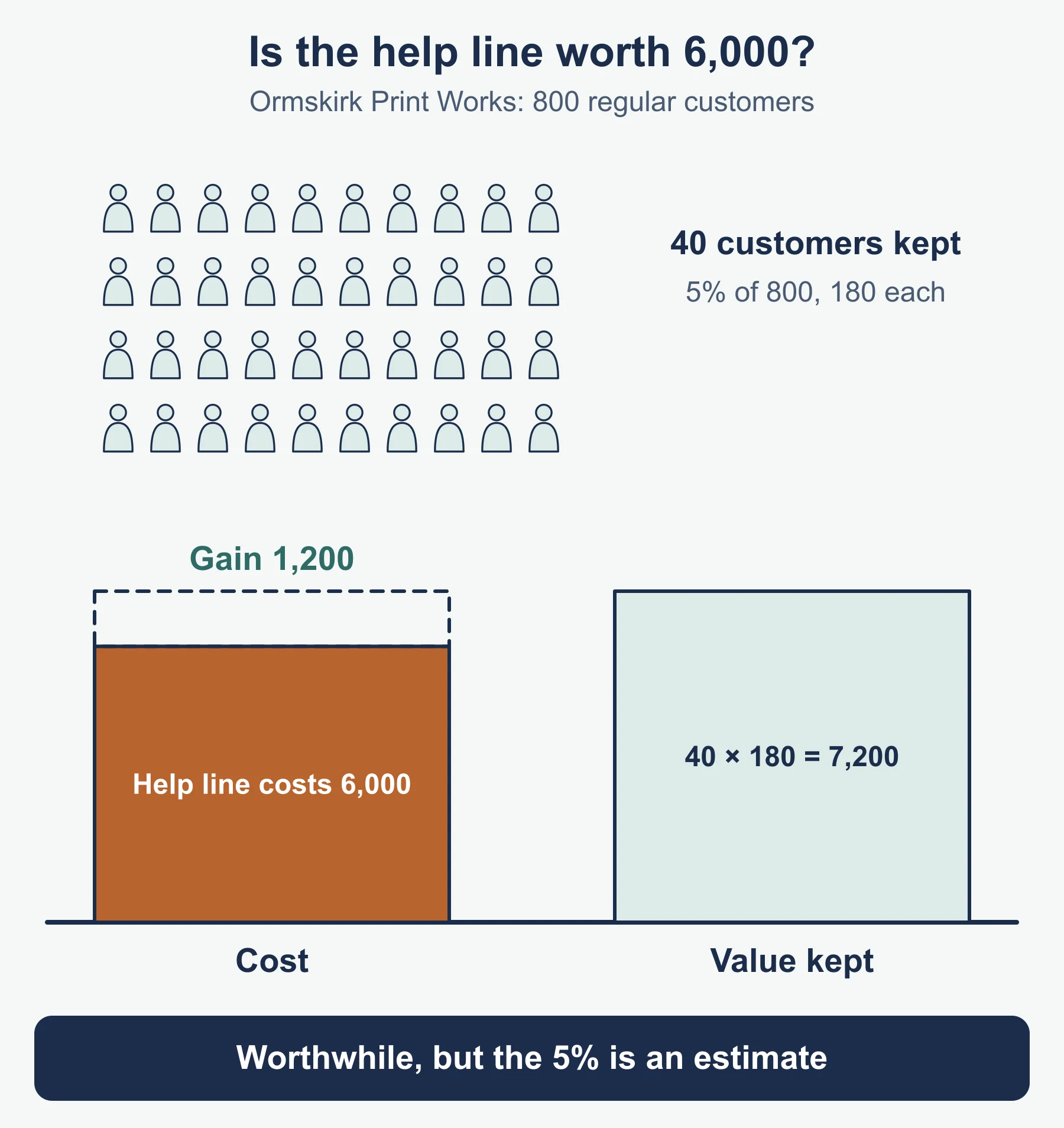
Worked example. Ormskirk Print Works spends 6,000 a year on a help line. Without it, it expects to lose 5% of its 800 regular customers, which is 40 customers. Each is worth 180 a year in sales contribution. Value kept: 40 x 180 = 7,200, which exceeds the 6,000 cost by 1,200. The help line looks worthwhile, though the figure of 5% is an estimate.
How ICT has changed customer service
- Websites: 24-hour information, frequently asked questions, order tracking and live chat.
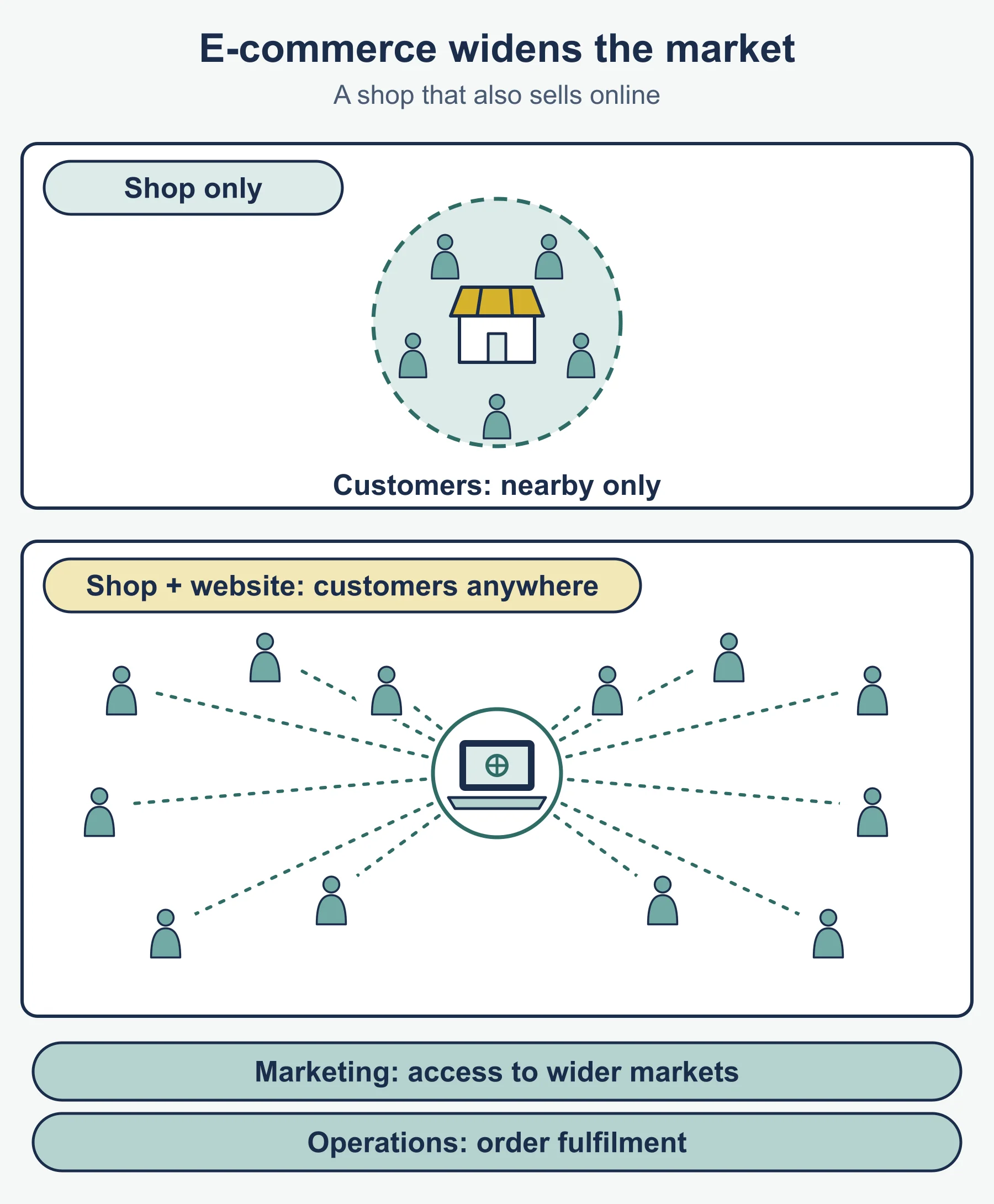
- E-commerce: customers buy online at any time, with fast payment and delivery tracking; it widens the market but needs reliable delivery and returns.
- Social media: quick, public two-way contact. Businesses can answer queries and gather feedback, but a poor reply is visible to many people.
Common errors
- Describing a production method without saying why it fits the business in the stem.
- Treating JIT as only a benefit. The specification wants costs of frequent deliveries and lost bulk discounts weighed too.
- Choosing the cheapest supplier without checking quality and reliability.
- Writing “TQM means checking quality at the end”. It means every employee builds in quality throughout.
- Listing customer service ideas without linking them to loyalty, reputation or sales.
Frequently asked questions
What is Kaizen? Kaizen is continuous improvement: all employees look for small, regular improvements, such as a quicker way to set up a machine or a layout that cuts walking time. Many small gains add up, and staff who suggest changes may feel more involved.
What is buffer stock? Buffer stock is spare stock kept to satisfy demand if sales jump or a delivery is late. Its benefit is protection against running out, but it has storage and holding costs.
When is job production the right choice? Job production makes one item at a time to a customer’s own order, so it suits unique, high-value, made-to-measure products. Its drawbacks are that it is slow and costly per item and needs skilled labour.
How can growth put quality at risk? As a business grows, managers see less of the daily work, new staff need training, and outsourcing gives the business less direct control over part of the work.
Official syllabus
OxfordAQA International GCSE Business (9225) specification, version 3.1, OxfordAQA, for International GCSE exams May/June 2022 onwards. Section 3.3 Business operations (3.3.1 to 3.3.4).
Get free revision emails (optional)
Occasional emails with practice questions, worked explanations and links to free resources for the qualification and subjects you choose. No spam, and you can unsubscribe from any email. The free tools on this site never need an email.
Related resources
-
Practice questions
OxfordAQA IGCSE Business: Business operations (9225) – Practice Questions
Twelve original questions with worked answers on production methods, JIT, suppliers, quality, TQM and customer service for OxfordAQA IGCSE Business.
Business · OxfordAQA · IGCSE
Try questions -
Revision notes
OxfordAQA IGCSE Business: Business operations (9225) – Revision Notes
Condensed revision notes on production methods, JIT, Kaizen, suppliers, quality, TQM and customer service for OxfordAQA IGCSE Business.
Business · OxfordAQA · IGCSE
Revise topic -
Exam preparation
OxfordAQA International GCSE Business: Operations and People, Marketing and Finance
OxfordAQA International GCSE Business 9225: how content splits across two 90-mark papers with no coursework, using the case and a recommendation routine.
Business · OxfordAQA · IGCSE
Read guide
Related articles
-
teaching
A Level tuition in Dubai: Cambridge or Pearson Edexcel International A Level?
Schools in Dubai and Abu Dhabi teach either Cambridge International AS & A Level or Pearson Edexcel International A Level. How the two are structured, why it matters for tuition, and how online classes from Lahore work.
9 October 2026
-
curriculum guides
Choosing subjects at IGCSE and A Level
How subject choices at 14 and 16 affect university options later, and how to keep pathways open without overloading a timetable.
28 July 2026
Studying this with a teacher
Working through Business IGCSE?
This page is free and stays free. If you would rather be taught it, Marlbridge runs Business classes one-to-one and in small groups of up to 15, online in your own time zone. The first trial class is free. WhatsApp replies within an hour (8am–11pm Pakistan time, every day); email the same day.
OxfordAQA Business teachers at Marlbridge
