
Revision Notes
OxfordAQA IGCSE Business: Finance (9225) – Revision Notes
Condensed revision notes for OxfordAQA International GCSE Business 9225 Finance: sources, cash flow, break-even, payback, margins and quick self-test.
- Subject
- Business
- Level
- IGCSE
- Topic
- Finance
- Author
- Marlbridge Academic Team
- Updated
- Reviewed by
- Salman Ahmad (what this means)
Aligned to OxfordAQA IGCSE Business (9225), First teaching September 2020, first examined May/June 2022. Official specification .
Syllabus page (what it covers and how it is assessed): OxfordAQA IGCSE Business.
Syllabus points this page covers
9225
- 6 Finance (whole topic)
Found an error? Report a correction.
Need help with this topic? Request a free trial class for IGCSE Business (9225).
These notes condense section 3.6 Finance of the OxfordAQA International GCSE Business (9225) specification, version 3.1 (exams from May/June 2022 onwards). For full explanations and worked examples, read the study guide. Then test yourself with the practice questions, tick off the printable checklist, and see the course hub or the free 10-minute diagnostics.
Map of the topic
- 3.6.1 Sources of finance
- 3.6.2 Cash flow
- 3.6.3 Financial terms and calculations (costs, break-even, payback)
- 3.6.4 Analysing the financial performance of a business
You will not be given formulae in an exam. You will not be asked to draw break-even charts or use the break-even formula, nor to construct an entire cash flow forecast.
3.6.1 Sources of finance
| Source | Internal or external | Best for | Main drawback |
|---|---|---|---|
| Retained profit | Internal | Any firm already making profit | Limited amount |
| Selling unwanted assets | Internal | Raising cash from idle items | One-off |
| Family and friends | External | Start-ups | Relationship risk |
| New share issue | External | Companies needing large sums | Ownership diluted |
| Loan or mortgage | External | Long-term purchases | Interest; security |
| Overdraft | External | Short-term gaps | High interest |
| Trade credit | External | Delaying supplier payment | Lost discounts |
| Crowdfunding | External | Ideas that appeal to the public | Target may not be met |
| Government and charitable grants/loans | External | Start-ups, targeted projects | Conditions; slow |
Method for “evaluate suitability”:
- State the amount needed and the time period.
- Say whether the firm is new or established.
- Give one advantage and one disadvantage in this context.
- Make a judgement and give a reason.
Must-know distinction: new businesses have no track record, so lenders see more risk; established businesses have profit history, assets and credibility.
3.6.2 Cash flow
- Cash flow problems lead to late payment of suppliers and wages, costly borrowing and possible closure.
- Positive cash flow allows bills to be paid, reserves to build and investment.
- Forecasts are built to spot shortfalls early, support loan applications and plan.
| Term | Meaning |
|---|---|
| Cash inflows | Money coming in |
| Cash outflows | Money going out |
| Net cash flow | Inflows − outflows |
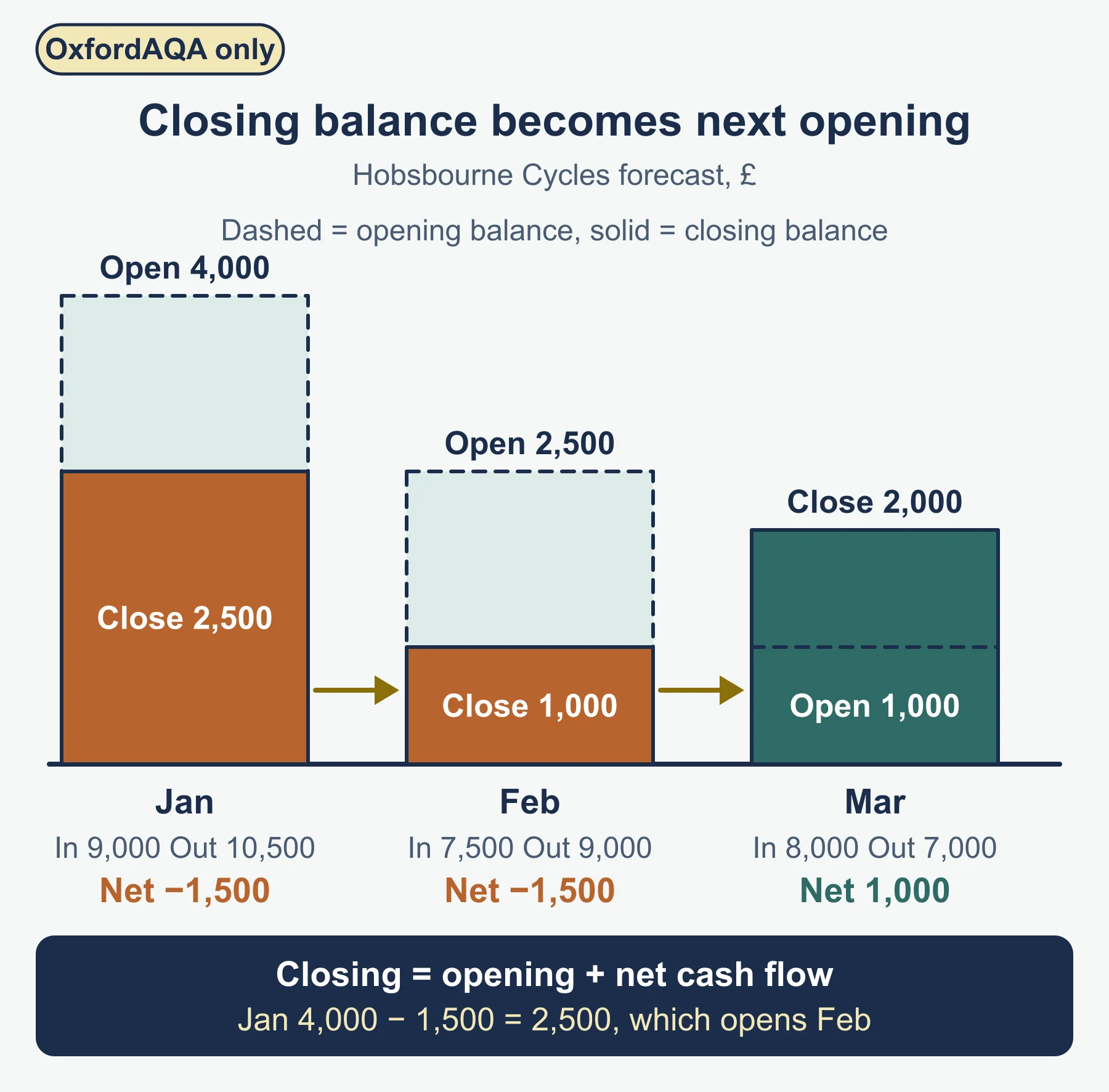
| Closing balance | Opening balance + net cash flow |
| Opening balance (next month) | Previous closing balance |
Small reminder: opening 2,000, inflows 6,500, outflows 7,200. Net cash flow = −700. Closing balance = 1,300.
Cash versus profit
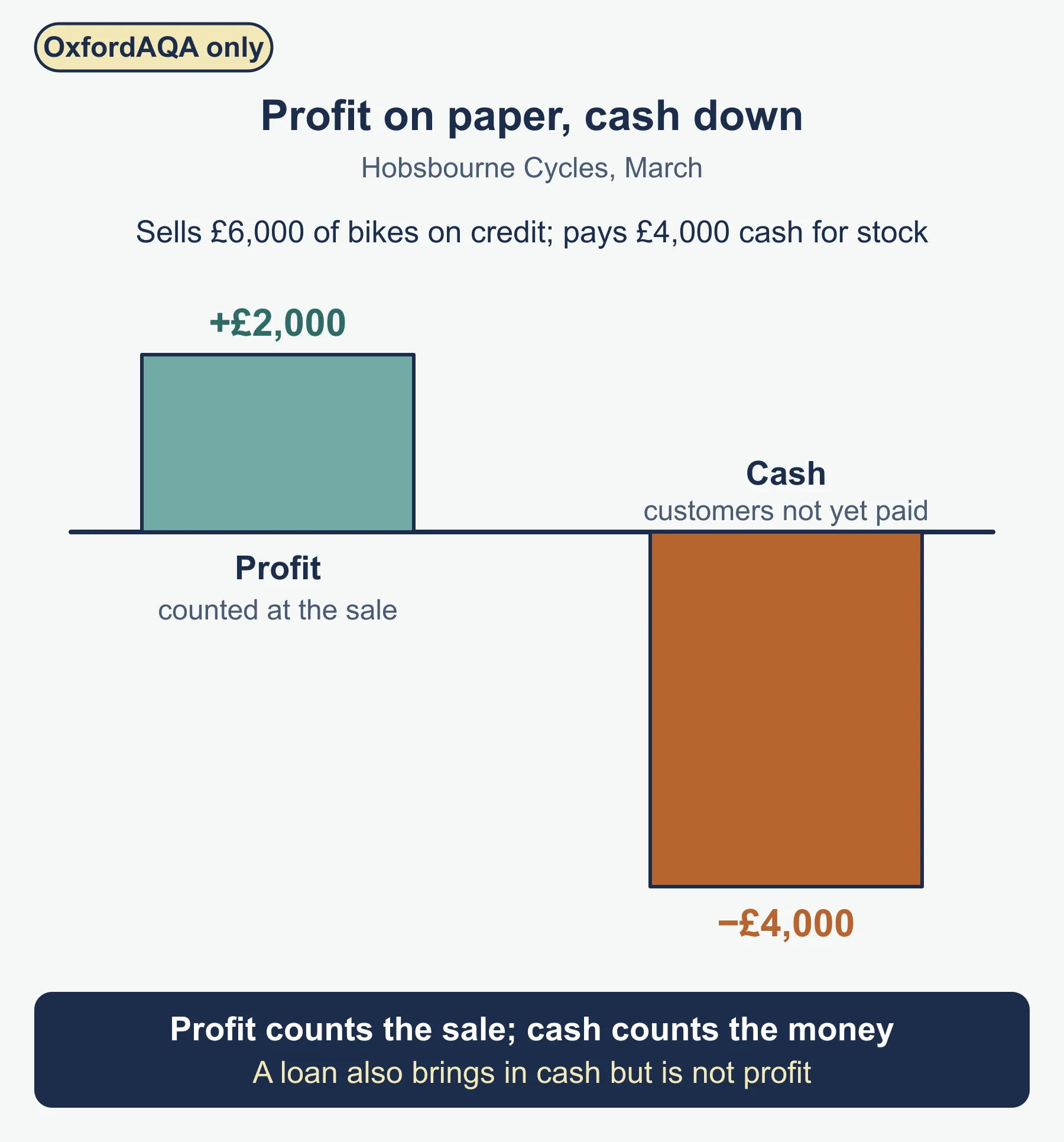
- Profit = revenue − costs, recognised when the sale is made.
- Cash is recognised when money moves.
- A firm can be profitable but short of cash (sales on credit, stock bought in advance, equipment bought outright).
- Loans raise cash, not profit.
Solutions (evaluate each):
| Solution | Plus | Minus |
|---|---|---|
| Re-schedule payments | Free, quick | Suppliers may refuse |
| Overdraft | Immediate | Interest high |
| Reduce cash outflow | Under the firm’s control | Quality or growth may suffer |
| Increase cash inflow (chase debtors, prompt-payment discount, sell assets) | Direct effect | Discounts cut profit |
| New sources of finance | Covers large gaps | Cost or shared ownership |
Judge by the size and length of the gap, the cost, and side effects.
3.6.3 Financial terms and calculations
| Term | Formula or meaning |
|---|---|
| Fixed costs | Do not change with output |
| Variable costs | Change with output |
| Total costs | Fixed + variable |
| Revenue | Price × quantity sold |
| Profit or loss | Revenue − total costs |
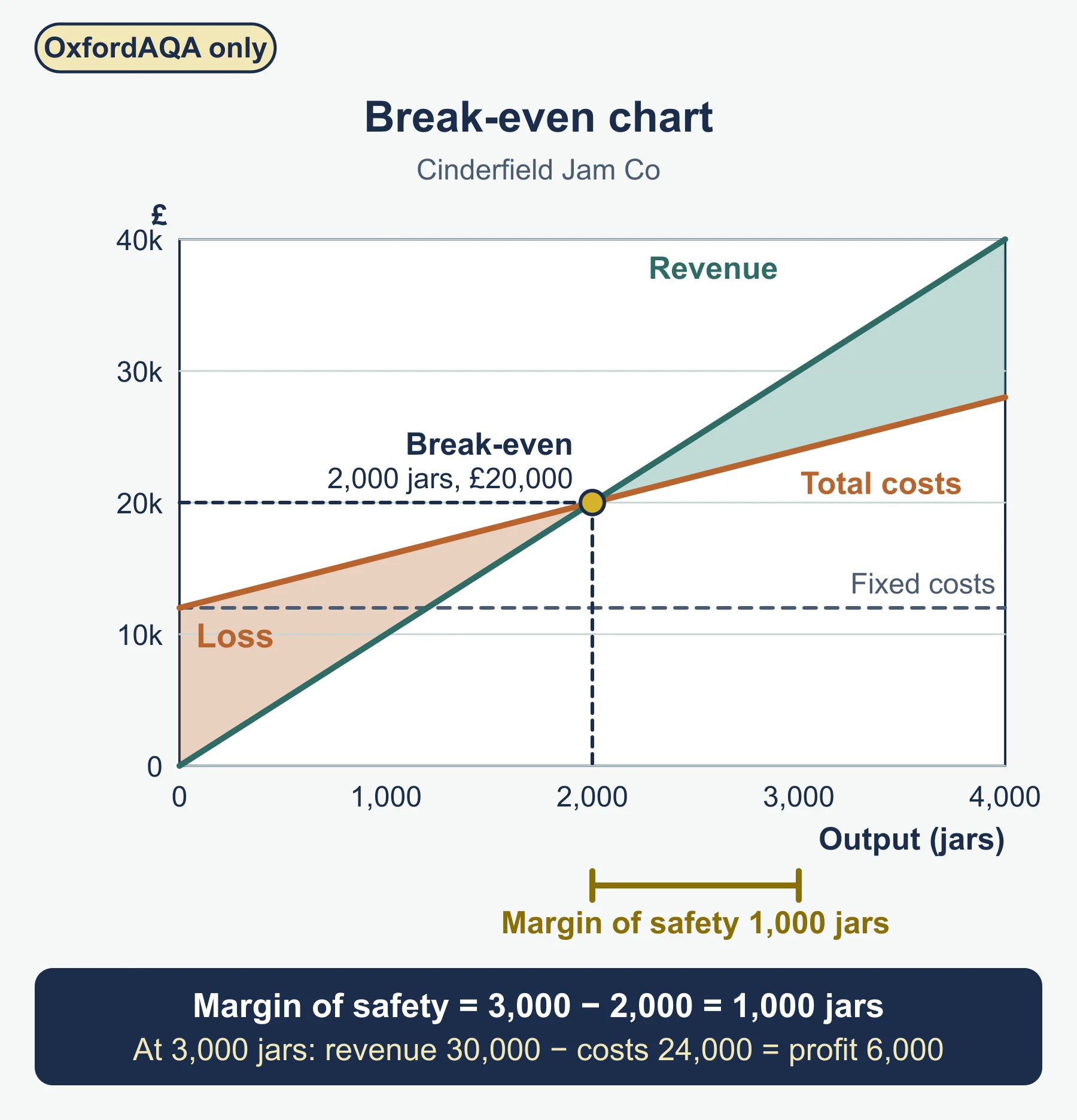
| Break-even output | Output where revenue = total costs |
| Margin of safety | Actual or planned output − break-even output |
| Payback period | Time for net cash inflows to repay the cost |
Small reminder: 5,000 units at 6 each give revenue 30,000. Fixed costs 9,000 plus variable 2.50 × 5,000 = 12,500 give total costs 21,500. Profit = 8,500.
Reading a break-even chart
- Find the total revenue line and the total costs line.
- The crossing point is break-even. Read its output on the horizontal axis.
- The gap between the lines left of that point is loss; to the right, profit.
- Margin of safety is the horizontal distance from break-even to actual output. Example: break-even 800 units, planned 1,100 units: margin of safety 300 units.
Value of break-even analysis: simple; shows risk; helps with loans and pricing decisions. But it assumes all output is sold, price and costs constant, and forecasts are accurate.
Payback steps
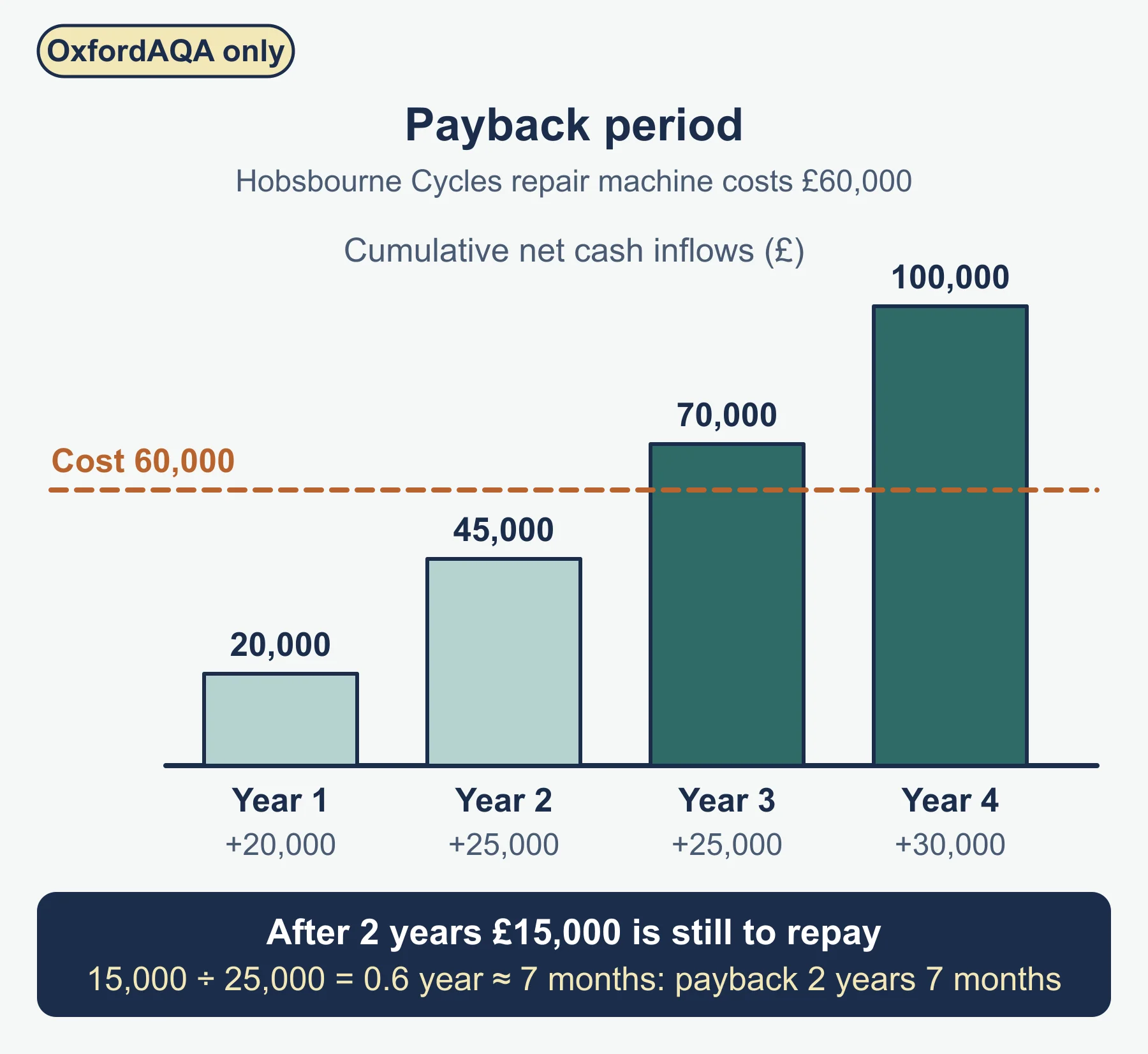
- Add yearly net cash inflows to make a running total.
- Find the year in which the total passes the cost.
- Part-year = amount still to repay ÷ that year’s inflow, times 12 for months.
Example: cost 24,000; inflows 8,000, 12,000, 15,000. After two years 20,000. Remaining 4,000 ÷ 15,000 = 0.27 years, about 3 months. Payback = 2 years 3 months. Investments include machinery, buildings and vehicles. Advantage: quick to calculate and shows risk. Limit: ignores cash after payback.
3.6.4 Financial performance
Purpose of financial statements: show how a business is doing; help owners, managers, lenders, investors and others decide.
| Statement | Shows | Time frame |
|---|---|---|
| Income statement | Revenue, cost of sales, gross profit, expenses, net profit | A period |
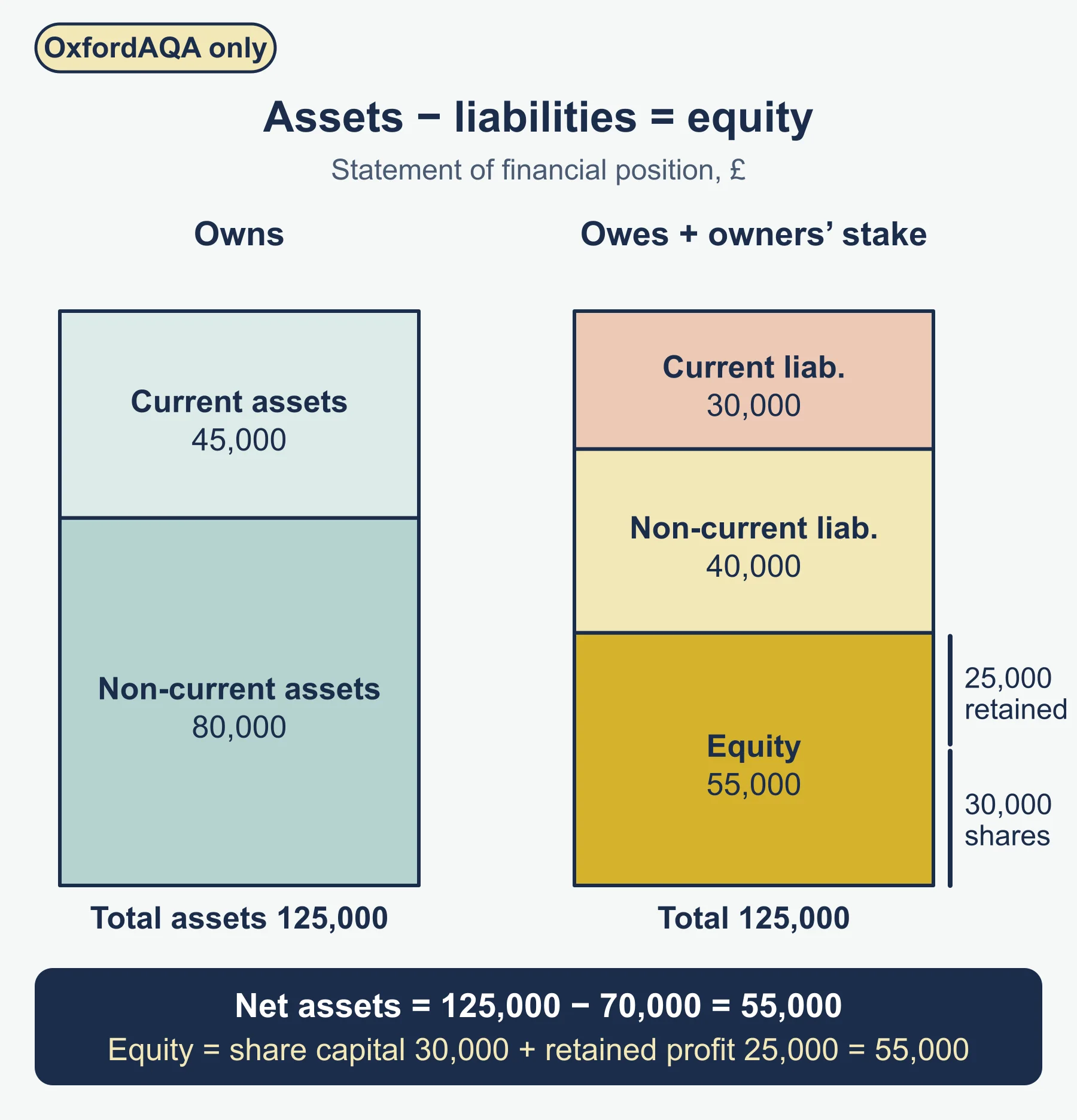
| Statement of financial position (Balance Sheet) | Assets, liabilities, equity | A snapshot at one date |
- Assets: owned or owed to the business (non-current and current).
- Liabilities: owed by the business (current and non-current).
- Net assets = total assets − total liabilities.
| Ratio | Formula |
|---|---|
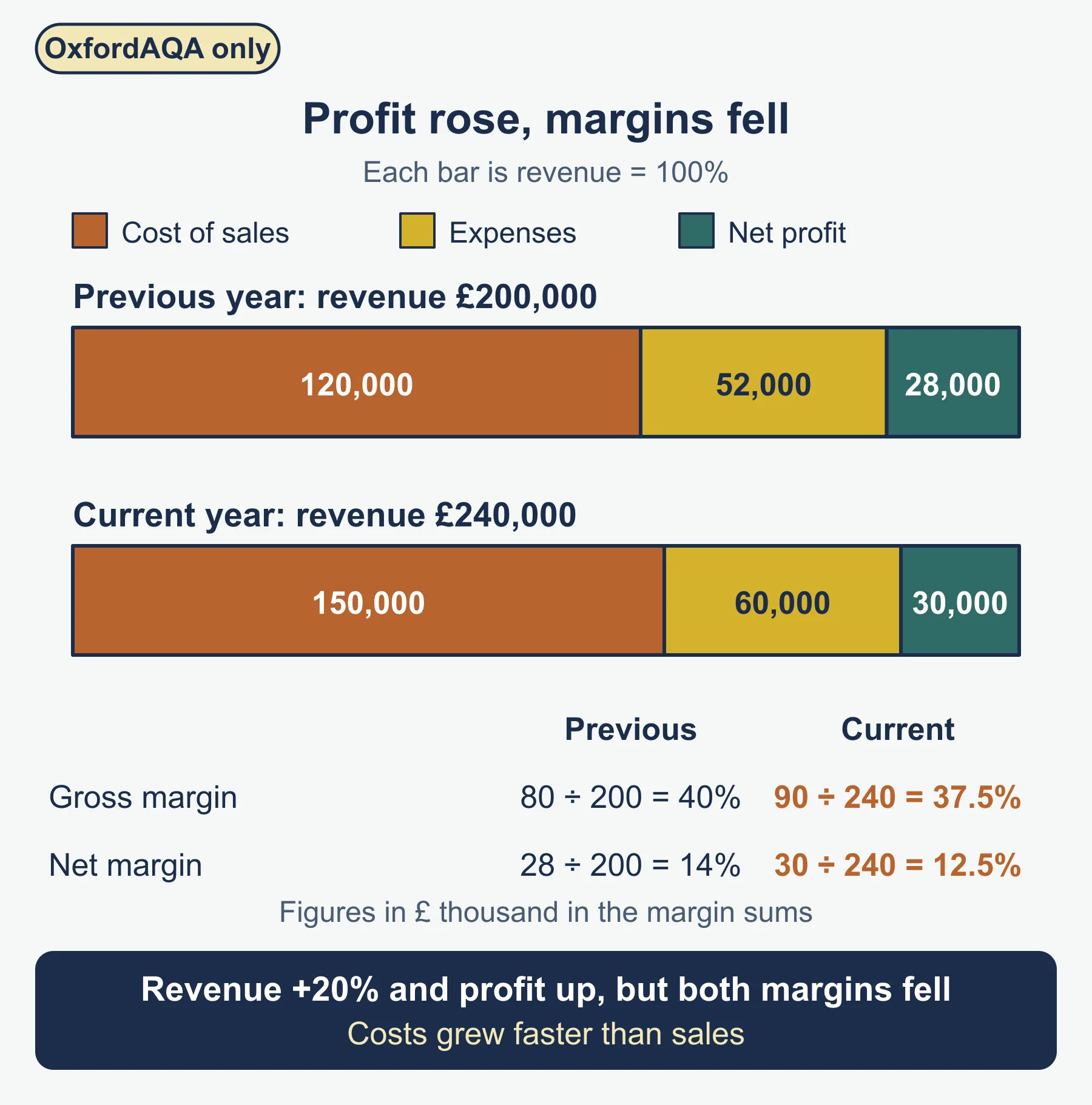
| Gross profit margin | Gross profit ÷ revenue × 100 |
| Net profit margin | Net profit ÷ revenue × 100 |
Small reminder: revenue 80,000; cost of sales 52,000; gross profit 28,000, margin 35%; expenses 20,000; net profit 8,000, margin 10%.
Layout reminder for an income statement, top to bottom: revenue, less cost of sales, equals gross profit, less expenses, equals net profit. For the statement of financial position: non-current assets plus current assets, less current and non-current liabilities, equals net assets, which equal equity.
| Stakeholder | Likely interest in the figures |
|---|---|
| Owners and shareholders | Profit and returns |
| Lenders | Ability to repay |
| Employees | Job security and pay |
| Suppliers | Whether they will be paid |
| Competitors | Margins to compare with their own |
Judging performance by four comparisons: current performance, previous years, competitors, and the view of each stakeholder (owner, lender, employee, supplier and others).
Linking the parts
Finance questions often join sections. A firm short of cash (3.6.2) may need an overdraft or loan (3.6.1). A break-even result (3.6.3) can support a loan request. Falling margins (3.6.4) may explain weak cash flow, because costs are taking more of each sale. Use these links to build analysis chains in longer answers.
Command words in finance questions
- State, identify, define: one short fact, no explanation.
- Calculate: show the formula or working, then the answer with units.
- Explain, analyse: make a point and develop it with because or so.
- Evaluate, justify, recommend: weigh both sides, link to the business in the case, and reach a reasoned judgement.
Quick self-test
- Name two internal sources of finance.
- A firm has an opening balance of 3,500, inflows of 9,000 and outflows of 10,200. State the closing balance.
- Define fixed costs and give one example.
- Output is 5,000 units, price 6, fixed costs 9,000, variable cost 2.50 a unit. Calculate profit.
- Break-even output is 800 units and planned output is 1,100 units. State the margin of safety.
- A project costs 30,000 and returns 10,000 net cash inflow a year. State the payback period.
- Revenue 80,000 and gross profit 28,000. Calculate gross profit margin.
- Why is the statement of financial position called a snapshot?
- Give one reason a profitable business may run out of cash.
- Give one advantage and one drawback of an overdraft.
Answers
- Retained profit; selling unwanted assets.
- 3,500 + 9,000 − 10,200 = 2,300.
- Costs that do not change with output, such as rent.
- 30,000 − 21,500 = 8,500.
- 1,100 − 800 = 300 units.
- 30,000 ÷ 10,000 = 3 years.
- 28,000 ÷ 80,000 × 100 = 35%.
- It shows assets and liabilities at one date only, not over a period.
- Customers pay late while suppliers and wages must be paid now.
- Flexible and quick for short-term gaps; interest is high and the bank can withdraw it.
Where marks are usually lost
- Using profit figures when the question asks about cash, or the reverse.
- Forgetting to carry the closing balance forward as the next opening balance.
- Reading break-even at the wrong axis: output is horizontal, money is vertical.
- Quoting a margin of safety in money when the chart question asks for output, or the reverse.
- Stopping the payback calculation at whole years and ignoring the part-year.
- Dividing by cost of sales instead of revenue for margins.
- Listing a source of finance without saying why it suits this business.
- Evaluating with no judgement at the end.
- Describing a statement of financial position as covering a year.
Frequently asked questions
Are formulae given in the OxfordAQA IGCSE Business exam? No. In OxfordAQA International GCSE Business (9225) you will not be given formulae, so you need to learn them. You will not be asked to draw break-even charts or use the break-even formula, nor to construct an entire cash flow forecast.
Why do new businesses find it harder to raise finance? New businesses have no track record, so lenders see more risk. Established businesses have a profit history, assets and credibility, which makes borrowing easier.
How do you calculate the payback period? Add the yearly net cash inflows to make a running total and find the year in which the cost is recovered. For the part-year, divide the amount still needed by that year’s inflow and convert it into months.
How do you judge a business’s financial performance? Use four comparisons: current performance, performance against previous years, performance against competitors, and the view of each stakeholder, such as owners, lenders, employees and suppliers.
Official syllabus
OxfordAQA International GCSE Business (9225), version 3.1, first teaching September 2020, first examined May/June 2022, section 3.6 Finance. Published by OxfordAQA.
Get free revision emails (optional)
Occasional emails with practice questions, worked explanations and links to free resources for the qualification and subjects you choose. No spam, and you can unsubscribe from any email. The free tools on this site never need an email.
Related resources
-
Study guides
OxfordAQA IGCSE Business: Finance (9225)
Study guide to OxfordAQA International GCSE Business 9225 section 3.6 Finance: sources of finance, cash flow, break-even, payback and financial statements.
Business · OxfordAQA · IGCSE
Read guide -
Practice questions
OxfordAQA IGCSE Business: Finance (9225) – Practice Questions
Original practice questions with worked answers on OxfordAQA International GCSE Business 9225 Finance: sources, cash flow, break-even, payback and margins.
Business · OxfordAQA · IGCSE
Try questions -
Study guides
OxfordAQA IGCSE Business: Human resources (9225)
Study guide to organisational structures, recruitment, motivation and training for the human resources topic of OxfordAQA International GCSE Business.
Business · OxfordAQA · IGCSE
Read guide
Related articles
-
teaching
A Level tuition in Dubai: Cambridge or Pearson Edexcel International A Level?
Schools in Dubai and Abu Dhabi teach either Cambridge International AS & A Level or Pearson Edexcel International A Level. How the two are structured, why it matters for tuition, and how online classes from Lahore work.
9 October 2026
-
curriculum guides
Choosing subjects at IGCSE and A Level
How subject choices at 14 and 16 affect university options later, and how to keep pathways open without overloading a timetable.
28 July 2026
Studying this with a teacher
Working through Business IGCSE?
This page is free and stays free. If you would rather be taught it, Marlbridge runs Business classes one-to-one and in small groups of up to 15, online in your own time zone. The first trial class is free. WhatsApp replies within an hour (8am–11pm Pakistan time, every day); email the same day.
OxfordAQA Business teachers at Marlbridge
