
Study Guides
OxfordAQA IGCSE Business: Human resources (9225)
Study guide to organisational structures, recruitment, motivation and training for the human resources topic of OxfordAQA International GCSE Business.
- Subject
- Business
- Level
- IGCSE
- Topic
- Human resources
- Author
- Marlbridge Academic Team
- Updated
- Reviewed by
- Salman Ahmad (what this means)
Aligned to OxfordAQA IGCSE Business (9225), First teaching September 2020, first examined May/June 2022. Official specification .
Syllabus page (what it covers and how it is assessed): OxfordAQA IGCSE Business.
Syllabus points this page covers
9225
- 4 Human resources (whole topic)
Found an error? Report a correction.
Need help with this topic? Request a free trial class for IGCSE Business (9225).
This guide covers section 3.4 Human resources of the OxfordAQA International GCSE Business (9225) specification, version 3.1, for exams from May/June 2022 onwards. The specification lists this topic as number 4 in its subject content. The official text divides it into four parts, set out in the map below. Human resources is assessed on Paper 1, which the specification titles as the influences of operations and human resources on business activity. All businesses and figures are invented. The course hub, printable checklist and free diagnostics cover the rest of the course. The revision notes and practice questions go with this page.
Map of the topic
| Section | What the specification asks for |
|---|---|
| 3.4.1 Organisational structures | Internal structures, span of control, chain of command, delayering, delegation; why structures exist and the roles in them; tall and flat structures; centralisation and decentralisation; effect on communication |
| 3.4.2 Recruitment and selection | The need for recruitment; internal and external recruitment; stages of recruitment and selection; benefits of doing it well |
| 3.4.3 Motivating employees | Benefits of a motivated workforce; financial methods (salary, wage, commission, profit sharing); non-financial methods (management style, training, responsibility, fringe benefits) |
| 3.4.4 Training | Benefits of training; induction, on the job and off the job training; costs and benefits of the last two; choosing the best method |
The specification states that specific motivational theories (such as Maslow) will not be examined. You are asked about methods of motivation and their effects, not about named theories.
3.4.1 Organisational structures
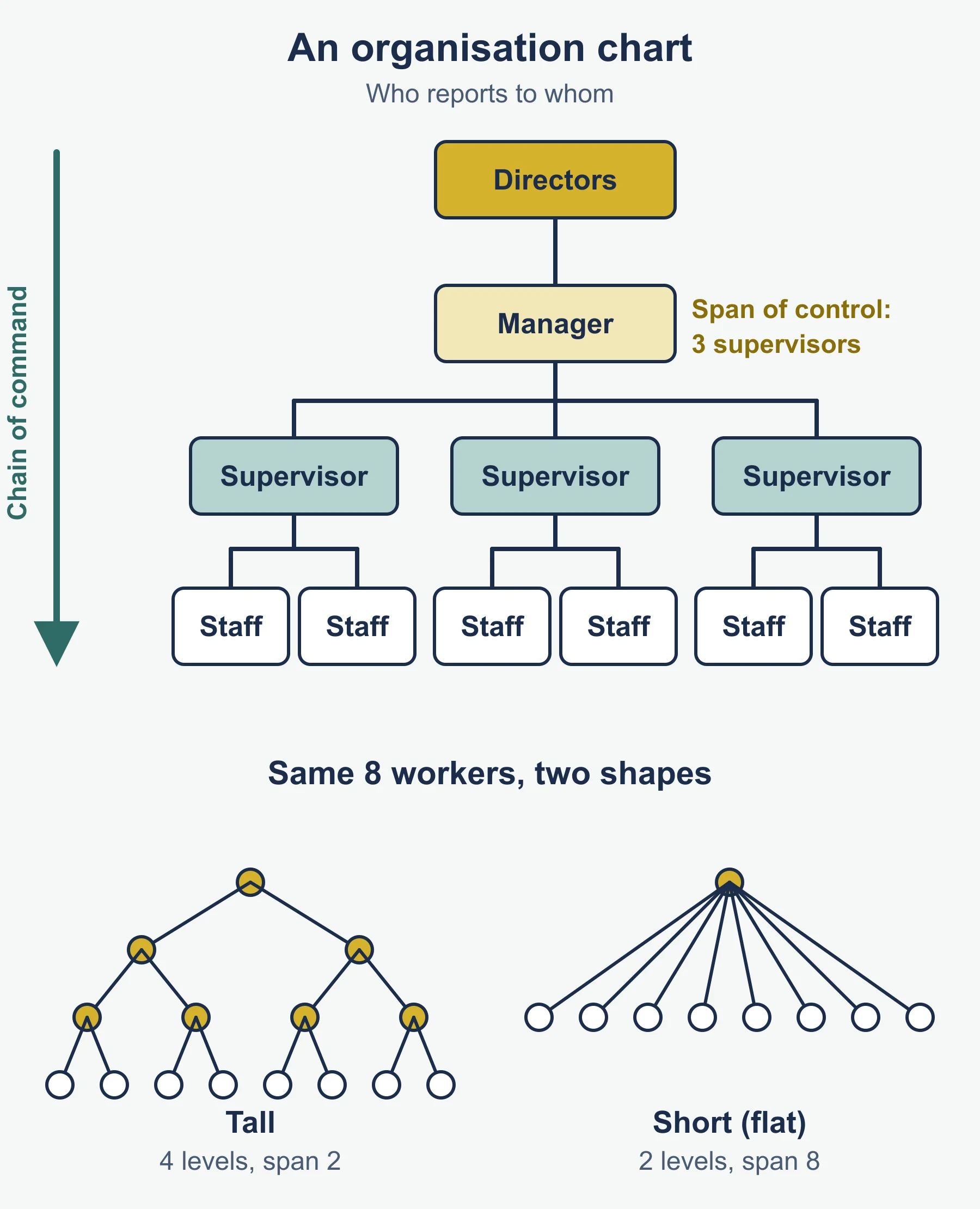
An organisational structure shows how a business arranges its people into levels of authority and groups of jobs. It sets out who does which job, who is responsible for what and who reports to whom. Businesses have a structure so that tasks are covered, nobody is unsure who makes a decision, and workers know who to ask. Job roles run from directors (who set direction), through managers and supervisors (who organise and check work), to operatives (who do the tasks).
Key terms:
- Chain of command: the path along which authority and instructions travel between the highest and lowest posts. Instructions pass down it and reports pass up it.
- Span of control: the number of people a manager or supervisor is directly responsible for.
- Delegation: giving someone lower in the chain the authority to carry out a task, along with the right to decide how it is done. The manager still answers for the outcome.
- Delayering: removing one or more levels from the structure.
Tall and flat structures
A tall structure has many levels and usually a narrow span of control. A flat structure has few levels and a wide span.
| Tall | Flat | |
|---|---|---|
| Chain of command | Long | Short |
| Span of control | Narrow, so close supervision | Wide, so workers have more freedom |
| Communication | Slower, and messages can change as they pass through many people | Faster and more direct |
| Management | Clear promotion steps, but more managers to pay | Fewer managers to pay, but each manager is stretched |
Worked example: span of control and delayering
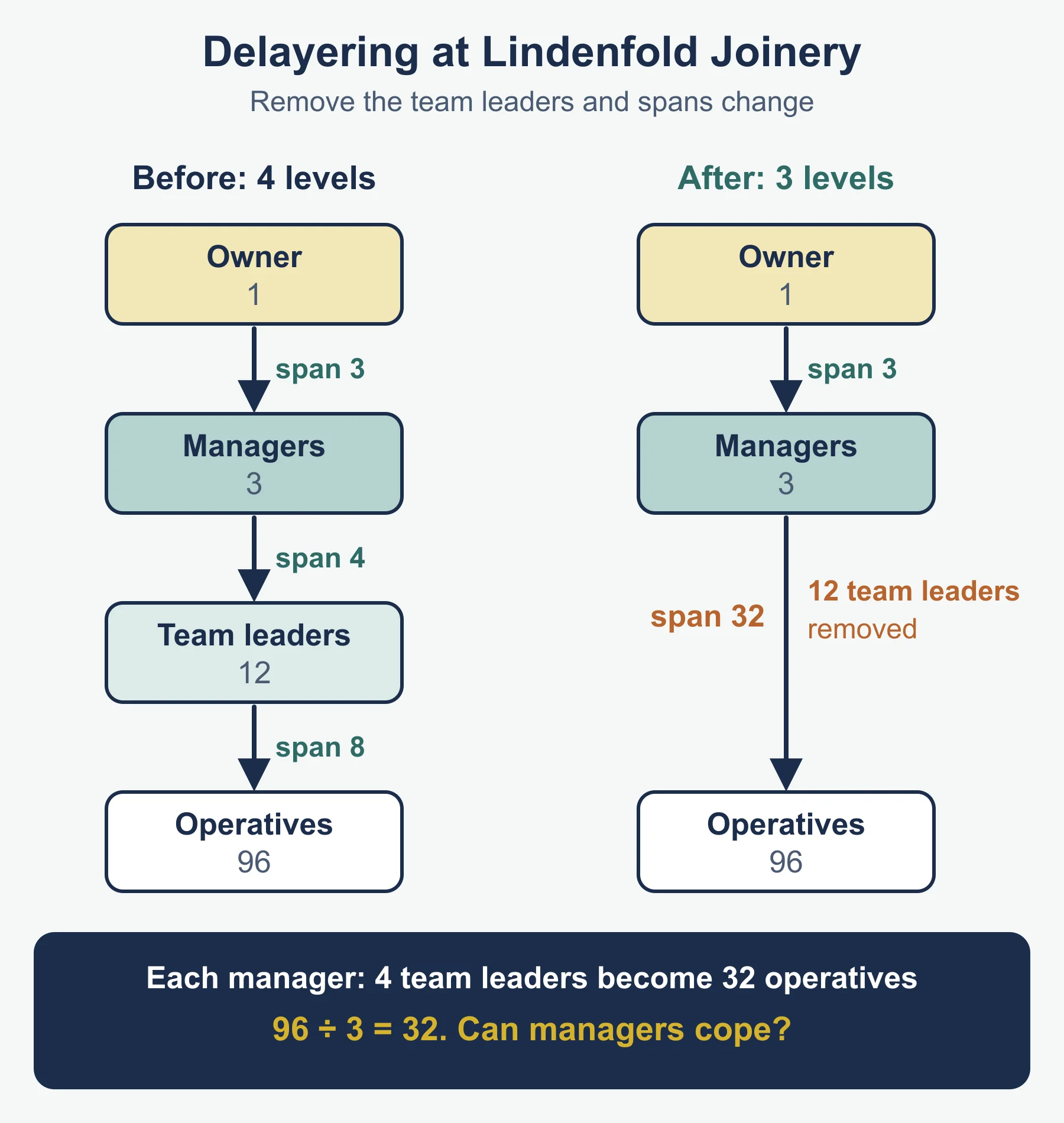
Lindenfold Joinery has an owner, 3 managers, 12 team leaders and 96 operatives. Each manager has 4 team leaders. Each team leader has 8 operatives.
- Total staff: 1 + 3 + 12 + 96 = 112.
- The structure has 4 levels.
- The span of control is 3 for the owner, 4 for each manager and 8 for each team leader.
The owner delayers by removing the team leaders. The 96 operatives now report to the 3 managers: 96 ÷ 3 = 32 each. Wage costs fall and messages travel faster. Each manager’s span rises from 4 to 32, though, which may be too many to supervise or support well, and the 12 team leaders lose their promotion step. Delayering suits a business only if managers can cope with the wider span, for example with skilled operatives.
Centralised and decentralised structures
In a centralised structure, decisions are made at the top. Decisions are consistent and the owner keeps control, but they can be slow and staff may feel unimportant. In a decentralised structure, decisions are made lower down, often through delegation. Decisions are quicker and closer to customers, and staff may feel more trusted, but managers have less control and different parts of the business may act in different ways.
Appropriateness
No structure is best for every business. A small cafe with six staff works well with a flat, centralised structure. A large firm with several sites and hundreds of staff usually needs more levels, or decentralised decisions, so that local managers can respond to local problems. When you recommend a structure, use the size of the business, the type of work and the skills of the staff.
Structure and communication
A tall structure means more links in the chain, so messages are slower, can be distorted and may not reach the top. A flat structure gives faster and more direct communication in both directions, but a wide span means each manager has less time for each worker.
3.4.2 Recruitment and selection of employees
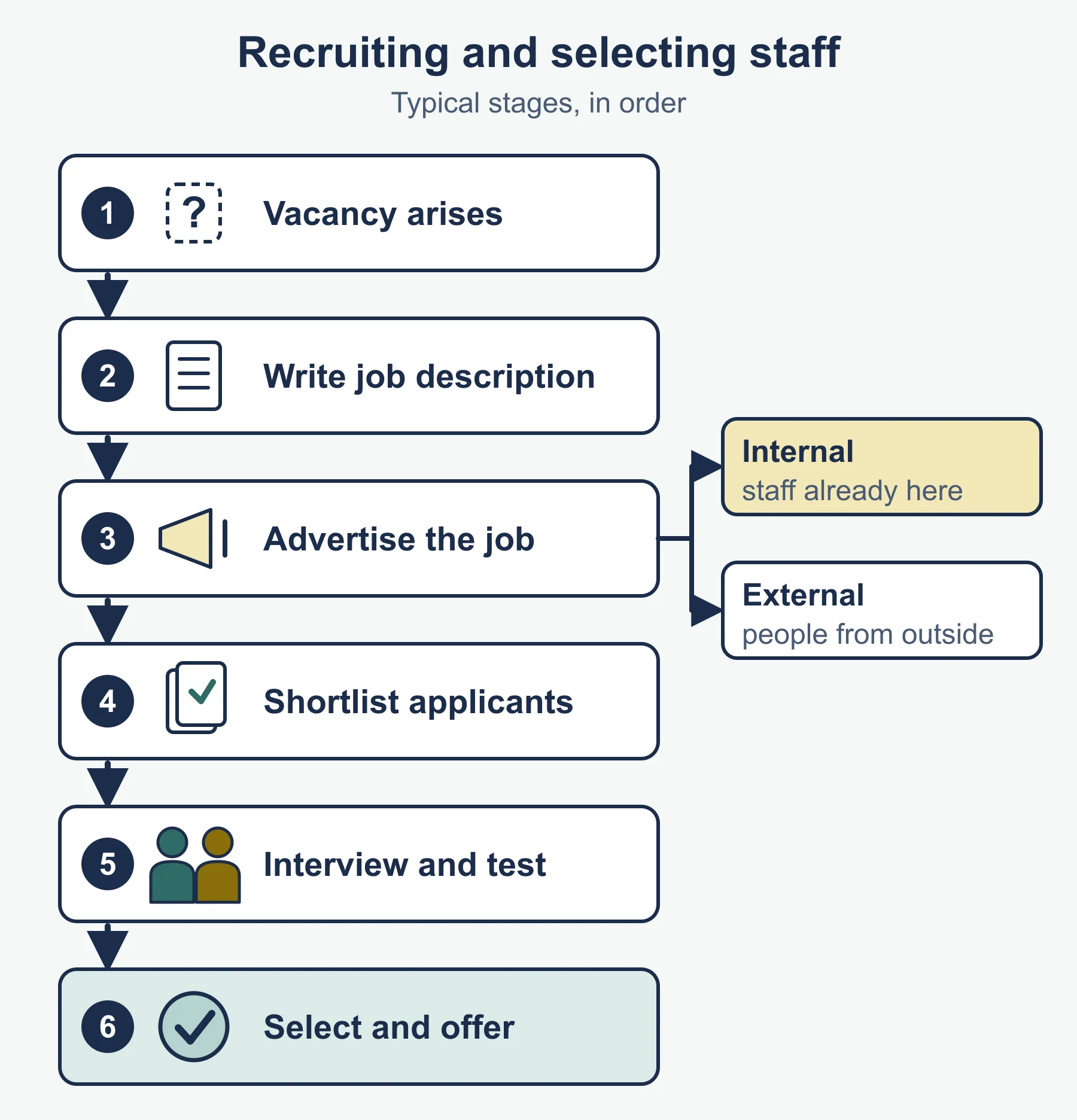
The need for recruitment arises when a business has a vacancy: someone leaves or retires, the business grows, it opens a new branch, or it needs skills it does not have. The process has two parts. Recruitment attracts suitable applicants. Selection chooses between them.
Internal and external recruitment
| Internal (an existing employee fills the post) | External (someone from outside fills the post) | |
|---|---|---|
| Benefits | Cheaper and quicker; the person already knows the business; shows other staff there are promotion chances, which can motivate them; the business already knows the person’s record | A wider choice of applicants; new ideas and skills; the business may find specialist skills it lacks |
| Drawbacks | Small choice; no new ideas; the vacancy left behind must be filled; unsuccessful candidates may be disappointed | Slower and dearer (advertising, interviews); more risk because the person is unknown; the person needs time to learn the business |
Stages of recruitment and selection
- Identify the vacancy and decide whether the job is needed.
- Write a job description (the tasks and responsibilities) and a person specification (the skills, qualifications and experience needed).
- Advertise the job, internally or externally.
- Applicants send in application forms or CVs, and the business shortlists the best.
- Shortlisted candidates are interviewed, and may also take tests or give a presentation.
- The business checks references, makes an offer and the candidate accepts.
Benefits of an effective process
An effective process chooses people with the right skills and attitude. The specification asks you to analyse three benefits:
- High productivity: well-matched staff produce more per hour, so unit costs fall.
- High quality output or customer service: capable and well-suited staff make fewer mistakes and deal better with customers, which builds reputation.
- Staff retention: people who fit the job and the business are likelier to stay, so the business spends less on re-advertising, interviewing and induction.
A poor choice does the reverse: the worker may leave within weeks and the cost is repeated.
3.4.3 Motivating employees
Motivation is the desire to work hard and do the job well. The specification asks you to understand the benefits of a motivated workforce, such as staff retention and high productivity. A demotivated workforce shows the opposite signs: absence, mistakes, complaints and staff leaving.
Financial methods
| Method | How it works |
|---|---|
| Salary | A fixed yearly amount, paid in monthly instalments, whatever the hours or output |
| Wage | Pay by the hour or week, so pay rises with hours worked |
| Commission | A percentage of the sales a worker makes, often added to a basic pay |
| Profit sharing | A share of the business’s profit paid to employees |
Worked example: pay calculations
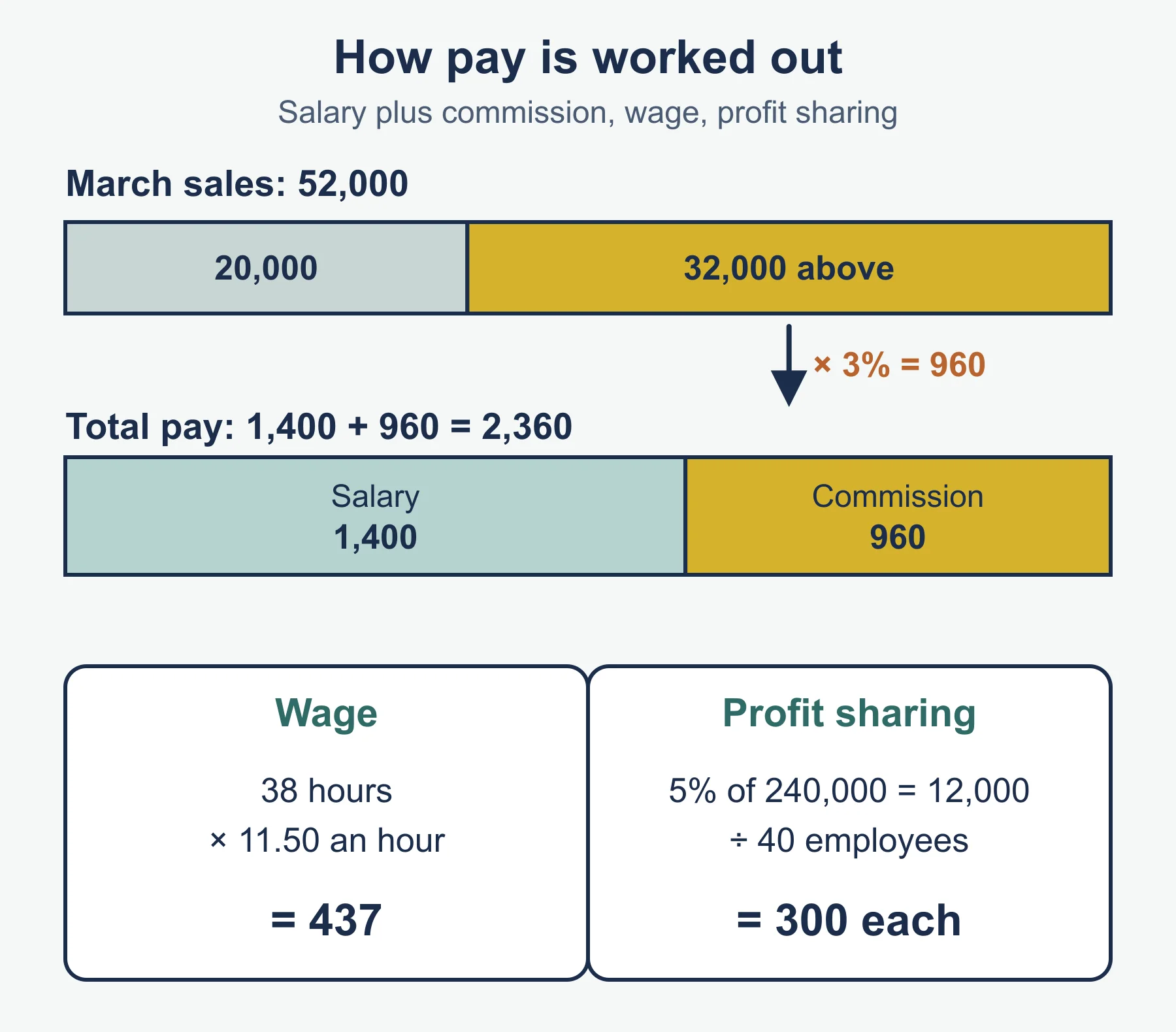
Sedgefield Motors pays a salesperson a basic salary of 1,400 a month plus 3% commission on sales above 20,000. Sales in March are 52,000.
- Sales above 20,000: 52,000 - 20,000 = 32,000.
- Commission: 3% of 32,000 = 960.
- Total pay: 1,400 + 960 = 2,360.
A cleaner works 38 hours at a wage of 11.50 an hour: 38 × 11.50 = 437. If a business with 40 employees makes a profit of 240,000 and shares 5% of it equally, the pool is 12,000 and each person receives 12,000 ÷ 40 = 300.
Financial methods are easy to understand and can link pay to effort. Commission can push staff to take risks or neglect customers after the sale. Profit sharing makes staff care about the whole business, but the payout can be small and is delayed. A fixed salary gives security, but nothing rewards extra effort.
Non-financial methods
- Styles of management: managers who explain decisions, ask for views and delegate often motivate more than those who only give orders.
- Training: it shows the business values staff, gives skills and opens the way to promotion.
- Greater responsibility: handing over more decisions or more varied tasks makes work more interesting.
- Fringe benefits: extras in addition to pay, such as a company car, staff discount, free meals, health insurance or paid time off for study.
Non-financial methods may cost less than a pay rise, though training and benefits do cost money.
3.4.4 Training
Training teaches employees the skills and knowledge to do their jobs well. The specification asks you to explain these benefits to the business:
- Increased productivity: skilled workers work faster and waste less.
- Ability to deal with changes in technology: trained staff can use new machines and systems.
- Increased motivation: staff feel valued and more confident.
- Staff retention: trained staff are likelier to stay, so fewer replacements are needed.
- High-quality goods: fewer faults and less rework.
- Good customer service: staff who know the product and the system deal with customers better.
Methods
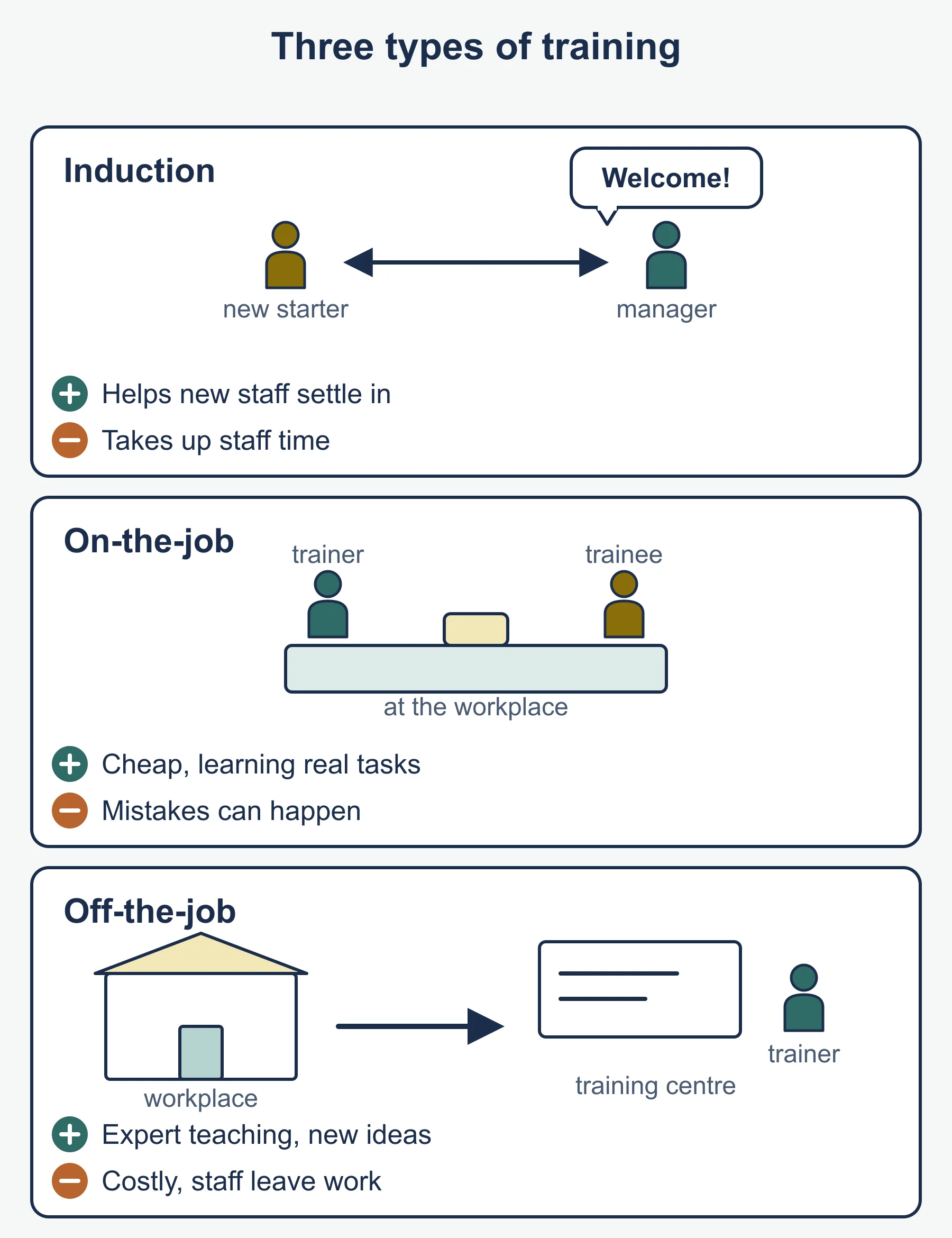
- Induction training: introduces a new employee to the business, covering the layout, safety rules, colleagues and the job. It helps new staff settle quickly and avoid early mistakes.
- On the job training: learning at the place of work while doing the real job, for example by shadowing a skilled colleague. It is cheap, practical and costs no travel, and the trainee still produces something. The trainer’s time is taken from their own work, and the trainer may pass on bad habits.
- Off the job training: learning away from the workplace, for example at a college or a training centre, or through an external course. It can teach wider skills from specialists, but fees and travel add cost and the worker is away from the job.
Worked example: comparing costs
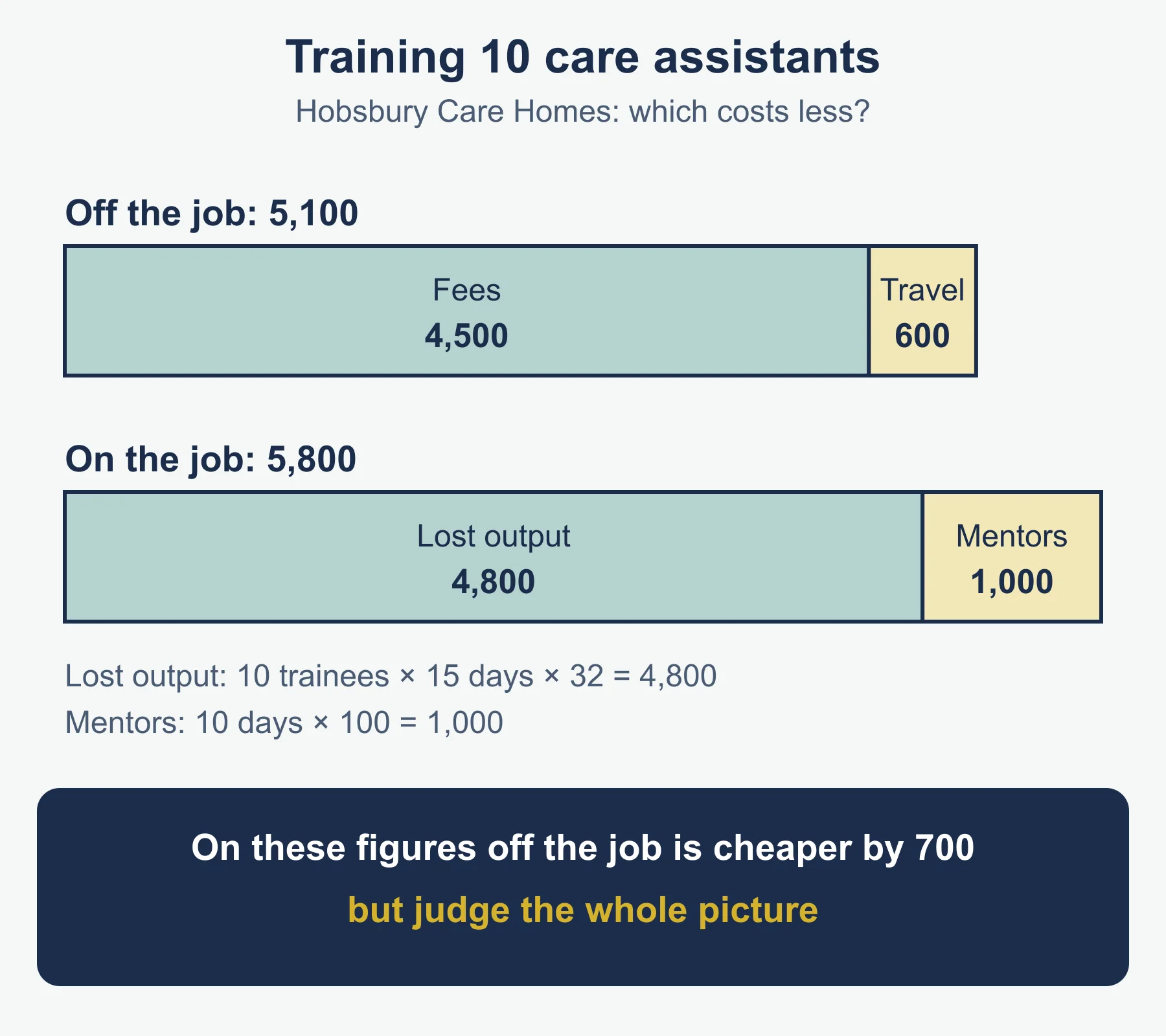
Hobsbury Care Homes trains 10 new care assistants. An off the job course costs 450 per person plus 60 travel each: 10 × (450 + 60) = 5,100. The alternative is on the job training. Each trainee works for 15 days at 40% less output than normal, and a day of normal output is worth 80. Lost output is 10 × 15 × (0.4 × 80) = 4,800. Mentors spend 10 days at 100 a day, which is 1,000. The on the job total is 5,800.
So off the job is cheaper on these figures. You must still judge the whole picture. On the job training keeps trainees at work and teaches the home’s own routines, and the lost output is only an estimate. Off the job may bring new ideas and recognised qualifications. For a small business with few staff, on the job training is usually the practical choice. A large business with many recruits, or one needing specialist skills, may favour off the job. State the choice, then give the reason from the stem.
Common errors
- Confusing span of control (people directly managed) with the number of levels.
- Saying a flat structure is always better.
- Writing “internal recruitment is cheaper” without saying why, or ignoring the gap left in the old post.
- Listing motivation methods without linking them to retention or productivity.
- Mixing up commission (tied to the worker’s own sales) and profit sharing (tied to the business’s profit).
- Evaluating training without a decision for the business in the stem.
Frequently asked questions
What is span of control? Span of control is the number of people a manager is directly responsible for. It is different from the number of levels in a structure, which is a common confusion.
What is the difference between a salary and a wage? A salary is a fixed yearly amount, usually paid in monthly instalments, while a wage is paid by the hour or week. Commission and profit sharing can be added to link pay to sales or business profit.
What is the difference between on the job and off the job training? On the job training happens at the workplace while doing the real job, which is cheap and practical but takes the trainer’s time. Off the job training happens away from the workplace, such as at a college, and can teach wider skills but adds fees and travel costs.
What is induction training? Induction training introduces a new employee to the business, covering the layout, safety rules, colleagues and the job. It helps new staff settle quickly and avoid early mistakes.
How do you calculate commission on sales above a target? Subtract the target from total sales to find the sales that qualify, multiply by the commission rate, then add any basic salary. Applying the rate to all sales is a common error.
Next steps
Condense this guide with the revision notes, then test yourself with the practice questions.
Official syllabus
OxfordAQA International GCSE Business (9225) specification, version 3.1, OxfordAQA, for International GCSE exams May/June 2022 onwards. Section 3.4 Human resources (3.4.1 to 3.4.4).
Get free revision emails (optional)
Occasional emails with practice questions, worked explanations and links to free resources for the qualification and subjects you choose. No spam, and you can unsubscribe from any email. The free tools on this site never need an email.
Related resources
-
Practice questions
OxfordAQA IGCSE Business: Human resources (9225) – Practice Questions
Twelve original questions with worked answers on structures, recruitment, motivation and training for OxfordAQA International GCSE Business.
Business · OxfordAQA · IGCSE
Try questions -
Revision notes
OxfordAQA IGCSE Business: Human resources (9225) – Revision Notes
Condensed revision notes on structures, recruitment, motivation and training for OxfordAQA International GCSE Business human resources, with a self-test.
Business · OxfordAQA · IGCSE
Revise topic -
Practice questions
OxfordAQA IGCSE Business: Influences on Business — Practice Questions (9225)
Original OxfordAQA International GCSE Business 9225 practice questions with worked answers on technology, ethics, the economy, globalisation, law and rivals.
Business · OxfordAQA · IGCSE
Try questions
Related articles
-
teaching
A Level tuition in Dubai: Cambridge or Pearson Edexcel International A Level?
Schools in Dubai and Abu Dhabi teach either Cambridge International AS & A Level or Pearson Edexcel International A Level. How the two are structured, why it matters for tuition, and how online classes from Lahore work.
9 October 2026
-
curriculum guides
Choosing subjects at IGCSE and A Level
How subject choices at 14 and 16 affect university options later, and how to keep pathways open without overloading a timetable.
28 July 2026
Studying this with a teacher
Working through Business IGCSE?
This page is free and stays free. If you would rather be taught it, Marlbridge runs Business classes one-to-one and in small groups of up to 15, online in your own time zone. The first trial class is free. WhatsApp replies within an hour (8am–11pm Pakistan time, every day); email the same day.
OxfordAQA Business teachers at Marlbridge
