
Revision Notes
OxfordAQA IGCSE Business: Human resources (9225) – Revision Notes
Condensed revision notes on structures, recruitment, motivation and training for OxfordAQA International GCSE Business human resources, with a self-test.
- Subject
- Business
- Level
- IGCSE
- Topic
- Human resources
- Author
- Marlbridge Academic Team
- Updated
- Reviewed by
- Salman Ahmad (what this means)
Aligned to OxfordAQA IGCSE Business (9225), First teaching September 2020, first examined May/June 2022. Official specification .
Syllabus page (what it covers and how it is assessed): OxfordAQA IGCSE Business.
Syllabus points this page covers
9225
- 4 Human resources (whole topic)
Found an error? Report a correction.
Need help with this topic? Request a free trial class for IGCSE Business (9225).
These notes condense section 3.4 Human resources of the OxfordAQA International GCSE Business (9225) specification, version 3.1, for exams from May/June 2022 onwards. For full explanations and worked examples, read the study guide. Then test yourself with the practice questions. The course hub, the printable checklist and the free diagnostics cover the rest of the course.
Topic map
| Section | Content in one line |
|---|---|
| 3.4.1 Organisational structures | Span of control, chain of command, delayering, delegation; tall v flat; centralised v decentralised; communication |
| 3.4.2 Recruitment and selection | Need for recruitment; internal v external; stages; benefits of an effective process |
| 3.4.3 Motivating employees | Benefits of motivation; salary, wage, commission, profit sharing; non-financial methods |
| 3.4.4 Training | Benefits; induction, on the job, off the job; costs, benefits and choice of method |
The specification says specific motivational theories (such as Maslow) will not be examined.
3.4.1 Organisational structures
| Term | Meaning |
|---|---|
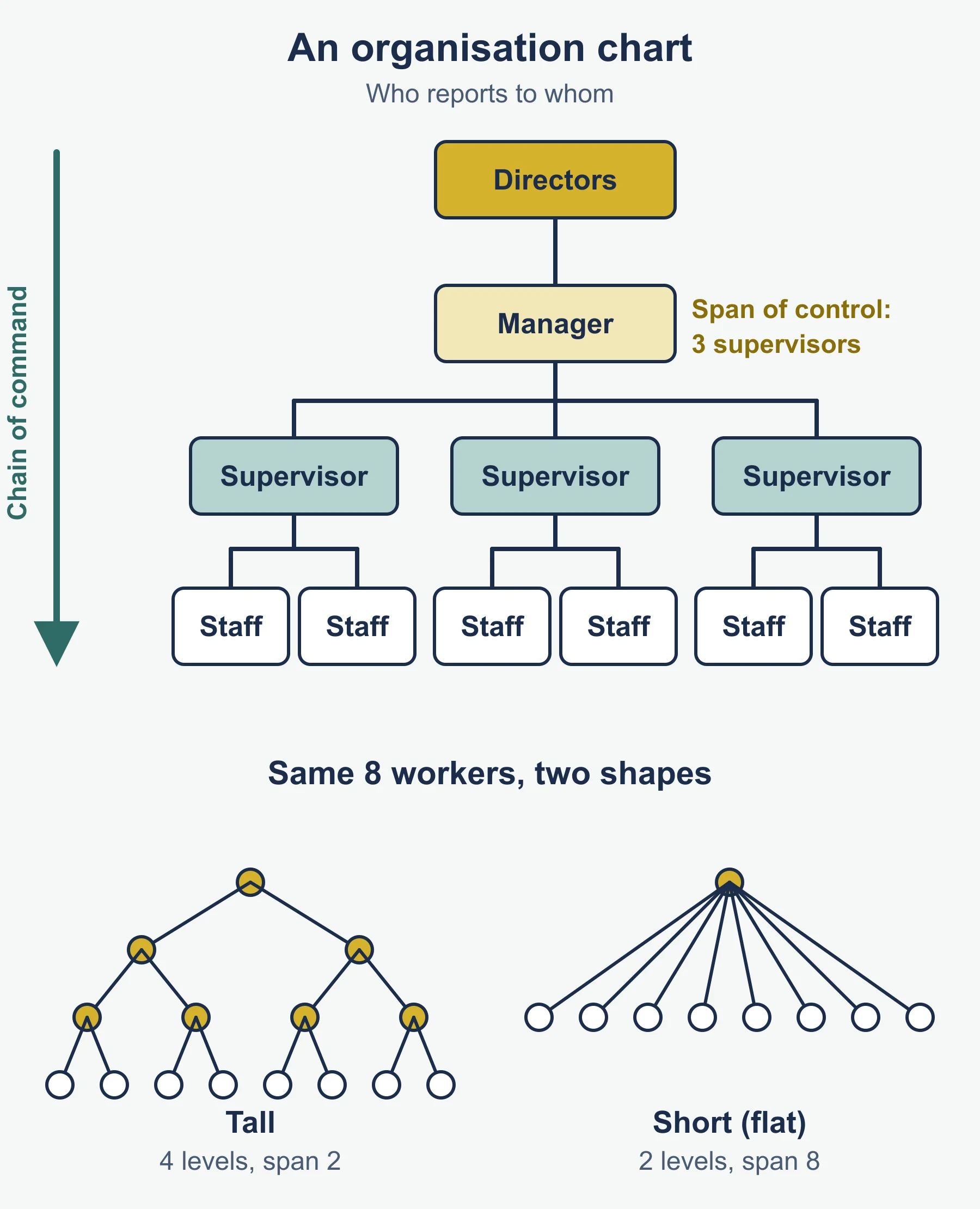
| Organisational structure | How a business arranges people into levels and groups, showing roles and who reports to whom |
| Chain of command | Path of authority linking the highest and lowest posts |
| Span of control | Number of people directly under one manager |
| Delegation | Passing authority for a task, and the right to decide about it, to someone lower down |
| Delayering | Removing one or more levels |
| Centralised | Decisions made at the top |
| Decentralised | Decisions made lower down, often by delegation |
Why have a structure: everyone knows their job and who they answer to, work is shared out, and decisions have an owner. Job roles run from directors to managers, supervisors and operatives.
| Tall | Flat | |
|---|---|---|
| Levels / chain | Many / long | Few / short |
| Span | Narrow | Wide |
| Communication | Slower, can be distorted | Faster, more direct |
| Management | Close supervision, promotion steps, higher management cost | Lower management cost, more freedom, managers stretched |
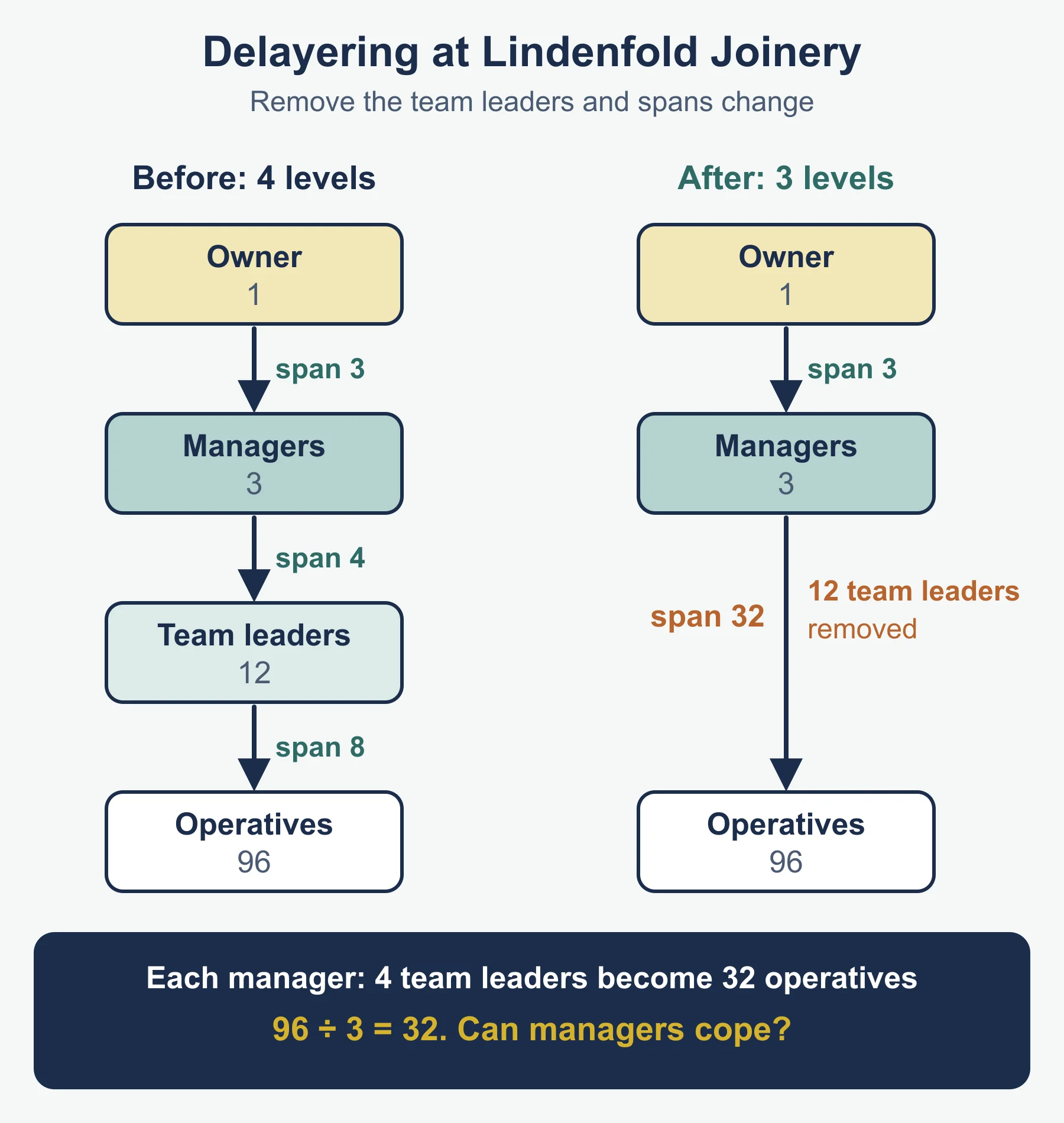
Method for a delayering question:
- Count the staff in each level.
- Divide the staff below the removed level by the managers above it to find the new span.
- State the gain (lower cost, faster communication) and the cost (wider span, fewer promotion steps).
- Judge whether this business can cope.
Small reminder: a manager with 5 supervisors, each with 12 workers, has a span of 5 at the top. If the supervisors go, that manager has 60 workers.
Centralised: consistent decisions and tight control, but slow and may demotivate. Decentralised: quick, local and trusting, but less control and risk of inconsistency. Choose by size, type of work and skills of staff. Structure also affects communication, because every extra level is another link where a message can be delayed or changed.
3.4.2 Recruitment and selection
Need: a vacancy from leavers or retirement, growth, a new branch or missing skills. Recruitment attracts applicants. Selection picks one.
| Internal | External | |
|---|---|---|
| For | Cheaper, quicker, known person, promotion chance motivates | Wider choice, new ideas and skills |
| Against | Small choice, no new ideas, leaves another vacancy | Slower, dearer, riskier, needs settling in |
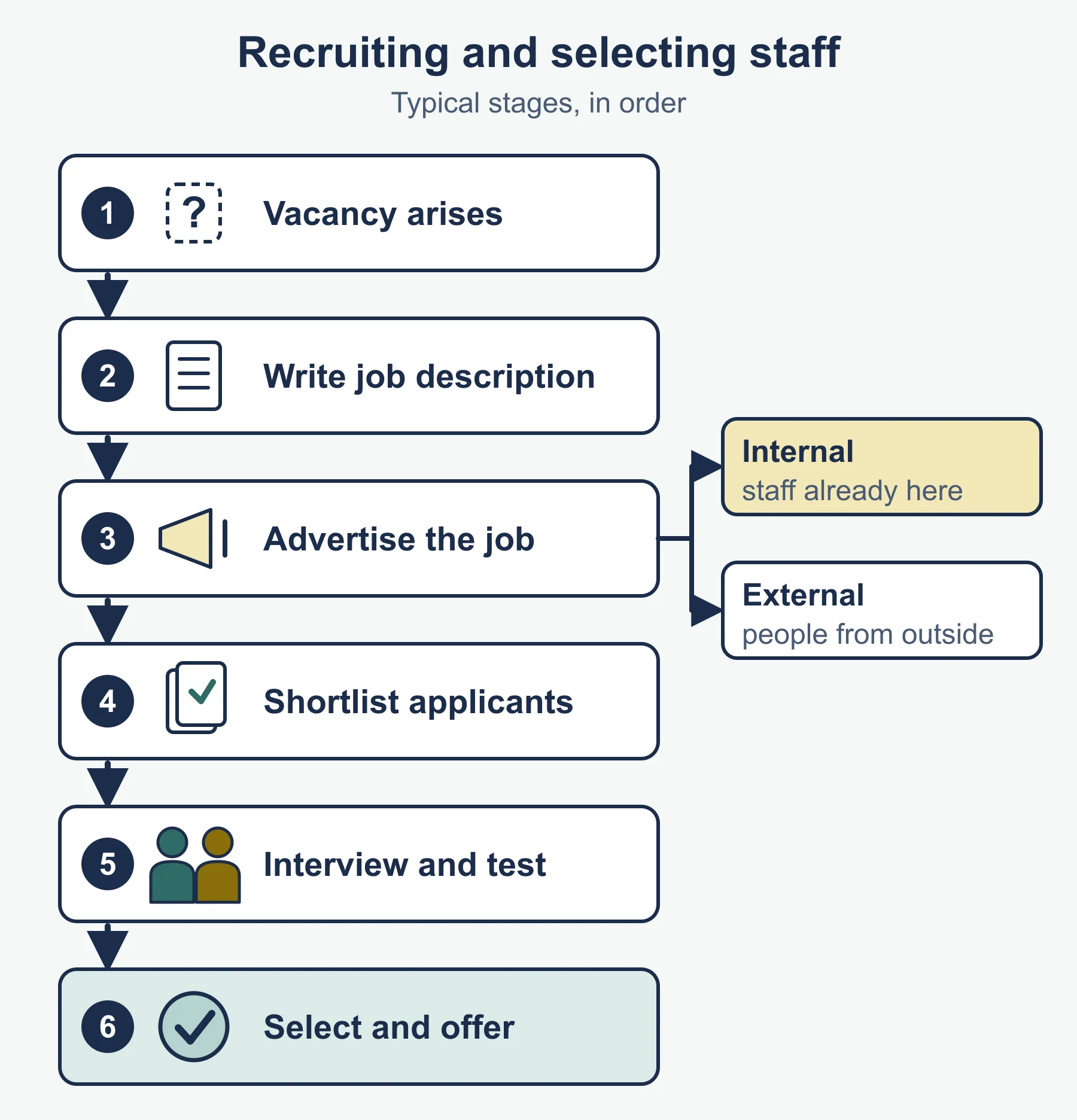
Stages in order:
- Identify the vacancy.
- Job description and person specification.
- Advertise.
- Applications and shortlist.
- Interviews (and tests).
- References, offer, acceptance.
Benefits of doing it well, which the specification asks you to analyse: high productivity, high quality output or customer service, and staff retention. Link each to a cost saving or a sales gain. A bad hire who leaves means paying to recruit again.
3.4.3 Motivating employees
Benefits of a motivated workforce: staff retention and high productivity. Without motivation you see absence, errors and resignations.
| Financial method | Key point | Strength | Weakness |
|---|---|---|---|
| Salary | Fixed yearly pay | Security, easy to budget | No link to effort |
| Wage | Pay per hour or week | Pay rises with hours | Income varies, may favour hours over quality |
| Commission | Percentage of own sales | Rewards effort | Pressure on staff, ignores teamwork |
| Profit sharing | Share of business profit | Staff care about the business | Payout delayed, small and uncertain |
Non-financial methods:
- Styles of management: consulting and trusting staff rather than only giving orders.
- Training: shows the business values staff and builds skills.
- Greater responsibility: more decisions or more varied work.
- Fringe benefits: extras beyond pay, such as discounts, meals, health cover or a company vehicle.
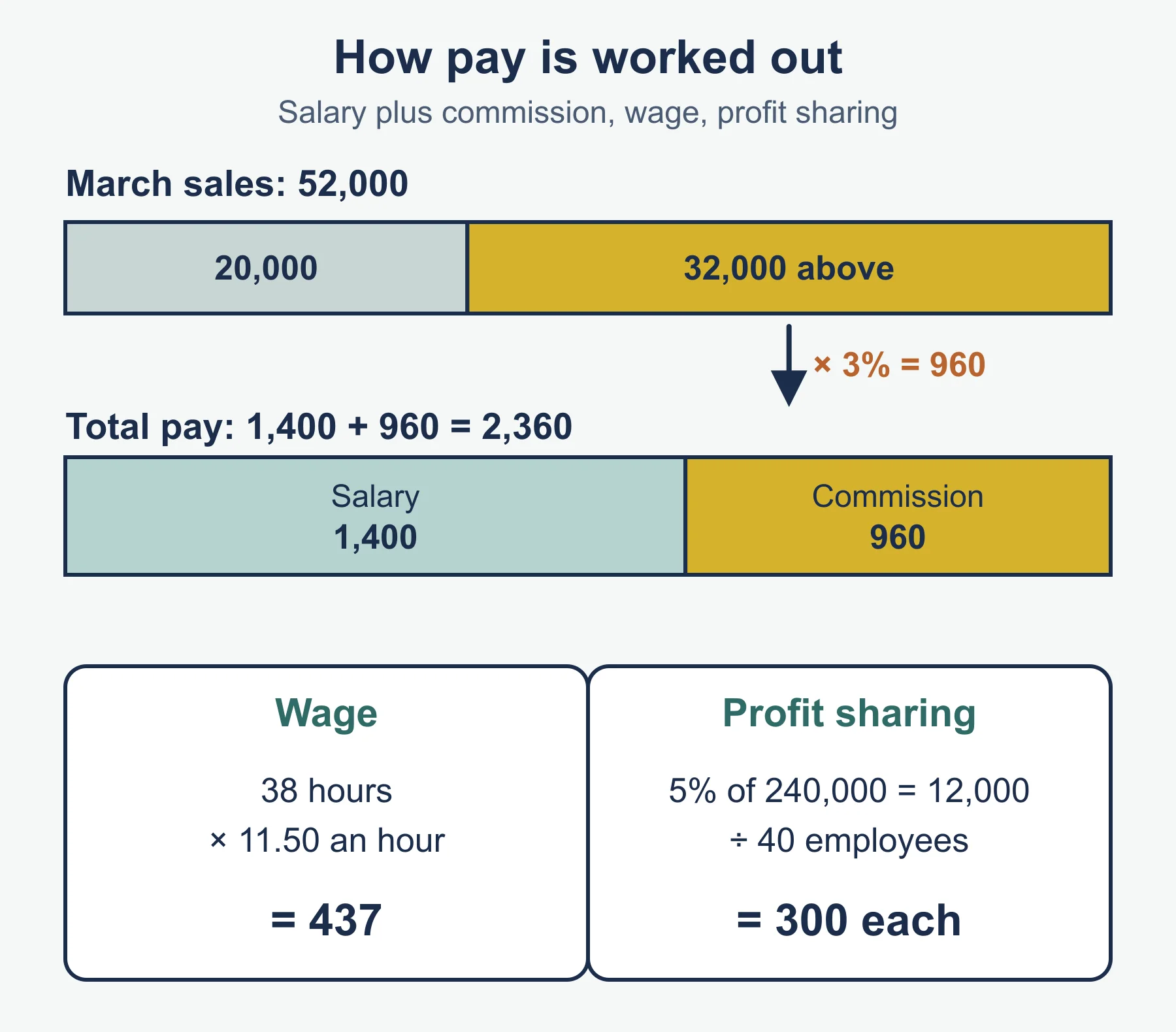
Pay calculation reminder: commission is the percentage multiplied by the sales that qualify, then added to any basic pay. Profit sharing is profit × percentage shared, then divided by the number of employees.
3.4.4 Training
Benefits to the business: increased productivity, ability to deal with changes in technology, increased motivation, staff retention, high-quality goods and good customer service.
| Method | What it is | Benefits | Costs |
|---|---|---|---|
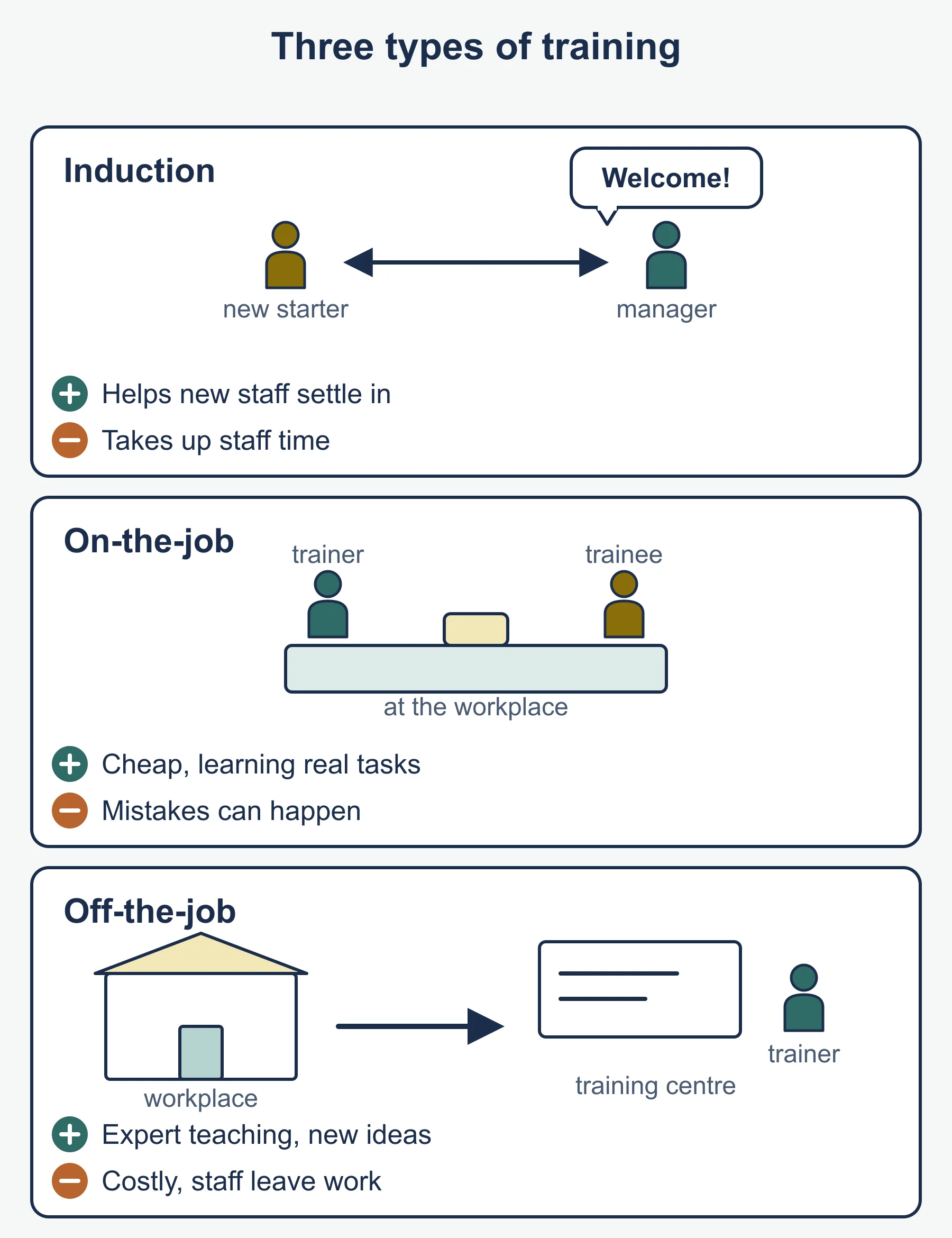
| Induction | Introduction for new starters to the business, rules and job | Settles staff, reduces early errors | Time of staff running it |
| On the job | Learning at work, for example by shadowing | Cheap, practical, trainee keeps working | Trainer’s time, slower output, bad habits may pass on |
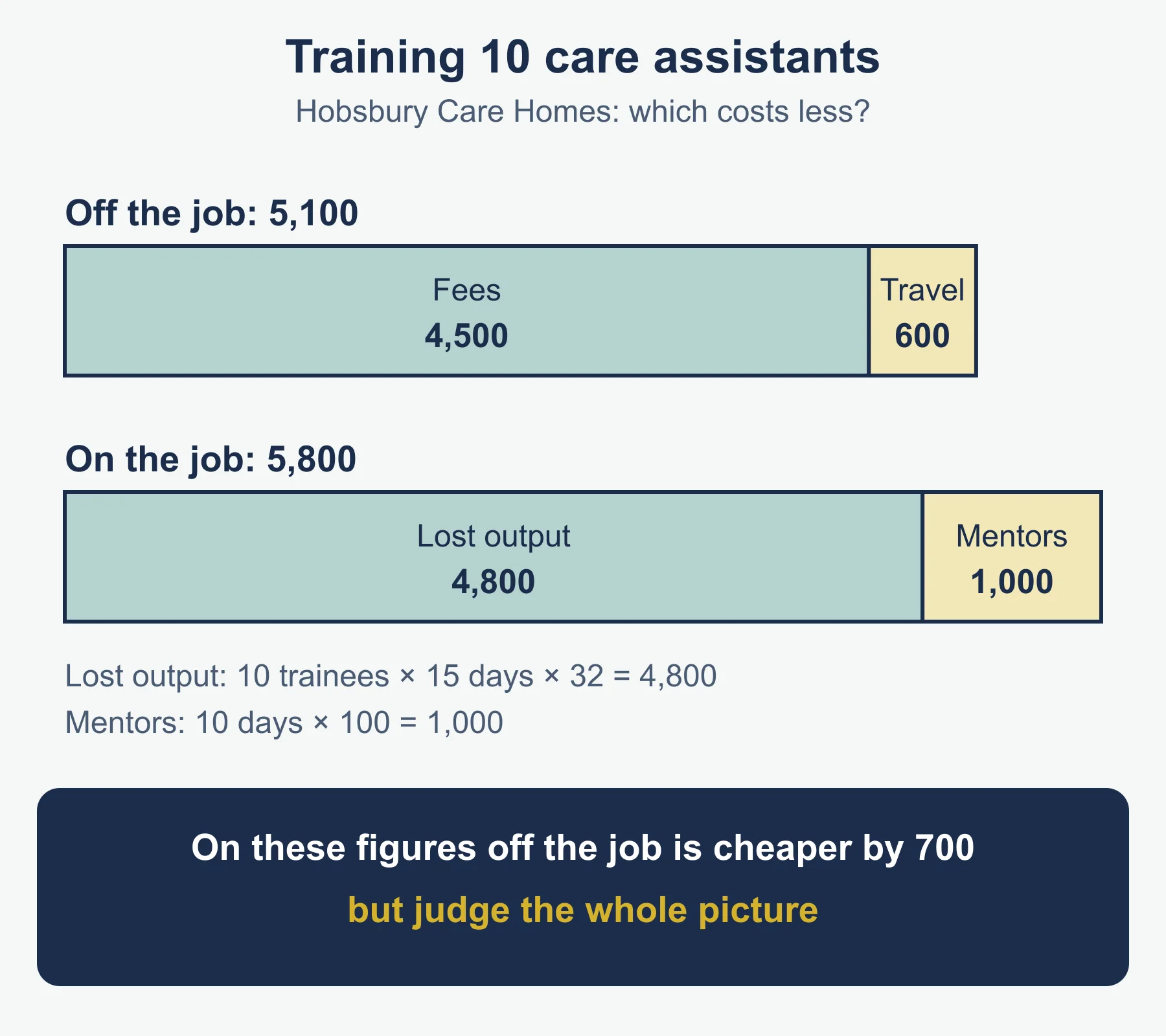
| Off the job | Learning away from work, such as an external course | Specialist teaching, wider skills, new ideas | Fees, travel, time away from the job |
How to choose:
- Add up the costs of each method, including lost output and travel.
- Match the method to the stem: number of trainees, how specialist the skill is, size of the business.
- Give a decision and a reason. A small business with few spare staff may prefer on the job. Specialist skills point to off the job.
Worked reminder: cost of filling a post
Verrow Pharmacy compares two ways to fill a counter vacancy. External route: advert 1,150, five interviews at 85 each and induction 300. Internal route: notice board 40, two interviews at 85 each and induction 100.
- External: 1,150 + (5 × 85) + 300 = 1,875.
- Internal: 40 + (2 × 85) + 100 = 310.
- Difference: 1,875 - 310 = 1,565 in favour of the internal route.
Cost is only one factor. The internal route leaves another vacancy to fill and gives no new ideas, so a full answer weighs this against the saving.
Evaluation frame
For an evaluate or justify question on any method (a structure, a way of recruiting, a pay system or a type of training), use this pattern: the benefit with its effect on the business, the drawback with its effect, a point from the stem that tips the balance, and a decision.
Must-know distinctions
- Recruitment (attract) and selection (choose).
- Salary (fixed yearly) and wage (hourly or weekly).
- Commission (own sales) and profit sharing (business profit).
- Delegation (passing authority down) and delayering (removing levels).
- Centralised (decisions at the top) and decentralised (decisions lower down).
- On the job (at work) and off the job (away from work).
- Induction (introduces the business) and training (builds job skills).
Quick self-test
- Define span of control.
- A business has 4 levels and removes one by delayering. How many levels remain?
- A worker earns a basic 1,200 a month plus 4% commission on sales above 15,000. Sales are 41,000. Calculate total pay.
- A worker is paid 9.80 an hour for a 40-hour week. Calculate weekly pay.
- A business with 30 employees makes 180,000 profit and shares 4% of it equally. Calculate each share.
- Give two benefits of internal recruitment.
- Put in order: shortlist, advertise, interview, job description.
- Give two examples of fringe benefits.
- Which type of training introduces a new employee to the safety rules and layout?
- Explain one way training can improve staff retention.
- State one drawback of a decentralised structure.
Answers
- The number of people a manager is directly responsible for.
- 3 levels.
- Commission = 4% × (41,000 - 15,000) = 1,040. Total = 1,200 + 1,040 = 2,240.
- 9.80 × 40 = 392.
- 4% of 180,000 = 7,200. 7,200 ÷ 30 = 240 each.
- Any two: cheaper, quicker, the person already knows the business, promotion chances motivate other staff.
- Job description, advertise, shortlist, interview.
- Any two: staff discount, free meals, health insurance, company car, paid study leave.
- Induction training.
- Trained staff feel valued and can do the job well, so they are likelier to stay, which saves the cost of replacing them.
- Any one: less control for senior managers, inconsistent decisions between sites, or more need for communication.
Where marks are usually lost
- Giving a definition of span of control that mentions levels instead of the number of people managed.
- Stating a benefit of delayering without the matching cost of a wider span.
- Saying external recruitment is better without using the stem.
- Mixing up the stages, or leaving out the person specification and references.
- Writing “motivation increases productivity” and stopping, with no chain of reasoning to costs or sales.
- Mistakes in pay questions: applying commission to all sales when only sales above a threshold qualify.
- Writing about named motivation theories, which the specification says will not be examined.
- Naming on the job or off the job training without costs and benefits for that business.
- Ending an evaluation without a decision.
Frequently asked questions
What is the difference between centralised and decentralised structures? In a centralised structure decisions are made at the top, giving consistency and tight control but slower decisions that may demotivate staff. In a decentralised structure decisions are made lower down, which is quicker and more trusting but gives less control and a risk of inconsistency.
What is the difference between delegation and delayering? Delegation is passing authority down to someone lower in the structure. Delayering is removing levels from the structure.
What is the difference between recruitment and selection? Recruitment is attracting people to apply for a job, while selection is choosing the right person from the applicants.
What are the benefits of training to a business? Training can increase productivity, help the business deal with changes in technology, increase motivation and staff retention, and lead to high-quality goods and good customer service.
Official syllabus
OxfordAQA International GCSE Business (9225) specification, version 3.1, OxfordAQA, for International GCSE exams May/June 2022 onwards. Section 3.4 Human resources (3.4.1 to 3.4.4).
Get free revision emails (optional)
Occasional emails with practice questions, worked explanations and links to free resources for the qualification and subjects you choose. No spam, and you can unsubscribe from any email. The free tools on this site never need an email.
Related resources
-
Study guides
OxfordAQA IGCSE Business: Human resources (9225)
Study guide to organisational structures, recruitment, motivation and training for the human resources topic of OxfordAQA International GCSE Business.
Business · OxfordAQA · IGCSE
Read guide -
Practice questions
OxfordAQA IGCSE Business: Human resources (9225) – Practice Questions
Twelve original questions with worked answers on structures, recruitment, motivation and training for OxfordAQA International GCSE Business.
Business · OxfordAQA · IGCSE
Try questions -
Practice questions
OxfordAQA IGCSE Business: Influences on Business — Practice Questions (9225)
Original OxfordAQA International GCSE Business 9225 practice questions with worked answers on technology, ethics, the economy, globalisation, law and rivals.
Business · OxfordAQA · IGCSE
Try questions
Related articles
-
teaching
A Level tuition in Dubai: Cambridge or Pearson Edexcel International A Level?
Schools in Dubai and Abu Dhabi teach either Cambridge International AS & A Level or Pearson Edexcel International A Level. How the two are structured, why it matters for tuition, and how online classes from Lahore work.
9 October 2026
-
curriculum guides
Choosing subjects at IGCSE and A Level
How subject choices at 14 and 16 affect university options later, and how to keep pathways open without overloading a timetable.
28 July 2026
Studying this with a teacher
Working through Business IGCSE?
This page is free and stays free. If you would rather be taught it, Marlbridge runs Business classes one-to-one and in small groups of up to 15, online in your own time zone. The first trial class is free. WhatsApp replies within an hour (8am–11pm Pakistan time, every day); email the same day.
OxfordAQA Business teachers at Marlbridge
