
Revision Notes
OxfordAQA International GCSE Geography (9230): Ecosystems – Small-Scale Ecosystems and Global Biomes – Revision Notes
Condensed ecosystem notes for OxfordAQA IGCSE Geography 9230: pond example, food webs, nutrient cycling, chains of change and the world's main biomes.
- Subject
- Geography
- Level
- IGCSE
- Topic
- Component 1 – Living With the Physical Environment
- Author
- Marlbridge Academic Team
- Updated
- Reviewed by
- Azam Siddique (what this means)
Aligned to OxfordAQA IGCSE Geography (9230), Version 4.3. Official specification .
Syllabus page (what it covers and how it is assessed): OxfordAQA IGCSE Geography.
Syllabus points this page covers
9230
- 3.1.2.1 Ecosystems
These notes cover section 3.1.2.1, Ecosystems, of the OxfordAQA International GCSE Geography (9230) specification, Version 4.3: “Ecosystems exist at a range of scales and involve the interaction between biotic and abiotic components.” For the whole unit, see the Living with the Physical Environment study guide; for full explanations, read the ecosystems study guide.
Specification checklist
- One small-scale ecosystem example showing interrelationships.
- Producers, consumers, decomposers, food chain, food web, nutrient cycling.
- Balance between components; the impact of changing one component.
- Overview of the distribution and characteristics of global ecosystems.
Key terms
| Term | Meaning |
|---|---|
| Ecosystem | Living things plus the non-living environment they interact with |
| Biotic | Living: plants, animals, fungi, bacteria |
| Abiotic | Non-living: sunlight, water, temperature, soil, rock, air, nutrients |
| Producer | Makes its own food by photosynthesis |
| Primary consumer | Eats producers (herbivore) |
| Secondary consumer | Eats primary consumers |
| Decomposer | Breaks down dead material, releasing nutrients |
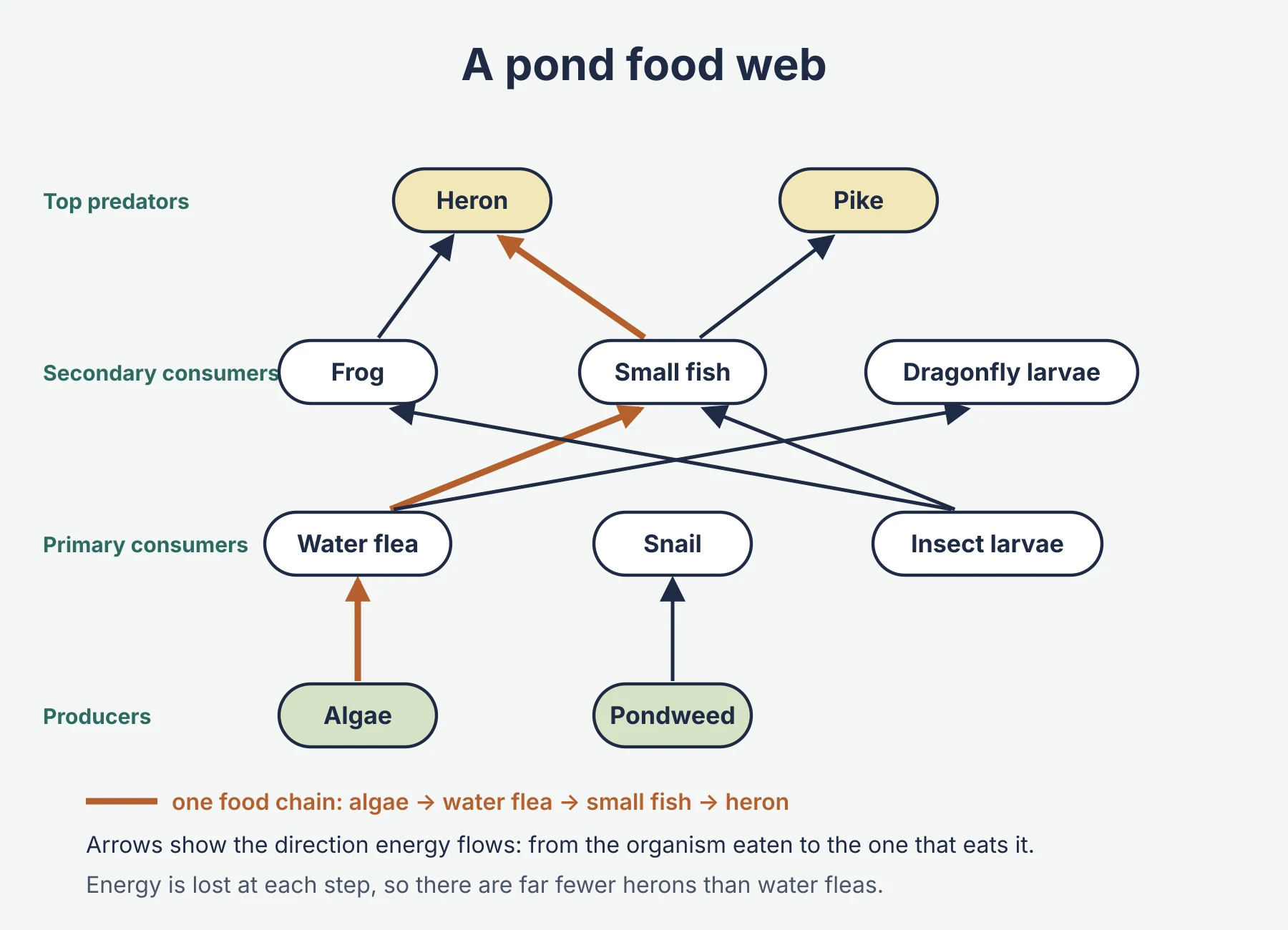
| Food chain | One line of feeding links; arrows show energy flow |
| Food web | Interlinked food chains |
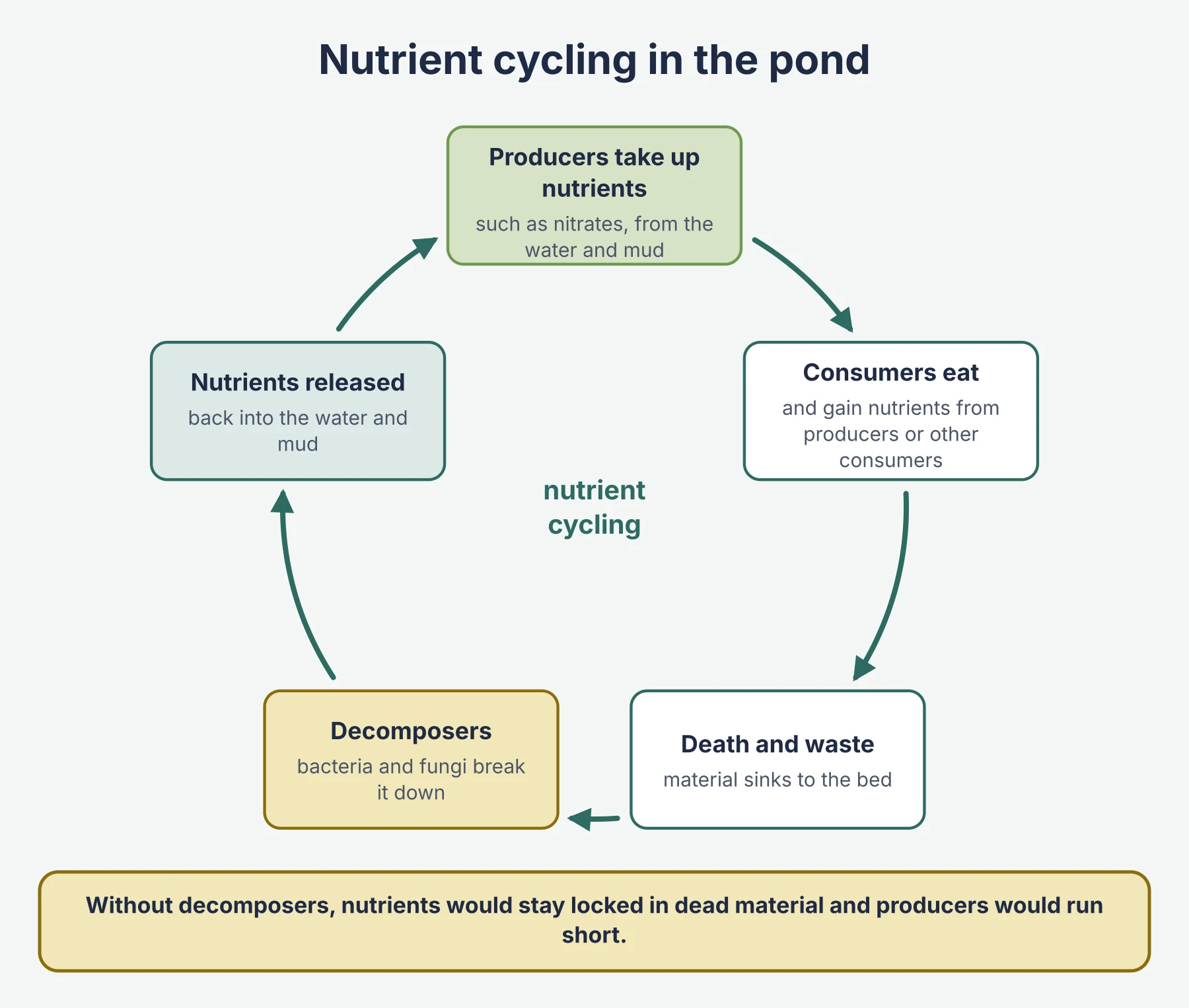
| Nutrient cycling | Nutrients move from soil or water to living things and back |
| Biome | Large-scale global ecosystem |
| Eutrophication | Excess nutrients cause algal growth, oxygen loss and deaths |
Pond ecosystem at a glance
| Role | Examples |
|---|---|
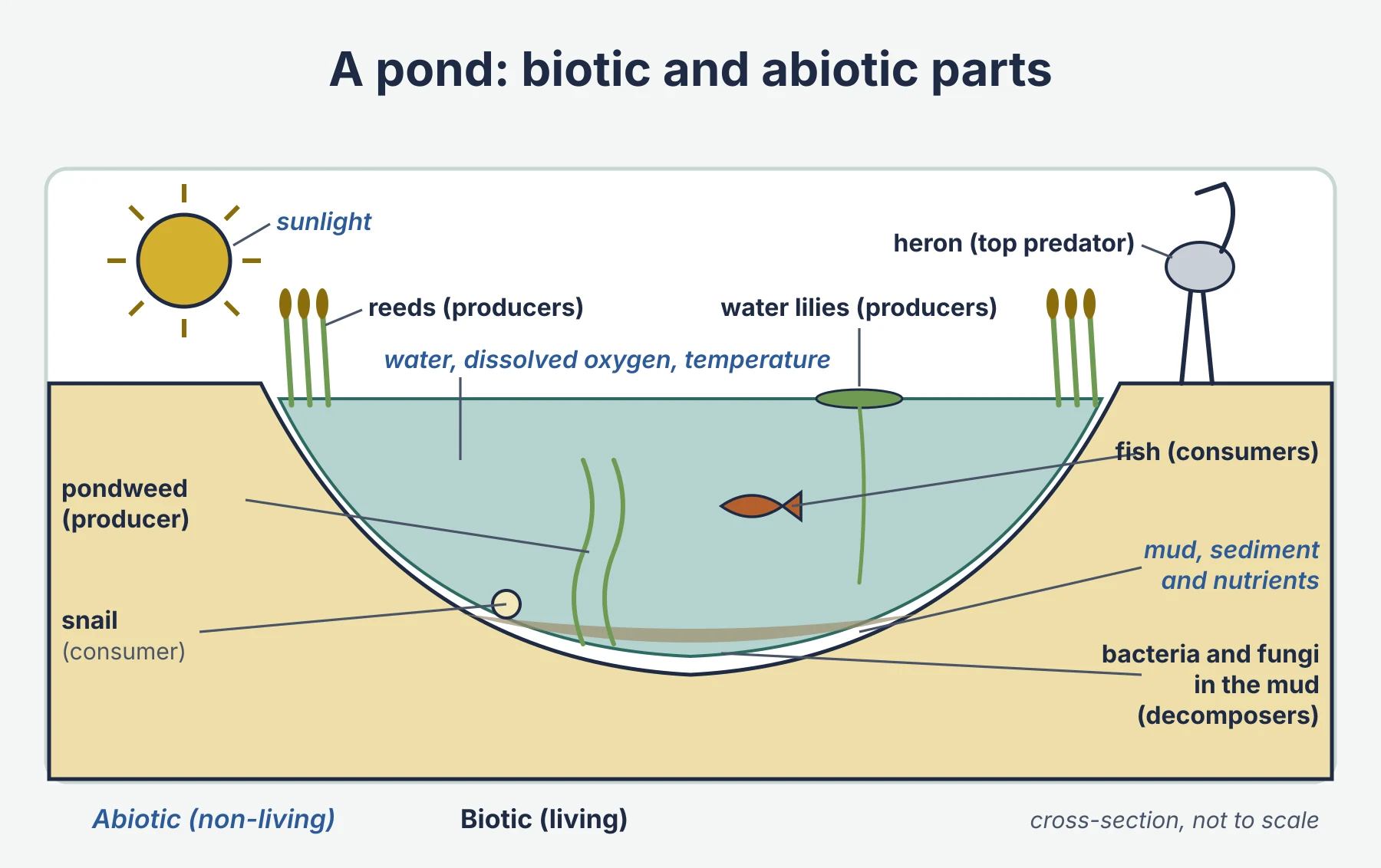
| Abiotic | Sunlight, water, dissolved oxygen, temperature, mud, nitrates and phosphates |
| Producers | Algae, pondweed, water lilies, reeds |
| Primary consumers | Water fleas, snails, some insect larvae |
| Secondary consumers | Small fish, frogs, dragonfly larvae |
| Top predators | Pike, herons |
| Decomposers | Bacteria and fungi in the mud |
Food chain: algae → water flea → small fish → heron.
Energy: enters as sunlight via producers; much is lost at each level as heat and life processes, so fewer organisms at higher levels.
Nutrient cycle (five steps)
Producers take up nutrients → consumers eat them → death and waste sink → decomposers release nutrients → producers reuse them.
Balance and change
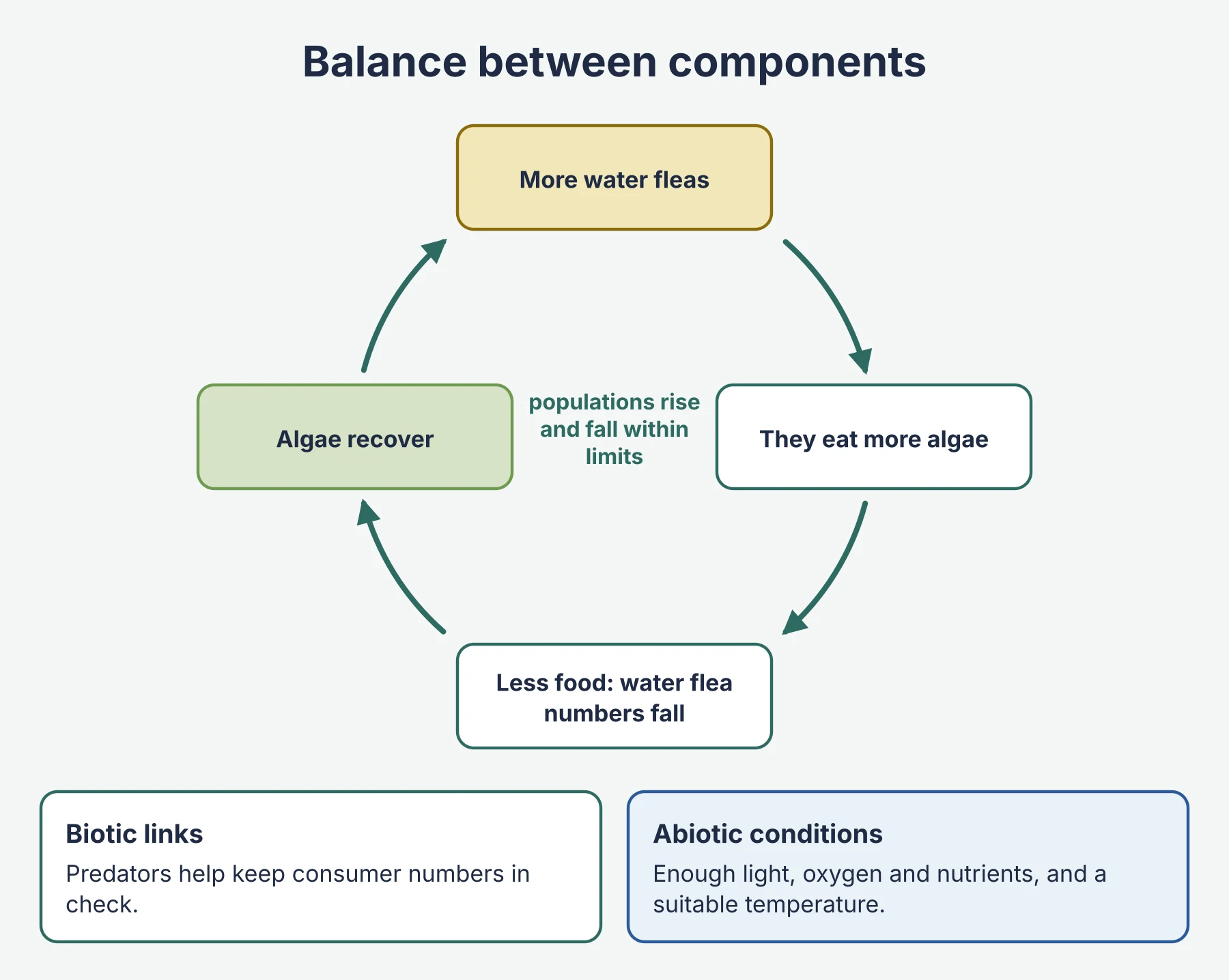
- Balance: linked populations rise and fall within limits; predators and food supply keep numbers in check.
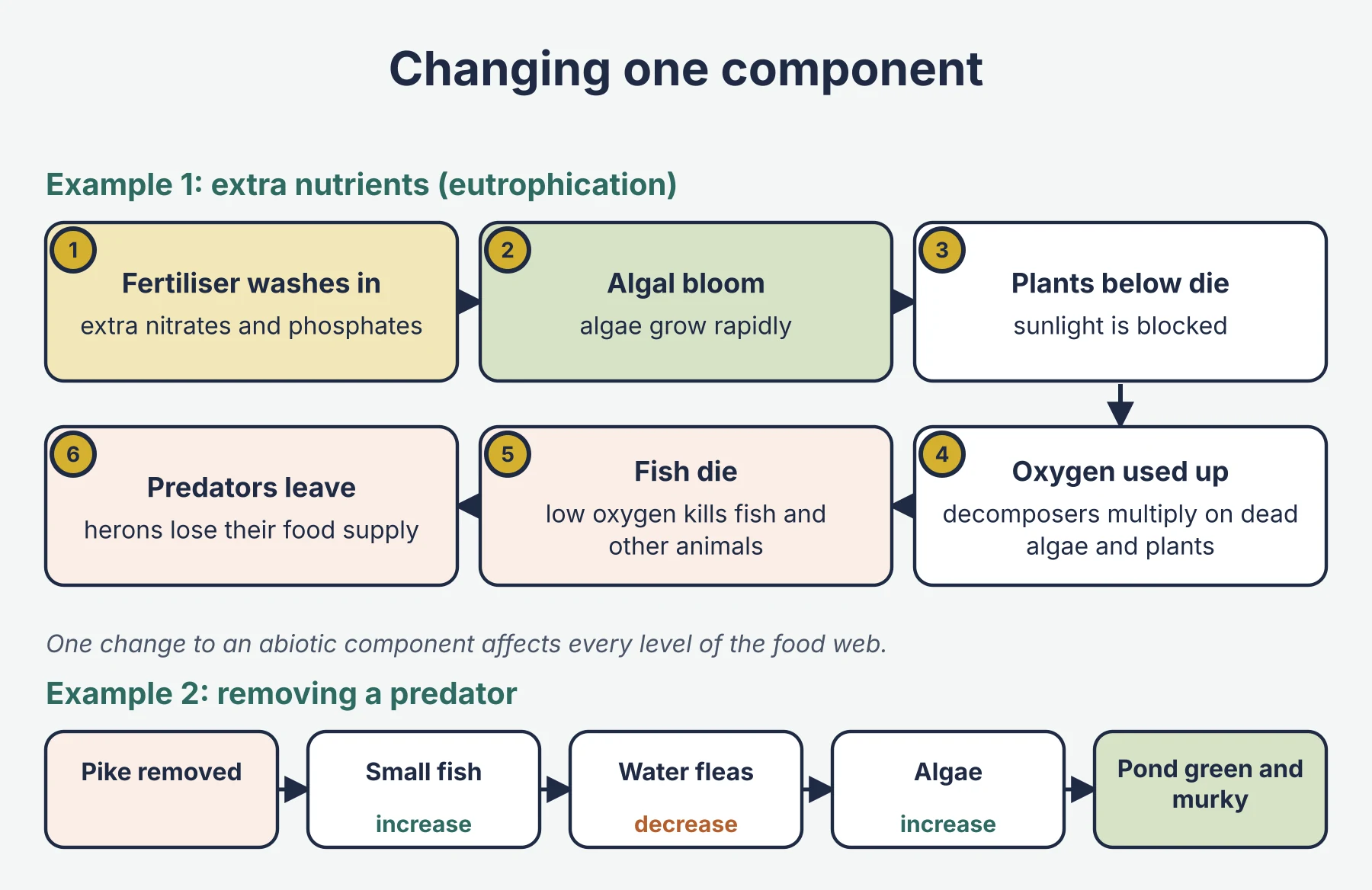
- Eutrophication: fertiliser → algal bloom → light blocked, plants die → decomposers use oxygen → fish die → predators leave.
- Predator removed: small fish increase → fewer water fleas → more algae → murky water.
- Drought: lower water, higher temperature, less oxygen, loss of edge habitat.
Always give the chain of effects, not one step.
How to answer a “changing one component” question. Name the change, then work outwards one link at a time, using “so” or “which means” between steps. For example, if a new road drains water away from a pond: the water level falls, so marginal reeds dry out, which means frogs lose breeding sites, so herons that eat frogs have less food. Four linked steps show understanding of interrelationships; four separate facts do not.
Global biomes
| Biome | Where | Climate | Key feature |
|---|---|---|---|
| Tropical rainforest | Near the equator: Amazon, Congo, South-East Asia | Hot, wet all year | Layered forest, highest biodiversity |
| Savanna | Between rainforest and desert, e.g. East Africa | Hot; wet and dry seasons | Grass with scattered trees |
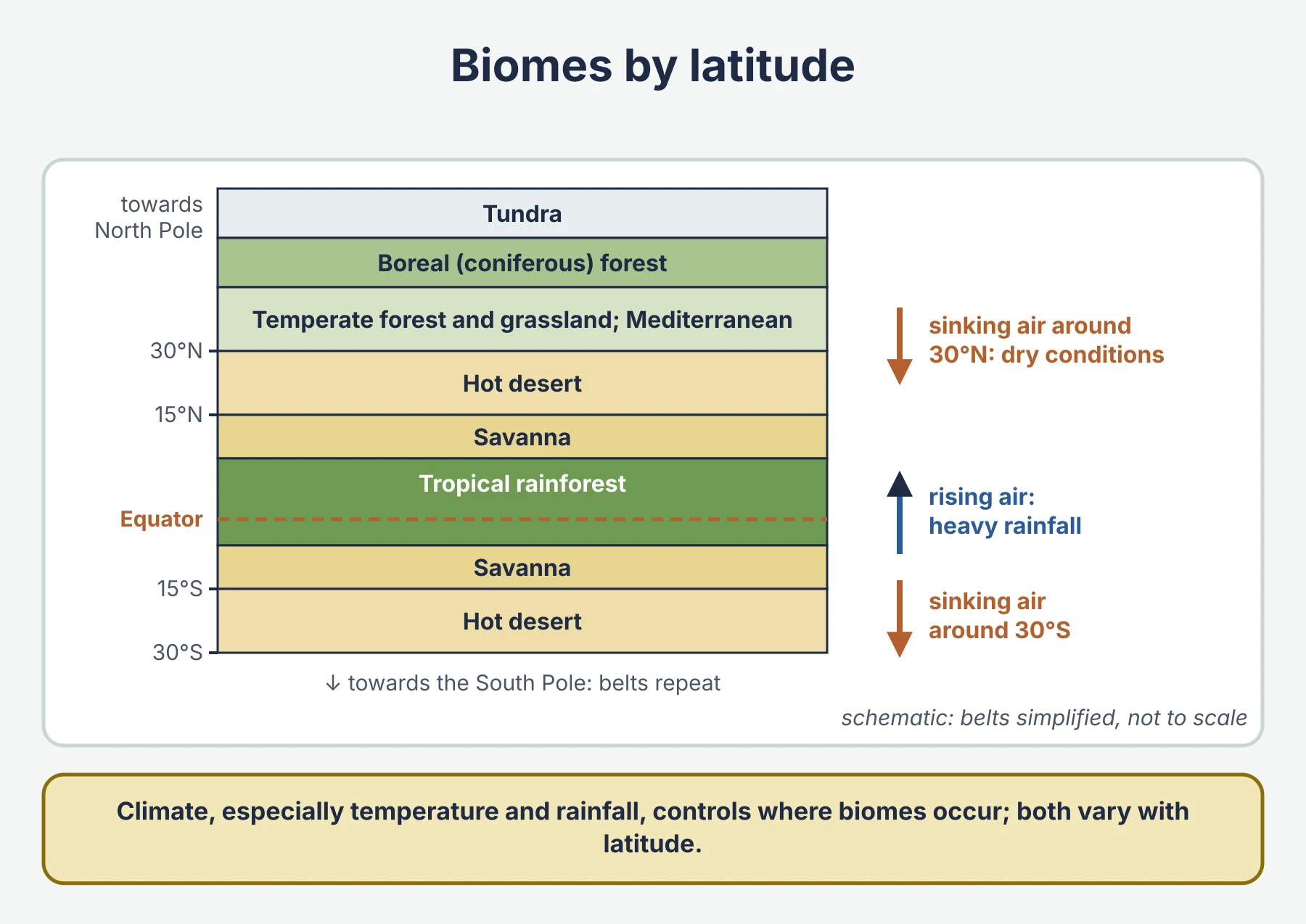
| Hot desert | About 15-30° N and S: Sahara, Arabian, central Australia | Very dry; hot days | Sparse, drought-adapted plants |
| Mediterranean | Mediterranean Sea, California | Hot dry summer, mild wet winter | Drought-tolerant shrubs |
| Temperate grassland | Prairies, steppes | Warm summer, cold winter | Grasses, fertile soils |
| Temperate deciduous forest | Western Europe, eastern USA, eastern China | Mild, rain all year | Trees lose leaves in winter |
| Boreal forest | Northern Canada, Scandinavia, Russia | Long cold winters | Evergreen conifers |
| Tundra | Arctic fringes | Very cold, short growing season | Mosses, lichens; frozen ground below |
Control: climate (temperature and rainfall), which varies with latitude and the atmospheric circulation: rising air and heavy rain near the equator; sinking, dry air around 30°.
Exam traps
- Soil is abiotic; the bacteria in it are biotic.
- Food-chain arrows point from the eaten to the eater.
- Decomposers are not consumers in food chains; they recycle nutrients.
- “Changing one component” needs a sequence of effects.
- Biome descriptions need named locations or latitudes.
- Explaining distribution needs climate linked to vegetation, not just a list of places.
Self-test
- Define biotic and abiotic, with one example of each.
- What is the difference between a food chain and a food web?
- Give a four-step pond food chain.
- Why are there fewer top predators than primary consumers?
- Describe the role of decomposers in nutrient cycling.
- Explain the sequence of eutrophication.
- What could happen if a pond’s top predator were removed?
- What mainly controls the global distribution of biomes?
- Where are hot deserts mainly found, and why?
- Name the biome found across northern Canada and Russia.
- Which biome has wet and dry seasons with grass and scattered trees?
- In which direction do arrows in a food chain point?
Answers
- Biotic: living, e.g. pondweed. Abiotic: non-living, e.g. sunlight.
- A chain is one line of feeding links; a web shows many interlinked chains.
- Algae → water flea → small fish → heron.
- Energy is lost at each level, so less is available to support organisms higher up.
- They break down dead material and waste, releasing nutrients that producers take up again.
- Excess nutrients → algal bloom → light blocked, plants die → decomposers use oxygen → fish die.
- Small fish increase, eat more water fleas, so algae increase and the water becomes murky.
- Climate, especially temperature and rainfall, which vary with latitude.
- Around 15-30° north and south, where sinking air in the atmospheric circulation brings dry conditions.
- Boreal (coniferous) forest.
- Tropical grassland (savanna).
- From the organism eaten to the one that eats it, showing the direction of energy flow.
Practise with the ecosystems practice questions.
Related resources
-
Study guides
OxfordAQA International GCSE Geography (9230): Hot Desert Landscapes
Hot desert landscapes for OxfordAQA IGCSE Geography 9230: wind and water processes, desert landforms, and the opportunities and challenges of development.
Geography · OxfordAQA · IGCSE
Read guide -
Practice questions
OxfordAQA International GCSE Geography (9230): Hot Desert Landscapes – Practice Questions
Original exam-style questions on hot desert landscapes for OxfordAQA IGCSE Geography 9230: processes, landforms, opportunities and challenges, with answers.
Geography · OxfordAQA · IGCSE
Try questions -
Revision notes
OxfordAQA International GCSE Geography (9230): Hot Desert Landscapes – Revision Notes
Condensed notes on hot desert landscapes for OxfordAQA IGCSE Geography 9230: wind and water processes, landforms, and development opportunities and challenges.
Geography · OxfordAQA · IGCSE
Revise topic
Studying Geography?
This page is free and stays free. Marlbridge is not offering Geography classes at the moment, so there is no tuition to book for it. The free study resources stay open to everyone.
Get free revision emails (optional)
Occasional emails with practice questions, worked explanations and links to free resources for the qualification and subjects you choose. No spam, and you can unsubscribe from any email. The free tools on this site never need an email.