
Study Guides
OxfordAQA International GCSE Geography (9230): Ecosystems – Small-Scale Ecosystems and Global Biomes
Ecosystems for OxfordAQA IGCSE Geography 9230: a small-scale pond ecosystem, food webs, nutrient cycling, changing one component and global ecosystems.
- Subject
- Geography
- Level
- IGCSE
- Topic
- Component 1 – Living With the Physical Environment
- Author
- Marlbridge Academic Team
- Updated
- Reviewed by
- Azam Siddique (what this means)
Aligned to OxfordAQA IGCSE Geography (9230), Version 4.3. Official specification .
Syllabus page (what it covers and how it is assessed): OxfordAQA IGCSE Geography.
Syllabus points this page covers
9230
- 3.1.2.1 Ecosystems
This guide covers section 3.1.2.1, Ecosystems, at the start of Section B (The living world) of Unit 1 of the OxfordAQA International GCSE Geography (9230) specification, Version 4.3. The key idea is: “Ecosystems exist at a range of scales and involve the interaction between biotic and abiotic components.” For the whole unit, including tropical rainforests and hot deserts, start with the Living with the Physical Environment study guide. This page goes deeper on the ecosystem concepts that the rainforest and desert themes build on.
What the specification lists
- “An example of a small-scale ecosystem to illustrate the concept of interrelationships within a natural system, an understanding of producers, consumers, decomposers, food chain, food web and nutrient cycling.”
- “The balance between components. The impact on the ecosystem of changing one component.”
- “An overview of the distribution and characteristics of large-scale natural global ecosystems.”
So you need one worked small-scale example, the vocabulary to describe how it works, the idea of balance and change, and a world-scale overview.
Key terms
| Term | Meaning |
|---|---|
| Ecosystem | A community of living things and the non-living environment they interact with |
| Biotic | Living parts: plants, animals, fungi, bacteria |
| Abiotic | Non-living parts: sunlight, water, temperature, soil, rock, air, nutrients |
| Producer | An organism that makes its own food by photosynthesis, usually a green plant or alga |
| Consumer | An organism that gets energy by eating other organisms; primary consumers eat producers, secondary consumers eat primary consumers |
| Decomposer | An organism, such as a bacterium or fungus, that breaks down dead material and waste, releasing nutrients |
| Food chain | A single line of feeding relationships showing how energy passes from one organism to the next |
| Food web | Many interlinked food chains in one ecosystem |
| Nutrient cycling | The movement of nutrients from soil or water into living things and back again |
| Biome | A large-scale global ecosystem, such as tropical rainforest or tundra |
A small-scale ecosystem: a freshwater pond
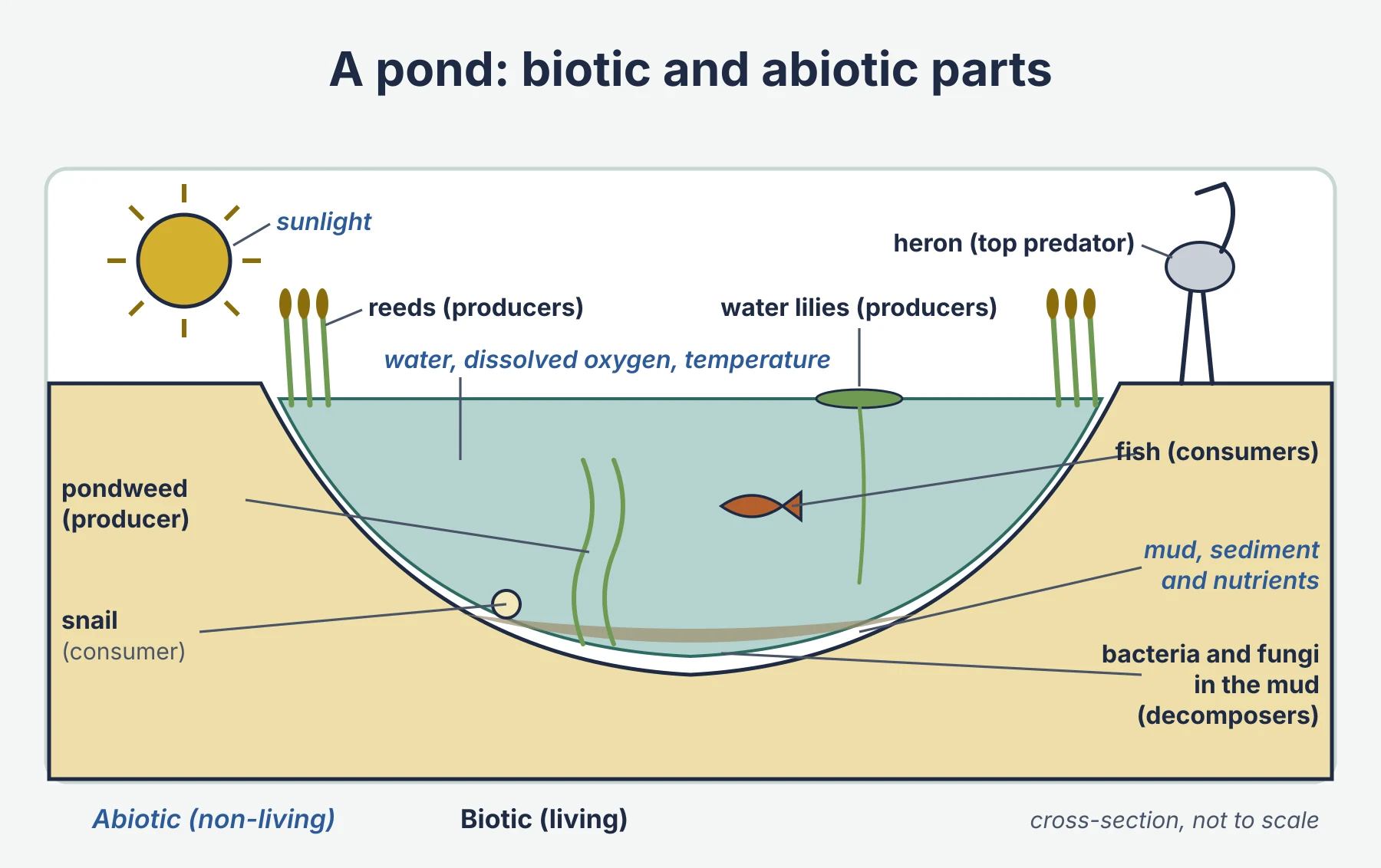
A pond is a common small-scale example because its parts are easy to see and its interrelationships are clear. You may study a different example in class; the same concepts apply.
Abiotic components. Sunlight; water; dissolved oxygen; temperature; mud and sediment on the bed; nutrients such as nitrates and phosphates dissolved in the water.
Biotic components.
- Producers: algae, pondweed, water lilies and reeds at the edges.
- Primary consumers: water fleas and snails that graze algae and plants; some insect larvae.
- Secondary consumers: small fish, frogs and dragonfly larvae that eat the primary consumers.
- Top predators: larger fish such as pike, or herons that feed from the edge.
- Decomposers: bacteria and fungi in the mud.
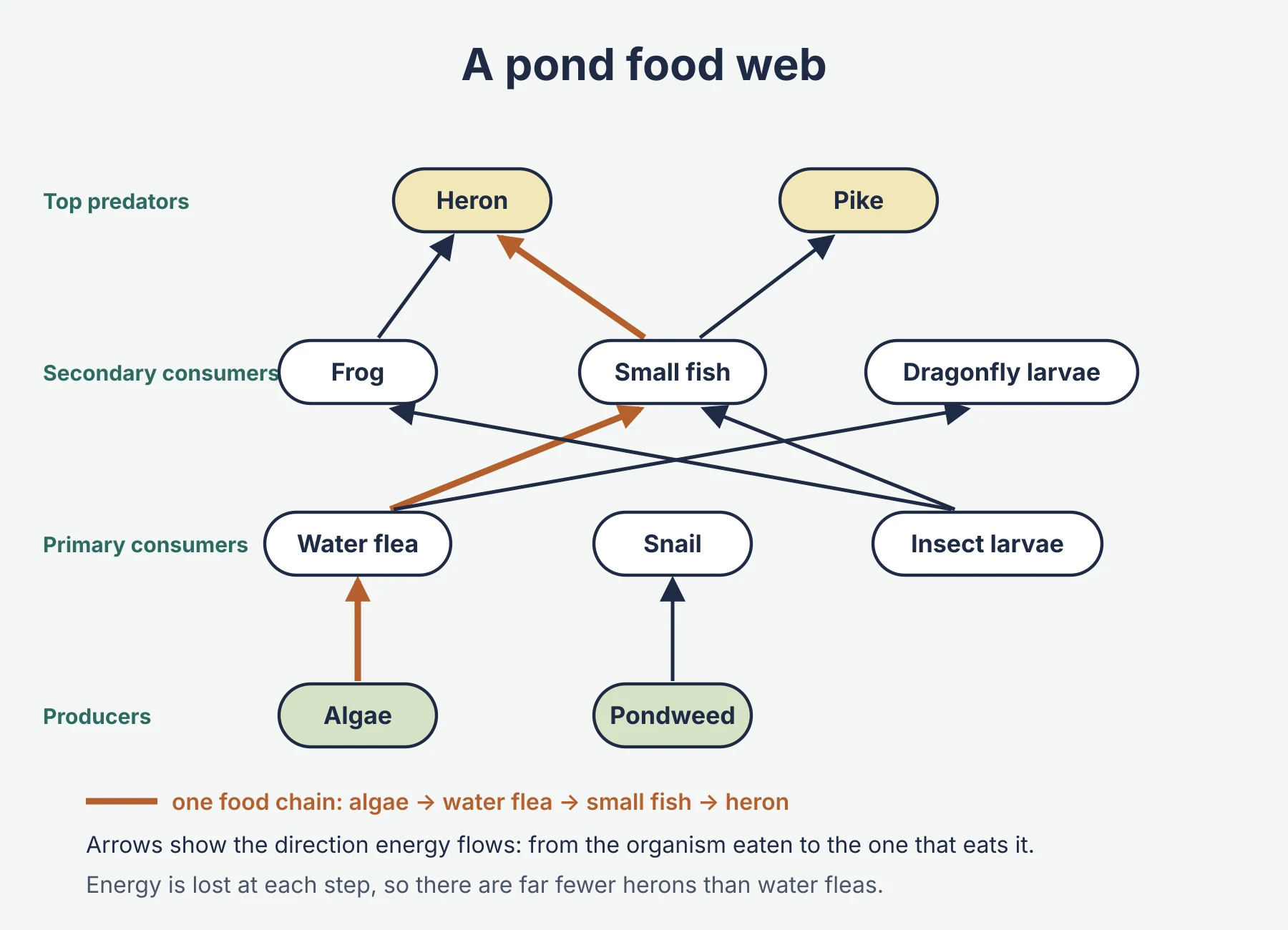
A food chain: algae → water flea → small fish → heron.
A food web. In reality, the heron also eats frogs, frogs eat insects, snails graze pondweed, and small fish eat both water fleas and insect larvae. Drawing these links as a web shows that most organisms depend on several others, which is why a change to one part spreads through the system.
Energy. Energy enters the ecosystem as sunlight captured by producers. At each step along a food chain, much of the energy is used for movement and life processes or lost as heat, so less is available to the next level. That is why there are far fewer herons than water fleas.
Nutrient cycling in the pond
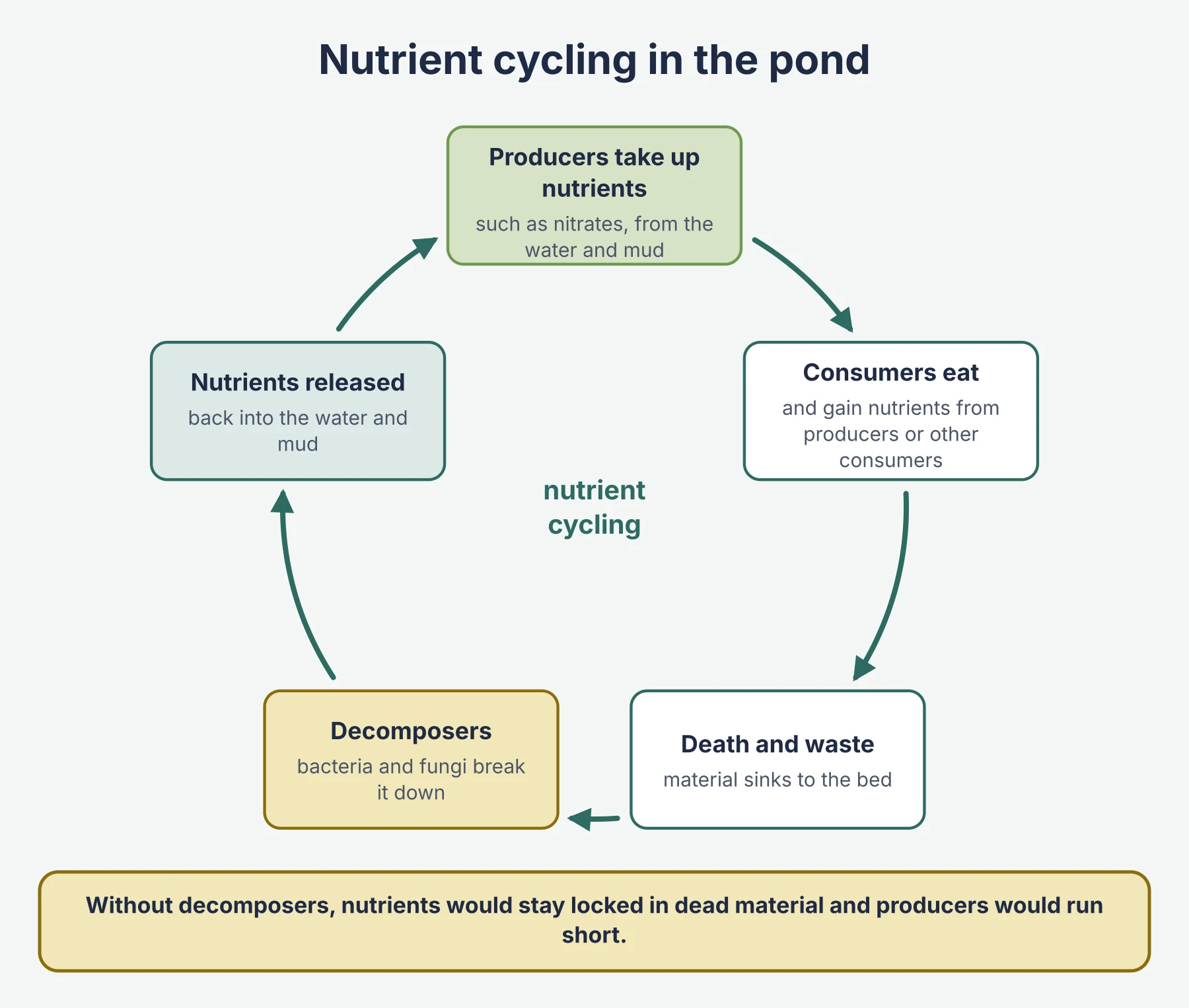
- Producers take up nutrients, such as nitrates, from the water and mud.
- Consumers gain nutrients by eating producers or other consumers.
- When organisms die, or produce waste, the material sinks to the bed.
- Decomposers break it down, releasing nutrients back into the water and mud.
- Producers take them up again.
Without decomposers, nutrients would stay locked in dead material and producers would run short.
Balance between components
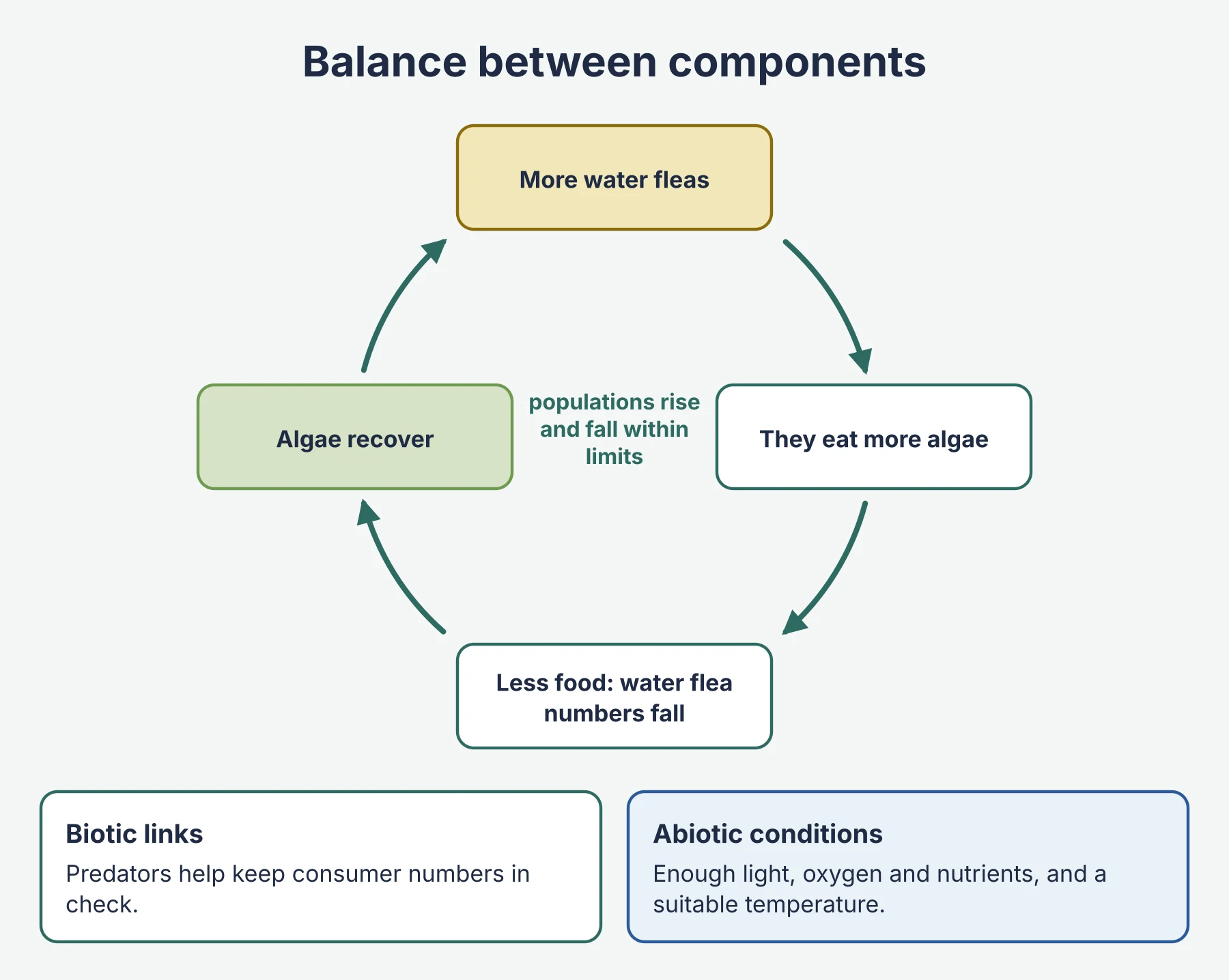
A stable ecosystem is in balance: populations rise and fall but stay within limits because they are linked. If water fleas become more numerous, they eat more algae; with less food, their numbers fall again, and the algae recover. Predators help keep consumer numbers in check. Balance depends on abiotic conditions too: enough light, oxygen and nutrients, and a suitable temperature.
The impact of changing one component
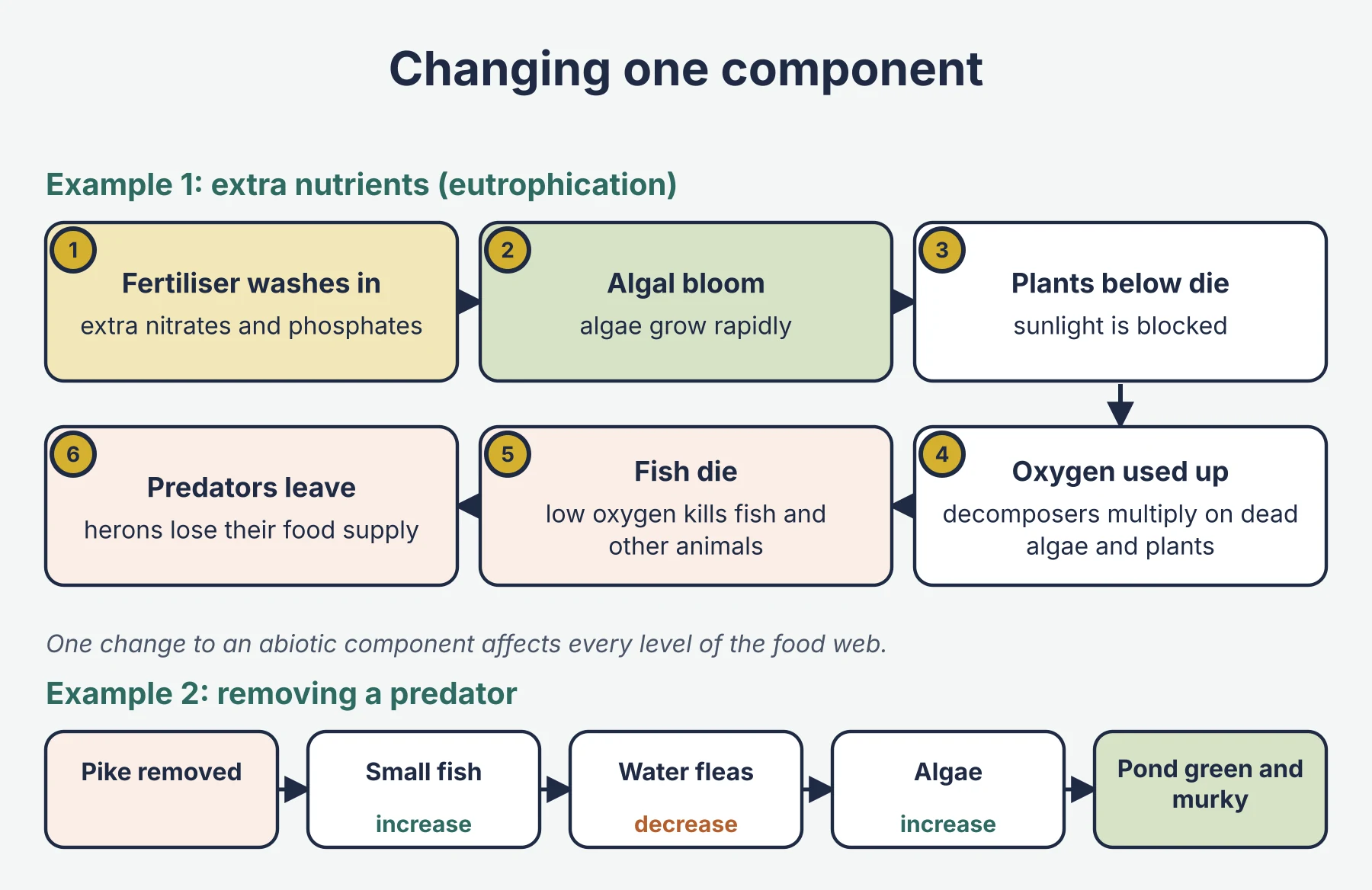
This is a favourite exam theme because it tests whether you understand interrelationships. Follow the chain of effects step by step.
Example 1: extra nutrients (eutrophication). Fertiliser washes off nearby fields into the pond.
- Extra nitrates and phosphates cause algae to grow rapidly, forming an algal bloom.
- The bloom blocks sunlight from plants lower in the water, and they die.
- When the algae die too, decomposers multiply and use up dissolved oxygen as they break down the dead material.
- Low oxygen kills fish and other animals.
- Predators such as herons lose their food supply and move away.
One change to an abiotic component has affected every level of the food web.
Example 2: removing a predator. If the pike are removed, small fish increase. They eat more water fleas, so algae increase because fewer are being grazed. The pond may become green and murky.
Example 3: drought. Lower water levels concentrate nutrients and raise water temperature, reducing dissolved oxygen; marginal plants dry out, and animals that depend on them lose habitat.
Global ecosystems: distribution and characteristics
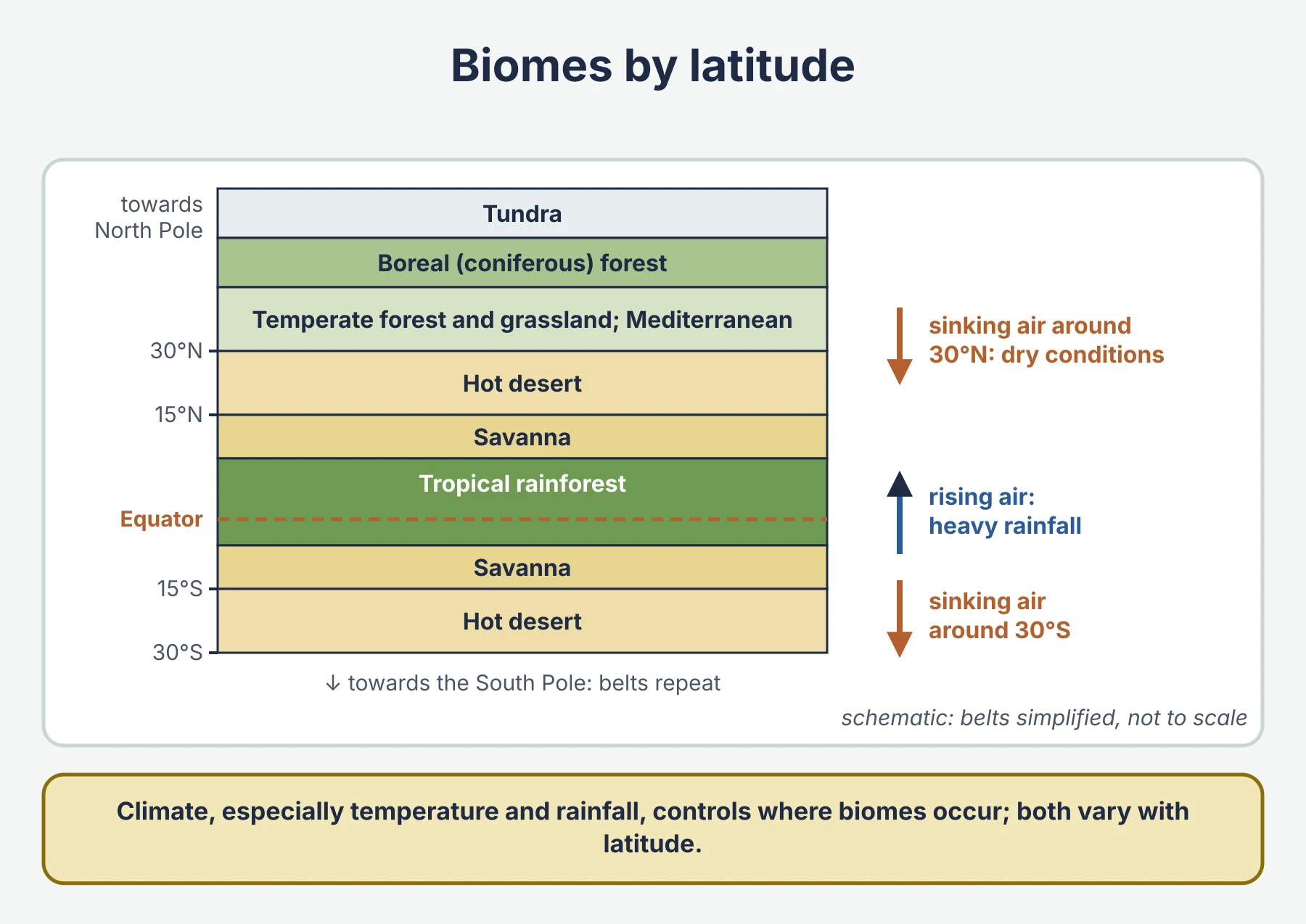
At the largest scale, ecosystems are called biomes. Their distribution is controlled mainly by climate, especially temperature and rainfall, which vary with latitude. This links to the general atmospheric circulation model in the weather hazards section: rising air near the equator brings heavy rainfall, while sinking air around 30° north and south brings dry conditions.
| Biome | Typical location | Climate | Characteristics |
|---|---|---|---|
| Tropical rainforest | Near the equator: Amazon Basin, Congo Basin, South-East Asia | Hot and wet all year | Dense, layered forest; very high biodiversity |
| Tropical grassland (savanna) | Between rainforests and hot deserts, for example much of East Africa | Hot, with distinct wet and dry seasons | Grasses with scattered trees; large grazing animals |
| Hot desert | Around 15-30° north and south: Sahara, Arabian Desert, central Australia | Very little rainfall; hot days, often cold nights | Sparse vegetation adapted to drought |
| Mediterranean | Around the Mediterranean Sea, California, parts of Chile, South Africa and Australia | Hot, dry summers; mild, wet winters | Drought-tolerant shrubs and small trees |
| Temperate grassland | Continental interiors: prairies of North America, steppes of Central Asia | Warm summers, cold winters, moderate rainfall | Grasses, few trees; fertile soils |
| Temperate deciduous forest | Western Europe, eastern USA, eastern China | Mild, with rainfall all year and four seasons | Trees that lose leaves in winter |
| Boreal (coniferous) forest | Across northern Canada, Scandinavia and Russia | Long, very cold winters; short summers | Evergreen conifers such as pine and spruce |
| Tundra | Arctic fringes of North America, Europe and Asia | Very cold; short growing season; low precipitation | Mosses, lichens, low shrubs; permanently frozen ground below |
Describing the pattern. A good description uses latitude and named examples: “Tropical rainforests lie in a belt close to the equator, for example in the Amazon and Congo Basins, while hot deserts lie further from the equator, around 15-30° north and south, such as the Sahara.”
Explaining the pattern. Link climate to vegetation: high temperatures and rainfall all year allow continuous growth in rainforests; a long dry season limits trees in savanna; low rainfall limits plants in deserts; low temperatures and a short growing season limit growth in tundra.
Worked example: a 4-mark answer
Question: Explain how decomposers are important in a small-scale ecosystem. [4 marks]
Model answer: “Decomposers such as bacteria and fungi break down dead plants, animals and waste. This releases nutrients such as nitrates back into the soil or water. Producers, such as pondweed, then take up these nutrients to grow. Without decomposers, nutrients would stay locked in dead material, producers would grow less, and so there would be less food for consumers throughout the food web.”
Each sentence moves one step along the cycle, and the last sentence explains the consequence for the whole ecosystem.
Common mistakes
- Confusing biotic and abiotic. Soil is abiotic, but the bacteria in it are biotic.
- Arrows the wrong way. In food chains, arrows show the direction energy flows: from the organism eaten to the one that eats it.
- Stopping after one effect. “Changing one component” questions need the chain of effects through the web.
- Calling decomposers consumers. They are a separate group that recycles nutrients.
- Describing global biomes without locations. Name latitudes, continents or regions.
Condense this with the ecosystems revision notes and test yourself with the ecosystems practice questions. Related units: climate change and coastal processes and landforms.
Related resources
-
Practice questions
OxfordAQA International GCSE Geography (9230): Ecosystems – Small-Scale Ecosystems and Global Biomes – Practice Questions
Original exam-style ecosystem questions for OxfordAQA IGCSE Geography 9230: food webs, nutrient cycling, changing one component and biomes, with answers.
Geography · OxfordAQA · IGCSE
Try questions -
Revision notes
OxfordAQA International GCSE Geography (9230): Ecosystems – Small-Scale Ecosystems and Global Biomes – Revision Notes
Condensed ecosystem notes for OxfordAQA IGCSE Geography 9230: pond example, food webs, nutrient cycling, chains of change and the world's main biomes.
Geography · OxfordAQA · IGCSE
Revise topic -
Study guides
OxfordAQA International GCSE Geography (9230): Hot Desert Landscapes
Hot desert landscapes for OxfordAQA IGCSE Geography 9230: wind and water processes, desert landforms, and the opportunities and challenges of development.
Geography · OxfordAQA · IGCSE
Read guide
Studying Geography?
This page is free and stays free. Marlbridge is not offering Geography classes at the moment, so there is no tuition to book for it. The free study resources stay open to everyone.
Get free revision emails (optional)
Occasional emails with practice questions, worked explanations and links to free resources for the qualification and subjects you choose. No spam, and you can unsubscribe from any email. The free tools on this site never need an email.