
Revision Notes
Cambridge International AS & A Level Geography (9696): 5.3 International migration – Revision Notes
Revision notes for Cambridge 9696 Geography 5.3 International migration: key terms, processes, worked examples, exam traps and a self-test with answers.
- Subject
- Geography
- Level
- AS LEVEL
- Topic
- Topic 5 – Migration
- Author
- Marlbridge Academic Team
- Updated
- Reviewed by
- Azam Siddique (what this means)
Aligned to Cambridge A Level Geography (9696), 2025-2026. Official specification .
Syllabus page (what it covers and how it is assessed): Cambridge A Level Geography.
Syllabus points this page covers
9696 (AS Level)
- 5.3 International migration
Condensed recall for 5.3 International migration: voluntary and forced movements and their impacts. For full explanations, read the Core Human Geography study guide.
Key terms
| Term | Meaning |
|---|---|
| International migration | Movement across national borders |
| Economic migrant | Moves mainly for work or better income |
| Refugee | Person who has fled their country through fear of persecution, conflict or violence |
| Asylum seeker | Person who has applied for refugee protection and awaits a decision |
| Internally displaced person (IDP) | Forced to flee but still inside their own country |
| Forced (involuntary) migration | Movement with little or no choice |
| Brain drain | Emigration of skilled workers |
| Brain gain | Return of skilled migrants, or the gain of skills by a destination |
| Remittances | Money sent to family at home |
| Diaspora | People of one origin living across other countries |
Causes and patterns
- Voluntary / economic: wage and job differences between countries, family links and networks, recruitment of workers. Typical flows run from LICs and MICs to HICs, but also between neighbouring developing countries.
- Forced: war, persecution, disaster. Most refugees stay in neighbouring countries rather than travelling far.
- Patterns are shaped by distance, history (former colonial links), language and immigration policy.
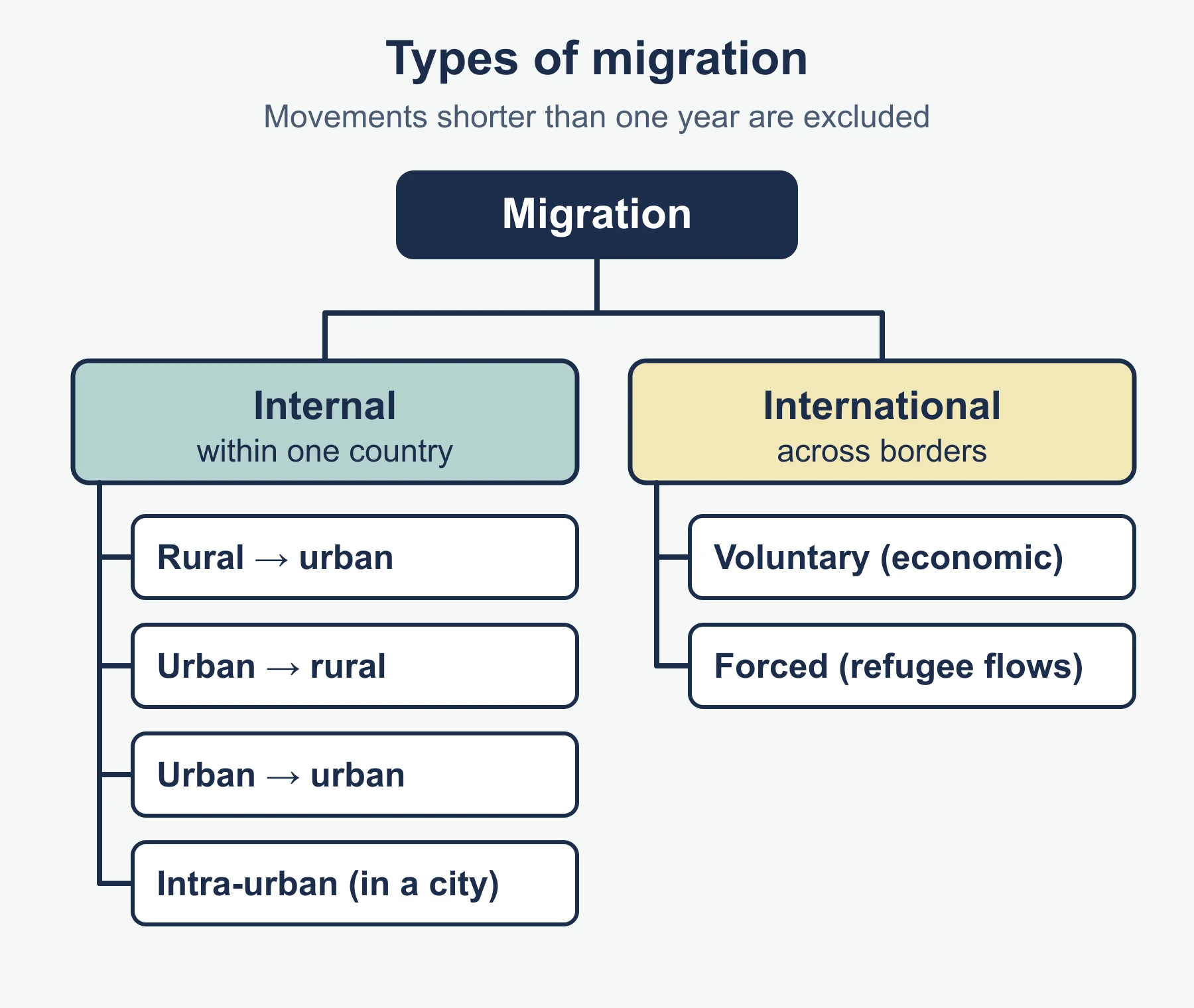
The voluntary and forced labels are the ends of a continuum rather than two neat boxes. A farmer leaving after repeated droughts, or a family leaving an area of rising violence and collapsing jobs, has some choice but not much. In answers, explain where a flow sits and why.
Examples of streams (illustrative)
| Stream | Type | Main causes | Notes |
|---|---|---|---|
| South Asia to the Gulf states | Voluntary, labour | Oil-funded construction and service jobs; wage gap | Mostly temporary contracts; workers sponsored by employers; concerns over working conditions |
| Philippines to many countries | Voluntary, labour | Government-organised overseas work; demand for nurses, seafarers, domestic workers | Remittances are a large part of national income |
| Syria to Turkey, Lebanon, Jordan and Europe | Forced, refugee | Civil war from 2011 | Turkey has hosted the largest number of Syrian refugees, over three million at its peak; a smaller share reached Europe, especially in 2015 |
| Poland to the UK after 2004 | Voluntary, labour | Free movement after EU enlargement; wage gap | Many later returned or moved on, showing flows can reverse |
The Syrian case supports the general rule that most refugees stay in neighbouring countries. The Polish case shows how a policy change (freedom of movement) can open a new stream very quickly.
Impacts
| Source country | Destination country | |
|---|---|---|
| Economic | Remittances, reduced unemployment; loss of skills (brain drain) | Fills labour gaps, taxes, skills; possible wage pressure in some sectors |
| Demographic | Fewer young adults, imbalanced sex ratio | Younger age structure, higher fertility, population growth |
| Social | Families split; return of ideas and skills | Cultural diversity; possible tension, segregation |
| Services | Less pressure on jobs | Pressure on housing, schools, health |
Impacts of refugee flows are distinct: neighbouring host countries, often LICs or MICs themselves, face sudden pressure on water, housing, schools and health care, and many refugees live for years in camps or informal shelters. Humanitarian aid can bring money and jobs to host regions, but refugees often lack the right to work legally, which limits their contribution and keeps them dependent.
Remittances in detail
Remittances are often larger and more stable than aid. They go straight to households, which spend them on food, schooling, health care and housing, and they bring foreign currency into the economy. Drawbacks: they can widen inequality between households with and without migrants, may be spent on consumption rather than investment, and fall when the destination economy slows. Some countries depend heavily on them, which is a risk.
Brain drain or brain circulation?
Losing doctors, nurses and engineers can weaken health and education systems in source countries. But some migrants return with skills, capital and contacts, and diaspora networks can bring trade and investment. Evaluate both views; the balance depends on how many return and on how large the loss is relative to the country’s skilled workforce.
Annotated model paragraph
“Assess the impacts of international migration on source countries.”
Emigration can reduce unemployment and bring remittances that fund education (benefit). However, the loss of skilled workers can weaken health services (cost). Impacts are uneven: households with migrants gain more (distribution). Overall, the balance depends on the skill level of migrants and whether they return (judgement).
Exam traps
- Refugees and economic migrants are different categories; do not merge them.
- Impacts differ by group: workers, employers and local residents may view them differently.
- Remittances are a benefit but dependence on them carries risk.
- Use named streams for the 5.4 case study, not here.
- An IDP is not a refugee: refugees have crossed an international border.
- Do not assume most migration is from LICs to HICs: flows between developing countries are large.
Self-test
- Difference between a refugee and an asylum seeker?
- What is brain drain?
- Give two benefits to destination countries.
- Why do remittances help source countries?
- Where do most refugees go?
- Give a negative effect on source countries.
- What is an internally displaced person?
- Why are voluntary and forced migration best seen as a continuum?
- Give two drawbacks of dependence on remittances.
- Why might refugees in host countries remain dependent on aid?
- How can a diaspora benefit its country of origin?
Answers: 1. Refugee status is granted; an asylum seeker is awaiting a decision. 2. Emigration of skilled and educated workers. 3. Fills labour shortages, adds tax revenue, brings skills and diversity. 4. They raise household incomes and bring in foreign currency. 5. To neighbouring countries. 6. Loss of skills or an ageing, depleted workforce. 7. A person forced to flee who remains within their own country. 8. Many moves involve partial choice under strong pressure, such as drought or rising insecurity. 9. They widen inequality, may fund consumption rather than investment, and fall when the destination economy slows. 10. They often lack the legal right to work. 11. Through remittances, investment, trade links and returning skills.
More resources on this topic
Related resources
-
Revision notes
Cambridge International AS & A Level Geography (9696): 5.4 The management of international migration – Revision Notes
Revision notes for Cambridge 9696 Geography 5.4 The management of international migration: key terms, processes, exam traps and a self-test with answers.
Geography · Cambridge · AS Level
Revise topic -
Revision notes
Cambridge International AS & A Level Geography (9696): 5.1 Migration as a component of population change – Revision Notes
Revision notes for Cambridge 9696 Geography 5.1 Migration as a component of population change: key terms, processes, exam traps and a self-test with answers.
Geography · Cambridge · AS Level
Revise topic -
Study guides
Cambridge International AS & A Level Geography (9696): 5.2 Internal migration (within a country)
Study guide for Cambridge 9696 Geography 5.2: rural-urban, urban-rural, stepped, urban-urban and intra-urban moves, with causes and impacts.
Geography · Cambridge · AS Level
Read guide
Studying Geography?
This page is free and stays free. Marlbridge is not offering Geography classes at the moment, so there is no tuition to book for it. The free study resources stay open to everyone.
Get free revision emails (optional)
Occasional emails with practice questions, worked explanations and links to free resources for the qualification and subjects you choose. No spam, and you can unsubscribe from any email. The free tools on this site never need an email.