
Revision Notes
Cambridge International AS & A Level Geography (9696): 4.4 The management of natural increase – Revision Notes
Revision notes for Cambridge 9696 Geography 4.4 The management of natural increase: key terms, processes, exam traps and a self-test with answers.
- Subject
- Geography
- Level
- AS LEVEL
- Topic
- Topic 4 – Population
- Author
- Marlbridge Academic Team
- Updated
- Reviewed by
- Azam Siddique (what this means)
Aligned to Cambridge A Level Geography (9696), 2025-2026. Official specification .
Syllabus page (what it covers and how it is assessed): Cambridge A Level Geography.
Syllabus points this page covers
9696 (AS Level)
- 4.4 The management of natural increase
Condensed recall for 4.4 The management of natural increase (population policy and its results). For full explanations, read the Core Human Geography study guide.
Key terms
| Term | Meaning |
|---|---|
| Pro-natalist policy | Aims to raise birth rates |
| Anti-natalist policy | Aims to lower birth rates |
| Coercive policy | Uses penalties or compulsion |
| Non-coercive policy | Uses education, incentives and services |
| Family planning | Services giving access to contraception and advice |
| Population policy | Government strategy to influence the size, growth or structure of a population |
| Sex ratio | Number of males per 100 females (at birth or in the whole population) |
| Old-age dependency ratio | People of pension age per 100 of working age |
| Replacement-level fertility | About 2.1 children per woman in most HICs: enough to replace parents over time |
| Population momentum | Continued growth after fertility falls, because many young people are entering childbearing age |
Policy tools
| Aim | Tools |
|---|---|
| Lower birth rate | Family planning clinics, contraception, education for girls, incentives for small families, minimum marriage age, penalties or limits (coercive) |
| Raise birth rate | Child benefits, tax relief, parental leave, childcare, housing support |
| Manage results | Pension and retirement age reform, services for the elderly, immigration, support for a shrinking workforce |
Why governments intervene
- Anti-natalist: rapid growth can outstrip the provision of schools, jobs, housing and food; a youthful population raises youth dependency.
- Pro-natalist: fertility below replacement level leads to an ageing and eventually shrinking workforce, with fewer taxpayers supporting more pensioners.
Population momentum means a fall in fertility does not stop growth at once: the large number of young people already born will have children of their own, so growth continues for a generation.
Managing the results
A policy that cuts births later produces an ageing population and a high old-age dependency ratio. It may also change the sex ratio where there is a preference for sons. Pro-natalist policies can increase demand for schools and services in the short term.
Worked case study outline: China
China is the best-documented example of a strict anti-natalist policy and of its later results. Check any figure you add against a dated source.
- Context: by the 1970s planners were concerned that population growth would slow economic development. A voluntary campaign, “later, longer, fewer” (later marriage, longer gaps between births, fewer children), had already cut fertility sharply during the 1970s.
- Policy (from about 1979 to 1980): the one-child policy limited most urban couples to one child. Methods included incentives (better access to housing, schooling and jobs for one-child families), fines for extra births, workplace monitoring and, at times, pressure for sterilisation and abortion.
- Exceptions: many rural couples could have a second child, especially if the first was a girl; most ethnic minority groups faced looser limits.
- Outcomes: fertility fell to well below replacement level, and the government claimed hundreds of millions of births were avoided. Critics point out that fertility was already falling and was falling in other East Asian economies without such controls, so the policy’s exact contribution is debated.
- Unintended results: a strong preference for sons, combined with sex-selective abortion, raised the sex ratio at birth well above the natural level, leaving a surplus of young men; the “4-2-1” family, in which one adult child may support two parents and four grandparents; rapid ageing and a shrinking working-age population.
- Managing the results: the policy was relaxed to a two-child policy from 2016 and a three-child policy in 2021, when fines for extra births were also scrapped. The government has offered childcare subsidies and other support, and approved a gradual rise in the retirement age. Births have continued to fall, and China’s population began to decline in 2022.
Evaluation: the policy cut births quickly but at a high human-rights cost, and it created demographic problems that pro-natalist measures are struggling to reverse, because the cost of housing and education, and changed attitudes to family size, now keep fertility low.
Contrasting approaches
- Non-coercive anti-natalist: the Indian state of Kerala is often cited for reaching low fertility through female literacy, health care and family planning access, without strict limits. This supports the view that development and the status of women are the most effective long-term contraceptive.
- Pro-natalist: Singapore moved from an anti-natalist “Stop at Two” campaign in the 1970s to pro-natalist incentives from the late 1980s, such as baby bonuses and tax relief. Fertility has stayed low, showing that incentives struggle against high living costs.
Evaluating a policy
- Effectiveness: did the birth rate or fertility rate change, and was it the policy or wider development?
- Equity: who gained and who lost?
- Ethics and human rights: coercion is controversial.
- Time: effects take decades.
- Cost: services, enforcement and incentives.
Required case study
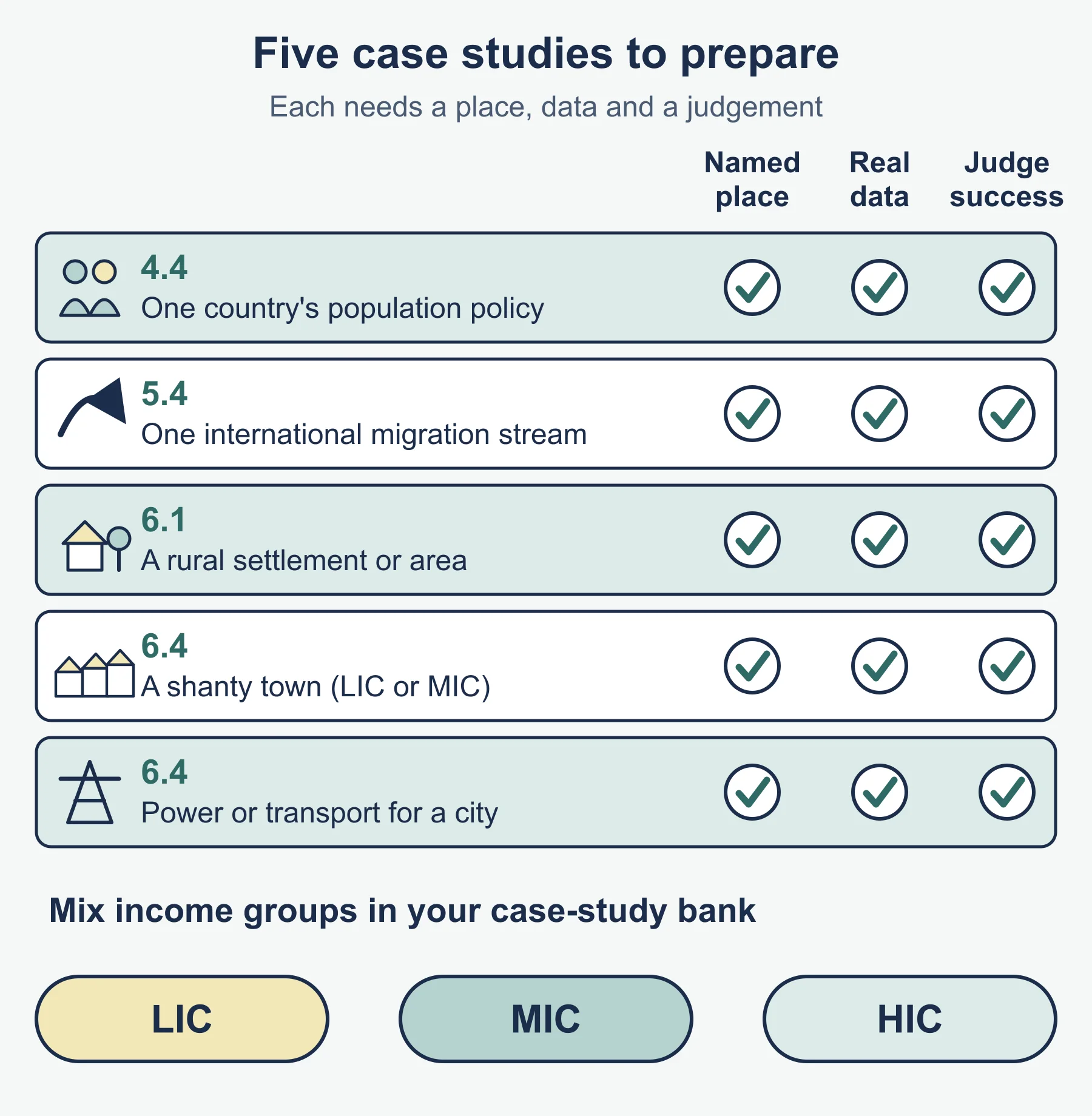
The syllabus requires a case study of one country’s population policy: attempts to alter the natural increase rate and to manage its results. Prepare a country you can describe with checked facts: the policy aims, methods, dates, outcomes, and unintended consequences.
Exam traps
- A fall in births may have many causes; do not credit the policy alone.
- Discuss management of results, not only the policy itself.
- Policies in HICs (pro-natalist) and LICs (anti-natalist) differ; know the context.
- China’s policy was never a uniform one-child rule: know the main exceptions.
- Do not confuse a policy that raises fertility with one that manages ageing: pension reform and immigration manage results, they do not raise the birth rate.
Self-test
- Difference between pro- and anti-natalist?
- Give one coercive and one non-coercive anti-natalist measure.
- Name a long-term result of reducing births.
- Give two pro-natalist measures.
- Why is evaluating a policy difficult?
- What must the 4.4 case study cover?
- What is population momentum?
- Why did China’s sex ratio at birth rise?
- What is the “4-2-1” family?
- Name two ways China has tried to manage the results of its policy.
- What does the Kerala example suggest about reducing fertility?
Answers: 1. Pro-natalist raises birth rates; anti-natalist lowers them. 2. Coercive: penalties or limits. Non-coercive: family planning or girls’ education. 3. Ageing population and higher dependency ratio. 4. Child benefit, tax relief, parental leave, childcare. 5. Other factors also change fertility. 6. One country’s policy to alter natural increase and manage the results. 7. Continued growth after fertility falls, because of a large young population. 8. A preference for sons combined with sex-selective abortion under the birth limits. 9. One adult child supporting two parents and four grandparents. 10. Relaxing limits to two and then three children, and raising the retirement age or offering childcare support. 11. Education, health care and women’s status can lower fertility without coercion.
More resources on this topic
Related resources
-
Revision notes
Cambridge International AS & A Level Geography (9696): 4.1 Natural increase as a component of population change – Revision Notes
Cambridge 9696 Geography 4.1 Natural increase as a component of population change: key terms, processes, exam traps and a self-test with answers.
Geography · Cambridge · AS Level
Revise topic -
Revision notes
Cambridge International AS & A Level Geography (9696): 4.3 Population-resource relationships – Revision Notes
Revision notes for Cambridge 9696 Geography 4.3 Population-resource relationships: key terms, processes, exam traps and a self-test with answers.
Geography · Cambridge · AS Level
Revise topic -
Study guides
Cambridge International AS & A Level Geography (9696): 4.2 Demographic transition
Study guide to Cambridge 9696 Geography 4.2: birth and death rate change, a critical view of the DTM, youthful and ageing populations, and development links.
Geography · Cambridge · AS Level
Read guide
Studying Geography?
This page is free and stays free. Marlbridge is not offering Geography classes at the moment, so there is no tuition to book for it. The free study resources stay open to everyone.
Get free revision emails (optional)
Occasional emails with practice questions, worked explanations and links to free resources for the qualification and subjects you choose. No spam, and you can unsubscribe from any email. The free tools on this site never need an email.