
Revision Notes
Cambridge International AS & A Level Geography (9696): 6.4 The management of urban settlements – Revision Notes
Revision notes for Cambridge 9696 Geography 6.4 The management of urban settlements: key terms, processes, exam traps and a self-test with answers.
- Subject
- Geography
- Level
- AS LEVEL
- Topic
- Topic 6 – Settlement dynamics
- Author
- Marlbridge Academic Team
- Updated
- Reviewed by
- Azam Siddique (what this means)
Aligned to Cambridge A Level Geography (9696), 2025-2026. Official specification .
Syllabus page (what it covers and how it is assessed): Cambridge A Level Geography.
Syllabus points this page covers
9696 (AS Level)
- 6.4 The management of urban settlements
Condensed recall for 6.4 The management of urban settlements, including the required case studies. For full explanations, read the Core Human Geography study guide.
Key terms
| Term | Meaning |
|---|---|
| Shanty town (squatter / informal settlement) | Housing built without legal tenure, often lacking services |
| Self-help scheme | Residents build or improve housing with support |
| Site and service | Plots with basic services provided for residents to build on |
| Upgrading | Improving existing informal housing in place |
| Infrastructure | Basic systems such as power, transport, water and sanitation |
| Sustainable city | Meets present needs without harming future generations |
| Security of tenure | Legal right to stay on a plot without fear of eviction |
| Bus rapid transit (BRT) | Buses on dedicated lanes with station boarding, run like a metro |
| Integrated transport | Different modes linked by shared tickets and timed connections |
Required case studies
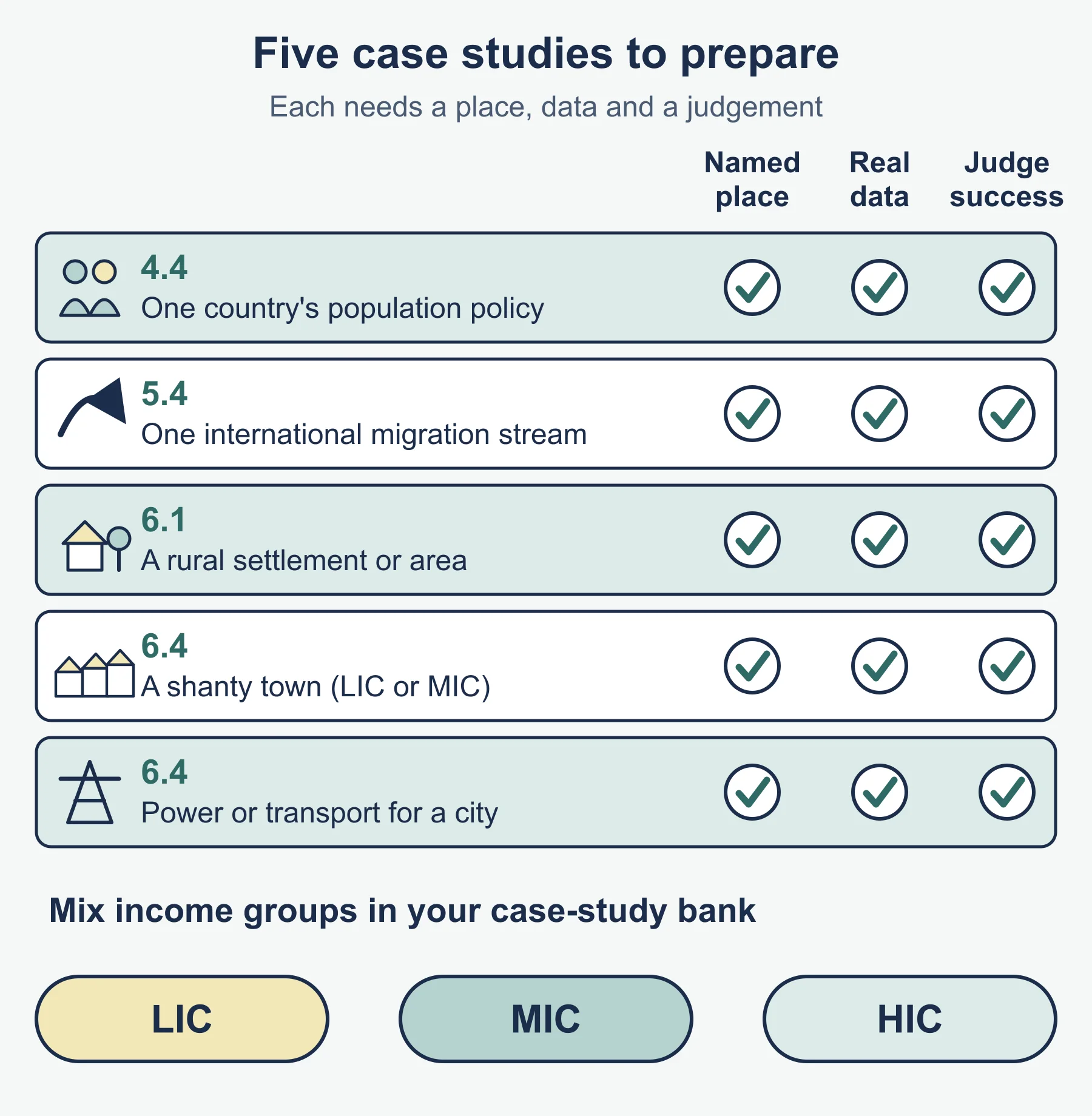
The syllabus requires both:
- A shanty town in an LIC or MIC: growth and causes, living conditions and problems, and attempts to improve them (upgrading, self-help, site and service, or clearance) with evaluation.
- Provision of infrastructure (power or transport) for a city: need, scheme, costs and benefits, who gained and lost, and sustainability.
Why shanty towns grow
Rapid rural-urban migration and natural increase outpace the supply of affordable formal housing. Land at the edge of the city, on steep slopes, floodplains, beside railways or on unused public land, is occupied because nobody else uses it. Without legal tenure, residents risk eviction and have little reason to invest. Problems typically include overcrowding, a lack of piped water and sanitation, fire and flood risk, poor health, and insecure informal work. But shanty towns are also places of enterprise, community networks and gradual improvement.
Strategies for informal settlements
| Strategy | Advantage | Weakness |
|---|---|---|
| Clearance and relocation | Removes unsafe housing | Destroys communities and livelihoods |
| Upgrading in place | Keeps community; cheaper | Slow; tenure and funding needed |
| Self-help | Low cost, empowers residents | Needs materials and security of tenure |
| Site and service | Planned layout | Sites may be far from jobs |
Granting tenure is often the key first step: once residents know they can stay, they invest their own money in brick walls, roofs and extra storeys.
Worked case study outline: Dharavi, Mumbai (India, MIC)
- Growth and causes: Dharavi grew on marshy land in central Mumbai from the late nineteenth century, as migrants from across India came for work. It is often described as one of Asia’s largest informal settlements, on a site of roughly two square kilometres; population estimates vary widely, commonly from several hundred thousand to around a million.
- Conditions: very high densities; many households share toilets and water points; narrow lanes, fire risk and flooding in the monsoon.
- Strengths: a dense informal economy of recycling, pottery, leather, garments and food processing, with workshops in homes; strong community ties; a central location near jobs and railway stations.
- Attempts to improve: the long-running Dharavi Redevelopment Project proposes rehousing eligible residents in high-rise blocks in return for allowing developers to build commercial and market housing on freed land. It has been delayed many times since it was first proposed in the 2000s; in 2022 a new tender was won by the Adani Group.
- Evaluation: supporters say residents would gain sanitation, safety and legal homes. Critics argue that high-rise blocks do not suit home-based workshops, that residents who arrived after the eligibility cut-off date may receive nothing, and that the scheme mainly unlocks valuable land for developers. Upgrading in place, such as improving water and toilets, is cheaper but does less to solve overcrowding.
Contrast: the Favela-Bairro programme in Rio de Janeiro (from the 1990s) upgraded favelas in place with paved paths, drainage, water, lighting and community buildings, keeping residents in their homes. It is often cited as a successful model of upgrading, although later problems with security and maintenance showed that physical improvements alone are not enough.
Infrastructure and transport
Aims: reduce congestion and pollution, improve access to jobs. Tools: public transport such as buses, metro or tram; road management and charging; walking and cycling; park-and-ride. Power: generation and distribution to meet demand with lower emissions. Consider cost, funding, displacement and environmental effects.
Worked case study outline: TransMilenio, Bogotá (Colombia, MIC)
- Need: severe congestion, slow informal buses competing for passengers, air pollution and long journeys for poorer residents on the edge of the city.
- Scheme: a bus rapid transit system opened in 2000, with buses on dedicated central lanes, enclosed stations with level boarding and fares paid before boarding, and feeder buses from outer districts. It was promoted alongside cycle routes and car restrictions.
- Benefits: much cheaper and faster to build than a metro; faster journeys on trunk routes; improved access to jobs for low-income districts; less pollution than the old bus fleet.
- Problems: severe overcrowding at peak times as demand outgrew capacity; fare rises that hit poorer users; some routes still poorly served. Bogotá has since begun building a metro line to add capacity.
- Evaluation: TransMilenio has been copied by many cities, showing BRT can work where metro funding is limited, but its success depended on continued investment, which did not always keep pace with demand.
Evaluation points
Who benefits, cost against benefit, short against long term, and sustainability. Mixed approaches usually work better than one measure.
Annotated model paragraph
“Assess the success of attempts to improve one shanty town.”
Redevelopment in Dharavi promises sanitation and legal homes (potential gain). However, high-rise housing may not suit home-based workshops (cost to livelihoods), and later arrivals may not qualify (who loses). Repeated delays mean conditions have changed slowly (evidence). So success so far has been limited (judgement).
Exam traps
- Cover both required case studies; they are separate.
- Use real, checked facts for the chosen places.
- Evaluate success: improvement for some groups can disadvantage others.
- Population figures for informal settlements vary widely between sources; give a range or describe the scale.
- Infrastructure means power or transport here: a housing scheme does not answer an infrastructure question.
Self-test
- Define a shanty town.
- What is site and service?
- Give one weakness of clearance.
- Name two ways of easing urban congestion.
- What does sustainable mean for a city?
- What two case studies does 6.4 require?
- Why is security of tenure important for improving housing?
- Give two features of a bus rapid transit system.
- Give one strength of Dharavi that redevelopment could threaten.
- Why was TransMilenio chosen over a metro?
- What did the Favela-Bairro programme do?
Answers: 1. Housing built without legal tenure, often lacking basic services. 2. Providing plots with basic services for residents to build on. 3. It destroys communities and livelihoods. 4. Public transport investment and congestion charging. 5. Meeting current needs without harming future generations. 6. A shanty town in an LIC or MIC, and infrastructure (power or transport) for a city. 7. Residents invest in their homes only when they know they will not be evicted. 8. Dedicated lanes, enclosed stations with pre-paid fares, feeder buses. 9. Home-based workshops and the informal economy, or its central location near jobs. 10. It was much cheaper and quicker to build. 11. Upgraded favelas in place with paths, drainage, water, lighting and community buildings.
More resources on this topic
Related resources
-
Revision notes
Cambridge International AS & A Level Geography (9696): 6.2 Urban trends and issues of urbanisation – Revision Notes
Revision notes for Cambridge 9696 Geography 6.2 Urban trends and issues of urbanisation: key terms, processes, exam traps and a self-test with answers.
Geography · Cambridge · AS Level
Revise topic -
Study guides
Cambridge International AS & A Level Geography (9696): 6.1 Changes in rural settlements
Study guide for Cambridge 9696 Geography 6.1: rural depopulation, service provision, urban growth at the fringe and evaluating responses to rural change.
Geography · Cambridge · AS Level
Read guide -
Practice questions
Cambridge International AS & A Level Geography (9696): 6.1 Changes in rural settlements – Practice Questions
Original practice questions with marked answers on Cambridge 9696 Geography 6.1: rural depopulation, thresholds, second homes and the rural case study.
Geography · Cambridge · AS Level
Try questions
Studying Geography?
This page is free and stays free. Marlbridge is not offering Geography classes at the moment, so there is no tuition to book for it. The free study resources stay open to everyone.
Get free revision emails (optional)
Occasional emails with practice questions, worked explanations and links to free resources for the qualification and subjects you choose. No spam, and you can unsubscribe from any email. The free tools on this site never need an email.