
Revision Notes
Cambridge International AS & A Level Geography (9696): 3.3 Slope processes – Revision Notes
Revision notes for Cambridge 9696 Geography 3.3 Slope processes: key terms, processes, worked examples, exam traps and a self-test with answers.
- Subject
- Geography
- Level
- AS LEVEL
- Topic
- Topic 3 – Rocks and weathering
- Author
- Marlbridge Academic Team
- Updated
- Reviewed by
- Azam Siddique (what this means)
Aligned to Cambridge A Level Geography (9696), 2025-2026. Official specification .
Syllabus page (what it covers and how it is assessed): Cambridge A Level Geography.
Syllabus points this page covers
9696 (AS Level)
- 3.3 Slope processes
Condensed recall for 3.3 Slope processes (mass movement and water and sediment movement on slopes). For full explanations, read the Core Physical Geography study guide.
Key terms
| Term | Meaning |
|---|---|
| Mass movement | Downslope movement of material under gravity |
| Shear stress | Force pulling material downslope |
| Shear strength | Resistance of material to movement |
| Pore water pressure | Pressure of water in spaces between particles, reducing friction |
| Rainsplash | Raindrop impact that moves soil particles |
| Surface runoff | Water flowing over the surface: sheetwash and rills |
| Cohesion | The force binding particles together, such as clay bonds or roots |
| Friction | Resistance between particles or along a surface, which rises with the weight pressing down |
| Factor of safety | Shear strength divided by shear stress; failure is likely when it falls below 1 |
| Angle of rest (repose) | Steepest angle at which loose material stays stable |
| Regolith | Loose weathered material overlying bedrock |
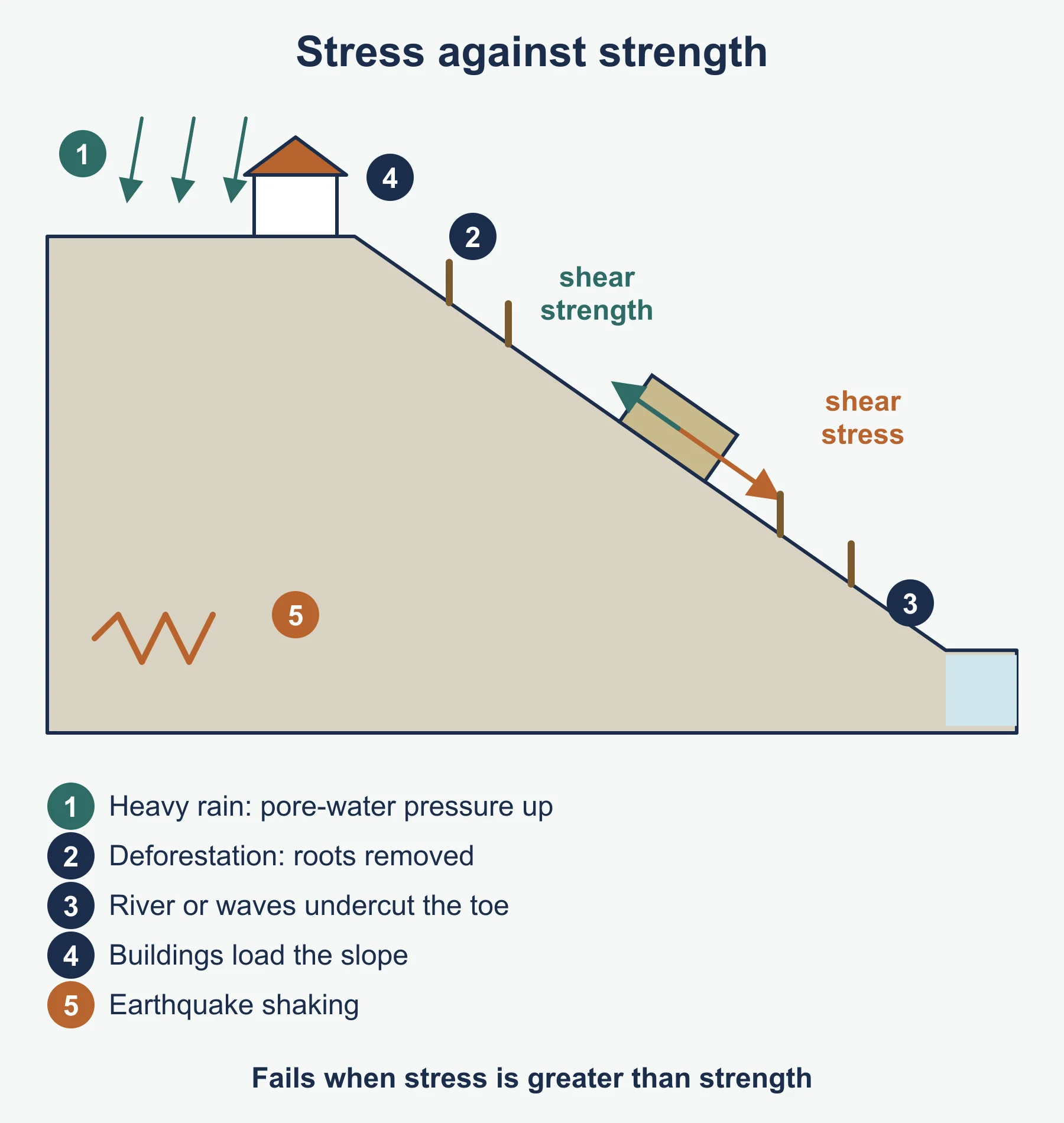
Failure occurs when shear stress exceeds shear strength.
Stress and strength explained
Gravity acting on slope material can be split into two parts: one pulling along the slope (shear stress) and one pressing into it (normal force, which helps friction). On a steeper slope, more of the weight acts downslope, so stress rises. Strength comes from friction between particles and from cohesion. Water acts on both sides:
- it adds weight, raising stress;
- it raises pore water pressure, which pushes particles apart and reduces the normal force, so friction falls;
- it can weaken cohesion, for example by softening clay.
Factor of safety: a value above 1 means the slope is stable; around 1 means failure is close; below 1 means failure. Any change that lowers strength or raises stress moves the factor towards 1.
Classification of mass movement
| Group | Examples | Features |
|---|---|---|
| Heave | Soil creep, solifluction | Very slow movement; freeze-thaw and wetting-drying lift and settle particles |
| Flows | Earthflow, mudflow, debris flow | Saturated material moving as a viscous fluid; fast |
| Slides | Landslide, rotational slip (slump) | Material moves along a plane or curved surface |
| Falls | Rockfall | Free fall from a steep rock face, often after weathering |
Moisture content and speed increase from creep to flows.
Each group in more detail
- Heave (soil creep): wetting or freezing lifts particles at right angles to the slope; drying or thawing lets them fall back vertically under gravity, so each cycle moves them a tiny distance downslope. Evidence: terracettes, leaning fences, walls and trees, and soil piled up behind walls. Solifluction is a periglacial process where a thawed active layer flows over permanently frozen ground, forming lobes.
- Flows: material behaves like a liquid when it holds a lot of water. Mudflows carry fine sediment; debris flows carry boulders and can travel fast along valleys. Volcanic mudflows are called lahars.
- Slides: a coherent mass moves on a slip surface. Translational slides move along a flat plane, such as a bedding plane dipping downslope. Rotational slips (slumps) move on a curved surface, typically in clay or where weak rock overlies stronger rock, leaving a back-tilted block and a curved scar.
- Falls: blocks detach from steep faces along joints, often after freeze-thaw or undercutting, and collect at the base as scree (talus) slopes at the angle of rest.
Factors that raise stress or reduce strength
- Heavy rain or snowmelt adding weight and raising pore water pressure;
- steep slope angle;
- removal of vegetation and root support;
- undercutting by rivers or the sea;
- weak or jointed rock, or clay;
- earthquakes and other vibration;
- weathering that loosens material.
| Raises shear stress | Lowers shear strength |
|---|---|
| Steepening by undercutting or cutting | Rising pore water pressure |
| Extra weight from water, buildings or debris | Weathering of rock into weak regolith |
| Vibration from earthquakes | Loss of root cohesion |
| Removal of support at the base | Weak layers such as clay or bedding planes dipping downslope |
Water and sediment movement
Rainsplash detaches particles. Surface runoff begins as thin sheetwash, then concentrates into rills. Runoff increases where infiltration is low: bare soil, compaction, intense rain. Vegetation reduces it.
- Rainsplash: each raindrop throws particles outwards; on a slope, more travel downhill than uphill, so there is a net downslope movement. It also seals the surface by filling pores with fine particles, which lowers infiltration and promotes runoff.
- Sheetwash: a thin, unchannelled layer of water that moves fine soil evenly across the surface.
- Rills: small channels, a few centimetres deep, where flow concentrates and erodes faster. If they deepen and join, they can grow into gullies.
Annotated model paragraph
“Explain how heavy rainfall can trigger a landslide.”
Infiltrating water adds weight to the slope material, raising shear stress (stress). It also raises pore water pressure, which reduces friction between particles (strength). In clay it can weaken cohesion (strength). When stress exceeds strength, the factor of safety falls below 1 and the slope fails along a slip surface (outcome).
Exam traps
- State the cause of failure as an imbalance: stress greater than strength.
- Do not say water “only adds weight”: it also lowers friction and cohesion.
- Slow versus rapid is about speed; flows versus slides is about how material moves.
- Soil creep moves particles by lifting and falling, not by steady sliding.
- A slump has a curved slip surface; a translational slide has a flat one.
- Name evidence in the landscape, such as terracettes or a slump scar, when describing a process.
Self-test
- Define mass movement.
- When does slope failure occur?
- Name a slow mass movement.
- How does water trigger a landslide?
- What is a rill?
- Why does vegetation loss increase mass movement?
- What does a factor of safety below 1 mean?
- Explain how soil creep moves particles.
- Difference between a rotational slip and a translational slide?
- Give two pieces of field evidence for soil creep.
- How does rainsplash increase surface runoff?
- What is scree, and how does it form?
Answers: 1. Downslope movement of material under gravity. 2. When shear stress exceeds shear strength. 3. Soil creep, or solifluction. 4. Adds weight and increases pore water pressure, reducing friction. 5. A small channel formed where surface runoff concentrates. 6. Less root binding and interception, and more runoff. 7. Shear stress is greater than shear strength, so failure is likely. 8. Particles are lifted at right angles to the slope by wetting or freezing, then fall back vertically, moving slightly downslope each time. 9. Rotational: curved slip surface; translational: flat plane. 10. Terracettes, leaning walls, fences or trees, soil build-up behind walls. 11. It seals the surface with fine particles, lowering infiltration. 12. Angular rock debris at the foot of a face, formed by rockfall, often after freeze-thaw.
More resources on this topic
Related resources
-
Revision notes
Cambridge International AS & A Level Geography (9696): 3.4 The human impact – Revision Notes
Revision notes for Cambridge 9696 Geography 3.4 The human impact: key terms, processes, worked examples, exam traps and a self-test with answers.
Geography · Cambridge · AS Level
Revise topic -
Revision notes
Cambridge International AS & A Level Geography (9696): 3.2 Weathering – Revision Notes
Revision notes for Cambridge 9696 Geography 3.2 Weathering: key terms, processes, worked examples, exam traps and a self-test with answers.
Geography · Cambridge · AS Level
Revise topic -
Study guides
Cambridge International AS & A Level Geography (9696): 3.1 Plate tectonics
Study guide to Cambridge 9696 Geography 3.1 Plate tectonics: plates and their patterns, boundaries, sea floor spreading, subduction, ridges, trenches and arcs.
Geography · Cambridge · AS Level
Read guide
Studying Geography?
This page is free and stays free. Marlbridge is not offering Geography classes at the moment, so there is no tuition to book for it. The free study resources stay open to everyone.
Get free revision emails (optional)
Occasional emails with practice questions, worked explanations and links to free resources for the qualification and subjects you choose. No spam, and you can unsubscribe from any email. The free tools on this site never need an email.