
Study Guides
AQA A-level Biology: Transport Across Cell Membranes and Required Practicals 3 and 4 (7402)
Study guide to AQA A-level Biology 3.2.3: fluid-mosaic model, diffusion, water potential, active transport, co-transport in the ileum and practicals 3 and 4.
- Subject
- Biology
- Level
- A LEVEL (AS CONTENT)
- Topic
- Transport Across Cell Membranes and Required Practicals 3 and 4
- Author
- Marlbridge Academic Team
- Updated
- Reviewed by
- Hina Mogul (what this means)
Aligned to AQA A Level Biology (7402), For first teaching 2015. Official specification .
Syllabus page (what it covers and how it is assessed): AQA A Level Biology.
Syllabus points this page covers
7402 (AS content of the A Level)
- 3.2.3 Transport across cell membranes
Found an error? Report a correction.
Need help with this topic? Request a free trial class for A Level Biology (7402).
Section 3.2.3 of the AQA A-level Biology (7402) specification, Transport across cell membranes, asks you to describe the fluid-mosaic model of membrane structure and to explain five ways substances cross membranes: simple diffusion, facilitated diffusion, osmosis, active transport and co-transport. You must also explain how surface area, the number of carrier and channel proteins, and gradients of concentration or water potential change the rate of transport, and you must know required practicals 3 and 4.
This guide is aligned to the AQA AS and A-level Biology specification (A-level 7402), for first teaching 2015 with exams from June 2016, Version 1.5. Section 3.2.3 is AS content. Use it with the membrane transport revision notes and the membrane transport practice questions. Phospholipid structure is in the lipids and protein structure study guide, and absorption in the ileum returns in the exchange with the environment study guide. Course hub: AQA A-level Biology.
What the specification asks for
| Specification content (3.2.3) | What you must be able to do |
|---|---|
| All cell membranes share the same basic structure | Apply the model to cell-surface membranes and organelle membranes |
| Fluid-mosaic model: phospholipids, proteins, glycoproteins, glycolipids; cholesterol | Describe the arrangement and movement of each component and the role of cholesterol |
| Simple diffusion; facilitated diffusion (carrier and channel proteins) | Explain the limits set by the phospholipid bilayer and the roles of the proteins |
| Osmosis in terms of water potential | Predict and explain water movement using water potential values |
| Active transport (carrier proteins, hydrolysis of ATP) | Explain why energy is needed and where it comes from |
| Co-transport (sodium ions and glucose in the ileum) | Describe the sequence of events in an ileum epithelial cell |
| Adaptations for rapid transport | Explain how surface area and the number of proteins raise the rate |
| Required practical 3 (MS 3.2, 3.4) | Make a dilution series and use a calibration curve to find the water potential of plant tissue |
| Required practical 4 | Investigate the effect of a named variable on the permeability of cell-surface membranes |
What is the fluid-mosaic model?
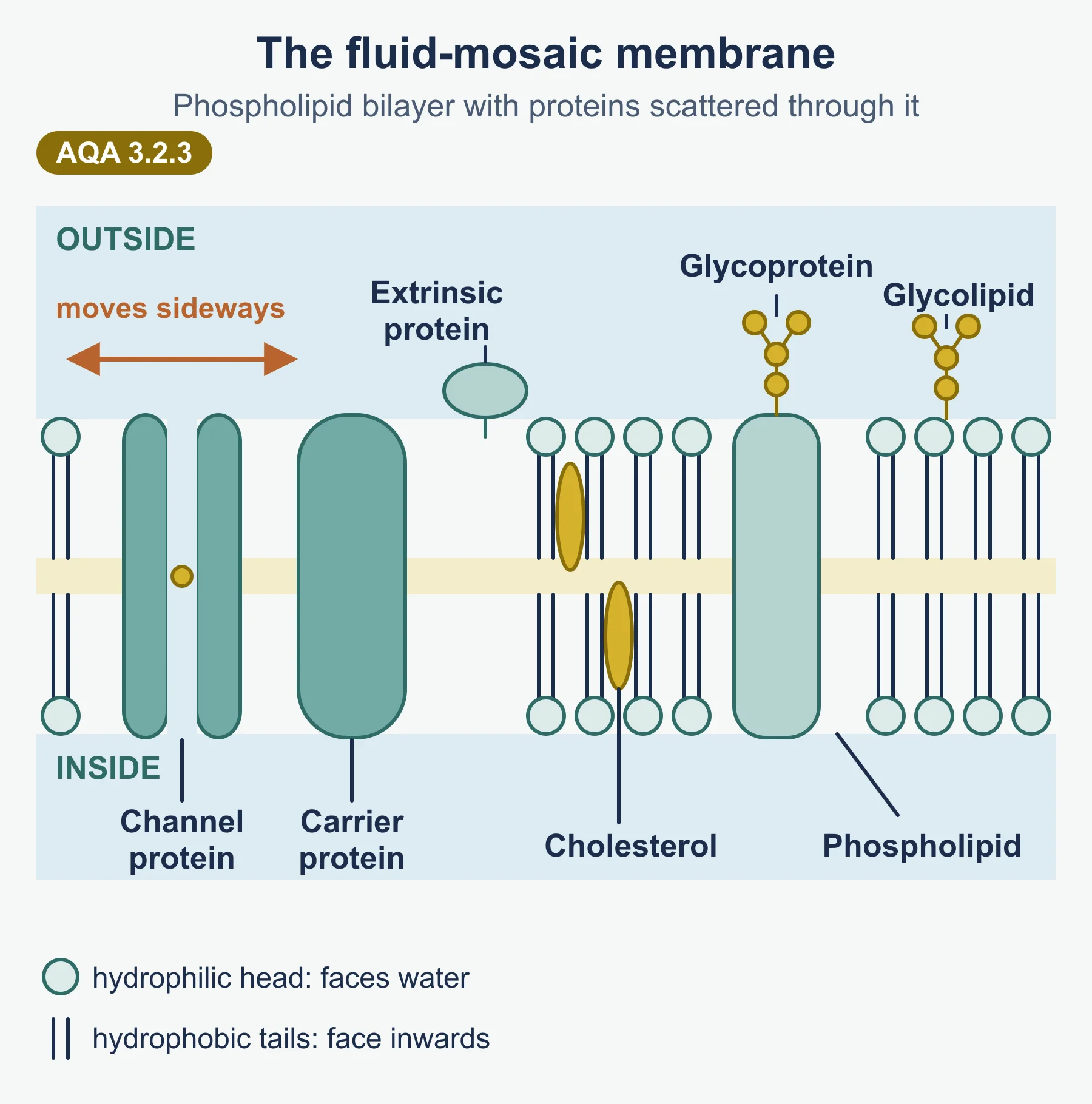
The membrane is a phospholipid bilayer: hydrophilic phosphate heads face the watery cytoplasm and tissue fluid on each side, and the hydrophobic fatty acid tails face inwards. It is fluid because individual phospholipids and many proteins can move sideways within the layer, and a mosaic because proteins are scattered through it.
| Component | Arrangement | Role |
|---|---|---|
| Phospholipids | Bilayer, tails inwards | Barrier to water-soluble (polar) substances and ions; allow lipid-soluble substances through |
| Intrinsic proteins (channel and carrier proteins) | Span the bilayer | Transport polar molecules and ions across |
| Extrinsic proteins | On the surface | For example receptors or enzymes |
| Glycoproteins | Protein with a carbohydrate chain on the outer surface | Cell recognition (antigens), receptors, cell attachment |
| Glycolipids | Lipid with a carbohydrate chain on the outer surface | Cell recognition and stability |
| Cholesterol | Between phospholipids | Restricts the movement of other molecules in the membrane, making it less fluid and more stable |
How do substances diffuse across membranes?
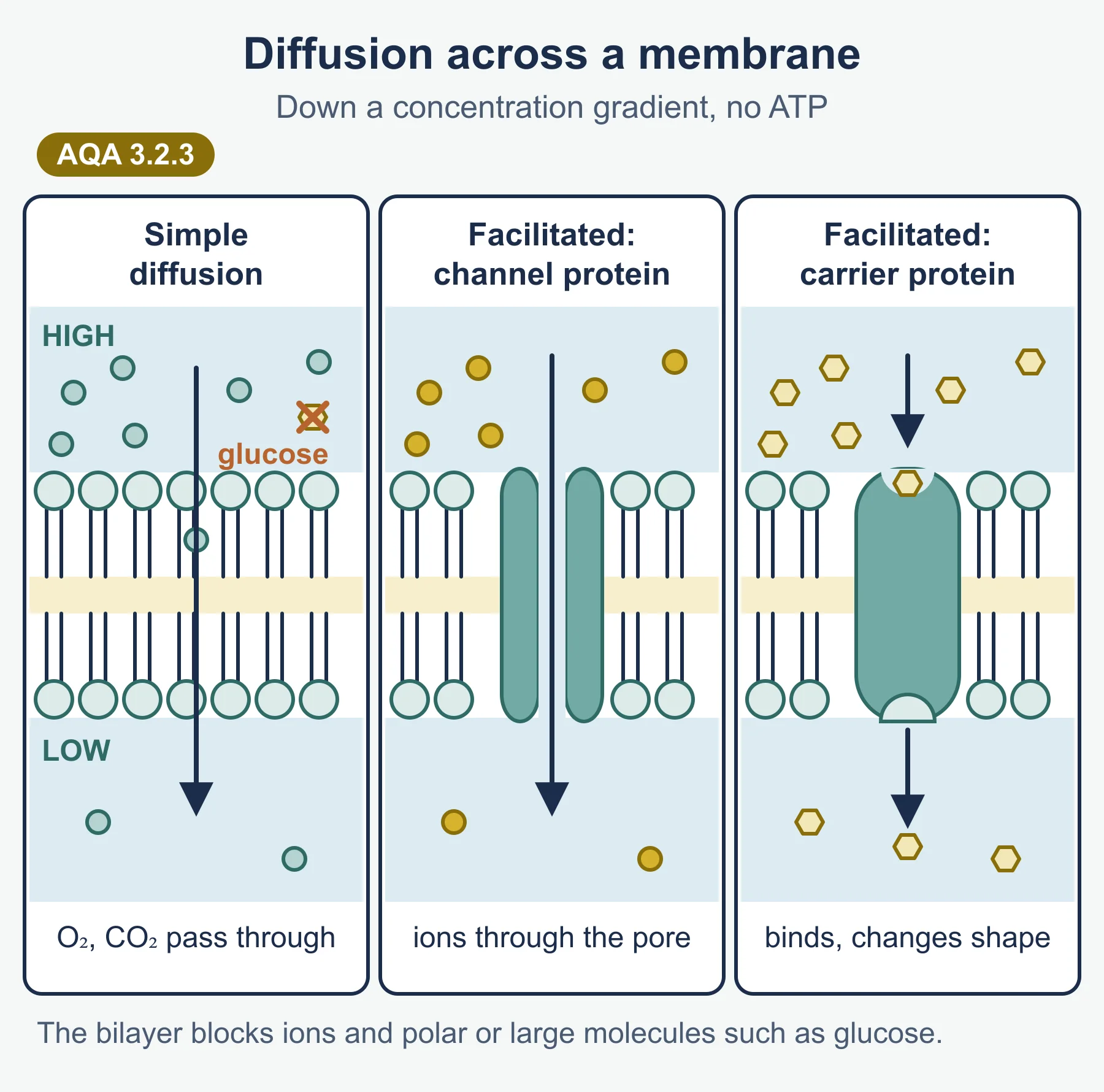
Simple diffusion is the net movement of molecules from a higher to a lower concentration, down a concentration gradient, without energy from ATP. Small, non-polar molecules such as oxygen and carbon dioxide pass straight through the bilayer. The bilayer limits simple diffusion: ions and polar or large molecules, such as glucose, cannot pass through the hydrophobic core.
Facilitated diffusion is also passive and down a gradient, but uses proteins:
- Channel proteins form water-filled pores that let specific ions through.
- Carrier proteins bind a specific molecule (such as glucose), change shape and release it on the other side.
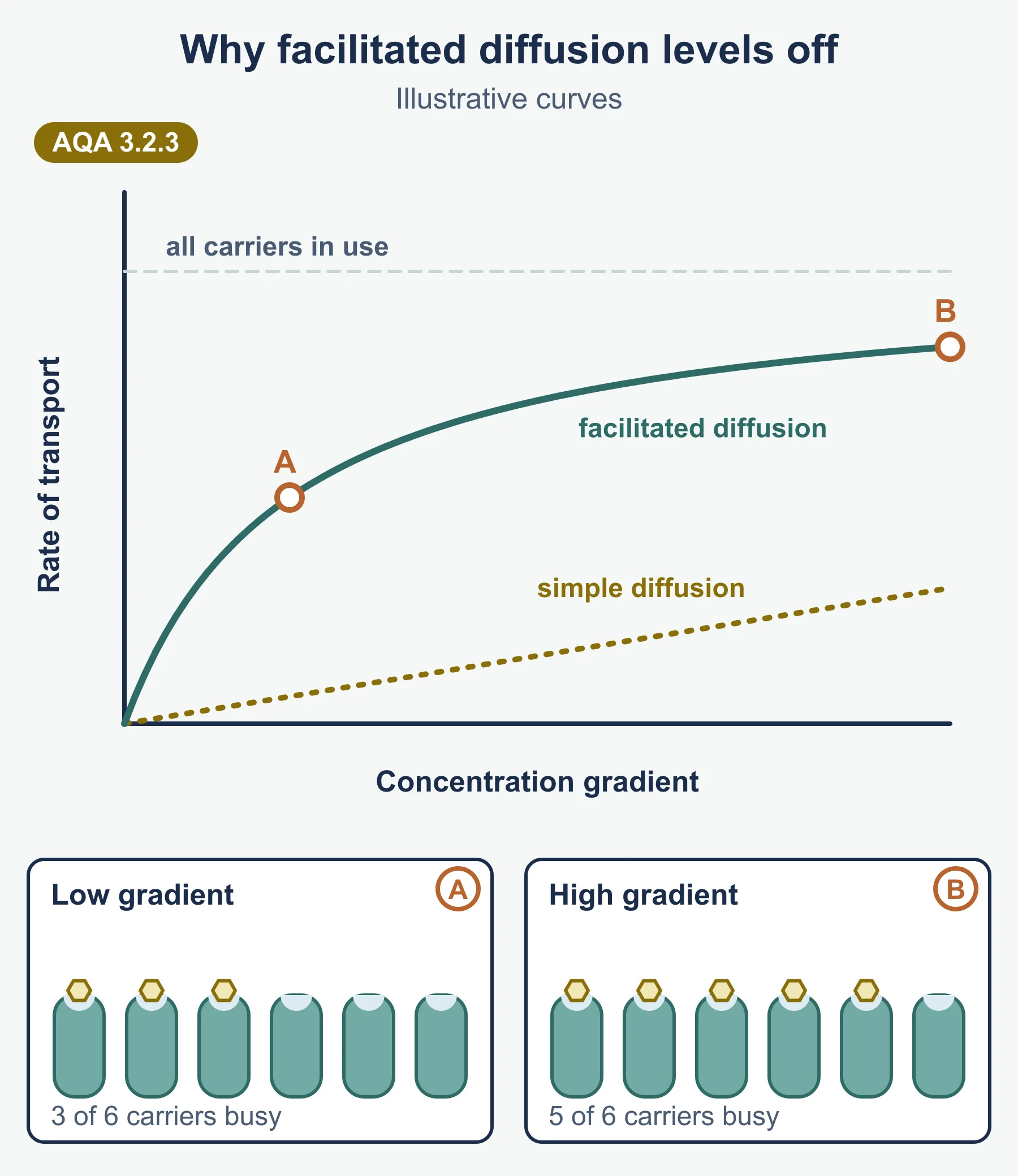
Because the number of proteins is limited, the rate of facilitated diffusion levels off at high concentration gradients, when all the proteins are in use.
How do you explain osmosis using water potential?
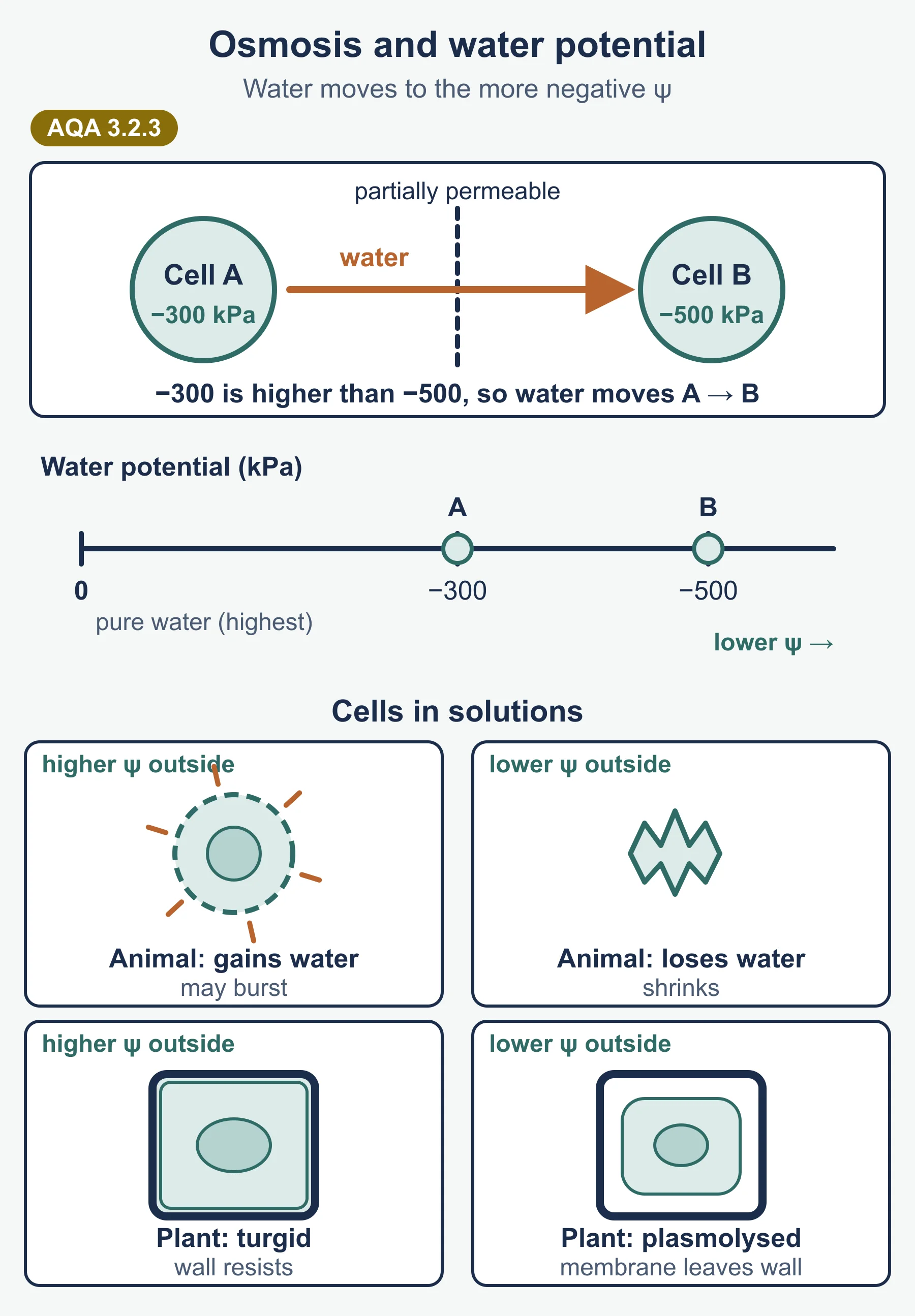
Osmosis is the net movement of water across a partially permeable membrane from a solution of higher (less negative) water potential to a solution of lower (more negative) water potential.
- Water potential is shown by the Greek letter psi and measured in kilopascals (kPa).
- Pure water has the highest possible water potential: 0 kPa.
- Adding solute lowers the water potential, so every solution has a negative value.
Worked example 1. Cell A has a water potential of -300 kPa and cell B, next to it, -500 kPa. -300 is higher than -500, so water moves by osmosis from A to B.
Animal cells placed in a solution of higher water potential gain water and may burst; in lower water potential they shrink. Plant cells gain water until the cell wall resists (they become turgid), and in a solution of lower water potential they lose water and the membrane pulls away from the wall (plasmolysis).
What is active transport?
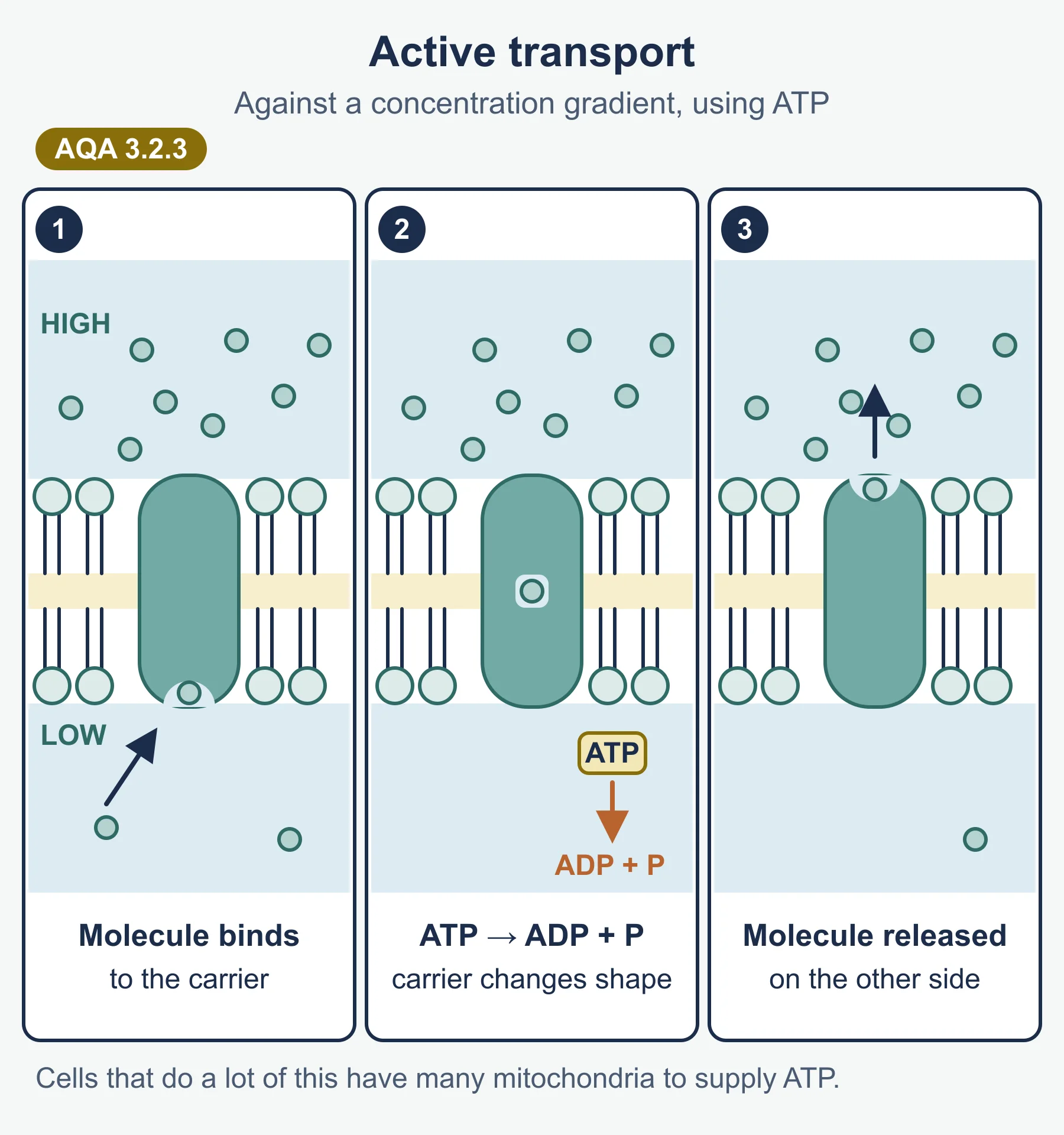
Active transport moves molecules or ions against a concentration gradient, from lower to higher concentration, using carrier proteins and energy from the hydrolysis of ATP. The molecule binds to the carrier; ATP is hydrolysed to ADP and phosphate, releasing energy that changes the shape of the carrier protein so the molecule is released on the other side. Cells that carry out a lot of active transport have many mitochondria to supply ATP by respiration.
How does co-transport absorb glucose in the ileum?
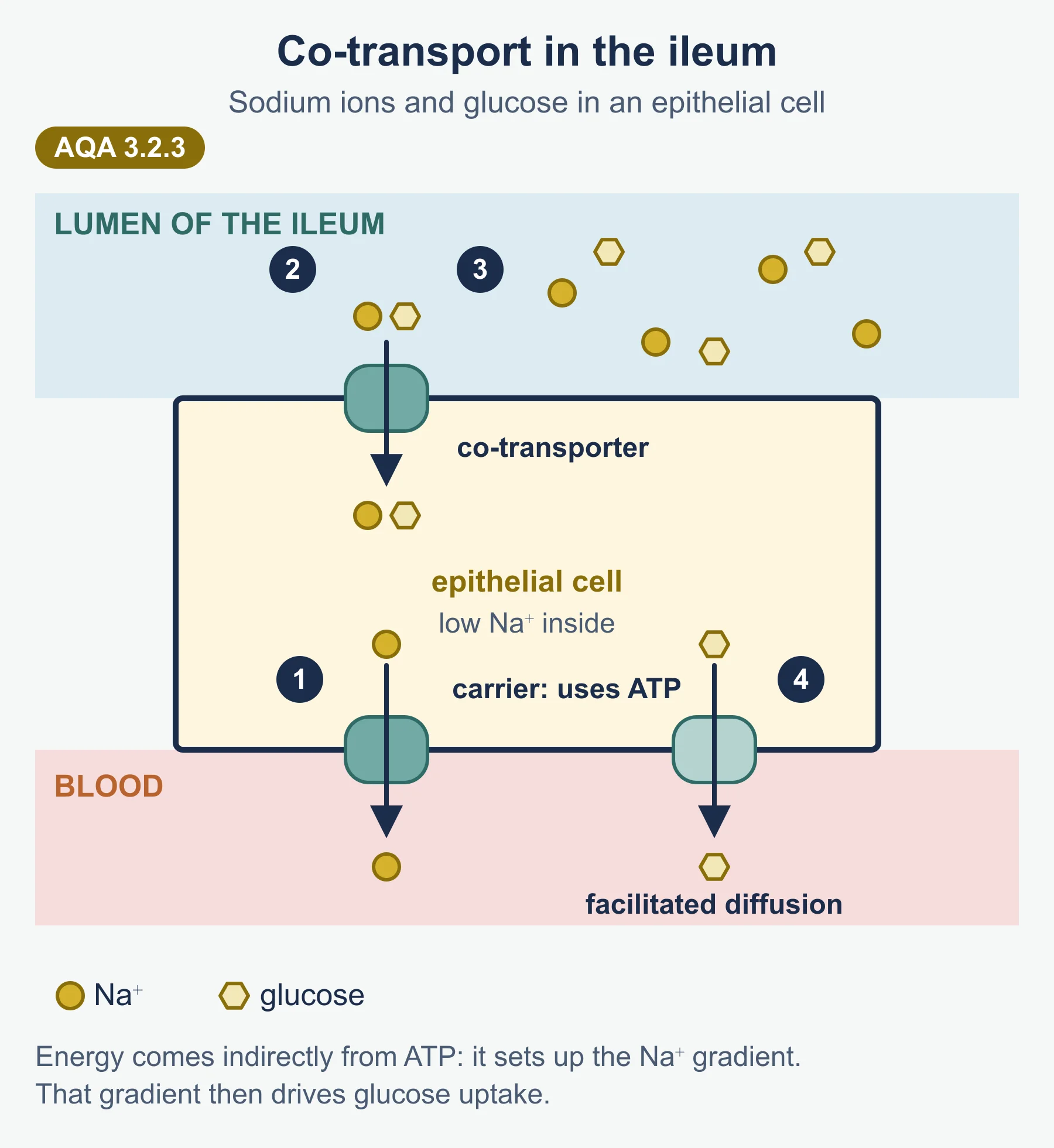
The specification illustrates co-transport with the absorption of sodium ions and glucose by the epithelial cells lining the mammalian ileum.
- Sodium ions are actively transported out of the epithelial cell into the blood, by a carrier protein using ATP. This keeps the sodium ion concentration inside the cell low.
- Sodium ions in the lumen of the ileum now diffuse into the epithelial cell down their concentration gradient, through a co-transporter protein.
- The co-transporter carries glucose in with the sodium ions, so glucose enters the cell against its own concentration gradient.
- Glucose then moves from the cell into the blood by facilitated diffusion.
The energy comes indirectly from ATP: it is used to set up the sodium ion gradient, and that gradient drives glucose uptake.
What affects the rate of transport across membranes?
| Factor | Effect on rate | Example of an adaptation |
|---|---|---|
| Surface area of membrane | Greater area, faster rate | Microvilli on ileum epithelial cells; folded inner mitochondrial membrane |
| Number of channel or carrier proteins | More proteins, faster facilitated diffusion and active transport | Many glucose carriers in ileum cells |
| Concentration or water potential gradient | Steeper gradient, faster diffusion or osmosis | Blood flow removing absorbed substances |
Remember that the gradient affects passive processes; active transport depends on ATP supply and carriers.
How do you carry out required practical 3?
The aim is to produce a dilution series of a solute and use a calibration curve to identify the water potential of plant tissue.
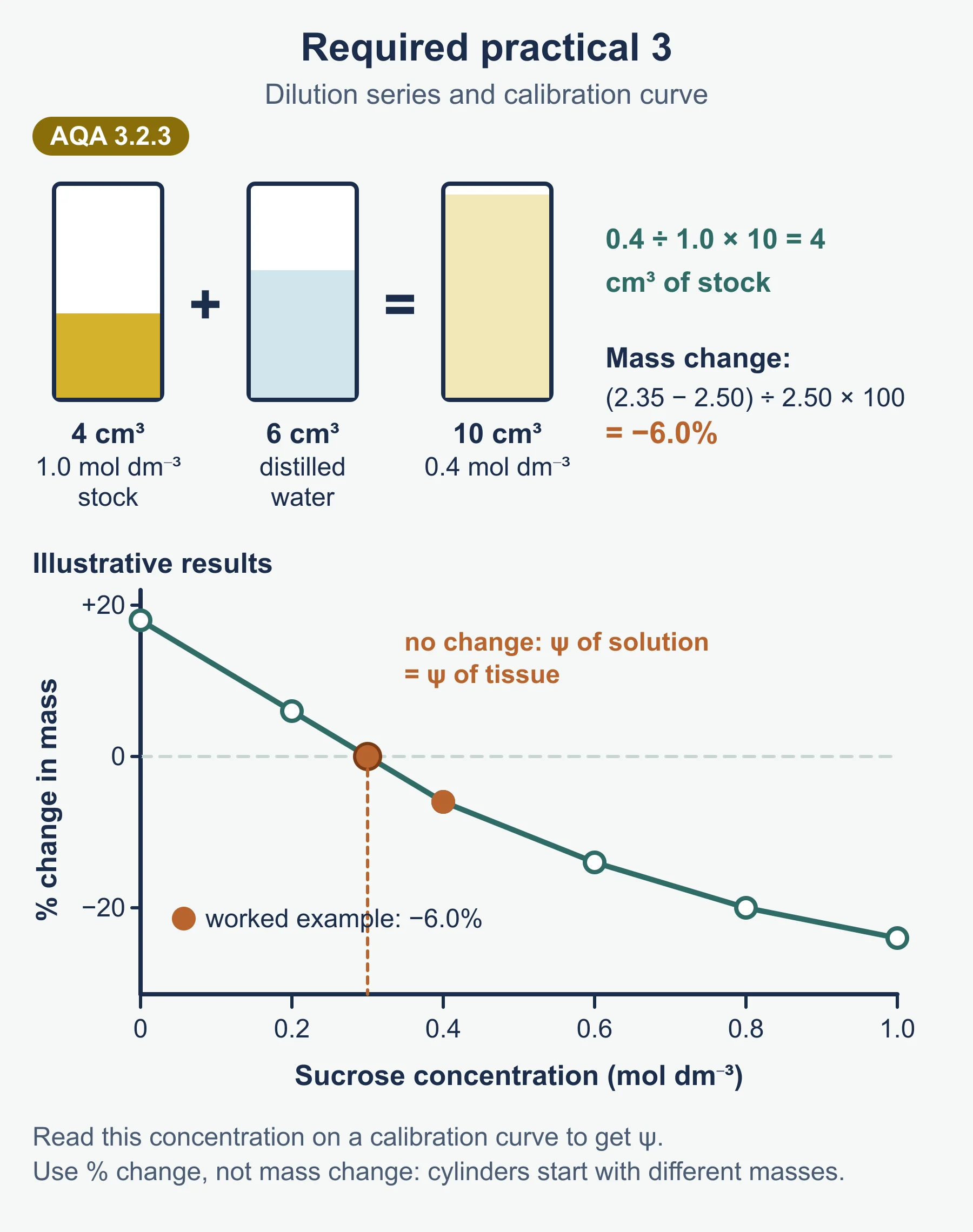
Making a dilution series. To make 10 cm cubed of 0.4 mol dm-3 sucrose from a 1.0 mol dm-3 stock, mix 4 cm cubed of stock with 6 cm cubed of distilled water (0.4 / 1.0 x 10 = 4).
Method. Cut equal cylinders of potato (or another plant tissue), blot and weigh each. Place one in each solution (for example 0, 0.2, 0.4, 0.6, 0.8 and 1.0 mol dm-3) at constant temperature for a set time. Blot and reweigh, then calculate the percentage change in mass.
Worked example 2. A cylinder’s mass changes from 2.50 g to 2.35 g. Percentage change = (2.35 - 2.50) / 2.50 x 100 = -6.0%.
Plot percentage change in mass (y-axis) against concentration (x-axis). Where the line crosses zero change, the solution has the same water potential as the tissue. A calibration curve (or table) relating concentration to water potential then converts that concentration into the tissue’s water potential (MS 3.4: using the intercept). Percentage change is used, not change in mass, because the cylinders start with different masses.
How do you carry out required practical 4?
The aim is to investigate the effect of a named variable on the permeability of cell-surface membranes. Beetroot cells contain a red pigment in their vacuoles; damaged membranes let it leak out.
- Cut equal-sized beetroot pieces and rinse them to remove pigment from cut cells.
- Place each in the same volume of water at a different temperature (or different concentration of ethanol) for a set time.
- Remove the pieces and measure the colour of the liquid with a colorimeter (absorbance), using a blue-green filter, calibrated with distilled water.
Higher absorbance means more pigment leaked, so the membranes are more permeable. As temperature rises, phospholipids move more and gaps appear; at high temperatures membrane proteins denature, so permeability rises sharply. Ethanol, a solvent, dissolves lipids in the membrane and also increases permeability.
Frequently asked questions
Why does pure water have a water potential of 0 kPa? It is defined that way. Water potential measures the tendency of water to move out of a solution, and pure water has the greatest tendency, so any solute lowers it below zero.
What is the difference between active transport and co-transport? Active transport uses ATP directly to move a substance against its gradient. In co-transport, ATP is used to make a sodium ion gradient; sodium ions diffusing back in carry glucose with them against glucose’s gradient.
Why does facilitated diffusion level off? At high concentration gradients all the carrier or channel proteins are occupied, so the number of proteins limits the rate.
What does cholesterol do in a membrane? It restricts the movement of the other molecules in the membrane, making it less fluid and more stable.
Common mistakes
- Writing that water moves from a “high to low concentration” in osmosis instead of using water potential.
- Saying -500 kPa is a higher water potential than -300 kPa.
- Saying glucose is actively transported directly into ileum cells; it enters by co-transport.
- Forgetting that facilitated diffusion is passive and needs no ATP.
- In practical 3, using change in mass instead of percentage change.
- In practical 4, not naming absorbance or a colorimeter as the measure of pigment.
Official syllabus
AQA AS and A-level Biology (7401/7402) specification, Version 1.5 (26 November 2021), section 3.2 Cells, 3.2.3 Transport across cell membranes, including required practicals 3 and 4 and the mathematical requirements MS 3.2 and MS 3.4.
Get free revision emails (optional)
Occasional emails with practice questions, worked explanations and links to free resources for the qualification and subjects you choose. No spam, and you can unsubscribe from any email. The free tools on this site never need an email.
Related resources
-
Exam preparation
AQA A-Level Biology: Paper-by-Paper Exam Preparation
How AQA A-Level Biology 7402 Papers 1, 2 and 3 work, with strategy for the Paper 2 comprehension, the Paper 3 essay and practical skills, plus a checklist.
Biology · AQA · A Level
Read guide -
Practice questions
AQA A-level Biology: Transport Across Cell Membranes and Required Practicals 3 and 4 (7402) – Practice Questions
Original questions with worked answers on AQA A-level Biology 3.2.3: fluid mosaic, diffusion, water potential, active transport, co-transport, practicals 3-4.
Biology · AQA · A Level (AS content)
Try questions -
Revision notes
AQA A-level Biology: Transport Across Cell Membranes and Required Practicals 3 and 4 (7402) – Revision Notes
Condensed AQA A-level Biology 7402 notes on 3.2.3: the fluid-mosaic model, diffusion, osmosis, active transport, co-transport and Required Practicals 3 and 4.
Biology · AQA · A Level (AS content)
Revise topic
Related articles
-
study skills
How to revise for a science examination
Most science revision fails because it rereads notes instead of retrieving them. A practical method for revising physics, chemistry and biology in the weeks before a paper.
14 July 2026
-
teaching
A Level tuition in Dubai: Cambridge or Pearson Edexcel International A Level?
Schools in Dubai and Abu Dhabi teach either Cambridge International AS & A Level or Pearson Edexcel International A Level. How the two are structured, why it matters for tuition, and how online classes from Lahore work.
9 October 2026
Studying this with a teacher
Working through Biology A LEVEL (AS CONTENT)?
This page is free and stays free. If you would rather be taught it, Marlbridge runs Biology classes one-to-one and in small groups of up to 15, online in your own time zone. The first trial class is free. WhatsApp replies within an hour (8am–11pm Pakistan time, every day); email the same day.
AQA Biology teachers at Marlbridge


